At the end of 2013, I published a post under the title of We must rewild. The core of that post was an essay from Patrice Aymes called Rewilding Us. Here’s a small extract from that essay:
In Africa, there are about 500,000 elephants. 25,000 to 30,000 are killed, a year, to send the ivory to east Asia (China, Vietnam). So African elephants may disappear. This is beyond tragic, it’s irreplaceable. Elephants understand people’s gestures, without any learning (they apparently learn to use trunk gestures among themselves). One is talking about extremely intelligent animals here. (In contrast, chimpanzees have great difficulties understanding human gestures.)
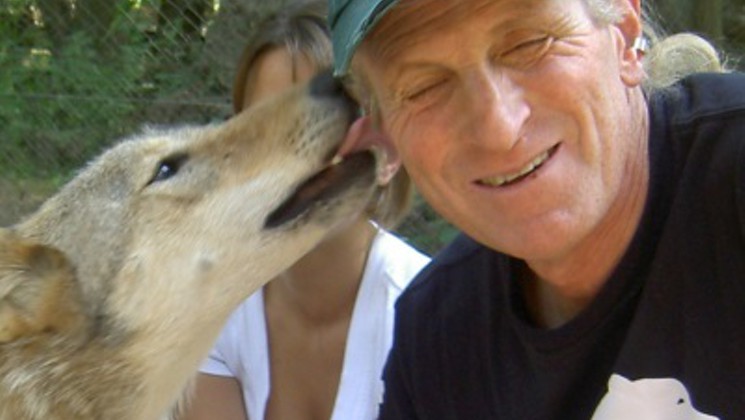
My post also included this photograph of young Cleo, just five months old, showing that her innate skills of being in the wild were alive and well, despite thousands of years of dogs being domesticated animals. Ergo, humans could manage just as well.
Photograph taken 25th April, 2012.
Last Friday, George Monbiot published an essay in The Guardian newspaper that stays with the theme of loving the wild. It is republished here with Mr. Monbiot’s very kind permission.
ooOOoo
Falling in Love Again
17th July 2015
Rebuilding our relationship with the natural world can re-animate our own lives, as well as the ecosystem.
When the robin was voted the UK’s national bird last month, we chose to celebrate half of a broken relationship. The robin is to the wild boar what the oxpecker is to the Cape buffalo: it has evolved to catch the worms and insects exposed by their grubbing. But boar are mostly absent from the UK, so its survival often depends on finding the next best thing: human gardeners. This is why the robin is so tame in this country. As far as the bird is concerned, you and I are just fake pigs.
We are surrounded by such broken relationships, truncated natural processes, cauterised ecologies. In Britain we lack almost all large keystone species: ecological engineers that drive the fascinating dynamics which allow other lifeforms to flourish. Boar, beavers, lynx, wolves, whales, large sharks, pelicans, sturgeon: all used to be abundant here, all, but for a few small populations or rare visitors, are missing.
The living systems that conservationists seek to protect in some parts of this country are a parody of the natural world, kept, through intensive management, in suspended animation, like a collection in a museum. An ecosystem is not just a place. It is also a process.
I believe their diminished state also restricts the scope of human life. We head for the hills to escape the order and control that sometimes seem to crush the breath out of us. When we get there, we discover that the same forces prevail. Even our national parks are little better than wet deserts.
Our seas were once among the richest on earth. A few centuries ago, you could have watched fin whales and sperm whales hammering the herring within sight of the shore. Shoals of bluefin tuna thundered up the North Sea. Reefs of oysters and other sessile animals covered the seabed, over which giant cod, skate and halibut cruised. But today, industrial fishing rips up the living fabric of all but 0.01% of our territorial waters. To walk or dive in rich environments we must go abroad.
Though not, I hope, for long. On Wednesday, a new organisation, Rewilding Britain, was launched. (It was inspired by my book Feral and I helped to found it, but I don’t have a position there). Its aim is to try to catalyse the mass restoration of the living world, bring trees back to bare hills, allow reefs to form once more on the seabed and to return to these shores the magnificent, entrancing animals of which we have so long been deprived. Above all it seeks to enhance and enrich the lives of the people of this nation. I hope that it might help to change the face of Britain.
Already, local projects hint at what could be achieved. In the southern uplands of Scotland, the Borders Forest Trust has bought 3000 hectares of bare mountainside and planted hundreds of thousands of native trees. The community of Arran seabed trust in the Firth of Clyde managed, after 13 years of campaigning, to persuade the government to exclude trawlers and scallop dredgers from one square mile of seabed. The result, in this tiny reserve, is an explosion of lobsters, crabs, scallops and fish. It’s now trying to extend the project to a larger area.
In Sussex, the Knepp Castle estate gave up its unprofitable wheat farming, released a few cattle and pigs and let natural processes take over. Now it hosts some of Britain’s highest populations of nightingales, purple emperor butterflies and turtle doves. Partly through ecotourism and accommodation and selling high-grade meat, it has become profitable. In south London, the Wandle Trust has turned a mangled and polluted urban river back into a beautiful chalkstream, supporting kingfishers and wild trout. Wonderful as these projects are, until now they have lacked a national voice. Britain remains in a state of extreme depletion.
Some people argue that we should not seek to re-establish missing species until we’ve protected existing wildlife. But nothing better protects our ecosystems than keystone species. Beaver dams provide habitats for fish, invertebrates, amphibians and waterbirds. In Ireland, resurgent pine martens appear to have pushed back the grey squirrel, allowing red squirrels to recolonise. One study suggests that our woodland ecology cannot recover unless half the country’s deer are culled every year. Lynx could do it for nothing. Functional ecosystems, in which dynamic living processes prevail once more, are likely to be more resistant to climate change than stagnant collections in virtual glass cases.
Over the past two years, there has been a surge of enthusiasm for change. A poll in Scotland found that 60% support the reintroduction of beavers, with only 5% opposed. 91% of respondents to a survey by the Lynx UK Trust supported a trial reintroduction. Researchers at the University of Cumbria digitally altered photographs of Borrowdale in the Lake District, adding or subtracting trees. 69% of the people who saw them favoured the images with extra trees. A video extracted from my TED talk, about the relationship between wolves and other wildlife, has been watched 18 million times.
But the interests of local people must never be overruled. Rewilding must take place only with active consent. Already, landowners are coming forward, proposing to rewild their own property. Community groups, such as Cambrian Wildwood in mid-Wales, are seeking to buy and restore surrounding land. What rewilding offers is a new set of options in places where traditional industries can no longer keep communities alive, where schools and shops and chapels and pubs are closing and young people are leaving the land to find work elsewhere.
In the hills of southern Norway, the return of trees has been accompanied by a diversification and enrichment of the local economy. There, the small income from farming is supplemented with eco-tourism, forest products, rough hunting, fishing, outdoor education, skiing and hiking. The governments of Britain now claim to be willing to pay for the protection of soils and watersheds. These are likely to be more resilient sources of income than the current farm subsidy system upon which all hill farming in this country depends, whose gross injustice – transferring vast sums from the poor to the rich simply for owning land – is as unsustainable politically as it is ecologically.
Perhaps most importantly, rewilding offers hope. It offers the hope of recovery, of the enhancement of wonder and enchantment and delight in a world that often seems crushingly bleak. My involvement with rewilding, to my own amazement, has made me much happier and more optimistic than I was before. I feel an almost evangelical sense of excitement about the prospects for change. I want other people to be able to experience it too.
In 2009, the rewilding pioneers Trees for Life released some wild boar into an enclosure at Dundreggan, in the Scottish Highlands. Within twenty minutes, robins came down from the trees and started following them. Their ecological memory was intact. When I’ve accompanied children from deprived London boroughs to the woods and rockpools for the first time in their lives, I have seen something similar: an immediate, instinctive re-engagement, the restoration of a broken ecological relationship. Once we have richer wild places to explore, we won’t need much prompting to discover their enchantments.
In the copy of George Monbiot’s essay that was published on his blogsite there were 25 links to other materials. I feel very bad that I just didn’t have the time to copy across all those links so my strong recommendation is that if you enjoyed reading this here then you go across to the essay on his blogsite and check out all the additional material available to you. My only exception was to insert the link to the organisation Rewilding Britain that was referred to in the sixth paragraph.
Our neighbourhood watch garage sale has Jean and me fully occupied for these next two days.
Plus much of yesterday afternoon was spent getting our ‘site’ all set up ready for today.
I have taken the opportunity of showing you two videos, one today and one tomorrow.
This was sent to me by Suzann and will melt your heart in a very big way.
►If watching the flowering of love could inspire love, then “The Story Of The Weeping Camel” would forever alter the world…
►The Story of the Weeping Camel.
Mongolian: Ингэн нулимс, Ingen nulims, “Tears of the Camel” is a 2003 German docudrama released internationally in 2004.
►During Spring, a family of nomadic shepherds in the Gobi Desert, South Mongolia, assists the births of their camel herd. The last camel to calve this season has a protracted labor that persists for two days. With the assistance and intervention of the family, a rare white bactrian camel (Camelus bactrianus) calf is born.
This is the mother camel’s first calving. Despite the efforts of the shepherds, the mother rejects the newborn, refusing it her milk and failing to establish a care-bond with it. The family resolve to secure the services of an indigenous ‘violinist’ to play the music for a Mongolian ‘Hoos’ ritual.
When repeatedly intoned the calming sounds and beautiful melody of the violin, the mother camel starts to weep, tears visibly streaming from her eyes. Immediately after the rite the mother and calf are reconciled and the calf draws milk from her teat.
As regular followers of Learning from Dogs will know, I frequently republish essays written by George Monbiot. I do so because there is only so much one can write about dogs, Mr. Monbiot is a great writer, and the gentleman has generously given me blanket permission to republish his essays! 😉
Plus, while many of my posts are directly about dogs, the underlying theme of this blog is to use the qualities of dogs as emblems, or metaphors, for how mankind has to behave if we are to have any chance of survival into the longterm. Or in the words of my essay on Dogs and integrity:
Because of this closeness between dogs and man, we (as in man!) have the ability to observe the way they live. Now I’m sure that scientists would cringe with the idea that the way that a dog lives his life sets an example for us humans, well cringe in the scientific sense. But man seems to be at one of those defining stages in mankind’s evolution where the forces bearing down on the species homo sapiens have the potential to cause very great harm. If the example of dogs can provide a beacon of hope, an incentive to change at a deep cultural level, then the quicker we ‘get the message’, the better it will be.
All of which is my way of introducing Mr. Monbiot’s latest essay on the recent shenanigans involving Greece, in particular, and the EU, in general.
ooOOoo
Breaking Faith
13th July 2015
The European Union is becoming ever harder for progressives to love. Is it time to get out?
By George Monbiot, published on the Guardian’s website, 10th July 2015
Had I been asked a couple of years ago how I would vote in the referendum on whether or not the UK should stay in the European Union, my answer would have been unequivocal.
The EU seemed to me to be a civilising force, restraining the cruel and destructive tendencies of certain member governments (including our own), setting standards that prevented them from destroying the natural world or trashing workers rights, creating a buffer between them and the corporate lobby groups that present an urgent threat to democracy.
Now I’m not so sure. Everything good about the European Union is in retreat; everything bad is on the rampage.
I accept the principle of sharing sovereignty over issues of common concern. I do not accept the idea of the rich nations combining to crush the democratic will of the poorer nations, as they are seeking to do to Greece.
I accept the principle that the European Union should represent our joint interests in creating treaties for the betterment of humankind. I do not accept that it has a right to go behind our backs and quietly negotiate a treaty with the United States – the Transatlantic Trade and Investment Partnership (TTIP) – that transfers power from parliaments to corporations.
I accept the principle that the EU could distribute money to the poor and marginalised. I do not accept that, as essential public services are cut, €57bn a year should be sloshed into the pockets of farmers, with the biggest, richest landowners receiving the largest payments. The EU’s utter failure to stop this scandal should be a source of disillusionment even to its most enthusiastic supporters.
While these injustices, highly damaging to the reputation of the European Union among people who might otherwise be inclined to defend it, are taking place, at the same time the EU’s restraints on unaccountable power are in danger of being ripped away.
The slippage began with the disastrous abandonment last year of the Soil Framework Directive, at the behest of agricultural lobbyists and the British government. It’s the first time a directive has been derailed.
The directive would have obliged the member states to minimise soil erosion and compaction, maintain the organic matter contained in the soil, prevent landslides and prevent soil from being contaminated with toxic substances. Could any sentient person object to these aims? And can anyone who has studied the complete failure of current soil protection measures in countries like the United Kingdom, where even Farmer’s Weekly admits that “British soils are reaching crisis point” fail to see that further measures are required?
The National Farmers Union, who appear to regard it as their mission to vandalise the fabric of the nation, took credit for the decision.
Now the same industries are trying to sink the directives protecting the natural world. In some European countries, the nature directives are just about all that prevent the eradication of the wildlife that belongs to everyone and no one. Thanks to the capture and cowardice of the European Commission, there is now a real danger that the industrial lobbyists who want to destroy our common heritage will get their way.
The European Union’s two nature directives – the Birds Directive and the Habitats Directive – are often all that stand between our wildlife and the industries that would destroy them.
Look, for example, at what’s happening to our harbour porpoises. These beautiful creatures, that enhance the lives of everyone who has seen them leaping and playing the sea, are being caught and killed in fishing nets, starved to death by overfishing, mashed up by propellers and driven out of their feeding grounds by a cacophony of underwater noise from boats.
The only way in which they can be protected is through creating areas in which these activities are restricted, particularly in places such as the Hebrides, the outer Moray Firth and in parts of Cardigan Bay. But the only site the government has proposed is a tiny speck of sea off the coast of Northern Ireland.
The one defence this species has against the mailed fist of the fishing industry, which appears to be locked around the sensitive parts of the UK’s environment department, is an appeal under the Habitats Directive, of which this country is blatantly in breach.
Or look at the continued massacre of birds of prey by grouse shooting estates, which operate as black holes in which hen harriers, peregrines, eagles and other species disappear without trace: shot, trapped or poisoned by an industry that exists to serve the ultra-elite, while damaging the common heritage of humankind. There’s no point in asking nicely: representing the interests of the ultra-elite while damaging the common interests of humankind appears to be the government’s mission. So the only possible restraint is an appeal under the Birds Directive, which the UK government signed and still claims to uphold.
Badly and erratically as we protect our precious species and the places in which they live, they would be in a much worse state were it not for the restraining influence of European law.
I happen to think that there is quite a lot wrong with the Habitats Directive. Some of the places it protects, at the behest of national governments, are highly degraded ecosystems, and it locks them into their depleted state, ensuring that they can recover neither the wealth of species that might live there, nor much of the dynamism and ecological function that could otherwise have been restored.
The irrational way in which upland heather moors are protected is one example. Like the strikingly similar landscapes of low wiry vegetation that you can now see in some former rainforest areas in the tropics, these habitats have been created through repeated cycles of cutting and burning. This destruction is necessary to keep these wastelands in their current state, by preventing trees from returning.
While we decry these processes when we see them take place abroad, here we treat them as if they were essential conservation tools. It’s a form of madness which afflicts everyone from grouse moor owners to conservationist groups, and it reflects an astonishing loss of perspective on the part of those who should be protecting the natural world. The Habitats Directive is one of the legal instruments that has turned this continued destruction into a legal requirement.
But the European Commission’s proposals to “reform” the directives, are likely to make them worse, not better. The danger is that it will leave their irrational aspects intact, while stripping away the essential protections they offer to our wildlife.
No one is in any doubt that the “reform” being proposed is the kind that is usually enacted with a can of petrol and a box of matches. In November last year, Jean-Claude Juncker, the president of the European Commission, instructed the Environment Commissioner to “overhaul” the directives and to examine the possibility of merging them. A reliable if sometimes eccentric set of protections is now at mortal risk.
A public consultation on these proposals is taking place at the moment, and it closes on July 24. I’ll repeat that because the only hope these directives possess is a huge public response calling for their defence. The consultation closes on July 24. Please send in your views. Already, 270,000 people have done so, prompted by campaigning organisations such as the RSPB. Let’s turn this into half a million.
The ostensible purpose of this proposed vandalism is to reduce the costs to business. But when the Conservative former president of Bavaria, Edmund Stoiber, was asked by the European Commission to conduct a review of all European legislation, with a view to deregulating it, he discovered that the combined impact of all seven of the EU’s environmental directives (of which birds and habitats are just two) is less than 1% of the total cost to business caused by European law. In other words it is utterly insignificant.
In fact, changing these directives could be costly for businesses, as they have already adapted their practices to meet them, and they would have to start all over again if the laws are changed.
The threat to the directives arises not from a demand by business as a whole, but from pressure by two of the most destructive industries in the European Union, Big Farmer and the construction lobby. That the European Commission should have chosen to listen to them while ignoring the views of everyone else cuts to the heart of what is going wrong there.
So when the referendum comes, I will find myself in a struggle I never anticipated. I am an internationalist. I think it’s essential that issues which transcend national borders are tackled together, rather than apart. I recognise the hideous history of conflict in Europe, and the extraordinary achievement of peace that the European Union represents. I feel nothing in common with the Eurosceptics of the right, who appear to see the EU as interfering with their god-given right to exploit other people and destroy their surroundings.
My feelings towards the EU are now similar to my feelings towards the BBC: a sense that I ought to join the defence of this institution against reactionary forces, but that it has succumbed so catastrophically to those forces that there is little left to defend. If the nature directives go down, while TTIP and the fiscal waterboarding of countries like Greece proceed, it will not be obvious what continued membership has to offer us.
Difficult to add anything of value to these powerful words from GM other than to remind everyone, both in the EU and outside (for the survey accepts non-EU resident contributions), to complete the survey highlighted by George Monbiot. The link is here.
Dogs and humans go back even further than previously thought.
Humans and dogs were constant companions well before our ancestors settled in villages and started growing crops 10,000 years ago …
I have no doubt that thousands of dog owners all around the world must be enthralled by the way that dogs relate to us and, in turn, how we humans relate to dogs. More than once a day, one of our dogs will do something that has me and Jean marvelling at their way of living so close to us.
Then when one starts to reflect on how long dogs and humans have been together, perhaps it could be seen as the direct result of that length of relationship.
Now there’s nothing new in me writing this, after all the home page of Learning from Dogs states:
Yet they have been part of man’s world for an unimaginable time, at least 30,000 years. That makes the domesticated dog the longest animal companion to man, by far!
Back in May the website Livescience published an article that revealed more about the length of our relationship with dogs. This is how it opened:
Ancient Wolf DNA Could Solve Dog Origin Mystery
by Becky Oskin, Senior Writer
Humans and dogs were constant companions well before our ancestors settled in villages and started growing crops 10,000 years ago, a new study suggests.
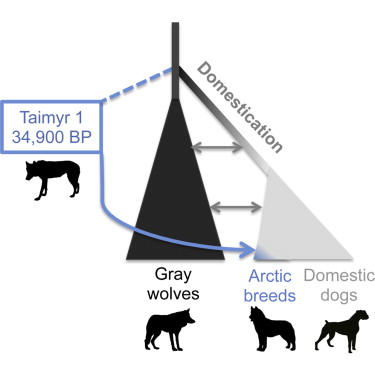
Genetic evidence from an ancient wolf bone discovered lying on the tundra in Siberia’s Taimyr Peninsula reveals that wolves and dogs split from their common ancestor at least 27,000 years ago. “Although separation isn’t the same as domestication, this opens up the possibility that domestication occurred much earlier than we thought before,” said lead study author Pontus Skoglund, who studies ancient DNA at Harvard Medical School and the Broad Institute in Massachusetts. Previously, scientists had pegged the wolf-dog split at no earlier than 16,000 years ago.
The Livescience article referred to results that were published in the journal Current Biology on May 21st this year. One needs a subscription to read the full report but here is their summary:
The origin of domestic dogs is poorly understood [ 1–15 ], with suggested evidence of dog-like features in fossils that predate the Last Glacial Maximum [ 6, 9, 10, 14, 16 ] conflicting with genetic estimates of a more recent divergence between dogs and worldwide wolf populations [ 13, 15, 17–19 ]. Here, we present a draft genome sequence from a 35,000-year-old wolf from the Taimyr Peninsula in northern Siberia. We find that this individual belonged to a population that diverged from the common ancestor of present-day wolves and dogs very close in time to the appearance of the domestic dog lineage. We use the directly dated ancient wolf genome to recalibrate the molecular timescale of wolves and dogs and find that the mutation rate is substantially slower than assumed by most previous studies, suggesting that the ancestors of dogs were separated from present-day wolves before the Last Glacial Maximum. We also find evidence of introgression from the archaic Taimyr wolf lineage into present-day dog breeds from northeast Siberia and Greenland, contributing between 1.4% and 27.3% of their ancestry. This demonstrates that the ancestry of present-day dogs is derived from multiple regional wolf populations.
That summary page also includes the following Graphical Abstract:
I don’t have permission to republish the Livescience article in full but would like to offer the closing paragraphs of this fascinating report.
“It is a very well-done paper,” Perry [George Perry, an expert in ancient DNA at Pennsylvania State University] told Live Science. “This topic is a critical one for our understanding of human evolution and human-environment interactions in the Paleolithic. Partnership with early dogs may have facilitated more efficient hunting strategies.”
If dogs first befriended hunter-gatherers, rather than farmers, then perhaps the animals helped with hunting or keeping other carnivores away. For instance, an author of a new book claims humans and dogs teamed up to drive Neanderthals to extinction. Skoglund also suggested the Siberian husky followed nomads across the Bering Land Bridge, picking up wolf DNA along the way.
“It might have been beneficial for them to absorb genes that were adapted to this high Arctic environment,” Skoglund said.
This is the first wolf genome from the Pleistocene, and more ancient DNA from prehistoric fossils could provide further insights into the relationship between wolves, dogs and humans, the researchers said.
Yes, our dogs have been part of man’s world for an unimaginable time – and Jean and I, as with tens of thousands of others, can’t imagine a world without dogs.
I started writing this post approaching midnight (UTC) on the afternoon of Tuesday, 26th May, 2015. In other words, approaching 00:00 UTC 26/05/15 (or in American ‘speak’ 05/26/15 – a little thing that is taking me years to become accustomed to.)
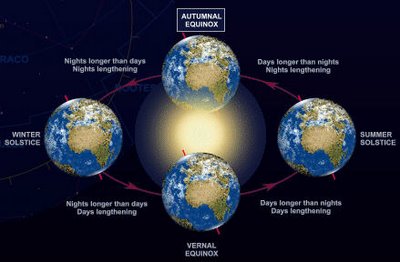
At that time, it was fewer than four weeks to the June solstice. Now it was over a week ago and Christmas is just around the corner! (OK, I’ll admit a slight exaggeration!)
However, I thought the TomDispatch essay was just as valid on June 29th as it was on May 26th. So I will continue.
The planet Earth has been in orbit around the sun for a very long time! Time beyond imagination. By comparison, in a very short time one species alone, namely homo sapiens, has altered the biosphere of Planet Earth. It’s almost beyond comprehension!
To expand on that shortage of time, let me republish an essay from TomDispatch from last September. Republished with the kind permission of Tom Engelhardt.
ooOOoo
What to Do When You’re Running Out of Time
Posted by Rebecca Solnit at 8:09am, September 18, 2014.
Follow TomDispatch on Twitter @TomDispatch.
Just when no one needed more lousy news, the U.N.’s weather outfit, the World Meteorological Organization (WMO), issued its annual Greenhouse Gas Bulletin. It offered a shocking climate-change update: the concentrations of long-lasting greenhouse gases in the Earth’s atmosphere (carbon dioxide, methane, and nitrous oxide) rose at a “record-shattering pace” from 2012 to 2013, including the largest increase in CO2 in 30 years — and there was a nasty twist to this news that made it even grimmer.
While such increases reflected the fact that we continue to extract and burn fossil fuels at staggering rates, something else seems to be happening as well. Both the oceans and terrestrial plant life act as carbon sinks; that is, they absorb significant amounts of the carbon dioxide we release and store it away. Unfortunately, both may be reaching limits of some sort and seem to be absorbing less. This is genuinely bad news if you’re thinking about the future warming of the planet. (As it happens, in the same period, according to the Yale Project on Climate Change Communication, parts of the American public stopped absorbing information in no less striking fashion: the number of those who believe that global warming isn’t happening rose 7% to 23%.)
So consider this a propitious moment for a major climate-change demonstration, possibly the largest in history, in New York City this Sunday. [Ed:it turned out to be the largest climate march in history.] As the WMO’s Secretary-General Michel Jarraud pointed out, there is still time to make a difference. “We have the knowledge and we have the tools,” he said, “for action to try to keep temperature increases within 2°C to give our planet a chance and to give our children and grandchildren a future. Pleading ignorance can no longer be an excuse for not acting.” As TomDispatch regular Rebecca Solnit, author of the indie bestseller Men Explain Things to Me, points out, the pressure of mass movements can sometimes turn history upside down. Of course, the only way to find out if climate change is a candidate for this treatment is to get out in the streets. So, for those of you anywhere near New York, see you this Sunday! Tom
The Wheel Turns, the Boat Rocks, the Sea Rises
Change in a Time of Climate Change
By Rebecca Solnit
There have undoubtedly been stable periods in human history, but you and your parents, grandparents, and great-grandparents never lived through one, and neither will any children or grandchildren you may have or come to have. Everything has been changing continuously, profoundly — from the role of women to the nature of agriculture. For the past couple of hundred years, change has been accelerating in both magnificent and nightmarish ways.
Yet when we argue for change, notably changing our ways in response to climate change, we’re arguing against people who claim we’re disrupting a stable system. They insist that we’re rocking the boat unnecessarily.
I say: rock that boat. It’s a lifeboat; maybe the people in it will wake up and start rowing. Those who think they’re hanging onto a stable order are actually clinging to the wreckage of the old order, a ship already sinking, that we need to leave behind.
As you probably know, the actual oceans are rising — almost eight inches since 1880, and that’s only going to accelerate. They’re also acidifying, because they’re absorbing significant amounts of the carbon we continue to pump into the atmosphere at record levels. The ice that covers the polar seas is shrinking, while the ice shields that cover Antarctica and Greenland are melting. The water locked up in all the polar ice, as it’s unlocked by heat, is going to raise sea levels staggeringly, possibly by as much as 200 feet at some point in the future, how distant we do not know. In the temperate latitudes, warming seas breed fiercer hurricanes.
The oceans are changing fast, and for the worse. Fish stocks are dying off, as are shellfish. In many acidified oceanic regions, their shells are actually dissolving or failing to form, which is one of the scariest, most nightmarish things I’ve ever heard. So don’t tell me that we’re rocking a stable boat on calm seas. The glorious 10,000-year period of stable climate in which humanity flourished and then exploded to overrun the Earth and all its ecosystems is over.
But responding to these current cataclysmic changes means taking on people who believe, or at least assert, that those of us who want to react and act are gratuitously disrupting a stable system that’s working fine. It isn’t stable. It is working fine — in the short term and the most limited sense — for oil companies and the people who profit from them and for some of us in the particularly cushy parts of the world who haven’t been impacted yet by weather events like, say, the recent torrential floods in Japan or southern Nevada and Arizona, or the monsoon versions of the same that have devastated parts of India and Pakistan, or the drought that has mummified my beloved California, or the wildfires of Australia.
The problem, of course, is that the people who most benefit from the current arrangements have effectively purchased a lot of politicians, and that a great many of the rest of them are either hopelessly dim or amazingly timid. Most of the Democrats recognize the reality of climate change but not the urgency of doing something about it. Many of the Republicans used to — John McCain has done an amazing about-face from being a sane voice on climate to a shrill denier — and they present a horrific obstacle to any international treaties.
Put it this way: in one country, one party holding 45 out of 100 seats in one legislative house, while serving a minority of the very rich, can basically block what quite a lot of the other seven billion people on Earth want and need, because a two-thirds majority in the Senate must consent to any international treaty the U.S. signs. Which is not to say much for the president, whose drill-baby-drill administration only looks good compared to the petroleum servants he faces, when he bothers to face them and isn’t just one of them. History will despise them all and much of the world does now, but as my mother would have said, they know which side their bread is buttered on.
As it happens, the butter is melting and the bread is getting more expensive. Global grain production is already down several percent thanks to climate change, says a terrifying new United Nations report. Declining crops cause food shortages and rising food prices, creating hunger and even famine for the poorest on Earth, and also sometimes cause massive unrest. Rising bread prices were one factor that helped spark the Arab Spring in 2011. Anyone who argues that doing something about global warming will be too expensive is dodging just how expensive unmitigated climate change is already proving to be.
It’s only a question of whether the very wealthy or the very poor will pay. Putting it that way, however, devalues all the nonmonetary things at stake, from the survival of myriad species to our confidence in the future. And yeah, climate change is here, now. We’ve already lost a lot and we’re going to lose more, but there’s a difference between terrible and apocalyptic. We still have some control over how extreme it gets. That’s not a great choice, but it’s the choice we have. There’s still a window open for action, but it’s closing. As the Secretary-General of the World Meteorological Society, Michel Jarraud, bluntly put it recently, “We are running out of time.”
New and Renewable Energies
The future is not yet written. Look at the world we’re in at this very moment. The Keystone XL tar sands pipeline was supposed to be built years ago, but activists catalyzed by the rural and indigenous communities across whose land it would go have stopped it so far, and made what was supposed to be a done deal a contentious issue. Activists changed the outcome.
Fracking has been challenged on the state level, and banned in townships and counties from upstate New York to central California. (It has also been banned in two Canadian provinces, France, and Bulgaria.) The fossil-fuel divestment movement has achieved a number of remarkable victories in its few bare years of existence and more are on the way. The actual divestments and commitments to divest fossil fuel stocks by various institutions ranging from the city of Seattle to the British Medical Association are striking. But the real power of the movement lies in the way it has called into question the wisdom of investing in fossil fuel corporations. Even mainstream voices like the British Parliament’s Environmental Audit Committee and publications like Forbes are now beginning to question whether they are safe places to put money. That’s a sea change.
Renewable energy has become more efficient, technologically sophisticated, and cheaper — the price of solar power in relation to the energy it generates has plummeted astonishingly over the past three decades and wind technology keeps getting better. While Americans overall are not yet curtailing their fossil-fuel habits, many individuals and communities are choosing other options, and those options are becoming increasingly viable. A Stanford University scientist has proposed a plan to allow each of the 50 states to run on 100% renewable energy by 2050.
Since, according to the latest report of the U.N.’s Intergovernmental Panel on Climate Change, fossil fuel reserves still in the ground are “at least four times larger than could safely be burned if global warming is to be kept to a tolerable level,” it couldn’t be more important to reach global agreements to do things differently on a planetary scale. Notably, most of those carbon reserves must be left untapped and the modest steps already taken locally and ad hoc show that such changes are indeed possible and that an encouraging number of us want to pursue them.
ooOOoo
In case you are wondering why this TomDispatch essay has been published some ten months after it first appeared, it is simply because I made a note to leave it for a few months to see if the benefit of some hindsight put the essay into context.
Here’s the context.
In the month of September, 2014, when this essay was published over on TomDispatch, the Atmospheric CO2 monthly average was 395.26 ppm. In April, 2015 it was 403.26 ppm. I can’t spell it out any better than what is written on the home page of CO2Now.org:
What the world needs to watch
Global warming is mainly the result of CO2 levels rising in the Earth’s atmosphere. Both atmospheric CO2 and climate change are accelerating. Climate scientists say we have years, not decades, to stabilize CO2 and other greenhouse gases.
To help the world succeed, CO2Now.org makes it easy to see the most current CO2 level and what it means. So, use this site and keep an eye on CO2. Invite others to do the same. Then we can do more to send CO2 in the right direction.
What an interesting period in man’s history to be alive.
Believers and non-believers alike owe Pope Francis a giant ‘thank you’.
As regular followers of this place will have heard before, one of the roles of the ‘alpha’ dog, or more accurately referred to these days as the Mentor dog, in other words the female dog that in the days before domestication was the leader of her pack, was to move her pack if she intuited that the pack’s home range was not sustaining them. (Her other role was pick of the male dogs!)
Thus the title of today’s post came to me as just possibly the metaphorical equivalent. That the global human ‘pack’ has been sharply reminded by one of the world’s key religious leaders that ‘more of the same’ isn’t going to work for much longer.
Quite rightly, there has been a huge amount of reporting and analysis of last week’s Papal Encyclical. But one of the most beautiful and profoundly eloquent came from the writer Jennifer Browdy. If you haven’t come across her before then do drop across to her website; you will love what she presents! I have been a subscriber to her blog posts for some time and that was how I came across her post called: And the Walls Came Tumbling Down: Pope Francis Shows Us the Way. Jennifer very kindly gave me permission to republish her post today.
ooOOoo
And the Walls Came Tumbling Down: Pope Francis Shows Us the Way
By Jennifer Browdy
The Encyclical on climate change and the environment released by Pope Francis this week has all the magic of the fall of the Berlin Wall in 1991. Back then, the antagonism between the U.S. and the U.S.S.R. seemed implacable and unresolvable, a fight to the death. And then suddenly the wall came down and the world walked through, marveling, into a new era.
Now we have another abrupt shift, this time of a religious order. The leaders of the Catholic Church can hardly be accused of being “radical tree-huggers.” And yet here is Pope Francis, solemnly exhorting his flock of a billion Catholics worldwide to be respectful to Mother Earth and all the living beings she supports. In the blink of an eye, the language of Native American spirituality has been taken up by the same Catholic Church that once tortured and executed indigenous peoples precisely because of their different religious beliefs.
I urge you to read the entire Encyclical for yourself. It is a truly remarkable document, worth serious study. Of many passages I’d like to underline, here are two:
228 Care for nature is part of a lifestyle which includes the capacity for living together and communion. Jesus reminded us that we have God as our common Father and that this makes us brothers and sisters. Fraternal love can only be gratuitous; it can never be a means of repaying others for what they have done or will do for us. That is why it is possible to love our enemies. This same gratuitousness inspires us to love and accept the wind, the sun and the clouds, even though we cannot control them. In this sense, we can speak of a “universal fraternity”.
229 We must regain the conviction that we need one another, that we have a shared responsibility for others and the world, and that being good and decent are worth it. We have had enough of immorality and the mockery of ethics, goodness, faith and honesty. It is time to acknowledge that light-hearted superficiality has done us no good. When the foundations of social life are corroded, what ensues are battles over conflicting interests, new forms of violence and brutality, and obstacles to the growth of a genuine culture of care for the environment.
Here we find spiritual ecology enshrined as Catholic doctrine. And one thing about the Catholic Church—it is big on obedience. For believers, to ignore the Pope is to risk hellfire and damnation. In this case, though, the hellfire and damnation will be earthly, if we do not listen to the wise advice of Pope Francis and curb the insanity of industrial growth that goes beyond the limits of the planet to support.
Scientists appeal to our sense of reason, presenting compelling evidence that if we continue on our present path of wasteful consumption of the Earth’s resources, we will destroy our own future as a flourishing species. Religious leaders appeal to human beings’ moral conscience in invoking the responsibility of current parents and grandparents to leave a livable world to our descendants. It is up to the politicians, though, to translate vision into practice.
For too long, Christian conservatives in the U.S. have played the role of the ideological wing of Big Business, using money, manipulation and scare tactics to buy politicians and votes. In the face of the new Papal Encyclical, can American Christians really continue in good conscience to support the worst of the planet’s polluters and plunderers? Can they continue to elect mercenary politicians who hold our country hostage to the highest bidder?
If all good people who love our Earth and its creatures were to translate our love into action, as Pope Francis has just done so forcefully, I have no doubt the seemingly invincible wall of the industrial growth society we’ve been living with these past 200 years would melt away, revealing the path into a green, prosperous future.
“Where there’s a will, there’s a way,” the saying goes. Pope Francis has just shown us the will, and the way. It is now the task of us ordinary citizens to break the stranglehold of Big Business on politics and insist that our politicians follow his lead.
I close with an excerpt from the Pope’s “Christian Prayer in Union with Creation,” a vision of ecological interdependence if ever there was one:
“Triune Lord, wondrous community of infinite love,
teach us to contemplate you
in the beauty of the universe,
for all things speak of you.
“Awaken our praise and thankfulness
for every being that you have made.
Give us the grace to feel profoundly joined to everything that is.
God of love, show us our place in this world
as channels of your love
for all the creatures of this earth,
for not one of them is forgotten in your sight.
Enlighten those who possess power and money
that they may avoid the sin of indifference,
that they may love the common good, advance the weak,
and care for this world in which we live.”
Amen.
And the meek shall inherit the Earth…. Photo by J. Browdy, 2015
ooOOoo
I am sure that, whatever your religious or spiritual persuasion, you will agree with me with regard to the beauty of Jennifer’s essay. I know there are millions and millions of people who will want to look back in a few years time and see how Pope Francis’ legacy literally saved our lives.
“In defending the natural world, we should be honest about our motivations – it’s love that drives us, not money.”
Not my words but the opening line from a brilliant essay published yesterday by George Monbiot.
I can add very little to the power of Mr. Monbiot’s essay other than to ‘top and tail’ his words with a couple of photographs taken here at home. Plus not forgetting to add that the essay is republished with George Monbiot’s very kind permission.
A view of our property looking out to the North-East. Our boundary is the other side of the line of trees. (Photo taken July, 2012)
ooOOoo
Channelling the Joy
17th June 2015
In defending the natural world, we should be honest about our motivations – it’s love that drives us, not money.
By George Monbiot, published in the Guardian 17th June 2015
Who wants to see the living world destroyed? Who wants an end to birdsong, bees and coral reefs, the falcon’s stoop, the salmon’s leap? Who wants to see the soil stripped from the land, the sea rimed with rubbish?
No one. And yet it happens. Seven billion of us allow fossil fuel companies to push shut the narrow atmospheric door through which humanity stepped. We permit industrial farming to tear away the soil, banish trees from the hills, engineer another silent spring. We let the owners of grouse moors, 1% of the 1%, shoot and poison hen harriers, peregrines and eagles. We watch mutely as a small fleet of monster fishing ships trashes the oceans.
Why are the defenders of the living world so ineffective? It is partly, of course, that everyone is complicit; we have all been swept off our feet by the tide of hyperconsumption, our natural greed excited, corporate propaganda chiming with a will to believe that there is no cost. But perhaps environmentalism is also afflicted by a deeper failure: arising possibly from embarrassment or fear, a failure of emotional honesty.
I have asked meetings of green-minded people to raise their hands if they became defenders of nature because they were worried about the state of their bank accounts. Never has a hand appeared. Yet I see the same people base their appeal to others on the argument that they will lose money if we don’t protect the natural world.
Such claims are factual, but they are also dishonest: we pretend that this is what animates us, when in most cases it does not. The reality is that we care because we love. Nature appealed to our hearts, when we were children, long before it appealed to our heads, let alone our pockets. Yet we seem to believe we can persuade people to change their lives through the cold, mechanical power of reason, supported by statistics.
I see the encyclical by Pope Francis, which will be published on Thursday, as a potential turning point. He will argue that not only the physical survival of the poor, but also our spiritual welfare depends on the protection of the natural world; and in both respects he is right.
I don’t mean to suggest that a belief in God is the answer to our environmental crisis. Among Pope Francis’s opponents is the evangelical Cornwall Alliance for the Stewardship of Creation, which has written to him arguing that we have a holy duty to keep burning fossil fuel, as “the heavens declare the glory of God; and the firmament proclaims his handiwork”. It also insists that exercising the dominion granted to humankind in Genesis means tilling “the whole Earth”, transforming it “from wilderness to garden and ultimately to garden city”.
There are similar tendencies within the Vatican. Cardinal George Pell, its head of finance, currently immersed in a scandal involving paedophile priests in Australia, is a prominent climate change denier. His lecture to the Global Warming Policy Foundation was the usual catalogue of zombie myths (discredited claims that keep resurfacing), nonsequiturs and outright garbage, championing, for example, the groundless claim that undersea volcanoes could be responsible for global warming. There are plenty of senior Catholics seeking to undermine the Pope’s defence of the living world; which could explain why his encyclical was leaked.
What I mean is that Pope Francis, a man with whom I disagree profoundly on matters such as equal marriage and contraceptives, reminds us that the living world provides not only material goods and tangible services, but is also essential to other aspects of our well-being. And you don’t have to believe in God to endorse that view.
In his beautiful book The Moth Snowstorm, Michael McCarthy suggests that a capacity to love the natural world, rather than merely to exist within it, might be a uniquely human trait. When we are close to nature, we sometimes find ourselves, as Christians put it, surprised by joy: “a happiness with an overtone of something more, which we might term an elevated or, indeed, a spiritual quality.”
He believes we are wired to develop a rich emotional relationship with nature. A large body of research suggests that contact with the living world remains essential to our psychological and physiological well-being. (A paper published this week, for example, claims that green spaces around city schools improve children’s mental performance).
This does not mean that all people love nature; what it means, McCarthy proposes, is that there’s a universal propensity to love it, which may be drowned out by the noise that assails our minds. As I’ve found while volunteering with the outdoor education charity Wide Horizons, this love can be provoked almost immediately, even among children who have never visited the countryside before. Nature, McCarthy argues, remains our home, “the true haven for our psyches”, and retains an astonishing capacity to bring peace to troubled minds. Acknowledging our love for the living world does something that a library full of papers on sustainable development and ecosystem services cannot: it engages the imagination as well as the intellect. It inspires belief; and this is essential to the lasting success of any movement.
Is this a version of the religious conviction from which Pope Francis speaks? Or could his religion be a version of a much deeper and older love? Could a belief in God be a way of explaining and channelling the joy, the burst of love that nature sometimes provokes in us? Conversely, could the hyperconsumption that both religious and secular environmentalists lament be a response to ecological boredom: the void that a loss of contact with the natural world leaves in our psyches?
Of course, this doesn’t answer the whole problem. If the acknowledgement of love becomes the means by which we inspire environmentalism in others, how do we translate it into political change? But I believe it’s a better grounding for action than pretending that what really matters to us is the state of the economy. By being honest about our motivation we can inspire in others the passions that inspired us.
I’m not going to repeat my full introduction to Professor Bekoff’s essay from yesterday other than to repeat this:
Thus with Marc Bekoff’s generous permission, here is his essay in full. (I’ve taken the decision to split this long essay into two parts.)
Finally, Professor Bekoff includes numerous ‘html’ links within his essay to other materials. I’ve cheated by saving quite some time adding those links but have underlined the linked phrase in question, apart from the very early chapters that do have ‘html’ links. Please go to the site of the original essay to explore further those links.
Marc Bekoff and friend.
ooOOoo
Butts and Noses: Secrets and Lessons from Dog Parks (Concluding Part)
Dog parks are gold mines of information about the behavior of dogs and humans
Are dogs really our best friends and are we really their best friends?
I’m asked these questions a lot and I always say it’s simply not so that dogs are “unconditional lovers.” They discriminate among humans just like we discriminate among dogs. And, while dogs might love “too much,” they’re very careful about to whom they open up. So, sometimes — perhaps very often — dogs are our best friends and we are their best friends but we all know of picky dogs and the horrific abuse to which dogs are subjected.
Are dogs really free at a dog park?
I often hear something like, “Oh I love coming to the dog park because my dog is so free” – and then she’s/he’s called back constantly when he plays too roughly or strays too far. People surely differ in how much control they exert, but some just don’t give their dog the opportunity to play, sniff, and hump. Control freaks often abound and they don’t realize it. Patrick Jackson, in the essay to which I referred above, writes about how “caretakers become ‘control managers’ who must negotiate problems related to a variety of dog behaviors, especially mounting, aggression, and waste management.” He’s right on the mark, but there are also those who get upset when play gets a bit rough, even when the dogs obviously are enjoying themselves.
Do dogs display dominance?
Yes, they do, just like many other animals. There is major confusion and mistakes among many “dog people” about what dominance really means, and dogs, like numerous other animals, do indeed use various forms of dominance in their social interactions. However, this does not mean that dominance is equated with overt aggression and physical harm nor that we need to dominate them in order to live in harmony with them (for more on this topic and the fact that dominance is not a myth please see this essay and and and references therein).
Why do dogs mount and hump?
Here are some of the statements I hear about dog mounting and humping: “Oh my God, my dog was fixed to stop this stuff.” “Oh, that’s easy, it’s always to dominate the other dog.” “Domination.” “Dogs are hyper-sexual because of domestication.” There are many reasons why dogs hump and there’s not a single answer (please see this essay and references therein).
Do Dogs feel shame and guilt?
While I hear numerous stories about shame and guilt, the simple and most correct answer is that we really don’t know. While we’re not all that good at reading guilt this does not mean that they do not feel guilt (please see this essay and references therein).
Do dogs get jealous?
Yes they do and a study published in 2014 showed this to be the case (please see this essay and references therein). I often hear very compelling stories about jealousy in dogs.
Do dogs get bored?
Yes, of course they do, just as do many other mammals, especially those living in various conditions of captivity. It’s clear that researchers and zoo administrators, for example, recognize that animals get bored, hence the numerous enrichment programs that are designed to relieve the animals’ boredom. The detailed research of Francois Wemelsfelder is a wonderful place to begin to learn about boredom in animals (see also the essays listed here).
Do dogs suffer from PTSD and other psychological disorders?
Yes they do as do many other animals.
Do dogs mind being used as service dogs or in animal assisted therapy?
Because dogs are such a variable lot, it’s impossible to say something like, “Of course they do.” The correct answer is that because dogs vary in personality and temperament there are some who would mind it and some who won’t. I’ve met many in each camp and I’m sure many readers have as well.
Are there Attention Deficit Dogs (ADD’s)?
I often hear people say that their dogs don’t hear them or that they ignore them most of the time. While there are many reasons why this might be so, it’s entirely possible that there are dogs who get so excited they simply don’t respond to their human’s requests. But, it’s also possible that some dogs do suffer from attention deficit disorder and hyperactivity.
How often does social play escalate into serious aggressive encounters?
We all know that play behavior predominates at dog parks and that dogs have fun when they play (see also) and that play is very contagious. Dogs play socially with one another, often involving objects, and they also play alone with objects or just go berserk on their own because it feels good. Dogs can play very roughly and still be in control and there are distinct “rules of social play” that help to keep even a vigorous interaction well within bounds so that there’s really little or no worry that play will escalate into aggression. Nonetheless, I hear this statement a lot: “Oh whenever dogs play it turns into aggression.” It doesn’t. My own observations suggest that it seems escalation happens more in large groups in which dogs can’t read one another’s subtle signals that “this still is play,” but it is very rare. Dogs can be rather fair. I want to say a bit more on this topic because it seems to be major reason why dogs are called back to their human or that humans break up rough-and-tumble play.
Although my students and I haven’t kept detailed records on this aspect of play for dogs, we all agree that play didn’t turn into serious fighting in more than around 2% of the 1000s of play bouts we’ve observed. Current observations at dog parks around Boulder, Colorado support our conclusion. And, for the approximately 1000 play bouts that my students and I observed in wild coyotes, mainly youngsters, on only about five occasions did we see play fighting escalate into serious fighting. Along these lines, Shyan, Fortune, and King (2003) discovered that fewer than 0.5% of play fights in dogs developed into conflict, and only half of these were clearly aggressive encounters. In this case our intuitions were right on the mark. Of course, there may be dogs who simply bite too hard or slam too hard into their play partners when they get highly aroused and lost in play, and this results in an aggressive encounter of varying intensity. But that is the exception rather than the rule, for play fighting only very rarely escalates into real fighting. Because play is a foundation of fairness there is a good deal of cooperation among the players as they negotiate the ongoing interaction so that it remains playful. I think one can make a good case for their having a theory of mind. Nonetheless, we still need more data on this aspect of play as well.
Do older dogs play less than younger dogs?
While this is true of wild animals who have to work harder to survive and to thrive, older dogs play a lot when they can and we really need more data on this question.
Do dogs have a theory of mind?
We don’t know. While some studies suggest they don’t, we need more “naturalistic” research especially when dogs are socially interacting. Because play is a foundation of fairness and there is a good deal of cooperation among the players as they negotiate the ongoing interaction so that it remains playful. Perhaps dogs even know what their playmates are thinking and feeling. Do they have a theory of mind? While I think so, we still need more data on this aspect of play as well.
Why do dogs roll and writhe on their back?
It could be to impart an odor. A wild canid known as the raccoon dog who lives in South America has a scent gland on its back. Dogs might also roll on their back to mask their own odor. And, of course, it might feel really good so why not do it? I love watching dogs writhe on their back and they look like they’re in doggie heaven.
Do dogs have a sense of time? The “two minute warning”
We really don’t know much at all about the dog’s sense of time. Yet, people often use what I call the “two minute warning” and ask their dog if it’s okay if they leave in 2 minutes, or people tell their dog something like, “You have 5 minutes more to play with your friends before we go to the store.” They also ask their dog, “What the hell took you so long, I’ve been calling you for minutes?” or “Where were you when I called you?” I can well imagine the dog thinking something like, “Huh?”
Why do dogs snort?
While there are physical reasons why dogs snort, recent research shows that dogs sort odors in their nose, forcing out those that aren’t relevant or salient, hence the snort and often a good deal of snot (for more on the fascinating dog’s nose please see this essay and this.
Why do dogs try to pee and nothing comes out?
This is called “dry marking” and we know that lifting a leg as if the dog is peeing serves as a visual signal to tell others he is. Often a dog will “dry mark” and then pee a few seconds later, so it’s clear their bladder isn’t empty. A study I did years ago with some students showed that dogs do this more often when there are other dogs around who can see them and then pee a bucket.
Why do dogs scratch the ground after they pee or poop?
They do this for a number of possible reasons and there isn’t a simple answer to this question.
Poop central: Why do people talk so much about dog poop at dog parks?
People also talk about poop a lot as if they’re freer to do so with their dog. Matthew Gilbert notes, “poop was more of a thing at the park than I had expected.” (p. 66) He also talks about a “stray bowel movement” as a “voluminous and frozen still life” (p, 67). Dog poop is a ripe area for future research.
Why do dogs stick their noses into butts, groins, and ears?
It’s a way of greeting and social investigation, but there haven’t been any studies of which I’m aware that provide any details about why they do this, even to their dog friends or humans. It’s been suggested that some animals might pick up information on the food others have eaten.
Are there breed specific odors?
Many people report that on their first encounter with other dogs, members of the same breed prefer one another and treat breed members differently from individuals of different breeds. There’s been some discussion that there may be a common odor to members of the same breed. However, my reading of available information is that we really know little about this question right now.
Do dogs know what they look like?
While dogs know what they smell like, they don’t know what they look like, or might they? Research done on birds in the 1960s suggests that they might learn their own color from reflections in water. So, I suppose dogs might know what they look like if they’ve seen their own reflection, but we need much more research about this question.
Why do dogs circle before lying down?
Dogs do not always circle before lying down, as some authors claim. They likely do it to flatten or soften the ground, and may also be looking around to see who’s around before they relax. In a study some of my students did years ago they reported that the dogs they watched circled around 65% of the time, but more detailed studies are needed.
Why does the hair on a dog’s back stand up?
This is called piloerection (sort of like goose bumps) and indicates that a dog is highly aroused but not necessarily aggressive. Many other species, including birds, show the same (sympathetic nervous system) response.
Dogs and humans: Why do people open up at dog parks?
Dogs can easily serve as icebreakers and social catalysts. People often open up at dog parks and talk to friends about things they likely don’t talk about in other arenas. They seem to feel safe among kinfolks. Some people began talking to me about pretty personal stuff within a minute of meeting them such as a woman who decided that she didn’t like her BFF because of how she treated a dog she just rescued, and a woman who, after meeting someone for around 10 seconds, decided that the woman wasn’t a good dog owner because she was suffering from bipolar disorder but didn’t know it! Some people – men and women, alike – have told me that dogs are social magnets and make it easy to meet other people who also are out with their canine BFF. These discussions often have very interesting “conclusions.” Enough on that for now …
Why do dogs eat grass?
There are many reasons and Stanley Coren has written a good myth-debunking essay on this. He notes that dogs do not eat grass to cause vomiting to relieve stomach distress. While it’s possible that some dogs do, we need a lot more research on this question.
More questions for a future essay
The list of questions can go on and on, and some questions I’ll consider in the future include: Why do dogs chase their tail? Why do dogs bark and what sort of barks are there? Why do dogs bark and howl at sirens? Why does my dog hoard tennis balls? Are dogs territorial as are wolves? Why do dogs pee/scent mark so much? Why do dogs sniff pee so much even when it’s their friends’ pee? Why do males sometimes squat when they pee and why do females sometimes lift their leg? Do dogs have a sense of self? Studies of “yellow snow” suggest they do. Are they conscious? (Of course they are, and scientists agree.) Why do dogs sniff and eat frozen turds? Why do dogs eat gooey feces? Why do dogs dig holes and then lie in them? Why do dogs scrape their butt on the ground? Why do people openly disparage their dog and then tell them they love them? (I often hear something like, “Oh, he’s really retarded, but I love him” or “You are so fat!” or “My goodness, your breath stinks!). Do dogs pick up on these mixed signals?“ Do dogs have a “little dog” complex? Do dogs make and use tools? (They do.) Why do dogs drink filthy water? How do dogs pick their mates? Do dogs dream? Do dogs get heartburn? Do dogs sweat? Do dogs understand baby talk? (People are well known to talk to dogs as if they’re infant humans.) What does “feral” mean? How did wolves become dogs? (Please see essays by Mark Derr.) What’s the difference between a socialized animal and a domesticated animal? (A wolf who likes humans is a socialized wolf. A domesticated wolf is a dog.) Do dogs really live in the moment? (No, their past clearly influences their behavior — just ask anyone who’s rescued an abused dog — and they think about the future — just watch a dog waiting for a frisbee or a ball to be thrown and watch them track the trajectory, although tracking might not be conscious, even in humans.)
Where to from here? There are many holes in the database and dog parks are gold mines of information.
It’s important to stress that there here are many holes in the database, and people find this very surprising because of many popular dog books that purport to “tell it like it is,” as if there are facts about this or that question. Dog parks are wonderful places for studies in dog-dog ethology and anthrozoology, the study of human-animal interactions, and I hope this essay will stimulate people to conduct formal studies and encourage citizen scientists to share their stories that can be used to generate further more systematic studies.
Studies in dog parks, that some may call “too uncontrolled,” may also shed light on questions that are being debated among different groups of researchers, for example, whether dogs follow human gazing or pointing and how well they perform these activities, or if dogs have a theory of mind. And, let’s face it, some laboratory studies also are rather uncontrolled, mainly because dogs are such a mixed bag of participants as might be the researchers themselves. Watching animals in their “natural habitats,” and dog parks might qualify as such, has shed much light on various aspects of behavior that are difficult to study in captivity or in other more controlled environs. Although many lab studies of dogs are likely more controlled than those conducted on free-running dogs, many people have seen behavior patterns that warrant reinvestigation in more ecologically relevant situations.
I continue to learn a lot about dog and human behavior when I visit dog parks. People often feel free to offer advice even when they knew who I am and what I do for a living. But, on a number of occasions, I chose to keep some distance to determine if their comments and explanations to other people (and often to the dogs) differ from when they know I’m around. For the most part, they did not. For example, I’ve been told that “familiar dogs definitely play differently from unfamiliar dogs,” that “humping is always about dominance,” that “dogs know what other dogs are thinking and feeling and they also know the same about people,” and that “know-it-all researchers ought to get off their butts and out of the ivory tower and watch dogs in the field.” On a few occasions some people made it clear that I had a lot to learn about dogs and they could teach me some valuable lessons. When I agreed, they were very surprised, and over the years I’ve had many interesting discussions that have made me re-evaluate what we know and don’t know about dog behavior and dog-human interactions. Concerning two of the areas above, we actually don’t know if familiar dogs play differently from unfamiliar dogs (I’ve got a student studying this) and, as I mentioned above, there’s not just one explanation for humping. Anyway …
There are numerous research projects just waiting to be done as we watch dogs romp here and there and have fun, meet old friends and strangers, and negotiate social relationships with other dogs and humans. I’m aware that I may have missed some studies so I hope readers will send me the details and share them in the comments section for this essay.
Dog behavior, in all of its kaleidoscopic forms, is an incredibly exciting field of research
Dogs openly share with us a lot about what they know and what they’re thinking and feeling, and we just have to be keen enough and patient enough to figure it all out. Dogs also are wonderful social catalysts and social magnets and they can help us learn a lot about ourselves. The arena of inquiry about dog-dog behavior and dogs and their humans truly is deep and boundless and there are numerous opportunities for studies at dog parks, where dogs frolic and sometimes cower and have to learn to deal with a wide variety of social situations with other dogs and humans, and at other places where dogs and humans congregate. And, as I mentioned before, talking about “the dog” can often be misleading and perilous.
Dog behavior, in all of its kaleidoscopic forms, is an incredibly exciting field of research, and I really look forward to seeing further studies of the above and other questions. When people tell me they’re having trouble coming up with a research project I humbly ask them if they’ve thought about dogs, and then the conversation gets going and going and going ….
Marc Bekoff’s latest books are Jasper’s story: Saving moon bears (with Jill Robinson), Ignoring nature no more: The case for compassionate conservation, Why dogs hump and bees get depressed, and Rewilding our hearts: Building pathways of compassion and coexistence.The Jane effect: Celebrating Jane Goodall (edited with Dale Peterson) has recently been published. (marcbekoff.com; @MarcBekoff)
ooOOoo
Now I don’t know about you but I found this essay both fascinating and wonderfully interesting. If I ever get the chance to publish other essays or information from the good Professor you can bet your life that I will, and without hesitation!
Part One of a stunningly interesting essay from Professor Marc Bekoff.
As a newbie yet-to-be published author I am technically at the stage of having a completed draft that Jeannie and a close friend are proof-reading. Then after corrections, it is going to be released to some ‘beta’ readers who will give me some early feedback. (Too scary to even think of just now!)
OK, with that admission out of the way, let me move on to my ‘draft’ chapter on play; in Part Four of the book. In researching what is known about the way that dogs play and what lessons there are for us humans, I came across an essay by Marc Bekoff, Ph.D. Marc is Professor Emeritus of Ecology and Evolutionary Biology at the University of Colorado, Boulder. His essay had been published in May on the website of Psychology Today. It was incredibly interesting and full of material for the book!
Within a few minutes of me sending Professor Bekoff an email requesting permission to include quotations in my ‘draft’ chapter, he had responded in the affirmative. I had also sought his permission to publish the essay here on Learning from Dogs. Again, a very quick, positive reply.
Thus with Marc Bekoff’s generous permission, here is his essay in full. (I’ve taken the decision to split this long essay into two parts.)
Finally, Professor Bekoff includes numerous ‘html’ links within his essay to other materials. I’ve cheated by saving quite some time adding those links but have underlined the linked phrase in question, apart from the very early chapters that do have ‘html’ links. Please go to the site of the original essay to explore further those links.
Marc Bekoff and friend.
ooOOoo
Butts and Noses: Secrets and Lessons from Dog Parks (Part One)
Dog parks are gold mines of information about the behavior of dogs and humans
I love going to dog parks. So, too, do dogs and their people. Dog parks are a fascinating recent and growing cultural phenomenon. Indeed, I go rather often to what I call my field sites, for that’s what they are, to study play behavior and other aspects of dog behavior including urination and marking patterns, greeting patterns, social interactions including how and why dogs enter, become part of, and leave short-term and long-term groups, and social relationships. I also study human-dog interactions and when I study how humans and dogs interact I also learn a lot about the humans. For example, I often hear how happy people are that their dogs are free to run here and there or free to be dogs when they’re at the dog park. Often, they say this while they’re constantly calling them back to them even when the dog is simply sniffing here or there or looking for a friend. They also call them to break up play when they think it’s gotten out of hand. You call this free?
Two works to which I often go when thinking about social dynamics at dog parks are Matthew Gilbert’s book titled Off the Leash: A Year at the Dog Park and Sonoma State University’s Patrick Jackson‘s essay called “Situated Activities in a Dog Park: Identity and Conflict in Human-Animal Space.” Linda Case writes about Dr. Jackson’s study and she is not a fan of dog parks because she feels they’re not safe and because “Dog park people frequently behave badly by not being responsible dog owners and by being inconsiderate and uncaring towards other people and their dogs.” We really need empirical studies on the safety issue. After having spent countless hours at dog parks I’ve never entertained drawing this conclusion, but there aren’t any detailed data on this topic of which I’m aware. However, on occasion, but hardly regularly, I’ve marveled at just how inconsiderate a very few people can be. But, as part of the gossip network among the other people, I often hear that a given person behaves like this even in non-dog park situations. On a few ocassions I’ve had a rather inconsiderate person ask me why their dog has bad manners and rather than get involved I call attention to some interesting dog-dog interactions.
Most people realize that “dogs are in” and countless scientific and popular essays (see also New Directions in Canine Behavior, Julie Hecht’s “Dog Spies,” and essays written for Psychology Today by writers including Mark Derr, Stanley Coren, Jessica Pierce, and yours truly) and books have been published in the past decade or so about these fascinating mammals. The bottom line is that a plethora of detailed data — and the database is rapidly increasing — clearly show that dogs are thinking, clever, and feeling sentient beings, and viewing them as sort of robotic machines is incredibly misleading and academically corrupt (please see this essay). This does not mean that they are “doggy Einsteins,” however, ample data from numerous different research groups around the world clearly show that dogs are rather complex and incredibly interesting mammals who deserve a good deal of further study. Perhaps even René Descartes would consider changing his views on nonhuman animals (animals) as unfeeling machines given the enormous amount of empirical evidence on sentience in animals.
Why do dogs do this and that? Canine confidential
“Why do dogs do this and that?” The purpose of this short essay, that can be conceived as a field guide to the extremely interesting and largely unknown world of the fascinating dogs with whom we share our lives, is to provide some lessons in dog behavior from observations and questions arising from visits to various dog parks, especially around Boulder, Colorado where I live. I see myself as “a naturalist in a dog park” and aim to show here, via a series of questions, what we know and don’t know about many different aspects of dog behavior. Dogs are often called social catalysts – icebreakers or lubricants — for social interactions with other dogs and they often open the door for pretty frank and wide-ranging conversations among familiar and unfamiliar humans. It always amazes me how dogs free up humans to talk about things they might be more reluctant to share in other venues including what they really think about their human “BFF’s — best friends forever” — and the infamous “3 p’s,” namely, pee, poop, and puke. Often when I get home and look at my notes I view them as “canine confidential.” So, what follows is a sampler of many “why” questions, including why dogs hump, why they sniff butts, genitals, and ears, why they play, and why they organize themselves the ways they do. There are also many “what” questions such as “What do they know?”, “What are they thinking?”, and “What are they feeling?” in different contexts. The list of questions is endless and I’m sure those that follow can easily mutate in many, many more.
People who are lucky enough to share their world with a dog often think they know it all. And, while they do know a good deal about what their canine buddy is thinking and feeling and what they want and need, there really are large gaps in the scientific database. As I mentioned above, there are numerous anecdotes about why dogs do this or that, and, taken together, they form their own pool of data. However, while the claim that “the plural of anecdote is data” applies in some cases, many mysteries still loom in what we actually know about the world of dogs.
Furthermore, often there is no single “right” answer to a question — even some of the most commonly asked queries — and that’s just fine. Dogs compose a highly variable group of mammals — I often say “the dog” doesn’t really exist — so it’s not surprising that just when we think we have a solid handle on what they’re thinking and feeling and why they do what they’re doing an exception or three arises. Surely, the early experience of individual dogs influences their later behavior. So, while we know a lot, people are often amazed by how little we know and that hard and fast answers can’t be given to some common questions.
Visiting dog parks can be wonderful educational experiences. Visits, some lasting hours on end each and every day, can be myth breakers and icebreakers, and also provide information about why dogs are doing this or that. People are always asking questions about why their dog is doing something and really want to know what we know. They also freely offer advice to other people about why their dog is doing something and how they can treat various problems such as shyness, aggressiveness, and why dogs ignore what their human is asking them to do. And, as I wrote above, dogs also are icebreakers – “social catalysts” the academics call them — and get people to talk with one another and to talk about things.
The questions below range from interests about basic dog behavior such as why do dogs stick their noses where they do, and why they play, bark, pee, eat turds, and roll on their back, to more lofty questions about whether dogs have a theory of mind and whether they know what they look like and if they know who they are. A good number of questions deal with dogs’ butts and noses, hence the title of this brief essay (motivated, of course, by the famous rock group, Guns N’ Roses). Butts and noses — including other “private parts” – figure into a number of the questions below. We all know dogs put their noses in places where we couldn’t imagine there would be anything of interest, and also place their active snouts, often on their first introduction, to other dogs and humans, in places that make us rather uneasy. We don’t greet friends or strangers by immediately licking their mouth or with a genital sniff or slurp. There also are many general questions that don’t center on anatomical features that figure largely in the world of the dog. I’ll answer each question briefly with what we know from various types of research, with some stories where they’re available, and note where we really need more information. It’s entirely possible that I have missed a given study (or studies) and I apologize for the oversights and look forward to hearing from readers.
While we know a lot about dogs, there are holes in the database, so the future is chock full of exciting research. Readers will discover that what we often take to be the gospel about dog behavior frequently isn’t all that well supported by published empirical research or even detailed observations. While good stories are interesting and can serve to stimulate more “controlled” research, in and of themselves they don’t constitute “data” as do detailed and more focused studies (I’ll suggest below that studies in dog parks may be more “ecologically relevant” than studies in laboratories and help to settle on-going debates among different research groups). In some ways, then, this essay is sort of a myth-buster and a fun way not only to learn about dogs but also to stimulate further research about dogs and dogs and humans. So, here we go.
This is a repost of what appeared over on Alex Jones’ blog Liberated Way last Thursday. It resonated so wonderfully with all the young plants and trees around us here at home in Merlin, and the numerous oak saplings making their way into the world! Republished with Alex’s kind permission.
ooOOoo
Things prosper when cared for!
The joy of caring for something.
These oak saplings prosper because of care.
Today, I moved my eight oak saplings into the full sun, added a new layer of quality compost to their pots, and watered them. In their second year of life these oak saplings prosper because of care.
Caring for something means one must pay attention to the small details. For instance, I remove the caterpillars from the oak leaves, and the weeds that grow in the pots. If I did not concentrate on the small details, the little problems could grow into larger problems, the caterpillars destroying the oak saplings, the weeds stealing their nutrients in the pots.
Also, the individual spends time on the thing cared about, establishing regular activities, such as in my case, watering the oak saplings every few days. The individual looks for ways that the cared for thing might benefit, just as I moved my oak saplings into the full sun, added new compost to them, and infected them with a type of symbiotic fungus that aids oak sapling growth.
The thing cared for becomes special, for instance there are millions of oak trees in Britain, but only eight of those, my saplings, are special to me. In such a caring relationship, both sides come to depend upon the other. My oak saplings need my care and attention to survive, I need my oak saplings to feel good about myself when life is hard.
If the individual has nothing to care for, their life becomes empty and meaningless. I love the book by Antoine De Saint-Exupery called The Little Prince, which explores ideas around friendship and caring for things. In The Little Prince is the following beautiful quote:
“You are beautiful, but you are empty. One could not die for you. To be sure, an ordinary passerby would think that my rose looked just like you — the rose that belongs to me. But in herself alone she is more important than all the hundreds of you other roses: because it is she that I have watered; because it is she that I have put under the glass globe; because it is she that I have sheltered behind the screen; because it is for her that I have killed the caterpillars; because it is she that I have listened to, when she grumbled, or boasted, or even sometimes when she said nothing. Because she is my rose.”
ooOOoo
Can’t recommend too highly you dropping in on Alex’s blog Liberated Way – even signing up as a ‘follower’!