This is a TED video presented by Will Marshall. A quick web search reveals that Will Marshall is:
Co-founder & CEO of Planet Labs.
Planet Labs is helping share near-real-time images of our planet, from a constellation of earth-observing satellites.
In his Twitter bio, William Marshall calls himself a “quantum physicist cum space scientist in search of world peace and harmony.” And when you hear about his job, it falls into place: he and his cofounders at Planet Labs want to show the earth what it looks like, almost real time, via a new network of compact, capable satellites. They hope that up-to-date images will inform future humanitarian and commercial projects all over our planet; it will enable people to make decisions that enable us to take care of our dearest spaceship, spaceship earth.
Before co-founding Planet Labs, Marshall was a scientist at NASA/USRA, where he helped to formulate the Small Spacecraft Office at NASA Ames Research Center. He worked on lunar orbiter mission LADEE, lunar impactor mission LCROSS and the groundbreaking PhoneSat project, building satellites out of consumer parts.
It was only a couple of mouse clicks to find the website for Planet Labs.
All of which is my way of introducing the TED video but not before thanking next door neighbour Larry Little who emailed me the link to the video.
Published on Nov 18, 2014
Satellite imaging has revolutionized our knowledge of the Earth, with detailed images of nearly every street corner readily available online. But Planet Labs’ Will Marshall says we can do better and go faster — by getting smaller. He introduces his tiny satellites — no bigger than 10 by 10 by 30 centimeters — that, when launched in a cluster, provide high-res images of the entire planet, updated daily.
Another example of the fabulous ways in which blogging connects people.
In the last twenty-four hours, Learning from Dogs has attracted a new follower. As always, I went across to this person’s blogsite and left a ‘thank you’ note. I loved what I saw because the blogsite was called Wolves of Douglas County Wisconsin authored by Rachel Tilseth. Better than that, there were a number of posts that I know LfD readers would enjoy very much.
Let me offer you an example of what you will find over on Rachel’s blog: Compassionate Conservation. Republished here with Rachel’s kind permission (but see my note at the very end of the post).
ooOOoo
Compassionate Conservation
When I think of compassionate conservation several well known conservationists, scientists, and psychologists come to mind. On a scale one to ten Dr. Jane Goodall, Joy Adamson, Bill Travers and Virginia McKenna, and Marc Bekoff Ph.D all rate in the top ten for their compassionate ideals and work regarding wild animals. I believe that it is wrong for humankind to kill off one species to save another because it is not acting in the best interests of wild animals and the ecosystems they support.
In a recent Facebook post on Todd Wilkinson’s timeline I was alerted to a column by Dr. Marc Bekoff on the subject of ‘compassionate conservation’ and decided to post Beckoff’s thought provoking article on my blog.
The broad and interdisciplinary field of conservation biology(link is external) has received a good deal of attention in the past two weeks that has stimulated researchers and others to weigh in on what sorts of human-animal interactions are permissible as we try to save nonhuman animals (animals) and their homes. For example, some of the challenging questions that arise are: Should we kill in the name of conservation? Is it okay to trade off the lives of animals of one species for the good of their own or other species? Is seeking the “most humane” way of killing animals the only way to move forward? Is it possible to stop the killing of other animals and factor compassion that centers on the lives of individuals into our decisions? Should we try a “hands off” policy to see if it works where it’s clear our interference, despite our best intentions, has not solved the problems at hand? How do we factor in the interests of other animals and humans as we deal with the numerous — and growing — challenging and frustrating conflicts at hand? The field of anthrozoology (link is external) focuses on these and other questions.
Clearly, there are going to be differences among the people who are trying to save other animals and their homes and also take into account the interests of humans. And, this is what makes the field of conservation biology so exciting, for we are the only animals who are able to do what needs to be done to reverse the rather dismal and depressing situations in which humans and other animals find themselves in conflict. It goes without saying that the major problem is that there are too many humans and if we don’t stop making more of us it’s going to be a long and hard battle to right the wrongs for which we are responsible. And, given all of the information that is currently available, I like to call attention to a quote from William Wilberforce sent to me by Sadie Parr of Wolf Awareness(link is external), “You may choose to look the other way but you can never say again that you did not know. (link is external)”
Compassionate conservation comes of age
A recent meeting that centered on the rapidly growing international field called compassionate conservation (link is external) brought people together from all over the world, all of whom are trying to reduce or eliminate human-animal conflict. The conference was sponsored and coordinated by the Born Free Foundation (link is external) and the Centre for Compassionate Conservation(link is external) at the University of Technology, Sydney and hosted by the Animal Welfare Program(link is external) at the University of British Columbia (for more on compassionate conservation please click here, here (link is external), and here (link is external)). A most exciting part of the meetings was the presence of numerous students and young researchers. And, also very stimulating, were the obvious differences of opinion — the expected shades of gray — in what is possible and what methods are permissible as we try to deal with rampant and growing global human-animal conflicts. Some people argued that in the “real world” the “most humane” ways of killing are the only ways forward, whereas others argued that compassionate conservation is not about the “most humane” way of killing, but rather centers on stopping the killing because it is unethical and in many instances it really hasn’t worked. For them, individual animals are the focus of concern and the guide for compassionate conservation and “First do no harm (link is external)” means not harming or killing other animals “in the name of conservation.”
There also was very valuable discussion of the words people use to refer to the killing of otherwise healthy animals “in the name of conservation,” with the recognition that it is not euthanasia, or mercy-killing, but rather “zoothanasia” when it’s done in zoos or slaughter when done in other situations (please see “Animal ‘Euthanasia’ Is Often Slaughter: Consider Kangaroos“). Also of interest was the use of the word “pests” to refer to animals who are causing problems. Many agreed that it’s humans who are the pests, but because we can dominate and control other animals, they pay the price for just doing what comes naturally for them but is bothersome for us.
Clearly, there were many valuable discussions, and the abstracts of the broad array of papers that were presented can be seen here (link is external). They are a goldmine of information on the broad topics that were covered, the numerous different species discussed, and anthrozoologists should them to be indispensable for future studies of human-animal relationships. We learned that many wild animals really aren’t free (Yolanda Pretorius of the Centre for Wildlife Management at the University of Pretoria told us that elephants in South Africa are fenced and can’t migrate) and that “methods to assess the well-being of elephants are not included as a requirement for developing an elephant management plan.” Moles are ruthlessly killed in the UK because they destroy gardens and in many locations geese are killed because they poop on golf courses. We take away the geese’s habitats and then we kill them because they have nowhere else to go.
We also learned in a paper by MarÍa Fàbregas and G. M. Koehler of Save China’s Tigers(link is external) that in order to reintroduce critically endangered captive South China tigers back to restored protected areas within their historic range in China, they are allowed to practice killing ungulates. Many people were rather concerned with this practice, and it reminded me of breeding golden hamsters to allow endangered black-footed ferrets to practice killing them before being released into wild habitat. For many, these sorts of trade-offs are unacceptable.
In another project that was the focus of discussion, almost 900 wolves and other non-target animals were killed in Alberta, Canada (please also see and and), to try to save woodland caribou (it didn’t work) and not only were families broken up but there also are trans-generational effects. Simply put, far too many other animals are harmed or killed because we move into their homes and they have nowhere else to go and thus, they, innocent victims, become the “problems.” It’s a no-win situation for millions of other animals and we need to do much better so the killing stops.
Compassionate conservation meets Cecil the slain lion
It was also rather timely, and of course incredibly sad, that news about the thoroughly unnecessary killing of Cecil the lion(link is external) by Walter Palmer (please also see the numerous articles listed here (link is external) and Jennifer Jacquet’s “The Shaming of Walter Palmer (link is external)“) was making world-wide headlines as the meeting got under way. A few of us received requests for interviews the first morning of the meeting and Cecil was the topic of conversation at a number of talks and also at the coffee breaks, as was Marius, the young giraffe who was mercilessly killed at the Copenhagen Zoo in February 2014, because he didn’t fit into the zoo’s breeding program. Marius us a classic case of an animal who was zoothanized, not euthanized, as claimed by zoo administrators.
Many people are interested in the status and fate of African lions and as I was writing this essay I came across a review of a book called Lions in the Balance: Man-Eaters, Manes, and Men with Guns(link is external) by world renowned lion researcher Dr. Craig Packer(link is external) (the Kindle edition can be found here(link is external)). In the review by Iris Barber(link is external) called “Lions in the Balance: Can hunting save the kings of the jungle?” we learn that Dr. Packer argues, “‘Lions need trophy-hunting just as much as trophy-hunting needs lions.’ His plan: kill only male lions over the age of 6, so cubs aren’t killed by a lion mating with their mother who seeks to safeguard his own progeny. This is a fresh approach to conservation, where hunting is essential to survival.”
While numerous compassionate conservationists would argue against killing lions, when experts like Dr. Packer speaks, it’s highly worthwhile to listen carefully because it makes clear just how complex the issues are. As the book’s description notes, “Packer is sure to infuriate millionaires, politicians, aid agencies, and conservationists alike as he minces no words about the problems he encounters. But with a narrative stretching from far flung parts of Africa to the corridors of power in Washington, DC, and marked by Packer’s signature humor and incredible candor, Lions in the Balance is a tale of courage against impossible odds, a masterly blend of science, adventure, and storytelling, and an urgent call to action that will captivate a new generation of readers.”
Putting an end to dancing bears: All stakeholders count
Another tenet of compassionate conservation is that all stakeholders count, human and nonhuman. Of course, this is very challenging because various animals kill or harm humans or kill or harm animals on whom the livelihoods of humans and their communities depend. In an earlier essay I wrote about two projects in India that stress peaceful coexistence between humans and nonhumans who harm and kill the humans and destroy their businesses. Another excellent example of a project that took into account the interests of humans and nonhumans centered on putting an end to the use of dancing bears, discussed by Kartick Satyanarayan and Geeta Seshamani of the organization Wildlife SOS, India (link is external). The abstract for their talk reads as follows:
“Wildlife SOS spearheaded a conservation success story in India by resolving the barbaric dancing bear practice in which sloth bear cubs were poached from the wild, brutally trained in inhumane ways and spent their short tragic lives at the end of a four foot rope dragged through towns and villages to earn for the indigent, nomadic community called the Kalandars. Wildlife SOS’s initiative was to both rehabilitate the sloth bears held in captivity and the Kalandars themselves in alternative livelihoods. This in turn made a huge difference to the sloth bear population in the wild helping in its conservation.
“Compassionate Conservation and sustainability of wildlife and forests was the focus of the program which is still ongoing. Wildlife SOS also works with human-animal conflict situations similarly aiming for compassionate conservation and rehabilitation measures which educate the stakeholders, such as the villagers or dwellers around a forested area, in avoidance behavior.
“The education awareness programs are run in Maharashtra where the conflict species is the leopard and in Kashmir where the conflict species is the black bear and in Delhi and Agra the program deals with the rhesus macaque which seems to be the species humans have declared war on. Attempts at resolution involve creating safe spaces for the animals (rehabilitation centres) teaching people behaviours which do not lead to confrontation with the animals in question (awareness and education) but most importantly to inculcate a feeling for the animals in question emphasizing adjustment and acceptance of the existence of wildlife close to our human habitations. Our work with captive elephants is yet another conservation attempt at bringing down an ancient Indian traditional bastion that emphasizes training elephants using pain, fear and physical abuse by replacing it with compassion.
“Our training school – the kindness school provide straining to elephant keepers on modern and humane elephant management systems, compassionate handling, replacing negative management with positive reinforcement. However conservation also demands use of the law so the Wildlife SOS Anti-Poaching enforcement unit works to gatherintelligence on wildlife traffickers and smugglers and enforces the law working in partnership with the Indian Government.
“Compassionate conservation is the key to the future ahead of us.”
Another wonderful project in which human and nonhuman interests were taken into account and satisfied was concerned with how to deal non-lethally with “problem” raccoons at a fast food restaurant in Vancouver. Dr. Sara Dubois, who works with theBritish Columbia SPCA (link is external), outlined various strategies for coming to terms with urban “pests.” She noted, “The overall goal of developing humane standards for nuisance wildlife control is to create an educational and enforcement tool, setting a higher bar for control measures, whether they are done for conservation or nuisance purposes.”
The coming of age of compassionate conservation: It’s a “sad bad” if killing is the only viable option for “peaceful” coexistence
The field of compassionate conservation is slowly coming of age and it’s essential that all opinions come to the table to be discussed. Ethicist Bill Lynn, who supported the experimental humane killing of a few thousand barred owls to try to save endangered snowy owls, called this practice a “sad good.” While it may be a “sad good” for the snowy owls, it’s surely not for the slaughtered barred owls. I would call it a “sad bad” for the barred owls and many other animals if killing remains the only option. A “sad good” is a very slippery slope that sets a lamentable precedent for opening the door for the more widespread “experimental killing” of barred owls and other species just to see if it works.
Compassionate conservation requires a large change in heart and practices, and like any other revolutionary paradigm shift it will take time. Many hope that this most needed paradigm shift in conservation biology that entails stopping the killing “in the name of conservation” will endure its growing pains as more and more researchers and others realize that killing is not the answer. I hope those who see the “real world” as mandating killing will change their minds and hearts. Future and young researchers are critical to the development and implementation of compassionate conservation, as are those careerconservation officers, zoo administrators, and researchers who come to realize that using “the most humane killing” is not what compassionate conservation is all about. I like to imagine a world where killing is no longer part of the conservationist’s toolkit. The welfarist calculus patronizes other animals and when push comes to shove, or often when it’s merely convenient, the nonhumans suffer and are killed when it’s determined that the benefits to humans outweigh the costs to the animals.
It’s time to put away the guns, the traps, the snares, the poisons, and other “weapons of mass destruction” (as a few attendees called them) and figure out how to live in peaceful coexistence with the fascinating animals with whom we’re supposed to share our most magnificent planet. There does not have to be blood. I dedicated my talk to Cecil the lion and also to Bryce Casavant, a most courageous conservation officer who refused to kill two black bear cubs (link is external) near Port Hardy on northern Vancouver Island and was suspended because he said “no.” More people simply have to say “no” to killing other animals. We need to stop the violence and recognize that “The world becomes what we teach (link is external).” Compassion begets compassion and violence begets violence. By rewilding our hearts (link is external) and by becoming re-enchanted and reconnecting with nature I like to think that the killing will come to an end, slow as it may be.
If some people argue the killing cannot stop, it will not stop. It saddens me to think that we’ve gotten to the point where for some, killing is the only viable option for peaceful coexistence. Shame on us. As Kartick Satyanarayan and Geeta Seshamani concluded, “Compassionate conservation is the key to the future ahead of us.” I couldn’t agree more. We need to leave our comfort zones and think and act “outside of the box.”
The next meeting that will focus on compassionate conservation is slated for 2017 in Sydney, Australia. I often say that compassionate conservation is a wonderful meeting place for people who would otherwise not, but should, meet. This was so in Vancouver and I anticipate this will be the case in Sydney. Please stay tuned for more information on this future gathering and the exciting, challenging, and forward-looking field of compassionate conservation in general.
Note: I just learned of an essay titled “Mutant Animals Bred to be Brutally Killed by Hunters(link is external)” in which the person offering up these freaks outlandishly claims, “Conservation is a by-product of what I do.”
Marc Bekoff’s latest books are Jasper’s story: Saving moon bears (with Jill Robinson), Ignoring nature no more: The case for compassionate conservation, Why dogs hump and bees get depressed, and Rewilding our hearts: Building pathways of compassion and coexistence. The Jane effect: Celebrating Jane Goodall (edited with Dale Peterson) has recently been published. (marcbekoff.com; @MarcBekoff)
As Rachel points out in an earlier paragraph, the bulk of this essay was published by Marc Bekoff and I included the links in the third paragraph back to Marc’s essay.
However, Marc’s essay, via Rachel’s post, had a very great number of links including the many ‘link is external’ references and, sadly, far too many for me to enter in this reposting. So if you are curious about any aspect of Rachel/Marc’s essay then please re-read it here where all the links will be available to you.
Unlike a certain companion animal that will go unnamed, dogs lose their minds when reunited with their owners. But it’s not immediately obvious why our canine companions should grant us such an over-the-top greeting—especially considering the power imbalance that exists between the two species. We spoke to the experts to find out why.
Call of the Wild
In order to gain an appreciation for dog behavior, it’s important to understand that dogs are descended from wolves (or at least a common wolf-like ancestor). Clearly, the two species, separated by about 10,000 to 15,000 years, share a lot in common.
Like dogs, wolves greet each other with vigorous face licking (Credit: Sander van der Wel CC A-SA 2.0)
That reference to wolves seemed like as good a reason as any to write further about the wonderful wolf. Or more specifically about the wolves of Oregon.
It’s been a busy last few days for Oregon’s wolves and those working to protect them, with new places, new dates, and new pups!
When I wrote to you last, it was about an important Oregon Department of Fish and Wildlife (ODFW) Commission meeting in Seaside. But there’s been a change! The agenda for that meeting has moved and the ODFW Commission will now be taking comments on whether to delist gray wolves on Friday, Oct. 9th in Florence, Oregon. Please sign up to attend and testify on behalf of Oregon’s wolves. After all, they can’t testify for themselves!
I also shared with you a video of the Rogue Pack yearlings playing, caught by trail cam. These were Journey’s pups from last year, but it was also reported that he and his mate had produced another litter this year. Thanks to the US Fish and Wildlife Service, we have a look at these new pups.
Here’s that video:
Published on Jul 8, 2015
A camera captured images of three yearling wolves playing in June, providing biologists with confirmation the offspring of Oregon’s wandering wolf OR7 and his mate have survived.
I can well imagine that the majority of the readers of Learning from Dogs will not be able to attend that ODFW Commission meeting in Florence, OR, on the 9th October (as we can’t) but that doesn’t stop you from wanting to support wolf recovery here in Oregon by signing and sharing the Oregon Wild petition.
I did warn you, my dear reader, at the end of yesterday’s post that my introspective mood continues!
Over today and tomorrow, I want to explore why we humans can be so incredibly clever, especially in a group sense, yet the males of our species find it so difficult to express themselves, and what that means for the future of humanity (at the risk of sounding a tad pompous).
More or less at random, a dip into yesterday’s selection of blogs brought to light some deeply disturbing items.
Professor William Even, Professor of Economics at the Farmer School of Business at Miami University was reported in The Conversation saying that:
As of 2014, there were approximately 39 million people aged 16-24 in the US, and 5.4 million of them were neither employed nor in school. That’s almost 14% of the age cohort, or more than two-and-a-half times the national rate of unemployment.
In that same bulletin from The Conversation, John Shepherd, a Professorial Research Fellow in Earth System Science at the University of Southampton in England, in writing about the challenges of directly removing CO2 from the atmosphere, stated (my emphasis):
A new paper in Nature Communications shows just how big the required rates of removal actually are. Even under the IPCC’s most optimistic scenario of future CO2 emission levels (RCP2.6), in order to keep temperature rises below 2℃ we would have to remove from the atmosphere at least a few billion tons of carbon per year and maybe ten billion or more – depending on how well conventional mitigation goes.
We currently emit around eight billion tonnes of carbon per year, so the scale of the enterprise is massive: it’s comparable to the present global scale of mining and burning fossil fuels.
Time to tackle a topic that’s very hard to get right, and that will get me quite a few pairs of rolling eyes. I want to argue that societies need a social fabric, a social contract, and that without those they must and will fail, descend into chaos.
Then after referring to the European Union, he goes on to write (my emphasis):
Though it may look out of far left field for those of us -and there are many- who think in economic and political terms only, we cannot do without a conscious definition of a social contract. We need to address the role of compassion, morals, even love, in our societies. If Jesus meant anything, it was that.
There have been times through history when this subject would have been much easier to breach, but we today almost seem to think they are irrelevant, that we can do without them. We can’t. But in the US, people get killed at traffic stops every day, and in Europe, they die of sheer negligence. Developments like these will lead to ‘centers that cannot hold’.
In that part of the media whirlwind that we at the Automatic Earth expose ourselves to, virtually all discussions about our modern world, and what goes wrong with it, which is obviously a whole lot, are conducted in rational terms, in financial and political terminology.
But that’s exactly what we should not be doing. Because it’s never going to get us anywhere. In the end, let alone in the beginning too, we are not rational creatures. And if and when we resort to only rational terms to define ourselves, as well as our world and the societies we create in that world, we can only fail.
For a society to succeed, before and beyond any economic and political features are defined, it must be based solidly on moral values, a moral compass, compassion, humanity and simple decency among its members. And those should never be defined by economists or lawyers or politicians, but by the people themselves. A social contract needs to be set up by everyone involved, and with everyone’s consent. Or it won’t last.
How and why that most basic principle got lost should tell us a lot about where we are today, and about how we got here. Morals seem to have become optional. The 40-hour death struggle of Cecil the lion exemplifies that pretty well. And no, his is not some rare case. The lack of morals involved in killing Cecil is our new normal.
Let me now set the stage for what I want to write about tomorrow. And I’m going to do that by referring to a TED Talk that was recorded by historian and author Yuval Noah Harari. Here’s how that TED Talk was introduced:
Seventy thousand years ago, our human ancestors were insignificant animals, just minding their own business in a corner of Africa with all the other animals. But now, few would disagree that humans dominate planet Earth; we’ve spread to every continent, and our actions determine the fate of other animals (and possibly Earth itself). How did we get from there to here? Historian Yuval Noah Harari suggests a surprising reason for the rise of humanity.
Yuval Harari’s talk is based firmly on his thesis presented in his book: Sapiens: A Brief History of Humankind. (There’s a review of his book in The Guardian newspaper.) Namely:
The book surveys the history of humankind from the evolution of archaic human species in the Stone Age up to the twenty-first century. Its main argument is that Homo sapiens dominates the world because it is the only animal that can cooperate flexibly in large numbers. The book further argues that Homo sapiens can cooperate flexibly in large numbers, because it has a unique ability to believe in things existing purely in its own imagination, such as gods, nations, money and human rights. The author claims that all large scale human cooperation systems – including religions, political structures, trade networks and legal institutions – are ultimately based on fiction.
Other salient arguments of the book are that money is a system of mutual trust; that capitalism is a religion rather than only an economic theory; that empire has been the most successful political system of the last 2000 years; that the treatment of domesticated animals is among the worst crimes in history; that people today are not significantly happier than in past eras; and that humans are currently in the process of upgrading themselves into gods.
It is my contention that humankind’s evolution, our ability to “cooperate flexibly in large numbers”, is rooted in the gender differences between man and woman. A contention that I expand upon tomorrow.
That very ancient relationship between man and dog.
The website Eye Witness to History has a lovely item on Mount Vesuvius:
On August 24, 79 Mount Vesuvius literally blew its top, spewing tons of molten ash, pumice and sulfuric gas miles into the atmosphere. A “firestorm” of poisonous vapors and molten debris engulfed the surrounding area suffocating the inhabitants of the neighboring Roman resort cities of Pompeii, Herculaneum and Stabiae. Tons of falling debris filled the streets until nothing remained to be seen of the once thriving communities. The cities remained buried and undiscovered for almost 1,700 years until excavation began in 1748. These excavations continue today and provide insight into life during the Roman Empire.
An ancient voice reaches out from the past to tell us of the disaster. This voice belongs to Pliny the Younger whose letters describe his experience during the eruption while he was staying in the home of his Uncle, Pliny the Elder. The elder Pliny was an official in the Roman Court, in charge of the fleet in the area of the Bay of Naples and a naturalist. Pliny the Younger’s letters were discovered in the 16th century.
If you are keen to read the full article then it may be found here.
My reason for quoting those opening paragraphs is because they offer a good historical introduction to another item from the BBC News website. That item is about a dog mosaic that is back on show after its restoration at Pompeii.
ooOOoo
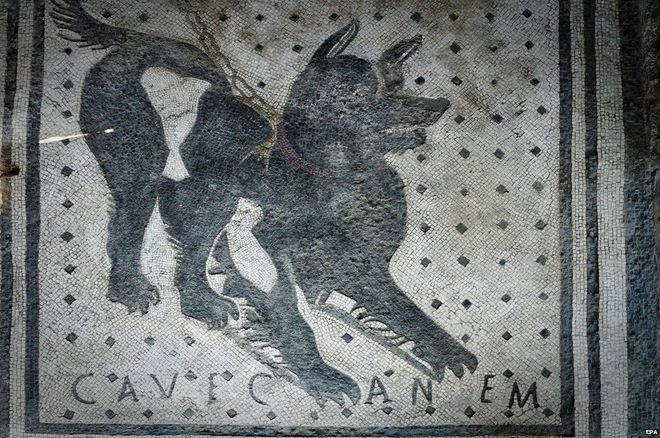
Pompeii guard dog mosaic back on show
One of Pompeii’s finest mosaics – a guard dog at the entrance to a villa.
A vivid Roman dog mosaic is back on show after restoration at Pompeii, despite Italy’s problems funding the historical site’s conservation.
A glass shield now protects the House of the Tragic Poet, where tourists can see the dog with the inscription “Cave Canem” – Latin for “Beware of the dog“.
Frescoes at the house’s entrance were also restored. Ash from a volcanic eruption buried Pompeii in AD79.
A staffing dispute caused long queues at Pompeii on Friday, in searing heat. Pompeii gives visitors an extraordinary insight into everyday life in ancient Rome because many buildings were protected from the elements under the thick blanket of ash from Mount Vesuvius.
The restored mosaic now has better protection.
The site, near the southern city of Naples, has suffered from funding problems for years. Staff unions at Pompeii have criticised a management reorganisation there.
The House of the Tragic Poet has some of Pompeii’s finest examples of interior decoration, including scenes from Greek mythology.
But the house’s owners remain unknown – they may have died in the eruption along with many other Pompeii citizens.
ooOOoo
Now we all know that the relationship between dogs and man goes way, way back before Pompeii but, nonetheless, it’s rather nice to see dogs commemorated in this way from 1,936 years ago.
Stranded orca saved by volunteers who kept it cool for hours until high tide
A pump and sheets were used to keep whale alive near Hartley Bay on B.C.’s North Coast
By Maryse Zeidler, CBC News Posted: Jul 23, 2015 7:20 AM PT – Last Updated: Jul 24, 2015 5:35 AM PT
An orca that was stranded on some rocks was kept alive for eight hours by a dedicated team of whale researchers and volunteers on the North Coast of B.C.
“She cried often, which tore at our hearts, but as the tide came up there were many cheers as this whale was finally free,” said in a Facebook post from the group The Cetacean Lab.
Early Wednesday morning, the group received a call from a colleague about the beached orca, which was stuck on some rocks at low tide.
“We decided the best thing to do would be to keep her cool, that meant to put water on her body and we used blankets and sheets,” said Hermann Meuter, a co-founder of Cetacean Lab.
“It was the only thing we could do.”
Meuter said they could see the orca’s behaviour change as they began to help her.
“At first she was stressed, you could see that her breathing was getting a little faster,” said Meuter.
But after about 15 to 20 minutes, she began to calm down.
“I think she knew that we were there to help her,” said Meuter.
Around 4 p.m. PT, the tide began to rise and the orca was able to start freeing herself.
“It took her about 45 minutes to negotiate how best to get off the rocks,” said Meuter. “We all just kept our distance at that point.”
When she swam away, the orca was quickly reunited with her pod, which was nearby.
Metuer said members of the World Wildlife Fund and the Git G’at Guardians from Hartley Bay were also on the scene helping to free the animal.
“We all cared about this whale and we were just very lucky to give that whale another chance,” said Meuter.
ooOOoo
There are photographs to view on that CBS News item plus this video (wish it could have been longer) was also included in Maryse Zeidler’s report.
Well done to everyone who helped save this magnificent animal.
(I’m conscious that many recent posts have been more of me republishing stuff than being creative on my own account. Blame it on ‘the book’: my first edit is now complete and the next stage is sending the manuscript out to those who have volunteered to proof-read the book.)
I saw this article on Mother Nature Network and it struck me immediately as being full of common-sense and well worth sharing with you.
ooOOoo
How to build the perfect backyard for dogs
Learn which plants are hardy, which are poisonous, and how to create a beautiful but functional layout.
Designing your garden with your dog in mind will prevent an infinite number of headaches down the road. (Photo: upixa/Shutterstock)
A dog and a healthy, beautiful backyard don’t often go hand in hand. The amount of wear and tear a dog throws at a garden can leave it in tatters. But it doesn’t have to be this way! With a bit of planning and a careful selection of plants able to hold up to whatever dogs spray at them, your backyard can be both a haven for humans and a paradise for your pups.
Here are helpful strategies for planning out a yard and a list of plants to use or to avoid.
7 tips for dog-friendly garden design
Build raised beds for the more sensitive plants or for any fruits and vegetables you may want to grow. Add in some fencing or netting around the boxes to protect them if your dog is still tempted to hop up and snoop around in them.
Build a dog-friendly path around the yard. This will guide your dog through the garden and minimize the detours into the flowerbeds. You may want to start by watching where your dog goes on his own, and creating the path along that route. That way you aren’t trying to train your dog to go somewhere he doesn’t normally want to go, and you aren’t frustrated when your dog goes where he wants to anyway.
Providing pathways for your dogs will show them where they’re allowed to run and will help keep them out of more sensitive areas of the garden. (Photo: Julius Elias/Shutterstock)
Discourage digging through design. If your dog sometimes digs holes, you can help keep your garden beds safe by making them raised beds. However, if your dog is a relentless digger and no part of the yard is safe, then consider building an area where your dog can do anything he’d like within that space, including dig. This could be a fenced area that has a sand box, where the outlet of digging is welcomed.
Create a designated area for bathroom breaks. This will of course require training your dog to use it, but the time and effort spent in training will counter any time and money spent in replacing dead plants.
Provide places to sun. Many dogs love to sunbathe and might pick the sunniest spot in the middle of your favorite bed of flowers. Avoid a dog selecting his own area by providing one for him instead. A small deck, or a few paving stones in a pretty design, or even an area with bark chips will be a welcoming place for your dog to lie down, out of the way of the plants.
Create shaded areas to keep your pet comfortable. Yards are the perfect place to hang out in the sun, but on hot days it can feel pretty miserable without relief with a little shade. Plant trees or tall shrubs where your dog can enjoy a cool break from playing in the sun.
If you have a water feature, make sure the water is drinkable and free of chemicals.
Safe and hardy plants for dogs
After figuring out a few design elements to make your yard a place where both dogs and humans can feel comfortable, it’s time to review your plant selection. There are a fair number of plants that are resistant to dog urine. By placing these plants in the areas your dog frequents, you can reduce how much replanting you need to do as well as keep your yard looking fresh and healthy.
Many herbs are not only safe but also healthy for dogs. But you’ll still want to protect them from your dog by growing them in a raised bed or pots. (Photo: Jamie Hooper/Shutterstock)
Luckily, the herbs you likely want to have in your kitchen garden are also healthy for dogs. If you like cooking with these savory staples, you’ll be happy to know they’re more than welcome in your dog-friendly garden! The five best options include:
Basil — antioxidant, antiviral and antimicrobial properties
Oregano — helps digestive problems including diarrhea and gas
Parsley — a source of flavonoids, antioxidants and vitamins
Peppermint — soothes upset stomachs, reduces gas and nausea, and helps with travel sickness
Rosemary — high in iron, calcium and Vitamin B6
Groundcovers are a great alternative to a grassy lawn. Many varieties can withstand abuse from dogs better than any grasses. Great options include:
Carpet bugle
Elfin thyme
Kinnikinick
Miniature stonecrop
Silver carpet
Snow in summer
Winter creeper
Another staple for a dog-friendly yard are urine-resistant plants. Here are a few suggestions:
Bears breech
Burkwood osmanthus
Doublefile viburnum
Feather reed grass
Holly fern
Japanese spindle tree
Mexican sage
New Zealand flax
Redtwig dogwood
Snowball viburnum
Spider plants
Sword fern
Plants poisonous to dogs
Even if they look pretty, there are quite a few plants you should avoid having in your yard because ingesting them can mean illness or death for your pet. It doesn’t mean you can’t have these plants around; it just means you’ll want to plant them in areas your dog can’t access, such as fenced-off portions of the yard or in hanging baskets out of reach. University of California, Davis put together a list of the 12 plants that cause the most visits to their vet hospital. They include:
Aloe vera
All species of amaryllis
Anemone
Asparagus fern
Chrysanthemums
Cycads (including Sago palm and cardboard palm)
Cyclamen
Daffodil
Jade plants
Lilies
Lily of the valley
Philodendrons
The ASPCA provides a full list of plants toxic to dogs. Reviewing this list before planting will help prevent trips to the vet in the future.
Be sure to double check if the plants you’re adding to your garden are toxic to dogs. While some dogs stay out of the plants, others may munch on anything they feel like, which could lead to a trip to the vet’s office. (Photo: Dora Zett/Shutterstock)
Other things your dog could, but shouldn’t eat
Which mulch you select could be important to your dog’s health. Cocoa mulch, made of cocoa bean shells, is a by-product of chocolate production and can be toxic. Most dogs aren’t going to eat mulch and if they do, they probably wouldn’t eat enough to cause a problem. However, if you have a dog that seems to dine on anything and everything, you may want to consider using something like shredded pine instead.
Much like eating mulch, ingesting large amounts of fertilizer can be unhealthy or even life-threatening for your pet. Be sure to use all-natural fertilizers, follow the directions and make sure that your pet isn’t allowed into the fertilized area within the suggested waiting period after application.
Compost piles are a great addition to any garden but depending on what you’re tossing in them, they can also pose problems for pets. Coffee grinds, moldy food and certain types of fruit and vegetables are toxic to dogs. In addition, fungal toxins can grow within the compost piles that can cause problems for your pet’s health and overall immunity if consumed. It’s a good idea to keep your compost in a bin that is off limits to your dog.
It is also a smart idea to ditch the chemical herbicides and pesticides. Not only are they terrible for the environment but they can also have disastrous effects on pets, including causing cancer.
ooOOoo
This is so brimful of good advice that it deserves to be shared as widely as possible.
This is what happens when an animal trainer finds a bear cub.
(Today’s post has a number of very beautiful photographs. However, it is much better presented to you, dear reader, as a standalone post rather than under the umbrella of a Picture Parade.)
Thanks to Suzann for sending this on to me.
ooOOoo
A Man Found Two Bear Cubs Beside Their Dead Mother.
A naturalist named Casey Anderson stumbled across two grizzly bear cubs nestled beside their dead mother in the wild mountains of Alaska . Casey couldn’t just leave these little guys to die in the wilderness, so he made the brave decision to take them with him. He trains animals for a living, so he knew he would be able to give these cubs a real shot. That simple decision, borne out of grief, turned into one of the most unique and adorable rehabilitation stories we have ever laid eyes on.
This is Casey and the little cubs. Unfortunately, only one survived and Casey decided to adopt him.
He named him Brutus.
Brutus grew up as part of the family, albeit a very fuzzy part.
It was Casey’s job to train animals, so raising and training Brutus was normal for him.
oooo
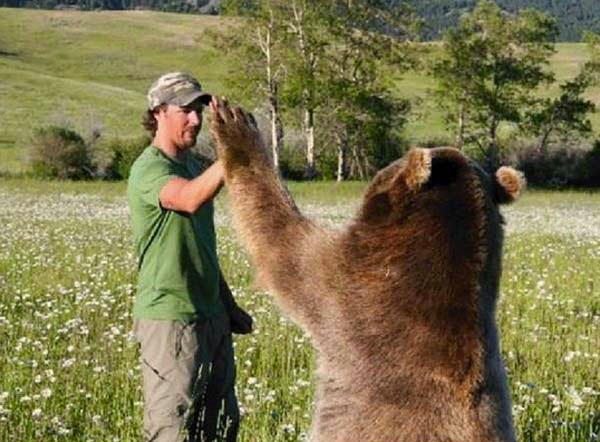
Over the years, they became close friends and brothers.
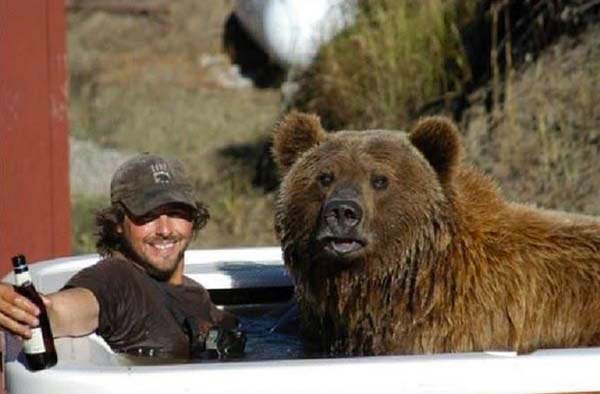
And Brutus got the run of the pool.
oooo
oooo
oooo
Brutus grew to be so close to Casey, he was even his best man (bear) at the wedding.
It may have made the bride a little nervous.
But she was probably glad Brutus wasn’t capable of taking him out to dinner (no thumbs).
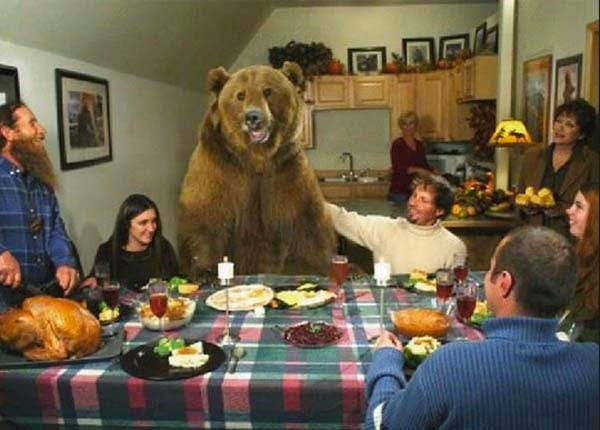
Brutus also gets a place of honor at the Thanksgiving table.
Life is good for this not-so-average bear.
oooo
oooo
oooo
oooo
oooo
You’ll be hard pressed to find a situation cooler than being best friends with a killer grizzly bear. If Casey and Brutus made you smile, then you should probably spread the joy and share this.
This is a lovely story. Shame all humans aren’t this kind and understanding. Though many are and this is a lovely example of such a person.







 oooo
oooo