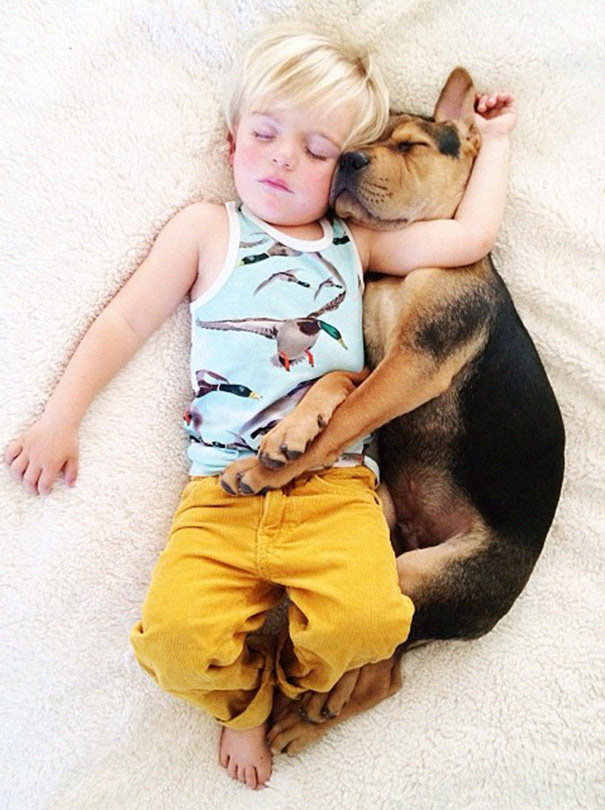
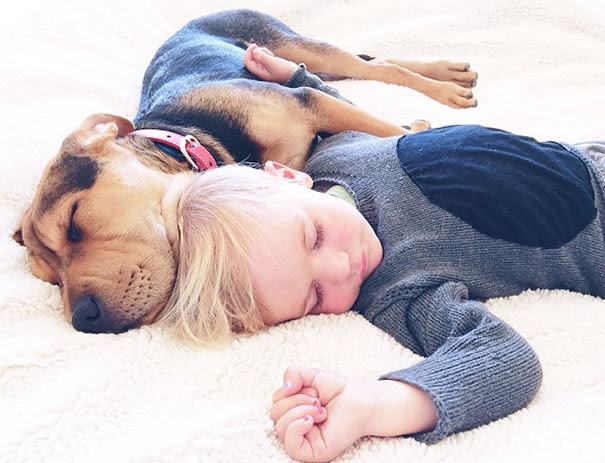
The last of the perfect puppy pictures.

oooo
oooo
oooo

oooo
For those of you that missed the first two sets of these puppy pictures, set number one is here and last week’s set is here.
You all take care out there.
Dogs are animals of integrity. We have much to learn from them.
Category: Environment
The last of the perfect puppy pictures.
oooo
oooo
oooo
oooo
For those of you that missed the first two sets of these puppy pictures, set number one is here and last week’s set is here.
You all take care out there.
Dogs, women and men.
I did warn you, my dear reader, at the end of yesterday’s post that my introspective mood continues!
Over today and tomorrow, I want to explore why we humans can be so incredibly clever, especially in a group sense, yet the males of our species find it so difficult to express themselves, and what that means for the future of humanity (at the risk of sounding a tad pompous).
More or less at random, a dip into yesterday’s selection of blogs brought to light some deeply disturbing items.
Professor William Even, Professor of Economics at the Farmer School of Business at Miami University was reported in The Conversation saying that:
As of 2014, there were approximately 39 million people aged 16-24 in the US, and 5.4 million of them were neither employed nor in school. That’s almost 14% of the age cohort, or more than two-and-a-half times the national rate of unemployment.
In that same bulletin from The Conversation, John Shepherd, a Professorial Research Fellow in Earth System Science at the University of Southampton in England, in writing about the challenges of directly removing CO2 from the atmosphere, stated (my emphasis):
A new paper in Nature Communications shows just how big the required rates of removal actually are. Even under the IPCC’s most optimistic scenario of future CO2 emission levels (RCP2.6), in order to keep temperature rises below 2℃ we would have to remove from the atmosphere at least a few billion tons of carbon per year and maybe ten billion or more – depending on how well conventional mitigation goes.
We currently emit around eight billion tonnes of carbon per year, so the scale of the enterprise is massive: it’s comparable to the present global scale of mining and burning fossil fuels.
Then Raúl Ilargi Meijer authored an item on The Automatic Earth blog, a blog that usually writes almost exclusively about money matters. His article was called: Power and Compassion. He opens his essay:
Time to tackle a topic that’s very hard to get right, and that will get me quite a few pairs of rolling eyes. I want to argue that societies need a social fabric, a social contract, and that without those they must and will fail, descend into chaos.
Then after referring to the European Union, he goes on to write (my emphasis):
Though it may look out of far left field for those of us -and there are many- who think in economic and political terms only, we cannot do without a conscious definition of a social contract. We need to address the role of compassion, morals, even love, in our societies. If Jesus meant anything, it was that.
There have been times through history when this subject would have been much easier to breach, but we today almost seem to think they are irrelevant, that we can do without them. We can’t. But in the US, people get killed at traffic stops every day, and in Europe, they die of sheer negligence. Developments like these will lead to ‘centers that cannot hold’.
In that part of the media whirlwind that we at the Automatic Earth expose ourselves to, virtually all discussions about our modern world, and what goes wrong with it, which is obviously a whole lot, are conducted in rational terms, in financial and political terminology.
But that’s exactly what we should not be doing. Because it’s never going to get us anywhere. In the end, let alone in the beginning too, we are not rational creatures. And if and when we resort to only rational terms to define ourselves, as well as our world and the societies we create in that world, we can only fail.
For a society to succeed, before and beyond any economic and political features are defined, it must be based solidly on moral values, a moral compass, compassion, humanity and simple decency among its members. And those should never be defined by economists or lawyers or politicians, but by the people themselves. A social contract needs to be set up by everyone involved, and with everyone’s consent. Or it won’t last.
How and why that most basic principle got lost should tell us a lot about where we are today, and about how we got here. Morals seem to have become optional. The 40-hour death struggle of Cecil the lion exemplifies that pretty well. And no, his is not some rare case. The lack of morals involved in killing Cecil is our new normal.
Let me now set the stage for what I want to write about tomorrow. And I’m going to do that by referring to a TED Talk that was recorded by historian and author Yuval Noah Harari. Here’s how that TED Talk was introduced:
Seventy thousand years ago, our human ancestors were insignificant animals, just minding their own business in a corner of Africa with all the other animals. But now, few would disagree that humans dominate planet Earth; we’ve spread to every continent, and our actions determine the fate of other animals (and possibly Earth itself). How did we get from there to here? Historian Yuval Noah Harari suggests a surprising reason for the rise of humanity.
Yuval Harari’s talk is based firmly on his thesis presented in his book: Sapiens: A Brief History of Humankind. (There’s a review of his book in The Guardian newspaper.) Namely:
The book surveys the history of humankind from the evolution of archaic human species in the Stone Age up to the twenty-first century. Its main argument is that Homo sapiens dominates the world because it is the only animal that can cooperate flexibly in large numbers. The book further argues that Homo sapiens can cooperate flexibly in large numbers, because it has a unique ability to believe in things existing purely in its own imagination, such as gods, nations, money and human rights. The author claims that all large scale human cooperation systems – including religions, political structures, trade networks and legal institutions – are ultimately based on fiction.
Other salient arguments of the book are that money is a system of mutual trust; that capitalism is a religion rather than only an economic theory; that empire has been the most successful political system of the last 2000 years; that the treatment of domesticated animals is among the worst crimes in history; that people today are not significantly happier than in past eras; and that humans are currently in the process of upgrading themselves into gods.
It is my contention that humankind’s evolution, our ability to “cooperate flexibly in large numbers”, is rooted in the gender differences between man and woman. A contention that I expand upon tomorrow.
That very ancient relationship between man and dog.
The website Eye Witness to History has a lovely item on Mount Vesuvius:
On August 24, 79 Mount Vesuvius literally blew its top, spewing tons of molten ash, pumice and sulfuric gas miles into the atmosphere. A “firestorm” of poisonous vapors and molten debris engulfed the surrounding area suffocating the inhabitants of the neighboring Roman resort cities of Pompeii, Herculaneum and Stabiae. Tons of falling debris filled the streets until nothing remained to be seen of the once thriving communities. The cities remained buried and undiscovered for almost 1,700 years until excavation began in 1748. These excavations continue today and provide insight into life during the Roman Empire.
An ancient voice reaches out from the past to tell us of the disaster. This voice belongs to Pliny the Younger whose letters describe his experience during the eruption while he was staying in the home of his Uncle, Pliny the Elder. The elder Pliny was an official in the Roman Court, in charge of the fleet in the area of the Bay of Naples and a naturalist. Pliny the Younger’s letters were discovered in the 16th century.
If you are keen to read the full article then it may be found here.
My reason for quoting those opening paragraphs is because they offer a good historical introduction to another item from the BBC News website. That item is about a dog mosaic that is back on show after its restoration at Pompeii.
ooOOoo
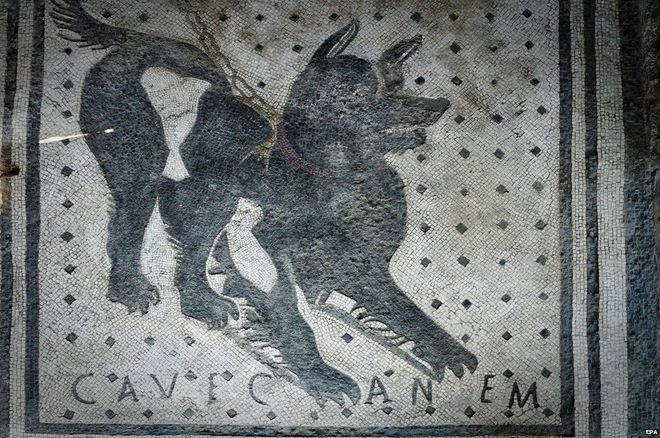
A vivid Roman dog mosaic is back on show after restoration at Pompeii, despite Italy’s problems funding the historical site’s conservation.
A glass shield now protects the House of the Tragic Poet, where tourists can see the dog with the inscription “Cave Canem” – Latin for “Beware of the dog“.
Frescoes at the house’s entrance were also restored. Ash from a volcanic eruption buried Pompeii in AD79.
A staffing dispute caused long queues at Pompeii on Friday, in searing heat. Pompeii gives visitors an extraordinary insight into everyday life in ancient Rome because many buildings were protected from the elements under the thick blanket of ash from Mount Vesuvius.

The site, near the southern city of Naples, has suffered from funding problems for years. Staff unions at Pompeii have criticised a management reorganisation there.
The House of the Tragic Poet has some of Pompeii’s finest examples of interior decoration, including scenes from Greek mythology.
But the house’s owners remain unknown – they may have died in the eruption along with many other Pompeii citizens.
ooOOoo
Now we all know that the relationship between dogs and man goes way, way back before Pompeii but, nonetheless, it’s rather nice to see dogs commemorated in this way from 1,936 years ago.
Wonderful volunteers keep a stranded Orca whale alive.
I saw this shared on Facebook by George Ball, a friend from my English days. It’s a lovely example of the compassionate side of man.
ooOOoo
From CBS News:
A pump and sheets were used to keep whale alive near Hartley Bay on B.C.’s North Coast
By Maryse Zeidler, CBC News Posted: Jul 23, 2015 7:20 AM PT – Last Updated: Jul 24, 2015 5:35 AM PT
An orca that was stranded on some rocks was kept alive for eight hours by a dedicated team of whale researchers and volunteers on the North Coast of B.C.
“She cried often, which tore at our hearts, but as the tide came up there were many cheers as this whale was finally free,” said in a Facebook post from the group The Cetacean Lab.
Early Wednesday morning, the group received a call from a colleague about the beached orca, which was stuck on some rocks at low tide.
“We decided the best thing to do would be to keep her cool, that meant to put water on her body and we used blankets and sheets,” said Hermann Meuter, a co-founder of Cetacean Lab.
“It was the only thing we could do.”
Meuter said they could see the orca’s behaviour change as they began to help her.
“At first she was stressed, you could see that her breathing was getting a little faster,” said Meuter.
But after about 15 to 20 minutes, she began to calm down.
“I think she knew that we were there to help her,” said Meuter.
Around 4 p.m. PT, the tide began to rise and the orca was able to start freeing herself.
“It took her about 45 minutes to negotiate how best to get off the rocks,” said Meuter. “We all just kept our distance at that point.”
When she swam away, the orca was quickly reunited with her pod, which was nearby.
Metuer said members of the World Wildlife Fund and the Git G’at Guardians from Hartley Bay were also on the scene helping to free the animal.
“We all cared about this whale and we were just very lucky to give that whale another chance,” said Meuter.
ooOOoo
There are photographs to view on that CBS News item plus this video (wish it could have been longer) was also included in Maryse Zeidler’s report.
Well done to everyone who helped save this magnificent animal.
How to build the perfect backyard for your dogs.
(I’m conscious that many recent posts have been more of me republishing stuff than being creative on my own account. Blame it on ‘the book’: my first edit is now complete and the next stage is sending the manuscript out to those who have volunteered to proof-read the book.)
I saw this article on Mother Nature Network and it struck me immediately as being full of common-sense and well worth sharing with you.
ooOOoo
Learn which plants are hardy, which are poisonous, and how to create a beautiful but functional layout.
By: Jaymi Heimbuch
July 14, 2015

A dog and a healthy, beautiful backyard don’t often go hand in hand. The amount of wear and tear a dog throws at a garden can leave it in tatters. But it doesn’t have to be this way! With a bit of planning and a careful selection of plants able to hold up to whatever dogs spray at them, your backyard can be both a haven for humans and a paradise for your pups.
Here are helpful strategies for planning out a yard and a list of plants to use or to avoid.
7 tips for dog-friendly garden design
Build raised beds for the more sensitive plants or for any fruits and vegetables you may want to grow. Add in some fencing or netting around the boxes to protect them if your dog is still tempted to hop up and snoop around in them.
Build a dog-friendly path around the yard. This will guide your dog through the garden and minimize the detours into the flowerbeds. You may want to start by watching where your dog goes on his own, and creating the path along that route. That way you aren’t trying to train your dog to go somewhere he doesn’t normally want to go, and you aren’t frustrated when your dog goes where he wants to anyway.

Discourage digging through design. If your dog sometimes digs holes, you can help keep your garden beds safe by making them raised beds. However, if your dog is a relentless digger and no part of the yard is safe, then consider building an area where your dog can do anything he’d like within that space, including dig. This could be a fenced area that has a sand box, where the outlet of digging is welcomed.
Create a designated area for bathroom breaks. This will of course require training your dog to use it, but the time and effort spent in training will counter any time and money spent in replacing dead plants.
Provide places to sun. Many dogs love to sunbathe and might pick the sunniest spot in the middle of your favorite bed of flowers. Avoid a dog selecting his own area by providing one for him instead. A small deck, or a few paving stones in a pretty design, or even an area with bark chips will be a welcoming place for your dog to lie down, out of the way of the plants.
Create shaded areas to keep your pet comfortable. Yards are the perfect place to hang out in the sun, but on hot days it can feel pretty miserable without relief with a little shade. Plant trees or tall shrubs where your dog can enjoy a cool break from playing in the sun.
If you have a water feature, make sure the water is drinkable and free of chemicals.
Safe and hardy plants for dogs
After figuring out a few design elements to make your yard a place where both dogs and humans can feel comfortable, it’s time to review your plant selection. There are a fair number of plants that are resistant to dog urine. By placing these plants in the areas your dog frequents, you can reduce how much replanting you need to do as well as keep your yard looking fresh and healthy.

Luckily, the herbs you likely want to have in your kitchen garden are also healthy for dogs. If you like cooking with these savory staples, you’ll be happy to know they’re more than welcome in your dog-friendly garden! The five best options include:
Groundcovers are a great alternative to a grassy lawn. Many varieties can withstand abuse from dogs better than any grasses. Great options include:
Another staple for a dog-friendly yard are urine-resistant plants. Here are a few suggestions:
Plants poisonous to dogs
Even if they look pretty, there are quite a few plants you should avoid having in your yard because ingesting them can mean illness or death for your pet. It doesn’t mean you can’t have these plants around; it just means you’ll want to plant them in areas your dog can’t access, such as fenced-off portions of the yard or in hanging baskets out of reach. University of California, Davis put together a list of the 12 plants that cause the most visits to their vet hospital. They include:
The ASPCA provides a full list of plants toxic to dogs. Reviewing this list before planting will help prevent trips to the vet in the future.

Other things your dog could, but shouldn’t eat
Which mulch you select could be important to your dog’s health. Cocoa mulch, made of cocoa bean shells, is a by-product of chocolate production and can be toxic. Most dogs aren’t going to eat mulch and if they do, they probably wouldn’t eat enough to cause a problem. However, if you have a dog that seems to dine on anything and everything, you may want to consider using something like shredded pine instead.
Much like eating mulch, ingesting large amounts of fertilizer can be unhealthy or even life-threatening for your pet. Be sure to use all-natural fertilizers, follow the directions and make sure that your pet isn’t allowed into the fertilized area within the suggested waiting period after application.
Compost piles are a great addition to any garden but depending on what you’re tossing in them, they can also pose problems for pets. Coffee grinds, moldy food and certain types of fruit and vegetables are toxic to dogs. In addition, fungal toxins can grow within the compost piles that can cause problems for your pet’s health and overall immunity if consumed. It’s a good idea to keep your compost in a bin that is off limits to your dog.
It is also a smart idea to ditch the chemical herbicides and pesticides. Not only are they terrible for the environment but they can also have disastrous effects on pets, including causing cancer.
ooOOoo
This is so brimful of good advice that it deserves to be shared as widely as possible.
This is what happens when an animal trainer finds a bear cub.
(Today’s post has a number of very beautiful photographs. However, it is much better presented to you, dear reader, as a standalone post rather than under the umbrella of a Picture Parade.)
Thanks to Suzann for sending this on to me.
ooOOoo
A Man Found Two Bear Cubs Beside Their Dead Mother.
A naturalist named Casey Anderson stumbled across two grizzly bear cubs nestled beside their dead mother in the wild mountains of Alaska . Casey couldn’t just leave these little guys to die in the wilderness, so he made the brave decision to take them with him. He trains animals for a living, so he knew he would be able to give these cubs a real shot. That simple decision, borne out of grief, turned into one of the most unique and adorable rehabilitation stories we have ever laid eyes on.

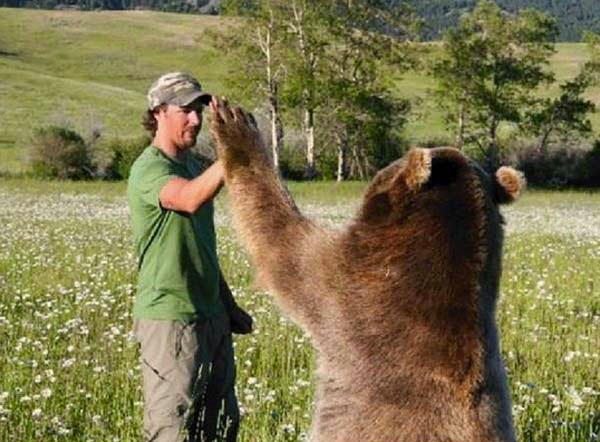
This is Casey and the little cubs. Unfortunately, only one survived and Casey decided to adopt him.
He named him Brutus.

Brutus grew up as part of the family, albeit a very fuzzy part.

It was Casey’s job to train animals, so raising and training Brutus was normal for him.
 oooo
oooo

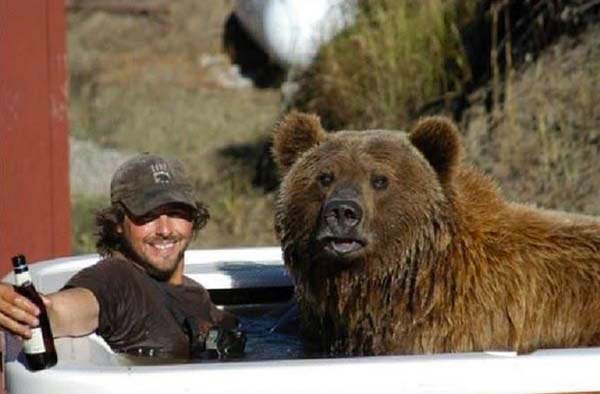
Over the years, they became close friends and brothers.

And Brutus got the run of the pool.

oooo

oooo

oooo

Brutus grew to be so close to Casey, he was even his best man (bear) at the wedding.

It may have made the bride a little nervous.

But she was probably glad Brutus wasn’t capable of taking him out to dinner (no thumbs).
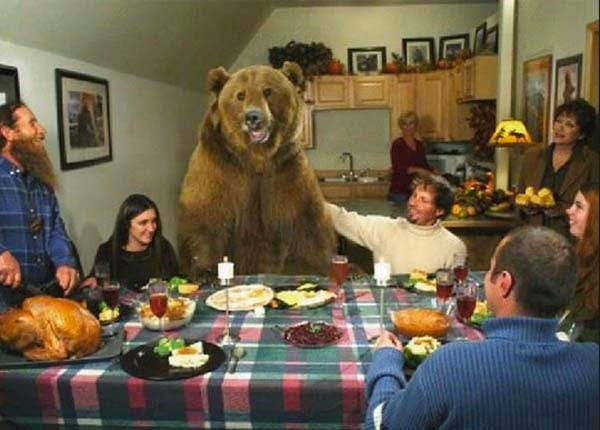
Brutus also gets a place of honor at the Thanksgiving table.

Life is good for this not-so-average bear.

oooo

oooo
oooo
oooo

oooo

You’ll be hard pressed to find a situation cooler than being best friends with a killer grizzly bear. If Casey and Brutus made you smile, then you should probably spread the joy and share this.
This is a lovely story. Shame all humans aren’t this kind and understanding. Though many are and this is a lovely example of such a person.
Lessons from the wild
At the end of 2013, I published a post under the title of We must rewild. The core of that post was an essay from Patrice Aymes called Rewilding Us. Here’s a small extract from that essay:
In Africa, there are about 500,000 elephants. 25,000 to 30,000 are killed, a year, to send the ivory to east Asia (China, Vietnam). So African elephants may disappear. This is beyond tragic, it’s irreplaceable. Elephants understand people’s gestures, without any learning (they apparently learn to use trunk gestures among themselves). One is talking about extremely intelligent animals here. (In contrast, chimpanzees have great difficulties understanding human gestures.)
My post also included this photograph of young Cleo, just five months old, showing that her innate skills of being in the wild were alive and well, despite thousands of years of dogs being domesticated animals. Ergo, humans could manage just as well.

Last Friday, George Monbiot published an essay in The Guardian newspaper that stays with the theme of loving the wild. It is republished here with Mr. Monbiot’s very kind permission.
ooOOoo
17th July 2015
Rebuilding our relationship with the natural world can re-animate our own lives, as well as the ecosystem.
When the robin was voted the UK’s national bird last month, we chose to celebrate half of a broken relationship. The robin is to the wild boar what the oxpecker is to the Cape buffalo: it has evolved to catch the worms and insects exposed by their grubbing. But boar are mostly absent from the UK, so its survival often depends on finding the next best thing: human gardeners. This is why the robin is so tame in this country. As far as the bird is concerned, you and I are just fake pigs.
We are surrounded by such broken relationships, truncated natural processes, cauterised ecologies. In Britain we lack almost all large keystone species: ecological engineers that drive the fascinating dynamics which allow other lifeforms to flourish. Boar, beavers, lynx, wolves, whales, large sharks, pelicans, sturgeon: all used to be abundant here, all, but for a few small populations or rare visitors, are missing.
The living systems that conservationists seek to protect in some parts of this country are a parody of the natural world, kept, through intensive management, in suspended animation, like a collection in a museum. An ecosystem is not just a place. It is also a process.
I believe their diminished state also restricts the scope of human life. We head for the hills to escape the order and control that sometimes seem to crush the breath out of us. When we get there, we discover that the same forces prevail. Even our national parks are little better than wet deserts.
Our seas were once among the richest on earth. A few centuries ago, you could have watched fin whales and sperm whales hammering the herring within sight of the shore. Shoals of bluefin tuna thundered up the North Sea. Reefs of oysters and other sessile animals covered the seabed, over which giant cod, skate and halibut cruised. But today, industrial fishing rips up the living fabric of all but 0.01% of our territorial waters. To walk or dive in rich environments we must go abroad.
Though not, I hope, for long. On Wednesday, a new organisation, Rewilding Britain, was launched. (It was inspired by my book Feral and I helped to found it, but I don’t have a position there). Its aim is to try to catalyse the mass restoration of the living world, bring trees back to bare hills, allow reefs to form once more on the seabed and to return to these shores the magnificent, entrancing animals of which we have so long been deprived. Above all it seeks to enhance and enrich the lives of the people of this nation. I hope that it might help to change the face of Britain.
Already, local projects hint at what could be achieved. In the southern uplands of Scotland, the Borders Forest Trust has bought 3000 hectares of bare mountainside and planted hundreds of thousands of native trees. The community of Arran seabed trust in the Firth of Clyde managed, after 13 years of campaigning, to persuade the government to exclude trawlers and scallop dredgers from one square mile of seabed. The result, in this tiny reserve, is an explosion of lobsters, crabs, scallops and fish. It’s now trying to extend the project to a larger area.
In Sussex, the Knepp Castle estate gave up its unprofitable wheat farming, released a few cattle and pigs and let natural processes take over. Now it hosts some of Britain’s highest populations of nightingales, purple emperor butterflies and turtle doves. Partly through ecotourism and accommodation and selling high-grade meat, it has become profitable. In south London, the Wandle Trust has turned a mangled and polluted urban river back into a beautiful chalkstream, supporting kingfishers and wild trout. Wonderful as these projects are, until now they have lacked a national voice. Britain remains in a state of extreme depletion.
Some people argue that we should not seek to re-establish missing species until we’ve protected existing wildlife. But nothing better protects our ecosystems than keystone species. Beaver dams provide habitats for fish, invertebrates, amphibians and waterbirds. In Ireland, resurgent pine martens appear to have pushed back the grey squirrel, allowing red squirrels to recolonise. One study suggests that our woodland ecology cannot recover unless half the country’s deer are culled every year. Lynx could do it for nothing. Functional ecosystems, in which dynamic living processes prevail once more, are likely to be more resistant to climate change than stagnant collections in virtual glass cases.
Over the past two years, there has been a surge of enthusiasm for change. A poll in Scotland found that 60% support the reintroduction of beavers, with only 5% opposed. 91% of respondents to a survey by the Lynx UK Trust supported a trial reintroduction. Researchers at the University of Cumbria digitally altered photographs of Borrowdale in the Lake District, adding or subtracting trees. 69% of the people who saw them favoured the images with extra trees. A video extracted from my TED talk, about the relationship between wolves and other wildlife, has been watched 18 million times.
But the interests of local people must never be overruled. Rewilding must take place only with active consent. Already, landowners are coming forward, proposing to rewild their own property. Community groups, such as Cambrian Wildwood in mid-Wales, are seeking to buy and restore surrounding land. What rewilding offers is a new set of options in places where traditional industries can no longer keep communities alive, where schools and shops and chapels and pubs are closing and young people are leaving the land to find work elsewhere.
In the hills of southern Norway, the return of trees has been accompanied by a diversification and enrichment of the local economy. There, the small income from farming is supplemented with eco-tourism, forest products, rough hunting, fishing, outdoor education, skiing and hiking. The governments of Britain now claim to be willing to pay for the protection of soils and watersheds. These are likely to be more resilient sources of income than the current farm subsidy system upon which all hill farming in this country depends, whose gross injustice – transferring vast sums from the poor to the rich simply for owning land – is as unsustainable politically as it is ecologically.
Perhaps most importantly, rewilding offers hope. It offers the hope of recovery, of the enhancement of wonder and enchantment and delight in a world that often seems crushingly bleak. My involvement with rewilding, to my own amazement, has made me much happier and more optimistic than I was before. I feel an almost evangelical sense of excitement about the prospects for change. I want other people to be able to experience it too.
In 2009, the rewilding pioneers Trees for Life released some wild boar into an enclosure at Dundreggan, in the Scottish Highlands. Within twenty minutes, robins came down from the trees and started following them. Their ecological memory was intact. When I’ve accompanied children from deprived London boroughs to the woods and rockpools for the first time in their lives, I have seen something similar: an immediate, instinctive re-engagement, the restoration of a broken ecological relationship. Once we have richer wild places to explore, we won’t need much prompting to discover their enchantments.
ooOOoo
In the copy of George Monbiot’s essay that was published on his blogsite there were 25 links to other materials. I feel very bad that I just didn’t have the time to copy across all those links so my strong recommendation is that if you enjoyed reading this here then you go across to the essay on his blogsite and check out all the additional material available to you. My only exception was to insert the link to the organisation Rewilding Britain that was referred to in the sixth paragraph.
Our neighbourhood watch garage sale has Jean and me fully occupied for these next two days.
Plus much of yesterday afternoon was spent getting our ‘site’ all set up ready for today.
I have taken the opportunity of showing you two videos, one today and one tomorrow.
This was sent to me by Suzann and will melt your heart in a very big way.
►If watching the flowering of love could inspire love, then “The Story Of The Weeping Camel” would forever alter the world…
►The Story of the Weeping Camel.
Mongolian: Ингэн нулимс, Ingen nulims, “Tears of the Camel” is a 2003 German docudrama released internationally in 2004.►During Spring, a family of nomadic shepherds in the Gobi Desert, South Mongolia, assists the births of their camel herd. The last camel to calve this season has a protracted labor that persists for two days. With the assistance and intervention of the family, a rare white bactrian camel (Camelus bactrianus) calf is born.
This is the mother camel’s first calving. Despite the efforts of the shepherds, the mother rejects the newborn, refusing it her milk and failing to establish a care-bond with it. The family resolve to secure the services of an indigenous ‘violinist’ to play the music for a Mongolian ‘Hoos’ ritual.When repeatedly intoned the calming sounds and beautiful melody of the violin, the mother camel starts to weep, tears visibly streaming from her eyes. Immediately after the rite the mother and calf are reconciled and the calf draws milk from her teat.
►Added music: Sad Romance – Thao Nguyen Xanh
I can’t resist this essay from George Monbiot.
As regular followers of Learning from Dogs will know, I frequently republish essays written by George Monbiot. I do so because there is only so much one can write about dogs, Mr. Monbiot is a great writer, and the gentleman has generously given me blanket permission to republish his essays! 😉
Plus, while many of my posts are directly about dogs, the underlying theme of this blog is to use the qualities of dogs as emblems, or metaphors, for how mankind has to behave if we are to have any chance of survival into the longterm. Or in the words of my essay on Dogs and integrity:
Because of this closeness between dogs and man, we (as in man!) have the ability to observe the way they live. Now I’m sure that scientists would cringe with the idea that the way that a dog lives his life sets an example for us humans, well cringe in the scientific sense. But man seems to be at one of those defining stages in mankind’s evolution where the forces bearing down on the species homo sapiens have the potential to cause very great harm. If the example of dogs can provide a beacon of hope, an incentive to change at a deep cultural level, then the quicker we ‘get the message’, the better it will be.
All of which is my way of introducing Mr. Monbiot’s latest essay on the recent shenanigans involving Greece, in particular, and the EU, in general.
ooOOoo
13th July 2015
The European Union is becoming ever harder for progressives to love. Is it time to get out?
By George Monbiot, published on the Guardian’s website, 10th July 2015
Had I been asked a couple of years ago how I would vote in the referendum on whether or not the UK should stay in the European Union, my answer would have been unequivocal.
The EU seemed to me to be a civilising force, restraining the cruel and destructive tendencies of certain member governments (including our own), setting standards that prevented them from destroying the natural world or trashing workers rights, creating a buffer between them and the corporate lobby groups that present an urgent threat to democracy.
Now I’m not so sure. Everything good about the European Union is in retreat; everything bad is on the rampage.
I accept the principle of sharing sovereignty over issues of common concern. I do not accept the idea of the rich nations combining to crush the democratic will of the poorer nations, as they are seeking to do to Greece.
I accept the principle that the European Union should represent our joint interests in creating treaties for the betterment of humankind. I do not accept that it has a right to go behind our backs and quietly negotiate a treaty with the United States – the Transatlantic Trade and Investment Partnership (TTIP) – that transfers power from parliaments to corporations.
I accept the principle that the EU could distribute money to the poor and marginalised. I do not accept that, as essential public services are cut, €57bn a year should be sloshed into the pockets of farmers, with the biggest, richest landowners receiving the largest payments. The EU’s utter failure to stop this scandal should be a source of disillusionment even to its most enthusiastic supporters.
While these injustices, highly damaging to the reputation of the European Union among people who might otherwise be inclined to defend it, are taking place, at the same time the EU’s restraints on unaccountable power are in danger of being ripped away.
The slippage began with the disastrous abandonment last year of the Soil Framework Directive, at the behest of agricultural lobbyists and the British government. It’s the first time a directive has been derailed.
The directive would have obliged the member states to minimise soil erosion and compaction, maintain the organic matter contained in the soil, prevent landslides and prevent soil from being contaminated with toxic substances. Could any sentient person object to these aims? And can anyone who has studied the complete failure of current soil protection measures in countries like the United Kingdom, where even Farmer’s Weekly admits that “British soils are reaching crisis point” fail to see that further measures are required?
The National Farmers Union, who appear to regard it as their mission to vandalise the fabric of the nation, took credit for the decision.
Now the same industries are trying to sink the directives protecting the natural world. In some European countries, the nature directives are just about all that prevent the eradication of the wildlife that belongs to everyone and no one. Thanks to the capture and cowardice of the European Commission, there is now a real danger that the industrial lobbyists who want to destroy our common heritage will get their way.
The European Union’s two nature directives – the Birds Directive and the Habitats Directive – are often all that stand between our wildlife and the industries that would destroy them.
Look, for example, at what’s happening to our harbour porpoises. These beautiful creatures, that enhance the lives of everyone who has seen them leaping and playing the sea, are being caught and killed in fishing nets, starved to death by overfishing, mashed up by propellers and driven out of their feeding grounds by a cacophony of underwater noise from boats.
The only way in which they can be protected is through creating areas in which these activities are restricted, particularly in places such as the Hebrides, the outer Moray Firth and in parts of Cardigan Bay. But the only site the government has proposed is a tiny speck of sea off the coast of Northern Ireland.
The one defence this species has against the mailed fist of the fishing industry, which appears to be locked around the sensitive parts of the UK’s environment department, is an appeal under the Habitats Directive, of which this country is blatantly in breach.
Or look at the continued massacre of birds of prey by grouse shooting estates, which operate as black holes in which hen harriers, peregrines, eagles and other species disappear without trace: shot, trapped or poisoned by an industry that exists to serve the ultra-elite, while damaging the common heritage of humankind. There’s no point in asking nicely: representing the interests of the ultra-elite while damaging the common interests of humankind appears to be the government’s mission. So the only possible restraint is an appeal under the Birds Directive, which the UK government signed and still claims to uphold.
Badly and erratically as we protect our precious species and the places in which they live, they would be in a much worse state were it not for the restraining influence of European law.
I happen to think that there is quite a lot wrong with the Habitats Directive. Some of the places it protects, at the behest of national governments, are highly degraded ecosystems, and it locks them into their depleted state, ensuring that they can recover neither the wealth of species that might live there, nor much of the dynamism and ecological function that could otherwise have been restored.
The irrational way in which upland heather moors are protected is one example. Like the strikingly similar landscapes of low wiry vegetation that you can now see in some former rainforest areas in the tropics, these habitats have been created through repeated cycles of cutting and burning. This destruction is necessary to keep these wastelands in their current state, by preventing trees from returning.
While we decry these processes when we see them take place abroad, here we treat them as if they were essential conservation tools. It’s a form of madness which afflicts everyone from grouse moor owners to conservationist groups, and it reflects an astonishing loss of perspective on the part of those who should be protecting the natural world. The Habitats Directive is one of the legal instruments that has turned this continued destruction into a legal requirement.
But the European Commission’s proposals to “reform” the directives, are likely to make them worse, not better. The danger is that it will leave their irrational aspects intact, while stripping away the essential protections they offer to our wildlife.
No one is in any doubt that the “reform” being proposed is the kind that is usually enacted with a can of petrol and a box of matches. In November last year, Jean-Claude Juncker, the president of the European Commission, instructed the Environment Commissioner to “overhaul” the directives and to examine the possibility of merging them. A reliable if sometimes eccentric set of protections is now at mortal risk.
A public consultation on these proposals is taking place at the moment, and it closes on July 24. I’ll repeat that because the only hope these directives possess is a huge public response calling for their defence. The consultation closes on July 24. Please send in your views. Already, 270,000 people have done so, prompted by campaigning organisations such as the RSPB. Let’s turn this into half a million.
The ostensible purpose of this proposed vandalism is to reduce the costs to business. But when the Conservative former president of Bavaria, Edmund Stoiber, was asked by the European Commission to conduct a review of all European legislation, with a view to deregulating it, he discovered that the combined impact of all seven of the EU’s environmental directives (of which birds and habitats are just two) is less than 1% of the total cost to business caused by European law. In other words it is utterly insignificant.
In fact, changing these directives could be costly for businesses, as they have already adapted their practices to meet them, and they would have to start all over again if the laws are changed.
The threat to the directives arises not from a demand by business as a whole, but from pressure by two of the most destructive industries in the European Union, Big Farmer and the construction lobby. That the European Commission should have chosen to listen to them while ignoring the views of everyone else cuts to the heart of what is going wrong there.
So when the referendum comes, I will find myself in a struggle I never anticipated. I am an internationalist. I think it’s essential that issues which transcend national borders are tackled together, rather than apart. I recognise the hideous history of conflict in Europe, and the extraordinary achievement of peace that the European Union represents. I feel nothing in common with the Eurosceptics of the right, who appear to see the EU as interfering with their god-given right to exploit other people and destroy their surroundings.
My feelings towards the EU are now similar to my feelings towards the BBC: a sense that I ought to join the defence of this institution against reactionary forces, but that it has succumbed so catastrophically to those forces that there is little left to defend. If the nature directives go down, while TTIP and the fiscal waterboarding of countries like Greece proceed, it will not be obvious what continued membership has to offer us.
ooOOoo
Difficult to add anything of value to these powerful words from GM other than to remind everyone, both in the EU and outside (for the survey accepts non-EU resident contributions), to complete the survey highlighted by George Monbiot. The link is here.
Dogs and humans go back even further than previously thought.
Humans and dogs were constant companions well before our ancestors settled in villages and started growing crops 10,000 years ago …
I have no doubt that thousands of dog owners all around the world must be enthralled by the way that dogs relate to us and, in turn, how we humans relate to dogs. More than once a day, one of our dogs will do something that has me and Jean marvelling at their way of living so close to us.
Then when one starts to reflect on how long dogs and humans have been together, perhaps it could be seen as the direct result of that length of relationship.
Now there’s nothing new in me writing this, after all the home page of Learning from Dogs states:
Yet they have been part of man’s world for an unimaginable time, at least 30,000 years. That makes the domesticated dog the longest animal companion to man, by far!
Back in May the website Livescience published an article that revealed more about the length of our relationship with dogs. This is how it opened:
Ancient Wolf DNA Could Solve Dog Origin Mystery
by Becky Oskin, Senior Writer
Humans and dogs were constant companions well before our ancestors settled in villages and started growing crops 10,000 years ago, a new study suggests.
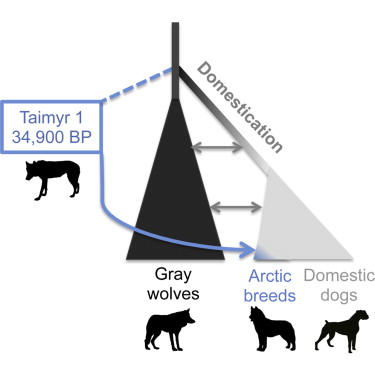
Genetic evidence from an ancient wolf bone discovered lying on the tundra in Siberia’s Taimyr Peninsula reveals that wolves and dogs split from their common ancestor at least 27,000 years ago. “Although separation isn’t the same as domestication, this opens up the possibility that domestication occurred much earlier than we thought before,” said lead study author Pontus Skoglund, who studies ancient DNA at Harvard Medical School and the Broad Institute in Massachusetts. Previously, scientists had pegged the wolf-dog split at no earlier than 16,000 years ago.
The Livescience article referred to results that were published in the journal Current Biology on May 21st this year. One needs a subscription to read the full report but here is their summary:
The origin of domestic dogs is poorly understood [ 1–15 ], with suggested evidence of dog-like features in fossils that predate the Last Glacial Maximum [ 6, 9, 10, 14, 16 ] conflicting with genetic estimates of a more recent divergence between dogs and worldwide wolf populations [ 13, 15, 17–19 ]. Here, we present a draft genome sequence from a 35,000-year-old wolf from the Taimyr Peninsula in northern Siberia. We find that this individual belonged to a population that diverged from the common ancestor of present-day wolves and dogs very close in time to the appearance of the domestic dog lineage. We use the directly dated ancient wolf genome to recalibrate the molecular timescale of wolves and dogs and find that the mutation rate is substantially slower than assumed by most previous studies, suggesting that the ancestors of dogs were separated from present-day wolves before the Last Glacial Maximum. We also find evidence of introgression from the archaic Taimyr wolf lineage into present-day dog breeds from northeast Siberia and Greenland, contributing between 1.4% and 27.3% of their ancestry. This demonstrates that the ancestry of present-day dogs is derived from multiple regional wolf populations.
That summary page also includes the following Graphical Abstract:
I don’t have permission to republish the Livescience article in full but would like to offer the closing paragraphs of this fascinating report.
“It is a very well-done paper,” Perry [George Perry, an expert in ancient DNA at Pennsylvania State University] told Live Science. “This topic is a critical one for our understanding of human evolution and human-environment interactions in the Paleolithic. Partnership with early dogs may have facilitated more efficient hunting strategies.”
If dogs first befriended hunter-gatherers, rather than farmers, then perhaps the animals helped with hunting or keeping other carnivores away. For instance, an author of a new book claims humans and dogs teamed up to drive Neanderthals to extinction. Skoglund also suggested the Siberian husky followed nomads across the Bering Land Bridge, picking up wolf DNA along the way.
“It might have been beneficial for them to absorb genes that were adapted to this high Arctic environment,” Skoglund said.
This is the first wolf genome from the Pleistocene, and more ancient DNA from prehistoric fossils could provide further insights into the relationship between wolves, dogs and humans, the researchers said.
Yes, our dogs have been part of man’s world for an unimaginable time – and Jean and I, as with tens of thousands of others, can’t imagine a world without dogs.
 Learning from Dogs