Category: Environment

The Cave of Crystal Giants

This will take us away from the daily beat of life!

On the 18th. February the BBC News website carried an article that I found incredible. It was the story of Naica’s crystal caves in Mexico.

oooo

Naica’s crystal caves hold long-dormant life

By Jonathan Amos, BBC Science Correspondent, Boston, 18 February 2017.
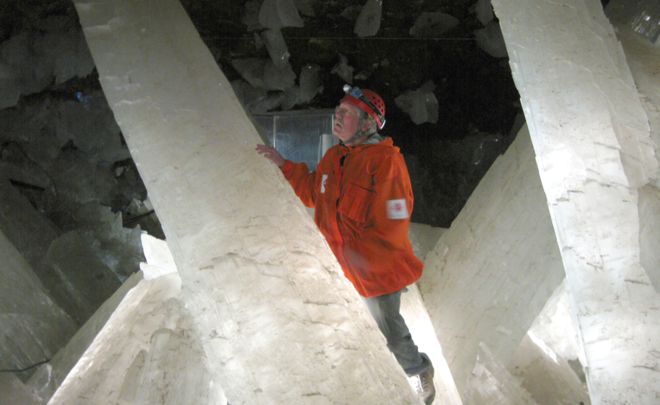
 The caves were discovered by miners 100 years ago
The caves were discovered by miners 100 years ago. Picture credit: Penelope J. Boston

It is a remarkable discovery in an amazing place.

Scientists have extracted long-dormant microbes from inside the famous giant crystals of the Naica mountain caves in Mexico – and revived them. [Ed: my emphasis]

The organisms were likely to have been encased in the striking shafts of gypsum at least 10,000 years ago, and possibly up to 50,000 years ago.

It is another demonstration of the ability of life to adapt and cope in the most hostile of environments.

“Other people have made longer-term claims for the antiquity of organisms that were still alive, but in this case these organisms are all very extraordinary – they are not very closely related to anything in the known genetic databases,” said Dr Penelope Boston.

The new director of Nasa’s Astrobiology Institute in Moffett Field, California, described her findings here at the annual meeting of the American Association for the Advancement of Science (AAAS).

oooo

I was delighted to find more details in many other places on the ‘web’.

Such as this one on the National Geographic website:

By Victoria Jaggard

PUBLISHED February 17, 2017

Boston, Massachusetts

Creatures that thrive on iron, sulfur, and other chemicals have been found trapped inside giant crystals deep in a Mexican cave. The microbial life-forms are most likely new to science, and if the researchers who found them are correct, the organisms are still active even though they have been slumbering for tens of thousands of years.

If verified, the discovery adds to evidence that microbial life on Earth can endure harsher conditions in isolated places than scientists previously thought possible. (See “Life Found Deep Under Antarctic Ice for First Time?”)

“These organisms have been dormant but viable for geologically significant periods of time, and they can be released due to other geological processes,” says NASA Astrobiology Institute director Penelope Boston, who announced the find today at a meeting of the American Association for the Advancement of Science. “This has profound effects on how we try to understand the evolutionary history of microbial life on this planet.”

Then there’s another article on that NatGeo website: (Apologies for some duplication in the message.)

By Neil Shea, National Geographic Staff
In a nearly empty cantina in a dark desert town, the short, drunk man makes his pitch. Beside him on the billiards table sits a chunk of rock the size of home plate. Dozens of purple and white crystals push up from it like shards of glass. “Yours for $300,” he says. “No? One hundred. A steal!” The three or four other patrons glance past their beers, thinking it over: Should they offer their crystals too? Rock dust on the green felt, cowboy ballads on the jukebox. Above the bar, a sign reads, “Happy Hour: 8 a.m. to 9 p.m.”

This remote part of northern Mexico, an hour or so south of Chihuahua, is famous for crystals, and paychecks at the local lead and silver mine, where almost everyone works, are meager enough to inspire a black market. “Thirty dollars.” He leans in. “Ten.” It’s hard to take him seriously. Earlier in the day, in a cave deep below the bar, I crawled among the world’s largest crystals, a forest of them, broad and thick, some more than 30 feet long and half a million years old. So clear, so luminous, they seemed extraterrestrial. They make the chunk on the pool table seem dull as a paperweight.

Nothing compares with the giants found in Cueva de los Cristales, or Cave of Crystals. The limestone cavern and its glittering beams were discovered in 2000 by a pair of brothers drilling nearly a thousand feet below ground in the Naica mine, one of Mexico’s most productive, yielding tons of lead and silver each year. The brothers were astonished by their find, but it was not without precedent. The geologic processes that create lead and silver also provide raw materials for crystals, and at Naica, miners had hammered into chambers of impressive, though much smaller, crystals before. But as news spread of the massive crystals’ discovery, the question confronting scientists became: How did they grow so big?

It takes 20 minutes to get to the cave entrance by van through a winding mine shaft. A screen drops from the van’s ceiling and Michael Jackson videos play, a feature designed to entertain visitors as they descend into darkness and heat. In many caves and mines the temperature remains constant and cool, but the Naica mine gets hotter with depth because it lies above an intrusion of magma about a mile below the surface. Within the cave itself, the temperature leaps to 112 degrees Fahrenheit with 90 to 100 percent humidity—hot enough that each visit carries the risk of heatstroke. By the time we reach the entrance, everyone glistens with sweat.

That article continues here.
Finally, lose yourself in this video. (If the voice doesn’t get to you!)

How to close today’s post?

Both by embracing the power of the natural order of things, life and death, and by reminding us all that there are in the order of over two billion stars in this universe.

That universe must be teeming with life, current and dormant, and the day when we truly confirm that will put everything into perspective!

oooo

Talk about synchronicity!

For yesterday, around 10am PST, the BBC News website carried this big news item: Earliest evidence of life on Earth ‘found’.

Here’s how that article opens:

Earliest evidence of life on Earth ‘found’

By Pallab Ghosh Science correspondent, BBC News
Scientists have discovered what they say could be fossils of some of the earliest living organisms on Earth.
They are represented by tiny filaments, knobs and tubes in Canadian rocks dated to be up to 4.28 billion years old.
That is a time not long after the planet’s formation and hundreds of millions of years before what is currently accepted as evidence for the most ancient life yet found on Earth.

The researchers report their investigation in the journal Nature.

As with all such claims about ancient life, the study is contentious. But the team believes it can answer any doubts.

The scientists’ putative microbes from Quebec are one-tenth the width of a human hair and contain significant quantities of haematite – a form of iron oxide or “rust”.

Matthew Dodd, who analysed the structures at University College London, UK, claimed the discovery would shed new light on the origins of life.

Do read the full article including viewing some wonderful photographs.
Stupendous!

From the sublime to the amazing!

First, the sublime.

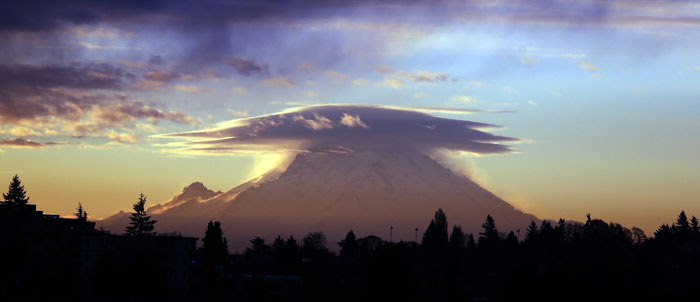
As in this stunning picture from the latest Cloud Appreciation Society newsletter.

A cap cloud at sunrise over Mount Rainier, spotted from Seattle, Washington, US, by Elaine Thompson (Member 41974).

“Though outwardly a gloomy shroud,
The inner half of every cloud
Is bright and shining:
I therefore turn my clouds about,
And always wear them inside out
To show the lining.”

[From ‘The Wisdom of Folly’ by Ellen Thorneycroft Fowler in Verses, Wise or Otherwise (1895)]

Then to the amazing!

It’s hard to comprehend the sheer size of objects in space, but take 2 minutes and give it a try!

This video is from the European Southern Observatory (ESO) comparing the sizes of Earth, our sun and stars.

Small miracles

It’s not just the rescuing of people that matters.

Last Thursday, the 26th January, the BBC News website published a short video under the heading of: Italian avalanche survivors tell how they stayed alive.

Colleen Barry and Eldar Emric of Associated Press reported in US News:

A couple among the nine survivors of an Italian avalanche that devastated a mountain hotel say they survived nearly 58 hours buried beneath feet of snow by sucking on glass- and mud-filled ice, comforting each other and those nearby, and praying.

Now there’s no way I am belittling that survival; far from it. But 58 hours is a tad under 3 days.

Now read the following that was published on the Care2 site.

ooOOoo

Puppies Rescued 5 Days After Devastating Avalanche in Italy

3199461-largeBy: Laura Goldman    January 26, 2017

After an avalanche buried central Italy’s luxury Hotel Rigopiano and its guests Wednesday, Jan. 18, rescue workers spent days digging in the snow in a desperate attempt to locate any survivors.

About 120,000 tons of snow, 16 feet deep, slammed into the hotel at 60 miles per hour. It took a while for emergency operators to believe the avalanche had occurred. The first man who called to report it was told that everything was fine at the hotel.

When they finally realized a disaster had in fact happened, first responders had to ski to the hotel, which took 12 hours. It took another day until the roads could be cleared with snowplows so emergency vehicles could finally get through.

Despite these circumstances, 11 survivors, including three children, were somehow able to keep themselves alive for over 40 hours by using their cellphones as flashlights to find water. The children, trapped in a game room, ate packets of Nutella and drank bottled water.

By Monday, rescuers were only pulling bodies from the snow and rubble. Discouraged and depressed, they were ready to give up hope.

The rescuers were told there were three puppies at the hotel. They had no idea where they were until they heard a noise in a boiler room inside what remained of the building. It was the three fluffy, white Abruzzo sheepdog puppies, only six weeks old, who had miraculously managed to survive both the avalanche and being stranded for five days.

“They just started barking very softly,” said Sonia Marini, one of the rescuers. “In fact, it was hard to find them right away because they were hidden. Then we heard this very tiny bark and we saw them from a little hole the firefighters had opened in the wall. We expanded the hole and we pulled them out.”

The puppies, born Dec. 4, had survived in an air pocket by eating snow, Walter Milan, the spokesman for Italy’s elite Alpine rescue squad, told the Daily Beast. They are the offspring of Nuvola (Cloud) and Lupo (Wolf), who lived at the hotel and were popular with guests.

Like their lucky litter, Nuvola and Lupo also survived the avalanche, according to a Facebook post by Martina Rossi, who was a bartender at the hotel.

Lupo e Nuvola, i pastori abruzzesi nati e cresciuti all'Hotel Rigopiano, non so come, sono riusciti a raggiungere la mia contrada, una frazione di Farindola (Villa Cupoli) sani e salvi. Questo non può di certo colmare il vuoto e la distruzione che attraversa un paese in ginocchio ancora speranzoso, nell'attesa soltanto di notizie positive, me in prima persona. Ma questi due bellissimi cagnoloni, rivedendoli, di certo sono riusciti a farmi tornare a battere il cuore, almeno per qualche secondo, riportando la speranza.
Lupo e Nuvola, i pastori abruzzesi nati e cresciuti all’Hotel Rigopiano, non so come, sono riusciti a raggiungere la mia contrada, una frazione di Farindola (Villa Cupoli) sani e salvi.
Questo non può di certo colmare il vuoto e la distruzione che attraversa un paese in ginocchio ancora speranzoso, nell’attesa soltanto di notizie positive, me in prima persona.
Ma questi due bellissimi cagnoloni, rivedendoli, di certo sono riusciti a farmi tornare a battere il cuore, almeno per qualche secondo, riportando la speranza.

The three puppies raised the hopes and spirits of the rescuers. “If the puppies survived, humans could as well,” Milan told the Daily Beast. Firefighter Fabio Jerman agreed. “It’s an important sign of life, which gives us hope,” he said.

Sadly, no one else has been found alive. A week after the disaster, 24 bodies have been found and five people are still missing.

In addition to unusually heavy snowfall, the avalanche may have been caused by a series of earthquakes that struck the area the day before.

Last year, devastating quakes killed more than 300 people in Italy. Another fortunate four-legged survivor, a border collie pulled from the rubble two days after an earthquake struck in late October, is being trained to pay it forward as a rescue dog.

Photo credit: YouTube

ooOOoo

Well done the team, as in Walter Milan the spokesman, and the rest of Italy’s elite Alpine rescue squad!

Stories like this put a real smile on my face!


Connections

Funny how things flow at times.

In yesterday’s post about the cleverness of chickens, John Zande, a long-time friend of this place, left this remark:

I have a marvellous blogging friend in New Mexico who has Rufina, a chicken who was shot in the head, sealed in a plastic bag, placed in a freezer for 24hrs, and lived! (albeit now blind).

I have a framed poster of Rufina up in my living room, and even one her feathers perched in one of my many, many, many St. Francis’s

Here’s the Huffington Post article on her

http://www.huffingtonpost.com/2014/08/14/zombie-chicken-freezer-alive_n_5675615.html

And here’s Laura’s first post on this gorgeous creature.

https://liveclayart.com/2013/06/24/the-undead-chicken

Then in response to me wanting to republish that story replied: “Contact her, she’s wonderful, and her pottery is to die for.

So I did and, with Laura’s permission here is that story of this most remarkable chicken.

ooOOoo

The Undead Chicken

by Laura Bruzzese, June 24th, 2013

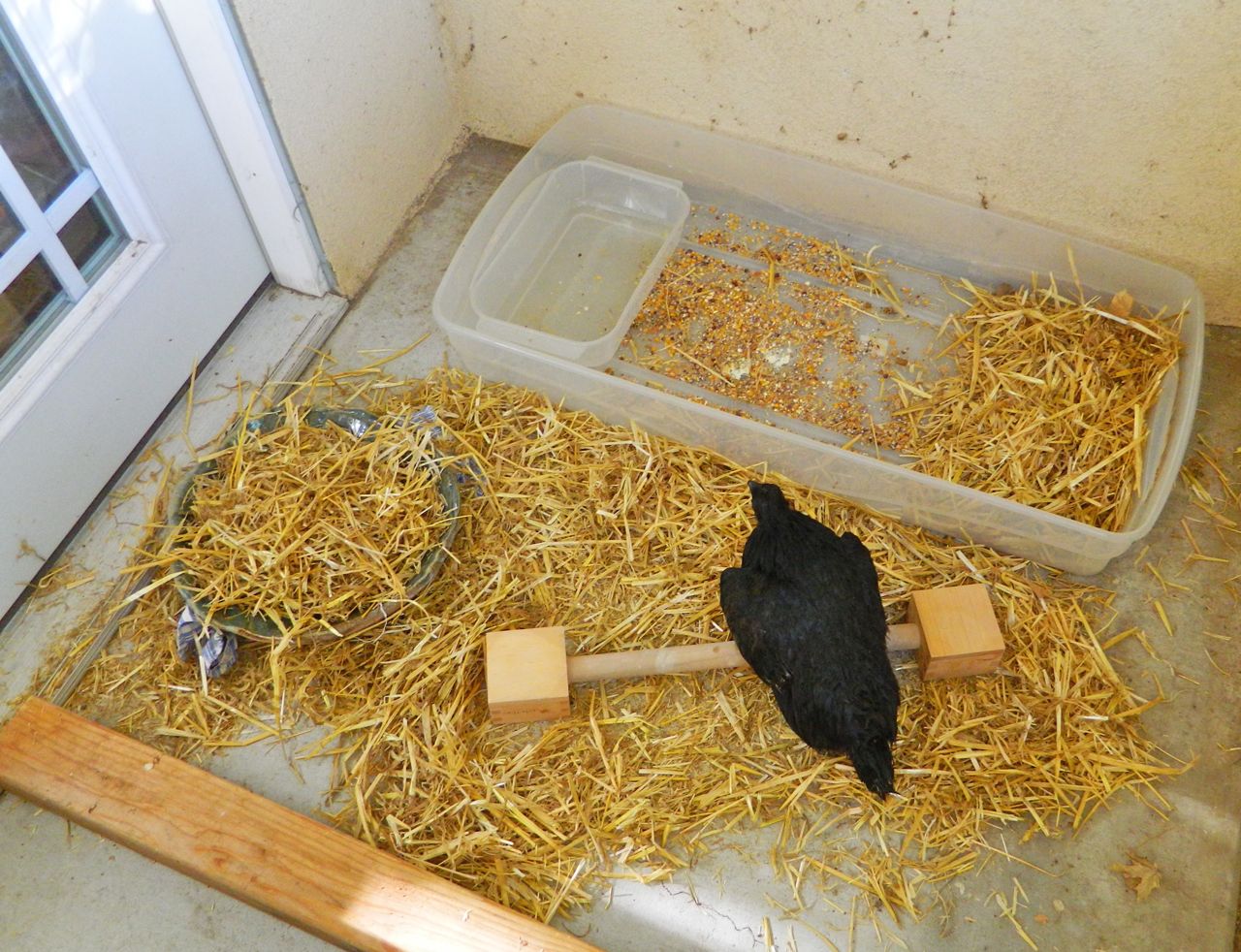
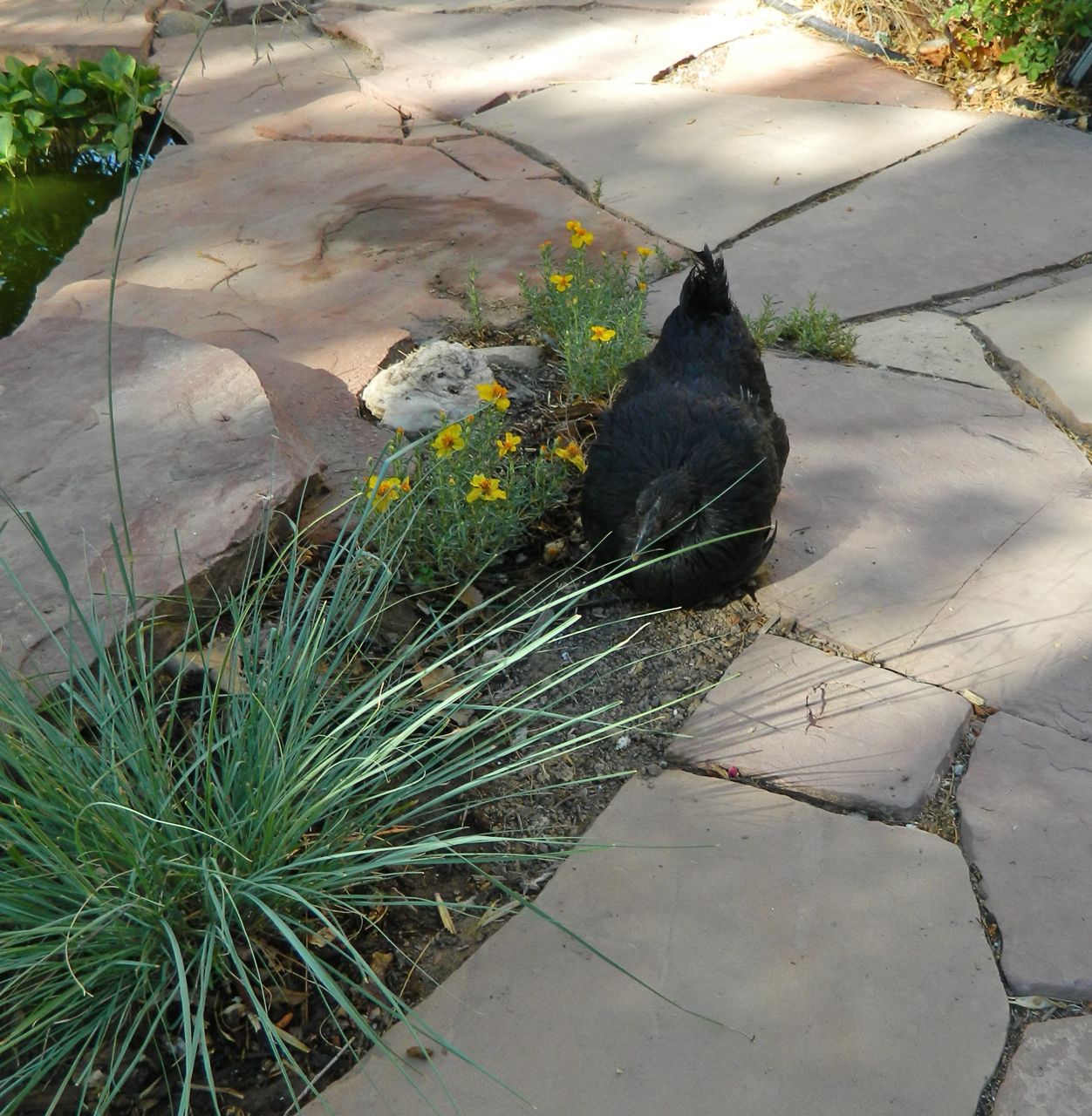
rufinaThis is Rufina. She’s new to our household.

She’s quiet and doesn’t take up much space, mostly sits on her perch or in her ceramic nest all day. She moves around slowly. If you are really gentle, she lets you pick her up.

We sit by the pond together in the morning, before everyone else gets up.

rufina1Last Thursday, I answered a friend’s call on Facebook for someone to take this chicken. Isabella and I drove to my friend’s house in the South Valley, put her in a bin, and brought her home. I didn’t think she’d actually still be alive today.

My friend had posted this story Thursday morning:

The neighbor gave us fresh chickens last night for cooking up. He shot them in the head with gun and handed them over the fence. We bagged them and put in freezer for today. Evan gets home, opens freezer and one bird is perched fully alive, very cold, and pissed off.
Chase ensues… !! We now have a blind undead chicken in our yard.

Anybody want it?

I’m not sure why anyone would shoot chickens in the head.

But when I read the story, I couldn’t help but admire this chicken’s tenacity. She is courageous. She made her way out of a plastic bag inside a freezer and survived for thirty-six hours. After being shot in the head.  I figured any animal that fought that hard to live deserved a little help, if only for a day or two.

The chicken hasn’t made any effort to eat like a normal chicken. Because, of course, she can’t see where to peck. (There isn’t much point in force-feeding a blind chicken.) But she does drink, so I’ve started blending up borrowed chicken food and water and giving her that. She seems content, grooming herself sometimes, showing no signs of pain or anxiety. And still, she will die.

But until then, we will enjoy each of her borrowed mornings by the pond, the sound of birds and running water, the sun on her feathers, expecting nothing.

I’m not sure why I have a blind, undead chicken in my studio. But here is one of my favorite poems, by Laura Gilpin.

The Two-Headed Calf

Tomorrow when the farm boys find this
freak of nature, they will wrap his body
in newspaper and carry him to the museum.

But tonight he is alive and in the north
field with his mother. It is a perfect
summer evening: the moon rising over
the orchard, the wind in the grass. And
as he stares into the sky, there are
twice as many stars as usual.

[Epilogue]

ooOOoo

Now if you think that was remarkable then let me share what Laura posted a few weeks later, linked to via her Epilogue above.

ooOOoo

The Miracle of Re-Birth

by Laura Bruzzese, July 11th, 2013

Good news: it’s been three weeks since the attempted murder of Rufina, and she continues to dwell among the living!

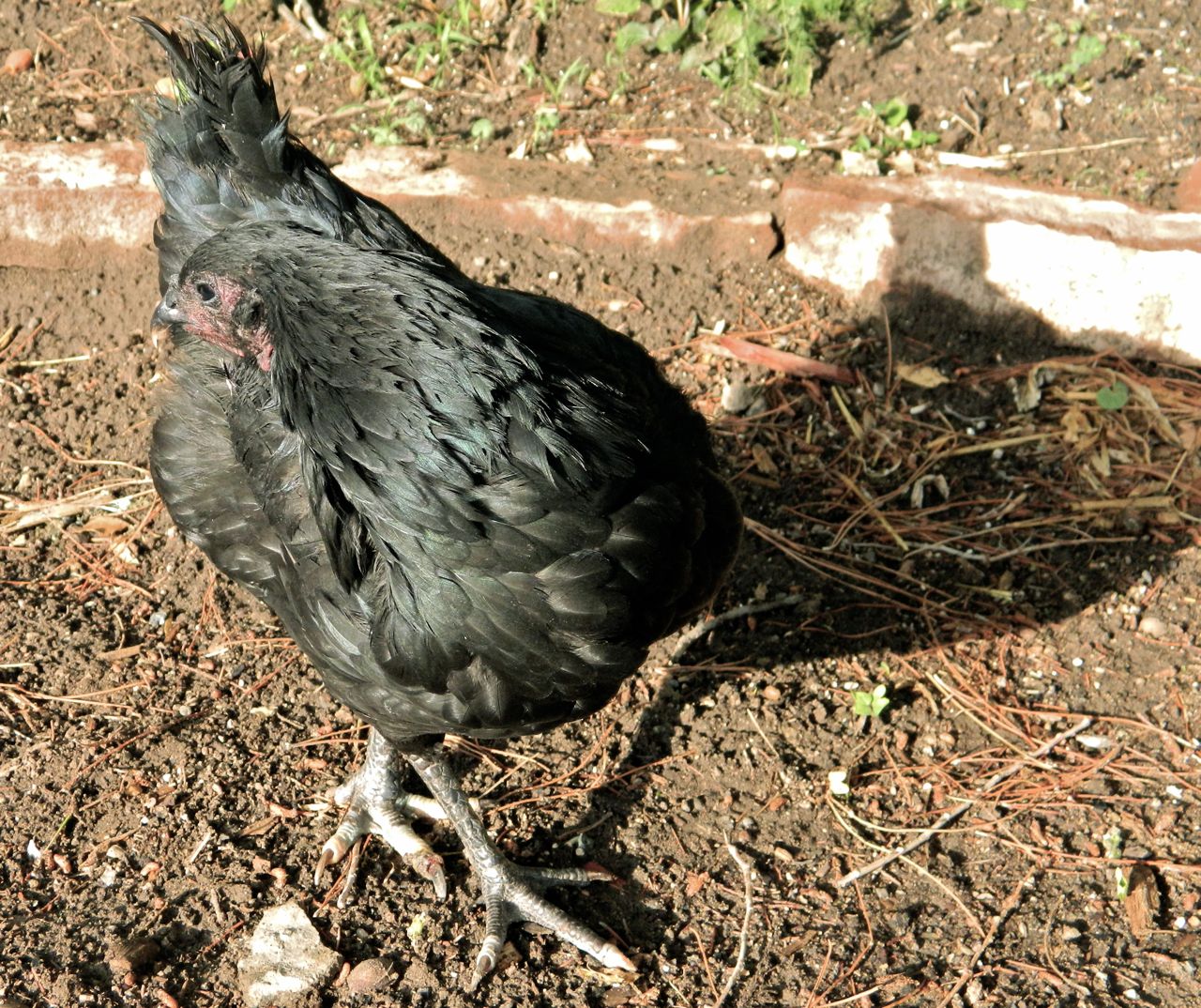
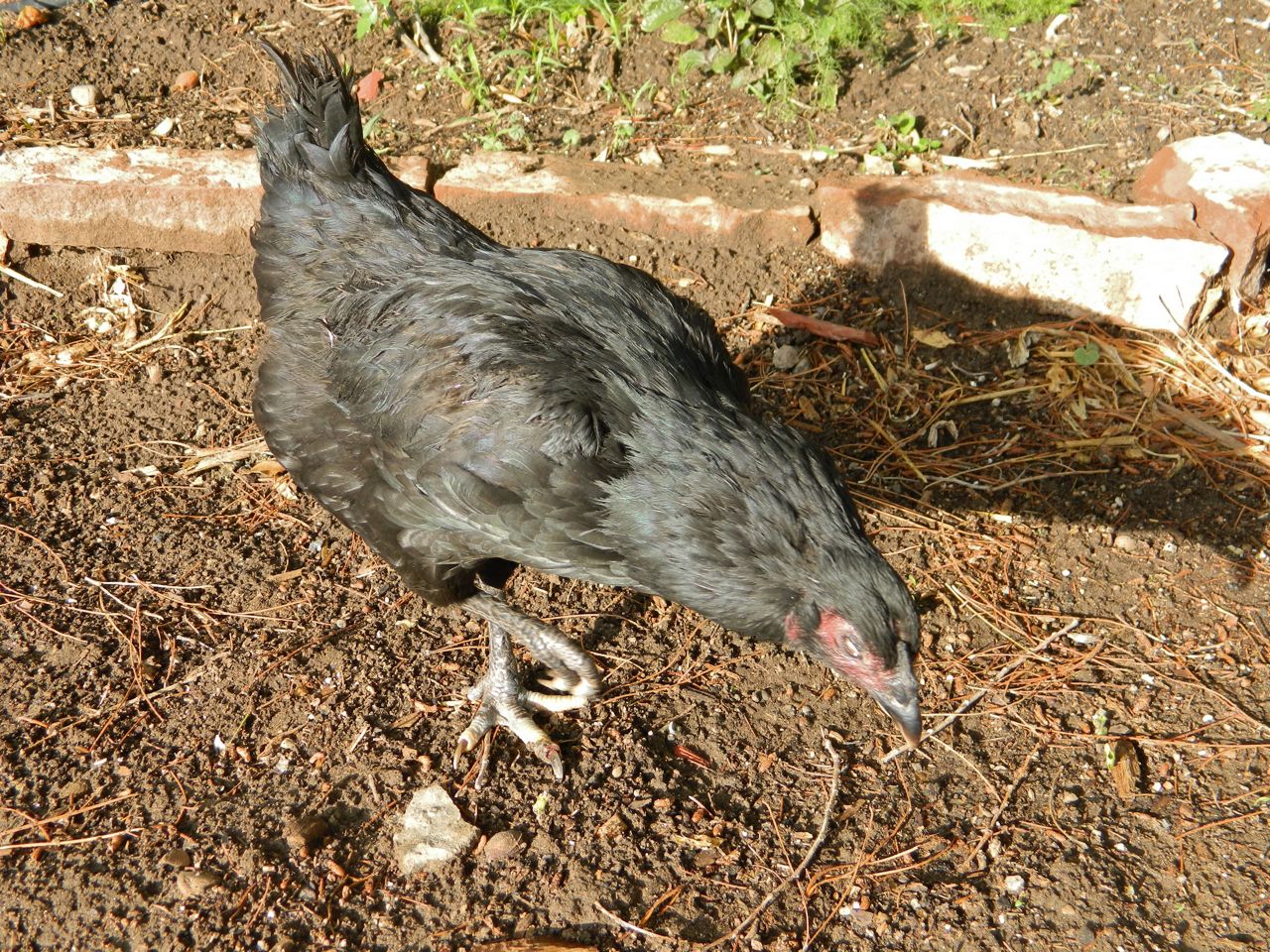
rufina2After loads of eye care, foot washing, antibiotics, food and vitamins, she has gained weight and is learning to find food and water by herself. Her remaining eye looks normal again but is still blind (I was hoping for a miracle), and the place of its former pair seems to have reached its majority in terms of healing–no eye, but no skin, either. Just a weird,  green spot surrounded by red skin that looks not unlike a tiny sun-dried tomato.

But that does not prevent her daily forays into the garden where she walks around with her head craned forward to “feel” where she’s going, and from exhibiting other persisting chicken qualities that seem to evidence a contented life.

rufinaagainI’m still surprised, and slightly in awe of this traumatized chicken who is satisfied to reside indefinitely on my studio porch. Shiny, happy chicken.

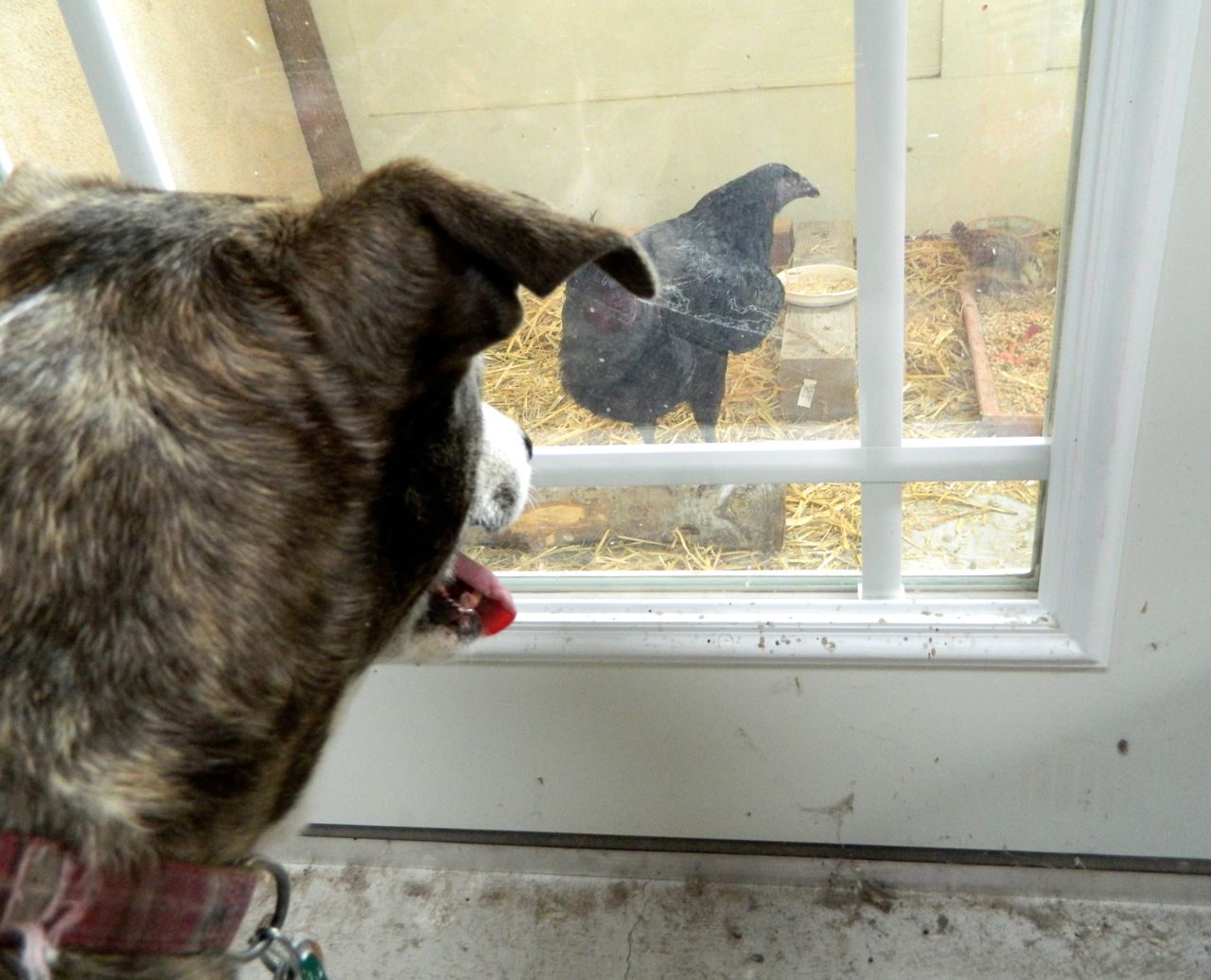
And so far, Velma the Rascally Whippet has not been the nuisance I was afraid she might be, but instead, a proud example of a bird-dog in defiance of her own natural instincts (save for one minor incident involving a tail feather. That was still attached to Rufina.). Perhaps Velma knows they are kindred spirits, she herself having survived a scary encounter with the Great Beyond earlier this year.

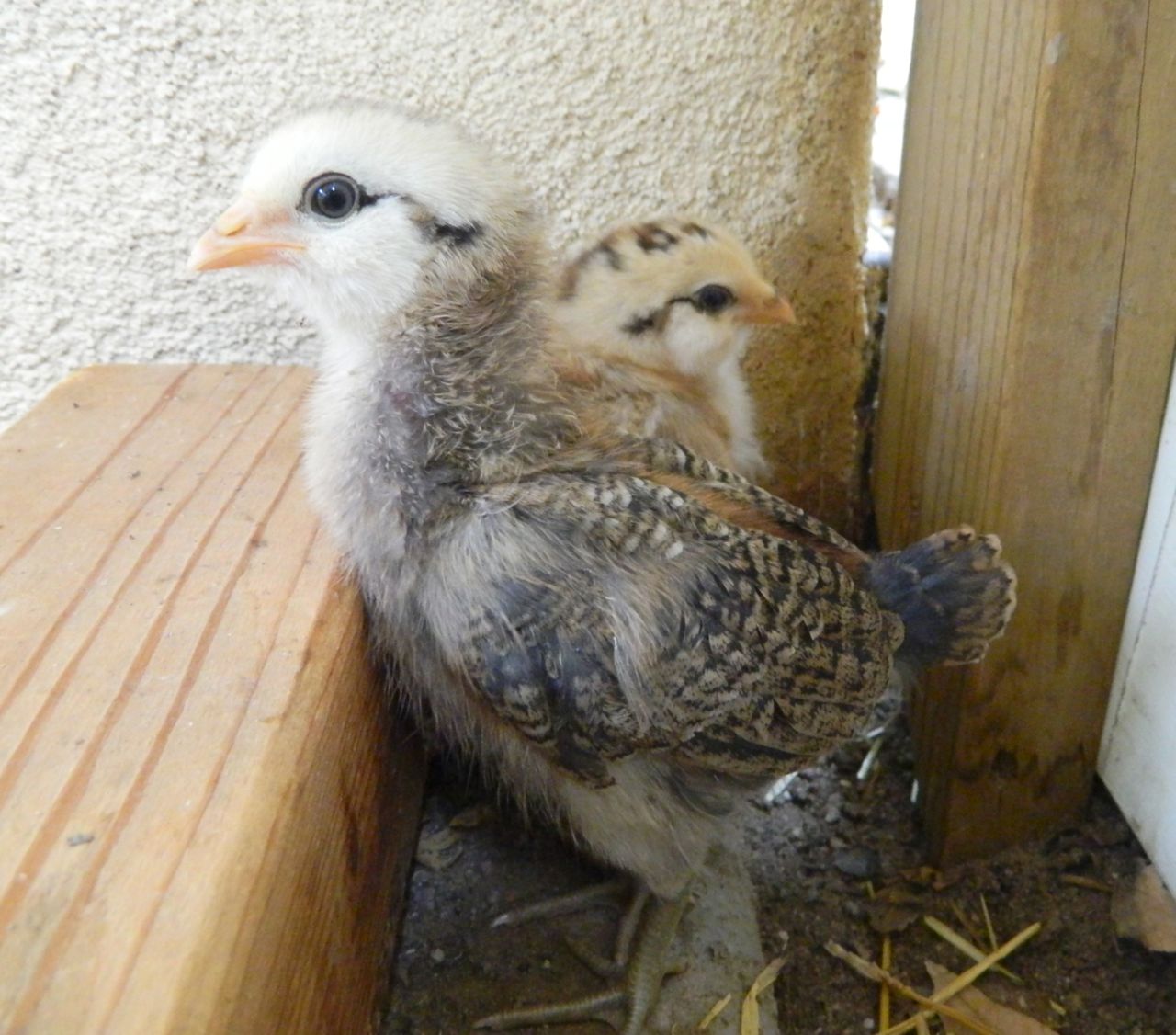
velmaThanks to everyone who has contributed free chicken advice, food, ER and vet consults, and even a couple of adorable, surprise chicks* (!) to keep Rufina company.

chicks*Chicks will unfortunately be dispatched to some other venue because they are exploiting their sighted advantage: stealing food out of Rufina’s mouth, crowding the water dish, and mocking her by constantly blinking and sticking their tongues out.  Also, they are filthy little creatures that walk in their own poop and then jump on me.

And finally, what’s in a name? When it became clear that chicken might live, I thought I should name her, and Rufina was the first thing that popped into my head. A few days later, I googled it to see what came up. This is what I found on Wiki:

Saints Justa and Rufina (Ruffina) (Spanish: Santa Justa y Santa Rufina) are venerated as martyrs. They are said to have been martyred at Hispalis (Seville) during the 3rd century.

Their legend states that they were sisters and natives of Seville who made fine earthenware pottery for a living, with which they supported themselves and many of the city’s poor. Justa was born in 268 AD, Rufina in 270 AD, of a poor but pious Christian family. During a pagan festival, they refused to sell their wares for use in these celebrations. In anger, locals broke all of their dishes and pots. Justina and Rufina retaliated by smashing an image of Venus.

The city’s prefect, Diogenianus, ordered them to be imprisoned. Failing to convince them to renounce their faith, he had them tortured on the rack and with iron hooks. This method also having failed, they were imprisoned, where they suffered from hunger and thirst.

They were then asked to walk barefoot to the Sierra Morena; when this did not break their resolve, they were imprisoned without water or food. Justa died first. Her body, thrown into a well, was later recovered by the bishop Sabinus. Diogenianus believed that the death of Justa would break the resolve of Rufina. However, Rufina refused to renounce her faith and was thus thrown to the lions. The lion in the amphitheatre, however, refused to attack Rufina, remaining as docile as a house cat. Infuriated, Diogenianus had Rufina strangled or beheaded and her body burned. Her body was also recovered by Sabinus and buried alongside her sister in 287 AD.

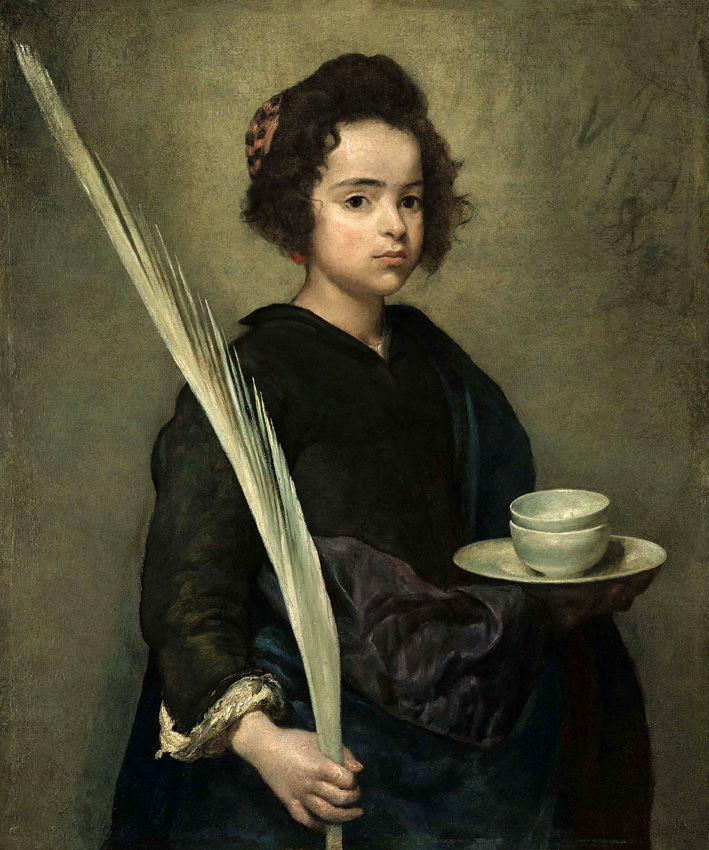
Old Master Paintings Sale Sotheby's, London - July, 4 , 2007 Velazquez (1599 - 1660) Saint Rufina Estimate: 6,000,000 - 8,000,000 Copyright in this image shall remain vested in Sotheby’s. Please note that this image may depict subject matter which is itself protected by separate copyright. Sotheby’s makes no representations as to whether the underlying subject matter is subject to its own copyright, or as to who might hold such copyright. It is the borrower's responsibility to obtain any relevant permissions from the holder(s) of any applicable copyright and Sotheby’s supplies this image expressly subject to this responsibility.
Saint Rufina, by Velázquez. See the likeness?? She’s even carrying a giant feather!

Just another name? Perhaps. Or: a dark-haired Spaniard and a Italian-New Mexican, two Christian potters separated by centuries, a saint, a chicken, and an ordinary human united in an extraordinary coincidence of the undead.

ooOOoo

Follow that!

Well I can’t but John Zande can.

For he was the first to leave a comment to Laura’s Rebirth post:

Here, i feel this song is in order. Listen carefully to the words, and who is singing them.

Including the following in his comment.

Contrasts!

It has been a bit of a week weather-wise!

During the heavy rains this last week we had an oak tree come down in front of the house. Luckily not doing any collateral damage.

But cutting it up into rounds and then splitting them ready for the wood tent took up most of yesterday (and Michael and Stanley many thanks for your help).

For today’s post I wanted to share two photographs with you. Two very different views of the world as seen from our property.

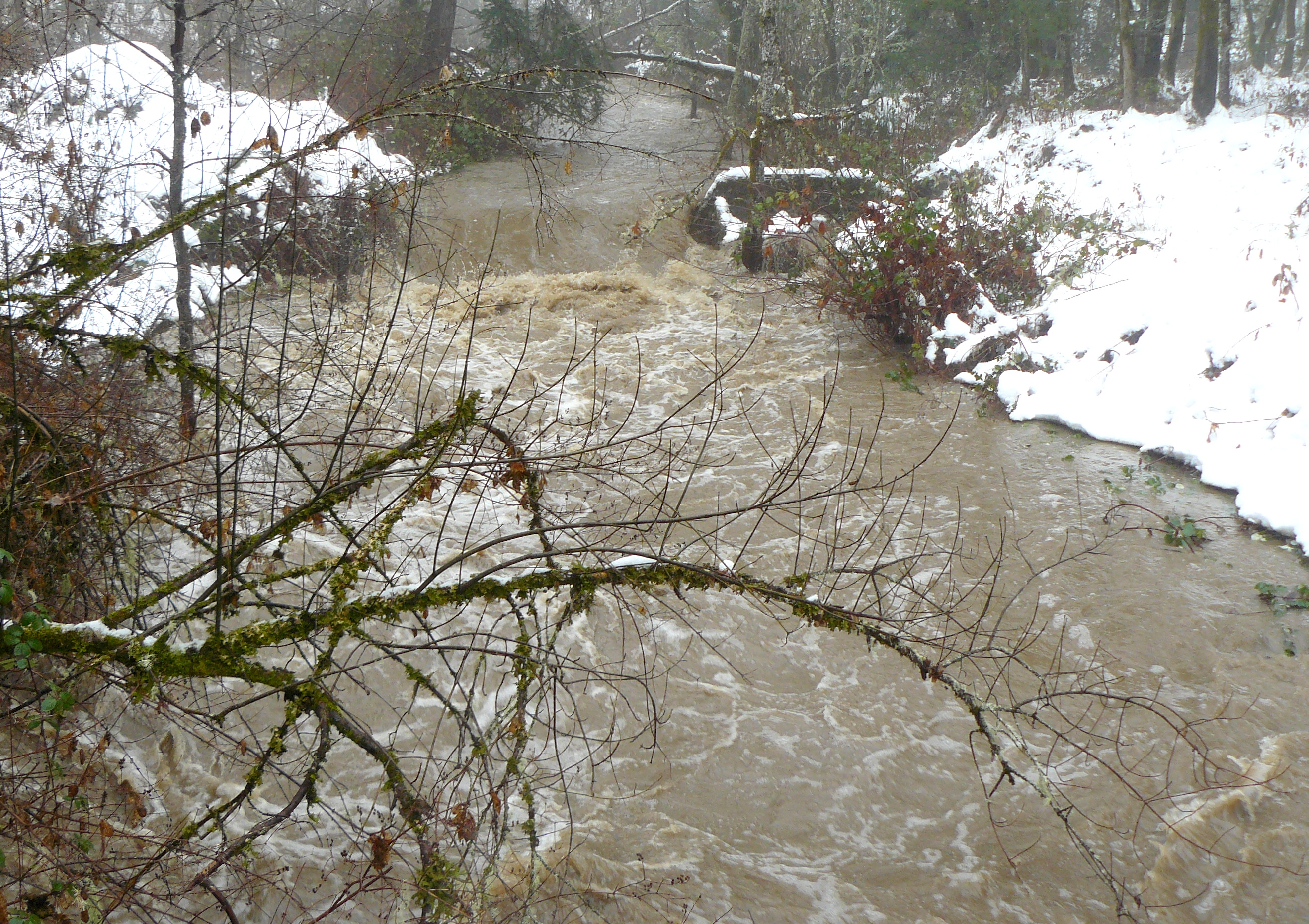
p1160860The first photograph above is of Bummer Creek that runs through our property. The view is upstream and the picture was taken last Sunday from our driveway bridge that crosses the creek. The flood waters were as high as we have ever seen them.

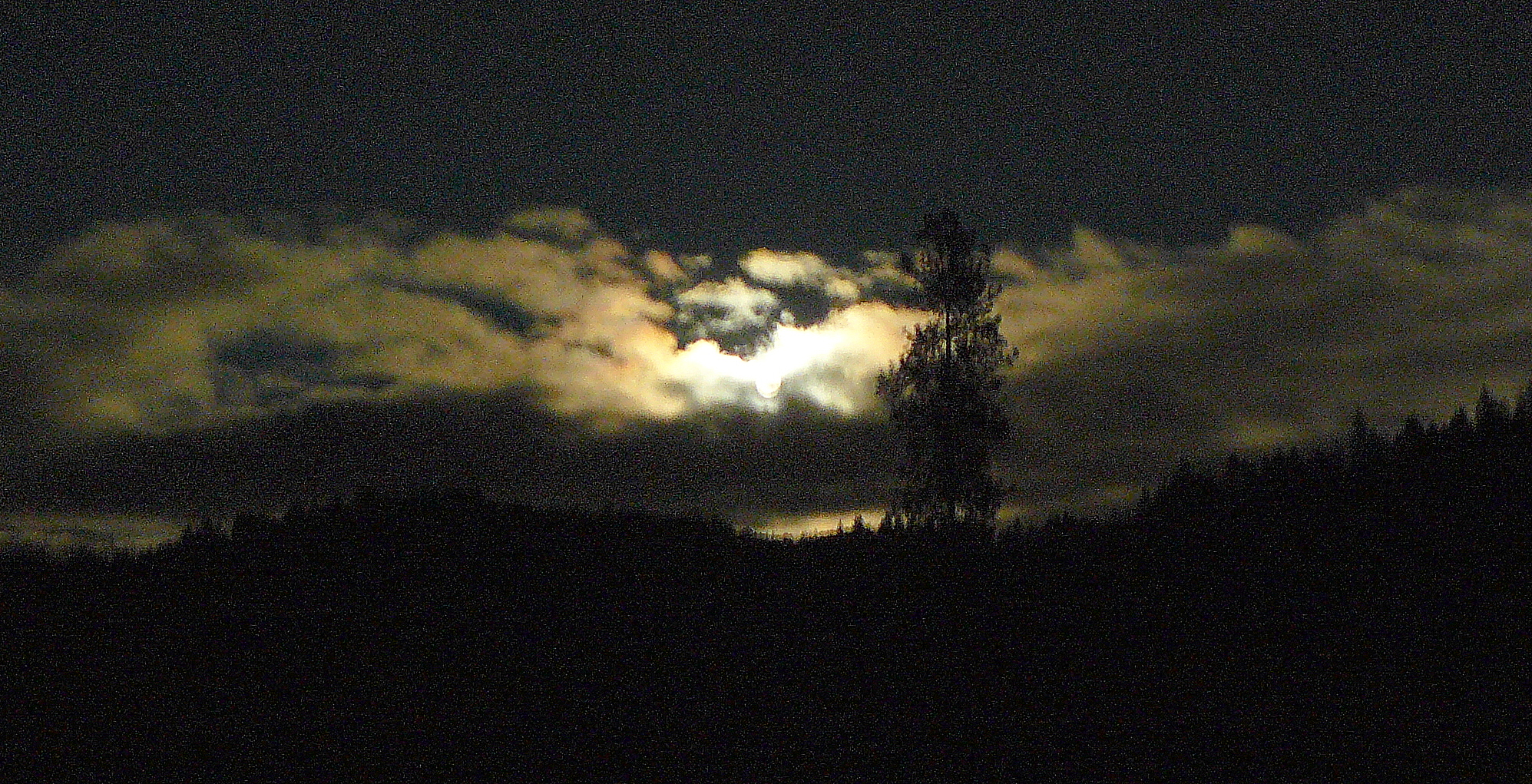
p1160867Please accept the slight fuzziness of the second photograph. But it is a shot of the full moon just as it appeared above the line of hills to the North-East. I dashed out to our deck and took the shot. Moments later the moon had been hidden by clouds. This was Thursday evening.

The picture doesn’t even get close to recording the magic of the dark night sky, stars shining so brightly, and the glorious full moon. Apparently a moon in orbit closer to planet Earth than is usual.

Nonetheless, the two photographs represent two very different and contrasting faces of our natural world.

You all have a very relaxing weekend.

The rights and wrongs of hunting!

The philosophy of hunting in terms of it being ‘right’ or ‘wrong’.

Anyone who comes here for more than a couple of visits will know that both Jean and I are opposed to hunting completely. Period!

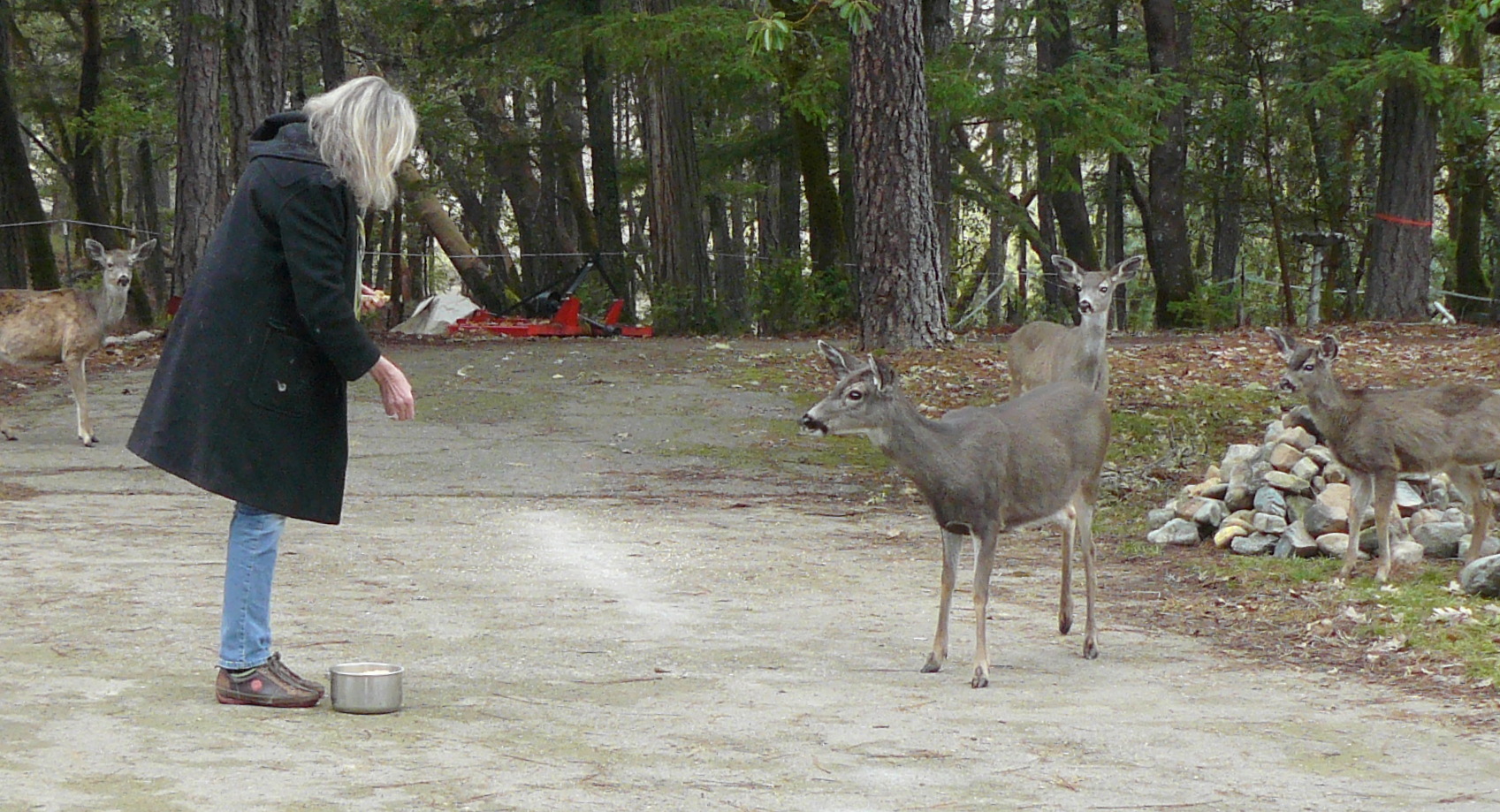
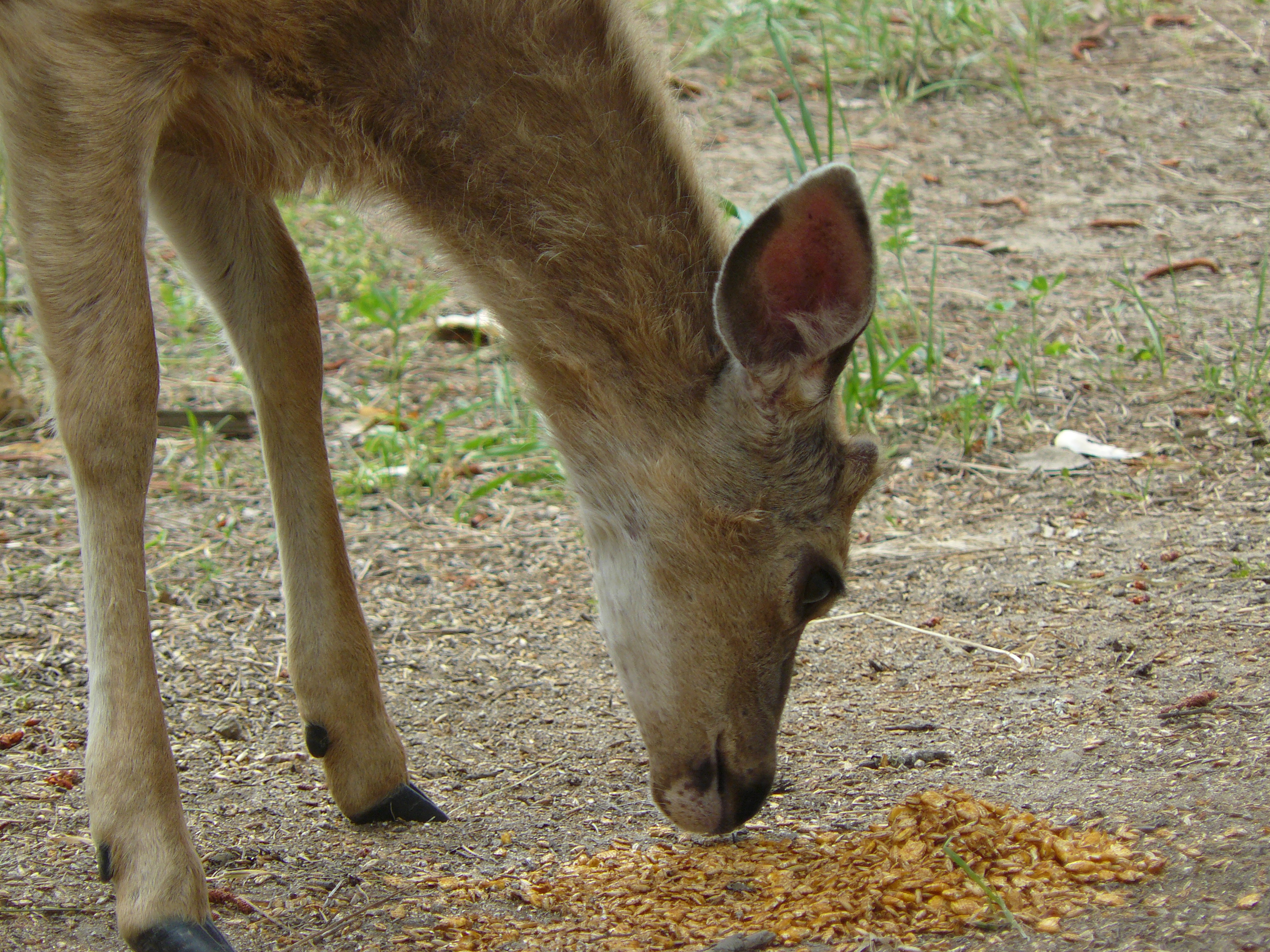
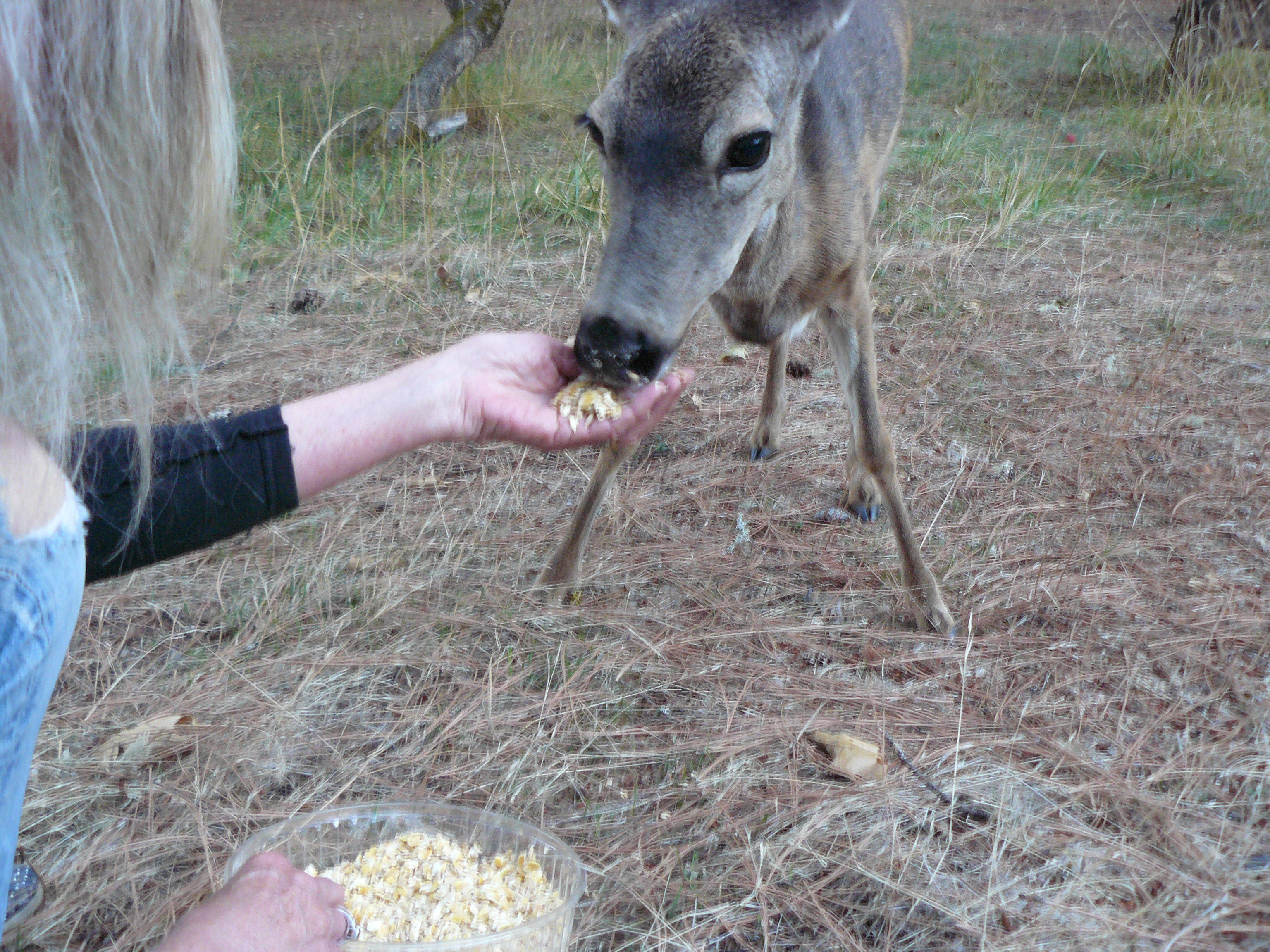
That’s not surprising as there have been a number of posts over the years describing how we feed the wild deer. Here’s three more photographs that haven’t previously been shared with you.

p1140238oooo

p1160189oooo

p1150179But, of course, the opinions of Jean and me are not, and should not be, the rule for the wider population of this part of Oregon.

All I would ask is that there is a proper, mature discussion as to the pros and cons of hunting wild animals in this, the twenty-first century.

All of which leads me to a recent essay posted on The Conversation site and republished here within the terms of that site.

ooOOoo

Is hunting moral? A philosopher unpacks the question

January 4, 2017 8.37pm EST

by
Three generations of a Wisconsin family with a nine-point buck. Wisconsin Department of Natural Resources/Flickr, CC BY-ND

Every year as daylight dwindles and trees go bare, debates arise over the morality of hunting. Hunters see the act of stalking and killing deer, ducks, moose and other quarry as humane, necessary and natural, and thus as ethical. Critics respond that hunting is a cruel and useless act that one should be ashamed to carry out.

As a nonhunter, I cannot say anything about what it feels like to shoot or trap an animal. But as a student of philosophy and ethics, I think philosophy can help us clarify, systematize and evaluate the arguments on both sides. And a better sense of the arguments can help us talk to people with whom we disagree.

Three rationales for hunting

One central question is why people choose to hunt. Environmental philosopher Gary Varner identifies three types of hunting: therapeutic, subsistence and sport. Each type is distinguished by the purpose it is meant to serve.

Therapeutic hunting involves intentionally killing wild animals in order to conserve another species or an entire ecosystem. In one example, Project Isabella, conservation groups hired marksmen to eradicate thousands of feral goats from several Galapagos islands between 1997 and 2006. The goats were overgrazing the islands, threatening the survival of endangered Galapagos tortoises and other species.

Subsistence hunting is intentionally killing wild animals to supply nourishment and material resources for humans. Agreements that allow Native American tribes to hunt whales are justified, in part, by the subsistence value the animals have for the people who hunt them.

 Crawford Patkotak, center, leads a prayer after his crew landed a bowhead whale near Barrow, Alaska. Both revered and hunted by the Inupiat, the bowhead whale serves a symbol of tradition, as well as a staple of food. AP Photo/Gregory Bull
Crawford Patkotak, center, leads a prayer after his crew landed a bowhead whale near Barrow, Alaska. Both revered and hunted by the Inupiat, the bowhead whale serves a symbol of tradition, as well as a staple of food. AP Photo/Gregory Bull

In contrast, sport hunting refers to intentionally killing wild animals for enjoyment or fulfillment. Hunters who go after deer because they find the experience exhilarating, or because they want antlers to mount on the wall, are sport hunters.

These categories are not mutually exclusive. A hunter who stalks deer because he or she enjoys the experience and wants decorative antlers may also intend to consume the meat, make pants from the hide and help control local deer populations. The distinctions matter because objections to hunting can change depending on the type of hunting.

What bothers people about hunting: Harm, necessity and character

Critics often argue that hunting is immoral because it requires intentionally inflicting harm on innocent creatures. Even people who are not comfortable extending legal rights to beasts should acknowledge that many animals are sentient – that is, they have the capacity to suffer. If it is wrong to inflict unwanted pain and death on a sentient being, then it is wrong to hunt. I call this position “the objection from harm.”

If sound, the objection from harm would require advocates to oppose all three types of hunting, unless it can be shown that greater harm will befall the animal in question if it is not hunted – for example, if it will be doomed to slow winter starvation. Whether a hunter’s goal is a healthy ecosystem, a nutritious dinner or a personally fulfilling experience, the hunted animal experiences the same harm.

But if inflicting unwanted harm is necessarily wrong, then the source of the harm is irrelevant. Logically, anyone who commits to this position should also oppose predation among animals. When a lion kills a gazelle, it causes as much unwanted harm to the gazelle as any hunter would – far more, in fact.

 Lions attack a water buffalo in Tanzania. Oliver Dodd/Wikipedia, CC BY
Lions attack a water buffalo in Tanzania. Oliver Dodd/Wikipedia, CC BY

Few people are willing to go this far. Instead, many critics propose what I call the “objection from unnecessary harm”: it is bad when a hunter shoots a lion, but not when a lion mauls a gazelle, because the lion needs to kill to survive.

Today it is hard to argue that human hunting is strictly necessary in the same way that hunting is necessary for animals. The objection from necessary harm holds that hunting is morally permissible only if it is necessary for the hunter’s survival. “Necessary” could refer to nutritional or ecological need, which would provide moral cover for subsistence and therapeutic hunting. But sport hunting, almost by definition, cannot be defended this way.

Sport hunting also is vulnerable to another critique that I call “the objection from character.” This argument holds that an act is contemptible not only because of the harm it produces, but because of what it reveals about the actor. Many observers find the derivation of pleasure from hunting to be morally repugnant.

In 2015, American dentist Walter Palmer found this out after his African trophy hunt resulted in the death of Cecil the lion. Killing Cecil did no significant ecological damage, and even without human intervention, only one in eight male lions survives to adulthood. It would seem that disgust with Palmer was at least as much a reaction to the person he was perceived to be – someone who pays money to kill majestic creatures – as to the harm he had done.

The hunters I know don’t put much stock in “the objection from character.” First, they point out that one can kill without having hunted and hunt without having killed. Indeed, some unlucky hunters go season after season without taking an animal. Second, they tell me that when a kill does occur, they feel a somber union with and respect for the natural world, not pleasure. Nonetheless, on some level the sport hunter enjoys the experience, and this is the heart of the objection.

Is hunting natural?

In discussions about the morality of hunting, someone inevitably asserts that hunting is a natural activity since all preindustrial human societies engage in it to some degree, and therefore hunting can’t be immoral. But the concept of naturalness is unhelpful and ultimately irrelevant.

A very old moral idea, dating back to the Stoics of ancient Greece, urges us to strive to live in accordance with nature and do that which is natural. Belief in a connection between goodness and naturalness persists today in our use of the word “natural” to market products and lifestyles – often in highly misleading ways. Things that are natural are supposed to be good for us, but also morally good.

Setting aside the challenge of defining “nature” and “natural,” it is dangerous to assume that a thing is virtuous or morally permissible just because it is natural. HIV, earthquakes, Alzheimer’s disease and post-partum depression are all natural. And as The Onion has satirically noted, behaviors including rape, infanticide and the policy of might-makes-right are all present in the natural world.

Head-Smashed-In Buffalo Jump, a UNESCO World Heritage Site in Alberta, Canada, commemorates a place where indigenous peoples of the North American Plains killed buffalo for more than 6,000 years by driving them over a cliff.

Hard conversations

There are many other moral questions associated with hunting. Does it matter whether hunters use bullets, arrows or snares? Is preserving a cultural tradition enough to justify hunting? And is it possible to oppose hunting while still eating farm-raised meat?

As a starting point, though, if you find yourself having one of these debates, first identify what kind of hunting you’re discussing. If your interlocutor objects to hunting, try to discover the basis for their objection. And I believe you should keep nature out of it.

Finally, try to argue with someone who takes a fundamentally different view. Confirmation bias – the unintentional act of confirming the beliefs we already have – is hard to overcome. The only antidote I know of is rational discourse with people whose confirmation bias runs contrary to my own.

ooOOoo

This is a very important essay from Joshua. Well done, that man!

I will just leave you all with this further image.

Two young stags keeping it together. (xxx)
Two young stags keeping it together. (Taken here at home in July, 2016.)

Best wishes to each of you; irrespective of your view on hunting!

Service restored! :-)

Dear people,

A little over an hour-and-a-half ago, at 1pm PST, the power was restored.

The first task was to see if the water pipes coming from the well had been frozen last night because the outside temperature went down to -8 C./18 deg F. Luckily they had not. However tonight they are forecast to drop to -10 C./14 F. So before coming in to see if the internet was restored the number one task was to run a power cord to the well house and leave a 25 watt old-fashioned lamp down near the water pipes.

Ten minutes ago I turned on my AppleMac and, hey presto, we are connected to that big, virtual world.

Then a quick download of my Gmail to discover that I have 17,262 unread emails awaiting me! (Sorry, I was just showing off. There’s no way that I am that popular!!)

However, the last three digits are correct: there are 262 unread emails.

So I trust you will understand why there will not be a ‘proper’ post at midnight PST, as per normal, but hopefully if everything holds up (including yours truly) then blogging should be back to the regular daily pattern come next Saturday.

Oh, by the way, the forecast for this weekend includes a risk of flooding. Medford National Weather Service have published a hydrological warning.

HYDROLOGIC OUTLOOK
NATIONAL WEATHER SERVICE MEDFORD, OR
333 AM PST THU JAN 5 2017

...Flood Potential Outlook for quick rises and possible flooding
due to heavy rain and snow melt on creeks, streams, and rivers in
the following counties in California...Modoc...Siskiyou and in
Oregon...Coos...Curry...Douglas...Jackson...Josephine...

.A series of frontal systems will move through the area this weekend
through next week. The combination of recent heavy snowfall, rising
snow levels, and periods of heavy rainfall will lead to run-off
concerns beginning Sunday and continuing through early next week.

An initial round of heavy rainfall this weekend will saturate low
elevation snow pack leading to increased run-off. A second round of
heavy rain Tuesday through Thursday will lead to another period of
substantial run-off next week.

Lost for words!

Yet another smile!

This “good news” theme is rather fun!

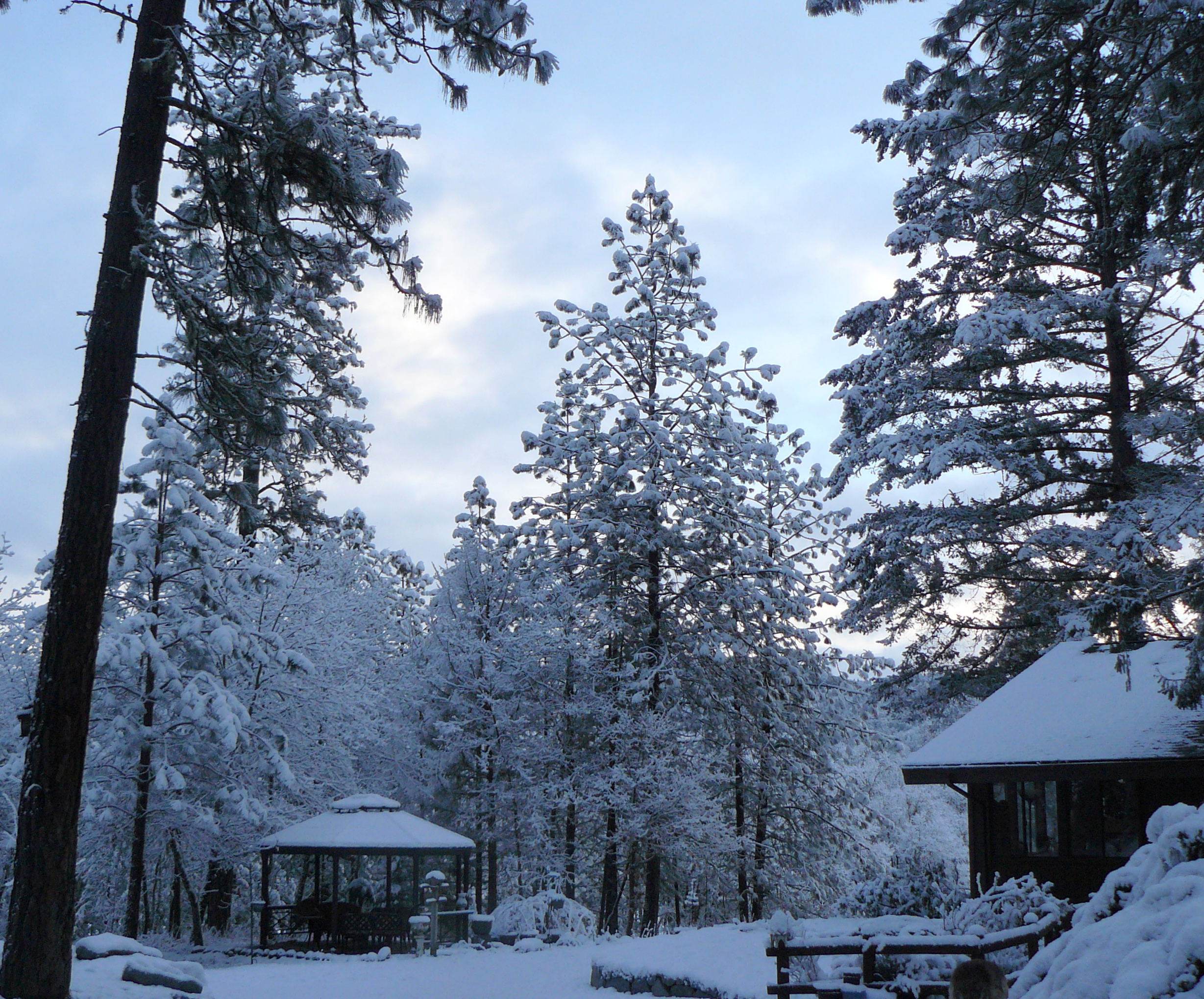
p1160817Overnight we had more snow, possibly something approaching 4 inches.

p1160820Now the challenge is seeing at what point we can drive out from the property to the main road. But leave that to worry about tomorrow.

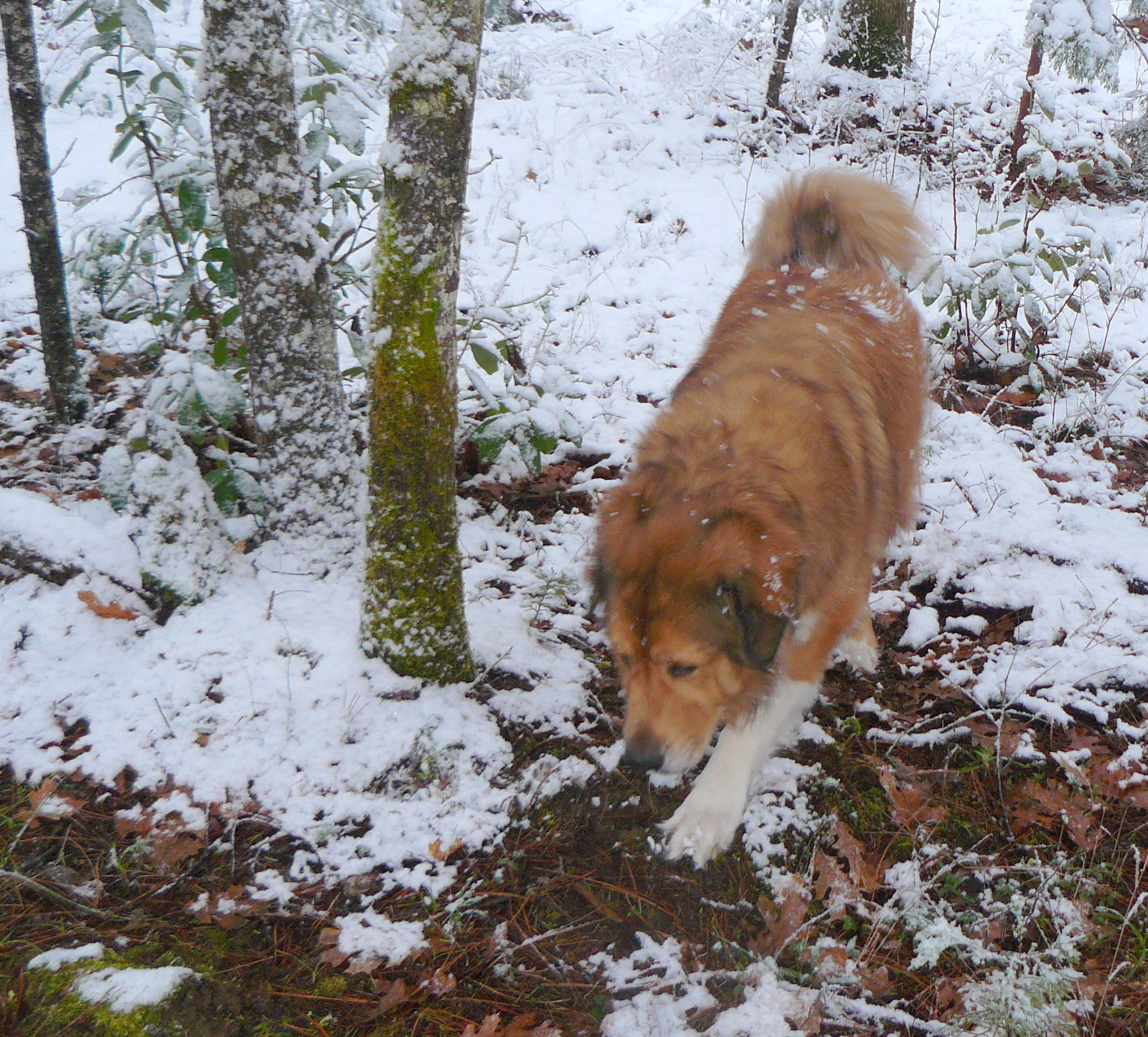
It’s well-known that dogs love snow and are very curious about it. As Brandy is demonstrating below.

p1160822Plus the snowy conditions offer me a good introduction to an item recently published on the Care2 site.

ooOOoo

Daily Cute: Rescued Pit Bulls Enjoy a Snow Day

These pit bull pals are overjoyed to play in the snow!

See you all tomorrow!

Private power.

The power of corporations must never be permitted to override democratic choice.

The main thrust in yesterday’s post was a plea by , Lecturer on Anthropology, University of Colorado, Denver for our natural lands to be given the legal status of a person. Here’s how Prof. Colwell concluded his essay (my emphasis):

In New Zealand, the Te Urewera Act offers a higher level of protection, empowering a board to be the land’s guardian. The Te Urewera Act, though, does not remove its connection to humans. With a permit, people can hunt, fish, farm and more. The public still has access to the forest. One section of the law even allows Te Urewera to be mined.

Te Urewera teaches us that acknowledging cultural views of places as living does not mean ending the relationship between humans and nature, but reordering it – recognizing nature’s intrinsic worth and respecting indigenous philosophies.

In the U.S. and elsewhere, I believe we can do better to align our legal system with the cultural expressions of the people it serves. For instance, the U.S. Congress could amend the NHPA or the American Indian Religious Freedom Act to acknowledge the deep cultural connection between tribes and natural places, and afford better protections for sacred landscapes like New Mexico’s Mount Taylor.

Until then, it says much about us when companies are considered people before nature is.

Chip Colwell was alerting us, as in humanity, that our natural resources are way, way too important for them to be considered corporate assets.

The days between a Christmas Day and a New Year’s Day are frequently a time for introspection; well they are for me! A few days to reflect on what did or did not work in the year just coming to an end and to find some clarity about the important issues for the new year.

That mood of introspection, of reflection, seems to be creeping into my blog posts this last week of 2016. For following Chip Colwell comes George Monbiot and an essay he published on the 6th December, 2016, that is republished here with Mr. Monbiot’s very kind permission.

Regarding the power of corporations there are strong echoes between Prof. Colwell and Mr. Monbiot.

ooOOoo

The Golden Arches Theory of Decline

Why is there a worldwide revolt against politics as usual? Because corporate globalisation has crushed democratic choice.

By George Monbiot, published in the Guardian, 6th December 2016

A wave of revulsion rolls around the world. Approval ratings for incumbent leaders are everywhere collapsing. Symbols, slogans and sensation trump facts and nuanced argument. One in six Americans now believes that military rule would be a good idea. From all this I draw the following, peculiar conclusion: no country with a McDonald’s can remain a democracy.

Twenty years ago, the New York Times columnist Thomas Friedman proposed his “golden arches theory of conflict prevention”. This holds that “no two countries that both have McDonald’s have ever fought a war against each other since they each got their McDonald’s”.

Friedman’s was one of several end-of-history narratives suggesting that global capitalism would lead to permanent peace. He claimed that it might create “a tip-over point at which a country, by integrating with the global economy, opening itself up to foreign investment and empowering its consumers, permanently restricts its capacity for troublemaking and promotes gradual democratization and widening peace.” He didn’t mean that McDonald’s ends war, but that its arrival in a nation symbolised the transition.

In using McDonalds as shorthand for the forces tearing democracy apart, I am, like him, writing figuratively. I do not mean that the presence of the burger chain itself is the cause of the decline of open, democratic societies (though it has played its part in Britain, using our defamation laws against its critics). Nor do I mean that countries hosting McDonald’s will necessarily mutate into dictatorships.

What I mean is that, under the onslaught of the placeless, transnational capital McDonald’s exemplifies, democracy as a living system withers and dies. The old forms and forums still exist – parliaments and congresses remain standing – but the power they once contained seeps away, re-emerging where we can no longer reach it.

The political power that should belong to us has flitted into confidential meetings with the lobbyists and donors who establish the limits of debate and action. It has slipped into the dictats of the IMF and the European Central Bank, which respond not to the people but to the financial sector. It has been transported, under armed guard, into the icy fastness of Davos, where Mr Friedman finds himself so warmly welcomed (even when he’s talking cobblers).

Above all, the power that should belong to the people is being crushed by international treaty. Contracts such as NAFTA, CETA, the proposed TransPacific Partnership and Trade in Services Agreement and the failed Transatlantic Trade and Investment Partnership are crafted behind closed doors in discussions dominated by corporate lobbyists. They are able to slip in clauses that no informed electorate would ever approve, such as the establishment of opaque offshore tribunals, through which corporations can bypass national courts, challenge national laws and demand compensation for the results of democratic decisions.

These treaties limit the scope of politics, prevent states from changing social outcomes and drive down labour rights, consumer protection, financial regulation and the quality of neighbourhoods. They make a mockery of sovereignty. Anyone who forgets that striking them down was one of Donald Trump’s main promises will fail to understand why people were prepared to risk so much in electing him.

At the national level too, the McDonalds model destroys meaningful democracy. Democracy depends on a reciprocal sense of belief, trust and belonging: the conviction that you belong to the nation and the nation belongs to you. The McDonalds model, by rooting out attachment, could not have been better designed to erase that perception.

As Tom Wolfe observes in his novel A Man in Full, “the only way you could tell you were leaving one community and entering another was when the franchise chains started repeating and you spotted another 7-Eleven, another Wendy’s, another Costco, another Home Depot.” The alienation and anomie this destruction of place promotes are enhanced by the casualisation of labour and a spirit-crushing regime of monitoring, quantification and assessment (at which McDonald’s happens to excel). Public health disasters contribute to the sense of rupture. After falling for decades, for example, death rates among middle-aged white Americans are now rising. Among the likely causes are obesity and diabetes, opioid addiction and liver failure, diseases whose vectors are corporations.

Corporations, released from democratic constraints, drive us towards climate breakdown, an urgent threat to global peace. McDonald’s has done more than its fair share: beef production is among the most powerful causes of climate change.

In his book The Globalisation Paradox, the Harvard economist Dani Rodrik describes a political trilemma. Democracy, national sovereignty and hyperglobalisation, he argues, are mutually incompatible. You cannot have all three at once. McDonalisation crowds out domestic politics. Incoherent and dangerous as it often is, the global backlash against mainstream politicians is, at heart, an attempt to reassert national sovereignty against the forces of undemocratic globalisation.

An article about the history of the Democratic party by Matt Stoller in The Atlantic reminds us that a similar choice was articulated by the great American jurist Louis Brandeis. “We may have democracy, or we may have wealth concentrated in the hands of a few, but we can’t have both.” In 1936, the congressman Wright Patman managed to pass a bill against the concentration of corporate power. Among his targets was A&P, the giant chainstore of his day, that was hollowing out towns, destroying local retailers and turning “independent tradesmen into clerks”.

In 1938, President Roosevelt warned that “the liberty of a democracy is not safe if the people tolerate the growth of private power to a point where it becomes stronger than their democratic state itself. That, in its essence, is fascism.” The Democrats saw concentrated corporate power as a form of dictatorship. They broke up giant banks and businesses and chained the chainstores. What Roosevelt, Brandeis and Patman knew has been forgotten by those in power, including powerful journalists. But not by the victims of this system.

One of the answers to Trump, Putin, Orban, Erdogan, Salvini, Duterte, Le Pen, Farage and the politics they represent is to rescue democracy from transnational corporations. It is to defend the crucial political unit that’s under assault by banks, monopolies and chainstores: community. It is to recognise that there is no greater hazard to peace between nations than a corporate model which crushes democratic choice.

http://www.monbiot.com

ooOOoo

It’s very easy to pick out from Mr. Monbiot’s essay what the theme should be for 2017, and beyond. What each and every one of us who cares about the future and understands the huge changes that have to take place if our grandchildren are to have a viable future.

It was that compelling quotation by Louis Brandeis:

We may have democracy, or we may have wealth concentrated in the hands of a few, but we can’t have both.

It’s as simple as that!

Dreams of hope

My wish for 2017, and for evermore.

One of the many things that we adore about living here in Merlin, Southern Oregon is the closeness of nature. Not just the nature of the slopes and mountains but the nature of the trees, creeks, grasses and wild plants.

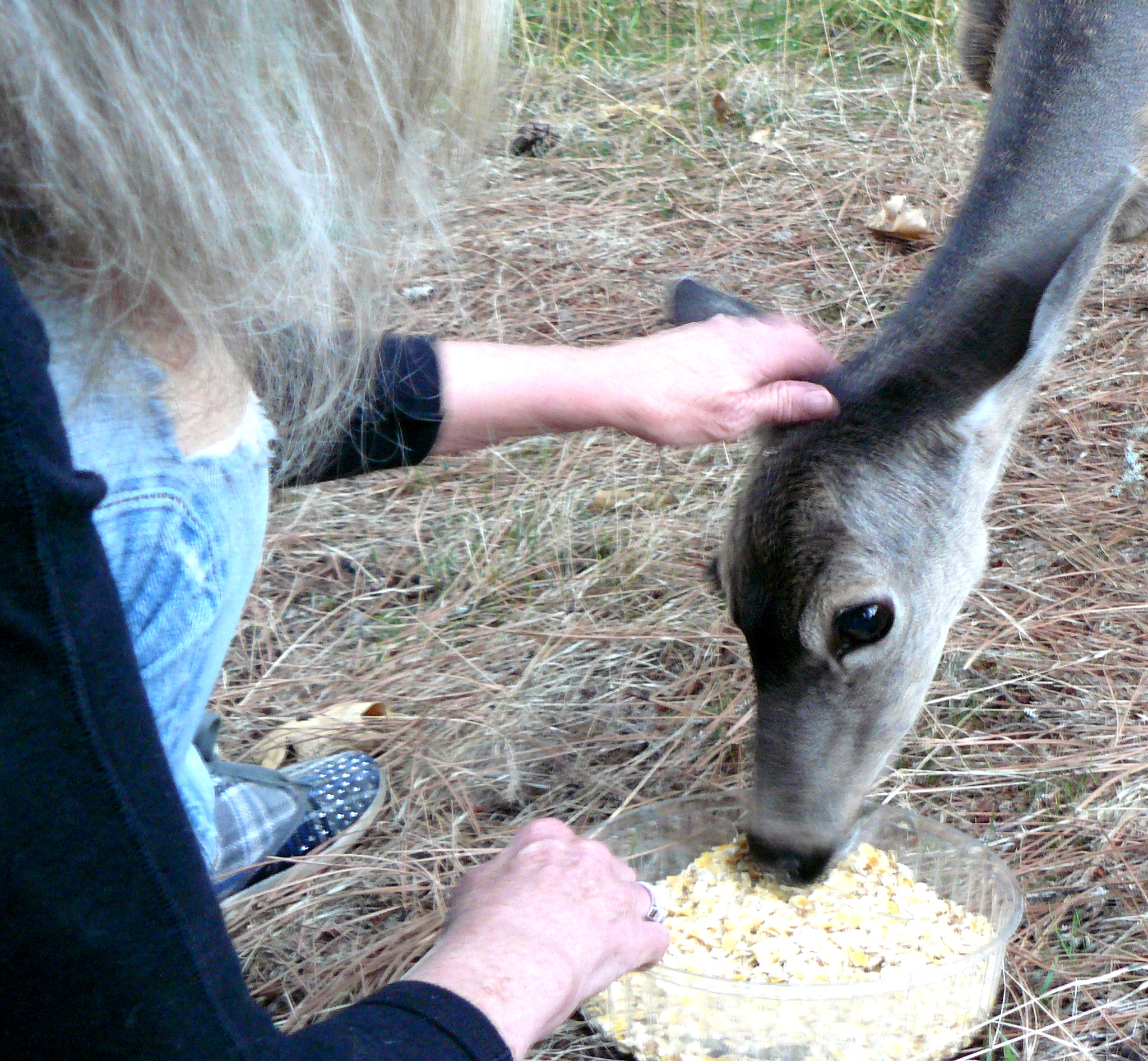
Plus the awareness over the 4+ years that we have been here of how easy it is to gain the trust of wild animals. I will go to my grave holding on to the sweet sensation of a wild deer trusting me and Jean to the point where we could stroke the deer’s neck when we were feeding her.

The trust between the deer and Jean then enabled the deer to feed from Jean's hand.
The trust between the deer and Jean then enabled the deer to feed from Jean’s hand.
Then, unbelievably, the wild deer continues feeding as Jean fondles the deer's ear.
Then, unbelievably, the wild deer continues feeding as Jean fondles the deer’s ear.

(Both photographs taken in October, 2014 in the area of grassland near to our stables.)

The measure of how we, as in humanity, really feel about the only home we have, as in Planet Earth, is how we regard our planet.

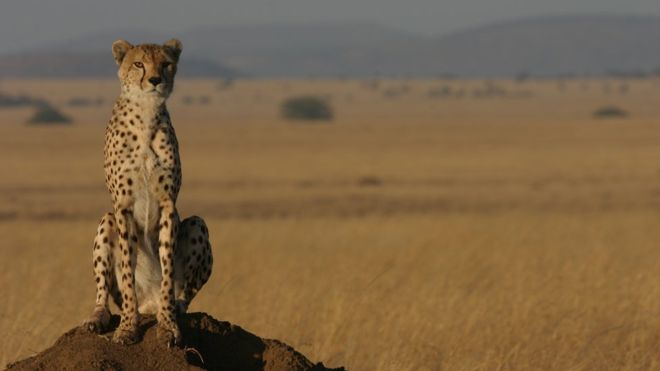
The pain that we feel when we read, as I did yesterday, about another animal species possibly heading towards extinction. In this case, an item on the BBC News website about Cheetahs.

Cheetahs heading towards extinction as population crashes

By Matt McGrath Environment correspondent

Protected parks and reserves for cheetahs are not sufficient as the animal ranges far beyond these areas.

 The sleek, speedy cheetah is rapidly heading towards extinction according to a new study into declining numbers.

The report estimates that there are just 7,100 of the world’s fastest mammals now left in the wild.

Cheetahs are in trouble because they range far beyond protected areas and are coming increasingly into conflict with humans.

The authors are calling for an urgent re-categorisation of the species from vulnerable to endangered.

(Read the full article here.)

It’s no good tut-tutting; something different has to be done. For otherwise nature will have the last word to say about the future of vast numbers of species especially homo sapiens!

All of which leads me to the main theme of today’s post: holding nature in higher esteem as in higher legal esteem.

Read the following that was published on The Conversation blogsite on October 10th, 2016 and is republished here within their terms. The author is , Lecturer on Anthropology, University of Colorado, Denver.

ooOOoo

What if nature, like corporations, had the rights and protections of a person?

October 10, 2016 8.16am EDT

image-20161005-20110-9ipkfz
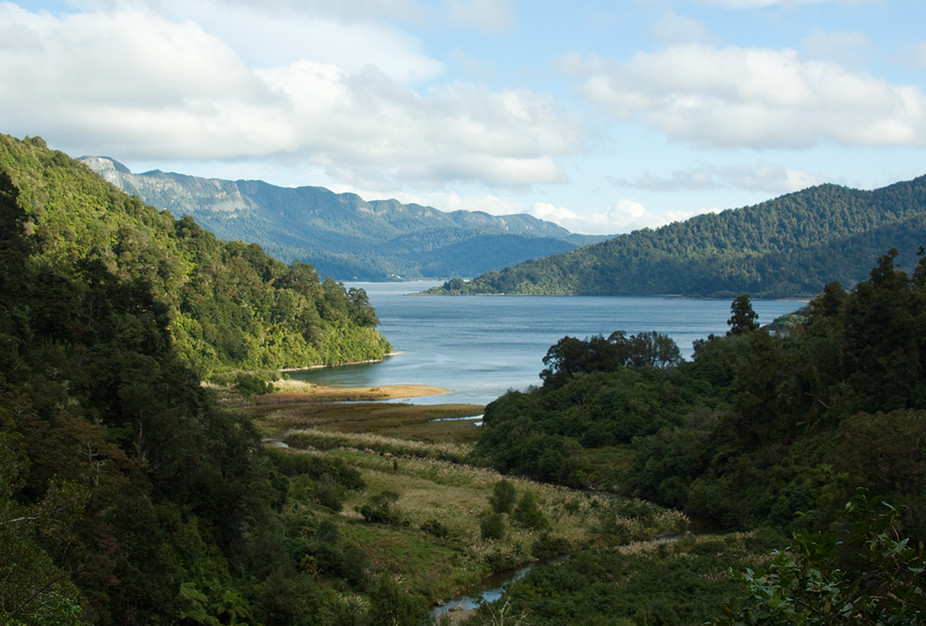
The forest around Lake Waikaremoana in New Zealand has been given legal status of a person because of its cultural significance. Paul Nelhams/flickr, CC BY-SA

In recent years, the U.S. Supreme Court has solidified the concept of corporate personhood. Following rulings in such cases as Hobby Lobby and Citizens United, U.S. law has established that companies are, like people, entitled to certain rights and protections.

But that’s not the only instance of extending legal rights to nonhuman entities. New Zealand took a radically different approach in 2014 with the Te Urewera Act which granted an 821-square-mile forest the legal status of a person. The forest is sacred to the Tūhoe people, an indigenous group of the Maori. For them Te Urewera is an ancient and ancestral homeland that breathes life into their culture. The forest is also a living ancestor. The Te Urewera Act concludes that “Te Urewera has an identity in and of itself,” and thus must be its own entity with “all the rights, powers, duties, and liabilities of a legal person.” Te Urewera holds title to itself.

Although this legal approach is unique to New Zealand, the underlying reason for it is not. Over the last 15 years I have documented similar cultural expressions by Native Americans about their traditional, sacred places. As an anthropologist, this research has often pushed me to search for an answer to the profound question: What does it mean for nature to be a person?

The snow-capped mountain

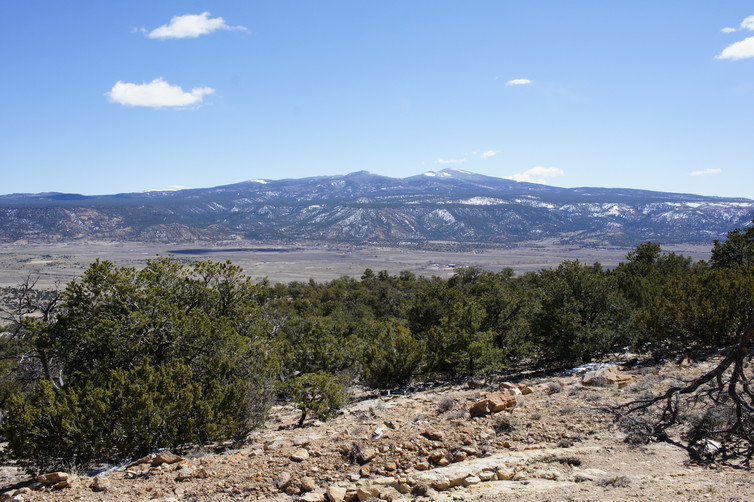
A majestic mountain sits not far northwest of Albuquerque, New Mexico. Like a low triangle, with long gentle slopes, Mount Taylor is clothed in rich forests that appear a velvety charcoal-blue from the distance. Its bald summit, more than 11,000 feet high, is often blanketed in snow – a reminder of the blessing of water, when seen from the blazing desert below.

The Zuni tribe lives about 40 miles west of Mount Taylor. In 2012, I worked with a team to interview 24 tribal members about the values they hold for Dewankwin K’yaba:chu Yalanne (“In the East Snow-capped Mountain”), as Mount Taylor is called in the Zuni language. We were told that their most ancient ancestors began an epic migration in the Grand Canyon.

 Mount Taylor in New Mexico, a sacred site to the Zuni who believe it is a living being. Chip Colwell, Author provided.
Mount Taylor in New Mexico, a sacred site to the Zuni who believe it is a living being. Chip Colwell, Author provided.

Over millennia they migrated across the Southwest, with important medicine societies and clans living around Mount Taylor. After settling in their current pueblo homes, Zunis returned to this sacred mountain to hunt animals like deer and bear, harvest wild plants like acorns and cattails, and gather minerals used in sacrosanct rituals that keep the universe in order. Across the generations Dewankwin Kyaba:chu Yalanne has come to shape Zuni history, life, and identity no less than the Vatican has for Catholics.

But unlike holy places in the Western world, Zunis believe Mount Taylor is a living being. Zuni elders told me that the mountain was created within the Earth’s womb. As a mountain formed by volcanic activity, it has always grown and aged. The mountain can give life as people do. The mountain’s snow melts in spring and nourishes plants and wildlife for miles. Water is the mountain’s blood; buried minerals are the mountain’s meat. Because it lives, deep below is its beating heart. Zunis consider Mount Taylor to be their kin.

There is a stereotype that Native American peoples have a singular connection to nature. And yet in my experience, they do see the world in a fundamentally different way from most people I know. Whether it is mountains, rivers, rocks, animals, plants, stars or weather, they see the natural world as living and breathing, deeply relational, even at times all-knowing and transcendent.

In my work with Arizona’s Hopi tribe, I have traveled with cultural leaders to study sacred places. They often stop to listen to the wind, or search the sky for an eagle, or smile when it begins to rain, which they believe is a blessing the ancestors bestow upon them.

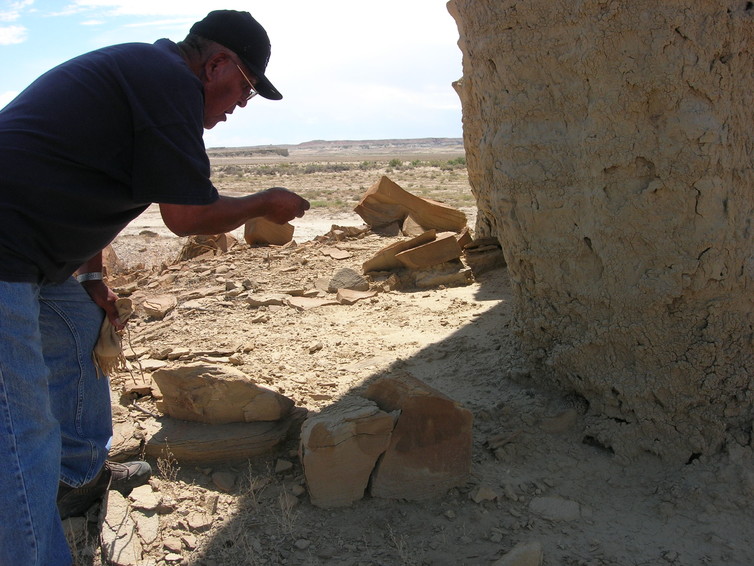
During one project with the Hopi tribe, we came across a rattlesnake coiled near an ancient fallen pueblo. “Long ago, one of them ancestors lived here and turned into a rattlesnake,” the elder Raleigh H. Puhuyaoma Sr. shared with me, pointing to the nearby archaeological site. “It’s now protecting the place.” The elders left an offering of corn meal to the snake. An elder later told me that it soon rained on his cornfield, a result from this spiritual exchange.

Violent disputes

Understanding these cultural worldviews matters greatly in discussions over protecting places in nature. The American West has a long history of battles over the control of land. We’ve seen this recently from the Bundy family’s takeover of the federal wildlife refuge in Oregon to the current fight over turning Bears Ears – 1.9 million acres of wilderness – into a national monument in Utah.

Yet often these battles are less about the struggle between private and public interests, and more about basic questions of nature’s purpose. Do wild places have intrinsic worth? Or is the land a mere tool for human uses?

 A Hopi elder making an offering to a snake to protect a sacred space. Chip Colwell, Author provided.
A Hopi elder making an offering to a snake to protect a sacred space. Chip Colwell, Author provided.

Much of my research has involved documenting sacred places because they are being threatened by development projects on public land. The Zuni’s sacred Mount Taylor, much of it managed by the U.S. National Forest Service, has been extensively mined for uranium, and is the cause of violent disputes over whether it should be developed or protected.

Even though the U.S. does not legally recognize natural places as people, some legal protections exist for sacred places. Under the National Historic Preservation Act, for example, the U.S. government must take into consideration the potential impacts of certain development projects on “traditional cultural properties.”

This and other federal heritage laws, however, provide tribes a small voice in the process, little power, and rarely lead to preservation. More to the point, these laws reduce what tribes see as living places to “properties,” obscuring their inherent spiritual value.

In New Zealand, the Te Urewera Act offers a higher level of protection, empowering a board to be the land’s guardian. The Te Urewera Act, though, does not remove its connection to humans. With a permit, people can hunt, fish, farm and more. The public still has access to the forest. One section of the law even allows Te Urewera to be mined.

Te Urewera teaches us that acknowledging cultural views of places as living does not mean ending the relationship between humans and nature, but reordering it – recognizing nature’s intrinsic worth and respecting indigenous philosophies.

In the U.S. and elsewhere, I believe we can do better to align our legal system with the cultural expressions of the people it serves. For instance, the U.S. Congress could amend the NHPA or the American Indian Religious Freedom Act to acknowledge the deep cultural connection between tribes and natural places, and afford better protections for sacred landscapes like New Mexico’s Mount Taylor.

Until then, it says much about us when companies are considered people before nature is.

ooOOoo

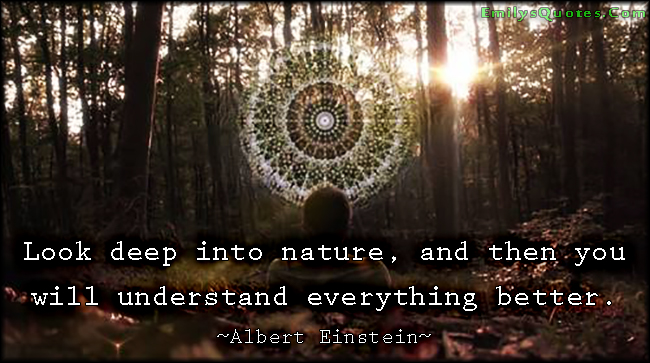
 emilysquotes-com-look-deep-nature-understand-wisdom-inspirational-life-albert-einsteinMy dreams of hope!