Dear friend of this place, Margaret K. from Tasmania (MargfromTassie), recently sent me an email with a link to a story that had appeared on the BBC website.
I thought the photographs would make a fabulous Picture Parade.
But first sufficient of the news story for the photographs to be seen in proper context.
Meet Scotland’s ‘most well-travelled dog’
By Ewan Murrie,BBC Scotland news website, 3rd June 2017
After photographs of her West Highland Terrier received more “likes” on social media than even the most stunning Glencoe landscapes she could capture, Sam Grant conceded that “the wee white dug” should star in her Scottish travel blog.
“Casper is my unique selling point,” says Sam Grant, an Edinburgh-based VisitScotland ambassador who spends her spare time travelling the country with her pet.
She adds: “There are lots of travel bloggers out there who are very good writers, but they don’t have the wee white dug.”
Here are almost all of those photographs that the BBC presented.
You will love them.
Please note that all of the photographs were taken by Sam Grant who, I am sure, retains copyright ownership of them. Sam’s blogsite is Scotland With The Wee White Dug and well worth a visit.
The village of Crianlarich is located in Glen Strathfillan to the north of the Trossachs, around eight miles north of the head of Loch Lomond
oooo
The village of Carrbridge, in the Scottish Highlands is famous for its 18th Century packhorse bridge.
oooo
Whiting Bay, Isle of Arran, offers views across to Holy Isle.
oooo
Culzean Castle is perched on the Ayrshire cliffs.
oooo
Culloden Moor in the Highlands is where the Battle of Culloden took place in 1746.
oooo
Iona, Inner Hebrides, is often described as a “tiny island paradise”.
oooo
The Tomb of the Eagles, Orkney, is thought to be more than 5,000 years old.
oooo
North Berwick, East Lothian, boasts many great beaches and coastal scenery.
oooo
“Dolphin Spirit” is a boat to take tourists onto the waters of the inner Moray Firth to see the dolphin pods.
oooo
Bow Fiddle Rock is a natural sea arch near Portknockie on the north-eastern coast of Scotland.
oooo
Kilchurn Castle is a ruined castle on a rocky peninsula at the northeastern end of Loch Awe, Argyll and Bute.
oooo
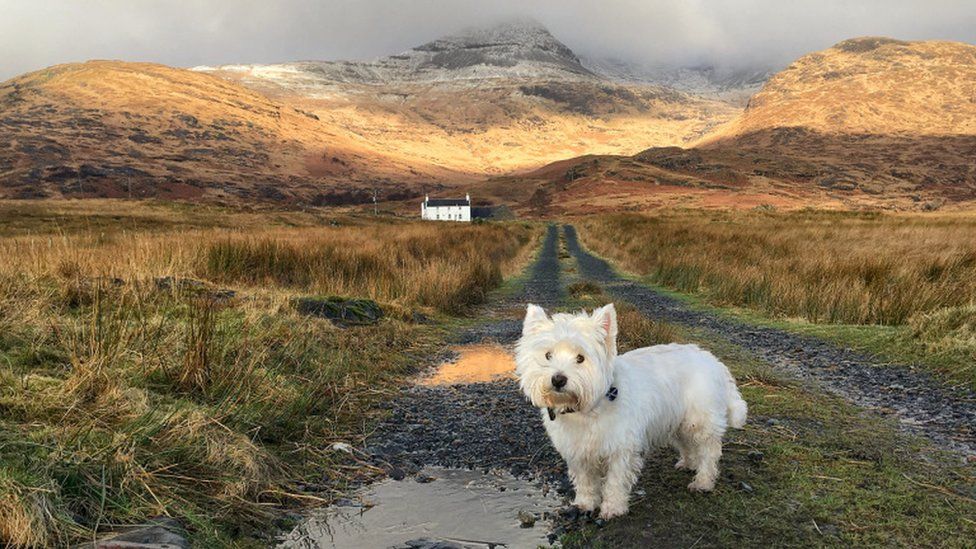
Snow capped Ben More in Glen More, Isle of Mull, Western Isles.
oooo
Balnakeil Bay is near Durness, Scottish Highlands.
I can’t resist including the rest of the text that the BBC published for the photographs are strengthened enormously by Sam’s words.
Her eccentric website details places of interest in areas including Orkney, Loch Lomond and the Scottish Borders.
It was launched in 2015 after an Instagram account written from Casper’s perspective proved popular with followers.
The social media profile has nearly 4,000 followers, who Sam says “can’t get enough” of the wee white dug’s quirky anecdotes about his travels.
Sam says travelling with Casper has given her lots of insight into Scotland’s best pet-friendly tourist attractions and holiday accommodation.
She says: “There are loads of good places that you can visit nowadays where you can bring along your four-legged friends.”
Sam hopes the blog could encourage more Scots to look around their own country, as well as attracting other visitors.
She says: “If you visit the beaches in the Outer Hebrides, you’ll see there’s really no need to go to the Caribbean – unless you’re a sun worshipper.
“Scotland’s a country with a rich history and heritage. A country full of stories just waiting to be told.”
Sam says most traffic to her website comes from the UK and US but she has had visitors from more than 100 countries – including China.
“When I see that I’ve had visitors from far-flung countries, I imagine them on the other side of the world reading about Scotland and the wee white dug,” the writer adds.
Asked if she thinks some people could say her pictures are a bit twee, Sam replied: “I did worry about that at first, so I try to make a joke of it.
“But if people like my pictures and they bring a bit of happiness to someone’s day, then why not?”
I guarantee that all of you dear people who view these photographs will have much happiness brought to you. As was brought to Jeannie and me.
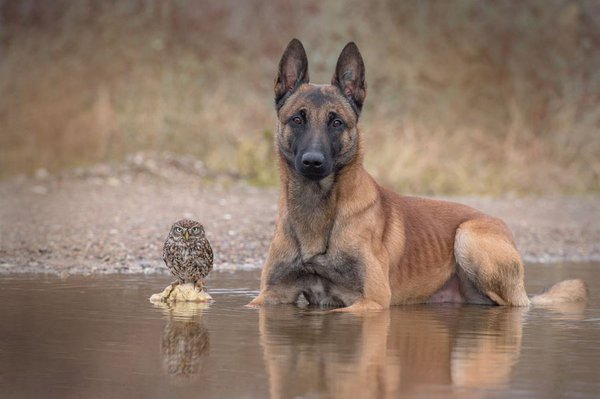
You will all recall that when we were ‘enjoying’ the chaos of having new flooring installed in three of our rooms I posted over a number of days a selection of wonderful, incredible photographs taken by Tanja Brandt. Here is one of those photos.
We were all utterly enthralled by them and wanted to know more about Tanja.
But Tanja is German and her website and blogsite are, not surprisingly, in German. However, a good friend of mine from times past, Chris Snuggs, who is fluent in German (and French) came to the rescue when I asked for a favour of an English translation.
I sent Chris the link to Tanja’s ‘About Me’ page and here is what Chris emailed me yesterday.
…. she introduces herself with two short texts followed by a list of publications and/or photographic events and awards etc.
I have done a translation of the two elements of her introduction but not attempted to translate the list that follows.
I am assuming that if you want to write an introduction to her you can take her words according to my translation and reformulate them in your own words.
If you want a proper translation of her own words then I think I would need to work on it a bit more. The difficulty there is that if I translate her words directly it will not sound great in English; to get her meaning across in good English I would have to be a bit more free with the phrasing.
I hope that makes sense.
Made sense to me! Wonderful sense!
Here are those translations with the original German in blockquotes and the English translation by Chris topped and tailed with Tanja’s photographs:
Über mich …
Verlasse dich auf dein Herz – es schlug schon, bevor du denken konntest …
…. gibt es nicht so viel zu erzählen. Meine große Leidenschaft, seit ich in Windeln krabbeln kann, sind Tiere.
Tiere im Allgemeinen – vor allem auch Greifvögel und Raubkatzen – und Hunde im Speziellen.
Ich glaube, ich spreche ihre Sprache.
Ein Leben ohne Tiere ist für mich schwer vorstellbar und wenn Jemand keine Tiere mag, dann wird er sich vermutlich nicht sehr lange bei mir aufhalten.
About me Trust your heart; it was beating before you were capable of thought.
There’s not all that much to say. My greatest passion even since I was a baby are animals – all kinds of animals, above all birds of prey and big cats – and especially dogs.
I believe I speak their language!
For me a life without animals is difficult to imagine, and if someone doesn’t like animals, then he or she would probably not be around me for long.
oooo
Fotografie ist meine Leidenschaft
Wie es begann?
Ich wollte schöne Fotos von meinen Tieren. Bzw überhaupt von Tieren. Fotos, die die Seele und den Charakter des jeweiligen Tieres widerspiegeln. Nicht einfach nur Fotos.
So kam mir der Gedanke, mit einer professionellen Kamera dürfte das kein Problem sein. Die Kamera wurde gekauft und es ging los – das Ergebnis war ernüchternd ….
Ich musste dann doch noch einige Workshops besuchen, um da zu sein, wo ich heute stehe.Kurse, Workshops, Webinare, Bücher, Austausch mit anderen Fotografen und viel üben. Und ich versuche jeden Tag, was dazu zu lernen und zu entdecken.
Aber allein das Technikverständnis macht es nicht aus, um die Seele der Tiere zu zeigen und die Arbeit mit den Tieren ist so wertvoll. Ich kann Tiere nur fotografieren, wenn sie sich wohlfühlen und mit Begeisterung mitmachen oder Wildtiere eben keine Angst vor mir haben.
Photography is my passion. How did it all begin? I wanted to take beautiful photos of my animals, indeed, of all animals: photos which would reveal the soul and character of each animal – not just snaps …..
So I had the idea that all I needed was a professional camera. The camera was bought and off I went – the experience was chastening. I realized I needed training to get where I am now: went to workshops, on courses, internet lessons, books, exchanges with other photographers and lots more. And I still try every day to discover and learn something new.
But technique alone doesn’t suffice to lay bare the soul of a creature. Working with animals is so fulfilling, but I can only photograph them when they are at ease and enthusiastically join in the process, or if with wild animals when they are not afraid of me.
So many things make presenting this blog to you so very special for me. Then something comes along that takes it into the stratosphere of being special. That is Tanja Brandt. Tanja’s photographs and how she describes herself are stratospheric!
I am so pleased to have been granted permission by Tanja to share her photographs; something I never want to stop doing!
Our English guests, Mark and Debbie, who stayed with us after traveling to Warm Springs, South-East of Portland, Oregon, to view the eclipse took the following three photographs.
See the crescents in the dappled shade of a near by bush. 10 minutes before totality.
oooo
Totality – August 21st, 2017.
oooo
Our English guests.
oooo
Then you will love the next one. Sent in by Neil Kelly from Devon, England.
Madison wears sunglasses to view the eclipse along the Cumberland River, Nashville, USA
oooo
And another beauty courtesy of Neil K.
Last but not least ….
oooo
Back to the stars!
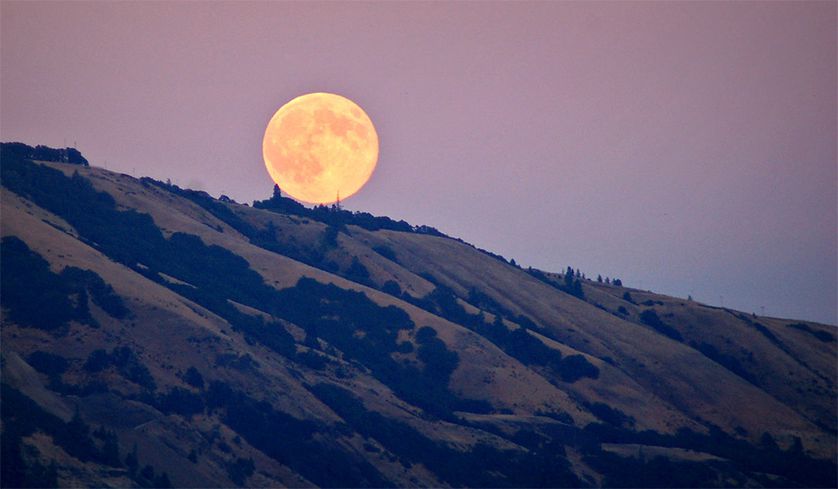
The rising moon a little after 5am on the 19th August.
oooo
And there hanging above that rising moon was Venus!
oooo
Finally, back to Tanja Brandt whose most beautiful photographs will be gracing these Picture Parades in the future.
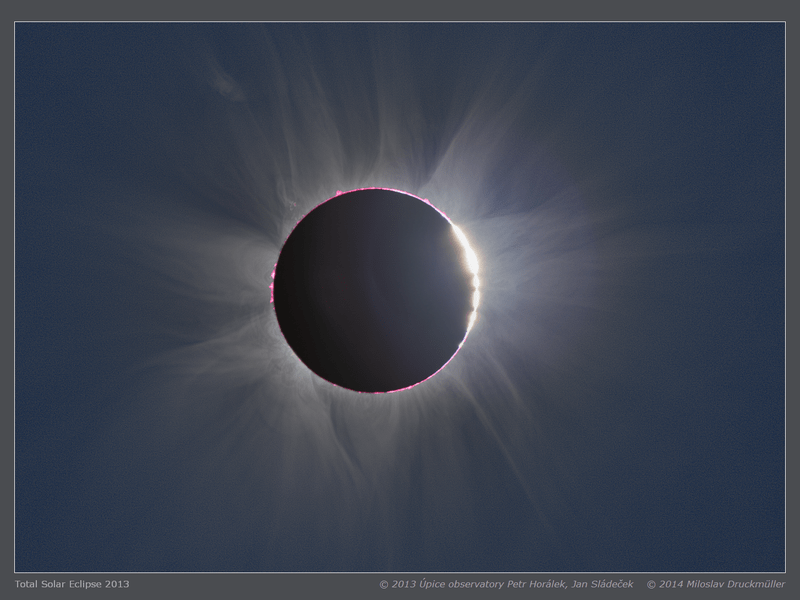
How would you describe an eclipse to a blind person? The moon moves in front of the sun, yes. But what does that look like? Someone trained in illustrative description of images might say, “The moon appears as a featureless black disk that nearly blocks out the sun. The sun’s light is still visible as a thin band around the moon’s black disk. To the upper right, at the moon’s leading edge, a small area of sunlight still shines brilliantly.”
That’s just an example of how such an event could be described. Bryan Gould, director of accessible learning and assessment technologies at the National Center for Accessible Media, a non-profit working to make media experiences accessible to people with disabilities, is hoping to offer oral descriptions of the eclipse in an app. Paired with other features, like a tactile diagram and audio from the changing natural environment as the eclipse darkens the sky, the app is designed to make the event more accessible to blind or visually impaired people who want to experience it.
Gould is working with Henry Winter, a solar astrophysicist at the Harvard-Smithsonian Center for Astrophysics, to develop the app, called Eclipse Soundscapes. As the August 21 solar eclipse darkens a path across the United States, Eclipse Soundscapes will release descriptions, timed—based on the user’s location—to match the progress of the eclipse.
Winter conceived Eclipse Soundscapes after a conversation with a friend who’s been blind since birth. She asked him to explain what an eclipse means.
Such an event might provide an interesting representation of the eclipse, thought Winter, so he partnered with the National Park Service’s Natural Sounds program, which preserves and catalogs sounds from the parks. Helpers stationed at national parks along the route will record audio during the eclipse, to hear the change in the “bioacoustical chorus” of the animals.
This can’t happen in real time, of course, so the National Center for Accessible Media is providing illustrative descriptions, based on a previous eclipse. The sounds of crickets, frogs and birds becoming active on the day of the eclipse will be added to the app later.
Last, with the help of an audio engineer named Miles Gordon, Winter is trying something completely new. Gordon developed a “rumble map” of the eclipse: The app places images of different stages of an eclipse on your smartphone’s screen, and as you trace your finger across the eclipse’s image, the vibration increases or decreases based on the brightness of the image.
“It does give you the impression that you’re actually feeling the sun, as you move your finger around,” says Winter.
“I realized I didn’t have the vocabulary to answer that question for her,” says Winter. “Every way I thought about it was visual in nature, and I didn’t know how to explain it to somebody … light, dark, bright, dim, flash. All these different words have no meaning to somebody that’s never seen.”
But the project goes well beyond audio descriptions. It includes two further elements: audio of the changing soundscape caused by the eclipse, and a tactile exploration of the eclipse’s image (which means that people who are blind or visually impaired can “feel” the eclipse using vibrations on their smartphones).
Many creatures become active as the sun sets, and many of them use darkness as an indicator of time of day. During an eclipse, crickets will chirp and frogs will chorus, thinking night has fallen. These habits were noted as far back as 1932, in a Proceedings of the American Academy of Arts and Sciences article titled “Observations on the Behavior of Animals During the Total Solar Eclipse of August 31, 1932.”
Scientists around the world will be using the eclipse as an opportunity to study solar astronomy in a way they usually can’t, measuring the ultraviolet light emitted from the sun’s corona, which Earth-based observers can’t normally see, as it is overpowered by the normal sunlight. It’s also rare for an eclipse to cover this much land — it traverses from Oregon to South Carolina — and Winter points out that it is a particularly good opportunity for education and outreach.
Though education is important, for Wanda Diaz Merced, a visiting scientist at the Harvard-Smithsonian Center for Astrophysics who is completely blind, there’s a lot more to the eclipse than that. Merced, who has consulted on the Eclipse Soundscapes project, studies human-computer interaction and astrophysics, and to do her research, she needs assistance translating data into a format she can interact with. She’s been building tools to help with that translation, and sees elements of Winter’s project that could contribute.
“It’s still not a prototype that I may use, for example, to study elements of the photosphere. It is not on that stage,” says Merced. “But hopefully one day we will be able to not only hear, but to touch.”
The eclipse will occur on August 21, starting around 10 a.m. in Oregon and finishing by 3 p.m .in South Carolina. The Eclipse Soundscapes app is available for iOS now, and the team is working on an Android app as well.
ooOOoo
I can’t imagine there’s anyone still pondering on whether or not to view the eclipse.
But that still doesn’t stop me offering you this recently presented TED Talk.
On August 21, 2017, the moon’s shadow will race from Oregon to South Carolina in what some consider to be the most awe-inspiring spectacle in all of nature: a total solar eclipse. Umbraphile David Baron chases these rare events across the globe, and in this ode to the bliss of seeing the solar corona, he explains why you owe it to yourself to witness one, too.
This talk was presented to a local audience at TEDxMileHigh, an independent event. TED editors featured it among our selections on the home page.
About the speaker: David Baron David Baron writes about science in books, magazines, newspapers and for public radio. He formerly served as science correspondent for NPR and science editor for PRI’s The World.
Enjoy it, good people. And protect your eyes!!!
Or better still allow NASA Television to show the eclipse to you.
NASA Television will air a four-hour show – Eclipse Across America – which will include live video of the event, along with coverage of activities in parks, libraries, stadiums, festivals and museums across the nation, and on social media. NASA’s show begins at 15:00 UTC (11 a.m. EDT; translate to your time zone), or later (we’ve seen this time waffle around a bit). Check the website for changes or further details.
How humans and animals communicate with each other has more than an edge of mystery to it!
We sleep with our bedroom door open to the main run of the rest of the house. Generally, all six dogs sleep in our bedroom unless it is a very warm night when some of them may choose the cooler tiled surface of the kitchen floor.
Cleo, our female German Shepherd, has a bit of a sensitive stomach and it is not unknown for her to need to be let outside in the middle of the night. Just a couple of nights ago her need for a ‘poo’ break came at 02:40!
But the point of this is that no matter how deeply I am sleeping, all it takes is a short, quiet whimper next to my side of bed and I am instantly awake. I need no time at all to know that Cleo has to be let outside from our bedroom door that opens out onto the deck. A few minutes later I hear her feet padding along the wooden boards of the deck and she is let back in to the bedroom.
Thus this demonstrates how well I understand her and in turn how well she acutely listens to me.
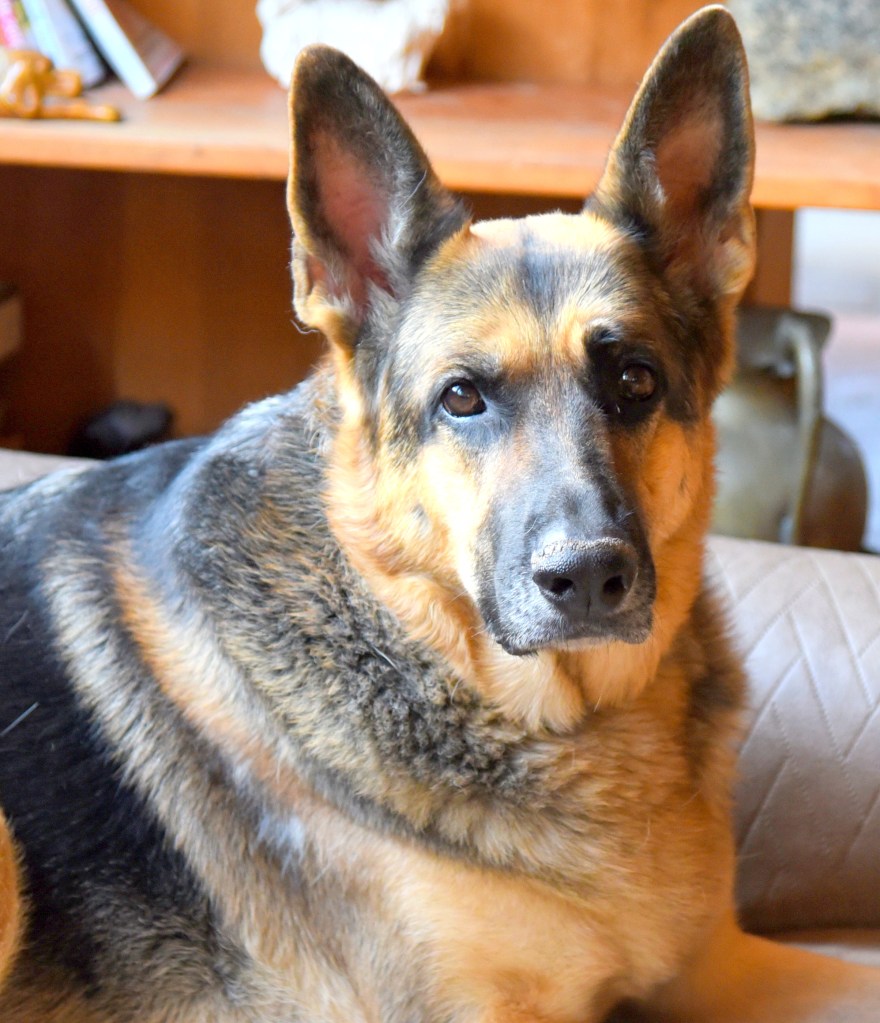
Just look at this photograph.
The connection, the intensity, of her attention towards me. And this was just from me pointing the camera at her and ‘click, clicking’ my tongue.
Moving on!
My introduction today was inspired by an article that I recently read on the Care2 site and that I want to share with you. Here it is.
ooOOoo
Can Humans Understand When Animals Are in Distress?
Have you ever jumped at the sound of birds fighting or a squirrel screaming? Heard an animal make a sound somewhere nearby that made your heart race?
More than one hundred years ago, Darwin suggested that there was a universal understanding of certain animal vocalizations — a way of expressing emotion that went all the way back to the Earth’s earliest animals. Now, researchers are re-examining that theory, and they’re making some interesting headway.
In a study published in the journal “Proceedings of the Royal Society B: Biological Sciences,” researchers decided to explore the idea that animal vocalizations, including distress calls, might be recognizable across different species — and even into different animal classes.
Earlier research delved into whether or not humans could detect which emotion, or signal, another mammal was using, but this study is the first to examine other vertebrates as well. Amphibians and reptiles joined the club, and, perhaps surprisingly, humans did pretty well determining what these animals were trying to communicate.
The researchers primarily looked into whether or not people listening to certain animal sounds would be able to detect the level of arousal — high or low — that an animal expressed vocally. High arousal indicates an animal in distress, expressing desperate or negative screams, who might be calling out because of a fight, a predator in the area or another perceived danger. Scientists believe that these sounds are part of an old signaling system.
Researchers asked 75 college-aged individuals to listen to sounds from nine different species. In order to account for language differences, these people included English, German and Mandarin speakers.
Scientists collected 180 recordings of animal vocalizations, reflecting high or low levels of excitement, such as “the sounds of frogs in competition for mates, monkeys reacting to danger or ravens confronted by a dominant bird,” and included humans in that list, instructing actors to react neutrally or with different, heightened emotions while speaking Tamil.
The 75 people were then asked to identify which vocalization out of paired sounds from the same species represented the higher level of arousal.
In this study, the results showed that people identified the correct “emotion,” roughly speaking, better than expected by chance. Here is how the accuracy broke down across species:
Humans: 95 percent correct
Giant panda: 94 percent correct
Hourglass tree frog: 90 percent correct
African bush elephant: 88 percent correct
American alligator: 87 percent correct
Black-capped chickadee: 85 percent correct
Pig: 68 percent correct
Common raven: 62 percent correct
Barbary macaque (monkey): 60 percent correct
It seems strange that people were less able to identify the distress call of a monkey than a frog, but Harold Gouzoules, a bioacoustician and animal behavior expert at Emory University, posits that the monkey calls may have sounded less extreme in intensity than those of the other species, making it harder to tell the difference.
“Our study shows that humans are naturally able to recognize emotional arousal across all classes of vocalizing animals,” said Piera Filippi, who studies the evolution of cognition and communication at the Vrije University Brussels in Belgium.
This doesn’t mean that humans should feel confident in interpreting animal emotions or body language in general, though. Those behaviors can vary greatly, and humans are prone to misinterpretation and anthropomorphism. You wouldn’t, for example, want to assume a wolf baring its teeth is simply smiling at you.
Naturally, much remains to be studied in the effort to understand a wider range of animal emotions. Filippi hopes to repeat the experiment, but with the black-capped chickadees taking the place of the college-aged humans in interpreting the distress calls. It will be interesting to see if this understanding between humans and other animals goes both ways.
Could there be a beneficial reason for animals to understand each other’s distress calls? What do you think?
Yes, we know that they are but the science as to why this is nonetheless is fascinating!
Inevitably when you think about my cultural roots you would not be surprised to hear that I use the BBC News website as a key source of staying in touch with the world. But very rarely would I think of sharing a news item with you via these pages.
One of those rare exceptions greeted my eyes back on July 20th. It was an article published by Helen Briggs of the BBC under the Science & Environment news classification. I can’t imagine any reason why I can’t republish it here.
ooOOoo
Why dogs are friendly – it’s written in their genes
By Helen Briggs – BBC News, 20 July 2017
Some wolves are more sociable than others.
Being friendly is in dogs’ nature and could be key to how they came to share our lives, say US scientists.
Dogs evolved from wolves tens of thousands of years ago.
During this time, certain genes that make dogs particularly gregarious have been selected for, according to research.
This may give dogs their distinctive personalities, including a craving for human company.
“Our finding of genetic variation in both dogs and wolves provides a possible insight into animal personality, and may even suggest similar genes may have roles in other domestic species (maybe cats even),” said Dr Bridgett vonHoldt of Princeton University.
The researchers studied the behaviour of domestic dogs, and grey wolves living in captivity. They carried out a number of tests of the animals’ skills at problem-solving and sociability.
Captive wolves gave humans only brief attention.
These showed that wolves were as good as dogs at solving problems, such as retrieving pieces of sausage from a plastic lunchbox.
Dogs, however, were much more friendly. They spent more time greeting human strangers and gazing at them, while wolves were somewhat aloof.
DNA tests found a link between certain genetic changes and behaviours such as attentiveness to strangers or picking up on social cues.
Similar changes in humans are associated with a rare genetic syndrome, where people are highly sociable.
Dr Elaine Ostrander of the National Institutes of Health, who was a co-researcher on the study, said the information would be useful in studying human disease.
“This exciting observation highlights the utility of the dog as a genetic system informative for studies of human disease, as it shows how minor variants in critical genes in dogs result in major syndromic effects in humans,” she said.
Wolves playing at Yellowstone.
Dogs were domesticated from wolves between 20,000 and 40,000 years ago.
This process began when wolves that were tolerant of humans sneaked into hunter gatherer camps to feed on food scraps.
Over the course of history, wolves were eventually tamed and became the dogs we know today, which come in all shapes and sizes.
The finding of genetic changes linked to sociability in dogs shows how their friendly behaviour might have evolved.
“This could easily play into the story then of how these wolves leave descendants that are also ‘friendlier’ than others, setting the path for domestication,” said Dr vonHoldt.
The post Floor Diversion Day Three has been postponed for twenty-four hours.
Simply because yesterday morning the installers contracted by Home Depot (HD) to rip up our existing carpet and start laying the laminate wooden boarding found underneath the old carpet underlay another carpet that some time in the distant past had been glued down. Why this wasn’t spotted by the HD measuring unit when they came here to look at the project and offer an estimate for the cost of installing the new flooring is a question that has yet to be answered.
However, while the majority of HD work the full weekend the ‘Chargeback’ department do not. This department had to hear what had been discovered in order for us to know what extra costs we might be looking at!
A long-winded way of explaining why it is a pleasure to offer you a regular Picture Parade for today.
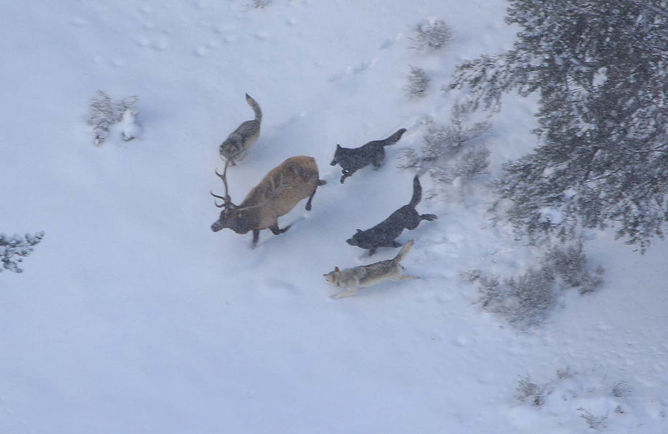
Not so long ago there was some discussion about how important it was for the natural way of things to include predators. I mentioned how this had been the topic of a post published some time ago in this place.
It was back in February, 2014 and I have republished it today.
oooo
The critical value of predators in our wild lands.
February 24th, 2014
The consequences of the reintroduction of wolves to Yellowstone National Park.
I have two people to offer my thanks to for today’s post: Suzann and Ginger. Both of them within hours of each other sent me an email recommending the following video. So, without further ado, here is that video. (Oh, would you believe this. The video was released on February 13th, 2014 and, at the time of me writing this post, has been viewed 1,453,345 times! Wow!)
“When we try to pick out anything by itself, we find it hitched to everything else in the Universe.” – John Muir
When wolves were reintroduced to Yellowstone National Park in the United States after being absent nearly 70 years, the most remarkable “trophic cascade” occurred. What is a trophic cascade and how exactly do wolves change rivers? George Monbiot explains in this movie remix.
Narration from TED: “For more wonder, rewild the world” by George Monbiot. Watch the full talk, here: http://bit.ly/N3m62h
Music Credits:
“Unfoldment, Revealment, Evolution, Exposition, Integration, Arson” by Chris Zabriskie (http://bit.ly/1c2uckW)
FAIR USE NOTICE: This video may contain copyrighted material. Such material is made available for educational purposes only. This constitutes a ‘fair use’ of any such copyrighted material as provided for in Title 17 U.S.C. section 106A-117 of the US Copyright Law.
If you want to read more on a general level, then my post on the 11th January, 2014, An echo in the hills! may be worthwhile. It included this from William Ripple, of Oregon State University:
ooOOoo
Top dogs keep ecosystems in order
Many of these large carnivore species are endangered and some are at risk of extinction, either in specific regions or entirely. Ironically, they are vanishing just as we are learning about their important ecological effects, which is what led us to write a new paper in the journal Science to document their role.
From a review of published reports, we singled out seven species that have been studied for their important ecological role and widespread effects, known as trophic cascades. These are the African lion, leopard, Eurasian lynx, cougar, gray wolf, sea otter and dingo.
Based on field research, my Oregon State University co-author Robert Beschta and I documented the impact of cougars and wolves on the regeneration of forest tree stands and riverside vegetation in Yellowstone and other national parks in western North America. Fewer predators, we found, lead to an increase in browsing animals such as deer and elk. More browsing disrupts vegetation, reduces birds and some mammals and changes other parts of the ecosystem. From the actions of the top predator, widespread impacts cascade down the food chain.
Similar effects were found in studies of Eurasian lynx, dingoes, lions and sea otters. For example in Europe, absence of lynx has been closely tied to the abundance of roe deer, red fox and hare. In Australia, the construction of a 3,400-mile dingo-proof fence has enabled scientists to study ecosystems with and without dingoes which are closely related to gray wolves. They found that dingoes control populations of herbivores and exotic red foxes. The suppression of these species by dingoes reduces predation pressure, benefiting plants and smaller native prey.
In some parts of Africa, the decrease of lions and leopards has coincided with a dramatic increase in olive baboons, which threaten crops and livestock. In the waters off southeast Alaska, a decline in sea otters through killer whale predation has led to a rise in sea urchins and loss of kelp beds.
Predators are integral, not expendable
We are now obtaining a deeper appreciation of the impact of large carnivores on ecosystems, a view that can be traced back to the work of landmark ecologist Aldo Leopold. The perception that predators are harmful and deplete fish and wildlife is outdated. Many scientists and wildlife managers now recognise the growing evidence of carnivores’ complex role in ecosystems, and their social and economic benefits. Leopold recognised these relationships, but his observations were ignored for decades after his death in 1948.
Top carnivores, at work keeping things in check. Doug Smith
Human tolerance of these species is the major issue. Most would agree these animals have an intrinsic right to exist, but additionally they provide economic and ecological services that people value. Among the services documented in other studies are carbon sequestration, restoration of riverside ecosystems, biodiversity and disease control. For example, wolves may limit large herbivore populations, thus decreasing browsing on young trees that sequester carbon when they escape browsing and grow taller. Where large carnivore populations have been restored – such as wolves in Yellowstone or Eurasian lynx in Finland – ecosystems appear to be bouncing back.
I am impressed with how resilient the Yellowstone ecosystem is, and while ecosystem restoration isn’t happening quickly everywhere in this park, it has started. In some cases where vegetation loss has led to soil erosion, for example, full restoration may not be possible in the near term. What is certain is that ecosystems and the elements of them are highly interconnected. The work at Yellowstone and other places shows how species affect each another through different pathways. It’s humbling as a scientist to witness this interconnectedness of nature.
My co-authors and I have called for an international initiative to conserve large carnivores in co-existence with people. This effort could be modelled after a couple of other successful efforts including the Large Carnivore Initiative for Europe, a non-profit scientific group affiliated with the International Union for the Conservation of Nature, and the Global Tiger Initiative which involves all 13 of the tiger-range countries. With more tolerance by humans, we might be able to avoid extinctions. The world would be a scary place without these predators.
William Ripple does not work for, consult to, own shares in or receive funding from any company or organisation that would benefit from this article, and has no relevant affiliations.
Well the reason I am using that connection is because I want to share with you an email that was received yesterday.
Paul
The Mexican gray wolf (also called lobo) is the rarest subspecies of gray wolf in the world. With just 113 individuals in the wild, this federally endangered species needs your voice now.
Despite recommendations by the US Fish and Wildlife Service’s own scientists, they have released a highly politicized Draft Mexican Wolf Recovery Plan, which we fear will lead these severally endangered wolves to extinction.
The draft recovery plan ignores science, gives special interests controlling power over recovery, and outlines criteria which will prematurely remove Endangered Species Act protections from the wolf.
Of course I wrote in support of the Lobo! And was delighted to notice that Action Network had set a goal of 3,200 letters and, as of yesterday morning, only a further 275 letters were needed to make that goal.
You all understand that this blog, while predominantly about our special doggie friends, never hesitates to wander away from matters canine if I think it will be enjoyed by all you good people.
You will also all appreciate that August is the month where in the USA, on August 21st, there will be a total eclipse of the sun.
The reasons why I didn’t hesitate to republish a recent post that was presented on Mother Nature Network.
ooOOoo
What to see in the night sky in August
While the total solar eclipse is the highlight, there are other celestial fireworks to look forward to this month.
Celestial events for August 2017 include a total solar eclipse, Perseid meteor shower and the rise of the Sturgeon Moon. (Photo: Michael Seeley/Flickr)
Welcome to August, a month defined by loud cicadas, pool parties, humidity and children fretting about an impending return to school. When it comes to celestial happenings, however, there is no larger star this month that our own moon. From a partial lunar eclipse to the first coast-to-coast solar eclipse in almost a century, the moon will be the cause of most eyeballs drifting towards the heavens over the next several weeks.
Below is a small sampling of some of the night and day celestial events to look forward to this month. Wishing you all clear skies!
The rise of the full Sturgeon Moon (Aug. 7)
The full Sturgeon Moon is so-named for the fish that are easily caught in August and early September. (Photo: Paul Kline/flickr)
August’s full moon, nicknamed the Sturgeon Moon, will rise for the U.S. Eastern Seaboard on the evening of Aug. 7 at 8:05 p.m.
The Sturgeon Moon gets its name from the species of fish native to both Europe and the Americas that is easily caught this time of year. Other nicknames include the Corn Moon, Fruit Moon and Grain Moon. In countries experiencing winter, such as New Zealand, native Māori called this full moon “Here-turi-kōkā” or “the scorching effect of fire is seen on the knees of man.” This reference is to warm fires that glow during the Southern Hemisphere’s coldest month.
Partial lunar eclipse (Aug. 7 & 8)
Observers in Africa, Asia and Australia will see August’s partial lunar eclipse in its entirety. (Photo: Forrest Tanaka/flickr)
As a kind of consolation prize for missing out on this month’s total solar eclipse over North America, those living on the continents of Africa, Asia and Australia will bear witness to a partial lunar eclipse. Spectators in Europe will catch the tail end of the eclipse as the moon rises around 7:10 p.m. on Aug. 7.
This phenomenon occurs between two to four times a year when the moon passes through a portion of the Earth’s shadow. Because the shadow cast is more than 5,700 miles wide, lunar eclipses last much longer than solar eclipses. In some instances, totality can occur for as long as 1 hour and 40 minutes. As a reference, maximum totality for the Aug. 21 solar eclipse will top out a mere 2 minutes and 42 seconds. The longest, at over 7 minutes, won’t take place until the year 2186.
This month’s partial lunar eclipse is the last of the year. Next year, total lunar eclipses will take place in January and July.
Perseid meteor shower (Aug. 12)
A composite shot of last year’s Perseid meteor shower over Turkey. Notice how the path of the meteors appears to race from the constellation Perseus. (Photo: NASA)
Regarded as one of the best celestial light shows of the year, the Perseid meteor shower occurs from July 17 to Aug. 24 and peaks on the evening of Aug. 12.
The shower, sometimes creating as many as 60 to 200 shooting stars per hour, is produced as Earth passes through debris left over from the orbit of Comet Swift-Tuttle. This 16-mile-wide periodic comet, which completes an orbit around the sun every 133 years, has been described as “the single most dangerous object known to humanity.” This is because every instance of its return to the inner solar system brings it ever closer to the Earth-moon system. Though astronomers believe the comet bears no threat for at least the next 2,000 years, future impacts cannot be ruled out.
If the comet were to hit Earth, scientists believe Swift-Tuttle would be at least 27 times more powerful than the asteroid or comet that wiped out the dinosaurs. For now, you can take in the beauty of the debris from this harbinger of doom by looking north towards the constellation Perseus. Because the moon will be three-quarters full, you’ll need to search out a nice dark sky to escape any light pollution from urban environments.
Total solar eclipse (Aug. 21)
A total solar eclipse as captured over the Southern Hemisphere in November 2012. (Photo: NASA Goddard Space Flight Center)
Total solar eclipses occur when the new moon moves between the Earth and the sun and casts its shadow on the planet. This shadow is comprised of two concentric cones –– the larger penumbra, which from Earth only shows the sun partially blocked, and the much smaller umbra, which blocks the sun completely. It is within this latter cone that totality will occur, giving spectators on the ground what’s considered by many to be a “once-in-a-lifetime” experience.
The Great American Eclipse will actually first start out in the Pacific (at this point, it will actually, unbelievably rise while completely eclipsed!), making landfall on the Oregon community of Lincoln Beach at 10:16:01 a.m. (PDT). From there, the moon’s shadow will continue to race across the U.S. The point of greatest eclipse, where the axis of the moon’s shadow passes nearest to the center of Earth, will take place in Hopkinsville, Kentucky and last 2 minutes and 40.1 seconds. In celebration of the event, the town has temporarily renamed itself “Eclipseville,” and expects anywhere from 55,000 to 150,000 tourists to visit in advance of Aug. 21.
The next total solar eclipse over the U.S. will take place on April 8, 2024.
New moon (Aug. 21)
August’s new moon will not only create a show during the day, but also leave the heavens to glow unimpeded by night. (Photo: Coconino National Forest/flickr)
Fresh after wowing the U.S. during the day with its solar theatrics, August’s new moon will give way to dark skies for the next several nights. This is the perfect opportunity to grab a blanket and head outside into the still-warm summer evenings to enjoy the heavens in all their glory. With some remnants of the Perseids still visible, it will also offer a chance to catch some of the faintest shooting stars.
Look for Earth’s shadow (All year)
The Earth’s shadow and ‘Belt of Venus’ as captured above Mauna Kea, Hawaii. (Photo: Jay El Eskay/flickr)
Ever wonder what causes the beautiful bands of color in the eastern sky at sunset or the western sky at sunrise? The dark blue band stretching 180 degrees along the horizon is actually the Earth’s shadow emanating some 870,000 miles into space. The golden-red portion, nicknamed the “Belt of Venus,” is Earth’s upper-atmosphere illuminated by the setting or rising sun.
Now that you know about this phenomenon, choose a night or morning sometime to try and pick it out. You’ll need a western or eastern horizon that’s fairly unobstructed to get a clear view of our planet’s huge curved shadow.
Looking ahead to September
On Sept. 15, the Cassini spacecraft will end its 20-year mission to Saturn with a dramatic death dive into the ringed planet. (Photo: NASA)
As fall beckons, the biggest event next month will be the dramatic death dive of the Cassini spacecraft into Saturn. Taking place on Sept. 15, Cassini will make discoveries about Saturn right up until its fiery conclusion, with unprecedented photos and data captured and transmitted during its final moments.
ooOOoo
It is going to be quite a month!
Oh, and for those of you that want to know the timings of the eclipse over North America there is a useful reference site here, from which I republish the following table.
Eclipse Start & End: Local Time for US States
The eclipse will begin over the Pacific Ocean at 15:46 UTC, which corresponds to 8:46 am Pacific Time. It will reach the coast of Oregon at Lincoln City, just west of Salem, at 9:04 am local time. The eclipse will reach its maximum point here at 10:17 am.
From here, the Moon’s central shadow will move inland. The following table shows when the Moon will begin to move in front of the Sun and the moment it completely covers the Sun, as seen from some locations along the central path of the eclipse. All times are local.
Please note that this list includes only a small selection of locations where the total eclipse will be visible. You can look up more locations in our Eclipse Database or via the Eclipse Map.
Enjoy your nights out there! And let your dogs howl their hearts out!














 Man! We are a strange species at times!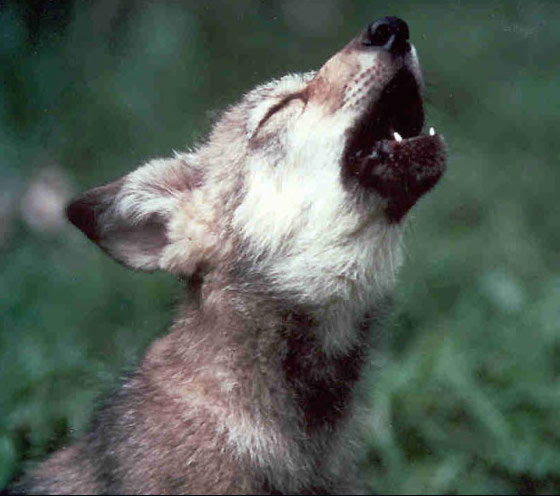



 Learning from Dogs