Category: Environment

It’s all we have!

A bit tight on time for today’s Post so just feast your eyes on this image.


Earthrise, from the cabin of Apollo 8


This view of the rising Earth greeted the Apollo 8 astronauts as they came from behind the Moon after the lunar orbit insertion burn. The photo is displayed here in its original orientation, though it is more commonly viewed with the lunar surface at the bottom of the photo. Earth is about five degrees left of the horizon in the photo. The unnamed surface features on the left are near the eastern limb of the Moon as viewed from Earth. The lunar horizon is approximately 780 kilometers from the spacecraft. Height of the photographed area at the lunar horizon is about 175 kilometers.

The Apollo 8 mission was the first time man had left the orbit of the Earth.

The photograph was taken on the 24th December 1968 by NASA astronaut William Anders.  Within 18 months of this image being published, the environmental movement had started. Wilderness photographer Galen Rowell called it “the most influential environmental photograph ever taken.”


Group human insanity

In individuals, insanity is rare; but in groups, parties, nations, and epochs it is the rule.Friedrich Nietzsche

I was minded to select this quote because an item in the UK Independent newspaper brought to light a new book from Lester R Brown, founder and President of Earth Policy Institute, called World on the Edge.  Here’s what The Independent wrote (selected extracts by me, the full article is here ):

Like many environmentalists, Lester Brown is worried.

In his new book “World on the Edge,” released this week, Brown says mankind has pushed civilization to the brink of collapse by bleeding aquifers dry and overplowing land to feed an ever-growing population, while overloading the atmosphere with carbon dioxide.

If we continue to sap Earth’s natural resources, “civilizational collapse is no longer a matter of whether but when,” Brown, the founder of Worldwatch and the Earth Policy Institute, which both seek to create a sustainable society, told AFP.

“We’ve got to get our act together quickly. We don’t have generations or even decades – we’re one poor harvest away from chaos,” he said.

Global warming is also impacting the global supply of grain, which Brown calls the foundation of the world food economy.

Every one-degree-Celsius rise above the normal temperature results in a 10 percent fall in grain yields, something that was painfully visible in Russia last year, where a seven-week heatwave killed tens of thousands and caused the grain harvest to shrink by 40 percent.

Food prices soared in Russia as a result of the poor harvest, and Russia – which is one of the top wheat exporters in the world – cut off grain exports.

Different grains are staple foods in most of the world, and foods like meat and dairy products are “grain-intensive.”

It takes seven pounds (3.2 kilograms) of grain fed to a cow to produce a pound of beef, and around four pounds (1.8 kilograms) of grain to produce a pound of cheese, Brown told AFP.

In “World on the Edge”, Brown paints a grim picture of how a failed harvest could spark a grain shortage that would send food prices sky-rocketing, cause hunger to spread, governments to collapse and states to fail.

Regular readers of Learning from Dogs will understand, because I bang on about it, how the behaviour of dogs over thousands and thousands of years gives us so many metaphors that we can use to rethink how we live, before it’s too late.

(Of course, it’s not just dogs, there are many ‘higher order’ pack animals such as horses, lions and dolphins. to name but a few, that instinctively live in harmony with their surroundings and also we shouldn’t forget some of the earlier human inhabitants of this planet; Eskimos, native North American Indians, Australian Aborigines, that lived similarly in balance with their environment.)

Anyway, back to the theme of this article.

Read a little about Lester, his biography is here.  It starts:

Lester Brown

The Washington Post called Lester Brown “one of the world’s most influential thinkers.” The Telegraph of Calcutta refers to him as “the guru of the environmental movement.” In 1986, the Library of Congress requested his personal papers noting that his writings “have already strongly affected thinking about problems of world population and resources.”

Brown started his career as a farmer, growing tomatoes in southern New Jersey with his younger brother during high school and college. Shortly after earning a degree in agricultural science from Rutgers University in 1955, he spent six months living in rural India where he became intimately familiar with the food/population issue. In 1959 Brown joined the U.S. Department of Agriculture’s Foreign Agricultural Service as an international agricultural analyst.

Brown earned masters degrees in agricultural economics from the University of Maryland and in public administration from Harvard. In 1964, he became an adviser to Secretary of Agriculture Orville Freeman on foreign agricultural policy. In 1966, the Secretary appointed him Administrator of the department’s International Agricultural Development Service. In early 1969, he left government to help establish the Overseas Development Council.

As I said, that was just the start; read the full biography here.

Having recently signed up to the EPI mailing list, this morning an email arrived talking further about Lester Brown’s latest book, World on the Edge.  Here’s what was in that email.

World on the Edge: Quick Facts

JANUARY 25, 2011

We are facing issues of near-overwhelming complexity and unprecedented urgency. Can we think systemically and fashion policies accordingly? Can we change direction before we go over the edge? Here are a few of the many facts from the book to consider:

  • In Sana’a, the capital of Yemen—home to 2 million people—water tables are falling fast. Tap water is available only once every 4 days; in Taiz, a smaller city to the south, it is once every 20 days.
  • The indirect costs of gasoline, including climate change, treatment of respiratory illnesses, and military protection, add up to $12 per gallon. Adding this to the U.S. average of $3 per gallon brings the true market price closer to $15 per gallon.
  • Between 2007 and 2010, U.S. coal use dropped 8 percent. During the same period,300 new wind farms came online, adding 21,000 megawatts of U.S. wind-generating capacity.

“We can get rid of hunger, illiteracy, disease, and poverty, and we can restore the earth’s soils, forests, and fisheries. We can build a global community where the basic needs of all people are satisfied—a world that will allow us to think of ourselves as civilized.” –Lester R. Brown

World on the Edge: How to Prevent Environmental and Economic Collapse is available online at www.earth-policy.org.

In a very real sense it’s a book we should all be reading and if so minded you can buy it directly from the EPI here.  But there is a health warning, so to speak.  That is that each and every one of us has to take a stand to protect the world we live on, to preserve it for our children’s children, and to start the long haul towards sustainability.

Think about one small thing you can do this week to make a positive difference, and do it!

“By the inch it’s a cinch, by the yard it’s hard!”

Afghanistan and truth!

“But better to be hurt by the truth than comforted with a lie.”

The quote is from the film, The Kite Runner, which was based on the book  of the same name written by Khaled Hosseini.

This Post is not about taking a position, at any level, about the West’s involvement in the war in Afghanistan – far too dangerous territory!  But it is a reflection on what truth means.

At first that proposition might appear bizarre, of course we know what truth means. My Thesaurus offers three meanings: Correspondence with fact or truth; Freedom from deceit or falseness; The quality of being actual or factual.  Clear?  H’mmm not really in this instance.

OK, to the motivation behind this article.

Last Sunday two outwardly disconnected actions came together, as often seems to happen, to cause me to ponder on how my opinions are formed.  The actions concerned Afghanistan.

The first was that a friend from the congregation gave me his copy of TIME Magazine for January 17th.  In it was an article about a Black Hawk Medevac unit in Afghanistan.  From the TIME website:

The Birds Of Hope: With A Black Hawk Medevac Unit In Afghanistan

By James Nachtwey Monday, Jan. 17, 2011

General William Tecumseh Sherman got it right. War is hell. But even within the cruelty of war, there exists mercy.

Across a dusty field, two U.S. Marines walk toward a helicopter, each carrying a bloodied and bandaged child. They hold the children as if they were their own. Although at this moment they appear as saviors, a few minutes earlier, they had called in air support in response to enemy fire. The shooter was among children, however (a fact that I have to believe was not known to the Marines), and two were seriously wounded by fragments from machine-gun rounds.

Innocent people are caught in the cross fire in all wars. That’s reality. The two Marines never signed up to hurt kids, and in the shock and confusion, their default reaction was to be protective of the children they indirectly had a hand in wounding. The kids were not left to die, as they might have been in another time and another place by other armies. Instead, a U.S. Army air-ambulance medevac crew was dispatched to fly them to the same medical facility that treats American casualties. If the shooter had survived, he too would have been helped.

Read more: http://www.time.com/time/magazine/article/0,9171,2041191,00.html#ixzz1Byu1S0xj

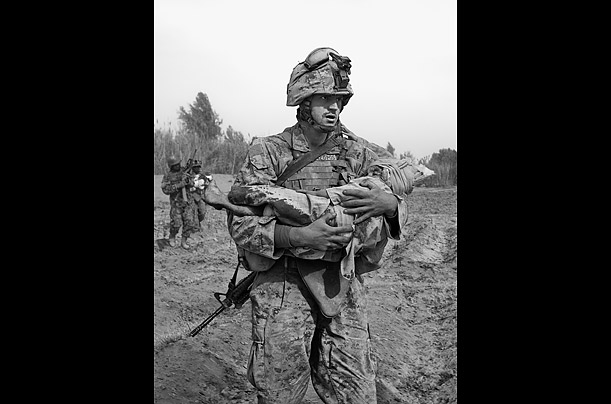
The article in TIME Magazine contained some emotionally powerful pictures, such as the one below.


A Marine carries an Afghan child.

The full description of the photograph, taken by James Nachtwey for TIME , is Helping Hand
A Marine carries an Afghan child, one of two wounded by coalition aircraft during an air support mission.

My reaction on reading the gruelling story was confused and difficult to articulate clearly but certainly not complimentary! Something along the lines of big and powerful nations, such as the USA, Russia and the United Kingdom, playing out their global strategies with no real insight into the pain and suffering caused by their big ‘war games’.

The second action was that Jean had returned a rental film to the local Blockbuster store and returned with another one that had caught her eye for us to watch on Sunday evening.  That film was The Kite Runner based on the book of the same name by Khaled Hosseini.

There’s a good summary of the plot of the film at WikiPedia.  Here’s a flavour.

In Kabul, prior to the Soviet invasion of Afghanistan, well-to-do young boy Amir and his loyal young Hazara servant Hassan are best of friends. Amir enjoys writing and literature, reading stories to the eager but illiterate Hassan. Amir’s Baba (father), is contemptuous of Amir’s writing and privately regards him as a weakling for letting Hassan protect him from bullies. Baba’s friend Rahim Khan demonstrates interest and encouragement to Amir. Assef, a bully with rancor towards Hazaras, and two accomplices confront Hassan and Amir, but Hassan prevents the attack with a slingshot, a birthday gift from Amir. Assef swears revenge, ridiculing their relationship as mere master and servant. .

Soon the Soviets invade Afghanistan; forcing Baba, a known anti-communist, to flee the country leaving Rahim Khan as property caretaker. En route to Pakistan, Baba bravely risks his life defending a female refugee from a Soviet soldier who demands to rape her in return for safe passage for all. Baba and Amir eventually reach the United States as humble refugees in Fremont, California. Baba tends a gas station while Amir attends community college and vends at a weekly flea market. There, Amir meets Soraya Taheri; Soraya is interested in Amir’s writing although her father, the ex-General Taheri, a proud traditional Pashtun, is contemptuous. Baba is stricken mortally ill but manages to obtain General Taheri’s permission for Amir to marry Soraya. Although Soraya feels bound to confess her previous relationships, they are happily married despite an inability to conceive children. As foreshadowed in the movie’s first scene, Amir’s debut novel is published, dedicated to Rahim Khan who encouraged his writing.

It was a fabulous film, one of the more thought-provoking films seen in many years.  If you haven’t seen it, do so.

So to the point of this article.

The film demonstrated to me that my rather black-and-white opinion of the West’s involvement in Afghanistan was based much more on my instincts that ‘war is bad’ and that the USA tends to throw its military weight around, than having a clue as to the enormous complexities, both at the level of a family and of the nation, that these conflicts entail.

The film showed a much more compassionate aspect to the activities of the USA, specifically in getting involved in Afghanistan and, more generally, in a policy of offering a new home and new hope to those from afar.

And for me, the realisation that while it may be said, ‘There is only one truth’, knowing what that truth is is something very much more challenging!

The first casualty when war comes is truth“. (Hiram W Johnson, senator for California, 1917)

Don’t forget Tara’s Babies!

Big thank you to all those that have acted.

I have received quite a few emails in response to a mailing sent out by me yesterday promoting the fabulous work being done by a dog rescue centre near Payson, here in Arizona.  Thank you for letting me know you are adding your support to this great effort by Tara’s Babies to win $250,000 from Pepsi!

If you missed the post on Friday, here’s a link to it – https://learningfromdogs.com/2011/01/21/taras-babies/

An email received a short while ago from Tara’s Babies shows that everyone involved is making a difference!

Yesterday we were unplaced in

The Animal Rescue Site, now we’re

#9 in AZ and 266 overall!

Thank you for VOTING : we CAN win!!


PEPSI VOTING LINKS:Three dogs
a. vote online here

b. text 105549 to 73774


c. Have a Facebook page?
1. Click here
2. Click on “Vote for this Idea”
3. Click on “Login with Facebook account”
4. Click on “Vote for this Idea” again!
 

THE ANIMAL RESCUE SITE VOTING LINK:


1. Click here

2. Click on the Purple Box “Click Here to Give, its FREE”

3. Click on thje link in the box at the top of the page “Vote Now”

4. Search for “Taras Babies” in “AZ”

5. Click on “VOTE”

6. Prove you are a human being and not a Bot by identifying an animal!

7. Click on “Confirm Vote”

NB: You only have to do Step 4 – Search – the first time you vote. The site remembers Tara’s Babies for you!
Mr HCompassion  community  innovation

love   determination  humor  prayer

MANY THANKS FROM ALL OF US AT TARA’S BABIES


Approaches to ‘growth’.

Some thought-provoking articles on the need, or otherwise, of continued growth.

Intellectually, most people, if they stopped and thought about it, would not challenge the absurdity of the notion that a finite rock in space, Planet Earth, can handle an infinite increase in the demands and resources of that finite planetary body, our home in space!

Yet the reality is very different.  For many complex reasons, way beyond the competencies of this writer to fully explain, we, as in the peoples of Planet Earth, continue to behave as though there are no limits to the resources of this beautiful planet that is home for all of us.

Here are some extracts from some recent items that have passed across my ‘in-box’.

A piece from the CASSE website:

What If We Stopped Fighting for Preservation and Fought Economic Growth Instead?

by Tim Murray

Seriously.

Each time environmentalists rally to defend an endangered habitat, and finally win the battle to designate it as a park “forever,” as Nature Conservancy puts it, the economic growth machine turns to surrounding lands and exploits them ever more intensively, causing more species loss than ever before, putting even more lands under threat. For each acre of land that comes under protection, two acres are developed, and 40% of all species lie outside of parks. Nature Conservancy Canada may indeed have “saved” – at least for now – two million acres, but many more millions have been ruined. And the ruin continues, until, once more, on a dozen other fronts, development comes knocking at the door of a forest, or a marsh or a valley that many hold sacred. Once again, environmentalists, fresh from an earlier conflict, drop everything to rally its defense, and once again, if they are lucky, yet another section of land is declared off-limits to logging, mining and exploration. They are like a fire brigade that never rests, running about, exhausted, trying to extinguish one brush fire after another, year after year, decade after decade, winning battles but losing the war.

Just read again the sentence, “For each acre of land that comes under protection, two acres are developed, and 40% of all species lie outside of parks.” Powerful ideas.

Anyway, do read the article in full and see if it changes your attitude.  Here’s how it ends.

Sir Peter Scott once commented that the World Wildlife Fund would have saved more wildlife it they had dispensed free condoms rather invested in nature reserves. Biodiversity is primarily threatened by human expansion, which may be defined as the potent combination of a growing human population and its growing appetite for resources. Economic growth is the root cause of environmental degradation, and fighting its symptoms is the Labor of Sisyphus.

The next article is from The Christian Science Monitor writing about how scientists are getting a new idea about the rate of loss of polar ice.

The seasonal cooling effect of light-reflecting snow and ice in the Northern Hemisphere may be weakening at twice the rate predicted by climate models, a new study shows, accelerating the impact of global warming.

By Pete Spotts, Staff writer / January 18, 2011

A long-term retreat in snow and ice cover in the Northern Hemisphere is weakening the ability of these seasonal cloaks of white to reflect sunlight back into space and cool global climate, according to a study published this week.

Indeed, over the past 30 years, the cooling effect from this so-called cryosphere – essentially areas covered by snow and ice at least part of the year – appears to have weakened at more than twice the pace projected by global climate models, the research team conducting the work estimates.

This is a well-constructed article, easy to read with obvious conclusions.  Towards the end, the author writes:

Snow appears to have its maximum cooling effect – reflecting the most sunlight back into space – in late spring, as the light strengthens but snow cover is still near its maximum extent for the year. Sea ice in the Arctic Ocean has its biggest effect in June, before its annual summer melt-back accelerates, explains Don Perovich, a researcher at the US Army Corps of Engineers Cold Regions Research and Engineering Laboratory in Hanover, N.H., and a member of the team reporting the results.

The final article that I want to include is one from the website Foreign Policy. I’m going to take the liberty of reproducing it in full because it strikes me as an extremely intelligent commentary on where mankind is in terms of our attitudes to growth.

Thomas Homer-Dixon
ECONOMIES CAN’T JUST KEEP ON GROWING

Humanity has made great strides over the past 2,000 years, and we often assume that our path, notwithstanding a few bumps along the way, goes ever upward. But we are wrong: Within this century, environmental and resource constraints will likely bring global economic growth to a halt.

Limits on available resources already restrict economic activity in many sectors, though their impact usually goes unacknowledged. Take rare-earth elements — minerals and oxides essential to the manufacture of many technologies. When China recently stopped exporting them, sudden shortages threatened to crimp a wide range of industries. Most commentators believed that the supply crunch would ease once new (or mothballed) rare-earth mines are opened. But such optimism overlooks a fundamental physical reality. As the best bodies of ore are exhausted, miners move on to less concentrated deposits in more difficult natural circumstances. These mines cause more pollution and require more energy. In other words, opening new rare-earth mines outside China will result in staggering environmental impact.

Or consider petroleum, which provides about 40 percent of the world’s commercial energy and more than 95 percent of its transportation energy. Oil companies generally have to work harder to get each new barrel of oil. The amount of energy they receive for each unit of energy they invest in drilling has dropped from 100 to 1 in Texas in the 1930s to about 15 to 1 in the continental United States today. The oil sands in Alberta, Canada, yield a return of only 4 to 1.

Coal and natural gas still have high energy yields. So, as oil becomes harder to get in coming decades, these energy sources will become increasingly vital to the global economy. But they’re fossil fuels, and burning them generates climate-changing carbon dioxide. If the World Bank’s projected rates for global economic growth hold steady, global output will have risen almost tenfold by 2100, to more than $600 trillion in today’s dollars. So even if countries make dramatic reductions in carbon emissions per dollar of GDP, global carbon dioxide emissions will triple from today’s level to more than 90 billion metric tons a year. Scientists tell us that tripling carbon emissions would cause such extreme heat waves, droughts, and storms that farmers would likely find they couldn’t produce the food needed for the world’s projected population of 9 billion people. Indeed, the economic damage caused by such climate change would probably, by itself, halt growth.

Humankind is in a box. For the 2.7 billion people now living on less than $2 a day, economic growth is essential to satisfying the most basic requirements of human dignity. And in much wealthier societies, people need growth to pay off their debts, support liberty, and maintain civil peace. To produce and sustain this growth, they must expend vast amounts of energy. Yet our best energy source — fossil fuel — is the main thing contributing to climate change, and climate change, if unchecked, will halt growth.

We can’t live with growth, and we can’t live without it. This contradiction is humankind’s biggest challenge this century, but as long as conventional wisdom holds that growth can continue forever, it’s a challenge we can’t possibly address.

Thomas Homer-Dixon is the CIGI chair of global systems at the Balsillie School of International Affairs in Waterloo, Canada.

As Rob Dietz of CASSE wrote in a recent email to me, “I’m a big Thomas Homer-Dixon fan.  His book, The Upside of Down, is outstanding.

Economic growth may one day turn out to be a curse rather than a good, and under no conditions can it either lead into freedom or constitute a proof for its existence” Hannah Arendt (1906-1975).


Well said, Hannah!

Tara’s Babies

A rare request from Learning from Dogs asking if you will vote on behalf of a dog rescue centre.

Many who follow this Blog will know that my beautiful wife, Jean, is totally devoted to dogs, especially rescue dogs.  Over the years that she and her previous husband Ben, who died in 2005, lived in Mexico, Jean must have rescued at least 70 dogs.  Even today, we have 11 ex-rescue dogs enjoying a fabulous life in our mountain home here in Payson, Arizona.

So it was a big surprise to come across a dog rescue organisation called Tara’s Babies and find that their sanctuary is in our neighbourhood.


Photo by Wib Middleton


Here’s a description of the organisation taken from the local newspaper from September 9th, 2009.

By Alan R. Hudson
Gazette/Connection Correspondent
It has been nearly five years since Tara’s Babies Animal Welfare began rescuing animals displaced by Hurricane Katrina. Tara’s Babies operates a no-kill animal rescue and sanctuary “off the grid” at the Ellinwood Ranch, near Young.

A few dogs from the dark days of Katrina still remain and many more have been added since. This is no normal animal rescue however: It is operated by three very dedicated and compassionate ordained Buddhists.

Kunzang Drolma, a Buddhist Nun and the director of Tara’s Babies, graciously invited the Connection to spend the afternoon at the facility. When we arrived, she was (as we had anticipated) wearing her Shamtab—the traditional Buddhist robe—as she fed her canine adoptees.

From that article Drolma explains:

“Katrina was a catastrophe that threw it in everyone’s faces but ultimately, every day, hundreds of dogs and cats are being euthanized in shelters because there’s not enough space for them—just because they were abused, homeless, old or sick. And so that’s when we just moved straight into this process of being a no-kill rescue and sanctuary. We will never euthanize.”

What’s needed, explained Drolma, is a paradigm shift. One that is so profound that shelters will become a thing of the past. While euthanasia is something that Tara’s Babies does not agree with, the solution lies at a higher cultural level.

Frankly, my view is that we need solutions to so many of life’s problems to come from a ‘higher cultural level’ but this Post is about helping Tara’s Babies raise more funds to help their mission.  It’s easy for any of you to help.  You can do it now from your computer.

Go here – http://www.tarasbabies.org/pepsi_refresh.html and read.  If you need convincing of the purpose watch this video (the one at that last web page or direct from YouTube as below).

And from that web-link you can read:

Feel free to copy and personalize the following paragraph to send to your friends:

“Have you heard about Tara’s Babies Animal Welfare, a No-Kill Dog Rescue and Sanctuary in Arizona? They started rescuing dogs left homeless and injured by Hurricane Katrina, after their founder, Jetsunma Ahkon Lhamo, felt compelled to act on seeing the devastation and suffering in the Gulf. They have continued rescuing dogs on death row in overcrowded shelters ever since.

Tara’s Babies Animal Welfare is working to win a $250,000 Pepsi Refresh grant by receiving the most votes for their project in the month of January. The grant will allow them to improve the care they provide to dogs at their beautiful, off-the-grid Sanctuary.

I am going to help Tara’s Babies Animal Welfare by voting for them daily in the Pepsi Refresh grant program and hope that you will too. Please visit www.tarasbabies.org to check them out. You will be able to sign up from their website to support their application to Pepsi Refresh.

The dogs need your vote!”

Here, here!  It’s very quick to initiate and then each day all you need to do is to add your daily vote – a few seconds of your life exchanged for the rest of the life of a dog that, otherwise, would have nowhere to go!

Thank you!


Dr Bruce Lipton

The astounding work showing that what we believe affects our genes and our DNA.

Regular followers of Learning from Dogs have probably read the two Posts published earlier this week about the work by British biochemist, Dr Rupert Sheldrake.  If you missed those then allocate just a couple of hours of your private time to a) watch the video contained here, and then b) learn more about this scientist here. The implications of energy fields, Morphic Fields as Dr Sheldrake has named them, are almost so profound as to be beyond rational description.  Animal and human telepathy is shown to be real, as in scientifically reproducible.

There is much that flows out of Sheldrake’s work but before I try and pull together all my thoughts and feelings, there is more astounding evidence to share with you on the power of thoughts, the power of your beliefs and how they make you how you are both in terms of your biology but also your behaviours.  That comes from an American developmental biologist, Dr Bruce Lipton.

I’m not going to write any more at this stage but hope that you will watch a lecture given by Dr Lipton with the title of The Biology of Perception.  That lecture is available as 7 shortish (9 mins plus or minus) You Tube videos.  They are easy to watch, Dr Lipton has a lovely fast-moving style, and the conclusions are, as I said, astounding.

So the first four sections are below, the balance will be published tomorrow.

Concluding parts tomorrow – do watch them.

In humble recognition of great writers

The technology of the Internet will prove to be of huge democratic value.

Those who know me know a disquieted man.  Someone, who despite being more at peace with himself than ever before, nonetheless senses that we, as in the mankind of Planet Earth, are already deep in the ‘no mans land’ of change between the last, say, forty years and a very different future just around the corner.

In the past opinion and commentary has been in the hands, more or less, of the giant media moguls.  But technology has changed that.  Now more than ever a huge people have access to the Internet.  Indeed, a quick Google search reveals that of a world population of 6.85 billion people, just under 2 billion (29%) have internet access.  In North America that percentage is 77.4% (226 million) and in Europe the percentage is 58.4% (475 million).  I.e. nearly a billion people in just North America and Europe!

My point is that, in a manner never before experienced in human history, the vast majority of us have the ability to read, learn and muse about the critically important issues facing us today, coming to conclusions that carry political weight.  We have almost infinite choice as to where and how we form opinions.

Thus having access, via the internet, to the scribblings of so many wise people may end up giving democracy the boost it really needs in the face of overwhelming powerful plutocratic forces.

Here are just a couple of those wise voices.

Simon Johnson

I first came across him in an article in The Atlantic Magazine back in May 2009.  That article was called The Quiet Coup.  If you haven’t read it, go here.  It is introduced thus:

The crash has laid bare many unpleasant truths about the United States. One of the most alarming, says a former chief economist of the International Monetary Fund, is that the finance industry has effectively captured our government—a state of affairs that more typically describes emerging markets, and is at the center of many emerging-market crises. If the IMF’s staff could speak freely about the U.S., it would tell us what it tells all countries in this situation: recovery will fail unless we break the financial oligarchy that is blocking essential reform. And if we are to prevent a true depression, we’re running out of time.

Simon is also one of the lead writers for the Blog Baseline Scenario.  Have a read of a recent article about the appointment of Bill Daley as President Obama’s new chief of staff.  That article concludes thus:

Top executives at big U.S. banks want to be left alone during relatively good times – allowed to take whatever excessive risks they want, to juice their return on equity through massive leverage, to thus boost their pay and enhance their status around the world.  But at a moment of severe financial crisis, they also want someone in the White House who will whisper at just the right moment: “Mr. President, if you let this bank fail, it will trigger a worldwide financial panic and another Great Depression.  This will be worse than what happened after Lehman Brothers failed.”

Let’s be honest.  With the appointment of Bill Daley, the big banks have won completely this round of boom-bust-bailout.  The risk inherent to our financial system is now higher than it was in the early/mid-2000s.  We are set up for another illusory financial expansion and another debilitating crisis.

Bill Daley will get it done.

Now let’s turn to that other writer, Patrice Ayme.

That name is a nom-de-plume but so what!  Having read Patrice for some time now and corresponded via email from time to time, I have to tell you this is one giant of an intellectual thinker.  Take this Post from example: Pluto Lie #1: Glass Beads Matter More It’s a beautifully written article but not something that you should try a skim read through; it deserves a really focussed mind on the words and the meanings expressed. Here’s a flavour:

Abstract: An American historian paid by the hyper rich, exhumed again the old fallacy that material riches matter more than anything else. He points at recent electronic gadgetry, and attributes it to Reagan. This article of faith in Reagan and American plutocracy amusingly gives, obviously without knowing, prominence to recent French and German governmental research, which allowed to make such gadgets.

I skewer this lamentable, not to say corrupt, piece of dismal propaganda which was published all over the American media, for Christmas. I use the occasion to give a new metric to evaluate riches over the last 100,000 years, explain why the USA does not use the metric system, and what European kings were really about.

Too great a disparity of riches is another name for plutocracy.  Indeed, money is power, and thus, too much money is too much power.

Here is how Patrice’s article closes (but it would be so much better if you read the article in its entirety):

Morality? Europeans Kings of old could live long, and lived strong.The best of them were working relentlessly, brandishing whatever it took to stabilize the situation ethically, politically, and civilizationally. They were incredibly brutal. They would die, and kill, just over the length of hair (kings and prospective kings wore it long, religious wore it nought). Even small children, if viewed as potential kings, would be presented with the scissors and the sword (if they did not go for the former, they would get the later).

So of course, kings of old would have made it to today’s highest class. Kings were often the richest people around, and they got there, or stayed there, by killing, in the name of new, and higher principles. This only happened because their subordinates agreed to strive towards the same new and higher principles. Hanson misses completely the spiritual dimension of the kings of old. Kings of old led an ethical revolution, which was their reason for being in power, and why people elected them (or elected to follow them).

Kings of old lived very comfortably by their metrics, with residences all around Europe, and wives, concubines, nobles under oaths to serve them (to death). Some, such as Charlemagne, were very healthy into old age. What’s more fun than to make war for decades, mostly winning, as Charlemagne did?

Dr. Victor Davis Hanson, a classicist and military historian, is a senior fellow at the Hoover Institution and a recipient of the 2007 National Humanities Medal.

That appurtenance, too, tells volumes. Hanson has tales to tell, and they sing of American plutocracy. It remains to be seen if history will sing along. Two things, though: history does not tell lies, and human beings are not reducible to gadget loving midgets.

So to repeat my point.  Whether or not one choses to agree with the likes of Simon Johnson and Patrice Ayme there is no doubt that in my mind it will be writers like these that, through the better education of millions of citizens, will not only preserve democracy in so many countries but will ensure that the age before us will be fairer and more just.

Change can be achieved by the threat of tomorrow being the same

even quicker than by the hope of tomorrow being different! C. Graham-Leigh.

Head scratching stuff!

“All truths are easy to understand once they are discovered; the point is to discover them.”

Galileo

Thus said Galileo Galilei.

Why do I start this Post in this fashion?

Simple! Discovering the truth is always the challenge.

But before I go any further, I want to say thanks to my son who drew my attention to the video that is linked to in the next paragraph.  (As a professional pilot he clearly takes a more than casual interest in the weather).

Here’s a link to that video by Joe Bastadi about the big changes to the planet’s weather.  The video is summarised thus, “Temperature is a measure of kinetic energy, and the dirty little secret of the whole AGW debate is that total kinteic energy of the Earth over the longer term is not changing, but is cyclical.

Joe is a professionally trained forecaster (Penn State University) but also a controversial figure.  He is a member of the AccuWeather team.

Anyway, do watch that video – the link is here.  Bottom line is that global weather patterns and longer-term trends are hugely driven by the earth’s natural rhythms and the influence of mankind is minimal in comparison.

Please click the video link above because that is much more current than an earlier interview of Joe Bastardi on YouTube that follows.

OK?

Now go here – ClimateProgress.org.  It’s an important long article that concludes thus:

CONCLUSION:  Unrestricted emissions of greenhouse gases threaten multiple catastrophes, any one of which justifies action.  Together, they represent the gravest threat to humanity imaginable.  The fact that the overwhelming majority of the mainstream media ignored the overwhelming majority of these studies and devoted a large fraction of its climate ‘ink’ in the last 12 months to what was essentially a non-story is arguably the single greatest failing of the science media this year.

So, if you are like me and so many others in wanting to understand the truth about our planet’s climatic future – this Post is going to disappoint you!

A return to Kevin Richardson

This is one special person.

Almost a year ago, Learning from Dogs published an article about the ‘Lion Whisperer‘; Kevin Richardson.  Here’s a small extract from that blog Post which has remained the most popular piece on this blog ever since it was first published.

His name is Kevin Richardson and there is an interesting account of how he works and some of his ‘experiences’ in Revolution Magazine, luckily with online content.  That article is here.  It starts thus:

To do this he does not use the common methods of breaking the animal’s spirit with sticks and chains, instead he uses love, understanding and trust. With this unusual method of training he has developed some exceptionally personal bonds with his students. He sleeps with lions, cuddles newborn hyenas, swims with lionesses.  Kevin can confidently look into their eyes, crouch to the their level and even lie down with them – all taboos in the normal world of wild animal handling – yet he doesn’t get  mauled or attacked.

The article goes on to say that Kevin often works with the animals when they are very young.  Thus he is demonstrating very powerfully that how we behave, especially with our children when they are young, creates the environment for building trust out of consistency of deed and thought.

Just beautiful!

Anyway, I thought to look in on Kevin’s website, http://www.lionwhisperer.co.za/ once again and to view some of the videos posted on that website.  Here’s an example – enjoy!