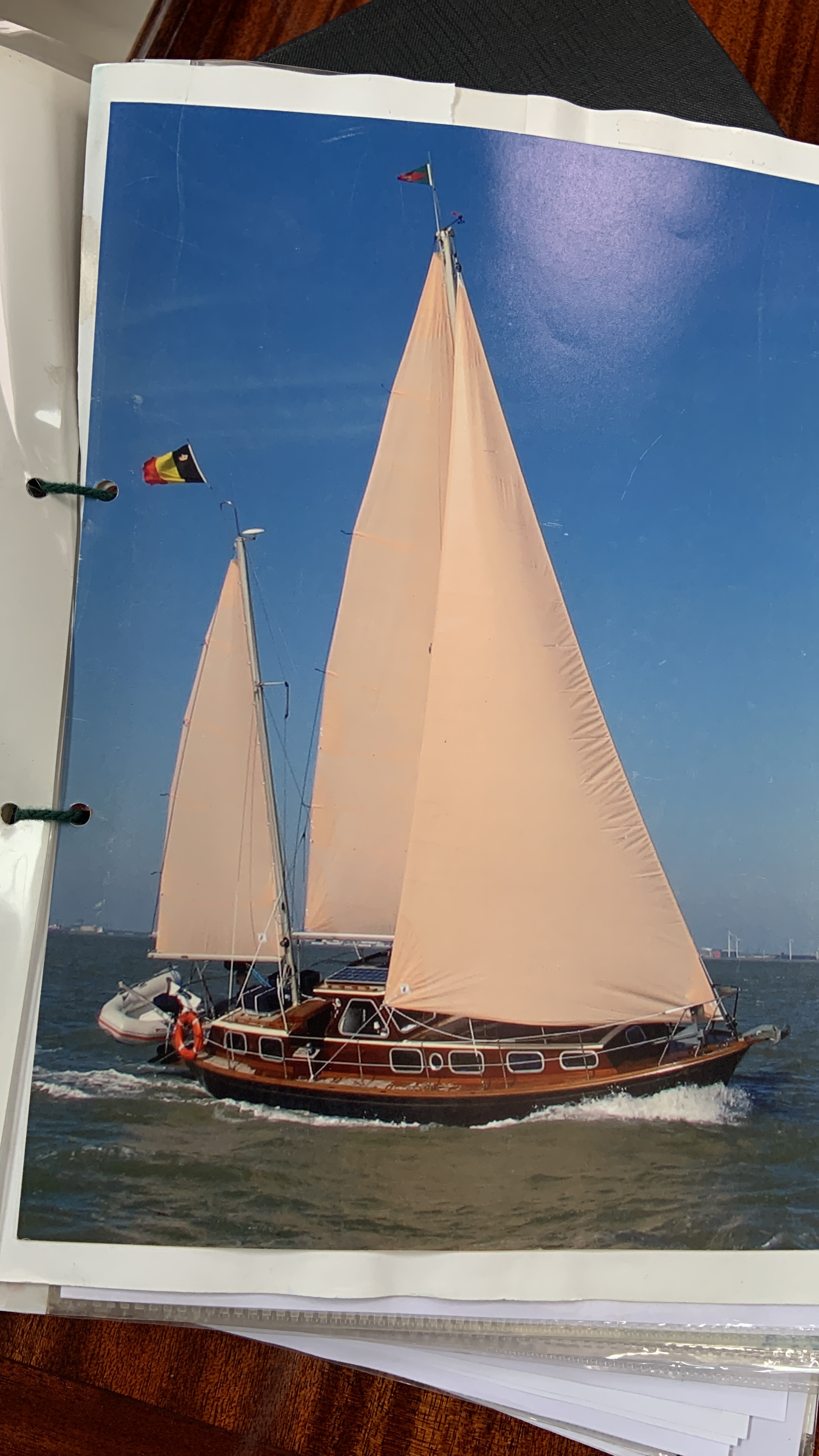
Bob Derham is someone I met many years ago, when I was living on my yacht in Larnaca, Cyprus, and I can do no better than to repeat what I wrote in my autobiography.
ooOOoo
I negotiated what I thought was a good deal and sold the company. Inevitably I resigned from what was now not my company; it was the end of November in the year of 1988.
In Tollesbury, I had my annual tax returns done by Peter Michael, also living in the village. Peter was an accountant who also taught accountancy at the nearby Essex University. I saw Peter and we discussed the recent agreement for the sale of the business.
“Paul, there is not a lot you can do, to be honest. You will be liable in broad terms for the tax in the difference between the opening price and the closing price. In your case the opening price was near enough zero and the closing price…” Peter did not need to finish the sentence. I got the picture and stood up to leave. Just has I was going out of the room, Peter added: “Unless you can leave the country before April 15th next year, and stay away for a minimum of four tax years. In other words, leave before April 15th, 1989.”
I walked home from Peter Michael’s house that November, 1988 with the advice I had been given ringing in my ears. I would worry about the tax implications in a day or two. But once again fate intervened.
I was a subscriber to the boating magazine Practical Boat Owner (PBO). In a late 1988 issue I read in the classifieds:
Songbird of Kent – Tradewind 33
Great opportunity to purchase a long-distance ocean yacht designed by John Rock for sea-kindly short-handed sailing.
Well kitted out, continually updated and maintained Songbird of Kent is the yacht for you if you dream of blue waters and serious long distance cruising.
Lying Larnaca, Cyprus.
I knew about Tradewind yachts, was familiar with John Rock. (As the designer of Tradewind yachts he had been featured several times in Practical Boat Owner magazine), and knew how many of his yachts had made world circumnavigations, and, finally, I deserved a holiday. I arranged to go out to Larnaca as soon as I could.
About a week later I caught a flight to Larnaca International Airport; upon arriving I rented a car and drove the few miles to the Marina.
The yacht was easy to find as it was out of the water. I met the owners, Michael and Betty Hughes, who were still living onboard Songbird of Kent. They explained why they were selling. Simply because, as Michael put it, they had been living on the boat for many years and it was time to return to their native Wales. Songbird had been extensively cruised the length of the Mediterranean Sea using Larnaca Marina as the base.
I quietly inspected the boat. Because it was lifted out viewing the boat in detail was much easier than had it still been floating. It was in good condition; very good condition in fact. Then I climbed up the ladder and entered the boat. Again I found everything that I expected, and more. It was clear to me that Michael and Betty had had the boat as their home and, consequently, everything was in order. Or to use the phrase; shipshape and Bristol fashion!
I excused myself, left the yacht and went and sat on a nearby seawall. I wanted to think. To be honest, it was pretty easy thinking. I loved the boat; it was a purchase I could afford, and if everything went to plan and I left the UK before April 15th, 1989, and stayed away for four tax years, there would be no UK tax to pay on the sale of my company Dataview. Nothing: Nada!
So that is exactly what I did!
I went back to Songbird, where Michael and Betty were still sitting in the cockpit, and told them I would buy it. They drew up a contract there and then and I signed it!
My autobiography
ooOOoo
Here is Bob’s story:
Paul and I first met in 1992, when I was working as a contract pilot on the BAC 1-11 for Cyprus Airways.
My last flying post was down in New Zealand, a wonderful place to be, with it’s natural beauty, and lack of aggression and oppression. The joy of life is set around being outdoors, so road trips, camping, sailing, and skiing all feature, but less on big houses, and possessions.
Although I have travelled widely in my career, I now want a simple life, and that amounts to being free of ties to a property, such that all I really need is a warm, dry place to sleep, a suitable place to prepare food, and a place to relax, it is no longer about the big house, which brings it’s own issues, and expenses.
Following on from my time living on Paul’s boat, I was then drawn to living on a boat. I owned a smaller Westerley Centaur, for a few years, and even though small, I had a very happy time when I lived on that. It was down in Lymington, a small market town on the south coast of England opposite Yarmouth, on the Isle of Wight, that I kept my first boat.
The reason for this was simple 🙂
One of the interesting people I met in Cyprus was a man called Les Powles. Paul and I would regularly go out and have a mezze in a side street of Larnaca. Les would be very easy company, and found fun in the most silly situations. I was invited to call by on his boat any time, and have a “ cuppa” What I was intrigued with onboard was a picture of the globe, but cut in half, and opened up. There were a series of lines around the world. I asked Les what this was. His reply was “It’s where I have been when sailing round the world.“
So why I asked are their three lines ?
“Because I have done it three times!“
Les was a most unusual character in that he had started building his boat in 1970. It took him 5 years to complete, and apart from a few short sea trials, Les actually had no other sailing experience, but in 1975, with barely enough rice and water onboard, he headed west. Actually he had intended to go to the Caribbean, but he had applied the variation to his navigation the wrong way, and made land fall 1500 miles from his intended destination. Les only died last year, 96, and his home had been his boat for all those years.
It’s that bit that has been the big thing for me.
Having a home has been ongoing hassle, the fun and enjoyment has been removed, because you are in a trap.
It is important to have a home, but I started to question the point of having a physical building. That brings all the ongoing costs and expenses, where the authorities can milk you for a lot of money!
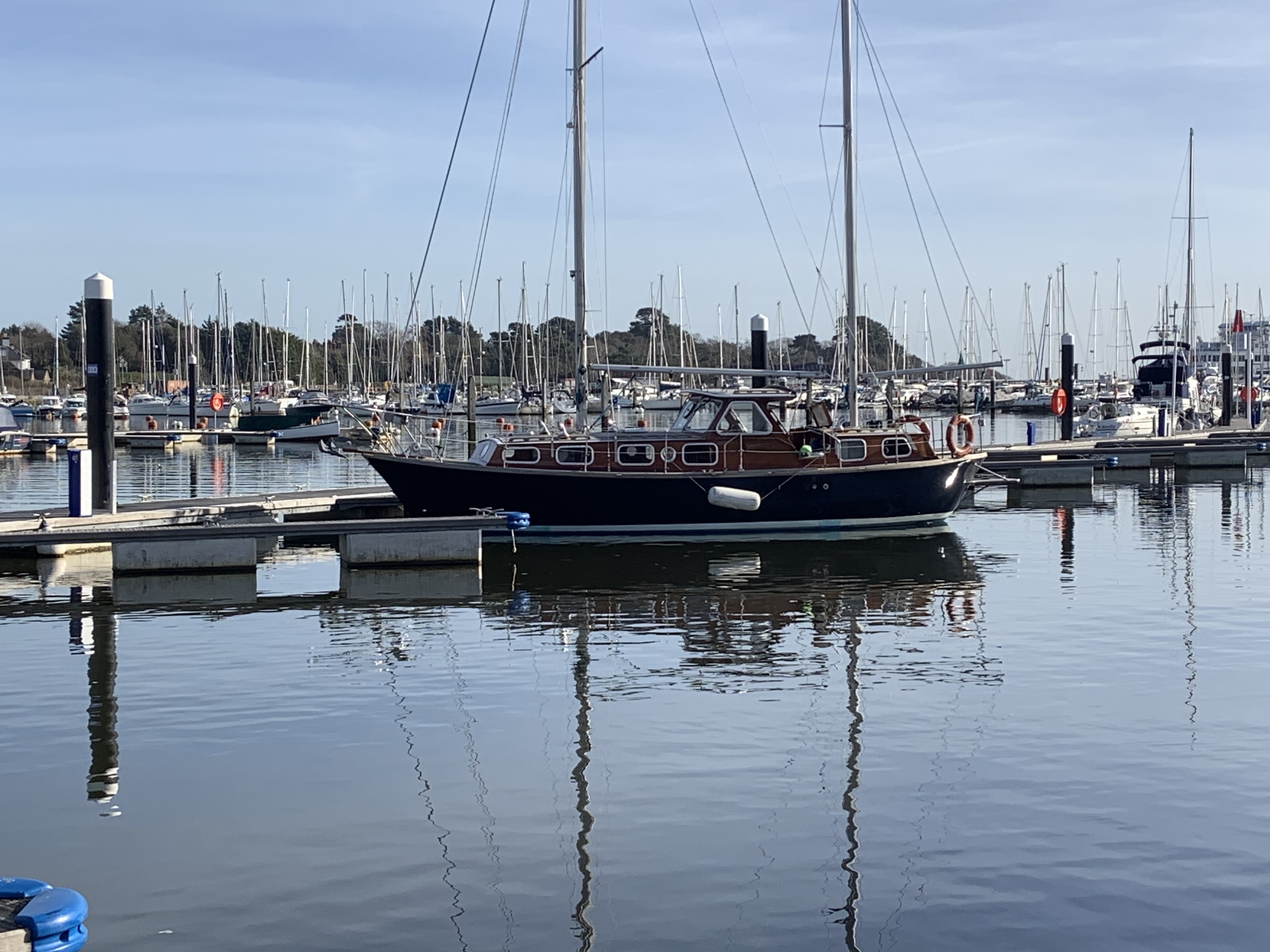
I first saw Antoinette, in Lymington, and from the first moment I saw the boat, I knew I could make the boat my “home.”
She went to Southwold in Suffolk, England for a major refit, and so there is a new engine, gearbox, and propeller, replaced decking, and repairs have been carried out to the hull.
Inside, I can stand up, and although only 37 foot long, being beamy, there is a lot of room.
There are double cabins both fore and after, with “heads” (bathrooms). The main cabin and galley is very comfortable. It has a lot of mahogany wood, so looks homely, and the “dog house” (bit in the middle), is a very open useable space, either enclosed when cold and wet, or if the weather permits, opened up to enjoy the sun.
The key is that this is “my home”.
I can now travel, and go where I like, but I have my home with me. It has heating, but normally when you arrive somewhere, part of the mooring fees offer a shower unit and facilities. I have space to entertain, but above all, I am free of all the ties that we adopt by following the life society offers us as “the norm“.
It is only now that I see the traps that others face, because I can up anchor and head off, and can see where Les Powles got his freedom, and lived his dream.
In the cabin of Antoinette with Finn the dog belonging to Natalie (on the left).
The collie is “Finn”, Natalie’s dog. I think Paul was one of the first to see her when she was born, so 31 years later, Natalie wants to enjoy the alternative life.
As for Finn, he loves it. Fresh air, plenty going on, and a lot to see.
“Tiny living”, but the release from the way most people live is amazing.
No speeding tickets for me. 🤪
ooOOoo
Thank you, Bob for the story of you and me. That last thirty years have flown by and those years on Songbird of Kent were really special albeit the end of my cruising days were pretty scary.
There have been so many disastrous activities on climate change, and I am not belittling them, but it was amazing to come across a TED Talk last Saturday that I watched. But first the speaker, Asmeret Asefaw Berhe, who was born in Asmara, Eritrea. Her bio (in part):
From WikiPedia:
ooOOoo
Asmeret Asefaw Berhe is a soil biogeochemist and political ecologist who is the current Director of the Office of Science at the US Department of Energy. She was previously the Professor of Soil Biogeochemistry and the Ted and Jan Falasco Chair in Earth Sciences and Geology in the Department of Life and Environmental Sciences; University of California, Merced.[1] Her research group worked to understand how soil helps regulate the Earth’s climate.
Advocacy and global impact work
Berhe’s work at the intersection of soil, climate change, and political ecology lends itself well to a number of global issues. During her graduate career, she was a member of the working group that produced the Millennium Ecosystem Assessment, which was called for by the United Nations Secretary Kofi Annan to assess the impact of humans on the environment. She was one of the lead authors on the 2005 report’s chapter on “Drivers of Change in Ecosystem Condition and Services.”[19] The Assessment received the Zayed International Prize for the Environment in 2005.[20]
In 2018, Berhe was selected as part of the inaugural National Academies of Sciences, Engineering, and Medicine New Voices in Sciences, Engineering, and Medicine cohort, as an early career leader working to advance the conversation around key emerging global issues and communicate the evidence base around those challenges.[21]
An advocate for women in science, Berhe is currently a co-Principal Investigator of ADVANCEGeo, which is working to transform the workplace climate of the geosciences to increase retention of women in the field and develop a sustainable model that can be transferred to other scientific domains. Currently, the Earth Science Women’s Network (ESWN), the Association for Women Geoscientists, and the American Geophysical Union (AGU) have partnered to address the issue of sexual harassment in the earth, space and environmental sciences.[22] The program led by Erika Marín-Spiotta and is run with support from a four-year $1.1 million grant from the National Science Foundation.[23]
She currently serves as an advisory board member of 500 Women Scientists, a grassroots organization working to make science open, inclusive, and accessible, and is on the leadership board of the Earth Science Women’s Network.
Earth’s soil can store vast amounts of carbon. Biogeochemist Asmeret Asefaw Berhe says soil could be a powerful tool for fighting climate change – if only we stopped treating it like dirt.
About Asmeret Asefaw Berhe
Asmeret Asefaw Berhe is a soil biogeochemist and President Biden’s nominee to lead the Department of Energy Office of Science. She is a professor of soil biogeochemistry at University of California, Merced. Her research group works to understand how soil helps regulate the earth’s climate.
Berhe’s work exists at the intersection of soil, climate change, and political ecology. During her graduate career, she was a member of the working group that produced the Millennium Ecosystem Assessment, which was called for by the United Nations to assess the impact of humans on the environment.
Berhe received a B.Sc. in Soil and Water Conservation at the University of Asmara in Eritrea. She has an M.Sc. in Political Ecology from Michigan State University and a Ph.D. in Biogeochemistry from University of California, Berkeley.
This segment of the TED Radio Hour was produced by Matthew Cloutier and Sylvie Douglis and edited by Rachel Faulkner and Katie Simon. You can follow us on Facebook @TEDRadioHour and email us at TEDRadioHour@npr.org.
Now that positive TED Talk:
We wish Asmeret the very best of fortune in bringing about these changes.
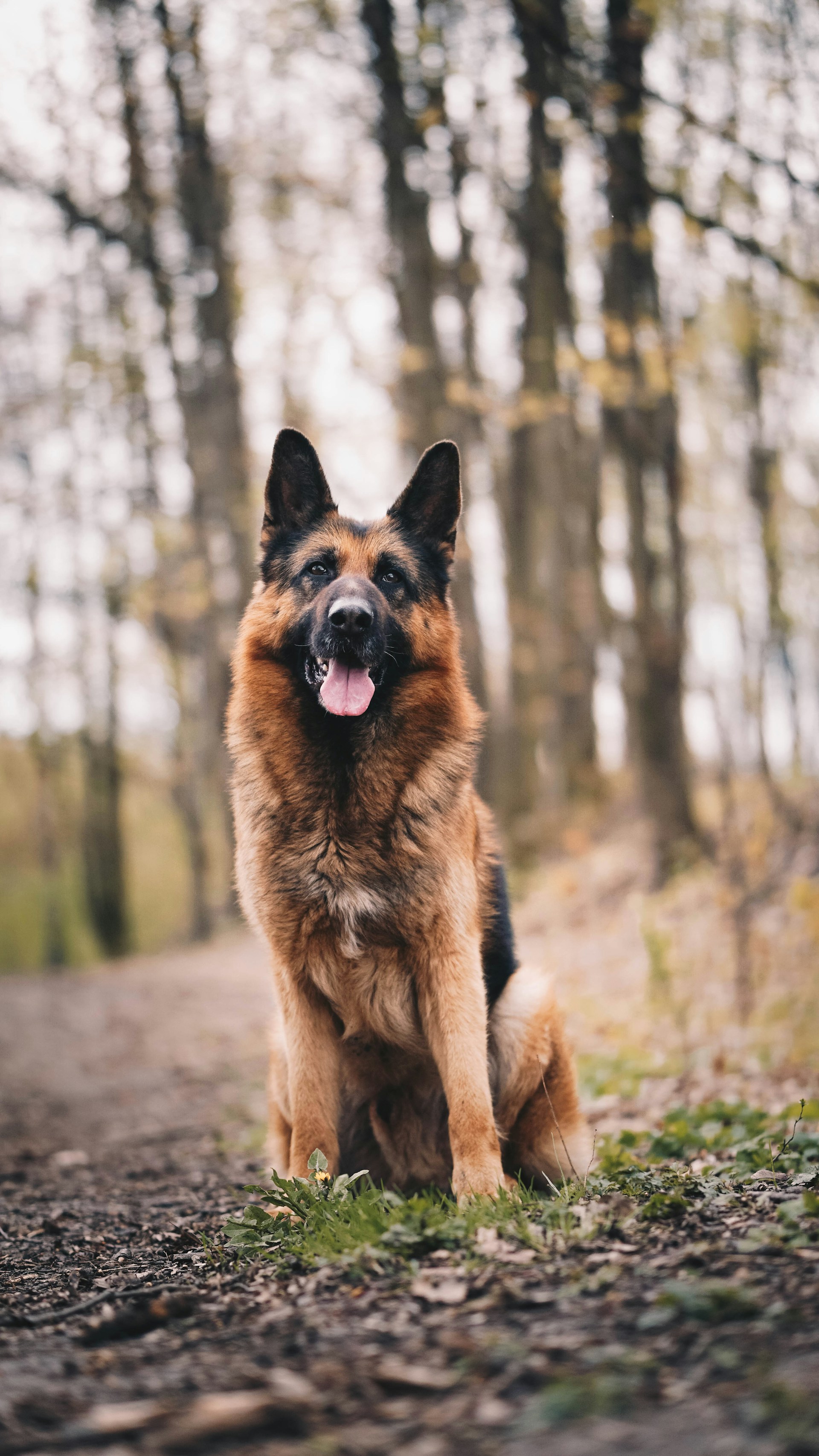
In our case our (remaining) dogs, Oliver and Cleopatra, are able to go outside but still remain on our land. But plenty of dog owners are not in such a privileged position and need to take their dogs on public pavements and the like.
Thus for all you dog owners in that position then Erik’s advice is for you.
ooOOoo
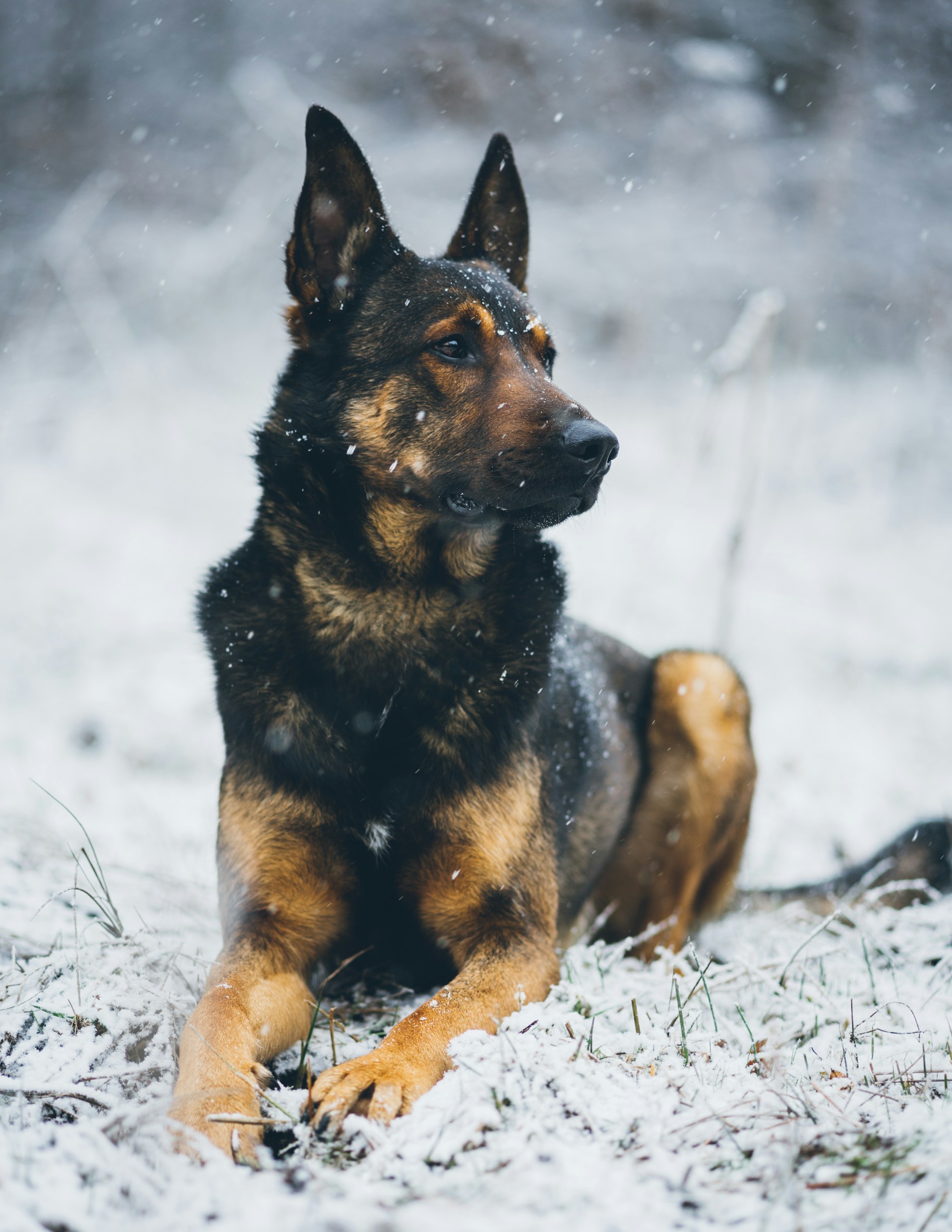
Dog care below freezing − how to keep your pet warm and safe from cold weather, road salt and more this winter
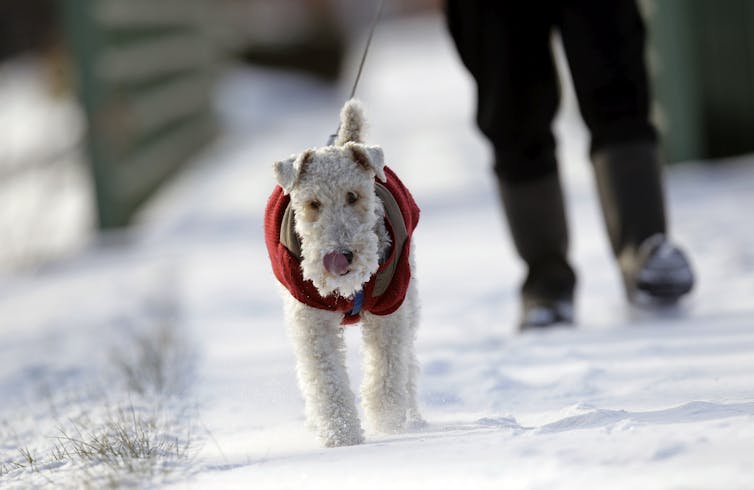
Dogs get cold in the winter too, but there are things pet owners can do to help them feel comfortable. AP Photo/David Duprey
Time outside with your dog in the spring, summer and fall can be lovely. Visiting your favorite downtown café on a cool spring morning, going to a favorite dog park on a clear summer evening or going on walks along a river when the leaves are changing color are all wonderful when the weather is favorable. But in much of the country, when winter rolls around, previously hospitable conditions can quickly turn chilly and dangerous for people and pups alike.
Winter brings some unique challenges for dog owners, since dogs still need activity and socialization during colder seasons. Studies have shown that dog owners are almost 50% less likely to walk their dogs when the weather gets cold. Knowing the basics of winter safety is critical to maintaining a healthy lifestyle for your dog.
I am an assistant professor at the University of California Davis School of Veterinary Medicine who weathered polar vortexes with my dog while living in Michigan early in my career. While I’ve since moved to sunny California, I’ve seen how quickly frigid temperatures can turn dangerous for pets.
Breed and age differences
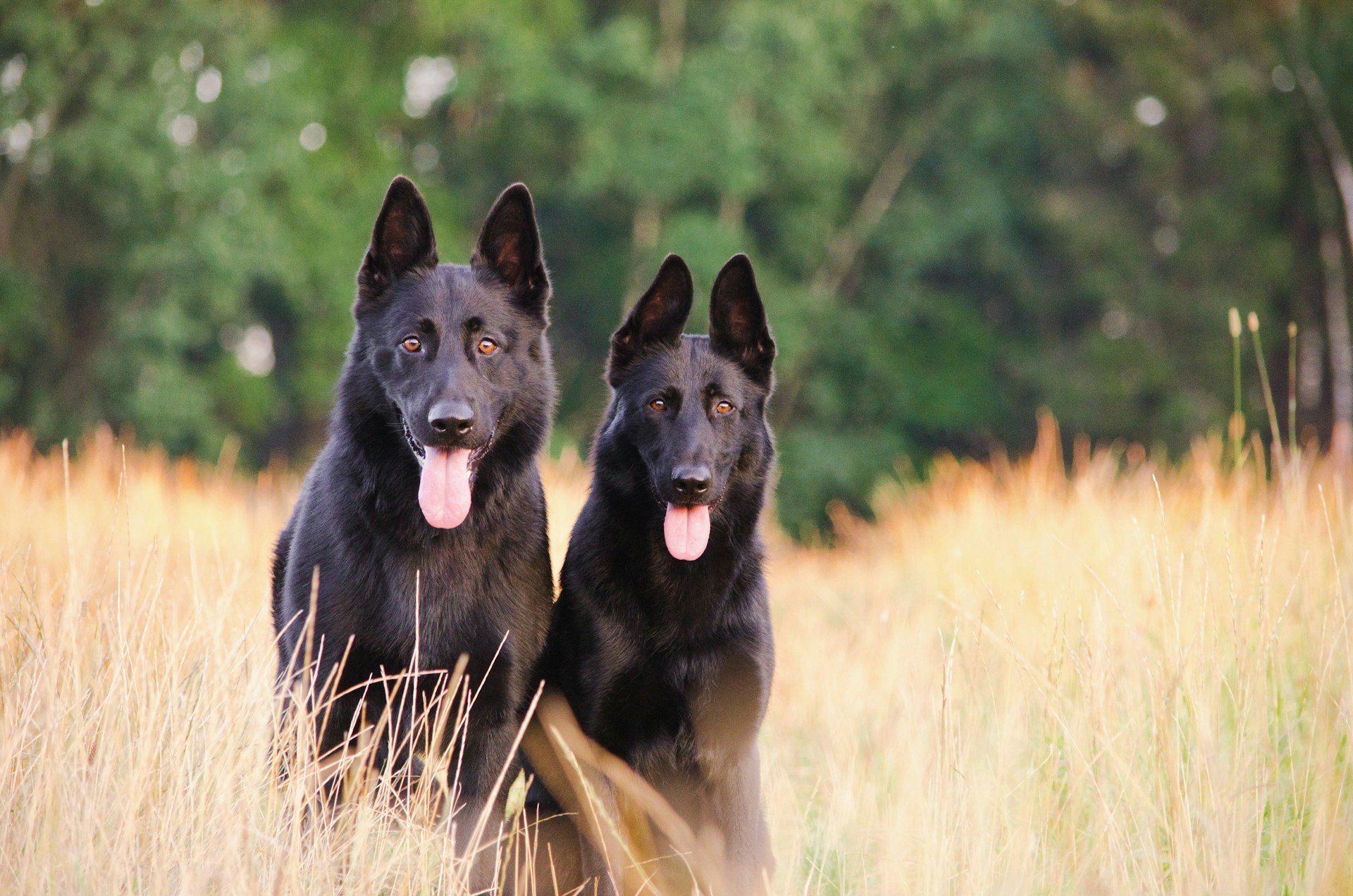
Not all dogs have the same abilities to deal with cold weather. A short-coated dog like a Chihuahua is much more susceptible to the dangers of cold weather than a thick-coated husky. When the weather dips below 40 degrees Fahrenheit (4 degrees Celsius), the well-acclimated husky may be comfortable, whereas the Chihuahua would shiver and be at risk of hypothermia.
Additionally, if your dog is used to warm weather, but you decide to move to a colder region, the dog will need time to acclimate to that colder weather, even if they have a thick coat.
Age also affects cold-weather resilience. Puppies and elderly dogs can’t withstand the chill as well as other dogs, but every dog is unique – each may have individual health conditions or physical attributes that make them more or less resilient to cold weather.
Pet owners should be able to recognize the symptoms of a dog that is getting too cold. Dogs will shiver, and some may vocalize or whine. Dogs may resist putting their feet down on the cold ground, or burrow, or try to find warmth in their environment when they are uncomfortable.
Just like people, dogs can get frostbite. And just like people, the signs can take days to appear, making it hard to assess them in the moment. The most common sites for frostbite in dogs are their ears and the tips of their tails. Some of the initial signs of frostbite are skin discoloring, turning paler than normal, or purple, gray or even black; red, blistered skin; swelling; pain at the site; or ulceration.
Other serious signs of hypothermia include sluggishness or lethargy, and if you observe them, please visit your veterinarian immediately. A good rule to live by is if it is too cold for you, it is too cold for your dog.
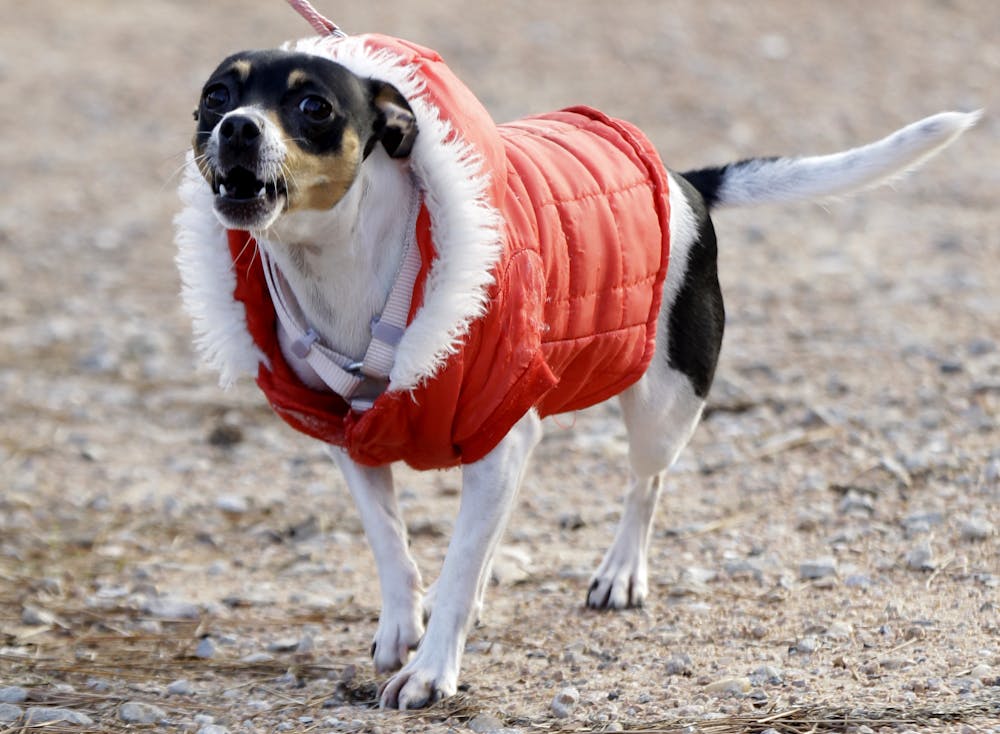
Getting your dog a sweater or jacket and paw covers can provide them with protection from the elements and keep them comfortable. Veterinarians also recommend closely monitoring your dog and limiting their time outside when the temperature nears the freezing point or drops below it.
Road salt dangers
Road salt that treats ice on streets and sidewalks can also harm dogs. When dogs walk on the salt, the sharp, rough edges of the salt crystals can irritate the sensitive skin on their paws.
Paw covers for dogs can keep their feet warm and protected from road salt. AP Photo/Jim Cole
Dogs will often lick their feet when they’re dirty, wet or irritated, and if they ingest any salt doing that, they may face GI upset, dehydration, kidney failure, seizures or even death. Even small amounts of pure salt can disrupt critical body functions in dogs.
Some companies make pet-safe salt, but in public it can be hard to tell what type of salt is on the ground. After walking your dog, wash off their feet or boots. You can also keep their paw fur trimmed to prevent snow from balling up or salt collecting in the fur. Applying a thin layer of petroleum jelly or paw pad balm to the skin of the paw pads can also help protect your pet’s paws from irritation.
Antifreeze, or ethylene glycol, is in most vehicles to prevent the fluids from freezing when it gets cold out. Some people pour antifreeze into their toilets when away from their home to prevent the water in the toilet from freezing.
Antifreeze is an exceptionally dangerous chemical to dogs and cats, as it tastes sweet but can be deadly when ingested. If a pet ingests even a small amount of antifreeze, the substance causes a chemical cascade in their body that results in severe kidney damage. If left untreated, the pet may have permanent kidney damage or die.
There are safer antifreeze options on the market that use ingredients other than ethylene glycol. If your dog ingests antifreeze, please see your veterinarian immediately for treatment.
When temperatures dip below freezing, the best thing pet owners can do is keep the time spent outside as minimal as possible. Try some indoor activities, like hide-and-seek with low-calorie treats, fetch or even an interactive obstacle course. Food puzzles can also keep your dog mentally engaged during indoor time.
Although winter presents some unique challenges, it can still be an enjoyable and healthy time for you and your canine companion.
Erik’s comments about ethylene glycol (EG), or antifreeze as it more commonly known, and the incredible dangers to dogs EG possesses are vital to understand.
Please, please keep your dogs very safe in Winter! If Erik’s advice helps save even a single dog then me republishing this will have been worthwhile.
The challenge with writing posts, albeit not so often, about the global environment, especially when I am a non-scientist, is that one relies entirely on the words of others. In the case of a recent article, published by The Conversation, the authors are claimed to be specialists, and I do not doubt their credentials.
The three authors are René van Westen who is a Postdoctoral Researcher in Climate Physics, at Utrecht University, Henk A. Dijkstra who is a Professor of Physics, also at Utrecht University, and Michael Kliphuis, a Climate Model Specialist, again at Utrecht University.
So, here is their article:
ooOOoo
Atlantic Ocean is headed for a tipping point − once melting glaciers shut down the Gulf Stream, we would see extreme climate change within decades, study shows
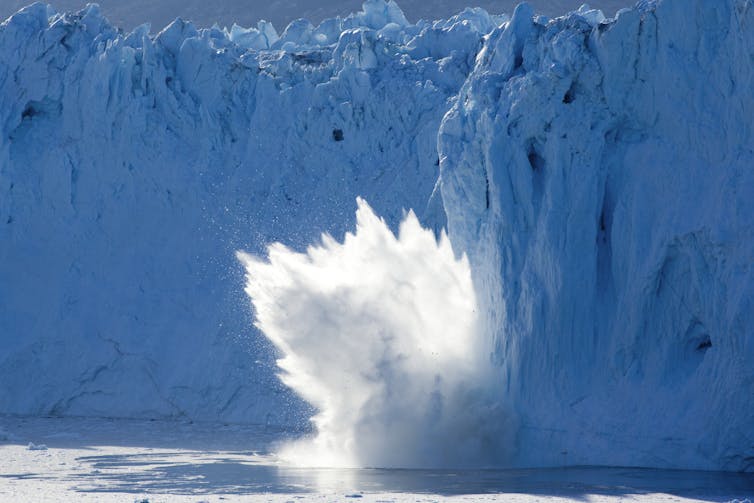
Superstorms, abrupt climate shifts and New York City frozen in ice. That’s how the blockbuster Hollywood movie “The Day After Tomorrow” depicted an abrupt shutdown of the Atlantic Ocean’s circulation and the catastrophic consequences.
While Hollywood’s vision was over the top, the 2004 movie raised a serious question: If global warming shuts down the Atlantic Meridional Overturning Circulation, which is crucial for carrying heat from the tropics to the northern latitudes, how abrupt and severe would the climate changes be?
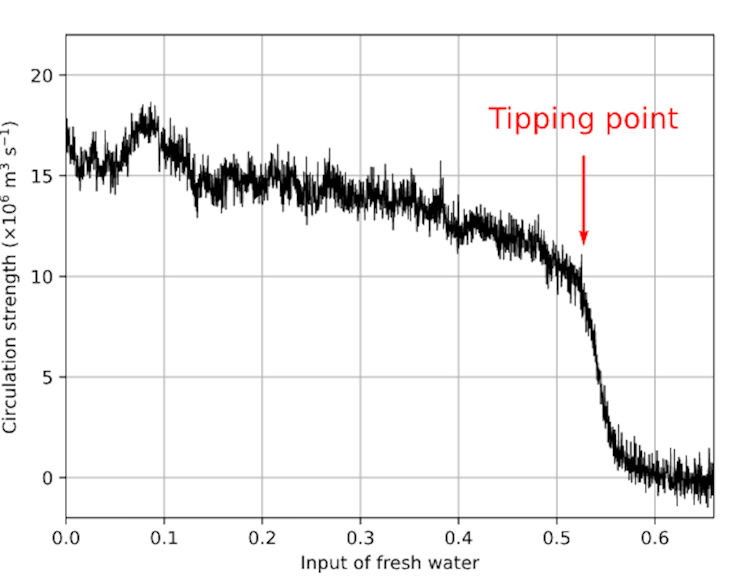
In a new study using the latest generation of Earth’s climate models, we simulated the flow of fresh water until the ocean circulation reached that tipping point.
The results showed that the circulation could fully shut down within a century of hitting the tipping point, and that it’s headed in that direction. If that happened, average temperatures would drop by several degrees in North America, parts of Asia and Europe, and people would see severe and cascading consequences around the world.
We also discovered a physics-based early warning signal that can alert the world when the Atlantic Ocean circulation is nearing its tipping point.
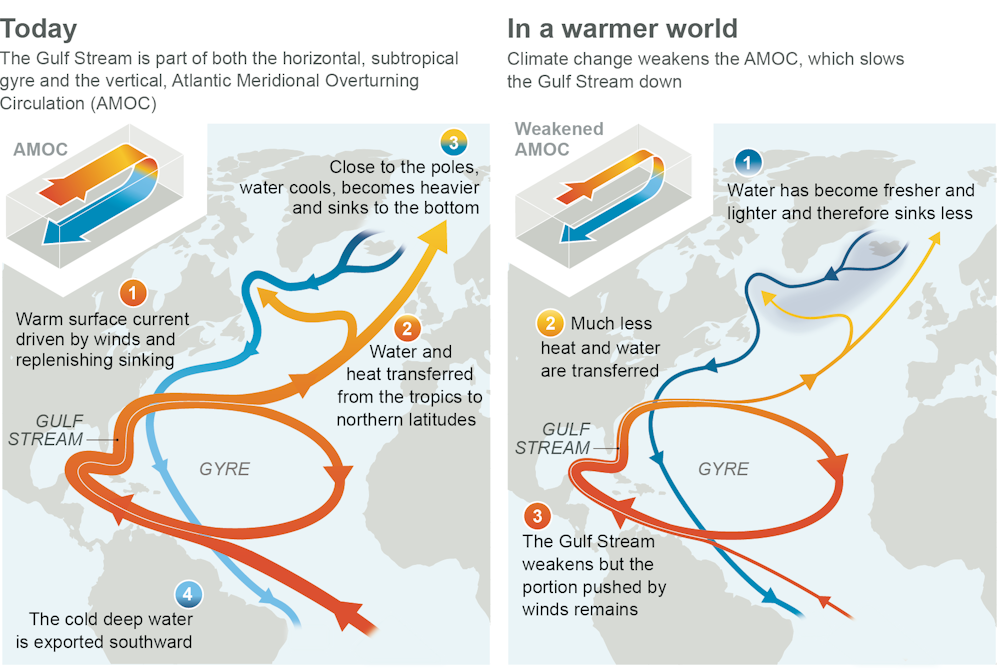
In the Atlantic Ocean circulation, the relatively warm and salty surface water near the equator flows toward Greenland. During its journey it crosses the Caribbean Sea, loops up into the Gulf of Mexico, and then flows along the U.S. East Coast before crossing the Atlantic.
This current, also known as the Gulf Stream, brings heat to Europe. As it flows northward and cools, the water mass becomes heavier. By the time it reaches Greenland, it starts to sink and flow southward. The sinking of water near Greenland pulls water from elsewhere in the Atlantic Ocean and the cycle repeats, like a conveyor belt.
This is where our study comes in. We performed an experiment with a detailed climate model to find the tipping point for an abrupt shutdown by slowly increasing the input of fresh water.
We found that once it reaches the tipping point, the conveyor belt shuts down within 100 years. The heat transport toward the north is strongly reduced, leading to abrupt climate shifts.
The result: Dangerous cold in the North
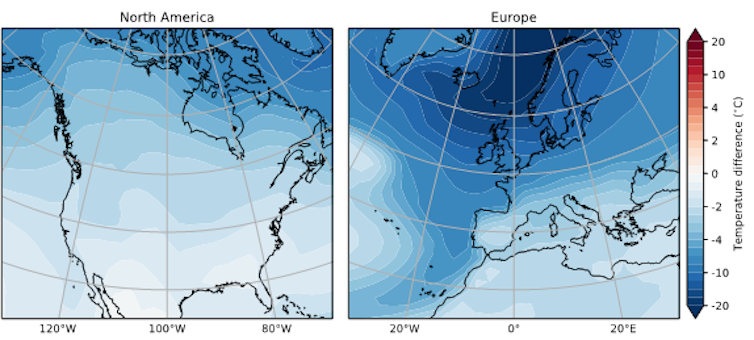
Regions that are influenced by the Gulf Stream receive substantially less heat when the circulation stops. This cools the North American and European continents by a few degrees.
The European climate is much more influenced by the Gulf Stream than other regions. In our experiment, that meant parts of the continent changed at more than 5 degrees Fahrenheit (3 degrees Celsius) per decade – far faster than today’s global warming of about 0.36 F (0.2 C) per decade. We found that parts of Norway would experience temperature drops of more than 36 F (20 C). On the other hand, regions in the Southern Hemisphere would warm by a few degrees.
The annual mean temperature changes after the conveyor belt stops reflect an extreme temperature drop in northern Europe in particular. René M. van Westen
These temperature changes develop over about 100 years. That might seem like a long time, but on typical climate time scales, it is abrupt.
The conveyor belt shutting down would also affect sea level and precipitation patterns, which can push other ecosystems closer to their tipping points. For example, the Amazon rainforest is vulnerable to declining precipitation. If its forest ecosystem turned to grassland, the transition would release carbon to the atmosphere and result in the loss of a valuable carbon sink, further accelerating climate change.
The Atlantic circulation has slowed significantly in the distant past. During glacial periods when ice sheets that covered large parts of the planet were melting, the influx of fresh water slowed the Atlantic circulation, triggering huge climate fluctuations.
So, when will we see this tipping point?
The big question – when will the Atlantic circulation reach a tipping point – remains unanswered. Observations don’t go back far enough to provide a clear result. While a recent study suggested that the conveyor belt is rapidly approaching its tipping point, possibly within a few years, these statistical analyses made several assumptions that give rise to uncertainty.
Instead, we were able to develop a physics-based and observable early warning signal involving the salinity transport at the southern boundary of the Atlantic Ocean. Once a threshold is reached, the tipping point is likely to follow in one to four decades.
A climate model experiment shows how quickly the AMOC slows once it reaches a tipping point with a threshold of fresh water entering the ocean. How soon that will happen remains an open question. René M. van Westen
The climate impacts from our study underline the severity of such an abrupt conveyor belt collapse. The temperature, sea level and precipitation changes will severely affect society, and the climate shifts are unstoppable on human time scales.
It might seem counterintuitive to worry about extreme cold as the planet warms, but if the main Atlantic Ocean circulation shuts down from too much meltwater pouring in, that’s the risk ahead.
This article was updated to Feb. 11, 2024, to fix a typo: The experiment found temperatures in parts of Europe changed by more than 5 F per decade.
I am 79! I like to think that whatever is coming down the wires, so to speak, will be after my death. But that is a cop out for a) I have a son and a daughter who are in their early fifties, b) I have a grandson, my daughter and son-in-law’s young man, who is a teenager, with his birthday next month, and c) I could possibly live for another twenty years.
The challenge is how to bring this imminent catastrophic global change in temperature to the fore. We need a global solution now enforced by a globally respected group of scientists and leaders, and, frankly, I do not see that happening.
All one can do is to hope. Hope that the global community will eschew the present-day extremes of warring behaviour and see the need for change. That is NOW!
So that the Hollywood movie, The Day After Tomorrow, remains a fictional story. And for those that have forgotten the film or who have never seen it, here is a small slice of a Wikipedia report:
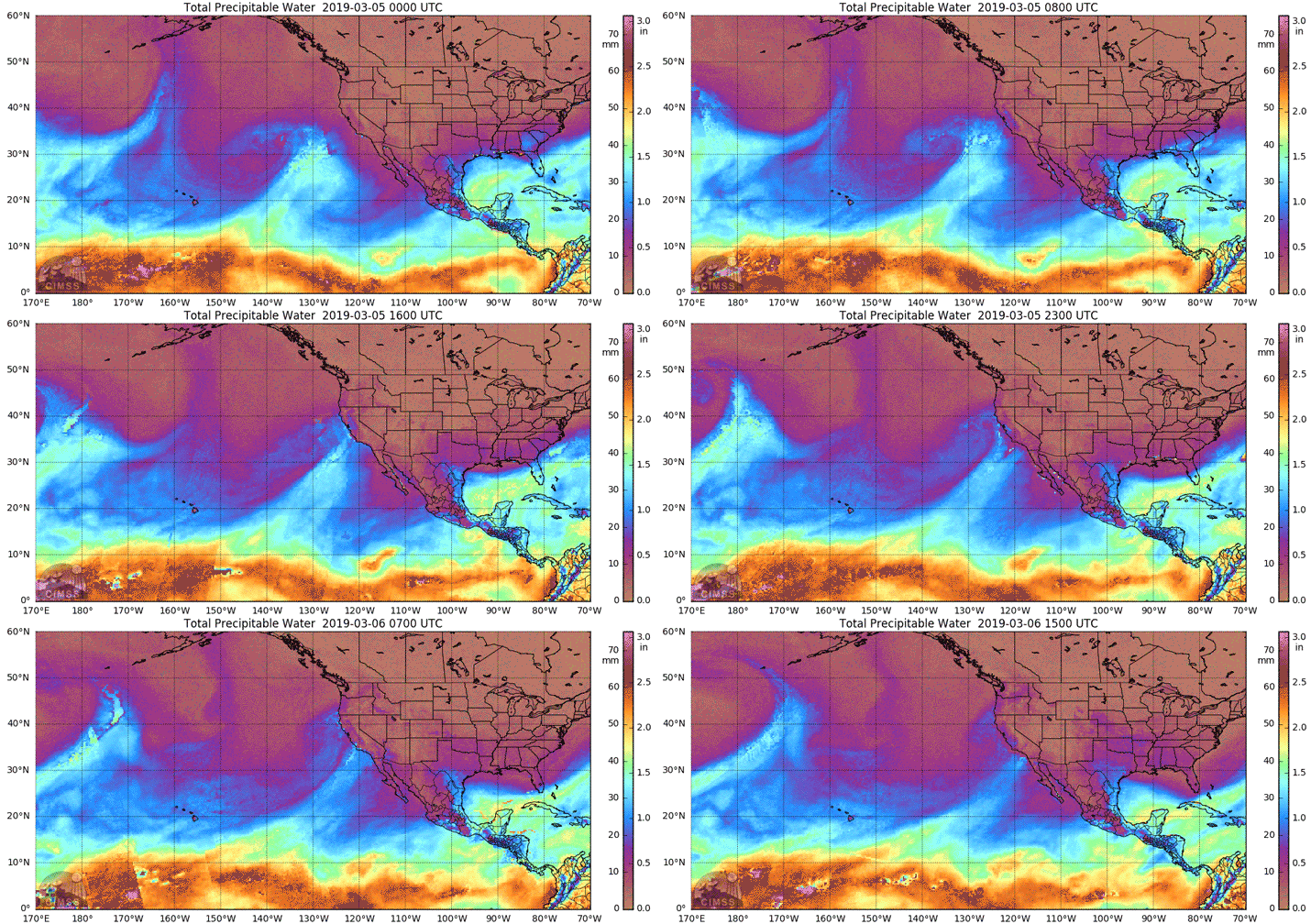
The atmospheric river in California is reaching up to Southern Oregon
After we had the thick end of twelve inches of rain in January, February has kept up the downpours; as of yesterday morning we had had 0.52 inches (1.32 cm) for the month and it was still raining. (And 0.8 in at 08:00 this morning.)
Here’s an item from yesterday about the situation in California.
Plus the BBC News had an item on the California flood.
So it seemed opportune to present this article on atmospheric rivers.
ooOOoo
What is an atmospheric river? A hydrologist explains the good and bad of these flood-prone storms and how they’re changing
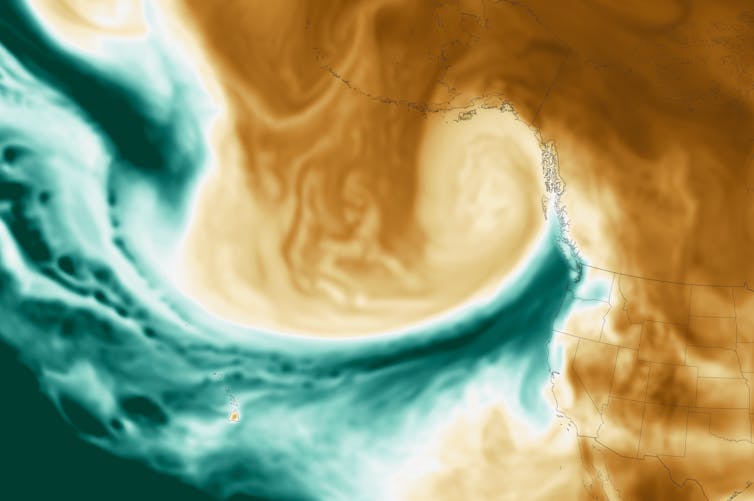
A satellite image shows a powerful atmospheric river hitting the Pacific Northwest in December 2023. Darker greens are more water vapor. Lauren Dauphin/NASA Earth Observatory
A series of atmospheric rivers is bringing the threat of heavy downpours, flooding, mudslides and avalanches to the Pacific Northwest and California this week. While these storms are dreaded for the damage they can cause, they are also essential to the region’s water supply, particularly in California, as Qian Cao, a hydrologist at the University of California, San Diego, explains.
What are atmospheric rivers?
An atmospheric river is a narrow corridor or filament of concentrated water vapor transported in the atmosphere. It’s like a river in the sky that can be 1,000 miles long. On average, atmospheric rivers have about twice the regular flow of the Amazon River.
When atmospheric rivers run up against mountains or run into local atmospheric dynamics and are forced to ascend, the moisture they carry cools and condenses, so they can produce intense rainfall or snowfall. https://www.youtube.com/embed/w3rtYM0HtIM?wmode=transparent&start=0 A satellite view of atmospheric rivers.
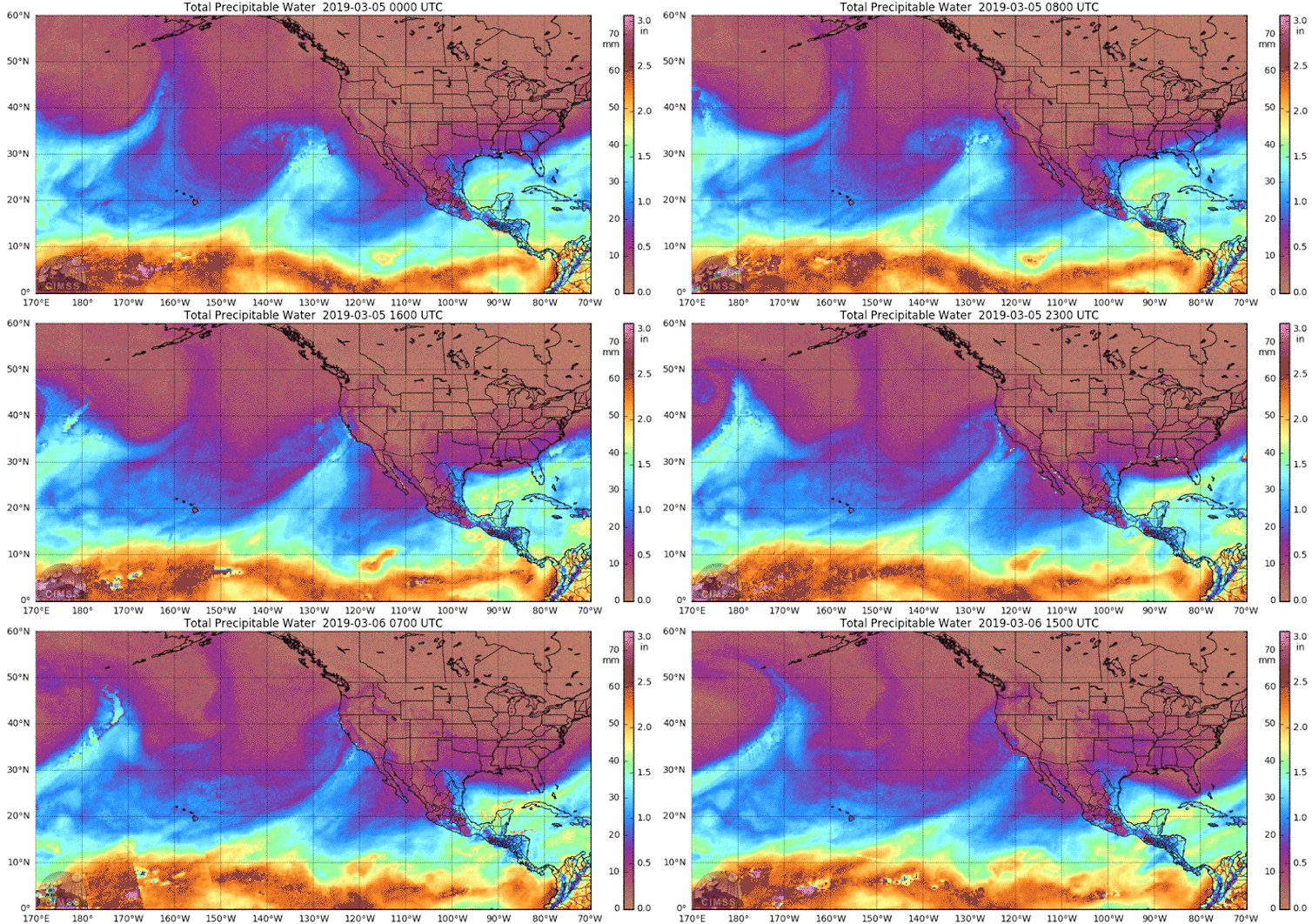
Atmospheric rivers occur all over the world, most commonly in the mid-latitudes. They form when large-scale weather patterns align to create narrow channels, or filaments, of intense moisture transport. These start over warm water, typically tropical oceans, and are guided toward the coast by low-level jet streams ahead of cold fronts of extratropical cyclones.
Along the U.S. West Coast, the Pacific Ocean serves as the reservoir of moisture for the storm, and the mountain ranges act as barriers, which is why the western sides of the coastal ranges and Sierra Nevada see so much rain and snow.
Why are back-to-back atmospheric rivers a high flood risk?
The first heavy downpours saturate the ground. As consecutive storms arrive, their precipitation falls on soil that can’t absorb more water. That contributes to more runoff. Rivers and streams fill up. In the meantime, there may be snowmelt due to warm temperatures, further adding to the runoff and flood risk.
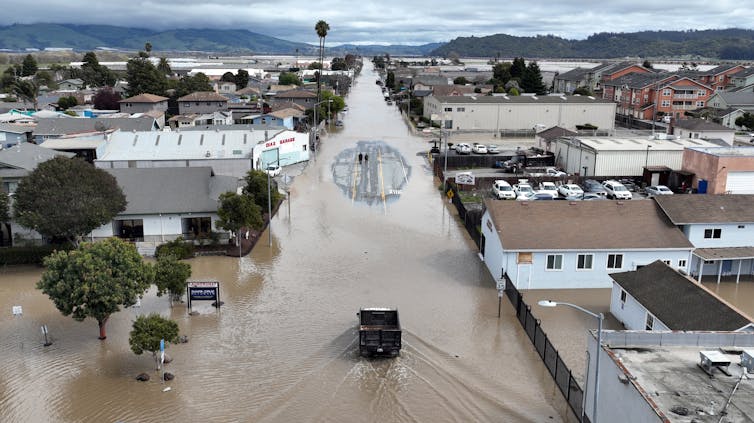
California experienced a historic run of nine consecutive atmospheric rivers in the span of three weeks in December 2022 and January 2023. The storms helped bring most reservoirs back to historical averages in 2023 after several drought years, but they also produced damaging floods and debris flows.
Atmospheric rivers forming over the tropical Pacific Ocean head for the U.S. West Coast. NOAA
The cause of AR families is an active area of research. Compared with single atmospheric river events, AR families tend to be associated with lower atmospheric pressure heights across the North Pacific, higher pressure heights over the subtropics, a stronger and more zonally elongated jet stream and warmer tropical air temperatures.
Large-scale weather patterns and climate phenomena such as the Madden-Julian Oscillation, or MJO, also play an important role in the generation of AR families. An active MJO shift occurred during the early 2023 events, tilting the odds toward increased atmospheric river activity over California.
An aerial view shows a flooded neighborhood in the community of Pajaro in central California on March 11, 2023, after a series of atmospheric rivers. Josh Edelson/AFP via Getty Images
A recent study by scientists at Stanford and the University of Florida found that storms within AR families cause three to four times more economic damage when the storms arrive back to back than they would have caused by themselves.
How important are atmospheric rivers to the West Coast’s water supply?
I’m a research hydrologist, so I focus on hydrological impacts of atmospheric rivers. Although they can lead to flood hazards, atmospheric rivers are also essential to the Western water supply. Atmospheric rivers have been responsible for ending more than a third of the region’s major droughts, including the severe California drought of 2012-16.
They also contribute to the snowpack, which provides a significant portion of California’s year-round water supply.
In an average year, one to two extreme atmospheric rivers with snow will be the dominant contributors to the snowpack in the Sierra Nevada. Together, atmospheric rivers will contribute about 30% to 40% of an average season’s total snow accumulation there.
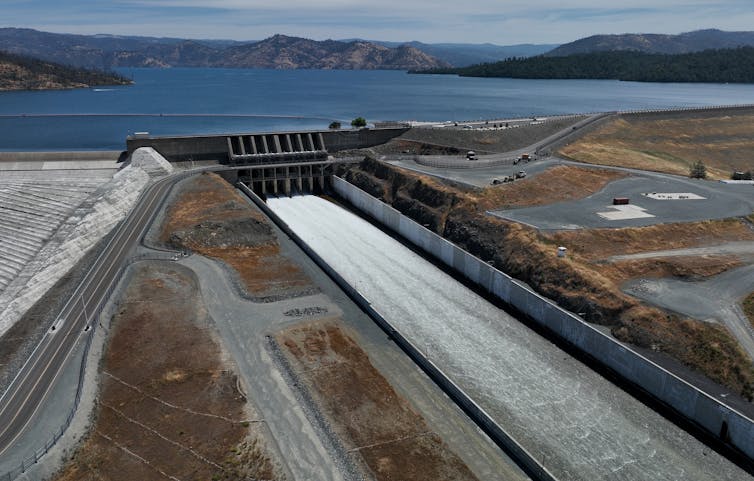
After several winter storms brought record snowfall to California’s Sierra Nevada in early 2023, Lake Oroville, California’s second-largest reservoir, was at 100% capacity. The previous year, much of the state had faced water restrictions. Justin Sullivan/Getty Images
That’s why my colleagues at the Center for Western Weather and Water Extremes at the Scripps Institution of Oceanography, part of the University of California, San Diego, work on improving atmospheric river forecasts and predictions. Water managers need to be able to regulate reservoirs and figure out how much water they can save for the dry season while still leaving room in the reservoirs to manage flood risk from future storms.
How is global warming affecting atmospheric rivers?
My research also shows that more atmospheric rivers are likely to occur concurrently during already wet conditions. So, the chance of extreme flooding also increases. Another study, by scientists from the University of Washington, suggests that there will be a seasonal shift to more atmospheric rivers earlier in the rainy season.
There will likely also be more year-to-year variability in the total annual precipitation, particularly in California, as a study by my colleagues at the Center for Western Weather and Water Extremes projects.
Last Sunday Jean and I watched a Top Documentary Film about the origins of dogs. It was filmed in 2018 and was precious.
Here are the words that accompanied the film:
He has been an integral part of our existence for over 20,000 years. Throughout history, his contributions have been diverse and invaluable. He’s aided us in procuring sustenance, safeguarded our domesticated animals, served as a shield against adversaries, provided navigation during harsh conditions, and rescued us from imminent danger.
Presently, he offers solace, alleviating solitude and assisting us in managing the challenges of advancing age. He has evolved into an unwavering comrade. The origins of dogs raise intriguing questions: How did these remarkable creatures emerge? How did they ascend to such prominence in our lives? How did we forge a collaborative relationship, leveraging their distinct abilities? Moreover, what remarkable feats do they accomplish for us in contemporary times?
Prepare to embark on a journey that unveils the extraordinary escapades of these exceptional beings, showcasing their heroic deeds. Transitioning from wild wolves to beloved companions, from predatory instincts to steadfast friendship, we will traverse the globe to narrate the captivating narrative of how dogs earned their title: man’s first friend.
Director: Frédéric Fougea
Luckily the film, that runs for 90 minutes, is available on YouTube.
Here it is:
If you haven’t seen the film then, please, put some time aside to watch it. You will not be disappointed.
So here we are, 2024, and the year when I become 80! However, I still have eleven months before that happens. Like an amazing number of people, I do not really think long about this New Year but there are plenty that do.
Here is an article that explains much more. It is from The Conversation.
ooOOoo
What winter solstice rituals tell us about indigenous people
On the day of winter solstice, many Native American communities will hold religious ceremonies or community events.
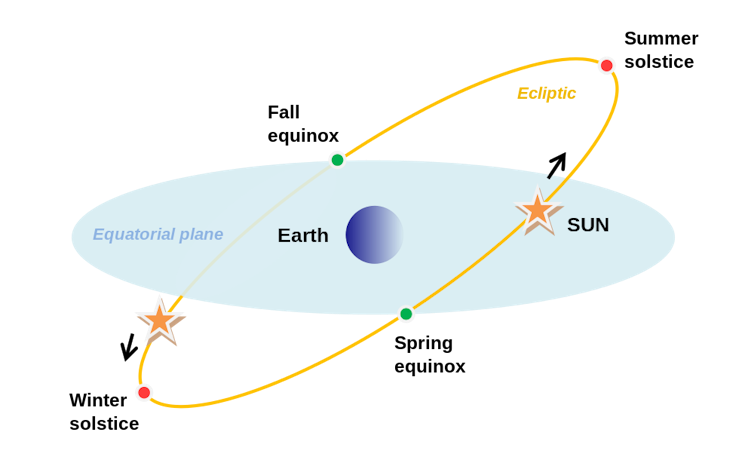
The winter solstice is the day of the year when the Northern Hemisphere has the fewest hours of sunlight and the Southern Hemisphere has the most. For indigenous peoples, it has been a time to honor their ancient sun deity. They passed their knowledge down to successive generations through complex stories and ritual practices.
As a scholar of the environmental and Native American religion, I believe, there is much to learn from ancient religious practices.
Ancient architecture
For decades, scholarshave studied the astronomical observations that ancient indigenous people made and sought to understand their meaning.
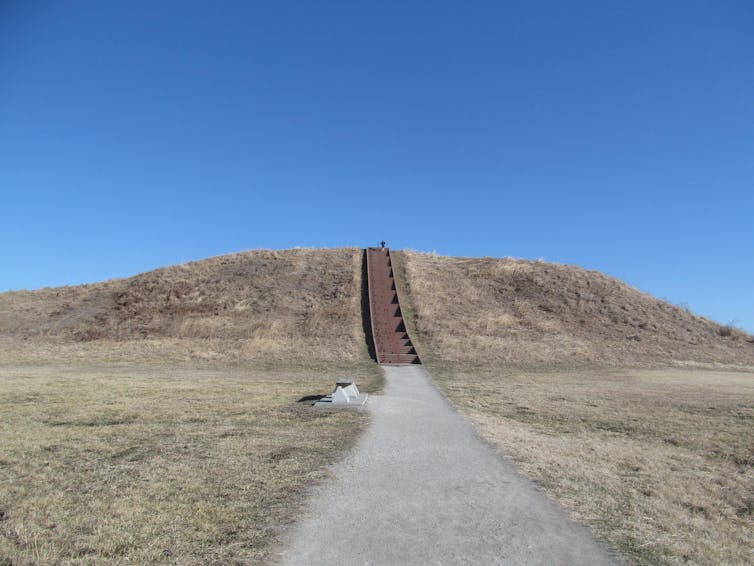
One such place was at Cahokia, near the Mississippi River in what is now Illinois across from St. Louis.
In Cahokia, indigenous people built numerous temple pyramids or mounds, similar to the structures built by the Aztecs in Mexico, over a thousand years ago. Among their constructions, what most stands out is an intriguing structure made up of wooden posts arranged in a circle, known today as “Woodhenge.”
To understand the purpose of Woodhenge, scientists watched the sun rise from this structure on winter solstice. What they found was telling: The sun aligned with both Woodhenge and the top of a temple mound – a temple built on top of a pyramid with a flat top – in the distance. They also found that the sun aligns with a different temple mound on summer solstice.
Archaeological evidence suggests that the people of Cahokia venerated the sun as a deity. Scholars believe that ancient indigenous societies observed the solar system carefully and wove that knowledge into their architecture.
Scientists have speculated that the Cahokia held rituals to honor the sun as a giver of life and for the new agricultural year.
Complex understandings
Zuni Pueblo is a contemporary example of indigenous people with an agricultural society in western New Mexico. They grow corn, beans, squash, sunflowers and more. Each year they hold annual harvest festivals and numerous religious ceremonies, including at the winter solstice.
At the time of the winter solstice they hold a multiday celebration, known as the Shalako festival. The days for the celebration are selected by the religious leaders. The Zuni are intensely private, and most events are not for public viewing.
But what is shared with the public is near the end of the ceremony, when six Zuni men dress up and embody the spirit of giant bird deities. These men carry the Zuni prayers for rain “to all the corners of the earth.” The Zuni deities are believed to provide “blessings” and “balance” for the coming seasons and agricultural year.
As religion scholar Tisa Wenger writes, “The Zuni believe their ceremonies are necessary not just for the well-being of the tribe but for “the entire world.”
Winter games
Not all indigenous peoples ritualized the winter solstice with a ceremony. But that doesn’t mean they didn’t find other ways to celebrate.
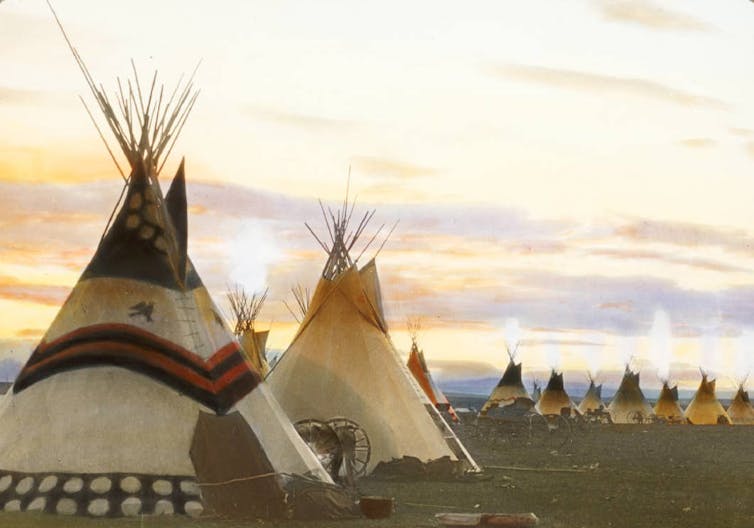
The Blackfeet tribe in Montana, where I am a member, historically kept a calendar of astronomical events. They marked the time of the winter solstice and the “return” of the sun or “Naatosi” on its annual journey. They also faced their tipis – or portable conical tents – east toward the rising sun.
They rarely held large religious gatherings in the winter. Instead the Blackfeet viewed the time of the winter solstice as a time for games and community dances. As a child, my grandmother enjoyed attending community dances at the time of the winter solstice. She remembered that each community held their own gatherings, with unique drumming, singing and dance styles.
Later, in my own research, I learned that the Blackfeet moved their dances and ceremonies during the early reservation years from times on their religious calendar to times acceptable to the U.S. government. The dances held at the time of the solstice were moved to Christmas Day or to New Year’s Eve.
Today, my family still spends the darkest days of winter playing card games and attending the local community dances, much like my grandmother did.
Although some winter solstice traditions have changed over time, they are still a reminder of indigenous peoples understanding of the intricate workings of the solar system. Or as the Zuni Pueblo’s rituals for all peoples of the earth demonstrate – of an ancient understanding of the interconnectedness of the world.