Category: Environment

You have to feel it!

Fascinating insight into our complex relationship with complex ideas!

There’s a powerful saying in the world of writing: If you can’t feel it you can’t write it!

But our feelings are so, so much a part of what it is to be human.  That’s why I spent some time exploring how our resistance to change is so wrapped up in the emotions that change brings about in an article back on the 2nd August: Changing the person: Me.

So a post on the grist online magazine not so long ago really caught my eye.  It was called Why climate change doesn’t spark moral outrage, and how it could, and was written by David Roberts.  I would dearly love to have sought David’s permission to republish it in full; it’s so relevant to understanding how we humans have to approach turning back from our present course of making the Earth’s biosphere uninhabitable for we humans.

But in a couple of days time, I have a Post coming out that is republished with David’s written permission called Cutting CO2 emissions – who leads the world! It felt greedy to ask David for another full republication.  So I’m going to dip into this one, hopefully to the point where you will go across to grist and read it for yourself.

David opens up as follows:

Perhaps the single biggest barrier to action on climate change is the fact that it doesn’t hit us in the gut. We can identify it as a great moral wrong, through a chain of evidence and reasoning, but we do not instinctively feel it as one. It does not trigger our primal moral intuitions or generate spontaneous outrage, anger, and passion. It’s got no emotional heat. (Ironic!)

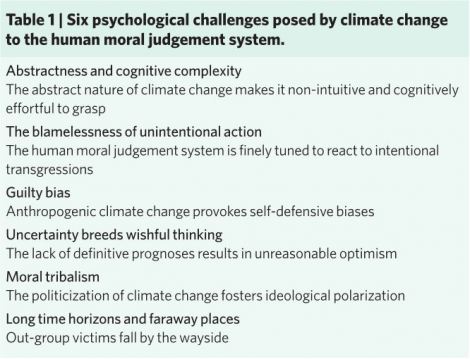
David’s article then goes on to refer to a recent paper published on the Nature.com website called Climate change and moral judgement by Ezra M. Markowitz & Azim F. Shariff.  The abstract sets out that:

Converging evidence from the behavioural and brain sciences suggests that the human moral judgement system is not well equipped to identify climate change — a complex, large-scale and unintentionally caused phenomenon — as an important moral imperative. As climate change fails to generate strong moral intuitions, it does not motivate an urgent need for action in the way that other moral imperatives do. We review six reasons why climate change poses significant challenges to our moral judgement system and describe six strategies that communicators might use to confront these challenges. Enhancing moral intuitions about climate change may motivate greater support for ameliorative actions and policies.

M’mmm – not sure how that leaves me.  (Which is my way of saying that I don’t really understand that!)  Luckily David goes on to say that the authors “go on to identify six reasons why, “unlike financial fraud or terrorist attacks, climate change does not register, emotionally, as a wrong that demands to be righted.” and refers to an interesting table in the research paper.

Now go to the article on grist to better understand how those challenges are explained.

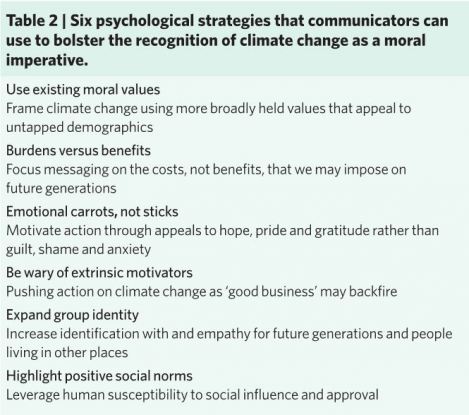
Then later on in the research paper, there is a second table, as below:

Again, these strategies are expanded upon in David’s article.  What I will do is to copy his final few paragraphs:

6. Highlight positive social norms: This is, to me, the Big Kahuna. As I was reading about all the psychological barriers to climate action, I kept thinking, “one thing can overcome all these: peer pressure!” If people see others that they view as peers or leaders doing something, they will tend to do it too, and retrofit reasons for it after the fact. This is the essence of humans as social creatures.

The recommendation is twofold, though: not just to “highlight pro-environmental, prosocial injunctive norms such as prohibitions against being wasteful,” but also to “be careful not to inadvertently highlight negative, but existent, descriptive norms, which can actually encourage individuals to follow suit in the wrong direction.”

In other words, you want to emphasize that climate hawkery is good, socially desirable, admirable, and that all the cool kids are doing it. You don’t want to give people the impression that “everyone’s doing it” if it is bad. Even if you state clearly that it’s bad, the fact that others are doing it is, in and of itself, a powerful incentive to do it too. It’s the herd instinct. This is good reason not to whine on and on about how everyone drives too much or everyone wastes electricity. The subtext is, “it’s the social norm.”

—-

Aaaanyway, this is a lot of food for thought. But it’s the kind of stuff — not about science but about people — that far too many climate hawks ignore or disregard. Climate change is not only the economic and ecological crisis of our time, it’s also a moral crisis. What we are doing to our descendants is a moral crime. Finding ways to help people get that, feel it in their guts the way they would if someone threatened their own families, is a precondition for serious, sustained action.

Let me repeat David’s closing words, “Climate change is not only the economic and ecological crisis of our time, it’s also a moral crisis. What we are doing to our descendants is a moral crime.

OK, so how strongly do you feel that?  Great, so you do feel it – even feel it deep inside you.

Now that you do, let’s all get stuck into making a difference.  It is all about doing.  As someone of huge stature, and a wonderful person of action no less, said;

I have been impressed with the urgency of doing. Knowing is not enough; we must apply. Being willing is not enough, we must do. Leonardo da Vinci (1452-1519)

We must do!  Start your own ‘doing’, don’t wait upon others, actively look for ideas (there are a few here) and together we can make a positive difference.

Well done, David – great article.

The power of nature

Another gem from Cynthia Gomez.

Do you remember the beautiful pictures of the horse and mare from Saturday, 4th August?  Well many did and loved that Post as was recorded by the number of ‘Likes’.  That was sent to me by Cynthia.

Here’s another one from Cynthia; a beautiful insight into the world of nature, seen over 20 million times!

Wonderful.

Annual meteor show

Raise your eyes in wonder at the most wonderful annual show from space.

A Perseid meteor streaks across the sky in this Aug. 12, 2008 photo near Rogers Spring in the Lake Mead National Recreation Area in Nevada. (Ethan Miller/Getty Images)

As the EarthSky website explains,

As of August 8, 2012, the zenithal hourly rate (ZHR) of meteors visible in a dark sky has gone up to 21! That’s according to the International Meteor Organization. Clearly the Perseid meteor shower is rising to its peak, as it does every year at this time.

The peak mornings will be August 11, 12 and 13. August 12 might be the best morning. August 11 might be better than August 13. The moon is waning now. And many people are seeing meteors!

The Delta Aquarid and Perseid meteor showers combine in late July and August to create what most consider the best and most reliable meteor display for Northern Hemisphere observers. As always, after midnight is the best time for meteor-watching. The moon will be there, but getting thinner every morning. On the mornings (not the evenings) of August 11, 12 and 13, the moon will be a waning crescent, and the meteors should be flying at a rate closer to their peak of 50 or 60 meteors per hour. As an added treat – on August 11, 12 and 13 – the moon will be sweeping past the brightest planets Venus and Jupiter in the eastern predawn sky. You can’t ask for more!

Well you could ask for more and there is more on that very helpful website, ergo:

August 10/11, 11/12, and 12/13, 2012 Perseids

Meteors are typically best after midnight, but in 2012, with the moon rising into the predawn sky, you might want to watch for Perseid meteors in late evening as well. You can get moonrise times via this custom sunset calendar. As seen from around the world, the waning crescent moon will rise later on August 12 than on August 11, and, on the morning of August 13, although you’re slightly past the peak, the moon will rise later still.

On any of those mornings, moonlight shouldn’t be so overwhelming as to ruin the show. Plus the moon on those mornings will be near the bright planets Venus and Jupiter in the eastern predawn sky. It’ll be a beautiful early morning scene.

The Perseids are typically fast and bright meteors. They radiate from a point in the constellation Perseus the Hero. You don’t need to know Perseus to watch the shower because the meteors appear in all parts of the sky. The Perseids are considered by many people to be the year’s best shower, and often peak at 50 or more meteors per hour in a dark sky.

The Perseids tend to strengthen in number as late night deepens into midnight, and typically produce the most meteors in the wee hours before dawn. These meteors are often bright and frequently leave persistent trains.

Starting in late evening on the nights of August 10/11, 11/12 and 12/13, the Perseid meteors will streak across these short summer nights from late night until dawn, with only a little interference from the waning crescent moon. Plus the moon will be near the bright planets Venus and Jupiter in the eastern predawn sky.

Finally, here’s some fabulously helpful information on the NASA website:

NASA Chat: Stay ‘Up All Night’ to Watch the Perseids!

Escape the heat of the waning days of summer for an evening of sky watching. The Perseid meteor shower peaks on the night of August 11 through the morning of August 12. Perseid rates can get as high as 100 per hour, with many fireballs visible in the night sky. A waning crescent moon will interfere slightly with this year’s show, but viewing should definitely be worth a look!

On the night of Aug. 11-12, astronomer Bill Cooke and his team from the Meteoroid Environment Office at NASA’s Marshall Space Flight Center will answer your questions about the 2012 Perseid meteor shower via an “Up All Night” live chat. To join the chat, simply return to this page and log in. The chat experts will be available to answer questions between the hours of 11 p.m. – 3 a.m. EDT, beginning the evening of Aug. 11 and continuing into the morning of Aug. 12.

Watch the Perseids! Live Video/Audio Feed

On the night of Aug. 11, a live video/audio feed of the Perseid shower will be embedded below (go to here). The camera is mounted at NASA’s Marshall Space Flight Center in Huntsville, Ala. During daylight, you’ll see a dark gray box — the camera is light-activated and will turn on at dusk. At night you’ll see white points, or stars, on a black background.

About the Perseids

The Perseids have been observed for at least 2,000 years and are associated with the comet Swift-Tuttle, which orbits the sun once every 133 years. Each year in August, the Earth passes through a cloud of the comet’s debris. These bits of ice and dust — most over 1,000 years old — burn up in the Earth’s atmosphere to create one of the best meteor showers of the year. The Perseids can be seen all over the sky, but the best viewing opportunities will be across the northern hemisphere. Those with sharp eyes will see that the meteors radiate from the direction of the constellation Perseus.

 Wonderful!

No pain: No gain!

The truth is always our friend.

The last couple of weeks of Posts seem to have been rather dominated by the risks to the planet’s biosphere from the highly probable actions of mankind.  I feel a little uncomfortable about this as Learning from Dogs is not a single issue Blog.  Well not in the sense of a tightly defined issue.  But in another sense, it is about the issue of integrity; about raising the values of truth and openness so that it’s clear how we are to move forward as a species and pass through these ‘interesting times’ with hope and confidence.

Dogs are such pure creatures, as I try and explain in the Dogs and Integrity sidelink.  As I wrote in the Vision,

  • Our children require a world that understands the importance of faith, integrity and honesty
  • Learning from Dogs will serve as a reminder of the values of life and the power of unconditional love – as so many, many dogs prove each and every day
  • Constantly trying to get to the truth …
  • The power of greater self-awareness and faith …

So that’s the issue!

If we don’t embrace the truth of what is happening to our planet, then we can’t embrace change.

With thanks to the Yale Forum on Climate Change for promoting this video.

Thinking outside the box

Strange theory reveals secrets of the universe, the logic of sycamore leaves and why even smart people struggle with new ideas.

A guest post from Pete Aleshire, Editor, Payson Roundup.

Introduction

The Payson Roundup is our local newspaper here in Payson, AZ.  I first saw this article by Pete a couple of weeks ago and was just utterly engrossed by it.  Not just the tantalising peek into a physics I know so little about but the beautiful prose.  The latter is not surprising because as well as being editor of the paper, Pete also teaches the creative writing course at our local college.  Jean and I had the benefit of attending the course, I guess about a year ago, and therefore can speak from experience.

So settle down and enjoy.

oooOOOooo

I finally got Drake Larson together with both sycamore leaves and Payson Mayor Kenny Evans. Moreover, I have been entrusted with a formula that may win me an invitation to Oslo if Drake gets a Nobel Prize.

But even if that don’t work out, I did get to eavesdrop on Drake and Evans. Quite the event, from my bemused point of view, since it shed light on dangerous delights of outside-the-box thinking and the Nature of the Universe.

But wait. You look confused.

Let me back up — and start somewhere closer to the beginning. Be patient with me — by the time we’re done, you’ll realize why God’s a math nerd, one surprising secret of Dark Energy, why farmers become original thinkers and what sycamore leaves tell us about the universe.

But first, I have to explain about Drake.

We grew up together, getting into (and mostly out of) various varieties of trouble. Very early on, I realized that he was much (much) smarter than me. This initially really irritated me, as I was previously inclined to vanity about my intelligence. Turns out, I love learning stuff other people have discovered, but Drake only gets truly excited when he has hold of a completely new idea that no one else can quite grasp. This prepared me, as it turns out, for meeting Kenny Evans — but that’s getting ahead of the story.

Drake and I grew up doing math homework together, before I wandered off into a career in newspapers. He got his degree in mathematics, turned down a job with the RAND Corporation and took up growing table grapes.

But he never quit picking at the lock of the universe.

Years ago when I was the science writer for the Oakland Tribune, he came to me all excited about a set of formulas he had. I did my best to follow the two pages of calculations, but all I can tell you is that they described instabilities of any sphere with uniform density. He predicted that when the Voyager spacecraft reached Jupiter, it would report inexplicable turbulence at a certain depth in the atmosphere. I ran his numbers past various top-level physicists and mathematicians who couldn’t find a flaw in his formulas — but concluded that it had to be wrong since it led to a violation of the keystone laws of conservation of mass and energy.

But I took note some months later when the Voyager spacecraft reported mysterious levels of turbulence deep within the atmosphere of Jupiter.

The years passed. Drake kept growing grapes, flowers, dates and vegetables — and working on his calculations. He wrote a book, “The Cults of Relativity,” in which he described a few of his theories, delighted in the conundrums of mathematics and pondered the curious resistance of even smart people to unconventional ideas.

We got together again recently. I took him down to Fossil Creek, all overhung with sycamores with the rustle of floppy, five-pointed leaves. Drake was his old self on our Fossil Creek tour as he tried to show me math’s beauty around us, although I was but a blind man clutching the tail of his mathematical elephant.

He had now connected his formulas to dark energy, a still hypothetical form of energy invoked by desperate cosmologists to explain the startling observation that the expansion of the universe is actually accelerating. To explain this seeming impossibility, they invented “dark energy” — which they figure pervades the universe and at certain densities creates a repulsive force stronger than the attractive force of gravity.

Anyhow, here’s the point: Drake was in awe that his mathematical wanderings offered a way to calculate dark energy’s cap within earth — it happened to be an “inside is now outside” inversion of Isaac Newton’s simplest integral. No. Please. Don’t ask me to explain that. But earth’s dark energy cannot exceed 17 pounds per square inch at a depth of about 1,500 miles. He’s been working with University of Southern California computer crunching guru professor Barry Boehm, and the University of California at Riverside geophysics professor Shawn Biehler on its implications. Among other things, it could explain the perplexing observation that major earthquakes increase the earth’s rotation rate.

No one knows how to measure such a quantity at present. Someday they will. If it turns out that 17 pounds per square inch is a relevant benchmark for earth’s dark energy, then this column will maybe win Drake the Nobel — and I’ll get to dress up and attend the ceremony.

So Drake and I spent the day wandering along the banks of Fossil Creek as he kept trying to come up with metaphors so I could grasp math’s secret within the beauty of Fossil Creek’s sycamore leaves. The well-designed sycamore leaves adhere to the Fibonacci sequence, a mysterious progression of numbers that crops up throughout nature — from the spiral of a nautilus shell to the layout of the ruins of Chaco Canyon.

So I figured I’d just write this — and get earth’s 17 PSI cap for dark energy out there in the time/date/ stamped world.

Oh, yeah: And about Kenny Evans.

So that night, I took Drake to the Payson council meeting. Turns out, Drake’s family was growing grapes in the Coachella Valley at the same time Evans was farming 10,000 acres in Yuma. They both managed to survive that tempestuous time when the United Farm Workers union organized agriculture workers.

I introduced them and listened as they recalled events and figured out whom they knew in common.

It was then that I decided to blame Drake for my faith in Evans’ ridiculous conviction that a university will build a campus here in this itty bitty tourist town — complete with a research center and convention hotel. No sensible small-town mayor would risk public ridicule while spending thousands of hours on such an outside-the-box notion … unless he’d learned to gamble on dreams and hard work during all those years as a farmer.

Evans’ notion is almost as silly as a farmer who calculates the amount of dark energy emanating from earth, while credentialed experts scratch their collective heads.

Still, I’m thinking maybe I’ll get a nice suit jacket — something I can wear to both the university’s groundbreaking and the ceremonies in Oslo.

Hey, never hurts to be prepared.

oooOOOooo

A big thank-you for the permission to republish this on Learning from Dogs. I have no doubt that many LfD readers enjoyed it as much as I did!  Stay with me for tomorrow when the theme of thinking, innovation and craziness is explored a touch more.

The power of touch

Nature, once again, shows the value of loving contact during those crucial early years.

I’m writing this at 7.45am on the 30th.  Coincidentally, Jean and I were chatting in bed about an hour ago about this ‘touchy – feely’ stuff.  This was a bed having four dogs on it!  One of those, Hazel, was laying alongside my left leg just sucking up me stroking her head and tummy.  Jean and I were musing that for animals and humans, how we are touched by our parents, especially our mother, during those first few years of growing up has profound implications for how we as adults respond to being touched and hugged.

So then I opened up my mail box and there was this sent by Cynthia Gomez serving as a wonderful reminder of the power of touch.  Thanks Cynthia, great timing!

oooOOOooo

Some pictures just don’t need captions.
There is nothing like Mom’s lap no matter who you are. This is precious !!!!
This is a newborn offspring of Taskin, a Gypsy Stallion owned by
Villa Vanners of Oregon ..
These pictures were taken immediately after his birth on April 6.
The mare laid down, and then he trotted around and
crawled right up into her lap.
—————–
——–
——–
——–
——–
So give someone a hug today!

And now to do something.

The cumulative effect of millions of decisions brings about change!

Yesterday’s Post was about personal change.  It came on the back of a short series that was triggered by the Bill McKibben essay in Rolling Stone magazine that I republished on 31st July.  If you haven’t read it, do yourself a favour and read it soon.

The essay highlighted the challenge of how we change our ways, that is at a personal level, which is why I decided to devote a complete Post to the subject of change.  There was no doubt that the McKibben essay opened our eyes to the need for change, if they weren’t open already.  So being clear about the need for change and how, initially, it can make us feel less sure of ourselves, where do we go from here?  As John Fisher explains, within the change process, there is the stage where things start to happen.  This is what he writes about that stage,

Moving forward

In this stage we are starting to exert more control, make more things happen in a positive sense and are getting our sense of self back. We know who we are again and are starting to feel comfortable that we are acting in line with our convictions, beliefs, etc. and making the right choices. In this phase we are, again, experimenting within our environment more actively and effectively.

Keep this stage in mind as you journey along your individual path towards reducing your impact on the planet.  It really does act as a beacon for you, as a candle in the darkness.

OK, there’s an old saying in business ‘if you can’t measure it you can’t manage it!‘  So let’s start off by calculating the CO2 we are presently responsible for.

There are a number of CO2 calculators available on the Web but this one from The Resurgence Trust website seems as good as any.  Easy to use and it provides a starting point from which to plan your attack!  Make a promise to calculate your present CO2 output, soon!

Then to the plan of action!  A web search on reducing CO2 produces a huge number of results and I recommend that you undertake your own trawl to find the information that ‘rocks your boat’.  But on the Brave New Climate website there’s a summary that caught my eye, especially how it was introduced:

Top 10 ways to reduce your CO2 emissions footprint

Posted on 29 August 2008 by Barry Brook

Solving climate change is a huge international challenge. Only a concerted global effort, involving the governments of all nations, will be enough to avert dangerous consequences. But that said, the individual actions of everyday people are still crucial. Large and complex issues, like climate change, are usually best tackled by breaking down the problem into manageable bits.

For carbon emissions, this means reducing the COcontribution of each and every one of the six and a half billion people on the planet. But what can you, as an individual person or family, do that will most make a difference to the big picture? Here are my top ten action items, which are both simple to achieve and have a real effect. They are ranked by how much impact they make to ‘kicking the COhabit’.

Then follows ten solid recommendations:

  1. Make climate-conscious political decisions.
  2. Eat less red meat.
  3. Purchase “green electricity“.
  4. Make your home and household energy efficient.
  5. Buy energy and water efficient appliances.
  6. Walk, cycle or take public transport.
  7. Recycle, re-use and avoid useless purchases.
  8. Telecommute and teleconference.
  9. Buy local produce.
  10. Offset what you can’t save.

Each of these recommendations is supported by great web links and plenty of advice.  So don’t just skip through those 10 options, go here and commit to doing something!

And when you are ready to involve others beyond your family, 350.org has a great selection of resources for potential organizers.

We can make a difference!

More on the ‘Act’ stuff!

The business of acting to make a difference.

The future depends on what we do in the present. – Mahatma Gandhi

Yesterday, I republished a long essay from Bill McKibben under my title of Stop, read, reflect and Act!    Bill’s essay was called Global Warming’s Terrifying New Math and terrifying the numbers are!

If you didn’t read it yesterday, I encourage you to do so as soon as you can.  Why?  Because the process of change cannot start until we truly want to change; a total emotional commitment.  And the formation of those emotions, that realisation, requires a new understanding of the world around us, who we are and who we want to be.  An outcome that is all part of being better informed, which is why the McKibben essay is so profoundly important.

Tomorrow, I want to explore that process of personal change.

But before then, let me go back and repeat some words in Bill’s essay that really jumped off the page and hit me between the eyes.

Writing of Germany, Bill said, “… on one sunny Saturday in late May, that northern-latitude nation generated nearly half its power from solar panels within its borders. That’s a small miracle – and it demonstrates that we have the technology to solve our problems. But we lack the will.

We lack the will!!

Then in the next paragraph, Bill went on to write,

This record of failure means we know a lot about what strategies don’t work. Green groups, for instance, have spent a lot of time trying to change individual lifestyles: the iconic twisty light bulb has been installed by the millions, but so have a new generation of energy-sucking flatscreen TVs. Most of us are fundamentally ambivalent about going green: We like cheap flights to warm places, and we’re certainly not going to give them up if everyone else is still taking them. Since all of us are in some way the beneficiaries of cheap fossil fuel, tackling climate change has been like trying to build a movement against yourself – it’s as if the gay-rights movement had to be constructed entirely from evangelical preachers, or the abolition movement from slaveholders.

This is what hit me between the eyes, “the iconic twisty light bulb has been installed by the millions, but so have a new generation of energy-sucking flatscreen TVs.”  That describes me to perfection.  OK, we have installed solar panels as well but I admit to a significant degree of ambivalence! ” tackling climate change has been like trying to build a movement against yourself

Let me remind you of Bill’s next paragraph,

People perceive – correctly – that their individual actions will not make a decisive difference in the atmospheric concentration of CO2; by 2010, a poll found that “while recycling is widespread in America and 73 percent of those polled are paying bills online in order to save paper,” only four percent had reduced their utility use and only three percent had purchased hybrid cars. Given a hundred years, you could conceivably change lifestyles enough to matter – but time is precisely what we lack.

So it comes down to change; change in a timely manner, to boot!

Let’s hold that until tomorrow and I will leave you with this: Put your future in good hands – your own.

Stop, read, reflect and Act!

The latest from Bill McKibben has to be read and shared.

Introduction

We live in a world where there’s a great fondness for shortness, whether it’s headlines, soundbites, Twitter length ‘conversations’, text messages, and the rest.  However, I’m introducing an essay from Bill McKibben that is long.  When I use the word long I mean both literally, the essay is a shade under 6,200 words, and subjectively, the essay is long, very long, on meaning.

It was published in the August 2nd, 2012 issue of Rolling Stone.  As Allyse of the 350.org team wrote in a widely distributed email,

Here at 350.org, we do a lot of our internal communication via online chat, and our written shorthand for “YES!” and “totally awesome!” and “you rock!” is “++”. Which is why I say to you: ++ Social Media Team, ++. You all rock.

Bill McKibben’s article in Rolling Stone—which we asked you to spread around the internet last week—has been shared on Facebook almost 100K times and seen by hundreds of thousands of people. Great work. If you haven’t read it yet, please do.

This article really lays out the intellectual framework for much of our work in the weeks, months, and years ahead. We want to keep pushing these ideas out there, especially this one: our objection to the fossil fuel industry is structural—these businesses are in fact planning to wreck the planet!

So we took a quote from Bill’s article and made it into a graphic that’s already been shared almost 2,500 times on Facebook. Will you help us push it past 5,000? Click here to share.

As you know if you’ve read the article, this is really an all-hands-on-deck moment for humanity. Thanks for doing your part—in ways both large and small.

Onward,

Allyse

Will you put aside some time, settle down in a comfortable chair, and read the article?  Please do!

It crossed my mind to split it over a couple of days but I decided against that.  But I have inserted a ‘click to reveal more’ about 1,100 words into the article – please do read on when you reach that point.  And just as important, do comment!

Oh, want to see that image on Facebook that has been shared so widely?  Here it is:

A’int that the truth!

Finally, feel free to share this as far and wide as you want.  Thank you.

oooOOOooo

(Apart from the first image from Edel Rodriguez, all the other photographs have been inserted by me and are not in the original Rolling Stone production – I decided to insert them to make reading the article more visually attractive on a screen.)

Global Warming’s Terrifying New Math

Three simple numbers that add up to global catastrophe – and that make clear who the real enemy is

Illustration by Edel Rodriguez

By Bill McKibben
July 19, 2012 9:35 AM ET

If the pictures of those towering wildfires in Colorado haven’t convinced you, or the size of your AC bill this summer, here are some hard numbers about climate change: June broke or tied 3,215 high-temperature records across the United States. That followed the warmest May on record for the Northern Hemisphere – the 327th consecutive month in which the temperature of the entire globe exceeded the 20th-century average, the odds of which occurring by simple chance were 3.7 x 10-99, a number considerably larger than the number of stars in the universe.

Meteorologists reported that this spring was the warmest ever recorded for our nation – in fact, it crushed the old record by so much that it represented the “largest temperature departure from average of any season on record.” The same week, Saudi authorities reported that it had rained in Mecca despite a temperature of 109 degrees, the hottest downpour in the planet’s history.

Not that our leaders seemed to notice. Last month the world’s nations, meeting in Rio for the 20th-anniversary reprise of a massive 1992 environmental summit, accomplished nothing. Unlike George H.W. Bush, who flew in for the first conclave, Barack Obama didn’t even attend. It was “a ghost of the glad, confident meeting 20 years ago,” the British journalist George Monbiot wrote; no one paid it much attention, footsteps echoing through the halls “once thronged by multitudes.” Since I wrote one of the first books for a general audience about global warming way back in 1989, and since I’ve spent the intervening decades working ineffectively to slow that warming, I can say with some confidence that we’re losing the fight, badly and quickly – losing it because, most of all, we remain in denial about the peril that human civilization is in.

When we think about global warming at all, the arguments tend to be ideological, theological and economic. But to grasp the seriousness of our predicament, you just need to do a little math. For the past year, an easy and powerful bit of arithmetical analysis first published by financial analysts in the U.K. has been making the rounds of environmental conferences and journals, but it hasn’t yet broken through to the larger public. This analysis upends most of the conventional political thinking about climate change. And it allows us to understand our precarious – our almost-but-not-quite-finally hopeless – position with three simple numbers.

Continue reading “Stop, read, reflect and Act!”

The West in flames

Yet another stunningly powerful essay on TomDispatch.

Introduction

I do hope that as a result of Tom Engelhardt giving me written blanket permission to republish essays that appear on TomDispatch, for which I am ever grateful, many readers have gone across to the TomDispatch website and, consequently, quite a few of you have subscribed.  The regular flow of essays from major names across the many fields of life is impressive.

Plus I want to harp back to a theme that I touched on during my introduction to Dianne Gray’s guest post on the 25th last, Dogs and life.  That is that the vision of Learning from Dogs is to remind all of us that we have no option in terms of the long-term viability of our species than to acknowledge the power of integrity, so beautifully illustrated by our closest animal companion for tens of thousands of years, the domestic dog.

So with that in mind, settle back and read,

Tomgram: William deBuys, The West in Flames

Posted by William deBuys at 9:20AM, July 24, 2012

[Note for TomDispatch Readers: Check out my hour on Media Matters with Bob McChesney on Sunday, where he and I talked about the militarization of the U.S. and of American foreign policy, and I discussed my latest book, The United States of Fear, as well as the one I co-authored with Nick Turse, Terminator Planet: The First History of Drone Warfare, 2001-2050.  Tom]

The water supply was available only an hour a day and falling.  People — those who hadn’t moved north to cooler climes — were dying from the heat.  Food was growing ever scarcer and the temperature soaring so that, as one reporter put it, you could “cook eggs on your sidewalk and cook soup in the oceans.”  The year was 1961 and I was “there,” watching “The Midnight Sun,” a Twilight Zone episode in which the Earth was coming ever closer to the sun.  (As it was The Twilight Zone, you knew there would be a twist at the end: in this case, you were inside the fevered dreams of a sick woman on a planet heading away from the sun and growing ever colder.)

In 1961, an ever-hotter planet was a sci-fi fantasy and the stuff of entertainment.  No longer.  Now, it’s the plot line for our planet and it isn’t entertaining at all.  Just over a half-century later, we are experiencing, writes Bill McKibben in Rolling Stone, “the 327th consecutive month in which the temperature of the entire globe exceeded the 20th-century average, the odds of which occurring by simple chance were 3.7 x 10-99, a number considerably larger than the number of stars in the universe.”

Speaking personally, this summer, living through a staggering heat wave on the East coast (as in much of the rest of the country), I’ve felt a little like I’m in that fevered dream from The Twilight Zone, and a map of a deep-seated drought across 56% of the country and still spreading gives you a feeling for just why.   Never in my life have I thought of the sun as implacable, but that’s changing, too.  After all, the first six months of 2012 in the U.S. were 4.5 degrees Fahrenheit above the long-term norm and Colorado, swept by wildfires, was a staggering 6.4 degrees higher than the usual.  TomDispatch regular William deBuys, author of A Great Aridness: Climate Change and the Future of the American Southwest, catches the feel of living in a West that’s aflame and drying out fast.  (To catch Timothy MacBain’s latest Tomcast audio interview in which deBuys discusses where heat, fire, and climate change are taking us, click here or download it to your iPod here.) Tom

oooOOOooo

The Oxygen Planet Struts Its Stuff 
Not a “Perfect Storm” But the New Norm in the American West 
By William deBuys

Dire fire conditions, like the inferno of heat, turbulence, and fuel that recently turned 346 homes in Colorado Springs to ash, are now common in the West. A lethal combination of drought, insect plagues, windstorms, and legions of dead, dying, or stressed-out trees constitute what some pundits are calling wildfire’s “perfect storm.”

They are only half right.

This summer’s conditions may indeed be perfect for fire in the Southwest and West, but if you think of it as a “storm,” perfect or otherwise — that is, sudden, violent, and temporary — then you don’t understand what’s happening in this country or on this planet. Look at those 346 burnt homes again, or at the High Park fire that ate 87,284 acres and 259 homes west of Fort Collins, or at the Whitewater Baldy Complex fire in New Mexico that began in mid-May, consumed almost 300,000 acres, and is still smoldering, and what you have is evidence of the new normal in the American West.

For some time, climatologists have been warning us that much of the West is on the verge of downshifting to a new, perilous level of aridity. Droughts like those that shaped the Dust Bowl in the 1930s and the even drier 1950s will soon be “the new climatology” of the region — not passing phenomena but terrifying business-as-usual weather. Western forests already show the effects of this transformation.

If you surf the blogosphere looking for fire information, pretty quickly you’ll notice a dust devil of “facts” blowing back and forth: big fires are four times more common than they used to be; the biggest fires are six-and-a-half times larger than the monster fires of yesteryear; and owing to a warmer climate, fires are erupting earlier in the spring and subsiding later in the fall. Nowadays, the fire season is two and a half months longer than it was 30 years ago.

All of this is hair-raisingly true. Or at least it was, until things got worse. After all, those figures don’t come from this summer’s fire disasters but from a study published in 2006 that compared then-recent fires, including the record-setting blazes of the early 2000s, with what now seem the good old days of 1970 to 1986. The data-gathering in the report, however, only ran through 2003. Since then, the western drought has intensified, and virtually every one of those recent records — for fire size, damage, and cost of suppression — has since been surpassed.

New Mexico’s Jemez Mountains are a case in point. Over the course of two weeks in 2000, the Cerro Grande fire burned 43,000 acres, destroying 400 homes in the nuclear research city of Los Alamos. At the time, to most of us living in New Mexico, Cerro Grande seemed a vision of the Apocalypse. Then, the Las Conchas fire erupted in 2011 on land adjacent to Cerro Grande’s scar and gave a master class in what the oxygen planet can do when it really struts its stuff.

The Las Conchas fire burned 43,000 acres, equaling Cerro Grande’s achievement,in its first fourteen hours. Its smoke plume rose to the stratosphere, and if the light was right, you could see within it rose-red columns of fire — combusting gases — flashing like lightning a mile or more above the land. Eventually the Las Conchas fire spread to 156,593 acres, setting a record as New Mexico’s largest fire in historic times.

It was a stunning event. Its heat was so intense that, in some of the canyons it torched, every living plant died, even to the last sprigs of grass on isolated cliff ledges. In one instance, the needles of the ponderosa pines were not consumed, but bent horizontally as though by a ferocious wind. No one really knows how those trees died, but one explanation holds that they were flash-blazed by a superheated wind, perhaps a collapsing column of fire, and that the wind, having already burned up its supply of oxygen, welded the trees by heat alone into their final posture of death.

It seemed likely that the Las Conchas record would last years, if not decades. It didn’t. This year the Whitewater Baldy fire in the southwest of the state burned an area almost twice as large.

Half Now, Half Later?

In 2007, Tom Swetnam, a fire expert and director of the laboratory of Tree-Ring Research at the University of Arizona, gave an interview to CBS’s 60 Minutes.Asked to peer into his crystal ball, he said he thought the Southwest might lose half its existing forests to fire and insects over the several decades to come. He immediately regretted the statement.  It wasn’t scientific; he couldn’t back it up; it was a shot from the hip, a WAG, a wild-ass guess.

Swetnam’s subsequent work, however, buttressed that WAG. In 2010, he and several colleagues quantified the loss of southwestern forestland from 1984 to 2008. It was a hefty 18%. They concluded that “only two more recurrences of droughts and die-offs similar or worse than the recent events” might cause total forest loss to exceed 50%. With the colossal fires of 2011 and 2012, including Arizona’s Wallow fire, which consumed more than half-a-million acres, the region is on track to reach that mark by mid-century, or sooner.

But that doesn’t mean we get to keep the other half.

In 2007, the Intergovernmental Panel on Climate Change forecast a temperature increase of 4ºC for the Southwest over the present century. Given a faster than expected build-up of greenhouse gases (and no effective mitigation), that number looks optimistic today. Estimates vary, but let’s say our progress into the sweltering future is an increase of slightly less than 1ºC so far. That means we still have an awful long way to go. If the fires we’re seeing now are a taste of what the century will bring, imagine what the heat stress of a 4ºC increase will produce. And these numbers reflect mean temperatures. The ones to worry about are the extremes, the record highs of future heat waves.  In the amped-up climate of the future, it is fair to think that the extremes will increase faster than the means.

At some point, every pine, fir, and spruce will be imperiled. If, in 2007, Swetnam was out on a limb, these days it’s likely that the limb has burned off and it’s getting ever easier to imagine the destruction of forests on a region-wide scale, however disturbing that may be.

More than scenery is at stake, more even than the stability of soils, ecosystems, and watersheds: the forests of the western United States account for 20% to 40% of total U.S. carbon sequestration. At some point, as western forests succumb to the ills of climate change, they will become a net releaser of atmospheric carbon, rather than one of the planet’s principle means of storing it.

Contrary to the claims of climate deniers, the prevailing models scientists use to predict change are conservative. They fail to capture many of the feedback loops that are likely to intensify the dynamics of change. The release of methane from thawing Arctic permafrost, an especially gloomy prospect, is one of those feedbacks. The release of carbon from burning or decaying forests is another. You used to hear scientists say, “If those things happen, the consequences will be severe.” Now they more often skip that “if” and say “when” instead, but we don’t yet have good estimates of what those consequences will be.

Ways of Going

There have always been droughts, but the droughts of recent years are different from their predecessors in one significant way: they are hotter. And the droughts of the future will be hotter still.

June temperatures produced 2,284 new daily highs nationwide and tied 998 existing records. In most places, the shoe-melting heat translated into drought, and the Department of Agriculture set a record of its own recently by declaring 1,297 dried-out counties in 29 states to be “natural disaster areas.” June also closed out the warmest first half of a year and the warmest 12-month period since U.S. record keeping began in 1895. At present, 56% of the continental U.S. is experiencing drought, a figure briefly exceeded only in the 1950s.

Higher temperatures have a big impact on plants, be they a forest of trees or fields of corn and wheat. More heat means intensified evaporation and so greater water stress. In New Mexico, researchers compared the drought of the early 2000s with that of the 1950s. They found that the 1950s drought was longer and drier, but that the more recent drought caused the death of many more trees, millions of acres of them. The reason for this virulence: it was 1ºC to 1.5ºC hotter.

The researchers avoided the issue of causality by not claiming that climate changecaused the higher temperatures, but in effect stating: “If climate change is occurring, these are the impacts we would expect to see.” With this in mind, they christened the dry spell of the early 2000s a “global-change-type drought” — not a phrase that sings but one that lingers forebodingly in the mind.

No such equivocation attends a Goddard Institute for Space Studies appraisal of the heat wave that assaulted Texas, Oklahoma, and northeastern Mexico last summer. Their report represents a sea change in high-level climate studies in that they boldly assert a causal link between specific weather events and global warming. The Texas heat wave, like a similar one in Russia the previous year, was so hot that its probability of occurring under “normal” conditions (defined as those prevailing from 1951 to 1980) was approximately 0.13%. It wasn’t a 100-year heat wave or even a 500-year one; it was so colossally improbable that only changes in the underlying climate could explain it.

The decline of heat-afflicted forests is not unique to the United States. Global research suggests that in ecosystems around the world, big old trees — the giants of tropical jungles, of temperate rainforests, of systems arid and wet, hot and cold — are dying off.

More generally, when forest ecologists compare notes across continents and biomes, they find accelerating tree mortality from Zimbabwe to Alaska, Australia to Spain. The most common cause appears to be heat stress arising from climate change, along with its sidekick, drought, which often results when evaporation gets a boost.

Fire is only one cause of forest death. Heat alone can also do in a stand of trees. According to the Texas Forest Service, between 2% and 10% of all the trees in Texas, perhaps half-a-billion or so, died in last year’s heat wave, primarily from heat and desiccation. Whether you know it or not, those are staggering figures.

Insects, too, stand ready to play an ever-greater role in this onrushing disaster. Warm temperatures lengthen the growing season, and with extra weeks to reproduce, a population of bark beetles may spawn additional generations over the course of a hot summer, boosting the number of their kin that that make it to winter. Then, if the winter is warm, more larvae survive to spring, releasing ever-larger swarms to reproduce again. For as long as winters remain mild, summers long, and trees vulnerable, the beetles’ numbers will continue to grow, ultimately overwhelming the defenses of even healthy trees.

We now see this throughout the Rockies. A mountain pine beetle epidemic has decimated lodgepole pine stands from Colorado to Canada. About five million acres of Colorado’s best scenery has turned red with dead needles, a blow to tourism as well as the environment. The losses are far greater in British Columbia, where beetles have laid waste to more than 33 million forest acres, killing a volume of trees three times greater than Canada’s annual timber harvest.

Foresters there call the beetle irruption “the largest known insect infestation in North American history,” and they point to even more chilling possibilities. Until recently, the frigid climate of the Canadian Rockies prevented beetles from crossing the Continental Divide to the interior where they were, until recently, unknown. Unfortunately, warming temperatures have enabled the beetles to top the passes of the Peace River country and penetrate northern Alberta. Now a continent of jack pines lies before them, a boreal smorgasbord 3,000 miles long. If the beetles adapt effectively to their new hosts, the path is clear for them to chew their way eastward virtually to the Atlantic and to generate transformative ecological effects on a gigantic scale.

The mainstream media, prodded by recent drought declarations and other news, seem finally to be awakening to the severity of these prospects. Certainly, we should be grateful. Nevertheless, it seems a tad anticlimactic when Sam Champion, ABC News weather editor, says with this-just-in urgency to anchor Diane Sawyer, “If you want my opinion, Diane, now’s the time we start limiting manmade greenhouse gases.”

One might ask, “Why now, Sam?” Why not last year, or a decade ago, or several decades back? The news now overwhelming the West is, in truth, old news. We saw the changes coming. There should be no surprise that they have arrived.

It’s never too late to take action, but now, even if all greenhouse gas emissions were halted immediately, Earth’s climate would continue warming for at least another generation. Even if we surprise ourselves and do all the right things, the forest fires, the insect outbreaks, the heat-driven die-offs, and other sweeping transformations of the American West and the planet will continue.

One upshot will be the emergence of whole new ecologies. The landscape changes brought on by climate change are affecting areas so vast that many previous tenants of the land — ponderosa pines, for instance — cannot be expected to recolonize their former territory. Their seeds don’t normally spread far from the parent tree, and their seedlings require conditions that big, hot, open spaces don’t provide.

What will develop in their absence? What will the mountains and mesa tops of the New West look like? Already it is plain to see that scrub oak, locust, and other plants that reproduce by root suckers are prospering in places where the big pines used to stand. These plants can be burned to the ground and yet resprout vigorously a season later. One ecologist friend offers this advice, “If you have to be reincarnated as a plant in the West, try not to come back as a tree. Choose a clonal shrub, instead. The future looks good for them.”

In the meantime, forget about any sylvan dreams you might have had: this is no time to build your house in the trees.
(Buy from Amazon)

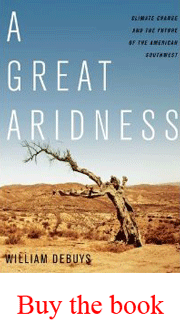
William deBuys, a TomDispatch regular, is the author of seven books, most recently A Great Aridness: Climate Change and the Future of the American Southwest (Oxford, 2011). He has long been involved in environmental affairs in the Southwest, including service as founding chairman of the Valles Caldera Trust, which administers the 87,000-acre Valles Caldera National Preserve in New Mexico. To listen to Timothy MacBain’s latest Tomcast audio interview in which deBuys discusses where heat, fire, and climate change are taking us, click here or download it to your iPod here.

Copyright 2012 William deBuys