An extremely powerful new essay from George Monbiot.
While this post from G. Monbiot is about politics, I think it goes far beyond that. Hence my reason for republishing this essay, with George Monbiot’s permission. When I will die is not known but surely I will in the next ten years or so. I really want to leave this world seeing everything improving, from the lessening of the change in our climate, to a reduction in world fighting, to a greater equality for all.
Please, please be wrong, Mr. Monbiot.
ooOOoo
The Urge to Destroy
Posted on14th April 2025
It’s a cast-iron relationship: the more unequal a society becomes, the better the far right does. Here’s why.
By George Monbiot, published in the Guardian 13th April 2025
“He’s really gone and done it this time. Now everyone can see what a disaster he is.” How many times have we heard this about Donald Trump? And how many times has it been proved wrong? Well, maybe this time he really has overstepped. After all, his clowning around with tariffs, sparking trade wars, then suddenly reversing his position, could provoke a global recession, perhaps even a depression. Surely his supporters will disown him? But I’m not banking on it, and this is why.
Already, Trump has waged war on everything that builds prosperity and wellbeing: democracy, healthy ecosystems, education, healthcare, science, the arts. Yet, amid the wreckage, and despite some slippage, his approval ratings still hold between 43 and 48%: far higher than those of many other leaders. Why? I believe part of the answer lies in a fundamental aspect of our humanity: the urge to destroy that from which you feel excluded.
This urge, I think, is crucial to understanding politics. Yet hardly anyone seems to recognise it. Hardly anyone, that is, except the far right, who see it all too well.
In the US, a high proportion of the population is excluded from many of the benefits I’ve listed. Science might lead to medical breakthroughs, but not, perhaps, for people who can’t afford health insurance. A university education might open doors, but only if you’re prepared to carry tens or hundreds of thousands of dollars of debt. Art and theatre and music improve our lives: good for those who can buy the tickets. So do national parks, but only if you can afford to visit them.
Democracy, we are told, allows people a voice in politics. But only, it seems, if they have a few million to give to a political party. As the political scientist Prof Martin Gilens notes in his book Affluence and Influence: “Under most circumstances, the preferences of the vast majority of Americans appear to have essentially no impact on which policies the government does or doesn’t adopt.” GDP growth was strong under Joe Biden, but as the economics professor Jason Furman points out: “From 2019 to 2023, inflation-adjusted household income fell, and the poverty rate rose.” GDP and social improvement are no longer connected.
All those good things? Sorry, they’re not for you. If you feel an urge to tear it all down, to burn the whole stinking, hypocritical, exclusive system to the ground, Trump is your man. Or so he claims. In reality his entire performance is both a distraction from and an accelerant of spiralling inequality. He can hardly lose: the more he exacerbates inequality, the more he triggers an urge for revenge against his scapegoats: immigrants, trans people, scientists, teachers, China.
But such killer clowns can’t pull this off by themselves. Their most effective recruiters are centrist parties paralysed in the face of economic power. In hock to rich funders, terrified of the billionaire media, for decades they have been unable even to name the problem, let alone address it. Hence the spectacular uselessness of the Democrats’ response to Trump. As the US journalist Hamilton Nolan remarks: “One party is out to kill, and the other is waiting for its leaders to die.”
In the UK, Labour, like the Democrats, has long assured itself that it doesn’t matter how wide economic disparities are, as long as the poorest are raised up. Now it has abandoned even that caveat: we can cut benefits, so long as GDP grows. But it does matter. It matters very much. A vast array of evidence, brought together in 2009 in The Spirit Level by Richard Wilkinson and Kate Pickett and updated in 2024, shows that inequality exerts a massive influence on social, economic, environmental and political outcomes, regardless of people’s absolute positions.
If there is a such a thing as Starmerism, it collapses in the face of a paper published by the political scientists Leonardo Baccini and Thomas Sattler last year, which finds that austerity increases support for the radical right in economically vulnerable regions.(My emboldening. PH) Austerity, they found, is the key variable: without it, less-educated people are no more likely to vote for rightwing demagogues than highly educated people are. In other words, Keir Starmer and Rachel Reeves are busily handing their core constituencies to Nigel Farage.
Of course, they deny they’re imposing austerity, using a technical definition that means nothing to those on the sharp end. Austerity is what the poor experience, while they must watch the rich and upper middle classes, under a Labour government, enjoy ever greater abundance.
Starmer and his minions suggest there’s nothing they can do: wealthy people are already taxed to the max. As private jets and helicopters cross the skies, anyone can see this is nonsense. Of all the remarkable things I stumbled across while researching this column, the following is perhaps the most jaw-dropping. On the most recent (2022) figures, once benefits have been paid, the Gini coefficient for gross income in the UK scarcely differs from the Gini coefficient for post-tax income. In other words, the gap between the rich and the poor is rougly the same after taxes are levied, suggesting that taxation has no further significant effect on income distribution. How could this possibly be true, when the rich pay higher rates of income tax? It’s because the poor surrender a much higher proportion of their income in sales taxes, such as VAT. So much for no further options. So much for Labour “realism”.
The one thing that can stop the rise of the far right is the one thing mainstream parties are currently not prepared to deliver: greater equality. The rich should be taxed more, and the revenue used to improve the lives of the poor. However frantically centrist parties avoid the issue, there is no other way.
George writes about Britain but my judgement is that this issue is not limited to that country; I suspect it is a far wider problem. Did you know that Finland is the world’s happiest country?
An extract of that article: “Finland has been ranked as the world’s happiest country for the eighth successive year, with experts citing access to nature and a strong welfare system as factors.
It came ahead of three other Nordic countries in this year’s UN-sponsored World Happiness Report, while Latin America’s Costa Rica and Mexico entered the top 10 for the first time.
Both the UK and the US slipped down the list to 23rd and 24th respectively – the lowest-ever position for the latter.”
But first I want to publish a comment left by me on Tuesday morning.
This is (marginally) beyond my intellect. But I understood sufficient to be amazed by the incredible facts of the vastness of space.
We live just far enough away from the nearest town so that the electric lights do not interfere with the night sky.
When we have a clear moonless night I stand on our rear deck and look up at the stars and become lost, in the sense that I do not think, in gazing and gazing and g….. and g…. and ..
The vastness of space!
Now to the article.
ooOOoo
Abstract: Modern cosmological theories of the 2010s are incredibly precise. Those Lambda Cold Dark Matter (ΛLCDM) theories have a problem: the acceleration of the expansion of the universe computed in our cosmic neighborhood disagrees with the acceleration of the expansion computed using what is viewed as the early universe. It is a question of 73 locally versus 68 early on. But these are accelerations…
Only SQPR has something deep to say about this situation, because in that theory “Dark Energy” augments with time (so the local Hubble constant should be higher than any old one…) .
***
In the first half of the 20C a number of European and US astronomers, including Hubble, a lawyer turned astronomer using the world’s most powerful telescope (in California), established that the universe was expanding. Isolated galaxies, and giant clusters of galaxies, were observed to separate from each other. When Hubble announced the expansion (which had been guessed by some of his European colleagues), he got a number that was so high that the universe was younger than the Sun. That was corrected by Baade, a German astronomer.
***
DARK MATTER:
Meanwhile, in 1933 Fritz Zwicky, a Swiss at Caltech, studying the giant Coma cluster of more than 1,000 galaxies, saw that they were moving too fast for the observed mass, and announced Dunkle Materie, Dark Matter. Nobody liked that, and ignoring it was facilitated by what was viewed as Zwicky’s insufferable, eccentric personality (as all people of exceptional intellect). Fritz also coined the term “supernova” while fostering the concept of neutron stars.(Zwicky also pushed for “Tired Light” theory (which SQPR predicts)… what was viewed as a major irritant by the Big Bangists…)
A generation later, Vera Rubin, an astronomer at Carnegie, confirmed after studying 60 galaxies and Andromeda with a state of the art spectrometer, that, well, the galaxies rotated too much like plates (and not just like vortices)… confirming Zwicky’s Dark Matter. She was not ignored, although a woman and a mother to boot. A major observatory coming on line at high altitude in the Atacama desert bears her name. It’s not called the Zwicky. Maybe Zwicky should have claimed to be a woman?
***
DARK ENERGY:
Dark Energy is the name given to whatever is causing the accelerating expansion of the universe. Here’s a quick presentation of what We (Sort of) Know:
In the late 1990s, astronomers studying distant supernovae discovered that the universe’s expansion is speeding up, not slowing down. This was unexpected—gravity, a constant force towards the center of mass (whatever that is!) should be pulling everything together, slowing the expansion down. Something must be pushing it apart (another explanation -not usually considered- would be that gravity weakens over ultra-cosmological distances… as SQPR would have it).
That “something” supposedly pushing galactic clusters apart, is what we call Dark Energy. It’s not directly observed, but, like many things in science, inferred from its effects. How Much of the Universe Is It?
According to the reigning current models (like Lambda-CDM), the universe is roughly: 68% dark energy, 27% dark matter… and 5% regular matter (you, me, stars, planets, etc.)
***
What Might Dark Energy Be? There are a few theoriescharacterized by a parcimony of imagination:
Cosmological Constant (Λ) – Einstein originally added this to his equations of general relativity. It represents a constant energy density filling space uniformly. Einstein put it in to prevent the equation representing gravitation in the universe to collapse the universe gravitationally. As a prima donna, he later claimed that to be his “greatest mistake”, as otherwise he, Einstein The Great Again, would have “predicted” the expansion of the universe. In any case, the Cosmological Constant (Λ) explains nothing, it’s just a description of behavior (but supposes a few things one may be able to contradict)..
Quintessence – Turning the constant Λ into a dynamic field, evolving over space and time.
Modified Gravity – Maybe gravity doesn’t work quite the way we think on cosmic scales, and we don’t need a “dark energy” at all. The problem is that the “official” MONDs (MOdified Newtonian Dynamics) were devised to explain Dark Matter in galaxies… But they failed.
***
The only proposed theory that is not just a description of behavior, is SQPR, Sub Quantic, Physical Reality.y Is Dark Energy So Weird:
The energy density of dark energy stays constant (or nearly so), even as the universe expands.
This means more space = more dark energy, which further accelerates expansion.
In SQPR this is directly explained by the weakening of gravity as the carrier bosons are ripped apart…Because the Quantum Interaction is not of infinite range…
***
73 – 68 = 5… 5 km/s per Megaparsec…Let’s meditate on this. Over a billion years, if we have two objects the distance of which augments at 15,000 km/s. It turns out that affects severely the famed high precision of the age of the universe… which I always took with a bucket of salt…
A higher Hubble constant affects key cosmic stats — assuming a flat universe with ΛCDM (standard model). These numbers are approximate and based on best-fit ΛCDM calculations — exact values depend on details like matter/dark energy density. The difference might not seem huge in light-years, but in cosmology, even a 5% shift is massive — it changes how we model the early universe, galaxy formation, and fundamental physics.
Hubble Constant (H₀) 67 km/s/Mpc (Planck satellite): Age of Universe ~13.8 billion years; Radius of Observable Universe ~46.5 billion light-years; Diameter ~93 BLY
At the higher 73 km/s/Mpc ( from Local data), the age of the universe is only ~13.0 billion years, the observable radius ~43.8 billion light-years, its diameter, ~87.6 BLY
***
Astronomy has long led towards new physics. F = ma, the crucial “2nd law” of mechanics was discovered by Buridan, circa 1340 CE, by mentally exploring what happened to a falling body (I read Buridan directly and made that conclusion myself). Then Buridan suggested that his first law (no force, no change of impetus; implicitly considers them to be vectors) implied that planets would keep rotating indefinitely… Then of course there was the synthesis in the 17C from Kepler to Newton… Observing the satellites of Jupiter and their twenty minute delay when they are the furthest from Earth, gave the speed of light..
Supposing that the Quantum Interaction which teleports quantum states does so at finite speed, gives Dark Matter and Dark Energy….
Is a very simple modification… but quite at odds from the way physicists learn Quantum Physics.
Anyway, the mildly called “Hubble Tension” is turning into the “Hubble Crisis”. Good, With enough crises, we may get somewhere…
Patrice Ayme
Please contemplate below with what the scandal started, the Coma Cluster of 1,000+ galaxies… Zwicky computed that the visible mass would have to be multiplied by 400 to hold the cluster together…
This article was published in The Conversation last Thursday, the 6th March, 2025.
Where we live in rural Southern Oregon is glorious and photos of our locale have been published before. However, I wanted to share this article with you all.
ooOOoo
Butterflies declined by 22% in just 2 decades across the US – there are ways you can help save them
We found declines in just about every region of the continental U.S. and across almost all butterfly species.
Overall, nearly one-third of the 342 butterfly species we were able to study declined by more than half. Twenty-two species fell by more than 90%. Only nine actually increased in numbers.
West Coast lady butterflies range across the western U.S., but their numbers have dropped by 80% in two decades. Renee Las Vegas/Wikimedia Commons, CC BY
Some species’ numbers are dropping faster than others. The West Coast lady, a fairly widespread species across the western U.S., dropped by 80% in 20 years. Given everything we know about its biology, it should be doing fine – it has a wide range and feeds on a variety of plants. Yet, its numbers are absolutely tanking across its range.
Why care about butterflies?
Butterflies are beautiful. They inspire people, from art to literature and poetry. They deserve to exist simply for the sake of existing. They are also important for ecosystem function.
Butterflies are pollinators, picking up pollen on their legs and bodies as they feed on nectar from one flower and carrying it to the next. In their caterpillar stage, they also play an important role as herbivores, keeping plant growth in check.
A pipevine swallowtail caterpillar munches on leaves at Brookside Gardens in Wheaton, Md. Herbivores help keep plant growth in check. Judy Gallagher/Wikimedia Commons, CC BY
Butterflies can also serve as an indicator species that can warn of threats and trends in other insects. Because humans are fond of butterflies, it’s easy to get volunteers to participate in surveys to count them.
The annual North American Butterfly Association Fourth of July Count is an example and one we used in the analysis. The same kind of nationwide monitoring by amateur naturalists doesn’t exist for less charismatic insects such as walking sticks.
What’s causing butterflies to decline?
Butterfly populations can decline for a number of reasons. Habitat loss, insecticides, rising temperatures and drying landscapes can all harm these fragile insects.
A study published in 2024 found that a change in insecticide use was a major factor in driving butterfly declines in the Midwest over 17 years. The authors, many of whom were also part of the current study, noted that the drop coincided with a shift to using seeds with prophylactic insecticides, rather than only spraying crops after an infestation.
The Southwest saw the greatest drops in butterfly abundance of any region. As that region heats up and dries out, the changing climate may be driving some of the butterfly decline there. Butterflies have a high surface-to-volume ratio – they don’t hold much moisture – so they can easily become desiccated in dry conditions. Drought can also harm the plants that butterflies rely on.
Only the Pacific Northwest didn’t lose butterfly population on average. This trend was largely driven by an irruptive species, meaning one with extremely high abundance in some years – the California tortoiseshell. When this species was excluded from the analyses, trends in the Pacific Northwest were similar to other regions.
The California tortoiseshell butterfly can look like wood when its wings are closed, but they’re a soft orange on the other side. Walter Siegmund/Wikimedia Commons, CC BY-SA
When we looked at each species by its historical range, we found something else interesting.
Many species suffered their highest losses at the southern ends of their ranges, while the northern losses generally weren’t as severe. While we could not link drivers to trends directly, the reason for this pattern might involve climate change, or greater exposure to agriculture with insecticides in southern areas, or it may be a combination of many stressors.
There is hope for populations to recover
Some butterfly species can have multiple generations per year, and depending on the environmental conditions, the number of generations can vary between years.
This gives me a bit of hope when it comes to butterfly conservation. Because they have such short generation times, even small conservation steps can make a big difference and we can see populations bounce back.
The Karner blue is an example. It’s a small, endangered butterfly that depends on oak savannas and pine barren ecosystems. These habitats are uncommon and require management, especially prescribed burning, to maintain. With restoration efforts, one Karner blue population in the Albany Pine Bush Preserve in New York rebounded from a few hundred individuals in the early 1990s to thousands of butterflies.
Similar management and restoration efforts could help other rare and declining butterflies to recover.
What you can do to help butterflies recover
The magnitude and rate of biodiversity loss in the world right now can make one feel helpless. But while national and international efforts are needed to address the crisis, you can also take small actions that can have quick benefits, starting in your own backyard.
Butterflies love wildflowers, and planting native wildflowers can benefit many butterfly species. The Xerces Society for Invertebrate Conservation has guides recommending which native species are best to plant in which parts of the country. Letting grass grow can help, even if it’s just a strip of grass and wildflowers a couple of feet wide at the back of the yard.
A patch of wildflowers and grasses can become a butterfly garden, like this one in Townsend, Tenn. Chris Light, CC BY-SA
Supporting policies that benefit conservation can also help. In some states, insects aren’t considered wildlife, so state wildlife agencies have their hands tied when it comes to working on butterfly conservation. But those laws could be changed.
The federal Endangered Species Act can also help. The law mandates that the government maintain habitat for listed species. The U.S. Fish and Wildlife Service in December 2024 recommended listing the monarch butterfly as a threatened species. With the new study, we now have population trends for more than half of all U.S. butterfly species, including many that likely should be considered for listing.
With so many species needing help, it can be difficult to know where to start. But the new data can help concentrate conservation efforts on those species at the highest risk.
I believe this study should be a wake-up call about the need to better protect butterflies and other insects – “the little things that run the world.”
This is a long and comprehensive guest post from Michael Kempkes.
ooOOoo
5 Best German Shepherd Dog Breeders in California.
If you are looking for the highest-quality German Shepherd in California, you must choose the right breeder first and this selection will make all the difference. A well-bred German Shepherd is a loyal companion, a skilled working dog, and a trusted member of your family, so the right choice is extremely important. But with so many options available, how to pick a reputable breeder? In this post, we have compiled a list of the top 5 German Shepherd breeders in California for 2025. These breeders are known for their commitment to health, temperament, and ethical breeding practices and for producing strong, well-balanced dogs with excellent genetics. All these breeders provide German shepherds for different purposes whether you are looking for a family protector, a sports dog, or a working-line GSD.
So, let’s just find out the best places to get a well-bred German Shepherd in California.
1. Kempkes Executive K9s (Agua Dulce, CA)
Rating: ⭐⭐⭐⭐⭐
Location: 9450 Yucca Hills Rd, Agua Dulce, CA 91390
Specialization: Elite German & European Bloodline GSD
Certifications: SV, FCI, VA, Schutzhund/IPO Titled German Shepherd Dogs
Kempkes Executive K9s has over 30 years of experience in breeding top-quality German Shepherds. They focus on elite German and European bloodlines, their expertise makes them one of the best breeders in the world. You can trust their dogs to have exceptional traits and strong lineage. They provide top-tier, fully trained imported GSDs from the finest bloodlines perfect as protection dogs and family companions. They put health first, train with care, and build strong temperaments for 100% customer satisfaction. This commitment to quality sets them apart as a top breeder in California. A name you can trust for well-bred, highly trained dogs. They have years of experience working with all types of German bloodline dogs. This includes Malinois, West German Showline German Shepherds, Working Line German Shepherds, Rottweilers, Doberman Pinschers, and Schnauzers. Their team is skilled in handling these dogs, making sure they receive the best training.
What Makes Kempkes Executive K9s Stand Out?
Kempkes Executive K9s is renowned for producing elite German Shepherds with exceptional quality and temperament.
Each puppy and dog is carefully selected from the top European bloodline to ensure superior genetics and health.
Their German Shepherds undergo three levels of protection training, including guarding, bomb detection, and search and rescue, providing unmatched security.
They deliver advanced personalized training program packages to satisfy the personal needs of each family or individual.
All dogs are free from genetic health issues, ensuring a long and healthy life for your companion.
Their trainers have a deep understanding of German Shepherds’ behavior. They know the behavioral patterns and instincts of dogs. Using this knowledge, they apply proven training techniques to develop effective obedience and confidence in GSDs.
Their training programs help improve communication and build trust. Both the dog and owner will feel safe and supported during the entire training.
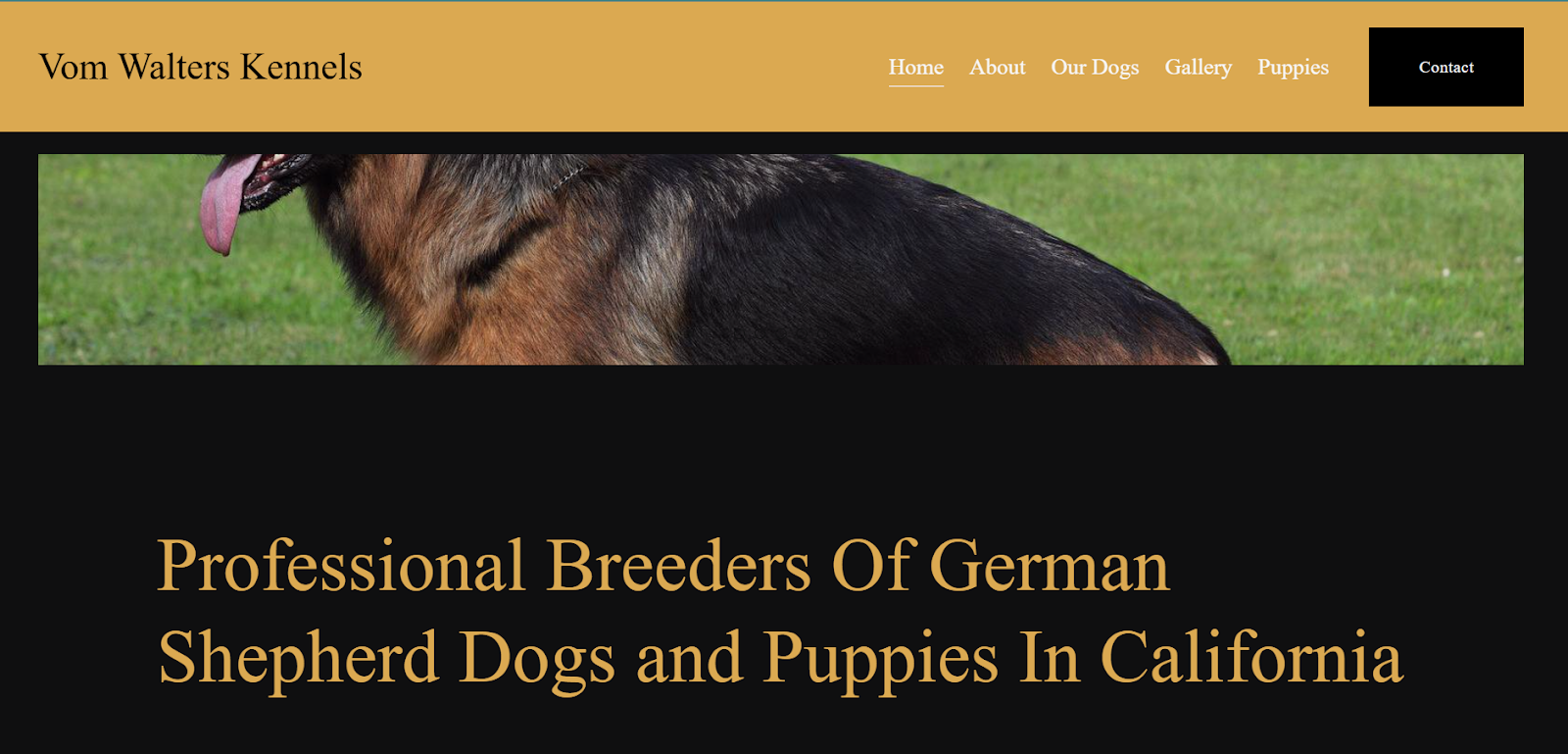
2. Vom Walters Kennels (Pilot Hill, CA)
Rating: ⭐⭐⭐⭐⭐
Location: 5580 Salmon Falls Rd, Pilot Hill, CA 95664, United States
Specialization: Finest German VA, V, & Schutzhund imported lines.
Certifications: AKC-registered & OFA-certified
Vom Walters Kennels breeds top-quality German Shepherds. They focus on the best German VA, V, and Schutzhund bloodlines. Years of experience help them raise dogs with great temperaments and strong abilities. Passion and commitment set them apart. First-time owners and experienced handlers will find the right match here. Their dogs come with expert care and full support. You also get a pet free from hip and elbow dysplasia.
What Makes Vom Walters Kennels Stand Out?
Vom Walters Kennels breeds come from elite bloodlines. These lines have strong genetics, high intelligence, and excellent working skills.
Every dog at Vom Walters Kennels goes through strict health tests and gets OFA certification. They are checked for hip and elbow issues to make sure they are free from dysplasia. This focus on health gives buyers confidence. They can trust their dog will live a long and healthy life.
Vom Walters Kennels has dogs grow up in a caring environment and adjust well to different roles. They make great family pets, work with law enforcement, and excel in sports.
Vom Walters Kennels goes the extra mile to support their clients for life. They help you choose the right puppy, offer training advice, and continue to assist you throughout your journey together. Their dedication to your success goes beyond just getting a dog. You’ll always have the guidance and resources needed to build a strong bond with your pet.
Vom Walters Kennels values quality above all. The health and happiness of their dogs come first. Their breeding program focuses on strong health, good temperament, and following breed standards. Each puppy is carefully bred to represent the true German Shepherd breed.
3. Lundborg-Land (Southern CA)
Rating: ⭐⭐⭐⭐⭐
Location: 15110 Harness Hill Drive Perris, California 92570
Specialization: Show and Work quality dogs & puppies
Certifications: AKC, SV, Schutzhund titled, Hip Certified Dogs
Lundborg-Land is a distinguished breeder located in Southern California, specializing in show and work-quality German Shepherds. With a focus on breeding the German “SV” way, they produce dogs with exceptional temperament, intelligence, and physical structure. They raise puppies and adult dogs in an affectionate environment, which helps them grow confident, friendly, and ready for different roles. Some become loving family pets, while others shine in shows or as working dogs. Lundborg-Land focuses on top health and quality, that’s why German Shepherd lovers trust them.
What Makes Lundborg-Land Stand Out?
Lundborg-Land carefully selects their breed for their conformation, intelligence, and drive, making them versatile companions for families, competitors, and working professionals.
All dogs at Lundborg-Land are bred for the highest quality and good temperament. They are hip-certified and come from Schutzhund-titled, health-certified parents. This ensures they are free from genetic health issues and have stable, confident personalities.
Lundborg-Land breeds German Shepherds with excellence and maintains heritage. They stick to the highest standards set by the German Shepherd Club (SV).
They train puppies well, each one learns obedience training and becomes a well-mannered and well-adjusted adult.
Lundborg-Land offers dog boarding for your convenience, as well as new crates tailored to your dog’s size. They also assist with airplane flight costs, making it easier for out-of-state clients to bring home their new companions.
4. Mountain Valley K9 (Lindsay, CA)
Rating: ⭐⭐⭐⭐⭐
Location: 2500 Ave 220, Lindsay, CA 93247, US
Specialization: Working Line German Shepherd breeding
Certifications: AKC Registration, Hip & Elbow OFA, Schutzhund-titled dogs
Mountain Valley K9, based in Lindsay, California, breeds working-line German Shepherds. They focus on dogs that are smart, strong, and full of energy. These dogs are trained for jobs like family protection and sports. The puppies are raised in a loving home, helping them grow confident and social. The breeder cares about their dogs’ health, temperament, and abilities, making them a top choice for those looking for working dogs.
What Makes Mountain Valley K9 Stand Out?
Mountain Valley K9 specializes in breeding German Shepherds, these dogs are known for their strong instincts and quick learning abilities. They excel in protection, search and rescue, and even sports with smooth and efficient training programs.
The breeding program pays close attention to structure, movement, and coat quality. This way, the dogs are not only capable but also look great.
Each puppy is checked by a vet, vaccinated, dewormed, and given plenty of love and care. This ensures they are healthy and ready for their new home.
Socialization starts early, with puppies being exposed to different sounds and sights. This helps them grow into confident, well-adjusted dogs.
Mountain Valley K9 stands behind their puppies. They offer a 100% satisfaction guarantee and provide ongoing support to make sure your dog thrives in your home.
5. Royal Tribes K9 (Beverly Hills, CA)
Rating: ⭐⭐⭐⭐⭐
Location: 113 North San Vicente Blvd. Suite 348, Beverly Hills, CA 90211
Specialization: Black and Long Hair German Shepherd
Certifications: Health Guarantee Certificate
Royal Tribes K9 is a luxury breeder based in Beverly Hills. They specialize in rare black and long-haired German Shepherds, these dogs are known for their beauty and wonderful temperaments. The puppies are bred to meet high standards of health, intelligence, and appearance. Royal Tribes K9 aims to provide top-tier companions for clients who want only the best. Each puppy is raised with great care, they are not only stunning to look at but also well-socialized. These dogs are ready to become a beloved member of your family.
What Makes Royal Tribes K9 Stand Out?
Royal Tribes K9 specializes in rare black, long-haired German Shepherds. These dogs offer a luxurious choice for anyone looking for a unique companion.
Each puppy undergoes thorough health checks to ensure they are in top condition, giving you confidence in their well-being.
The puppies are kept up-to-date on vaccinations and follow a strict care routine. This helps lay the foundation for a healthy, happy life.
If your puppy develops a hereditary genetic issue within five years, Royal Tribes K9 will replace it with a puppy of equal value. This shows their dedication to customer satisfaction.
To help your puppy stay healthy, they provide detailed food and supplement plans. These plans ensure your dog thrives in its new home.
What to Look for in a German Shepherd Breeder
You need to choose the right German Shepherd breeder to bring home a healthy, well-behaved dog. This decision is crucial. Here are four important things to consider when picking a breeder:
1. Health Screenings & Genetic Testing
An authentic breeder would really keep dogs in good health. Health screenings and genetic testing done on the dog would fetch out any potential problems. German Shepherds can have problems like hip dysplasia, elbow dysplasia, and degenerative myelopathy, and ask the breeder for health clearances for the parents. This includes hip and elbow clearances from OFA (Orthopedic Foundation for Animals). They should also test for degenerative myelopathy and other issues. Healthy puppies come from healthy parents, so make sure to ask for this information.
2. Ethical Breeding Practices & Socialization
Ethical breeding and proper socialization are key to raising German Shepherd dogs. These practices help make sure the dogs grow up healthy and well-balanced. They also build confidence and make them better suited for life with families. A responsible breeder follows ethical practices to raise puppies in a clean and smooth environment. Socializing puppies is also key, early exposure to various sights, sounds, and experiences helps build their confidence. It’s important to ask the breeder about:
How do they socialize their puppies?
Do they introduce the pups to different people, places, and new things?
This early interaction helps them become well-adjusted adults later on.
3. Registration & Pedigree Verification
A reliable breeder will give you registration papers and pedigree details for their puppies. This shows the dog comes from a proven lineage and follows breed standards. Choose breeders who register their dogs with trusted groups like the:
American Kennel Club (AKC)
Verein fur Deutsche Schaferhunde (SV)
Federation Cynologique Internationale (FCI)
the German Shepherd Dog Club of America (GSDCA)
Pedigree details also show the dog’s family history. You can see if its parents or grandparents earned titles or awards. This can help you gauge the dog’s quality and temperament.
4. Customer Reviews and Breeder Transparency
Customer reviews and breeder transparency are key signs of a breeder’s trustworthiness. Check for feedback from past clients. Feel free to ask for references, a reliable breeder will answer all your questions openly. They’ll also let you visit their facility to meet the puppies and their parents. Trustworthy breeders are clear about their practices. Avoid breeders who seem secretive or refuse to share details about their breeding process.
The Bottom Line
The breeders listed here are known for their priority on health, ethical breeding, and expert training. If you need a working-line GSD, a show-quality champion, or a loyal family protector, these breeders deliver top-quality dogs with strong genetics and great temperaments.
You should first visit the breeder to inquire about the breeding standards, health, and many other aspects. The health certifications are of great importance to ensure the dog’s health. A well-bred German Shepherd is a long-term investment that will bring years of loyalty, protection, and companionship. The right breeder will help you find a dog that fits your home and lifestyle.
ooOOoo
The Author’s Bio.
Michael Kempkes grew up in Borken, Germany, and discovered his passion for German Shepherds at the age of nine. Over the years, he has gained deep experience in training, titling, and showing these incredible dogs. Michael has worked with the German Military, training dogs for Personal Protection, Guard duty, bomb detection, and search and rescue. He has earned his official certifications through one of the top schools in the world for K9 training in Koblenz, Germany.
My thanks to Michael.
This was a great guest post. Very informative and very useful information.
Finally, it is shame that all dogs do not live long enough, especially the German Shepherd!
The information about this episode is published below.
Ella Al-Shamahi asks why do we love dogs? Dogs evolved from wolves but why did they choose us humans to be their best friends? They say dogs are a man’s best friend but all dogs, even chihuahuas are descended from wolves, the grey wolf, a majestic, fierce and incredibly dangerous species. How did this happen but more importantly, why did we start trusting wolves? And when did wolves turn into dogs? Dogs have been a part of our story for a long time. They are depicted in cave and rock art and dogs are a part of our story because of how useful they are. From the mundane everyday hunting and guarding to the epic stories of life saving dogs . But how did we get here? Oxford Professor Greger Lawson studies ancient dog DNA and thinks the evolution from wolves into dogs began when we both realised we could help each other.
Early on last Wednesday, February 26th, the BBC Radio 4 programme World at One, had a major item on scamming. Here are the details of that programme:
Released On: 26 Feb 2025
Back in September we revealed the knitted cardigan scam. Millions have been taken in by social media ads of expensive looking knitwear for a reasonable price. Victims hear nothing until something cheap and nasty arrives in the post months later. But it’s more than a simple con. Shari Vahl reveals what its really about. Sales of stout show no sign of stopping as more young women are turning to it. Guinness blames increased demand with supply chain issues for a recent shortage. Its rivals in the dark beer world are jumping on the opportunity with some success. Will it work? Finally, a listener tells us how his energy company gave his mobile number to a criminal who went on to steal £40,000. We find out how you can prevent this happening to you. Presenter: Shari Vahl Producer: Kevin Mousle.
Then later on that morning, I watched the video below, produced by the American Social Administration
Then there was this list of scams and frauds produced by the USA Government
Jeannie and I are at opposite ends of the scale, so to speak. The older I get the more I want everything in the same place, primarily because I cannot remember where I previously put something.
Jeannie loves putting stuff anywhere because she can recall where it is!
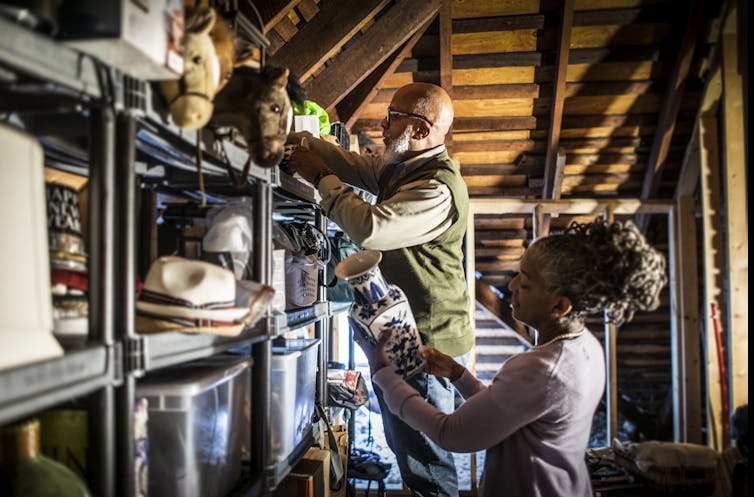
I recently helped my mom sort through boxes she inherited when my grandparents passed away. One box was labeled – either ironically or genuinely – “toothpick holders and other treasures.” Inside were many keepsakes from moments now lost to history – although we found no toothpick holders.
My favorite of the items we sorted through was a solitary puzzle piece, an artifact reflecting my late grandmother’s penchant for hiding the final piece to a jigsaw puzzle just to swoop in at the last moment and finish it.
After several hours of reminiscing, my mom and I threw away 90% of what we had sorted.
“Why did I keep this?” is a question I hear frequently, both from my family and friends and from patients. I am a licensed clinical psychologist whose research focuses on the characterization, assessment and treatment of hoarding disorder, particularly for adults 60 years of age or older. As such, I spend a great deal of my time thinking about this question.
What drives the need to keep stuff?
Hoarding disorder is a psychiatric condition defined by urges to save items and difficulty discarding current possessions. For adults with “clinically severe” hoarding disorder, this leads to a level of household clutter that impairs daily functioning and can even create a fire hazard. In my professional experience, however, many adults struggle with clutter even if they do not meet the clinical criteria for hoarding disorder.
When I was a graduate student, I conducted a study in which we asked adults with hoarding disorder to spend 15 minutes making decisions about whether to keep or discard various items brought from their home. Participants could sort whatever items they wanted. Most chose to sort paper items such as old mail, cards or notes.
We found that age was associated with lower levels of distress during the task, such that participants who were older tended to feel less stressed when making the decision about what to keep and what to discard. We also found that many participants, particularly those who were older, actually reported positive emotions while sorting their items.
In new research publishing soon, my current team replicated this finding using a home-based version of the task. This suggests that fear of making the wrong decision isn’t a universal driver of our urge to save items.
In fact, a study my team published in August 2024 with adults over 50 with hoarding disorder suggests that altruism, a personality trait of wanting to help others, may explain why some people keep items that others might discard. My colleagues and I compared our participants’ personality profiles with that of adults in the general population of the same gender and age group. Compared with the general population, participants with hoarding disorder scored almost universally high on altruism.
Altruism also comes up frequently in my clinical work with older adults who struggle with clutter. People in our studies often tell me that they have held onto something out of a sense of responsibility, either for the item itself or to the environment.
“I need it to go to a good home” and “my grandmother gave this to me” are sentiments we commonly hear. Thus, people may keep things not out of fear of losing them but because saving them is consistent with their values. https://www.youtube.com/embed/JNVjPM1cIbg?wmode=transparent&start=0 Your values can help guide which possessions should stay in your life and which ones should go.
Leaning into values
In a 2024 study, my team demonstrated that taking a values-based approach to decluttering helps older adults to decrease household clutter and increases their positive affect, a state of mind characterized by feelings such as joy and contentment. Clinicians visited the homes of older adults with hoarding disorder for one hour per week for six weeks. At each visit, the clinicians used a technique called motivational interviewing to help participants talk through their decisions while they sorted household clutter.
We found that having participants start with identifying their values allowed them to maintain focus on their long-term goals. Too often, people focus on the immediate ability of an object to “spark joy” and forget to consider whether an object has greater meaning and purpose. Values are the abstract beliefs that we humans use to create our goals. Values are whatever drives us and can include family, faith or frivolity.
Because values are subjective, what people identify as important to keep is also subjective. For example, the dress I wore to my sister’s wedding reminded me of a wonderful day. However, when it no longer fit I gave it away because doing so was more consistent with my values of utility and helpfulness: I wanted the dress to go to someone who needed it and would use it. Someone who more strongly valued family and beauty might have prioritized keeping the dress because of the aesthetics and its link to a family event.
Additionally, we found that instead of challenging the reasons a person might have for keeping an item, it is helpful to instead focus on eliciting their reasons for discarding it and the goals they have for their home and their life.
Start with writing out your values. Every object in your home should feel value-consistent for you. For example, if tradition and faith are important values for you, you might be more inclined to hold onto a cookbook that was made by the elders at your church and more able to let go of a cookbook you picked up on a whim at a bookstore.
If, instead, health and creativity are your core values, it might be more important to hold onto a cookbook of novel ways to sneak more vegetables into your diet.
Defining value-consistent goals for using your space can help to maintain motivation as you declutter. Are you clearing off your desk so you can work more efficiently? Making space on kitchen counters to bake cookies with your grandchildren?
Remember that sometimes your values will conflict. At those moments, it may help to reflect on whether keeping or discarding an object will bring you closer to your goals for the space.
Similarly, remember that values are subjective. If you are helping a loved one declutter, maintain a curious, nonjudgmental attitude. Where you might see a box filled with junk, your grandmother might see something filled with “toothpick holders and other treasures.”
Prof. Mary Dozier makes some powerful, and cogent, statements in this article. Especially that one’s values are subjective. Nevertheless, I think I should write out my values and see what they tell me.
All known human languages display a surprising pattern: the most frequent word in a language is twice as frequent as the second most frequent, three times as frequent as the third, and so on. This is known as Zipf’s law.
Researchers have hunted for evidence of this pattern in communication among other species, but until now no other examples have been found.
In new research published today in Science, our team of experts in whale song, linguistics and developmental psychology analysed eight years’ of song recordings from humpback whales in New Caledonia. Led by Inbal Arnon from the Hebrew University, Ellen Garland from the University of St Andrews, and Simon Kirby from the University of Edinburgh, We used techniques inspired by the way human infants learn language to analyse humpback whale song.
We discovered that the same Zipfian pattern universally found across human languages also occurs in whale song. This complex signalling system, like human language, is culturally learned by each individual from others.
Learning like an infant
When infant humans are learning, they have to somehow discover where words start and end. Speech is continuous and does not come with gaps between words that they can use. So how do they break into language?
Thirty years of research has revealed that they do this by listening for sounds that are surprising in context: sounds within words are relatively predictable, but between words are relatively unpredictable. We analysed the whale song data using the same procedure.
A breaching humpback whale in New Caledonia. Operation Cetaces
Unexpectedly, using this technique revealed in whale song the same statistical properties that are found in all languages. It turns out both human language and whale song have statistically coherent parts.
In other words, they both contain recurring parts where the transitions between elements are more predictable within the part. Moreover, these recurring sub-sequences we detected follow the Zipfian frequency distribution found across all human languages, and not found before in other species.
Whale song recording (2017) Operation Cetaces 916 KB (download)
Close analysis of whale song revealed statistical structures similar to those found in human language. Operation Cetaces
How do the same statistical properties arise in two evolutionarily distant species that differ from one another in so many ways? We suggest we found these similarities because humans and whales share a learning mechanism: culture.
A cultural origin
Our findings raise an exciting question: why would such different systems in such incredibly distant species have common structures? We suggest the reason behind this is that both are culturally learned.
Cultural evolution inevitably leads to the emergence of properties that make learning easier. If a system is hard to learn, it will not survive to the next generation of learners.
There is growing evidence from experiments with humans that having statistically coherent parts, and having them follow a Zipfian distribution, makes learning easier. This suggests that learning and transmission play an important role in how these properties emerged in both human language and whale song.
So can we talk to whales now?
Finding parallel structures between whale song and human language may also lead to another question: can we talk to whales now? The short answer is no, not at all.
Our study does not examine the meaning behind whale song sequences. We have no idea what these segments might mean to the whales, if they mean anything at all.
A competitive pod of humpback whales on the New Caledonian breeding grounds. Operation Cetaces
It might help to think about it like instrumental music, as music also contains similar structures. A melody can be learned, repeated, and spread – but that doesn’t give meaning to the musical notes in the same way that individual words have meaning.
Next up: birdsong
Our work also makes a bold prediction: we should find this Zipfian distribution wherever complex communication is transmitted culturally. Humans and whales are not the only species that do this.
We find what is known as “vocal production learning” in an unusual range of species across the animal kingdom. Song birds in particular may provide the best place to look as many bird species culturally learn their songs, and unlike in whales, we know a lot about precisely how birds learn song.
Equally, we expect not to find these statistical properties in the communication of species that don’t transmit complex communication by learning. This will help to reveal whether cultural evolution is the common driver of these properties between humans and whales.
The research scientists have led to a prediction: … we should find this Zipfian distribution wherever complex communication is transmitted culturally. Humans and whales are not the only species that do this.
Since then, information overload continues unabated, and many people are rightfully confused by an onslaught of conflicting health information. Even expert advice is often contradictory.
On top of that, people sometimes deliberately distort research findings to promote a certain agenda. For example, trisodium phosphate is a common food additive in cakes and cookies that is used to improve texture and prevent spoilage, but wellness influencers exploit the fact that a similarly named substance is used in paint and cleaning products to suggest it’s dangerous to your health.
Such claims can proliferate quickly, creating widespread misconceptions and undermining trust in legitimate scientific research and medical advice. Social media’s rise as a news and information source further fuels the spread of pseudoscientific views.
Misinformation is rampant in the realm of health and nutrition. Findings from nutrition research is rarely clear-cut because diet is just one of many behaviors and lifestyle factors affecting health, but the simplicity of using food and supplements as a cure-all is especially seductive.
I am an assistant professor specializing in medical education and science communication. I also train scientists and future health care professionals how to communicate their science to the general public.
In my view, countering the voices of social media influencers and health activists promoting pseudoscientific health claims requires leaning into the science of disease prevention. Extensive research has produced a body of evidence-based practices and public health measures that have consistently been shown to improve the health of millions of people around the world. Evaluating popular health claims against the yardstick of this work can help distinguish which ones are based on sound science.
To parse pseudoscientific claims from sound advice about health and nutrition, it’s crucial to evaluate the information’s source. tadamichi/Getty Images
Navigating the terrain of tangled information
Conflicting information can be found on just about everything we eat and drink.
That’s because a food or beverage is rarely just good or bad. Instead, its health effects can depend on everything from the quantity a person consumes to their genetic makeup. Hundreds of scientific studies describe coffee’s health benefits and, on the flip side, its health risks. A bird’s-eye view can point in one direction or another, but news articles and social media posts often make claims based on a single study.
Things can get even more confusing with dietary supplements because people who promote them often make big claims about their health benefits. Take apple cider vinegar, for example – or ACV, if you’re in the know.
Apple cider vinegar has been touted as an all-natural remedy for a variety of ailments, including digestive issues, urinary health and weight management. Indeed, some studies have shown that it might help lower cholesterol, in addition to having other health benefits, but overall those studies have small sample sizes and are inconclusive.
Advocates of this substance often claim that one particular component of it – the cloudy sediment at the bottom of the bottle termed “the mother” – is especially beneficial because of the bacteria and yeast it contains. But there is no research that backs the claim that it offers any health benefits.
It’s also important to keep in mind that the global dietary supplements industry is worth more than US$150 billion per year, so companies – and wellness influencers – selling supplements have a financial stake in convincing the public of their value.
Misinformation about nutrition is nothing new, but that doesn’t make it any less confusing.
How nutrition science gets twisted
There’s no doubt that good nutrition is fundamental for your health. Studies consistently show that a balanced diet containing a variety of essential nutrients can help prevent chronic diseases and promote overall well-being.
However, pseudoscientific claims often twist such basic facts to promote the idea that specific diets or supplements can prevent or treat illness. For example, vitamin C is known to play a role in supporting the immune system and can help reduce the duration and severity of colds.
Some companies overstate the benefits while underplaying the hazards.
For example, wellness influencers have promoted raw milk over pasteurized milk as a more natural and nutritious choice, but consuming it is risky. Unpasteurized milk can contain harmful bacteria that leads to gastrointestinal illness and, in some cases, much more serious and potentially life-threatening diseases such as avian influenza, or bird flu.
The lure of dietary myths has led people with cancer to replace proven science-backed treatments, such as chemotherapy or radiation, with unproven and misleading nutrition programs.
How to spot less-than-solid science
Pseudoscience exploits your insecurities and emotions, taking advantage of your desire to live the healthiest life possible.
While the world around you may be uncertain and out of your control, you want to believe that at the very least, you have control over your own health. This is where the wellness industry steps in.
What makes pseudoscientific claims so confusing is that they use just enough scientific jargon to sound believable. Supplements or powders that claim to “boost immunity” often list ingredients such as adaptogens and superfoods. While these words sound real and convincing, they actually don’t mean anything in science. They are terms created by the wellness industry to sell products.
I’ve researched and written about reliable ways to distinguish science facts from false health claims. To stay alert and find credible information, I’d suggest you follow a few key steps.
First, check your emotions – strong emotional reactions, such as fear and anger, can be a red flag.
Next, check that the author has experience or expertise in the field of the topic. If they’re not an expert, they might not know what they are talking about. It’s always a good idea to make sure the source is reputable – ask yourself, would this source be trusted by scientists?
Finally, search for references that back up the information. If very little or nothing else exists in the science world to back up the claims, you may want to put your trust in a different source.
Following these steps will separate the facts from fake news and empower you to make evidence-based decisions.











 Learning from Dogs
.jpg)

