Category: Education

The ways our dogs speak to the world.

Dogs are very vocal creatures.

Anyone who has been close to dogs in their lives knows that they are frequently very vocal creatures. Likewise, anyone who has been close to a dog or two quickly learns to understand the basic emotions being conveyed by a dog’s vocal sounds.

But, nonethless, there was an item over on the Care2.com site recently that provided a comprehensive tutorial on listening and interpreting the sounds from our dogs. I wanted to share it with you today.

ooOOoo

How to Interpret Your Dog’s Growls

1387750.large By: Vetstreet.com August 3, 2016

Freedom with a capital ‘F’.

Sometimes the most obvious solutions take the longest to find.

I feel a little embarrassed that this introduction may come across as rather self-indulgent; I don’t intend that.

My purpose is to offer an introduction to a recent blogpost from Sue Dreamwalker that explains why her post really ‘spoke’ to me and why it felt important to share Sue’s post with all you good people.

Yesterday morning I left a comment to a Transition Times article, penned by Jennifer Browdy. The article was headed: Hillary Clinton: Holding the Center in These Complex Transition Times, So We Can Do the Essential Work of Creating a Better World.

Subsequently, I left a follow-up to my first comment, replying to a comment from Diane Husic. This is what Diane wrote:

Many of us realize what a critical junction the country faces in this election cycle. As an academic, I am trying to figure out the appropriate role I should play. We need to teach students to be respectful of difference, to be tolerant, to be problem solvers, and to be civically engaged, but we aren’t supposed to use our positions to “force” our political views on them. But given the magnitude of issues confronting the planet and humanity and the importance of having leadership that “gets it” (and displays compassion and empathy), this is a tough balance to try to find.

and this was my reply to Diane:

Diane, as someone who previously has run his own business and then, after selling it in 1986, spent a number of years as a mentor with the Prince’s Youth Business Trust in the UK, I have come to the conclusion that the best role model we adults can offer our ‘students’ is this: “Be the best you can be!” That flows from being fully aware of the person that one is. For self-awareness is the key to understanding oneself and, consequently, of understanding others. Understanding why people think and behave the way they do, for good and bad, is the only effective way of engaging with others and seeking that ‘civic engagement’ so critically important.

Apologies, that paragraph sounds like a damn speech! I didn’t intend it to be so. Plus, my own journey of self-awareness has been a long and tortuous one – but that doesn’t change my view just expressed.

Coincidentally, I have been having some informal chats with Jan Schmuckle: http://www.janconsults.com/home

Her recently released book on the effectiveness of Role Montage in building leadership skills is highly relevant to today’s students. In Jan’s words (and I have no commercial or financial link with Jan):

Role Montage: A Creative New Way to Discover the
Leader Within You is written from Jan’s experience
with her client work and her research. It helps
leaders explore self-awareness and leadership using
the role montage process.

I’ll creep back into my hole!😉

You can see why I offered a warning about coming across as self-indulgent!

But if you have stayed with me so far (and thank you) you will now understand why Sue’s post spoke so clearly to me. Republished here with Sue’s very kind permission.

ooOOoo

Set Yourself Free..

by Sue Dreamwalker. July 28th, 2016.

This morning I switched on the radio and the first record I heard was this one.. It was the very first time I had listened to this recording, never hearing it before.. It made me smile.. Especially when it mentioned taking Calcium and taking care of our knees..  So I decided to YouTube it to listen to again and to my delight found several versions..

Life has been busy within the Dreamwalker’s Domain this last week.. Last night I was so tired I went to bed at 7pm and slept for 12 hours.

Today the Universe thought to allow me to cool  down in the showers of rain,  so I thought I would share about my Busy time in the Sun on my Gardening Blog. And to share what brought such a smile to my face first thing this morning..

I particularly enjoyed the lyrics in the middle of this narrative of the inclusion of Rozalla’s Song Everybody’s Free to Feel Good, which is an old favourite of mine..

 So Go On FEEL GOOD and DANCE.. LAUGH and SING..

And SHARE THE FEEL GOOD FACTOR 

Sending Love and Blessings

Next time I will share with you the village I grew up in as we went  back to see the Well Dressings.. Along with some of my thoughts..

Sue

ooOOoo

Feeling good about ourselves is the result of knowing and liking who we are. The foundation stone of knowing and liking all the many good people we interact with throughout our lives.

And now go and hug a dog!

Underground magic

A trip to the Oregon Caves National Monument & Preserve.

A week ago when our family guests were staying with us we decided it would be a treat for all of us to visit the very famous Oregon Caves – it was not a disappointment.

P1160302
Morten and Marius gathering information.

The history of the caves does involve a dog.

Apparently Elijah Davidson discovered the caves in 1874 when he was out with Bruno, his dog, and it disappeared. The dog had fallen down a fissure that Elijah managed to squeeze into and, bingo!, there was the most incredible deep cave ahead of him. (Watch the video below for a fuller description of how the cave was discovered.)

Joaquin Millers Chapel This is a room seen on the cave tour. It is called Joaquin Miller's Chapel and it is named after the author, Joaquin Miller because he wrote about Oregon Caves in Sunset magazine.
Joaquin Millers Chapel
This is a room seen on the cave tour. It is called Joaquin Miller’s Chapel and it is named after the author, Joaquin Miller because he wrote about Oregon Caves in Sunset magazine.

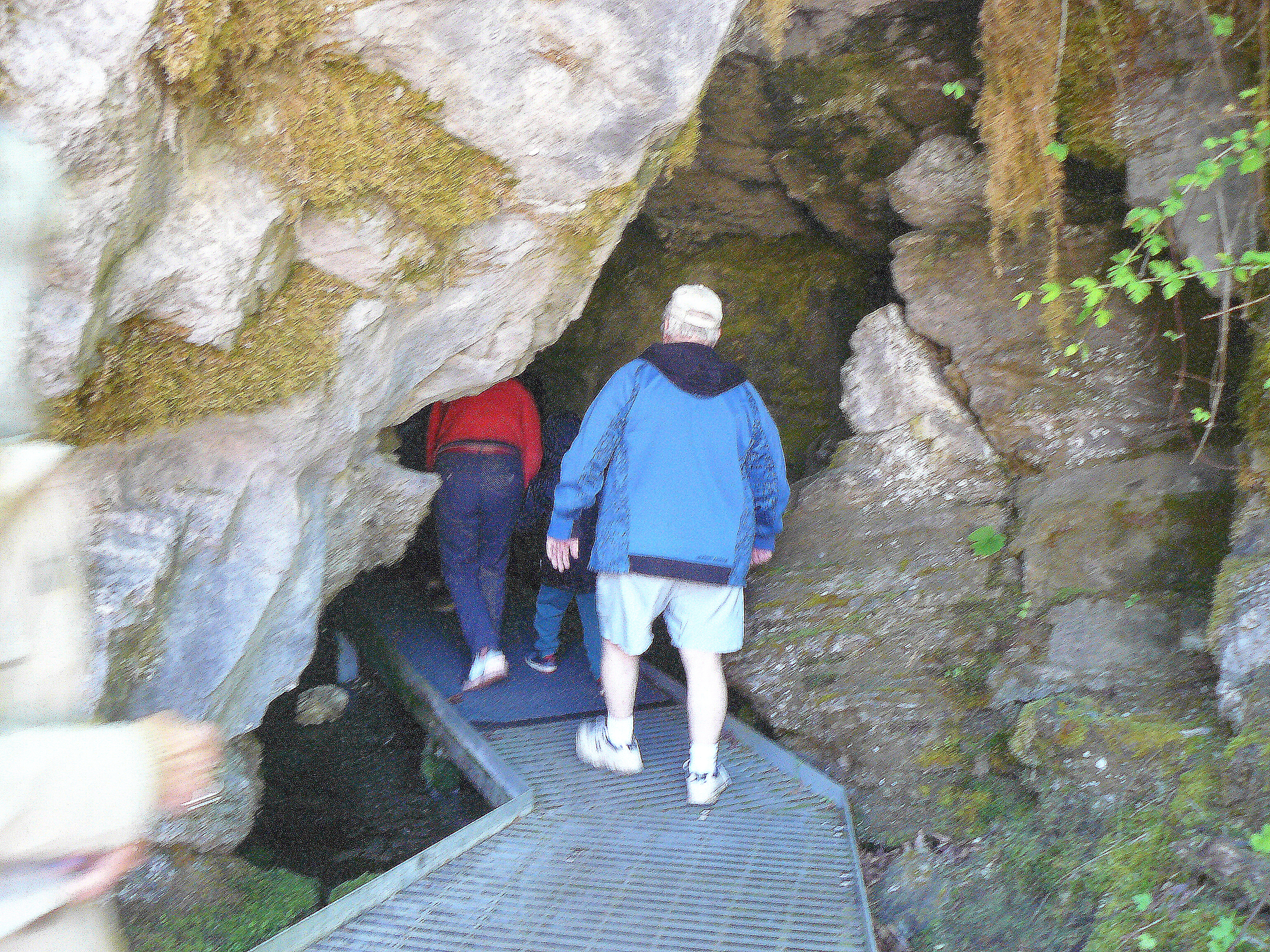
Clearly today’s visitors to the cave enter in a more gentle fashion!

P1160309WikiPedia has a very good description of the caves, from which I quote:

Oregon Caves National Monument and Preserve is a National Monument and Preserve in the northern Siskiyou Mountains of southwestern Oregon in the United States. The main part of the 4,558-acre (1,845 ha) park, including the marble cave and a visitor center, is located 20 miles (32 km) east of Cave Junction, on Oregon Route 46. A separate visitor center in Cave Junction occupies 4 acres (1.6 ha) of the total. Both parts of the monument, managed by the National Park Service, are in southwestern Josephine County, near the Oregon–California border. The climate is generally mild even at the cave’s elevation of about 4,000 feet (1,200 m) above sea level, but icicles can form at the cave entrance, and winter snow sometimes blocks the park highway.

Elijah Davidson, a resident of nearby Williams, discovered the cave in 1874. Over the next two decades, private investors failed in efforts to run successful tourist ventures at the publicly owned site. After passage of the Antiquities Act by the United States Congress, President William Howard Taft established Oregon Caves National Monument, to be managed by the United States Forest Service, in 1909. The popularity of the automobile, construction of paved highways, and promotion of tourism by boosters from Grants Pass led to large increases in cave visitation during the late 1920s and thereafter. Among the attractions at the remote monument is the Oregon Caves Chateau, a six-story hotel built in a rustic style in 1934. It is a National Historic Landmark and is part of the Oregon Caves Historic District within the monument. The Park Service, which assumed control of the monument in 1933, offers tours of the cave from mid-April through early November. In 2014, the monument was expanded by about 4,000 acres (1,600 ha) and re-designated a National Monument and Preserve. In addition, the River Styx, which flows through the cave and emerges as Cave Creek, was named to the National Wild and Scenic Rivers System.

Oregon Caves is a solutional cave, with passages totaling about 15,000 feet (4,600 m), that formed in marble. The parent rock was originally limestone that metamorphosed to marble during the geologic processes that created the Klamath Mountains, including the Siskiyous. Although the limestone formed about 190 million years ago, the cave itself is no older than a few million years. Valued as a tourist cave, the cavern also has scientific value; sections of the cave that are not on tour routes contain fossils of national importance.

Daughter Maija, grandson Morten and your truly just having exited the cave.
Daughter Maija, grandson Morten and yours truly just having exited the cave.

Between Marius and myself we took a great number of photographs but many of them can’t compare to the quality of photos found on the web.

For example here’s one of my pictures:

P1160322and here’s one taken from the National Parks Service website:

These are formations known as soda straws and like soda straws they are hollow tubes. They are made up of the mineral calcite.

Won’t go on! (But I will post a collection of photographs, both from me and Marius and found online in a future Picture Parade.)

What I will do is to close with this YouTube video. It is 17 minutes long but very interesting and, hopefully, an inspiration to others to come and visit this incredible geological site.

Happy Holidays to all!

Who is the teacher?

The two-way flow from having a pet.

I can’t believe it was so long ago but back in February I received an email:

Hey!

I’m sure you get a ton of spammy submissions so I’ll get straight to the point – I’d love to submit a post for publishing on your site.

If you’re still accepting posts, please let me know and I can put together a draft for your approval.

Thanks for your time!

Emily Parker

Chief Creative Cat
After a quick check to make sure that Emily wasn’t promoting a business I said that I would be delighted to publish a guest post from her.
So who is Emily? This is a short introduction to her:

Emily Parker is a cat parent to 2 lovely cats, Gus and Louis (Gus only has one eye, but we love him all the same!). She has lived with dogs in the past and can’t wait to add a dog to the family again. She writes about all things cats at her blog, Catological.com.

Don’t ask me how late February became late July but that doesn’t diminish in the slightest the quality of Emily’s guest post.

Before you read on let me present you with a picture of one of our cats that we have here at home.

P1150737ooOOoo

Cats, Dogs, and Kids: Who Teaches Who.

by Emily Parker, Catological.com
You’ve heard it as a kid, and if you have children of your own, you may have told your kids this.

“Having a dog is a big responsibility.”

This is absolutely true. A dog can teach kids how difficult it can be to take care of another living being, all while teaching them valuable life skills.

But little do we know that raising a dog is not a one-way street. Not only do dogs teach kids, but kids teach dogs, too. And if you’re a cat owner, it creates another web of teaching. Let’s break it down.

What Dogs Teach Kids

The Importance of Feeding, and Nutrition

What a dog will teach a kid is the importance of regular feeding. However, a kid can’t just dump some dog food in a bowl and call it a day. To raise a dog properly, the child needs to make sure the pup is getting the adequate nutrition it needs, all while not overeating.

If you have a kid, you must teach the child that proper nutrition is a must when feeding the dog. He or she will need to measure out the serving size, pay attention to ingredients, and become acquainted with the macronutrient profiles most beneficial for their dog. This can bleed into the child’s own eating habits as they learn to eat healthy and measure out portions.

Also, feeding a dog will teach a child that rewarding yourself is good if it’s done on occasion. Nothing wrong with the occasional treat!
Just be sure to keep up on the latest recalls.

Exercising

A child needs to have at least an hour each day dedicated to getting outside and playing. There are many ways to get a child outside, but perhaps the best way is to have a dog.
A dog needs to be walked every day, and by having your kid walk the dog, they’ll be getting exercise and learning to enjoy the great outdoors. Plus, it can get even more physical. Kids can chase dogs. Dogs can chase kids. Kids can run with their pets. The possibilities, as it turns out, are endless.

That Taking Care of a Pet Can Get Messy

This applies to cats as well. Children will have to scoop a cat’s litter, though it may seem a bit cleaner than picking up after a dog, who will of course be doing its business as the child takes it out for a walk, and the child will have to pick up after their pet.

It can seem a little a messy, and it will teach the child how to handle an animal’s waste, (which works out great if they ever decide to have children).

What Cats Teach Kids

The Importance of Consent

Most dogs are all over you, while some cats tend to want you to pet them at certain times.
Yes, we know that not all cats are like that, but a majority are. Sometimes, a cat doesn’t want to be held, pet, or bothered in general. And that’s okay!

You should teach your kid that sometimes, an animal, or indeed a human, needs their personal space, and that needs to be respected.

The Importance of Sleeping

Cats can sleep almost twice as much as humans can.

While your kid isn’t going to be sleeping for 16 hours a day, they still need 8 hours in most cases (or more if the child is younger), and may be neglecting that.

Having a cat around, who sleeps all the time, can teach the kid that sleep is important to anyone’s life, and they may soon be sleeping along with the kitty.

The Importance of Curiosity

Cats are always curious about their surroundings. If something changes, the cat will examine the surroundings incessantly. While some say that curiosity kills the cat, we believe that being curious about everything around you is a good thing, and should be taught to children.

As Fluffy examines her surroundings, kids will soon learn to examine what is around them. They’ll be aware of the people around them, look around their room when trying to find something, and be aware at all times. All of these are valuable tools for a child to have.

What Kids Teach Cats

How to Have a Little Fun

Despite learning the cat’s boundaries, some kids will still pick the kitty up, pet them excessively, and bother them. The cat may soon learn to be more sociable. They may have points where they don’t want to be bothered, sure, but they can learn to let loose once in a while.

What Dogs Teach Cats

How to Tolerate Each Other

Sure, cats and dogs can get along great, but at the end of the day, they are two different species with two different ways of behavior. Sometimes, an antisocial, sleeping cat can get annoyed by Fido’s constant need for attention. A dog may be confused by Fluffy scratching it whenever it tries to chase her.

Dogs and cats soon learn, however, to get along, or at least tolerate each other’s differences. This can teach children that they may have to be acquaintances with someone who is different than them and who may annoy them to death, like a coworker or a classmate. You may have to be with some people who are different than you. You’ll have to tolerate it. Heck, you may even grow fond of them after a while.

The Importance of Eating What is Yours

Cats can get into dog food, and vice versa. While cat food isn’t going to harm a dog and dog food won’t hurt a cat, the food doesn’t meet the nutritional needs of the opposite species. Dogs and cats will soon have to learn where their food is and not get into another animal’s food (though you should keep their feeders and dishes far apart from each other to prevent confusion and territorial fights). It’s a valuable lesson to learn for any pet.

Finally…

A kid raising a pet isn’t just a learning experience for the child. It can be a learning experience to the pet, as well as a learning experience from one pet to another. In life, you’ll learn different things from different people, and those who aren’t human can ironically be the best teachers.

ooOOoo

Wise words indeed, and a pleasure to publish. Thanks Emily.

Cats and dogs indeed!
Pedy sharing a couch with Mitts.

The needs of pregnant dogs!

As in the nutritional needs of those dear creatures.

Having said in yesterday’s post that this week would be a succession of repeat posts along comes an email from Susan Combs offering a guest post. It seemed a great post to share with you all.

She describes herself as:

Susan works as a Pet Health and Safety Expert and holds expertise in the area of animal/pet care. She has over 6 years of experience in pet healthcare and is a pet parent to a dog named Chilly.
Her post has also been published over on the MyPetZilla blogsite and the following is a copy of that version.
ooOOoo
FAMILY

Jul 14, 2016

How to Meet the Nutritional Needs of Pregnant Dogs

As a pet owner you should remain educated about the nutritional requirements of your dog at the time of her pregnancy. A pregnant dog needs precise nutrition and if proper care is not taken then it can lead to serious health issues.

How long does a dog’s pregnancy last?

It lasts for 63 days. The first 3-4 weeks she can be fed a regular diet, however the last weeks are important from nutrition point of view and she requires more calories. During the first 3-4 weeks, it is recommended to feed her green trippet which is made from high quality green tripe. It contains lots of digestive enzymes and ensures good health. You can mix tippet to high-quality kibble and feed to your dog.

What should I change in my dog’s diet during the 2nd half of pregnancy?

During the 2nd half of pregnancy, dog should be fed around 30-40% more calories than what she was being fed in the first half of pregnancy. Your dog’s weight should increase by 15-25% at the time of whelping in order to maintain optimal body weight after parturition, as she needs to produce sufficient quantities of milk and colostrums to support growth in the newborn pups until they are weaned.

By week 8-9, the meal should be a third more than the regular meal. Total food quantity should be divided into four or more servings per day and dog foods with minimum levels of  430 kilocalories/cup should be provided in order to supply adequate quantities of calories. If the dog is experiencing weight issues then it is recommended to consult a vet immediately.

It is absolutely okay if your dog is eating too little in one go. You can break the meal into little portions to be fed entire day. Actually, in the advanced stages of pregnancy, the stomach cannot take large quantities of food in one intake so it is better to allow eating several portions of light meal throughout the day.

How to spot potential problems?

If your dog is experiencing diarrhea then that’s an indication that you are feeding her high volumes of food. If this is the case then shift to energy dense food, preferably dry dog food.

How much should I feed her prior to parturition?

Once the bitch is ready to give birth, you should slowly increase her calorie intake to around 15 to 25 percent. It should be noted here that most bitches refuse to eat food 12 hours prior to whelping. You should keep attention and provide her to drink water in order to prevent dehydration.

How to increase the calorie intake depending on the number of puppies?

For every puppy, your dog will require a 25% increase in her caloric intake, up to 180-200% maximum increase can be done in case she has around 10-12 puppies. Increasing more than 200% is not recommended. For example, a dog eating 2 cups of a high quality dog food each day before breeding will now need about 6 cups of food a day, in order to feed herself and provide for 8-10 puppies.

What preparation do I need to do for the puppies?

Yes, there is certain preparation that you need to as a dog owner prior to the birth of the puppies. You must prepare a room for the birth to occur. Ensure that the floor should be easy to clean and the area should be calm and soothing. You should also prepare a bed for the mother to deliver the babies. Have lots of towels and encourage the mother to sit on them so they become comfortable with them and opt to use them when on labor. This would make the birth easier for both you and the mother. Also as a responsible pet owner, it is your duty to get them insured.

When should I wean the puppies?

Puppies will begin to start eating food once they achieve 3-4 weeks of age. Henceforth, weaning should be completed at 6-7 weeks of age. After 6-7 weeks, you should start giving puppy food to them.

It is important to note here that the energy content level in dog’s milk increases all the time until around day 40. After this, the level of milk drops down and this is the time when you should start feeding the pups with light puppy food.

Is puppy food different than adult food?

Yes, puppy food is different than adult food. It is high in proteins and contains higher amounts of fat soluble and water soluble vitamins, minerals, fats, and other essentials. It also has a controlled amount of calcium and phosphorus that helps in the overall growth and health of the newly born puppies.

Should I exercise my pet regularly?

Obesity is potential danger in pregnant dogs when delivery time comes so exercising should be done regularly during the first 4 weeks of pregnancy but during the later stages, light walk is preferred.

Any other precaution that I need to take?

Treatment for internal and external parasites is necessary. It is better to consult the veterinarian if there is any problem related to external parasites. Another important point to note is that soon after whelping, your dog will actually need to eat twice as much as normal – and three times the normal level during the peak lactation period, which occurs three to four weeks after whelping.

When should I visit my vet?

Visiting a vet should be a regular practice. If possible, take your dog to the vet during each week of her pregnancy. This will ensure that all her nutritional requirements are met. Your vet should also guide you regarding any complications and after pregnancy care tips.
Pregnancy is an important part in the life of your dog and making her comfortable is your duty. You should take complete care of her nutritional and emotional needs so that the pups born are healthy. Apart from healthy and nutritious food, you need to ensure that your dog is getting plenty of clean, fresh water, enough exercise and fresh air.

The ancient roots of the relationship.

The recent news of finding a dog graveyard that is 2,000 years old.

Before going on to today’s post, can I just remind you kind folks that as of today, and for the rest of this week, we have family guests staying with us here in Oregon.

IMG_1368
Grandson Morten responding to his mother, Maija, taking a picture of him and Marius, as they wait to board the aircraft for San Francisco yesterday morning.

Thus from tomorrow until the end of the coming weekend my posts will be a preponderance of republications of previous posts. Plus my attention to you dear readers will be less than you are accustomed to.

Now on to today’s post that was kindly sent to me by Chris Gomez. Thanks Chris.

ooOOoo

2,000-Year-Old Dog Graveyard Discovered in Siberia

Rationally speaking ….

… it’s not that easy to be rational!

It’s alright! I haven’t missed taking my pills! 😉

My headline and sub-heading was me trying to catch your eye and persuade you stop what you are doing for eleven minutes and watch this video that was filmed earlier this year at the TEDxPSU conference.  It’s all about being rational.

The presenter is Julia Galef described by WikiPedia (in part) as:

20150126_Julia_Galef_2

Julia Galef (born 1983) is president and co-founder of the Center for Applied Rationality. She is a writer and public speaker on the topics of rationality, science, technology and design. She serves on the board of directors of the New York City Skeptics and hosts their official podcast, Rationally Speaking, which she has done since its inception in 2010, sharing the show with co-host and philosopher Massimo Pigliucci until 2015. She also blogs with her brother Jesse on the website Measure of Doubt.

Biography

Galef received a B.A. in statistics from Columbia University. In 2010 she joined the board of directors of the New York City Skeptics. She co-founded and became president of the nonprofit Center for Applied Rationality (CFAR) in 2012. The organization also gives workshops to train people to internalize and use strategies based on the principles of rationality on a more regular basis to improve their reasoning and decision making skills and achieve goals. She was elected a fellow of the Committee for Skeptical Inquiry in 2015.

Julia’s website further explains:

The problem I’m most interested in is how to change one’s mind. Starting from the premise that every human being is at least a little wrong about many things that matter — in our careers, or about health, science, politics, our self-image, and more — we should, in theory, be updating our views frequently as we learn more about the world. In practice, however, our opinions ossify.

So here’s that talk from Julia – I bet all of you will find it interesting! Rationally speaking, that is!

Published on Jul 11, 2016

Perspective is everything, especially when it comes to examining your beliefs. Are you a soldier, prone to defending your viewpoint at all costs — or a scout, spurred by curiosity? Julia Galef examines the motivations behind these two mindsets and how they shape the way we interpret information, interweaved with a compelling history lesson from 19th-century France. When your steadfast opinions are tested, Galef asks: “What do you most yearn for? Do you yearn to defend your own beliefs or do you yearn to see the world as clearly as you possibly can?”

If only our leaders and power-brokers across the world yearned for truth!

Strangely normal!

Reading the behaviours of our dogs.

Apologies, going straight into this republication of an article that appeared on the Care2 blogsite back in June. Didn’t get to sit down in front of my computer until 4pm.

ooOOoo

7 Totally Normal (But Kind of Weird) Dog Behaviors

1384665.largeBy: Katie Waldeck June 19, 2016

About Katie

It’s not surprising that our beloved canine companions’ behavior is sometimes confusing to us. After all, it’s not like they can tell us why they do certain things! But is your pooch’s behavior normal, or a sign of something more troubling?

And, for that matter, are common dog behaviors totally fine, or something we should be working to stop? Oftentimes, the answer is the former. Read on to discover some of the strangest dog behaviors that are actually totally normal.

1. Barking at Mirrors

If you show a human baby a mirror, they don’t always recognize themselves— young infants lack the self-awareness needed to do that — and dog babies are no exception. Most of the time, dogs grow out of it as they age, losing interest in their own reflections. Dogs are much less affected by visual events than humans, relying far more on their sense of smell to gather information. Since the dog in the mirror doesn’t have its own smell, most dogs tend to lose interest pretty quickly.

2. Being Scared of Thunderstorms

Dogs have far more sensitive hearing than humans, so it’s understandable that the loud noises accompanying storms don’t exactly delight our canine companions. But there may actually be more behind this fear — some scientists believe that dogs can actually detect changes in barometric pressure leading up to a storm. Thunderstorms can send even the best-behaved dogs into anxious fits, and unfortunately, it can be difficult to break even the healthiest dog of this habit. There are strategies to cope, however, such as providing a safe place for dogs to go during storms or dressing them in snug-fitting shirts that function similarly to swaddling a baby.

3. Eating Poop

Though it’s certainly not appetizing to us humans, many dogs eat poop. Eating feces is actually a fairly typical behavior for canine mothers, because it cleans the area where they are caring for their puppies. Some evidence also suggests that dogs eat feces when they’re lacking in certain nutrients. Eating poop can even be a way to get your attention and alleviate anxiety. This is not exactly a GOOD behavior for dogs, however, and solutions for it are mostly simple. Supervision and simple commands like “Leave it” and “Come” are often enough to curb most dogs’ fecal fascination, and vitamin and enzyme supplementation can work for dogs whose diets are missing nutrients.

4. Spinning Around in Circles

Plenty of dogs spin around and around for what seems like forever. Some breeds, including bull terriers in particular, are especially susceptible to this behavior. While this is often normal dog behavior, it can also be a sign of stress or anxiety. Whatever the reason your pooch spins in circles, this behavior should be nipped in the bud. The best way to do that? Well, get them moving and thinking. Take them on walks. Give them toys that stimulate their mind. If that still doesn’t work, you might need a dog behavior expert to intervene.

5. Separation Anxiety.

Many dogs experience separation anxiety — they just love you THAT much! Often, this is a result of changes in routines, moving, household membership changes or after moving in with a new family. It’s totally normal, but, unsurprisingly, it isn’t the best behavior for your pet’s mental health. The key to breaking your pooch of this behavior is to identify how big of a problem it is before you go about fixing it. Click here for detailed ways to help break this habit.

6. Hating Other Dogs.

Dogs who weren’t socialized at an early age around fellow canines will understandably have some aggression towards unknown dogs. Conversely, some dogs that have been socialized around other dogs seem to pick and choose which dogs they like. Why is that? Well, dogs aren’t all that different than humans in that regard — sometimes we just don’t like certain people. Dogs perceive a massive amount of information through scent, and two dogs may find something off-putting about each other’s smells. Dogs may also be overprotective of their owners or have something in their history that makes them especially distrustful of certain other kinds of dogs. Avoiding another dog at the park isn’t much cause for concern, but if your dog is consistently aggressive, it’s time to consult a veterinary behaviorist.

7. Having Sensitive Spots.

Some dogs have areas where they just don’t like to be touched. There can be several reasons for this — everything from a recent injury to poor socialization as a puppy — but, often, this is simply because, well, dogs just don’t like to be touched in certain spots. Think about it this way: plenty of humans don’t want to be patted on the butt by people they don’t know. In fact, most don’t! This can be perfectly innocuous — or it can be a sign of trouble. Dogs that demonstrate overly aggressive behavior regardless of where they’re touched may be in need of a behavior expert. You can read more about this here.

ooOOoo

Any thoughts dear people?

Life-saving dogs.

The great relationship that can exist between dogs and cheetahs.

Before you read on let me raise my hand in connection with this blog. Or to be clearer, next Monday Jean and I have the very great pleasure in welcoming my daughter, Maija (she of Sonic Journeys from SOUND UK), her husband, Marius, and my grandson Morten. They are staying with us until the 24th July.

Inevitably, and for all the right reasons, I will not be putting in anything like the normal time I usually spend on Learning from Dogs. It did cross my mind to stop blogging for those seven days but that seemed like a step too far.

However, what is certain is that the period from now right through to the last week in July is going to see me lowering the priority of this blog and being more random in nature in terms of if or how I respond to your comments and replies.  You will also read a succession of repeats of posts from previous years. I’m hoping that because so many of you will not have been reading this place during my early years that the number of times you see something that you have previously read is kept to a minimum.

So why this note to you all today? Because the rest of this week is going to be pretty busy as we get the house all tidied up and fully prepared for our visitors.

Having got that off my chest do read the following that appeared recently over on Care2.com.

ooOOoo

How Dogs Are Saving Cheetahs From Extinction

3183088.largeBy: Laura Goldman July 10, 2016

About Laura Follow Laura at @lauragoldman

Cheetahs, the fastest land animals on Earth, have been disappearing almost as fast as they can run.

But in the African country of Namibia, the cheetah population has grown from 2,500 to 4,000 since 1994. And dogs are helping to keep those numbers rising.

Instead of trapping or shooting cheetahs that wander onto their property and kill livestock, some farmers are relying on Anatolian Shepherds and their fierce barking to scare away the predators.

“You may see in history that this dog can be responsible for saving the cheetah from extinction,” Jack Hanna, director emeritus of the Columbus Zoo, told CBS News. “That is one heck of a story right there.”

The dogs are provided to farmers and ranchers by the Cheetah Conservation Fund (CCF), the world’s leading organization dedicated to saving the lives of cheetahs in the wild.

 The majority of cheetahs in the wild – over 90 percent of them, according to the CCF — live outside protected areas, surrounded by farming communities. And many of those farmers, especially poor ones, are more concerned about protecting their livelihood than an endangered species. About 10,000 cheetahs were killed during the 1980s, before CCF launched the Livestock Guarding Dog program in 1994.

Since then, the program has placed more than 500 dogs, helping to reduce the loss of livestock from 80 to almost 100 percent. The program is extremely popular — there’s a two-year wait to get in. It not only provides free Anatolian Shepherd puppies, but also training advice and free veterinary care.

“CCF research shows that the people’s attitudes towards predators are changing as a result of this and other CCF programs,” the organization said on its website.

Dogs and Cheetahs Aren’t Enemies in U.S. Zoos

As a way to promote “the life-saving role dogs play for cheetahs in the wild,” according to CBS News, some zoos in the United States are raising puppies with cheetah cubs.

“The number one question up here, this $40 million exhibit: ‘Are the dogs coming out?’” Suzi Rapp, director of the Columbus Zoo’s animal programs, told CBS News. “And I say the Columbus Zoo built the world’s most expensive Labrador retriever exhibit in the world… the biggest dog run.”

Dogs and cheetahs can also be found together at the Cincinnati Zoo. It was there, as you probably remember, where Harambe the gorilla was shot to death when a boy fell into his exhibit. His killing sparked international outrage and concern over keeping wild animals captive in zoos.

What are domesticated animals doing in these zoos? Like the Anatolian Shepherds in Africa, the zoos say, the dogs are helping to prevent cheetahs from becoming extinct. But instead of scaring cheetahs away from livestock, the zoo dogs are best buddies with the cheetahs. Their friendship, which begins when they’re about 3 months old, helps put the skittish cheetahs at ease so they can more easily be bred.

The San Diego Zoo, which has been raising dogs with cheetahs for over 30 years, gets many of its puppies from animal shelters. So in a way, the rescued dogs are paying it forward by helping save the lives of another species.

ooOOoo

That Care2 article by Laura Goldman included a short video from CBS News. However, despite me having a link to that video I couldn’t get it to play.

No problem because YouTube came up with a very good alternative.

Published on Apr 29, 2013

CCF Operations Manager Brian Badger explains how our Livestock Guarding Dog program works as part of the whole of CCF’s operations to help save the cheetah in the wild.

In fact, there was more than one interesting video and I couldn’t make up my mind which was best.

So you got two!

Published on Sep 25, 2013

In Gobabis, Namibia, these Kangal dogs guard the goats against predators, including the worlds largest population of wild cheetahs. This stops the farmers from targeting the cheetahs. Since the big dogs were introduced to Namibia, the cheetah population has reached a 30-year high ! Hurray!

Let’s hear it for (shelter) cats.

Just to demonstrate that Learning from Dogs isn’t wall-to-wall about dogs!

Over the years that I have been writing in this place it has been mentioned before that as well as us having our dogs we also have cats. When Jeannie and I moved up from Mexico to the USA in 2010 we came with six cats, all of them cats that Jean had rescued off local streets down in San Carlos, Mexico.

Four years ago, when we moved up from Arizona to this present home here in Merlin, Southern Oregon, we built a cat run that was attached to the garage. Then about a year ago we brought what was now four cats into the house. The cats are in their own rooms during the day but mingle with the ‘living room’ group of dogs in the evening. The cats are not let outside for we fear that they would be grabbed by a passing coyote or similar before they learnt to return home in the evening.

All of which is my preamble to an article that was published a month ago over on the Care2 Causes site, and is republished here within Care2’s terms.

ooOOoo

10 Reasons to Adopt a Shelter Cat

3010560.largeBy: s.e. smith June 9, 2016

About s.e. Follow s.e. at @realsesmith

Once every eight seconds, an unwanted cat or dog is euthanized somewhere in the United States thanks to pet overpopulation and limited shelter capacity. No one likes to think about that reality, but you can do your small part to help. In addition to supporting organizations that promote an aggressive national spay and neuter policy, facilitate no-kill shelter transitions and work with communities to address specific issues like feral cat colonies, you can adopt a shelter cat (or dog!).

If you’re thinking of adding a cat to your life (and really, why stop with one?), here are ten compelling reasons to consider a shelter cat over one from a breeder or a pet store.

10. Shelter cats come in all shapes, sizes and colors.

If you want a kitten, shelters are usually overflowing with them, especially during spring kitten season. If you’re interested in an adolescent feline or even a more mature companion, shelters have those too. In fact, many are really excited by potential adopters who want to take on an older kitty, because mature cats tend to linger in shelters longer because many people prefer kittens. If you’re looking for a cat to accompany an older adult or someone who’s not as mobile, a mellow older cat might be a great fit.

9.  Shelter cats are ready to go!

They’re spayed or neutered, immunized, dewormed, microchipped and assessed for behavioral issues by the skilled staff at the shelter. They’ve also been trained to use the litterbox in most cases, so you don’t have to worry about an awkward and potentially smelly transition to living at your house. Many also come with a certificate for a free first visit to the vet, and some shelters have a take-home package with food, toys and other goodies. You’re all set up for your first year of pet ownership, and your pet will be healthy, because the shelter has a vested interest in keeping its animals happy and healthy, while pet stores and unscrupulous breeders do not.

8.  Shelter staff can help you pick the perfect companion.

Adopting an animal is a big commitment, and not all cats are the same. If you come in with your family, the shelter staff can get to know you, introduce you to some prospects, and help with the matchmaking process. They’re motivated to make sure cats find their forever homes, and they won’t lead you astray when it comes to, well, rescuing a stray. Shelter staff can also provide you with information about the adjustment period if you’ve never had a cat before.

7. Turns out you can teach an old cat new tricks.

(Note that when she’s tired of it, she’s not afraid to make her opinion known!)

6. Set an example!

There are a lot of myths about cats living in animal shelters, like claims that they’re damaged, feral or broken in some way. In fact, the vast majority of unwanted animals are happy, healthy and well-adjusted, they just need loving homes to get comfortable and let their personalities come up. By adopting a shelter cat, you can encourage other people to do the same; talking about your positive experiences and introducing people to your cat will help reduce the stigma about adopting from a rescue group.

If you want to adopt a special-needs animal, you’re certainly welcome to. Shelters are particularly choosy when it comes to homing out cats with medical problems, but they are always happy to hear people are interested, committed and ready to give a cat with some extra needs a home to share.

5. Adult cats are low maintenance.

If you want a cat in your life but you don’t have a lot of time for teaching a kitten how to use the litterbox, stay away from the toilet paper roll, and stop wreaking havoc on your shoes, an adult cat is definitely for you. Adult cats already know the lay of the land and they tend to settle into routines quickly, making them great housemates. And if you travel a lot, consider adopting cats as a pair so they can keep each other company. A shelter often has a pair of cats whom they’d love to see go out together because they’re relatives or they’ve developed a close bond.

4. You’ll feel better.

Companion animals offer a number of mental health benefits. Having a pet of any species around can make people feel happier and more balanced, and the routine of caring for and interacting with a pet like a cat can improve mood and reduce the sense of isolation. Cats are especially great companion animals for people who don’t have the energy or ability to care for a dog, but still want someone around the house to keep them company.

3. Shelter cats have varied personalities.

Cats are incredibly diverse, personality-wise. They can be shy and outgoing, playful or more reserved, fascinated by sinks or horrified by water. If you haven’t had the pleasure of having a cat in your life yet, a shelter cat might totally change the way you view these delightful animals.

Check out some of the personalities on display at the Los Alamos Animal Shelter:

2. Don’t support animal cruelty.

Pet stores source their animals from a variety of places, and those cute kittens in the window might come from an abusive kitten mill where cats endure horrible conditions to produce animals for the pet trade. The sale of companion animals in general promotes the continued existence of exploitative breeders that view cats as cash drawers, not living beings. By turning away from companion animals offered for sale and choosing to adopt, you’ll be voting with your wallet. And that adoption fee? Will be a lot lower than buying an animal from a petstore or breeder.

1. You’ll save a life.

Even if your local shelter is no-kill (which is great! consider an extra donation to help them with operational costs), adopting shelter cats to get them out of the shelter system and into living homes reduces the strain on shelters and frees up space for more homeless animals. No-kill shelters often rescue from facilities that euthanize, so by adopting from them, you’re opening up another slot for a kitty who’d otherwise be on death row. If you live in an area where there is a kill shelter or where animal care and control adopts out animals, please consider looking there first for a new cat. Some organizations maintain “kill lists” published by shelters, listing animals slated for euthanasia within the next few days, and you might find your new companion on just such a list.

ooOOoo
 Even if just one person who reads this makes a commitment to take on a shelter cat it will be one less cat on a ‘kill list’.