In a reply to Colette following my post of last week Caring for animals, I wrote:
Jean is on a diet that is predominantly fruit and vegetables as part of slowing down the progression of her Parkinson’s disease. The diet is essentially a no-dairy, no-grain, no-meat diet to eliminate the risk of any gut inflammation. She is advised by a professional nutritionist here in Grants Pass, OR. I follow along with Jean motivated to slow down my own cognitive decline.
Colette then responded to my reply with quite extensive details of her own diet. Her reply opening:
I have some food sensitivities that started my dietary changes a number of years ago. I found I was allergic to eggs after struggling with severe joint pain that doctors couldn’t explain. Then I began to find that a few other things were problematic including gluten, also prompting dietary change. The animal protein side came into sharper focus during a moment of epiphany at an elephant sanctuary and I started a vegetarian diet. However, I soon switched to a completely (almost except for some contamination in the odd thing now and again) vegan diet.
I am healthier, my cholesterol dropped from a total of 212 mg/dlto 135mg/dl and I have more stamina, fewer infections, colds and illness. (Nothing terrible to put me to bed since I became Vegan).
I do try to get a balance of a variety of fresh fruit and veg, protein and fats in my diet.
… that was then followed by her describing what a typical day looked like in terms of what she eat.
I offered to describe what Jean and I eat.
Fundamentally, Jean was advised to have a diet that reduced the chance of her having any gut inflammation but, if she did, a diet that would bring that inflammation to a close. All to do with Leaky Gut Syndrome and how the brain can be negatively affected.
So …
Breakfast
Two tablespoons of milled flax,
One tablespoon of hemp hearts,
A sprinkling of chia seed,
Prunes, banana, dried apricots, walnuts, berries when available,
Coconut milk or almond milk
Lunch
Mainly salad greens, raw vegetables, tomatoes, avocado, some canned herring,
Mixed fruits, as in oranges, apples,
‘Naked Green’ smoothie
Dinner
Mixed vegetables,
Baked chicken breast,
Green salad with tomatoes and avocado,
Almonds or other nuts
Drinks during the day
Herb teas, ‘V8’ juice, green tea, ‘Naked Green’ smoothies, almond milk.
We are also taking a course of Juice-Plus tablets; a recommendation from our local nutritionist.
Anyway, that’s enough from me for today.
If there’s good interest in me sharing some of the many links to this whole area of diet, the gut and how it can affect the brain, then do sing out! (But I have no professional knowledge; will just report our findings!)
oooo
Wow! What an incredibly useful link thanks to Colette. I am referring to the NutritionFacts website.
Then how easy it was on that site to find a video specifically about diet and PD.
Jean and I are removing chicken and fish from our diet immediately; in other words going vegan.
Anyone who emails me this is impossible to resist!
Hi,
I work on behalf of petsbyplane.com, and I recently noticed your blog while I was looking around for a few resources on pets and taking pets by plane!
I know sometimes it’s hard to create new content all the time and sometimes you probably find yourself needing blog content at learningfromdogs.com
I’m looking for high-quality sites like yours that I can contribute quality articles to in order to continue to build my profile, win a Pulitzer Prize and eventually take over the Universe.
Well another person trying to take over the Universe seems to fit the pattern of these present times so what the hell!
ooOOoo
Seven Techniques to Create a Safe New Home for Your Dog
Whether you are moving houses and you have to transport your dog or you are bringing a new dog into your house, you have to be prepared. Dogs can easily be stressed out by changes. They can become anxious, which will impact their behavior and even their eating habits. By doing your research beforehand and knowing how to handle various situations, you can be fully prepared on moving day and you can ensure your dog will enjoy his new home from the very first day.
1. Think about Transportation
If you’re bringing a dog home from a shelter, you will need to pick him up with a car and a dog crate. It’s strongly recommended to put your dog in a crate while you are driving since you don’t know yet how it will react to so many new things and environments. This way, you will be able to focus on driving and getting to your destination safely.
If, on the other hand, you are moving houses with your pet, you have to decide if you want to use a professional pet moving company or do it all by yourself. Moving to a different state or country will imply travelling by car or plane. Depending on the situation, you have to get informed about vaccines, plane tickets and necessary documents.
2. Keep Your Dog away from the Commotion on Moving Day
To keep your dog stress-free, consider taking him to a friend’s house while you pack up your last things or move out furniture. By keeping him away from the commotion, you are shielding him from unnecessary stress. Make sure not to pack all of your dog’s favorite toys. Keep a few around at all times as these will comfort and soothe your dog during anxious hours.
3. Make Sure the New Home Is Ready to Receive Your Dog
Moving with your pet is stressful. You have to take care of dozens of things at the same time. An important thing you shouldn’t forget to do is to check the new house is prepared for your dog. If you are renting, make sure the landlord accepts pets. You will probably have to make a deposit and even pay monthly rent for your dog. If the house has a backyard, ensure there are no gaps in the fence or other hazardous plants or objects. Inspect the rooms as well and eliminate dangerous things such as exposed wires, shabby furniture, old cans of paint or cleaning products.
4. Keep a Schedule
Dogs thrive on routine, so keep that in mind even when moving houses. You might not be able to go back to your schedule on the first day, but try to get back on track as soon as possible. Feed your dog at the same hours and take him for walks as you used to before.
5. Take it Easy
New surroundings can be overwhelming for your dog. There are new places, smells, sounds and people to get used to. He might be anxious at first, and even refuse to eat, but he will easily adjust to the new settings in his own time. The best thing you can do through this entire experience is to be very patient and talk encouragingly to him. If you want to start training him, start on day one. Be generous with the treats and occasionally repay good behavior with a new toy.
When you’re introducing your dog to the neighbors and showing him around new places, always keep him on a leash. He might be too excited to contain his happiness and you never know how he will react.
6. Find a Veterinarian Before Moving
You should ask your veterinarian for recommendations before moving. Get in touch with your new vet prior to the move and make sure they are fully equipped to take care of your pet. It’s essential to find a trustworthy vet before moving so you can have the peace of mind that your dog will be in good hands no matter what happens.
7. Give Your Dog a Lot of Attention and Love
Even if moving occupies your whole time, you should always make time to play with your dog and show him that he is loved. This will help him cope better with the situation and will help calm him down. If you would like to train your dog but don’t know how, reach out to a professional trainer. Give your dog the attention he needs and he will have a smoother transition and adjust to the new environment in no time.
ooOOoo
So what part of the Universe do you intend to start taking over first, John?
The other day we went to buy more hay and feed from our local supplier The Red Barn on Upper River Road in Grants Pass.
Tyler, the owner, was distraught having just returned from urgently running his dog in to see Dr. Russ at local Lincoln Road Vet Clinic. The reason being that his dog had eaten some rat poison that he had put out on one of the upper floors of the barn.
Later I was discussing this with our good friend, Jim Goodbrod, also a Doctor of Veterinary Medicine (DVM), and Jim said that so long as the dog is caught quickly and taken to a vet it is unlikely that it would leave the dog with any permanent harm.
However, Jim then went on to say that especially at this time of the year the thing that vets see far too often is dogs who have drunk antifreeze that car owners put into their radiators ahead of the winter season.
Jim stressed that dogs very rarely are unharmed after having contact with antifreeze. Even a teaspoonful was sufficient to kill a cat and cause severe kidney damage in dogs!
So it was essential to spread the word.
No better done than by offering you this video. Watch it! Especially through to the end where Dr. Barker offers clear advice as to what to do if you suspect antifreeze poisoning of your dog or cat.
http://healthypets.mercola.com/sites/… Dr. Karen Becker, a proactive and integrative wellness veterinarian, talks about antifreeze poisoning, which often occurs when an animal encounters an antifreeze leak from a car radiator.
If this prevents even a single dog or cat from being poisoned by antifreeze then that’s a win!
My posts of the last few days have been in the ‘cuddly, cosy’ vein of life and, as many would say, a long way from the reality of this 21st century.
The reality is tough and scary and many, including me, favour running away from scary places. I’m sure that the urge to flee and hide is a survival behaviour from long time ago. BUT!! But the only hope for us humans is to face the facts full on.
Take, for example, the Ganges River. We have all heard of this famous river (my emphasis below):
The source of the Ganges is the Gangotri glacier. Here it is:
Gaumukh, snout of the Gangotri glacier,surrounded by the Bhagirathi peaks of Garhwal Himalayas, at an altitude of over 4,000 metres. Photo: Vidya Venkat.
Scientists say dwindling snowfall affects volume of water fed to the Bhagirathi, the main source of the Ganga
After a four-hour-long trek from Bhojwasa, the final camping spot in Gangotri, when a brown, fractured pile of rocks finally came into view it was hard to believe that this was the mouth of the glacier from which the ‘holy’ Ganga emerged.
Gaumukh, the snout of the Gangotri glacier, named after its shape like the mouth of a cow, has retreated by over 3 kilometres since 1817, says glaciologist Milap Chand Sharma of Jawaharlal Nehru University.
It was nearly two centuries ago that the retreat of the glacier was first documented by John Hodgson, a Survey of India geologist.
With 10 Indian States reeling under drought and the country facing a severe water crisis after two weak monsoons, the story of retreating freshwater sources such as the Himalayan glaciers is worrying. And though a three-kilometre retreat over a period of two centuries might seem insignificant at first glance, data shows that the rate of retreat has increased sharply since 1971. The rate of retreat is 22 metres per year.
Twenty-two metres or seventy-two feet a year!
Wringing our hands is no good. All of us who care for our Living Planet have to shout out just what is going on. As George Monbiot continues to do. Take his latest essay, for example, that is republished here in full with GM’s very kind permission.
ooOOoo
Insectageddon
The scale and speed of environmental collapse is beyond imagination.
By George Monbiot, published in the Guardian 20th October 2017
Which of these would you name as the world’s most pressing environmental issue? Climate breakdown, air pollution, water loss, plastic waste or urban expansion? My answer is none of the above. Almost incredibly, I believe that climate breakdown takes third place, behind two issues that receive only a fraction of the attention.
This is not to downgrade the danger presented by global heating – on the contrary, it presents an existential threat. It is simply that I have come to realise that two other issues have such huge and immediate impacts that they push even this great predicament into third place.
One is industrial fishing, which, all over the blue planet, is now causing systemic ecological collapse. The other is the erasure of non-human life from the land by farming.
And perhaps not only non-human life. According to the UN Food and Agriculture Organisation, at current rates of soil loss, driven largely by poor farming practice, we have just 60 years of harvests left. And this is before the Global Land Outlook report, published in September, found that productivity is already declining on 20% of the world’s cropland.
The impact on wildlife of changes in farming practice (and the expansion of the farmed area) is so rapid and severe that it is hard to get your head round the scale of what is happening. A study published this week in the journal Plos One reveals that flying insects surveyed on nature reserves in Germany have declined by 76% in 27 years. The most likely cause of this Insectageddon is that the land surrounding those reserves has become hostile to them: the volume of pesticides and the destruction of habitat have turned farmland into a wildlife desert.
It is remarkable that we need to rely on a study in Germany to see what is likely to have been happening worldwide: long-term surveys of this kind simply do not exist elsewhere. This failure reflects distorted priorities in the funding of science. There is no end of grants for research on how to kill insects, but hardly any money for discovering what the impacts of this killing might be. Instead, the work has been left – as in the German case – to recordings by amateur naturalists.
But anyone of my generation (ie in the second bloom of youth) can see and feel the change. We remember the “moth snowstorm” that filled the headlight beams of our parents’ cars on summer nights (memorialised in Michael McCarthy’s lovely book of that name). Every year I collected dozens of species of caterpillars and watched them grow and pupate and hatch. This year I tried to find some caterpillars for my children to raise. I spent the whole summer looking and, aside from the cabbage whites on our broccoli plants, found nothing in the wild but one garden tiger larva. Yes, one caterpillar in one year. I could scarcely believe what I was seeing – or rather, not seeing.
Insects, of course, are critical to the survival of the rest of the living world. Knowing what we now know, there is nothing surprising about the calamitous decline of insect-eating birds. Those flying insects – not just bees and hoverflies but species of many different families – are the pollinators without which a vast tract of the plant kingdom, both wild and cultivated, cannot survive. The wonders of the living planet are vanishing before our eyes.
Well, I hear you say, we have to feed the world. Yes, but not this way. As a UN report published in March explained, the notion that pesticide use is essential for feeding a growing population is a myth. A recent study in Nature Plants reveals that most farms would increase production if they cut their use of pesticides. A study in the journal Arthropod-Plant Interactions shows that the more neonicotinoid pesticides were used to treat rapeseed crops, the more their yield declines. Why? Because the pesticides harm or kill the pollinators on which the crop depends.
Farmers and governments have been comprehensively conned by the global pesticide industry. It has ensured its products should not be properly regulated or even, in real-world conditions, properly assessed. A massive media onslaught by this industry has bamboozled us all about its utility and its impacts on the health of both human beings and the natural world.
The profits of these companies depend on ecocide. Do we allow them to hold the world to ransom, or do we acknowledge that the survival of the living world is more important than returns to their shareholders? At the moment, shareholder value comes first. And it will count for nothing when we have lost the living systems on which our survival depends.
To save ourselves and the rest of the living world, here’s what we need to do:
We need a global treaty to regulate pesticides, and put the manufacturers back in their box.
We need environmental impact assessments for the farming and fishing industries. It is amazing that, while these sectors present the greatest threats to the living world, they are, uniquely in many nations, not subject to such oversight.
We need firm rules based on the outcomes of these assessments, obliging those who use the land to protect and restore the ecosystems on which we all depend.
We need to reduce the amount of land used by farming, while sustaining the production of food. The most obvious way is greatly to reduce our use of livestock: many of the crops we grow and all of the grazing land we use are deployed to feed them. One study in Britain suggests that, if we stopped using animal products, everyone in Britain could be fed on just 3m of our 18.5m hectares of current farmland (or on 7m hectares if all our farming were organic). This would allow us to create huge wildlife and soil refuges: an investment against a terrifying future.
We should stop using land that should be growing food for people to grow maize for biogas and fuel for cars.
Then, at least, nature and people would have some respite from the global onslaught. And, I hope, a chance of getting through the century.
Science shows that animals, including dogs, do dream!
I wanted to republish a recent and serious article written by George Monbiot but couldn’t bear to push back against the wonderful video of yesterday. Those loving ripples are still spreading across my consciousness and, I’m sure, that’s the same for you.
Consciousness, sleep, and dreaming are fascinating states of the mind. Previously thought exclusively the states of human minds. But not so!
The electric eel exhibit at the New England Aquarium has a feature that makes it a favorite. Whenever the eel is hunting or stunning prey, the charge powers a voltmeter above his tank. It lights up when the eel is using his electricity, and allows you to see the invisible—like magic.
One day I saw another magical thing happen in the tank. Thanks to the voltmeter, I was able to watch the eel dream.
It happened when I was standing in front of the exhibit with Scott Dowd, the lead aquarist for the freshwater gallery, watching the eel resting motionless at the bottom of the tank. “I think he’s asleep,” I said to my companion.
“Yes, that eel is catching some serious z’s,” he agreed.
Being hard-core fish enthusiasts, we continued to watch transfixed while the electric eel slept. And that’s when it happened: A big flash shot across the voltmeter display—and another and another.
Electric eels hunt while swimming forward, wagging their heads to and fro, sending out electric signals that bounce back to them, sort of like a dolphin’s echolocation. But he was still motionless. So what was the flash for?
“I thought the eel was asleep!” I said to Dowd.
“He is asleep,” he replied.
We realized at once what we were almost surely witnessing. The electric eel was dreaming.
“It would appear that not only do men dream,” Aristotle wrote in History of Animals, “but horses also, and dogs, and oxen; aye, and sheep and goats. . . .”
It was obvious: Like most of us, Aristotle had watched sleeping dogs twitch their ears, paddle their paws, and bark in their sleep. Surely other animals dreamed as well.
But since Aristotle’s day, more “modern” thinkers denied that animals could dream. Complex and mysterious, dreams were considered the exclusive province of so-called higher minds.
As brain research advanced, however, researchers were forced to concede that Aristotle was right. Animals do dream.
And now we are even able to glimpse what they dream about.
Since the 1960s scientists have understood that our dreams happen during the rapid eye movement (REM) phase of the sleep cycle. During this time our muscles are normally paralyzed by the pons of the brain stem, so that we don’t act out our dreams. In 1965 researchers removed the pons from the brain stems of cats.* They discovered the cats would get up and walk around, move the head as if to follow prey, and pounce as if on invisible mice—all
while asleep.
By 2007 we would get an even more vivid picture of animals’ dreams. Massachusetts Institute of Technology scientists Matthew Wilson and graduate student Kenway Louie recorded the activity of rats’ brains while the animals were running a maze. Neurons fire in distinct patterns while a rat in a maze performs particular tasks. The researchers repeatedly saw the exact same patterns reproduced while the rats slept—and they saw this so clearly they could tell what point in the maze the rat was dreaming about and whether an individual rat was running or walking in his dreams.
The rats’ dreams arose from the hippocampus, the same area in the brain that seems to drive humans’ dreams. It’s an area known to record and store memories, and that supports the notion that one important function of dreams is to help us remember what we have learned. Of course, it’s important to a lab rat to remember the right way to run a maze.
So if rats dream of running mazes, what do birds dream about? Singing.
University of Chicago professor Daniel Margoliash conducted experiments on zebra finches. Like most birds, zebra finches aren’t born knowing their songs; they learn them, and young birds spend much of their days learning and rehearsing the song of their species. While awake, neurons in the forebrain known as the robustus archistrialis fire when the bird sings particular notes. The researcher was able to determine the individual notes based on the firing pattern of the neurons. While the birds were asleep, their neurons fired in the same order—as if they were singing in their dreams.
Much less work has been done on fish than on mammals and birds. No one has found REM sleep in fish—yet. But that does not mean they don’t dream. Interestingly, no one has discovered REM sleep in whales, either. But whales almost surely dream. They are long-lived, social animals with very big brains much like our own, and for whom long-term memory consolidation is crucial.
And if you were looking for rapid eye movement in sleeping owls, you’d never see it—because owls’ eyes are fixed in their sockets. That’s why they need to turn their heads around, Exorcist-style. Yet owls’ brain waves show they dream, too.
Fish do sleep, however—that much is well known. It’s been carefully documented that if zebra fish are deprived of sleep (because pesky researchers keep waking them up), they have trouble swimming the next day—just as a person would have trouble concentrating after a dreamless night.
What might an electric eel dream about? The voltmeter at the New England Aquarium showed us the answer: hunting and shocking prey.
*Care2 stands firmly against animal testing and believes it to be a cruel and unnecessary practice for which there are viable alternatives, such as computer modeling.
ooOOoo
A young Pharaoh asleep, and dreaming?? September, 2003.
Last October 4th, just three weeks ago tomorrow, I introduced Emily Ridgewell to you. She had written a guest post for us Return to the Movies. It was well-received.
For many, the next few weeks are an important time of the year to do a spot of gardening. A time when dog-owners allow their loved ones to ‘help’, especially in the digging department. But are our gardens as safe for dogs as many of us might like to believe? Emily’s second guest post addresses that question.
ooOOoo
How to Create a Dog-Friendly Garden
by Emily Ridgewell, October 18th, 2017
Being a pet owner is not only a great pleasure but also a huge responsibility. While most of the people think that taking care of dog only included feeding and walking it three times a day, the truth is that being a good dog owner means much more than that. There are plenty of unobvious things that might pose potential threats to the health and wellbeing of dogs, and plants from home garden is a telling example of such threats.
Before listing all home plants and flowers that might pose threat to your dog, it makes sense to say a bit about general rules of creating a dog-friendly garden. After all, it is not about the right or wrong plants only.
If possible, choose robust plants
Young plants or plants with especially delicate stems might not survive if your dog will run through them every now and then. That’s why you are strongly advised to plant large and robust plants like astilbe, hardy geranium, or lavender.
Remember to protect your garden
If you don’t want your home garden to be ruined by a happy running dog, make sure your garden has clearly defined boundaries and borders. Low-growing box hedge serves perfectly for this matter.
Be careful using chemicals
The importance of this point is paramount. Plenty of gardeners use non-organic slug pellets and other chemicals when taking care of a garden. If you own a dog, the only option for you is to learn how to deal with snails and slugs organically and avoid any chemicals altogether.
Choose gentle materials
If you want garden decorations, avoid sharp stones and kinds of materials that might become extremely hot under the sun or too slippery when wet.
Which home plants and flowers are not dog-friendly?
By now you know the most common rules you should follow when creating a dog-friendly garden. Now it is time to learn which particular plants and flowers might be dangerous for dogs and should be avoided at all cost.
All poisonous plants range from slightly toxic (those that might cause vomiting, but nothing more serious) to extremely toxic (those that might cause serious health problems, including death). The list of plants that are dangerous to dogs is long, so it makes sense to divide all plants into subcategories.
In the case with perennial flowers, you should avoid Foxglove, Mums, Lenten Rose, Bleeding Hearts, Hosta, Lily-of-the-valley, Monkshood, Yarrow, and Iris. Speaking of vines, your home garden should not have Morning Glory, English Ivy, Clematis, Bittersweets, Boston Ivy, and Wisteria. As for annuals, you’d better stay away from Lantana and Begonia. The list of poisonous shrubs includes Rose of Sharon, Hydrangea, Yew Bushes, Burning Bush, Azalea Genus, Boxwood, Daphne, and Andromeda. You should also be careful with certain trees, including American Holly, Golden Chain, Oak Trees, Yellow Bird of Paradise, and Oleander.
Armed with this information, you should not have any problems creating a beautiful and dog-friendly home garden. Just make sure to double-check all plants that you decide to plant and refer to common sense when choosing home garden decorations.
ooOOoo
I thought this was valuable information and a very helpful article from Emily.
Then wanted to close this post by sharing with you an example of how our dogs help with the gardening around here.
But all I could find was this photograph of Cleo ‘thinking’ of doing the front lawn.
Well during the last week I was referred by my local doctor to see a urologist in connection with a query regarding my ‘back end’. Dr. N, the urologist pointed out that the human body, especially the brain, places such demands on ensuring that water is readily available (non-scientific description!) that it will ‘steal’ water from the bowel. Ergo, when I do my bike rides in the morning I was told to drink the water that I carry with me but previously have not been consuming. For even my hour’s ride three times a week will cause sufficient perspiration that other parts of my body will remove water from my bowel.
All of which seems more than sufficient introduction to today’s post that I first read on the Care 2 site.
Editor’s note: This Care2 favorite was originally posted on June 14, 2015. Enjoy!
Water makes up around 80 percent of a dog’s body. It’s essential for optimum health — for both humans and pets — but how much is enough for our pets? And is there such thing as too much water?
Looking after an animal is a major responsibility, since they depend on humans for their needs. We tend to assume that as long as we provide our dogs with a water bowl, they will drink the necessary amount, but unfortunately this is not always true.
Some dogs are under-hydrated, while others may drink too much. Here’s what every pet owner should know about hydration.
Water’s Vital Role in the Body
Water is the basis of life, as it hydrates, nourishes and cleanses the body. While your dog can survive for a long time without food, insufficient water consumption can seriously damage the body. In a relatively short period of time, just a 10 percent drop in hydration can be fatal.
From mental alertness and ease of breathing, to optimum digestion and bowel movements, every metabolic process in a dog’s body will be affected by its level of hydration.
Blood flow pumps oxygen through the body and removes toxins, but poor hydration can lead to a buildup of toxins in the muscles and organs, causing a huge array of health issues. Dogs regulate their heat by panting, and this heavy breath causes a lot of moisture to leave the body — especially on hot days or while exercising.
Lack of water can result in dehydration, organ failure and kidney stones or other urinary tract problems, but apart from these direct health issues, insufficient water intake can be an indicator of existing problems.
Water Consumption Can Be a Health Indicator
Dogs who are not drinking enough water or who have an insatiable thirst could be displaying signs of more serious health problems — and that’s why it’s essential to keep a close eye on their drinking habits.
Dogs with illnesses such as parvovirus, pancreatitis and leptospirois — as well as many others — do not tend to drink much water, so if you notice that your dog is barely drinking anything, it may be worth taking them for a check-up. On the flip side, dogs with bladder infections, diabetes and Cushing’s disease — among others — are often extremely thirsty and can be observed drinking excessive amounts of water.
While it’s important to monitor how much your dog is drinking, remember to keep things in perspective with their other behaviors, temperature conditions and so on, so that you don’t become overly concerned every time your dog has a big drink of water!
So How Much Water Does Your Dog Need?
A dog’s water needs vary from breed to breed, and they also depend on size, age, diet, activity level and environmental conditions.
The recommended water intake for a dog is approximately one ounce of water per pound of bodyweight, per day.
Your dog’s diet will play a big role in the amount of water that it needs to consume. For instance, dogs who solely eat dry biscuits or kibble will get significantly less hydration from their food than those on moisture-rich diets.
During the hot weather, if your dog is very thirsty after a long walk or play session, it’s a good idea to let him or her rehydrate over an extended period of time, rather than letting the dog guzzle down too much water at once.
If your dog finishes all the water in its bowl, wait for half an hour before refilling it, so that your pup has time to rest and digest. You can also help keep dogs hydrated during exercise by giving them access to water — little and often is best.
To test whether your dog may be dehydrated, you can lift the skin on the back of the neck and watch to see how quickly it returns to its normal position. If it forms a sort of tent, and doesn’t fall back into place immediately, then your dog may be dehydrated.
Nobody knows your dog better than you, and by keeping a close eye on your dog’s behavior you can tell if he or she is happy and healthy — or showing signs of dehydration or illness. Regularly monitoring water intake should become a habit, as it can tell you a lot about your dog’s health and wellness.
Thus picking up on that recommended water intake, a 20lb dog should be drinking 20 oz of water a day. And for your reference:
USA system: 16 USA ounces to the USA pint
Imperial system (old British system): 20 imperial fluid ounces to the imperial pint
So Brandy, who weighs in at 140 lbs, should be drinking 8.75 US pints or more than 1 gallon of water a day!
Our Brandy!
Back to what you and I should be drinking? Sound advice in this Mayo Clinic article (that includes this):
So how much fluid does the average, healthy adult living in a temperate climate need? The National Academies of Sciences, Engineering, and Medicine determined that an adequate daily fluid intake is:
About 15.5 cups (3.7 liters) of fluids for men
About 11.5 cups (2.7 liters) of fluids a day for women
These recommendations cover fluids from water, other beverages and food. About 20 percent of daily fluid intake usually comes from food and the rest from drinks.
A plea to choose a shelter dog before other sources!
Of the six dogs that we have here at home only one, Cleo, came to us from a breeder. That was because we specifically wanted a GSD puppy to be a playmate for Pharaoh as he was getting into his final years.
Pharaoh demonstrating his benevolent status with puppy Cleo. April 2012.
The other five are all dogs that we took from rescue shelters or, in the case of Brandy, from a couple that couldn’t handle such a big dog despite him being the most placid and loving dog one could ever come across.
The Care2 blogsite recently published an article that hammered home the reasons why everyone should (nay, must!) consider a shelter dog first.
Please read and share this. For the sake of those thousands of dogs that never have the joy of loving owners in their lives.
ooOOoo
6 Common Myths About Shelter Animals (and the Truth About Them)
Adopting a dog doesn’t mean you’re inheriting someone else’s problem. Learn the truth and some common myths about shelter animals.
It’s a sad fact that each year approximately 670,000 dogs are euthanized in animal shelters across the United States. It happens because too many dogs enter the shelter and too few people consider adoption when it comes to getting a new pet. Many buy into one of the most common myths that when you adopt a dog from a shelter you are inheriting someone else’s problem.
The truth is that shelters and rescues are brimming with happy, healthy pets just waiting for someone to take them home. Most shelter pets are surrendered because of a human problem like a move or a divorce, not because the animals did anything wrong. Many are already housetrained and used to living with families.
“When you adopt a shelter dog you are most likely bringing home a dog who has good manners, is leash trained and knows some commands,” said Ellen Ribitzki, kennel manager for the Bloomingdale Regional Animal Shelter Society (B.A.S.S.) in New Jersey. “In addition, shelter dogs are temperament tested so adopters will have an idea of a pet’s personality―whether he/she gets along with other dogs or with cats and young children.”
In late August the Herrera family visited B.A.S.S. to find a companion for their rescue dog, Charlie. The family had just lost their beloved Roxy, a 12-year-old boxer, and all of them―including Charlie―were mourning the loss.
“We started visiting our local shelters because we know what love rescue dogs can give,” Robin Herrera said. “We knew that we didn’t want a puppy but we were looking for a dog young enough to be playful. We also knew that Charlie had to approve of the new dog.”
At B.A.S.S. they fell in love with Sophia, an 18-month-old German shorthair pointer mix, an energetic fun-loving and playful dog. Luckily Charlie approved and Sophia is now a much-loved addition to the family.
The Herrera family fell in love with Sophia, a German shorthaired pointer mix, for adoption at the Bloomingdale Regional Animal Shelter in NJ. Image courtesy of the Robin Herrera
“Sophia and Charlie are constantly hunting for chipmunks in our yard,” Herrera said. “They love long walks together and enjoy snuggling with us at night.”
Ribitzki said that dogs are rarely returned to B.A.S.S., and when it does happens it’s because of health or life changes―for example, allergies or a job change―and not behavioral issues.
“The majority of dogs and cats are surrendered to B.A.S.S. by heartbroken owners in tears because they can no longer care for their beloved pet,” Ribitzki said. “Unfortunately, with the recent catastrophic hurricanes, there will be a lot more animals impacted and more demands on rescues and shelters.”
Shelter dog Sophia (standing) was recently adopted by the Herrera family in New Jersey and has become a loving member of the household. Image courtesy: Bloomingdale Regional Animal Shelter
October is Adopt a Shelter Dog Month and a perfect time to help dogs in shelters across the country find loving forever homes. If you’re thinking of adding a dog to the family, please consider adopting your next animal companion.
6 Common Myths about Shelter Animals
Myth #1: Dogs only end up in shelters because they have behavior problems or are sick.
Truth: Some dogs do end up in shelters and rescue groups because their owners can’t handle their perceived behavior problems (which may be as easy to fix as an older puppy reluctant to housebreaking), but most of them end up in shelters because of a combination of these reasons:
They were strays―either they never had a home or they ran away and their owners didn’t reclaim them.
The owner moved and couldn’t take his/her pet along.
Owners were too busy to take care of their pets, or couldn’t afford to due to job loss or medical emergencies.
Owners didn’t know how to train their pet to behave appropriately.
Owners got rid of their pet when their baby was born.
Owner or family members developed allergies to the pet.
The pet required a medical procedure that the owner couldn’t afford.
Owners and their family simply lost interest in the pet, this is especially true for older puppies.
Myth #2: You never know what you’re getting with a shelter or rescue pet.
Truth: When you deal with a reputable shelter or rescue group that gets all vetting done―spay/neuter, vaccinations, deworming and heartworm preventative―and temperament tests all of their adoptable pets, you do know what you’re getting!
Myth #3: You have to start the bonding process when your pet is a baby.
Truth: Rescued pets are often noted as being “grateful” for their new lease on life. Forming a bond with an animal whose life you saved comes naturally for most people. Dogs become attached to the people who take care of their basic needs, no matter when those people came into their lives.
Forming a bond with an animal whose life you saved comes naturally for most people. Image credit: Thinkstock
Myth #4: Shelter animals are not as clean as pet store animals.
Truth: Not only is this untrue, but the conditions of many breeding facilities or puppy mills (which supply pet stores that sell dogs) are nothing short of horrific. Puppies born in puppy mills are usually removed from their mothers at just 6 weeks old and are housed in overcrowded and unsanitary wire-floored cages, without adequate veterinary care, food or water.
Myth #5: Adopting big or very strong dogs is a bad idea if you have little children.
Truth: There’s no evidence that big dogs are more likely than small dogs to harm children. A dog’s behavior is a function of many factors including breeding, socialization, training, environment and treatment by owners.
Myth #6: Getting animals from breeders is safer because the breeders know the animal’s bloodline and family history.
Truth: As a result of their breeding, purebred dogs very often have genetic disorders and medical issue predispositions, certainly no less often than shelter dogs. Also, while bloodlines and histories are useful tools to assess an animal’s value, they are limited in terms of predicting behavior. On the other hand, shelters are motivated to save lives and make strong matches. Some use science and sophisticated tools to appropriately pair up animals and owners and are happy to share everything they know about each animal.
The Humane Society of the United States offers the top reasons to adopt a pet.
ooOOoo
Did you notice that link on the very last line of this article, the one regarding The Humane Society offering the reasons why everyone should adopt? If that link was followed then one would read the most important reason to adopt a pet (my emphasis):
Because you’ll save a life.
Each year, 2.7 million adoptable dogs and cats are euthanized in the United States, simply because too many pets come into shelters and too few people consider adoption when looking for a pet.
The number of euthanized animals could be reduced dramatically if more people adopted pets instead of buying them. When you adopt, you save a loving animal by making them part of your family and open up shelter space for another animal who might desperately need it.
On the 6th September last I offered a guest post from Lea of the blog Paws Give Me Purpose that carried the title More Doggie Language. It was well-received by all of you.
So it was easy for me to say “Yes” to Lea offering an update. Here it is.
ooOOoo
September 1, 2017, by Lea
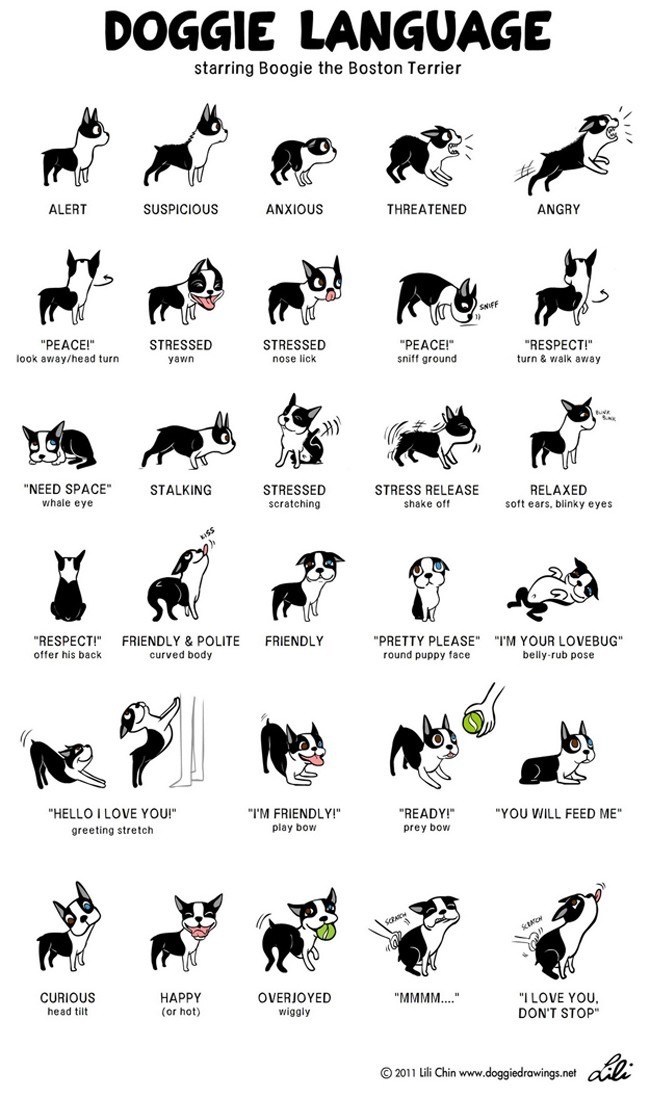
Doggie Language Continued
Lately, I have seen many articles written on dog language and what your dog may be telling you. I published my own post entitled “Doggie Language” back on June 25th, the link can be found here:
There are just so many ways our dogs speak to us that one post will never be enough. Even when you think you have it all covered you suddenly think of something else, see your dog do something new, or read something else from another individual’s perspective. That is why today I am writing about this subject once again.
So here’s an interesting question that I have been asked a few times, and it makes me laugh every time I see someone on Facebook, or another site posting a joke or photo about it. Why do dogs follow you into the bathroom?
(image courtesy of Pinterest.com)
Having a loyal dog in your household ensures an incredible amount of love between you and your pup. Understanding your dog can be easy and it’s not hard to understand that your pup wants to give you some love with kisses, however your pup may often behave in more subtle manners as well.
Now, most of us aren’t mentalists or even Dr. Doolittle, so here are some things your dog may do and what they are trying to say to you:
Puppy dog eyes – puppy dog eyes are often used by young children whenever they really want something. Your pup may use them to show love and it enforces a greater trust between you both.
Following you around – you must agree that it is absolutely adorable when your pup follows you all over the house. According to some Veterinarians, following behavior is a dog’s instinct, to always do things with their pack/family.
Giving you gifts – I have had my dogs bring me dead birds, squirrels, and even once a live baby squirrel into the house. The gift is not always as interesting or gross, sometimes it’s a ball to play fetch or a stuffed toy, but turns out that our pups simply want to share their joy with us and there’s no better person to share it with!
Cuddle time after dinner – most of us are used to our dogs cuddling at bedtime or on the couch when we watch tv, but cuddling with you after their bellies are filled with a hearty meal shows that your pup is truly comfortable around you.
Licking your face and body – there are some people who love it, others find it gross, but all dogs like giving licks once in a while. Licking is actually a submissive behavior and it actually helps your pup ease their stress level as well as of course being a sign of loving you.
Going “crazy” when you come home – the second your dog hears you coming back home, chaos ensues. I know at my house it starts the minute I pull into the driveway, I can hear them even before I put my key in the lock.. Your pup is just happy you’re home, happy to see you! This enthusiastic response is just their way of saying “I missed you”.
Knowing when something is wrong – Your pet doesn’t need to be able to actually talk to you to sense that something is wrong or if you’re feeling sad. They read your body language and use their senses to detect if something is wrong. They are also more than willing to help you feel better.
Crawling into your bed – not everyone sleeps with their dogs, it’s a personal preference. Perhaps once every so often, your pup will join you in your bed, they won’t just sit there, they keep you close. Often they will cuddle you, they lay on you. When you’re not home and away for work, they may just want to smell you so they climb in the bed because they miss you.
Raising a single paw or tapping you with a paw – raising one of two paws usually means your dog is in the mood for some playtime or wants attention. Sometimes, they’ll do this when they see something interesting in their environment, they will sit with one paw raised like a statue.
Leaning against you – if your dog is actively leaning against you, it means he or she is looking for some extra love, hugs, pets from you. Dogs always love to have your undivided attention!
Try to get your opinion – have you ever had the feeling that your dog was looking for your approval? Your pup actually really appreciates and values your opinion. A little love and affection go a long way!
(image courtesy of Pinterest.com)
Whether you have a new dog or you and your pup have been together for a while, it’s helpful to know the meaning of their communication signals so that you can adjust your own behavior as needed and also you know how your pup is feeling.
Dogs make vocalizations and gestures using their face and body just as us humans do in order to express their feelings. While some of these gestures can appear similar to ours, they can have very different meanings. It is my hope that my original post on the subject and in this follow up, I have helped you learn a little more about how to interpret your dog’s various actions and that you’ve learned something new about how to communicate more effectively with your own pup!
When I was reading this I was struck by Lea reminding me, and all other dog lovers, that the role of the gestures and faces of our dogs so closely matches how we humans communicate non-verbally. No wonder the bond between dog and human can be so close and wonderful.
You loved Sam Grant’s photos of Casper and Scotland. Learn more about her.
Last Sunday my Picture Parade was primarily a recent item that appeared on the BBC website.
Meet Scotland’s ‘most well-travelled dog’
By Ewan Murrie, BBC Scotland news website, 3rd June 2017
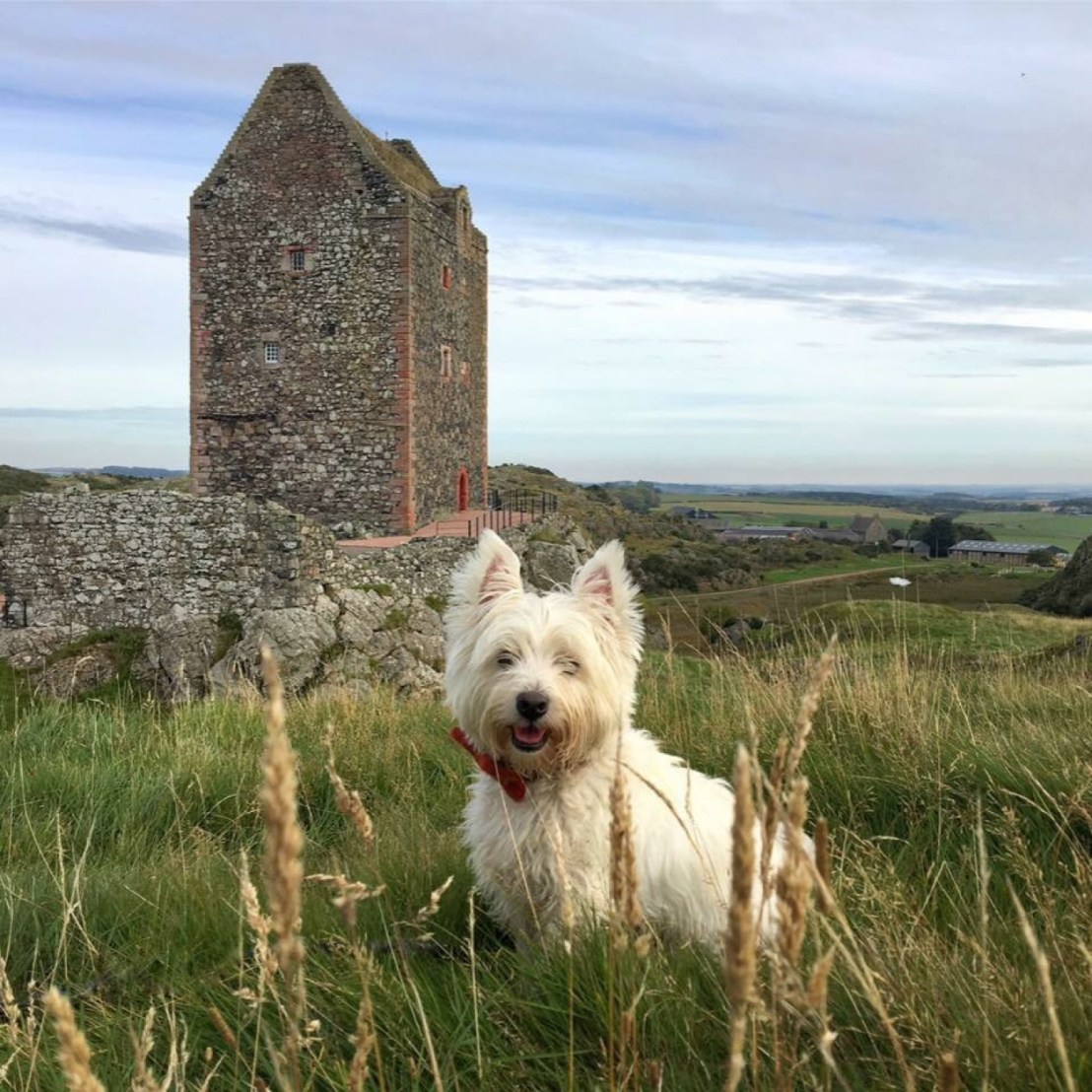
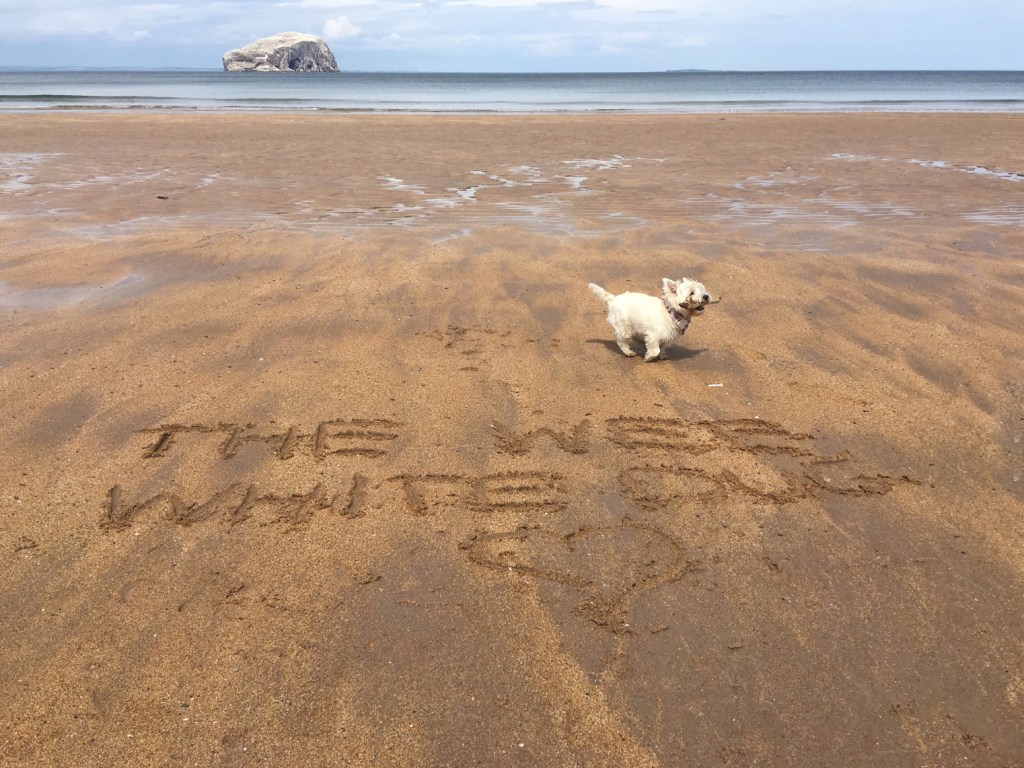
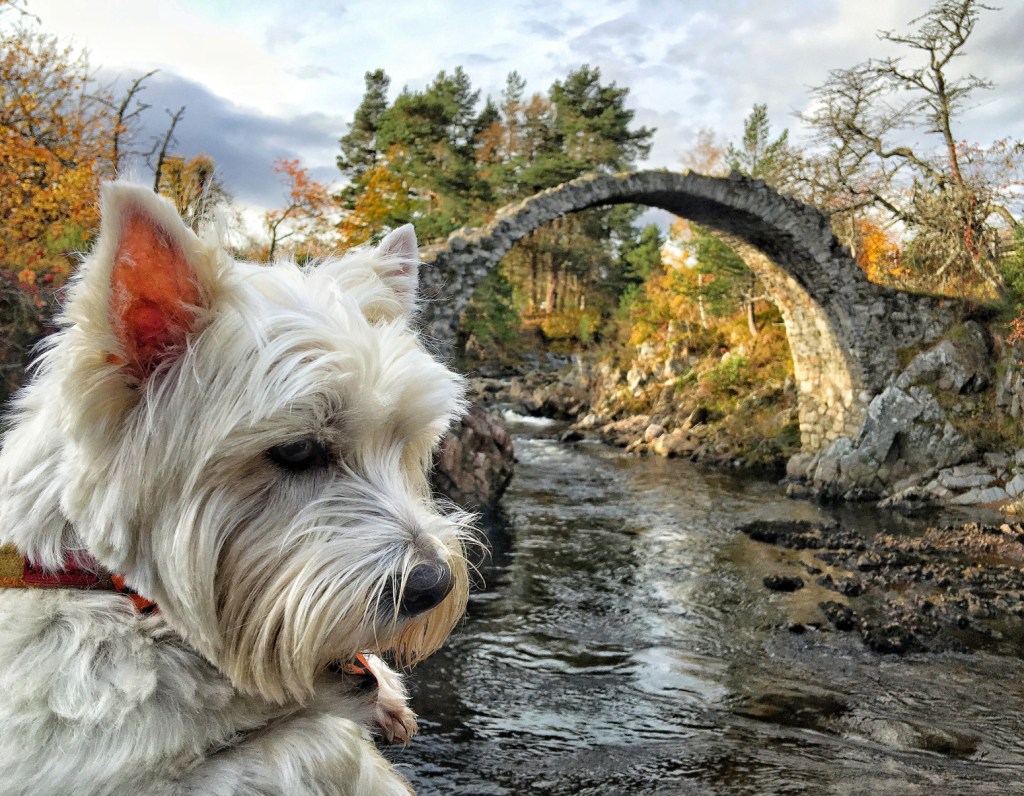
After photographs of her West Highland Terrier received more “likes” on social media than even the most stunning Glencoe landscapes she could capture, Sam Grant conceded that “the wee white dug” should star in her Scottish travel blog.
I went on to republish a wonderful set of photographs that had been taken by Sam. You all loved them and that led me to ask Sam if I could republish her About Me page on her blog. Sam very kindly said that would be fine.
ooOOoo
Scotland with the Wee White Dug
A Scottish travel blog showcasing the best of Scotland. Scotland with the Wee White Dug is a comprehensive and informative guide to Scotland, covering history, outdoor activities, events, visitor attractions, accommodation, eating out and more.
About Me
A little bit about me
Hello and welcome to my Scottish travel blog which I hope you’ll find informative and interesting, but most of all fun.
I’m Samantha but am generally known as Sam, Mrs G or Mum. I’m married to Alex (Mr G) and we live in Edinburgh with a well travelled wee white dug called Casper. We also share our home with the The Teen, Casper’s sloth like and gadget obsessed big sister.
All of my free time is spent road-tripping around Scotland. I’ve travelled extensively throughout the country and never tire of its jawdropping and diverse beauty.
I have a vast knowledge of where to stay, eat and what to do in Scotland. Whether it be an afternoon out, a day trip or an extended tour. I also know all of the best places to go with your four legged friend.
I’m a Visit Scotland Ambassador and I helped launch their online Community in the spring of 2016. The Community is a Scottish travel forum for sharing insider hints and tips about visiting Scotland. Visit Scotland’s Ambassadors were selected for their expert knowledge of the country.
In January 2017 I took up the role of resident blogger for East Lothian Council on their Visit East Lothian website. I write a fortnightly post for their blog, highlighting the delights of East Lothian.
I’m passionate about the history, language, literature, customs and myths of Scotland. I read History at the University of Edinburgh and during my time there I studied Scottish History, Literature and Politics which gave me an excellent understanding of how Scotland became the country that it is today.
I absolutely adore the great outdoors – it’s my happy place. I love hiking, have been known to summit a Munro or two and am happiest when surrounded by lochs, moors and mountains.
My photography
I’ve been an avid hobby photographer since joining Instagram several years ago. I’m part of a diverse group of Scottish Instagrammers with a passion for sharing Scotland with the World.
My feed @bean_nighe has appeared on Instagram’s prestigious Suggested User list. You’ll find the Wee White Dug on Instagram too @theweewhitedug. His feed is also dedicated to sharing our Scottish travels.
My photos appear regularly on various social media channels including those of Canon UK, BBC, Skyscanners, Scottish Memories Magazine, Scotrail, Historic Scotland, Visit Scotland and The Guardian.
I share my Scottish travels on Facebook and Twitter too so if you’re on those sites stop by and say hello.
I’m passionate about promoting Scotland as a wonderful place to visit. It’s a country with a rich history and heritage. A country full of stories just waiting to be told.
I appreciate you taking the time to stop by my blog to join me on my travels. I hope ‘Scotland with the Wee White Dug’ inspires you to visit Scotland, helps you to plan for a forthcoming trip or makes you reminisce fondly about a past visit.
If you’re interested in working with me you can find out more here.