Category: Education

Up, Up And Away?

It is very hard to avoid hyperbole when one speaks of global warming.

I am indebted to The Nation magazine, May 8/15 Issue, in which is included a feature article authored by Bill McKibben. My sub-heading is much of what Bill wrote in his first line.

It is hard to avoid hyperbole when you talk about global warming. It is, after all, the biggest 
thing humans have ever done, and by a very large margin.

A few sentences later, Bill offers this:

In the drought-stricken territories around the Sahara, we’ve helped kick off what The New York Times called “one of the biggest humanitarian disasters since World War II.” We’ve melted ice at the poles at a record pace, because our emissions trap extra heat from the sun that’s equivalent to 400,000 Hiroshima-size explosions a day.

Yet what scares me, scares me beyond comprehension, is the almost universal disregard being shown by Governments and those with power and influence right across the world to what in anyone’s language is the most pressing catastrophe heading down the tracks. Not next year; not tomorrow, but now!

Or in Mr. McKibben’s words, once more from that Nation article:

But as scientists have finally begun to realize, there’s nothing rational about the world we currently inhabit. We’re not having an argument about climate change, to be swayed by more studies and journal articles and symposia. That argument is long since won, but the fight is mostly lost—the fight about the money and power that’s kept us from taking action and that is now being used to shut down large parts of the scientific enterprise. As Trump budget chief Mick Mulvaney said in March, “We’re not spending money on that anymore. We consider that to be a waste of your money to go out and do that.” In a case this extreme, scientists have little choice but to be citizens as well. And given their credibility, it will matter: 76 percent of Americans trust scientists to act in the public interest, compared with 27 percent who think the same thing about elected officials.

Whatever your response is to what I have already presented, the one thing that I do know is that you have been aware of humanity’s effect on our atmosphere for many, many years. Indeed, Bill McKibben wrote his first book twenty-eight years ago!

His 1989 book The End of Nature is regarded as the first book for a general audience about climate change, and has appeared in 24 languages; he’s gone on to write a dozen more books.

But I would be the first to acknowledge that back in 1989 while I did become aware of Bill McKibben and did purchase and read that book of his, I didn’t see the effects he prophesied. In addition, I didn’t understand the mechanisms that would bring those effects into place.

Now, today, it’s very difficult to deny that global weather systems are behaving in ways that most do not understand albeit we do understand how those weather changes are affecting our lives.

One person who did, and still does even more, understand the physics involved in our changing weather, is Patrice Ayme. For some nineteen years after Bill McKibben’s first book, Patrice published a post on his blog. I have been following Patrice’s blog for some years and while I would be the first to stick my hand in the air and declare that some of his posts are a little beyond me, there’s no question of the integrity of his writings and his bravery in spelling out the truth of these present times. (OK, the truth a la Monsieur Aymes but I would place a decent bet of PA being closer to the core truth of many issues than Joe Public.)

I am indebted to Patrice for granting me permission to republish that post. Please read it. Don’t be put off by terms that may not be familiar to you. Read it to the end – the message is very clear.

ooOOoo

Applying Equipartition Of Energy To Climate Change PREDICTS WILD WEATHER.

By Patrice Ayme, March 8th, 2008.

Lately, the world weather has been especially perplexing, influenced by the cold ocean temperatures of a La Niña current in the equatorial Pacific. For Earth’s land areas, 2007 was the warmest year on record.

This year, record cold is more the norm. Global land-surface temperatures so far are below the 20th-century mean for the first time since 1982, according to the National Climatic Data Center. Last month in China, snowstorms stranded millions of people, while in Mumbai, officials reported the coldest day in 46 years.

Yet, England basked in its fourth-warmest January since 1914, the British Met Office reported. The crocus and narcissus at the U.K.’s Royal Botanical Gardens at Kew flowered a week earlier than last year — 11 days ahead of their average for the decade and weeks ahead of their pattern in the 1980s. In Prague, New Year’s Day was the warmest since 1775.

“It is difficult to judge the significance of what we are seeing this year,” said Kew researcher Sandra Bell. “Is it a glitch or is it the beginning of something more sinister and alarming?”” (Robert Lee Hotz, Wall Street Journal, March 8, 2008).

Many scientists have pondered this question, as if they did not know the answer, but it is a straightforward application of thermodynamics.

A basic theorem of equilibrium thermodynamics, the EQUIPARTITION OF ENERGY theorem, says that the same amount of energy should be present in all degrees of freedom into which energy can spill.

(How does one demonstrate this theorem? Basically, heat is agitation, kinetic energy at the scale of atoms and molecules. This agitation can spill in a more organized manner, in great ensembles, such as vast low and high pressure systems, or large scale dynamics. See the note on entropy and negative temperatures.)

In the case of meteorology, this implies, oversimplifying a bit, that only one-third of the energy should go into heat (and everybody focuses on the augmentation of temperature). Now, of course, since the energy enters the system as heat, non equilibrium thermodynamics imposes more than one-third of the energy will be heat.

As time goes by, though, the other two degrees of freedom, potential energy (represented as the geometry of gradients of pressures, high and low pressure systems, hurricanes) and dynamics (wind speed and vast movements of air masses of varying temperatures and/or pressure; and the same for sea currents) will also store energy.

Thus the new heat created in the lower atmosphere by the increased CO2 greenhouse will be transformed in all sorts of weather weirdness: heat, cold, high and low pressures, wind, and big moves of big things. Big things such as vast re-arrangements of low and high pressure systems, as observed in the Northern Hemisphere, or the re-arrangement of sea currents as apparently also observed, and certainly as it is expected. Since it happened in the past (flash ice age of the Younger Dryas over Europe, 18,000 years ago).

As cold and warm air masses get thrown about, the variability of temperatures will augment all over.

In other words, record snow and cold in the Alps and record warmth simultaneously in England is a manifestation of the equipartition of energy theorem applied to the greenhouse warming we are experiencing. It is not mysterious at all, and brutal variations such as these, including sudden cold episodes, are to be expected, as more and more energy gets stuffed in the planetary climate, and yanks it away from its previous equilibrium.

Wind speed augmentations have already had a spectacular effect: by shaking the waters of the Austral ocean with increasingly violent waves, carbon dioxyde is being removed as if out of a shaken carbonated drink. Thus the Austral ocean is now a net emitter of CO2 (other oceans absorb CO2, and transform it into carbonic acid).

Hence the observed variations are the beginning of something more sinister and alarming. Climate change is changing speed. Up, up, and away.

Patrice Ayme
Patriceayme.com
Patriceayme.wordpress.com.

Note on entropy: Some may object that transforming heat into collective behavior of vast masses of air or sea violates the Second Law Of Thermodynamics, namely that entropy augments always, in any natural process. Well, first of all, the genius of the genus Homo, not to say of all of life itself, rests on local violations of the Second Law. Secondly, the most recent physics recognizes that fundamental considerations allow systems where increased energy lead to increased order (such a system is said to be in a negative temperature state).

Even more revealingly, a massive greenhouse on planet Earth would lead, as happened in the past, to a much more uniform heat, all around the planet, that is, a more ordered state. Meanwhile, the transition to the present order of a temperate climate to the completely different order of an over-heated Earth will bring complete disorder, as observed.

ooOOoo

Going to leave you with a picture taken from weather.com

An emaciated polar bear is seen on a small sheet of ice in this image taken in August in Svalbard, north of mainland Norway. (Kerstin Langenberger)

Please, please, please: make a difference! Environmentally, domestically and politically, please make a difference.

Dog & Cat Food Recall

This was issued a little over two hours ago!

It concerns possible contamination of food with Salmonella so please read and share as widely as you can.

ooOOoo

Smallbatch Dog and Cat Food Recall of May 2017

May 5, 2017 — Smallbatch Pets Inc. of Portland, OR, is voluntarily recalling two lots of its Smallbatch frozen chicken blend for dogs and cats due to the potential to be contaminated with Salmonella.

About Salmonella

Salmonella can affect animals eating the products and there is risk to humans from handling contaminated pet products, especially if they have not thoroughly washed their hands after having contact with the products or any surfaces exposed to these products.

Symptoms of infection in people include nausea, vomiting, diarrhea or bloody diarrhea, abdominal cramping and fever.

Rarely, Salmonella can result in more serious ailments, including arterial infections, endocarditis, arthritis, muscle pain, eye irritation, and urinary tract symptoms.

Consumers exhibiting these signs after having contact with this product should contact their healthcare providers.

Pets with Salmonella infections may be lethargic and have diarrhea or bloody diarrhea, fever, and vomiting.

Some pets will have only decreased appetite, fever and abdominal pain.

Infected but otherwise healthy pets can be carriers and infect other animals or humans.

If your pet has consumed the recalled product and has these symptoms, please contact your veterinarian.

No pet or consumer illnesses from this product have been reported to date. However, because of their commitment to safety and quality, Smallbatch Pets is conducting a voluntary recall of this product.

Consumers should also follow the Simple Handling Tips published on the Smallbatch Pets package when disposing of the affected product.

What’s Recalled?

The affected lots of 2 pound bags of Smallbatch Chicken Blend were distributed to retail pet food stores in the following states:

  • California
  • Colorado
  • Oregon
  • Washington

Two hundred eighty-two cases of this product were sold between the dates of 2/1/17 and 5/5/17.

The affected products are sold frozen in 2 pound bags.

The products affected by this recall are identified with the following manufacturing codes and “Best By” dates, located on the back of the package.

  • Lot: D032
    UPC: 705105970974
    Best By: 2/1/2018
  • Lot: E058
    UPC: 705105970974
    Best By: 2/27/2018

    What Caused the Recall?

    The recall was initiated after routine testing by the Food and Drug Administration of a 2 pound bag of Smallbatch Chicken Blend that was collected at a distributor revealed the presence of Salmonella.

    This recall is being made with the knowledge of the U.S. Food and Drug Administration.

What to Do?

Consumers who have purchased the above lots of Smallbatch Chicken Blend are urged to stop feeding the product to their dogs or cats and to return product to place of purchase for a full refund.

Or dispose of them immediately.

Consumers with questions are asked to call the company at 888-507-2712, Monday through Friday, 9:00 AM to 4:00 PM PST.

Or via email at info@smallbatchpets.com.

U.S. citizens can report complaints about FDA-regulated pet food products by calling the consumer complaint coordinator in your area.

Or go to http://www.fda.gov/petfoodcomplaints.

Canadians can report any health or safety incidents related to the use of this product by filling out the Consumer Product Incident Report Form.

Get Dog Food Recall Alerts by Email

Get free dog food recall alerts sent to you by email. Subscribe to The Dog Food Advisor’s emergency recall notification system.

ooOOoo

Once again, good people, read and share.

The aesthetic beauty of mathematics!

Sorry! Did you say the beauty of mathematics?

Those of you that read this blog fairly regularly know that from time to time I drift away from all things dog and potter in the garden of simply fascinating ideas.

Such is the case today.

It is an article on mathematics that was sent to me by Jim Goodbrod. He had read it in The New York Times in April.

Read it and see if you, too, find it as fascinating as I did!

ooOOoo

The World’s Most Beautiful Mathematical Equation

Training a dog correctly

A guest post from Robert Michael.

Jean and I went to a conference down in Medford last Saturday. It was a conference to do with Parkinson’s Disease and was arranged by the group Parkinson’s Resources of Oregon (PRO).

Almost immediately upon our arrival at 1pm we saw a gentleman in his wheel chair accompanied by his service dog. That gentleman soon identified himself as Ken Schiff and his wonderful service dog was named Lacey. It was clear within moments how beautifully behaved was Lacey and, by implication, how well trained he had been to perform his role as a service dog to Ken.

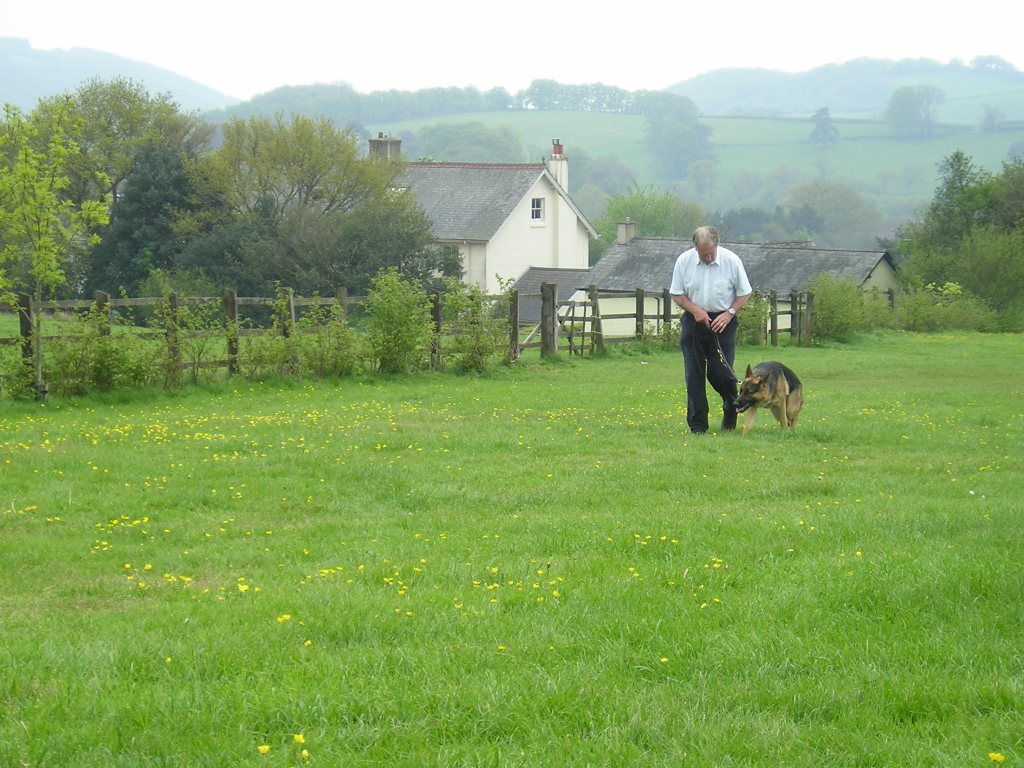
That took me way back to my days of working with Pharaoh back in Devon; before Jean and I met. Living in a very rural part of England with, reputedly, there being more sheep than people, one of the early requirements was to train Pharaoh to behave properly in the vicinity of sheep. Here are a couple of pictures from that training day in Devon.

Pharaoh’s training the afternoon of the 11th May, 2004.

oooo

Luckily the training paid off! Pharaoh was fabulous in and around sheep!

Needless to say, Pharaoh also received professional training for his general behaviours.

So treat all of the above as my introduction to a guest post by Robert Michael. On dog training. So who is Robert Michael?

Robert Michael

Robert is professional dog trainer having an experience of almost 8 years now. And he loves to contribute to the pets blogs to enjoy his passion. Plus, I write free of cost for those pets blogs: do you have one? Contact me rob.michael47@gmail.com

ooOOoo

A Comprehensive Visual Guide on Dog Training Schedule to Get 100% Outcomes

by Robert Michael. April 26th. 2017

There are a number of acts to follow on time, when your dog is on a training with you! So, if it is said that, you can get no any effective outcomes of the dog training, without making a proper schedule; it would not be wrong at all.

So, you must be aware of the fact that:

Making an appropriate dog training schedule is necessary for a super effective output. Now you might be thinking that:

How to make a dog training schedule?

So, it is not a tough task to do so! You just can make a schedule by following the tips given below:

  • Take a pen and diary specified in writing and following the schedule.
  • Save notes in your mobile phone, and set the reminders.
  • Make an Excel sheet containing the schedule.
  • Make an MS Word document to file the training schedule.
  • Make a training schedule chart and attach to one of the walls of your home.

So, these are the super easy ways, you can make and follow the training schedule of your dogs.

  • You will be habituated by the training schedule.
  • Your dog will get habituated by the schedule timings.
  • You will get a punctual routine.
  • Your training sessions will prove to be more effective.
  • You will be able to train your dog by an organized manner.

What can you include in the schedule?

  • The feeding timings.
  • The playing timings.
  • The walk timings.
  • The toilet timings.
  • The training sessions’ timings.
  • The exercise timings.
  • The sleeping and waking up timings.

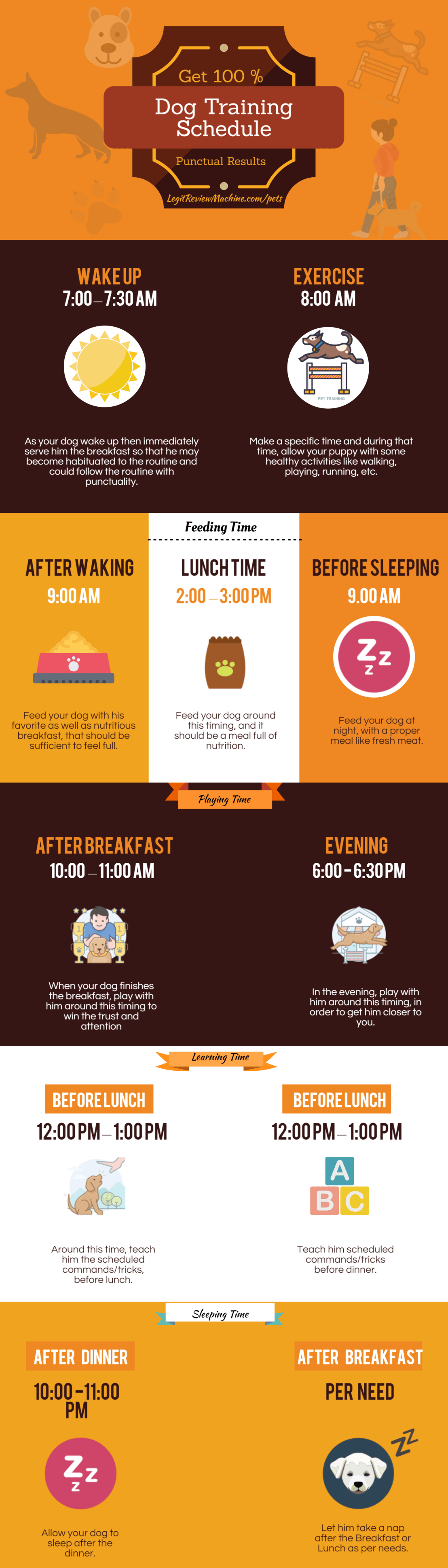
You can see the Legit Review Machine infographic to better understand the dog training schedule ways and steps.

ooOOoo

And here is that infographic that Robert included as a separate image in his email to me.

Puppy Training Schedule

I’m sure many of you will have found this very useful and I do hope there will be more guest posts from Robert.

Dogs are saving our lives!

Literally, not just emotionally!

Over on my website, under My Writings, I mention my recently published booklet, The Amazing World of Dogs.

Here’s an extract from pages 17-18 of that booklet.

Finally, Dr. Morten Kringelbach of the Department of Psychiatry at Oxford University1 explains that the need to nurture is very deep in us humans and that dogs produce an instinctive parental response in us that is very similar to our nurturing instinct for our children.

If the magic of having dogs in our lives for such a long time ended there it would still be breathtakingly wonderful. But dogs could now be offering us humans the capacity to understand many human diseases. Literally, our dogs could be saving our lives!

The challenge in understanding human diseases is that within our ‘breed’ there is a great variability of genes. Not surprising when one considers the incredible diversity and variation within us humans.

But when we turn to dogs then we have a bonus. For despite there being, as mentioned earlier, 400 or more different breeds of dog, within each breed dogs are very similar to each other. In other words, that narrow gene pool within a specific dog breed makes if far easier to pinpoint genetic mutations than it is in humans.

Elinor Karlsson is the director of the Vertebrate Genomics Group at the Broad Institute of MIT and Harvard.2 As a geneticist, Dr. Karlsson has identified, “hundreds of diseases common to dogs and humans”. In 2005, the dog’s genome was fully mapped; all 2.4 billion letters of the dog’s genome

Among those common diseases between us humans and our wonderful dogs are diabetes, cardiac diseases, epilepsy, many cancers especially bone cancers, and breast cancer and even brain tumours.

So it was an obvious thing to do to republish the following article that appeared on the Care2 site a few days ago.

ooOOoo

 Could a Dog Vaccine Help Save Kids With Brain Cancer?

By: Laura Goldman April 17, 2017

About Laura Follow Laura at @lauragoldman

The statistics are grim: About 60 to 70 percent of children who have glioblastoma, a form of brain cancer, do not survive more than two years. This fast-growing cancer is resistant to traditional treatments like radiation and chemotherapy.

For dogs, cancer statistics are also grim. More than 6 million dogs are diagnosed with cancer every year, and one out of four dogs will get cancer during their lifetime. It’s the leading cause of death for dogs after the age of two.

But there could be hope for both dogs and kids. A vaccine being developed that destroys cancer cells in dogs could also be successful in fighting glioblastoma in children.

Researchers at Children’s Mercy Hospital in Kansas City, Mo., have started a partnership with ELIAS Animal Health, a company that’s testing treatments for osteosarcoma (bone cancer) and B cell lymphoma in dogs.

“If we take advantage of the resources we have in this region and get behind those collaborations, this could be a mecca for advanced, exciting, innovative therapies for cancer and lots of other diseases,” Dr. Doug Myers, an oncologist at Children’s Mercy, told the Kansas City Star.

ELIAS Cancer Immunotherapy (ECI) uses the dog’s own immune system to destroy the cancer. “Research has shown that ex vivo activated T cells have the machinery to effectively kill cancer cells, including cancer stem cells,” according to the company’s website. “ELIAS Cancer Immunotherapy utilizes adoptive cell therapy to deliver an army of activated T cells.”

The dog is vaccinated with his own cancer cells to produce an immune response, then the generated white blood cells destroy the cancer cells.

“Personalized T cells are then safely obtained from the patient through apheresis [the removal of blood] and then ‘super charged’ to produce a large population of killer T cells that are reinfused into the patient to kill the cancer,” the company explains.

ELIAS Animal Health is currently conducting clinical trials of ECI at Kansas State University, the University of Missouri-Columbia and a few animal hospitals across the country. The success rates of using ECI along with surgery on dogs with cancer are being compared with those of patients that are treated with surgery alone.

“Early clinical study results already show positive outcomes,” Tammie Wahaus, CEO of ELIAS Animal Health, said in November 2016.

Among the ECI success stories is that of Dakota, a German shorthaired pointer who continues to survive a year after she was diagnosed with osteosarcoma. This is twice as long as her original prognosis. X-rays taken during a follow-up examination showed no signs of the cancer spreading.

Could ECI also successfully treat children with glioblastoma? Dr. Kevin Ginn, a pediatric oncologist at Children’s Mercy, and other researchers are currently developing protocols for trials. They’re planning to apply for a Phase II clinical trial with the U.S. Food and Drug Administration, using the results of ECI’s studies on safety and effectiveness as far as dogs are concerned. The Phase II trial would give ECI to a large group of children to see if it’s effective and further evaluate its safety.

Animal health trials are regulated by the U.S. Department of Agriculture. They are less expensive and proceed faster than FDA-regulated human trials, the Kansas City Star reports, “but successful human health treatments often bring a larger return on investment.”

In this case, a larger return on investment could be a win-win for children as well as dogs with cancer.

Photo credit: cgordon8527

ooOOoo

My booklet closes thus:

Many would extend that proficiency of dogs to include their sense of loyalty and forgiveness, to and of us humans, but that all pales into insignificance when compared to what our understanding of dogs is giving us.

No less than the capacity to help cure many of our diseases, to deeply understand the workings of the human mind, and above all else, to offer insight into our very existence.

That’s quite a relationship!

Quite a relationship indeed!

Thinking anew.

Humanity’s safe and viable future depends on seeing things very differently.

Next Tuesday is the 62nd anniversary of the death of Albert Einstein, the famous German theoretical physicist who died on the 18th April, 1955. He delivered many innovative ways of seeing our world way beyond his theory of relativity, one of the two pillars of modern physics (alongside quantum mechanics) (Ref: Wikipedia)

Why do I introduce today’s post with that reference to Mr. Einstein?

Because I wanted to share with you a recent essay from George Monbiot and an Einstein quotation seemed so apt an introduction.

We shall require a substantially new manner of thinking if mankind is to survive.

That essay from George Monbiot was published yesterday and is shared with you all with Mr. Monbiot’s full permission.

It is an essay that deserves being read slowly and carefully. Please take time aside to so do because it really does offer a new manner of thinking.

ooOOoo

Circle of Life

By reframing the economy, Kate Raworth’s Doughnut Economics changes our view of who we are and where we stand.

By George Monbiot, published in the Guardian 12th April 2017

So what are we going to do about it? This is the only question worth asking. But the answers appear elusive. Faced with a multifaceted crisis  – the capture of governments by billionaires and their lobbyists, extreme inequality, the rise of demagogues, above all the collapse of the living world – those to whom we look for leadership appear stunned, voiceless, clueless. Even if they had the courage to act, they have no idea what to do.

The most they tend to offer is more economic growth: the fairy dust supposed to make all the bad stuff disappear. Never mind that it drives ecological destruction, that it has failed to relieve structural unemployment or soaring inequality, that, in some recent years, almost all the increment in incomes has been harvested by the top 1%. As values, principles and moral purpose are lost, the promise of growth is all that’s left.

You can see the effects in a leaked memo from the UK’s foreign office: “Trade and growth are now priorities for all posts … work like climate change and illegal wildlife trade will be scaled down.” All that counts is the rate at which we turn natural wealth into cash. If this destroys our prosperity and the wonders that surround us, who cares?

We cannot hope to address our predicament without a new worldview. We cannot use the models that caused our crises to solve them. We need to reframe the problem. This is what the most inspiring book published so far this year has done.

In Doughnut Economics: seven ways to think like a 21st-century economist, Kate Raworth reminds us that economic growth was not, at first, intended as a measurement of well-being. Simon Kuznets, who standardised the measurement of growth, warned: “the welfare of a nation can scarcely be inferred from a measure of national income.” Economic growth, he pointed out, measures only annual flow, rather than stocks of wealth and their distribution.

Raworth points out that economics in the 20th Century “lost the desire to articulate its goals.” It aspired to be a science of human behaviour: a science based on a deeply flawed portrait of humanity. The dominant model – “rational economic man”, self-interested, isolated, calculating – says more about the nature of economists than it does about other humans. The loss of an explicit objective allowed the discipline to be captured by a proxy goal: endless growth.

The aim of economic activity, she argues, should be “meeting the needs of all within the means of the planet.” Instead of economies that need to grow, whether or not they make us thrive, we need economies that “make us thrive, whether or not they grow.” This means changing our picture of what the economy is and how it works.

The central image in mainstream economics is the circular flow diagram. It depicts a closed flow of income cycling between households, businesses, banks, government and trade, operating in a social and ecological vacuum. Energy, materials, the natural world, human society, power, the wealth we hold in common: all are missing from the model. The unpaid work of carers – principally women – is ignored, though no economy could function without them. Like rational economic man, this representation of economic activity bears little relationship to reality.

So Raworth begins by redrawing the economy. She embeds it in the Earth’s systems and in society, showing how it depends on the flow of materials and energy, and reminding us that we are more than just workers, consumers and owners of capital.

The Embedded Economy. Graphic by Kate Raworth and Marcia Mihotich

This recognition of inconvenient realities then leads to her breakthrough: a graphic representation of the world we want to create. Like all the best ideas, her Doughnut model seems so simple and obvious that you wonder why you didn’t think of it yourself. But achieving this clarity and concision requires years of thought: a great decluttering of the myths and misrepresentations in which we have been schooled.

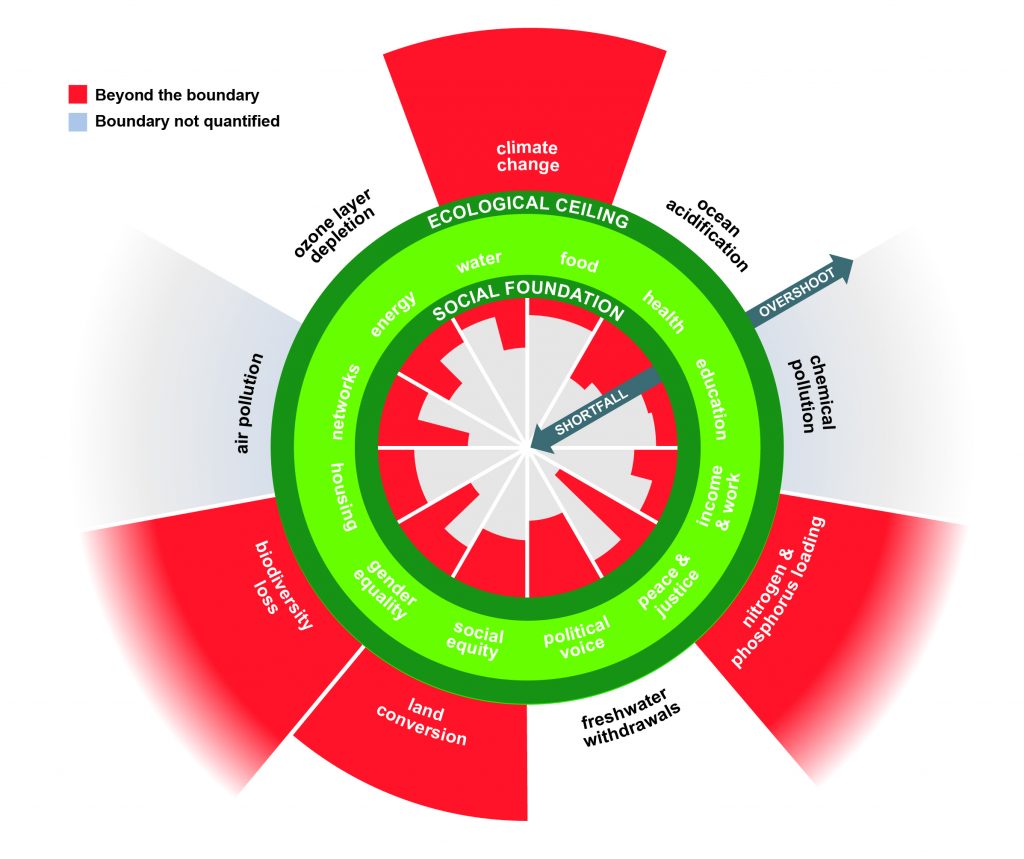
The diagram consists of two rings. The inner ring of the doughnut represents a sufficiency of the resources we need to lead a good life: food, clean water, housing, sanitation, energy, education, healthcare, democracy … . Anyone living below that line, in the hole in the middle of the doughnut, is in a state of deprivation.

The Doughnut. Graphic by Kate Raworth and Christian Guthier/The Lancet Planetary Health

The outer ring of the doughnut consists of the Earth’s environmental limits, beyond which we inflict dangerous levels of climate change, ozone depletion, water pollution, loss of species and other assaults on the living world. The area between the two rings – the doughnut – is the “ecologically safe and socially just space” in which humanity should strive to live. The purpose of economics should be to help us enter that space and stay there.

As well as describing a better world, the doughnut model allows us to see, in immediate and comprehensible terms, the state in which we now find ourselves. At the moment we transgress both lines. Billions of people still live in the hole in the middle. We have breached the outer boundary in several places.

Where we are now. Graphic by Kate Raworth and Christian Guthier/The Lancet Planetary Health

An economics that helps us to live within the doughnut would seek to reduce inequalities in wealth and income. Wealth arising from the gifts of nature would be widely shared. Money, markets, taxation and public investment would be designed to conserve and regenerate resources rather than squander them. State-owned banks would invest in projects that transform our relationship with the living world, such as zero-carbon public transport and community energy schemes. New metrics would measure genuine prosperity, rather than the speed with which we degrade our long-term prospects.

Such proposals are familiar, but without a new framework of thought, piecemeal solutions are unlikely to succeed. By rethinking economics from first principles, Raworth allows us to integrate our specific propositions into a coherent programme, and then to measure the extent to which it is realised. I see her as the John Maynard Keynes of the 21st-Century: by reframing the economy, she allows us to change our view of who we are, where we stand, and what we want to be.

Now we need to turn her ideas into policy. Read her book, then demand that those who wield power start working towards its objectives: human prosperity within a thriving living world.

www.monbiot.com

ooOOoo

 Please, wherever you are and whatever your plans are for this long weekend, do take great care of yourself and all your loved ones!

Being a great pet owner

Again and again the connections are wonderful!

On the 21st March, I received an email. It read:

Hello!

According to the ASPCA, animal shelters take in 7.6 million dogs and cats each year. Unfortunately, only 2.7 million animals are adopted each year. I’d love to see that number increase.

I’ve been a pet owner for decades. I know the seemingly infinite joy and love that comes from having a pet. But I also remember how nervous I was when I adopted my first dog.

To ease first-time and potential pet owners’ anxiety about caring for a pet, I would love to offer advice on how to be a great pet parent. Tips will be culled from my own experience and the experience of my blog’s (OurBestFriends.pet) contributors.

Can I write a guest article for your readers? My hope is that the piece will encourage folks to adopt a loving animal. The content will be completely original and free of charge. Please let me know if you’d like to take part.

Hope to hear from you soon!

Jessica

Jessica Brody

Ourbestfriends.pet

What a wonderful email and, of course, I was only too pleased to receive Jessica’s article.

Here it is:

ooOOoo

Survival Guide for First-Time Pet Owners: How to Be a Great Pet Parent

By Jessica Brody, 6th April, 2017

If you’re considering adopting a four-legged friend for the first time, you’re about to embark on an amazing journey. From learning your new pet’s unique personality traits to navigating the demands of providing the best care for your new family member, adopting a pet is a learning experience, but an enriching one. Here are a few essential tips to help you transition your new furry friend seamlessly into your family.

Make Arrangements for Regular Exercise

Dogs, in particular, require regular exercise. They say that a tired dog is a well-behaved dog. If you work long hours, consider hiring a dog walker who can take your pup out for a mid-day potty break and walk. Make sure your new pet – dog or cat – has plenty of toys to keep them occupied while you’re working or otherwise unable to devote your full attention to them while you’re at home.

From bones and dental chews to balls, bells, and feathers, there’s no shortage of unique and intriguing toys on the market to keep your pet entertained and healthy.

If you own your own home, you might also consider installing a fence around a section of your yard. That way your new pet will have a place to run and play without having to be on a leash. You can also use the space for training.

Choose a Veterinarian You Trust

First and foremost, your new pet will need to see a veterinarian. If you’re adopting from a shelter or rescue organization, your pet may come with veterinary records and may already be spayed or neutered. If you’re adopting a new pet from a pet store or breeder, however, you’ll most likely need to take care of initial vetting on your own.

Ask friends and family members for vet recommendations and call around to inquire about office policies and prices to make an informed decision. It’s important that you find a veterinarian that you trust to provide top-notch care for your beloved pet.

Choose a Quality Pet Food

All pet food is not created equal. If you want your pet to live a long, healthy life, you should choose a top-quality pet food that contains healthy ingredients and has a solid track record. There have been many pet food recalls in recent years, with some causing serious illness and even death in pets.

Do your research to determine what foods are the best and safest for your dog’s stage of life and health history. Puppies require different food than older dogs, for instance, and dogs with certain health conditions have special dietary requirements. Talk to your vet if you’re uncertain.

Establish Rules and Routines

Adopting a new pet for the first time requires a bit of playing by ear, as you don’t know exactly what your pet’s quirks will be. However, it’s a good idea to establish some general ground rules from the start. For example, what will you do to keep your pet out of storage areas where dangerous substances, such as yard care chemicals, anti-freeze, or pool chemicals are kept? Will you allow your dog on the furniture? Will your dog or cat sleep in your bed with you? Will you crate your dog while you’re at work?

Your pet will surely have a mind of her own, but knowing what general boundaries you want to set before introducing her to your home will help you be consistent with training.

Give Your Pet Plenty of Affection

While all of these tips are essential steps for being the best pet parent you can be, perhaps the most important is to give your pet plenty of love and affection. Dogs thrive on attention, while cats tend to be quite varied in their preferences. Some are lap cats, hopping on the nearest warm lap they can find; others are loners and generally prefer to be left to their own devices. Get to know your pet’s personality and make sure to shower him with as much love and affection as he wants.

Being a great pet parent isn’t hard, but these important tips will help you integrate your new furry friend into your family with ease. Setting boundaries and rules from the beginning with consistent reinforcement, making sure your pet gets plenty of exercise and has enough toys and activities to keep her engaged, and choosing top-quality pet food and a veterinarian you can trust will ensure that you and your pet can enjoy many joyful years together.

Image via Pixabay by OrsiO

ooOOoo

Naturally, I asked Jessica to write a few words about herself. This is what she sent me.

Jessica is the creator of OurBestFriends.pet. Jessica lives in Dallas, Texas with her loving family (which includes 2 dachshunds and a black lab). She is a certified dog lover, and believes dogs are just about the greatest creatures on earth. She loves collecting and sharing photos of them.

I know many will agree with me when I say that it would be good to receive some more articles from Jessica.

Another life-saving dog!

There’s no end to how dogs protect us!

Last Tuesday, I published a guest post that had been sent to me by my sister, Eleanor, who lives in Johannesburg in South Africa.

Then a day later I read on the Care2 site about a therapy dog that alerted a group of schoolchildren to potentially very unsafe drinking water.  I must share that with you as well.

ooOOoo

Therapy Dog Helps Alert School District to Lead in Water

A therapy dog belonging to a San Diego elementary school teacher proved to be a potential lifesaver – but not for what you might think.

When the teacher filled his bowl with water from the classroom sink on Jan. 26, the dog refused to drink it. The teacher took a good look at the water in his bowl and noticed a sheen on its surface. Concerned, she notified school officials.

After testing samples from around Emerson-Bandini Elementary and the San Diego Co-Operative Charter School 2, which share a campus, results showed the water was contaminated with lead, exceeding the allowable level in the state of California.

School officials contacted the City of San Diego Public Utilities Department, which supplies the water. Because that therapy dog that refused to drink it, the city is now testing the water at each of the school district’s 187 campuses.

The tests, however, won’t begin until April 4, San Diego Unified Chief Operations Officer Drew Rowlands announced last week. In the meantime, students are getting bottled drinking water.

A notice sent to the schools’ staff and parents said the water is safe for handwashing. Since cafeteria meals aren’t prepared on campus, they’re not affected by the contaminants in the water, according to the notice.

The testing of the water, which is expected to be completed by the end of the school year in June, will take place early in the morning, before school starts. At each campus, up to five samples will be taken from water fountains and cafeterias where food is prepared. The test results will be posted online.

If excessive lead is discovered, the contamination source will be determined and school district staff will take “appropriate action on a case-by-case basis,” said San Diego Unified Chief Operations Officer Drew Rowlands. Those appropriate actions could include replacing plumbing fixtures and making repairs.

Making Drinking Water Safe for Schoolchildren

Coincidentally, just one month before the therapy dog refused to drink the San Diego school’s water, the State Water Resources Control Board (SWRCB) Division of Drinking Water launched a program that requires water providers to test for lead in the drinking water at all K-12 schools in California.

“Recent events in the United States have shown that lead in drinking water remains an ongoing public health concern, particularly for children,” the SWRCB stated on its website.

How does lead end up in school water fountains? Although lead rarely occurs naturally in California’s drinking water sources, it can contaminate water that flows through old plumbing fixtures or the solder connecting them. It’s less likely that the water came from a contaminated source, as was the case in Flint, Mich.

Children younger than six are especially susceptible to the effects of lead poisoning. According to the Centers for Disease Control (CDC), about half a million children between the ages of one and five have blood lead levels above 5 micrograms per deciliter, the level at which the CDC recommends the initiation of public health actions – although no “safe” blood lead level in children has been identified.

A problem with lead poisoning is that there are no obvious symptoms. By the time children show the signs, such as weight loss, irritability and lack of appetite, dangerous amounts of lead may have accumulated in their bodies.

This is a compelling reason for more states to follow California’s lead and require water to be tested in schools. Thanks to a teacher’s therapy dog, students at two San Diego schools got a jump start on having safer water available.

Photo credit: Irisdepiris

ooOOoo

 There is no end to the way that dogs love us, protect us and make us better persons!

Putting a smile on your dog’s face!

Dogs do suffer from depression.

OK, in many cases I’m sure it is because dogs are watching too much television; especially the news!

OK: Only kidding!

Some may be surprised that dogs can express sadness and suffer from depression but it is true.

Only a few days ago there was a bit of a ‘punch up’ between Brandy and Ruby. Ruby was feeding and Brandy approached her food bowl. Ruby gave a short, throaty “stay away from my food” growl and the next instant Brandy had Ruby’s face in his mouth and it was quickly turning into a Grade A dog fight.

Luckily Jean and I were on hand and had the two of them separated within seconds. But it was still sufficient time for Brandy to have drawn blood from a small bite to the side of Ruby’s face.

However, the point I was coming to was that since that incident Ruby has clearly been very depressed and withdrawn.

So on to today’s topic. Recently published on Mother Nature Network.

ooOOoo

Is my dog depressed? The warning signs and solutions

Find out what causes doggy depression and how to fix it.

Jaymi Heimbuch March 30, 2017.

Dogs can get the doldrums. But there are ways to help them come out of it with a wagging tail. (Photo: Iuliubo/Shutterstock)

Yes, dogs can get depressed. Whether or not it’s the same as what humans experience, we may never know since we can’t ask a dog. But there are signs and symptoms from a dog’s behavior that reveal when a dog is in the doldrums. If you’ve noticed a sudden change in your four-legged friend’s behavior and are worried, you may need to see if the change is a clue that your dog needs some psychological TLC.

Common triggers for dog depression

Dogs are creatures of habit, activity and loyalty. A sudden change that affects their world can cause a dog to have a spat of depression. Triggers include:

  • The addition of a new person or pet to the family
  • A sudden drop in attention from an owner or family members
  • A sudden change in the household schedule
  • The loss of an owner or companion
  • Moving to a new home
  • A traumatic injury

Dogs may also suffer from Seasonal Affective Disorder, or SAD, during the winter months. Stanley Coren reports in Psychology Today: “Do dogs suffer from SAD? Some data comes from a survey conducted by a leading veterinary charity in the UK. PDSA (The People’s Dispensary for Sick Animals) found that approximately 40 percent of dog owners saw a considerable downturn in their pet’s moods during the winter months. In addition, half of the dog owners felt that their dogs slept longer, with around two in five reporting their pets to be less active overall.”

Some dogs may suffer depression simply for not having a job to do. The Guardian notes:

“In the not too distant past, dogs mostly had to work for a living and were probably very often physically and mentally fatigued at the end of the day – which is why we have the expression ‘dog-tired’. Could the stress of being made redundant be the source of this apparent unhappiness? Dog behaviourist Penel Malby told me: ‘Dogs live very differently to the way they used to. Lots more dogs, lots more people, lots more stress for everyone, I think. If you think back even just 50 years, dogs were allowed to roam free every day, socialise with their neighbourhood friends. Now they either go out with a dog walker or go out for an hour if they’re lucky, and the rest of the time is spent at home.'”

The upside is that canine depression usually isn’t permanent, or even necessarily long-lived, and there are ways to combat it to help your dog get back to normal in due time.

What are the warning signs?

Watch for warning signs of depression so you can catch the trouble early and help your dog recover. (Photo: DREIDREIEINS Foto/Shutterstock)

The most common symptoms dogs display when they’re depressed mirror those that humans experience during a depression. They include:

  • Sleeping much more than usual
  • A change in eating habits, including a loss or gain in appetite and in weight
  • A refusal to drink water
  • A lack of interest in usual energetic activities like going for walks or playing
  • Excessive licking of their paws
  • Excessive shedding
  • Become withdrawn or hiding in the house
  • Suddenly showing signs of aggression or anxiety

Unfortunately, these symptoms also occur with a range of other medical issues. A dog might have a change in appetite because of a thyroid or kidney issue, or the dog might not want to go on a walk because of joint pain or arthritis flaring up. So if you notice any changes in your dog’s behavior, the first thing to do is visit the vet to rule out any serious health-related issues before assuming it comes down to depression.

How to help your dog out of a depression

Sometimes time, extra love and a steady routine is all that’s needed. (Photo: Soloviova Liudmyla/Shutterstock)

If you have determined your dog is feeling depressed, there are many things you can do to help them pull out of it.

– Take your dog on more frequent walks during the day to favorite places, allowing them to sniff around and enjoy the scenery. It’s also helpful to do this first thing in the morning to start the day out with a bit of fresh air and energy.

– Try to keep a schedule as much as possible. Dogs are creatures of habit and having a predictable routine can be an enormous source of comfort for a stressed or depressed dog, especially if the trigger for the depression was a sudden change in routine.

– Reward your dog when he shows signs of improved mood or energy. Rather than babying the dog during the down times — which reinforces that behavior — reward him with extra special treats or a favorite toy when he shows a bit of enthusiasm about life to amplify the mood even more.

– Bring home a new toy, such as a squeaker or puzzle toy that stimulates the senses and encourages play.

– If the cause of depression is the loss of a companion, like another household pet, consider adopting another dog that can be a companion. However, only do this if you’ve seriously considered the needs of your household and your depressed dog. It isn’t an option to be taken lightly.

As a last resort, medication could be an option. There are antidepressants for dogs that you can discuss with your veterinarian. However, catching depression early on and trying for behavioral changes first is the best solution. Bonnie Beaver, DVM, notes in a WebMD article, “[I]t can take up to two months for drugs to become effective. But unlike people, who often remain on antidepressants for years, most dogs can get better in six to 12 months and then be taken off the drugs.”

And finally, give it time. As Wag Walking notes, “Be Patient: Sometimes — especially if the issue was a loss of a companion or master — the only thing that will heal a dog’s heart is time. It may be as few as a couple days or as much as a few months, but most dogs will be able to pull themselves out of depression with a little time and understanding.”

ooOOoo

May you, your family and all your wonderful animals have a wall-to-wall happy weekend!

This is the dog!

Perhaps the loss of a loved dog explains so much!

The posts for the last two days have carried separate and very different stories of terrible cruelty to dogs, the second one involving terrible cruelty to a dog and a bull! As a tradition! Ouch!!

Readers of this place know what they feel about dogs. It is felt deep within their hearts. Those feelings are poured out when, either from me or someone else, there’s a post lamenting the loss of their dog.

Just as a tiny example of that love we all have for our dogs, here’s a response from Marina Kanavaki and, trust me, Marina is far from being alone in this regard.

Oh, no, Paul!!! I’m so sorry my friend! It is hard to believe and not so long ago, Casey. I know words can’t take away the pain but you have my thoughts and I’m sending you both my love and hugs.

So a recent essay published on The Conversation site is a must to share with you today. As usual, it is republished within the terms of The Conversation.

ooOOoo

Why losing a dog can be harder than losing a relative or friend

March 9, 2017
Frank T. McAndrew,   Cornelia H. Dudley Professor of Psychology, Knox College.

Recently, my wife and I went through one of the more excruciating experiences of our lives – the euthanasia of our beloved dog, Murphy. I remember making eye contact with Murphy moments before she took her last breath – she flashed me a look that was an endearing blend of confusion and the reassurance that everyone was ok because we were both by her side.

When people who have never had a dog see their dog-owning friends mourn the loss of a pet, they probably think it’s all a bit of an overreaction; after all, it’s “just a dog.”

However, those who have loved a dog know the truth: Your own pet is never “just a dog.”

Many times, I’ve had friends guiltily confide to me that they grieved more over the loss of a dog than over the loss of friends or relatives. Research has confirmed that for most people, the loss of a dog is, in almost every way, comparable to the loss of a human loved one. Unfortunately, there’s little in our cultural playbook – no grief rituals, no obituary in the local newspaper, no religious service – to help us get through the loss of a pet, which can make us feel more than a bit embarrassed to show too much public grief over our dead dogs.

Perhaps if people realized just how strong and intense the bond is between people and their dogs, such grief would become more widely accepted. This would greatly help dog owners to integrate the death into their lives and help them move forward.

An interspecies bond like no other

What is it about dogs, exactly, that make humans bond so closely with them?

For starters, dogs have had to adapt to living with humans over the past 10,000 years. And they’ve done it very well: They’re the only animal to have evolved specifically to be our companions and friends. Anthropologist Brian Hare has developed the “Domestication Hypothesis” to explain how dogs morphed from their grey wolf ancestors into the socially skilled animals that we now interact with in very much the same way as we interact with other people.

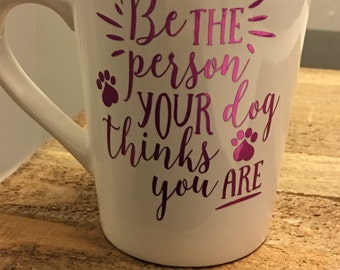
Perhaps one reason our relationships with dogs can be even more satisfying than our human relationships is that dogs provide us with such unconditional, uncritical positive feedback. (As the old saying goes, “May I become the kind of person that my dog thinks I already am.”)

This is no accident. They have been selectively bred through generations to pay attention to people, and MRI scans show that dog brains respond to praise from their owners just as strongly as they do to food (and for some dogs, praise is an even more effective incentive than food). Dogs recognize people and can learn to interpret human emotional states from facial expression alone. Scientific studies also indicate that dogs can understand human intentions, try to help their owners and even avoid people who don’t cooperate with their owners or treat them well.

Not surprisingly, humans respond positively to such unrequited affection, assistance and loyalty. Just looking at dogs can make people smile. Dog owners score higher on measures of well-being and they are happier, on average, than people who own cats or no pets at all.

Like a member of the family

Our strong attachment to dogs was subtly revealed in a recent study of “misnaming.” Misnaming happens when you call someone by the wrong name, like when parents mistakenly calls one of their kids by a sibling’s name. It turns out that the name of the family dog also gets confused with human family members, indicating that the dog’s name is being pulled from the same cognitive pool that contains other members of the family. (Curiously, the same thing rarely happens with cat names.)

It’s no wonder dog owners miss them so much when they’re gone.

Psychologist Julie Axelrod has pointed out that the loss of a dog is so painful because owners aren’t just losing the pet. It could mean the loss of a source of unconditional love, a primary companion who provides security and comfort, and maybe even a protégé that’s been mentored like a child.

The loss of a dog can also seriously disrupt an owner’s daily routine more profoundly than the loss of most friends and relatives. For owners, their daily schedules – even their vacation plans – can revolve around the needs of their pets. Changes in lifestyle and routine are some of the primary sources of stress.

According to a recent survey, many bereaved pet owners will even mistakenly interpret ambiguous sights and sounds as the movements, pants and whimpers of the deceased pet. This is most likely to happen shortly after the death of the pet, especially among owners who had very high levels of attachment to their pets.

While the death of a dog is horrible, dog owners have become so accustomed to the reassuring and nonjudgmental presence of their canine companions that, more often than not, they’ll eventually get a new one.

So yes, I miss my dog. But I’m sure that I’ll be putting myself through this ordeal again in the years to come.

ooOOoo

Just let the messages of this essay reverberate around your heart. I’ll say no more!