Opening up the world of a busy veterinary practice.
Like the majority of pet owners, our experiences of taking a cat or a dog to the local vet clinic are gained entirely in regard to those particular animals. The only small difference between this household and most others is that we have the distinct privilege of having Jim and Janet Goodbrod as close friends just a short distance away. Jim is a Doctor of Veterinary Medicine (DVM) and thank goodness for that as it was more than wonderful that Jim was able to be on hand a week ago when it came to Pharaoh’s last few moments.
Jim is a regular DVM working at Lincoln Road Veterinary Practice in nearby Grants Pass. That practice is run by Dr. Russel Codd.
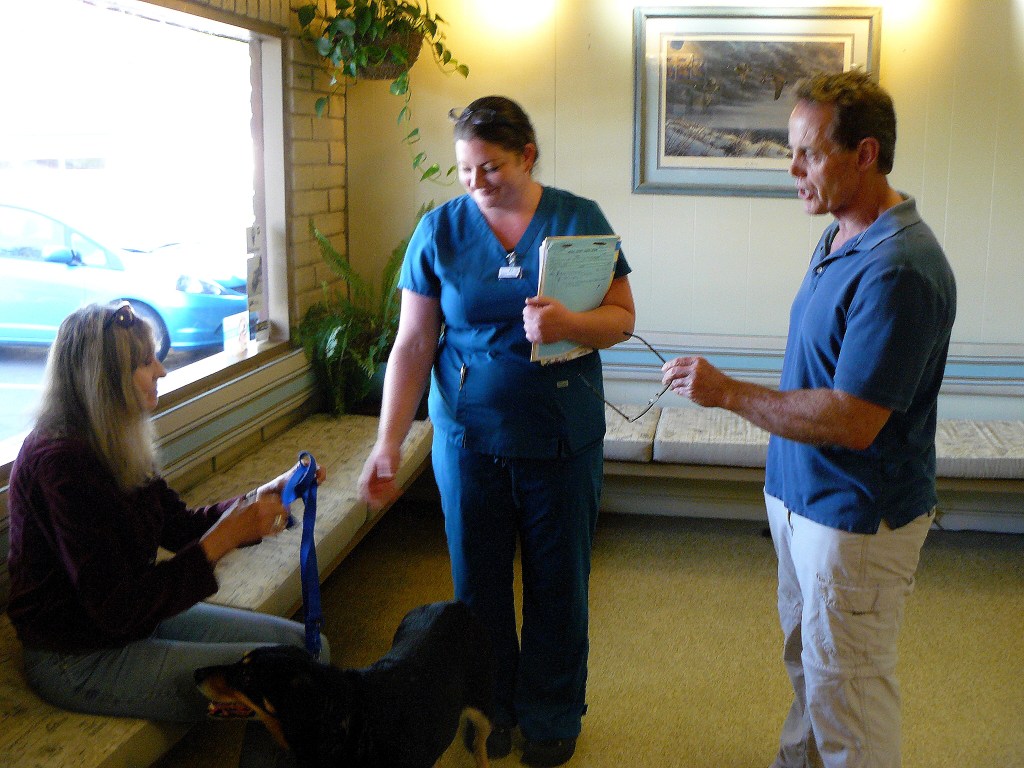
Dr. Russel Codd (RHS) speaking with Jean at the Clinic back in the days of our dear Hazel.
Some time ago, when we were visiting Lincoln Road, it struck me that the detail of what takes place ‘behind the counter’ of a busy vet clinic is most likely not commonly appreciated by those that visit said clinic.
I asked Russel one day if I might be allowed to spend time watching and listening to what goes on behind the scenes; so to speak. Russel said that he would be delighted for me to do that.
So it came to pass that last Thursday, June 22nd, I did just that.
It was a day when Dr. Jim worked a half-day at the clinic and I spent the thick end of six hours listening and observing what took place. I had a camera with me but as was only fit and proper was very sensitive to what photographs were taken. Likewise, I didn’t interrupt the proceedings with my questions although each pet owner had specifically said it was alright for me to be in the same room. In other words, what I will be writing in each post is much more my impressions of the workings of a day in the life of a veterinary clinic.
So tomorrow I will publish the first of my articles and at regular intervals report more from my day at Lincoln Road.
They will be published under the overall heading of Visiting The Vet.
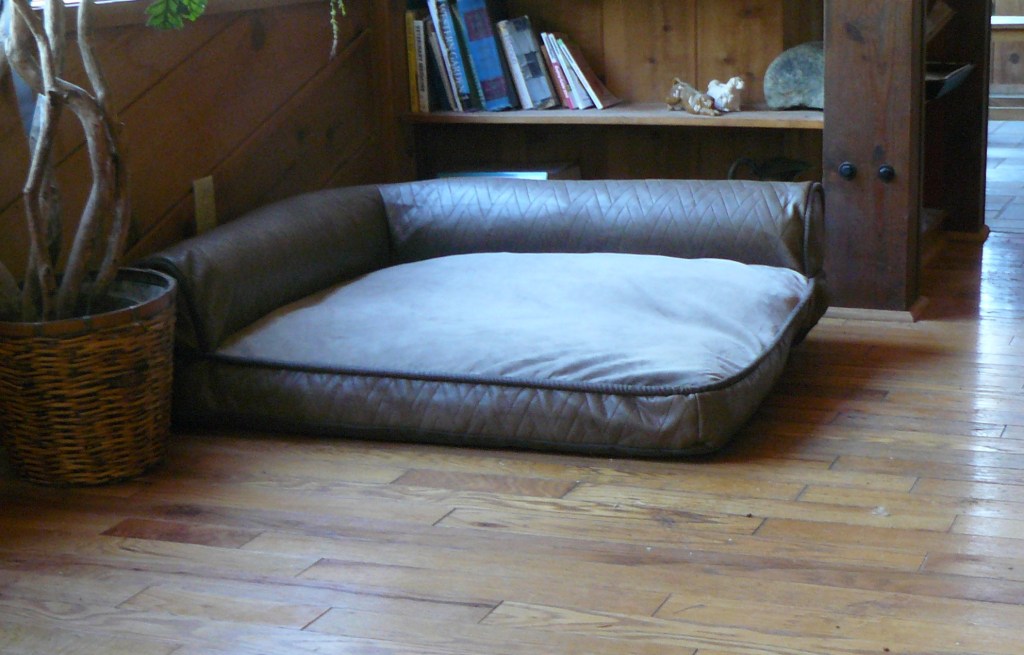
You will all recall the shock of me seeing Pharaoh’s empty bed that first morning after he had died. This picture:
Not only was it difficult to look at but not one of our other dogs went near it. This was despite the fact that Jean had washed and cleaned the whole bed.
One could almost imagine the dogs understanding that it would not have respected their memory of Pharaoh to immediately takeover his rather nice bed.
But life has to move on!
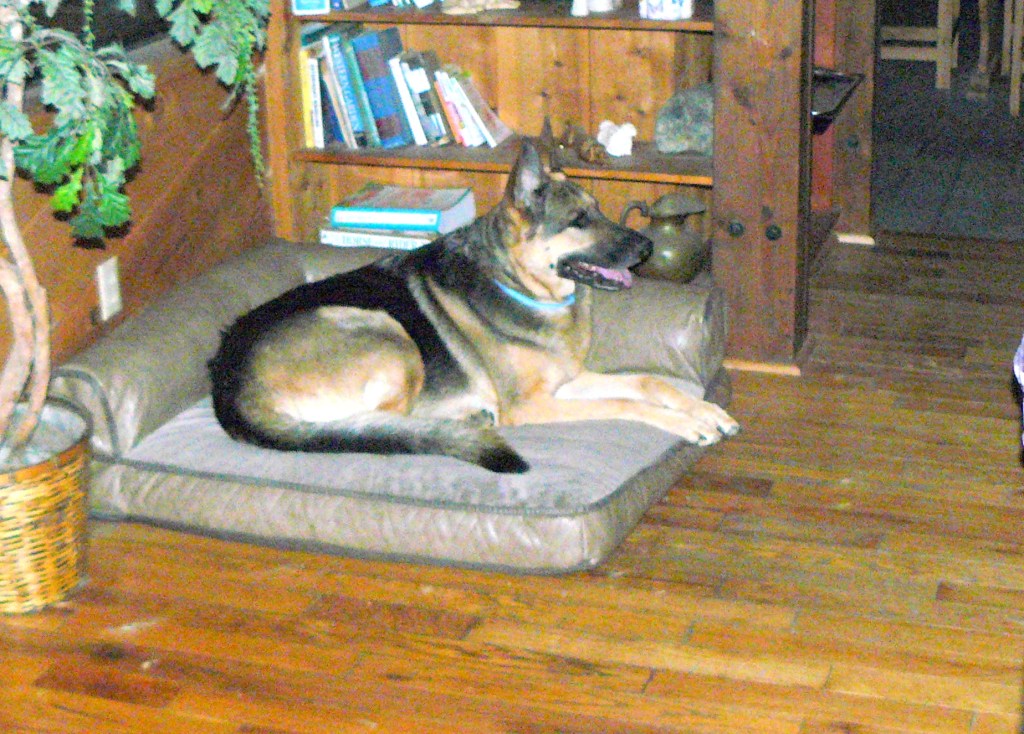
Yesterday evening, just as Jean and I were getting everyone ready for bedtime, Cleo signaled that she was moving on.
She had settled herself down on the bed.
That was so good to see and was another step in the right direction in settling me down as well!
So on the theme of being calm, especially in these hot summer months, do read this recent article that was published on the Care2 site.
My dogs are both terrified of thunderstorms. These are some of the tricks that vets and trainers have recommended to help our poor babes when stormy weather rolls in.
Our lab mix, Jenna, trembles in the corner when it thunders, while our 60-pound dog, Bandit, tries to leap into my lap. These are some of the ways to calm a dog during thunderstorms that we’ve tried.
Every dog is different, so what works for one may not work for another. Jenna is terrified of the Thundershirt, for example, but many people I know swear by it. Chances are, not all of these calming techniques will help your dog during a thunderstorm. You’re basically throwing spaghetti at the wall to see what sticks.
Ways to Calm a Dog During Thunderstorms
Lavender and massage oil on a old wooden background
1. Lavender Oil
You don’t want your dog to ingest lavender oil, so put a few drops on her collar when a storm is freaking her out. The soothing scent can help calm some dogs’ nerves, and the smell is a distraction from what’s going on in the sky.
2. Massage
Just like humans, dogs find massage soothing. The video above shows a calming massage that you can use on your dog during a thunderstorm. You can also try an ear massage, which Jenna responds to really well. Basically, you gently run your hand up the dog’s ear, from where the ear meets the head to the tip of the ear. When you reach the tip, gently massage for a second, then repeat. Like in the video, it seems to work best if I also talk to her in a soothing voice while massaging.
3. A Hand on the Back
Sometimes, your dog just needs to know that you are there and in control of the situation. This trick works well on our dog, Bandit, who is definitely boss dog in our house. During a storm, a hand on his back helps him feel like he can step back from being the pack leader, which helps him feel secure and safe. Talking in a soothing voice helps here, too.
4. Training Exercises
You may feel like it’s mean to start bossing your scared dog around, but practicing her sit/stay/shake is a great way to distract your dog from the storm and remind her that you’ve got this under control. This one works well on both of my dogs.
5. Thundershirt
These wrap shirts help soothe a lot of dogs during thunderstorms, and they’re available at any pet store. Many friends with dogs have recommended the Thundershirt to me. It made Jenna more anxious, but she is clearly in the minority in this situation.
6. White Noise
If your dog can’t hear the storm, your dog won’t be so scared. Dogs can feel the shift in pressure from a storm, even when they can’t hear it, so this technique seems to work best in conjunction with other calming techniques, like massage or lavender oil. Bring your dog to her favorite room, turn down the lights, and turn up the white noise. If you don’t have a white noise machine, you can find free white noise tracks on YouTube, like the one above.
7. Rescue Remedy for Pets
Rescue Remedy is a blend of plant extracts. They make homeopathic drops and gummies for humans, and they have drops for pets, as well. The site recommends putting the drops into water, but I’ve also had good luck putting them onto a treat or into a glob of peanut butter, if my dogs aren’t too scared from the storm to take a treat.
As I mentioned above, different natural remedies will work for different dogs, so don’t be discouraged if the first thing you try doesn’t work out. Sometimes, especially for high anxiety dogs, you’ll have the best results combining a few of these ways to calm a dog during a thunderstorm.
ooOOoo
I don’t know about tips for calming dogs, some of these sound great for yours truly!
Yesterday, I shared an article about what flowed from the bond between ex-shelter dogs and special needs children. It underlined what so many dog lovers instinctively understand: The magic that flows from the relationship of a dog to a person, disadvantaged or otherwise.
However, or perhaps better said inevitably, the obverse face of that life-saving bond practically guarantees that the loss of that bond results in huge stress and emotional turmoil for the dog.
In other words helping our beloved dog cope with the loss of a family member is something else that we can be helped with by others.
I liked the article and asked for permission to share it with you here. That permission was promptly given.
ooOOoo
Helping Your Dog Adjust To Loss or Separation
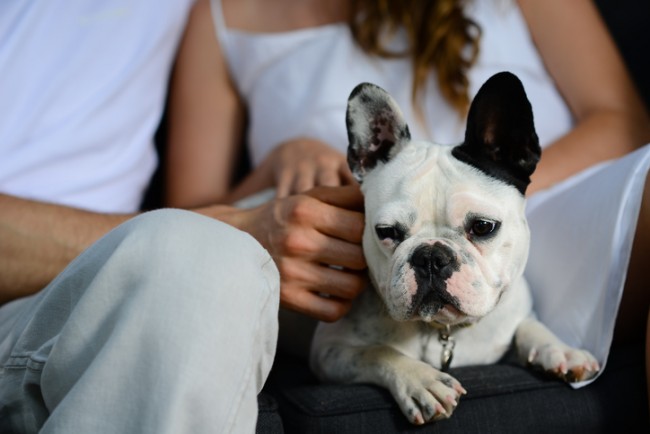
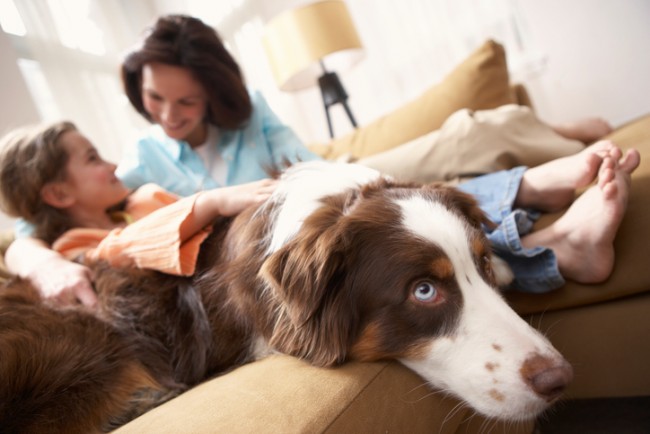
by Jennifer Hinders Whether it’s a death in the family, a child leaving home, or a divorce, your dog will notice that one of his “pack” members is missing. Learn to help him deal with his grief.
Grief has many forms, and can arise from many situations besides the death of a loved one. A relationship breakup, a child leaving home, even a prolonged business trip or hospital stay are all examples of family changes that can cause feelings of loss and grief in those remaining at home. That grief can be felt even more keenly by your dog, who doesn’t understand where the missing person is and when or even if s/he will be back.
My own dog became extremely sad when my husband left for an extended trip. Every time I sat down, he jumped in my lap (no small task since he weighs 50 pounds), lay his head on my arm and sighed pathetically. He poked around the house with his head drooping like a deflated balloon.
I asked veterinary behaviorist Dr. Nicholas Dodman about my dog’s behavior. “Dogs can get into a funk or lose interest in life because of separation,” he told me, adding that even short absences can cause changes in behavior. “For instance, if a man goes out to play a game of golf for five hours, the dog will feel temporary loss, but will be relieved when the owner returns.
“With long term separation or loss, dogs suffer bereavement and get depressed, not unlike humans,” Dr. Dodman adds. “Dogs have a difficult time adjusting to an owner or family member being removed from the household. This is especially the case if the person is someone to whom the dog is close — for example, a dog sleeps in someone’s room and then suddenly that person is out of the picture. The dog can’t understand why that person has disappeared.”
Symptoms of bereavement or loss
Here are some common symptoms that indicate your dog is grieving over a separation or loss:
He seems down and depressed.
He has lost interest in things he formerly liked to do.
He’s listless, not playing with toys.
His appetite changes – typically, a grieving dog eats less and may lose weight.
He shows signs of anxiety.
His energy seems low when he’s out for walks.
In extreme cases, bereavement can cause compulsive behaviors like incessant licking.
How to cheer him up
Many separations and losses in life are inevitable, which means you have to help your dog adjust to the absence of the missing family member. If you’re also grieving, it might be easy to overlook your dog’s feelings; but one of the best ways to help both of you is to try and find ways to make life happy and interesting again.
Act in an upbeat way around your dog; sympathy will actually make his depression worse because he’ll pick up on your own emotions. Dog behaviorist Bill Campbell calls this the “Jolly Routine”: when you act happy or jolly, it helps lift the dog’s mood. An old proverb states that “a cheerful heart is good medicine”. Being upbeat, fun and positive is good medicine for your dog (and for you).
Give your dog lots of attention — treats, new toys, extra walks or play sessions. Throw a ball. Let him play with other dogs. Consider getting him a new friend in the form of a puppy, if circumstances allow. When you go back to work after the loss or separation, don’t leave your dog at home alone. If your workplace allows, take him with you, or have him stay with a friend or family member he knows well.
The good news is that your dog’s grief will ease over time. He may feel low for a few weeks, but it’s generally temporary. As his owner, being aware of his suffering and taking the necessary actions to help him through it will speed his (and your) recovery and adjustment.
Losing a dog buddy is also hard on him
Dogs don’t just grieve when people in their lives die or go away. It’s also common for a dog to grieve over the loss of another dog he was closely bonded with. Dogs in the same household may play together, sleep together, operate as a pack, so the loss of one has a deep impact on the other.
Here’s one dramatic example involving two dogs in the same home. The older dog became terminally ill and needed to be put to sleep. The owner arranged for his healthy dog to go for a long run while the other was euthanized. Back home, the owner buried the older dog in the garden, covering the grave completely so it was basically indistinguishable from the surrounding area.
When the healthy dog was brought back from his outing, he ran around the house looking for his buddy, then begged to go outside. He immediately went to his friend’s grave and lay on it for three days.
ooOOoo
A few words of reflection from me following Jennifer Hinders useful article.
Death is inevitable. For both our beloved pets and, for that pet, their beloved humans. As they say about death and taxes!
But for that pet the loss of their beloved human can come about for other reasons apart from death.
Yet in the midst of say a divorce, or a loved young person leaving home to make their own life, it must be all too easy for people to lose the focus on what that means for the family pet, especially the family dog.
As in how a primate chooses to communicate with humans.
In recent times there have been a couple of posts in this place about the science of communication between dogs and humans.
What about other animals?
What about a gorilla?
If you drop across to the YouTube site and search for Koko the Talking Gorilla you will be astounded by how many videos are to be seen.
Try this one:
A very moving account from Robin Williams.
If we then want more background information on this remarkable animal, Wikipedia is there to oblige (in part):
Hanabiko “Koko” (born July 4, 1971) is a female western lowland gorilla who is known for having learned a large number of hand signs from a modified version of American Sign Language (ASL).
Her instructor and caregiver, animal psychologist Francine “Penny” Patterson, reports that Koko is able to understand more than 1,000 signs of what Patterson calls “Gorilla Sign Language” (GSL).[2] In contrast to other experiments attempting to teach sign language to non-human primates, Patterson simultaneously exposed Koko to spoken English from an early age. Reports state that Koko understands approximately 2,000 words of spoken English, in addition to the signs.[3] Koko’s life and learning process has been described by Patterson and some of her collaborators in a number of books, peer reviewed articles, and on a website.
Koko got her birthday wish this July 4th — not only did one kitten come to visit, but a whole litter. Koko fell in love with one, and the other fell in love with her. Koko has adopted these two kittens into her family, and it has energized her world.
Not only have Koko’s maternal and play instincts kicked in, but she is signing more to her caregivers and generating new content everyday that can be used by The Gorilla Foundation to create empathy for great apes. This can have significant benefits to both endangered free-living great apes and those in captive environments, by encouraging the development of 2-way communication with their caregivers (which Koko has had since she was a baby).
The Gorilla Foundation is now working on a multimedia sequel to the classic book, “Koko’s Kitten,” which has already reached millions of children worldwide, and has the power to motivate millions more to learn how to make the world a better place for all of its conscious inhabitants.
You can support The Gorilla Foundation mission of Conservation through Communication by visiting http://www.koko.org
Thank you!
Will close with this photograph seen ‘on the web’.
Graduate student Penny Paterson with a young Koko on her back not long after they met in 1971 in San Francisco. (The Daily Mail newspaper 2nd June, 2016.)
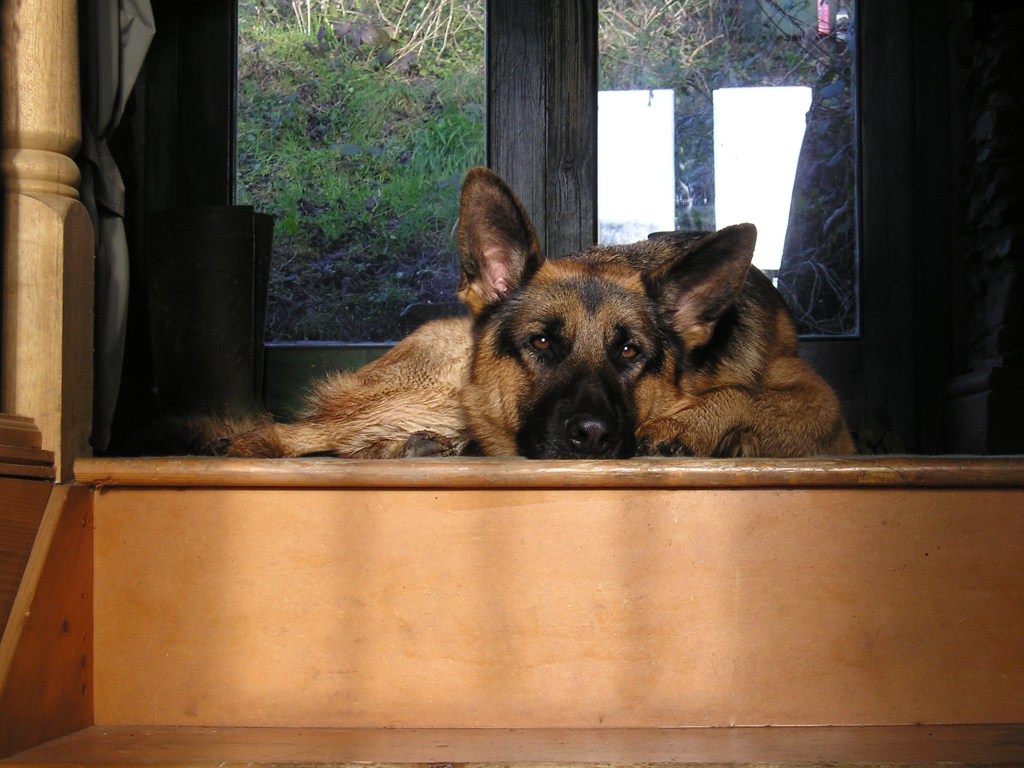
Here’s a photograph of Pharaoh taken on the 3rd December, 2005. Taken in my home in Harberton, Devon, some two years before I met Jeannie.
It’s not the world’s best photograph but I start today’s post with it simply because there is a look in Pharaoh’s eyes that spells out love to me in capital letters. Always has since the day I took that photograph.
Here’s an enlargement of the photo offering a closer look at Pharaoh’s expression in those eyes.
Right from the very first moment that I held Pharaoh I sensed the start of a loving bond. Did I choose to love Pharaoh? Well, of course I did! Was it a conscious decision? I don’t think so!
All of which is my introduction to a fascinating essay about the science of love that recently appeared on the Care2 site.
Love may often feel spontaneous and sometimes even out of control. But is it, really? Research is starting to show that you can change the intensity of love you feel towards others. Similar to emotions like fear or sadness, love can be influenced simply by how you think about a situation.
Is love under your control?
One study looked at altering love feelings in people who were either in a romantic relationship or had recently broken up from one. Each participant started by viewing pictures of their current lover or their ex-partner to bring up their current feelings towards them.
Then, researchers asked them to think about positive aspects of their partner, relationship or possible future scenarios. Their feelings towards their current or previous partners were assessed again.
The second part of the study asked participants to think of negative things about their partner, such as what’s wrong with them or their relationship.
Perhaps it’s not surprising that participants reported having greater love feelings after thinking positive thoughts. Whereas, they reported decreased lovingness after the negative thoughts. It was the same for everyone, whether they were in a relationship or had recently broken up.
Researchers felt this shows great potential for people to take more control of their emotional world, which could in turn benefit their lives and relationships.
Interestingly, thoughts also appeared to affect everyone’s overall mood and feelings about life in general. The positive thoughts improved people’s mood and disposition, whereas the negative thoughts brought everyone down.
This may highlight the importance of how positive and negative thoughts in general can affect our mental health.
How can you put this to use?
You can likely think of times in your own life when it would be helpful to either decrease or increase your love for another person.
Have you ever had an unwanted crush on someone? For instance, obsessing over a celebrity you’ll likely never meet can cause more frustration than joy in your life. Or maybe you’ve fallen for someone who’s not available, either physically or emotionally.
These are times when it’s in your best interest to end your attachment to the person and move on.
In addition, research has shown that thinking negatively about an ex-partner or your previous relationship helps you get over a break-up. The reverse is also true – if you think positively about an ex, it’s more difficult to heal and move on.
Keep this in mind if you’re going through a break-up, or need to reduce your feelings towards someone for another reason.
Try asking yourself questions like these:
What annoys me about this person?
Did we ever have a fight?
Why were we a bad match for each other?
What didn’t work in our relationship?
What could go wrong if we stayed together?
Reframing your thoughts is also a much healthier way to try to get over someone than taking self-destructive action to distract yourself, such as drinking too much.
On the other hand, the world always needs a lot more love to go around. Increasing your love towards others is often one of the best things you can do to help yourself and everyone in your life.
Unfortunately, the top reason married couples give for getting a divorce is growing apart and falling out of love. It’s true the intensity of love feelings usually fluctuates throughout a long-term relationship, but a decrease in feelings doesn’t have to mean the end.
If you’re starting to question whether or not you should stay in a long-standing relationship, take a closer look at your situation before making a final decision. Do you still respect and care for your partner? Do you still have lots in common? Is it possible you’re just in a temporary slump?
Questions like these may help to re-frame how you feel about your relationship:
What are some of your partner’s best qualities?
Why did you get together in the first place?
Are there things you’d like to do with your partner in the future?
What makes you a good match for each other?
Do you enjoy spending time with your partner?
Romantic partners who view each other in a positive light have been shown to actually have happier relationships. This is likely true for all relationships. Choosing more positive thoughts can go a long way towards creating greater harmony with all your loved ones.
Sharing your thoughts and telling others why you love them is even better.
ooOOoo
As my dearest Jeannie will confirm, I have never been the most comfortable person in terms of verbalising my love for her, despite Jean being the dream loving partnership of my life. Jean, on the other hand, expresses her love for me many times each day.
Maybe this essay offers an insight into the different ways we love?
For Jean also tells the dogs individually many times each day that she loves them. I feel the same but don’t say it anything like as often.
So is science showing us why the difference between Jean and me? I think so.
Yet another thing that we learn from dogs. Or more specifically that I have to learn from dogs!
The reason I start today’s post in such a fashion is that Jean and I have been mulling over how we might consider doing some traveling once we are down to six dogs. Indeed, to that end, just last week we met Jana Stewart, a local woman who came highly recommended and who has been in the pet industry for over 30 years.
The serendipitous aspect is that quite recently I received an email from a Sloan McKinney. This is part of what she wrote:
My name is Sloan McKinney and I am freelance writer and journalist and pet enthusiast. I just wanted to say that Learning from Dogs offers great information and advice about pet care issues.
I did happen to notice that you don’t have much information about pets and sitters, which I believe your readers would love to know more about, especially with many people having to leave their pets at home for travel or work.
Since your website contains relevant issues, I was wondering if you would be interested in sharing an infographic about choosing the right sitter for your pet.
More research quickly found Sloan’s background details:
Sloan McKinney is a journalist based in Southern California. After writing about pop culture for a number of years, she has recently begun writing for a new audience. Inspired by DeAnthony, her cat, as well as her dog Max, Sloan now hopes to help other pet owners guarantee their animal companions happy and healthy lives.
I replied that I would be delighted to receive Sloan’s guest post and her accompanying infographic. Here it is:
ooOOoo
How to Choose A Professional Pet Sitter and Why It’s Important
by Sloan McKinney. 1st June, 2017.
If you live with a four-legged friend, you sure understand how nervous and stressful it can be to leave it at home alone for a couple of days.
However, so wags the world that we sometimes have to travel, and oftentimes it is impossible to bring our pets with us. When such a situation occurs, you find yourself in an ethical dilemma. You have to choose between an expensive pet hotel or a friend who’ll be coming to your place once per day to feed your ball of fluff. While the first option is not cost-efficient, the second one might put you into uncomfortable situation when you have to ask your friend or relative to spend time on something that is your responsibility. What a hard choice to make, huh?
But the good news is that there is a great alternative in between the two options described above. This option won’t make you drain your purse, not it will make you feel shy and uncomfortable. Wonder what is it? Pet sitter is the answer. Yes, you will have to pay some money, but the price will be reasonable. No, you won’t have to put pressure on your friends or family members. And the best part is that professional pet sitters know how to make friends with virtually any pet. After all, it’s their job, right?
If you need more reasons to get convinced that pet sitters are the best solution, here is the list of benefits. To begin with, professional pet sitters guarantee regular visits and care. Apart from it, they can get on the right side of even the most demanding pet (of course, it might be still hard even for professional pet sitters to tame a squirrel or raccoon living in your attic). What’s more, they will assure an easier separation for both you and your four-legged friend.
Still not sure it’s a good idea to hire a pet sitter for your favorite ball of fluff? Then you absolutely need to see this beautiful infographic:
ooOOoo
Don’t know about you but Jean and I found that a very useful aide-memoir.
How did you find Sloan’s guest article? I would love to have your feedback.
Yesterday it was gliding, tomorrow it is going to be a celebration of Pharaoh’s 14th birthday and today it is about you!
Kadam Morten Clausen is a Buddhist teacher. Now I would be the first to stick up my arm and say that my understanding of Buddhism is pretty poor. But in the days many years back when I spent time exploring a number of Asian countries I found the culture surrounding Buddhism very appealing. (And I write as someone who is not a religious believer.)
Back to Morten Clausen.
The Kadampa Meditation Center in New York, where Kadam is a resident teacher, describe him as follows:
Kadam Morten met his teacher, Geshe Kelsang, while attending university in England. He taught widely throughout the UK and helped develop many Kadampa Centers in England. Kadam Morten has been teaching in the US for more than 20 years and has established centers throughout the New York area, as well as Washington DC, Virginia, and Puerto Rico. In addition to his local teaching responsibilities, he teaches and guides retreats regularly throughout the United States and Europe.
Kadam Morten is greatly admired as a meditation teacher and is especially known for his clarity, humor and inspirational presentation of Dharma. His teachings are always practical and easy to apply to everyday life. Through his gentle and joyful approach and his peaceful example, he has helped many people find true happiness in their hearts.
So what’s this all about when I say that today’s post is about you?
Evan Thompson of the University of British Columbia has verified the Buddhist belief of anatta, or not-self. Neuroscience has been interested in Buddhism since the late 1980s, when the Mind and Life Institute was created by HH Dalai Lama and a team of scientists. The science that came out of those first studies gave validation to what monks have known for years — if you train your mind, you can change your brain. As neuroscience has begun studying the mind, they have looked to those who have mastered the mind.
While Buddha didn’t teach anatta to lay people, thinking it might be too confusing, the concept is centered on the idea that there is no consistent self. The belief that we are the same one moment to the next, or one year to the next, is a delusion. Thompson says that “the brain and body is constantly in flux. There is nothing that corresponds to the sense that there’s an unchanging self.”
[W]hen there is no consistent self, it means that we don’t have to take everything so personally.
It is useful to look at a video of yourself from the past, or read something you wrote years ago. Your interests, perspective, beliefs, attachments, relationships, et al, have all changed in some way. Anatta doesn’t mean there’s no you; it just means that you are constantly changing, constantly evolving, and shape-shifting. Why is this important? Why does it matter if there’s no solid “you” or “me”?
Buddhist teacher Kadam Morten Clausen says Buddhism is a science of the mind:
Dr. Rick Hanson, author of Hardwiring Happiness and Buddha’s Brain, argues that when there is no consistent self, it means that we don’t have to take everything so personally. That is, our internal thoughts are only thoughts and don’t define us. External events are only external events and aren’t happening to us personally. Or as Tara Brach says, our thoughts are “real, but not true.”There is tremendous liberation in not identifying ourselves with thoughts, or a set idea of who we are.
It is then that we can grow and change, with the help of neuroplasticity. There is then hope that we can overcome our vices or bad habits (of mind and body), because if we aren’t stuck with the self-limiting beliefs inherent with a consistent self, we may orient ourselves toward becoming more of who we want to be.
The belief that we are the same one moment to the next, or one year to the next, is a delusion.
As science and Eastern thought continue to hang out with each other, there may be more 21st Century studies to back up 2,600-year-old thoughts. But, as HH Dalai Lama said, “Suppose that something is definitely proven through scientific investigation. … Suppose that that fact is incompatible with Buddhist theory. There is no doubt that we must accept the result of the scientific research.”Hearing a pro-science stance from a religious leader is a relief to many. In the end it seems Buddhism and neuroscience have similar goals: What is this thing we call the mind, and how can we use it to make ourselves a little less miserable and a little happier? Maybe even just 10 percent happier, as Dan Harris wrote. If there is no consistent self, it is at least my intention that my ever-changing self be equanimous and, well, 10 percent happier. No matter who I am.
—
Lori Chandler is a writer and comedian living in Brooklyn, NY, which is the most unoriginal sentence she has ever written. You can look at her silly drawings on Tumblr, Rad Drawings, or read her silly tweets @LilBoodleChild. Enough about her, she says: how are you?
PHOTO CREDIT: Chris McGrath/Getty Images
ooOOoo
So if there are times when you find yourself talking to yourself, perhaps the first thing to do is to ask if it is you! (Golly! I can feel a headache coming on!)
I am sharing this with you again because it so nicely complements the posts of the previous two days.
The ways our dogs speak to the world.
First published August 8th, 2016.
Dogs are very vocal creatures.
Anyone who has been close to dogs in their lives knows that they are frequently very vocal creatures. Likewise, anyone who has been close to a dog or two quickly learns to understand the basic emotions being conveyed by a dog’s vocal sounds.
But, nonetheless, there was an item over on the Care2.com site recently that provided a comprehensive tutorial on listening and interpreting the sounds from our dogs. I wanted to share it with you today.
Your dog communicates with you and other dogs in a variety of ways — including growling. Depending on the context, a growl can be anything from a sign of enthusiastic play to a warning of an impending attack. It is important to understand why your dog growls and when you should be concerned about this behavior.
A growl doesn’t always signal an unfriendly dog. Here are some common reasons your dog might growl and some situations where you may need to seek outside help.
Growling in Play
Dogs often growl during friendly play with other canines. This type of growling is typically higher pitched and shorter in length than other growls. To ensure that play is friendly, watch for the proper play signals and keep arousal levels low by taking frequent breaks.
Your dog may also growl when he plays with you. Pay attention to your dog’s body language during play — sometimes growling can indicate discomfort. Avoid rough play with hands and physical wrestling. If you are unsure about the distinction between acceptable play interactions and aggression, seek help from a professional.
Growling as a Warning
A dog who is afraid of something may growl to fend off potential harm; the message he’s sending is that he will defend himself if necessary. Some dogs may growl at any unfamiliar person, while others may respond only to specific types of people, like men with beards, or to sights they are uncomfortable with, such as a horse. If your dog growls only at specific people or things, remedial socialization help is needed.
Or your dog may growl at another dog as a way to tell him to back off before a confrontation occurs. Many times, the other dog will heed the growl and give your dog the space he desires. There are dogs, however, who will not back down when they are growled at; in this situation, a fight may ensue.
If your dog’s warnings to back off go unheeded, his growling may increase into other aggressive behaviors, making it difficult for him to be around other canines. Some dogs do best with only select doggy playmates, while others should be limited to socializing only with humans.
Growling for Medical Reasons
If your dog suddenly starts to growl when he is approached or touched, it may be a sign that he is in pain. Dogs with arthritis, abscessed teeth or other forms of illness or injury may experience increased pain when they are moved or touched and may growl to avoid it. A pet in pain is also more likely to bite than a healthy pet.
Pregnant or lactating dogs, or dogs in false pregnancy, are more likely to be protective and defensive with people and other animals, and are also more likely to growl at approaching humans. If you think your dog is growling for medical reasons, talk to your veterinarian.
Growling Out of Frustration
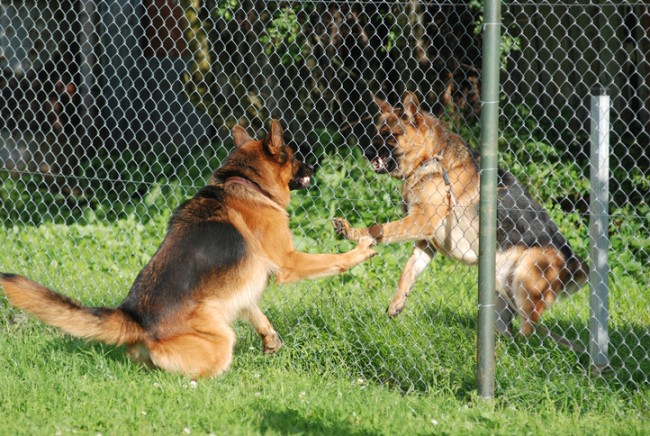
Your otherwise-friendly dog may growl as an expression of barrier frustration. A dog may growl or bark when he is on leash or behind a fence, even if he is comfortable with other dogs when he is off leash. Dogs who growl in these situations need to be trained to relax when on a leash or behind a fence, as territorial or frustration-based behavior can escalate over time. Your dog should never be chained up outside, as this can lead to extreme territorial and protective behavior, which puts the dog, other animals and people in danger.
When to Seek Outside Help
Growling is a way of communicating — for instance, his way of saying, “Give me space,” “Stop it,” or “Back off.” But certain situations — growling when approached or handled, and growling as part of resource guarding — require professional help. A dog who is engaging in resource guarding may be protecting food, toys or people, or his favorite places, like a sleeping space. Even with the best management plan in place, a guarding dog may escalate his aggression, which is why this behavior calls for professional intervention.
Your dog may also growl when he is handled, either because he is uncomfortable or afraid. He may growl when his collar is grabbed, his toenails are trimmed, his ears are touched or his mouth is opened. He may also be uncomfortable with direct eye contact, a person leaning over him, hugs or other forward greetings. Again, this behavior can escalate to something much more dangerous.
Talk with your veterinarian about these behaviors as soon as possible; have your pet’s health evaluated and, if necessary, ask for a referral to a behaviorist or trainer who can help you teach your dog strategies for coping with these situations.
By Mikkel Becker | Vetstreet.com
ooOOoo
You can imagine that with nine dogs here in the house there are times when Jean and I struggle to hear each other over the top of the doggy conversations.
But we wouldn’t have it any other way!
Back to today.
Just slightly sad that in those months since last August our doggie family has reduced to seven.
But on a brighter note, in just three days time, on June 3rd., we will be celebrating Pharaoh’s fourteenth birthday!
A couple of weeks ago I wrote a post Talking to One’s Dog. Many of you stopped by and left your comments, all of which was to confirm how much speaking to your dogs (and cats) is part of normal life for you.
I finished that post writing:
Let me close by reminding all you good people of yet another wonderful aspect of the relationship between humans and dogs. In that we all know the dog evolved from the grey wolf. But had you pondered on the fact that wolves don’t bark! Yes, they howl but they do not bark.
There is good science to underpin the reason why dogs evolved barking; to have a means of communicating with us humans.
Every person who has a dog in their life will instinctively understand the meaning of most, if not all, of the barks their dog utters.
Anyway, I was going through some websites yesterday and, quite by chance, came across that science that I referred to above. It was in a Care2 article published last September and I am republishing it below.
ooOOoo
Yes, Dogs Apparently Do Understand What We’re Saying
You might want to start spelling out some words around your dog. According to a new study, not only do dogs comprehend what we’re trying to tell them by the tone of our voices, but they can also even understand what it is we’re saying — sort of.
Neuroscientist Attila Andics and his fellow researchers at the Eotvos Lorand University in Budapest discovered that just like human brains, a dog’s brain reacts to both the meaning of a word and how it is spoken. Just like us, the left hemisphere of a dog’s brain responds to meaning, while the right hemisphere responds to intonation.
The study, published August 30 in the journal Science, shows that even non-primate mammals who cannot speak can still comprehend the meanings of words in a speech-filled environment. This suggests that the ability of our brains to process words is not unique to humans, and may have evolved much earlier than previously thought.
Not only could these results help make communicating with our dogs more efficient, but the study sheds new light on the origin of words during language evolution. “What makes words uniquely human is not a special neural capacity, but our invention of using them,” Andics said in a press release.
While previous studies have observed dogs to see how they understand us, this is the first one that took a look inside their brains using magnetic resonance imaging (MRI). The 13 participants were all family pets. They included six border collies, five golden retrievers, a Chinese crested dog and a German shepherd.
To be tested, the dogs were first trained to lie still for eight minutes in the MRI machine while wearing headphones and a radio-frequency coil. (Based on the wagging tail of a Golden Retriever in the video below, this didn’t seem to bother at least one of the participants.) Their brain activity was recorded as they listened to a recording of their trainer saying, in both positive and neutral tones, words of praise – like “Good boy!” and “Well done!” – as well as neutral words like “however” and “as if.”
Not too surprisingly, the positively spoken positive words got a big reaction in the reward centers of the dogs’ brains. The positive words spoken neutrally and neutral words spoken with positive tones? Not so much.
Regardless of how they were spoken, the dogs processed the meaningful words in the left hemisphere of their brains. They processed intonation in the right hemisphere.
“There’s no acoustic reason for this difference,” Andics told Science. “It shows that these words have meaning to dogs. They integrate the two types of information to interpret what they heard, just as we do.”
Of course, this doesn’t mean dogs understand every single thing we say (although a Border Collie named Chaser understands over 1,000 words, which is pretty doggone remarkable).
Julie Hecht, a Ph.D. student studying canine behavior and cognition at City University of New York, offers this advice in Scientific American: “Before discussing this with your dog — ‘I knew you could understand me this whole time!’ — the caveat to this research is that a dog processing words — registering, ‘Ah! That’s familiar!’ — and a dog understanding words as you intend are not necessarily the same thing.”
Photo credit: Thinkstock
ooOOoo
I have recounted this example before about how well our dogs listen to Jean and me.
For we take our dogs out for some playtime each day after our lunch. Years ago we used to chat about whether or not to have a cup of tea before taking the dogs for a walk. But pretty quickly once they heard the word “walk’ spoken aloud they were all crowding around the front door.
Then it was a case of spelling out the word: “W – A – L – K”. That lasted for, oh, two or three days.
Then it was using a variety of phrases that we thought would be meaningless to the dogs. That didn’t work!
And on and on.
Now, as soon as we are finishing up our food they are at the door. Jean and I now delay our hot drink to later on!
The most beautiful human – animal relationship in the world!
We all know how good are the noses of our dogs. Yet, I suspect, many do not know how truly good is that nose. The Science ABC site has a detailed account of Why Do Dogs Have Such A Great Sense of Smell?
Here’s part of that article:
Dog Nose vs. Human Nose
When we try to smell something, we inhale air with our nose and we use the same passage in our nose to exhale that air. Therefore, all the smell that we get when we are inhaling is lost when we exhale that air. However, a dog has two different air passages, one for breathing and another for smelling. This means that dogs are able to store the smell in their nose even while breathing out the air!
When dogs exhale, they send air out through the slits of their nose, but the manner in which this air is exhaled through their nose helps the dogs to draw in new odor molecules. This also helps dogs capture more smells when sniffing.
You must have noticed that dogs’ noses are always wet, but have you ever wondered why? The mucus on the dog’s nose helps it smell by capturing scent particles. A dog also has the ability to smell independently from each nostril, this helps the dog to understand from which direction the smell is coming.
The passage through which dogs smell the air contains highly specialized olfactory receptor cells, which are responsible for receiving smells. A dog contains about 225-300 million smell receptors, as compared to just 5 million of these receptors being present in a human nose.
Dog Brain vs. Human Brain
By now, we clearly know that dogs have a nose that can smell about 1,000-10,000 times better than a human, but how are dogs able to remember all the different smells that they have sensed throughout their life?
The answer lies in the difference between the brains of dogs and humans. A human brain has a larger visual cortex than dogs, whereas a dog’s brain has a much larger olfactory cortex than humans. The visual cortex is responsible for processing visual information, whereas the olfactory cortex is responsible for processing the sense of smell. A dog’s olfactory cortex is about 40 times larger than that of a human.
Working dogs are an amazing asset not only for people, but for wildlife, endangered species and even threatened habitats. Expanding on the skills dogs have for tracking down scents and guarding something important, we humans have enlisted their help in many ways for conservation.
Here are five ways dogs are contributing to environmental protection efforts.
Smell for scat
It’s amazing the amount of information that can be sussed out of an animal’s poop. We can determine diet, health, genetics — even whether or not an animal is pregnant. Scat is really important to biologists studying elusive, sensitive or endangered species. Putting dogs on the track is an ideal solution.
Take cheetahs, for example. Scientists in Africa are using dogs and their unparalleled sniffing power to find cheetah poop, all in an effort to get an accurate count on the endangered big cats. (Only 7,000 cheetahs are left in the African wild, according to estimates.) And it’s working. Two trained dogs found 27 scats in an area of 2,400 square kilometers in western Zambia, according to a study published in the Journal of Zoology. Humans, looking for cheetah tracks over the same area, found none.
Groups like Conservation Canines (a handler and dog from the program pictured above), Working Dogs for Conservation and Green Dogs Conservation specialize in this area. Conservation Canines rescues highly energetic, “last chance” dogs from shelters and trains them to track down the scat of dozens of species, from wolves to moose to owl. Even things that are nearly impossible for humans to find — the minuscule scat of endangered pocket mice or orca scat floating on the ocean surface — dogs can track down. They are able to make huge contributions to scientific studies, all without ever bothering the wildlife being studied.
Sniff out problems for wildlife
Whether it’s sniffing out invasive species like giant snails in the Galapagos or detecting disease in beehives, dogs’ noses can be put to work in searching out what shouldn’t be there so that humans can act.
Dogs are able to sniff out particular plant species, pointing ecologists to tiny patches of invasive mustard so that the plants can be removed before they take over an area.
Conversely, dogs can sniff out rare or endangered native plants so that the species can be protected. Rogue is one such dog. The Nature Conservancy writes, “The 4-year-old Belgian sheepdog is part of a Nature Conservancy collaborative project to test the efficacy of using dogs to sniff out the threatened Kincaid’s lupine. The plant is host to the endangered Fender’s blue butterfly, found only in Oregon’s Willamette Valley.”
Surveying for the plant species is difficult work for people. It can only be done when the plant is in bloom so people can visually identify it. However, dogs like Rogue can sniff out the plant even when not in bloom, which can potentially double the length of the field season.
“More refined regional mapping of Kincaid’s lupine could promote the butterfly’s recovery and delisting — and contribute to larger habitat goals and wildlife impacts.”
Track down poachers
The trade in rare or endangered wildlife is a lot tougher for traffickers thanks to wildlife detector dogs. Trained to smell anything from tiger parts to ivory to South American rosewood, dogs are used in shipping ports, airports, border crossings and other locations to sniff out smuggled products.
It doesn’t stop there. Trained dogs can lead rangers to armed poachers in the wild, tracking down the culprits over long hours through heat and rain. They can catch poachers in the act, rather than just the products.
“Canine sleuths aren’t limited to the plains of East Africa, either,” reports National Geographic. “In the Democratic Republic of the Congo, bloodhounds are assisting in the fight against poaching in forested Virunga National Park, where the world’s last remaining mountain gorillas live. In South Africa, Weimaraner and Malinois dogs are helping to find wounded animals and track poachers on foot through the reserves around Kruger National Park.”
Guard endangered species
Dogs are also useful in putting their protective nature to use for endangered species.
Livestock protection dogs are trained to keep predators like cheetahs, lions and leopards safe, which then reduces conflict between ranchers and big cats and minimizes the instances of snaring or retaliatory killing of big cats. Cheetah Conservation Fund has a successful livestock protection dog program, which places Anatolian shepherd and Kangal dogs with ranchers. That not only has significantly reduced the number of livestock killed by predators but is also improving the attitude of local people toward cheetahs.
Sometimes the dogs are put to work guarding the endangered species themselves. One such successful program uses Maremma shepherd dogs to protect colonies of little penguins from foxes.
Keep bears wild
Karelian bear dogs are trained to keep bears from becoming too comfortable around people. A program by Wind River Bear Institute named Partners-in-Life uses a technique called bear shepherding. This specialized breed of hunting dog is used to scare bears away, and are an important part of the “adverse conditioning” work that keeps bears from becoming habituated. The ultimate goal is to protect bears from becoming habituated, a problem that leads to their being relocated or euthanized.
“Our Wind River Bear Institute mission, with the effective training and use of Karelian Bear Dogs, is to reduce human-caused bear mortality and conflicts worldwide to ensure the continued survival of all species of bears for future generations,” states the program.
This list is only a handful of ways that dogs help us with environmental conservation every day. More and more, we are figuring out new ways to put their skills to work, and more and more the dogs are proving they’re ready for the task!
Editor’s note: This story was originally published in July 2016 and has been updated with more recent information.
ooOOoo
Closing words from that Science ABC piece:
A dog does not care how you look or dress, but if he gets good vibes from your smell, then a dog will love you. The world is truly a better place because of these wonderful creatures that we are lucky enough to welcome into our lives.
Why not make the world smell a bit more beautiful for them?
Belay that!
Closing picture taken from the OregonLive website. A stunning picture of the “Fender’s blue butterfly, found only in Oregon’s Willamette Valley.”



 that one of his “pack” members is missing. Learn to help him deal with his grief.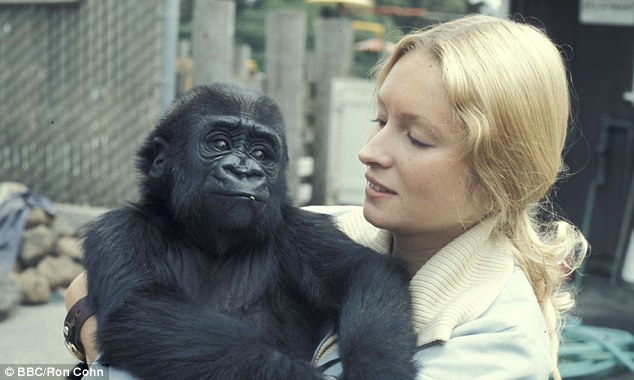


 Sloan McKinney is a journalist based in Southern California. After writing about pop culture for a number of years, she has recently begun writing for a new audience. Inspired by DeAnthony, her cat, as well as her dog Max, Sloan now hopes to help other pet owners guarantee their animal companions happy and healthy lives.
 taught widely throughout the UK and helped develop many Kadampa Centers in England. Kadam Morten has been teaching in the US for more than 20 years and has established centers throughout the New York area, as well as Washington DC, Virginia, and Puerto Rico. In addition to his local teaching responsibilities, he teaches and guides retreats regularly throughout the United States and Europe.





 Learning from Dogs