Posted by Eleanor Imster in EARTH | HUMAN WORLD|March 28, 2019
Across North America, coyotes are moving into urban environments. While human residents are having to get used to the new animal neighbors, coyotes are also habituating to people.
Seven-week-old coyote pups walk through the research facility in Utah as the mother follows. The first pup carries a bone in its mouth. Image via USDA National Wildlife Research Center/Steve Guymon.
As coyotes are moving into urban environments across North America, many human residents – whether they like it or not – are having to get used to them. Meanwhile, how are coyotes habituating to people?
A new study, published December 2018 in the peer-reviewed journal Ecology and Evolution, suggests that coyotes can habituate to humans quickly and that habituated parents pass this fearlessness on to their offspring.
Image via Connar L’Ecuyer via National Park Service/Flickr.
Until the 20th century, coyotes lived mostly in the U.S. Great Plains. But when wolves were hunted almost to extinction in the early 1900s, coyotes lost their major predator, and their range began to expand.
With continuing landscape changes, coyotes are now increasingly making their way into suburban and urban environments — including New York City, Los Angeles and cities in the Pacific Northwest — where they live, mainly off rodents and small mammals, without fear of hunters.
The aim of the new study, was to understand how a skittish, rural coyote can sometimes transform into a bold, urban one — a shift that can exacerbate negative interactions among humans and coyotes. University of Washington biologist Christopher Schell is the first author of the study, Schell said in a statement:
Instead of asking, ‘Does this pattern exist?’ we’re now asking, ‘How does this pattern emerge?’.
A key factor, the researchers suggest, might be parental influence. Coyotes pair for life, and both parents contribute equally to raising the offspring. This may be because of the major parental investment required to raise coyote pups, and the evolutionary pressure to guard them from larger carnivores.
The new study observed eight coyote families at the U.S. Department of Agriculture’s Predator Research Facility in Utah during their first and second breeding seasons. These coyotes are raised in a fairly wild setting, with minimal human contact and food scattered across large enclosures.
Five-week-old coyote pups eat food rations during the experiment. These second-litter pups were born in 2013 to more-experienced parents, and were more likely to approach a human. Image via USDA National Wildlife Research Center/Christopher Schell.
But during the experiment researchers occasionally placed all the food near the entrance of the enclosure and had a human researcher sit just outside, watching any approaching coyotes, from five weeks to 15 weeks after the birth of the litter. Then they documented how soon the coyotes would venture toward the food. Schell said:
For the first season, there were certain individuals that were bolder than others, but on the whole they were pretty wary, and their puppies followed. But when we came back and did the same experiment with the second litter, the adults would immediately eat the food – they wouldn’t even wait for us to leave the pen in some instances.
Parents became way more fearless, and in the second litter, so, too, were the puppies.
In fact, the most cautious pup from the second-year litter ventured out more than the boldest pup from the first-year litter. Schell said:
The discovery that this habituation happens in only two to three years has been corroborated, anecdotally, by evidence from wild sites across the nation. We found that parental effect plays a major role.
He added:
Even if it’s only 0.001 percent of the time, when a coyote threatens or attacks a person or a pet, it’s national news, and wildlife management gets called in. We want to understand the mechanisms that contribute to habituation and fearlessness, to prevent these situations from occurring.
Bottom line: A new study suggests coyotes puppies learn from their parents how to habituate to humans.
A fascinating article about the domestication of the wolf to the domesticated dog appeared on the BBC back in March.
It was, in turn, based on a report issued by Nature and makes interesting reading. But for the shorter version, read on:
ooOOoo
Study reveals the wolf within your pet dog
By Helen Briggs, BBC News, Science and Environment
14 March 2019
Scientists say the negative image of wolves is not always justified. Getty Images.
Wolves lead and dogs follow – but both are equally capable of working with humans, according to research that adds a new twist in the tale of how one was domesticated from the other.
Dogs owe their cooperative nature to “the wolf within”, the study, of cubs raised alongside people, suggests.
But in the course of domestication, those that were submissive to humans were selected for breeding, which makes them the better pet today.
FRIEDERIKE RANGE/VETMEDUNI VIENNA Dogs were more likely to follow human behaviourFRIEDERIKE RANGE/VETMEDUNI VIENNA.Wolves were equally able to cooperate with humans but also took the lead
Grey wolves, at the Wolf Science Center in Vienna, were just as good as dogs at working with their trainers to drag a tray of food towards them by each taking one end of a rope.
But, unlike the dogs in the study, they were willing to try their own tactics as well – such as stealing the rope from the trainer.
Friederike Range, from the Konrad Lorenz Institute, at Vetmeduni Vienna university, said: “It shows that, while wolves tend to initiate behaviour and take the lead, dogs are more likely to wait and see what the human partner does and follow that behaviour.”
About 30,000 years ago, wolves moved to the edges of human camps to scavenge for leftovers.
The subsequent “taming” process of domestication and selective breeding then slowly began to alter their behaviour and genes and they eventually evolved into the dogs that we know today.
A team of veterinary researchers recently revealed a complete cure for metaldehyde toxicity in dogs; it’s called hemodialysis-hemoperfusion — a procedure used to remove kidney toxins from the blood
Metaldehyde is a chemical found in many snail and slug baits and is highly toxic to dogs, cats and wildlife; metaldehyde poisoning in dogs is common worldwide and about 25% of affected dogs don’t survive
A 10-pound dog can show signs of poisoning after eating as little as 1 ounce of a slug/snail bait containing 3% metaldehyde
Dogs who receive early, aggressive and appropriate supportive treatment for metaldehyde toxicity can fully recover within a few days, however, treatment is difficult and costly
Dogs explore the world with their noses and often, their mouths. In addition, most are indiscriminate eaters. This combination can lead to all sorts of challenges for dog parents — some funny, some gross, and unfortunately, some that are potentially deadly.
The latter category includes a long list of toxic substances found both indoors and out that most dogs will sniff and perhaps taste, given the chance. One of these poisons goes by a name many of you have probably never heard of: metaldehyde, a chemical used to kill slugs and snails.
Metaldehyde is highly toxic to mammals and birds and is the sixth most common substance veterinarians ask about when they call the 24-hour Veterinary Poisons Information Service, a worldwide emergency hotline. There is no known antidote for metaldehyde toxicosis, and supportive treatment is complicated and costly. Death occurs in approximately 25% of poisoning cases involving dogs.
Veterinary Research Team Uncovers a Complete Cure
Lucky for us, a team of veterinarians at the University of Munich became concerned about the number of poisonings and the prognosis for dogs with metaldehyde toxicity. They did some outside-the-box thinking and decided to see if a technique called hemodialysis-hemoperfusion — a procedure used to remove kidney toxins from the blood — might be an effective treatment.
The Morris Animal Foundation funded a grant that allowed the researchers to test their theory on plasma samples contaminated with metaldehyde. They were able to successfully reduce concentrations of the toxin in the samples, so the next step was to see if the technique would work on an actual dog.
Enter Jimbo, a Jack Russell Terrier who sampled slug bait containing metaldehyde. By the time he was brought to the university research team, Jimbo was having one seizure after another, without fully regaining consciousness. The team quickly performed hemodialysis on the dog, and within 24 hours he was back on his feet and on his way home.
As of this writing, the veterinary team has treated 10 dogs with their novel therapy and all 10 had a complete recovery. Their research findings will be published in the not-too-distant future for use by the global veterinary community.
Common Brands of Bait Sold in the US
As I mentioned earlier, metaldehyde is a chemical most commonly found in slug and snail baits. The baits usually come in granule form, but can also be found in liquid, powder, meal, gel/paste or pellet form. The baits are designed to release metaldehyde for about 10 days to two weeks under moderately moist conditions.
Bran or molasses is usually added to the baits to make them more attractive to snails and slugs, which also makes them appealing to dogs. Baits sold for home use in the U.S. generally contain between 2% and 5% metaldehyde. According to veterinarian Dr. Ahna G. Brutlag of the Pet Poison Helpline, the products most commonly reported to the hotline in this country include:1
Ortho Bug-Geta Snail & Slug Killer and Ortho Bug-Geta Plus Snail, Slug & Insect Killer
Corry’s Slug & Snail Death
RainTough Deadline Slug & Snail Killer
Force II Deadline Slug & Snail Killer
Lilly Miller Slug, Snail & Insect Killer Bait
Other U.S. brands include Antimilace, Cekumeta, Meta, Metason, OR-CAL, Slugger Snail & Slug Bait, Ortho Metaldehyde 4% Bait, Slug Pellets, Slugit Pellets and Slug-Tox. Surprisingly, in Europe, slug and snail baits can contain up to 50% metaldehyde. The chemical is also used in small heating systems (e.g., camping stoves) and lamps. The Japanese use metaldehyde in color flame tablets that are ignited for entertainment purposes.
Signs of Metaldehyde Toxicity
Dogs typically eat slug bait either off the ground or from a container. We don’t yet know how metaldehyde causes toxicity, only that it’s extremely deadly. A 10-pound dog can show signs of poisoning after eating as little as 1 ounce of a typical bait containing 3 metaldehyde.2 The chemical is also toxic to cats, though cases of poisoning are rare. It can also affect wildlife.
If your pet ingests bait containing metaldehyde, signs of toxicity will develop quickly, typically within the hour. The first sign is usually vomiting, because the toxin irritates the lining of the stomach. Next come neurologic signs, which can include anxiousness, increased heart and respiratory rates, excessive drooling, a stiff or drunken gait, and in some cases, hypersensitivity to touch.
As the toxicity progresses, there are muscle tremors that often trigger a high fever that can lead to organ failure. Nystagmus (rapid back-and-forth movement of the eyes) may also occur.
Symptoms of metaldehyde toxicity continue to progress for several hours after the bait is ingested, ultimately resulting in lethargy and weakness, continuous muscle tremors or seizures, loss of consciousness and death if the dog doesn’t receive aggressive, appropriate treatment in time.
Diagnosis and Treatment
Diagnosis of metaldehyde toxicity is most often based on clinical signs and suspected exposure to slug bait. It’s possible to test the stomach contents for the presence of metaldehyde, but the results won’t be back quickly enough to be of any benefit in saving the dog.
Veterinarians typically run a number of diagnostic tests (i.e., complete blood cell count, serum chemistry profile, urinalysis, etc.) to rule out other possible causes for a pet’s symptoms, as well as to find possible complications resulting from the poisoning that also require treatment.
Veterinarians will induce vomiting in dogs brought to them within an hour of ingesting metaldehyde who aren’t showing any neurologic signs. They’ll also be given activated charcoal to bind the metaldehyde still in the intestines, decreasing further absorption. If you can’t get your dog to a clinic within an hour, your veterinarian may instruct you to induce vomiting at home before leaving.
In dogs whose conditions aren’t stable enough to safely induce vomiting, the stomach can be emptied using gastric lavage, a procedure requiring anesthesia and a tube that is passed through the esophagus to the stomach. The tube is used to drain the contents of the stomach, flush it with fluids and place activated charcoal in there to bind whatever metaldehyde remains.
Dogs who undergo gastric lavage will need to stay in the hospital for several hours to receive additional doses of activated charcoal and be closely monitored for signs of toxicity. If signs develop, a longer hospitalization will be required. Supportive care while hospitalized can help keep your dog comfortable and deal with certain effects of the toxin such as tremors, seizures and blood abnormalities. Intravenous (IV) fluids will be given and your pet’s body temperature will be closely monitored.
Prognosis and Prevention
Most dogs with metaldehyde toxicity who receive early, aggressive, appropriate treatment recover fully within two to three days. However, treatment can be expensive, especially in severe cases requiring sedation or anesthesia. Since the cost of treatment can be prohibitive, and since metaldehyde poisoning isn’t something any loving pet parent wants their dog to endure, prevention should always be the goal.
My recommendation is to avoid using slug and snail baits containing metaldehyde and/or other toxic chemicals. If you want to protect your garden from the critters, consider using broken shells, lava rock or other alternatives to snail and slug bait.
Veterinarian Dr. Catherine Barnett of VCA Hospitals also suggests using copper bands around plants, or adding lavender, mint or rosemary plants to your garden. You can also fill shallow cans with beer to attract and drown slugs.3 You can find additional nontoxic solutions at this link.
It’s yet another reason why one should wherever possible keep the whole of one’s property clear of all chemical products. And try as hard as you can to stop your dogs and cats from ‘straying’ onto your neighbour’s land.
For a while now I have been subscribing to The Dodo. As the website explains it’s for animal people and as you and I know that’s quite a great many people!
Until now I have been a little nervous of sharing articles from The Dodo with you. But then I noticed quite recently that there is a ‘share’ button at the end of the articles.
So I presume it’s alright to share these wonderful stories!
A family was out riding their bikes one day in South Carolina when they suddenly heard what sounded like a puppy crying. They pulled their bikes over to the side of the road and went to investigate, and were shocked to find a little puppy trapped under a pile of dirt and concrete. Not knowing how else to help, they quickly called 911, and both the police and firefighters with the North Charleston Fire Department responded in hopes that they could free the trapped puppy.
North Charleston Fire Department
“They showed us where the dog was located,” Captain Paul Bryant, of the North Charleston Fire Department, told The Dodo. “It was piles of concrete 4 foot by 4 foot, some smaller, some bigger. One of the police officers said he could see the dog so we got on our hands and knees to look and saw his nose sticking out of the pile of rubble.”
After moving the concrete slabs out of the way with a pry bar, Captain Bryant attempted to pull the puppy, later named Rocky, out from the remaining dirt and rubble, but unfortunately there just wasn’t enough room. He then took a shovel and started digging, and finally was able to create enough space to pull the confused puppy out to safety. The whole rescue only took about 11 minutes, but no one has any idea how long Rocky had been stuck under there before everyone arrived.
North Charleston Fire Department
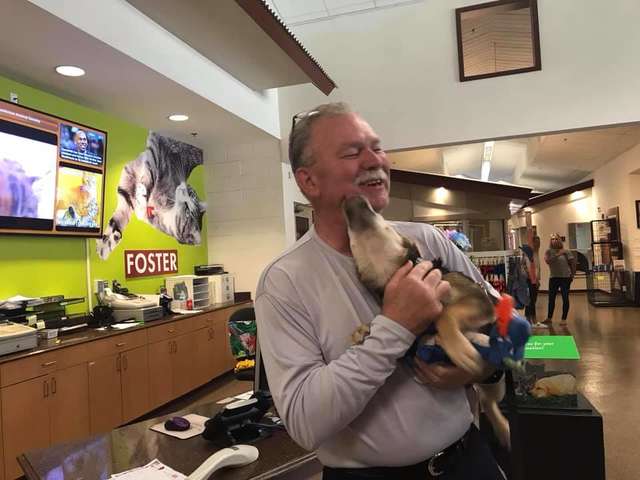
As soon as he was free, little Rocky couldn’t stop licking Bryant’s face in gratitude. The puppy clearly had so much energy and lots of love to give, and everyone immediately fell in love with him — especially Bryant. The family who had initially found Rocky said they would take him to a nearby animal hospital to get checked for a microchip so he could hopefully be reunited with his family, but after he was gone, Bryant just couldn’t get Rocky out of his head.
“I wanted to know if his owner was found, or if the person who found him was going to keep him,” Bryant said. “Once I found out he did not have an owner and the family who found him could not keep him, I knew he was coming home with me.”
North Charleston Fire Department
Bryant felt connected to Rocky from the second he rescued him from underneath that concrete, and it was as if the pair had always been meant to be together.
“I found out I was going to be able to adopt him, and I’ve been on a high ever since,” Bryant said in a video about Rocky’s rescue.
Captain Paul Bryant
Once Rocky had been given a clean bill of health and was ready to head off to his new forever home, Bryant headed over to Charleston Animal Society to pick him up …
Facebook/Charleston Animal Society
… and as soon as Rocky saw his rescuer again, he could barely contain his excitement.
Charleston Animal Society
Rocky is now all settled into his new home and couldn’t be happier with how things turned out. He went from being trapped and alone to having the world’s best dad, and everyone involved is so thrilled that Bryant and Rocky ended up together.
Captain Paul Bryant
“He is a very energetic dog and loves to play fetch with his new toys,” Bryant said. “He is always by my side, never letting me leave the room without following me.”
ooOOoo
Time and time again people from all walks of life know something instinctively when it’s in front of them. The love that we humans give to our dogs and the love that they return to us.
And a particular credit must go to the dog’s nose. It is many more times more sensitive than our nose, as the following article taken from Mother Nature Network shows. (And I really must stop republishing articles from MNN!)
ooOOoo
6 medical conditions that dogs can sniff out
From cancer to migraines and even seizures, dogs can give us a heads up about a range of human diseases.
Dogs have millions of smell receptors that can detect countless smells, including the smells of changes going on inside our bodies. (Photo: RedTC/Shutterstock)
Dogs are famous for their sense of smell. With about 220 million scent receptors (compared to our 5 million), dogs can smell things that seem unfathomable to us. They can detect some odors in parts per trillion, and they can detect countless subtleties in scents.
As PBS points out, “Experts have reported incredible true stories about the acuteness of dogs’ sense of smell. There’s the drug-sniffing dog that ‘found’ a plastic container packed with 35 pounds of marijuana submerged in gasoline within a gas tank. There’s the black lab stray from the streets of Seattle that can detect floating orca scat from up to a mile away across the choppy waters of Puget Sound.”
And yes, there are the dogs who have sniffed out medical issues that even doctors weren’t aware of. Dogs can pick up on tiny changes in the human body, from a tiny shift in our hormones to the release of volatile organic compounds, or VOCs, released by cancer cells. Researchers and dog trainers are just beginning to understand how dogs do this and how we might put them to work in being our helpers in health care. Here are six medical conditions that dogs are able to smell.
Dog are naturally tuned into their owner’s emotions, but what about signs of ill health? (Photo: sherwood/Shutterstock)
Cancer
Perhaps the condition dogs are currently most famous for detecting is cancer. Dogs have been able to sniff out a variety of types including skin cancer, breast cancer and bladder cancer.
There are quite a few stories of a pet dog obsessing about an owner’s mole or some part of their body, only to discover in a doctor’s appointment that the dog was actually sensing cancer. For example, Canada Free Press writes of a 1989 instance when a woman’s “dog kept sniffing at a mole on her thigh, but ignored other moles. In fact, the dog had actually tried to bite off the mole when she was wearing shorts. The woman consulted her doctor, the mole was excised and the diagnosis confirmed a malignant melanoma.”
In the last couple decades, researchers have looked seriously into dogs’ sniffing abilities when it comes to cancers. In studies, dogs have successfully been trained to detect the disease using samples from known cancer patients and people without cancer.
The newest study offers the most startling statistics: Dogs can correctly pick out blood samples from people who have cancer with 97% accuracy, a 2019 study published in Experimental Biology found. Heather Junqueira, the lead researcher at BioScentDx who performed the study, used clicker training with four beagles. The dogs focused their efforts on blood samples from patients with lung cancer, and with one exception, they were highly successful. The sample was small, so BioScentDx plans to continue its work, according to Science Daily.
In a 2006 study, five dogs were trained to detect cancer based on breath samples. Once trained, the dogs were able to detect breast cancer with 88 percent accuracy, and lung cancer with 99 percent accuracy. They could do this across all four stages of the diseases.
Sometimes the dogs can do an even better job than the humans in these studies. According to Penn State News, Nancy Dreschel, a veterinarian in Dairy and Animal Science at Penn State University, tells of an illuminating example: “A scientist was training dogs to detect bladder cancer in humans by smelling their urine. She said a dog alerted them to a sample from a supposedly healthy person who was being used as a control. On reexamination that person was found to have bladder cancer, so the dog caught it before anyone else did.”
Study after study has shown that dogs can detect cancer in people, but it may a while before your doctor employs a hound for your annual checkup. Researchers still don’t know exactly what chemical compounds for different types of cancers the dogs are sensing in these samples to alert to the presence of the disease, and this remains a hurdle both for better training of cancer-sniffing dogs and for creating machines that can more accurately detect cancer in the early stages.
Narcolepsy
Narcolepsy is a brain disorder that affects the ability to control sleep-wake cycles. This can mean a person suddenly falls asleep, even in the middle of a task. It’s a dangerous condition, as someone who has an attack could be injured falling to the ground or could have a car accident if it happens while driving.
Mary McNeight, Service Dog Academy director of training and behavior, has been working with narcolepsy service dogs since 2010, and she notes that there’s a scent the dogs pick up on when an attack is coming on. “It’s a biochemical change in the body. We do not know what the particular odor smells like due to the difference between human scent perception and dog scent perception,” she tells Sleep Review.
In a study published in 2013, Luis Dominguez-Ortega, M.D., Ph.D., found that two trained dogs detected 11 of 12 narcolepsy patients using sweat samples, demonstrating that dogs can detect a distinct scent for the disorder.
Service dogs help people with narcolepsy by performing several different types of tasks. They can stand over the person’s lap when an attack comes on, which prevents them from sliding out of a chair onto the floor; they can also stand over the person to protect them if they are out in public, or they can go get help. And most importantly, they can provide a warning up to 5 minutes before an attack comes on, giving their handler a chance to get to a safe place or a safe position.
While large dogs can be helpful in giving a narcoleptic sufferer extra support in balance and mobility after an attack, these dogs don’t have to be big. According to Petful, even medium-sized dogs can do the job. “Theo, a 2-year-old cocker spaniel, has virtually put an end to [Kelly] Sears’ suffering. He can sense when she is about to have a narcoleptic episode and warn her so that she can sit or lie down, waking her after a few seconds with a kiss on her chin. Since arriving two months ago from Medical Detection Dogs, the only organization in Europe that trains narcolepsy service dogs, Theo has proven himself indispensable.”
Dogs can smell all sorts of chemical changes in our bodies, including a drop in blood sugar or the onset of a migraine. (Photo: WilleeCole Photography/Shutterstock)
Migraines
For those who suffer migraines, having a warning before one comes on can mean the difference between managing the problem or succumbing to hours or days of intense pain. Fortunately, some dogs have a talent for sniffing out the signs that a migraine is on the way.
Psychology Today reports on a recent study that asked migraine sufferers with dogs if they noticed a change in their dogs’ behavior before or during a migraine. The results show that “54 percent of the 1027 participants indicated they had noticed changes in the behavior of their pets during or preceding migraines. Nearly 60 percent of these subjects indicated that their dog had alerted them to the onset of a headache — usually an hour or two in advance.” The results are fascinating, though it’s important to point out that the study was conducted with self-reports rather than observation by researchers. Even so, the study shows evidence that many dogs seem to detect and point out a change in their human companion’s health.
According to Kendall Winship, a migraine sufferer with a service dog, “These [migraine alert service] dogs are highly valued because the ability to tell when a migraine is approaching is an innate talent; it can’t be taught. Similar to diabetic alert dogs that can smell when their handler has low blood sugar, migraine alert dogs can hone in on the scent of serotonin, a chemical that skyrockets when the body is about to have a migraine. By alerting to the danger long before their handlers might feel any symptoms, these dogs can warn them to take preventative medication. When Rally looks up at me and whines, I know I have about two hours before the migraine will strike, and if I can take my medication early enough, I might be able to avoid the stroke-like symptoms and incapacitating pain.”
Low blood sugar
Increasingly, dogs are helping diabetics know when their blood sugar level is dropping or spiking. Dogs4Diabetics is one organization that trains and places service dogs with insulin-dependent diabetics. These dogs undergo extensive training to be able to detect and alert their handlers to changes in blood sugar levels.
A 2016 study published in the journal Diabetes Care found that the dogs detect isoprene, a common natural chemical found in human breath that rises significantly during episode of low blood sugar. People can’t detect the chemical, but the researchers believe that the dogs are particularly sensitive to it and can tell when their owner’s breath has high levels of it.
Medical News Today reports that dogs are trained to discriminate between the scent from a previous episode and the scent of a current episode. They detect when their handler is having an issue and alert the person, giving them time to test their blood sugar and take the insulin they need.
A 2013 study published in PLOS One showed that having a diabetic alert dog seems to provide significant improvements in both the safety and quality of life of insulin-dependent diabetics. “Since obtaining their dog, all 17 clients studied reported positive effects including reduced paramedic call outs, decreased unconscious episodes and improved independence.”
There’s still some skepticism about whether or not dogs can accurately alert handlers to a blood sugar change at a level beyond chance, something that can be determined with more studies. Even so, for those diabetics living with alert dogs, the sniffing ability of their companions seems to be a big help.
Seizure
One of the more controversial areas where dogs are used to alert to a medical condition is with seizures. There is growing evidence that dogs can and do detect the onset of a seizure; however, the level of accuracy and, most importantly, our ability to train dogs to alert a handler to an oncoming seizure remains a bit questionable.
As is the case with some other conditions, dogs cannot be trained to predict seizures. We don’t have a way to provide them with a scent or information that can be used for training. We can, however, train dogs how to respond to and assist a handler when a seizure occurs. Some service dogs that are placed with seizure patients do develop the ability to detect when a seizure is coming and can provide an alert if the handler pays close attention to the signals the dog provides. WebMD reports, “Jennifer Arnold, founder of Canine Assistants in Georgia, … says about nine out of 10 of the service dogs her organization has placed develop the ability on their own within a year of placement.”
A small 2019 study found that dogs were able to clearly discriminate a general epileptic “seizure odor.” However the study only involved a handful of dogs and involved odor samples that were collected during a seizure. Researchers pointed out that much more extensive testing would need to be done to see if other dogs would respond similarly and if dogs could predict seizures before they happened.
However, there is some question about how dogs are responding. How Stuff Workspoints out that in 2007, “two small studies in the journal Neurology reported that four out of seven seizure alert dogs studied turned out to be warning their masters of psychological, rather than epileptic seizures. This may not seem like a big deal, but the two disorders are different. A 2006 study revealed that up to 30 percent of patients who suffer from psychogenic nonepileptic seizures (PNES) are misdiagnosed with epilepsy. PNES, which results from emotional difficulties and can often be successfully treated with counseling, rather than unnecessary and harsh epilepsy drugs. The 2007 study also revealed one instance of seizures being triggered by the patient’s dog’s warning behaviors, indicating another flaw in the reliability of canine seizure prediction.”
A 2003 study concluded that “findings suggest some dogs have innate ability to alert and/or respond to seizures” however, it notes that further research is needed to uncover which seizure patients would benefit from the help of a dog. We also need more research to learn how to train dogs to be as effective as possible. We have to first learn how dogs know when a seizure is coming — are they smelling a change in body chemistry, or are they picking up on behavior changes? — before we can reliably train them to alert handlers before a seizure happens.
Dogs can smell fear and stress, and they can use that ability to help people with issues such as PTSD. (Photo: Glynnis Jones/Shutterstock)
Fear and stress
The age-old notion that dogs can smell fear is an accurate one. Dogs can smell when we are feeling fear or are experiencing an increased level of stress, even if we aren’t showing outward signs. What dogs are smelling is the surge of hormones our bodies release to respond to stressful situations, including adrenalin and cortisol.
Thankfully, this can be used to humans’ benefit, as dogs can signal a handler that they (or someone else) needs to take a few deep breaths. Dogs that alert handlers of the change in their emotional state — a change that often people aren’t even aware they’re experiencing — can help prevent panic attacks and other possible episodes associated with post-traumatic stress disorder or other issues.
“This 18-month Rhodesian ridgeback is the first cortisol-sniffing dog on staff at a school. Cortisol is known as the ‘stress hormone,’ and people on the autism spectrum tend to have higher levels of cortisol in their blood. Cali is employed to detect rising cortisol levels in the students. She waits outside of school each morning as the students file by. If she notices anyone with a high level of cortisol in their blood, she will signal to her handler, Casey Butler, a health teacher on staff at The Calais School who is a certified specialist in natural canine behavior rehabilitation and in animal adaptive therapy. When Cali stares at a child, Butler knows that is the signal. She then takes that child aside and works with him or her before a meltdown occurs.”
We still have a long way to go to discover exactly what dogs are smelling about us, let alone how we can train them to be as accurate as possible about a change in our bodies. Even though many details are not yet known, it’s clear that dogs have an uncanny ability to sniff out certain medical issues, and that’s a skill that could be a real lifesaver.
Editor’s note: This story was originally published in 2016 and has been updated with new information.
Jaymi Heimbuch ( @jaymiheimbuch ) focuses on wildlife conservation and animal news from her home base in San Francisco.
ooOOoo
Where on earth would we be without these wonderful, clever dogs! Seriously, whether you love dogs or not you cannot deny that they are incredible creatures!
Dog owners spend US$240 a month caring for their pets, compared with $193 for cats, according to the 2017-2018 National Pet Owners Survey from the American Pet Products Association. The extra money goes primarily toward vet visits and kennel boarding, but dog owners also spend more lavishly on treats, grooming and toys.
And almost half of households own a dog, while just 38 percent have a cat. Generational trends suggest this divergence is likely to grow, as millennials are more likely to adopt a canine, while baby boomers tend to be cat lovers.
One reason suggested was that dog owners had stronger bonds to their pets, which prompted them to spend more on things like veterinary care.
My research uncovered a key factor indicating why dog owners feel more attached to their pets: Dogs are famously more compliant than cats. When owners feel in control of their pets, strong feelings of psychological ownership and emotional attachment develop. And pet owners want to be masters – not servants.
Like other marketing researchers, my work uses “willingness to pay” as an indicator of the economic, rather than emotional, value owners place on their pets. It shows – and compares – how much pet owners would pay to save their animal’s life.
Dog owners are willing to pay twice as much as cat owners for a life-saving surgery. AP Photo/Angie Wang
Who’s in control?
So I carried out three online experiments to explore the role of psychological ownership in these valuations.
In the first experiment, I asked dog or cat owners to write about their pet’s behavior so I could measure their feelings of control and psychological ownership. Participants then imagined their pet became ill and indicated the most they would be willing to pay for a life-saving surgery.
Dog owners, on average, said they would pay $10,689 to save the life of their pet, whereas cat owners offered less than half that. At the same time, dog owners tended to perceive more control and psychological ownership over their pets, suggesting this might be the reason for the difference in spending.
Of course, correlation is not causation. So in a second experiment, I asked participants how much they would be willing to pay to save their animal’s life after I had disturbed their sense of ownership. I did this by asking participants to imagine their pet’s behavior was a result of training it received from a previous owner.
As expected, disrupting their feelings of ownership eliminated the difference in valuation between dogs and cats.
Since pet owners like to control their animals, and since cats are less controllable than dogs, the third experiment went straight to the point: Does the owner value the dog or cat for its own sake or for its compliant behavior?
To find out, I again asked survey respondents to describe how much they’d be willing to pay to save their pet’s life, but this time I randomly assigned one of four scenarios: Participants were told they either own a dog, a cat, a dog that behaves like a cat, or a cat that behaves like a dog.
Participants reported they would pay $4,270 to save the life of their dog, but only $2,462 for their cat. However, this pattern was reversed when the pet’s behavior changed, with dog-behaving cats valued at $3,636, but cat-behaving dogs only $2,372.
These results clearly show that the animal’s behavior is what makes people willing to pay.
When cats act more like dogs, people say they’d spend more money on them. pixfix/shutterstock.com
Master or servant
These findings establish that psychological ownership is a driving factor in dog owners’ higher valuations.
People feel ownership because they perceive that they can control their pets’ behavior. This research even distinguishes the type of control that probably most stimulates ownership feelings: It’s not just physical control, such as being able to pick up an animal or drag it by a leash. Rather, it’s the animal’s voluntary compliance with its owner’s wishes.
No matter how cute and cuddly your kitties may be, they can’t compete with dogs when it comes to giving pet owners the sense of mastery they seek.
But then I saw another version of the same story on the BBC News site, from which I republish it in its entirety.
ooOOoo
First ever black hole image released
By Pallab Ghosh
Science correspondent, BBC News
The first ever picture of a black hole: It’s surrounded by a halo of bright gas.
Astronomers have taken the first ever image of a black hole, which is located in a distant galaxy.
It measures 40 billion km across – three million times the size of the Earth – and has been described by scientists as “a monster”.
The black hole is 500 million trillion km away and was photographed by a network of eight telescopes across the world.
Details have been published today in Astrophysical Journal Letters.
Prof Heino Falcke, of Radboud University in the Netherlands, who proposed the experiment, told BBC News that the black hole was found in a galaxy called M87.
“What we see is larger than the size of our entire Solar System,” he said.
“It has a mass 6.5 billion times that of the Sun. And it is one of the heaviest black holes that we think exists. It is an absolute monster, the heavyweight champion of black holes in the Universe.”
The image shows an intensely bright “ring of fire”, as Prof Falcke describes it, surrounding a perfectly circular dark hole. The bright halo is caused by superheated gas falling into the hole. The light is brighter than all the billions of other stars in the galaxy combined – which is why it can be seen at such distance from Earth.
The edge of the dark circle at the centre is the point at which the gas enters the black hole, which is an object that has such a large gravitational pull, not even light can escape.
DR JEAN LORRE/SCIENCE PHOTO LIBRARY I have suspected that the M87 galaxy has a supermassive black hole at its heart from false colour images such as this one. The dark centre is not a black hole but indicates that stars are densely packed and fast moving.
The image matches what theoretical physicists and indeed, Hollywood directors, imagined black holes would look like, according to Dr Ziri Younsi, of University College London – who is part of the collaboration.
“Although they are relatively simple objects, black holes raise some of the most complex questions about the nature of space and time, and ultimately of our existence,” he said.
“It is remarkable that the image we observe is so similar to that which we obtain from our theoretical calculations. So far, it looks like Einstein is correct once again.”
But having the first image will enable researchers to learn more about these mysterious objects. They will be keen to look out for ways in which the black hole departs from what’s expected in physics. No-one really knows how the bright ring around the hole is created. Even more intriguing is the question of what happens when an object falls into a black hole.
What is a black hole?
A black hole is a region of space from which nothing, not even light, can escape
Despite the name, they are not empty but instead consist of a huge amount of matter packed densely into a small area, giving it an immense gravitational pull
There is a region of space beyond the black hole called the event horizon. This is a “point of no return”, beyond which it is impossible to escape the gravitational effects of the black hole
Prof Falcke had the idea for the project when he was a PhD student in 1993. At the time, no-one thought it was possible. But he was the first to realise that a certain type of radio emission would be generated close to and all around the black hole, which would be powerful enough to be detected by telescopes on Earth.
He also recalled reading a scientific paper from 1973 that suggested that because of their enormous gravity, black holes appear 2.5 times larger than they actually are.
These two previously unknown factors suddenly made the seemingly impossible, possible. After arguing his case for 20 years, Prof Falcke persuaded the European Research Council to fund the project. The National Science Foundation and agencies in East Asia then joined in to bankroll the project to the tune of more than £40m.
The eventual EHT array will have 12 widely spaced participating radio facilities
It is an investment that has been vindicated with the publication of the image. Prof Falcke told me that he felt that “it’s mission accomplished”.
He said: “It has been a long journey, but this is what I wanted to see with my own eyes. I wanted to know is this real?”
No single telescope is powerful enough to image the black hole. So, in the biggest experiment of its kind, Prof Sheperd Doeleman of the Harvard-Smithsonian Centre for Astrophysics, led a project to set up a network of eight linked telescopes. Together, they form the Event Horizon Telescope and can be thought of as a planet-sized array of dishes.
KATIE BOUMAN Information gathered is too much to be sent across the internet. Instead the data was stored on hundreds of hard drives which were flown to a central processing centre.JASON GALLICCHIO
Each is located high up at a variety of exotic sites, including on volcanoes in Hawaii and Mexico, mountains in Arizona and the Spanish Sierra Nevada, in the Atacama Desert of Chile, and in Antarctica.
A team of 200 scientists pointed the networked telescopes towards M87 and scanned its heart over a period of 10 days.
The information they gathered was too much to be sent across the internet. Instead, the data was stored on hundreds of hard drives that were flown to a central processing centres in Boston, US, and Bonn, Germany, to assemble the information. Prof Doeleman described the achievement as “an extraordinary scientific feat”.
“We have achieved something presumed to be impossible just a generation ago,” he said.
“Breakthroughs in technology, connections between the world’s best radio observatories, and innovative algorithms all came together to open an entirely new window on black holes.”
The team is also imaging the supermassive black hole at the centre of our own galaxy, the Milky Way.
Odd though it may sound, that is harder than getting an image from a distant galaxy 55 million light-years away. This is because, for some unknown reason, the “ring of fire” around the black hole at the heart of the Milky Way is smaller and dimmer.
One of the most remarkable things about this story is that it continues to validate the theories of Albert Einstein (1879-1955). That is doubly impressive.
There is so much about dogs in general to be amazed at.
But the nose is something to really marvel at.
There are many sources of information about how incredible is the dog’s nose. For example, I am looking at the page on The Dogington Post that speaks of the dog’s nose.
Nature has provided dogs with a nearly perfect sense of smell. If you have a dog, you probably already know that your dog will smell something long before you can. In fact, the average dog has over 300 million olfactory receptors in their noses (compared to a relatively tiny six million for humans). That means, your dog’s sense of smell is over fifty times greater than your own!
smithsonian.com
April 1, 2019
Service dogs can offer vital assistance to those who suffer from epilepsy, helping to prevent injury and signal for help when a seizure episode occurs. Whether dogs can detect seizures before they happen is another, more complicated question; anecdotal reports suggests that they can, but the evidence is inconclusive, and it hasn’t been clear what signals might trigger dogs to anticipate an oncoming seziure. But as Megan Schmidt reports for Discover, a small and intriguing new study suggests that people with epilepsy emit a specific odor when they are having seizures—and dogs can be trained to detect it.The study’s very good subjects were five service dogs from Medical Mutts in Indianapolis, trained to respond to the bodily odors of people with diabetes, anxiety and epilepsy. To test the dogs’ seizure-detecting abilities, researchers recruited five patients with different types of epilepsy to collect sweat samples at various intervals: either during or right after a seizure, after moderate exercise and at random points in the day during calm activity. Seven samples from each patient were then placed in opaque cans, which the dogs were given a chance to sniff. Each dog underwent nine trials in total: five of those trials were repeat tests with the odor of one patient, and the rest were conducted with samples from the four remaining patients. The dogs had not been exposed to the patients’ scents prior to the experiment.
The results, the study authors write in Scientific Reports “were very clear: all dogs discriminated the seizure odor.” Some of the pooches had a better track record than others—the dogs correctly identified the seizure samples between 67 and 100 percent of the time—but all of their performances were “well above” the margins of chance, according to the researchers.
It’s not entirely surprising that dogs have super-powered noses when it comes to detecting human ailments. Our best animal buddies have been used to sniff out diseases like cancer and diabetes “with some success,” the researchers note. The new study, however, not only shows that dogs can smell seizures, but also offers the first known proof that different types of seizures are associated with common scents; the patients, after all, did not all have the same kind of epilepsy.
Granted, the study was small and limited in scope. It suggests that dogs can smell seizures as they happen, but the verdict is still out on whether the animals can detect seizures that are about to happen. Further research is also needed to determine precisely what bodily chemicals the dogs are smelling in the sweat of epileptic patients. But “[a]s far as implications go, the results are very exciting,” Tim Edwards, a behavioral analyst and senior lecturer at New Zealand’s University of Waikato, who was not involved in the study, tells Scientific American’s Emily Willingham. Perhaps understanding how dogs detect seizures can help pave the way for artificial intelligence technology that is able to do the same.
Additionally, the study authors maintain that their findings dispel the “belief that epilepsy and seizure types were too individual-specific for a general cue to be found.” And this, the researchers say, offers “hope” that people with epilepsy can be warned of oncoming seizures by their furry, faithful friends.
ooOOoo
Wouldn’t that be fabulous! That people with epilepsy could be warned of oncoming seizures. All as a result of a dog’s keen, very keen, sense of smell.
A non profit organization, founded by Lya Battle and Alvaro Saumet. During the last eight years we’ve been promoting well-being and respect for animals.
HOW WE DO IT?
Veterinarian: We take care of our mutts with deworming, sterilization and any other care they need. The cost of maintaining a dog healthy is $5 per month.
Shelter: Territorio is home for hundreds of doggies. We give them here a safe place to live, free of maltreatment, and full of love. The cost of providing a home is $11 per month for each of our unique specimens.
Food: Each mont we consume thousands of kilos of dog food, to keep our pack healthy. Giving a full small plate to each mutt cost us $20 per month.
There is much, much more on their website that I encourage you to go to. Here are some photographs of the dogs that they rescue.
oooo
oooo
oooo
oooo
oooo
oooo
There are a number of videos on YouTube to watch.
Here’s a short one.
And here’s a slightly longer one by National Geographic.
Finally, if you feel so minded here is the donate page. It’s a good cause and, for example, for just $36 you can sponsor one dog. That’s what Jeannie and I did.
Because you signed up on our website and asked to be notified, I’m sending you this special recall alert. If you no longer wish to receive these emails, please click the “unsubscribe” link at the bottom of this message.
Hill’s Pet Nutrition is expanding its recall of specific lots of its Prescription Diet and Science Diet dog foods due to elevated levels of vitamin D.
Very high levels of vitamin D can lead to serious health issues in dogs, including kidney dysfunction.
To learn which products are affected, please visit the following link:
Vitamin D, when consumed at very high levels, can lead to serious health issues in dogs including kidney dysfunction.
What’s Recalled?
The following products and lot numbers are affected by the recall.
Items marked in blue are new SKUs that were added to the list on March 20, 2019.
About Excessive Levels of Vitamin D
While vitamin D is an essential nutrient for dogs, ingestion of elevated levels can lead to potential health issues depending on the level of vitamin D and the length of exposure.
Dogs may exhibit symptoms such as vomiting, loss of appetite, increased thirst, increased urination, excessive drooling, and weight loss.
Pet parents with dogs who have consumed any of the products listed and are exhibiting any of these signs should contact their veterinarian.
In most cases, complete recovery is expected after discontinuation of feeding.
What to Do?
If your SKU, Date and Lot codes are found in the list above, you have an affected product.
You should stop feeding it and should return to the place of purchase for a full refund.
If you have questions, you may contact Hill’s Consumer Affairs at 800-445-5777.
U.S. citizens can report complaints about FDA-regulated pet food products by calling the consumer complaint coordinator in your area.