This makes fascinating listening and thinking. I am referring to the BBC4 programme, Eureka Moment, first broadcast in March 2010.
Lovelock
Some frightening stuff to reflect on, however, he is a tremendously positive person. His level of thinking and orginality is breath taking. Painful and not pleasant, but a snapshot of a possible outcome.
Interesting from a David Hawkins point of view to measure his level of integrity on the scale of human consciousness that Hawkins developed.
I’m delighted to see that the BBC still has a huge amount available about Lovelock’s claims. A small extract from here.
The man who achieved global fame for his theory that the whole earth is a single organism now believes that we can only hope that the earth will take care of itself in the face of completely unpredictable climate change.
Interviewed by Today presenter John Humphrys, videos of which you can see below, he said that while the earth’s future was utterly uncertain, mankind was not aware it had “pulled the trigger” on global warming as it built its civilizations.
Here’s a video, taken quite recently, of the Professor explaining his approach to his science.
But whatever, don’t lose heart. Keep the faith in a better future, as Paul wrote yesterday.
You may (or may not) have noticed that I have been fairly absent from Learning From Dogs for the past few months. While numerous factors play into this, the primary reason is that in August I began my classes at the University of Georgia School of Law, and have since ceased to exist outside of Athens, GA.
Okay, so that is an exaggeration. The only unfortunate part of law school, though, is that it has hindered my ability to keep up with currents events, and thus has made it difficult for me comment on such.
In trying to think of something I could write about, I realized — why not just write about law school? I have been surprised (usually pleasantly) by my experiences here, and think that many readers would be equally surprised about many facets of legal education in the USA.
In the coming weeks I’ll be writing blog posts now and again about my experiences, how they do or do not conform to stereotypes about law school and lawyers, and what direction I think the American legal education system is heading in.
That being said, it’s time for the Legal Research and Writing class, so farewell for now!
This Post for Learning from Dogs was inspired by a simple email. An email sent out automatically by Facebook inviting me to join a group committed to holding the Nobel prize in Economics accountably for the crisis.
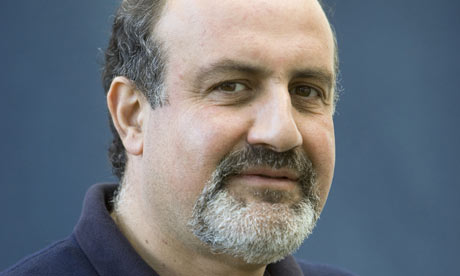
Nassim Nicholas Taleb
That intrigued me. Like thousands of others I had previously read The Black Swan, a book The Times newspaper describes as ” as one of the 12 most influential books since World War II”.
Wikipedia has a thorough description of Taleb much recommended if you have 10 minutes to read it.
Bryan Appleyard of The Times wrote an excellent piece on Taleb on the 1st June, 2008 which may be read here. Here’s an extract from near the front of that piece in The Times:
He spilt the tea – bear with me; this is important – while grabbing at his BlackBerry. He was agitated, reading every incoming e-mail, because the Indian consulate in New York had held on to his passport and he needed it to fly to Bermuda. People were being mobilised in New York and, for some reason, France, to get the passport.
The important thing is this: the lost passport and the spilt tea were black swans, bad birds that are always lurking, just out of sight, to catch you unawares and wreck your plans. Sometimes, however, they are good birds. The recorders cost $20 less than the marked price owing to a labelling screw-up at Circuit City. Stuff happens. The world is random, intrinsically unknowable. “You will never,” he says, “be able to control randomness.”
To explain: black swans were discovered in Australia. Before that, any reasonable person could assume the all-swans-are-white theory was unassailable. But the sight of just one black swan detonated that theory. Every theory we have about the human world and about the future is vulnerable to the black swan, the unexpected event. We sail in fragile vessels across a raging sea of uncertainty. “The world we live in is vastly different from the world we think we live in.”
Despite the article being over two years old, it is still an important piece for anyone trying to understand the causes of the financial mess we are all still in.
Finally, Taleb’s own website is a rich resource of much that will allow us all to better understand where we got to, where we are and what has to change if we are to have real hope for a better future.
Here’s a YouTube video of a TV interview taken in May, 2010.
Here’s an earlier video of Taleb explaining what his theory of black swans is about.
I say that not because I have sufficient financial knowledge to evaluate his writings from a technical point of view but because he puts in huge effort, I mean hundreds of hours a month, to support his perspective.
An article published on the 10th demonstrates both Denninger’s commitment to his audience and some very specific dangers potentially coming out of Europe. Called “A Round-Up Of Current Idiocy” it includes this conclusion:
Since we keep drinking more as an economy (debt and deficits) the violence and incidence of these “undesirable outcomes” is going to continue to increase. We had one nasty in 2000, and then again in 2007. From the so-called “recovery” (2003) to the onset of the last mess was about four years. We’re now about two years in from the so-called “bottom” of this latest train wreck (Lehman), and if we keep on-path, and we are as the below chart shows, our fuse should go inside the box for this next mess somewhere between now and the end of 2011.
I hope you’re ready, because this next one, coming with no real recovery having taken place in employment or private economic activity, may be the one that takes us well beyond the misery we suffered in the 1930s.
And if it does, it will be our – that’s right – our – fault, since we simply will not accept that there is no such thing as a free lunch.
Note the copyright please.
Despite it being quite a technical piece with some aspects that weren’t clear to me, no surprise!, it’s still got many important messages for all those concerned about our savings and assets. Do read it.
As yesterday, travelling demands make it impossible to find creative time for the Blog. Thus a repeat of one of the most popular Posts from the last year.
Incredible outcomes from the dig in 2008
Stonehenge is one of Britain’s most famous historical sites, deservedly so because Stonehenge was one of the most important places in ancient Europe.
StonehengeProfessors Tim Darvill and Geoff Wainwright are the world-renowned archaeologists who believe they have cracked the conundrum of Stonehenge's original purpose.
But evidence from a dig that was authorised in 2008 has shown that not only is Stonehenge a much older site of human habitation but that it’s purpose is altogether different to what has been assumed. It was, indeed, a healing place, possibly the most important in Europe.
Those living in the UK can watch the Timewatch programme on the BBC iPlayer. But for those living outside the UK then the following web site has reams of wonderfully fascinating information. That site is here.
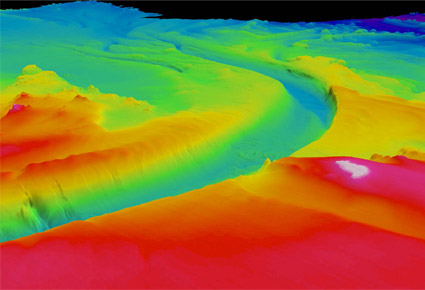
Researchers working in the Black Sea have found currents of water 350 times greater than the River Thames flowing along the sea bed, carving out channels much like a river on the land.
The undersea river, which is up to 115ft deep in places, even has rapids and waterfalls much like its terrestrial equivalents.
If found on land, scientists estimate it would be the world’s sixth largest river in terms of the amount of water flowing through it.
These channels are the main transport pathway for sediments to the deep sea where they form sedimentary deposits. These deposits ultimately hold not only untapped reserves of gas and oil, they also house important secrets – from clues on past climate change to the ways in which mountains were formed.
Now the team, led by Dr Dan Parsons and Dr Jeff Peakall from the University of Leeds, has been able to study the detailed flow within these channels. Dr Parsons, said: “The channel complex and the density flow provide the ideal natural laboratory for investigating and detailing the structure of the flow field through the channel.
More evidence that shows there’s more to dogs than we realise.
Earlier on this year, a series of Posts was published on Learning from Dogs based on a science programme on the BBC (BBC Horizon) that revealed the degree of sophistication that is inherent in these clever animals.
This is the link to that article. Unfortunately the YouTube videos have now been removed but there are some clips available on the BBC website here. As the programme was introduced:
We have an extraordinary relationship with dogs – closer than with any other animal on the planet. But what makes the bond between us so special?
Research into dogs is gaining momentum, and scientists are investigating them like never before. From the latest fossil evidence, to the sequencing of the canine genome, to cognitive experiments, dogs are fast turning into the new chimps as a window into understanding ourselves.
Anyway, all this is a lead in to an item on the news today regarding a study into dogs by the University of Vienna.
Dogs “automatically imitate” the body movements of their owners, according to a study.
This automatic imitation is a crucial part of social learning in humans.
But Austrian researchers report that the phenomenon – where the sight of another’s body movement causes the observer to move in the same way – is evident in many other animals.
They say that it reveals clues about how this type of learning evolved.
The study, which was led by Dr Friederike Range from the University of Vienna in Austria, also suggests that the way in which people interact with and play with their dogs as they are growing up shapes their ability to imitate.
The phenomenon under investigation is known as "selective imitation" and implies that dogs -- like human infants -- do not simply copy an action they observe, but adjust the extent to which they imitate to the circumstances of the action. (Credit: iStockphoto/David Brimm)
There’s more to the news release on Science Daily from which is quoted:
New research by Friederike Range and Ludwig Huber, of the University of Vienna, and Zsofia Viranyi, of the Eötvös University in Budapest, reveals striking similarities between humans and dogs in the way they imitate the actions of others. The phenomenon under investigation is known as “selective imitation” and implies that dogs–like human infants–do not simply copy an action they observe, but adjust the extent to which they imitate to the circumstances of the action.
The Economist, for me, is one of the great newspapers of our time. I have often referred to it on Learning from Dogs.
Last Saturday’s edition (July 24th – 30th 2010) carried a most beautiful obituary about Mau Piailug who in 1976 demonstrated that ancient seafarers could indeed have voyaged from Hawaii to Tahiti, a distance of some 2,500 miles, before the age of compasses, sextants or charts. Here is an extract from that obituary (you may need to register to view it):
As a Micronesian he did not know the waters or the winds round Tahiti, far south-east. But he had an image of Tahiti in his head. He knew that if he aimed for that image, he would not get lost. And he never did. More than 2,000 miles out, a flock of small white terns skimmed past the Hokule’a heading for the still invisible Mataiva Atoll, next to Tahiti. Mau knew then that the voyage was almost over.
On that month-long trip he carried no compass, sextant or charts. He was not against modern instruments on principle. A compass could occasionally be useful in daylight; and, at least in old age, he wore a chunky watch. But Mau did not operate on latitude, longitude, angles, or mathematical calculations of any kind. He walked, and sailed, under an arching web of stars moving slowly east to west from their rising to their setting points, and knew them so well—more than 100 of them by name, and their associated stars by colour, light and habit—that he seemed to hold a whole cosmos in his head, with himself, determined, stocky and unassuming, at the nub of the celestial action.
Mau Piailug creating model of his canoe - Steve Thomas Photo
Mau Piailug was born in 1932 on Satawal, a tiny Pacific island no wider than a mile in Micronesia. When he was still a little baby, his grandfather put him in a tide pool as though he were putting him in a cradle. There the sea gently rocked him back and forth with the rhythm of the tides.
When Mau was six, his grandfather began to teach him about navigation. He started by telling him about the stars; the grandfather made a star compass out of a circle of coral rocks, and in the center he put a little canoe he had made of palm fronds. Then he explained how the stars rose in the sky and traveled from east to west.
As he grew older, Mau spent his evenings in the canoe house. There he asked the elders to teach him about navigation. In this way, and with his grandfather’s help, he learned the paths of more than a hundred stars. He also learned that when clouds covered the sky, he could use the direction of the ocean waves to guide the canoe. He could also follow the birds toward land when they headed home in the evening, and he studied the creatures of the sea, for in times of trouble they, too, could help him find land.
A film was made about Mau called The Last Navigator. Do click on the link and read more about what Steve ‘learnt’ from Mau – here’s a closing taste:
It has been nearly fifteen years since I first met Piailug. In that time I have been blessed with relative fame and prosperity – an eventuality, by the way, that Piailug foretold to me. As I look back, I am impressed now by the twin qualities in the man that impressed me then: his generosity and his courage. Piailug took me into his family, assumed responsibility for my material and political well-being, and taught me his navigation without reserve. The knowledge he gave me about navigation is considered priceless in his culture. The knowledge he gave me about myself, I have come to see, is priceless as well. I often think of Piailug, and the fierceness and determination with which he defends a way of life he knows will die as the wise elders died. He has the courage to live and teach and voyage in spite of the certain knowledge that his struggle can never stem the tide of Westernization, which will change the character of his archipelago and may well eliminate the very role of the navigator as steward of his island’s sustenance and keeper of the flame of cultural knowledge.
Those that know me or have followed Learning from Dogs for the last year (and thank you!) know that I am pretty pessimistic about the economic future for North America and Europe (at least!). I speak not as an economist, far from it, but as someone sufficiently old to think that many millions of individuals and their countries have been living on borrowed time for decades.
David Kauders
Twenty years ago I didn’t really do anything than feel uncomfortable when friends announced another new house with mortgages far in excess of the old ‘rule’ of 1.5 to 2.0 times one’s annual income.
Then I came across David Kauders of Kauders Portfolio Management who explained in fundamental ways why this was all going to end in tears, so to speak. Wasn’t he right!
Thanks to David, I am moderately more well-off than I would have been – without a doubt. Not only did David manage my private pension, he greatly influenced my modest personal investments outside his portfolio.
Where’s this heading? This Blog is an attempt to show that integrity in all that we all do is not only the best personal strategy, it is the only viable course for mankind in bringing us back from the brink of global disaster. So a couple of recent items about economic matters from people of great integrity underlined the value of mentioning them in this Blog.
The first is a talk given by Elizabeth Warren two years ago, in January 2008, entitled The Coming Collapse of the Middle Class. It’s nearly an hour long but very well worth watching especially in the way that Ms. Warren shows how counter-intuitive is our understanding of how family costs have risen over the last 30 years. Although it applies to the US, it certainly has relevance for British viewers. Do watch it.
Here’s how the video is described:
Distinguished law scholar Elizabeth Warren teaches contract law, bankruptcy, and commercial law at Harvard Law School. She is an outspoken critic of America’s credit economy, which she has linked to the continuing rise in bankruptcy among the middle-class.
Next is that stalwart Karl Denninger. How he finds the energy and enthusiasm for publishing his Market Ticker is beyond me. He’s not subtle but his personal integrity is beyond reproach in my opinion.
Karl was recently interviewed by Bill Still (Bill produced the highly acclaimed film The Money Masters) and despite the videos being heavily edited Karl says “and for the most part accurately captures my views on the topics covered.”
Again these interviews are not short but, again, if you want to understand how dangerous the fundamentals still are – then watch them.
Karl Denninger, author of Market Ticker and winner of the 2008 Reed Irvine Accuracy in Media Award explains the roots of the current crisis and why real economic growth is impossible. He explains why the stock market rebounded in 2009 and why that can’t continue. He explains what needs to be done with the banks and predicts that all the big banks will fail.
Part One:
Part Two:
Finally back to David Kauders. He also publishes an opinion website Contrary View. Here’s what David wrote in February 2010.
No. 73 22nd February 2010 Predicting lost decades
There is plenty of evidence from Japan about lost decades for investments. Japan has now lost two decades in equity and property investment, during which time only Government Bonds provided any sanctuary. All policy options failed, because none tackled the real problem, which is that there is already too much debt. What lessons can be drawn for Britain?
Shares here have certainly had a lost decade. On the Japanese evidence, they may well suffer another lost decade. Property has only hit minor bumps, so the Japanese experience suggests that property may suffer a long decline for two decades. In the UK, the Bank of England’s support for mortgages will be withdrawn over the next two years, which itself threatens prices. Why, though, the hysteria about Government debt?
It is questionable whether pundits appreciate the extent of the private sector debt problem, which explains why two groups of economists can offer totally contradictory remedies. In a world with no Gold standard and therefore no anchor to the monetary system, Government debt is relatively safe. The global economy is perched on a knife edge, with a permanent loss of output that must cause income loss and therefore restrict the capacity of households to service their debts. Seeing the commercial risks, banks are still restricting lending, which means there can be no sustained recovery.
There is a misconceived demographic argument being touted at present, which completely ignores the real driver of the post-1945 expansion, namely increased credit. That credit growth has simply gone too far and now brings its own problems. For those people who neither saw the credit crunch nor the long fall in interest rates and inflation coming, to now be credible in predicting a lost decade for bonds, is itself unbelievable.
You see how it all makes sense – the fundamentals are in charge, and always will be!








 Learning from Dogs