This is a long theme that is being broken down into two posts. Hope you can stay with it because it seems to me to represent how difficult it can be, when the topic is complex with significant implications for society, to determine the truth of an issue.
To set my own position clear, I have for many years taken it more or less for granted that mankind, through the mechanisms of increased population, increased standards of living and increased use of carbon-based fuels must be having a deleterious effect on the planet’s atmosphere.
Indeed, there have been a number of articles on Learning from Dogs that support that position of mine. However, my dear friend Dan Gomez sent me a piece that I published on the 16th. June under the heading of Always two sides. Frankly, I was still a little sceptical.
Then on the 22nd June, I published an account about the increasing quietness of the sun which, at the end, included a quotation from Dr Frank Hill, “It is unfortunate that the global warming/cooling studies have become so politically polarizing.” H’mm, I thought, what is it that Dr. Hill sees that causes him to write this way?
Then another good friend of Learning from Dogs, Patrice Ayme, reminded me that he had written a comprehensive article on his own Blog about the apparent enigma of the sun cooling while at the same time the ice caps were melting. Ah ha, I thought, a thoughtful and erudite explanation that while it was complex we are still in a phase of climate change (i.e. warming) most likely caused by man. Patrice gave me permission to reproduce his essay in full, which I so do below.
But then reading the comments sent in to Patrice’s original essay on the 31st May, 2009, I was set right back to the position of being very, very confused. More about the confusion that exists tomorrow, but now here’s Patrice’s original essay.
SUN COOLING, ICE MELTING…
By Patrice Ayme
TWENTY FIVE METERS SEA LEVEL RISE ALL TOO SOON FROM MELTING OF ANTARCTICA’S ICE BASINS?
How to enlighten the conversation with one picture worth 10,000 words. Watch the red line below, and how much it dips lately:

Synopsis: More than 98% of scientific papers considering the subject opine that recent human activities have warmed up the climate. But the percentage of the public who believe that is only around 55% … in the USA. This disbelief, far from being healthy, is related to the propaganda of big polluters, allowing the latter to avoid making the economy of the USA efficient (so they have less to do, avoid public inquiry, and make greater profits, while being beyond any suspicion).
One recent tactic of these sneaky types has been to talk about the sun and planets. The main argument they make is that the sun is acting up, thus allegedly causing the warming. Fair enough. Considering the sun is a must, indeed: there is plenty of evidence that the recent Little Ice Age was caused by a sort of Solar Winter. So let’s look at the sun: as the graph above shows, it is COOLING. The sun is cooling. The warming would have been much greater, had the sun not been so kind. Ooopss.
Other climate deniers made some noise about a recent cover article in Science that computed that the collapse of the WAIS (West Antarctica Ice Shield) would rise sea level by only 3.30 meters. But this article sort of cheats: reading its fine print shows that the rise would be rather be 3.80 meters, and it brazenly ignores all possible melting of part of the Antarctica Peninsula (contriving to do so by the not so subtle artifice that said peninsula is not semantically part of the WAIS; however, the peninsula is more north and warmer, so, one ought to suspect, it would melt even more, as it has actually started to do!).
The authors in Science also ignore other mountainous regions of the WAIS itself, using, once again the artifice that being on land does not make them part of the WAIS, formally speaking, since the WAIS is a shield, and nothing inclined is, although, of course, having deep blue sea all around the present mountainous areas of the WAIS would warm them up.
I then turn this argument around. Looking towards the east, and I ponder what could happen with East Antarctica. Answer: very serious trouble.
By the way, the expression “climate change” is misleading. The biosphere is attacked in all ways by the rise in Greenhouse Gases, and not just by direct warming. It is losing the battle quickly. Changes that have happened before in millions of years are now happening in decades, so biological species cannot adapt through migration, and, or, biological evolution.
Half of the CO2 recently produced has sunk into the ocean, where it reacted with water to make carbonic acid. So millions of species of the plancton, many making oxygen, are dissolving in an acid prepared by the average American household and its refusal to endure a stiff carbon tax. Moreover entire zones within the oceans have warmed so much that they lost enough oxygen to support life as we know it (most sea species are highly sensitive to tiny temperature variations). And as evolution presently knows it. These gigantic zones are now dead: life does not have time to evolve species adapted to this new environment. What is going on is a BIOSPHERICAL CATASTROPHE, as a result of stuffing life’s environment with 400 million years of carbon deposits.
——————–
SOLAR INPUT:
No climate change discussion can be considered complete without considering the sun. This is one point greenhouse deniers have been making. It is indeed extremely correct.
Greenhouse deniers have been loudly proclaiming, that because some planets (Mars, Pluto) are warming (perhaps), then the sun has got to be warming. This argument can be put to rest: Mars and Pluto’s climates are dominated by astronomical and peculiar factors (see notes).
And, unfortunately for greenhouse deniers, the sun output has been slowing down, as the graph below shows.
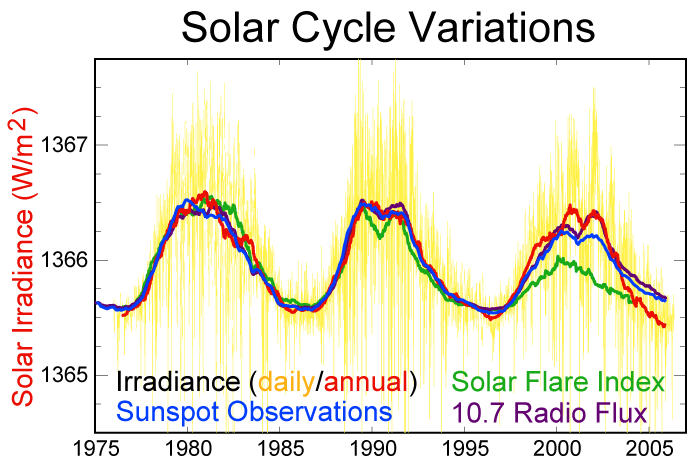
What does this mean? We should be cooling down, because the sun’s output has been going down as much as an astounding 6% in some frequencies. But, nevertheless, the lower troposphere has been warming up (while the stratosphere, robbed of heat by the greenhouse blanket BELOW it, has been cooling, a predicted effect of the greenhouse; this warming at low elevation accompanied by a cooling higher up shows that the observed changes of temperatures are due to a greenhouse, not just a global change in solar output).
Thus the warming of recent times is indeed caused by greenhouse warming, as humans augmented greenhouse gases by more than fifty percent in 150 years. Notice that in the graph above that we are reaching a local minimum of solar output, and that solar output should soon increase again in the next 11 years cycle.
Another tactic has been for some greenhouse deniers to turn into outright friends of the greenhouse, and claim that we were spared a new ice age from the human induced greenhouse. (That many people living in the Arctic will love the considerable heating the poles will experience is only natural though.)
Indeed, some scientists have speculated that herding augmented the production of methane during the Neolithic, thus preventing the cooling that would otherwise have happened. Methane is a very strong greenhouse gas. Basically Neolithic man killed the carnivores, and reduced the forests, so the herbivores would have plenty to munch on, and the herbivores became more numerous. As they did, the worldwide density of methane went up significantly, durably warming up the lower atmosphere.
Maybe. But that is not the point. The point is that we are doing GEOENGINEERING on our own planet, haphazardly, driven by short term profit and hubris. In particular what would happen if Mr. Sun would wake up, and produce as much output as it used to a few decades ago? Well, the gentle warming up would turn into outright swift heating.
(This being said, a lot of people living in high latitudes can only be pleased by polar heating: an entire world is opening up, and many of the big polluters know there are significant fossil fuel reserves around the poles, piled up there in warmer eons past…)
LUBRICATION, OR HOW TO LOSE AN ICE CAP:
A few years back, only the fringes of Greenland were melting in summer. The ice cap flowed majestically to the sea, at a sedate pace, through enormous flowing glaciers entering the sea. Greenland’s ice cap towers more than 3000 meters above sea level and the possibility of its melting sounded like bad science fiction.
In recent summers, though, up to half of Greenland has been melting, and “icequakes” have gone from about five a year in 1996 to around 30. In a typical icequake, a glacier the size of Manhattan, and 500 meters thick, slips by say ten meters in one minute (icequakes release their Richter 6 energy with lower frequency waves than the most destructive tectonic earthquakes, so one needs special seismographs to pick them up; although about half of the energy of the tsunami quake of 2004 was released that way, making the waves two-thirds as high as they would have been otherwise; hence that tsunami quake is viewed as 9.1 Richter, or 9.3 Richter, depending whether one counts the low frequency waves, or not…).
The reason for icequakes is undoubtedly lubrication by water gushing below the glaciers, having ended down there by what is called a moulin (a giant waterfall chute, up to twenty meters across and 3 kilometers deep). On the margins of Greenland, where the slope is strong, the glaciers avalanche down. Before 2000, glaciers on the West coast of Greenland had never done so. Now they do.
Interestingly, something a bit similar is found down south. Hundreds of lakes have been found under the main ice shield in Antarctica. They are most probably caused by geothermal heating, but they communicate with each other, and can propel (by appropriate swelling of their liquid mass) the ice shield above. That ice shield can be up to 4,000 meters thick. My point? One could imagine the same formation of moulins occurring down south (although there, right now temperatures, even in summer, oscillate between minus 50 Celsius and minus ten, so there are no dangers of lakes forming on the surface yet, as they now happen on the Greenland ice cap; such lakes can vanish into a newly formed moulin in minutes).
WHY GLACIATIONS COME AND GO, AND WHY IT’S GOING TO BE WARM FOR 50,000 YEARS:
One thing to know about Antarctica is that it was long covered with the same forests found nowadays in Patagonia. Trees and even dinosaurs (!) had adapted to the long nights. Glaciers were only found in the numerous high mountain ranges of the polar continent. In the last four million years, after 70 million years of steady cooling, perhaps because of the closing of the bridge between North and South America, and the rise of mighty mountain ranges, plus the opening of a circumpolar ocean which insulated Antarctica from the rest of the planet thermally, earth’s climate became much cooler. The apparition of glaciated poles was, most certainly, itself an accelerating cause of cooling. Sea level dropped 135 meters below the present level, as water ice gathered in colossal ice shields. Glaciations oscillated, between the poles and the temperate zones, as the parameters of earth’s orbit varied.
Joseph Alphonse Adhemar (1797 – 1862), a French mathematician, was the first to suggest that glaciations occurred from astronomical dispositions, in his 1842 book “Revolutions of the Sea”. Then the self educated Scottish scientist Croll, using Leverrier’s precise math (which had allowed him to discover Neptune) revealed the relationship between ice, albedo (that is the measure of how much sunlight is reflected back to space), and the eccentricity of earth’s orbit.
Croll suggested the basic idea of orbitally forced insolation variations influencing terrestrial temperatures. This comes from a geographical oddity, the fact that the continents of Earth are gathered up in the North. That allows support of enormous ice shields.
The sea does not allow support of huge iceshields, kilometers thick, as it is too warm (except in Antartica). Why the sea stays warm is another miracle, related to CO2 and volcanoes. Basically ice shields all over, as in “Snow Ball Earth”, lock up in the atmosphere CO2, bringing a strong greenhouse, which, in turn, melts the iceshields. A “Snow Ball Earth” related to the rise of complex life, is suspected to have occured a few times around 700 to 600 million years ago. So CO2, life, volcanoes, plate tectonic, active geology and temperature of the biosphere are tightly connected.
So, if not enough sun falls on those northern continents during summer, the ice from the preceding winter will not melt, and the continents will gather ice, and the ice will spread south, if it can.
This lack of sun exposure in summer will happen from celestial mechanics interacting with the inclination of the rotation axis of the earth. Croll’s work was widely discussed, but by the end of the 19th century, the theory was generally disbelieved. Much later, the Serbian Milutin Milankovitch further developed the theory that eventually triumphed in 1976, in modified form.
The bottom line is that the present astronomical calculations show that 65° North summer insolation should increase gradually over the next 25,000 years, and that no declines in 65° North summer insolation sufficient to cause an ice age are expected in the next 50,000 to 100,000 years.
Hence Earth should warm up for the next 50,000 years, an exceptionally long interglacial. [Berger A, Loutre MF (2002). “Climate: An exceptionally long interglacial ahead?”. Science 297: 1287–1288]
A DAMOCLES ICICLE, READY TO CRUSH US ALL: THE WEST ANTARCTIC ICE SHIELD (WAIS)
The West Antarctic Ice Shield (WAIS) looks all white and solid from space, with a few huge mountains ranges coming out. Those mountains are, in truth, massive islands coming out of a frozen mass of fresh water that stands in place of the ocean. The WAIS connects the Antarctic peninsula, which goes north towards Patagonia, to the main part of the polar continent. The WAIS is covered with ice, it is made of ice. The crucial point, though, is that most of the rock supporting the solid ice of the WAIS is below sea level. It is a giant ice cube resting on what ought to be the bottom of the ocean.
The sea is out there, lapping against the boundary of the WAIS, which rests so heavily on the continent, that it pushes it down. The rocky boundary has no ice pushing it down, except a bit on the side, so it is not as low. Thus the rock below the WAIS forms a bowl that would be under water, if it were not under ice. That bowl is glued on its margin by ice. The surface oceanic water is salty, and would be below freezing if it were not so salty, thus it glues efficiently the margin of the WAIS, since the WAIS is made of freshwater, and thus freezes solid below zero Celsius. This system sounds contrived, and it is indeed a rather unstable arrangement.
Water has the curious property that it is denser at 4 degree Celsius (8 degrees Fahrenheit above the freezing point of pure water). Hence the sub freezing salty ocean water is above relatively warmer ocean water. If at some point some warm water can come in contact with the boundary of the WAIS, it could suddenly melt the sweet water ice of the WAIS at the margin, and then flow below the WAIS, melting it from below, and organizing some sort of satanic Carnot thermal engine with a strong circulation squeaking below, and accelerating the whole thing (it maybe how and why the ice shelves dislocate so fast, by the way: sudden circulation forming a thermal engine underneath, I would suggest).
From previous studies, it was widely assumed that the WAIS would cause a sea level rise of 5 meters if it melted. But an article in Science, May 15, 2009, claiming more precise radar telemetry, revisits the threat: “Theory has suggested that the West Antarctic Ice Sheet may be INHERENTLY UNSTABLE. Recent observations lend weight to this hypothesis. We reassess the potential contribution to eustatic and regional sea level from a rapid collapse of the ice sheet and find that previous assessments have substantially overestimated its likely primary contribution. We obtain a value for the global, eustatic sea-level rise contribution of about 3.3 meters, with important regional variations.”
The important regional variations have mostly to do with the rise of the local shores in West Antarctica: as the ice goes away, the continent rebounds. The authors count ONLY regions of where the bedrock slope is opposite to the glacial flow, a pointless restriction, in my not so humble opinion. Counting all regions below sea level, as they should have, the same authors find a rise of 3.8 meters. The authors also ignore the melting in the colossal mountainous islands that would be left, some as large as medium size countries.
THE WEST ANTARCTIC ICE SHIELD (WAIS) IS ALL SET TO BREAK UP:
Temperatures have increased enormously in the polar regions (up to 5 degrees Celsius in some regions such as the Antarctica peninsula, although the overall planetary warming is only 0.75 C, less than one degree Celsius; some say only 0.4 degree Celsius!). This comes from the poles being the planet’s heat sinks: all the heat is sent there, as the greenhouse effect proceeds apace (another why little is being done about it, as temperate areas, where the deciders live, have barely warmed up).
This warming up at the poles has a very practical effect: the surface waters in Antarctica are in danger of reaching zero degree Celsius, the temperature at which fresh water ice melts. That means that the margin of the WAIS could come unglued, and warm ocean water could flow below it. In other words, we are within an easy warming reach of a WAIS catastrophe. Something like this happened to the ice shield over Hudson Bay, which dislocated very fast a few thousands years ago, as warm ocean water slipped below it. (I just suggested a mechanism for this otherwise unexplainable speedy break-up.)
COULD THE EAST ANTARCTIC ICE BASINS DISSOLVE TOO?
As if this looming WAIS disaster was not enough, there is another Damocles icicle hanging above the carbon banquet. A mechanism is revealed with a new actor, that I am perversely pleased to introduce, the East Antarctic Ice Shield, allowing a sea level rise of 35 meters in one generation. I am not saying that it will happen, but that there is a mechanism that could make it happen, and political leaders who claim to be cautious will now to have to consider this.
I looked at the pretty pictures in the same article in Science trying to minimize the danger posed by the WAIS, and looked again. And then looked again, and looked on the side, where East Antarctica, most of Antarctica, is found; disbelief setting in ominously all over.
Incredible. How interesting. There I saw a positively enormous area where the ice cap bottom is LOWER than 200 METERS BELOW SEA LEVEL. Yes, 200 meters below! Imagine the disaster when warm water is going to slip below that… There are actually two areas, next to each other, the Wilkes Subglacial Basin and the Aurora Basin, and they obviously communicate below sea level, and moreover front hundreds of kilometers of Antarctic ocean below 200 meters below sea level. They do this nicely by a pleasant 67 degrees of southern latitude, just under the Antarctic Polar Circle, about as close to the pole as Fairbanks, Iceland, and further than the Lofoten islands or the city of Murmansk, or Europe’s North Cape. (All those areas are free of ice, and Fairbanks is not under the influence of the Gulf Stream!)
The ambiance of that article in Science was reassuring in this typically reserved way scientists affect, in the hope of being taken seriously: “Collapse is considered to be a low-probability, high-impact event with, for example, a 5% probability of the WAIS contributing 10 mm per year within 200 years.” Of course, this is pseudo science, because “is considered to be” is not science. Science is about events that can be repeated at will. It’s not about getting consideration in a social setting.
Hence, if anything, I found the conclusions of that article scarier than ever. I want to see an article evoking not just the WAIS, but all the potential flash flood in EASTERN ANTARCTICA. Now, methinks it’s got to be of the order of twenty meters of sea level rise, just looking at it the maps. So thank you science, thank you lord, and let’s get ready for real nomadism, running for the hills! A bad emotion (the melting of the iceshields can only be a multimillennial event) reinforced by a little bit of the wrong knowledge (speciously minimizing arguments on a fraction of the problem, namely the WAIS) often spells disaster.
Conclusion: HELL NOW?
If the poles melt, there is no coming back. The Earth’s albedo will be irreversibly reduced, the dark polar oceans and polar forests will absorb light and heat, instead of throwing it back to space. The planet will switch to its HOT REGIME. To its hot regime it is very familiar with. But the present biosphere is not. We would be back in a flash to Jurassic Park. But without the dinosaurs in Alaska (as they used to be!)
We used to have about 280 ppm of CO2 equivalent greenhouse gases, 150 years ago. Now we are around 450 ppm, and increasing fast (3 ppm a year in CO2 rise alone, which is itself at 385 ppm). From long term geological records, we know that Antarctica covers itself with ice at 425 ppm. Even an American politician should be able to understand what this means; the southern polar icecap is now unstable.
At the most extreme, adding to the preceding tipping points the “clathrate gun” (massive eruptions of frozen methane stores, apparently greater than all the other fossil fuels combined), a hellish scenario seems possible where this would all happen WITHIN A CENTURY. Massive melting within much less than that is also possible: in 2007 frozen methane in the warmest Arctic ocean ever erupted a bit. In 2008, the ocean was a bit colder, and methane came out of the tundra instead. Before, for an entire decade, methane’s density had not augmented.
Methane, CH4 has 100 times the greenhouse capability of CO2; some fancy man-made gases have 10,000 times the greenhouse capability of CO2, hence the difference between 385 ppm of pure CO2, and the 450 ppm of warming by CO2 equivalent gases I evoked.
There is no doubt that at least 90% of mankind would die in the process (nuclear bombing of coal plants for ecological reasons may be an ironical twist, with a rare touch of ecological humor).
That of course, was the bad side of things. On the good side, carbon addicts will be able to burn coal like there is no tomorrow, for a few years more, thanks to the antics of Mr. Sun conveniently truly going to sleep, as CO2 build up. A self-fulfilling prophecy: there will be indeed no tomorrow, thanks to them.
Humankind, playing fast and loose with things it digs up from underground, where they have been buried for hundreds of millions of years, if not billions, burns those things in the atmosphere. The USA, apparently hoping to transmogrify itself through platitudes, is taking its sweet time to do nothing significant about climate change. Not only is the USA also culprit, indirectly, of a lot of Chinese emissions, but, as (still) the world number one industrial power, the USA, through competition of its products worldwide, has an unfair carbon advantage it is using to the hilt (most of the electricity of the USA comes from indigenous coal, cheap and plentiful).
Obama should have put a ten cents per gallon gas tax on his first day, but he found much safer to send more taxpayer money to Afghanistan, and his friends in high finance, so convenient, in truth, with financing him. At least, very short term, so it is: the sea has not reached the White House yet (when it does, it will be too late, as the greenhouse effect is highly non linear, as I described above).
Weirdly, and perniciously, Mr. Sun, which was supposed to be steady as a rock, has been cooperating with the polluters, in the last two decades. But we are at the bottom of the 11 year cycle, so this should be less of a factor for a while.
The Sun has slowed down for decades at least twice in the last millennium. This caused the Little Ice Age (which destroyed Viking Greenland). Should the Sun persists in cooling down in the coming decade, the catastrophe would be even greater than if it did not. Indeed, temperatures would not rise as much. Thus polluters would be encouraged to stuff the atmosphere with even more CO2, perhaps even arguing that they are sparing us an ice age. However, the CO2 would keep on building up, and half of it dissolves in the ocean, where it reacts with water to make carbonic acid. Thus the oceans would die even faster.
Ultimately, when the Sun wakes up from its slumber, all the heat would return, and more. Moreover a lot of CO2 would come out of the oceans, thanks to the temperature rise.
A little knowledge is a dangerous thing, a lot of knowledge is necessary to those who want to be morally right. Planetary engineering, as we are presently doing, without knowing enough, is the most terrible thing. When the hand of fate comes upon us, not only will the planet get hellish, but many of the vengeful ones in flooded countries will make sure that there is hell to pay.
Patrice Ayme
***
Notes: 1) Mars and Pluto’s climates are dominated by the enormous wobble for the former, and the amazing eccentricity of the second. Sometimes, Pluto is so far from the sun, its atmosphere snows down, and freezes on the ground. As it approaches the sun a century later, or so, the atmosphere goes back up, and puts a greenhouse around the planet, warming it up (right now Pluto is going away from the sun, but there is inertia to its greenhouse, so it keeps on warming).
Mars’ axis of rotation can be so inclined on the ecliptic plane (it oscillates between 10 and 45 degrees!) that then the poles get sun full on, once a year, and melt, and the Martian atmosphere is then thick with CO2 and H2O, two powerful greenhouse gases, so the planet warms up a lot (conversely, when the planet stands upright on its orbital plane, light grazes the poles, and the atmosphere freezes around the ice caps, the greenhouse effect goes way down, and the planet freezes.
2) The glory of SUBOCEANIC ANTARCTICA:
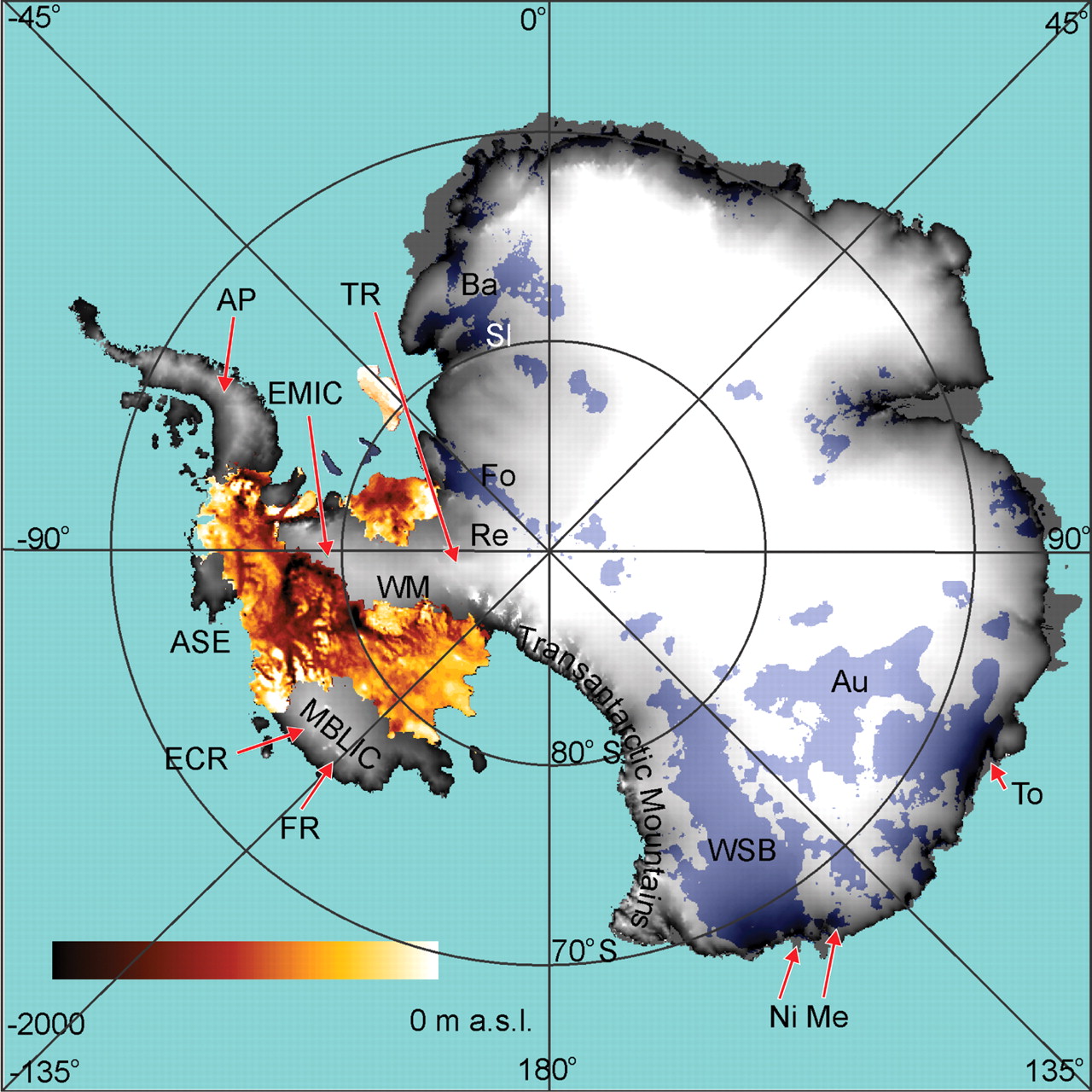
Fig. 1 Antarctic surface topography (gray shading) and bed topography (brown) defining the region of interest. For clarity, the ice shelves in West Antarctica are not shown. The brownish and yellow parts are the WAIS’ bed, and are all below sea level, and are why the WAIS will disintegrate.
Areas more than 200 meters BELOW SEA LEVEL in East Antarctica are indicated by blue shading. NOTICE THAT A LOT OF EAST ANTARCTICA, WHERE THE SUB SEA LEVEL BASINS ARE, HAVE THEIR MARGINS WELL NORTH OF 70 DEGREES (and actually just north of THE SOUTH POLAR CIRCLE).
AP, Antarctic Peninsula; EMIC, Ellsworth Mountain Ice Cap; ECR, Executive Committee Range; MBLIC, Marie Byrd Land Ice Cap; WM, Whitmoor Mountains; TR, Thiel Range; Ba, Bailey Glacier; SL, Slessor Ice Stream; Fo, Foundation Ice Stream; Re, Recovery Glacier; To, Totten Glacier; Au, AURORA BASIN; Me, Mertz Glacier; Ni, Ninnis Glacier; WSB, WILKES SUBGLACIAL BASIN; FR, Flood Range; a.s.l., above sea level.
(Illustrations from Bamber and al. Science May 15, 2009)
P/S 1: We are just coming out of a solar minimum so pronounced that cosmic rays, less deflected by the sun’s weakening magnetic field, have become a problem… Sunspots had nearly completely disappeared for the first half of 2009, before reappearing violently in July… There are mysterious strong correlations between sunspots and Earth’s temperature (mysterious, because, although very strong, they inverted in the 1970s;Vincent Courtillot, 2009).
P/S 2: Thus, we have had a sort of solar winter in the last generation, and we seem to have reached its nadir right now, in the spring of 2009. (That would explain why the lowest icepack in the Arctic was in 2007, and the second lowest in 2008, with 2009 the third lowest ever recorded.)
Nothing says that the sun will not be even weaker in its next cycle. Maybe the greenhouse effect will save us!
Indeed… During the “Little Ice Age“, there was a considerable cooling, apparently originating from the sun’s reduced activity. After a slow start around 1300 CE which had, nevertheless, dramatic consequences in Europe (famines, and maybe a contribution to the massive war and plague that quickly followed; soon the Greenland Vikking colonies were decimated and had to be evacuated), the SOLAR cooling accelerated around 1600 CE. Galileo still saw some sun spots. But just a few. Soon they completely disappeared (the so called “Maunder minimum”). And they stayed disappeared for centuries. The glaciers in the Alps advanced dramatically, sometimes by several miles. In the late nineteenth century, sunspots reappeared, and the CO2 went up significantly, from industrialization (although warming itself extracts CO2 from sea and tundra). The result was an even faster retreat of the glaciers.
We cannot predict the sun (aside from its 11 year and 22 year, and an apparent 1,000 year cycles). We can only assume it will pick up, back up to what has been its normal activity over the last 5,000 years of civilized history. If it did, solar warming would combine with the greenhouse, and it is to be feared that the planet will switch SUDDENLY to the hot mode. It may be in a way even more violent than anything movies have imagined so far (because of the methane stores, and the dramatic changes their release would lead to: melting poles, CO2 bubbling out of the oceans). Good luck to us all…