On the 17th March, I wrote another piece inspired by Lester Brown’s book, World on the Edge. That piece was about what Lester Brown calls Plan B and shows that there are positive, real solutions to the dilemma that us humans have got ourselves in.
Anyway, I was delighted to see in my email in-box the following,
PLAN B:MOBILIZING TOSAVECIVILIZATION—THE FILM
Plan B video
For the month of April only, you can watch a streaming edition of the film Plan B on the PBS website. So if you missed the initial release for whatever reason, here is your opportunity to watch it at your leisure.
Based on Lester Brown’s Plan B book series, this 90-minute film, by the award-winning film producers Marilyn and Hal Weiner, follows Lester as he speaks in Beijing, Seoul, Tokyo, New Delhi, Rome, Istanbul, Ankara, and Washington, DC, and visits with world leaders to discuss ways to respond to the challenges of climate change.
The film begins with a dramatic portrayal of a world where there is a mounting tide of public concern about melting glaciers and sea level rise and a growing sense that we need to change course in how we react to emerging economic and social pressures. The film also spotlights a world where ocean resources are becoming scarce, croplands are eroding, and harvests are shrinking.
But what makes Plan B significant and timely is that it provides hopeful solutions—a road map that will help eradicate poverty, stabilize population, and protect and restore our planet’s fisheries, forests, aquifers, soil, grasslands, and biological diversity.
Along with Lester Brown, you will hear from notable scholars and scientists including Nobel Laureate Paul Krugman, Pulitzer Prize winner and New York Times columnist Thomas Friedman, and former Governor and Secretary of the Interior Bruce Babbitt.
Narrated by Matt Damon, well-known for his work raising environmental awareness.
The film is available to view here. Note that it is only free to watch for the month of April.
My apologies but events yesterday conspired to get in the way of me offering a more thoughtful article for today. So I hope you will be happy with another video of Joseph Campbell.
MISH’s website pointed me to the website Space.com where there was this interesting reflection.
The massive earthquake that struck northeast Japan Friday (March 11) has shortened the length Earth’s day by a fraction and shifted how the planet’s mass is distributed.
A new analysis of the 8.9-magnitude earthquake in Japan has found that the intense temblor has accelerated Earth’s spin, shortening the length of the 24-hour day by 1.8 microseconds, according to geophysicist Richard Gross at NASA’s Jet Propulsion Laboratory in Pasadena, Calif.
Gross refined his estimates of the Japan quake’s impact – which previously suggested a 1.6-microsecond shortening of the day – based on new data on how much the fault that triggered the earthquake slipped to redistribute the planet’s mass. A microsecond is a millionth of a second.
“By changing the distribution of the Earth’s mass, the Japanese earthquake should have caused the Earth to rotate a bit faster, shortening the length of the day by about 1.8 microseconds,” Gross told SPACE.com in an e-mail. More refinements are possible as new information on the earthquake comes to light, he added.
The scenario is similar to that of a figure skater drawing her arms inward during a spin to turn faster on the ice. The closer the mass shift during an earthquake is to the equator, the more it will speed up the spinning Earth.
I was also interested to read in that article more confirmation that the earthquake moved Japan! (I had mentioned it in an earlier post on Learning from Dogs.)
The initial data suggests Friday’s earthquake moved Japan’s main island about 8 feet, according to Kenneth Hudnut of the U.S. Geological Survey. The earthquake also shifted Earth’s figure axis by about 6 1/2 inches (17 centimeters), Gross added.
The Earth’s figure axis is not the same as its north-south axis in space, which it spins around once every day at a speed of about 1,000 mph (1,604 kph). The figure axis is the axis around which the Earth’s mass is balanced and the north-south axis by about 33 feet (10 meters).
“This shift in the position of the figure axis will cause the Earth to wobble a bit differently as it rotates, but will not cause a shift of the Earth’s axis in space – only external forces like the gravitational attraction of the sun, moon, and planets can do that,” Gross said.
So if you are the sort of person that likes to be precisely on time ….. take note!
As many of you know, I wrote a piece last Monday about how close the moon will be to the Earth on the 19th, and some ideas about whether there was a correlation between close full moons and natural disasters.
Well tomorrow is the 19th and I wanted to remind everyone to take time off, be outside and just admire this wondrous object in our night sky.
A reader, thanks Suzann, pointed me to the NASA Science website where there is some good factual information about how special this moon is. From that website, I quote:
Mark your calendar. On March 19th, a full Moon of rare size and beauty will rise in the east at sunset. It’s a super “perigee moon”–the biggest in almost 20 years.
“The last full Moon so big and close to Earth occurred in March of 1993,” says Geoff Chester of the US Naval Observatory in Washington DC. “I’d say it’s worth a look.”
Full Moons vary in size because of the oval shape of the Moon’s orbit. It is an ellipse with one side (perigee) about 50,000 km closer to Earth than the other (apogee): diagram. Nearby perigee moons are about 14% bigger and 30% brighter than lesser moons that occur on the apogee side of the Moon’s orbit.
“The full Moon of March 19th occurs less than one hour away from perigee–a near-perfect coincidence1that happens only 18 years or so,” adds Chester.
A perigee full Moon brings with it extra-high “perigean tides,” but this is nothing to worry about, according to NOAA. In most places, lunar gravity at perigee pulls tide waters only a few centimeters (an inch or so) higher than usual. Local geography can amplify the effect to about 15 centimeters (six inches)–not exactly a great flood.
(The Moon looks extra-big when it is beaming through foreground objects–a.k.a. “the Moon illusion.”)
Indeed, contrary to some reports circulating the Internet, perigee Moons do not trigger natural disasters. The “super moon” of March 1983, for instance, passed without incident. And an almost-super Moon in Dec. 2008 also proved harmless.
Okay, the Moon is 14% bigger than usual, but can you really tell the difference? It’s tricky. There are no rulers floating in the sky to measure lunar diameters. Hanging high overhead with no reference points to provide a sense of scale, one full Moon can seem much like any other.
The best time to look is when the Moon is near the horizon. That is when illusion mixes with reality to produce a truly stunning view. For reasons not fully understood by astronomers or psychologists, low-hanging Moons look unnaturally large when they beam through trees, buildings and other foreground objects. On March 19th, why not let the “Moon illusion” amplify a full Moon that’s extra-big to begin with? The swollen orb rising in the east at sunset may seem so nearby, you can almost reach out and touch it.
Don’t bother. Even a super perigee Moon is still 356,577 km away. That is, it turns out, a distance of rare beauty. Author: Dr. Tony Phillips | Credit: Science@NASA
Footnote: Less-perfect perigee moons occur more often. In 2008, for instance, there was a full Moon four hours from perigee. Many observers thought that one looked great, so the one-hour perigee moon of 2011 should be a real crowd pleaser.
Yesterday, I included Parts One and Two of a recent BBC television programme put out under the Horizon banner that had found their way onto YouTube.
Nothing more to say in this Post than to let you watch the concluding parts. As I wrote yesterday, this may change forever the way you look at everything!
There’s that wonderful quote from American comedian, Woody Allen, “What if everything is an illusion and nothing exists? In that case, I definitely overpaid for my carpet.”
But that quote may not be as silly as it first appears if I made sense of a programme that we watched recently. That was a documentary broadcast by the BBC under their fabulous science series known as Horizon. As an aside, the range of programmes covered over the years under the Horizon banner is fantastic as this web page from March 2008 demonstrates. An in-depth history of this BBC series is available on WikiPedia and the ‘Home’ page of the current Horizon website is here.
Anyway, back to this particular programme, What is Reality? Rather than me natter on about a subject that I don’t understand, despite being captivated by it, let me allow you to watch the programme courtesy of YouTube! Here is the first half of the programme split into two YouTube videos; the last half will be posted tomorrow.
Do yourself a favour and settle down to watch them undisturbed – as the programme says you may never look at the world around you in quite the same way again!
When I posted my introductory piece on Joseph Campbell on the 14th February, I was tight on time. So it was pretty brief, as a piece.
But I was amazed at the number of people who read that Post; clearly this man Campbell has reached out to many across the world. Plus there was this comment from Michelle, better known as Dogkisses.
What a wonderful man! My hero. I cried when he passed on. He is the first person who reached me in my mid-twenties.
A friend of mine introduced me to “The Power of Myth,” and gave me a video series, which is so old now the VHS won’t play. Bill Moyers (I think I have that name right) interviewed him in the series.
The last book I had about him was, “Radio Interviews with Joseph Campbell.” I gave it to my teenage son. He loved it so much, but his girlfriend said reading that book made him act differently. I laughed and said thank goodness. He said the book disappeared. I wondered how. She said it made him not want to work full time. He was only barely seventeen, and I was trying to get him to take a different path in life.
The world would be a better place if everyone could appreciate what Joseph Campbell said and for the great work he did in his life.
Thank you. A very nice way to start a hectic Monday.
And in reply to me thanking DK for her comment and offering her the chance to guest post on Learning from Dogs, this further comment,
I certainly look forward to the future posts.
I’m having a hard time with my memory and mental fatigue lately. I would have to re-read myself to be able to write about what I learned from Joseph Campbell, which actually might help me and I know I would enjoy it.
I’ve been turning back for the past few months, looking back to when I stood on more solid ground spiritually. Hearing Joseph Campbell again would certainly help me remember that time in my life, because I was reading his work. I have daily quotes from him that come to my Google reader.
Thank you for the invitation and I am truly honored that you ask. I can do some reading and see if my brain gives me anything to share.
This Blog started on July 15th, 2009. At first there were a group of authors all committed to the vision but for various reasons they all were unable to maintain the very real challenges of writing a daily article and they amended the relationship to that of occasional guest author. My fellow founding author, Jon Lavin, has just completed a very demanding Master’s Degree which, for very valid reasons, has kept his nose to a different grinding wheel for the last 3 years. My greatest wish is that Jon can return to writing for this Blog simply because the original idea about dogs having much to teach us came from Jon.
The vision of why so many hours are spent managing and writing on Learning from Dogs is encapsulated here. One of the ideas expressed there is, “Our children require a world that understands the importance of faith, integrity and honesty“. This aspect has become more and more important in my mind. Within less than a month of this Post, I will have my first grandchild (the gender is a closely guarded secret!) When I look at some of the scenarios that could face that grandchild over the next four decades, it’s easy to feel pretty nervous. So being able to use the power of this electronically connected world to ramble on is my way to trying to do something!
This is leading me to the point of this Post. If it wasn’t for the growing number of readers, now several hundred a day, and the graciousness of those readers to find the time to comment, I think this Blog would have rolled over and gone back to sleep in front of the fire as Pharaoh is wont to do!
The comments have been fabulous and even selecting a couple seems unfair on the rest. But nonetheless that is what this article is going to include.
I feel quite positive about technology, including the Internet, but I also wish we could keep things like public libraries and continue to learn skills such as handwriting.
My nephew, an A student in college, recently had to take a handwriting course. My sis was embarrassed ’til she arrived finding many Mothers she knew there for the same reason. Many college students didn’t know how to write.
I volunteered once at a “Center for Independent Living.” One of the main services they offered was free Internet access to people with disabilities. I have since learned how important this is for people who are either bed-ridden or as with Chronic Fatigue Syndrome, stay home much of the time. It is a connection to the world. People can have a sense of community. This is a good thing.
I also love how quickly I can learn little things, such as words and how that might take me somewhere else to learn about something different. Pretty cool.
Maybe some people who have control in certain arenas are afraid that The People who are being controlled will, via the Internet, be heard and all too clearly.
Then last Friday, another reader, Steven Law, added an insightful comment to a Guest Post written by Patrice Ayme last December 10th., the Essence of the Civilizational Crisis, a very profound piece. This is what Steven wrote:
“To create public money, the money everybody uses (be it cash, electronic transfers, swaps, whatever) we use a private system, with proprietary money creating devices inside (say subprime, or derivatives). Civilization has never worked this way before, as the state previously was careful to stay the one and only money creator.”
What Patrice ignores here is that the State “creates” nothing. And I do not support “private” monopoly of money either.What I would like to entertain is the ability for a true free market (one in which we do not have) to explore competitive money, and yes, privately issued by competing banks. But that these banks would not operate on fractional reserve. They would largely operate their monies on a commodities basket reserve system. Not just precious metals, but multiple commodities as well.
At any rate you can learn more on this by reading F.A. Hayek’s “Good Money”pts. 1 & 2. Also I recommend spending some time at The Von Mises Institute online, great insights and education from an Austrian perspective on these matters.
I like your post, but find a few flaws in the argument. My main point here is that civilization has failed throughout history to keep the State under control and not allow state controlled money monopoly. Fiat currencies have failed miserably throughout history and are doing so again. We have some serious learning lessons coming our way…again.
Just want to expand on what I said about the State not creating anything. How can they create when the monies the receive are largely from coercion as well as monopoly? Therefore any “creation” by the State is at the expense of industry and freedom. Hence the need for a limited government.
I also recommend watching “Corporation Nation” on youtube. It’s pretty long and supports with verifiable evidence the depths our government has reached into fascism.
So there we are! Writing this Blog is a labour of love and having both readers and readers willing to comment keeps the love affair going! Thank you all, every one of you.
Finally, Steven mentions that YouTube video Corporation Nation. The whole series of videos is long but if you fancy starting in at the beginning, here it is.
More musings on how this present civilisation is going to change, as change it must.
I have a sense that this article is going to spread across a number of posts. Regular readers of Learning from Dogs will be aware that I am summarising Lester Brown’s excellent book, World on the Edge. If you have missed those summaries, the last one, Part 4, was here. (Part 3 here, Part 2 here, Part 1 here.)
Details of this excellent book are on the Earth Policy Institute website including the opportunity to download the book for free.
OK, back to the theme of this article, very much connected with the mission of the EPI.
Jean and I watched a video last night from the website Top Documentary Films; great site by the way. It was called 2210: The Collapse. This was how the film was described on that website.
Imagine if hundreds of years from now, scientists excavated the abandoned ruins of some of our largest cities, what conclusions would they come to?
It happened to the Romans, the Anasazi, and the Mayans and, inevitably, one day our own modern civilization will also fall. In this two hour special discover how a future civilization might be baffled as to why the population of these once-great cities would suddenly abandon their technology and architecture, and turn their homes into ghost towns.
Some experts believe that there is a very real risk this could happen, and the collapse of the world as we know it is closer than we think.
Examining the parallels between cultures separated by hundreds of years, explore whether the key to preventing such a global collapse today could lie in finding renewable alternatives to our dwindling energy supplies and sustainable resources. Can we learn from the mistakes of the past before it’s too late?
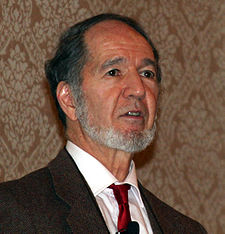
Jared Diamond
In some ways the film didn’t cover any new ground despite it being an interesting way of approaching the subject of the future of our present civilisation. But what was really worthwhile were the clips from three experts in their various fields. They were the author Jared Diamond, Daniel Gilbert who is Professor of Psychology at Havard, and Joseph Tainter also an author. There is much material around from these three gentlemen.
So I am going to start with Jared Diamond. WikiPedia has Jared’s details. The following is a video going back to 2003 which is no less relevant in terms of where we are in 2011. (If you want more of Jared’s ideas, just let me know and they will be included in a future Post.)
“I’ve set myself the modest task of trying to explain the broad pattern of human history, on all the continents, for the last 13,000 years. Why did history take such different evolutionary courses for peoples of different continents? This problem has fascinated me for a long time, but it’s now ripe for a new synthesis because of recent advances in many fields seemingly remote from history, including molecular biology, plant and animal genetics and biogeography, archaeology, and linguistics.”
JARED DIAMOND is Professor of Geography at the University of California, Los Angeles. Until recently he was Professor of Physiology at the UCLA School of Medicine. He is the author of the recently published Collapse: How Societies Choose to Fail or Succeed, and the Pulitzer Prize-winning author of the widely acclaimed Guns, Germs, and Steel: the Fates of Human Societies, which also is the winner of Britain’s 1998 Rhone-Poulenc Science Book Prize. (From here)
Continuing the review of Lester Brown’s book World on the Edge.
Regular readers will be aware that I have been summarising each chapter of this pivotal book. Chapters 2, 3 and 4 are part of the section that Lester Brown calls A Deteriorating Foundation. But I am aware that wall-to-wall gloom is often too much for people to take in so I wanted to let you know that the third section, The Response: Plan B, is very much a realistic and pragmatic approach to the alternative, a planet that will let countless future generations live in harmony and sustainably.
So please take in the dire situation that we are in by reading these summaries or, better still, buy the book!
Chapter Four, Rising Temperatures, Melting Ice, and Food Security.
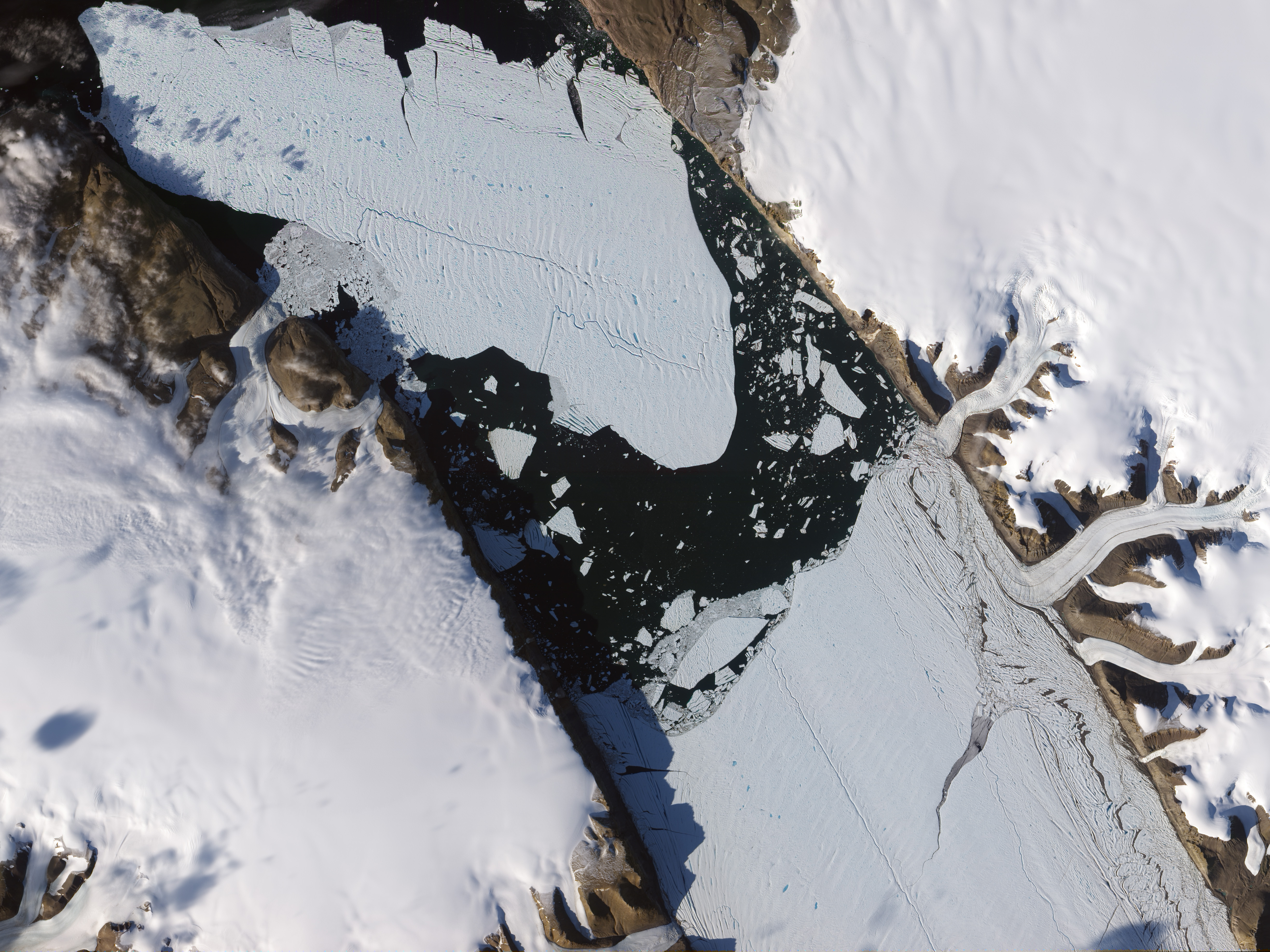
The Petermann Glacier calves an iceberg that covered 97 square miles on August 5th, 2010.
Scientists for some years have been reporting that the Greenland ice sheet was melting at an accelerating rate.
Richard Bates, from the University of St Andrews, part of a team monitoring Greenland ice melt, was reported as saying:
Dr Richard Bates, who is monitoring the ice alongside researchers from America, said the expedition had expected to find evidence of melting this year after “abnormally high” temperatures in the area. Climate change experts say that globally it has been the warmest six months globally since records began.
But he was “amazed to see an area of ice three times the size of Manhattan Island had broken off.
“It is not a freak event and is certainly a manifestation of warming. This year marks yet another record breaking melt year in Greenland; temperatures and melt across the entire ice sheet have exceeded those in 2007 and of historical records.”
A temperate rise of between 2C and 7C would cause the entire Greenland ice mass to melt – raising sea-levels world-wide by 23 feet (7 metres)!
In the United States last year saw record hot temperatures on the East Coast.
On September 27th Los Angeles recorded an all-time high of 113 degrees F, then the official thermometer broke.
A nearby thermometer survived to register a temperature of 119 degrees F, a record for the region.
Crop ecologists use a rule of thumb that for each 1-degree-Celsius rise in temperature above the optimum during the growing season, we can expect a 10-percent decline in grain yields.
Temperatures are rising much faster in the Arctic than elsewhere. Winter temperatures in the Arctic, including Alaska, western Canada and eastern Russia, have climbed by 4-7 degrees F. over the last half-century.
This record rise in temperatures in the Arctic region could lead to changes in climate patterns that will affect the entire planet.
Even a 3-foot rise in sea level would sharply reduce the rice harvest in Asia. It would inundate Bangladesh, a country of 164 million people, submerge part of the Mekong Delta ( a region that produces half of Viet Nam’s rice).
That’s enough from me, simply because although this chapter in the book continues with many more frightening facts, I can’t continue to list them in this particular Post. If the above doesn’t cause you to think and want to change, then a couple of dozen more facts aren’t going to do it either.
Just look at the photograph below and ponder on what we are leaving our children and our grand-children. Indeed, if you are, say 50 years or younger, ponder on what the next few decades could offer for you.
We have to break our addiction with our modern way of living – or Planet Earth will do it for us.
A mother of an iceberg!
On Aug. 5, 2010, an enormous chunk of ice, roughly 97 square miles (251 square kilometers) in size, broke off the Petermann Glacier, along the northwestern coast of Greenland. The Canadian Ice Service detected the remote event within hours in near real-time data from the Moderate Resolution Imaging Spectroradiometer (MODIS) on NASA’s Aqua satellite. The Petermann Glacier lost about one-quarter of its 70-kilometer (40-mile) long floating ice shelf, said researchers who analyzed the satellite data at the University of Delaware. Taken from here.