Category: Education

Always something to blame!

Another smile from Neil Kelly.

A child's burdens!

Oil, sustainability, and American politics

The strange affairs of humans.

A quick piece of web research turned up a quote by the famous physicist, Richard P. Feynman, as follows,

In physics the truth is rarely perfectly clear, and that is certainly universally the case

in human affairs.

I thought the quote an apt introduction to an article written by Bill McKibben of 350 org fame, recently published on Tom Engelhardt’s TomDispatch blog.  As always, a vote of thanks to Tom for giving me permission to reproduce his pieces.

The topic is the Keystone XL pipeline, recently sidelined by Pres. Obama and now generating some interesting musings about the political strategy that may be at play here.  I have written previously about this pipeline and a quick search from the home page of Learning from Dogs using the search terms ‘keystone pipeline’ will find these articles.

Do read the full article from Bill McKibben.  Despite it’s length it’s full of thought-provoking ideas.  As Tom Engelhardt says in the closing sentences of his introduction, “Mark my words on this one: sooner or later, Americans are going to wake up to climate change, just as they have this year on the issue of inequality, and when they do, watch out.  There will be political hell to pay.Tom”

With no more ado, to the TomDispatch article,

Tomgram: Bill McKibben, Puncturing the Pipeline

Posted by Bill McKibben at 8:07am, November 15, 2011.

What’s the biggest story of the last several weeks?  Rick Perry’s moment of silence, all 53 seconds’worth?  The Penn State riots after revered coach JoePa went down in a child sex abuse scandal? The Kardashian wedding/divorce?  The European debt crisis that could throw the world economy into a tailspin?  The Cain sexual harassment charges?  The trial of Michael Jackson’s doctor?

The answer should be none of the above, even though as a group they’ve dominated the October/November headlines.  In fact, the piece of the week, month, and arguably year should have been one that slipped by so quietly, so off front-pages nationwide and out of news leads everywhere that you undoubtedly didn’t even notice.  And yet it’s the story that could turn your lifeand that of your children and grandchildren inside out and upside down.

On the face of it, it wasn’t anything to shout about — just more stats in a world drowning in numbers.  These happen to have been put out by the U.S. Department of Energy and they reflected, as an Associated Press headline put it, the “biggest jump ever seen in global warming gases.”  In other words, in 2010, humanity (with a special bow to China, the United States, and onrushing India) managed to pump more carbon dioxide into the atmosphere than at any time since the industrial revolution began — 564 million more tons than in 2009, which represents an increase of 6%.

According to AP’s Seth Borenstein, that’s “higher than the worst case scenario outlined by climate experts just four years ago.” He’s talking about the Intergovernmental Panel on Climate Change, or IPCC, which is, if anything, considered “conservative” in its projections of future catastrophe by many climate scientists.  Put another way, we’re talking more greenhouse gases than have entered the Earth’s atmosphere in tens of millions of years.

Consider as well the prediction offered by Fatih Birol, chief economist at the International Energy Agency: without an effective international agreement to staunch greenhouse gases within five years, the door will close on preventing a potentially disastrous rise in the planet’s temperature.  You’re talking, that is, about the kind of freaky weather that will make October’s bizarre snowstorm in the Northeast look like a walk in the park.  (That storm had all the signs of a climate-change-induced bit of extreme weather: New York City hadn’t recorded an October snowfall like it since the Civil War and it managed to hit the region in a period of ongoing warmth when the trees hadn’t yet had the decency to lose their leaves, producing a chaos of downed electrical wires.)  And don’t get me started on what this would mean in terms of future planetary hot spells or sea-level rise.

Honestly, if we were sane, if the media had its head in the right place, this would have been screaming headlines.  It would have put Rick Perry and Herman Cain and the Kardashians andItaly and Greece and Michael Jackson’s doctor in the shade.

The only good news — and because it unsettled the politics of the 2012 election, it did garner a few headlines — was that the movement Bill McKibben and 350.org spearheaded to turn back the tar-sands pipeline from Hades (or its earthly global-warming equivalent, which is Alberta, Canada) gained traction in our Occupy Wall Street moment.  Think of it as a harbinger.  Mark my words on this one: sooner or later, Americans are going to wake up to climate change, just as they have this year on the issue of inequality, and when they do, watch out.  There will be political hell to pay.Tom

Obama’s Positive Flip and Romney’s Negative Flop
Is Global Warming an Election Issue After All? 

By Bill McKibben

Conventional wisdom has it that the next election will be fought exclusively on the topic of jobs. But President Obama’s announcement last week that he would postpone a decision on the Keystone XL pipeline until after the 2012 election, which may effectively kill the project, makes it clear that other issues will weigh in — and that, oddly enough, one of them might even be climate change.

The pipeline decision was a true upset.  Everyone — and I mean everyone who “knew” how these things work — seemed certain that the president would approve it. The National Journal runs a weekly poll of “energy insiders” — that is, all the key players in Washington. A month to the day before the Keystone XL postponement, this large cast of characters was “virtually unanimous” in guaranteeing that it would be approved by year’s end.

Transcanada Pipeline, the company that was going to build the 1,700-mile pipeline from the tar-sands fields of Alberta, Canada, through a sensitive Midwestern aquifer to the Gulf of Mexico, certainly agreed.  After all, they’d already mowed the strip and prepositioned hundreds of millions of dollars worth of pipe, just waiting for the permit they thought they’d bought with millions in lobbying gifts and other maneuvers. Happily, activists across the country weren’t smart enough to know they’d been beaten, and so they staged the largest civil disobedience actionin 35 years, not to mention ringing the White House with people, invading Obama campaign offices, and generally proving that they were willing to fight.

No permanent victory was won. Indeed, just yesterday Transcanada agreed to reroute the pipeline in Nebraska in an effort to speed up the review, though that appears not to change the schedule.  Still, we’re waiting for the White House to clarify that they will continue to fully take climate change into account in their evaluation.  But even that won’t be final.  Obama could just wait for an election victory and then approve the pipeline — as any Republican victor certainly would.  Chances are, nonetheless, that the process has now gotten so messy that Transcanada’s pipeline will die of its own weight, in turn starving the tar-sands oil industry and giving a boost to the global environment.  Of course, killing the pipeline will hardly solve the problem of global warming (though heavily exploiting those tar sands would, in NASA scientist James Hansen’s words, mean “game over for the climate.”)

In this line of work, where victories of any kind are few and far between, this was a real win.  It began with indigenous activists, spread to Nebraska ranchers, and eventually turned into the biggest environmental flashpoint in many years.  And it owed no small debt to the Occupy Wall Street protesters shamefully evicted from Zuccotti Park last night, who helped everyone understand the power of corporate money in our daily lives.  That these forces prevailed shocked most pundits precisely because it’s common wisdom that they’re not the sort of voters who count, certainly not in a year of economic trouble.

In fact, the biggest reason the realists had no doubts the pipeline would get its permit, via a State Department review and a presidential thumbs-up of that border-crossing pipeline, was because of the well-known political potency of the jobs argument in bad economic times. Despite endless lazy reporting on the theme of jobs versus the environment, there were actually no net jobs to be had from the pipeline. It was always a weak argument, since the whole point of a pipeline is that, once it’s built, no one needs to work there.  In addition, as the one study not paid for by Transcanada made clear, the project would kill as many jobs as it would create.

The Washington Post’s Juliet Eilperin and Steven Mufson finally demonstrated this late in the game with a fine report taking apart Transcanada’s job estimates. (The 20,000 jobs endlessly taken for granted assumed, among other stretches, that modern dance troupes would move to Nebraska, where part of the pipeline would be built, to entertain pipeline workers.)  Still, the jobs trope remained, and you can be sure that the Chamber of Commerce will run 1,000 ads during the 2012 presidential campaign trying to hammer it home. And you can be sure the White House knew that, which was why it was such a tough call for them — and why the pressure of a movement among people whose support matters to them made a difference.

Let’s assume the obvious then: that one part of their recent calculations that led to the postponement decision might just be the suspicion that they will actually win votes thanks to the global-warming question in the next election.

For one thing, global warming denial has seen its apogee. The concerted effort by the fossil-fuel industry to underwrite scientific revision met its match last month when a team headed by Berkeley skeptic and prominent physicist Richard Muller– with funding from the Koch Brothers, of all people — actually found that, what do you know, all the other teams of climate-change scientists were, um, right. The planet was indeed warming just as fast as they, and the insurance companies, and the melting ice had been insisting.

Still, scientific studies only reach a certain audience.  Weird weather is a far more powerful messenger. It’s been hard to miss the record flooding along the Mississippi and Missouri Rivers, and across the Northeast; the record drought andfires across the Southwest; the record multi-billion dollar weather disasters across the country this year; the record pretty-much everything-you-don’t-want across the nation. Obama certainly noticed.  He’s responsible for finding the cash every time some other state submerges.

As a result, after years of decline, the number of Americans who understand that the planet is indeed warming and that we’re to blame appears to be on the rise again. And ironically enough, one reason may be the spectacle of all the tea-partying GOP candidates for the presidency being forced to swear fealty to the notion that global warming is a hoax. Normal people find this odd: it’s one thing to promise Grover Norquist that you’ll never ever raise taxes; it’s another to promise that you’ll defeat chemistry and physics with the mighty power of the market.

Along these lines, Mitt Romney made an important unforced error last month. Earlier in the primaries, he and Jon Huntsman had been alone in the Republican field in being open to the idea that global warming might actually be real. Neither wanted to do anything about it, of course, but that stance itself was enough to mark them as realists.  It was also a sign that Romney was thinking ahead to the election itself, and didn’t want to be pinned against this particular wall.

In late October, however, he evidently felt he had no choice but to pin himself to exactly that wall and so stated conclusively: “My view is that we don’t know what’s causing climate change on this planet.” In other words, he not only flip-flopped to the side of climate denial, but did so less than six months after he had said no less definitively: “I don’t speak for the scientific community, of course, but I believe the world’s getting warmer… And number two, I believe that humans contribute to that.”  Note as well that he did so, while all the evidence, even some recently funded by the deniers, pointed the other way.

If he becomes the Republican presidential candidate as expected, this may be the most powerful weathervane ad the White House will have in its arsenal.  Even for people who don’t care about climate change, it makes him look like the spinally challenged fellow he seems to be. But it’s an ad that couldn’t be run if the president had okayed that pipeline.

Now that Obama has at least temporarily blocked Keystone XL, now that his team has promised to consider climate change as a factor in any final decision on the pipeline’s eventual fate, he can campaign on the issue. And in many ways, it may prove a surprise winner.

After all, only people who would never vote for him anyway deny global warming.  It’s a redoubt for talk-show rightists. College kids, on the other hand, consistently rank it among the most important issues. And college kids, as Gerald Seib pointedout in the Wall Street Journal last week, are a key constituency for the president, who is expected to need something close to the two-thirds margin he won on campus in 2008 to win again in 2012.

Sure, those kids care about student loans, which threaten to take them under, and jobs, which are increasingly hard to come by, but the nature of young people is also to care about the world.  In addition, independent voters, suburban moms — these are the kinds of people who worry about the environment.  Count on it: they’ll be key targets for Obama’s presidential campaign.

Given the economy, that campaign will have to make Mitt Romney look like something other than a middle-of-the-road businessman.  If he’s a centrist, he probably wins. If he’s a flip-flopper with kooky tendencies, they’ve got a shot. And the kookiest thing he’s done yet is to deny climate science.

If I’m right, expect the White House to approve strong greenhouse gas regulations in the months ahead, and then talk explicitly about the threat of a warming world. In some ways it will still be a stretch.  To put the matter politely, they’ve been far from perfect on the issue: the president didn’t bother to waste any of his vaunted “political capital” on a climate bill, and he’s opened huge swaths of territory to coal mining and offshore drilling.

But blocking the pipeline finally gave him some credibility here — and it gave a lot more of the same to citizens’ movements to change our world. Since a lot of folks suspect that the only way forward economically has something to do with a clean energy future, I’m guessing that the pipeline decision won’t be the only surprise. I bet Barack Obama talks on occasion about global warming next year, and I bet it helps him.

But don’t count on that, or on Keystone XL disappearing, and go home.  If the pipeline story (so far) has one lesson, it’s this: you can’t expect anything to change if you don’t go out and change it yourself.

Bill McKibben is a founder of 350.org, a TomDispatch regular, and Schumann Distinguished Scholar at Middlebury College. His most recent book is Eaarth: Making a Life on a Tough New Planet.

Copyright 2011 Bill McKibben

This is not ‘rocket science’!

We all live on one, finite, planet.  Full stop!

When putting together the short item for yesterday, Sunday, I was taken by the power of such simple concepts as beauty, harmony, love, the natural world.  Then I came across an article published by Tom Engelhardt, of TomDispatch fame, a little over two weeks ago.  It was a guest essay by Chip Ward and is reproduced below.

Learning from Dogs is about integrity.  In the sense that dogs, both literally and metaphorically, offer mankind an alternative, and more integrous, way of living.  As I wrote in one of the background items to Learning from Dogs, over two years ago,

Because of this closeness between dogs and man, we (as in man!) have the ability to observe the way they live.  Now I’m sure that scientists would cringe with the idea that the way that a dog lives his life sets an example for us humans, well cringe in the scientific sense.  But man seems to be at one of those defining stages in mankind’s evolution where the forces bearing down on the species homo sapiens have the potential to cause very great harm.  If the example of dogs can provide a beacon of hope, a incentive to change at a deep cultural level, then the quicker we ‘get the message’, the better it will be.

Dogs:

  • are integrous ( a score of 210) according to Dr David Hawkins
  • don’t cheat or lie
  • don’t have hidden agendas
  • are loyal and faithful
  • forgive
  • love unconditionally
  • value and cherish the ‘present’ in a way that humans dream of achieving
  • are, by eons of time, a more successful species than man.

So with those thoughts in mind, please read Chip’s essay as published on TomDispatch.  It is reproduced with the written permission of Tom Engelhardt

Someone Got Rich and Someone Got Sick
Nature Is the 99%, Too
By Chip Ward

What if rising sea levels are yet another measure of inequality? What if the degradation of our planet’s life-support systems — its atmosphere, oceans, and biosphere — goes hand in hand with the accumulation of wealth, power, and control by that corrupt and greedy 1% we are hearing about from Zuccotti Park?  What if the assault on America’s middle class and the assault on the environment are one and the same?

Money Rules: It’s not hard for me to understand how environmental quality and economic inequality came to be joined at the hip.  In all my years as a grassroots organizer dealing with the tragic impact of degraded environments on public health, it was always the same: someone got rich and someone got sick.

In the struggles that I was involved in to curb polluters and safeguard public health, those who wanted curbs, accountability, and precautions were always outspent several times over by those who wanted no restrictions on their effluents.  We dug into our own pockets for postage money, they had expense accounts.  We made flyers to slip under the windshield wipers of parked cars, they bought ads on television.  We took time off from jobs to visit legislators, only to discover that they had gone to lunch with fulltime lobbyists.

Naturally, the barons of the chemical and nuclear industries don’t live next to the radioactive or toxic-waste dumps that their corporations create; on the other hand, impoverished black and brown people often do live near such ecological sacrifice zones because they can’t afford better.  Similarly, the gated communities of the hyper-wealthy are not built next to cesspool rivers or skylines filled with fuming smokestacks, but the slums of the planet are. Don’t think, though, that it’s just a matter of property values or scenery.  It’s about health, about whether your kids have lead or dioxins running through their veins.  It’s a simple formula, in fact: wealth disparities become health disparities.

And here’s another formula: when there’s money to be made, both workers and the environment are expendable.  Just as jobs migrate if labor can be had cheaper overseas, I know workers who were tossed aside when they became ill from the foul air or poisonous chemicals they encountered on the job.

The fact is: we won’t free ourselves from a dysfunctional and unfair economic order until we begin to see ourselves as communities, not commodities.  That is one clear message from Zuccotti Park.

Polluters routinely walk away from the ground they poison and expect taxpayers to clean up after them.  By “externalizing” such costs, profits are increased.  Examples of land abuse and abandonment are too legion to list, but most of us can refer to a familiar “superfund site” in our own backyard.  Clearly, Mother Nature is among the disenfranchised, exploited, and struggling.

Democracy 101: The 99% pay for wealth disparity with lost jobs, foreclosed homes, weakening pensions, and slashed services, but Nature pays, too.  In the world the one-percenters have created, the needs of whole ecosystems are as easy to disregard as, say, the need the young have for debt-free educations and meaningful jobs.

Extreme disparity and deep inequality generate a double standard with profound consequences.  If you are a CEO who skims millions of dollars off other people’s labor, it’s called a “bonus.”  If you are a flood victim who breaks into a sporting goods store to grab a lifejacket, it’s called looting.  If you lose your job and fall behind on your mortgage, you get evicted.  If you are a banker-broker whodesigned flawed mortgages that caused a million people to lose their homes, you get a second-home vacation-mansion near a golf course.

If you drag heavy fishnets across the ocean floor and pulverize an entire ecosystem, ending thousands of years of dynamic evolution and depriving future generations of a healthy ocean, it’s called free enterprise.  But if, like Tim DeChristopher, you disrupt an auction of public land to oil and gas companies, it’s called a crime and you get two years in jail.

In campaigns to make polluting corporations accountable, my Utah neighbors and I learned this simple truth: decisions about what to allow into the air we breathe, the water we drink, and the food we eat are soon enough translated into flesh and blood, bone and nerve, and daily experience.  So it’s crucial that those decisions, involving environmental quality and public health, are made openly, inclusively, and accountably.  That’s Democracy 101.

The corporations that shred habitat and contaminate your air and water are anything but democratic.  Stand in line to get your 30 seconds in front of a microphone at a public hearing about the siting of a nuclear power plant, the effluent from a factory farm, or the removal of a mountaintop and you’ll get the picture quickly enough: the corporations that profit from such ecological destruction are distant, arrogant, secretive, and unresponsive.  The 1% are willing to spend billions impeding democratic initiatives, which is why every so-called environmental issue is also about building a democratic culture.

First Kill the EPA, Then Social Security: Beyond all the rhetoric about freedom from the new stars of the Republican Party, the strategy is simple enough: obstruct and misinform, then blame the resulting dysfunction on “government.”  It’s a great scam.  Tell the voters that government doesn’t work and then, when elected, prove it.  And first on the list of government outfits they want to sideline or kill is the Environmental Protection Agency, so they can do away with the already flimsy wall of regulation that stands between their toxins and your bloodstream.

Poll after poll shows that citizens understand the need for environmental rules and safeguards.  Mercury is never put into the bloodstreams of nursing mothers by consensus, nor are watersheds fracked until they are flammable by popular demand.  But the free market ideologues of the Republican Party are united in opposition to any rule or standard that impedes the “magic” of the marketplace and unchecked capital.

The same bottom-line quarterly-report fixation on profitability that accepts oil spills as inevitable also accepts unemployment as inevitable. Tearing apart wildlife habitat to make a profit and doing the same at a workplace are just considered the price of doing business. Clearcutting a forest and clearcutting a labor force are two sides of the same coin.

Beware of Growth: Getting the economy growing has been the refrain of the Obama administration and the justification for every bad deal, budget cut, and unbalanced compromise it’s made.  The desperate effort to grow the economy to solve our economic woes is what keeps Timothy Geithner at the helm of the Treasury and is what stalls the regulation of greenhouse gasses.  It’s why we are told we must sacrifice environmental quality for pipelines and why young men and women are sacrificed to protect access to oil, the lubricant for an acquisitive economic engine.  The financial empire of the one percenters and the political order it has shaped are predicated on easy and relentless growth.  How, we are asked, will there be enough for everyone if we don’t keep growing?

The fundamental contradiction of our time is this: we have built an all-encompassing economic engine that requires unending growth.  A contraction of even a percent or two is a crisis, and yet we are embedded in ecosystems that are reaching or have reached their limits.  This isn’t complicated: There’s only so much fertile soil or fresh water available, only so many fish in the ocean, only so much CO2 the planet can absorb and remain habitable.

Yes, you can get around this contradiction for a while by exploiting your neighbor’s habitat, using technological advances to extend your natural resources, and stealing from the future — that is, using up soil, minerals, and water your grandchildren (someday to be part of that same 99%) will need.  But the limits to those familiar and, in the past, largely successful strategies are becoming more evident all the time.

At some point, we’ll discover that you can’t exist for long beyond the boundaries of the natural world, that (as with every other species) if you overload the carrying capacity of your habitat, you crash.  Warming temperatures, chaotic weather patterns, extreme storms, monster wildfiresepic droughtsBiblical floods, anavalanche of species extinction… that collapse is upon us now.  In the human realm, it translates into hunger and violence, mass migrations and civil strife, failed states and resource wars.

Like so much else these days, the crash, as it happens, will not be suffered in equal measure by all of us.  The one percenters will be atop the hill, while the 99% will be in the flood lands below swimming for their lives, clinging to debris, or drowning. The Great Recession has previewed just how that will work.

An unsustainable economy is inherently unfair, and worse is to come.  After all, the car is heading for the cliff’s edge, the grandkids are in the backseat, and all we’re arguing about is who can best put the pedal to the metal.

Occupy Earth: Give credit where it’s due: it’s been the genius of the protesters in Zuccotti Park to shift public discourse to whether the distribution of economic burdens and rewards is just and whether the economic system makes us whole or reduces and divides us.  It’s hard to imagine how we’ll address our converging ecological crises without first addressing the way accumulating wealth and power has captured the political system.  As long as Washington is dominated and intimidated by giant oil companies, Wall Street speculators, and corporations that can buy influence and even write the rules that make buying influence possible, there’s no meaningful way to deal with our economy’s addiction to fossil fuels and its dire consequences.

Nature’s 99% is an amazingly diverse community of species.  They feed and share and recycle within a web of relationships so dynamic and complex that we have yet to fathom how it all fits together.  What we have excelled at so far is breaking things down into their parts and then reassembling them; that, after all, is how a barrel of crude oil becomes rocket fuel or a lawn chair.

When it comes to the more chaotic, less linear features of life like climate, ecosystems, immune systems, or fetal development, we are only beginning to understand thresholds and feedback loops, the way the whole becomes greaterthan the sum of its parts.  But we at least know that the parts matter deeply and that, before we even fully understand them, we’re losing them at an accelerating rate.  Forests are dying, fisheries are going, extinction is on steroids.

Degrading the planet’s operating systems to bolster the bottom line is foolish and reckless.  It hurts us all.  No less important, it’s unfair.  The 1% profit, while the rest of us cough and cope.

After Occupy Wall Street, isn’t it time for Occupy Earth?

Chip Ward co-founded and led Families Against Incinerator Risk and HEAL Utah. A TomDispatch regular, he wrote about campaigns to make polluters accountable in Canaries on the Rim: Living Downwind in the West and about visionary conservationists in Hope’s Horizon: Three Visions for Healing the American Land.

Copyright 2011 Chip Ward

Voices from the Beeline Café

The second guest post from John H.

John’s first guest contribution, Clarity of Thought, was published on the 20th September and attracted a collection of very thoughtful comments.  To give you a sense of that first contribution, it started thus,

The Passion of Enlightenment

Enlightenment includes deep grief and a passion to leave life a bit better than we found it. Enlightenment has little practical value in a growing and constantly consuming cultural demographic. Consumers tend to spiritually disconnect when faced by a need for change or when morality becomes inconvenient.

To set the scene for these musings from John, Highway 87 that runs South-North through Payson, where John lives, is called the Beeline Highway and there is, indeed, a Beeline Cafe in town.

Over to John now.

Voices from the Beeline Café

Americans are the best entertained and the least informed people on earth.

Combined commercial and investment banks have become a global casino.

No one can afford to run for political office without corporate approval.

—ooOOoo—

Political campaigns are celebrity theaters devoid of content or reality.

Climate change is a planetary constant exacerbated by human activities.

A twenty-four hour media drumbeat of fear encourages human divisiveness.

—ooOOoo—

Education, history and science are marginalized.

Facts are systematically denied.

People are confused.

—ooOOoo—

Global totalitarianism is immensely profitable.

Corporations do not care about democracy or humanity.

Economically stressed voters are disenfranchised by corporate government.

—ooOOoo—

The rule of law has lost equity and become the tool of oppressors.

Firefighters, policemen, nurses and clergy have become political pawns.

Corporate supported criminals control a majority of the nations of the world.

—ooOOoo—

We have lost the rudder of human morality.

Material well-being is considered the greastest good.

War is a highly profitable form of corporate enterprise.

—ooOOoo—

The flag and cross are employed to demonize opposition to corporate authority.

Politics worth supporting begin and end with service to God and nature.

God grant us each the grace to make a transformative difference.

—ooOOoo—

an old lamplighter

The view from the window.

Perhaps ancient man is still alive and well in all of us.

Two delightful events have provided the fuel for today’s post which, I warn you, is much more the personal mental ramble than the usual daily post on Learning from Dogs.  So, health warning, continue reading at your own risk, or be safe and switch off now!

Before getting in to my perambulations, just a word of thanks to you for your support.  Last month, there were 31,291 viewers of Learning from Dogs and 71 of you have chosen to subscribe.  I am humbled by your interest.  Don’t ever hesitate to give me feedback or, if you prefer, comment to a specific post.

OK, to the theme of today.

On Wednesday I had an enjoyable lunch with a friend from here in Payson, Dennis L.  Sitting in the Crosswinds restaurant at Payson airport is one of the most beautiful eating spots in terms of the view from the window.  So it’s a very conducive place to relax and try put the world to rights!  Conversation ranged across a variety of topics but frequently touched on the lunacy of so many things to do with man, especially when it comes to the government of peoples.

Dennis and I also acknowledged that entering politics with a set of passionate ideals, as we were sure many persons did, would quickly run up against the skein of vested interests that must permeate governments from top to bottom.

Yes Minister was a satirical comedy written by Antony Jay and Jonathan Lynn that ran for many years.  It was extraordinarily funny, here’s a 3-minute clip,

That programme underlined, far better than anything else, how governments most probably work in reality.

Dennis and I were clear, as so many millions of other global citizens must be, that the complexity of commerce, politics, national interests, global finance, and more, had created ‘systems’ of decision making that were utterly disconnected with the needs of mankind having a long and stable future on the only finite home around, Planet Earth.

Then today (Thursday), Jean and I attended our regular weekly gardening course at the local college in Payson.  Today’s subject was Arizona’s Climate and the tutor, Mike C., was a professional climatologist and meteorologist.  It was fascinating, indeed, totally absorbing.  Mike’s graphs and slides about the climate, some showing data for the last 1,000 years, underlined the incredible complexity and interconnectedness of the processes that made up the global climate system.

Once again that use of the word ‘complexity’.  He confirmed that there was no scientific doubt that the world was warming as a result of changes to the Earth’s atmosphere, science certain most of it is caused by increasing concentrations of greenhouse gases produced by human activities such as deforestation and burning fossil fuels.

Mike closed the session with an interesting reflection.  He reminded the audience that mankind is still essentially wired, in evolutionary terms, to know how to react to an attacking tiger or similar wild beast, as in the fight or flee response, than know how to deal with such complex, despite intellectually obvious, threats as global climate change, rising sea levels and many other totally unsustainable practices.  Mike held the view that only when man had the threat in his face equivalent to that of the attacking tiger would there be a wholesale change.

On the home page of this blog, I write,

As man’s companion, protector and helper, history suggests that dogs were critically important in man achieving success as a hunter-gatherer.  Dogs ‘teaching’ man to be so successful a hunter enabled evolution, some 20,000 years later, to farming,  thence the long journey to modern man.  But in the last, say 100 years, that farming spirit has become corrupted to the point where we see the planet’s plant and mineral resources as infinite.  Mankind is close to the edge of extinction, literally and spiritually.

In the context of homo sapiens, Latin for “wise man” or “knowing man”, then we know that modern man, anatomically, originated in Africa about 200,000 years ago.  Modern man only evolved from hunter/gatherer to farmer around 10,000 years ago, a tiny proportion of H. sapiens existence and, in evolutionary terms, no time at all.

The DNA of the domesticated dog separated from that of the wolf around 100,000 years ago.  No one knows for sure when man and dog came together but there is archaeological evidence of dogs being buried in mens’ graves around 30,000 years ago.  That’s an association over a huge time period.

Dennis and Mike, between them, triggered in my mind something fundamental.  Perhaps modern society, with all it’s bizarre behaviours and so many totally illogical practises (especially, in terms of a long-term relationship with our planet), could be understood.  Understood from the perspective of our social behaviours, built so much on technology, having raced far on to the point where they are now practically out of sight of our instinctive evolutionary behaviours.  We really don’t know how to change those core behaviours.

In contrast, dogs have remained much more stable with regard to their evolutionary progress and their external world.  Consider that the last big change for the domesticated dog was the association with man and that is at least three times as long ago as man becoming farming man.  No wonder when we curl up with our dog it has echoes of a time thousands of years before we could even spell the word, ‘politician’.  Echoes of a stability that seems now so way beyond reach.

And the view from the window of the Crosswinds ……

Mogollon Rim, North of Payson, AZ., in Winter

All Watched Over by Machines of Loving Grace

Three very thought-provoking films

Over the last week we have watched all three 0ne-hour films made by the BBC, aired in 2011,  under the title of the heading of this post, All Watched Over by Machines of Loving Grace.  The films are available on the website Top Documentary Films, the direct link is here.  As that website explains,

A series of films about how humans have been colonized by the machines they have built. Although we don’t realize it, the way we see everything in the world today is through the eyes of the computers. It claims that computers have failed to liberate us and instead have distorted and simplified our view of the world around us.

1. Love and Power. This is the story of the dream that rose up in the 1990s that computers could create a new kind of stable world. They would bring about a new kind global capitalism free of all risk and without the boom and bust of the past. They would also abolish political power and create a new kind of democracy through the Internet where millions of individuals would be connected as nodes in cybernetic systems – without hierarchy.

2. The Use and Abuse of Vegetational Concepts. This is the story of how our modern scientific idea of nature, the self-regulating ecosystem, is actually a machine fantasy. It has little to do with the real complexity of nature. It is based on cybernetic ideas that were projected on to nature in the 1950s by ambitious scientists. A static machine theory of order that sees humans, and everything else on the planet, as components – cogs – in a system.

3. The Monkey in the Machine and the Machine in the Monkey. This episode looks at why we humans find this machine vision so beguiling. The film argues it is because all political dreams of changing the world for the better seem to have failed – so we have retreated into machine-fantasies that say we have no control over our actions because they excuse our failure.

Adam Curtis is a documentary film maker, whose work includes The Power of Nightmares,The Century of the SelfThe Mayfair SetPandora’s BoxThe Trap and The Living Dead.

As was eluded, the three films are deeply thought-provoking.  There is a ‘taster’ to the first film on YouTube, as below,

Adam Curtis, the film maker, has a blog site under the BBC Blogs umbrella.  The entry on that blog-site by Adam in connection with these films is here, and makes interesting reading.  It also includes a longer trailer than the one from YouTube, above.

Finally, there are comprehensive writings on all three films on the WikiPedia website here.  To give you a taste, here’s what was written about the third film,

The Monkey In The Machine and the Machine in the Monkey

This programme looked into the selfish gene theory which holds that humans are machines controlled by genes which was invented by William Hamilton. Adam Curtis also covered the source of ethnic conflict that was created by Belgian colonialism’s artificial creation of a racial divide and the ensuing slaughter that occurred in the Democratic Republic of the Congo, which is a source of raw materialfor computers and cell phones.

William Hamilton went to Kisangani in the Democratic Republic of the Congo while the Second Congo War was raging. He went there to collect Chimpanzee faeces to test his theory that HIV was due to a medical mistake. Unfortunately he caught malaria, for which he took aspirin, which caused a haemorrhage and he died. However his selfish gene theory lived on.

In 1960 Congo had become independent from Belgium, but governance promptly collapsed, and towns became battle grounds as soldiers fought for control of the mines. America and the Belgians organised a coup and the elected leader was assassinated, creating chaos. The Western mining operations were largely unaffected however.

Bill Hamilton was a solitary man, and he saw everything through the lens of Darwin’s theory of evolution. When he wanted to know why some ants and humans gave up their life for others, he went to Waterloo station and stared at humans for hours, and looked for patterns. In 1963 he realised that most of the behaviours of humans was due to genes, and looking at the humans from the genes’ point of view. Humans were machines that were only important for carrying genes, and that it made sense for a gene to sacrifice a human if it meant that another copy of the gene elsewhere would prosper.

In the 1930s Armand Denis made films that told the world about Africa. However, his documentary gave fanciful stories about Rwanda’s Tutsis being a noble ruling elite originally from Egypt, whereas the Hutus were a peasant race. In reality they were racially the same and the Belgian rulers had ruthlessly exploited the myth. But when it came to create independence, liberal Belgians felt guilty, and decided that the Hutus should overthrow the Tutsi rule. This led to a blood bath, as the Tutsis were then seen as aliens and were slaughtered.

So, all in all, this is a great personal recommendation and, it goes without saying, those of you that do watch the films and want to comment, would love to hear from you.

The Changing Face of Society

A powerful and compelling essay from Tom Engelhardt

First, a preamble from me.

There have been a number of references to Tom Engelhardt’s writings on Learning from Dogs over the last 12 months; if you want to browse through them why not start with TomDispatch – The Great American Carbon Bomb.  Frequently, Tom writes an introductory piece to an essay from a guest author; Tom has generously given me written permission to republish any of his writings.

But his latest essay is 100% Tom and beautifully written.  My instinct is to agree with Tom’s conclusions entirely.  The reason you hear a slight hesitation in that last sentence is because I was not born an American, indeed only became a permanent USA resident this last April.  From the perspective of  a Londoner born in 1944, I suspect not too many years Tom’s senior, much of Tom’s essay really resonates with me.

OK, that’s enough from me.  Whoops, sorry, a few more words.  Tom’s essay is long, but so what!  Guess what I am saying is don’t be put off by the length, just make a mental note that if you haven’t got a quiet 15 minutes now, then wait until you have.  The essay will be compelling, I can guarantee it.  Especially if you are one of the many Learning from Dogs readers that is outside the USA – this provides very great insight into the Occupy Wall Street movement and the changes in society that are going to flow from that movement, flow around the globe.

Tomgram: Engelhardt, Wall Street by the Book Posted by Tom Engelhardt at 8:00pm, October 30, 2011.

OWS at Valley Forge
A (Self-)Graduation Speech for the Occupiers of Zuccotti Park 

By Tom Engelhardt

Once the Arab Spring broke loose, people began asking me why this country was still so quiet.  I would always point out that no one ever expects or predicts such events.  Nothing like this, I would say, happens until it happens, and only then do you try to make sense of it retrospectively.

Sounds smart enough, but here’s the truth of it: whatever I said, I wasn’t expecting you.  After this endless grim decade of war and debacle in America, I had no idea you were coming, not even after Madison.

You took me by surprise.  For all I know, you took yourself by surprise, the first of you who arrived at Zuccotti Park and, inspired by a bunch of Egyptian students, didn’t go home again.  And when the news of you penetrated my world, I didn’t pay much attention.  So I wasn’t among the best and brightest when it came to you.  But one thing’s for sure: you’ve had my attention these last weeks.  I already feel years younger thanks to you (even if my legs don’t).

Decades ago in the Neolithic age we now call “the Sixties,” I was, like you: outraged.  I was out in the streets (and in the library).  I was part of the anti-Vietnam War movement.  I turned in my draft card, joined a group called the Resistance, took part in the radical politics of the moment, researched the war, became a draft counselor, helped organize an anti-war Asian scholars group — I was at the time preparing to be a China scholar, before being swept away — began writing about (and against) the war, worked as an “underground” printer (there was nothing underground about us, but it sounded wonderful), and finally became an editor and journalist at an antiwar news service in San Francisco.

In that time of turmoil, I doubt I spent a moment pondering this irony: despite all those years in college and graduate school, the most crucial part of my education — learning about the nature of American power and how it was wielded — was largely self-taught in my off-hours.  And I wasn’t alone.  In those days, most of us found ourselves in a frenzy of teaching (each other), reading, writing — and acting.  That was how I first became an editor (without even knowing what an editor was): simply by having friends shove their essays at me and ask for help.

Those were heady years, as heady, I have no doubt, as this moment is for you.  But that doesn’t mean our moments were the same.  Not by a long shot.  Here’s one major difference: like so many of the young of that distant era, I was surfing the crest of a wave of American wealth and wellbeing.  We never thought about, but also never doubted, that if this moment ended, there would be perfectly normal jobs — good ones — awaiting us, should we want them.  It never crossed our minds that we couldn’t land on our feet in America, if we cared to.

In that sense, while we certainly talked about putting everything on the line, we didn’t; in truth, economically speaking, we couldn’t. Although you, the occupiers of Zuccotti Park and other encampments around the country, are a heterogeneous crew, many of you, I know, graduated from college in recent years.

Most of you were ushered off those leafy campuses (or their urban equivalents) with due pomp and ceremony, and plenty of what passes for inspiration.  I’m ready to bet, though, that in those ceremonies no one bothered to mention that you (and your parents) had essentially been conned, snookered out of tens of thousands of dollars on the implicit promise that such an “education” would usher you into a profession or at least a world of decent jobs.

As you know better than I, you got soaked by the educational equivalent of a subprime mortgage.  As a result, many of you were sent out of those gates and directly — as they say of houses that are worth less than what’s owed on their mortgages — underwater.

You essentially mortgaged your lives for an education and left college weighed down with so much debt — a veritable trillion-dollar bubble of it — that you may never straighten up, not if the 1% have their way.  Worse yet, you were sent into a world just then being stripped of its finery, where decent jobs were going the way of TVs with antennas and rotary telephones.

Lost Worlds and Utopia

Here’s a weakness of mine: graduation speeches.  I like their form, if not their everyday reality, and so from time to time give them unasked at TomDispatch.com, speeches for those of us already out in the world and seldom credited for never stopping learning.

In this case, though, don’t think of me as your graduation speaker.  Think of this as a self-graduation.  And this time, it’s positives all the way to the horizon.  After all, you haven’t incurred a cent of debt, because you and those around you in Zuccotti Park are giving the classes you took.  First, you began educating yourself in the realities of post-meltdown America, and then, miraculously enough, you went and educated many of the rest of us as well.

You really did change the conversation in this country in a heartbeat from, as Joshua Holland wroteat Alternet.org, “a relentless focus on the deficit to a discussion of the real issues facing Main Street: the lack of jobs… spiraling inequality, cash-strapped American families’ debt-loads, and the pernicious influence of money in politics that led us to this point” — and more amazingly yet, at no charge.

In other words, I’m not here, like the typical graduation speaker, to inspire you.  I’m here to tell you how you’ve inspired me.   In the four decades between the moment when I imagined I put everything on the line and the moment when you actually did, wealth and income inequalitiesexploded in ways unimaginable in the 1960s.  For ordinary Americans, the numbers that translated into daily troubles began heading downhill in the 1990s, the Clinton years, and only a fraudulent bubble in home values kept the good times rolling until 2008.

Then, of course, it burst big time.  But you know all this.  Who knows better than you the story of the financial and political flim-flam artists who brought this country to its knees, made out like bandits, and left the 99% in the dust?  Three years of stunned silence followed, as if Americans simply couldn’t believe it, couldn’t take it in — if, that is, you leave aside the Tea Party movement.

But give those aging, angry whites credit.  They were the first to cry out for a lost world (while denouncing some of the same bank bailouts and financial shenanigans you have).  That was before, in a political nano-second, the phrase “Tea Party” was essentially trademarked, occupied, and made the property of long-time Republican operatives, corporate cronies, and various billionaires.

That won’t happen to you.  Among your many strengths, the lack of a list of demands that so many of your elders have complained about, your inclusiveness, and your utopian streak — the urge to create a tiny, thoroughly democratic new society near the beating financial heart of the old one — will make you far harder to co-opt.  Add in the fact that, while any movement taking on inequity and unfairness is political, you are also, in the usual sense of the term, a strikingly apolitical movement.  Again, this is, to my mind, part of your strength.  It ensures that neither the Democratic Party nor left sects will find it easy to get a toehold in your environs.  Yes, in the long run, if you last and grow (as I suspect you will), a more traditional kind of politics may form around you, but it’s unlikely to abscond with you as those Republican operatives did with the Tea Party.

Actuarially, the Tea Party is a movement of the past in mourning for a lost world and the good life that went with it.  All you have to do is look at the sudden, post-2008 burst of poverty in the suburbs, that golden beacon of the post-World War II American dream, to know that something unprecedented is underway.

Once upon a time, no one imagined that an American world of home ownership and good jobs, of cheap gas and cheaper steaks, would ever end.  Nonetheless, it was kneecapped over the last few decades and it’s not coming back.  Not for you or your children, no matter what happens economically.

So don’t kid yourself: whether you know it or not, young as you are, you’re in mourning, too, or Occupy Wall Street wouldn’t exist. Unlike the Tea Party, however, you are young, which means that you’re also a movement of the unknown future, which is your strength.

Self-Education U.

Let me fess up here to my fondness for libraries (even though I find their silence unnerving).  As a child, I lived in the golden age of your lost world, but as something of an outsider.  The 1950s weren’t a golden age for my family, and they weren’t particularly happy years for me.  I was an only child, and my escape was into books.  Less than a block from where I lived was a local branch of the New York City public library and, in those days before adult problems had morphed into TV fare, I repaired there, like Harriet the Spy, to get the scoop on the mysterious world of grown-ups.  (The only question then was whether the librarian would let you out of the children’s section; mine did.)

I remembering hauling home piles of books, including John Toland’s But Not in Shame, Isaac Asimov’s space operas, and Désirée (a racy pop novel about a woman Napoleon loved), often with little idea what they were and no one to guide me.  On the shelves in my small room were yet more books, including most of the Harvard Five Foot Shelf, a collection of 51 classic volumes.  My set had been rescued from somebody’s flooded basement, their spines slightly warped and signs of mildew on some of them.  But I can still remember taking them off my shelf with a certain wonder: Dana’s Two Years Before the Mast (thrilling!), Darwin’s The Origins of the Species(impenetrable), Homer’s The Odyssey (Cyclops!), and so on.

Books — Johannes Gutenberg’s more than 500-year-old “technology” — were my companions, my siblings, and also my building blocks.  To while away the hours, I would pile them up to create the landscape — valleys and mountains — within which my toy soldiers fought their battles.  So libraries and self-education, that’s a program in my comfort zone.

Though my route seemed happenstantial at the time, it’s probably no accident that, 35 years ago, I ended up as a book editor on the periphery of mainstream publishing and stayed there.  After all, it was a paid excuse to retreat to my room with books (to-be) and, if not turn them into mountains and valleys, then at least transform them into a kind of eternal play and self-education.

All of which is why, on arriving for the first time at your encampment in Zuccotti Park and taking that tiny set of steps down from Broadway, I was moved to find myself in, of all things, an informal open-air library.  The People’s Library no less, even if books sorted by category in plastic bins on tables isn’t exactly the way I once imagined The Library.

Still, it couldn’t be more appropriate for Occupy Wall Street, with its long, open-air meetings, its invited speakers and experts, its visiting authors, its constant debates and arguments, that feeling when you’re there that you can talk to anyone.

Like the best of library systems, it’s a Self-Education U., or perhaps a modern version of theChautauqua adult education movement.  Your goal, it seems, is to educate yourselves and then the rest of us in the realities and inequities of twenty-first century American life.

Still, for the advanced guard of your electronic generation to commit itself so publicly to actual books, ones you can pick up, leaf through, hand to someone else — that took me by surprise.  Those books, all donations, are flowing in from publishers (including Metropolitan Books, where I work, and Haymarket Books, which publishes me), private bookstores, authors, and well, just about anyone.  As I stood talking with some of you, the librarians of Zuccotti Park, I watched people arriving, unzipping backpacks, and handing over books.

Of the thousands of volumes you now have, some, as in any library, are indeed taken out and returned, but some not. As Bill Scott, a librarian sitting in front of a makeshift “reference table” in muffler and jacket told me, “The books are donated to us and we donate them to others.”

A youthful-looking 42, Scott, an associate professor of English at the University of Pittsburgh, is spending his sabbatical semester camped out in the park.  His book, Troublemakers, is just about to be published and he’s bubbling with enthusiasm.  He’s ordered a couple of copies to donate himself.  “It’s my first book ever.  I’ve never even held it in my hands.  To shelve the first copy in the People’s Library, it’s like all the strands of my life coming together!”

Think of it: Yes, your peers in the park were texting and tweeting and streaming up a video storm.  They were social networking circles around the 1%, the mayor, the police, and whoever else got in their way.  Still, there you all were pushing a technology already relegated by many to the trash bin of cultural history.  You were betting your bottom dollar on the value to your movement of real books, the very things that kept me alive as a kid, that I’ve been editing, publishing, and even writingfor more than three decades.

“I Wanted Something Productive to Do”

That library — in fact, those libraries at Occupy Boston, Occupy Washington, Occupy San Francisco, and other encampments — may be the least commented upon part of your movement.  And yet, you set your library up not as an afterthought or a sideline, but almost as soon as you began imagining a society worth living in, a little world of your own.  You didn’t forget the books, which means you didn’t forget about education.  I mean, a real education.

This was both generous of you and, quite simply, inspiring.  Who would have expected that the old-fashioned, retro book would be at the heart of this country’s great protest movement of a tarnished new century?

When asked how the library began, librarian “Scales” (aka Sam Smith), an unemployed, 20-year-old blond dancer still in shorts on a chilly fall day, responded, “Nobody knows exactly who started it. It was like an immaculate conception.  It was just here.”  If the movement itself were a book, that might stand as its epigraph.  Even if Occupy Wall Street indeed did start somewhere (as did its library), the way it has exploded globally in a historical nanosecond, does give it exactly the feeling Scales described.

When asked why he himself was here, he simply said, “I wanted something productive to do.”

In an economy where “production” is gone with the wind, that makes the deepest sense to me.  Who doesn’t want to be productive in life?  Why should a generation that Wall Street and Washington seem perfectly happy to sideline not want to produce something of their own, as they now have?

I was no less touched, while listening in on a long meeting of the Library Working Group one Saturday afternoon amid the chaos of Zuccotti Park — crowd noise all around us, a band playing nearby — when the woman standing next to me interrupted your meeting.  She identified herself as an elected legislator from an upstate New York county who had driven down to see Occupy Wall Street for herself.  She just wanted you, the librarians, to know that she supported what you were doing and that, while her county was still funding its libraries, it was getting ever harder to do so, given strapped state and local budgets.

In other words, as education is priced out of the reach of so many Americans and in many communities library hours are cut back or local libraries shut down, you’ve opened for business.

Here are just a few things that you, the librarians of Zuccotti Park, said to me:

Bill Scott: “Part of the reason we’re down here is because we live in a society which promotes the idea that education should be bought and sold on the open market.  We want to establish it as a human right.  What the People’s Library proves is that books belong to the people, as does education.  People with student-loan debt find their freedom and options limited.  It severely limited my options.  I’m still crawling out from under a ton of debt.”

Zachary Loeb, who in what passes for real life is an actual librarian: “I’m working part time, so I wake up every morning and spend two hours sending out resumes, but the work isn’t out there.  My training’s in archiving, but nobody’s hiring.  I got a degree in library science, not philosophy, which I wanted to go into, to be on a job track.  Obviously, I’m not.  Lots of people are here because the work situation is abysmal.

“I’ve been an activist for a long time.  I read [the magazine] Adbusters and saw the call to occupy Wall Street.  I was down here on the first day.  I think we’ve changed the conversation in this country.  We’ve given people permission to stand up, to talk to each other, test their ideas out against each other, and consider decisions that shouldn’t simply be made by the powerful in Washington.”

Frances Mercanti-Anthony, out-of-work actress (“my last play closed in August”) and comic writer: “Knowledge is the greatest weapon we have.  What we’re doing is offering knowledge to people who have been disenfranchised.  Our online database of books [in the People’s Library] stands as a great symbol of the movement, of democracy, of knowledge, and sharing.”

Lighting Up the Landscape

Here’s what you’ve done: your anger and your thoughtfulness — what you don’t know and don’t mind not knowing, as well as what you do know — has lit up a previously dismal landscape.  And every move made by those who want to get rid of you has only spurred your growth.

I’m a pretty levelheaded guy, but call me a little starry-eyed right now and I don’t mind at all.  It’s something to feel this way for the first time in I don’t know how long, and whatever happens from now on, I can thank you for that — and for the sudden sense of possibility that goes with it.

Only six weeks into your movement, with so little known about where you’re going or what will happen, it’s undoubtedly early for graduation ceremonies.  Still, let’s face it, you’ve been growing up fast and, for all we know, these could have been the six weeks that changed the world.  Anyway, there’s no limit out here, where you can make your own traditions, on how often you can graduate yourself.

So I say, go for it.  Mark your progress thus far.  Self-graduate.  You don’t need me.   I’ll stay here and borrow a book from your library — and later, when I’m done, just as you suggest, I’ll donate it to someone else.

Shoulder your handmade signs.  Lift them high.  Chant your chants.  Let the drummers play as you march.  Head out toward Wall Street, toward the future, looking back over your shoulder, remembering exactly what your elders squandered, the world they left you, the debts they piled on you.  And the next time they start telling you what you should do with your movement, take it with a grain of salt.  The future, after all, is yours, not theirs.  It may be the only thing you have, exactly because it’s so beautifully unknown, so deeply unpredictable.  It’s your advantage over them because it’s one thing that Washington and Wall Street have no more way of controlling than you do.

In a world of increasing misery, you carry not just your debts, but ours too.  It’s a burden no one should shoulder, especially with winter bearing down, and that 1% of adults waiting for the cold to make tempers short, hoping you’ll begin to fall out, grow discouraged, and find life too miserable to bear, hoping that a New York winter will freeze you out of your own movement.

I take heart that last weekend, on a beautiful fall day, you, the librarians, were already discussing the need to buy “Alaska-style” sleeping bags and a generator which would give you heat; that you, like the mayor, are looking ahead and planning for winter.  This, after all, could be your Valley Forge.  As actress-librarian Mercanti-Anthony told me:  “We have the whole world behind us at this point.  We want to stand our ground for the long haul.  If we can make it through the winter, this occupation is here to stay.”

And she just might be right.  So head out now, and whatever you do, don’t go home.  It’s underwater anyway, and we need you.  We really do.  The world’s in a hell of a mess, but what a time for you to take it in your own hands and do your damnedest.

Tom Engelhardt, co-founder of the American Empire Project and the author of The American Way of War: How Bush’s Wars Became Obama’s as well as The End of Victory Culture, runs the Nation Institute’s TomDispatch.com. His latest book, The United States of Fear(Haymarket Books), will be published in November. To listen to Timothy MacBain’s latest Tomcast audio interview in which Engelhardt discusses the Occupy Wall Street movement and what hope means in our time click here, or download it to your iPod here.

Copyright 2011 Tom Engelhardt

Who am I?

An intriguing examination of how we build our sense of self.

Note: This article goes back to 2007, part of a programme that I was involved in back then.  However, re-reading the article shows it to be timeless, so trust you find it interesting.  There is a fascinating test, still online, details provided at the end of the article – but if you can’t wait, it’s here.

Finding the self.

What is Self?

Edited by Fiona Kerr from original text by Dorothy Miell

So what is self and how do we study its development? As we grow older we become aware of differences between ourselves and others, for example: what I look like; my gender; what makes me happy or sad. A sense of self is not achieved in a single step; we don’t emerge from our mother’s womb as fully formed adults. As our bodies grow and change we also learn more and more about ourselves. How we describe ourselves to others changes as we get older. This process is not necessarily constant – some aspects of self may stay the same for many years, others may change rapidly.

There may also be big differences to how you feel and how you want others to think you are. This may colour your choices in self-description.

A sense of self is also a cultural construction – in some societies individual uniqueness and self-expression is seen as vulgar and uncivilised. In Open2.net’s “Who Am I?” test we will be examining self in a Western sense, the gradual formation of becoming a self-aware individual. We’ll be grouping the results in age groups, so you can see how the self-descriptions change as people get older. Although self development is most significant in childhood, we’ve decided to keep the results going to see how things change into adulthood (if at all!).

I exist!

A child’s first step to self-understanding is the recognition that she or he exists. As an infant explores the world and interacts with caregivers, she becomes aware that she has power – she is an agent of change within her own environment. She is able to cause things to happen and control objects. This awareness is known as “self-as-subject”, “I” or the “existential self”:

There are thought to be four elements to the existential self:

  1. an awareness of one’s own agency (i.e. one’s power to act) in life events,
  2. an awareness of the uniqueness of one’s own experience, of one’s distinctiveness from other people,
  3. an awareness of the continuity of one’s identity,
  4. an awareness of one’s own awareness, the element of reflexiveness.

For example, if a child closes his or her eyes, the world goes dark. If a toy is touched, it moves. The interaction with the world is physical, external and, in developmental terms, it helps the child differentiate between self and other.

What Makes Me?

At around a child’s second birthday, many children recognise themselves in a mirror or in a photograph. In Western cultures, from the age of 18 months to 3 years of age, infants start to display self-awareness through the use of the word “me” or “mine”. This self-sense isn’t a passive, self-reflective discovery, but is often the result of effort, particularly in rivalry with others. It arises from striving in the face of obstacles.

These are the second steps in establishing a full sense of self, the acquisition and elaboration as “self-as-object” or “me”, now often referred to as the “categorical self”. This aspect of self concerns the qualities that define oneself as a person, e.g. gender, name and relationships with others. Once a child has gained a certain level of self-awareness (of the existential self) he or she begins to place herself (or is placed by others) into a set of categories. This aspect of self is the most influenced by social factors, since it is made up of social roles (such as being a student, a sister, a friend) and characteristics that come from a comparison with others (such as trustworthiness, shyness or sporting ability). Social context is an important feature in self-development.

Self-Esteem

Measuring self-esteem is difficult. We might feel good about ourselves in one aspect of our lives, but not so good in others. One way of measuring self-esteem in children is to ask questions about how they feel in the different aspects of their life, such as: scholastic competence; athletic competence; social acceptance; behavioural conduct; physical appearance.

How we feel about ourselves overall may bear little or no relationship to how we feel about ourselves in these different areas. It’s the importance we place on our areas of achievement or failure that leads to an overall level of self-esteem. A child who is anxious to succeed at sport would have a high level of self-esteem if she did well at sport, but low self-esteem if her performance in sport was poor, even if the child was good academically or socially. The match between our aspirations and performance is one important factor in determining self-esteem. Another factor which might influence a child’s overall feeling of self-esteem is the regard in which they are held by “significant others”, people whose opinion the child values, such as parents, teachers and peers.

Gender identity

Children by the age of about two are able to correctly label themselves as a boy or a girl. But it is not until later that they understand that gender is a stable concept, e.g. that boys cannot become mothers. Being able to identify themselves in terms of gender helps children develop a sense of categorical self and helps define appropriate behaviour for boys and girls. Children develop their gender roles in part through imitation of models, so parents’ reactions to the behaviour of children are an important influence on children’s developing sense of gender identity. Parents who try to raise their children in a non-sexist way have encountered difficulties, as other influences such as the media and society itself can counter their attempts.

If children are shown individual differences between people, that different people believe different things, they can see that contradictory beliefs and behaviours can co-exist, that the rules for their family may not be true of the family next door, but both are valid.

Describing self changes as we grow older

A child uses comparison with others to see how he or she fits into different categories. In order to evaluate if he or she is short, tall, clever or shy, a child either has to compare themselves physically with others, or consider their evaluation by others.

This contrast between self and others helps the child to develop an increasingly complex understanding about self. Children’s self-descriptions change as they become more able to evaluate themselves and develop a sense of self-worth and self-esteem. Children seem to think about themselves in different ways as they get older. Younger children seem to focus more on physical features, activities and behaviours, whereas older children mention more psychological characteristics. So, by the age of about 18, individuals are able to describe themselves in terms of the world of emotions, attitudes, secrets and wishes. Self-reflection is focused inwards, on their inner, private world.

OpenLearn, part of The Open University, have designed a test to illustrate how people of different ages define themselves. Once you take the test, you can then compare yourself to the database of other people who have taken the test to see how you compare with others in your age group, how you compare with people from other age groups and how people differ according to gender. Alternatively you can view the database without taking the test first. Try taking the test with a child and see how your results compare. So why not take the test to find out “Who Am I?”

That test link is here.

References
MIELL, D. (1995) ‘Developing a Sense of Self’
BARNES, P. (ed.) Personal, Social and Emotional Development of Children, Oxford, Blackwell Publishers

The above article was published by the BBC as part of their Child of our Time series, unfortunately no longer available online.

The results of the Who Am I test based on 53,345 entries as at October 30th, 2011, show overwhelmingly that both sexes at all ages describe their relationships and inner emotions as more important than their physical or character descriptions. For men from the age of 16-19 until 61+ their description of their relationships scores more important than their inner self but the margin is slight. For women over the same age span the situation is reversed; inner emotions score marginally higher than relationships.

What is very revealing is that for both sexes across the whole of their adult life, their physical and character identities are significantly less important than their social and emotional selves.

Common sense

The ways of our carbon-consuming past & present cannot be continued into the future.

In many ways that sub-heading above is not controversial for millions of citizens of Planet Earth.  The challenge is in changing behaviours, ending old habits of energy use, and working towards a truly sustainable relationship with the only planetary home we have!

Some time ago, I wrote about Lester Brown’s book, World on the Edge, quickly following it up with Plan B Movie for Planet Earth.  Since reading Lester’s book, I have subscribed to the Blog/website Earth Policy Institute, Lester Brown is President of EPI.

Like many others, Jean and I are of the view that the Keystone XL Pipeline is not required.  Last week there was an update from EPI about this subject illustrating how the pipeline is not required.  That update is published in full, as follows,

Plan B Updates

OCTOBER 06, 2011

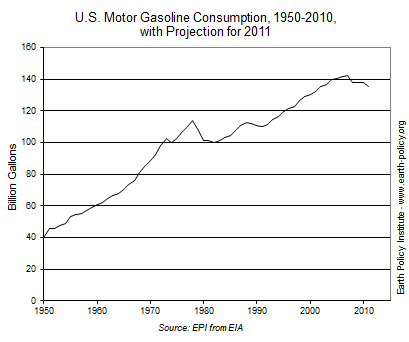
U.S. Gasoline Use Declining: Keystone XL Pipeline Not Needed

Lester R. Brown

As the debate unfolds about whether to build a 1,711-mile pipeline to carry crude oil from the tar sands in Canada to refineries in Texas, the focus is on the oil spills and carbon emissions that inevitably come with it. But we need to ask a more fundamental question. Do we really need that oil?

The United States currently consumes more gasoline than the next 16 countries combined. Yes, you read that right. Among them are China, Japan, Russia, Germany, and Brazil. (See data.)

But now this is changing. Not only is the affluence that sustained this extravagant gasoline consumption eroding, but the automobile-centered lifestyle that was considered part of the American birthright is fading as well. U.S. gasoline use has dropped 5 percent in four years.

Four key developments are set to further reduce U.S. gasoline use: a shrinking car fleet, a decline in the miles driven per car, dramatic mandated future gains in new car fuel efficiency, and the shift from gasoline to electricity to power our cars.

The U.S. fleet appears to have peaked at 250 million vehicles in 2008. From 1994 through 2007, new-car sales were in the range of 15–17 million per year. Since then they have totaled 10–13 million per year, and they are unlikely to top 14 million again. Retirees likely will exceed sales of new cars throughout this decade.

The contraction that began when the fleet dropped from 250 million in 2008 to 248 million in 2010 is likely to continue. Sales of new cars are not matching those of earlier years in part because the economic prospect has dimmed and in part because we are still urbanizing. Today 82 percent of us live in urban areas where cars are becoming less essential.

On top of urbanization, we also have a change in the manner in which young people socialize. For teenagers in rural communities a half century ago, getting a driver’s license and something to drive—a car, a pickup, or even a farm truck—was a rite of passage. That’s what everyone did.

This too is changing. Today’s teenagers, most of whom grew up in an urban setting, socialize through smartphones and the Internet. For many of them, a car is of little interest. The number of licensed teenage drivers in this country—the car owners of the future—has dropped from a peak of 12 million in 1978 to 10 million today.

Cities are also being redesigned for people. Among other things, this means cities are becoming pedestrian- and bicycle-friendly, with ready access to public transit.

Many cities are building a cycling infrastructure of bicycle trails, dedicated bike lanes, and bike racks for parking. Bike-sharing programs are showing up, too. In Washington, D.C., the Capital Bikeshare program that began in 2010 has expanded to 116 stations with 1,100 bicycles. Within the first year, some 16,000 riders signed up for annual membership in the program. Denver and Chicago have similar bike share programs. And New York City is about to launch a huge program of its own.

The second reason that gasoline use is falling is the decline in miles driven per car. This is partly in response to economic uncertainty and the high price of gasoline. When gas costs nearly $4 a gallon, people think twice before jumping in a car and using a gallon of gasoline to pick up a half-gallon of milk.

A third trend that is reducing gasoline use is the rising fuel efficiency of the U.S. automobile fleet. New cars sold in 2008 averaged 27 miles per gallon. But in early 2009, President Obama raised the average fuel efficiency standard so that those sold in 2016 will get 36 miles per gallon. Additional standards announced in 2011 mean that new cars sold in 2025 will use less than half as much gasoline as the 2008 models.

The game changer in reducing gasoline use is going to come as drivers shift from gasoline to electrically powered vehicles, including plug-in hybrids and all-electric cars. General Motors recently introduced the Chevrolet Volt, designed to run largely on electricity, and Nissan unveiled the Leaf, an all-electric vehicle. Beyond these, Toyota is accepting orders for the plug-in version of its Prius hybrid, the pacesetter in fuel efficiency. It will be followed by a steady flow of new plug-in hybrid and all-electric car models coming to market.

Although these electrically powered vehicles are typically more costly to buy, the day-to-day cost of operating them is extraordinarily low. An analysis by Professor Michael McElroy at Harvard indicates that running a car on wind-generated electricity could cost less than the equivalent of 80-cent-a-gallon gasoline.

With the auto fleet shrinking, with the average car being driven less, with the fuel use of new cars to be cut in half by 2025, and with electricity starting to replace gasoline as a fuel, why do we need to build a pipeline to bring crude oil from Canada’s tar sands to oil refineries in Texas? The answer is we don’t.

Lester R. Brown is president of the Earth Policy Institute and author of World on the Edge.

Copyright © 2011 Earth Policy Institute

There’s a footnote that I would like to add from the Center for Biological Diversity (great website!) that came out in a recent newsletter.

Here it is,

Lawsuit Seeks to Halt Work on Controversial Keystone XL Pipeline

Keystone Pipeline

The hotly contested Keystone XL pipeline hasn’t been approved for construction, but federal officials don’t seem to care; they’ve allowed the pipeline company to mow down 100 miles of native prairie grasslands in Nebraska to clear the way — before any public hearings were held on whether Keystone XL should move forward at all.

The Center for Biological Diversity and Friends of the Earth filed a lawsuit in federal court in Omaha Wednesday to halt that work. Specifically, we’re challenging decisions by the State Department and U.S. Fish and Wildlife Service to allow work to begin before a decision’s been made on the pipeline or the public hearings, which look like little more than a sham at this point.

If approved, TransCanada’s 1,700-mile pipeline would carry up to 35 million gallons of oil a day from tar sands in Canada to refineries in Texas. Not only will this project add fuel to the global climate crisis, but the pipeline will cut across Nebraska’s legendary Sandhills, hundreds of rivers and streams, and the Ogallala Aquifer, which provides drinking water for millions of people. TransCanada’s existing pipeline, called Keystone 1, has reportedly leaked 14 times since it started operating in June 2010.

Please will there be some common sense over this?

Can modernisation be “ecological”?

Three guest posts from Martin Lack of Lack of Environment, today Part Two

As previously mentioned, Martin came to the attention of Learning from Dogs when making a comment to the second part of my Sceptical Voices essay.   This is the second part of an essay that Martin wrote that is worthy of deep consideration.  Part One can be read here; the concluding Part Three next Monday, the 10th.

————————-

Can modernisation be “ecological”? – Part 2

What is the problem with Modernity?
The problem is that the accumulation of personal wealth has become the sole objective of many people in modern society; and perpetual growth is posited as a means whereby even the poorest might achieve it. However, the New International Version of the Bible records the Apostle Paul as having written, “For the love of money is a root of all kinds of evil…” (1 Timothy 6:10); and economists and politicians have argued about this for centuries…

According to Jon Elster, it was Karl Marx that coined the term ‘money fetishism’ to describe the belief that money (and/or precious metals) have intrinsic (use) value rather than just instrumental (exchange) value, which Marx felt was as misguided as the religious practice of endowing inanimate objects with supernatural powers (Elster 1986: 56-7). However, the terms use value and exchange value were first put forward by Aristotle (384-322 BC) who, according to Daly, also recognised the danger of focusing on the latter (i.e. whereby the accumulation of wealth becomes an end in itself). Therefore, Daly suggests that the paperless economy (where no useable commodities actually change hands) is the ultimate destiny for money fetishism (Daly 1992: 186).

In 1987, the World Commission on the Environment and Development (WCED) was clearly keen to try and settle an argument and, therefore, made the following quite astonishing assertion: “Growth has no set limits in terms of population or resource use beyond which lies ecological disaster” (Brundtland et al 1987: 45). Instead, WCED gave us the much-touted – but ill-defined – concept of sustainable development (SD). However, in stark contrast to the WCED report, Carter much more recently observed that SD “…will require a fundamental transformation in attitudes to economic growth, consumption, production and work” (Carter 2007: 48). This appears to be a subtle acknowledgement of the legitimacy of Herman Daly’s insistence of the need for a move to a steady-state economy; precisely because infinite growth is impossible in a closed system.

A basic tenet of Daly’s thesis is that economic activity does not take place in a vacuum and that economic – not just ecological – collapse awaits us unless we recognise the limited capacity of the ecosystem within which we operate: “Of all the fields of study, economics is the last one that should seek to be ‘value-free’, lest it deserve Oscar Wilde’s remark that an economist ‘is a man that knows the price of everything and the value of nothing.’” (Daly 1992: 4).

On 22 December 2010, the BBC broadcast a Panorama programme entitled “What Price Cheap Food” containing the startling revelation that, in the two years between 1 November 2008 and 1 November 2010, town planners approved applications for at least 577 new supermarkets across the UK. The programme also revealed that so-called “mega farms” (i.e. factory farming of cows and pigs – “dairy-go-rounds” and “sty scrappers” respectively) will be the next ‘big idea’ imported from the USA. The potential mega farm operators argue that there is significant scope for recycling and energy from waste schemes to be incorporated, although environmentalists would question (1) the wisdom of concentrating potentially polluting activities; and (2) the ethics of factory farming (which undoubtedly goes against the grain of green consumerism). However, although the potential for economies of scale cannot be denied, this could all be seen as symptomatic of what Daly called “growthmania“.

Growthmania versus Limits to Growth
One of the world’s most famous deniers of Limits to Growth arguments is Julian Simon, who once famously won a bet with Paul Ehrlich that the price of any commodity would reduce with the passage of time. Nevertheless, how can anyone deny that the Earth’s resource base or its capacity to accommodate human beings is anything other than limited? Quite easily, apparently: In 1994, Simon claimed that “humanity now has the ability (or knowledge) to make it possible to feed, clothe, and supply energy to an ever-growing population for the next 7 billion years.”

However, the stupidity of such a dangerously fallacious argument was exposed 2 years later by Paul and Anna Ehrlich, who pointed out that at 1994 growth rates, “it would take only 774 years for the 1994 population of 5.6 billion to increase to the point where there were 10 human beings for each square meter of ice-free land on the planet!” Furthermore, they pointed out that if growth did not decline from 1994 levels, it would take only 1900 years for the mass of the human population to equal the mass of the Earth! (Ehrlich and Ehrlich 1996: 66).

Fortunately, the UN now believes (May 2011) that the human population on this planet will probably stabilise by the end of the current Century at somewhere between 10 and 15 billion. The only trouble with that is that, we may well have already exceeded the ecological carrying capacity of the planet, and are therefore causing extreme stress to the global ecosystem; of which the most obvious symptom is AGW.
—————-
References:
Daly, H. (1992), Steady State Economics (2nd ed), London: Earthscan.
Elster, J. (1986), An Introduction to Karl Marx, Cambridge: Cambridge University Press.
Ehrlich, P. and Ehrlich, A. (1996), Betrayal of Science and Reason, New York: Island Press.