A reflection of our unconscious minds – and the potential perils ahead.
Last Monday, March 12th, the BBC aired a programme under their excellent Horizon science series. This programme was entitled, Out of Control? Here’s how the programme was introduced,
We all like to think we are in control of our lives – of what we feel and what we think. But scientists are now discovering this is often simply an illusion.
Surprising experiments are revealing that what you think you do and what you actually do can be very different. Your unconscious mind is often calling the shots, influencing the decisions you make, from what you eat to who you fall in love with. If you think you are really in control of your life, you may have to think again.
The whole 60 minute programme was fascinating right from the start when Professor Nobre introduced the secret world of our unconscious mind. Professor Anna Nobre heads The Brain & Cognition Laboratory, a cognitive neuroscience research group at the Department of Experimental Psychology in the University of Oxford.
For starters, how much of your mind do you think is your conscious mind as opposed to your unconscious mind? Watch this clip and be amazed!
“Are you in control of your unconscious, or is it in control of you?”
So let me link how our mind works to something more relevant today than possibly any other aspect of life.
I’m thinking of the fundamental question that bothers me and, perhaps millions of others. That question being: “Why, with the overwhelming scientific evidence that man is critically threatening the planet’s biosphere upon which we all depend, is there not an equally overwhelming global commitment for change to a sustainable way of life?”
Take, for example, this compelling story.
Last Saturday the BBC News website published a report by Richard Black, the BBC’s Environment correspondent, that opened thus,
An eminent UK engineer is suggesting building cloud-whitening towers in the Faroe Islands as a “technical fix” for warming across the Arctic.
Scientists told UK MPs this week that the possibility of a major methane release triggered by melting Arctic ice constitutes a “planetary emergency“. [my emboldening]
The Arctic could be sea-ice free each September within a few years.
and later goes into this detail (do please read it all, it’s only a few minutes of quiet reading),
On melting ice
The area of Arctic Ocean covered by ice each summer has declined significantly over the last few decades as air and sea temperatures have risen.
For each of the last four years, the September minimum has seen about two-thirds of the average cover for the years 1979-2000, which is used a baseline. The extent covered at other times of the year has also been shrinking.
What more concerns some scientists is the falling volume of ice.
Analysis from the University of Washington, in Seattle, using ice thickness data from submarines and satellites, suggests that Septembers could be ice-free within just a few years.
Data for September suggests the Arctic Ocean could be free of sea ice in a few years
“In 2007, the water [off northern Siberia] warmed up to about 5C (41F) in summer, and this extends down to the sea bed, melting the offshore permafrost,” said Peter Wadhams, professor of ocean physics at Cambridge University.
Among the issues this raises is whether the ice-free conditions will quicken release of methane currently trapped in the sea bed, especially in the shallow waters along the northern coast of Siberia, Canada and Alaska.
Methane is a much more potent greenhouse gas than carbon dioxide, though it does not last as long in the atmosphere.
Several teams of scientists trying to measure how much methane is actually being released have reported seeing vast bubbles coming up through the water – although analysing how much this matters is complicated by the absence of similar measurements from previous decades.
Nevertheless, Prof Wadhams told MPs, the release could be expected to get stronger over time. “With ‘business-as-usual’ greenhouse gas emissions, we might have warming of 9-10C in the Arctic. That will cement in place the ice-free nature of the Arctic Ocean – it will release methane from offshore, and a lot of the methane on land as well.”
This would – in turn – exacerbate warming, across the Arctic and the rest of the world.
Abrupt methane releases from frozen regions may have played a major role in two events, 55 and 251 million years ago, that extinguished much of the life then on Earth.
Meteorologist Lord (Julian) Hunt, who chaired the meeting of the All Party Parliamentary Group on Climate Change, clarified that an abrupt methane release from the current warming was not inevitable, describing that as “an issue for scientific debate”.
But he also said that some in the scientific community had been reluctant to discuss the possibility.
“There is quite a lot of suppression and non-discussion of issues that are difficult, and one of those is in fact methane,” he said, recalling a reluctance on the part of at least one senior scientists involved in the Arctic Climate Impact Assessment to discuss the impact that a methane release might have.
Reams of other factual evidence shows that mankind may have only a few years left to stop the planet going into a runaway condition that would then extinguish much of the life on Earth!
So what’s stopping us?
Dr. Sharot
Well back to that Horizon programme. In the programme, Dr. Tali Sharot of University College London explains how we are all optimists despite the risks. I.e. our unconscious mind deliberately prevents negative information from affecting our conscious mind, our conscious judgment.
In an experiment, an individual is asked to guess the likelihood of a whole range of outcomes, 80 in all. Ergo, you see a gentleman guessing the likelihood of cancer as 18%, of a bone fracture as 10%, of Alzheimer’s as 2%, and so on.
In some cases he guessed a pessimistic probability, in others an optimistic probability. After each guess he was shown the correct probability. E.g. cancer 30% vs his estimate of 18%, for a bone fracture 34% vs his guess of 10%, and the risk in reality of Alzheimer’s is 10% versus his instinct of just 2%. I’ve just quoted his optimistic guesses, in many questions his guess was a pessimistic view, i.e. he guessed a higher likelihood than the statistical reality.
Then he was asked all 80 questions again, having seen the accurate probability compared to his intuitive guess.
So here’s the fascinating outcome.
Where his instinct was a negative guess versus the statistical probability then he adjusted his mind and was able to quote a more accurate figure the second time around. But where the reality was more pessimistic than his first guess, then that adjusted knowledge wasn’t retained. In other words, our beliefs only change when we can adjust to a more positive view of the future.
I just hope I have made that clear. Readers may like to view an article written by Dr. Sharot published in TIME Magazine in May, 2011, called The Optimism Bias or read the introduction to a lecture given in Seattle in June, 2011; “A sunny outlook doesn’t just make you a more pleasant companion: Tali Sharot argues that optimism is a tool for survival and happiness that gets us through hard times—even an economic recession. Sharot, author of The Optimism Bias, uncovers myths about optimism, illuminates the ways it can affect our lives, examines why optimism is necessary for us to function, and illustrates how the human brain is extremely adept at turning lead into gold.”
A summary of a publication, Sharot, T. (2011). The optimism bias. Curr Biol 21(23), R941-R945, reads,
The ability to anticipate is a hallmark of cognition. Inferences about what will occur in the future are critical to decision making, enabling us to prepare our actions so as to avoid harm and gain reward. Given the importance of these future projections, one might expect the brain to possess accurate, unbiased foresight. Humans, however, exhibit a pervasive and surprising bias: when it comes to predicting what will happen to us tomorrow, next week, or fifty years from now, we overestimate the likelihood of positive events, and underestimate the likelihood of negative events. For example, we underrate our chances of getting divorced, being in a car accident, or suffering from cancer. We also expect to live longer than objective measures would warrant, overestimate our success in the job market, and believe that our children will be especially talented. This phenomenon is known as the optimism bias, and it is one of the most consistent, prevalent, and robust biases documented in psychology and behavioral economics.
Our bias towards an optimistic future is a “tool for survival and happiness that gets us through hard times.” But if that ancient bias is preventing mankind from recognising just how close we may be to some form of ‘tipping point’ then this tool for survival may be our undoing.
But if on the other hand, we now unite in changing our ways, first by community then by town then by country our future is incredibly optimistic.
“A single candle may light a thousand others and they in turn many thousands more” – Buddha
The third of an unmissable series of four 1-hour videos from National Geographic.
The first episode plus the introduction can be seen here, the second episode can be seen here.
By now if you have watched the first two episodes, you will be aware of the huge commitment made by National Geographic and PBS in putting this production together. That’s a strong indicator to my mind that getting the message out there is being taken more and more seriously.
The third episode is called Predator and underscores an important element of the change process. That of properly understanding the nature of a problem before attempting a solution. This episode has some very positive messages, so do watch it.
National Geographic – Strange Days on Planet Earth – Part 3 of 4 – Predator
The second of an unmissable series of four 1-hour videos from National Geographic.
The background and introduction to the first episode was published yesterday. So I won’t natter on today saying more or less the same thing.
But I will add this thought.
The videos are tough viewing but compelling because they show the complexity and inter-relatedness of all forms of life on our Planet. It shows that the debate about climate change/global warming/call it what you will is not a simplistic do you or do you not believe mankind is at the root of the changes. No it’s a much more complex question about the threat to our whole biosphere, as Patrice Ayme so eloquently spelt out on March 2nd. These videos make that crystal clear.
Here’s the second episode,
National Geographic – Strange Days on Planet Earth – Part 2 of 4 – One Degree Factor
An unmissable series of four 1-hour videos from National Geographic.
In my summary yesterday of what had come out of the Posts about man’s influence on the planet, I wrote, “But one of the most wonderful aspects for me was the incredible sharing of ideas and resources.” I then gave many details of those resources. One of the great links was a blogsite called Dogs of Doubt. On that blogsite I came across an item published on the 8th March, called Strange Days on Planet Earth. With permission I repost how that item was introduced.
While the average global temperature on Earth has increased by 1 degree Celsius in the last century, in some places on Earth the temperature has increased by a phenomenal 11 Degrees, for some species, already adapted to life as it has been for millions of years such changes puts them in great danger.
Inter-species transfer from one continent to another through what many thought were harmless human activities has placed great pressures on the survival of local animals, insects and even plants, all of which were not prepared for the arrival of newer, more aggressive species.
In many areas of the world some ocean species are actually relocating themselves in order to survive the loss of their food resources and habitats due to the warming of the oceans.
Herds of animals are vanishing as they struggle with warming temperatures which bring in longer breeding seasons for many insects in turn affecting the living standards and health of the many animals they attack.
On land and across the world entire lakes are either disappearing or being reduced in size through the effects of long lasting droughts, the lack of rain waters in some parts is changing much of our surrounding environment and the dust this causes in some parts of the world is affecting the health of children thousands of miles away.
In the oceans plankton are down 20% to what they were in the 1950s, when the waters are cold they do well but now that the waters are warmer their numbers are falling drastically.
Every little change that occurs on earth through global warming might not mean much to some, but all these changes will eventually add together until our environment reaches a breaking point from which none of us may survive.
This video series from National Geographic aims to create an innovative type of environmental awareness by revealing a cause and effect relationship between what we as humans do to the Earth and what that in turn does to our environment and ecosystems, the series creates a new sense of environmental urgency.
Each of the four episodes is constructed as a high-tech detective story, with the fate of the planet at stake.
Jean and I have watched the first two episodes in full and are about 60% through the third. They are both spell-binding and eye-opening. I believe they were first aired by PBS back in 2005 but, no matter, they are even more relevant today.
So for today and the rest of the week I shall provide a link to the YouTube copy of each programme. Please, if you can, do put aside an hour to watch each video and, even better, please give us your feedback to Learning from Dogs.
The first episode is called Invaders.
National Geographic – Strange Days on Planet Earth – Part 1 of 4 – Invaders
Around the globe, scientists are racing to solve a series of mysteries. Unsettling transformations are sweeping across the planet, and clue by clue, investigators around the world are assembling a new picture of Earth, discovering ways that seemingly disparate events are connected. Crumbling houses in New Orleans are linked to voracious creatures from southern China. Vanishing forests in Yellowstone are linked to the disappearance of wolves. An asthma epidemic in the Caribbean is linked to dust storms in Africa. Scientists suspect we have entered a time of global change swifter than any human being has ever witnessed. Where are we headed? What can we do to alter this course of events? National Geographic’s Strange Days on Planet Earth, premiered on PBS, explores these questions. Drawing upon research being generated by a new discipline, Earth System Science (ESS), the series aims to create an innovative type of environmental awareness. By revealing a cause and effect relationship between what we as humans do to the Earth and what that in turn does to our environment and ecosystems, the series creates a new sense of environmental urgency. Award-winning actor, writer and director Edward Norton (Primal Fear, American History X, Italian Job) hosts the series. A dedicated environmental activist, Norton has a special interest in providing solar energy to low income families. Each of the four one-hour episodes is constructed as a high-tech detective story, with the fate of the planet at stake.
All my life, well all the years that I have appreciated a ‘tea-break’, stopping for a cup of hot tea has been laden with symbolism. A chance to let the brain catch up with whatever one is doing. When working with others an opportunity to stand back and evaluate how the particular project is going. When sharing a project with a loved one, an opportunity to lay down memories for future years, and so forth. (Jean and I were building a chicken coop yesterday afternoon.) Sure there are millions of people that share these feelings.
Anyway, as many of you have been aware, the last 10 days or so on Learning from Dogs have been pretty ‘full-on’ in terms of man and Planet Earth. It started with me publishing on the 27th February a Post called Please help! – A plea to those who understand climate science so much better than I do!. Then on the 2nd March, I republished a Post from Patrice Ayme called The collapse of the biosphere.
That there were a total of 6,313 viewings of those Posts and 69 comments (OK, that doesn’t mean different individuals) was incredibly gratifying – a very big ‘thank you’ to all of you that read the Posts, and likewise to those that commented.
But one of the most wonderful aspects for me was the incredible sharing of ideas and resources. So the point of today’s Post is to bring all those links and contacts onto one ‘page’, so to speak.
Martin Lack was the first to point me in the direction of the book, Merchants of Doubt. There are a number of videos on YouTube but the one below is a good introduction to Naomi Oreskes.
On October 28, 2010 historian of science Naomi Oreskes gave a presentation at Forum Lectures (US Embassy Brussels), based on her new book, Merchants of Doubt: How a Handful of Scientists Obscured the Truth on Issues from Tobacco Smoke to Global Warming, about how right wing scientists founded the George Marshall Institute which has become a key hub for successfully spreading fear, uncertainty and doubt about climate change, along with other environmental issues, and how myths about science enable these political strategies to work.
An in-depth video of over an hour from the University of Rhode Island’s Spring 2010 Vetlesen Lecture Series, hugely worth watching, is here.
Then there is the powerful blog site, De Smog Blog. As the site explains, “The DeSmogBlog Project began in January 2006 and quickly became the world’s number one source for accurate, fact based information regarding global warming misinformation campaigns. TIME Magazine named DeSmogBlog in its “25 Best Blogs of 2011” list.”
Moving on. One of the challenges is knowing how to look up some reasonably reliable information about a person who is claiming this or that. That’s where SourceWatch is invaluable. The website describes itself, “The Center for Media and Democracy publishes SourceWatch, this collaborative resource for citizens and journalists looking for documented information about the corporations, industries, and people trying to influence public policy and public opinion. We believe in telling the truth about the most powerful interests in society—not just relating their self-serving press releases or letting real facts be bleached away by spin.”
Let me give you an example of how SourceWatch works. In my Post A skeptic’s view, Dan offered extensive comment about U.S. Senator James Inhofe’s book The Greatest Hoax. A quick search on SourceWatch revealed (a) (my emboldening)
Arthur B. Robinson is one of the three co-founders of the Oregon Institute of Science and Medicine, a group best known for organising a petition disputing the scientific evidence for human-induced global warming.
On January 7, 2009, the Willamette Week reported that Robinson is “in the vanguard of a small but vocal and persistent collection of scientists, industry advocates and commentators who dismiss human culpability for climate change. … Robinson’s critics say his analysis is simplistic, but it remains persuasive a decade later with powerful policymakers like U.S. Senator James Inhofe (R-Okla.), a visible and effective player in blocking a bill to limit greenhouse-gas emissions last fall.
James Mountain Inhofe, usually known as Jim Inhofe, has been a Republican Senator for Oklahoma since winning a special election in 1994.
Oil
James M. Inhofe has voted in favor of big oil companies on 100% of important oil-related bills from 2005-2007, according to Oil Change International. These bills include Iraq war funding, climate change studies, clean energy, and emissions.
On to another book. I forget who recommended the book by James Hansen, Storms of my Grandchildren but it’s another ‘must-read’ for all those wanting to better understand the risks that lay ahead. As the book’s website explains,
In Storms of My Grandchildren, Dr. James Hansen—the nation’s leading scientist on climate issues—speaks out for the first time with the full truth about global warming: The planet is hurtling even more rapidly than previously acknowledged to a climatic point of no return.
On that website there is a section Hansen On The Issues that includes this 2-minute YouTube video of Dr. Hansen talking about his book.
I can’t close without mentioning some other wonderful websites. There is Skeptical Science, described thus,
Explaining climate change science & rebutting global warming misinformation
Scientific skepticism is healthy. Scientists should always challenge themselves to improve their understanding. Yet this isn’t what happens with climate change denial. Skeptics vigorously criticise any evidence that supports man-made global warming and yet embrace any argument, op-ed, blog or study that refutes global warming. This website gets skeptical about global warming skepticism. Do their arguments have any scientific basis? What does the peer reviewed scientific literature say?
Then there’s ClimateSight, a wonderful effort by Kate, “Kate is a B.Sc. student and aspiring climatologist from the Canadian prairies. She started writing this blog when she was sixteen, simply to keep herself sane, but hopes that she’ll be able to spread accurate information about climate change far and wide while she does so.” Kate’s interest and passion in the subject is unmissable and it’s a real pleasure to subscribe to her postings.
Bill McKibben’s famous site, 350.org, is a must for the thousands of people that are working for a better future. As the mission statement opens up,
350.org is building a global grassroots movement to solve the climate crisis. Our online campaigns, grassroots organizing, and mass public actions are led from the bottom up by thousands of volunteer organizers in over 188 countries.
350 means climate safety. To preserve our planet, scientists tell us we must reduce the amount of CO2 in the atmosphere from its current level of 392 parts per million to below 350 ppm. But 350 is more than a number—it’s a symbol of where we need to head as a planet.
350.org works hard to organize in a new way—everywhere at once, using online tools to facilitate strategic offline action. We want to be a laboratory for the best ways to strengthen the climate movement and catalyze transformation around the world.
RealClimate is a commentary site on climate science by working climate scientists for the interested public and journalists. We aim to provide a quick response to developing stories and provide the context sometimes missing in mainstream commentary. The discussion here is restricted to scientific topics and will not get involved in any political or economic implications of the science. All posts are signed by the author(s), except ‘group’ posts which are collective efforts from the whole team. This is a moderated forum.
There are so many more fabulous sources of real caring about the society we are and, more importantly, the society we hope to be. In this category comes Wibble. Then there’s Dogs of Doubt, that I shall be referring to tomorrow on Learning from Dogs, and The Green Word and so on and so on. It shows the power of ‘hands across the ether’ that the modern world of web sites now offers. I put great faith in this power becoming the power of truth and the power of change. (If you have a blog or a website that resonates with the ones mentioned here, please do drop me an email giving me details.)
Finally, I’m closing with this. If it all sometimes feels too much for you and you want to drift away into the world of the inner consciousness, into the world of dreamtime, then you can do no worse than to call by Sue Dreamwalker‘s wonderful website. Try this, for example. Dan and I had no idea what we were getting into. 😉
Starting to feel like a long way from John Masefield’s poem Sea Fever.
The call of the sea.
One of my all-time favourite poems.
I must go down to the seas again, to the lonely sea and the sky,
And all I ask is a tall ship and a star to steer her by,
And the wheel’s kick and the wind’s song and the white sail’s shaking,
And a grey mist on the sea’s face, and a grey dawn breaking.
I must go down to the seas again, for the call of the running tide
Is a wild call and a clear call that may not be denied;
And all I ask is a windy day with the white clouds flying,
And the flung spray and the blown spume, and the sea-gulls crying.
I must go down to the seas again, to the vagrant gypsy life,
To the gull’s way and the whale’s way, where the wind’s like a whetted knife;
And all I ask is a merry yarn from a laughing fellow-rover,
And quiet sleep and a sweet dream when the long trick’s over.
Why do I start this piece with that poem?
Well, read this,
Carbonic acid is a weak acid that is created when carbon dioxide (CO2) is dissolved in water (H2O), resulting in the chemical formula H2CO3. When the acid dissociates, or gives up a hydrogen ion, the resulting molecule is called a bicarbonate ion. Carbonic acid appears frequently in the natural world. It can be found in sodas, champagne, and blood. The acid even appears in rain.
But like so many things in nature, it’s all about balance.
Besides, it’s not all about “climate change”. Half of the CO2 is presently dissolving in the oceans, so a rise of two degrees Celsius means extremely acid oceans (CO2 turns into carbonic acid after it reacts with water). At the present rate of acidification, marine life will dissolve big time by 2100. That’s how a lot of the oxygen is produced, by photosynthesizing unicellular animals, with acid sensitive skeletons. Atmospheric poisoning deniersdo not want just to warm us up.
On that same day of March 2nd, Yves Smith of Naked Capitalism published an item that reinforced what Patrice wrote. Yves very kindly gave me permission to republish her Post in full, as follows:
Science has published a troubling but not entirely surprising article on the fact that the oceans are acidifying at the fastest rate in 300 million years. Actually, it could be the fastest rate over an even longer time period, but we can only go back with any degree of accuracy for 300 million years
….there are side effects to our love affair with CO2 that are not often mentioned. In fact, whether the earth cools or warms is absolutely irrelevant to these effects. I repeat: Absolutely irrelevant.
One of the most startling effects is the acidification of the oceans. Since 1750, the oceans have become increasingly acidic. In the oceans, CO2 forms carbonic acid, a serious threat to the base of the food chain, especially on shellfish of all sizes. Carbonic acid dissolves calcium carbonate, an essential component of any life form with an exoskeleton. In short, all life forms with an exoskeleton are threatened: shell fish, an important part of the food chain for many fish; coral reefs, the habitat of many species of fish….
The formation of carbonic acid does not depend upon temperature. Whether the oceans warm or cool is irrelevant. Of concern only is the amount of CO2 that enters the oceans.
Fast forward to today. Consider the scope of the paper in Science, per a very good discussion in ars technica:
A new paper in Science examines the geologic record for context relating to ocean acidification…The research group (twenty-one scientists from nearly as many different universities) reviewed the evidence from past known or suspected intervals of ocean acidification…They find that the current rate of ocean acidification puts us on a track that, if continued, would likely be unprecedented in last 300 million years.
There is an important driver of this process that this overview mentions only in passing further on, and it’s useful to have it in mind when you review the discussion of the historical record:ocean acidification depends primarily on the rate of atmospheric CO2 increases, not the absolute concentration. Look at how attenuated the rate of past CO2 changes was in the past versus the speed now:
The first period the researchers looked at was the end of the last ice age, starting around 18,000 years ago. Over a period of about 6,000 years, atmospheric CO2 levels increased by 30 percent, a change of roughly 75 ppm. (For reference, atmospheric CO2 has gone up by about the same amount over the past 50 years.) Over that 6,000 year time period, surface ocean pH dropped by approximately 0.15 units. That comes out to about 0.002 units per century. Our current rate is over 0.1 units per century—two orders of magnitude greater, which lines up well with a model estimate we covered recently.
The last deglaciation did not trigger a mass extinction, but it did cause changes in some species…
During the Pliocene warm period, about 3 million years ago, atmospheric CO2 was about the same as today, but pH was only 0.06 to 0.11 units lower than preindustrial conditions. This is because the event played out over 320,000 years or so. We see species migration in the fossil record in response to the warming planet, but not ill effects on calcifiers…
Next, the researchers turned their focus to the Paleocene-Eocene Thermal Maximum (or PETM), which occurred 56 million years ago. Global temperature increased about 6°C over 20,000 years due to an abrupt release of carbon to the atmosphere (though this was not as abrupt as current emissions). The PETM saw the largest extinction of deep-sea foraminifera of the last 75 million years, and was one of the four biggest coral reef disasters of the last 300 million years…
The group also examined the several mass extinctions that defined the Mesozoic—the age of dinosaurs. The boundary between the Triassic and Jurassic included a large increase in atmospheric CO2 (adding as much as 1,300 to 2,400 ppm) over a relatively short period of time, perhaps just 20,000 years. The authors write, “A calcification crisis amongst hypercalcifying taxa is inferred for this period, with reefs and scleractinian corals experiencing a near-total collapse.” Again, though, it’s unclear how much of the catastrophe can be blamed on acidification rather than warming.
Finally, we come the big one—The Great Dying. The Permian-Triassic mass extinction (about 252 million years ago) wiped out around 96 percent of marine species. Still, the rate of CO2 released to the atmosphere that drove the dangerous climate change was 10-100 times slower than current emissions…
In the end, the researchers conclude that the PETM, Triassic-Jurassic boundary, and Permian-Triassic boundary are the closest analogs to the modern day, at least as far as acidification is concerned. Due to the poor ocean chemistry data for the latter two, the PETM is the best event for us to compare current conditions. It’s still not perfect—the rate of CO2 increase was slower than today…
The authors conclude, “[T]he current rate of (mainly fossil fuel) CO2 release stands out as capable of driving a combination and magnitude of ocean geochemical changes potentially unparalleled in at least the last ~300 [million years] of Earth history, raising the possibility that we are entering an unknown territory of marine ecosystem change.”
Translation: “We’re probably fucked, but the data is so far outside of historical parameters, we can’t say anything with a high degree of certainty.”
For me that quotation sums up how I would like to reply to not only my dear friend, Dan Gomez, who is a denialist of anthropogenic climate change, as last Monday’s Post illustrated, but also to skeptics everywhere else.
I should also add the important qualifier that I am neither a scientist nor have any expert skills in the relevant areas. But, then again, neither does Dan. He and I are both citizens of Planet Earth with a passion for the truth.
So where to go from here? There is no question that the Earth’s climate is complex and endeavouring to understand ’cause and effect’ relies heavily on mathematical models. But many complex aspects of our world are treated similarly, therefore so what! Dan and I share with millions of others a lack of scientific competence, ergo we have to be rely on the scientific views expressed by those who do have the scientific competencies.
Would one challenge the competence of Scientific American magazine, that in an article on March 18, 2007, (five years ago!) opened thus,
Paris–The signs of global climate change are clear: melting glaciers, earlier blooms and rising temperatures. In fact, 11 of the past 12 years rank among the hottest ever recorded.
and continued later with this, [my emboldening]
For example, after objections by Saudi Arabia and China, the report dropped a sentence stating that the impact of human activity on the earth’s heat budget exceeds that of the sun by fivefold. “The difference is really a factor of 10,” says lead author Piers Forster of the University of Leeds in England: compared with its historical output, the sun currently contributes an extra 0.12 watt of energy for each square meter of the earth’s surface, whereas man-made sources trap an additional 1.6 watts per square meter.
Or what ‘influence’ might be at play when the British newspaper The Guardian reported earlier this year that,
Wall Street Journal rapped over climate change stance
The Wall Street Journal has received a dressing down from a large group of leading scientists for promoting retrograde and out-of-date views on climate change. In an opinion piece run by the Journal on Wednesday, nearly 40 scientists, including acknowledged climate change experts, took on the paper for publishing an article disputing the evidence on global warming.
The offending article, No Need to Panic About Global Warming, which appeared last week, argued that climate change was a cunning ploy deployed by governments to raise taxes and by non-profit organisations to solicit donations to save the planet.
It was signed by 16 scientists who don’t subscribe to the conventional wisdom that climate change is happening and is largely man-made – but as Wednesday’s letter points out, many of those who signed don’t actually work in climate science.
Later in that article Suzanne writes, referring to the 40 scientists, [again, my emboldening]
The letter goes on to note that some 97% of researchers who actively publish on climate science agree that climate change is real and caused by humans. It concludes: “It would be an act of recklessness for any political leader to disregard the weight of evidence and ignore the enormous risks that climate change clearly poses.”
There’s much, much more evidence that shows that the science is clear – mankind is risking the future viability of this planet for the species homo sapiens and countless other species!
One of the important points made by Dan in that Post last Monday was about the book, written by Senator James Inhofe, The Greatest Hoax. Dan wrote, “This is all about money and power, not weather.”
There are a number of independent websites across the world where one can quickly research the credentials and background by name of any person. Try Skeptical Science as an example. A quick enquiry using Senator Inhofe’s name came up with this: Quotes by James Inhofe – Climate Myth/What the Science Says. Read It! And read this on the website Think Progress. There are other websites where one can do that type of research.
In an email just a day ago, Dan wrote, “My message/warning remains the same: “Follow the Money”. When the “End-of-the-World” is the message, what politician can resist?” If only it was that easy.
OK, I’m going to start rounding this all off by first asking you to watch this 4-minute video that I came across thanks to Pedantry’s blogsite Wibble.
Next I’m going to repeat something that I have previously mentioned on Learning from Dogs. There’s a saying in the aviation industry, “If there’s any doubt, there’s no doubt!” That saying underpins the culture that has turned commercial air transport into one of the safest means of travel in history.
Let’s ponder that idea of doubt.
There is no question that there is a great deal of doubt. Back in 2010 Gallup Poll reported that “42% of adults worldwide who see global warming as a threat to themselves and their families in 2010 hasn’t budged in the last few years“.
Would you get into a commercial airliner to fly from ‘a’ to ‘b’ if 42% of the passengers saw the flight as a threat to themselves? No, of course not!
So one certainly wouldn’t fly then if 62% thought it was risky! From here,
The newest study from the National Survey of American Public Opinion on Climate Change, which is a biannual survey taken since fall 2008 and organized by the Brookings Institute, shows that 62 percent of Americans now believe that man-made climate change is occurring, and 26 percent do not. The others are unsure.
So back to the theme that started this Post. For the sake of all of us on this planet, for all our children and grandchildren and beyond, we need to start caring deeply about the future, changing our life-styles in as many ways as we can and demanding that our politicians and leaders are similarly committed to the future.
Not because the future is anything like certain – but to reduce the risks of a global catastrophy. I have a grandson who will be one-year-old on March 21st. I want to be certain that he has a viable life ahead of him for many, many years. That means caring ‘a whole awful lot‘, letting hope motivate me to change, and recognising that change is already taking place, as the following trailer so superbly demonstrates.
“Unless someone like you cares a whole awful lot, Nothing is going to get better. It’s not.”
Many of you read the post I called Please help! that came out exactly a week ago. If you were one of those readers you will have read how Dan and I go back 33 years. In many ways we see eye-to-eye but not over mankind’s influence over the climate of our Planet. To be clear, my own view is that we are very close, if not already past, the point of preventing a massive collapse of the biosphere. Dan believes that we are living through possibly the biggest hoax in history.
Dan, however, has been willing to provide evidence that supports his view and has given me permission to reproduce some of his emails to me. That’s generous of him – thanks Dan.
PH – I guess I could write all day and provide numerous scientific papers and positioning that would repudiate a lot of the popular press on “Global Warming” or “Climate Change”, if that is more PC. Read a little from the good Senator below and then I’ll buy you HIS book.
This is all about money and power, not weather. As the Senator points out, when he saw that the “Cap and Trade” bill was shot down, he stopped commenting. Then, more and more regulation from the UN and EPA Agency provoked this new book.
Once again, the science is at best moot and at worst fraudulent. Each of us must make up his own mind. Global climate cooling or heating will continue operating under geological time rules and, oh yeah, the Sun, Oceans and Regional Oscillations contribute a little.
As long as world governments don’t take public money or redistribute public money for their own “climate control” self-interests, I don’t really care. If there was no public money at stake, there would be no controversy.
People will continue to build houses below sea level in New Orleans. Another, bigger hurricane will flood them out again. Apparently, we can’t even stop this kind of nonsense through more legislation and then expensive emergency re-routing of public funds. This is part of the reason that the public sector is broke.
If private agencies wish to donate money to stop the rising seas or just support related studies, tant mieux. Just don’t add yet another set of agencies and regulations as another layer of big government. This only results in an ever higher tax structure and declining standards of living.
Book Description
Publication Date: February 28, 2012
Americans are over-regulated and over-taxed. When regulation escalates, the result is an increase in regulators. In other words, bigger government is required to enforce the greater degree of regulation. Bigger government means bigger budgets and higher taxes. “More” simply doesn’t mean “better.” A perfect example is the entire global warming, climate-change issue, which is an effort to dramatically and hugely increase regulation of each of our lives and business, and to raise our cost of living and taxes. In The Greatest Hoax, Senator James Inhofe will reveal the reasons behind those perpetuating the Hoax of global warming, who is benefitting from the general acceptance of the Hoax and why the premise statements are blatantly and categorically false.
In another couple of emails, Dan wrote,
There are two questions to answer: Whose science do you want to believe and who profits? My source of direction stems from a natural skepticism of big science when big money is involved. One of the definitions of science is that it is never completely understood and new discoveries as well as new methods of collecting data are ever changing. As we know, new evidence pops up everyday. So, to assume that “my science or your science” is irrefutable relevant to global warming, is not “good science”. Taking billions of global dollars out of private enterprise as well as higher public sector tax in order to “change the world- maybe” is irresponsible and dangerous.
Oh yeah, and I forgot, the world’s broke. Ask a Greek plumber or, for that matter, a Greek apparatchik, where global warming fits into his budget decisions……?
Then Dan wrote in another email,
Emotionalism aside, I can’t argue the science issues except by contributing relevant articles by other scientists with opposing views. There are many. I can comment on the political power and self-interest motivations of many proponents and that’s always fun……
Before spending trillions that the world does not have, let’s see if we can get the conversation a little more firmed up….. We need to really find out how sensitive the atmosphere, lithosphere and hydrosphere really are – without assumptions. Pretty hard thing to do even with advanced mainframes, GIGO…..
and then offered the article,
Ten Years After the Warming
February 26th, 2012 by Roy W. Spencer, Ph. D.
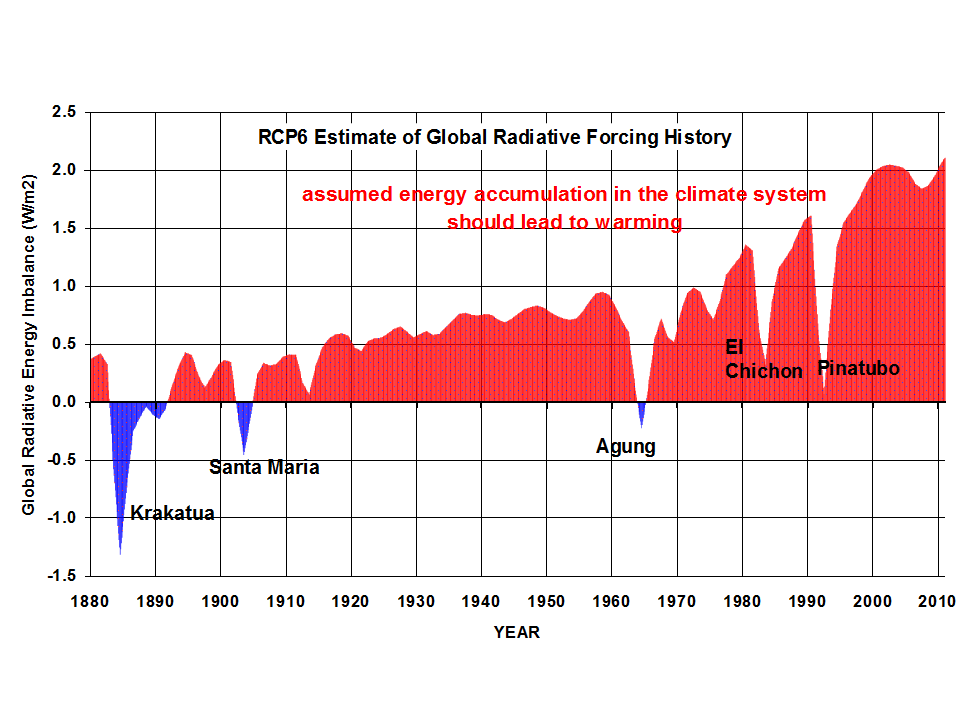
The version of global warming theory being pushed by the IPCC is that anthropogenic emissions of greenhouse gases are causing a radiative energy imbalance of the climate system, leading to warming.
The radiative forcing history being used in the latest IPCC climate models looks something like the following, with red areas representing times when the climate system’s “stove is turned up”, that is, with heat accumulating in the system.
(Actually, the correct analogy would be that the stove setting remains the same, but the lid partially covering the pot is covering it a little more over time…but that’s too hard to explain.)
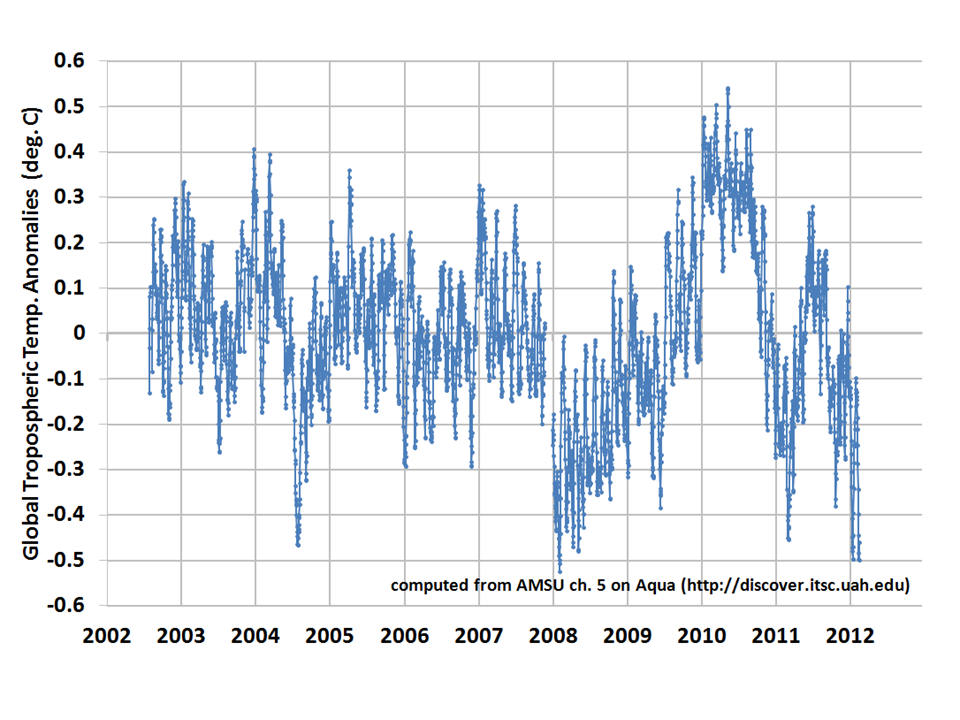
As can be seen, in the last 10 years the estimated forcing has been the strongest. Yet, most if not all temperature datasets show little or no global-average warming recently, either in the atmosphere, at the surface, or in the upper 700 meters of the ocean. For example, here are the tropospheric temperatures up though a few days ago:
So what is happening? You cannot simply say a lack of warming in 10 years is not that unusual, and that there have been previous 10-year periods without warming, too. No, we are supposedly in uncharted territory with a maximum in radiative forcing of the climate system. One cannot compare on an equal basis the last 10 years with any previous decades without warming.
There are 5 possibilities for the recent cessation of warming which are most discussed:
1) cooling from anthropogenic aerosols has been cancelling out warming from more greenhouse gases
2) natural cooling from internal climate fluctuations or the sun is cancelling out the GHG warming
3) increased ocean mixing is causing the extra energy to be distributed into the deep ocean
4) the temperature ’sensitivity’ of the climate system is not as large as the IPCC assumes.
5) there is something fundamentally wrong with the GHG warming theoryitself
Of course, some combination of the above 5 explanations is also possible.
The 1st possibility (aerosol cooling is cancelling out GHG forcing) is one of the more popular explanations with the climate modelers, and especially with NASA’s James Hansen. The uncertain strength (and even sign) of aerosol forcing allows the climate modelers to use aerosols as a tuning knob (aka fudge factor) in making their models produce warming more-or-less consistent with past observations. Using an assumed large aerosol cooling to cancel out the GHG warming allows the modelers to retain high climate sensitivity, and thus the fear of strong future warming if those aerosols ever dissipate.
The 2nd possibility (natural cooling) is a much less desirable explanation for the IPCC crowd because it opens the door to Mother Nature having as much or more influence on the climate system than do humans. We can’t have that, you know. Then you would have to consider the possibility that most of the warming in the last 50 years was natural, too. Goodbye, AGW funding.
The 3rd possibility (increased ocean mixing) is one of the more legitimate possibilities, at least theoretically. It’s popular with NCAR’s Kevin Trenberth. But one would need more observational evidence this is happening before embracing the idea. Unfortunately, how vertical mixing in the ocean naturally varies over time is poorly understood; the different IPCC models have widely varying strengths of mixing, and so ocean mixing is a huge wild card in the global warming debate, as is aerosol cooling. I believe much of past climate change on time scales of decades to many centuries might be due to such variations in ocean mixing, along with their likely influence on global cloud cover changing the amount of solar input into the climate system.
The 4th possibility (the climate system is relatively insensitive to forcing) is the top contender in the opinion of myself, Dick Lindzen, and a few other climate researchers who work in this field.
The 5th possibility (increasing GHGs don’t really cause warming) is total anathema to the IPCC. Without GHG warming, the whole AGW movement collapses. This kind of scientific finding would normally be Nobel Prize territory…except that the Nobel Prize has become more of a socio-political award in recent years, with only politically correct recipients. The self-flagellating elites don’t like the idea humans might not be destroying the Earth.
The longer we go without significant warming, the more obvious it will become that there is something seriously wrong with current AGW theory. I don’t think there is a certain number of years – 5, 10, 20, etc. – which will disprove the science of AGW….unless the climate system cools for the next 10 years. Eek! But I personally doubt that will happen.
As long as strong warming does not resume, the heat-hiding-in-the-deep-ocean explanation will provide refuge for many years to come, and will be difficult to convincingly rule out as an explanation since it takes so long for the deep ocean to warm by even a tiny amount.
Instead, there probably will be a tipping point (sooner than later) in popular perception when the public and Congress decide the jig is up, and they are no longer interested in hearing how we ‘might’ be headed for Armageddon.
The public already knows how awful scientists are at forecasting the future…especially a future of doom, which curiously seems to be the only future scientists know how to predict.
Now the challenge in this Post is not to make it so long that it becomes tiresome on the eyes, irrespective of the content.
So I’m going to leave it at this point and, perhaps, next time include some of Dan’s other points and comments in the light of how readers respond to this Post.
On Monday of this week, I posted an item called Please help! It was to demonstrate how easily two people, with a long-standing friendship, both interested in the world around them, can differ over something so fundamental as man’s affect on our Planet.
I hoped that it would attract those who see things more clearly, and I was not mistaken. Not only did the item receive 1,334 readings on that day, there were a number of focused comments, plus emails to me personally. One of those comments was from Patrice Ayme, a long-standing friend of this Blog, who referred me to an article he had written in 2009, called BIOSPHERE COLLAPSE. I gratefully republish that article with the written permission of Patrice.
BIOSPHERE COLLAPSE, not “Climate Change”.
by Patrice Ayme.
It is a curious thing to observe how far some humans will go to make themselves the center of attention. Maybe it’s out of cowardice. After all, to become the center of something, however illusory, however silly, allows one to forget the fragility of the human condition.
A handful of top notch elite scientists can be found, who are among those who are skeptical about the fact that burning the fossil fuel accumulated in the last 400 million years is causing a dangerous warming of the climate. Those who belong to the elite are generally not climate scientists, but, unsurprisingly geologists or geophysicists (that means, paid by the burning of fossil fuels).
Moreover, when one looks at their arguments, or even their graphs, one generally find obvious bias. I have explained before that denial is big business, and that the sun itself has conspired with the giant fossil fuel business (the ultimate conspiracy theory!)
But this streak of solar cooling is not enough for the partisans of atmospheric poisoning. It seems as if they were hell bound not only to poison the air and the oceans, but reason itself. (I have explained in other essays that reason itself is the preferred target of the plutocrats and their agents.)
A preferred trick of those tricksters is to cut the graph depicting the concentration of CO2 at, say, 360 parts per million (ppm), when we are actually at 390 ppm! This has the undeniable advantage of masking the exponential growth of atmospheric CO2 in the last few years…
What we see in this graph is a basically flat line, followed by an exponential (the famous “hockey stick”, as a climate scientist dubbed it).
From studying ocean sea shells, we now know that the CO2 concentration did not exceed 300 ppm for the last 25 million years. That means that the basically flat line in the graph above extends considerably to the left. The basically flat line actually extends 2 kilometers to the left, at the scale of the graph above. Yes, more than a mile!
So there is no doubt that the recent CO2 exponential climb is man-made, and tied up to industry.
A related trick of the deniers is to “forget” that man has generated a lot of other gases than CO2. Those artifical, man-made gases can be up to 10,000 times better than CO2 at blocking infrared light.
A greenhouse consists of allowing visible light in, while blocking the exit of the light that heat makes, the infrared light. Three large greenhouses are Mars, Earth and Venus. All planets are greenhouses, and earth-like planets in other solar systems will have water, thus water vapor and CO2, two most powerful and natural greenhouse gases: these gases allow light in, but tend to block infrared.
Thus the heat gets trapped close to the ground, and the high atmosphere, now less warmed by infrared light on its way to space, cools down. Some ignorant fools have heard of that cooling, and screamed that it proved that there was no greenhouse, because a cooling has been demonstrated. Whereas, in truth, that high altitude cooling is expected, and proves the exact opposite, namely a greenhouse next to the ground!
When one is considering the man-made greenhouse, one has therefore to also include these exotic industrial gases and evaluate their contribution to the greenhouse. For example, the Greenhouse Warming Potential (GWP) for methane over 100 years is 25 and for nitrous oxide it is 298. This means that emissions of 1 million metric tons of methane and nitrous oxide respectively warm up the lower atmosphere as much as the emissions of 25 millions and 298 millions metric tons of carbon dioxide, respectively, over the following century.
Perfluorocarbons (CFCs) are the worst. They are used in refrigeration. The most frequent is tetrafluoromethane. Its GWP is 6,500 times that of CO2. The GWP of hexafluoroethane is 9,200 times that of carbon dioxide. Over ten years, the GWP of methane is higher than what it is over a century, because methane oxydizes quickly. Over ten years the GWP of methane is 100 times that of CO2. This means that a “methane burp“ would have a tremendous warming effect. There are reasons to believe that such “methane burps” have happened, and could happen again. They are catatastrophically violent events, complete with giant tsunamis, I know you wanted to know…
In any case we are around 450 ppm in CO2 equivalent (the exact number is fiercely debated, and irrelevant, because the yearly augmentation is so fast). We started from 280 ppm of CO2 equivalent in 1850 and at this rate we will pass a DOUBLING within twenty years.
Recent research on marine fossils has allowed us to find out the CO2 concentration over the last 25 million years: it never exceeded 300 ppm durably. (There were short spikes due to occasional major volcanic activity, but that’s always accompanied by marked and brutal drops in temperature, so Antarctic records show the two contrary effects wash each other out!)
I would go as far as saying that many papers in Nature and Science, when they deal about the climate, systematically underemphasize the planetary danger we seem to be getting in. Typically the authors’ research reveals an ominous evolution, but, then, rather meek conclusions are modestly drawn. There is no doubt an implicit pressure from the powers that be to not disrupt big business as usual, and climate scientists prefer to not bite the hand that feeds them (considering where the money, hence power, goes, that would be Goldman Sachs, or, at least, the fossil fuel/pollution establishment, which is somewhere near Goldman Sachs in the Pantheon that rules over us).
The IPCC, the world panel on “Climate Change” is the number one exhibit of meekness, and lack of common sense as far as viewing a “small” global temperature rise as tolerable. In its computations, the IPCC has refused to enter the melting of the polar ice shields, and the possibility of methane clathrate eruptions. Yet, it is known, from computing the sea level rise, and its acceleration, that the giant ice shields at the poles are melting.
It is also known that the methane (CH4) density in the atmosphere has doubled, or, maybe, quadrupled. During the last significant warm-up, methane eruption occured, causing a giant tsunami in the North Atlantic (in places, water went an incredible 80 kilometers inland!) The IPCC ignores all this superbly, preferring naively to stick to proven, observed and incontrovertible facts, and scrupulously rejecting inchoating, or probable events.
The IPCC claims to believe that limiting the global temperature rise at 2 degrees Celsius would be fine. Instead, it would be a dangerous stupidity to approach a two-degree Celsius of global temperature rise (yes, I thought carefully before using the word “stupidity“: all alternatives were found wanting).
Indeed the whole problem is not to warm up the poles too much. The global temperature rise is irrelevant. Two degrees more in Texas or Australia would just lead the offending natives to crank the air conditioning higher, and pour more prehistoric aquifer water on their greens.
Whereas the frozen poles constitute the planet’s air conditioning system. The frozen poles reflect light out into space, and make the atmosphere in a Carnot engine, with a warm source (the tropics) and a cold sink (the frozen poles). Heat is transported from warm to cold, from tropics to poles, by enormous oceanic currents, such as the Gulf Stream. Melt the poles, remove the heat reflectors, and shut down the currents.
But most of the warming, so far, is at the poles, and it has already reached nearly 5 degrees Celsius in parts (the Antarctica peninsula, for example). Yet, the global temperature rise, so far, is roughly ONLY one tenth of that. Scaling up, on present evidence, a global planetary rise of two degrees Celsius may mean a rise of twenty degrees Celsius in many glaciated polar areas (yes, a rise of 40 degrees Fahrenheit). So the poles would melt, and the Earth would lose its reflectors. Tipping points would tip, and things would get worse from there. Oceanic currents would stop. Europe would freeze in winter. Golbal temperatures would shoot up. Oxygen would disappear from huge parts of the tropical oceans, which would die. (Several of the preliminaries of these effects are tentatively observed.)
Many people reading this will scoff and say that this will not happen, because it did not happen before. Paleontologically, this is not true. Although there was no human industry to start a CO2 bubble, they have happened before (they can be generated by continental drift or super giant volcanic eruptions known as “supertraps”).
When dinosaurs flourished, the poles were warm. Dinosaurs were roaming the forests of Antarctica. Crocodiles terrorized Northern Greenland. However, the world had dozens of millions of years to adapt. Polar dinosaurs saw with the lights of the stars for months on end. Right now, we are going to hit the biosphere with the heat shock from hell.
Besides, it’s not all about “climate change”. Half of the CO2 is presently dissolving in the oceans, so a rise of two degrees Celsius means extremely acid oceans (CO2 turns into carbonic acid after it reacts with water). At the present rate of acidification, marine life will dissolve big time by 2100. That’s how a lot of the oxygen is produced, by photosynthesizing unicellular animals, with acid sensitive skeletons. Atmospheric poisoning deniersdo not want just to warm us up.
Ah, also, just a reminder, some gigantic, and deep, parts of the oceans got too warm to contain enough oxygen to support life, and they have already died.
And yes, the oceans are rising, and the icecaps are melting, both in Greenland, and Antarctica. The rise of sea level is itself augmenting at the rate of 5% a year (as many of the facts in this post, published in summer or fall of 2009). It’s an exponential!
When something augments at a rate proportional to its own value, it’s an exponential. The exponential is the most important function in analysis, if not mathematics. The exponential augments extremely fast, because the bigger it is, the faster it becomes bigger. Peons who know the exponential not, have no idea the danger we are in! They have no mathematical understanding of the danger we are in. They need to take those mathematic classes they never took, to realize how immoral their ignorance is.
Accelerating down. The trend line of Greenland ice mass (green) curves downward with time, suggesting that ice losses have been accelerating.
[Credit: Isabella Velicogna, geophysical research letters.]
The more fossil fuels burned, the more hot air, the less oxygen. But not to worry! American politicians will be pleased to inform you that their super private, super bank, the one which advises the White House always, and pays bonuses with taxpayer money, Goldman Sachs, will make a future oxygen market, and will sell it short. Trust American capitalism, White House style, to adapt. Down to the last gulp of air.
On a slightly more serious note, the expression “climate change” is thus a misnomer.
In truth, we are facing a man-made collapse of the biosphere, just because full grown men want to keep on playing with fire. There ought to be an IPCB: Intergovernmental Panel on the Collapse of the Biosphere.
Atmospheric poisoning deniers want to heat us up in acid, while cutting our air supply. By 2100 CE. Of course, when that apocalypse has become the future no one can deny, there will be only one solution: nuke the coal plants. More seriously, Asia plans an enormous augmentation of its CO2 production, and that may very well become a casus belli, when the runaway exponential nature of the man-made greenhouse becomes blatant.
Technical annex 1: To calculate the radiative forcing for a 1998 gas mixture, the IPCC in 2001 gave the radiative forcing (relative to 1750 CE) of various gases as: CO2=1.46 (corresponding to a concentration of 365 ppm), CH4=0.48, N2O=0.15 and other minor gases =0.01 W/m2. The sum of these is 2.10 W/m2. One obtains CO2 equivalent = 412 ppm. That was in 2001, we are in 2010 (about). CO2 concentration is now 290 ppm, which means that CO2 equivalent is above 440 ppm.
***
Technical annex 2: Quoting straight from Science:
“Climate Change: Fixing a Critical Climate Accounting Error.
The accounting now used for assessing compliance with carbonlimits in the Kyoto Protocol and in climate legislation contains a far-reaching but fixable flaw that will severely undermine greenhouse gas reduction goals (1). It does not count CO2 emittedfrom tailpipes and smokestacks when bioenergy is being used,but it also does not count changes in emissions from land use when biomass for energy is harvested or grown. This accounting erroneously treats all bioenergy as carbon neutral regardlessof the source of the biomass, which may cause large differences in net emissions. For example, the clearing of long-established forests to burn wood or to grow energy crops is counted as a 100% reduction in energy emissions despite causing large releases of carbon.”
[Science 23 October 2009: Vol. 326. no. 5952, pp. 527 – 528.]
It is hard to believe that errors of such magnitude, committed by scientists (and implemented by the European Union and the US Congress) are not deliberate.
A plea to those who understand climate science so much better than I do!
Background to this Post.
Among my friends, two go way back. One of them, Dan Gomez, a lively, ebullient Californian, was indirectly responsible for me and Jean meeting in Mexico back on December 17th, 2007. I first met Dan at a dealers’ conference in Boston way back in the early days of Commodore Computers. That was the Spring of 1979 and I had flown to Boston as the owner of the 8th Commodore Computer dealership to be appointed in the UK, based in Colchester, Essex. Later, I became the global distributor of an English word processing program known as Wordcraft, written by Pete Dowson in the UK, and appointed Dan as my US West Coast Wordcraft distributor. It gave me a wonderful reason to come out to Southern California several times a year; on business, of course!
Dan and I therefore go back 33 years! Dan’s sister Suzann has a house down in San Carlos, Mexico. Suzann invited me out to Mexico for Christmas 2007 which is where I first met Jean and, bingo, Jean and I then fell in love with each other! How life flows! (Two years ago yesterday, Jean and I moved into our house in Payson with our, then, 13 dogs and 6 cats!)
Paul & Dan Jan. 15th 2008
OK, to the Post!
Dan has been a climate change skeptic, as in caused by man, for many years. Regular readers of Learning from Dogs will know I see things very differently. But Dan and I agree fundamentally on getting to the truth. This Blog proudly claims to seek “The underlying theme of Learning from Dogs is about truth, integrity, honesty and trust in every way.”
So when the other day Dan sent me a number of links supporting his view that “My point remains that climate change is an enormous, complex process that no computer model is going to predict and no human activity modify significantly. Big money is now at stake here and as the article shows, even trusted scientists will produce fraudulent information to further their goals as well as fill politician’s coffers.” I found my faith in my own views slighted dented. Dan is a smart guy, a good thinker and not beholden to any firm or organisation with a vested interest in denying anthropogenic global warming.
IPCC Scientist Admits Fake Data Used To Pressure World Leaders
A scientist responsible for a key 2007 United Nations Intergovernmental Panel on Climate Change report warning Himalayan glaciers would be completely melted by 2035 has admitted that the claim was made to put political pressure on world leaders.
Such was revealed by the British Daily Mail Sunday in an article destined to further reduce the credibility of the world’s so-called leading authority on manmade global warming.
As NewsBusters reported Saturday, the IPCC acknowledged earlier this week that its claim concerning these glaciers was based on junk science.
Anthropogenic (Human Caused) Global Warming – Is This The Greatest Scientific Myth of our Generation?”
January 25th, 2012, Portland, Oregon
First Speaker – Gordon Fulks, PhD Physics, University of Chicago
[Extract]
Dr. Fulks said: “My thesis tonight is simple: virtually ALL of what climate alarmists put forth as science is not. Some is half correct, some is incorrect, and too much is just plain nonsense or worse.”
This led him into what he called “one of the central problems with Anthropogenic Global Warming,” “the integrity of the data.” He discussed a variety of temperature data from land surface data that shows various manipulations and biases to the best global data from NASA satellites to the excellent ice core temperature proxies going back 450,000 years.
Second Speaker – Chuck Wiese, Meteorologist – Oregon State University
[Extract]
Mr. Wiese finished his presentation with the following conclusions:
1. There is nothing in the REAL atmospheric record that supports the recent temperature rise of the last century to carbon dioxide induced anthropogenic warming.
2. The tropospheric water vapor optical depth is remarkably stable but has declined recently over the last 70 years of record as carbon dioxide rose substantially in the atmosphere during the same period. This is a consistent outcome as expected by the first principle founding physics and inconsistent with atmospheric climate models.
3. Without water vapor acting as a positive feedback ( growth pattern ) to increasing carbon dioxide concentrations, the projected radiative forcing on the earth’s surface is but a grossly exaggerated calculation of what the earth’s temperature will actually do in response to carbon dioxide.
4. The earth’s “greenhouse effect” is NOT controlled by atmospheric carbon dioxide. It is modulated and governed by atmospheric water vapor and clouds, where the warming modulation is controlled by the amount of vapor and optical depth. Clouds with the hydrological cycle act to trim out water vapor into a hydrostatic, convective equilibrium. The stable atmospheric optical depth likes the earth mean temperature of 59 deg F without further solar or planetary modulation.
5. The Anthropogenic warming hypothesis by atmospheric CO2 is falsified by the real record and radiation physics.
Third Speaker – George Taylor, former Oregon State Climatologist
[Extract]
His presentation finished with his conclusions:
1. Human activities DO affect climate, in a variety of ways. Greenhouse gases are just one parameter.
2. Natural variations affect climate. I believe that they have been more significant influences on climate because they do a much better job of explaining observed variations.
3. Effects of future changes in CO2 are likely to be modest and manageable.
4. Many aspects of climate remain poorly understood.
The full transcripts and supporting materials may be seen here.
Then, in stark contrast, this week’s edition of The Economist has a leader about the problem of overfishing. “Of all the sea’s many problems, overfishing should be the most fixable. ” What jumped off the page at me was how that leader article started,
ACIDIFICATION, warming, the destruction of coral reefs: the biggest problems facing the sea are as vast, deep and seemingly intractable as the oceans themselves. So long as the world fails to cut its emissions of greenhouse gases, cause of the global warming behind these troubles, they will grow.
So a newspaper of the standing of The Economist is clear, “So long as the world fails to cut its emissions of greenhouse gases, cause of the global warming behind these troubles”
So if, dear reader, you can offer good supporting evidence as to why the Oregon Chapter of the American Meteorological Society seems to contradict what so many now believe, that mankind is changing the Earth’s climate, please comment or, better still, consider writing a guest post.