Category: Economics

Shining a light on these times.

There’s many a slip ‘twixt the cup and the lip.

That sub-heading is a very old proverb supporting the idea  “that even when the outcome of an event seems certain, things can still go wrong.”

That proverb came to me when I was reading a TomDispatch essay that was published last Tuesday. I couldn’t make up my mind about whether or not to continue with yesterday’s mood of “Living in interesting times” but in the end decided to so do. Because Peter Van Buren’s essay, published as a Tomgram, needs to be widely read so that as many as possible appreciate the need to reach out to those that should be supported.

I am very grateful to Tom Engelhardt for his continuing permission for me to republish his TomDispatch essays.

ooOOoo

Tomgram: Peter Van Buren, Minimum Wage, Minimum Chance

We live in interesting times!

The impending ‘banquet of consequences’.

The Welcome page of this blog includes this:

Dogs ‘teaching’ man to be so successful a hunter enabled evolution, some 20,000 years later, to farming,  thence the long journey to modern man.  But in the last, say 100 years, that farming spirit has become corrupted to the point where we see the planet’s plant and mineral resources as infinite.  Mankind is close to the edge of extinction, literally and spiritually.

I continue that theme in Part Two of my book (Chapter 7: This Twenty-First Century)

Bad news sells! Bad news also causes stress and worry. In my previous explanation, I explained that the last thing you want is a catalogue of all the things that have that power to cause you stress and worry. However, I do see three fundamental aspects of this new century that have their roots in that loss of principles that I referred to in the previous chapter. They are

1. the global financial system,
2. the potential for social disorder, and
3. the process of government.

Because they are at the heart of how the coming years will pan out.

The first aspect, our global financial system, was selected because it underpins all our lives in so many ways. When I was living in southwest England I was a client of Kauders Portfolio Services[1]. The founder of the company, David Kauders, published[2] a book, The Greatest Crash, in 2011. It was an obvious read for me at that time and I still have the book on my shelves here in Oregon.
David explained that whether we like it or not, our lives are inextricably caught up in the twin dependencies of the global financial system: credit and debt. As he wrote in his opening chapter:

Households can barely afford their existing debts, let alone take on more. Since households now prefer not to borrow, indeed some even choose to pay back debt, it follows that those who have already borrowed, as a group, can no longer contribute to economic expansion.
People can be divided into borrowers and savers. With existing borrowers unable to afford or unwilling to take on extra debt, can new borrowers be found instead? Those who do not need to borrow are unlikely to volunteer. Except for the young wishing to buy houses, facing the reality that house prices are beyond their pockets, where are the new borrowers?
Businesses are also under pressure. There has been an inadequate recovery from recession, business prospects are poor as households cut back their spending. Lack of bank lending is a symptom rather than a cause, for if existing businesses were to be given more credit, they would probably be unlikely to find profitable growth opportunities in a world of austerity.

Later on in the book David describes this as “the financial system limit”. In other words, the period of growth and expansion, especially of financial and economic expansion, has come to an end in a structural sense. This was his perspective from 2011.

Recently, I chose to reread The Greatest Crash. What struck me forcibly, reading the book again some four years later on, was how visible this “system limit” appeared in the world today. Everywhere there are signs that the era of growth has come to an end. Many countries are now indebted to a point that reinforces the proposition of there being a financial system limit. The United States is greatly in debt[3] but the only thing mitigating that situation, for the time being anyway, is that the American dollar is the quasi dominant global currency.
The changing nature of the global population is also reinforcing the fact that this is the end of a long period of growth. Even without embracing the question of how much longer we can increase the number of people living on a finite planet, the demographics spell out a greater-than-even chance of a decline in consumption and economic activity. Simply because in all regions of the planet, except for India where there is still a growing youth element in the country, people are ageing. To state the obvious, ageing persons do not consume as much as middle-aged and younger persons.
Thus, the world’s economy that is just around the corner is certainly going to be very different to what it has been in the past. It is not being widely discussed. Worse than that, there is a widespread assumption adopted by many governments that a return to the “normal” economic growth of previous times is a given. Many do not share that assumption.

The second aspect that isn’t being spoken about is the potential for massive, widespread social disorder. All summed up in just three words: greed, inequality, and poverty. Just three words that metaphorically appear to me like a round, wooden lid hiding a very deep, dark well. That lifting this particular lid, the metaphorical one, exposes an almost endless drop into the depths of where our society appears to have fallen.
Even the slightest raising of awareness of where this modern global world is heading is scary. I have in mind the author Thomas Piketty who warned[4] that, “the inequality gap is toxic, dangerous.” Then there was the news in 2015[5] that, “Billionaires control the vast majority of the world’s wealth, 67 billionaires already own half the world’s assets; by 2100 we’ll have 11 trillionaires, while American worker income has stagnated for a generation.”

The third and final aspect that isn’t being widely discussed is the process of government. Not from the viewpoint of “left” or “right”, Labour or Conservative, Democratic or Republican (insert the labels appropriate to your own country), that is being discussed ad nauseum, but from the viewpoint of good government. It might be a terrible generalisation but it is still a fair criticism to say that many peoples of many countries have lost faith in their governments.
There appears to be a chronic absence of open debate about the need for good government, what that good government would look like, and how do societies bring it about.

If we were a dog pack, then our leader, our female mentor dog, would have moved us all to a new, pristine territory!


[1] My relationship was terminated when I became a resident of the United Staes in 2011.
[2] 2011, Sparkling Books.
[3] http://www.usgovernmentdebt.us offers on the 14th November, 2014 that the Federal Debt of the United States was about $18,006,100,032,000.
[4] In his book Capital in the Twenty-First Century (Belknap Press, 2014).
[5] http://www.marketwatch.com/story/capitalism-is-killing-americas-morals-our-future-2015-05-22.

Yes, these are indeed very interesting times!

So, dear reader, you can understand why a recent article over on Naked Capitalism spoke to me. It was penned by Satyajit Das, a former banker and the author of a number of books. Both Satyajit and Yves, of Naked Capitalism, were delighted to offer me permission to republish the full post.

ooOOoo

Satyajit Das: Age of Stagnation or Something Worse?

Yves here. If you’ve read Das regularly, one of the characteristics of his writing is wry detachment. The shift to a sense of foreboding is a big departure.

By Satyajit Das, a former banker and author whose latest book, The Age of Stagnation, is now available. The following is an edited excerpt from Age of Stagnation (published with the permission of Prometheus Books)

If you look for truth, you may find comfort in the end; if you look for comfort you will not get either comfort or truth, only . . . wishful thinking to begin, and in the end, despair. C.S. Lewis

The world is entering a period of stagnation, the new mediocre. The end of growth and fragile, volatile economic conditions are now the sometimes silent background to all social and political debates. For individuals, this is about the destruction of human hopes and dreams.

One Offs

For most of human history, as Thomas Hobbes recognised, life has been ‘solitary, poor, nasty, brutish, and short’. The fortunate coincidence of factors that drove the unprecedented improvement in living standards following the Industrial Revolution, and especially in the period after World War II, may have been unique, an historical aberration. Now, different influences threaten to halt further increases, and even reverse the gains.

Since the early 1980s, economic activity and growth have been increasingly driven by financialisation – the replacement of industrial activity with financial trading and increased levels of borrowing to finance consumption and investment. By 2007, US$5 of new debt was necessary to create an additional US$1 of American economic activity, a fivefold increase from the 1950s. Debt levels had risen beyond the repayment capacity of borrowers, triggering the 2008 crisis and the Great Recession that followed. But the world shows little sign of shaking off its addiction to borrowing. Ever-increasing amounts of debt now act as a brake on growth.

Growth in international trade and capital flows is slowing. Emerging markets that have benefited from and, in recent times, supported growth are slowing.

Rising inequality and economic exclusion also impacts negatively upon activity.

Financial problems are compounded by lower population growth and ageing populations; slower increases in productivity and innovation; looming shortages of critical resources, such as water, food and energy; and manmade climate change and extreme weather conditions.

The world requires an additional 64 billion cubic metres of water a year, equivalent to the annual water flow through Germany’s Rhine River. Agronomists estimate that production will need to increase by 60–100 percent by 2050 to feed the population of the world. While the world’s supply of energy will not be exhausted any time soon, the human race is on track to exhaust the energy content of hundreds of millions years’ worth of sunlight stored in the form of coal, oil and natural gas in a few hundred years. 10 tons of pre-historic buried plant and organic matter converted by pressure and heat over millennia was needed to create a single gallon (4.5 litres) of gasoline.

Europe is currently struggling to deal with a few million refugees fleeing conflicts in the Middle East. How will the world deal with hundreds of millions of people at risk of displacement as a resulting of rising sea levels?

Extend and Pretend

The official response to the 2008 crisis was a policy of ‘extend and pretend’, whereby authorities chose to ignore the underlying problem, cover it up, or devise deferral strategies to ‘kick the can down the road’. The assumption was that government spending, lower interest rates, and the supply of liquidity or cash to money markets would create growth. It would also increase inflation to help reduce the level of debt, by decreasing its value.

It was the grifter’s long con, a confidence trick with a potentially large payoff but difficult to pull off. Houses prices and stock markets have risen, but growth, employment, income and investment have barely recovered to pre-crisis levels in most advanced economies. Inflation for the most part remains stubbornly low.

In countries that have ‘recovered’, financial markets are, in many cases, at or above pre-crisis prices. But conditions in the real economy have not returned to normal. Must-have latest electronic gadgets cannot obscure the fact that living standards for most people are stagnant. Job insecurity has risen. Wages are static, where they are not falling. Accepted perquisites of life in developed countries, such as education, houses, health services, aged care, savings and retirement, are increasingly unattainable.

In more severely affected countries, conditions are worse. Despite talk of a return to growth, the Greek economy has shrunk by a quarter. Spending by Greeks has fallen by 40 percent, reflecting reduced wages and pensions. Reported unemployment is 26 percent of the labour force. Youth unemployment is over 50 percent. One commentator observed that the government could save money on education, as it was unnecessary to prepare people for jobs that did not exist.

Future generations may have fewer opportunities and lower living standards than their parents. A 2013 Pew Research Centre survey conducted in thirty-nine countries asked whether people believed that their children would enjoy better living standards: 33 percent of Americans believed so, as did 28 percent of Germans, 17 percent of British and 14 percent of Italians. Just 9 percent of French people thought their children would be better off than previous generations.

The Deadly Cure

Authorities have been increasingly forced to resort to untested policies including QE forever and negative interest rates. It was an attempt to buy time, to let economies achieve a self-sustaining recovery, as they had done before. Unfortunately the policies have not succeeded. The expensively purchased time has been wasted. The necessary changes have not been made.

There are toxic side effects. Global debt has increased, not decreased, in response to low rates and government spending. Banks, considered dangerously large after the events of 2008, have increased in size and market power since then. In the US the six largest banks now control nearly 70 percent of all the assets in the US financial system, having increased their share by around 40 percent.

Individual countries have sought to export their troubles, abandoning international cooperation for beggar-thy-neighbour strategies. Destructive retaliation, in the form of tit-for-tat interest rate cuts, currency wars, and restrictions on trade, limits the ability of any nation to gain a decisive advantage.

The policies have also set the stage for a new financial crisis. Easy money has artificially boosted prices of financial assets beyond their real value. A significant amount of this capital has flowed into and destabilised emerging markets. Addicted to government and central bank support, the world economy may not be able to survive without low rates and excessive liquidity.

Authorities increasingly find themselves trapped, with little room for manoeuvre and unable to discontinue support for the economy. Central bankers know, even if they are unwilling to publicly acknowledge it, that their tools are inadequate or exhausted, now possessing the potency of shamanic rain dances. More than two decades of trying similar measures in Japan highlight their ineffectiveness in avoiding stagnation.

Heart of the Matter

Conscious that the social compact requires growth and prosperity, politicians, irrespective of ideology, are unwilling to openly discuss the real issues. They claim crisis fatigue, arguing that the problems are too far into the future to require immediate action. Fearing electoral oblivion, they have succumbed to populist demands for faux certainty and placebo policies. But in so doing they are merely piling up the problems.

Policymakers interrogate their models and torture data, failing to grasp that ‘many of the things you can count don’t count [while] many of the things you can’t count really count’. The possibility of a historical shift does not inform current thinking.

It is not in the interest of bankers and financial advisers to tell their clients about the real outlook. Bad news is bad for business. The media and commentariat, for the most part, accentuate the positive. Facts, they argue, are too depressing. The priority is to maintain the appearance of normality, to engender confidence.

Ordinary people refuse to acknowledge that maybe you cannot have it all. But there is increasingly a visceral unease about the present and a fear of the future. Everyone senses that the ultimate cost of the inevitable adjustments will be large. It is not simply the threat of economic hardship; it is fear of a loss of dignity and pride. It is a pervasive sense of powerlessness.

For the moment, the world hopes for the best of times but is afraid of the worst. People everywhere resemble Dory, the Royal Blue Tang fish in the animated film Finding Nemo. Suffering from short-term memory loss, she just tells herself to keep on swimming. Her direction is entirely random and without purpose.

Reckoning Postponed

The world has postponed, indefinitely, dealing decisively with the challenges, choosing instead to risk stagnation or collapse. But reality cannot be deferred forever. Kicking the can down the road only shifts the responsibility for dealing with it onto others, especially future generations.

A slow, controlled correction of the financial, economic, resource and environmental excesses now would be serious but manageable. If changes are not made, then the forced correction will be dramatic and violent, with unknown consequences.

During the last half-century each successive economic crisis has increased in severity, requiring progressively larger measures to ameliorate its effects. Over time, the policies have distorted the economy. The effectiveness of instruments has diminished. With public finances weakened and interest rates at historic lows, there is now little room for manoeuvre. Geo-political risks have risen. Trust and faith in institutions and policy makers has weakened.

Economic problems are feeding social and political discontent, opening the way for extremism. In the Great Depression the fear and disaffection of ordinary people who had lost their jobs and savings gave rise to fascism. Writing of the period, historian A.J.P. Taylor noted: ‘[the] middle class, everywhere the pillar of stability and respectability . . . was now utterly destroyed . . . they became resentful . . . violent and irresponsible . . . ready to follow the first demagogic saviour . . .’

The new crisis that is now approaching or may already be with us will be like a virulent infection attacking a body whose immune system is already compromised.

As Robert Louis Stevenson knew, sooner or later we all have to sit down to a banquet of consequences.

ooOOoo

henrifredericamiel148210Very interesting times indeed!

In defence of sovereignty and democracy.

The challenges facing the European Union ripple out across the whole of the free world.

I note that this is the second Friday where there is an abrupt change from the run of posts during the previous few days. For last Friday I republished a George Monbiot article on Rigging the Market and today there is another Monbiot article that I want to share with you; shared with you with the kind permission of Mr. Monbiot.

Unlike last Friday’s Monbiot article that clearly had global implications, at first sight this article about the European Union has no relevance to those of us not living with EU boundaries. But that would be wrong. For the importance of protecting a country’s sovereignty and the democratic processes within that country is supreme across all democratically elected governments.

ooOOoo

The Lesser Evil

Oil, corruption and public money.

Nothing at all to do with dogs, or with integrity if it comes to that!

Regular followers of this place know that I am a tremendous fan of George Monbiot, the Englishman who so regularly exposes stuff that needs to be aired and discussed. As his About page explains:

Here are some of the things I love: my family and friends, salt marshes, arguments, chalk streams, Russian literature, kayaking among dolphins, diversity of all kinds, rockpools, heritage apples, woods, fishing, swimming in the sea, gazpacho, ponds and ditches, growing vegetables, insects, pruning, forgotten corners, fossils, goldfinches, etymology, Bill Hicks, ruins, Shakespeare, landscape history, palaeoecology, Gavin and Stacey and Father Ted.

Here are some of the things I try to fight: undemocratic power, corruption, deception of the public, environmental destruction, injustice, inequality and the misallocation of resources, waste, denial, the libertarianism which grants freedom to the powerful at the expense of the powerless, undisclosed interests, complacency.

Here is what I fear: other people’s cowardice.

I still see my life as a slightly unhinged adventure whose perpetuation is something of a mystery. I have no idea where it will take me, and no ambitions other than to keep doing what I do. So far it’s been gripping.

Way back in the early days of Learning from Dogs, the blog that is, not the book, George was very gracious in giving me blanket permission to republish his posts, and many of them have appeared in this place.

So now read George Monbiot’s latest Rigging the Market. It is yet another example of what is going wrong in these times.

ooOOoo

Rigging the Market

This interconnected world.

There is no question that we are living in interesting times!

Back in the old country there was a popular saying: “There are liars, damn liars, and politicians.” I am insufficiently aware of politics in both my new home country, the US of A, and my new home state, Oregon, to know if that saying is equally pertinent to life in America as it was in Great Britain – I suspect that it is.

So what’s getting ‘my knickers in a twist’ today? Namely the state of the world economy.

There seems to be so much spin and counter-spin that getting to the truth of what is going on, economically speaking, is not straightforward.

Which is why a recent article posted by over on The Automatic Earth jumped out at me. To my eyes, it really did cover the truth of what’s going on. And to double-check my analysis I shared it with Dan Gomez, no stranger to global finances, and he found it useful. Indeed, this was Dan’s reply: “That’s pretty much it. This should be the top of the world news every week until governments become accountable. All the other big issues of the day pale compare to the backlash from this sclerotic thinking. Good luck to all of us.”

Raúl has very kindly given me his permission to republish this. It’s not an easy read but that doesn’t detract from the value of the essay.

ooOOoo

 Why This Slump Has Legs

 January 18, 2016  Posted by Raúl Ilargi Meijer
Berenice Abbott Columbus Circle, Manhattan 1936

We’ve only really been in two weeks of trading in the new year, things are looking pretty bad to say the least, so predictably the press are asking -and often answering- questions about when the slump will be over. Rebound, recovery, the usual terminology. When will we get back to growth?

For me personally, but that’s just me, that last question sounds a bit more stupid every single time I hear and read it. Just a bit, but there’s been a lot of those bits, more than I care to remember. Luckily, the answer is easy. The slump will not be over for a very long time, there will be no rebound or recovery, and please stop talking about a return to growth unless you can explain what you want to grow into.

I’m sorry, I know that’s not what you want to hear, but life’s a bitch and so’s the economy. You’ve lived on pink fumes for a long time, most of you for their whole lives, but reality dictates that real ‘growth’ stopped decades ago, and you never figured that out because, and I quote here (see below), you and the world you’re part of became “addicted to borrowing money, spending it, and passing this off as ‘growth’”.

That you believed this was actual growth, however, is on you. You fell for a scam and you’re going to have to pay the price. If there’s one single thing people are good at, it’s lying. It’s as old as human history, and it happens every day, so you’re no exception to any rule. You’re perhaps just not particularly clever.

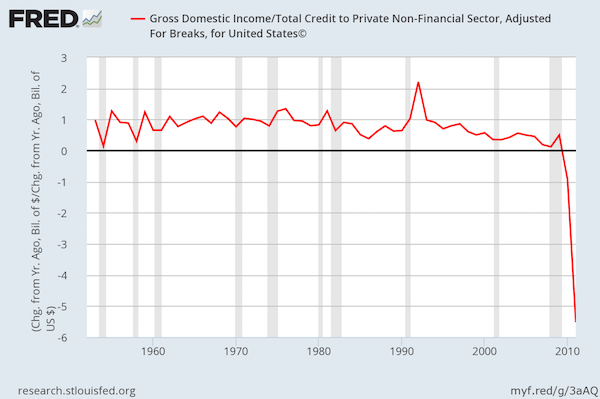
How do we know a ‘recovery’ is so far off it’s really no use to even talk about it? As I said, it’s easy. Let me lead this in with a graph I saw just today, which deals with a topic the Automatic Earth has covered a lot: marginal debt, or more precisely, the productivity/growth gained from each additional dollar of debt.

Please note, this particular graph deals with private non-financial debt only, we’ll get to other kinds of added debt, but that restriction is actually quite illuminating.

MarginalDebtNow of course, you have to wonder about the parameters the St. Louis Fed uses for its data and graphs, and whether ‘growth’ was all that solid in the run up to 2008. There’s plenty of very valid arguments that would say growth in the 1960’s was a whole lot more solid than that in the naughties, after the Glass-Steagall repeal, and after the dot.com blubber.

However, that’s not what I want to take away from this, I use this to show what has happened since 2008, more than before, when it comes to “passing debt off as ‘growth’”.

But it’s another thing that has happened since 2008, or rather not happened, that points out to us why this slump will have legs. That is, in 2008 a behemoth bubble started bursting, and it was by no means just US housing market. That bubble should have been allowed to fully deflate, because that is the only way to allow an economy to do a viable restart.

Instead, all that has been done since 2008, QE, ZIRP, the works, has been aimed at keeping a facade ‘alive’, and aimed at protecting the interests of the bankers and other rich parties. That facade, expressed most of all in rising stock markets, has allowed for societies to be gutted while people were busy watching the S&P rise to 2,100 and the Kardashians bare 2,100 body parts.

It was all paid for, apart from western QE, with $28 trillion and change of newfangled Chinese debt. The problem with this is that if you find yourself in a bubble and you don’t go through the inevitable deleveraging process that follows said bubble in a proper fashion, you’re not only going to kill economies, you’ll destroy entire societies.

And that is not just morally repugnant, it also works as much against the rich as it does against the poor. It’s just that that is a step too far for most people to understand. That even the rich need a functioning society, and that inequality as we see it today is a real threat to everyone.

Recognizing this simple fact, and the consequences that follow from it, is nothing new. It’s why in days of old, there were debt jubilees. It’s also why we still quote the following from Marriner Eccles, chairman of the Federal Reserve under FDR and Truman from 1934-1948, in his testimony to the Senate Committee on the Investigation of Economic Problems in 1933, which prompted FDR to make him chairman in the first place.

It is utterly impossible, as this country has demonstrated again and again, for the rich to save as much as they have been trying to save, and save anything that is worth saving. They can save idle factories and useless railroad coaches; they can save empty office buildings and closed banks; they can save paper evidences of foreign loans; but as a class they cannot save anything that is worth saving, above and beyond the amount that is made profitable by the increase of consumer buying.

It is for the interests of the well to do – to protect them from the results of their own folly – that we should take from them a sufficient amount of their surplus to enable consumers to consume and business to operate at a profit. This is not “soaking the rich”; it is saving the rich. Incidentally, it is the only way to assure them the serenity and security which they do not have at the present moment.

Everything would all be so much simpler if only more people understood this, that you need a – fleeting, ever-changing equilibrium- to prosper.

Instead, we’re falling into that same trap again. Or, more precisely, we already have. We have been fighting debt with more debt and built the facade put up by the Fed, the BoJ and the ECB, central banks that all face the same problems and all take the same approach: save the rich at the cost of the poor. Something Eccles said way back when could not possibly work.

Anyway, so here are the graphs that prove to us why the slump has legs. There’s been no deleveraging, the no. 1 requirement after a bubble bursts. There’s only been more leveraging, more debt has been issued, and while households have perhaps deleveraged a little bit, though that is likely strongly influenced by losses on homes etc. plus the fact that people were simply maxed out.

First, global debt and the opposite of deleveraging:

LeverageGlobalAnd global debt from a longer, 65 year, more historical perspective:

LeverageGlobal2-500It’s a global debt graph, but it’s perhaps striking to note that big ‘growth’ spurts happened in the days when Reagan, Clinton and Obama were the respective US presidents. Not so much in the Bush era.

Next, China. What we’re looking at is what allowed the post 2008 global economic facade to have -fake- credibility, an insane rise in debt, largely spent on non-productive overinvestment, overcapacity highways to nowhere and many millions of empty apartments, in what could have been a cool story had not Beijing gone all-out on performance enhancing financial narcotics.

LeverageChina500Today, the China Ponzi is on its last legs, and so is the global one, because China was the last ‘not-yet-conquered’ market large enough to provide the facade with -fleeting- credibility. Unless Elon Musk gets us to Mars very soon, there are no more such markets.

So US debt will have to come down too, belatedly, with China, and it will have to do that now. because there are no continents to conquer and hide the debt behind. We’re all going to regret engaging in the debt game, and not letting the bubble deflate in an orderly fashion when we still could, but all those thoughts are too late now.

LeverageUS500What the facade has wrought is not just the idea that deleveraging was not needed (though it always is, after every single bubble), but that net US household worth rose by 55% in the 6-7 years since the bottom of the crisis, an artificial bottom fabricated with…more debt, with QE, and ZIRP.

USTaxesHoneyPot2Meanwhile, in today’s world, as stock markets go down at a rapid clip, China, having lost control of a market system it never had the control over that Politburos are ever willing to acknowledge they don’t have, plays a game of Ponzi whack-a-mole, with erratic ‘policies’ such as circuit breakers and CIA-style renditions of fund managers and the like.

And all the west can do is watch them fumble the ball, and another one, and another. And this whole thing is nowhere near the end.

China bad loans have now become a theme, but the theme doesn’t mean a thing without including the shadow banking system, which in China has been given the opportunity to grow like a tumor, on which Beijing’s grip is limited, and which has huge claims on local party officials forced by the Politburo to show overblown growth numbers. If you want to address bad loans, that’s where they are.

Chinese credit/debt graphs paint only a part of the picture if and when they don’t include shadow banks, but keeping their role hidden is one of Xi’s main goals, lest the people find out how bad things really are and start revolting. But they will anyway. That makes China a very unpredictable entity. And unpredictable means volatile, and that means even more money flowing out of, and being lost in, markets.

The ‘least worst’ place to be for what money will be left is US dollars, US treasuries and perhaps metals. But there’ll be a whole lot less left than just about anyone thinks. That’s the price of deleveraging.

The price of not deleveraging, on the other hand, is what we see in the markets today. And there is no cure. It must be done. The price for keeping up the facade rises sharply with each passing day, and the effort will in the end be futile. All bubbles have limited lifespans.

I’ll close this with a few recent words from Tim Morgan, who puts it so well I don’t feel the need to try and do it better.

The Ponzi Economy, Part 1

In order to set the Ponzi economy into some context, let’s put some figures on it. In the United States, total “real economy” debt (which excludes inter-bank borrowing) increased by $19.4 trillion – in real, inflation-adjusted terms – between 2000 and 2014, whilst real GDP expanded by only $3.7 trillion. Britain, meanwhile, added £1.9 trillion of new debt for less than £400bn on “growth” over the same period. I spent part of the holiday period unearthing quite how much debt countries added for each dollar of “growth” over a period starting at the end of 2000 and ending in mid-2015.

Unsurprisingly, the league is topped by Portugal ($5.65 for each $1 of growth), Ireland ($5.42) and Greece ($5.39). Britain’s ratio ($3.46) is somewhat flattering, in that the UK has used asset sales as well as borrowing to sustain its consumption. The average for the Eurozone ($3.54) covers ratios as diverse as Germany (just $1.87) and France ($4.22).

China’s $2.56 looks unexceptional until you note that the more recent (post-2007) number is much worse. Economies which seem to have been growing without too much borrowing (such as Brazil and Russia) are now experiencing dramatic worsening in their ratios, generally in the wake of tumbling commodity prices.

In the proverbial nutshell, then, the world has become addicted to borrowing money, spending it, and passing this off as “growth”. This is a copybook example of a pyramid scheme, which in turn means that the world’s most influential economic mentor is neither Keynes nor Hayek, but Charles Ponzi.

[..] How, in the absence of growth, can inflated capital values be sustained? The answer, of course, is that they can’t. Like all Ponzi schemes, this ends with a bang, not a whimper. This is why I find forecasts of a ‘big fall’ or ‘sharp correction’ in markets hard to swallow. Ponzi schemes don’t end gradually, any more than someone can fall off a cliff gradually, or be “slightly pregnant”.

The Ponzi economy simply continues for as long as irrationality prevails, and then implodes. Capital markets, though, are the symptom, not the cause. The fundamental problem is an inability to escape from an addictive practice of manufacturing supposed “growth” on the basis of borrowed money.

There may be shallow lulls in the asset markets, nothing ever only falls down in a straight line in the real world, but that debt I’ve described here will and must come down and be deleveraged.

The process will in all likelihood lead to warfare, and to refugee movements the likes of which the world has never seen just because of the sheer numbers of people added in the past 50 years.

When your children reach your age, they will not live in a world that you ever thought was possible. But they will still have to live in it, and deal with it. They will no longer have the facade you’ve been staring at for so long now, to lull them into a complacent sleep. And the Kardashians will no longer be looking so attractive either.

ooOOoo

If you found your mind wandering somewhat as you tried to stay focussed on the essay, just go back and read the closing two paragraphs.

The process will in all likelihood lead to warfare, and to refugee movements the likes of which the world has never seen just because of the sheer numbers of people added in the past 50 years.

When your children reach your age, they will not live in a world that you ever thought was possible. But they will still have to live in it, and deal with it. They will no longer have the facade you’ve been staring at for so long now, to lull them into a complacent sleep. And the Kardashians will no longer be looking so attractive either.

As I said at the start: we are living in interesting times!

Trying to make sense of these times?

A departure from recent themes.

Tom Engelhardt
Tom Engelhardt

Some time ago, I republished, with Tom’s permission, essays that were being published on the TomDispatch blogsite. While those essays had nothing at all to do with dogs, they had much to do with integrity; the underlying theme of Learning from Dogs. Then Tom Engelhardt very generously gave me blanket permission to republish further TomDispatch essays whenever I felt so inclined. Thus back in 2011, I republished The Great American Carbon Bomb because it seemed so important to readers of this place. Subsequently, from time to time, other essays have been republished again because they seemed worthy of a broader distribution.

Which brings me to today’s post; another republication of a TomDispatch essay. Why? Because what is presently going on in the world, about the price of oil, about the chaos in the Middle-East, about the prospects of global deflation and the frightening consequences that could flow from that, are of concern to 99.9% of the ordinary folk living on this planet, including the vast majority of owners of dogs.

Thus without any further ado, here is the latest ‘Tomgram’: Michael Klare, The Look of a Badly Oiled Planet.

ooOOoo

Tomgram: Michael Klare, The Look of a Badly Oiled Planet

You couldn’t make it up!

However hard one tried to!

LfDFrontCoverebook
In Chapter Eight, Behaviours and Relationships, I speak of how the development of humans has been, unsurprisingly, the result of our human behaviours. Adding that it is likely that our behaviours have been damaging, in varying degrees, to the survival of our species and countless others for a very long time. Continuing:

But 2,000 years ago, the global population of man was only 300 million persons[1]. It took 1,200 years for that global population to become 1 billion persons; in 1800. Now track the intervals as we come forward in time.

In 1927, just 127 years later, the two-billionth baby was born. In 1960, only 33 years on, came the birth of the three-billionth baby. Just 16 years later, in 1974, the four-billionth baby was born. In 1987, now only 13 years later, we have a population of five billion persons. Around October 1999, the sixth-billionth baby was born.
The growth rate of global population is slowing[2] but nevertheless it is trending to a billion additional persons every decade. In other words, a 100-million population growth every year, or about 270,000 more persons every single day.

Combine man’s behaviours rooted in times way back with this growth in population and we have the present situation. A totally unsustainable situation for one basic and fundamental reason. We all live on a finite planet.

[1] http://en.wikipedia.org/wiki/Population_growth
[2] According to UN’s 2010 revision to its population projections, world population will peak at 10.1bn in 2100 compared to 7bn in 2011. A 2014 paper by demographers from several universities and the United Nations Population Division forecast that the world’s population will reach about 10.9 billion in 2100 and continue growing thereafter. However, some experts dispute the UN’s forecast and have argued that birthrates will fall below replacement rate in the 2020s. According to these forecasters, population growth will be only sustained till the 2040s by rising longevity but will peak below 9bn by 2050.

A growth of about 270,000 more persons every single day!

I am sure that I am not alone in seeing this growth in our population as something that is both unsustainable and a critical component of long-term damage to our planet.

But George Monbiot in a recent essay, in true Monbiot style, highlights an aspect of our human population and the damage resulting that would have never previously occurred to me.

Read it and see if you don’t agree likewise. (Again, there are just too many links in George’s essay to reconstruct in this republishing and, as the other day, I have highlighted those phrases that are a link to other material in red. Go here if you wish to further investigate those links.)

ooOOoo

Pregnant Silence

19th November 2015

It’s about time we discussed the real population crisis.

By George Monbiot, published in the Guardian 18th November 2015

This column is about the population crisis. About the breeding that’s laying waste to the world’s living systems. But it’s probably not the population crisis you’re thinking of. This is about another one, that we seem to find almost impossible to discuss.

You’ll hear a lot about population in the next three weeks, as the Paris climate summit approaches. Across the airwaves and on the comment threads it will invariably be described as “the elephant in the room”. When people are not using their own words, it means they are not thinking their own thoughts. Ten thousand voices each ask why no one is talking about it. The growth in human numbers, they say, is our foremost environmental threat.

At their best, population campaigners seek to extend women’s reproductive choices. Some 225 million women have an unmet need for contraception. If this need were answered, the impact on population growth would be significant, though not decisive: the annual growth rate of 83 million would be reduced to 62m (1). But contraception is rarely limited only by the physical availability of contraceptives. In most cases, it’s about power: women are denied control of their wombs. The social transformations they need are wider and deeper than donations from the other side of the world are likely to achieve.

At their worst, they seek to shift the blame from their own environmental impacts. Perhaps it’s no coincidence that so many post-reproductive white men are obsessed with human population growth, as it’s about the only environmental problem of which they can wash their hands. Nor, I believe, is it a coincidence that of all such topics this is the least tractable. When there is almost nothing to be done, there is no requirement to act.

Such is the momentum behind population growth, an analysis in the Proceedings of the National Academy of Sciences discovered, that were every government to adopt the one-child policy China has just abandoned, there would still be as many people on Earth at the end of this century as there are today. If two billion people were wiped out by a catastrophe in mid-century, the planet would still hold a billion more by 2100 than it does now.

If we want to reduce our impacts this century, the paper concludes, it’s consumption we must address. Population growth is outpaced by the growth in our consumption of almost all resources. There is enough to meet everyone’s need, even in a world of 10 billion people. There is not enough to meet everyone’s greed, even in a world of 2 billion people.

So let’s turn to a population crisis over which we do have some influence. I’m talking about the growth in livestock numbers. Human numbers are rising at roughly 1.2% a year. Livestock numbers are rising at around 2.4% a year. By 2050, the world’s living systems will have to support about 120m tonnes of extra human, and 400m tonnes of extra farm animals(2).

Raising them already uses three quarters of the world’s agricultural land. One third of our cereal crops are used to feed them. This may rise to roughly half by 2050. More people will starve as a result, because the poor rely mainly on grain for their subsistence, and diverting it to livestock raises the price. Now the grain that farm animals eat is being supplemented by oil crops, particularly soya, for which the forests and savannahs of South America are being cleared at shocking rates.

This might seem counter-intuitive, but were we to eat soya, rather than meat, the clearance of natural vegetation required to supply us with the same amount of protein would decline by 94%. Producing protein from chickens requires three times as much land as protein from soybeans. Pork needs nine times, beef 32 times.

A recent paper in the journal Science of the Total Environment suggests that our consumption of meat is likely to be “the leading cause of modern species extinctions”. Not only is livestock farming the major reason for habitat destruction and the killing of predators, but its waste products are overwhelming the world’s capacity to absorb them. Factory farms in the US generate 13 times as much sewage as the human population. The dairy farms in Tulare county, California produce five times as much as New York City.

Freshwater life is being wiped out across the world by farm manure. In England, as I reported last week, the system designed to protect us from the tide of crap has comprehensively broken down. Dead zones now extend from many coasts, as farm sewage erases ocean life across thousands of square kilometres.

Livestock farming causes around 14% of the world’s greenhouse gas emissions: slightly more than the output of the world’s cars, lorries, buses, trains, ships and planes. If you eat soya, your emissions per unit of protein are 20 times lower than eating pork or chicken, and 150 times lower than eating beef.

So why is hardly anyone talking about the cow, pig, sheep and chicken in the room? Why are there no government campaigns to reduce the consumption of animal products, just as they sometimes discourage our excessive use of electricity? A survey by the Royal Institute of International Affairs found that people are not unwilling to change their diets, once they become aware of the problem, but that many have no idea that livestock farming damages the living world.

It’s not as if eating less meat and dairy will harm us. If we did as our doctors advise, our environmental impacts would decline in step with heart disease, strokes, diabetes and cancer. British people eat, on average, slightly more than their bodyweight in meat every year, while Americans consume another 50%: wildly more, in both cases, than is good for us or the rest of life on Earth.

But while plenty in the rich world are happy to discuss the dangers of brown people reproducing, the other population crisis scarcely crosses the threshold of perception. Livestock numbers present a direct moral challenge, as in this case we have agency. Hence the pregnant silence.

www.monbiot.com

Footnotes:

  1. While the number of unintended pregnancies would fall by 52m (or 70%), this does not mean that the number of babies would fall by the same amount. The Guttmacher/UNFPA report breaks down the outcome thus: “21 million fewer unplanned births; 24 million fewer abortions; six million fewer miscarriages; and 0.6 million fewer stillbirths.”
  2. Additional global meat consumption by this date is estimated to be roughly 200 million tonnes. Boned meat comprises roughly half the weight of a living animal. So total additional livestock biomass will be in the order of 400 million tonnes, or 400 billion kg. The average human weight is 52 kg and the anticipated rise in population by 2050 is 2.3 billion (the median estimate is 9.7 billion by that date). So the additional human weight is likely to be somewhere around 120 billion kg.

ooOOoo

Powerful reasons to turn vegetarian or vegan. And well done if you are already there. Well done, indeed!

Forgive the introspection, Part One

This is not some intellectual exercise; far from it!

As often happens, a number of seemingly disconnected articles and reports seem to have provided a common theme. A theme that has previously been aired on Learning from Dogs yet a theme that always needs to be in the front of our faces: integrity.

Here are some of those articles.

Firstly, I presented recently in this place an essay from George Monbiot that proposed (my italics):

The revelation that humanity’s dominant characteristic is, er, humanity will come as no surprise to those who have followed recent developments in behavioural and social sciences. People, these findings suggest, are basically and inherently nice.

Patrice Ayme, however, pointed out in a reply:

Saying that “people are good, while tolerating bad things” is an ineffective morality. The crux, indeed, is the moral nature of institutions, controlled by a few, not whether humans are kind or not.

That struck me as central to the theme: it is the terrible lack of integrity that we see in those who hold positions of power that totally overrides the premise that people are fundamentally good.

The next article read was an essay by Professor Michael Perelman published on Naked Capitalism. Perelman is a professor of economics at California State University. He also writes at Unsettling Economics.  Here is a little from that essay:

The architecture of inequality must be carefully constructed. As the founding fathers of the United States clearly understood, democracy must be kept in check. For this purpose, they invented the Electoral College to prevent the president from being elected by popular vote.

To ensure an effective electoral system, an obsequious media must be skilled in drowning the public with a flood of misinformation to maintain a constant level of fear to make them more likely to side with the CS (corporate system).

If there is ever one example of how that lack of integrity manifests itself in our world it is through inequality. Professor Perelman’s essay is clearly written “tongue-in-cheek” but that doesn’t lessen the impact of his essay. Try his closing paragraphs: (CES = a subset of CS; WEM = The Wondrous Efficiency of Markets)

Regulators are not the only ones to see the benefits of working with the CES. Politicians who resign or are defeated are almost inevitably destined to enjoy the benefits of their dedication to the WEM with the returns from taking a rewarding position with a major corporation, lobbying, or even a lucrative contract to write a book that virtually no one would want to read.

When done correctly, this system works magnificently, although it periodically it seems to fall apart until the detested government apparatus rescues it. In the meantime, huge amounts of wealth and income fall into the hands of the top 1%, the people of greatest importance, while the rest of the public can enjoy watching the spectacular performance of the CES, a reward worthy of their place in society especially because envy of the wealthy brethren will obviously make them work harder to succeed, adding to WEM.

All power to WEM!

Does this have anything to do with dogs?

Yes!

Let me steal a little from Chapter 16: Community from my forthcoming book:

When dogs lived in the wild, their natural pack size was about fifty animals and there were just three dogs that had pack status: the mentor, minder and nanny dogs, as described in Chapter 5. [Pharaoh: the Teaching Dog] As was explained in that chapter, all three dogs of status are born into their respective roles and their duties in their pack are instinctive. There was no such thing as competition for that role as all the other dogs in that natural pack grouping would be equal participants with no ambitions to be anything else.

Anyone who has had the privilege of living with a group of dogs will know beyond doubt that they develop a wonderful community strength. Let’s reflect on the lessons being offered for us in this regard by our dogs.

To reinforce the fact that this is not a new phenomena, at the time I was drafting my book last November, a new report was issued by the Center of Economic Policy Research (CEPR) on the latest (American) Survey of Consumer Finances. It painted a picture very familiar to many: the rich becoming richer while those with less wealth are falling further and further behind.

David Rosnick of the CEPR, and one of the report co-authors, made this important observation:

The decline in the position of typical households is even worse than the Consumer Finances survey indicates. In 1989, many workers had pensions. Far fewer do now. The value of pensions isn’t included in these surveys due to the difficulty of determining what they are worth on a current basis. But they clearly are significant assets that relatively few working age people have now.

Sharmini Peries, of The Real News Network, in an interview with David Rosnick, asked:

PERIES: David, just quickly explain to us what is the Consumer Finance Survey. I know it’s an important survey for economists, but why is it important to ordinary people? Why is it important to us?

ROSNICK: So, every three years, the Federal Reserve interviews a number of households to get an idea of what their finances are like, do they have a lot of wealth, how much are their house’s worth, how much they owe on their mortgages, how much they have in the bank account, how much stocks do wealthy people own. This gives us an idea of their situations, whether they’re going to be prepared for retirement. And we can see things like the effect of the housing and stock bubbles on people’s wealth, whether they’ve been preparing for eventual downfalls, how they’ve reacted to various economic circumstances, how they’re looking to the long term. So it’s a very useful survey in terms of finding out how households are prepared and what the distribution of wealth is like.

PERIES: So your report is an analysis of the report. And what are your key findings?

ROSNICK: So, largely over the last 24 years there’s been a considerable increase in wealth on average, but it’s been very maldistributed. Households in the bottom half of the distribution have actually seen their wealth fall, but the people at the very top have actually done very well. And so that means that a lot of people who are nearing retirement at this point in time are actually not well prepared at all for retirement and are going to be very dependent on Social Security in order to make it through their retirement years.

PERIES: So, David, address the gap. You said there’s a great gap between those that are very wealthy and those that are not. Has this gap widened over this period?

ROSNICK: It absolutely has. As, say, the top 5 percent in wealth, the average wealth for people in the top 5 percent is about 66 percent higher in 2013, the last survey that was completed, compared to 1989. By comparison, for the bottom 20 percent, their wealth has actually fallen 420 percent. They basically had very little to start with, and now they have less than little.

PERIES: So the poorer is getting poorer and the richer is getting extremely richer.

ROSNICK: Very much so.

To my way of thinking, if in the period 1989 through to 2013 “the average wealth for (American) people in the top 5 percent is about 66 percent higher” and “for the bottom 20 percent, their wealth has actually fallen 420 percent” it’s very difficult not to see the hands of greed at work and a consequential devastating increase in inequality.

In other words, the previous few paragraphs seemed to present, and present clearly, the widening gap between the ‘haves’ and the ‘have-nots’, comparatively speaking, and that it was now time for society to understand the trends, to reflect on where this is taking us, if left unchallenged, and to push back as hard as we can both politically and socially.

I wrote that shortly before another item appeared in my email ‘in-box’ in the middle of November (2014), a further report about inequality that, frankly, emotionally speaking, just smacked me in the face. It seemed a critical addition to the picture I was endeavouring to present.

Namely, on the 13th October, 2014, the US edition of The Guardian newspaper published a story entitled: US wealth inequality – top 0.1% worth as much as the bottom 90%. The sub-heading enlarged the headline: Not since the Great Depression has wealth inequality in the US been so acute, new in-depth study finds.

The study referred to was a paper released by the National Bureau of Economic Research, Cambridge, MA, based on research conducted by Emmanuel Saez and Gabriel Zucman. The paper’s bland title belied the reality of the research findings: Wealth Inequality in the United States since 1913.

As the Guardian reported:

Wealth inequality in the US is at near record levels according to a new study by academics. Over the past three decades, the share of household wealth owned by the top 0.1% has increased from 7% to 22%. For the bottom 90% of families, a combination of rising debt, the collapse of the value of their assets during the financial crisis, and stagnant real wages have led to the erosion of wealth. The share of wealth owned by the top 0.1% is almost the same as the bottom 90%.

The picture actually improved in the aftermath of the 1930s Great Depression, with wealth inequality falling through to the late 1970s. It then started to rise again, with the share of total household wealth owned by the top 0.1% rising to 22% in 2012 from 7% in the late 1970s. The top 0.1% includes 160,000 families with total net assets of more than $20m (£13m) in 2012.

In contrast, the share of total US wealth owned by the bottom 90% of families fell from a peak of 36% in the mid-1980s, to 23% in 2012 – just one percentage point above the top 0.1%.

The report was not exclusively about the USA. As the closing paragraphs in The Guardian’s article illustrated:

Among the nine G20 countries with sufficient data, the richest 1% of people (by income) have increased their income share significantly since 1980, according to Oxfam. In Australia, for example, the top 1% earned 4.8% of the country’s income in 1980. That had risen to more than 9% by 2010.

Oxfam says that in the time that Australia has held the G20 presidency (between 2013 and 2014) the total wealth in the G20 increased by $17tn but the richest 1% of people in the G20 captured $6.2tn of this wealth – 36% of the total increase.

I find it incredibly difficult to have any rational response to those figures. I am just aware that there is a flurry of mixed emotions inside me and, perhaps, that’s how I should leave it. Nonetheless, there’s one thing that I can’t keep to myself and that this isn’t the first time that such inequality has arisen; the period leading up the the Great Depression of the 1930s comes immediately to mind.

What on earth is coming down the road this time!

If only we truly could learn from our dogs!

A revisit to earlier times.

How time flies!

Last Monday, Jean and I had been living here in Merlin, Oregon for three years.

Why I am explaining this is because my day yesterday ended up being so busy that I ran out of time to focus on writing a fresh new post for you good people.

Thus, I decided to repost something that I published that first week we moved in to our Merlin home. Namely, a post published on the 16th October, 2012 under the heading of The death of the USA?.

So my apologies for you dear readers that recall this from three years ago, and welcome to the many new followers of this place that have signed up since then.

ooOOoo

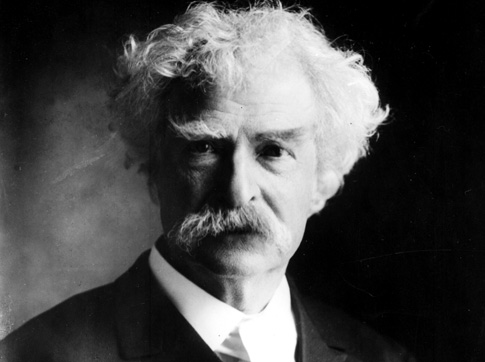
“The reports of my death are greatly exaggerated!” Mark Twain.

Mark Twain

The Mark Twain quotation after hearing that his obituary had been published in the New York Journal.

Mistaken publications of obituaries aren’t as rare as you might expect. A recent example is of Dave Swarbrick, the British folk/rock violinist, who was killed off mistakenly by the Daily Telegraph in April 1999 when they reported that his visit to hospital in Coventry had resulted in his death. He did at least get the opportunity to read a rather favourable account of his life, not something we all get to do, and to deliver the gag “It’s not the first time I have died in Coventry”.

So why have I opened with this quote from Mark Twain?  Read on and I hope all will be clear.

A little under a week ago, I published a couple of posts that proposed that the United States of America is an empire in decline.  The first was What goes up? and the second Might just come down! As a Brit, I well know that aspect of British history!

However a recent conversation with a friend of many years back in England, who has also been a shrewd and wise entrepreneur for longer than I care to remember, argued that the evidence for the ‘end of the USA’ could be challenged.

He cited five reasons why he thought the USA would remain, more or less, in its dominant position.  They were:

  1. Spirit of innovation
  2. Relaxed labour laws
  3. The importance of Mexico
  4. The uncertainty of China in terms of the next ’empire’
  5. The likely energy self-sufficiency for the USA in the near-term.

So let me expand on each of those points.

Spirit of innovation

Let me quote from an article in TIME Magazine of the 5th June, 2011,

Innovation is as American as apple pie. It seems to accord with so many elements of our national character — ingenuity, freedom, flexibility, the willingness to question conventional wisdom and defy authority. But politicians are pinning their hopes on innovation for more urgent reasons. America’s future growth will have to come from new industries that create new products and processes. Older industries are under tremendous pressure. Technological change is making factories and offices far more efficient. The rise of low-wage manufacturing in China and low-wage services in India is moving jobs overseas. The only durable strength we have — the only one that can withstand these gale winds — is innovation.

Now there are plenty who would argue both ways in terms of the future innovation potential for the USA, as a recent article in The Atlantic does, see American Innovation: It’s the Best of Times and the Worst of Times.  But the spirit of innovation will, nonetheless, be a powerful economic potential for the USA for many years to come.

Relaxed labour laws.

Definitely an area that I have little knowledge of except for the subjective notion that compared to many other nations, the laws in the USA are much less of a restraint on economic productivity than elsewhere.

The importance of Mexico.

The importance in the context of providing the USA with a source of cheaper manufacturing facilities.  My English friend thought that this was a significant competitive advantage for the USA.  Now, as it happens, we had a couple staying with us over the week-end of the 6th/7th October.  The husband is a senior manager of Horst Engineering, an American firm based in Guaymas, Sonora County, Mexico.  Here’s a picture from their website,

We are a contract manufacturer of precision machined components and assemblies for aerospace, medical, and other high technology industries. Our core processes include Swiss screw machining, turning, milling, thread rolling, centerless grinding, and assembly. Our extensive supply chain offers our customers a full service logistics solution for managing their precision product requirements. We are ISO9001:2008 and AS9100 registered and proud of our 66 year, three-generation legacy of quality and performance.

I was told that many American and British firms were using Mexico rather than China for a number of reasons.  Not least because Chinese suppliers require full payment before shipment.  Plus that taking into account that financial aspect together with shipping costs and other logistical issues, China wasn’t as ‘cheap’ over all.  Here’s a recent announcement from Rolls Royce,

Rolls-Royce plans new Sonora hub

The burgeoning aerospace industry in Guaymas had its efforts validated recently when the venerable Rolls-Royce chose it as the site for its newest global purchasing office.

Surrounded by several of its aerospace manufacturing suppliers, London-based Rolls-Royce will move into a Guaymas industrial park owned by Tucson-based The Offshore Group to develop a supply hub for commercial jets and military aircraft around the globe.

“Rolls-Royce has very robust booking orders for the next 10 years,” said Joel Reuter, director of communications for Rolls-Royce in North America. “We need to double our production.”

Because a number of Rolls-Royce suppliers already operate in Guaymas, the city was a logical choice, Reuter said.

The uncertainty of China in terms of the next ’empire’

The point made in terms of China taking over ’empire’ status from the USA, as Simon Johnson argues over at Baseline Scenario, is countered by the fact that politically China is an unknown quantity.  Until China endorses some form of democratic process, that unknowingness is not going to disappear.

The likely energy self-sufficiency for the USA in the near-term.

I can’t do better than to ask you to watch this video!  Just 27-minutes long, it is a very interesting review of the energy future of the USA.

As the TED website suggests in terms of why you should listen to Amory Lovins,

Amory Lovins was worried (and writing) about energy long before global warming was making the front — or even back — page of newspapers. Since studying at Harvard and Oxford in the 1960s, he’s written dozens of books, and initiated ambitious projects — cofounding the influential, environment-focused Rocky Mountain Institute; prototyping the ultra-efficient Hypercar — to focus the world’s attention on alternative approaches to energy and transportation.

His critical thinking has driven people around the globe — from world leaders to the average Joe — to think differently about energy and its role in some of our biggest problems: climate change, oil dependency, national security, economic health, and depletion of natural resources.

More on Reinventing Fire may be found here.

So, don’t know about you, but I found those five points deeply convincing.  How about you?  Are the reports of the death of the USA  greatly exaggerated? Do leave a comment.

ooOOoo

Now some three years later on, these five factors still seem to be valid.

Greek dogs making sad headlines

Once again, the power of unanticipated consequences.

I find it easy to lose sight of recent world events, for every new day seems to bring some new challenge to batter one’s emotions.

So a news item on the BBC website last Friday brought back into focus the debt challenges for Greece, or more pertinently, the Greek people, or even more precisely, Greek dogs.

Here’s what I read:

A million stray dogs ‘victims of Greek debt crisis’

3 October 2015 Last updated at 07:10 BST

Among the many problems brought on by the Greek debt crisis is a surging population of stray dogs.
Animal charities say there are now more than a million strays in Greece because people are simply abandoning pets they can no longer afford to keep.
There are fears it could lead to the spread of disease if the problem is not tackled soon, as Emilia Papadopoulos reports.

Emilia’s video report was uploaded to YouTube, thus allowing me to share the sad situation with you.

A quick search online found the following photograph.

cani randagi
Stray dogs in Athens.

That sad picture came from the ANSAmed website, that included a fuller report on the situation. That report ending:

According to the deputy mayor of Athens, Angelos Antonopoulos, who is also in charge of environmental issues, city officials in Athens picked up 457 dogs in the capital’s streets last year, providing medical treatment for 305 of them.

Antonopoulos, a vet by profession, admits that the number of cases of abandoned domestic animals – dogs in particular – has risen alarmingly because of the economic crisis, but says that a new trend is emerging for the same reason. Indeed, an increasing number of people who want to own a dog are choosing to adopt strays from the city’s doghouse rather than buying one from a pet shop or from dog-breeders. “People are becoming increasingly aware of the problem,” Antonopoulos says, providing a ray of hope for his four-legged patients. (ANSAmed).

Finally, I came across what appears to be a Greek charity, Stray.gr, and I’m going to contact them to see if readers of Learning from Dogs who wish to donate, can do so. Will report back.