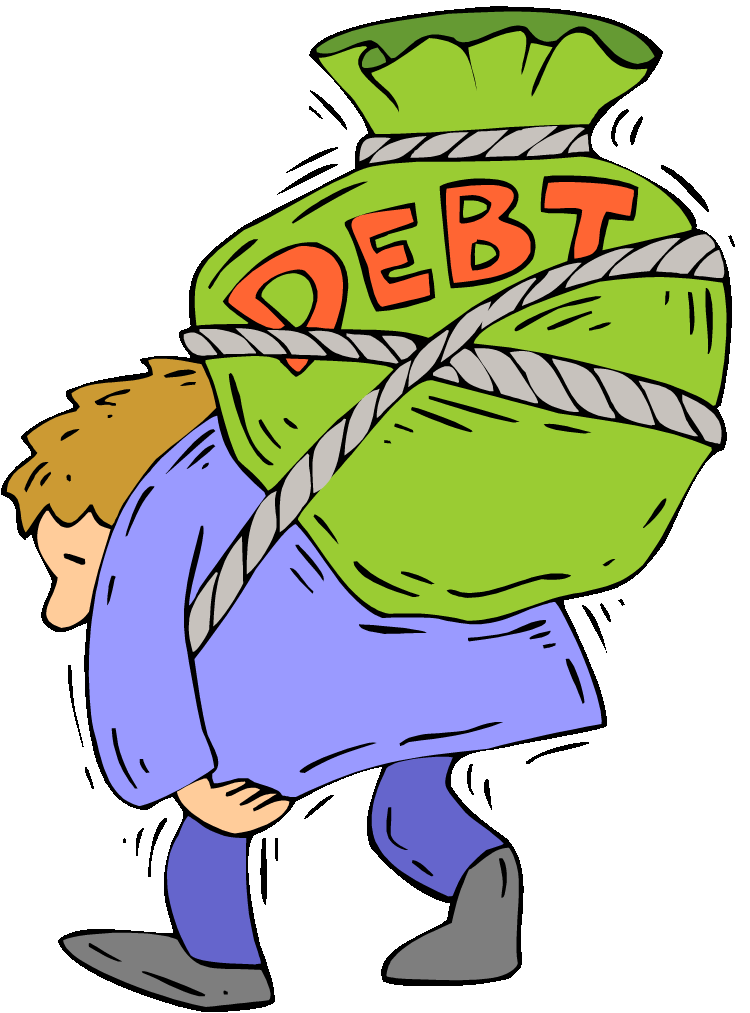
Category: Economics

The Wobbling Euro

Europe puts on a grand farce for the rest of the world to watch and wonder at.

The “Greece scuppers the euro” soap opera is steaming along at top speed and the iceberg ahead is more than big enough to sink the Euro, the flagship of those seeking a United States of Europe.

The Euro coin

Several very interesting things are becoming clearer about all this:

A) Greece (and for that matter some other countries) was NOT “ready” for the straitjacket of a single currency in the same bed as Germany, Holland and other serious (well, sort of ) countries, particularly in the North ….

B) The EU hierarchy set some stiff rules for entry to the Euro, which Greece LIED about to gain entry.

C) I firmly believe the EU leaders KNEW that Greece’s figures were the delusional fruits of fraudulent pretention, but they PRESSED ON regardless.

The question is, WHY did they let Greece in? And the reason was – I maintain – their GREED. Not directly for money (though that is ever in the background) but for POWER. The more countries in the Euro the bigger the organism and all organisms seek to grow to their maximum.

The bigger the Eurozone the more unstoppable the momentum would appear (and “appear” is certainly the right word) and the more power would accrue to Brussels and Frankfurt. POLITICAL GREED overcame economic and financial logic.

But the chickens always come home to roost and the result could now be the OPPOSITE of what they wanted to achieve.

Coming back to the roost

Instead of a tight core of financially-stable and righteous Eurocountries that could have thrived as a model for others to emulate and join, Euroland has become a haphazard bodge of totally-disparate economies that has every chance of unravelling in chaos.

I have no desire to see the Greeks or anyone else in economic trouble, but we cannot build a new Europe – let alone world – on lies and a lack of realism. A touch of hubris is direly needed. More practically, we need more long-term planning and less short-term political greed and cowardice.

If this Greek crisis had happened when the EU was flush with funds then it could perhaps – temporarily – have been bodged over as usual. Now we are still on a financial knife edge, and it could go either way. There is some talk that this crisis could accelerate political and monetary union, but I can’t see individual countries giving up their financial independence to Frankfurt and Brussels …. what is true is that we are in dangerous waters out of control and maybe heading towards the rapids … (or the iceberg …) Most EU countries are already in serious trouble; the last thing they need is a further drain on scarce resources. The Greek patient could well bring down the German doctor …….

One of the funniest things (if you like black humour) was soon after the EU bigwigs fixed a ceiling of 3% above GDP for countries’ budget deficits. In other words, countries joining the Euro had to guarantee to take steps to ensure this ceiling would not be breached, and this in the interests of Euroland as a whole; a sort of collective responsibility.

Yet as soon as FRANCE found it could not apply the self-discipline to keep to this promise (do promises matter at all in politics?) then some French government spokesperson said when challenged on this that “the rule could not be applied to big countries.

You couldn’t make it up!!!

By Chris Snuggs

Remarkable people: Eli Goldratt

What do you know? And when did you know it?

Eli Goldratt

Many of the situations that we face are well understood … or, at least, we think they are! Then someone comes along with a different approach and breaks through into a new regime.

This can be unsettling, but then the new approach becomes the norm. What was previously obvious is now ridiculous; and what was previously ridiculous is now obvious! No wonder these things do not happen often, because, if they did, they would not be so unusual!

Eli Godratt has had an enormous impact on many businesses through his approach to understanding business processes. Some of his most effective works are novels! How many business consultants write novels to help people to learn? “The Goal” was his first and captured the main elements of his approach which he termed the Theory of Constraints. He has gone on to describe new approaches to project management, which he calls Critical Chain.

Continue reading “Remarkable people: Eli Goldratt”

What a con!

How do young drivers afford the insurance?

My daughter turned 17 years of age on 4th February, and has been excited about the possibility of being able to drive for some time, apart from a period of concern when the British Government hinted at raising the driving age to 18. Fortunately that passed.

I likewise always wanted to drive and at age 17 moved from two wheels to four and in 10 days had passed my test. The car insurance giving nearly minimum cover was £26 a year, my first car having a 2.6 litre engine. The next was a Jaguar 2.4, and the third, another Jag, this time a 3.8 XK 150S, for which I probably had to pay an extra £10 a year, all while I was 17. (1969 ) Continue reading “What a con!”

Every Economist, Mr. President? No, Sir!

Here’s one person who doesn’t agree with the President.

The President seems to believe that he can say whatever he wants and no one will hold him accountable. He now claims that “every economist, from both sides of the aisle, believes that the stimulus program created jobs.”

I am an economist, Mr. President, and I know, based either on simple first principles of economics, or on a more rigorous controlled study of labor markets in each major sector of the economy, that the unemployment rate would have been much lower today had the stimulus program never occurred.

You are either woefully unaware of the facts, Mr. President, or are purposefully distorting the facts. Neither is good.  When are you going to realize that just because you say something does not make it so? The world does not contort itself to support your version of the truth.

Do not put words in my mouth, sir.

By Sherry Jarrell

Organic milk in the USA

The unacceptable face of the big agricultural businesses

Another wonderful link from Naked Capitalism.  This one refers to the way that the definition of ‘organic’ as in organic milk is being twisted and distorted to favour the huge indoor milking herds, up to 10,000 cattle, that in any sensible mind could never be regarded as the organic production of milk.

This to me is a picture of organic production of milk:

An English meadow

This to me is NOT! Yet the milk from these cows is defined as organic!

Organic milk?

This last picture is courtesy of The Cornucopia Institute, another web site worth a visit whether or not you take an interest in farming – after all, one presumes that you do eat!

The article is on the Politics of the Plate website, worth your visit whether or not you are an American, and is, to me, so important that I am taking the liberty of publishing the article in full.
Here it is:
Read this very important article

Time for a Review

What’s more common in business could/ought to apply to us.

I was very pleased to call by and have a chat with a very good friend and his wife recently because they are facing financial difficulties.

Slightly unusual in that he is a qualified Doctor and has a share in the practice and his wife is a music teacher. Why should they have problems?

They bought their house three years ago and, like so many others, took out a large mortgage.  Probably not the best deal available at the time but it allowed them to secure the house they wanted. Since they purchased the property, house prices have fallen so they have fallen straight into negative equity!

The house needed some work and they also carried out a loft conversion. To make this possible they arranged another loan, not at a very good rate, but at least they are working on the property, and the bits they have done look great.

Working hours and the need to keep up to date with patient notes and write appraisals means that there is almost no time for relaxation; to fall into bed at night is a welcome relief! But what of the financial situation?

To keep the show on the road there has been no time to review the arrangement of ‘bricks’ on which the financial blocks are built.  Now they facing a large tax bill, so another large loan is being proposed, just to keep the tax man quiet and keep the show on the road.

How many of us find ourselves in a similar situation? Yet industry has a business practice that can help us. Analyse, diagnose, correct – sort of based on the mantra that ‘You can’t manage what you can’t measure‘.

  • Review our situation and diagnose the problems.
  • Look at our options.
  • Decide what to do.
  • Action our decision
  • And lastly REVIEW progress.

How often are we likely to review our situation like this at home or even make basic changes.  Well perhaps we need to review more often than we think. Make it a regular weekly practice.

Look at being tax efficient, and in the case I am describing this was the major problem, so the cycle of worry is now being broken, and a new firm financial arrangement of blocks being put in place rather than the little boxes, which were piled high, and about to fall down.

Yes it takes time. No we don’t want to face it, but hey its like banging your head against a wall.

It is great when it stops.

Try it!

Bob Derham

Obama’s Farcical Freeze

When is a freeze not a freeze?

President Obama’s proposal to freeze parts of federal government spending over the next three years is a lot like a smoker buying a truckload of cigarettes one year before promising to “freeze spending” on cigarettes the next.  He can keep smoking for years to come without spending another dime.

Federal government spending has increased so much over the last year — by some estimates at a rate of 34% — that in December of 2009 the debt limit had to be raised to $12.4 trillion to help absorb a record-shattering $1.4 trillion deficit.

The promise to freeze spending is actually a guarantee that spending will remain at record high levels for the next three years.  It effectively prevents a reduction in federal spending.

How disingenuous of our President.

By Sherry Jarrell

Fed Sets up unit to Police Itself

Foxes and hen-house?

I’m not quite sure how I feel about this yet.  The Fed recently announced that it has appointed a long-time staffer with the New York Fed to head a newly created branch to oversee the the parts of its balance sheet acquired in efforts to bail out firms like AIG.

These massive asset purchases, orchestrated by Timothy Geithner, the current Treasury Secretary and former New York Fed official, ballooned the Fed’s balance sheet from $800 billion in primarily government bonds to $2.3 trillion in toxic assets.

Now the New York Fed is overseeing the assets brought into the Fed by the Treasury Secretary as he moved from the New York Fed to the Treasury.  All while the Treasury functions are supposed to be isolated from the Federal Reserve’s role in its implementation of monetary policy.Foxhenhouse

Smacks of the fox watching the hen house….

By Sherry Jarrell

Actual Unemployment is Worse

Unemployment statistics and the real world.

Keep in mind, even as the number of first-time claims for unemployment insurance rose again recently, that the 10% U.S. unemployment figure understates the actual number of unemployed. Even the 17% underemployment figure, which includes those who are either unemployed or who are working part-time but would like to work full-time, fails to include many of those who have lost their jobs but, because they fail to qualify for unemployment, are not being tracked.  I know several such people personally; one has been unemployed for over a year.

My point? Structural unemployment is a serious economic issue. But the solution is not to funnel more unemployment benefits to the unemployed.  The best thing the government can do is to reduce the barriers it has erected to a vibrant economy, including oppressive taxes, fees, paperwork, bureaucracy, and regulations that repress business productivity and raise prices.  By reducing these explicit and implicit costs, there is absolutely no doubt that the private economy will be able to employ more workers as it produces more output at lower prices.

The best thing we can do as private citizens and neighbors is to treat each other right.  Keep the economy moving.  Put in a good day’s work.  Volunteer or learn a new skill if you can’t find a job.  Fill a need.  Buy smart.  And, finally, elect business-friendly local and national politicians.  It matters.

By Sherry Jarrell


Capitalism and the Daimler-Chrysler Saga: Part 3 of 3

In a new departure for Learning from Dogs, Sherry Jarrell publishes a three-part article on the Daimler-Chrysler merger.  Learning from Dogs is indebted to Professor Jarrell for both giving so freely of her time to the Blog and for sharing such erudite material.

Here is Part Three, the concluding part.  If you missed Part One then it is here and Part Two is here.

Where is DCX today?

The Daimler-Chrysler merger was troubled from the beginning.

Investors sued over whether the transaction was a ‘merger of equals’ or a Daimler-Benz takeover of Chrysler. A class action lawsuit was settled in August 2003 for $300 million. A lawsuit by activist investor Kirk Kerkorian was dismissed

Jürgen E. Schrempp

in April 2005, but claimed the job of the merger’s architect, Chairman Jürgen E. Schrempp, who resigned in response to the fall of the merged company’s share price. The merger was also the subject of a book Taken for a Ride: How Daimler-Benz Drove Off With Chrysler, (2000) by Bill Vlasic and Bradley A. Stertz.

It is questionable whether the merger ever delivered promised synergies or ever successfully integrated the two businesses. As late as 2002, Daimler-Chrysler appeared to run as two still-independent companies.  In 2006, Chrysler reported losses of $1.5 billion.  In 2007, it announced plans to lay off 13,000 employees, close a major assembly plant, and reduce production at other plants in order to try to restore profitability.

It was all for naught.  In May of 2007 Daimler-Chrysler announced that it would sell 80.1% of Chrysler to Cerberus Capital Management of New York, a private equity firm specializing in troubled companies. Daimler continued to hold a 19.9% stake. Daimler paid Cerberus $650 million to take Chrysler and associated liabilities off its hands, an amazing development given the $36 billion Daimler paid to acquire Chrysler in 1998. Of the $7.4 billion purchase price, Cerberus Capital Management invested $5 billion in Chrysler Holdings and $1.05 billion in Chrysler’s financial unit. The de-merged Daimler AG received $1.35 billion directly from Cerberus but invested $2 billion in Chrysler LLC itself.

On April 27, 2009, Daimler AG agreed to give up its remaining 19.9% stake in Chrysler LLC to Cerberus and pay as much as $600 million into the auto-maker’s pension fund.  On April 30, 2009, Chrysler LLC filed for Chapter 11 bankruptcy protection and announced a plan for a partnership with Italian automaker Fiat. On June 1, Chrysler LLC stated they were selling some assets and operations to the newly formed company Chrysler Group LLC, with Fiat retaining a 20% stake in the new company.

On June 10, 2009, the sale of most of Chrysler assets to “New Chrysler”, formally known as Chrysler Group LLC, was completed. The federal government financed the deal with $6.6 billion in financing, paid to the “Old Chrysler.” The transfer does not include eight manufacturing locations, nor many parcels of real estate, nor equipment leases. Contracts with the 789 U.S. auto dealerships who are being dropped were not transferred.

By Sherry Jarrell