There are many people who might represent the subject of entrepreneurship. It is likely that a calm analysis of the candidates would select someone with a broad range of characteristics which had been identified as generally accepted as typical. But this would be to fly in the face of the nature of entrepreneurship itself!
How can the sense of the personal distortion of reality required to see a different path be communicated by someone identified as a “typical” entrepreneur?
With that in mind, the following video captures such a motivational performance that any selection process that might have been used has been abandoned in selecting Jason Calacanis, the controversial and abrasive founder of multiple “dot com” ventures, mainly in the broad area of web publishing.
Say what you like about his activities during his various ventures, and who knows whether it is as unprepared as it appears to be, his performance in this video is pure gold in the annals of motivational presentations for entrepreneurs. He starts slowly, sets the scene, describes his story and steadily builds momentum and intensity. As the stakes increase, so does the passion. Balanced by a substantial level of self-analysis, this is a gripping personal story. If you are interested in entrepreneurship, set aside the next half hour or so, sit back and enjoy this:
While many factors arise in describing entrepreneurs, the one issue that comes up time and again is the simple choice between two different paths. He captured that!
“Time and again we see behaviour by people – we are talking highly educated, high income people – who are making less than ideal financial decisions for themselves and their families,” said one source. “Other countries that have developed a strategy have focused on education in high schools. This task force has come to the early conclusion that, while enhanced financial education is vital over the long term, it is insufficient.”
The first sentence is so important, to my mind, that it is worth repeating, “Time and again we see behaviour by people – we are talking highly educated, high income people – who are making less than ideal financial decisions for themselves and their families,”
looking into ways of making Canadians “more savvy” about their personal finances.
The financial industry is very adept at producing complex financial products that are almost beyond the limits of the understanding of good common people. We, the people, need to be much smarter and that’s why this initiative from the Canadians seems, on the surface, to be such an excellent idea.
Even in the midst of great pain, we must think through our choices
The last week has been really mad. I have been working in different companies and organisations and having to be part of redundancies, power struggles and people rebuilding their lives.
For example, I was in a company that had just let its second lot of people go in as many months. It’s gone past losing ‘dead wood’ and now people with valuable skills needed for recovery are going. I’ve noticed previously that good, employable people with key skills start to get concerned and will often take voluntary redundancy rather than hanging around to see how things pan out.
End of job!
It’s the shocking way that it’s done as well that’s unbelievable. No warning, just a phone call to attend a meeting, no hint as to what the meeting is about, then an envelope slid across the table and then a rapid escort off site. All done and dusted in 5 minutes.
Having been through this myself some years ago, it’s not something you forget in a hurry. Lots of feelings of rejection and feeling unvalued and unwanted are what I remember. Perhaps its part of being bought up in a job-for-life culture and then having that illusion shattered.
Working with people in this situation is literally quite shocking and traumatic because it clearly affects them and their lives and the lives of their families, and it affects me because the work we started comes to an abrupt end usually with little or no warning, and so does a source of income to be brutally honest. I don’t even have chance to say good-bye in many cases.
Every Thursday I become a trainee psychotherapist and work with people who mostly struggle to hold down any sort of job. The reasons for this are generally because of upbringings that are awful beyond description. The shock and trauma that is in the air when working with these people is amazing, and so scary for them that the idea of being present in the room with me and is virtually impossible.
So that brings us to managing in a world where lots of mad and non-integrous things happen. I believe that mindfulness can provide a key to these situations; being present for another does more than any instruction manual!
Being present means we make ourselves available at many levels to someone who is suffering. By avoiding the subtle invitation to join someone in their shock and trauma but by being there for them, to the best of our ability and listening to them at depth, we can provide an environment where real reflection can take place. Then options may be chosen which are not born of panic and reaction but come from reflection and response.
I believe that this approach gets us out of the ‘noise machine in our heads‘ (that is forever churning and worrying, in my case) that we have no control over, and creates space for more subtle things to come through the quiet and calm.
Most people I’ve met in my engineering work like to assume that they think their way out of tight situations but I’m not convinced that this process is actually effective. I have heard and practised many times the activity of ‘sleeping on something’ and then being able to decide on a course of action the following morning with relative ease. My psychotherapy clients can’t think their way out the awfulness because thinking about things has got them into a spiral
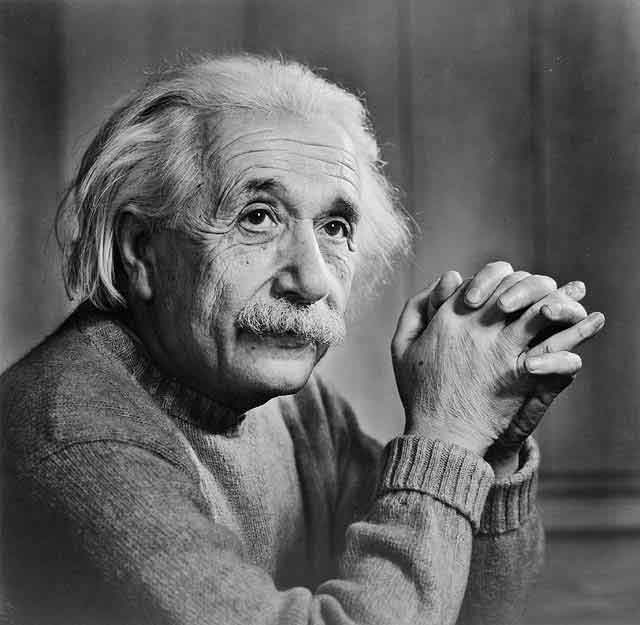
Albert Einstein
process which is highly addictive, predictable and virtually impossible to break without the intervention of a higher level of awareness. I think it was Einstein who said something like, “you can’t use the same intelligence that created a problem to solve it“! In other words, a different approach or level must be used.
I believe that this different approach or level can be used to solve most problems we have. By bringing a different level of awareness to a challenge, whether it is redundancy or some other sort of deeper problem always gives different results and provides more options. It’s just that initially it needs to be facilitated, until we can do it under our own steam. I am heartened that even in the depths of a recession that there are still companies out there that support this approach and the work I do.
By Jon Lavin [This article from the BBC is worth reading in conjunction with Jon’s excellent Post. Jon may be contacted via learningfromdogs (at) gmail (dot) com]
Looking more closely at the implications of changes in the Fed rate
Fed Funds rate influences consumer and business interest costs
Does the Fed Funds Rate, the rate charged by the Federal Reserve to make short-term loans to banks, directly influence the interest rate consumers and businesses pay on credit cards, mortgages, and consumer and business loans? If you took the word of the average business news commentator, you would think not. But the answer, of course, is yes.
One way to view the market rate of interest, although certainly not the only correct or useful way, is to think of it as a base rate that represents the risk-free rate, a rate that compensates the population for its impatience to consume the goods it would have consumed had it not lent the funds out in the first place. This risk-free rate is also influenced by the efficiency and functioning of the capital markets that bring borrowers and lenders together.
A risk premium is then added to this base rate of risk-free interest, one that varies depending on the degree of uncertainty of the lender getting repaid. The risk of default, the risk of prepayment, the risk of political uprising, exchange rate risk, and many other sources of uncertainty — including the risk of inflation — raise the level of the risk premium commanded by lenders in the market. As an example, over the last 100 years or so, the average annual risk-free rate in the U.S. has been about 4%, and the average annual risk premium for equity securities has been about 8%, bringing the average annual observed interest rate or rate of return to about 12% on these securities.
So what happens to the interest rate charged to consumers and businesses when the Fed raises the fed funds rate? Basically, the level of the risk-free rate in the economy rises and, as debt contracts expire or new lending takes place, this higher base rate gets factored into the market rate of interest charged.
Overall, the demand for loanable funds falls, the aggregate demand curve for the economy falls, and equilibrium output and employment fall, RELATIVE to where they would have been without the rate increase. The bright side is that a reduction in the money supply that accompanies an increase in the fed funds rate is absolutely essential to curtailing inflation, which drives the risk premium, and represents a much greater cost to the economy.
What does it mean when the Fed raises the interest rate? It helps to first understand how the Fed raises the rate, which may surprise some people. The Fed does not “set” the interest rate as it might, for example, by declaration or edict or by fixing prices. No, it targets a higher interest rate by contracting the money supply until that money supply intersects the market demand for money at a higher market-clearing rate of interest.
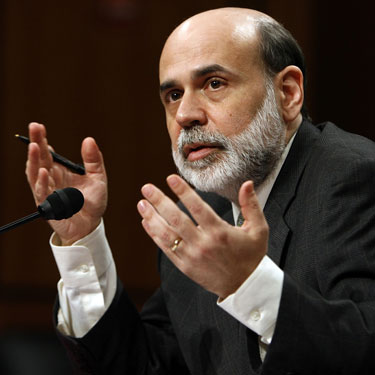
Ben Bernanke, recently reconfirmed Fed Chairman
How does the Fed reduce the money supply? Typically by conducting open market operations, which is the purchase or sale of government securities by the Fed. To raise the money supply, it purchases new government securities, paying for them by creating — out of thin air — reserves for the commercial banking system. To reduce the money supply, it sells securities which shrinks the amount of deposits in circulation in the economy. In other words, it reduces the liquidity or amount of credit in the system. This is equivalent to reducing aggregate demand for the goods and services in the economy. (Yes, you heard right — a reduction in the money supply decreases the aggregate demand for goods and services by businesses and consumers.)
Raising interest rates is a contractionary policy decision. It is designed to “slow down” the economy, reducing output and employment, and raising the equilibrium prices of goods and services in the economy. Why would the Fed choose to contract an already anemic economy? To head off inflation, which has it own set of insidious costs and distortions that significantly hurt the economy.
The Fed has always had to tread a very fine line between increasing the money supply enough in the short run to pump up demand and minimize the depth and length of a recession, but not increasing the money supply so much that the increase in demand outstrips the ability of the economy to produce, which creates inflation in the longer run. Excessive money growth is what causes inflation. And over the last two years, the U.S. has witnessed a record-shattering increase in the money supply as policymakers struggled to deal with an unprecedented financial crisis.
I have been saying for months that this behemoth money supply would inevitably lead to significant inflation unless steps were taken to shrink it. I believe the Fed has now begun to take those steps.
In a recent article, Moody’s announced that it may have to reduce the AAA rating of U.S bonds because of excess spending and historic debt levels of the U.S. government under President Obama.
Moody’s Investors Service Inc. said the U.S. government’s AAA bond rating will come under pressure in the future unless additional measures are taken to reduce budget deficits projected for the next decade.
The U.S. retains its top rating for now because of a “high degree of economic and institutional strength,” the New York- based rating company said in a statement today. The ratios of government debt to the U.S. gross domestic product and revenue have increased “sharply” during the credit crisis and recession. Moody’s expects the ratios to remain higher compared with other AAA-rated countries after the crisis.
What this means in practical terms is that the cost of borrowing by the U.S. government will rise, which will increase spending via more borrowing or higher taxes or more money creation to pay for the higher interest costs. Sound like a vicious cycle to you?
Has anyone noticed the absolute irony of the world capital market having a seat at the table that assesses the viability of Obama’s policies? Obama, who has spent the last year denigrating free markets and capitalism, and has laid the blame for the credit crisis squarely at the feet of those greedy capitalists, now has to deal with a rating agency, which plays a pivotal role in the functioning of those very capital markets, evaluating the creditworthiness of his policies and those of his budget director, Peter Orszag, pictured here.
Peter Orszag, Obama's Budget Director
How wonderfully ironic!
The U.S. would not be the first. Ireland was recently downgraded, and Japan lost its AAA rating from Moodys in November of 1998; both faced higher borrowing costs as a result.
We are going through unprecedented troubled times and the way ahead looks very uncertain. The whole world could be participating in the ‘lost decade’ that Japan experienced previously.
But this article is not about doom and gloom! It is about recognising the commitment to open and honest reporting being undertaken by (at least) these three individuals. Three commentators that this author follows in admiration and awe.
Learning from Dogs has nothing like the following of James Kwak, Yves Smith and Karl Denninger but the LfD authors do have an inkling of the work involved in writing not one but often several articles each day. It is a huge commitment.
James Kwak
First James Kwak of Baseline Scenario. Simon Johnson is, perhaps, the more well-known of this duo that comprise Baseline Scenario but it is James that puts in the leg-work. Here’s a taste of a recent article from James:
Radio Stories
I spend a lot of time in the car driving to and from school, so I end up listening to a lot of podcasts (mainly This American Life, Radio Lab, Fresh Air, and Planet Money). I was catching up recently and wanted to point out a few highlights.
Last week on Fresh Air, Terry Gross interviewed Scott Patterson, author of The Quants, and Ed Thorp, mathematician, inventor of blackjack card counting (or, at least, the first person to publish his methods), and, according to the book, also the inventor of the market-neutral hedge fund.
Large chunk snipped ……
I finally got around to listening to Planet Money’s interview with Russ Roberts from December. Russ Roberts and I are pretty sure to disagree on almost any actual policy question. But what I liked about his interview was that he basically admitted that policy questions cannot be settled by looking at the empirical studies. On whether the minimum wage increases or decreases employment for example, he says that he can poke holes in the studies whose conclusions he doesn’t agree with, but other people can poke holes in the studies he agrees with. In Roberts’s view, people’s policy positions are determined by their prior normative commitments.
I don’t completely agree. I don’t think that these questions, like the one about the minimum wage, are inherently unanswerable in the sense that the answer does not exist. But I agree that empirical studies are unlikely to get to the truth, particularly on a politically charged question, because there are so many ways to fudge an empirical study. As one of my professors said, there are a million ways you can screw up a study, and only one way to do it right. But I agree with the general sentiment. We are living in an age of numbers, where people think that statistics can answer any question. Statistics can answer any question, but they can answer it in multiple ways depending on who is sitting at the keyboard.
Help!! Is there a financial Wizard out there somewhere? I need your input! My bank, the Société Générale, is advising
Société Générale
its customers that “a global economic collapse” is very possible within the next two years and that we should make “defensive preparations” for it.
Is this a sign of the bank losing its mind (and they did lose £5 billion a few years ago at the hands of a rogue trader) or do they know something that other pundits don’t?
Where is the Guru that can tell me where I should put my money now? Under the mattress? And in which form? Shirt buttons?
They say gold will skyrocket as the only thing buyable worth buying! And there’s me having just sold all mine at what I thought was the top of the market!!!! Oh Dear …..
Europe puts on a grand farce for the rest of the world to watch and wonder at.
The “Greece scuppers the euro” soap opera is steaming along at top speed and the iceberg ahead is more than big enough to sink the Euro, the flagship of those seeking a United States of Europe.
The Euro coin
Several very interesting things are becoming clearer about all this:
A) Greece (and for that matter some other countries) was NOT “ready” for the straitjacket of a single currency in the same bed as Germany, Holland and other serious (well, sort of ) countries, particularly in the North ….
B) The EU hierarchy set some stiff rules for entry to the Euro, which Greece LIED about to gain entry.
C) I firmly believe the EU leaders KNEW that Greece’s figures were the delusional fruits of fraudulent pretention, but they PRESSED ON regardless.
The question is, WHY did they let Greece in? And the reason was – I maintain – their GREED. Not directly for money (though that is ever in the background) but for POWER. The more countries in the Euro the bigger the organism and all organisms seek to grow to their maximum.
The bigger the Eurozone the more unstoppable the momentum would appear (and “appear” is certainly the right word) and the more power would accrue to Brussels and Frankfurt. POLITICAL GREED overcame economic and financial logic.
But the chickens always come home to roost and the result could now be the OPPOSITE of what they wanted to achieve.
Coming back to the roost
Instead of a tight core of financially-stable and righteous Eurocountries that could have thrived as a model for others to emulate and join, Euroland has become a haphazard bodge of totally-disparate economies that has every chance of unravelling in chaos.
I have no desire to see the Greeks or anyone else in economic trouble, but we cannot build a new Europe – let alone world – on lies and a lack of realism. A touch of hubris is direly needed. More practically, we need more long-term planning and less short-term political greed and cowardice.
If this Greek crisis had happened when the EU was flush with funds then it could perhaps – temporarily – have been bodged over as usual. Now we are still on a financial knife edge, and it could go either way. There is some talk that this crisis could accelerate political and monetary union, but I can’t see individual countries giving up their financial independence to Frankfurt and Brussels …. what is true is that we are in dangerous waters out of control and maybe heading towards the rapids … (or the iceberg …) Most EU countries are already in serious trouble; the last thing they need is a further drain on scarce resources. The Greek patient could well bring down the German doctor …….
One of the funniest things (if you like black humour) was soon after the EU bigwigs fixed a ceiling of 3% above GDP for countries’ budget deficits. In other words, countries joining the Euro had to guarantee to take steps to ensure this ceiling would not be breached, and this in the interests of Euroland as a whole; a sort of collective responsibility.
Yet as soon as FRANCE found it could not apply the self-discipline to keep to this promise (do promises matter at all in politics?) then some French government spokesperson said when challenged on this that “the rule could not be applied to big countries.”
Many of the situations that we face are well understood … or, at least, we think they are! Then someone comes along with a different approach and breaks through into a new regime.
This can be unsettling, but then the new approach becomes the norm. What was previously obvious is now ridiculous; and what was previously ridiculous is now obvious! No wonder these things do not happen often, because, if they did, they would not be so unusual!
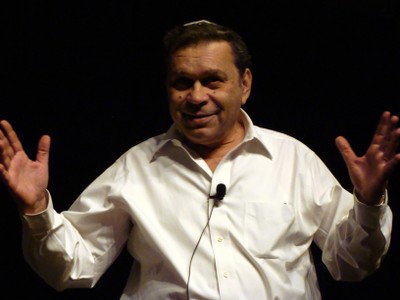
Eli Godratt has had an enormous impact on many businesses through his approach to understanding business processes. Some of his most effective works are novels! How many business consultants write novels to help people to learn? “The Goal” was his first and captured the main elements of his approach which he termed the Theory of Constraints. He has gone on to describe new approaches to project management, which he calls Critical Chain.





 Learning from Dogs