Category: Economics

Lessons of a Government Intern

When lending is motivated by politics, losses are not far behind.

Years ago, in the summer of 1980, I worked as an intern in the Federal Home Loan Bank Board at the Department of Agriculture.  I was a senior in college majoring in business and had been accepted to the University of Chicago doctoral program.  I didn’t want to take the internship because I wanted to take more courses over the summer to help prepare me for the rigors of grad school, but my college advisor had openly worried that I was far too serious for a young person.  He strongly encouraged me to accept the internship and take a break from academics before I immersed myself in graduate school, and buried myself once again in all things economics!

The U.S. Department of Agriculture was a major lender

I agreed, but only after I had arranged to take 6 credits of independent study in D.C.  I chose to examine the Negative Income Tax program, one of the largest social experiments in U.S. history. More on that at another time. Today, I want to talk about what I learned from being an employee of the U.S. federal government.

The first thing I learned was that the “problem” with government work is not the people; well, not all the people.  There was one man who spent his entire day going back and forth to feed quarters to the parking meter rather than pay for public transportation or do his work.  He represented the worst in government employees.  Most all of the others I met were hard-working and honest people, trying to do a good job and make a difference.

President George H. W. Bush

No, I learned that the real problem was the way the “work” was done in government. I worked for the Federal Home Loan Bank Board (FHLBB) that summer, which was one of the largest lenders in the world.  The FHLBB was responsible for small business, rural, agricultural, and economic development lending. My job was to review loan applications from community groups, fairs, farmers’ markets, and various municipal organizations to make sure that they were complete.

We did not analyze the applicants for creditworthiness.  Instead, if the application was correct and complete, and satisfied the application process, it was approved.  The FHLBB, which was publicly trashed by the first President Bush as being largely responsible for the savings and loan crisis, was abolished and replaced by the Office of Thrift Supervision (OTS) under the Department of the Treasury in 1989.

The OTS eventually expanded its oversight to companies that were not banks, including Washington Mutual, American International Group (AIG),  and IndyMac,  all implicated in the current U.S. financial crisis.

AIG

Little did I know back in 1980 that I was witnessing, from the inside, a government lending process that would lead to the most significant financial crisis since the Great Depression. Looking back, the outcome was perfectly predictable: when politics replaces profits as the motivation of the lender, it should be no surprise that losses result.

By Sherry Jarrell

The EU and the European Taxpayer

Integrity? Here is your quiz question for today:

Which international, taxpayer-funded organisation has an unelected crony of the British Prime Minister in a high-level post (though not the highest) who earns more than the President of the United States and double the salary of Hillary Clinton?

Clue!

Yes, you’re right. It is the European Union. This is an organisation of member states that in principle is supposed to be

Baroness Ashton

about creating a free, democratic and open market in Europe. It has turned into a proto-state (in the eyes of the Brusselocrats) which – therefore – has to have a “Foreign Minister”, in this case Baroness Ashton.

This is a person with very little knowledge of international affairs sent by Gordon Brown to Brussels because he couldn’t afford to lose Peter Mandelson or David Milliband. This is a person never elected to any public post, yet who receives a vast salary and benefits package higher than that of ANY of the Presidents and/or Prime Ministers of ANY of the member states of the EU.

As “The Daily Mail” points out, in addition to this very large salary the Foreign Minister also enjoys an extraordinary raft of other benefits:

“Her basic pay of £250,000 is double that of her U.S. counterpart, Hillary Clinton (who’s on £124,000). And on top of that, Lady Ashton is entitled to a raft of benefits including a £38,000 yearly accommodation allowance, £10,000 annual entertainment budget, two chauffeurs, plus thousands of pounds more in sundry allowances and – if she survives – a pension of £64,000 pa (three times the average salary in Britain) plus a “golden handshake” of over £450,000.”

All this goes hand-in-hand with billions spent on the new EU “diplomatic service”.

But hang on a minute! The EU is NOT A STATE!

The EU has no army! Baroness Ashton as “Foreign Minister” can decide on practically nothing that the key heads of government do not agree to. So what is going on here? Is all this vast waste of public money in a time of financial crisis either A) the bloated pretention of Brusselcrats who have a delusional idea of their own importance or B) another brick in the wall which one day WILL be a United States of Europe.

One can see how the thinking goes: “We’ll set up a “Foreign Ministry” so big and powerful that one day they will just have to agree to creating a single state to justify it. And of course the more it costs, the more important it obviously is and therefore the more powerful we ourselves will be. And naturally, the more jobs there will be for us to go to on the Brussels merry-go-round.

Of course, it is both A AND B. And how can they afford these humungous salaries? Well, because they can get away with it. In theory they are accountable, but in reality? How many people even know who their European MP is? Once you get onto the Euro Gravy Train it disappears out of sight. Nothing the voter says or does seems to stop the bloated upward creep of salaries, allowances and pretentions.

How ANY Brusselocrat can justify such a ludicrous salary for an unelected and essentially unimportant  “minister” is a mystery. The main justification seems to be “self-interest”. The EU is NOT A STATE. States have Foreign Ministers.

It is dishonest and amounts to theft of public funds. But that is not the WORST of it. The saddest thing is that it damages the morale of those who – like me – used to believe in a Europe united but not “statefied”. I want a free and open market. I do NOT want a United States of Europe. But this is where they want to lead us, and – like a black hole – each year sees a tiny creep in that direction, or in the above-mentioned case, a BIG creep. I also do not want a venal, money-grabbing, bureaucratic elite in Brussels which makes 80% and rising of British law.

Once again, one wonders if delusional pretentions will bring the whole edifice crashing down and the baby go out with the bathwater …

By Chris Snuggs

Econned, by Yves Smith

Learning from Dogs muses the new book from Yves Smith

ECONned, by Yves Smith

In Econned, Yves Smith, founder of Naked Capitalism, argues that the economy was doing just fine in the regulated environment up to the 1970s.  Then began the work of the Chicago economists who challenged Keynesian economics and touted the benefits of deregulation which eventually led to the financial crisis we have today.

Yves argument is internally consistent and well researched, but ignores some factors that I think would change the conclusions drawn from her work.

Yves Smith, author and founder of Naked Capitalism

First, Yves notes that the primary reason that economists are not useful to the real world is that economic research presumes equilibrium.  Smith misses the point here, but it is understandable. It took me years of study and contemplation to fully appreciate that an equilibrium simply gives economists a point of reference, a common base, from which to study shocks and movements. In and of itself, equilibrium is not interesting or important.   But movements to and from equilibrium are of real interest because they enable us to study and try to predict how individuals will react to incentives and changes in market conditions.

Second, we have to put the contributions of the Chicago economists of the 1970s into context.  Up until that time, the only real school of thought in macroeconomics was based on Keynes, who presumed that markets fail and that the government must play an active and large role – primarily through government spending and taxes — for the economy to perform well.  Keynes’ work was a reaction to the Great Depression.

Friedman’s monetarism also sought to explain the Great Depression, but focused on the role of monetary policy on the economy. This work showed that the missteps of the Federal Reserve was the primary cause of the depth and length of the Great Depression, and that long-term accommodative monetary policy causes inflation.  This body of work did not stress deregulation, although it did lean more heavily on enabling private market solutions than on replacing them with government solutions.  Neither theory is complete; Keynes focused on the short run (“In the long run, we are all dead” is a rather famous Keynes quip) and Monetarism focused on the long run.

There was a second large body of work that came out of the University of Chicago during the late 1960s and 1970s.  This research documented the tremendous costs of regulation. I know this literature personally and believe that its conclusions are very sound:  it shows that any effective regulation limits either the quantity or price of a good or service away from what it would have been without the regulation.  In fact, in my view, it was the passage of regulations requiring certain lending behavior that set off the series of events that led to the crisis, which is the exact opposite argument from what Ms. Smith makes.

By Sherry Jarrell

Greece, Oh Greece!

Fancy a Greek Isle?

Fancy a Greek Isle?

Germany is baulking at a Greek bailout ….. 84% of the people are opposed according to polls, and Frau Merkel is decidedly lukewarm. This is no surprise; the Germans are pretty commonsensical after all. They are  going through a “spot of fiscal turbulence” themselves and hardly in a mood to bail out a feckless, tax-avoiding, economic basket case on the flaky south of the Brusselian Empire ….

Instead, they have come up with a cunning plan; the Greeks should sell some of their islands. I can see the attraction; at knock-down prices, no doubt a good many Germans themselves – short of coast in the homeland – would be only too keen to snap up a firesale bargain.

But if I were Greek I would beware of Germans with cunning ideas. After all, it could be the islands today and the Acropolis tomorrow. Selling capital assets to clear debts built up on  a binge of tax-avoided short-term consumption is hardly the long-term solution, and it is remarkable how we humans do tend to go for short-term, quick-fix solutions (see my post on the Fat Pill) . Of course, in Europe at least the Sun (can I capitalize it? It is after all the source of my existence …) plays a large part here, for the further south you go the hotter it is, the more corruptly-shambolic the taxation system, the flakier the economy and the higher the debt. Of course, Britain is an exception to the rule, since it must be put in the Mediterranean basket of cases even though it is far up in the north. Still, Britain was ever exceptional ….

No, I would advise the Greeks to hang on to their islands for a rainy day and do the right thing, which is take the medicine, invest long-term rather than on frivolous consumption and in general live within your means. Selling the islands is desperation stakes, even if the ultimate solution would be to sell the whole country to the Germans and let them sort out the mess, and – more to the point – pay for it all as they did with East Germany.

But though this is hardly a laughing matter – especially for innocent Greeks (I assume there are some!!) – I did have a chuckle yesterday when I saw the headline.

“Greece calls for EU to play its part.” – in other words, bung in billions to bail them out. I am I confess mystified to understand exactly why the thrifty Danes should play their part in bailing out the hapless Greeks, though I suppose we do still owe them for democracy and stuff. When does the statute of limitations run out on this?

Well, good luck Greece, but don’t count on my pfennig, and don’t sell the islands either!

By Chris Snuggs

Kucinich’s Early Retirement Idea is Nuts!

Save a job – retire earlier! Duh!

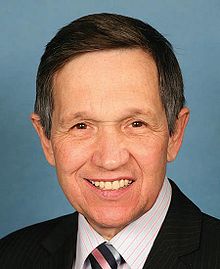
Democratic U.S. Senator Dennis Kucinich

Representative Dennis Kucinich (Democrat – Ohio) is on the media circuit promoting his rather novel idea on how to “create” jobs for younger people who are trying to enter the work force but can’t because of the recession.

The Congressman has proposed legislation that would allow people to take voluntary early retirement at age 60 instead of age 62, as the law now stands.

Kucinich, who ran for the Democratic nomination for President in both 2004 and 2008, estimates that about 25% of those eligible to retire at age 62, or about 1 million people, would choose to take early retirement under his plan. He claims that this is a conservative estimate, since about 70% of those who can retire at 62 do so now.

These early retirees would, of course, collect social security earlier, after having worked fewer years and contributed less to Social Security. And then we’d have to assume that these workers would be replaced by the younger people now looking.  And that they would generate the same tax revenues for the government that the early retirees did.

What a plan!  Lock in higher costs, with no guarantee of any benefits.  This is the kind of logic that put the U.S. into this pickle in the first place.

How does Mr.  Kucinich propose to pay for this plan?  Why, with government funds, of course!  Specifically, with the “extra” unspent stimulus and TARP funds.  This, despite the fact that he has spoken repeatedly about voting against the TARP funds because he opposes government interference in the private economy. But, hey, he goes on to say, “Since the money is lying around anyway, let’s use it!”  You’d think tax revenues fall out of the sky!

I do not know which is worse, the hypocrisy or the ignorance.  What folly! This man has absolutely no business talking about how to create jobs when he has no idea how the economy actually works.

Here’s an idea that is guaranteed to help the economy recover.  Why doesn’tMr. Kucinich take voluntary early retirement!

By Sherry Jarrell

Latest US GDP Figures

Growth in final GDP hides disturbing weaknesses in economy

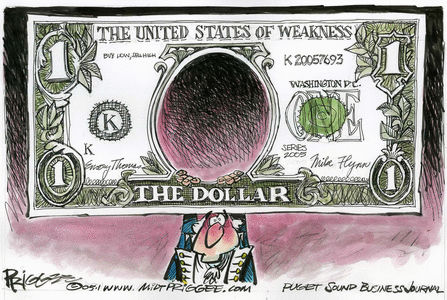
The U.S. GDP grew at an annual rate of 5.9% in the last quarter of 2009 which may look good at first glance, but when we dig a little deeper, we find some concerns about the implications for sustainable growth.  A large fraction of this reported growth came from businesses selling off accumulated inventories, which has more to say about past production than current. Exports were also a significant source of fourth quarter growth, driven in large part by a weak dollar.

Weak dollar both helps and hurts the economy

Of course, a weak dollar is a very mixed blessing for the economy, and is hardly a sign of a strong or recovering economy.

Real residential fixed investment increased 5.0 percent, helped along by the extension of the home purchase tax credits from the federal government.

New housing helps spur growth in GDP

Real nonresidential fixed investment increased 6.5 percent. This figure nets out nonresidential structures, which decreased at a troubling rate of 13.9 percent, and equipment and software, which increased 18.2 percent. Investment in equipment and software consists of capital account purchases of new machinery, equipment, furniture, vehicles, and computer software; dealers’ margins on sales of used equipment; and net purchases of used equipment from government agencies, persons, and the rest of the world. Own-account production of computer software is also included, which is production performed by a businesses or government for its own use.

Again, the underlying figures show that those variables most associated with building a sustainable productive capital base for the economy – nonresidential fixed investment –are declining at an alarming rate. This, combined with a 9.7% unemployment rate and the specter of rising debt levels, energy prices, and taxes, paints a picture of a slow to non-existent recovery to a robust economy any time in the next year.

http://www.bea.gov/newsreleases/national/gdp/gdpnewsrelease.htm

by Sherry Jarrell

The Magic Solution

A Magic Pill for Everything?

I am always struck by Man’s desperate groping for a Magic Solution to each and every problem. It is a bit pathetic but also of course rather funny, especially if one tries to see things from the perspective of a visiting alien from outer space.

Looking for a Magic Pill?

Let’s take “The Fat Pill”. What we really want is not to eat properly and cut down our vast consumption of just about everything but especially burgers, chips, popcorn swamped in sugar, honey or chocolate, giant steaks and pizzas, crisps, candy, and of course alcohol and simultaneously combine this with a healthy lifestyle involving regular exercise that makes us pant (to get the heart going – nothing to do with sex, though Tiger Woods is clearly pretty fit)!

No, what we prefer is to keep on stuffing ourselves and then take a FAT PILL! Whoever invents this is going to make Bill Gates look like a starving rickshaw- puller in India.

Then there is the ALCOPILL. Rather than drink in moderation to the benefit of all and sundry many of us prefer to binge ourselves to the point of death and then, just before hitting the sack (if we make it that far), grope for the magic pill. I believe pharmaceutical companies worldwide are working furiously on this in the hope of hitting the jackpot. Much more profitable than boring old stuff with malaria, which kills millions every year.

It may be cynical old age, but I’m currently off magic solutions. As a language teacher, I saw the desperate scrambling for nirvana when language laboratories came in. Every school had to have one; every timetable was hacked about; teachers would become redundant ….. Oh dear … most language labs are now broken-down, dusty and abandoned piles of junk at the bottom of some rubbish tip somewhere.  Are wind-turbines in the same category?

dot.com? This was the magic pill of the late 1990s! The new paradigm. Everything would be different; billions could be made without doing any real work. Oh, and does this remind us of the banker’s world? Of course, they are an exception because DESPITE everything they can STILL make billions for doing no real work.

As for government finance (a quite different animal), the current British magic pill is to print money and bung it into the economy in the hope of stimulating “growth”. None of this “living within our means”, taking “a bit of strong medicine” stuff. No, we’ll go for the magic pill so we can get back to normal levels of debt and spending. Patience, virtue, moderation and commonsense are much less fun than the magic pill of printing money.

And there is a VERY GOOD reason for this of course: the GENERAL ELECTION is around the corner and we don’t want any pain BEFORE then, do we? After, of course – if we get the right result – we will have a bit of commonsense back. Not that we want to, but it’ll be forced on us by the markets … but then we can blame it all on someone else. In Britain’s case, Mrs. Thatcher will probably still come in for considerable stick, even though she left power nearly twenty years ago.

Magic? Sadly, one can see the same desperate groping for the easy solution in religion. We are metaphysically, morally, spiritually and practically lost, so let’s look for some magic to provide a solution, even if there is not the slightest proof of the existence of God that would stand up in court.

Our epitaph may well be: Homo Sapiens – the Magic Species. Unfortunately, magic is best left to conjurors; it is not a recipe for managing society.

by Chris Snuggs

Health Care Summit

Political leadership or grandstanding?

What has become very clear to me, after watching the U.S. Health Care Summit between Democrats and Republicans as objectively as possible, is that the President’s goal was not to craft a thoughtful approach to shoring up and improving the U.S. health care system.

Pres. Obama making one of many points at Healthcare Summit

No, the reason for the President and the Democratic leadership to convene the so-called summit was to grandstand; to make a show; to create a photo opportunity; and, most importantly, to try to garner enough support from the Democrats in Congress to ram through the Reconciliation option on the behemoth, disastrous 2000-plus page version of the bill, filled with incomprehensible, internally conflicting doublespeak.

A sad day for American politics.  A very sad day for American citizens.  We deserve better.

In or out of recession?

A friend on another site just posed this question.

Why is it that a recession is described as two or more successive quarters of “negative growth”, but being out of recession is just one quarter of (estimated) growth?

I felt emboldened to pen an answer as follows ….

In Britain, the definition of recession-emergence is from the same school of economics as growth predictions for next year (any year), which are always about 5 zillion% more than actually turns out to  be the case.

Recession in Britain

The cunning  idea is that future growth will be vast enough to cover the even vaster existing debts and commitments. And, of course, by the time we KNOW what the growth actually turned out to be, most people will have forgotten the predictions on growth from the financial and economic wizards running the country. That’s also one of the great things about a new mess or crisis; it always takes the mind off previous crises, which are likely to be ongoing but less in the media and therefore not to be bothered about too much.

This is, of course, in addition to the fact that growth in itself is incompatible with reducing global warming, but here we are getting a bit too technical.

Well, that’s how we do it in Britain anyway. How do you manage it over there?

by Chris Snuggs

A reply from a U.S. economist.

Hello there Chris!

Recession in the U.S. is also defined as two successive quarters of negative GDP growth.  At least, that’s how its officially defined.  And to add my answer to your friend’s question — either the economy is either in a recession — i.e., two or more consecutive quarters of negative GDP growth — or it isn’t, which means that the string of negative GDP growth rates is broken.  And that only takes one quarter of positive growth.

Most of the economists I know personally tend to look at a bigger picture than the stated GDP figures, however.   I focus on capital and labor utilization rates as I believe that they are more important measures of a well-functioning economy.  The final GDP figures in both of our countries are national income accounting figures, and have all the weaknesses of any income statement variable.   They are flow variables, which ignore the stock of economic wealth.   For example, if you invest $100 this year in the stock market, and it grows in value by $20, only the $100 is counted. The increase in wealth is never captured in measures of GDP.

Another problem with current measures of GDP and GDP growth is that government spending is considered on par with private spending, which brings into question the sustainability of growth measures based on GDP, although President Obama and perhaps Prime Minister Brown are both fine with growth rates being fueled by large increases in government spending.  Finally, a significant fraction of economic activity, like the value of work in the home — is not measured.

So, yes, the official measurement of GDP is all wrapped up in technicalities.  But most economists I know pay little attention to it.  They are more concerned with how well the economy is functioning, whether the growth is sustainable, and whether people who want to work can find work.  If you are unemployed, the economy is in a recession, regardless of what the GDP figures say!

by Sherry Jarrell

Should you invest in U.S. bonds?

Could the U.S. government default on its bonds?

I’ve been asked many times over the years for advice on investing. “What is the market going to do?” “Should I be invested in stocks or bonds?” And, especially in the last few weeks, “Should I hold U.S. or foreign government bonds?”

A U.S. treasury bill

Those are some good questions!  The answers are not as “good.”  The factors that drive the yields on treasury bills and bonds are complex and, despite Ben Bernanke’s pronouncements to the contrary, less well understood than stock returns, and I don’t have a crystal ball, but I can at least begin to frame an answer to these questions here.  I will come back to expand on this topic over time, as markets, economies, and world events evolve.

The return on both bonds and stocks is measured as the percent change between the market price today, and the cash flows received later.  The cash flows of a bond, namely coupon payments and principal, are specified in a contract; if they are not paid, the issuer is in default, and the bondholder has the right to take them to court.  The cash flows on stock, dividends and capital gains, are residual; they are discretionary, and are paid out only after debt payments and other obligations are paid.  For this reason, bonds are considered to be less risky than stocks, and the nominal yields on bonds are generally lower than those of stocks.   The risk-adjusted returns on stocks and bonds may be the same, but the nominal yields on bonds are typically lower.

There is an important distinction between the nature of the returns on bonds and stocks. With bonds, the future cash flows are known.  Movements in the bond’s yield are determined simultaneously with movements in the bond’s price. Once a bond is issued, only changes in interest rates (yield, risk) drive unexpected changes in its price.  Stock prices, on the other hand, fluctuate as either risk or residual cash flows change.  As a result, changes in a bond’s price, hypothetically at least, are a much cleaner indicator of the market’s expectations of future market rates of interest than a stock’s price.

One problem that distorts the information about expected future interest rates that is revealed by changes in the bond’s price is that bonds are less frequently traded than stocks, so the price data on bonds is less comprehensive and complete. In addition, the reported price data that form the basis of bond yield models often diverge from actual market-clearing prices, so that bond pricing models may not describe actual market behavior. Lastly, there is such a tremendous volume of economic and policy information, some of it conflicting, that is crammed into this one variable, the bond price which, given the coupon and principal, summarizes the market’s referendum on future interest rates.

by Sherry Jarrell

Next time: Sources and types of risk in U.S. and other bond prices.