Category: Economics

More bending!

More on those revised US GDP figures

On the 2nd August there was a Post that highlighted the way that officialdom was changing figures that painted a very different picture to that promoted at the time the figures were released.

I linked to a recent article from Karl Denninger showing how previous US GDP figures had been significantly revised downwards.

Well Karl has now published a smart chart showing what happened in a way that makes it very easy to understand.

The chart is below, but please support Karl by going to the article which is here.

Revised US GDP figures

Do read the original article at Karl’s Blog site simply because he sets out in his usual clear (and forthright) manner just what this all means.  And it isn’t just affecting the US – this ripples across the pond!

Finally, another perspective on this issue is here – with the same implications being presented.  It’s gloomy ahead!

By Paul Handover

Of the people, for the people – huh!

It’s enough to make one weep!

Gettysburg Address

Just a couple of items from disparate sources came together last Friday to demonstrate just how possibly corrupt it has been over the last so many years!  But there is a golden lining to this stuff.

That is the ever increasing spread and reach of all forms of digital communications, from the humble email through to Wikileaks, is making it increasingly difficult for those that wish to cheat and lie their way through their lives, at the expense of others, to do so without detection.

Anyway, back to the theme of the Post.

The first item is from here (thanks to Naked Capitalism for the link):

Under the article title of – The Wages of Sin: Former Citi Execs Pay Token Fines for Lying to Investors

A news story today provides further confirmation of the rule by the banking classes in the US, with only token gestures to the rule of law.
(and after an in-depth review closes with:)
The message seems pretty clear. Sarbox [Sarbanes-Oxley Act. Ed]was intended to curtail phony corporate accounting in the wake of Enron. But why resort to complicated transactions like the energy company’s famed Raptors when Citi shows that mere lying will produce the same results with much less fuss?

The second from Karl Denninger, from which closes with these words are offered: GDP Report: Liar Liar Pants on Fire:

All three years of the revision period were revised down. Again, if a mistake or inaccuracy (as opposed to intentional falsehood) is responsible for errors, one would expect them to be normally distributed – that is, some would be positive, some negative.  This is obviously not the case.

Is there any good news in the report?  Well, yes – there was a material uptick in non-residential fixed investment, centered around equipment and software.  How much of this is a normal replacement cycle (deferred last year) and how much signifies real expansion is an open question and one not easily answered.  However, I wouldn’t call this particularly “robust”, despite the pump monkey characterization this morning in the media.

The drops in some of the previously-published numbers were, however, simply stunning.  For example, PCE (personal consumption) was previously reported for Q1/2010 as 2.13.  The revision is 1.33, a thirty percent downward revision.  That’s not an error, it was a falsehood.

Worse was the services false report.  The previous reported number for Q1/2010 was 0.69.  Revised was 0.03, a downward revision of ninety-five percent.

The services revision backward was truly sickening – the entirety of 2009 was negative with the exception of the fourth quarter, where all but the first was previously reported positive, and the changes were ridiculous.  First quarter was revised down from -0.13% to -0.75%, second from +0.09% to -0.79%, and so on.  Again, that’s not an error, it’s a lie.

Needless to say when I get all my graph source data updated, it’s going to look worse than it did – including my “government ponzi support” graph, one of my favorites.

The futures are diving on the report, as well they should.  Not because it’s bad – but because the entirety of the 2009 data set was a bald-faced lie.

Frankly, I’m much less interested in what is happening to Western economies – my views have been regularly reported on Learning from Dogs.

What appals me is how far we seem from those famous words in the Gettysburg Address given by President Abraham Lincoln on the afternoon of Thursday, November 19, 1863 (my emphasis):

It is rather for us to be here dedicated to the great task remaining before us—that from these honored dead we take increased devotion to that cause for which they gave the last full measure of devotion—that we here highly resolve that these dead shall not have died in vain—that this nation, under God, shall have a new birth of freedom—and that government of the people, by the people, for the people, shall not perish from the earth.

Pres. Lincoln's words

P.S. As it happens, after finishing this article last Friday, Jean and I watched the film The Verdict in the evening.  The words used by the lawyer Frank Galvin (Paul Newman) in his summation struck me so powerfully that I have made them a separate Post for tomorrow.
By Paul Handover

Our economic outlook – where to?

The fundamentals always win, in the end!

Those that know me or have followed Learning from Dogs for the last year (and thank you!) know that I am pretty pessimistic about the economic future for North America and Europe (at least!).  I speak not as an economist, far from it, but as someone sufficiently old to think that many millions of individuals and their countries have been living on borrowed time for decades.

David Kauders

Twenty years ago I didn’t really do anything than feel uncomfortable when friends announced another new house with mortgages far in excess of the old ‘rule’ of 1.5 to 2.0 times one’s annual income.

Then I came across David Kauders of Kauders Portfolio Management who explained in fundamental ways why this was all going to end in tears, so to speak.  Wasn’t he right!

Thanks to David, I am moderately more well-off than I would have been – without a doubt.  Not only did David manage my private pension, he greatly influenced my modest personal investments outside his portfolio.

Where’s this heading?  This Blog is an attempt to show that integrity in all that we all do is not only the best personal strategy, it is the only viable course for mankind in bringing us back from the brink of global disaster.  So a couple of recent items about economic matters from people of great integrity underlined the value of mentioning them in this Blog.

The first is a talk given by Elizabeth Warren two years ago, in January 2008, entitled The Coming Collapse of the Middle Class.  It’s nearly an hour long but very well worth watching especially in the way that Ms. Warren shows how counter-intuitive is our understanding of how family costs have risen over the last 30 years.  Although it applies to the US, it certainly has relevance for British viewers.  Do watch it.

Here’s how the video is described:

Distinguished law scholar Elizabeth Warren teaches contract law, bankruptcy, and commercial law at Harvard Law School. She is an outspoken critic of America’s credit economy, which she has linked to the continuing rise in bankruptcy among the middle-class.

Next is that stalwart Karl Denninger.  How he finds the energy and enthusiasm for publishing his Market Ticker is beyond me.  He’s not subtle but his personal integrity is beyond reproach in my opinion.

Karl was recently interviewed by Bill Still (Bill produced the highly acclaimed film The Money Masters) and despite the videos being heavily edited Karl says “and for the most part accurately captures my views on the topics covered.”

Again these interviews are not short but, again, if you want to understand how dangerous the fundamentals still are – then watch them.

Karl Denninger, author of Market Ticker and winner of the 2008 Reed Irvine Accuracy in Media Award explains the roots of the current crisis and why real economic growth is impossible. He explains why the stock market rebounded in 2009 and why that can’t continue. He explains what needs to be done with the banks and predicts that all the big banks will fail.

Part One:

Part Two:

Finally back to David Kauders.  He also publishes an opinion website Contrary View. Here’s what David wrote in February 2010.

No. 73 22nd February 2010 Predicting lost decades

There is plenty of evidence from Japan about lost decades for investments. Japan has now lost two decades in equity and property investment, during which time only Government Bonds provided any sanctuary. All policy options failed, because none tackled the real problem, which is that there is already too much debt. What lessons can be drawn for Britain?

Shares here have certainly had a lost decade. On the Japanese evidence, they may well suffer another lost decade. Property has only hit minor bumps, so the Japanese experience suggests that property may suffer a long decline for two decades. In the UK, the Bank of England’s support for mortgages will be withdrawn over the next two years, which itself threatens prices. Why, though, the hysteria about Government debt?

It is questionable whether pundits appreciate the extent of the private sector debt problem, which explains why two groups of economists can offer totally contradictory remedies. In a world with no Gold standard and therefore no anchor to the monetary system, Government debt is relatively safe. The global economy is perched on a knife edge, with a permanent loss of output that must cause income loss and therefore restrict the capacity of households to service their debts. Seeing the commercial risks, banks are still restricting lending, which means there can be no sustained recovery.

There is a misconceived demographic argument being touted at present, which completely ignores the real driver of the post-1945 expansion, namely increased credit. That credit growth has simply gone too far and now brings its own problems. For those people who neither saw the credit crunch nor the long fall in interest rates and inflation coming, to now be credible in predicting a lost decade for bonds, is itself unbelievable.

You see how it all makes sense – the fundamentals are in charge, and always will be!

You be safe out there!

By Paul Handover

Pass the parcel

Congratulations to Martin Wolf of the Financial Times

An article was published in the FT on the 29th June that beautifully describes the ways in which we are all being so beautifully ‘screwed’ by the world of finance.  (Note, you may need to register to see this article, but please do.  Registration is free and the FT is full of great content.)

It starts like this:

This global game of ‘pass the parcel’ cannot end well

By Martin Wolf

Published: June 29 2010 23:31 | Last updated: June 29 2010 23:31

Paul here. Pass the parcel is a game for kids’ parties that involves passing a multi-wrapped ‘present’ around where the kid holding the parcel when the music stops gets to unwrap one sheet, then passes it on, etc., etc., until the kid holding the parcel with just one wrapper on it when the music stops gets the present.

Martin continues:

Our adult game of pass the parcel is far more sophisticated: there are several games going on at once; and there are many parcels, some containing prizes; others containing penalties.

So here are four such games. The first is played within the financial sector: the aim of each player is to ensure that bad loans end up somewhere else, while collecting a fee for each sheet unwrapped along the way. The second game is played between finance and the rest of the private sector, the aim being to sell the latter as much service as possible, while ensuring that the losses end up with the customers. The third game is played between the financial sector and the state: its aim is to ensure that, if all else fails, the state ends up with these losses. Then, when the state has bailed it out, finance can win by shorting the states it has bankrupted. The fourth game is played among states. The aim is to ensure that other countries end up with any excess supply. Surplus countries win by serially bankrupting the private and then public sectors of trading partners. It might be called: “beggaring your neighbours, while feeling moral about it”. It is the game Germany is playing so well in the eurozone.

It’s an article that really does need to be read in full. Martin concludes thus:

Yet it is quite clear that an isolated discussion of the need to reduce fiscal deficits will not work. These cannot be shrunk without resolving the overindebtedness of damaged private sectors, reducing external imbalances, or both.

The games we have been playing have been economically damaging. We will be on the road to recovery, when we start playing better ones.

Now I really don’t want Learning from Dogs to focus on ‘doom and gloom’. There’s more than enough of that to go round twice and thrice.

But when someone writes in such a great clarifying way – then it deserves the widest promulgation. The more we all know about the games being played, the better we can change the rules to benefit society.  Well done, Martin.

By Paul Handover

Greece and America — Similar crises?

Fiddling with gravity!

Financial crises can be very difficult events to understand.  Even for those who have spent a great deal of time studying such areas as finance and economics, comprehension of these disasters can be elusive.  However, analyzing shared elements in the recent American and Greek financial crises can help give even the economic layman insight into their common causes.

One word can be used to sum up the basic concept behind both of these crises – overextension.  Both the American and Greek governments attempted to take on a much heavier economic load than either could handle.  While, in both cases, this has been painted by some as a noble, humanitarian effort to help those in need, methods such as inflationary monetary policy tantamount to theft and the disguising of massive budgetary deficits (in both cases with the help of Goldman Sachs) would not justify the means employed even had these efforts been successful, and certainly should be taken to task considering the disastrous ramifications of these actions.

In both cases, many are citing unrestrained spending as the source of the problem.  For example, CNN wrote of the Greek crisis that “years of unrestrained spending, cheap lending and failure to implement financial reforms…whisked away a curtain of partly fiddled statistics to reveal debt levels and deficits that exceeded limits set by the Eurozone.”

Without suggesting that CNN was attempting to be deceptive in this explanation, as the points made certainly are important, it must be noted that things like unrestrained spending, cheap lending, and fiddled statistics are merely symptoms of the deeper disease.  Instead of asking the government to spend less, tighten lending laws, and implement financial reform, one should instead ask the deeper question – how does the government even have the power to cause such problems in the first place, and why are the results of such government power so often much more hurtful than helpful?

This deeper problem, whose symptoms we are now dealing with, is central banking.  The Federal Reserve System and its Greek counterpart, the Bank of Greece, each had a heavy hand in their respective nations’ financial collapses.  This is due to these banks’ attempts at economic manipulation – the Federal Reserve directly sets interest rates, while the Greek system uses more indirect methods to do nearly the same thing.   Note that it is due to their attempts at economic manipulation, as attempting to set economic law is about as useful as attempting to set gravity.

Consider this metaphor of setting gravity.  A man claims to be able to set the force of gravity on the earth.  He tells a stunt biker that he can set gravity to be half as much as normal.  So, the biker attempts to jump a distance that is much longer than he normally would attempt.  Upon jumping, the biker finds that, obviously, the first man never was able to set the nature of gravity at all, and he falls to the ground long before reaching his destination.

This is exactly what happened due to the actions of central banks in the cases of both the United States and Greece.  Interest rates and other natural economic restrictions were said to be more flexible than they truly were. Thus, individuals who based their actions on this information ended up engaging in activities that were far more risky than usual.  However, once they had “jumped,” so to speak, they found that, in fact, economic law was as strict as ever, and they “fell.”

However, if the answer is so obvious, why are we not hearing more about it?  Each of these financial crises is extremely complicated, and the above described scene is, it must be admitted, an oversimplification.  This is not to say that it is not accurate, but rather that this nature of the crises’ root cause is not immediately apparent to all upon examining the situation.

For example, a person who has been educated their entire life in an economic school that praises central banking, deficit spending, and government action in general would certainly seek to find another cause for the crisis, perhaps by blaming business owners for making risky investments or stating that government controls were not strict enough.  However, a person who has studied and understands the damage done by central banking and government economic controls will be quick to realize what has occurred.

People with such knowledge are becoming more and more common in both the United States and around the world.  “Even today, with an economic crisis raging, the response by our government and the Federal Reserve has been characteristic,” Ron Paul writes in his recent book, End the Fed.  “Interest rates are driven to zero and trillions of dollars are pushed into the economy with no evidence that any problems will be solved.  The authorities remain oblivious to the fact that they are only making our problems worse in the long run.”

While he may be one of the most popular adversaries of central banking, it is not just Ron Paul, or even Austrian economists, who are calling out government for its role in these financial crises.  In an e-mail to supporters, Democratic congressman Dennis Kucinich cited “the 1913 Federal Reserve Act, the banks’ fractional reserve system and our debt-based economic system” as major factors in the American crisis.

Such complex and important issues as economic crises need all the attention we can give them, and it is impossible here to provide the in-depth analysis that these situations merit.  It also must be noted that while both the United States and Greece have to an extent both engaged in central banking to their detriments, each country does have a different system.  Still, the general principles hold, always returning us to that first word – overextension.  As long as nations attempt to manipulate the laws of economics to engage in far grander pursuits than they can sustain, we can expect to see such economic crises as have been seen in the United States and Greece in the future.

By Elliot Engstrom

Drink-Driving

Amazed they don’t just tax Fun and leave it at that!

Lemonade isn't a substitute!

Once again the British Politically Correct nanny-state lobby seems about to pounce by reducing the drink-driving limit to 50 mg. This is yet another fatuous knee-jerk “Let’s give the image that we are responsible and doing something” initiative.

No, I do NOT favour driving while drunk, but at 80 mg per ml you are not “drunk” or even impaired. The introduction of the 80 mg limit was a great step, but more would be a mg too far.

I know for an absolute fact that if I drink one pint of beer I am in no way more dangerous than if I drink nothing. Don’t ask me how I know; I just do. I’ve been driving all over Europe for 40 years; and experience counts for something after all.

Yes, I do want to see road accidents reduced, but let’s see something REALISTIC and EFFECTIVE. Why are most accidents caused? (apart from people way over the limit, unlicenced or driving unroadworthy cars and so on)

  • arrogance and lack of imagination: “It can’t happen to me.”
  • impatience: overtaking dangerously to save 45 seconds on a two-mile journey
  • driving too fast in the wrong place at the wrong time.
  • driving without consideration for others
  • not driving as if every other driver was an idiot
  • failing to give yourself enough of a margin for error
  • failing to understand statistics

The last two points are perhaps crucial. Drive on the périphérique in Paris and you’ll see examples of both. Of course, the French are, in general, brilliant drivers and 99.9% of the time they can get away with driving up someone’s boot, but statistics tell us that there is 0.01% of the time when this will NOT be OK.

What steps COULD be taken instead of clobbering the one pinter?

  • Start with the apparent ONE MILLION people in Britain driving either unlicensed and/or in uninsured or unroadworthy cars.
  • Ban rich Daddy’s boys from driving high-powered sports cars: nobody under 25 should be able to drive anything over 80 bhp for a start.
  • Where is the logic in manufacturing cars that can drive at three times the speed limit? BAN THEM. BE LOGICAL.
  • Make the viewing of video of the aftermath of accidents a compulsory part of the driving test so that people came reeling out of the room white and vomiting at the sight of accident victims with their faces smashed up and/or their heads severed. This is the REALITY of accidents. Let’s GET REAL.
  • Prevent people from driving for TOO LONG. Tiredness is a MAJOR factor in accidents, but there is ABSOLUTELY NO CONTROL over the hours that private motorists can drive. Modern technology could do something here.
  • Make the punishments for careless and/or dangerous driving SEVERE.
  • Make people AFRAID of causing an accident.

The truth is that a car is as dangerous as a gun and people should treat them as such. Sadly, familiarity breeds contempt and people too often forget the basic principles.

Every time I get in my car I tell myself the following:

  • Drive with as much care as when you first drove so nervously and gingerly on your first trip with your new licence.
  • Every journey could be your last. Just because the last n days have been trouble-free it doesn’t mean that today will. (statistics again)
  • There could be an idiot around the next corner, so drive defensively. (there is always a percentage of idiots, so statistically you are CERTAIN to meet one now and again)
  • Going too fast in the wrong place and/or conditions isn’t worth the risk. (stats again)
  • You have no right to maim or kill anyone else by bad driving and causing “an accident”‘.
  • Be afraid – think of what a serious injury or even your death would mean to your family.
  • It’s no good being “sorry” afterwards ……

Let’s hope the new British government has a bit of commonsense about this.

PS The Police could do their bit, too. A significant number of people are killed by policemen rushing about.

By Chris Snuggs

IAM Logo

A P.P.S. from the Editor. In fact, one of the best things that could be done is create an


incentive for passing the Institute of Advanced Driving driving test.  I passed the test in 1966 and it has been the best investment I have ever made.

Why doesn’t the UK Government give a free year’s road-tax for every person who passed the IAM test.  All this proposed change in the drink/drive limit will do is to put yet more British pubs out of business.  G’rrr.

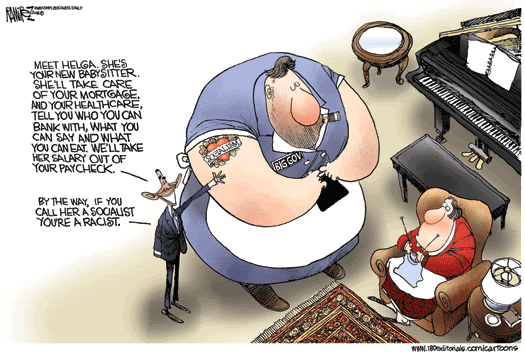
My Giant Mastiff Eats Socialists

“The trouble with Socialism is that you eventually run out of someone else’s money.”

The Human Species is unique in many aspects, but outstandingly so in the art of irony. Take Socialists, for example.

Now these are extremely caring people; they love their fellows so much that they want to do everything possible to make them comfortable and happy. It’s so wonderful; one is so admiring, inspired even at this outpouring of fellow-feeling.

In pursuit of their noble aim, socialists therefore spend vast amounts of money on all kinds of services to make people’s lives happy.

It’s true that they don’t always ASK people what they WANT in order to be happy, but that’s because they are very clever people who know what is best for other people.

And so mushrooms a whole myriad of agencies and quangoes for this or that disability; this or that special needs group.

There is free this, free that, handouts, subsidies, initiatives, pledges (Gordon Brown’s speciality). It is all so uplifting, and of course FREE!! What could be more wonderful?

Of course, it all has to be paid for. Now this phrase “of course” is very interesting. It means that being paid for is bleedin’ obvious to the writer and to anyone else with the slightest understanding of economics, including my old Gran.

Funnily enough, however, it is not quite so obvious to socialists, who – rather sadly – seem to believe that money grows on trees. This phrase is a bit hackneyed, but I can’t think of a more fitting one.

So where DOES the money come from, since it does not actually – to the surprise of many socialists – grow on trees? Well, it comes from those who MAKE money! What a surprise. And of course, that is an inexhaustible fount which can be milked till the cows come home (or perhaps after they come home!) Hence the expression “milch cow”. Yes, those nasty capitalists can be milked for all they are worth.

Read the rest of this brilliant Post

Laughing as you sink!

John Clarke and Bryan Dawe on the million dollar questions – courtesy of the Australian Broadcasting Corporation

This sketch is doing the rounds and deservedly so – it’s a very funny skit on Europe’s troubling financial situation.

As ex-Prime Minister, Margaret Thatcher, is reputed to have quoted, “The problem with socialism is eventually you run out of other peoples money.

By Paul Handover

BP and the mirror on the wall.

This is very, very uncomfortable.

Reflecting the truth?

Trying to say anything new about the implications of the terrible disaster in the Gulf of Mexico would be impossible.

All I can do is to admit my very great discomfort at knowing that later today, I shall be returning to Phoenix by flying across the Atlantic in a Boeing 747.

A small amount of web research suggests that there are about 600 transatlantic flights a day and that my B747 will use roughly 10 tons of fuel an hour, i.e. conservatively 100 tons for the flight LHR-PHX.

So 600 x 100 = 60,000 tons of fuel every day just in flights across the Atlantic!

So pointing the finger at BP is, in a very real sense, misdirected.  BP are only responding to our need for oil, in all its forms.

Do watch the videos from Prof Al Bartlett being shown on this Blog from tomorrow to understand the mathematics behind our unsustainable way of life.

By Paul Handover

The Foreign Policy Handbook

An outsider’s view of the European Union

Recently Young Americans for Liberty, a libertarian organization that I write for, published the second issue of the Foreign Policy Handbook, a magazine on foreign policy written by and for students.

However, the fact that it’s “for students” does not mean that others aren’t encouraged to check it out!  (Who says you need to be in school to be a student, anyways?)

The European Union

My article in this issue, “The European Union: Eurocrats and the Eurosphere,” discusses a few problems that I see with the European Union.  The article begins:

During the 19th and early 20th centuries, European governments came under attack for their colonial policies in the African continent.  One of the primary claims made by pan-Africanists and other anti-European individuals was that such European policies denied the peoples of Africa the right of self-determination.  For example, the Declaration of Rights of the Negro Peoples of the World, drafted at a 1920 convention of the Universal Negro Improvement Association led by Marcus Garby, stated, “We believe in the self-determination of all peoples.”  Through policies ranging from direct rule via military force to indirect rule via forced economic dependency, European governments were holding African countries back from determining their own course.

While the modern “third world” certainly is not free from the tethers of traditional western powers, the situation has greatly improved from what it was a hundred years ago.  However, the modern European governments now are directly denying the right of self-determination not to the peoples of other continents, but to the peoples of Europe itself.  Considering the rhetoric surrounding the European Union, such as a commitment to “sustainable development” and the goals of “peace, prosperity and freedom” for the people of Europe, this is a sad irony indeed.

Other articles in this issue of the FPH include:

  • “The War on Terror and Sun Tzu: Is American Strategy Sound?”,
  • “Why Conservatives Should Hate Our Foreign Policy,” and
  • “Law or Hoax? Disproving Democratic Peace Theory.”

Check out an entire digital copy for free here.

By Elliot Engstrom