Category: Economics

Looking into self.

Rounding off the week.

Starting with Monday’s video of Carl Sagan reminding us all that Planet Earth is just a grain of sand in the vast cosmos right through to yesterday’s Dealing with madness post, much of the week has been reminding us all of one very fundamental truth.  No better expressed than in a comment from Patrice Ayme [my emphasis]:

… there is no healthy man without a healthy world.

Regulars will have noted the high levels of debate this week.  Thank you all for those comments.

I have also received a couple of emails with feedback and comments, sent to me on a personal basis.  One of those emails had such a powerful message that I begged for permission to publish it on Learning from Dogs.  I was asked to keep the author’s identity private but, trust me, it is from someone I know well who subscribes to ideas of integrity and honesty in spades.

The author also strongly recommended publishing in association with his personal essay an extract from Chris Hedges’ book “Death of the Liberal Class”.  That extract follows straight on from the essay.

oooOOOooo

Reflections from a Vietnam Combat Veteran

War is an unnatural dichotomy.  Both sides are morally and materially diminished.  A future World War would most probably finish us as the self-appointed predominant intelligent species on planet earth.  It seems worth noting that German industrialists coordinated fundamentalist propaganda to foster the bigotry, hatred and fear which fueled their profitable war engines prior to World War II.

United States commercial media today reflects a financially dominated military-industrial culture with liberty and justice for sale.  The results are divisive and lead to both a declared international war against nebulous assailants we have been taught to dislike and an internal political war that has polarized our once fair nation.

We’ve stopped investing in the future in response to radicals who want to destroy government, human rights and what remains of the earth’s surface resources.  There is an emerging police state mentality on display with a variety of candidates for local dictator.

It’s well past time for moderate republicans to ignore their uber-conservative brethren.  It’s well past time for moderate democrats to renounce their corporate ties.  This will only happen when our financial and political leaders awaken to the reality of what is in the best long-term interests for all life on this planet rather than our present unsustainable global economy.

To complicate the problem, our planet is under attack by a swarm of vociferous human locusts seeking profit without regard to the consequences.  Meanwhile, despite human denial, the universe continues to emerge.  Species which do not adapt to change do not survive.

It’s important to remember that we’re in the midst of a battle that’s as old as the conscious awareness of the human species.  We generally have very little idea of the inclusive nature of our being; let alone the nature of our collective being as a species. We have as yet to learn how to surrender to reality.  The battle is with our own species.

Committing collective suicide for quarterly profit is not a sane way of life.  What we’ve created is a neo-feudal global economy without any foundation that feeds on an empire of consumption.  When we combine a neo-feudal economy with neo-fascist politics we arrive at a moral and biological dead end.

The coup d’état of the current Corporate State is the Citizen’s United ruling that makes money a form of free speech.  Money has no DNA.  In case anyone missed how the “occupy” movement was crushed, there’s no question that we’re rapidly criminalizing all forms of dissent.  These actions are being taking under the 1917 Espionage Act and related state secrets acts.  No discernment of moral value is considered and no public hearings are conducted.  People who speak up are locked up.  We’ve become a fearful and secretive population.

Our self-appointed elite power structure is completely irrational in its belief that human reason is our ultimate power and money is its servant.  We are made of the stuff of the stars.  At best, we’re in our adolescence as a species.  We think we know the answers rather than admitting our ignorance.  What little we know is vastly less than what we have as yet to learn.  We are often unaware of being unaware.

The lives we presently lead can not be sustained in ways that we have become accustomed to; ways we take for granted.  What’s going to need to change?  The simple answer is everything.  Our species has systemically corrupted the small part of the cosmos which sustains our being.  Nature has no sense of humor, no patience for human squabbles and no financial interest.

Fortunately, we already know what we need to do to adapt.  We know how nature works through the wisdom of our earth sciences.  The answer is simple.  Love the earth.  Love life.  Share compassion.  Educate, naturally energize, and transform.  The resulting process of change will help re-establish a realistic world economic foundation.

oooOOOooo

‘Death of the Liberal Class’

By Chris Hedges

From the book “Death of the Liberal Class,” by Chris Hedges.  Excerpted by arrangement with Nation Books, a member of the Perseus Books Group.  Copyright © 2010.

The following selection is taken from the first chapter of the book, published in October 201 by Nation Books.

In a traditional democracy, the liberal class functions as a safety valve. It makes piecemeal and incremental reform possible. It offers hope for change and proposes gradual steps toward greater equality. It endows the state and the mechanisms of power with virtue. It also serves as an attack dog that discredits radical social movements, making the liberal class a useful component within the power elite.

But the assault by the corporate state on the democratic state has claimed the liberal class as one of its victims. Corporate power forgot that the liberal class, when it functions, gives legitimacy to the power elite. And reducing the liberal class to courtiers or mandarins, who have nothing to offer but empty rhetoric, shuts off this safety valve and forces discontent to find other outlets that often end in violence. The inability of the liberal class to acknowledge that corporations have wrested power from the hands of citizens, that the Constitution and its guarantees of personal liberty have become irrelevant, and that the phrase consent of the governed is meaningless, has left it speaking and acting in ways that no longer correspond to reality. It has lent its voice to hollow acts of political theater, and the pretense that democratic debate and choice continue to exist.

The liberal class refuses to recognize the obvious because it does not want to lose its comfortable and often well-paid perch. Churches and universities—in elite schools such as Princeton, professors can earn $180,000 a year—enjoy tax-exempt status as long as they refrain from overt political critiques. Labor leaders make lavish salaries and are considered junior partners within corporate capitalism as long as they do not speak in the language of class struggle. Politicians, like generals, are loyal to the demands of the corporate state in power and retire to become millionaires as lobbyists or corporate managers. Artists who use their talents to foster the myths and illusions that bombard our society live comfortably in the Hollywood Hills.

The media, the church, the university, the Democratic Party, the arts, and labor unions—the pillars of the liberal class—have been bought off with corporate money and promises of scraps tossed to them by the narrow circles of power. Journalists, who prize access to the powerful more than they prize truth, report lies and propaganda to propel us into a war in Iraq. Many of these same journalists assured us it was prudent to entrust our life savings to a financial system run by speculators and thieves. Those life savings were gutted. The media, catering to corporate advertisers and sponsors, at the same time renders invisible whole sections of the population whose misery, poverty, and grievances should be the principal focus of journalism.

In the name of tolerance—a word the Rev. Dr. Martin Luther King Jr., never used—the liberal church and the synagogue refuse to denounce Christian heretics who acculturate the Christian religion with the worst aspects of consumerism, nationalism, greed, imperial hubris, violence, and bigotry. These institutions accept globalization and unfettered capitalism as natural law. Liberal religious institutions, which should concern themselves with justice, embrace a cloying personal piety expressed in a how-is-it-with-me kind of spirituality and small, self-righteous acts of publicly conspicuous charity. Years spent in seminary or rabbinical schools, years devoted to the study of ethics, justice, and morality, prove useless when it comes time to stand up to corporate forces that usurp religious and moral language for financial and political gain.

Universities no longer train students to think critically, to examine and critique systems of power and cultural and political assumptions, to ask the broad questions of meaning and morality once sustained by the humanities. These institutions have transformed themselves into vocational schools. They have become breeding grounds for systems managers trained to serve the corporate state. In a Faustian bargain with corporate power, many of these universities have swelled their endowments and the budgets of many of their departments with billions in corporate and government dollars. College presidents, paid enormous salaries as if they were the heads of corporations, are judged almost solely on their ability to raise money. In return, these universities, like the media and religious institutions, not only remain silent about corporate power but also condemn as “political” all within their walls who question corporate malfeasance and the excesses of unfettered capitalism.

Unions, organizations formerly steeped in the doctrine of class struggle and filled with members who sought broad social and political rights for the working class, have been transformed into domesticated negotiators with the capitalist class. Cars rolling off the Ford plants in Michigan were said to be made by UAW Ford. But where unions still exist, they have been reduced to simple bartering tools, if that. The social demands of unions in the early twentieth century that gave the working class weekends off, the right to strike, the eight-hour workday, and Social Security, have been abandoned. Universities, especially in political science and economics departments, parrot the discredited ideology of unregulated capitalism and have no new ideas. The arts, just as hungry as the media or the academy for corporate money and sponsorship, refuse to address the social and economic disparities that create suffering for tens of millions of citizens. Commercial artists peddle the mythical narrative, one propagated by corporations, self-help gurus, Oprah and the Christian Right, that if we dig deep enough within ourselves, focus on happiness, find our inner strength, or believe in miracles, we can have everything we desire.

Such magical thinking, a staple of the entertainment industry, blinds citizens to corporate structures that have made it impossible for families to lift themselves out of poverty or live with dignity. But perhaps the worst offender within the liberal class is the Democratic Party.

The party consciously sold out the working class for corporate money. Bill Clinton, who argued that labor had nowhere else to go, in 1994 passed the North American Free Trade Agreement (NAFTA), which betrayed the working class. He went on to destroy welfare and in 1999 ripped down the firewalls between commercial and investment banks to turn the banking system over to speculators. Barack Obama, who raised more than $600 million to run for president, most of it from corporations, has served corporate interests as assiduously as his party. He has continued the looting of the U.S. Treasury by corporations, refused to help the millions of Americans who have lost their homes because of bank repossessions or foreclosures, and has failed to address the misery of our permanent class of unemployed.

Populations will endure the repression of tyrants, as long as these rulers continue to manage and wield power effectively. But human history has demonstrated that once those in positions of power become redundant and impotent, yet insist on retaining the trappings and privileges of power, their subject populations will brutally discard them. Such a fate awaits the liberal class, which insists on clinging to its positions of privilege while at the same time refusing to play its traditional role within the democratic state. The liberal class has become a useless and despised appendage of corporate power. And as corporate power pollutes and poisons the ecosystem and propels us into a world where there will be only masters and serfs, the liberal class, which serves no purpose in the new configuration, is being abandoned and discarded. The death of the liberal class means there is no check to a corporate apparatus designed to enrich a tiny elite and plunder the nation. An ineffectual liberal class means there is no hope, however remote, of a correction or a reversal. It ensures that the frustration and anger among the working and middle classes will find expression outside the confines of democratic institutions and the civilities of a liberal democracy.

Our unsustainable way of life

The second of two essays reflecting the ‘New World Order’.

Yesterday, I introduced the first essay from Patrice Ayme.  Today, the second essay is a complete ‘copy and paste‘ as it appeared on TomDispatch.  The importance of such writers as Patrice Ayme, the authors that are published on TomDispatch, and many more besides, is beyond measure.  As the old saying goes, “The only thing required for evil to triumph is for good men to do nothing“.

So without further ado, here is that TomDispatch essay.

oooOOOooo

Tomgram: Mattea Kramer and Jo Comerford, Congress Tweeted While America Burned

Posted by Mattea Kramer and Jo Comerford at 10:11am, May 21, 2013.
Follow TomDispatch on Twitter @TomDispatch.

[Note for TomDispatch Readers: Those of you who were struck by the recent TD piece “You Are a Guinea Pig: How Americans Became Exposed to Biohazards in the Greatest Uncontrolled Experiment Ever Launched” shouldn’t miss last Sunday’s fascinating Bill Moyers interview with its authors, David Rosner and Gerald Markowitz, who have written the new book Lead Wars: The Politics of Science and the Fate of America’s Children. Tom]

Three days after the terrorist attacks of September 11, 2001, Congress passed a joint resolution called an Authorization for Use of Military Force (AUMF). You might remember it. In layman’s terms, it was a carte blanche for the Bush administration to go to war wherever it wanted, whenever it wanted, however it wanted, under the guise of fighting anyone who “planned, authorized, committed, or aided” the September 11th attackers, or “harbored” any terrorists or terror organizations connected to the attacks. That document, more than any other, launched the Global War on Terror or GWOT. President Obama long ago ditched the name and acronym, but he kept the global war.

And don’t expect that to change. On Thursday, Assistant Secretary of Defense Michael Sheehan went before Congress and insisted that the Defense Department couldn’t be more “comfortable” with AUMF, as it was written, and that not a word should be altered or amended for changed circumstances. The Pentagon was so comfortable, in fact, that its officials foresee using that resolution to continue its drone-powered “dirty wars” in the Greater Middle East and Africa for years to come. “In my judgment,” Sheehan said, “this is going to go on for quite a while, yes, beyond the second term of the president… I think it’s at least 10 to 20 years.”

So there you have it. The military got its blank check for overseas wars, for sending out the drones and the special operations forces, and has no plans to change that before 2023, if not 2033. In other words, for at least the next decade, the GWOT, whatever label it’s given, will continue to be the central fixture of American foreign policy.  It’s not going anywhere. Today, TomDispatch regulars Mattea Kramer and Jo Comerford of the invaluable National Priorities Project look at the “homeland” a decade into the future, as the effects of Congress’s austerity policies sink in. Put the two together and what a grim scene you have: a country investing in war in distant lands as it crumbles here at home. Andy Kroll

How America Became a Third World Country 
2013-2023 
By Mattea Kramer and Jo Comerford

The streets are so much darker now, since money for streetlights is rarely available to municipal governments. The national parks began closing down years ago. Some are already being subdivided and sold to the highest bidder. Reports on bridges crumbling or even collapsing are commonplace. The air in city after city hangs brown and heavy (and rates of childhood asthma and other lung diseases have shot up), because funding that would allow the enforcement of clean air standards by the Environmental Protection Agency is a distant memory. Public education has been cut to the bone, making good schools a luxury and, according to the Department of Education, two of every five students won’t graduate from high school.

It’s 2023 — and this is America 10 years after the first across-the-board federal budget cuts known as sequestration went into effect.  They went on for a decade, making no exception for effective programs vital to America’s economic health that were already underfunded, like job training and infrastructure repairs. It wasn’t supposed to be this way.

Traveling back in time to 2013 — at the moment the sequester cuts began — no one knew what their impact would be, although nearly everyone across the political spectrum agreed that it would be bad. As it happened, the first signs of the unraveling which would, a decade later, leave the United States a third-world country, could be detected surprisingly quickly, only three months after the cuts began. In that brief time, a few government agencies, like the Federal Aviation Administration (FAA), after an uproar over flight delays, requested — and won — special relief.  Naturally, the Department of Defense, with a mere $568 billion to burn in its 2013 budget, also joined this elite list. On the other hand, critical spending for education, environmental protection, and scientific research was not spared, and in many communities the effect was felt remarkably soon.

Robust public investment had been a key to U.S. prosperity in the previous century. It was then considered a basic part of the social contract as well as of Economics 101. As just about everyone knew in those days, citizens paid taxes to fund worthy initiatives that the private sector wouldn’t adequately or efficiently supply. Roadways and scientific research were examples. In the post-World War II years, the country invested great sums of money in its interstate highways and what were widely considered the best education systems in the world, while research in well-funded government labs led to inventions like the Internet. The resulting world-class infrastructure, educated workforce, and technological revolution fed a robust private sector.

Austerity Fever

In the early years of the twenty-first century, however, a set of manufactured arguments for “austerity,” which had been gaining traction for decades, captured the national imagination. In 2011-2012, a Congress that seemed capable of doing little else passed trillions of dollars of what was then called “deficit reduction.” Sequestration was a strange and special case of this particular disease.  These across-the-board cuts, instituted in August 2011 and set to kick in on January 2, 2013, were meant to be a storm cloud hanging over Congress. Sequestration was never intended to take effect, but only to force lawmakers to listen to reason — to craft a less terrible plan to reduce deficits by a wholly arbitrary $1.2 trillion over 10 years. As is now common knowledge, they didn’t come to their senses and sequestration did go into effect. Then, although Congress could have cancelled the cuts at any moment, the country never turned back.

It wasn’t that cutting federal spending at those levels would necessarily have been devastating in 2013, though in an already weakened economy any cutbacks would have hurt. Rather, sequestration proved particularly corrosive from the start because all types of public spending — from grants for renewable energy research and disadvantaged public schools to HIV testing — were to be gutted equally, as if all of it were just fat to be trimmed. Even monitoring systems for possible natural disasters like river flooding or an imminent volcanic eruption began to be shut down.  Over time the cuts would be vast: $85 billion in the first year and $110 billion in each year after that, for more than $1 trillion in cuts over a decade on top of other reductions already in place.

Once lawmakers wrote sequestration into law they had more than a year to wise up. Yet they did nothing to draft an alternate plan and didn’t even start pointing out the havoc-to-come until just weeks before the deadline. Then they gave themselves a couple more months — until March 1, 2013 — to work out a deal, which they didn’t.  All this is, of course, ancient history, but even a decade later, the record of folly is worth reviewing.

If you remember, they tweeted while Rome burned. Speaker of the House John Boehner, for instance, sent out dozens of tweets to say Democrats were responsible: “The president proposed sequester, had 18 mo. to prioritize cuts, and did nothing,” he typically wrote, while he no less typically did nothing. For his part, Senate Majority Leader Harry Reid tweeted back: “It’s not too late to avert the damaging #sequester cuts, for which an overwhelming majority of Republicans voted.” And that became the pattern for a decade of American political gridlock, still not broken today.

Destruction Begins

March 1st came and went, so the budgetary axe began to fall.

At first, it didn’t seem so bad. Yes, the cuts weren’t quite as across the board as expected. The meat industry, for example, protested because health inspector furloughs would slow its production lines, so Congress patched the problem and spared those inspectors. But meat production aside, there was a sense that the cuts might not be so bad after all.

They were to be doled out based on a formula for meeting the arbitrary target of $85 billion in reductions in 2013, and no one knew precisely what would happen to any given program. In April, more than a month after the cuts had begun, the White House issued the president’s budget proposal for the following year, an annual milestone that typically included detailed information about federal spending in the current year. But across thousands of pages of documents and tables, the new budget ignored sequestration, and so reported meaningless 2013 numbers, because even the White House couldn’t say exactly what impact these cuts would have on programs and public investment across the country.

As it happened, they didn’t have to wait long to find out. The first ripples of impact began to spread quickly indeed. Losing some government funding, cancer clinics in New Mexico and Connecticut turned away patients. In Kentucky, Oregon, and Montana, shelters for victims of domestic violence cut services. In New York, Maryland, and Alabama, public defenders were furloughed, limiting access to justice for low-income people. In Illinois and Minnesota, public school teachers were laid off. In Florida, Michigan, and Mississippi, Head Start shortened the school year, while in Kansas and Indiana, some low-income children simply lost access to the program entirely. In Alaska, a substance abuse clinic shut down. Across the country, Meals on Wheels cut four million meals for seniors in need.

Only when the FAA imposed furloughs on its air traffic controllers did public irritation threaten to boil over. Long lines and airport delays ensued, and people were angry. And not just any people — people who had access to members of Congress.  In a Washington that has gridlocked the most routine business, lawmakers moved at a breakneck pace, taking just five days to pass special legislation to solve the problem. To avoid furloughs and shorten waits for airline passengers, they allowed the FAA to spend funds that had been intended for long-term airport repairs and improvements.

Flights would leave on time — at least until runways cracked and crumbled.  (You undoubtedly remember the scandal of 2019 at Cincinnati International Airport, when a bright young candidate for Senate met her demise in a tragic landing mishap.)

And then, of course, the Pentagon asked for an exemption, too. We’re talking about the military behemoth of planet Earth, which in 2013 accounted for 40% of military spending globally, its outlays exceeding the next 10 largest militaries combined.  It, too wanted a special exemption for some of its share of the cutbacks.

Meat inspectors, the FAA, and the Department of Defense enjoyed special treatment, but the rest of the nation was, as the history books recount, not so lucky. Children from middle-class and low-income families saw ever fewer resources at school, closing doors of opportunity. The young, old, and infirm found themselves with dwindling access to basic resources such as health care or even a hot dinner. Federal grants to the states dried up, and there was less money in state budgets for local priorities, from police officers to lowly streetlights.

And remember that, just as the sequestration cuts began, carbon concentration in the atmosphere breached 400 parts per million.  (Climate scientists had long been warning that the level should be kept below 350 for human security.) Unfortunately, as with the groundbreaking research that led to the Internet, it takes money to do big things, and the long-term effects of cutting environmental protection, general research, and basic infrastructure meant that the U.S. government would do little to stem the extreme weather that has, in 2023, become such a part of our world and our lives.

Looking back from a country now eternally in crisis, it’s clear that a Rubicon was crossed back in 2013. There was then still a chance to reject across-the-board budget cuts that would undermine a nation built on sound public investment and shared prosperity. At that crossroads, some fought against austerity. Losing that battle, others argued for a smarter approach: close tax loopholes to raise new revenue, or reduce waste in health care, or place a tax on carbon, or cut excessive spending at the Pentagon. But too few Americans — with too little influence — spoke up, and Washington didn’t listen.  The rest of the story, as you well know, is history.

Mattea Kramer is Research Director at National Priorities Project, where Jo Comerford is Executive Director. Both are TomDispatch regulars.  They wrote A People’s Guide to the Federal Budget.

Follow TomDispatch on Twitter and join us on Facebook or Tumblr. Check out the newest Dispatch book, Nick Turse’s The Changing Face of Empire: Special Ops, Drones, Proxy Fighters, Secret Bases, and Cyberwarfare.

Copyright 2013 Mattea Kramer and Jo Comerford

oooOOOooo

If it strikes you as utter, complete madness trust me, you are not alone.

A new world order.

Two very different essays that, nonetheless, do sing to a common tune.

I sit here with a heavy heart. Why, you may ask?

Because I really wish I wasn’t setting the scene to a couple of disturbing essays.  The first from Patrice Ayme.  His essay is called Plutocracy: New World Order with the subtitle of The New World Thinking. The New World Emoting. The second essay is from Mattea Kramer and Jo Comerford under the TomDispatch umbrella.  Their title is How America Became a Third World Country.

That heaviness comes from an emotional conflict.  The conflict between never having been more contented in our beautiful Oregonian home and the tiny voice in my head that says that I shouldn’t throwing darts at the country that has been generous in welcoming me as a resident.

But I justify publishing these two essays in this manner.  Just as Pharaoh leads the barking whenever the dogs sense something threatening their ‘territory’, then too should citizens (I use the term in the broadest sense) start barking when they sense something threatening the integrity of their country.

So today the Patrice Ayme essay and tomorrow the TomDispatch essay.  I’m very grateful to both Patrice and Tom for their permission to republish their essays.

oooOOOooo

PLUTOCRACY: NEW WORLD ORDER

Obama just  nominated Commerce Secretary the billionaire heiress who discovered him, and introduced him to the Rubin-Summers-Goldman-Sachs-Citigroup conspiracy. Penny Priztker was condemned to pay a 460 million dollar fine by the Federal government in 2001, for financial malfeasance. 460 million, that’s more than Mitt Romney’s fortune, that made small rank and file democrats huff and puff, in indignation, a few months ago, just like their mighty masters told them to do.

Now, if the 460 million dollars fine felon becomes chief, that’s fine, as long as the masters of the people don’t ask the People to huff and puff about the fine. The finer the fine, the finer the master, say the little People, and they bleat, satisfied. As Obama put it:”Priztker is one of the most eminent personalities of our country“. When Pluto reigns, down is up.

When Common Decency Is A Hindrance

Plutocracy is the New World Order. The New World Thinking. The New World Emoting.

To get some perspective on this, it’s good to have a retrospective look at the greatest plutocratic realms of the past, and ponder why extremely wealthy fascism rose, increasingly, in the Orient, while clever democracy rose, occasionally, in the West. And sometimes fell, disastrously, for reasons related.

It turns out that, when Rome became fascist and plutocratic, it turned to Oriental despotism, and criminals, indeed, came to command and control.

***

PERSIA REIGNED WITH ALL CRAFTS; YET NOT SMART ENOUGH:

Establishing  giant, metastatic empires in the Orient is nothing new: the Hittites tried it, they proceeded to invade Lebanon and the rich valleys behind, Egyptian territory. However young Pharaoh Ramses II, defeated them at Qadesh, next to present day Damascus. Through courageous combat in that battle which defined his long rule, Ramses rescued victory from the jaws of defeat, somewhat miraculously.

Ramses lost ground, though, and later made a loving peace with his enemies. Then, the Hittites having been destroyed by the mysterious coalition of the Peoples of the Sea, the Assyrians tried to impose their own giant metastatic empire, using the harshest methods. That brought them so many enemies that they got invaded from all quarters, annihilated as a nation first, and an army, later.

Then the union of Medes and Persians, thanks to three remarkable leaders, established a giant fascist empire, from Ethiopia to Central Asia, Libya to India. The third emperor, Darius, besides being excellent at sword-play in the dark, and a great general, proved capable of using a free market economy, switching to so called Keynesianism, and then a command and control economy, as needed. Darius established a giant “Royal” road network (ancestral to the one the Romans would build, four centuries later).

A Persian Pony Express, with posts every five miles, would bring news from distant corners of the empire in a week. Darius went on to invade the Scythians, land of the Amazons, present day Ukraine.

Darius’ Persia was the greatest empire, so far, larger than the present day continental USA. It became so, thanks to a great variety of methods of socio-economic governance. Some of these methods would later be used by the West, massively. Not just the communication network, the free market, the command and control, but also a crafty diplomacy of seduction, cooptation and local autonomy (that’s how the Ionian Greeks and Phoenicians became collaborators of Persia; whereas Alexander would annihilate Tyr).

However, unbelievably, tiny Athens broke the Persian empire, inaugurating the next great event, still on-going, the rise of the West. Again and again, minuscule Greek armies routed the juggernauts of professional giant armies. Again and again, small democracies proved superior to large fascist foes. I claimed that mental superiority entailed military superiority.

***

FREE IN THE WEST, SLAVES IN THE EAST

Herodotus explained the Greeks’ military superiority: free men are more motivated in battle, as they fight for themselves, he said. But it’s not clear that elite Persian soldiers did not feel free.

So I hold something slightly different: free men are, living in an “open society” are not just more motivated, but, simply, more intelligent. Yes, intelligent.

Yet how come that the free men tended to be in the West, and the subjugated ones, in the East? And this for 4,000 years, defining the “West” as anything west of Mount Lebanon. Why did so much of the Mediterranean turn out propitious to freedom and individual initiative? What of the enormous Celto-German forests, from Spain to the Baltics?

Two factors played a role:

1) Trade, with the big man, the leader being the ship owner-captain (Tyr, Phoenicia, Crete, Athens, Carthage, etc.). This required to excel at technology and adaptative intelligence, confronting nature.

2) Small owner-peasants. The West’s agricultural system did better thanks to small, free owner-peasants.  The owner peasant was captain of his own plot of land, and found himself in a situation roughly similar to the ship captain. Such people worked hard, and thought hard about outwitting nature. All of Germany was this way, until the military encroachment of Rome in the beginning of its plutocratic phase, brought, by reaction, a militarization of German society (this is what archeology shows).

A demographic core of owner-peasants was the core of the success of the Roman republic, and its successors, the Imperium Francorum, and France, or anything working along French lines (most of Europe). When enjoying this basic culture, of free, independent peasants, the West did very well. Why so? Because thinking by oneself, for oneself, makes one more intelligent.

***

WHY THE ORIENT IS DUMBER:

The Orient did better when the peasants could cultivate. That meant, when they had water. That was not obvious in the increasingly parched lands, from the Maghreb to India. First, there, one needed to bring water to agricultural lands. Whereas in the West, both water and arable land were in the same place, not so in the East. In the East water was on rocky mountains, arable lands in parts of plains at the bottom of said mountains. To bring the former to the latter, one needed great hydraulic works. Underground canalizations, sometimes fifty feet deep, could extend dozens of miles.

Such extensive works meant armies of workers and maintenance people. And also standing armies to establish and protect the necessary order. Plus a field army to roam around the empire, and keep the static defenses obedient.

In other words, food on the carpet in the parched, basin and range Orient meant a large fascist system to make it possible, and everybody enslaved to it, in a military organization (Christianity and Islam, both oriental religions, kept much of this essential psychological character: fascist god on top, giving absolute, even capricious  orders to its slaves below).

***

ALL TOGETHER NOW, DOWN THE ROMAN ROAD TO HELL?

What consequences today? Western countries do not depend upon small owner-peasants anymore, but upon giant farms, or agribusinesses, for food procurement. Even trade has become unbalanced: production on one end of the Earth, increasing unemployment, at the other end.

Giant agribusinesses, and unbalanced trade became facts of empire in Rome, and lasted centuries. It was a deliberate plot of Roman plutocracy. At some point, six senatorial families owned most of North Africa. Seneca, Nero’s tutor, the plutocratic philosopher of note, used to boast that he had no idea how many giant properties he owned on the various continents.

That delocalization and globalization made Rome, and Italy into an empty shell of its former self. As those who had the power, the senatorial families, wished. What they feared first, was a proud, potent, empowered People.

(Part of) Italy would resurrect as independent republics, more than a millennium later.

What’s the morality of the story? Men have a strong instinct for doing things right. In a plutocratic system, though, men who do things wrong get rewarded, and this goes on, until the situation exponentiates and breaks down. Thus plutocratic systems are intrinsically pathological: they reward criminals. Not just criminal according to the laws of men, but criminals according to the laws of nature.

In the Orient, life is harder, less natural, militarization exploits part of the Dark Side, because human beings, by living there, live in a less optimal situation. In the West, the rise of plutocracy did not have these excuses.

The Romans knew this well. The Roman republic was the product of a revolution against Tarquinus Superbus, the king of Rome, of Etruscan origin. So the founding act of five centuries of Roman republic was an anti-plutocratic revolt. Same for Athens (several times, during the same centuries).

The Romans passed a strong anti-plutocratic law. That law limited, by force the size of a family’s fortune; it fixed an upper bound on how much one could own. The Second Punic war saw the death, on the battlefield, of too many of the best leading Romans. Meanwhile the conspirators of wealth, back behind the walls of the fortified cities, as Hannibal was roaming the countryside, established a New World order of rents.

When Carthage got defeated, those men of greed kept on pushing, and tried to grab control of the state. After several wars of distraction against Macedonia, Carthage, Numantia, Corinth, etc. it became clear that was what was going on to thousands of the best Romans, led by top nobles (in mind and ancestry), the Gracchi.

The Gracchis mostly tried to impose the wealth limitation law. They also succeeded to impose a land redistribution (an unthinkable socialist measure in the post Thatcher-Reagan world!). Yet, the Gracchi and their supporters lost a civil war. All got killed, by the private armies of the plutocrats. By 100 BCE, when Caesar was born, the dice had long been thrown. Only extreme measures could address the situation (extreme measures that Caesar and Cicero, on the good side, would try).

Now what? Losing democracy, means, ultimately, that we will lose not just freedom, but intelligence itself. It is difficult to imagine how the Americans will pull out of their present death spiral into furthering the wealth of the .1%. When bandits are called “philanthropists”, all values have been inverted in a country: gangsters are in control, the mafia has got metastatic. It will go on, all inverted, until it explodes, or get trampled over. The commerce chief will be a certified felon.

The situation in Europe is not as desperate: conditions for a revolt exist. Although Goldman Sachs has its servants in place all over, the Italians threw out one of them, a Goldman Sachs partner, Mario Monti, at the first chance they got.

Some may sneer, as they notice that, once again I used “Orient” and “Occident” according to old Greco-Roman semantics. What of the true Orient, the far-out East, China and company? Well, I will hide behind my usual observation: it’s Western culture that conquered the world. Present day China’s ideology has very little that is specifically Chinese, besides what the West and China had in common, such as the more or less free market. The idea of “People” (Populus) and “Republic” (Respublica) are Roman. So the very title of China, the “People Republic of China” is, well, (Greco-)Roman.

The dangers threatening China, accordingly, like those threatening us, are those that devastated the Roman republic. For the reasons exposed above, the development in the West, of a more advanced civilization was first, thus why everybody adopted it later.  Rome was first to rise as high as it did. But, the greater the rise, the greater the fall. By 700 CE, the fall of Rome had been so great, that China had risen higher, on many indicators. The West, invaded by hordes of savages for more than six hundred years (beyond even 400 CE to 1000 CE) was fighting for survival.

Plutocracy as a New World Order is not just the end of many things. In the fullness of time, plutocracy is the end of everything.

Even the Will to Power. Slave masters are not so masterful. After all, they are enslaved to their slaves.

When Rome went down, Roman plutocrats whined that the “world was getting old“. By this they meant that resources were being exhausted, and that, in its stupidity plutocratic civilization could not find a technology out.

Right now, the world is not getting old, it’s getting killed. And that’s worst.

***

Patrice Ayme

The fate of Europe!

A less than reverent view of the Euro.

This was sent to me by Richard Maugham from England.  Richard and I go back the thick end of 40 years or more.  He and I met when I was a salesman for IBM UK (Office Products Division) and Richard was a salesman for Olivetti UK.  Thus we were selling competitive products!

But that didn’t stop us from becoming great friends and remaining so ever since.  Indeed, Richard and Julie are out to see us in Oregon in just over 3 weeks time.

One of the bonds between Richard and me is a love for silliness and quirky humour.  Hence Richard sending me the following that, in turn, had been sent to him.

For those that are not familiar with the Blackadder comedy series on the BBC, more background provided later on.  Anyway, this is what I received from Richard.

oooOOOooo

The Euro according to Blackadder

blackadd

Baldrick: “What I want to know, Sir, is before there was a Euro there were lots of different types of money that different people used. And now there’s only one type of money that the foreign people use. And what I want to know is, how did we get from one state of affairs to the other state of affairs?”

Blackadder: “Baldrick. Do you mean, how did the Euro start?”

Baldrick: “Yes Sir”.

Blackadder: “Well, you see Baldrick, back in the 1980s there were many different countries all running their own finances and using different types of money. On one side you had the major economies of France, Belgium, Holland and Germany, and on the other, the weaker nations of Spain, Greece, Ireland, Italy and Portugal. They got together and decided that it would be much easier for everyone if they could all use the same money, have one Central Bank, and belong to one large club where everyone would be happy. This meant that there could never be a situation whereby financial meltdown would lead to social unrest, wars and crises”.

Baldrick: “But, Sir, isn’t this a sort of a crisis?”

Blackadder: “That’s right Baldrick. You see, there was only one slight flaw with the plan”.

Baldrick: “What was that then, Sir?”

Blackadder: “It was bollocks”.

oooOOOooo

blackadder
More about the Blackadder series can be read here, from which I republish:

Blackadder is the name that encompassed four series of a BBC 1 period British sitcom, along with several one-off instalments. All television programme episodes starred Rowan Atkinson as anti-hero Edmund Blackadder and Tony Robinson as Blackadder’s dogsbody, Baldrick. Each series was set in a different historical period with the two protagonists accompanied by different characters, though several reappear in one series or another, for example Melchett and Lord Flashheart.

The first series titled The Black Adder was written by Richard Curtis and Rowan Atkinson, while subsequent episodes were written by Curtis and Ben Elton. The shows were produced by John Lloyd. In 2000 the fourth series, Blackadder Goes Forth, ranked at 16 in the “100 Greatest British Television Programmes”, a list created by the British Film Institute. Also in the 2004 TV poll to find “Britain’s Best Sitcom”, Blackadder was voted the second-best British sitcom of all time, topped by Only Fools and Horses. It was also ranked as the 20th-best TV show of all time by Empire magazine.

Although each series is set in a different era, all follow the “misfortunes” of Edmund Blackadder (played by Atkinson), who in each is a member of a British family dynasty present at many significant periods and places in British history. It is implied in each series that the Blackadder character is a descendant of the previous one, although it is never mentioned how any of the Blackadders manage to father children.

There are many videos on YouTube of Blackadder sketches and it was a hard choosing what to include in today’s post.

See what you make of this:

Captain Blackadder is court-martialled for killing a pigeon and George provides counsel for the defence.

More new tomorrows.

New world order goes to ramming speed!

We spent some enjoyable time with neighbours Dordie and Bill yesterday afternoon from where my sub-heading quote comes.  Perhaps, a tad tongue-in-cheek, but only a tad!

Yesterday, the bulk of my post The new tomorrows consisted of a powerful essay from William deBuys ‘Phoenix in the Climate Crosshairs‘, courtesy of TomDispatch.  It painted in very stark terms the impact of climate change on the metropolitan city of Phoenix in Arizona; a city of over 4 million people, indeed home to more than two-thirds of Arizona’s population.

So, today, I wanted to wander through some other aspects of this new world order.

Here’s a recent item on Climate Crocks examining the changes in March’s weather, 2013 vs 2012.  From which I quote:

Much Different March. Same Reason?

Dittohead reasoning: “So when it’s warm, you blame it on climate change. When its cold, you blame it on climate change. It can’t be both.”

Well, yeah, it can, kinda.

Meteo people weigh in.

7Weather Blog WHDH-TV:

I think we’ve passed the point of tolerance with these ceaseless storms. Gone are the days when viewers would flood our inboxes with pretty pictures of their pets and kids frolicing in the snow. Constant cleanup has made us snippy and short – even a few plow guys have hoisted the white flag. The holidays are long past, the winter is stale, and the people just want spring…

…and accountability.  Instead of pictures, I get questions in my inbox. “Why are we getting so much snow? Why did it turn on a dime? And when will it stop?”

Those are fair questions. But with the limits of the long range (10-14 day) forecasts, I’m not ready to answer the last question. We may sail out of this in April, but so far the first week of the month isn’t looking much different from the first week in March. The ultimate question is why.

The jetstream has taken on an odd path. [my emphasis]

Now just look at this:

Forecast sea level pressure departures from average from the GFS computer model. This shows the large area of unusually high atmospheric pressure over Greenland.Image from Weatherbell
Forecast sea level pressure departures from average from the GFS computer model. This shows the large area of unusually high atmospheric pressure over Greenland.
Image from Weatherbell

Later on that article says:

Recent research suggests that rapid Arctic climate change, namely the loss of sea ice cover, may be contributing to blocking patterns like we’re seeing right now. That rapid decline in Arctic sea ice since the beginning of the satellite record in 1979 may be altering weather patterns both in the Far North and across the U.S.. Some studies have shown that sea ice loss favors atmospheric blocking patterns such as the pattern currently in place, while others have not shown statistically significant changes in blocking patterns across the Northern Hemisphere, at least not yet. Arctic sea ice extent declined to a record low during the 2012 melt season.

The last Winter in North-West Europe has been ‘interesting’, to say the least!  A follow-up to that Climate Crock’s essay reports:

study published in 2012 showed that by changing the temperature balance between the Arctic and mid-latitudes, rapid Arctic warming is altering the course of the jet stream, which steers weather systems from west to east around the northern hemisphere. The Arctic has been warming about twice as fast as the rest of the Northern Hemisphere, due to a combination of human emissions of greenhouse gases and unique feedbacks built into the Arctic climate system. The jet stream, the study said, is becoming “wavier,” with steeper troughs and higher ridges.

A new study published in the journal Environmental Research Letters shows that reduced sea ice cover can favor colder and stormier winters in the northern midlatitudes

Did you fully take in that paragraph?  The one about “The Arctic has been warming about twice as fast as the rest of the Northern Hemisphere …“?

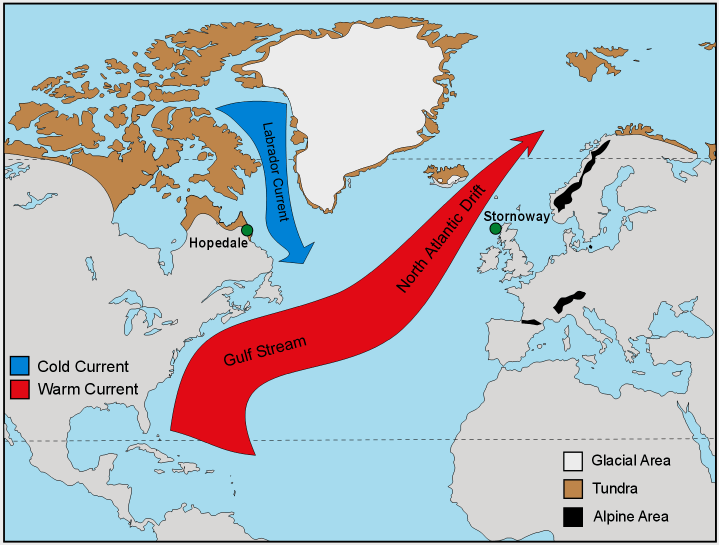
The other great ‘river’ in the North Atlantic is the thermohaline circulation or to put it in more familiar terms: The Gulf Stream.  Has that been changing?  You bet! In more ways than one might expect.

Here’s a snippet from an item from last October’s issue of Nature journal:

Recent changes to the Gulf Stream causing widespread gas hydrate destabilization

The Gulf Stream is an ocean current that modulates climate in the Northern Hemisphere by transporting warm waters from the Gulf of Mexico into the North Atlantic and Arctic oceans. A changing Gulf Stream has the potential to thaw and convert hundreds of gigatonnes of frozen methane hydrate trapped below the sea floor into methane gas, increasing the risk of slope failure and methane release.

How the Gulf Stream changes with time and what effect these changes have on methane hydrate stability is unclear. Here, using seismic data combined with thermal models, we show that recent changes in intermediate-depth ocean temperature associated with the Gulf Stream are rapidly destabilizing methane hydrate along a broad swathe of the North American margin.

As the diagram below shows all too clearly, the cold waters from above the Arctic circle directly affect the Gulf Stream.

gulfstream

From the website of the National Snow & Ice Data Center:

Average sea ice extent for February 2013 was 14.66 million square kilometers (5.66 million square miles). This is 980,000 square kilometers (378,000 square miles) below the 1979 to 2000 average for the month, and is the seventh-lowest February extent in the satellite record.

Less ice means more cold water. QED!

OK, moving on.

We met recently with Wayne over at Rogue Valley Firewood here in Merlin.  Not to buy more firewood but because Wayne has started into hugelkultur.  Jean and I hadn’t heard of the term before.  Come back to that in a moment.

In musing with Wayne about how rapidly life is changing for us all, he spoke of the consequence of rising fuel prices and the rising costs of putting petrol (OK, he used the word ‘gas’!) in one’s car.  Wayne pointed out the obvious.  That the inevitable effect of those rising costs would be to steadily reduce one’s range for ‘affordable’ car journeys.  Many people will no longer be able to afford to drive longer distances.

In other words, local will increasingly become more relevant to daily life.  Or to use a better word than local, community will return to the centre stage of our world.  And of all the things important to a community, none is more so than access to food.

Back to Hugelkultur. Watch this video:

Wayne is committed to seeing just what can be grown for the local community of Merlin using this form of raised garden bed.  You can read more here.

Is this just a piece of fun?  Most definitely not!

Here’s a recent item from Grist.

This sobering map shows you all of America’s food deserts

By Sarah Laskow

The USDA’s new Food Access Research Atlas is a map of all the places in the country where people live in food deserts — places where it’s difficult to access fresh food.

food-deserts1

More details here.

The message that hits me from that map is the consequence for millions of people, especially those in rural areas or unable to afford a car, when it comes to getting hold of fresh food.  Another reason why community food programs are going to be a feature of the new tomorrows.

Finally, take a look at a recent item on Paul Gilding’s blogsite.

paulgildingportrait
Paul Gilding

Paul is an independent writer, advisor and advocate for action on climate change and sustainability. He recently published Victory at Hand for the Climate Movement? From which I offer:

There are signs the climate movement could be on the verge of a remarkable and surprising victory. If we read the current context correctly, and if the movement can adjust its strategy to capture the opportunity presented, it could usher in the fastest and most dramatic economic transformation in history. This would include the removal of the oil, coal and gas industries from the economy in just a few decades and their replacement with new industries and, for the most part, entirely new companies. It would be the greatest transfer of wealth and power between industries and countries the world has ever seen.

To understand this incredible potential we first have to step back and understand the unique structure of this social change movement, which may rank among the most influential in history. It is simplistic to characterise it as an alliance of grass roots organisations and activists pitched against a rich and well connected adversary. While that is part of the story, it is more accurately understood as an idea whose tentacles reach into every tier of government, the world’s largest companies and financial institutions, and throughout the academic and science communities.

Because of this, it is winning the battle from within: Its core arguments and ideas are clearly right; being endorsed by the world’s top science bodies and any significant organisation that has examined them.

Read the full article here.

Strikes me that in one very important way, we will be reverting to how our ancient hunter-gatherer ancestors lived.  I mean reverting to living our lives as relatively small interdependent communities almost exclusively at the local level.

Guess what!  Yet another aspect of learning from dogs.  In the wild, dogs live in groups of about 50 animals with clear boundaries to their territory.  Just like the ancestors of the domesticated dog and the wild dog: The grey wolf Canis Lupus.

Grey wolf Canis Lupus

See you all tomorrow!

In search of intelligent life!

One does have to wonder at times!

The title of today’s post comes from that silly anecdote as to why Planet Earth has never been visited by a species of intergalactic explorers from a far, distant world?

Answer: Because as they passed by and looked down upon our planet they saw no signs of intelligent life!

So what triggered all this?

Well last Wednesday, Christine over at 350 or bust published a review of the recently released film Greedy Lying Bastards.  Christine offered an insightful review of the film but more importantly went on to reveal a whole raft of issues that deserve to be widely promoted.  She has been generous in allowing me to republish her post on Learning from Dogs.

What has this to do with dogs?  On the face of it, very little.  But then again, everything.  Because if humans reverted to the standards of trust, loyalty and openness that we see every day in our dogs then we wouldn’t be in the mess that we are in!

oooOOOooo

Greedy Lying Bastards: Exposing The Fossil Fools Who Put Profit Before Human Lives

GreedyLyingBastards.com

*

One of the few-and-far-between perks of being a climate blogger is that occasionally I get access to books and movies before the general public does. This past weekend I got to watch “Greedy Lying Bastards” before it hit movie screens across the U.S. on Monday. Sunday night I, along with some fellow Citizens Climate Lobby volunteers, got together to watch this 90 minute documentary. This movie exposes the American fossil fuel interests that have been blocking action on climate change for decades, taking a page – and some of the same PR firms and lobbyists – right out of the tobacco companies’ playbook.  Like the tobacco lobby, these fossil fools have opposed government action on the science showing their product is harmful and have actively disseminated lies about the science.

After the movie, I surveyed group members for their responses; we all gave it 10 out of 10 for its topic, but for actual delivery the movie was rated between 6 to 8 out of 10.

Some of the comments were:

“I really appreciated the whistle-blowing, the naming of names. I also really appreciated first-hand accounts of people in the U.S. who are already suffering the consequences of climate change.”

“I haven’t watched a documentary about this topic before, and really appreciated the great graphics. They made the connections for me.”

Two viewers had recently watched “The Age of Stupid” and felt that it spelled out the greed and petro-corruption as well as the consequences of inaction on climate change more clearly than did GLB.

I enjoyed the movie. Of course as a climate hawk I’m thrilled that this corruption and interference in democracy is receiving more attention at this critical juncture in the planet’s history, and for that I want to give a big shout-out to writer and director Scott Rosebraugh and producer Darryl Hannah. Compared to “Age of Stupid” which totally overwhelmed and depressed me and my companion, GLB left me riled up and ready to fight back at these soulless corporate monsters. One critique I have is that the movie ended with a whimper. Rosebraugh offers – in 60 seconds – four actions for people to take in response to the information they’ve just heard (possibly for the first time). It’s not that the actions mentioned (boycotting Exxon & Koch products, asking your Congressional representatives to take action to curb greenhouse gases, “joining the campaign” to stop fossil fuel subsidies and campaigning to overturn Citizens United) aren’t important, they are but to spend 89 minutes of the movie focused on the fossil fools who are destroying U.S. democracy as well as our children’s future without giving viewers more information on taking action may well foster more futility and despair. And, frankly, just signing a petition or writing a letter to your congressperson isn’t going to cut it at this point. The movie doesn’t give enough specifics on responses; the shocking amount of fossil fuel subsidies companies are given every year ($4 Billion in the United States, $775 Billion globally) isn’t even mentioned even while people are encouraged to get active on this issue. To move people from outrage to action, more information and empowerment is necessary. For example, viewers should know that there are governments (Australia, and the Canadian province of British Columbia) who have enacted a tax on carbon pollution, one of the first actions that governments can take to counter the fossil fuel stranglehold on our democracies and our economies.There are groups like 350.org and Citizens Climate Lobby (to name the ones I’m most familiar with) who are working to mobilize people at the grassroots; these important resources are not mentioned in the movie or on the movie’s “take action” website. This silo mentality is one of the biggest stumbling blocks to climate action, so I would beg the fine people involved in GLB and its website to expand their resources and “take action” focus. For that reason I would give the movie a ranking of 7.5 out of 10. Having said that, get out and watch the movie if it’s showing in a theatre near you, and take some friends with you.

For my part as a Canadian, I’d like to add a few more GLBs to the rogues’ gallery compiled by Rosebraugh:

Tim Ball worked as a professor of geography at the University of Winnipeg for eight years between 1988 and 1996. I am personally offended by Mr. Ball because not only did he work at my alma mater, and employed a family member for several years as his research assistant, he has been quoted back to me by acquaintances of mine from rural Manitoba where he’s gone on paid lecturing junkets. I hear that he can be very persuasive, and he’s told these good people that climate change is nothing to worry about (“the climate has always changed”), and so they don’t worry, even while this inaction puts their children’s future at risk. He even lies about his credentials – in this 2007 movie that purports to debunk climate science, you can see he’s identified as being from a department that never existed, in the university that he left 11 years earlier. Now that’s what I call a GLB!

SwindleTimBall

And this Canadian GLB gallery wouldn’t be complete without a portrait of our current prime minister, Stephen Harper, son (spawn? LOL) of an Imperial Oil employee who went on to work for the oil company himself. Harper and his party’s ties to Big Oil are well-documented and are clearly playing themselves out in the current federal government’s policy decisions (see Murray Dobbin’s “Stephen Harper and the Big Oil Party of Canada, or DesmogBlog’s new series, Blame Canada).

406305_339945026024087_278550055496918_1365624_697749516_n

*

More links:

Dr. Jeff Masters’ WunderBlog: Greedy Lying Bastards: A Movie Review

Washington Post: Greedy Lying Bastards: Movie Review

GreedyLyingBastards.com

ExposeTheBastards.com: Take Action

Whoops!

Experience is not what happens to you; it’s what you do with what happens to you.Aldous Huxley

Today’s post is a republishing of a recent essay on TomDispatch by Professor Michael Klare; professor of peace and world security studies at Hampshire College.  Once again, I am indebted to Tom Engelhardt for such permission.

However, before Michael Klare’s post let me interject this.

Tens of thousands marched to the White House on February 17th, to protest about the Keystone XL pipeline.  Hundreds of thousands more across the globe are in support of the campaign to prevent the XL pipeline from ever being commissioned.

To my mind, political leaders are expected to show wisdom, patience and care in terms of how they respond to public opinion.

So was this really the smartest thing for President Obama to be doing at the same time as the protesters were massing outside the White House!  From the Huffington Post:

Obama Golfed With Oil Men As Climate Protesters Descended On White House

al_obama_021813

WASHINGTON — On the same weekend that 40,000 people gathered on the Mall in Washington to protest construction of the Keystone Pipeline — to its critics, a monument to carbon-based folly — President Obama was golfing in Florida with a pair of Texans who are key oil, gas and pipeline players.

Read more of this story here.

On to the TomDispatch guest essay, always introduced by Tom.

oooOOOooo

Tomgram: Michael Klare, Will the Keystone XL Pipeline Go Down?

Posted by Michael Klare at 4:54pm, February 10, 2013.
Follow TomDispatch on Twitter @TomDispatch.

[Note for TomDispatch Readers: Don’t miss Bill Moyers’s interview with TD Managing Editor Nick Turse on this week’s “Moyers & Company,” which you can watch by clicking here.  (And I don’t mind adding that, in introducing Turse, Moyers calls TomDispatch “the indispensible website if you want the news powerful people would prefer to keep hidden.”)  The focus of the interview is his new book, Kill Anything that Moves: The Real American War in Vietnam, which, miraculously enough, will be #35 on next week’s New York Times (extended) bestseller list — and well it should be.  If you want to know more about Turse’s work, check out Jonathan Schell’s powerful TomDispatch essay “How Did the Gates of Hell Open in Vietnam?” Keep in mind that, for a donation of $100 to this website, you can still get a personalized, signed copy of the book.  Just check out the offer at our donation page.  Or if, like so many others, you are planning to buy the book at Amazon and you go there via any TomDispatch book link like this one, we get a small cut of whatever you purchase at no cost to you. Tom]

Think of it as a prospective irony: In a spirit of pure, blind partisanship, the drill-baby-drill folks in the Republican Party may have done themselves in.  After all, their obsession with the Benghazi incident led them to launch a preemptive strike against the president’s choice for secretary of state, Susan Rice, for her statements on what happened when the U.S. ambassador and three other Americans were murdered there.  They sent her nomination down in flames.  In the process, it’s just possible that they took out something far dearer to them.  Though it didn’t get much attention during her disastrous nomination moment, we did learn that Rice and her husband had made significant investments in companies connected to the Canadian tar-sands industry and the proposed Keystone XL pipeline, which is to bring the resulting crude (and carbon-dirty) oil 1,700 miles from Alberta, Canada, to the U.S. Gulf Coast.  They reportedly had $300,000-$600,000 in stock in TransCanada, the company building the pipeline.  In addition, “about a third of Rice’s personal net worth is tied up in oil producers, pipeline operators, and related energy industries north of the 49th parallel,” including Enbridge, a company which hopes to build another tar-sands pipeline.  Had she been secretary of state, she might have had one of the great conflicts of interest of our time (or a major divestment problem).

Congress seems desperate to see that pipeline built.  More than half the Senate — 44 Republicans, including key Rice opponent John McCain, and nine Democrats — signed a letter to that effect, but it matters little.  Because of the international border Keystone XL crosses, only two people stand between us and its construction, the secretary of state and President Obama, who alone will make the final decision on whether the project should proceed. The president’s second choice for secretary of state, who recently swept through the nomination process, is of course former Senator John Kerry, a “climate hawk” who has already said that he will be deeply involved in the State Department’s review of the pipeline.  (It’s worth noting that TransCanada, trying to cover all its bases, hired one of Kerry’s 2004 presidential campaign staffers as a lobbyist, along with “heavyweights” from past Obama and Hillary Clinton presidential runs, and that Kerry does have to divest himself of holdings in two Canadian energy companies which have supported the pipeline.)

No one, of course, can know what the new secretary of state and the president will decide.  They are, however, already being pushed hard by a growing coalition of environmentally oriented groups, fearful of what it would mean to get all those tar sands out of the ground and (as carbon dioxide) into the atmosphere.  In addition, this coming Sunday, February 17th, an enormous “forward on climate” rally is to take place in Washington.  Originally organized by 350.org and TomDispatch regular Bill McKibben but now involving dozens of groups, it is expected to draw worried protestors (including this writer) from all over to demonstrate on the National Mall.  The goal is, in part, to push President Obama to make the necessary decision on the Keystone pipeline.  It’s remarkable that one man has the power to shoot this project down.  As another TomDispatch regular, Michael Klare, explains below, should he do so, the tar-sands industry might never recover.  That would lend a genuine hand to our over-heating planet, which means there has seldom been a situation where demonstrations to pressure a president were more in order. Tom

A Presidential Decision That Could Change the World 
The Strategic Importance of Keystone XL 
By Michael T. Klare

Presidential decisions often turn out to be far less significant than imagined, but every now and then what a president decides actually determines how the world turns. Such is the case with the Keystone XL pipeline, which, if built, is slated to bring some of the “dirtiest,” carbon-rich oil on the planet from Alberta, Canada, to refineries on the U.S. Gulf Coast.  In the near future, President Obama is expected to give its construction a definitive thumbs up or thumbs down, and the decision he makes could prove far more important than anyone imagines.  It could determine the fate of the Canadian tar-sands industry and, with it, the future well-being of the planet.  If that sounds overly dramatic, let me explain.

Sometimes, what starts out as a minor skirmish can wind up determining the outcome of a war — and that seems to be the case when it comes to the mounting battle over the Keystone XL pipeline. If given the go-ahead by President Obama, it will daily carry more than 700,000 barrels of tar-sands oil to those Gulf Coast refineries, providing a desperately needed boost to the Canadian energy industry. If Obama says no, the Canadians (and their American backers) will encounter possibly insuperable difficulties in exporting their heavy crude oil, discouraging further investment and putting the industry’s future in doubt.

The battle over Keystone XL was initially joined in the summer of 2011, when environmental writer and climate activist Bill McKibben and 350.org, which he helped found, organized a series of non-violent anti-pipeline protests in front of theWhite House to highlight the links between tar sands production and the accelerating pace of climate change. At the same time, farmers and politicians in Nebraska, through which the pipeline is set to pass, expressed grave concern about its threat to that state’s crucial aquifers. After all, tar-sands crude is highly corrosive, and leaks are a notable risk.

In mid-January 2012, in response to those concerns, other worries about the pipeline, and perhaps a looming presidential campaign season, Obama postponed a decision on completing the controversial project.  (He, not Congress, has the final say, since it will cross an international boundary.)  Now, he must decide on a suggested new route that will, supposedly, take Keystone XL around those aquifers and so reduce the threat to Nebraska’s water supplies.

Ever since the president postponed the decision on whether to proceed, powerful forces in the energy industry and government have been mobilizing to press ever harder for its approval. Its supporters argue vociferously that the pipeline will bring jobs to America and enhance the nation’s “energy security” by lessening its reliance on Middle Eastern oil suppliers. Their true aim, however, is far simpler: to save the tar-sands industry (and many billions of dollars in U.S. investments) from possible disaster.

Just how critical the fight over Keystone has become in the eyes of the industry is suggested by a recent pro-pipeline editorial in the trade publication Oil & Gas Journal:

“Controversy over the Keystone XL project leaves no room for compromise. Fundamental views about the future of energy are in conflict. Approval of the project would acknowledge the rich potential of the next generation of fossil energy and encourage its development. Rejection would foreclose much of that potential in deference to an energy utopia few Americans support when they learn how much it costs.”

Opponents of Keystone XL, who are planning a mass demonstration at the White House on February 17th, have also come to view the pipeline battle in epic terms. “Alberta’s tar sands are the continent’s biggest carbon bomb,” McKibben wrote at TomDispatch. “If you could burn all the oil in those tar sands, you’d run the atmosphere’s concentration of carbon dioxide from its current 390 parts per million (enough to cause the climate havoc we’re currently seeing) to nearly 600 parts per million, which would mean if not hell, then at least a world with a similar temperature.” Halting Keystone would not by itself prevent those high concentrations, he argued, but would impede the production of tar sands, stop that “carbon bomb” from further heating the atmosphere, and create space for a transition to renewables. “Stopping Keystone will buy time,” he says, “and hopefully that time will be used for the planet to come to its senses around climate change.”

A Pipeline With Nowhere to Go?

Why has the fight over a pipeline, which, if completed, would provide only 4% of the U.S. petroleum supply, assumed such strategic significance? As in any major conflict, the answer lies in three factors: logistics, geography, and timing.

Start with logistics and consider the tar sands themselves or, as the industry and its supporters in government prefer to call them, “oil sands.” Neither tar nor oil, thesubstance in question is a sludge-like mixture of sand, clay, water, and bitumen (a degraded, carbon-rich form of petroleum). Alberta has a colossal supply of the stuff — at least a trillion barrels in known reserves, or the equivalent of all the conventional oil burned by humans since the onset of commercial drilling in 1859.  Even if you count only the reserves that are deemed extractible by existing technology, its tar sands reportedly are the equivalent of 170 billion barrels of conventional petroleum — more than the reserves of any nation except Saudi Arabia and Venezuela. The availability of so much untapped energy in a country like Canada, which is private-enterprise-friendly and where the political dangers are few, has been a magnet for major international energy firms. Not surprisingly, many of them, including ExxonMobil, Chevron, ConocoPhillips, and Royal Dutch Shell, have invested heavily in tar-sands operations.

Tar sands, however, bear little resemblance to the conventional oil fields which these companies have long exploited. They must be treated in various energy-intensive ways to be converted into a transportable liquid and then processed even further into usable products. Some tar sands can be strip-mined like coal and then “upgraded” through chemical processing into a synthetic crude oil — SCO, or “syncrude.” Alternatively, the bitumen can be pumped from the ground after the sands are exposed to steam, which liquefies the bitumen and allows its extraction with conventional oil pumps. The latter process, known as steam-assisted gravity drainage (SAGD), produces a heavy crude oil.  It must, in turn, be diluted with lighter crudes for transportation by pipeline to specialized refineries equipped to process such oil, most of which are located on the Gulf Coast.

Extracting and processing tar sands is an extraordinarily expensive undertaking, far more so than most conventional oil drilling operations. Considerable energy is needed to dig the sludge out of the ground or heat the water into steam for underground injection; then, additional energy is needed for the various upgrading processes. The environmental risks involved are enormous (even leaving aside the vast amounts of greenhouse gases that the whole process will pump into the atmosphere). The massive quantities of water needed for SAGD and those upgrading processes, for example, become contaminated with toxic substances.  Once used, they cannot be returned to any water source that might end up in human drinking supplies — something environmentalists say is already occurring.  All of this and the expenses involved mean that the multibillion-dollar investments needed to launch a tar-sands operation can only pay off if the final product fetches a healthy price in the marketplace.

And that’s where geography enters the picture.  Alberta is theoretically capable of producing five to six million barrels of tar-sands oil per day.  In 2011, however, Canada itself consumed only 2.3 million barrels of oil per day, much of it supplied by conventional (and cheaper) oil from fields in Saskatchewan and Newfoundland.  That number is not expected to rise appreciably in the foreseeable future. No less significant, Canada’s refining capacity for all kinds of oil is limited to 1.9 million barrels per day, and few of its refineries are equipped to process tar sands-style heavy crude. This leaves the producers with one strategic option: exporting the stuff.

And that’s where the problems really begin. Alberta is an interior province and so cannot export its crude by sea. Given the geography, this leaves only three export options: pipelines heading east across Canada to ports on the Atlantic, pipelines heading west across the Rockies to ports in British Columbia, or pipelines heading south to refineries in the United States.

Alberta’s preferred option is to send the preponderance of its tar-sands oil to its biggest natural market, the United States. At present, Canadian pipeline companies do operate a number of conduits that deliver some of this oil to the U.S., notably the original Keystone conduit extending from Hardisty, Alberta, to Illinois and then southward to Cushing, Oklahoma. But these lines can carry less than one million barrels of crude per day, and so will not permit the massive expansion of output the industry is planning for the next decade or so.

In other words, the only pipeline now under development that would significantly expand Albertan tar-sands exports is Keystone XL.  It is vitally important to the tar-sands producers because it offers the sole short-term — or possibly even long-term — option for the export and sale of the crude output now coming on line at dozens of projects being developed across northern Alberta.  Without it, these projects will languish and Albertan production will have to be sold at a deep discount — at, that is, a per-barrel price that could fall below production costs, making further investment in tar sands unattractive. In January, Canadian tar-sands oil was already selling for $30-$40 less than West Texas Intermediate (WTI), the standard U.S. blend.

The Pipelines That Weren’t

Like an army bottled up geographically and increasingly at the mercy of enemy forces, the tar-sands producers see the completion of Keystone XL as their sole realistic escape route to survival.  “Our biggest problem is that Alberta is landlocked,” the province’s finance minister Doug Horner said in January. “In fact, of the world’s major oil-producing jurisdictions, Alberta is the only one with no direct access to the ocean. And until we solve this problem… the [price] differential will remain large.”

Logistics, geography, and finally timing. A presidential stamp of approval on the building of Keystone XL will save the tar-sands industry, ensuring them enough return to justify their massive investments. It would also undoubtedly prompt additional investments in tar-sands projects and further production increases by an industry that assumed opposition to future pipelines had been weakened by this victory.

A presidential thumbs-down and resulting failure to build Keystone XL, however, could have lasting and severe consequences for tar-sands production. After all, no other export link is likely to be completed in the near-term. The other three most widely discussed options — the Northern Gateway pipeline to Kitimat, British Columbia, an expansion of the existing Trans Mountain pipeline to Vancouver, British Columbia, and a plan to use existing, conventional-oil conduits to carry tar-sands oil across Quebec, Vermont, and New Hampshire to Portland, Maine — already face intense opposition, with initial construction at best still years in the future.

The Northern Gateway project, proposed by Canadian pipeline company Enbridge, would stretch from Bruderheim in northern Alberta to Kitimat, a port on Charlotte Sound and the Pacific.  If completed, it would allow the export of tar-sands oil to Asia, where Canadian Prime Minister Stephen Harper sees a significant future market (even though few Asian refineries could now process the stuff).  But unlike oil-friendly Alberta, British Columbia has a strong pro-environmental bias and many senior provincial officials have expressed fierce opposition to the project. Moreover, under the country’s constitution, native peoples over whose land the pipeline would have to travel must be consulted on the project — and most tribal communities are adamantly opposed to its construction.

Another proposed conduit — an expansion of the existing Trans Mountain pipeline from Edmonton to Vancouver — presents the same set of obstacles and, like the Northern Gateway project, has aroused strong opposition in Vancouver.

This leaves the third option, a plan to pump tar-sands oil to Ontario and Quebec and then employ an existing pipeline now used for oil imports. It connects to a terminal in Casco Bay, near Portland, Maine, where the Albertan crude would begin the long trip by ship to those refineries on the Gulf Coast. Although no official action has yet been taken to allow the use of the U.S. conduit for this purpose, anti-pipeline protests have already erupted in Portland, including one on January 26th that attracted more than 1,400 people.

With no other pipelines in the offing, tar sands producers are increasing their reliance on deliveries by rail.  This is producing boom times for some long-haul freight carriiers, but will never prove sufficient to move the millions of barrels in added daily output expected from projects now coming on line.

The conclusion is obvious: without Keystone XL, the price of tar-sands oil will remain substantially lower than conventional oil (as well as unconventional oil extracted from shale formations in the United States), discouraging future investment and dimming the prospects for increased output.  In other words, as Bill McKibben hopes, much of it will stay in the ground.

Industry officials are painfully aware of their predicament.  In an Annual Information Form released at the end of 2011, Canadian Oil Sands Limited, owner of the largest share of Syncrude Canada (one of the leading producers of tar-sands oil) noted:

“A prolonged period of low crude oil prices could affect the value of our crude oil properties and the level of spending on growth projects and could result in curtailment of production… Any substantial and extended decline in the price of oil or an extended negative differential for SCO compared to either WTI or European Brent Crude would have an adverse effect on the revenues, profitability, and cash flow of Canadian Oil Sands and likely affect the ability of Canadian Oil Sands to pay dividends and repay its debt obligations.”

The stakes in this battle could not be higher.  If Keystone XL fails to win the president’s approval, the industry will certainly grow at a far slower pace than forecast and possibly witness the failure of costly ventures, resulting in an industry-wide contraction.  If approved, however, production will soar and global warming will occur at an even faster rate than previously projected. In this way, a presidential decision will have an unexpectedly decisive and lasting impact on all our lives.

Michael Klare is a professor of peace and world security studies at Hampshire College, a TomDispatch regular and the author, most recently, of The Race for What’s Left, just published in paperback.  A documentary movie based on his book Blood and Oil can be previewed and ordered at http://www.bloodandoilmovie.com. You can follow Klare on Facebook by clicking here.

Copyright 2013 Michael T. Klare

oooOOOooo

The expression of being between a rock and a hard place comes to mind!

Unintended Consequences

That pesky ‘law’ regarding the power of unintended consequences.

As many of you are aware, last week was an unusual format for Learning from Dogs in that the whole of the week was dedicated to republishing Dr. Samuel Alexander’s essay The Sufficiency Economy – Envisioning a Prosperous Way Down.  If you missed that, the first chapter was a week ago today under the title of Where less is so much more.

Moving on. Many living in Northern California and South-West Oregon will have had a timely reminder that nature is tapping mankind on the shoulder in new and challenging ways.  I’m referring to the massive storm that was featured in a recent Climate Crocks article that delivered over a foot of rainfall in recent days.  Here in Southern Oregon we received over 10 inches!  Hence the growing awareness that we have to do something!

So with those musings in mind, read the following essay written by Gail Tverberg of the website Our Finite World.  Gail describes herself, thus:

I am an actuary interested in finite world issues – oil depletion, natural gas depletion, water shortages, and climate change. The financial system is also likely to be affected.

I’m very grateful to Gail for so promptly giving me written permission to republish her work.  It is very relevant to all of us.

oooOOOooo

Climate Change: The Standard Fixes Don’t Work

World leaders seem to have their minds made up regarding what will fix world CO2 emissions problems. Their list includes taxes on gasoline consumption, more general carbon taxes, cap and trade programs, increased efficiency in automobiles, greater focus on renewables, and more natural gas usage.

Unfortunately, we live in a world economy with constrained oil supply. Because of this, the chosen approaches have a tendency to backfire if some countries adopt them, and others do not. But even if everyone adopts them, it is not at all clear that they will provide the promised benefits.

Figure 1. Actual world carbon dioxide emissions from fossil fuels, as shown in BP’s 2012 Statistical Review of World Energy. Fitted line is expected trend in emissions, based on actual trend in emissions from 1987-1997, equal to about 1.0% per year.

The Kyoto Protocol was adopted in 1997. If emissions had risen at the average rate that they did during the 1987 to 1997 period (about 1% per year), emissions in 2011 would be 18% lower than they actually were. While there were many other things going on at the same time, the much higher rise in emissions in recent years is not an encouraging sign.

The standard fixes don’t work for several reasons:

1. In an oil-supply constrained world, if a few countries reduce their oil consumption, the big impact is to leave more oil for the countries that don’t. Oil price may drop a tiny amount, but on a world-wide basis, pretty much the same amount of oil will be extracted, and nearly all of it will be consumed.

2. Unless there is a high tax on imported products made with fossil fuels, the big impact of a carbon tax is to send manufacturing to countries without a carbon tax, such as China and India. These countries are likely to use a far higher proportion of coal in their manufacturing than OECD countries would, and this change will tend to increase world CO2 emissions. Such a change will also tend to raise the standard of living of citizens in the countries adding manufacturing, further raising emissions. This change will also tend to reduce the number of jobs available in OECD countries.

3. The only time when increasing natural gas usage will actually reduce carbon dioxide emissions is if it replaces coal consumption. Otherwise it adds to carbon emissions, but at a lower rate than other fossil fuels, relative to the energy provided.

4. Substitutes for oil, including renewable fuels, are ways of increasing consumption of coal and natural gas over what they would be in the absence of renewable fuels, because they act as  add-ons to world oil supply, rather than as true substitutes for oil. Even in cases where they are theoretically more efficient, they still tend to raise carbon emissions in absolute terms, by raising the production of coal and natural gas needed to produce them.

5. Even using more biomass as fuel does not appear to be a solution. Recent work by noted scientists suggests that ramping up the use of biomass runs the risk of pushing the world past a climate change tipping point.

It is really unfortunate that the standard fixes work the way they do, because many of the proposed fixes do have good points. For example, if oil supply is limited, available oil can be shared far more equitably if people drive small fuel-efficient vehicles. The balance sheet of an oil importing nation looks better if citizens of that nation conserve oil. But we are kidding ourselves if we think these fixes will actually do much to solve the world’s CO2 emissions problem.

If we really want to reduce world CO2 emissions, we need to look at reducing world population, reducing world trade, and making more “essential” goods and services locally.  It is doubtful that many countries will volunteer to use these approaches, however.  It seems likely that Nature will ultimately provide its own solution, perhaps working through high oil prices and weaknesses in the world financial system.

Elastic Versus Inelastic Supply

It seems to me that many bad decisions have been made because many economists have missed the point that crude oil supply tends to be very inelastic, while other fuels are fairly elastic. Let me explain.

Elastic supply is the usual situation for most goods. Plenty of the product is available, if the price is high enough. If there is a shortage, prices rise, and in not too long a time, the market is well-supplied again. If supply is elastic, if you or I use less of it, ultimately less of the product is produced.

Coal and natural gas usually are considered to be elastic in their supply. To some extent, they are still “extract it as you need it” products. Supply of natural gas liquids (often grouped with crude oil, but acting more like a gas, so it is less suitable as a transportation fuel) is also fairly elastic.

Crude oil is the one product that is in quite short supply, on a world-wide basis. Its supply doesn’t seem to increase by more than a tiny percentage, no matter how high the price rises. This is a situation of inelastic supply.

Figure 2. World crude oil production (including condensate) based primarily on US Energy Information Administration data, with trend lines fitted by the author.

Even though oil prices have been very high since 2005  (shown in Figure 3, below), the amount of crude oil has increased by only 0.1%  per year (Figure 2, above).

Figure 3. Historical average annual oil prices, (“Brent” or equivalent) in 2011$, from BP’s 2012 Statistical Review of World Energy.

In the case of oil, both supply and demand are quite inelastic. No matter how high the price, demand for oil doesn’t drop back by much. No matter how high the price of oil, world supply doesn’t rise very much, either.1

In a situation of inelastic supply, the usual actions a person might take appear to work when viewed on a local basis, but backfire on a world basis, if not everyone participates. When one country tries to conserve crude oil (whether through a carbon tax, gasoline tax, or higher automobile mileage requirement), it may reduce its own consumption, but there are still plenty of other buyers in the market for the oil that was saved. So the oil gets used by someone else, perhaps at a slightly lower price.  World oil production remains virtually unchanged. Thus, a reduction in oil usage by an OECD country can translate to more oil consumption by China or India, and ultimately more development of all types by those countries.

Adding Substitutes Adds to Carbon Emissions

If we don’t have enough crude oil, one approach is to create substitutes. Because crude oil supply is inelastic, though, these substitutes aren’t really substitutes, though. They are “add ons” to world oil supply, and this is one source of our problem with increasing world emissions.

What do we use to make the substitutes? Basically, natural gas and coal, and to a limited extent oil (because we can’t avoid using oil). The catch is, that to make the substitutes, we need to burn natural gas and coal more quickly than we would, if we didn’t make the oil substitutes. Since the supply of coal and natural gas is elastic, it is possible to pull them out of the ground more quickly. Thus, making the substitutes tends to increase carbon dioxide emissions over what they would have been, if we had never come up with the idea of substitutes.

The increased use of coal and natural gas is pretty clear, if a person thinks about coal-to-liquids or gas-to-liquids. Here, we need to first build the plants used in production, and then with each barrel of substitute made, we need to use more natural gas or coal. So it is very clear that we are extracting a lot of additional coal and natural gas, to make a relatively smaller amount of oil substitute. There is often a substantial need for water to make the process work as well, adding another stress on the system.

But the same issue comes up with biofuels, and with other renewables. These too, are add-ons to the world oil supply, not substitutes. While theoretically they might produce energy with less CO2 per unit than fossil fuel systems, in absolute terms they lead to natural gas and coal being pulled out of the ground more quickly to be used in making fertilizer, electricity, concrete, and other inputs to renewables.2

Carbon Taxes and Competitiveness

Each country competes with others in the world market place. Adding a carbon tax makes products made by the local company less competitive in the world marketplace.  It also signals to potential coal users that the countries adopting the carbon taxes are willing to a leave a greater proportion of world coal exports to those who are not adopting the tax, thus helping to keep the cost of imported coal down.

Asian countries already have a competitive edge over OECD countries in terms of lower wages and lower fuel costs (because of their heavy coal mix), when it comes to manufacturing. Adding a carbon tax tends to add to the Asian competitive edge. This tends to shift production offshore, and with it, jobs.

Figure 4. China’s energy consumption by source, based on BP’s Statistical Review of World Energy data.

China joined the World Trade Organization in 2001. Figure 4 shows clearly that its fuel consumption ramped up rapidly thereafter. It seems likely that the number of Chinese manufacturing jobs and spending on Chinese infrastructure increased at the same time.

Economists seem to have missed the serious worldwide deterioration in CO2 emissions in recent years by looking primarily at individual country indications, including CO2 emissions per unit of GDP. Unfortunately, this narrow view misses the big picture–that total CO2 emissions are rising, and that CO2 emissions relative to world GDP have stopped falling. (See my posts Is it really possible to decouple GDP growth from energy growth and Thoughts on why energy use and CO2 emissions are rising as fast as GDP. See also Figure 1 at the top of the post.)

The Employment Connection

I have shown that in the US there is a close correlation between energy consumption and number of jobs. (For more information, including a look at older periods, see my post, The close tie between energy consumption, employment, and recession.)

Figure 5. Employment is the total number employed at non-farm labor as reported by the US Census Bureau. Energy consumption is the total amount of energy of all types consumed (oil, coal, natural gas, nuclear, wind, etc.), in British Thermal Units (Btu), as reported by the US Energy Information Administration.

There are several reasons why a connection between energy consumption and the number of jobs is to be expected:

(1) The job itself in almost every situation requires energy, even if it is only electricity to operate computers, and fuel to heat and light buildings.

(2) Equally importantly, the salaries that employees earn allow them to buy goods that require the use of energy, such as a car or house. (“Energy demand” is what people canafford; jobs allow “demand” to rise.)

(3) The lowest salaried people can be expected to spend the highest proportion of their salaries on energy-related services (such as food and gasoline for commuting). The wealthy spend their money on high priced goods and services, such as financial planning services and designer clothing that require much less energy per dollar of expenditure.

The thing I find concerning is the close timing between the ramp-up of Asian coal use and thus jobs using coal, and the drop-off of US employment as a percentage of US population, as illustrated in Figure 6 below. Arguably, the ramp up in world trade is just as important, but some aspects of programs that are intended to save CO2 emissions also seem to encourage world trade.

Figure 6. US Number Employed / Population, where US Number Employed is Total Non_Farm Workers from Current Employment Statistics of the Bureau of Labor Statistics and Population is US Resident Population from the US Census. 2012 is partial year estimate.

Of course, the US did not sign the Kyoto Protocol or enact a carbon tax, and it is its jobs that I show falling as a percentage of population. It is more that the CO2 solutions act as yet another way to encourage more international trade, and with it more “growth”, and  more CO2.

Using More Biomass is Not a Fix Either

Burning more wood for fuel and creating “second generation” biofuels from biomass seems like a fix, until a person realizes that we are reaching limits there, as well.

In June 2012, twenty noted scientist published a paper in the journal Nature called Approaching a State Shift in the Earth’s Biosphere. This report indicates that humans have already converted as much as 43% of Earth’s land to urban or agricultural uses. In total, 20% to 40% of Earth’s primary productivity has been taken over by humans. The authors are concerned that we may now be reaching a tipping point leading to a state shift, because of loss of ecosystem services as use of biological products increases. With this state change would come a change in climate. Simulations indicate that this tipping point may occur when as little as 50% of land use is disturbed. This tipping point may be even lower, if world-wide synergies take place.

On Our Current Path – Lacking Good Solutions

While this list of problems relating to current proposed solutions is not complete, it gives a hint of the problems with reducing CO2 emissions using approaches suggested to date. There are many issues I have not covered.

One issue of note is the fact the cost of integrating intermittent renewables (such as wind and solar PV) increases rapidly, as we add increasing amounts to the grid. This occurs because there is more need to transport the electricity long distances and to mitigate its variability through electricity storage or fossil fuel balancing. (See for example, Low Carbon Projects Demand a New Transmission and Distribution ModelGrid Instability Has Industry Scrambling for Solutions, and Hawaii’s Solar Power Flare-Up.)

While the problems noted in these articles are probably solvable, the cost of these solutions has not been built into energy balance analyses. Energy balances (or EROEI estimates) as currently reported do not vary with the proportion of intermittent renewables added to the grid. If energy balance analyses were adjusted to reflect the high cost of adding an increasing proportion of wind or solar PV to the grid, they would likely show a rapidly declining energy balance, above a certain threshold. This would indicate that while adding a little intermittent renewables (as we have done to date) can be a partial solution, adding a lot is likely to have serious cost and energy balance issues.

Another issue that is difficult to deal with is the fact that we are not dealing with a temporary problem with CO2 emissions. The idea is not to slow down the burning of fossil fuels, and burn more later; what we really need to do is to leave unburned fossil fuels in the ground for all time. This is a problem, because there is no way that we can impose our will on people living 10 or 50 years from now. The Maximum Power Principle of H. T. Odum would seem to indicate that any species will make use of whatever energy sources are available to it, to the extent that it can. Even if we temporarily defeat this tendency with respect to humans’ use of fossil fuels, I don’t see any way that we can defeat this tendency for the long term.

Considering all of these issues, it does not appear that most of the “standard” solutions will really work.3 What other options do we have?

Nature’s Solution  

The Earth has been handling the problem of shifting conditions for over 4 billion years. The earth is a finite system. Nature provides that finite systems, such as the Earth, will cycle to new states of equilibrium over time, as conditions change. While we would like to defeat Earth’s tendency in this regard, it is not at all clear that we can. Part of this cycling to a new state is likely to be a change in climate.

A state change is a cause for concern to humans, but not necessarily to the Earth itself.  The Earth has moved from state to state many times in its existence, and will continue to do so in the future. The changes will bring the Earth back into a new equilibrium. For example, if CO2 levels are high, species that can make use of higher CO2 levels (such as plants) are likely to become dominant, rather than humans.

Exactly how this state change might occur is subject to different views. One view is that changing CO2 levels will be a primary driver. The Nature article referenced previously suggested that increased disturbance of natural ecosystems (as with greater use of biomass) might force a state change. My personal view is that a financial collapse related to high oil price may be part of Nature’s approach to moving to a new state. It could bring about a reduction in world trade, a scale back in CO2 emissions, and a general contraction of human systems.4

However the change takes place, it could be abrupt. It will not be to many people’s liking, since most will not be prepared for it.

Steps That Might Work to Slow CO2 Emissions

It would be convenient if we could slow CO2 emissions by working to produce energy with less CO2. This option does not seem to be working well though, so I would argue that we need to work in a different direction: toward reducing humans’ need for external energy. In order to do this, I would suggest two major steps:

(1) Reduce the world’s population, through one-child policies and universal access to family planning services. This step is necessary because rising population adds to demand. If we are to reduce demand, lower population needs to play a role.

(2) Change our emphasis to producing essential goods locally, rather than outsourcing them to parts of the world that are likely use coal to produce them. I would suggest starting with food, water, and clothing, and the supply chains necessary to produce these items.

Changing our emphasis to producing essential goods locally will have a multiple benefits. It will (a) add local jobs, and (b) lead to less worldwide growth in coal usage, (c) save on transport fuel, and (d) add protection against the adverse impact of declining world oil supply, if this should happen in the not too distant future. It should also help reduce CO2 emissions. The costs of goods will likely be higher using this approach, leading to less “stuff” per person, but this, too, is part of reaching reduced CO2 emissions.

It is hard to see that the steps outlined above would be acceptable to world leaders or to the majority of world population. Thus, I am afraid we will end up falling back on Nature’s plan, discussed above.

Notes:

[1] Michael Kumhof and Dirk Muir recently prepared a model of oil supply and demand (IMF working paper: Oil and the World Economy: Some Possible Futures). In it, they assume a long run price-elasticity of oil supply of 0.03, and remark that a paper by Benes and others indicates a range of 0.005 to 0.02 for this variable. The long term price elasticity of oil demand is  assumed to be .08 in the Kumhof and Muir analysis.

[2] I would argue that standard EROEI measurements are defined too narrowly to give a true measure of the amount of energy used in making a particular substitute. For example, EROEI measures do not consider the energy costs associated with labor (even though workers spend their salaries on clothing, and commuting costs, and many other good and services that use fossil fuels), or with financing costs, or of indirect impacts like wear and tear on the roads by transporting corn for biofuel.

Other types of analysis have ways of dealing with this known shortfall. For example, when the number of jobs that a new employer can be expected to add to a community is evaluated, the usual approach seems to be to take the number of jobs that can be directly counted and multiply by three, to estimate the full impact. I would argue that with substitutes, some similar adjustment is needed. This adjustment which would act to increase the energy use associated with renewables, and reduce the EROEI. For example, the adjustment might divide directly calculated EROEI by three.

A calculation of the true net benefit of renewables also needs to recognize that nearly the full energy cost is paid up front, and only over time is recovered in energy production. When renewable production is growing rapidly, society tends to be in a long-term deficit position. Typically, it is only as growth slows that society reaches as net-positive energy position.

[3] I obviously have not covered all potential solutions. Nuclear power is sometimes mentioned, as is space solar power. There are new solutions being proposed regularly. Even if these solutions would work, ramping them up would take time and require use of fossil fuels, so it is wise to consider other options as well.

[4] The way that limited oil supply could interfere with world trade is as follows: High oil prices cause consumers to cut back on discretionary goods. This leads to layoffs in discretionary sectors of the economy, such as vacation travel. It also leads to secondary effects, such as debt defaults and lower housing prices. The financial effects “concentrate up” to governments of oil importing nations, because they receive less tax revenue from laid-off workers at the same time that they pay out more in unemployment benefits, stimulus, and bank bailouts. (We are already at this point.)

Eventually, countries will find that deficit spending is spiraling out of control. If countries raise taxes and cut benefits, this is likely to lead to more lay offs and debt defaults. One possible outcome is that citizens will become increasingly unhappy, and replace governments with new governments that repudiate old debt. The new governments may have difficulty establishing financial relationships with other governments, given that most are major debt defaulters. Such issues could reduce world trade substantially. With the drop of world trade would come much more limited ability to maintain our current systems, such as electricity and long distance transport.

oooOOOooo

Reminds me of that old saying, “The best laid plans of mice and men …” Or as Robbie Burns wrote in 1785,

But Mousie, thou art no thy lane,
In proving foresight may be vain:
The best-laid schemes o’ mice an’ men
Gang aft agley,
An’ lea’e us nought but grief an’ pain,
For promis’d joy!

Looking out to the horizon

The concluding Part Five of The Sufficiency Economy

So here we are.  Friday and the last part of this stimulating essay by Dr. Samuel Alexander.  I do hope you have found all five chapters not only of interest but also that they have stimulated new ways of thinking.  Because the only way humanity is going to pull itself into a new, sustainable way of living is by thinking ‘outside the box’.

oooOOOooo

THE SUFFICIENCY ECONOMY
ENVISIONING A PROSPEROUS WAY DOWN
Samuel Alexander
Simplicity Institute Report 12s, 2012

Dr Samuel Alexander is co-director of the Simplicity Institute and a lecturer with the Office for Environmental Programs, University of Melbourne.

5. The Ambiguous Charge of Utopiansim

This time, like all times, is a very good one, if we but know what to do with it. – R.W. Emerson

With the notion of a sufficiency economy now broadly sketched out, and some issues about the transition raised for consideration, it may be worthwhile stepping back from the analysis to consider the vision as a whole. This should provide a new perspective and perhaps raise new issues that deserve attention. One objection that can be easily anticipated is that the notion of a sufficiency economy, as I have described it, is fundamentally utopian in its outlook, and in this section I will respond to this objection briefly.

5.1. Four Responses

The charge of utopianism can be dealt with in at least the following four ways. First, if the charge is meant to imply that the goal of economic sufficiency, as opposed to economic growth, is unrealistic, then there is a sense in which that charge must be turned on its head. It is limitless growth on a finite planet that is unrealistic. After all, what could be more utopian, in the pejorative sense, than the neoclassical growth model which takes as ‘given’ certain non-physical parameters (e.g. market price, preferences, technology, wealth distribution, etc.) but on that basis purports to be independent of the biophysical laws of nature? Recognising the biophysical (and other) limits to growth may indeed require a radical new approach to how economies are structured, as I have argued it does; but this would be in recognition of certain realities, not in any attempt to transcend them.

In a second sense, however, the charge of utopianism should be embraced, not as an indictment, but as a defence. ‘Without the hypothesis that a different world is possible,’ Genevieve Decrop has recently stated, ‘there can be no politics, but only the administrative management of men [sic] and things’ (as quoted in Latouche, 2009: 32). In this sense, the sufficiency economy is indeed a utopian vision, arising out of a defiant faith that a different world is possible. But as Serge Latouche (2009: 32) has aptly explained with respect to the degrowth movement, ‘Far from representing a flight of fancy, it is an attempt to explore the objective possibility of its implementation.’ With a nod to Latouche, the sufficiency economy described above should be understood in similar terms. Imagining the alternative is the first step toward its realisation.

But there is a third sense in which the sufficiency economy is not utopian at all – not if ‘utopia’ refers to that which does not and could never exist. Granted, there is no economy that resembles closely the one described above, which is of a growth economy that has gone through the transition to sufficiency. Nevertheless, almost all the features of the sufficiency economy do find reflection in existing economies in the developed world (and elsewhere). Indeed, real-world examples of sufficiency in practice are everywhere bubbling beneath the surface, threatening to expand into the mainstream; some are in the process of doing so, albeit slowly. For example, there are nascent movements based on notions such as voluntary simplicity, eco-villages, permaculture, transition towns, slow food, degrowth, steady-state economics, etc., all of which can be understood to be exemplifying the practice of sufficiency in disparate but overlapping ways. What this indicates is that a sufficiency economy is not at all a utopian fantasy, but rather an embryonic, fragmented reality struggling away beneath the existing economy, trying to replace that economy with something fundamentally different. It is easy to forget that social movements constantly surprise us, often moving from tiny subcultures to the cultural mainstream with startling speed. Rather than despair, we should proceed on the assumption that more surprises could still lie in store of us.

Finally, some might claim that the sufficiency economy is utopian – again, in the pejorative sense – for the reason that it posits a transformation of economy that relies on a cultural embrace of low-consumption lifestyles of sufficiency, or rather lifestyles of ‘voluntary simplicity,’ as the phrase is more widely known. Human beings are essentially consumers with insatiable material desires, the objection might run, and the sufficiency economy will never voluntarily emerge because voluntary simplicity asks people to act against their personal interests. Any response to this point should begin with the social critique of consumer culture, which would be based on the large and robust body of hedonics research ratifying what many people, perhaps, know intuitively, namely, that ‘beyond a certain threshold, more material wealth is a poor substitute for community cohesion, healthy relationships, a sense of purpose, connection with nature, and other dimensions of human happiness’ (Talberth, 2008: 21). Since the evidence suggests that many people in affluent societies are above such a ‘threshold,’ there are strong grounds for thinking that reducing consumption in such cases would actually increase personal happiness. Relying on the expansion of the Voluntary Simplicity Movement would be more problematic, of course, if voluntary simplicity were a living strategy founded solely upon altruism, or if it implied sacrificing personal well-being for the sake of ecological health. But plainly its foundations are less demanding. Although many in the Voluntary Simplicity Movement are indeed motivated by humanitarian and ecological concerns, the most promising sign for the expansion of the movement lies in the fact that almost all those who practise simplicity report being happier in their lifestyle choice, despite a voluntary reduction or restraint in income and consumption (Alexander and Ussher, 2012). A utopian theory of economic transformation seems much less utopian, I would suggest – as would any theory of social reorganisation – when it is based upon a living strategy that is demonstrably in people’s best interests, including their own happiness.

For all these reasons, I contend that the sufficiency economy is not utopian in any problematic sense. The prospects of its imminent realisation, I admit, seem slim; and certainly it will depend on human beings working relatively well together as the challenges ahead intensify. But human beings share a universal desire to work toward a better life, and if that energy can be harnessed and the transition wisely negotiated, then the sufficiency economy will be quite achievable. Seemingly impossible things have happened before.

6. Conclusion

The challenges that will be faced on the path to a sufficiency economy can hardly be overstated. One of them not considered above is our genetic composition, which is not well suited to dealing effectively or thoughtfully with long-term issues. Historically we had to worry about immediate dangers such as tigers, other tribes, staying warm, and getting enough food; now we also have to get our heads around and respond effectively to the seemingly distant and abstract issues of climate change and peak oil. Evidently, this does not come easy to us. Secondly, the very task of decarbonising our economies as far as possible will be much harder and more unsettling than most people think. As you read these words, look around your room and consider what material artefacts are not, in some way, the product of fossil fuels. Is there anything? My point is that the sufficiency economy described above is not about turning off the lights and taking shorter showers. It is about embracing a fundamentally different way of life and a fundamentally different economy. If we do not voluntarily embrace these differences, however, and instead persist with the goal of universal affluence, then soon enough ecological and / or economic systems will collapse and we will be faced with fundamental change all the same, only with much more suffering. As I noted earlier, we can go the easier way (which will not be easy), or the harder way (which will be unspeakably tragic), depending on our attitudes and actions. We are free to choose our fate, and presently we are in the process of doing so.

I have hardly presented the full picture of the sufficiency economy and I acknowledge that various issues, probably most issues, are controversial and will be contested. That is the way it will be, and that is the way it should be. What is important is that the debate gets drawn away from the question of how to maintain the existing system, toward the urgent and necessary question of what new system should replace the existing system. In this sense the humble notion of a sufficiency economy can be seen as the revolutionary proposal that it is. It will not, of course, be easy to build a new, simpler way of life from within industrial civilisation. Everything will conspire against us. But various social movements already in existence provide a glimmer of hope in these dark times, and that glimmer is everyday growing brighter.

In all movements for change, including the broad movements for justice and sustainability, it is important occasionally to hold up for examination what one understands to be the clearest expression of one’s highest hopes and ideals. That is what I have tried to do in this essay, albeit in an incomplete way. No doubt some will find the threads of underlying positivity utterly indigestible, and already I can sense the trolls gathering, waiting to unleash their pure, unconstructive negativity. But let them fester in their own negativity, while the rest of us (including the constructive critics) set about building the new economy out of the emerging ashes of Empire. All we can do is our best, and we should die trying, not because we think we will succeed, but because if we do not try, something noble in our hearts and spirits will be lost.

Notes:

  1. In forming the following views I have been influenced and inspired by many people, the most significant of whom I would like to acknowledge. With respect to material simplicity and ‘the good life,’ Henry Thoreau (1982) has by far been the greatest influence on my world view, followed by William Morris (2004) and the Greek and Roman Stoics (e.g. Seneca, 2004). I am also greatly indebted to my colleagues and fellow authors at the Simplicity Institute – Ted Trainer, Mark Burch, David Holmgren, and Simon Ussher – all of whom, in their own way, have deeply influenced the following discussion (see Simplicity Institute, 2012). The work of Ernst Schumacher (1973) and the Club of Rome (Meadows et al, 2004) first introduced me to the ‘limits to growth’ analysis, and Serge Latouche (2003; 2009) introduced me to the insight that degrowth, not merely zero-growth, is what is needed to achieve sustainability in overdeveloped nations. With respect to energy, Howard and Elisabeth Odum (2001) and Joseph Tainter (1988) have been my biggest influences, showing me how central energy is to the world we live in. I must also mention and thank Rob Hopkins (2008) and the Transition Movement, for providing what I consider to be the most promising framework for bringing about a just and sustainable, post-carbon world.
  2. It may be that tar-sealed roads and existing water infrastructure can be reimagined into decentralised water management systems, but for present purposes I will treat that as a distant possibility on the grounds that the systems for distributing and treating water collected in this manner are still undeveloped. Furthermore, I do not have the knowledge to understand how difficult it would be to secure water for consumption in this manner.
  3. I will not argue against privatisation models here, other than note that in the sufficiency economy I envision, private companies that serve narrow shareholder interests cannot be left in charge of the provision of basic needs. Instead, the universal provision basic needs, such as water, must be considered a social duty that ultimately remains under social control. No one, for example, should be denied water on the grounds that they are too poor.
  4. http://en.wikipedia.org/wiki/Water_supply_and_sanitation_in_the_United_States
  5. http://www.abs.gov.au/ausstats/abs@.nsf/Lookup/CAE301277A675941CA257956000E646E?opendocument
  6. http://www.waterfootprint.org/?page=files/UnitedKingdom
  7. http://hdr.undp.org/en/media/HDR06-complete.pdf p34.
  8. I will currently assume the continuation of some form of monetary economy, an issue that I will give further attention below.
  9. Between 2008-9, water in Australia (where I am writing from) was on average $1.93 per 1,000 litres, and for industry water averaged $0.12 per 1,000 litres. See Australian Bureau of Statistics:
    http://www.abs.gov.au/ausstats/abs@.nsf/Lookup/by%20Subject/1301.0~2012~Main%20Features~Water~279
  10. See http://www.abc.net.au/science/articles/2007/11/28/2103395.htm [accessed 22 December 2011].
  11. See Sustain, ‘Eating Oil: Food Supply in a Changing Climate,’ see:
    http://www.sustainweb.org/pdf/eatoil_sumary.PDF [accessed 2 October 2012].
  12. To provide a real-world example, when oil rose to $147 in 2008, it became cheaper to make steel in the US, since the high price of oil added $90 ton to steel production, making Chinese imports less economic than local production. See Jeff Rubin (2009) 150. See also, Peter North, ‘Eco-localisation as a Progressive Response to Peak Oil and Climate Change – A Sympathetic Critique’ 42 Geoforum (2010) 585.
  13. E.g.,http://www.transport.wa.gov.au/mediaFiles/AT_TS_P_ThetruthabouttravelinPerth.pdf
  14. E.g., http://www.planning.org.au/documents/item/363

References:

  • Alexander, S., ed., 2009. Voluntary Simplicity: The Poetic Alternative to Consumer Culture, Stead & Daughters, Whanganui.
  • Alexander, S., 2010. ‘Deconstructing the Shed: Where I Live and What I Live For’ 18 Concord Saunterer: The Journal of Thoreau Studies 125.
  • Alexander, S., 2011a. ‘The Voluntary Simplicity Movement: Reimagining the Good Life beyond Consumer Culture.’ 7(3) International Journal of Environmental, Cultural, Economic, and Social Sustainability 133.
  • Alexander, S., 2011b. ‘Property beyond Growth: Toward a Politics of Voluntary Simplicity’ (doctoral thesis, Melbourne Law School, University of Melbourne) available at http://papers.ssrn.com/sol3/papers.cfm?abstract_id=1941069 [accessed 5 May 2011]
  • Alexander, S., 2012a. ‘Planned Economic Contraction: The Emerging Case for Degrowth’ 21(3) Environmental Politics, 349. [Working paper available here.]
  • Alexander, S., 2012b, ‘Resilience through Simplification: Revisiting Tainter’s Theory of Collapse’ Simplicity Institute Report 12h.
  • Alexander, S., 2012c, ‘Degrowth, Expensive Oil, and the New Economics of Energy’ Real-World Economics Review 40.
  • Alexander, S., 2012d, ‘The Optimal Material Threshold: Toward an Economics of Sufficiency’ Real-World Economics Review 2.
  • Alexander, S., 2012e, ‘Radical Simplicity and the Middle-Class: Exploring the Lifestyle Implications of a “Great Disruption”’ Simplicity Institute Report 12p.
  • Alexander, S., 2012f ‘Degrowth Implies Voluntary Simplicity: Overcoming Barriers to Sustainable Consumption’ Simplicity Institute Report 12b.
  • Alexander, S., and Ussher, S. 2012. ‘The Voluntary Simplicity Movement: A Multi-National Survey Analysis in Theoretical Context,’ 12(1) Journal of Consumer Culture 66. [Working paper available here.]
  • Alexander, S., Trainer, T., and Ussher, S., 2012. ‘The Simpler Way: A Practical Action Plan for Living More on Less’ Simplicity Institute Report 12a.
  • Astyk, S., 2012. Making Home: Adapting Our Homes and Our Lives to Settle in Place. New Society Publishers, Gabriola Island.
  • Beckerman, W., 2002. A Poverty of Reason: Sustainable Development and Economic Growth, Independent Institute, Oakland, CA.
  • Brown, L. 2011. World on the Edge: How to Prevent Environmental and Economic Collapse. W. W. Norton and Co., New York.
  • Brown, K., and Kasser, T., 2005, ‘Are Psychological and Ecological Well-being Compatible? The Role of Values, Mindfulness, and Lifestyle. Social Indicators Research’, 74, 349-368.
  • Burch, M. 2012a, ‘Simplicity and Economy’ Simplicity Institute Report 12q.
  • Burch, M., 2012b. ‘Mindfulness: The Doorway to Simple Living’ Simplicity Institute Report 12n.
  • Burch, M., 2012c, ‘Educating for Simple Living’ Simplicity Institute Report 12j.
  • Burch, M., 2012d. ‘The Simplicity Exercises: A Sourcebook for Simplicity Educators’ Simplicity Institute Report 12k.
  • Daly, H., 1996, Beyond Growth: The Economics of Sustainable Development, Beacon Press, Boston.
  • Friedrichs, J., 2010. ‘Global Energy Crunch: How Different Parts of the World Would React to a Peak Oil Scenario’ 38 Energy Policy 4562.
  • Gilding, P., 2011. The Great Disruption: How the Climate Crisis will Transform the Global Economy. London, Bloomsbury.
  • Global Footprint Network, 2012. Reports available at:
    http://www.footprintnetwork.org/en/index.php/GFN/ [accessed at 31 March 2012].
  • Greer, J.M., 2008. The Long Descent. New Society Publishers, Gabriola Island.
  • Greer, J.M. 2009. The Ecotechnic Future. New Society Publishers, Gabriola Island.
  • Hansen, J. et al., 2008, ‘Target Atmospheric CO2: Where Should Humanity Aim? Available at http://www.columbia.edu/~jeh1/2008/TargetCO2_20080407.pdf [accessed 31 March 2012].
  • Hicks, J., 1959. Essays in World Economics. Clarendon Press, Oxford.
  • Hirsch R., R., Bezdek, and R. Wendling, (2010) The Impending World Energy Mess. Burlington: Apoge Prime.
  • Heinberg, R. 2011. The End of Growth: Adapting to Our New Economic Reality, New Society Publishers, Gabriola Island.
  • Holmgren, D., 2002, Permaculture: Principles and Pathways beyond Sustainability, Holmgren Design Services, Hepburn.
  • Holmgren, D. 2012. ‘Retrofitting the Suburbs for the Energy Descent Future’ Simplicity Institute Report 12i.
  • Hopkins, R., 2008, The Transition Handbook: From Oil Dependency to Local Resilience, Green Books, Totnes, Devon.
  • Hudson, M., 2012. ‘Debts that Can’t be Repaid, Won’t be.’ Available at: http://michael-hudson.com/2012/04/debts-that-cant-be-paid-wont-be/ [accessed 1 November 2012].
  • International Energy Agency (IEA), 2010a. World Energy Outlook 2010: Executive Summary, IEA Report, available at http://www.iea.org/Textbase/npsum/weo2010sum.pdf (accessed 22 December 2011).
  • International Energy Agency (IEA), 2010b. Key World Energy Statistics. Available at: http://www.iea.org/textbase/nppdf/free/2010/key_stats_2010.pdf [accessed 20 June, 2012].
  • Intergovernmental Panel of Climate Change (IPCC), 2007. ‘Climate Change 2007 – The Physical Science Basis’ available at http://www.ipcc.ch/publications_and_data/publications_and_data_reports.shtml [accessed 29 June 2011.
  • Jackson, T., 2005. ‘Live Better by Consuming Less? Is There a Double Dividend in Sustainable Consumption?’ Journal of Industrial Ecology, 9, 19-36.
  • Jackson, T., 2009. Prosperity without Growth: Economics for a Finite Planet, Earthscan, London.
  • Jeavons, J. 2012 (8th ed). How to Grow More Vegetables. Ten Speed Press, Berkeley.
  • Jenkins, J. 2005, 3rd ed. The Humanure Handbook: A Guide to Composting Human Manure. Chelsea Green Publishing. White River Junction, VT.
  • Kasser, T., 2002. The High Price of Materialism, MIT Press, Cambridge, Mass.
  • Korowics, D., 2012. ‘Trade-Off: Financial System Supply-Chain Cross-Contagion: A Study in Global Systemic Collapse’ (Metis Risk Consulting, 30th June, revised, 2012).
  • Lane, R. 2000. The Loss of Happiness in Market Democracies. Yale University Press, New Haven.
  • Latouche, S., 2003. ‘Would the West actually be Happier with Less? The World Downscaled’ Le Monde Diplomatique (English Version) <http://www.hartford-hwp.com/archives/27/081.html&gt; at 10 November 2011.
  • Latouche, S., 2009. Farewell to Growth Polity Press, Cambridge, UK.
  • MacRae, R. et al. 2010. ‘Could Toronto Provide 105 of its Fresh Vegetable Requirements from within its own Boundaries? Matching Consumption Requirements with Growing Space’ 1(2) Journal of Agriculture, Food Systems, and Community Development.
  • Meadows, D., Randers, J. and Meadows, D., 2004. Limits to Growth: The 30-year Update, White River Junction, Vt., Chelsea Green Pub.
  • Moriarty, P. and D. Honnery, 2008. ‘Low-Mobility: The Future of Transport’ Futures 40: 865.
  • Morris, W. 2004. New from Nowhere and Other Writings. Penguin, London.
  • Murphy, D. and Hall, C., 2011. ‘Energy Return on Investment, Peak Oil, and the End of Economic Growth’ Annals of the New York Academy of Sciences 1219: 52.
  • North, P. 2010. ‘Eco-localisation as a Progressive Response to Peak Oil and Climate Change – A Sympathetic Critique’ 42 Geoforum (2010) 585.
  • Odum, E. and Odum, H., 2001. A Prosperous Way Down: Principles and Policies. University Press of Colorado, Colorado.
  • Percy, E. et al, 2010. ‘Planning for Peak Oil: Learning from Cuba’s “Special Period”’ 163(4) Urban Design and Planning 169.
  • Pickett, K., and Wilkinson, R. 2010. The Spirit Level: Why Greater Equality Makes Societies Stronger, Penguin, London.
  • Princen, T. 2005. The Logic of Sufficiency. Cambridge, Mass., MIT Press.
  • Purdey, S. 2010. Economic Growth, the Environment, and International Relations: The Growth Paradigm. Routledge, New York.
  • Rubin, J., 2009. Why Your World is About to Get a Whole Lot Smaller. London: Virgin.
  • Rubin, J., 2012. The End of Growth: But is that all bad? Random House, Toronto.
  • Schumacher, E., 1973. Small is Beautiful: Economics as if People Mattered. Blond and Briggs, London.
  • Sen, A. 1998. ‘The Living Standard,’ in Crocker, D. and Linden, T. (eds), Ethics of Consumption. Rowman and Littlefield, New York.
  • Seneca, 2004. Letters from a Stoic. Penguin, London.
  • Simplicity Institute, 2012. Reports available at http://www.simplicityinstitute.org/publications [accessed 9 August 2012].
  • Sorrell, S. 2010. 2 ‘Energy, Economic Growth, and Environmental Sustainability: Five Propositions,’ 1784.
  • Suwankitti, W. and Pongquan, S. Enhancement of Rural Livelihoods in Thailand: An Application of Sufficiency Economy Approach in Community Economic Development. Lambert Academic Publishing, Saarbrucken.
  • Tainter, J., 1988. The Collapse of Complex Societies. Cambridge University Press, Cambridge.
  • Talberth, J., 2008. ‘A New Bottom Line for Progress,’ in State of the World <http://www.worldwatch.org/files/pdf/SOW08_chapter_2.pdf&gt; at 10 September 2010
  • Tham, J-C., 2010. Money and Politics: The Democracy We Can’t Afford. University of New South Wales Press, Sydney.
  • Thoreau, H. 1982. The Portable Thoreau, edited by Bode, C. Penguin, New York.
  • Trainer, T. 2010. The Transition to a Sustainable and Just World, Envirobook, Sydney.
  • Trainer, T., 2011. ‘The Radical Implications of Zero Growth Economy’ 57 Real World Economics Review 71.
  • Trainer, T., 2012a. ‘But Can’t Technological Advance Solve the Problems?’ Simplicity Institute Report 12g.
  • Trainer, T., 2012b. ‘Can Renewable Energy Sustain Consumer Societies? A Negative Case.’ Simplicity Institute Report 12e.
  • Trainer, T., 2012c. ‘How Cheaply Could We Live and Still Flourish?’ in Alexander, S., Trainer, T., and Ussher, S., ‘The Simpler Way: A Practical Action Plan for Living More on Less’ Simplicity Institute Report 12a.
  • Trainer, T., 2012d. ‘”Education” under Consumer-Capitalism, and The Simpler Way Alternative’ Simplicity Institute Report 12m.
  • Tverberg, G., 2012a. ‘Oil Supply Limits and the Continuing Financial Crisis’ 37(1) Energy 27-34.
  • United Nations Development Program (UNDP), 2007/8. ‘Human Development Report’ available at: http://hdr.undp.org/en/reports/global/hdr2007-2008/ [accessed 30 April 2011].
  • United Nations Department of Social and Economic Affairs (UNDSEA), 2011. See ‘Global Population to pass 10 billion by 2100, UN Projections indicate’ available at http://www.un.org/apps/news/story.asp?NewsID=38253&Cr=population&Cr1#.UJ3soY5EC5Y [accessed at 10 January 2012].
  • Woodward, D. and Simms, A., 2006. ‘Growth Isn’t Working: The Uneven Distribution of Benefits and Costs from Economic Growth’ available at http://www.neweconomics.org/publications/growth-isn%E2%80%99t-working [accessed 10 April 2010].
  • World Bank, 2009, ‘World Development Indicators’ available at http://data.worldbank.org/indicator [accessed at 29 June 2011].

oooOOOooo

May I close this post by thanking Dr. Alexander and the Simplicity Institute for their support in the republication of this essay in Learning from Dogs.

Doing nothing is not an option

Part Three of The Sufficiency Economy

A recent item on Naked Capitalism under their links section, deserves being highlighted.  It was a reference to a recent report on OilPrice under the heading of Why Current Methods to Combat Climate Change Don’t Work  Let me offer a taster:

World leaders seem to have their minds made up regarding what will fix world CO2 emissions problems. Their list includes taxes on gasoline consumption, more general carbon taxes, cap and trade programs, increased efficiency in automobiles, greater focus on renewables, and more natural gas usage.

Unfortunately, we live in a world economy with constrained oil supply. Because of this, the chosen approaches have a tendency to backfire if some countries fail to adopt them. But even if everyone adopted them, it is not at all clear that they would provide the promised benefits.

The Kyoto Protocol was adopted in 1997. If emissions had risen at the average rate that they did during the 1987 to 1997 period (about 1% per year), emissions in 2011 would be 18% lower than they actually were. While there were many other things going on at the same time, the much higher rise in emissions in recent years is not an encouraging sign.

The standard fixes don’t work for several reasons ….

Not going any further because the author, Gail Tverberg has given me permission to reproduce her article and I shall be doing that next Monday.  If you can’t wait until then the article may be read on Gail’s website.

So yesterday, Dr. Alexander set out a series of aspects that showed just how challenging is the present global predicament.  The fundamental argument being that growth is now utterly inappropriate for where mankind now is at the end of 2012.  Part three of the essay examines how, whether we like it or not, change is on its way.

oooOOOooo

THE SUFFICIENCY ECONOMY
ENVISIONING A PROSPEROUS WAY DOWN
Samuel Alexander
Simplicity Institute Report 12s, 2012

Dr Samuel Alexander is co-director of the Simplicity Institute and a lecturer with the Office for Environmental Programs, University of Melbourne.

3. Embracing Life After Growth (Before it Embraces Us)

Earlier I mentioned that eventually we are likely to have a sufficiency economy whether we choose it or not. It should now be clearer why this is so. The growth paradigm has reached, more or less, the ‘limits to growth,’ and this means that we must move away from growth-based economies if we are to avoid exacerbating existing ecological crises to the point of catastrophe. Billions of lives are at stake, as are the biodiversity and climatic balance of our planet. But even if we do not choose to give up on growth, energy and resource constraints are in the process of bringing growth to an end all the same, and no amount of ‘quantitative easing’ or technological advances are going to provide an escape from this biophysical reality. When, in the foreseeable future, the world reaches the ‘end of growth,’ we will have a form of ‘sufficiency economy’ imposed upon us, in the sense at least that we will have to make do, as best we can, without further growth. This may well imply radically reduced consumption, compared to levels prevalent in consumer societies today, because when growth-based economies do not grow, debts cannot be repaid, and economic contraction, not merely stagnation, tends to ensue. If this situation is not well managed – for example, if we persist blindly with expectations of limitless growth and continue to structure our economies accordingly – then this phase in history is probably going to mark the beginning of civilisational collapse, although it is impossible to be sure whether this would be a rapid breakdown of the existing order (Korowics, 2012) or a slow deterioration over many decades (Greer, 2008).

Nevertheless, the fact that there are biophysical limits to growth from which we cannot escape sometimes obscures the fact that living within those limits is something that we should want to do, simply to be good stewards of Earth. It is obviously in our self-interest to preserve the life-support systems upon which all life depends, a point that is too often overlooked. Furthermore, the social and psychological evidence noted immediately above implies that ‘the good life’ does not actually consist in the consumption of material things, contrary to the promises of advertisements, and this means that denying ourselves consumer lifestyles need not be considered a hardship, as the ‘voluntary simplicity’ movement, for example, already understands (Alexander and Ussher, 2012). Certainly, consumer culture must not be accepted as the peak of civilisation. We must explore alternative ways to flourish without relying on material abundance, and I will argue that embracing a sufficiency economy is one means of doing so, and probably a necessary means. I will now briefly elaborate on some of the values underlying the sufficiency economy then proceed to unpack their practical implications in some detail.

3.1. The Principle of Sufficiency – ‘Enough, for Everyone, Forever’

The fundamental aim of a sufficiency economy, as I define it, is to create an economy that provides ‘enough, for everyone, forever.’ In other words, economies should seek to universalise a material standard of living that is sufficient for a good life but which is ecologically sustainable into the deep future. Once that is achieved, further growth in material wealth would not be an economic priority. As noted above, for individuals and economies that are already overconsuming, the attainment of sufficiency implies not merely resisting further growth, but first entering a phase of planned economic contraction. Once sustainable sufficiency has been attained, prosperity should be sought in various low-impact, non-materialistic forms of well being, such as enjoying social relationships, experiencing connection with nature, engaging in meaningful work or spiritual practice, or exploring various forms of peaceful, creative activity. There are no limits to the scale or diversity of qualitative improvement of life in a sufficiency economy, but to achieve sustainability in a world of seven billion people (and counting), material standards of living must not aim for consumer affluence but only for what is minimally sufficient for a good life. The basic economic reasoning here is that once basic material needs are met, human beings are not so strictly bound by materialistic concerns and are thus free to dedicate more of their energy and attention to things other than increasing material living standards. ‘As wealth increases,’ John Hicks (1959: xiii) once wrote, ‘wealth itself becomes (or should become) less important,’ a dynamic that Hicks mischievously called ‘the diminishing marginal significance of economics.’

These broad comments obviously require (and will receive below) more concrete expression, but they nevertheless provide a normative starting point that contrasts sharply with the materialistic ‘more is better’ ethos underpinning existing growth economies. The sufficiency economy is based on an alternative economic perspective that accepts that ‘just enough is plenty,’ and this alternative perspective implies that producing more than is sufficient is not required for an individual or society to flourish. In the words of Henry Thoreau (1982: 568): ‘Superfluous wealth can buy superfluities only.’ Furthermore, we have already seen that the growth paradigm has produced high-impact economic systems that are grossly unsustainable and certainly not universalisable, so the sufficiency economy treats consumer lifestyles, and the growth economies that are required to support them, as neither desirable nor sustainable.

Determining exactly what level of material provision is ‘sufficient’ cannot be defined with any analytical precision, and will always be context and culturally specific (Sen, 1998). But material sufficiency can be broadly understood to include meeting basic biophysical needs for food and water, shelter, and clothing, as well as having access to basic medical services and some minimal level of social education. Access to extra energy supplies for heating will also be required in certain climates, and since energy is required to sustain any level of social complexity, some indeterminate level of energy supply, beyond food, fire, and labour, should also be considered a basic requirement for a full, human life. (Only those anarcho-primitivists, I presume, who think hunter-gathering is the only acceptable form of social organisation, would object to there being a basic need for energy beyond food, fire, and labour.) Sustainability may not necessarily mean living like the Amish – I am sure people will creatively salvage the wastes of industrial civilisation to live in ways that lie beyond the Amish lifestyles for some time. But using the Amish as a rough touchstone or benchmark may not be so far from the truth. At least this evokes a serious image of what low-consumption ‘simple living’ could look like in an energy descent context, a scenario that is entirely absent from mainstream sustainability discourse (perhaps because such simplicity of life is politically unpalatable). The most important point to understand is that nothing much resembling consumer lifestyles today are sustainable or universalisable.

Although these comments on sufficiency remain highly indeterminate – especially with respect to the amount of energy required – my position is that the concept of sufficiency is so important to sustainability discourse that its indeterminacy must not be a reason to reject it. I contend that universal sufficiency, like justice, is a fuzzy goal towards which humanity should be moving, and the most important thing is that there is a debate over the meaning of sufficiency and an attempt to practice our theory as best we can (Princen, 2005). Currently, in the developed nations, at least, sufficiency does not enter our economic or political vocabulary, which is why so few are asking the question, ‘How much is enough?’, and why fewer still are trying to answer it.

In an age that has done so much to link ‘the good life’ with material abundance, some will think the pursuit of sufficiency means giving up happy and fulfilling lives, but such an objection is based on a particular conception of human beings that the sufficiency perspective I am outlining rejects (Alexander, 2012d). If it were true that happiness and fulfilment consisted in the consumption and accumulation of ever more material things, then, admittedly, a sufficiency economy would seem to be inconsistent with ‘the good life.’ But that is far too narrow a conception of the good life and it is based on a misunderstanding of human beings. It may be that affluence can produce well being, but that does not prove that well being depends on affluence. Indeed, the conception of human beings upon which the sufficiency economy is based is one in which there are an infinite variety of fulfilling lives that can be lived while consuming no more than an equitable share of nature. Put more directly, the sufficiency economy is based on the premise that ‘a simple life’ can be ‘a good life,’ a truth that is obscured only to those who have not sufficiently explored their imaginations. Since consumerist conceptions of ‘the good life’ are causing devastating social and ecological problems, it follows that our economies should promote conceptions of the good life based on far lower resource and energy consumption, and that is the defining characteristic of the sufficiency economy.

3.2. The Macro-Economic and Lifestyle Implications of Energy Descent

The necessity of highly reduced energy consumption is perhaps the critical issue (Odum and Odum, 2001). Such a reduction will arise whether it is enforced by declining oil supplies or voluntarily embraced as a response to climate change. However, even the most progressive ecological economists who argue for decarbonising the economy do not seem to realise quite how revolutionary this proposal is – which is not to say the proposal is misconceived (Hansen et al, 2008), only that its economic implications may be misunderstood. If the global economy managed to wean itself off fossil fuels over the next few decades in response to climate change, then a ‘steady state’ economy would be impossible, if a steady state is meant to imply maintaining anything like existing levels of affluence. It would be impossible because fossil fuels currently make up around 80% of global energy supply (IEA, 2010b: 6), and given the close relationship between energy and economics, nothing like existing production or distribution could be maintained when we are talking about that level of energy reduction. Without fossil fuels, the world just would not have the energy supply to maintain a steady state of economic output; the economy would have to contract significantly. This is not a consequence many people seem to understand or dare to acknowledge, but it is a reality that we must not shy away from if a post-carbon world is indeed what we seek.

The implications of drastically reduced energy consumption primarily means two things for economies. First, it means significantly reduced production and consumption, commensurate with the available energy supply. In order to meet basic needs for all, this will require much more efficient use of energy and a radical reassessment of how best to use what limited energy is available (Alexander 2012b). Secondly, energy descent will mean an inevitable transition to highly localised forms of economic activity, for the reason that trade over large distances would be simply too energy-intensive and costly to afford, especially in an era of stagnating or declining oil supplies and rising prices (Rubin, 2009).

In short, a sufficiency economy is an economy that has low energy and resource requirements (relative to developed economies) but which sufficiently provides for mostly local needs using mostly local resources. These defining features of a sufficiency economy may receive some vague support in certain areas of the ‘deep green’ literature on sustainability, but to date almost no attention has been given to describing in any detail what economic life would be like if such an economy were ever to arise (but see Morris, 2004; Trainer, 2010; Burch, 2012a). Accordingly, the remainder of this essay is dedicated to providing some of those details, in the hope of advancing the debate on what real sustainability actually means for daily life. Until we have some clearer vision of the alternative society, it is very difficult to work effectively and prosperously toward its realisation.

(The full set of references will be included in the concluding Part Five to be published on Friday.)

Part Four – Envisioning a Prosperous Way Down will be published on Learning from Dogs tomorrow.