We haven’t had a recall for some time but here’s one from Health Canada.
ooOOoo
Carnivora Dog and Cat Food Recall
June 15, 2020 — Health Canada is recalling Carnivora Fresh Frozen Patties for Dogs and Cats due to a possible contamination with E. coli O157.
E. coli O157 is a particularly dangerous strain of bacteria that can cause serious and life-threatening illness in both pets and humans after eating or handling the affected food.
What’s Recalled?
The recall includes 6 varieties of Carnivora brand raw pet food.
Approximately 1,803 packages of the affected products were sold nationwide in Canada between January 13, 2020 and June, 2020.
As of June 12, four cases of illness related to the recalled product have been reported.
About E. Coli Bacteria
E. coli O157 is a bacteria that can cause serious, sometimes life-threatening illness.
Some people infected with E. coli O157 do not get sick at all, though they can still spread the infection to others.
Common symptoms observed after infection include nausea, vomiting, headache, mild fever, severe stomach cramps, and watery or bloody diarrhea.
Most symptoms end within five to ten days.
Pregnant women, those with weakened immune systems, young children and older adults are most at risk for developing serious complications and might need hospitalization.
There is no real treatment for E. coli infections, other than monitoring the illness, providing comfort, and preventing dehydration.
People should contact their health care provider if symptoms persist or worsen with time.
What to Do?
Health Canada advises consumers to stop using any of the affected pet food products and contact the retailer where it was purchased from for a full exchange or refund.
U.S. citizens can report complaints about FDA-regulated pet food products by calling the consumer complaint coordinator in your area.
So soon after we welcomed Sheena, Ruby had a severe downturn.
Ruby had had one operation for the removal of a mast cell tumor back in February but we were advised by the vet that almost certainly it would grow back. Late on Saturday Ruby became very tired and went off her food and Jean and I were discussing having to take her to be put down on Monday (today).
Then overnight Saturday it was clear that her breathing was very laboured and on Sunday she was weak and struggling. It was time.
Being a Sunday we had no option other than to go to the Southern Oregon Veterinary Specialty Center, or SOVSC. We called them and they asked a few questions about Ruby and then told us to come straight over. They are at Biddle Road, Central Point and it took us 45 minutes to get there.
A little bit from their website:
Outstanding Team
Our team includes board certified specialists and highly trained doctors and staff, who have been chosen for their skill and expertise, as well as their compassion and dedication to veterinary medicine.
Then a couple of photographs from us.
oooo
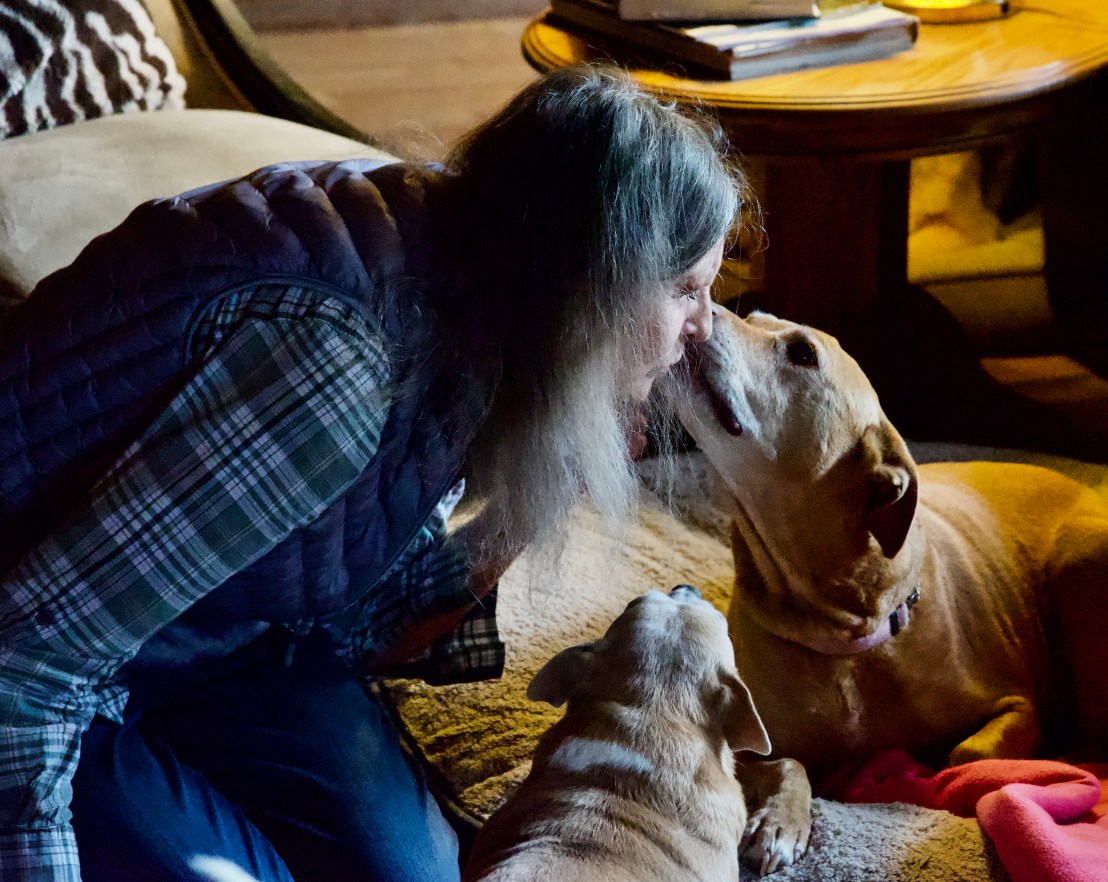
Jeannie saying goodbye.
Ruby was the last of Jean’s Mexican rescues. She will be sorely missed!
Those were Jeannie’s words not mine. When you consider the number of dogs that Jean has introduced into her pack, especially down in Mexico, that is quite a statement!
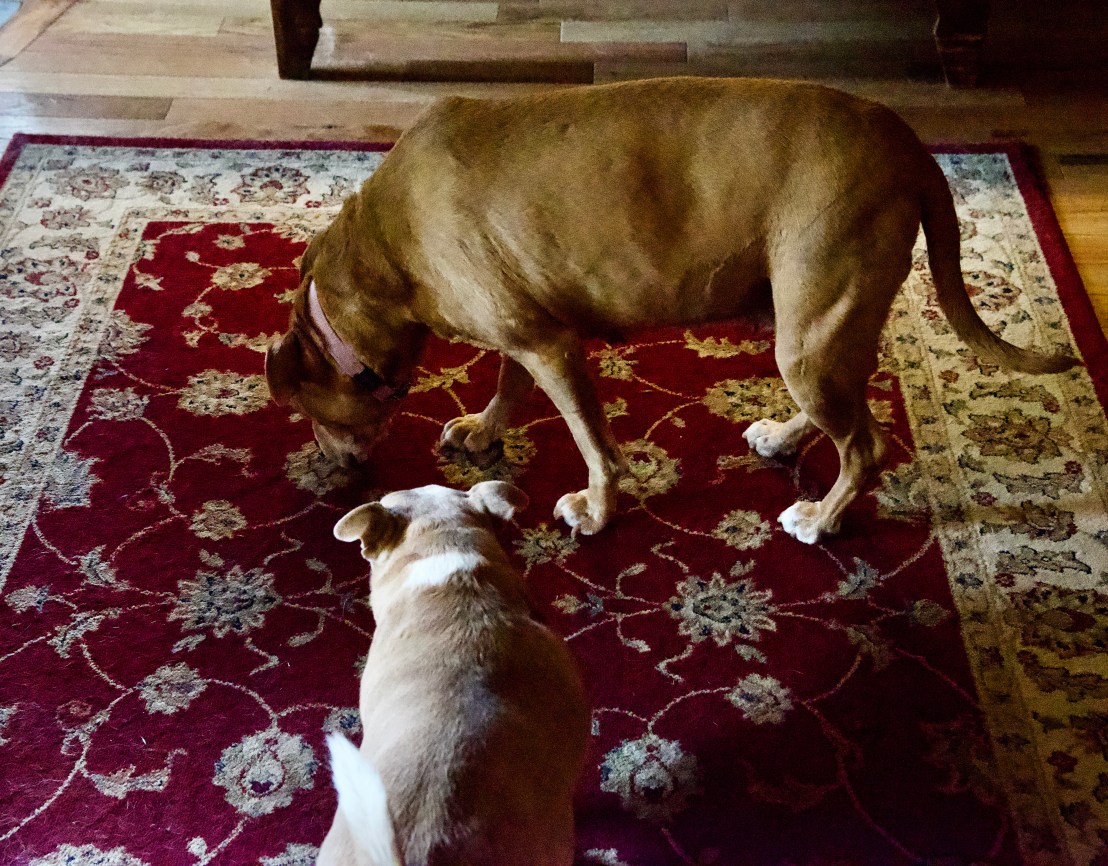
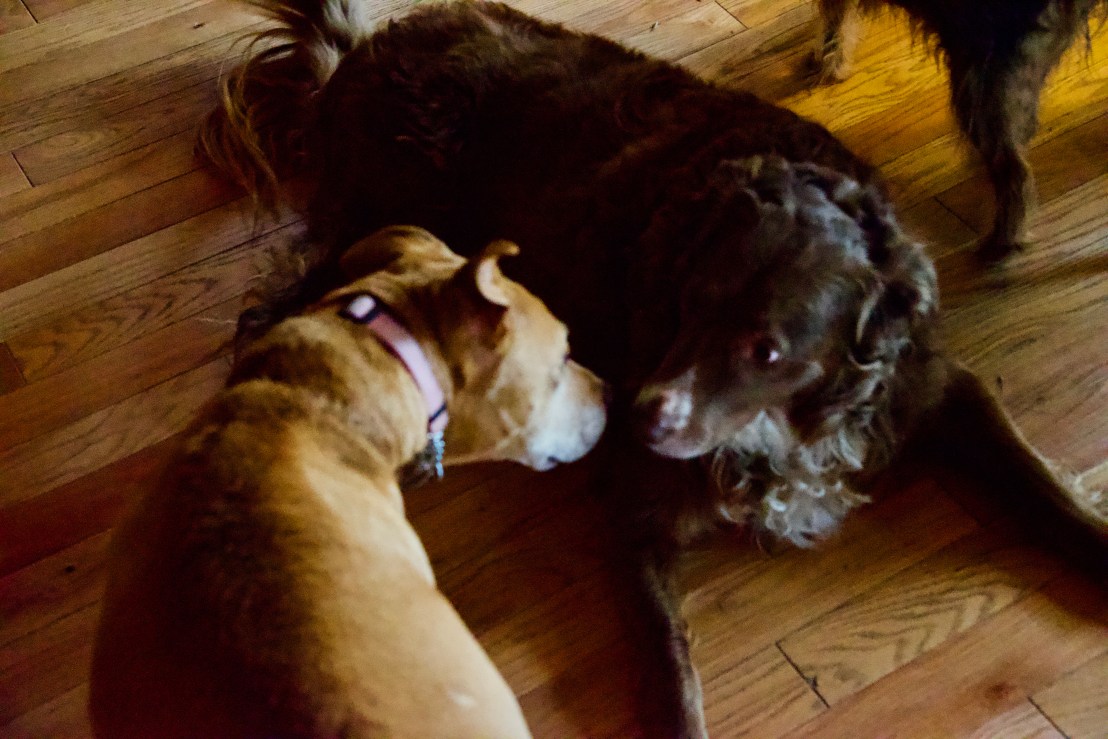
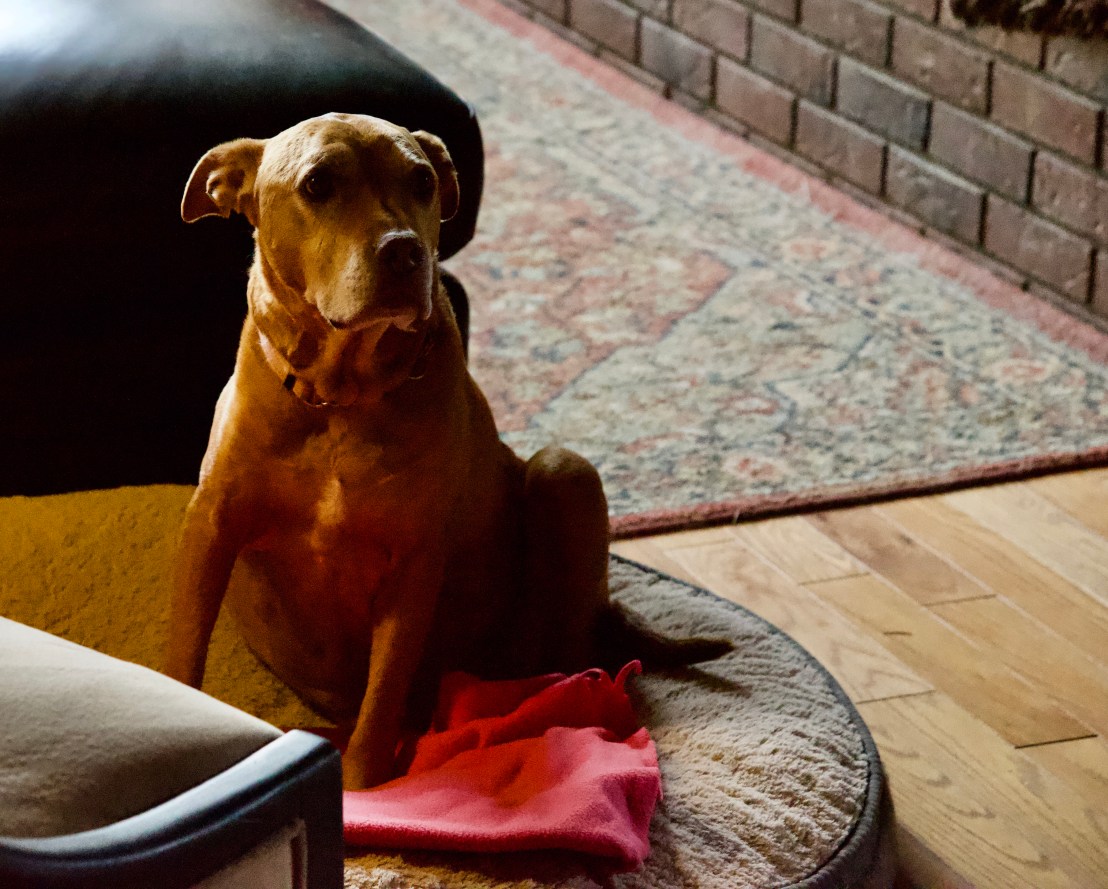
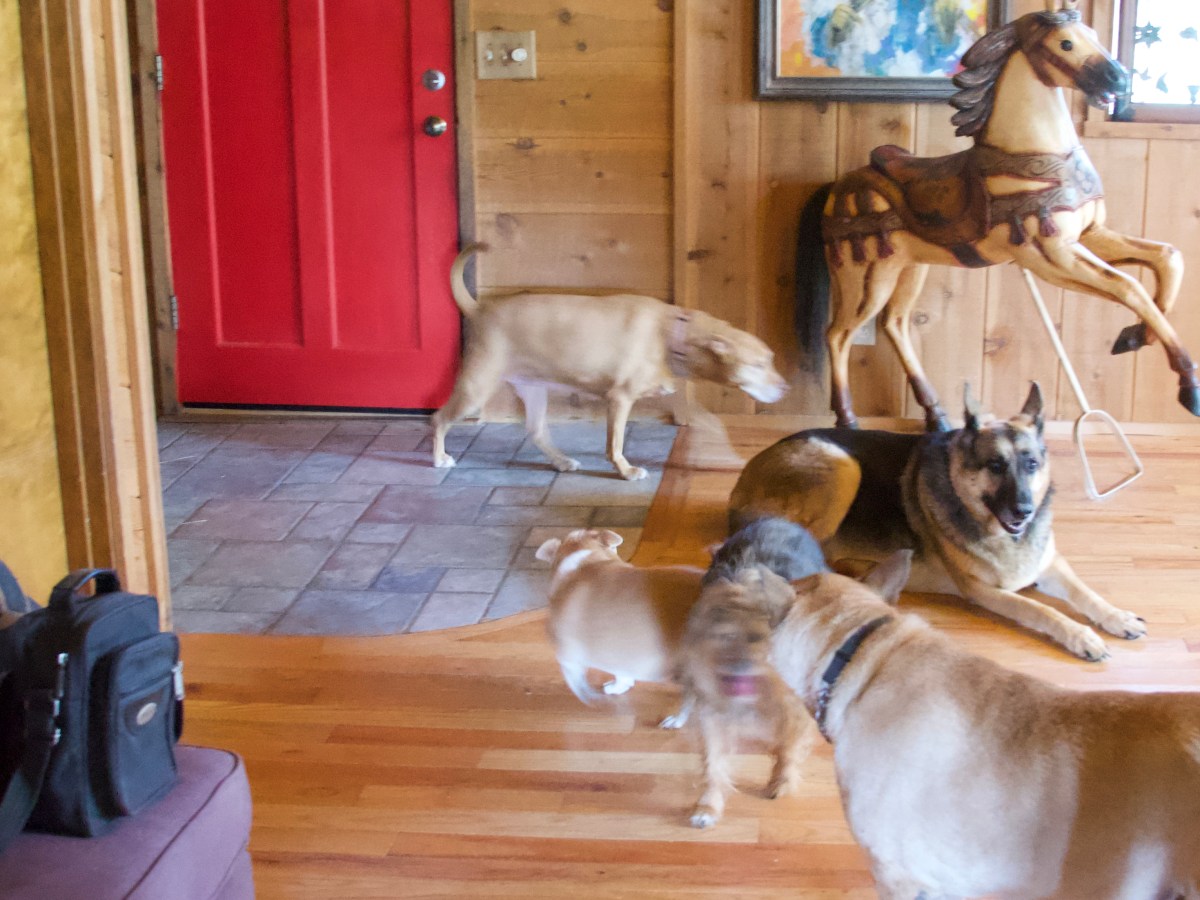
Very soon after Renate coming round to our place at 10 am yesterday morning Sheena came into the house. I tried to take a few photographs in those early moments. They are not the best I have taken!
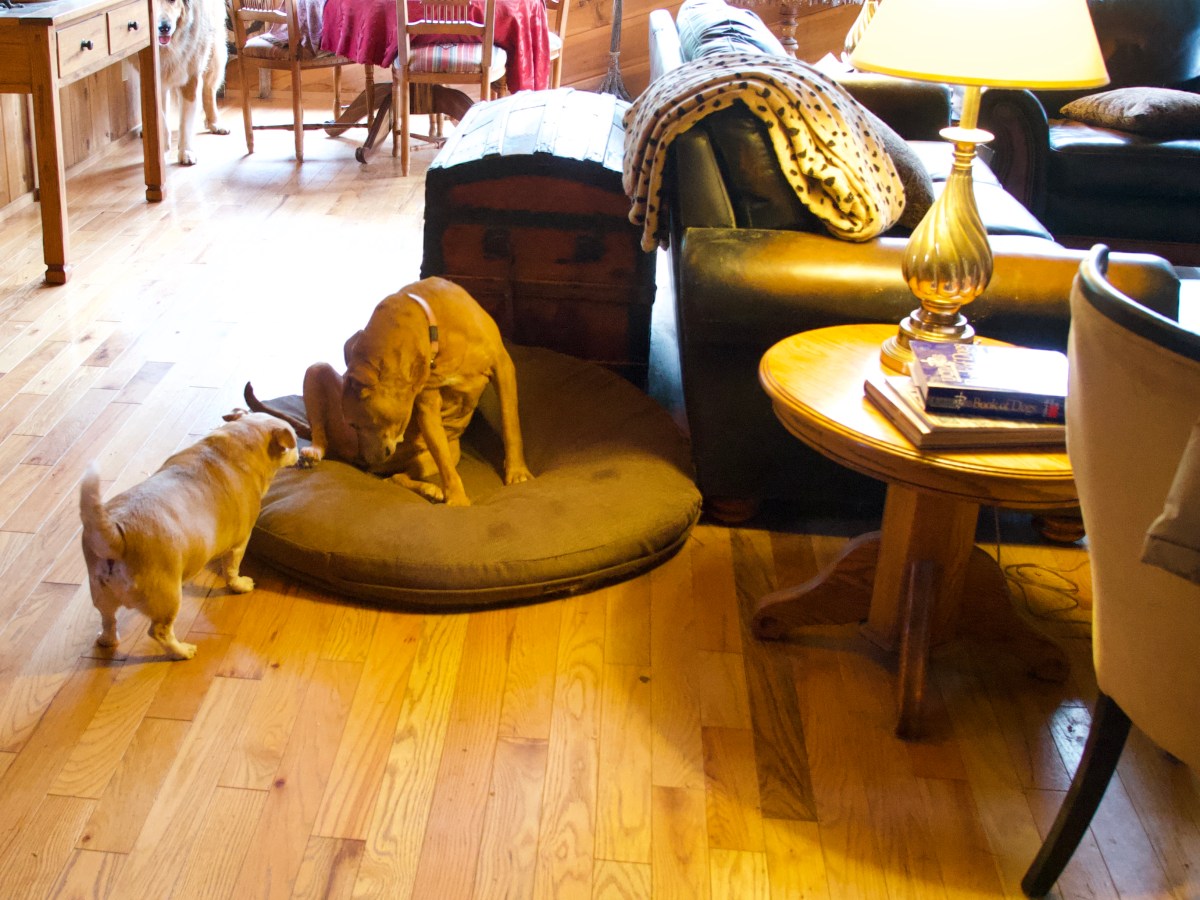
Sheena within minutes goes to her bed.
oooo
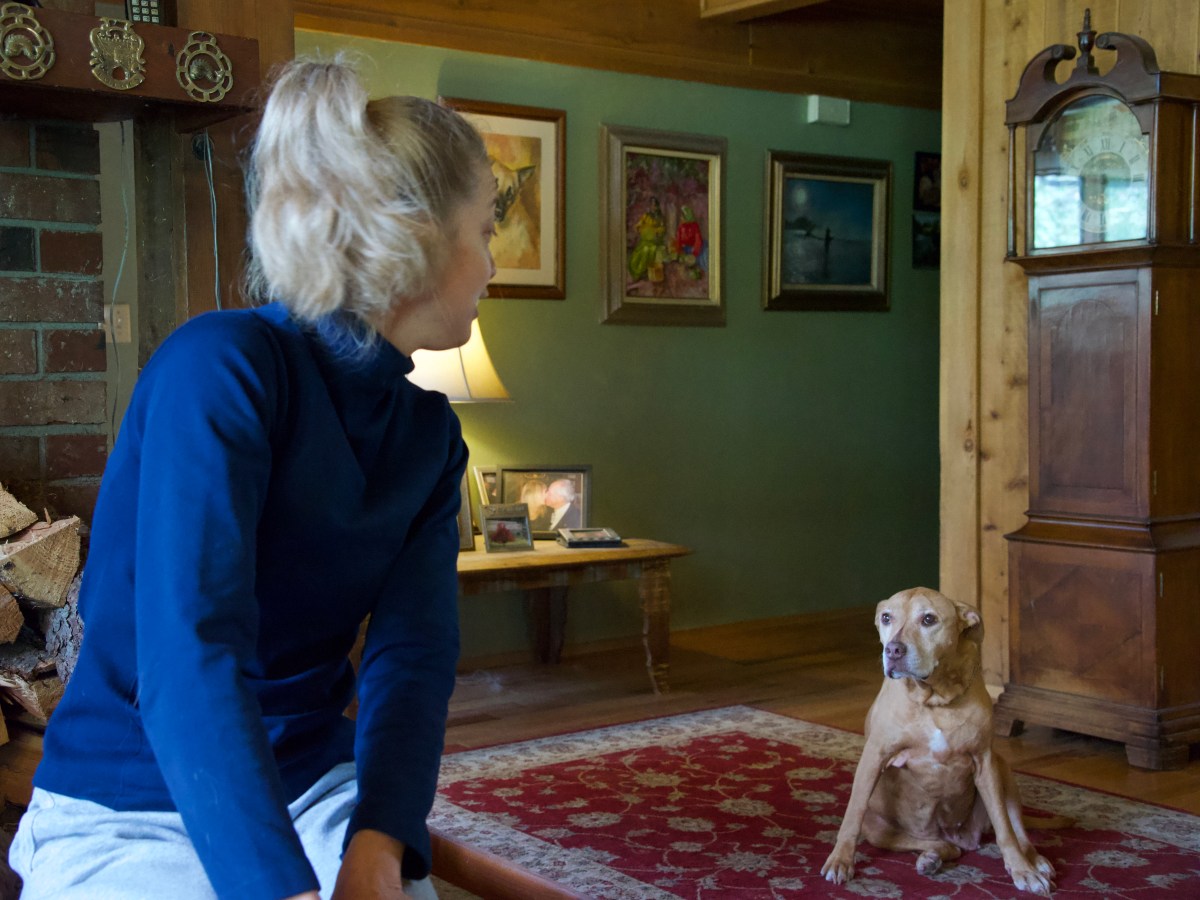
Little Pedi watching Sheena!
oooo
oooo
oooo
Sheena getting to know Oliver.
oooo
oooo
oooo
Now we have yet to go a full day (as this is being written on Friday for publication at midnight PDT tonight). But Jean and I have a good feeling about Sheena.
As you may know, I run a rescue for pets of the homeless. Sheena had lived most of her life on the streets. For the last 4 years or so, she has been in either our house or with a foster.
Her current foster is moving out of the country and I need a new home for Sheena. My Shepard started attacking her out of the blue. 4 times over 8 months, so for safety reasons, I rehomed Sheena.
Our rescue, Tail Waggers Rescue, a non-profit, provides all food and needs for Sheena. We pay her veterinary expenses as well. She is on the cancer diet.
She is extremely sweet, about 13 years old, and is /has fighting cancer. We had the tumors removed a few months ago. She weighs approx 55 lbs. She is short-haired.
She is dog friendly, with dogs of all sizes. I am unsure about cats.
She is not used to being around children so a home with little kids would not be preferred. A quieter home is ideal.
She also does not like people who are intoxicated. She does lay on the furniture, after all, she is a Queen. She is mostly an indoor dog. She is house trained. She will run to the door to let the person know she is there. She is not a huge barker. She loves going on car rides and insists on the front seat.
If you have room in your home and heart, and a fenced yard, and are willing to put her meals together to the menu of the cancer diet, (I help you with this) please let me know. An application and home check are required.
We will supply all her food, bed, dining table, bowls, leashes. You may need to drive her to her vet from time to time in Phoenix.
She is NOT leashed trained but loves to go on walks.
Pictures of Sheena are below.
Please contact me at the store if you are interested in meeting Sheena and being her long term foster.
It is getting very good reviews and they can ship products to those that can’t make it to the store. And I have no direct interest in Maria’s business.
The idea for today’s post came to me from Amanda down in Australia.
We go back years and years and have stayed in contact with each other over that time.
In her latest email she wrote (my italics):
I started some classes at the beginning of the year, a family history research one and a writing one, which had to stop a couple of weeks short courtesy of the virus. The family history class was essentially finished, but the writing class (How to Read/Write a Biography) is an ongoing thing, with the tutor being a published author. I signed up for term two of the writing class as the tutor decided to trial conducting it on-line via Zoom. Many people in the class are either writing a biography or just writing about their lives for their children or grandchildren, so the tutor encouraged us all to write a short piece about this COVID-19 outbreak; observations, feelings, how it’s affected us, or whatever we wanted. There are only six of us in the class, but it was fascinating to hear the resulting six pieces, so utterly different in tone and content, but all really interesting.
I wonder if you could invite something similar from your readers? Imagine the different perspectives and experiences of your readers in their different parts of the world! Just a thought anyway .
So how have you and your dogs been affected. Your feelings, your observations, how it has affected you, and any other thoughts.
And I will close with a photograph that Amanda sent me years ago.
Well it is to me and Jean and, I suspect, it will be to many other people.
I am an atheist. So is Jean. We have been all our lives. I think that many of you who follow this blog know that. The love that we have for our dogs, and all our animals, plus the beauty that is all around us in nature is enough. (Now I am not naive enough to realise that there are many, literally millions, that don’t have the same fortune in their lives.)
The Conversation recently republished an essay by David Weintraub that was first published in 2014. It is at the core of our existence and I am delighted to have the permission to republish it for you.
Square away your personal philosophy now; proof of life beyond earth is coming. Stargazing image via http://www.shutterstock.com
How will humankind react after astronomers hand over rock-solid scientific evidence for the existence of life beyond the Earth? No more speculating. No more wondering. The moment scientists announce this discovery, everything will change. Not least of all, our philosophies and religions will need to incorporate the new information.
Having already found the physical planets, astronomers are now searching for our biological neighbors. Over the next fifty years, they will begin the tantalizing, detailed study of millions of planets, looking for evidence of the presence of life on or below the surfaces or in the atmospheres of those planets.
And it’s very likely that astronomers will find it. Despite the fact that more than one-third of Americans surveyed believe that aliens have already visited Earth, the first evidence of life beyond our planet probably won’t be radio signals, little green men or flying saucers. Instead, a 21st century Galileo, using an enormous, 50-meter-diameter telescope, will collect light from the atmospheres of distant planets, looking for the signatures of biologically significant molecules.
Astronomers filter that light from far away through spectrometers – high-tech prisms that tease the light apart into its many distinct wavelengths. They’re looking for the telltale fingerprints of molecules that would not exist in abundance in these atmospheres in the absence of living things. The spectroscopic data will tell whether a planet’s environment has been altered in ways that point to biological processes at work.
With the discovery in a distant planet’s light spectrum of a chemical that could only be produced by living creatures, humankind will have the opportunity to read a new page in the book of knowledge. We will no longer be speculating about whether other beings exist in the universe. We will know that we not alone.
An affirmative answer to the question “Does life exist anywhere else in the universe beyond Earth?” would raise immediate and profoundly important cosmotheological questions about our place in the universe. If extraterrestrial others exist, then my religion and my religious beliefs and practices might not be universal. If my religion is not universally applicable to all extraterrestrial others, perhaps my religion need not be offered to, let alone forced on, all terrestrial others. Ultimately, we might learn some important lessons applicable here at home just from considering the possibility of life beyond our planet.
In my book, I investigated the sacred writings of the world’s most widely practiced religions, asking what each religion has to say about the uniqueness or non-uniqueness of life on Earth, and how, or if, a particular religion would work on other planets in distant parts of the universe.
Extrasolar sinners?
Let’s examine a seemingly simple yet exceedingly complex theological question: could extraterrestrials be Christians? If Jesus died in order to redeem humanity from the state of sin into which humans are born, does the death and resurrection of Jesus, on Earth, also redeem other sentient beings from a similar state of sin? If so, why are the extraterrestrials sinful? Is sin built into the very fabric of the space and time of the universe? Or can life exist in parts of the universe without being in a state of sin and therefore without the need of redemption and thus without the need for Christianity? Many different solutions to these puzzles involving Christian theology have been put forward. None of them yet satisfy all Christians.
Mormon worlds
Mormon scripture clearly teaches that other inhabited worlds exist and that “the inhabitants thereof are begotten sons and daughters unto God” (Doctrines and Covenants 76:24). The Earth, however, is a favored world in Mormonism, because Jesus, as understood by Mormons, lived and was resurrected only on Earth. In addition, Mormon so-called intelligences can only achieve their own spiritual goals during their lives on Earth, not during lifetimes on other worlds. Thus, for Mormons, the Earth might not be the physical center of the universe but it is the most favored place in the universe. Such a view implies that all other worlds are, somehow, lesser worlds than Earth.
Bahá’í without bias
Members of the Bahá’í Faith have a view of the universe that has no bias for or against the Earth as a special place or for against humans as a special sentient species. The principles of the Bahá’í Faith – unifying society, abandoning prejudice, equalizing opportunities for all people, eliminating poverty – are about humans on Earth. The Bahá’í faithful would expect any creatures anywhere in the universe to worship the same God as do humans, but to do so according to their own, world-specific ways.
Light years from Mecca
The pillars of the faith for Muslims require the faithful to pray five times every day while facing Mecca. Because determining the direction of Mecca correctly could be extremely difficult on a quickly spinning planet millions of light years from Earth, practicing the same faith on another world might not make any sense. Yet the words of the Qu’ran tell us that “Whatever beings there are in the heavens and the earth do prostrate themselves to Allah” (13:15). Can terrestrial Muslims accept that the prophetically revealed religion of Muhammad is intended only for humans on earth and that other worlds would have their own prophets?
Astronomers as paradigm-shatterers
Philosophers and scientists have forced worldviews to adapt in the past.
At certain moments throughout history, astronomers’ discoveries have exerted an outsized influence on human culture. Ancient Greek astronomers unflattened the Earth – though many then chose to forget this knowledge. Renaissance scholars Copernicus and Galileo put the Earth in motion around the Sun and moved humans away from the center of the universe. In the 20th century, Edwin Hubble eliminated the very idea that the universe has any center at all. He demonstrated that what the universe has is a beginning in time and that, bizarrely, the universe, the very fabric of three-dimensional space, is expanding.
Clearly, when astronomers offer the world bold new ideas, they don’t mess around. Another such paradigm-shattering new idea may be in the light arriving at our telescopes now.
No matter which (a)theistic background informs your theology, you may have to wrestle with the data astronomers will be bringing to houses of worship in the very near future. You will need to ask: Is my God the God of the entire universe? Is my religion a terrestrial or a universal religion? As people work to reconcile the discovery of extrasolar life with their theological and philosophical worldviews, adapting to the news of life beyond Earth will be discomfiting and perhaps even disruptive.
ooOOoo
Now I don’t really want to open up the subject of religion but I will say that WikiPedia have a great entry about the subject. My own view is that a few hundred years ago, when life was a lot more mysterious and uncertain, believing in life after death made some sense.
But we know a lot better now despite death still being a certainty.
Fairly soon after publishing my post about music and the dog world I came across another article on dogs, and other animals, having a sense of numbers.
Now this post which was originally published by The Conversation is intricate in it’s deliberations but it is still clear. Try the article yourself.
ooOOoo
Animals that can do math understand more language than we think
May 28, 2020
By Erik Nelson, Phd Student, Philosophy, Dalhousie University
So, what is it that makes us so different from other animals? Many philosophers, both past and present, have pointed to our linguistic abilities. These philosophers argue that language not only allows us to communicate with each other, but also makes our mental lives more sophisticated than those that lack language. Some philosophers have gone so far as to argue that creatures that lack a language are not capable of being rational, making inferences, grasping concepts or even having beliefs or thoughts.
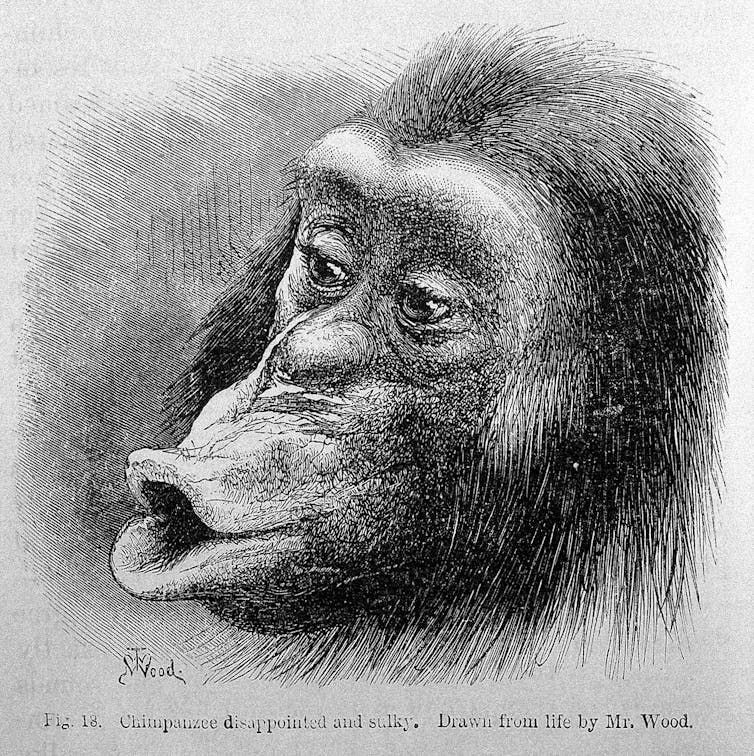
An illustration of a sulky chimpanzee from Charles Darwin’s 1872 book, ‘The Expression of the Emotions in Man and Animals.’ (Wellcome Collection)
Even if we are willing to accept these claims, what should we think of animals who are capable of speech? Many types of birds, most famously parrots, are able to make noises that at least sound linguistic, and gorillas and chimpanzees have been taught to communicate using sign language. Do these vocalizations or communications indicate that, like humans, these animals are also capable of sophisticated mental processes?
The philosophy of animal language
Philosophers have generally answered this question by denying that talking parrots and signing gorillas are demonstrating anything more than clever mimicry. Robert Brandom, a philosopher at the University of Pittsburgh, has argued that if a parrot says “red” when shown red objects and “blue” when presented with blue ones, it has not actually demonstrated that it understands the meaning of those words. According to Brandom — and many other philosophers — understanding the meaning of a word requires understanding both the meaning of many other words and the connections that exist between those words.
Imagine that you bring your toddler niece to a petting zoo for the first time, and ask her if she is able to point to the rabbits. If she successfully does, this might seem like a good indication that she understands what a rabbit is. However, you now ask her to point to the animals. If she points to some rocks on the ground instead of pointing to the rabbits or the goats, does she actually understand what the word “rabbit” means? Understanding “rabbit” involves understanding “animal,” as well as the connection between these two things.
So if a parrot is able to tell us the colour of different objects, that does not necessarily show that the parrot understands the meanings of those words. To do that, a parrot would need to demonstrate that it also understands that red and blue fall underneath the category of colour, or that if something is red all over, it cannot, at the same time, be blue all over.
What sort of behaviour would demonstrate that a parrot or a chimpanzee did understand the words it was using? As a philosopher who focuses on the study of animal cognition, I examine both empirical and theoretical work to answer these types of questions.
In the late 1800s, the German mathematician and philosopher Gottlob Frege tried to demonstrate that arithmetic is an objective science. Many philosophers and mathematicians at the time thought that arithmetic was merely an artifact of human psychology. Frege worried that such an understanding would make arithmetic entirely subjective, placing it on no firmer ground than the latest fashion trends.
In The Foundations of Arithmetic, Frege begins by logically analyzing what sorts of things numbers are. He thinks that the key to this investigation is figuring out what it takes to answer the question “how many?”
If I hand you a deck of cards and ask, “How many?” without specifying what I want counted, it would be difficult to even figure out what sort of answer I am looking for. Am I asking you how many decks of cards, how many cards all together, how many suits or any of the other number of ways of dividing up the deck? If I ask, “How many suits?” and you respond “four,” you are demonstrating not just that you can count, but that you understand what suits are.
Frege thought that the application of number labels depends on being able to grasp the connection between what is being counted and how many of them there are. Replying “four” to the question “How many?” might seem like a disconnected act, like parrots merely calling red objects “red.” However, it is more like your niece pointing to the rabbits while also understanding that rabbits are animals. So, if animals are able to reliably respond correctly to the question “How many?” this demonstrates that they understand the connection between the numerical amount and the objects they are being asked about.
Animal mathematical literacy
One example of non-human animals demonstrating a wide range of arithmetical capabilities is the work that Irene Pepperberg did with African grey parrots, most famously her subjects Alex and Griffin.
In order to test Alex’s arithmetic capabilities, Pepperberg would show him a set of objects on a tray, and would ask, “How many?” for each of the objects. For example, she would show him a tray with differently shaped objects on it and ask, “How many four-corner?” (Alex’s word for squares.) Alex was able to reliably provide the answer for amounts up to six.
Alex was also able to provide the name for the object if asked to look for a number of those objects. For example, if a tray had different quantities of coloured objects on it including five red objects, and Alex was asked, “What colour is five?” Alex was able to correctly respond by saying “red.”
Pepperberg’s investigations into the ability to learn and understand basic arithmetic provide examples that show that Alex was able to do more than simply mimic human sounds. Providing the right word when asked, “How many?” required him to understand the connections between the numerical amount and the objects being asked about.
Animal mathematical skills
While Pepperberg’s results are impressive, they are far from unique. Numerical abilities have been identified in many different species, most prominently chimpanzees. Some of these capabilities demonstrate that the animals understand the underlying connections between different words and labels. They are therefore doing something more than just mimicking the sounds and actions of the humans around them.
Animals that can do basic arithmetic show us that some really are capable of understanding the terms they use and the connections between them. However, it is still an open question whether their understanding of these connections is a result of learning linguistic expressions, or if their linguistic expressions simply help demonstrate underlying capabilities.
Either way, claims that humans are uniquely able to understand the meanings of words are a bit worse for wear.
ooOOoo
There’s little that I can add to the excellent summary in that penultimate paragraph;
Animals that can do basic arithmetic show us that some really are capable of understanding the terms they use and the connections between them. However, it is still an open question whether their understanding of these connections is a result of learning linguistic expressions, or if their linguistic expressions simply help demonstrate underlying capabilities.
but one thing is becoming clearer and clearer: dogs and other animals are a whole lot smarter than many (most?) of us think. Primarily on the back of research into the nature of our creatures and especially those creatures that are very close to us.
Now this is a story about a specific event, taking Sadie to the vet. But there’s a more fundamental theme to this post and that is the role of music in our lives and in the lives of our dogs.
ooOOoo
Dog Is Terrified Of Vet — Until He Decides To Sing To Her
From the Daily Dodo, May 22nd, 2020
Photo Credit: Kaeley Simek
Sadie was rescued from a local shelter when she was around a year old, and when she joined her family, she was quick to let them know that she was always down to have fun.
“Her personality is SO sassy and playful,” Kaeley Simek, Sadie’s mom, told The Dodo. “Ever since we gave her her first toy, she loves to play as often as she can. She is very high-energy and pretty much up for anything.”
While Sadie is usually the life of the party, the one thing that doesn’t make her smile is having to go to the vet.
“Sadie was not scared of vets when first rescuing her, but once she realized that she always goes there to get shots or if she has pain, she quickly learned it is not a fun place to be,” Simek said.
Photo Credit: Kaeley Simek
Sadie didn’t have great vet experiences when she was first rescued, and after that, she was absolutely terrified every time she realized that’s where she was headed. Her mom desperately wanted to find a vet who would understand Sadie’s anxiety and try to work with her to overcome it — and that’s when they met Dr. Noah.
“We started going to Dr. Noah of Dr. Noah’s Ark in Shorewood, [Wisconsin], in September of 2019,” Simek said. “After the bad experiences, I researched heavily a vet who would take time to understand and accept scared/reactive dogs. He was very highly rated and I also saw many reviews that [said] he doesn’t wear the ‘white coat’ at appointments, which can be a huge trigger for dogs.”
At their first visit, Simek explained Sadie’s anxieties to Dr. Noah, and it wasn’t hard to see how scared she was. That’s when Simek learned that Dr. Noah’s secret trick was singing to his patients.
In order to try and calm them down and make them feel more comfortable, Dr. Noah serenades the dogs who are scared or nervous — and most of the time, it totally works.
Photo Credit: Kaeley Simek
“The first time we went to him, he sang to her and she ended up on the floor kissing him and he was able to give the two shots she needed,” Simek said. “He has sang to her ever since.”
Dr. Noah understands that going to the vet can be overwhelming for some pets, so he does his best to create a positive experience for them the best way he knows how — through music.
“He heavily believes that music can completely change the mood,” Simek said.
For Sadie, it’s definitely been working. Even though she’s still scared when she first gets there, she definitely trusts Dr. Noah more than any other vet she’s been to, and with his help and his music she’s slowly learning that the vet isn’t actually so scary after all.
“She still has a lot of fear about the vet but he takes the time to sit down with her and we go for happy vet visits weekly so she can have positive associations,” Simek said. “He has the biggest heart out of any vet I’ve ever seen.”
ooOOoo
It’s very clear, from this story and many others including our personal experience of dogs, that dogs’ emotional responses are advanced and in many ways their emotions are familiar to us humans.
I’m going to include two videos.
The first is from 2012 and is a very short extract from the BBC Horizon video: Can dogs sense emotion?
And the second is a longer video but still only 18 minutes.
That second video shows the remarkable qualities of the dog and the similarities between the dog’s brain and the human brain!




















 David Weintraub,