This is just an interim post while I get my act together today (it’s 08:07am).
For yesterday morning, around 7am, we lost our internet service and it was only restored a couple of hours ago.
There’s an announcement from me coming out before the end of the day about my book and a way for anyone interested in reading a section to be able to download a few chapters.
More later!
Thanks Doranne for sharing that wonderful reminder.
We humans take self-awareness for granted. The key measure, as I understand it, is our ability to recognise ourselves, as in a mirror or photograph, for example.
I have more than once mentioned in posts in this place, that the evolutionary journey for us humans and our canine companions has resulted in the two species now sharing a number of psychological and physical ailments.
But what has been implicitly understood is that the one thing that dogs and us do not share is self-awareness. Hitherto, it has been believed that dogs do not recognise themselves in the mirror test.
All of which is an introduction to an item that was recently posted on the ScienceAlert website and was brought to my attention by dear friend Dan Gomez.
ooOOoo
Guise Barbiani, Flickr
Dogs show signs of self-consciousness in new ‘sniff test’ We knew it!
BEC CREW 10 DEC 2015
Self-awareness might seem like the most basic part of life to us humans, but it’s a surprisingly rare concept when it comes to other animals. While great apes, dolphins, orcas, rhesus macaques, Eurasian magpies, and a single Asiatic elephant have all passed the self-recognition test, everything from pandas and pigeons to sea lions, gorillas, and several species of monkey have failed to show signs of consciousness.
Dogs were also on that list of failures – until now. Traditionally, self-consciousness is evaluated via the ‘mirror test’. If an animal uses its own reflection to examine or touch a red mark that’s been applied to its body without its knowledge, scientists can confirm that they possess some sense of self. But what if the animal isn’t that visually oriented?
“I believed that because dogs are much less sensitive to visual stimuli with respect to what, for example, humans and many apes are, it is likely that the failure of this and of other species in the mirror test is mainly due to the sensory modality chosen by the investigator to test the self-awareness and not, necessarily, to the absence of this latter,” says evolutionary biologist Roberto Cazzolla Gatti from Tomsk State University in Russia.
Gatti was prompted into this line of thinking by the fact that in past mirror tests, dogs have shown no interest in looking at their reflection in the mirror, but they will go ahead and sniff the area and possibly even urinate around it. While this got them a big old “fail” in previous studies, Gatti thought the behaviour warranted a closer look.
Back in 2001, renowned animal behaviour expert, Marc Bekoff, investigated the ‘mirror sniffing’ phenomenon via an experiment dubbed the ‘yellow snow test’. Yep it’s exactly what it sounds like. Over a five-year period, Bekoff took his dog Jethro on walks during the winter months, and timed how long he would sniff clumps of snow soaked in his own or other dogs’ urine.
“Bekoff would wait until Jethro or other known female and male dogs urinated on snow, and then scoop up the clump of yellow snow as soon as Jethro was elsewhere and did not see him pick it up or move it (Bekoff used clean gloves each time and took other precautions to minimise odour and visual cues).
Bekoff then moved the yellow snow varying distances down the path so that Jethro would run across the displaced urine: (i) within about 10 seconds, (ii) between 10 and 120 seconds later, or (iii) between 120 and 300 seconds later. After Jethro arrived, Bekoff recorded how long he sniffed at the yellow snow, whether he urinated over it using the typical male raised-leg posture, and whether urination immediately followed the sniffing (‘scent marking’).”
Not surprisingly, Jethro paid a lot less attention to his own urine than he did to that of other dogs, so Bekoff concluded that his pet had to have some sense of self to be able to distinguish between scents. But with a sample size of one, the experiment wasn’t exactly going to set the scientific community on fire.
Gatti decided to come up with something a little more convincing. Called the Sniff Test of Self-Recognition (STSR), the experiment involved collecting urine samples from four stray dogs and systematically exposing them to the scents. He repeated this four times a year at the beginning of every season.
“I placed within a fence five urine samples containing the scent of each of the four dogs and a ‘blank sample’, filled only with cotton wool odourless,” he says. “The containers were then opened and each dog was individually introduced to the inside of the cage and allowed to freely move for 5 minutes. The time taken by each dog to sniff each sample was recorded.”
Just like Jethro, each dog spent way more time smelling the urine samples of other dogs than their own, which supports the hypothesis that they know their own scent and aren’t that interested in it. The result was stronger the older the dog, which suggests that self-awareness develops with age.
It might seem obvious that dogs would know their own scent, but if you’ve ever seen a dog bark at its own reflection, or completely ignore it – totally unaware of its own appearance and movements – you can see the significance.
“I demonstrated that even when applying it to multiple individuals living in groups and with different ages and sexes, this test provides significant evidence of self-awareness in dogs and can play a crucial role in showing that this capacity is not a specific feature of only great apes, humans, and a few other animals, but it depends on the way in which researchers try to verify it,” says Gatti.
Now, I know what you’re thinking: that sample size of four is pretty crap. And yep, it is, so we can’t really call this an official “pass” just yet. But the fact that we may well need to rethink the mirror test and figure out how to better align it with how certain species see the world is certainly worthy of a proper investigation. Certain behaviours such as empathy have been linked to self-awareness, and thanks to the ‘yawn test’, there’s evidence that dogs feel empathy towards their owners.
We’ll just have to wait and see if scientists are prepared to conduct a giant yellow snow test to put this conundrum to bed once and for all. In the meantime, here’s dolphins passing the mirror test adorably:
ooOOoo
Speaking of self-awareness, today, December 12th, is the centenary of the birth of Frank Sinatra.
Photo of Frank SINATRA, posed, c.early 1960s (Photo by GAB Archive/Redferns)
Bravo Pet Foods of Manchester, Connecticut, has announced it is voluntarily recalling select lots of its raw food for dogs and cats due to the possible presence of Salmonella.
Yesterday, I offered the account of physicist Paul Dirac falling in love with Margit Wigner, the sister of a Hungarian physicist. It was my way of opening a window into the mind of one individual, albeit a very clever one, falling in love. However, the conclusion, that won’t surprise anyone, is that the state of love in us humans is more mystery than fact!
Dogs have no such problem in showing their state of love!
A few days ago, in comments to a recent post, the author, John Zande wrote:
We were so heartbroken after losing Arthur so unexpectedly (an astonishing dog we found with a massive tumor in his eye) in Sao Paulo we literally moved cities. I couldn’t stand being in the same neighbourhood. Too much reminded me of him.
Then in response to my reply went on to say:
They are amazing creatures. The dog across the street from us died almost a year ago to the day. Beautiful dog, not so good owners (never paid her any attention, fed her crap… we’d sneakily feed her mince and chicken and treats every night). She had many male visitors (they never neutered her), but one in particular, Hop-along, a crippled dog from a street over considered her his wife/girlfriend. When she died it was only us and Hop-along who grieved. It was amazing. He held vigil outside her house for 2 weeks solid after she died, day and night. He never left. He just stood there.
More than thirty-five years ago, when I was working in Colchester, Essex, England, I met Roger Davis. It was Roger that introduced me to gliding (sailplaning in American speak!) courtesy of Rattlesden Gliding Club. Roger and I have stayed in touch ever since including, of course, keeping in touch with Sheila, Roger’s wife, and much of the family.
Yesterday, in an exchange of emails, Roger sent this:
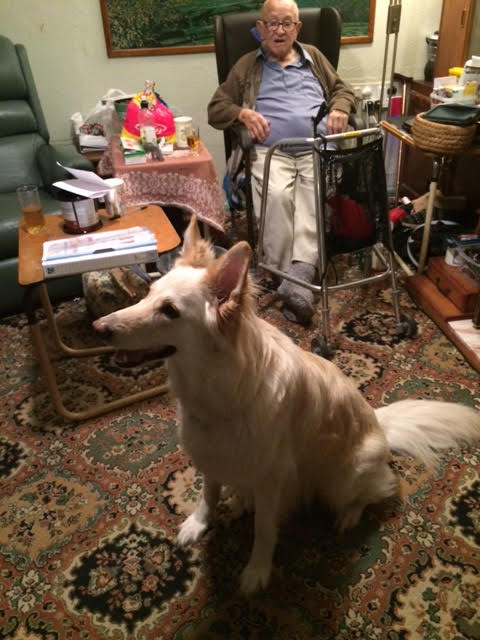
Just back from taking Ralph (now 89) to day surgery at Broomfields.His companion since Freda his wife died two years ago is Sasha, a blonde Alsatian. He always had Alsatians so no surprise when this one appeared.
The love and companionship offered by Sasha to Ralph.
I was moved equally by John’s love for Arthur, Hop-along’s love for his female canine love, and the love of Sasha for Ralph.
Here’s an anti-aging project that we all wish for a successful outcome.
Despite the fact that one of the very important items that we learn from dogs is the certainty of death, there is not a single dog carer who doesn’t want them to live much longer lives.
Today’s post is the republication of a recent science report over on Mother Nature Network concerning a drug, rapamycin, that is hoped may give our wonderful dogs several more healthy years of life. As always, republished within the generous terms of MNN.
We wish the scientists much luck in achieving this outcome, without any deleterious side effects.
ooOOoo
Anti-aging project aims to extend dogs’ life spans
Researchers hope a drug called rapamycin can give dogs several more healthy years of life.
By: Russell McLendon, December 4, 2015,
Although some dogs have lived as long as 29 years, canine life spans are typically closer to half that length. (Photo: Shutterstock)
Living with a dog can help humans in lots of ways, from reducing stress and anxiety to lifting our spirits and making us laugh. Yet despite the abundance of benefits dogs offer, they also come with a notable drawback: Their life spans are much shorter than ours, forcing us to deal with the sadness of their deaths every 15 years or so.
Grieving for our dogs is just part of life, and in the big picture, it’s a small price to pay. But according to researchers at the University of Washington (UW), there may be a way to help our best friends stay with us — and stay healthy — a little longer.
Dog aging varies widely by size and breed, with smaller dogs typically maturing more quickly, yet also living a few years longer on average. It’s also common for mutts to outlive purebred dogs, thanks to the perks of higher genetic diversity. But while almost any dog is considered elderly by age 15, some have been known to nearly double their expected life spans — including Bluey, an Australian cattle dog who famously lived to see his 29th birthday last century.
And now researchers at UW’s Dog Aging Project (DAP) are working to bring similar longevity to canines of all kinds. In addition to performing “the first nationwide, large-scale longitudinal study of aging in pet dogs,” this project involves efforts to improve dogs’ “healthy life span” via therapies that already work in lab settings.
“To be clear, our goal is to extend the period of life in which dogs are healthy, not prolong the already difficult older years,” the project’s website explains. “Imagine what you could do with an additional two to five years with your beloved pet in the prime of his or her life. This is within our reach today.”
If it pans out, this may also aid ongoing research into extending the lives of other animals, including humans. But for now, the therapy is focused on dogs.
Researchers think rapamycin might increase a dog’s healthy life span by up to 5 years. (Photo: Shutterstock)
Namely, they’re testing the FDA-approved drug rapamycin (aka sirolimus) on middle-aged dogs. High doses of rapamycin are already used in humans to fight cancer and prevent organ-transplant rejection, but at low doses, it has also been shown to slow aging and extend life span in several animals with few or no side effects. In mice, for example, the immunosuppressant can lengthen lives by up to 25 percent.
“If rapamycin has a similar effect in dogs — and it’s important to keep in mind we don’t know this yet — then a typical large dog could live 2 to 3 years longer, and a smaller dog might live 4 years longer,” the project’s organizers write. “More important than the extra years, however, is the improvement in overall health during aging that we expect rapamycin to provide.”
Rapamycin trials have already begun on 32 middle-aged golden retrievers, Labrador retrievers and German shepherds. Ranging from 6 to 9 years old, these dogs will spend several months on a low-dose rapamycin regimen in which researchers study age-related metrics like heart function, immune response, physical activity, body weight and cognitive measures. They’ll also follow these 32 dogs throughout the rest of their lives, looking for any significant changes in aging or life span.
And in phase two of the study, a second group of middle-aged dogs will enter a longer-term, low-dose rapamycin regimen “designed to optimize lifespan extension.” Based on mouse studies conducted both at UW and elsewhere, they anticipate the drug “could increase healthy lifespan of middle-aged dogs by 2-5 years or more.”
Rapamycin isn’t a miracle drug, however, and high doses have been linked to side effects like immune suppression and delayed wound healing. But as the DAP website argues, “these are greatly mitigated at the doses used to extend longevity, and both animal and human studies indicate that even mild adverse events are rare.”
Regular exercise and outdoor time are great ways to boost a dog’s quality of life. (Photo: Shutterstock)
While the idea of extending dogs’ lives is exciting, it’s important not to let quantity of life overshadow quality of life. We may never have full control over how long our dogs live, but we can make sure they live well while they’re here.
A good reminder of this comes from Pegasus, a Great Dane rescued from unscrupulous breeders in South Africa when she was 4 weeks old. Suffering from a pigment deficiency often associated with blindness and deafness, Pegasus wasn’t expected to live very long. Filmmaker Dave Meinert adopted her anyway, and decided to film her daily as she grew up. In May 2015, he released a time-lapse movie (see below) of her reaching adulthood that quickly went viral. And as he explains in the video, Pegasus’ prognosis only helped the pair live every day like it was their last.
“I still don’t know how long she is going to live,” Meinert admits. “But right now is pretty great.”
ooOOoo
Watching the video offers the most beautiful, and powerful, reminder of the unconditional love that we can share with our dogs! What a gift they give us!
Wouldn’t we all love a few more years of happy and healthy life for our beloved dogs.
What clues does your dog’s spit hold for human mental health?
This is not a spoof. Apparently the closeness of the relationship between dogs and humans holds real scientific value.
Just my way of introducing a most fascinating and interesting item that recently appeared on The Conversation blogsite. (And see my note at the end of today’s post.)
ooOOoo
What clues does your dog’s spit hold for human mental health?
December 2, 2015
Elixir Karlsson, Assistant Professor of Bioinformatics and Integrative Biology, University of Massachusetts Medical School
There goes some precious DNA…. Graeme Bird, CC BY-NC-ND
Dogs were the first animals people domesticated, long before the earliest human civilizations appeared. Today, tens of thousands of years later, dogs have an unusually close relationship with us. They share our homes and steal our hearts – and have even evolved to love us back. Sadly, they also suffer from many of the same difficult-to-treat psychiatric and neurological diseases we do.
I learned this firsthand about six years ago, when my sister Adria adopted Beskow, a beautiful,
Beskow, in fine spirits. Elinor Karlsson, CC BY-ND
boisterous, black and white mutt. Beskow became my constant companion on my morning runs along the Charles River. Her joy in running was obvious to everyone we passed, and she kept me going mile after mile.
When not running, though, Beskow suffered from constant anxiety that left her stressed and unhappy – on edge around other dogs and prone to aggressive behavior. Beskow had trouble even playing outdoors, since she was compelled to attend to every sound and movement. Working one-on-one with skilled behaviorists and trainers helped immensely, but poor Beskow still never seemed able to relax. Eventually, Adria combined the intensive training with medication, which finally seemed to give Beskow some relief.
Beskow’s personality – her intelligence, her focus and her anxiety – was shaped not only by her own life experiences, but by thousands of years of evolution. Have you ever known a dog who would retrieve the same ball over and over again, for hours on end? Or just wouldn’t stay out of the water? Or wasn’t interested in balls, or water, but just wanted to follow her nose? These dogs are the result of hundreds of generations of artificial selection by human beings. By favoring useful behaviors when breeding dogs, we made the genetic changes responsible more common in their gene pool.
When a particular genetic change rapidly rises in prevalence in a population, it leaves a “signature of selection” that we can detect by sequencing the DNA of many individuals from the population. Essentially, around a selected gene, we find a region of the genome where one particular pattern of DNA – the variant linked to the favored version of the gene – is far more common than any of the alternative patterns. The stronger the selection, the bigger this region, and the easier it is to detect this signature of selection.
In dogs, genes shaping behaviors purposely bred by humans are marked with large signatures of selection. It’s a bit like evolution is shining a spotlight on parts of the dog genome and saying, “Look here for interesting stuff!” To figure out exactly how a particular gene influences a dog’s behavior or health, though, we need lots more information.
To try to unravel these connections, my colleagues and I are launching a new citizen science research project we’re calling Darwin’s Dogs. Together with animal behavior experts, we’ve put together a series of short surveys about everything from diet (does your dog eat grass?) to behavior (is your dog a foot sitter?) to personality (is your dog aloof or friendly?).
Any dog can participate in Darwin’s Dogs, including purebred dogs, mixed breed dogs, and mutts of no particular breed – our study’s participants will be very genetically diverse. We’re combining new DNA sequencing technology, which can give us much more genetic information from each dog, with powerful new analysis methods that can control for diverse ancestry. By including all dogs, we hope to be able to do much larger studies, and home in quickly on the important genes and genetic variants.
A beagle considers making the saliva donation. Stephen Schaffner, CC BY-ND
Once an owner has filled out the survey, there’s a second, crucial step. We send an easy-to-use kit to collect a small dog saliva sample we can use for DNA analysis. There’s no cost, and we’ll share any information we find.
Our plan is to combine the genetic data from many dogs and look for changes in DNA that correlate with particular behaviors. It won’t be easy to match up DNA with an obsession with tennis balls, for instance. Behavior is a complex trait that relies on many genes. Simple Mendelian traits, like Beskow’s black and white coat, are controlled by a single gene which determines the observable characteristic. This kind of inherited trait is comparatively easy to map. Complex traits, on the other hand, may be shaped by tens or even hundreds of different genetic changes, each of which on its own only slightly alters the individual carrying it.
Adding to the complexity, environment often plays a big role. For example, Beskow may not have been as anxious if she’d lived with Adria from puppyhood, even though her genetics would be unchanged.
Darwin’s Dogs team member Jesse McClure extracts DNA from a sample. Elinor Karlsson, CC BY-ND
To succeed, we need a lot of dogs to sign up. Initially, we’re aiming to enroll 5,000 dogs. If successful, we’ll keep growing. With bigger sample sizes, we’ll be able to tackle even more complex biological puzzles.
Understanding the biology underlying a disease is the first step in developing more effective treatments – of both the canine and human variety. For example, genetic studies of narcolepsy in Doberman pinschers found the gene mutation causing the disease – but only in this one dog population. Researching the gene’s function, though, led to critical new insights into the molecular biology of sleep, and, eventually, to new treatment options for people suffering from this debilitating disease.
Darwin’s Dogs is investigating normal canine behaviors as well as diseases. We hypothesize that finding the small genetic changes that led to complex behaviors, like retrieving, or even personality characteristics, like playfulness, will help us figure out how brains work. We need this mechanistic understanding to design new, safe and more effective therapies for psychiatric diseases.
And Beskow? Six years later, she is as wonderful as ever. While still anxious some of the time, the
Beskow with one of her loving family members. Adria Karlsson, CC BY-ND
medication and training have paid off, and she enjoys her daily walks, training and playtime. She still gets very nervous around other dogs, but is a gentle, playful companion for my sister’s three young children.
We are now sequencing her genome. In the next few months, we should have our first glimpse into Beskow’s ancestry. We know she is a natural herder, so we’re curious to find out how much her genome matches up to herding breeds, and which genes are in that part of the genome.
This is an incredibly interest research project with far-reaching implications for us humans. I have written to Professor Karlsson to double-check that anyone who reads this can participate, even if living outside the USA, and will update this post as soon as I hear back from her.
Do share this as far and wide as you can for the benefits for us humans are clear and obvious.
Not a week goes by without me gaining more and deeper understanding of just how wonderful and fabulous our dogs are.
Your dog can cue to you open the door by ringing a bell, but how about taking it to the next level and teaching your dog to open the door by himself? In fact, there’s a handy trick built into this that we will introduce later on! This video walks you through all the steps to opening doors and drawers:
Hold an object
If your dog likes to play fetch or tug, it may be a great idea to teach him how to hold and carry an object. It’s a new way for a dog to think about holding a toy, since once the dog has a grip on it, he needs to wait for you to give the cue to release it. This trick is also included in a more complicated trick, which is next on our list. But first, here’s a video that shows you how to master this trick:
Fetch something from the fridge or cupboard
When you have the training down for touch, opening the door, knowing the names of objects, and holding an object, it’s just a matter of putting the steps together to teach your dog to fetch an item from somewhere in the house. A popular version of this trick is of course to fetch a beer from the fridge! But maybe start out with a less fizzy drink option, just in case.
Back up
An interesting trick to teach your senior dog is how to walk backwards. It’s a great one to help with getting him to think about using his body a little differently. Most dogs aren’t really aware of where their hind end is — it’s just the part that follows their front end. By teaching your dog to walk backward, you’re teaching him to be aware of where his back legs are going. It’s great for both mental and physical agility.
Find it
Keep life interesting for your dog by creating a game around using his nose to find a reward. This is a great trick especially for dogs whose hearing or sight has diminished with age. The trick teaches them to use their noses even more purposefully, using scent work to find the hidden treat or toy. Once you teach your dog how to find it, you can have the “it” be something different every time you play to keep your dog at the top of his game. This video shows an older Labrador learning the steps to the “find it” game and having fun playing:
Tuck himself in bed
It’s surprising how much fun you can have with a trick that only requires your dog to grab a blanket and roll over. This adorable trick is great for dogs of any age, and is an easy (and cozy) trick for your senior dog to learn. You simply teach your dog to lie down on a blanket, grab and hold the corner of it, and roll over so he tucks himself into bed. For senior dogs who like to snooze in extra warm blankets, this is a dream trick. Here’s how it works:
ooOOoo
So there you are. Plenty to keep you and your senior dogs engaged for a long time. Once again, if you missed part one then that was published yesterday.
The household here in Oregon has a number of seniors, both dogs and humans. And while I’m pretty sure that this senior human is practically past the point of learning new tricks, apparently it doesn’t apply to our old dogs.
So enjoy this recent article that appeared on Mother Nature News.
oooooh
Teaching an old dog new tricks is not only possible, but a lot of fun!
By: Jaymi Heimbuch, November 30, 2015
Old dogs can learn new tricks with ease! (Photo: Annette Shaff/Shutterstock)
The old saying goes that you can’t teach an old dog new tricks, but we know a lot of old sayings are wrong — this one included. Of course we can teach old dogs new tricks! In fact, it’s a great way to keep your dog mentally stimulated and having fun throughout his life.
One important thing to keep in mind about teaching senior dogs new tricks and behaviors is the dog’s level of physical ability. Many senior dogs are perfectly able, but if your dog is getting achy in the joints or has other limitations that come with age, keep these in mind. Older dogs may have joint pain or arthritis and have a harder time jumping or even sitting for long periods. They may also have dental issues which may limit the tricks they can do using their mouths. And they may also have hearing or vision problems which alter not only what kinds of tricks you want to teach them but also the way in which you teach them. So it’s important to know what your dog’s physical limitations are when you’re thinking up new tricks, and not push him to the point of possible injury.
While your dog may be past the days of learning to jump through hoops or leap over walls, there is a huge range of tricks that keep mobility issues in mind, and which senior dogs will have a lot of fun learning. Some of the tricks listed here build on each other and gain complexity, so you can keep things interesting for your dog for weeks at a time while training.
Touch
This is such a great trick to use as a foundation for other tricks, from flipping light switches on or off to coming back to your side. And it’s incredibly easy for your dog to learn and do. This is great for older dogs because you can make it really simple at first and build complexity into it after your dog has it down. To start out, you train your dog to do hand targeting. Here’s a video that shows not only how to train your dog to touch your hand, but many of the uses of the behavior:
Teaching your dog to yawn is all about “capturing behavior” with clicker training. It’s much like training your dog “touch” but this time, you have to wait for your dog to offer the behavior and capture it when it happens. Click — or say a key word like “Yes” — whenever you catch your dog yawning, and then reward him with treats or a game with a toy. After awhile, your dog begins to associate the yawn as being a trick that earns a reward. Here’s a video that demonstrates capturing different behaviors that you can turn into cute tricks, including yawning on command:
Even when you’re a grown-up, you have to pick up your toys when you’re done playing. Teaching your dog this tidy behavior will keep him or her a little more active in a low-key way, and thus help loosen up those stiff joints and muscles without putting a strain on their body. Plus, it’s a fun game that you can play over and over, not just on clean-up duty.
Stretch your dog’s mental abilities by teaching him the name of different objects or toys. This is a great way to teach your dog to fetch certain items from the toy box or even various objects from around house. You can start off with a few items from the toy box or simply get rolling with items you may want him to fetch for you, including hats, keys, shoes, blankets and so on.
Though it may take a while for your dog to truly grasp the name for each item at first, soon he will catch on to what the name game is all about and will likely grasp names faster when introduced to new objects.
Here’s a video that shows how to begin teaching a dog the name of an item, and how to add more items into the mix:
Your senior dog may be house-trained, but is he also trained to tell you precisely when he wants or needs to go out? You can give your older dog a great tool to tell you what he needs by teaching him to ring a bell as a cue to go outside. This video shows the progression of teaching a dog to touch the bell, and then eventually transition to learning that ringing the bell means their human opens the door for them.












 Learning from Dogs