I’m writing this post at 5pm yesterday (Tuesday) shortly after we returned home from collecting Hazel from Lincoln Road Vet Clinic following her earlier examination by Dr. Parker using his mobile sonogram.
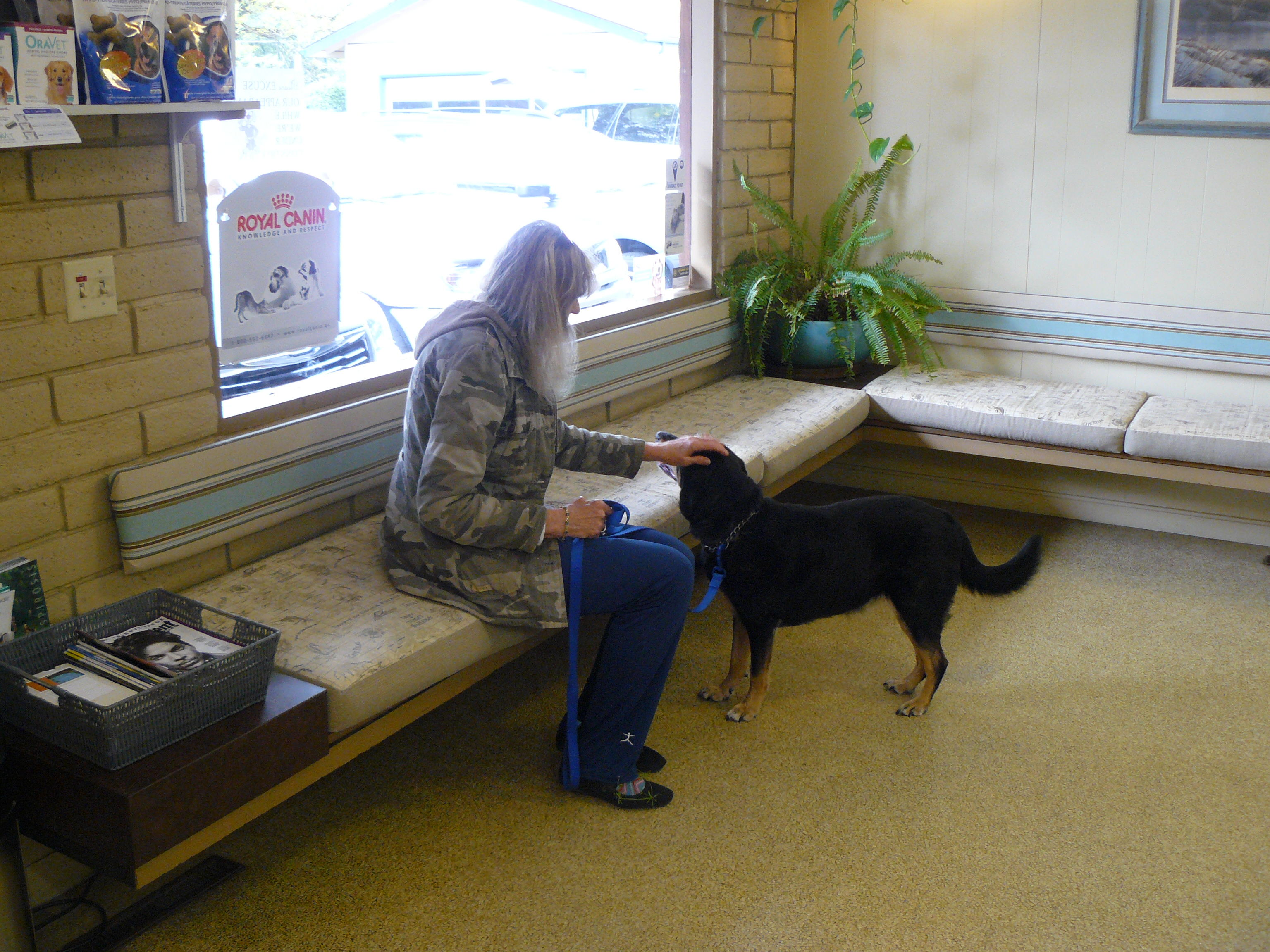
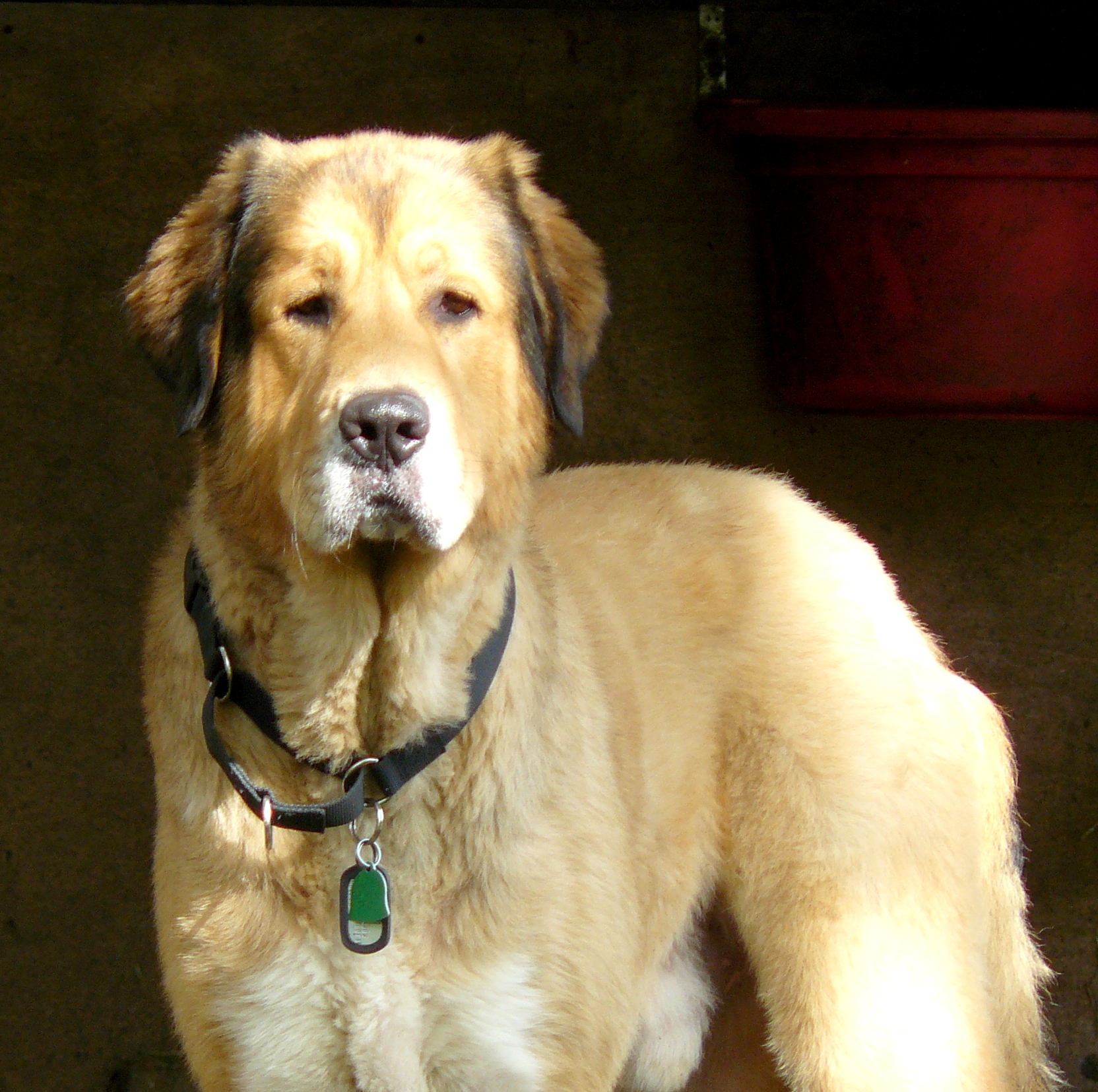
Hazel at the clinic shortly before she was taken in by the staff.
The good news is that Dr. Parker did not find any sign of trauma or life-threatening illnesses in Hazel’s body especially focusing on her abdomen.
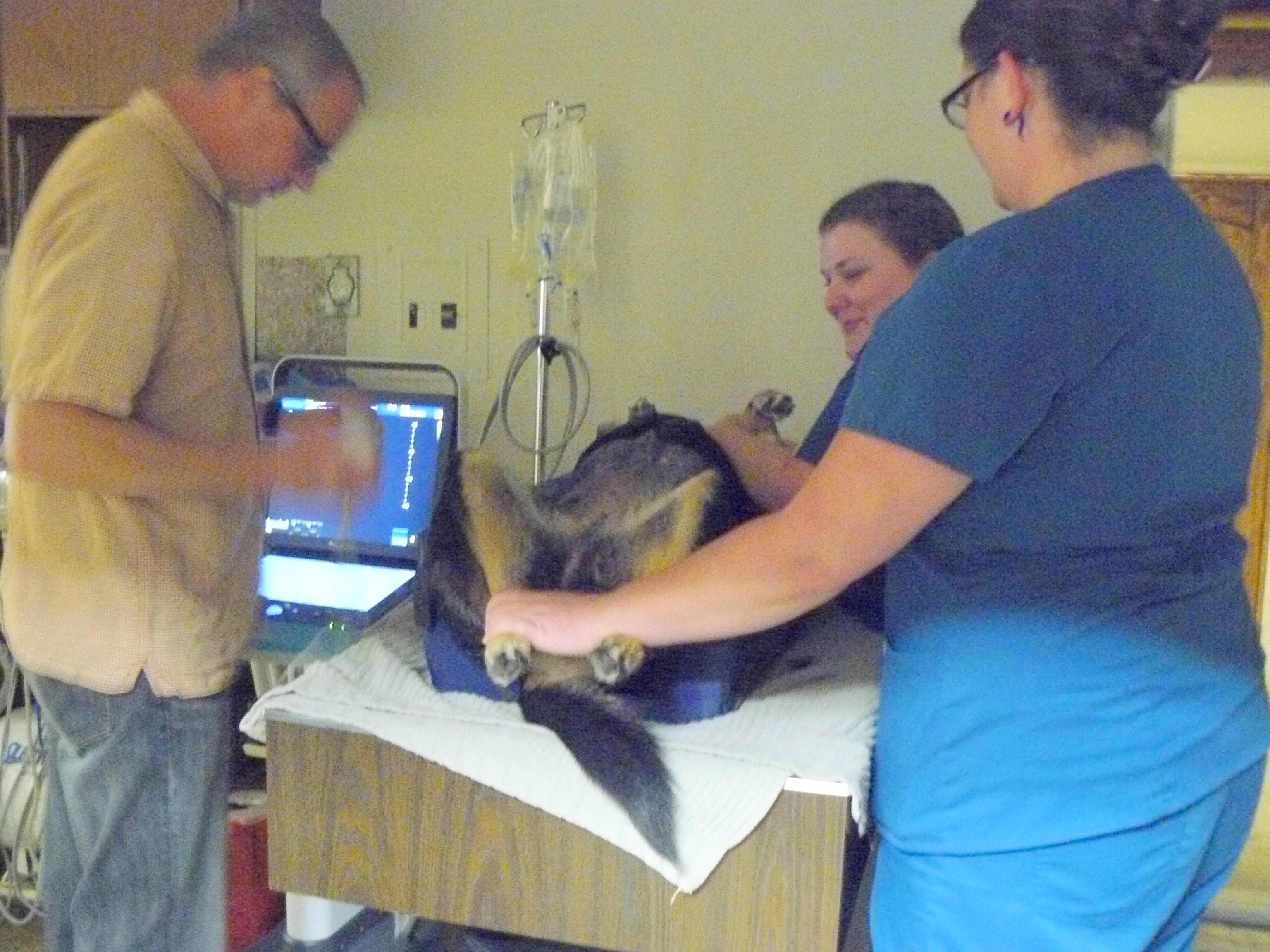
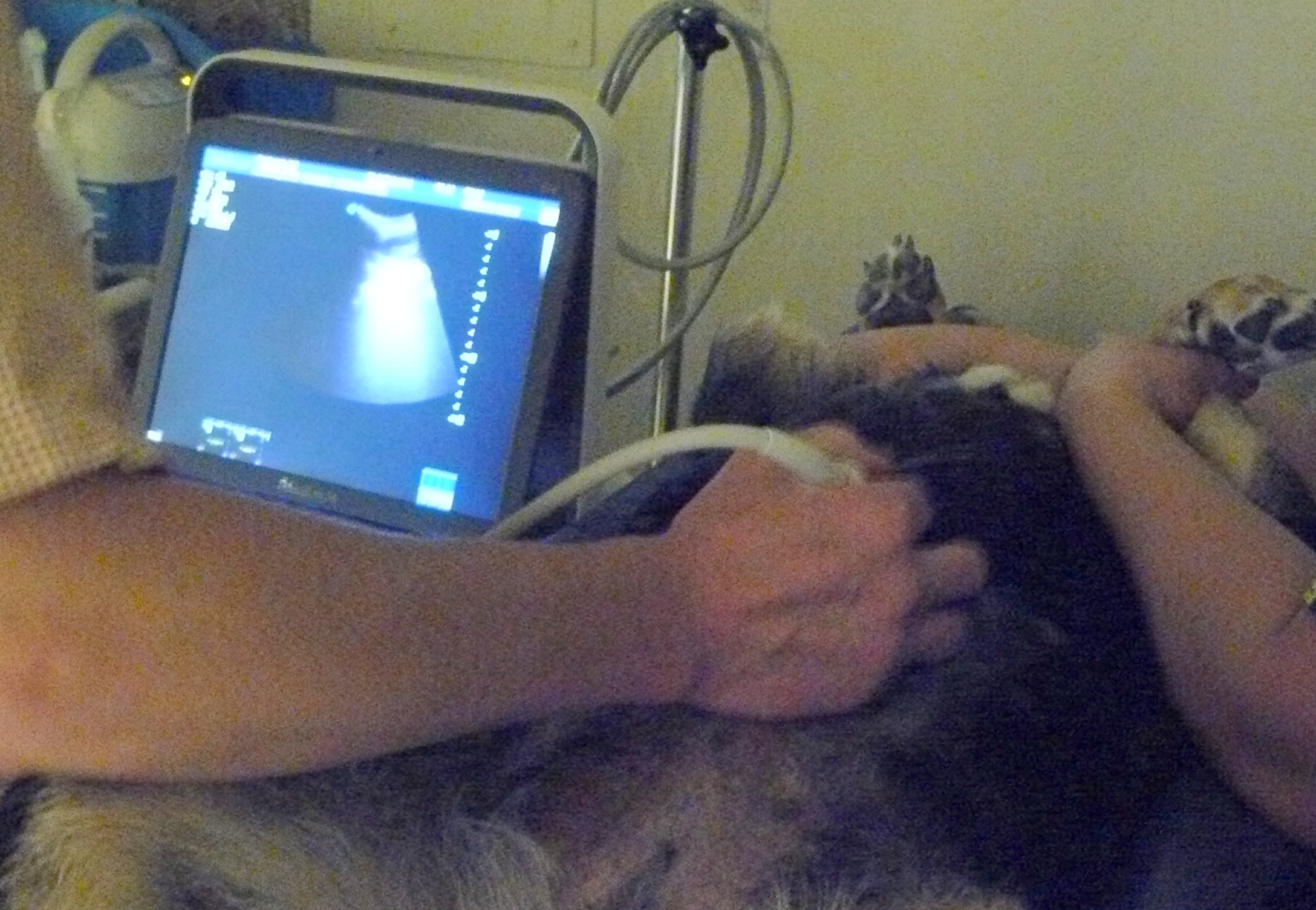
Dr. Parker to the left being assisted by clinic staff as he examines Hazel ultra-sonically.
(I should be quick to say that I left my camera with one of the technicians and wasn’t present. Indeed, Jean and I did not get to meet Dr. Parker.)
Dr. Parker, who is a board-certified veterinarian doctor, came to the conclusion that the most likely cause of Hazel’s illness was the fungal lung infection, as Dr. Codd and the radiologist supposed.
Nothing frightening seen!
To try and narrow down the exact fungal infection a further blood sample was taken and the lab results should be known in three or four days time.
Dr. Codd, in his briefing to Jean and me when we collected Hazel late afternoon, said that his recommendation based on the lack of any notable findings from the scan could be summarised as follows:
Regard treating the fungal infection as the number one priority,
Hold off from treating the tick fever in the interim,
Dose Hazel with 100mg of Fluconazole twice a day even if she is eating hardly anything,
The measure is whether Hazel, with a very small food intake, can take that dosage without vomiting,
Add a B12 tonic to her diet with immediate effect,
Give Hazel appetite stimulant medicine,
Consider the hemp oil (as queried by me) if the proper dosage can be determined.
(Petspeopleandlife: Hazel’s current weight is 53 lbs (24 kg). Any advice?)
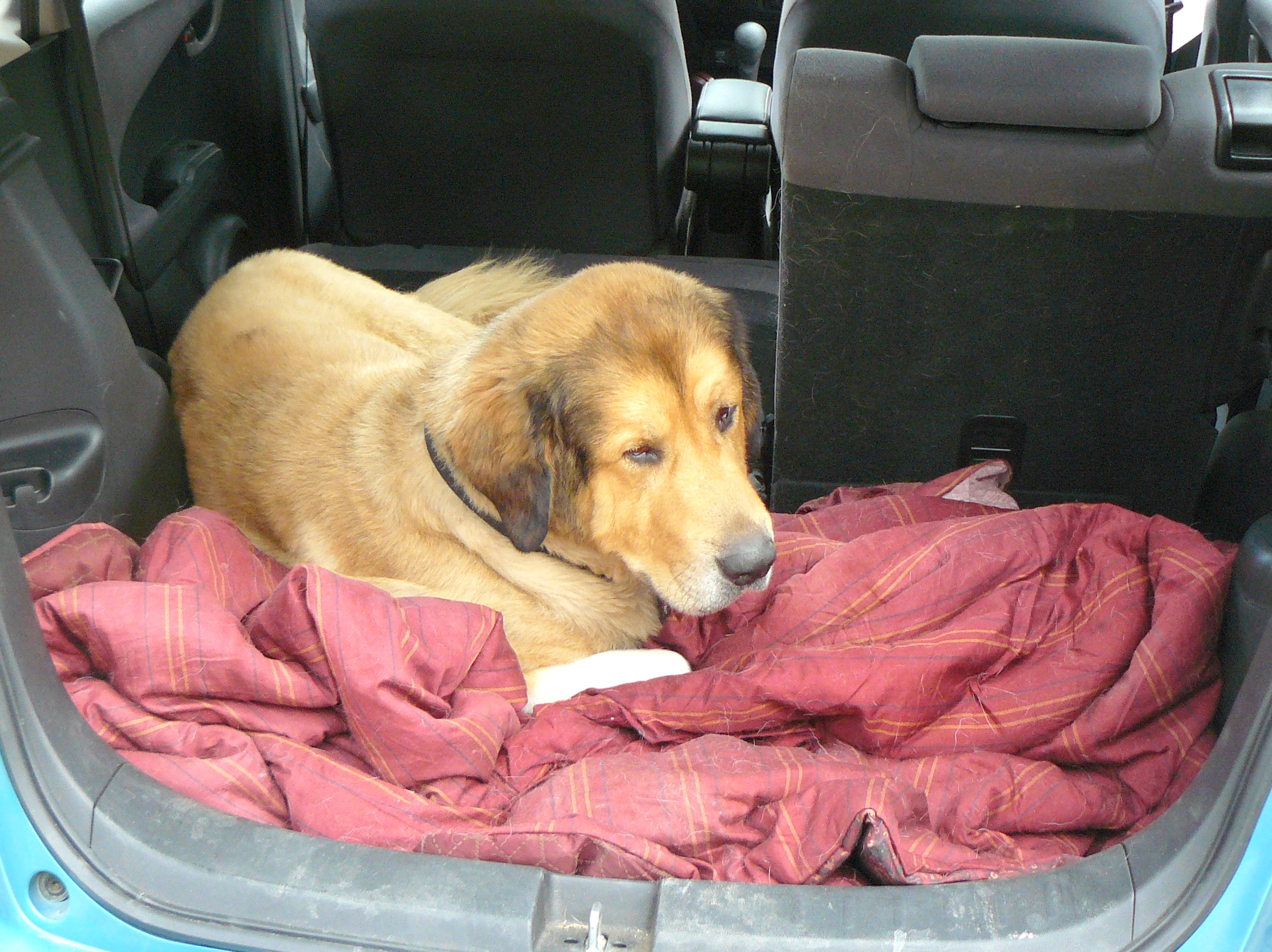
Back home again albeit still feeling a little drowsy!
Thus while we have not yet got to the bottom of what precisely is the nature of Hazel’s infection at least we know there isn’t anything else silently killing her.
Thank you so much, dear readers, for taking so much interest in Hazel and for sending your love and caring wishes – it’s working! 🙂
Still a long way from getting to the bottom of what is ailing Hazel.
In my last post about Hazel I opened by saying:
In the last post on Hazel’s condition, back last Thursday, I passed on Dr. Codd’s observation, “… that by not having Hazel on her meds we were, of course, letting the fungal infection continue its damage.”
Dr. Codd also recommended reducing the dosage of the Fluconazole to lower its side effect of suppressing appetite.
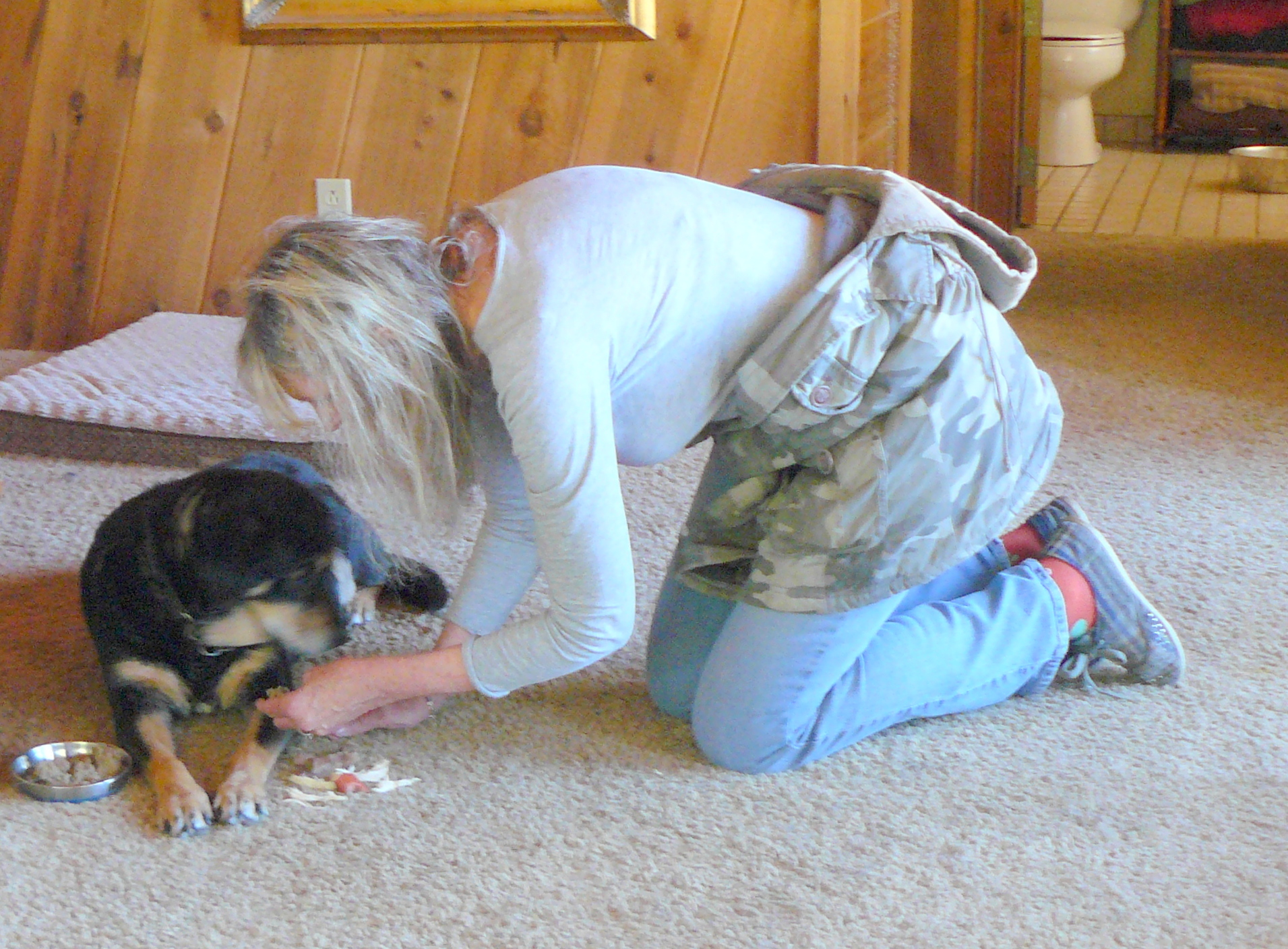
So since then, with outstanding care and patience, Jean has been coaxing Hazel to eat just sufficient food for Hazel to be able to take the Fluconazole, for her fungal infection in her lungs, and Doxycycline, for her tick infection. (Mind you, Hazel is still a long way from eating reliably.)
That was a week ago and while, at best, Hazel is just eating sufficient to take her meds she is far from improving to any noticeable degree. But she is not eating enough food to stabilise her weight and yesterday morning Jean was worried we might lose her if we didn’t rethink what was going on.
Jean is attempting to get Hazel to eat many times each day.
A Sunday morning call to Dr. Jim Goodbrod brought us the advice to re-think the evidence.
The titre results were negative but because there are so many variants of fungal infection that was discounted.
The film of Hazel’s lungs show what the radiologist described as a clear case of fungal infection.
However, if that infection had been in the past, before Hazel was taken in by us down in Mexico, and that infection had ceased, that film could be showing scarring in the lungs.
The positive result for Tick Fever showed evidence of antibodies not antigens. That might be interpreted as a previous incident.
Jim liaised with Dr. Codd and it was agreed that further examinations needed to be conducted to obtain a clear, unambiguous diagnosis and that in the interim we stop giving Hazel any medications and offer her body systems a bit of a rest.
One option being discussed is to call in a mobile sonogram or ultra-sonic scanner. There is a very expert doctor in the area who uses such a mobile device and scans can be taken of Hazel’s abdomen and lungs here at home.
Because we will do everything to try and return Hazel to good health.
More information will be passed to you just as soon as it is to hand.
Last Wednesday, dear friend Dan Gomez sent me an email that was headed Going to be controversial. It simply contained a link to a recent ScienceAlert item: You need to stop hugging your dog, study finds. I have to admit that my response was a rather rude one! Here’s how that article opened:
With their sweet faces, soft fur, and huge dumb grins, dogs were basically born to be hugged. As a species, they evolved over thousands of years with one clear path – to garner our attention and affection, and profit from all the benefits awarded to ‘Man’s best friend’. But along the way, they’ve had to make some serious trade-offs.
A family dog will never be the leader of the pack. It will be closed in, told when and where to pee, and now, preliminary data from a new study suggests that in return for room and board, our dogs suffer through our hugs.
I know, I know, it’s tough to hear, but bear with us, because it’s not all terrible news. Maybe your dog is cool with hugs. Maybe it finds your hugs annoying, but affection is affection, so it’ll take what it can get. Or maybe it freaking hates hugs and you’re stressing the crap out of it. All dogs are different, you just need to know how to read them.
Anyway, I was delighted to see the Care2 blogsite put out a slightly different assessment. I have great pleasure in republishing that Care2 article in full.
On the feel-good scale of one to 10, tenderly wrapping your arms around your dog and giving your pooch a gentle squeeze rates a solid 10, am I right?
But for dogs, the feeling apparently isn’t mutual, at least according to research by dog-training expert Dr. Stanley Coren, a psychology professor at the University of British Columbia.
Coren examined 250 images on Google and Flickr of people hugging dogs. In his blog “The Data Says ‘Don’t Hug the Dog!’” on Psychology Today, he noted that 81.6 percent of the dogs showed some symptoms of stress, anxiety or discomfort.
“I can summarize the data quite simply by saying that the results indicated that the Internet contains many pictures of happy people hugging what appear to be unhappy dogs,” Coren wrote.
The reason dogs dislike hugs, Coren explained, is because when they are threatened or otherwise under stress, their natural instinct is to run away, so being wrapped in our arms prevents them from doing what comes naturally. This can raise their stress levels.
“Save your hugs for your two-footed family members and lovers,” Coren wrote. “It is clearly better from the dog’s point of view if you express your fondness for your pet with a pat, a kind word and maybe a treat.”
I think it’s important to note that Coren’s study was not peer reviewed (i.e., it has not been approved by other scientists as being legit), nor was it published in any scientific journal, but only on PsychologyToday.com. “This is a set of casual observations,” Coren told the Washington Post in regard to all the recent media attention to his findings.
With this in mind, I decided to conduct my own non-peer-reviewed study for Care2.com. (I’ve been writing professionally about dogs for years and have had them as pets for most of my life, so that makes me kinda-sorta an expert, in my humble opinion.)
For my research, instead of passively Googling photos, I actively hugged two very willing study participants: my dogs, Leroy and Ella.
Leroy (that’s him getting hugged in my profile picture) seemed to enjoy the hug; he wagged his tail and the corners of his mouth curled up in what could be interpreted as a smile. Although Ella, who is a nervous dog, tensed her body at first, she relaxed after a few seconds and calmly rested her chin on my shoulder.
My conclusion: Dogs don’t hate hugs. While I wouldn’t recommend walking up to a strange dog and giving him a big ol’ bear hug, I don’t think there’s any need to stop hugging our own dogs based on Coren’s casual observations.
Neither does Corey Cohen, a companion animal behavior therapist. He told the New York Times the dogs in the photos Coren studied may have appeared anxious because they didn’t like having their pictures taken, or perhaps they were being forced to pose.
“My dogs love being hugged,” Cohen said, probably speaking on behalf of many of us dog owners. “I can definitely tell. Their facial expression changes: ‘Oh, give me more!’”
How to Tell if Your Dog Enjoys Hugs
If you’re not quite sure whether your dog likes to be hugged, here are some of the signs that he’s not into it, according to Coren and Erica Lieberman, a New York City dog trainer and behavior consultant.
Your dog turns his head away as you hug him.
He closes or half-closes his eyes. “Alternatively, dogs will often show what is commonly called a ‘half-moon eye’ or ‘whale eye,’ which is where you can see the white portion of the eyes at the corner or the rim,” Coren wrote.
He lowers his ears.
He licks his lips.
He yawns.
Lieberman told the New York Times that people should look for what she called “cutoff signals” when hugging their dogs. If dogs “shake off” after the hug, just as they shake off water after a bath, it means they didn’t enjoy it.
If your dog shows none of these warning signals, I say go ahead – hug it out.
I am referring to the one between human and animal.
The millions of people who love their pets probably never stop to think about how far that love would extend. As I observe Jean’s patience in coaxing Hazel to take food, time and time again each day, it never crosses my mind that there would be a limit to that devotion from her.
When I think about our animals and the special relationships we have with them all, dogs, horses and cats, never for a moment do I weigh up the pros and cons, despite there being many limitations when one stops and ponders the fact. Like the fact that Jean and I have not been away for a honeymoon or any other vacation together since we were married in 2010.
All it takes is for a dog to rub its head against my leg, or a cat to curl up on my lap, or a horse to give in to a hug around its head, something that happens many times each day, and I am content.
However, the following article that appeared on the Care2 blogsite really underlined how much people will give for their animals.
A story recently went viral about a Colombian man who risked his life to save a dog that was hanging from a balcony. The dog, who belongs to the man’s upstairs neighbors, was caught in the railing and was close to falling to the ground. The neighbor, whose name is Diego Andrés Dávila Jimenez, made a dangerous climb from his balcony up to his neighbors’ in order to save the dog.
For animal lovers, there wouldn’t be a second thought about doing the same, whether it was their own pet, someone else’s or an animal in the wild. People go great lengths for animals every day. Here are just a few inspirational examples of them.
Ric O’Barry Does Jail Time for Dolphins
In 1970, Ric O’Barry founded The Dolphin Project and since then, he has dedicated his life to saving dolphins. His life’s work hasn’t been easy, though. O’Barry – who was featured in the 2009 documentary The Cove – has been detained, fined and threatened for his dolphin activism. In January, he was detained at a Japanese airport on his way to monitor the annual dolphin hunt in Taiji. By now, being detained is nothing new to O’Barry, as it happens nearly every time he visits Japan for the hunt. In August, O’Barry was arrested in Japan for not carrying his passport. Still, he carries on with his mission to rescue dolphins.
Adam Warwick saved a black bear from drowning
When a bear is roaming around a neighborhood, sedating it is one of the only safe options. That’s what Florida wildlife officers did when they got a call about a black bear wandering around an Alligator Point neighborhood. The officers shot the bear with a tranquillizer dart, but the bear ran away and headed straight into water, where he would eventually fall asleep and drown. Biologist Adam Warwick came to the bear’s rescue and pulled the 400-pound bear back on land. The bear was then safely transported back to its home in a national forest.
Motorist fights traffic to save injured dog
A Mexican woman was driving down a busy highway when she saw a dog get hit by a car and lay injured on the side of a crash barrier. Nobody stopped or slowed down as they drove by, leaving her to try to dodge traffic to get to the dog. The timid dog tried to limp away, but she eventually gained its trust and took it to an area vet to have its injuries treated.
Man saves a stranger’s dog that was blown off a pier
An Australian woman was walking her Shih Tzu-Maltese Bibi on a pier when a strong gust of wind picked the dog up and carried him into the water. Raden Soemawinata was at the pier scattering his grandmother’s ashes when he saw the Bibi in the water and immediately jumped in to save him. Soemawinata humbly told media that “it wasn’t such a great feat.” We think otherwise.
Two Norwegian men save lamb from drowning
Three friends were out taking pictures when they noticed a lamb struggling in choppy waters. Two of the young men worked together to rescue the lamb, while the other used the camera to take incredible pictures of the rescue. They pulled the lamb to safety and reunited it with its flock.
Randy Jordan removes hooks from sharks
Most people try to avoid sharks. Randy Jordan has made a mission to help them. The diver frequently noticed fishing hooks caught in sharks’ mouths, so he made it his mission to remove the hooks from the sharks he encountered. He worked with scientists in order to find the safest way – for himself and the sharks – to have the hooks removed. Jordan has gone on to free multiple sharks from the painful hooks.
Men save baby giraffe in crocodile-infested waters
For four hours, a baby giraffe tried to keep its head above the Uaso Nyiro river’s harsh waters. The Kenyan river is not only fast moving, but is home to many crocodiles. A group of men ignored the river’s danger and waded through the water to pull the giraffe back onto land.
With so many reminders, especially in the media, of the greed and selfishness of people it really does one good to read these seven examples of how wonderful is the bond between humans and animals.
In case you’ve forgotten the section on the food web from high school biology, here’s a quick refresher.
Plants make up the base of every food chain of the food web (also called the food cycle). Plants use available sunlight to convert water from the soil and carbon dioxide from the air into glucose, which gives them the energy they need to live. Unlike plants, animals can’t synthesize their own food. They survive by eating plants or other animals.
Clearly, animals eat plants. What’s not so clear from this picture is that plants also eat animals. They thrive on them, in fact (just Google “fish emulsion”). In my new book, “A Critique of the Moral Defense of Vegetarianism,” I call it the transitivity of eating. And I argue that this means one can’t be a vegetarian.
Chew on this
I’ll pause to let the collective yowls of both biologists and (erstwhile) vegetarians subside.
A transitive property says that if one element in a sequence relates in a certain way to a second element, and the second element relates in the same way to a third, then the first and third elements relate in the same way as well.
Take the well-worn trope “you are what you eat.” Let’s say instead that we are “who” we eat. This makes the claim more personal and also implies that the beings who we make our food aren’t just things.
How our food lives and dies matters. If we are who we eat, our food is who our food eats, too. This means that we are who our food eats in equal measure.
Plants acquire nutrients from the soil, which is composed, among other things, of decayed plant and animal remains. So even those who assume they subsist solely on a plant-based diet actually eat animal remains as well.
This is why it’s impossible to be a vegetarian.
For the record, I’ve been a “vegetarian” for about 20 years and nearly “vegan” for six. I’m not opposed to these eating practices. That isn’t my point. But I do think that many “vegetarians” and “vegans” could stand to pay closer attention to the experiences of the beings who we make our food.
For example, many vegetarians cite the sentience of animals as a reason to abstain from eating them. But there’s good reason to believe that plants are sentient, too. In other words, they’re acutely aware of and responsive to their surroundings, and they respond, in kind, to both pleasant and unpleasant experiences.
Check out the work of plant scientists Anthony Trewavas, Stefano Mancuso, Daniel Chamowitz and František Baluška if you don’t believe me. They’ve shown that plants share our five senses – and have something like 20 more. They have a hormonal information-processing system that’s homologous to animals’ neural network. They exhibit clear signs of self-awareness and intentionality. And they can even learn and teach.
I suspect how some biologists may respond: first, plants don’t actually eat since eating involves the ingestion – via chewing and swallowing – of other life forms. Second, while it’s true that plants absorb nutrients from the soil and that these nutrients could have come from animals, they’re strictly inorganic: nitrogen, potassium, phosphorus and trace amounts of other elements. They’re the constituents of recycled minerals, devoid of any vestiges of animality.
As for the first concern, maybe it would help if I said that both plants and animals take in, consume or make use of, rather than using the word “eat.” I guess I’m just not picky about how I conceptualize what eating entails. The point is that plants ingest carbon dioxide, sunlight, water and minerals that are then used to build and sustain their bodies. Plants consume inasmuch as they produce, and they aren’t the least bit particular about the origins of the minerals they acquire.
With respect to the second concern, why should it matter that the nutrients drawn by plants from animals are inorganic? The point is that they once played in essential role in facilitating animals’ lives. Are we who we eat only if we take in organic matter from the beings who become our food? I confess that I don’t understand why this should be. Privileging organic matter strikes me as a biologist’s bias.
Then there’s the argument that mineral recycling cleanses the nutrients of their animality. This is a contentious claim, and I don’t think this is a fact of the matter. It goes to the core of the way we view our relationship with our food. You could say that there are spiritual issues at stake here, not just matters of biochemistry.
Changing how we view our food
Let’s view our relationship with our food in a different way: by taking into account the fact that we’re part of a community of living beings – plant and animal – who inhabit the place that we make our home.
We’re eaters, yes, and we’re also eaten. That’s right, we’re part of the food web, too! And the well-being of each is dependent on the well-being of all.
From this perspective, what the self-proclaimed “farmosopher” Glenn Albrecht calls sumbiotarianism (from the Greek word sumbioun, to live together) has clear advantages.
Sumbioculture is a form of permaculture, or sustainable agriculture. It’s an organic and biodynamic way of farming that’s consistent with the health of entire ecosystems.
Sumbiotarians eat in harmony with their ecosystem. So they embody, literally, the idea that the well-being of our food – hence, our own well-being – is a function of the health of the land.
In order for our needs to be met, the needs and interests of the land must come first. And in areas where it’s prohibitively difficult to acquire the essential fats that we need from pressed oils alone, this may include forms of animal use – for meat, manure and so forth.
Simply put, living sustainably in such an area – whether it’s New England or the Australian Outback – may well entail relying on animals for food, at least in a limited way.
All life is bound together in a complex web of interdependent relationships among individuals, species and entire ecosystems. Each of us borrows, uses and returns nutrients. This cycle is what permits life to continue. Rich, black soil is so fertile because it’s chock full of the composted remains of the dead along with the waste of the living.
Indeed, it’s not uncommon for indigenous peoples to identify veneration of their ancestors and of their ancestral land with the celebration of the life-giving character of the earth. Consider this from cultural ecologist and Indigenous scholar-activist Melissa Nelson:
The bones of our ancestors have become the soil, the soil grows our food, the food nourishes our bodies, and we become one, literally and metaphorically, with our homelands and territories.
You’re welcome to disagree with me, of course. But it’s worth noting that what I propose has conceptual roots that may be as old as humanity itself. It’s probably worth taking some time to digest this.
ooOOoo
In reflecting on how to close this post I couldn’t help thinking that “The bones of our ancestors have become the soil, ” presumably includes the bones of our dogs! Leading me to ponder that maybe our dogs from old are nourishing our bodies; I would like to think that is the case.
The powerful combination of good medicine and unconditional love.
In the last post on Hazel’s condition, back last Thursday, I passed on Dr. Codd’s observation, “… that by not having Hazel on her meds we were, of course, letting the fungal infection continue its damage.”
Dr. Codd also recommended reducing the dosage of the Fluconazole to lower its side effect of suppressing appetite.
So since then, with outstanding care and patience, Jean has been coaxing Hazel to eat just sufficient food for Hazel to be able to take the Fluconazole, for her fungal infection in her lungs, and Doxycycline, for her tick infection. (Mind you, Hazel is still a long way from eating reliably.)
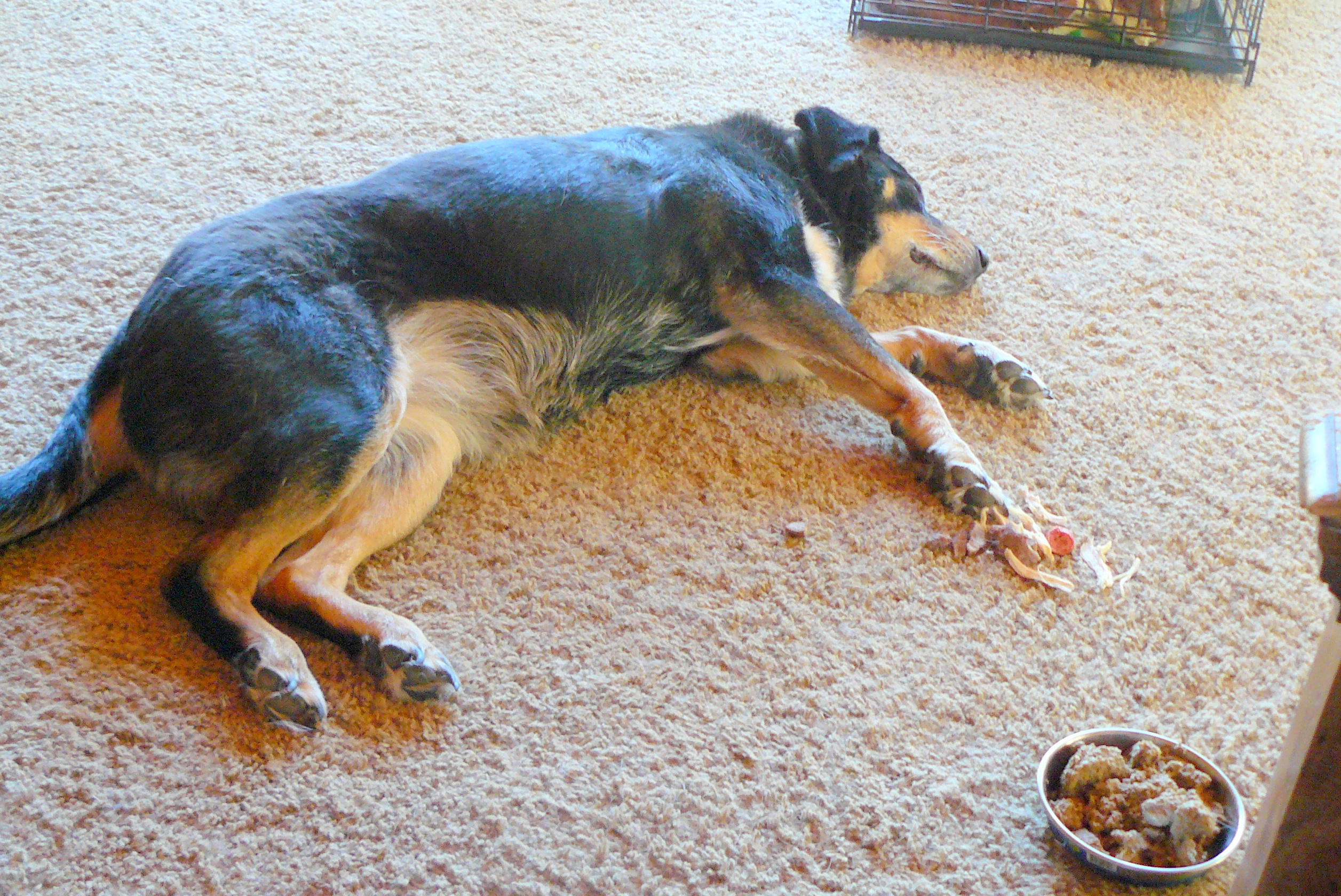
Yesterday, (Saturday) Hazel was showing clear signs of feeling better but still having to be hand-fed by Jean.
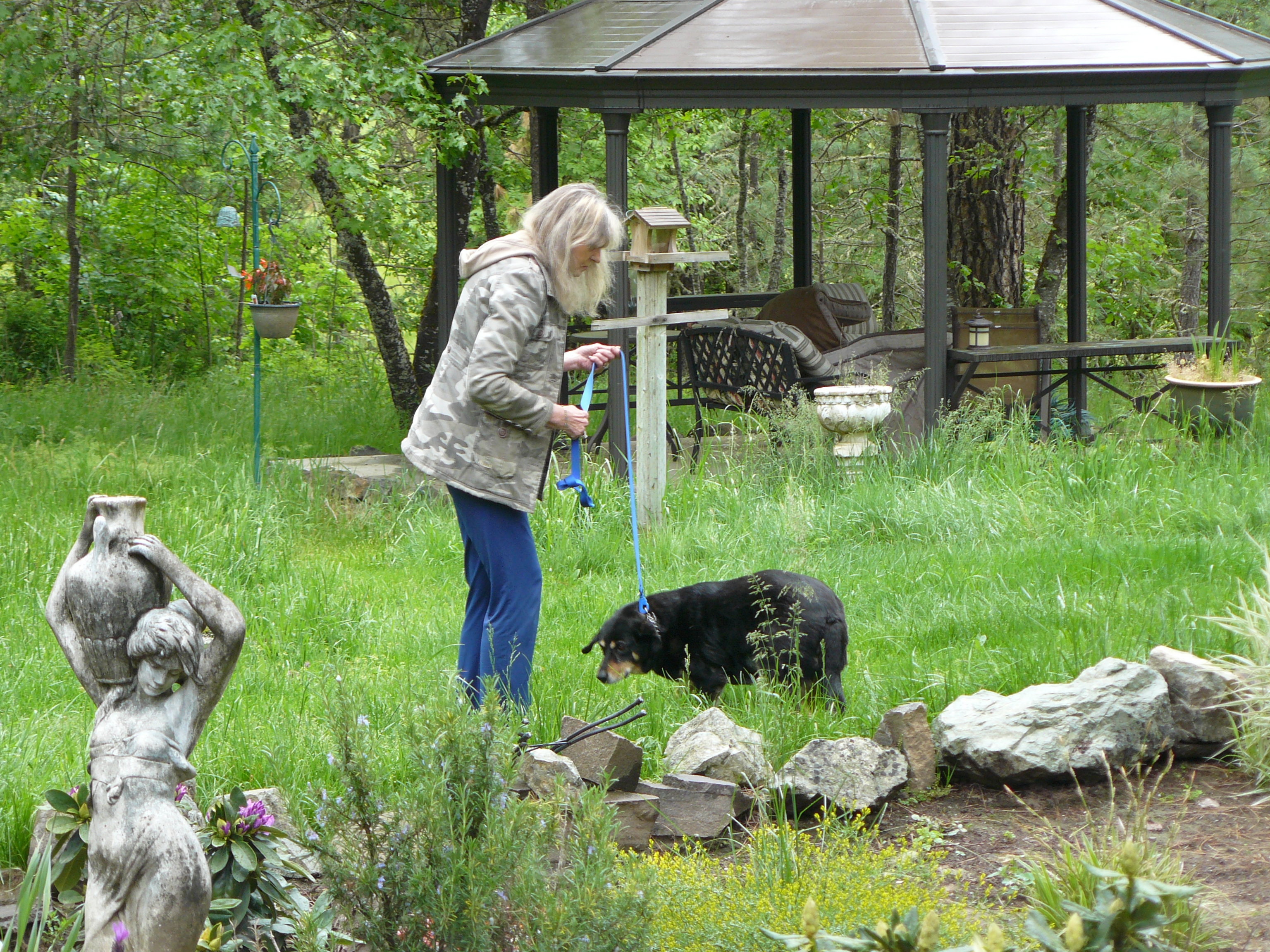
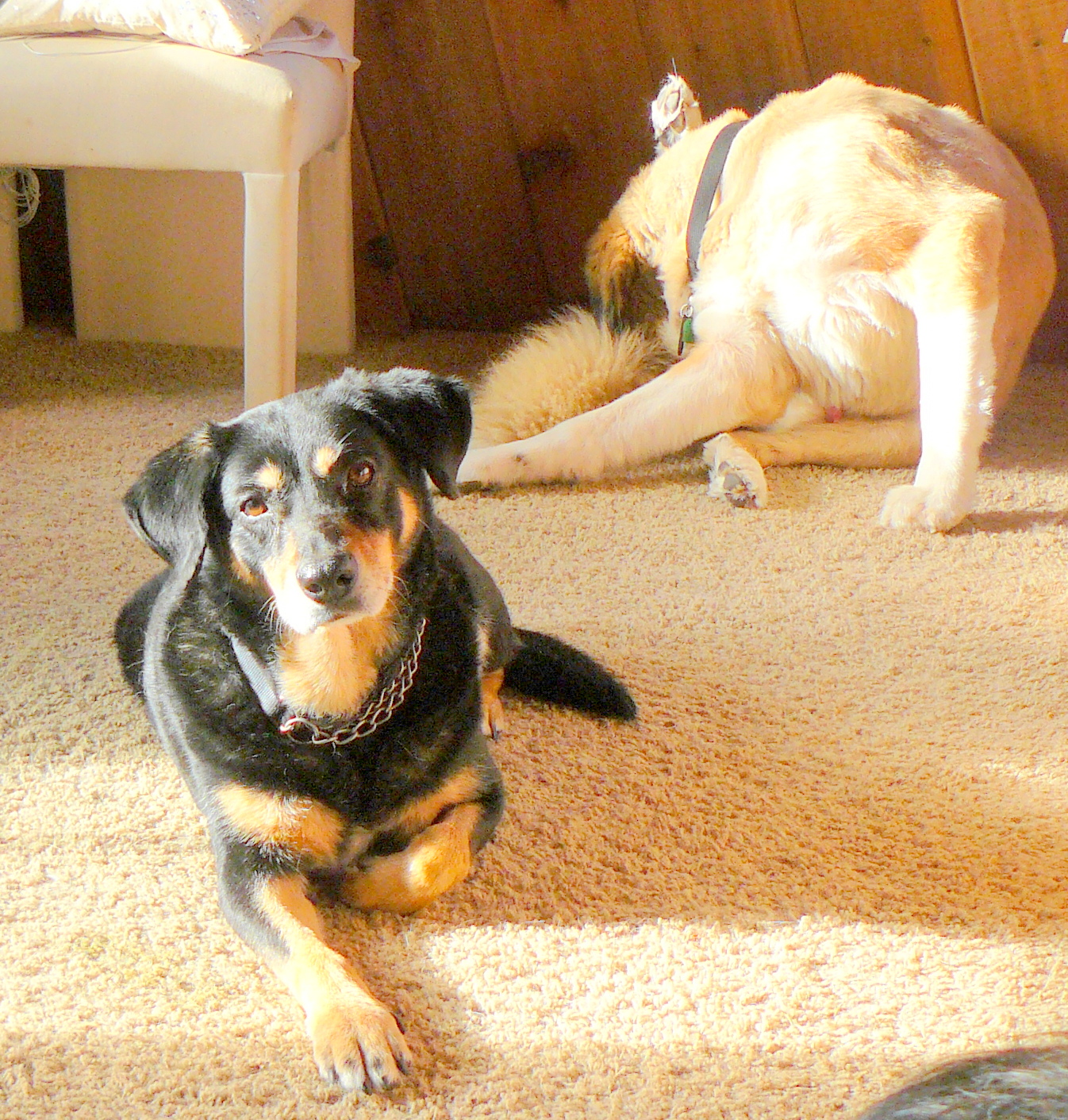
Then this morning (Sunday) she really was perky and readily came out for a walk with the other dogs.
First time in recent days when Hazel has shown an interest in the world around her.
oooo
A return of a head gesture unique to Hazel that we haven’t seen in ages! 🙂
More generally, Dr. Jim was trying to track down supporting details to the observation made by Dr. Russ:
Namely, that there was evidence that fungal infections can lay dormat for quite long periods of time.
Jim sent me the following email:
Paul …
The following article is the one and only reference I have found so far that refers to the possible dormancy of this fungal infection. In paragraph 2 (Clinical Disease) I have highlighted it in red. I have to admit, I was skeptical.
Jim
The article was:
Coccidioidomycosis (Zoonotic) Last updated on 2/4/2011.
Contributors:
Rhea V. Morgan DVM, DACVIM, DACVO
Synonyms:
San Joaquin Valley Fever
Valley Fever
This is that domancy aspect from that paper that Jim highlighted (in red):
The incubation period in the dog is 1 to 3 weeks.1,2The organism can remain dormant, with exposure preceding the onset of clinical signs by 3 years or more.1,3 Although people may acquire the disease from the same sources as domestic animals and the mycelial forms are highly infectious, with one exception the disease has not been transmitted from animals to people. One published report exists of transmission to a veterinary assistant via the bite of an infected cat.15
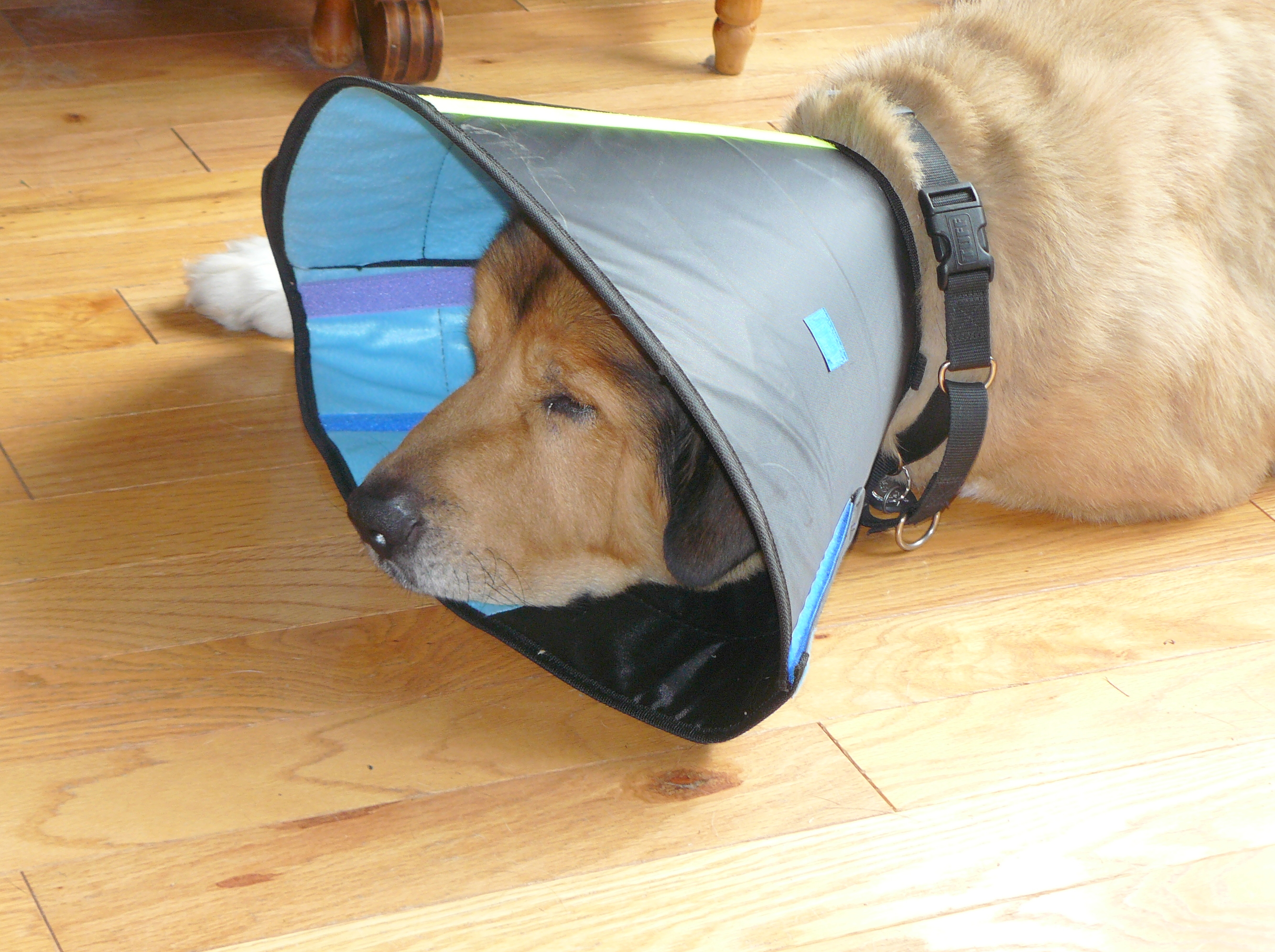
Meanwhile, over in Brandy’s corner, he has very quickly healed after his neutering operation last Thursday. It was fair to say that he was not a happy chappy when he arrived home that day.
Didn’t like that!
oooo
And I can’t even lick my balls!
But his cone was off by Saturday and he is back to the wonderful, bouncing dog we all love so much. (Can’t believe that last Saturday was only the second week that Brandy had been with us; he has so quickly woven his way into all our hearts.)
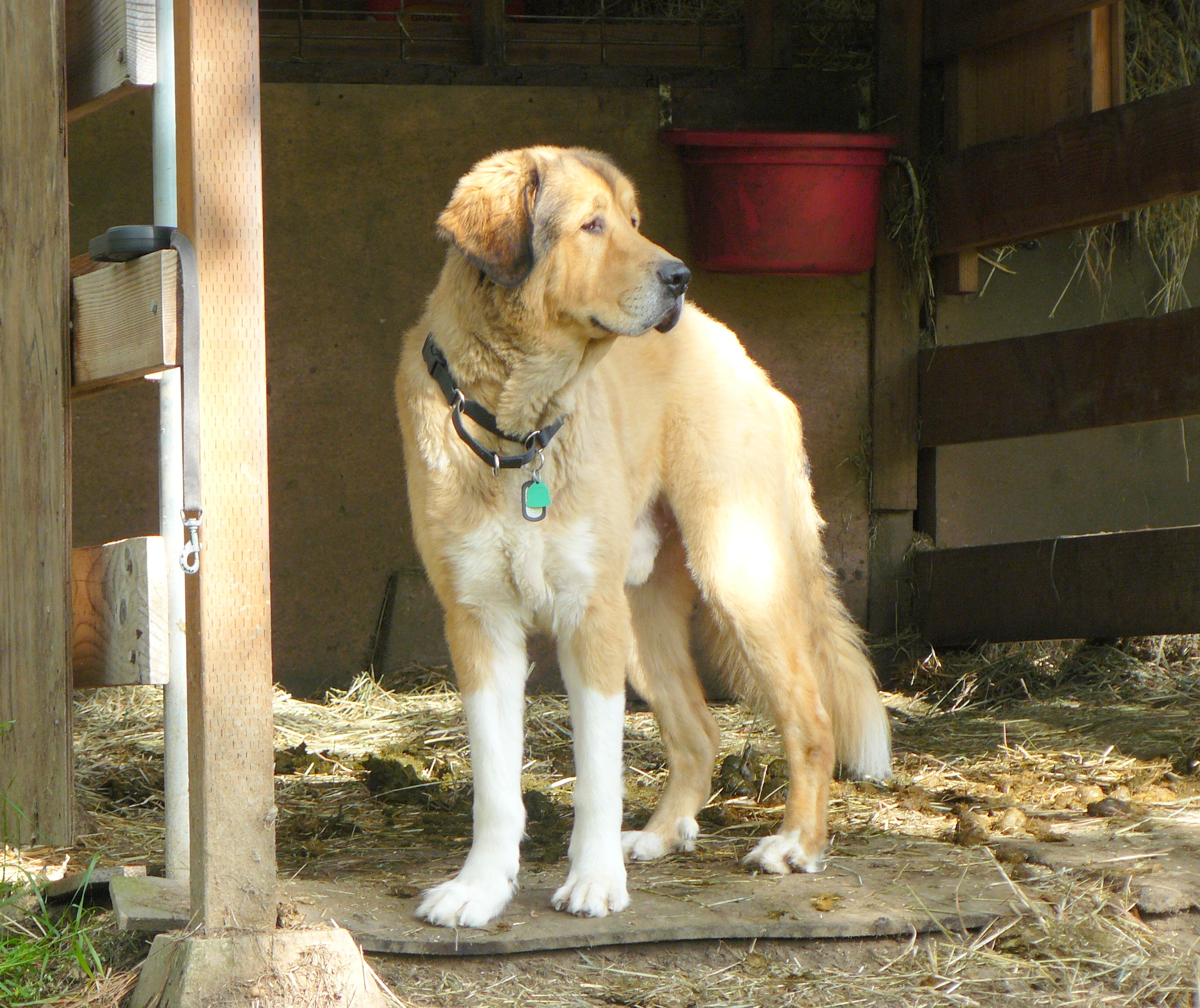
Checking out the stables yesterday (Sunday) morning.
oooo
Behind that placid expression is the most docile, loving brain and heart one could ever wish for!
Returning to Hazel we are still some way from knowing that she has returned to a fully fit dog but the love and caring sent her way by all of you out there has been precious beyond imagination.
A fabulous example of how we reach out to others across the internet!
A week-and-a-half ago in came an email to me:
Hi Paul,
Just came across a post of yours for Earth Day 2014.
Absolutely love the fact that you’ve written about a “Green” topic!
In fact, I wanted to reach out and let you know that in honor of this year’s Earth Day (April 22), I just finished designing an infographic about 14 easy ways dog owners can become more environmentally friendly people.
Would it be okay with you if I passed it along? I’d love to hear your thoughts on it!
Best,
Mike
Mike was Mike Shannon, about which more at the bottom of this guest post. Of course, I was delighted to receive his lovely guest post and infographic. Over to Mike.
ooOOoo
In its 46th anniversary to date, Earth Day is bound to continue to do what it has always succeeded in doing, help raise awareness among† individuals from all across the globe about environmentally-friendly topics so they work together to make this† world a better place to live in for the future generations to come.
In honor of this year’s Earth Day, which happens to be on Friday, April the 22nd, Ultimate Home Life have designed an info-graphic† that explains the most important 14 steps you can take as of today to go green with your dog.
This topic is certainly nothing to be taken lightly, and most certainly nothing of the impossible. Just look at the statistic provided at the beginning of the info-graphic – nearly 50% of families in the United States alone have a dog at home, which makes for more than 70 million dogs!
Let’s kick off our “going green” mission this year by making our dogs greener, one dog at a time.
If you have any tips for going green with your dog, make yourself heard in the comments!
Bio: Michael is the creator, editor, webmaster – alright, let’s just say he runs the show over at UltimateHomeLife.Com! He regularly blogs about anything and everything dog related, with an emphasis on trying to cover all questions that dog owners tend to worry about. So, hop over and give him a bark!
ooOOoo
What a fabulous and highly pertinent post for these times.
Happy Earth Day to all of us and our wonderful dogs right across this magnificent planet.
So said Sophocles. But too slow a decision, or no decision is, of course, a decision in its own right.
Last Tuesday in my update on Hazel Of art, and science I wrote:
It seemed to make sense that until we had confirmation of whether or not Hazel had a lung fungal infection, for which taking Fluconazole would be an excellent course of action, we should pause in her dose until the results were in.
At 08:45 this morning we had to take Brandy in to Lincoln Road Clinic for his neutering operation (that we heard a short time ago has gone well with no complications – he will be collected in about an hour). Dr. Codd asked after Hazel and we said that she was brighter but still not eating sufficient for her to be taking her medications.
Dr. Codd then made the eminently sensible observation that by not having Hazel on her meds we were, of course, letting the fungal infection continue its damage.
In response to the query as to why a fungal infection from either Mexico or Arizona had taken so long to appear, Dr. Codd added more sense to the situation. Namely, that there was evidence that fungal infections can lay dormat for quite long periods of time. Possibly in Hazel’s case the trigger for the infection becoming active was the additional stress on Hazel’s body systems from her recently contracting an Ehrlichia Infection from a local tick.
The final element for the argument of not delaying any longer Hazel’s healing medications was that the titre results would only be a result of one particular ‘brand’ of fungal infection. Dr. Codd said that it may well have been one of many other fungal infections that took hold of Hazel’s lungs.
So the decision was made to try Hazel on an oral anti-nausea med that would be much easier to administer. It is Ondansetron Orally. Also to cut down the dosage of the Fluconazole so that it doesn’t dampen Hazel’s appetite for food, a known side effect of Fluconazole, in quite such a dramatic fashion. (Note: Fluconazole is the least appetite suppressant compared to alternatives.)
So there we are.
We hang on to the fact that Hazel is still with us and coping with what is ailing her, albeit with a heightened stomach sensitivity that is complicating eating. Time is on our side.
A thousand thanks to all of you that have shown so much love and concern for our dear hazel.
Dear people, I must add this: CAUTION: The following is offered by way of information reaching out to other loving dog owners. Please do not assume I have any specialist veterinarian knowledge and please do not take the following as a replacement for seeing your own vet.
Finally, Mike Shannon is my guest blogger with a lovely post for Earth Day 2016 that will be published in a little under 10 hours time. That is why this post has been published now.
Today’s post was inspired by something yesterday I read, not for the first time, over on The People Workshop site. (As an aside, I know that many regulars of this place are familiar with the history of my friendship with Jon.) On the page that explains more of Jon Lavin’s approach to his work with clients, he writes:
“We can’t solve problems by using the same kind of thinking we used when we created them.”
Thus said Albert Einstein (1879-1955).
Intuitively, it strikes one as correct. However, reflect for a few moments on how you think and very quickly it becomes clear that how you think is based on deep-seated experiences and the learnings that flow from those experiences.
As it is for all of us.
Just as relevantly, perhaps more so, is that how we behave is based on those same deep-seated experiences and subsequent learnings. This offers a clue as to why bringing about lasting, behavioural change can often feel like pushing water uphill!
That prompted me to look up a previous time when I had written a post about feelings. It was last December when in a post called Feelings – Of Both Humans and Animals, I wrote this:
There couldn’t have been a better answer to that ponder than a recent video that was presented by TED Talks. It was a talk by Carl Safina about what is going on inside the brains of animals: What are animals thinking and feeling? Or in the fuller words of that TED Talk page:
What’s going on inside the brains of animals? Can we know what, or if, they’re thinking and feeling? Carl Safina thinks we can. Using discoveries and anecdotes that span ecology, biology and behavioral science, he weaves together stories of whales, wolves, elephants and albatrosses to argue that just as we think, feel, use tools and express emotions, so too do the other creatures – and minds – that share the Earth with us.
So back to what inspired today’s post. It was the challenge of really knowing why we behave the way we do, both humans and dogs. With dogs, however, we accept they cannot speak to us clearly. Or as Esme put it in a recent reply to an update on Hazel: “Well you’re getting there, half the battle is diagnosis with dogs because they can’t actually tell us how they feel.” (My emphasis.)
Back to humans. When Jon wrote on his site, “…. how you think …… is based on deep-seated experiences ….”, what I heard is that for us humans there are many times when we cannot actually tell ourselves what we are feeling. That is why we need the counselling of someone who has the professional training and experience to expose those deep emotional and psychological drivers within us; those drivers that are normally out of sight from us.
In my own case, how my father’s death was managed by my mother back in December, 1956 left an emotional wound that was totally out of sight from my conscious mind for 50 years. The emotional crisis that I went through back then was discovered by Jon to have its roots back in December, 1956. By a massive stroke of fortune Jon gave me the insight into that mental place of old and a year later I met Jean down in Mexico.
In other words, to return to Albert Einstein:
“We can’t solve problems by using the same kind of thinking we used when we created them.”
The challenge is having sufficient self-awareness to know when an aspect of our behaviour requires the support of the Jon Lavins of this world.
So what would we require from a counsellor, from a therapist, who was working with us to uncover those hidden aspects? In other words, in terms of assessing that therapist what’s the difference that would make the difference?
Naturally, I don’t have the skills to answer that question in any direct, professional manner. But if I look down at our dogs then a form of answer does ‘speak’ to me. Dogs are creatures of integrity, openness and trust. They relate to us humans and other known dogs around them through friendship and love; frequently unconditional love.
A therapist who embraces those values; nay, lives those values, would display that very quickly after meeting with the ‘client’. Any person seeing that in a therapist would be seeing the difference that makes the difference.
Good people, I’m not asking any of you who read this to divulge any personal stuff but, nonetheless, I would love to hear your thoughts on what I have written today!



 Learning from Dogs