Category: Dogs

More rescue tales.

Or should that be rescue tails!

I have another guest post for you tomorrow that, as with Maria’s story yesterday, will be appreciated greatly by you.

But for today I’m going to republish an item that appeared on the Care2 site that isn’t a million miles away from Maria’s theme about her Ellie finding lost persons.

ooOOoo

3 Rescued Dogs Who Saved Their Family Members’ Lives This Year

3187860.largeBy: Laura Goldman

August 25, 2016

Celebrated on August 26 every year, National Dog Day encourages pet adoptions and honors dogs who save lives, keep us safe and bring us comfort. Created in 2004 by pet lifestyle expert Colleen Paige, the holiday falls on the date her family adopted their first rescue dog. Among the ways you can celebrate are by adopting a dog of your own or donating $5 to your local animal shelter.

In honor of National Dog Day, meet three rescued dogs who really “pawed” it forward this year by saving the lives of their forever family members.

Leon Alerts Family to Home Intruders

As Theresa Lero was feeding her horses outside her Gulfport, Miss., home early one April morning, two armed and masked men entered her house.

When she went inside, her rescue dog, Leon, was growling at the door to the sunroom. Peeking through a window, Lero saw a man with a gun.

She ran to wake up her husband. Grabbing a gun, she ran back to the sunroom with her dog by her side. “Get ‘em, Leon,” she told him.

The men began shooting. They missed Lero, but shot Leon in the head. “You shot my dog. I’ll kill you myself,” Lero yelled at them. A neighbor heard her and called 911.

The intruders ran off and were later caught by police. In the meantime, the Leros rushed Leon to the veterinarian. Amazingly, the bullet skimmed his skull and exited out his ear. He was able to walk in and out of the animal hospital.

For saving his family, Leon was given a framed certificate of bravery from the county sheriff.

When the Leros adopted their dog from a shelter two years ago, they thought he was a redbone coonhound, so they named him after the singer Leon Redbone. As it turns out, Leon may actually be a red nose pit bull. One thing is certain: Leon is definitely a hero.

Haus Saves Girl from Rattlesnake

In May, 7-year-old Molly Deluca was playing in her Tampa backyard with Haus, the German Shepherd her family adopted in March from a rescue organization, when her grandmother noticed Haus jump in front of the girl and then rear up.

He was protecting her from a venomous Eastern diamondback rattlesnake that had slithered in from a habitat at a nearby state park. Haus “had every opportunity to run but he didn’t,” Molly’s mother, Donya Deluca, told the Associated Press.

Molly was unharmed, but Haus was bitten three times in the leg. He was successfully treated at an animal hospital for kidney damage, and was given a blood transfusion and anti-venom. A week later, Haus was well enough to return home. His expensive veterinary bills were covered by generous donations from an online fundraising campaign. Haus received a Heroic Dog Award from PETA.

“He just exceeded our expectations all the way around,” Molly’s dad, Adam DeLuca, told the Associated Press. “He’s the type of dog that when you want to go buy a dog, you pay thousands of dollars and that’s the dog you get. But we adopted him and got him for free.”

Earl Wakes Up New Owner as House Burns

Barely a week after he was adopted from Petco’s Stray Animal Adoption Program in July, a pug named Earl rescued his new dog mom by alerting her to a house fire in their Erlanger, Ky., home.

“He just fell asleep with me on the couch along with (another dog named) Tucker, and the next thing I know, he’s waking me up, licking my face. It’s the first time he’s done that,” Kristina Brate told WLWT.

The fire, believed to have been caused by faulty wiring, started in the basement and quickly spread through the rest of the house.

Brate lost almost everything in the fire, but she’s alive thanks to Earl. Petco awarded the hero dog with a $500 shopping spree to help replace the lost pet items and also stock up on some well-deserved treats.

“I believe that he came to me for a reason,” Brate told WLWT. “I think that, for some reason, the first family had passed him up and that there’s a reason why I got him.”

Photo credit: YouTube

ooOOoo

Physically, psychologically and emotionally the number of ways that dogs save us is almost limitless!

Delivering a new purpose in life.

Such a precious relationship!

Very frequently when I connect with dog lovers I make it clear that if they have any stories that they would like to share with you good people that they don’t hesitate to submit something. I am always blown away by these submissions. Indeed, there are two being offered to you dear readers this week.

So the first is from Maria Matthews and without any further delay from me, here it is.

ooOOoo

How an amazing Collie pup gave me a new purpose in life.

By Maria Matthews, 28th August 2016.

I was redundant, sitting at home, days divided between housekeeping, writing and walking Bob our dog who was then 7 years of age.

The trouble was I hate cleaning a house, and Bob an Norwegian elk-hound is allergic to being energetic.

My husband mentioned he would love to find a husky and as I was at home I agreed; I was 51 years of age and didn’t hold out much hope of finding work. Our search took us to a well known dogs rescue centre. They suggested we needed to build up our walls, as a husky needs a secure environment, plus the home and us would have to be inspected. We agreed, went home and made the necessary changes. When we returned we discovered there was one hiccup in the plan, a dog taken from the centre had to be housed indoors. We couldn’t agree to it, as Bob loves being outdoors.

I pointed this out and stressed that the backdoor is always open, but it was useless for they wouldn’t budge. The internet is a terrific place and google, God Bless him, suggested loads of places but when I rang there was no husky available. Until I contacted a lady in Easky, County Sligo (the Western side of Ireland) and she informed me she had twenty dogs for re-homing.

So on a sunny Saturday morning we, including Bob, set off. He wasn’t impressed with spending more than half an hour in the car and refused to lie down. We joked that he was watching the road, noting the sign posts, etc., in case he needed to make his own way back. However to cut a long story short, none of the twenty dogs liked him or he them. “We do have one other option,” she paused. “We have a collie cross husky who is extremely active, but she is still a pup.

We decided to meet the pup.This time when the gate opened there was a pause of maybe thirty seconds while this tiny pup, with the biggest ears ever seen, inspected us. Then she raced into the compound, ran around Bob, jumped over him, turned about, and then ducked under him. He responded by diving down, front paws on the ground and joining in the game.

An hour later we left, with Bob snuggling up to his new companion in the back. She snored for most of the way home and once there took control of his bed, his life and everyone’s hearts.

However, we discovered a downside to having a clever pup. She loved balls, would do anything to find one, and learned how to open gates, upend the laundry basket and sneak socks and other pieces of underwear out into the garden.

She needed a job. We tried agility, and she excelled at it, but the class was too crowded for her and a distance away from the house. Then I stumbled on an article about dogs that search for people who are lost.

I began by hiding her ball. She loved this game. I made contact with Irish Search Dogs and a local man who agreed to meet with me. He was bowled over by her ability. She quickly began learning how to find people. Our new weekly regime included a drive to County Cork at 6 am on Sunday mornings, a drive of three-and-a-half hours there and another three-and-a-half back home. All for a training session of fifteen to twenty minutes. I needed to find someone closer to home. After much searching I met Fred Quinn a dog trainer of 40 years who agreed to take a look at her.

He was impressed but decided our training methods needed adjusting. And she loved it. We searched: woods; water; urban areas; for our hidden helpers. It became a challenge to think of new places to hide. So we used cars, car boots, trees, dried out ditches, derelict sheds, wheelie bins, massive drainage pipes under the roads, and on one occasion a huge hollowed out hole in the ground with shrubs, etc., covering the opening. And on each occasion she found our volunteer missing body. Then we upped her training further and began using dead scent.

At each change in her training she took it with a big wag of her tail.

She continues to love it. Three years ago we met with a group who recover and rescue people from the rivers and lakes in the County. They were intrigued with her and asked us to join their group. Now it was my turn to train, I learnt how to cox a boat, took more first aid courses, learnt how to walk a river bed, swam in the river Boyne on a star-filled night, learned how to cross a weir safely and feed a boat across it by rope. I think Ellie viewed my training sceptically as she sat on the boat and watched with interest.

When we are on call out, we are a team. We have worked through rain, snow, freezing temperatures even having a picnic in a wood on the top of a hillside during a snow storm and all through it this medium-sized dog was urging me to get up and move again. She knows she has a job to do and is eager to complete it.

In the past two years she has helped in nine recoveries. People wonder why we do it and I suppose now the answer simply is, because she has this great ability or gift and it would be a shame not to make use of it. However, the greatest gift she has given me are the friendships I have gained and the extra life-skills made during the past few years. It is probably down to all of this extra or new found confidence that I have a blog site, two books published and a great amount of energy.

And I thank my four legged friend, my dear Ellie, for bringing me on so many adventures.

ooOOoo

Not only is this a wonderful story but it is yet another insight into the precious relationship that so many of us humans have with our dogs. Beautiful!

I’m also going to close by including a little of what was in Maria’s covering email.

Ellie has been working now as a search and recovery dog for the past three years and more than proven her worth to all around us.
I would love to think other people might read it and consider doing something with their own dog even if it was only to bring them on visits to elderly relatives as I have noticed that my own father and mother-in-law get comfort from Bob’s visits to them.
Many times I stop and ponder about these very strange times we are now living in. How they have the potential to be most unsettling.
Then just as many times I know that while I have my darling Jeannie in my life and so many dogs who make me feel so special to them those strange times ‘out there’ are, to me, like water off a duck’s back.
Maria’s story just reinforced that feeling in me and I bet I’m not the only one affected in that way by Maria’s words!

Quick recovery Casey!

Casey’s return to full health is remarkable!

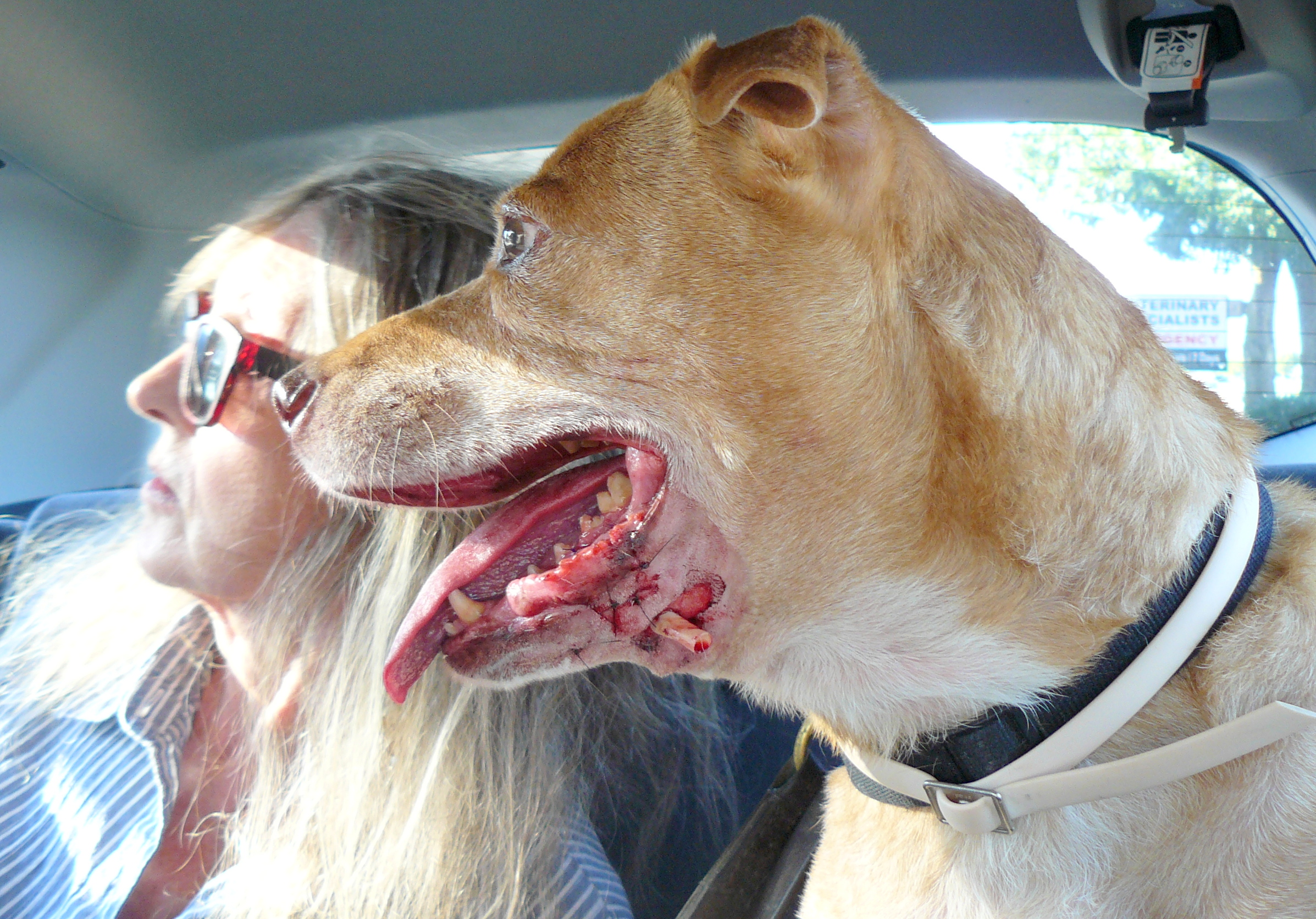
On the 17th August I published a post Life’s Lottery that was about an injury that our Casey had suffered on the 14th August. It included this photograph:

P1160394I’m delighted to say that yesterday morning Casey returned to Lincoln Road Vet Clinic and the sutures were removed.

The drain was removed last Monday.

Jean and I were not with Casey for the five minutes it took to remove the sutures but the picture below shows a very happy Casey just 15 minutes after we arrived.

P1160428(If I could better drive the Apple photos app on my new iMac I would have shown you a closer image! Revised image inserted on Saturday morning as a result of me playing with the app.)

Eating human food?

For our precious dogs, that is!

Dog Food Selector recently published a post about whether or not dogs can eat human foods.

As one might anticipate the answer is neither an unqualified yes nor a no. The article included a detailed list of human foods and an analysis of their potential risks as well as a useful graphical summary.

But first to the article.

ooOOoo

Can Dogs Eat Human Foods?

The most important recommendation for introducing new foods to your dog’s diet is to do so progressively.

Because introducing new foods into your dog’s diet may lead to digestive problems.

Our advice is to introduce only one new food at a time, in small amounts at first and observe your dog for any reactions to the change.

Keep in mind that every dog is different, so if you have any doubts please check with your veterinarian to see which ingredients are appropriate for your dog.

But how about foods you eat?

We’re sure you sometimes wonder yourself: Can my dog eat this? Is this food bad for him? Are human foods for dogs OK?

The following list includes numerous foods organized by alphabetical order.

Every food is marked with the potential risk to induce gastrointestinal or toxicity problems in dogs.

The risk is classified as:

0: Minimal risk if given in controlled amounts
1: Low risk
2: Moderate risk
3: High Risk
We advise you not to give your dog foods marked with risk 2 and 3.

Anyhow, you should always consult a vet to get a specific overview of the human foods’ risks on your dog.

ooOOoo

Then follows an extensive list of foods in alphabetical order. Here’s an example:

Food: Apricot Risk: 2 Comments: The seeds, leaves, and stems contain cyanide. Additionally, the pits can be a potential choking hazard or cause an intestinal obstruction.

But as well as the detailed list of foods with their associated Risk factor and additional comments, the article included the following ‘infographic’.

Produced by DogFoodSelector.com

I think that’s a most useful reference.

What are your thoughts as to how useful this chart is?

The power of love …

….. for the animals in our lives.

In yesterday’s post Senior Smiles there was a lovely exchange between Cindy and me. Cindy wrote:

Just a few days ago I relived in my mind the pain of losing our 16 year old Bichon- and that was a year and a half ago! Honestly, that is my biggest fear of adopting another dog- esp an older one.

Cindy then, mistakenly in my view, thought that, “it’s selfish to hang on to grief like this, and I REALLY don’t mean to“, to which I replied:

Grief is not a selfish attitude, far from it! You will know when it’s the right time to adopt, and love, a new dog.

You can then easily imagine my pleasure when thinking of what to write for today’s post to see a recent item over on the Care2 site about our commitment to our pets. About our love for our pets.

The item was called How Far Would You Go For Your Pet? and is republished here today. I would like to dedicate this post to Cindy! Cindy is the author of the blog: Mermaid in a Mudslide.

ooOOoo

How Far Would You Go for Your Pet?

1388717.largeBy: TreeHugger. August 23, 2016

There is simply no denying the power that pets hold over us.

I suppose there are a number of reasons why we love our dogs and cats (and others) so much, but surely their innocence and unconditional love rank right up there on top. Plus they’re cute, and furry, and funny, and sweet, and overall good companions. But I have to think there is something about them providing access to the larger animal world in general as well – domesticated animals are like a bridge between us civilized humans and wildlife, and for this they serve an important role. If we can find compassion for our companion animals, in many cases that compassion seeps out and becomes extended to other elements of the natural world as well.

And we really, really have compassion for our pets. Like, approaching fervency. Last year Americans spent over $60 billion on their pets, a number expected to increase by another $2 billion this year. That. Is. So. Much. Money. If you spent $20 per second, it would take 95 years to spend $60 billion.

But even more telling than how much we spend on our pets is the other sacrifices we would make for them. With pets on their mind, the website Abodo conducted a survey of 2,000 dog and cat owners and asked them all kinds of bordering-on-Sophie’s-Choice type of questions. The following results display just how cuckoo we are for our creature cohabitants.

What-Would-People-Really-Do-for-Their-Pets

See more of the survey’s results here.

Written by Melissa Breyer, this post originally appeared on TreeHugger.

Photo Credit: dougwoods/Flickr

ooOOoo

The power of (unconditional) love!

Senior Smiles

Adopting dogs who are no longer young animals.

A trip to your local animal shelter reveals that dogs of all types, backgrounds, and ages may usually be seen. Inevitably, those dogs that are no longer in ‘the first flush of youth’ are frequently seen as less adoptable than younger animals. While that is understandable from a prospective owner’s point of view there’s no reason at all to disfavor the older dog.

Both Casey and Pedy were dogs that Jean and I adopted when they were well into their middle years, or six-years-old to put a number to it.

Casey, shown above, had been in the animal shelter for over a year and on top of being six had the added burden of being a Pit Bull breed.

Hi Pedy, I'm the bossman around here. Name's Pharaoh and you'll be OK.
Hi Pedy, I’m the bossman around here. Name’s Pharaoh and you’ll be OK.

So when the Care2 blogsite published a post about adopting senior dogs I thought that this was most certainly something to be shared with you.

Here it is.

ooOOoo

What Advice Would You Offer Someone Adopting a Senior Dog?

1388615.large

By: Vetstreet.com August 18, 2016

About Vetstreet.com
Those of us who have been fortunate enough to share our hearts and homes with a senior dog know just how special those gray-muzzled darlings can be. Earning the love of an aging pup who truly needs you creates a special bond that’s hard to put into words.

True, they may have some age-related health issues (like arthritis, dental disease or failing vision or hearing) that require attention or treatment. But older dogs have lots of pros, too, like the fact that they’re likely to be better trained than a puppy and they’re probably game to lounge around with you and take it easy. And when it comes to adopting a senior dog, you have the benefit of knowing what you’re getting in terms of size and in most cases, personality.

Our readers recently shared some great tips for people getting their first dog or cat — and in fact, we know that many of you have opened your homes to adult dogs. So when we wanted to offer tips to people looking to welcome an older canine into the family, we turned to our Vetstreet Facebook followers and asked: What’s the one piece of advice you’d give someone adopting a senior dog? And, as we suspected, our readers came through with some excellent — and touching — words of wisdom.

Advice for Someone Adopting a Senior Dog

Many readers expressed the importance of showering your senior dog with love. “Love them unconditionally, as you don’t know how long you will have them,” said Peggy Lowe-Brooks. “Enjoy each day they are in your life.”

Rich Dunn agreed, saying, “Love them, love them. Treat them like family, be there to the end and hope someday to see them on the other side!” Dee Davis added, “Make sure you’re committed to love, care and cater to them for them the rest of their lives.”

Mike Carroll suggested remembering that, for some dogs, age might be just a number: “Have fun with them; they still have a lot of energy and the desire to do most anything they ever did before. Baby them big time and be ready to be on the receiving end of some serious love and affection from them. Just let them enjoy the rest of their life like never before.”

William West Patience’s experience backs up Carroll’s suggestion. “I have had dogs that lived until 15, then I adopted one that was 16 because no one else would,” he said. “It has been a rewarding experience and has taught me so much. Except for some mobility issues he doesn’t know he’s an old dog.”

Of course, it’s important to remember that taking on a dog during his golden years can be a big responsibility, and potential owners should be ready for that. “…Remember they may have expensive medical bills; be prepared to give them the medical care they will need,” said Priscilla Leuliette.

Susan Holt Stanley was of a similar mind, saying, “Love them with your heart, care for them medically and tell them a million times how special they are!”

And Sarah Vaughn reminded us of the golden rule: “Be patient! One day you’re going to be elderly and you don’t want someone yelling at or getting frustrated with you because you move so slowly and have accidents because you can’t make it outside (or to the facilities) in time.”

If you’re considering bringing a senior dog into your home, there are numerous things you can do to help him enjoy his senior years. You might take steps to pet-proof your home in a way that makes it easier for him to get around. And believe it or not, teaching your old dog new tricks isn’t only possible, it’s a great way to help your new-old pup stay mentally and physically sharp! Getting him to the vet for regular exams and keeping an eye out for any physical or behavioral changes is important for dogs of all ages, but becomes perhaps even more important as he ages.

Care2 readers, what advice do you have for people adopting senior dogs? Tell us below in the comments. [Ed: as comments left on this post.]

By Kristen Seymour | Vetstreet.com

ooOOoo

Keeping an eye out for any physical or behavioral changes doesn’t just apply to aging dogs! 😉

Dusk to Dawn Commitment!

The love that exists between so many humans and so many dogs!

Yesterday, after I had returned from my morning bike ride with our local group of friends, Brandy was incredibly pleased to see me. To the extent that he crouched down, his head and front legs on the hardwood floor, his rear hips still up in the air, so to speak (Jean said that this posture is called a play bow), and everything about him signaling that he wanted to play with me.

I could not resist adopting a similar physical position and then we both rolled onto our backs with our heads locked together ‘cheek to cheek’ in the most exquisite and intimate bond between dog and human.

Such gorgeous events produce a loyalty and affection from me (and, I suspect, from Brandy too) that would mean that there would be no limit within me if I had to protect and save Brandy from harm.

Countless numbers of you dear readers will know precisely what I feel and how I expressed it.

Thus the example of others showing not the slightest hesitation in rescuing a dog trapped underground both makes sense and makes us feel so proud. Here it is reproduced from a recent Care2 posting.

ooOOoo

Firefighters Dig Until Dawn to Rescue Underground Dog

3186301.large

By: Laura S. August 14, 2016 About Laura
Could it be that when you name a dog “Tiger” you can expect him to be especially territorial? Well, perhaps that’s why this dog in Gulfport, Miss., decided to race down the street in pursuit of a neighborhood cat. Only problem is, there’s something just as dangerous as quicksand in the concrete “jungle” and it swallowed poor Tiger just as quickly.

13537611_10210668737501632_1622830518241307423_n-e1470705597405

Tiger fell deep into a concrete culvert pipe near the intersection of Mississippi Avenue and Tyler Street around 9 p.m. one evening, and it wasn’t until residents exhausted their own resources that they decided to call for help at around 3 a.m. the next morning.

13537803_10210668754782064_2234247258038085561_n-e1470705642332

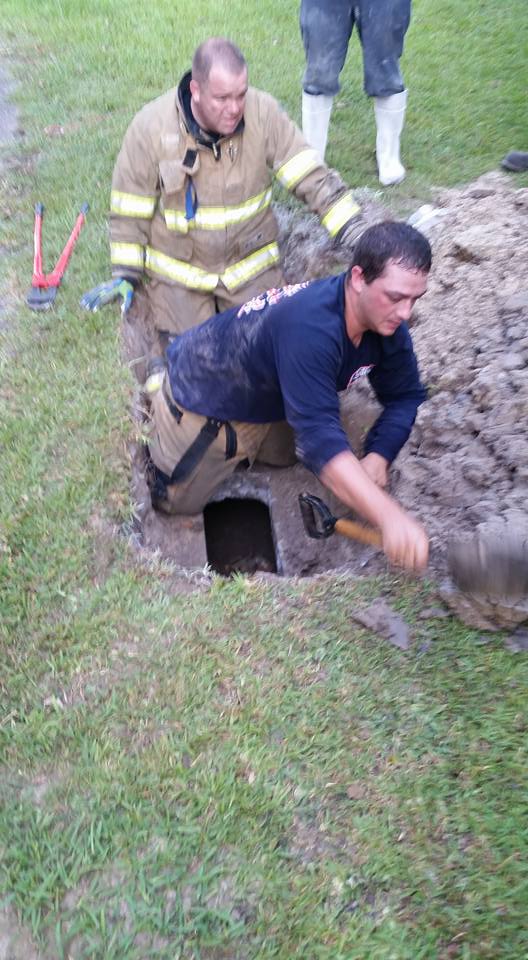
Gulfport Fire Department Battalion Chief Chris Henderson, along with seven other firefighters and a pair of workers from the public works department, began working together to extricate the dog.

13532987_10210668750381954_366151199408553747_n

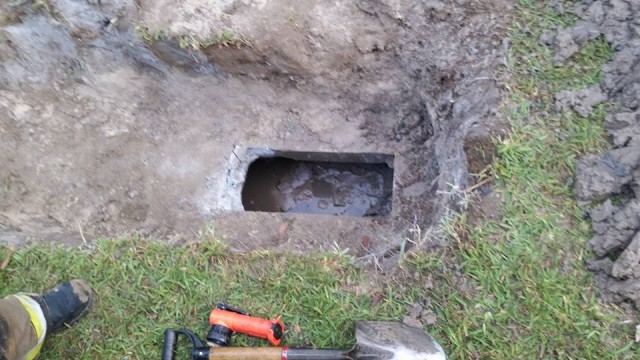
It was a tedious rescue because the pipe was far too narrow for any rescue worker to fit through, so the team had to cut their way through the pipe.

13516745_10210668782462756_5451559875121588209_n-e1470705711228

“We counted the joints in the pipe to estimate the distance, then walked off the distance on the top above the ground,” Henderson told the local ABC News affiliate.

13557934_10210668767582384_3853048143151108954_n

The firefighters dug down and then drilled holes to locate Tiger before bringing in a concrete saw to cut through the pipe and reach him.

13532769_10210668777382629_7833975136202473459_n-e1470705760700

By 7 a.m. Tiger was pulled to safety and reunited with his guardian who planned to take him to the veterinarian as a precautionary measure although the dog appeared unharmed.

13439019_10210668786662861_6228593877549457302_n

(All the photographs are Credit: Chris Henderson of Gulfport Fire Department / Facebook)

ooOOoo

Nothing further to add from me!

Spreading love and kindness

The huge gift we receive from therapy animals.

Our Brandy is a Pyrenean Mastiff!

I know there are times when giving Brandy a big hug feeds something very deep inside me. That unconditional affection Brandy shows me has a very strong healing sense.

I know that Jean shares my sense of being loved by Brandy, and by all our other dear dogs.

I am without doubt that hundreds of thousands of other people experience this.

Yet there must always be room for more therapy dogs which is why an item on Care2 just a few days ago is being shared with you today.

(P.S. When a photo of me hugging Brandy was sought his nibs did not comply!)

ooOOoo

Could Your Pet Become a Therapy Animal?

3187027.large

If you have a pet who’s mellow and loves being around people, and the idea of helping your pet bring joy to others appeals to you, you might just have a therapy animal in the making.

Accompanied by their owners, therapeutic visitation animals – which are most commonly dogs, but can also be cats, rabbits, pot-bellied pigs, horses, etc. – regularly visit people in hospitals, nursing homes, schools and other facilities, providing furry comfort and compassion.

“Four-footed therapists give something special to enhance the health and well-being of others,” says the website of  Therapy Dogs International (TDI), a nonprofit organization that regulates, tests and registers therapy dogs and their handlers. “It has been clinically proven that through petting, touching and talking with animals, patients’ blood pressure is lowered, stress is relieved and depression is eased.”

What It Takes to Be a Therapy Animal

Therapy animals are “born, not made,” according to TDI. They must have an outstanding temperament, and be outgoing and friendly to people of all ages. They must also behave well with other animals.

 In general, therapy animals must also be at least one year old; current on all vaccines required by local laws; and be clean and well groomed when visiting people.

As for dogs, along with the ability to obey basic commands like “Sit,” “Stay,” “Come” and “Leave it,” they are tested by therapy dog certification organizations to ensure they can do the following, according to TDI (most of these requirements apply to other species of potential therapy animals as well):

  • Listen to their handlers
  • Allow strangers to touch them all over
  • Not jump on people when interacting
  • Not mind strange noises and smells
  • Be calm for petting
  • Not be afraid of people walking unsteadily

Getting Your Pet Certified as a Therapy Animal

Think your pet has the right stuff to be a therapy animal? To get an idea of the type of testing involved, this TDI brochure describes each of the 13 tests a dog must pass in order to be certified. The tests are similar for other animals.

Some therapy animal organizations, including Pet Partners, offer workshops so you and your pet can practice the required skills before being tested for certification.

The AKC website has a list of therapy animal organizations all across the U.S. from which your pet can receive certification. Contact the one nearest you for further information.

The Difference Between Therapy and Service Animals

Although the two are often confused, therapy animals are not the same as service animals, which “have been individually trained to do work or perform tasks for the benefit of a person with a disability,” according to the Americans with Disabilities Act (ADA).

“An example of a service dog is a dog who guides an owner who is blind or assists someone who has a physical disability,” the American Kennel Club (AKC) explains. “Service dogs stay with their person and have special access privileges in public places such as planes, restaurants, etc.”

Therapy dogs, on the other hand, are privately owned. Unlike service animals and their handlers, in most U.S. states, therapy animals and their owners don’t have protections under federal law (ADA, the Fair Housing Act, etc.), reports the National Service Animal Registry.

Additional Resources

You can find out more about therapy animals and getting your pet certified from these organizations:

Photo credit: Thinkstock

ooOOoo

Closing this post with some photographs Jean took yesterday afternoon. Me with Pharaoh and Cleo.

(OK, they were staged for this post as the look on Cleo’s face rather suggests!)

P1160423oooo

P1160414oooo

P1160419Have a very huggable weekend!

Kate Humble and Teg

Following on from yesterday.

In yesterday’s post I included the full documentary that was recently broadcast by the BBC. It was really interesting and a great insight into the uniqueness of the Welsh Sheepdog. More of that in a moment but first some details about Kate. As WikiPedia puts it:

Katherine “Kate” Humble (born 12 December 1968) is an English television presenter, mainly for the BBC, specialising in wildlife and science programmes. She was also the President of the RSPB until 2013.

Inevitably, Kate has her own website where one reads on the ‘home’ page:

kate&tegKate Humble and her sheepdog Teg set off to learn about the threats to British herding dogs. Filmed over a year, and with an exclusive insight into Kate’s shepherding life,  ‘Kate Humble: My Sheepdog and Me’, unveils the story of the Welsh Sheepdog, explores the challenges of breed recognition and celebrates the simple joy of a handful of puppies.

‘Kate Humble: My Sheepdog and Me’ will be on BBC 2 on the 15th August 2016 at 9pm.

As changing farming practices, cross breeding and dog shows came about, so too did the decline of Britain’s working dogs.  Of 22 British herding dog breeds, 12 are now extinct and the 10 remaining are mostly show dogs or pets. Kate sets out to discover if Teg belongs to one of these rare breeds, criss-crossing Wales as she uncovers the story of the Welsh Sheepdog and tries to find a mate for Teg.

From sheepdog trials to droving, from DNA profiling to a nationwide search for a mate, Kate and Teg’s journey is a celebration of the Welsh landscape and rural traditions. It also delves into the hi-tech, hi-value world of breeding rare dogs, and explores the timeless bond between humans and their dogs.

Join Kate and Teg as they play their part in the continuing survival of Britain’s herding dogs.

Now we hear a great deal about this endangered animal and that endangered animal but British herding dog breeds wouldn’t for me come to mind as one such endangered breed.

Clearly the effort to save the future of the Welsh sheepdog is significant underpinned by the fact that there is a society devoted exclusively to the breed: The Welsh Sheepdog Society. The website of the Welsh Sheepdog Society also has a page where registered sheepdogs are for sale. I’m going to republish the details on that page not only to show readers what the dogs look like but also to promote them to a wider audience.

ooOOoo

FOR SALE

Registered Welsh Sheepdogs of Sale from Society Members

Red and white welsh sheepdog pups for sale, pictured below. 6 bitches and 2 dogs by Fferm Mynydd Morgan out of Safn y Coed Erin. Both parents good workers. Ready to go now. Contact Edward Hopkins phone 07867 474 866.

hopkins pups
Welsh sheepdog pups for sale. Black and white and red and white. By Wilden Gel out of Fron Felen Fflei. Good working stock. Contact Bob Williams 01745 550 304.

Welsh sheepdog pups for sale. By Hendrerhys Gelert out of Fron Felen Nel. Both parents good workers. Contact John Williams 01745 5870 657.

Welsh sheepdog pups for sale, picture below, ready December. Sire Ty Llwyd Bonnie trophy winner Penlanlwyd Tango. Dam Glyngwilym Rose. Contact Simon and Emma Mogford, 07846 017 669

mogs pupsooOOoo

Here’s hoping they all find wonderful loving homes.

Let me finish off today’s post by extensively quoting from the WikiPedia page about the Welsh Sheepdog.

The Welsh sheepdog (Welsh: ci defaid Cymreig, pronounced [kiː dɛˈvaɪd kəmˈrɛɨɡ]) is a landrace of herding dog from Wales.

Like other types of working dog, Welsh sheepdogs are normally bred for their herding abilities rather than appearance, and so they are generally somewhat variable in build, colour and size. Welsh sheepdogs are of collietype, usually black-and-white, red-and-white or tricolour, and merle markings may occur over any of these combinations. The coat may be short or fairly long, and the ears are pricked, but usually folded at the tip. They are longer in leg, broader in chest and wider in muzzle than the Border Collie. They are extremely active and intelligent, and therefore need much exercise and mental stimulation, if they are to be kept as pets. Welsh sheepdogs are more commonly known as Welsh collies, however these are the same breed.

Over many decades the Welsh sheepdog has largely been replaced for working sheep in Wales by the Border Collie, a standardised breed. However, in more recent years, efforts have been made to maintain the indigenous Welsh sheepdog as a distinct variety.

Welsh sheepdogs are usually of loose-eyed action, not fixing the stock with their gaze like the strong-eyed (de)Border Collie. They are able to work independently without necessarily being under direct human control. Welsh sheepdogs are most often used for herding sheep, but also readily work cattle, goats, and even horses and pigs. Traditionally they were often used as droving dogs to take cattle and sheep to markets locally or elsewhere in Britain.

The Welsh sheepdog’s life span is 12–15 years.

History

At one time there existed many sheep-herding dogs peculiar to Wales; during the 18th century Welsh drovers taking sheep for sale took with them five or six Welsh sheepdogs as “herders on the narrow roads, guards against highwaymen, and providers of game on the route”. These were an early type of Welsh sheepdog, higher on the leg and more racily built than the modern day breed.

However, by the 1940s the group had decreased to two or three breeds only. The ancient pure breeds of black-and-tan sheepdog and Welsh hillman were almost extinct, and were scarcely ever seen working. The type best known in Wales at that time was mostly descended from the old black-and-tan with an infusion of working Border Collie blood.

In the 1940s the Welsh sheepdog was still common throughout the north and central Welsh counties. In herding activities, it did not normally work low to the ground in “the showy manner sometimes seen in the work of the working [Border] Collies”, as British dog fancier C. L. B. Hubbard put it in 1948. It was variable in type; approximately 18 in (46 cm) in height, but the weight ranged from the lighter built, leggier dog of North Wales at 35 lb (16 kg) to the more solid 40 to 45 lb (18 to 20 kg) dogs of Glamorganshire and Monmouthshire. There were no dog show classes for the Welsh sheepdog as it was purely a working breed.

Finally another picture of Kate and Teg.

JS50109203Fabulous animals!

Welsh Sheepdogs

Congratulations to the BBC for a fascinating documentary.

Recently the BBC aired a documentary about Kate Humble and her journey to have her dog, Teg, registered as a Welsh sheepdog by the Welsh Sheepdog Society. It was fascinating and a ‘must see’ for all dog lovers irrespective of their residency in Wales or not! The programme, that is no longer available (still on BBC iPlayer at the time of writing), was described on the BBC website, thus:

When Kate Humble decides she wants to breed from her dog Teg, she finds out that her beloved pet is a Welsh sheepdog. She sets out to learn more about this little-known and endangered breed, and discovers that a true Welsh sheepdog is a working dog. Kate wants Teg and her future puppies to be certifiably Welsh, and sets out to train Teg to work in the traditional Welsh way. Teg shows willing, and Kate works on her own shepherding skills, but will the demanding experts from the Welsh Sheepdog Society be impressed by the pair’s performance?

However, some smart soul has uploaded the episode to YouTube so if you want to watch it do so quickly before it is removed.

http://www.youtube.com/watch?v=-7m7dKBd3mQ

Published on Aug 15, 2016

Kate Humble sets out to breed Welsh sheepdog puppies from her beloved pet Teg, and learns about the threat facing British herding dogs. A true Welsh sheepdog is a working dog, and so Kate sets out to train Teg to work in the traditional Welsh way. Along the way, she meets a team of researchers at the University of Aberystwyth, whose groundbreaking DNA research reveals some remarkable facts about the Welsh sheepdog. If Teg can produce a litter of healthy Welsh sheepdog puppies, she can play a big part in helping one of Britain’s unique herding dogs survive for generations to come.

I’m going to continue this item tomorrow for there’s more information that I think you will find interesting.

But for now, watch the documentary – you’ll love it!