(NB:For much of the next three days I am going to have my attention diverted elsewhere. So, apologies in advance if I am not as attentive as I try to be.)
But first, let me offer an update and a correction.
In my first report, published on June 28th, the very first patient for Dr. Jim was Ginger.Here’s an extract from that report:
It was immediately clear to Jim when he listened to Ginger’s heart that it was racing; Jim thought at something like 200 beats per minute. Jim continued to check Ginger over although, as he told me later, he had an idea that Ginger’s medical problem was a cardiac issue. Jim arranged for Ginger to be given an X-ray as well as blood work.
A number of you wanted me to check on Ginger’s status. Jim said that in a follow-up call made by the clinic they were told that Ginger was doing well.
The second item is a correction. In the report that described Lynn bringing in a stray kitten that had terrible puss oozing from one eye, I wrote: “Moments later Jim has not only cleaned out all the puss but found and removed the cause of the infection that was behind the kitten’s eyeball.”
When I queried with Jim what was the cause of the infection, he said that there was nothing physical behind the eye but that the kitten had contracted a severe eye infection probably a viral infection. The kitten was also doing well.
So last Thursday, the 13th July, I returned to Lincoln Road, arriving at 09:45. My plan was to spend the morning with Jim and then the afternoon with Dr. Russel Codd the owner of the clinic.
It was another wonderfully interesting day and I have sufficient material for the next two to three weeks.
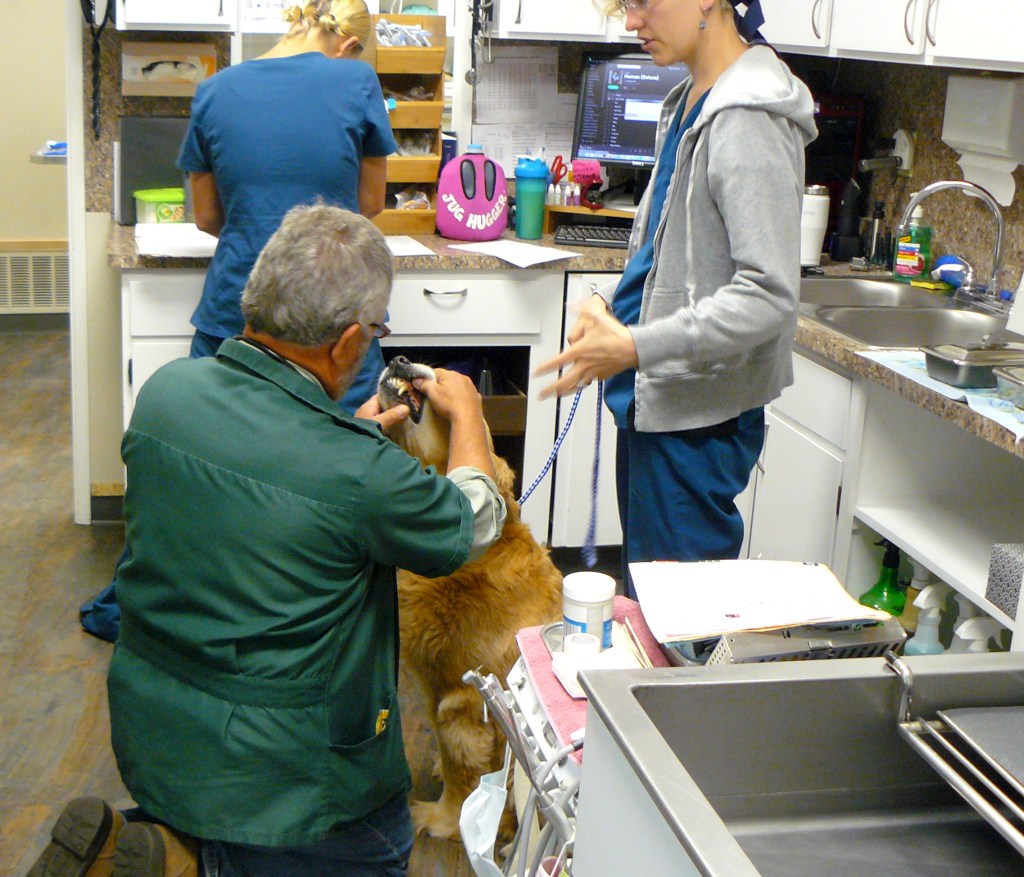
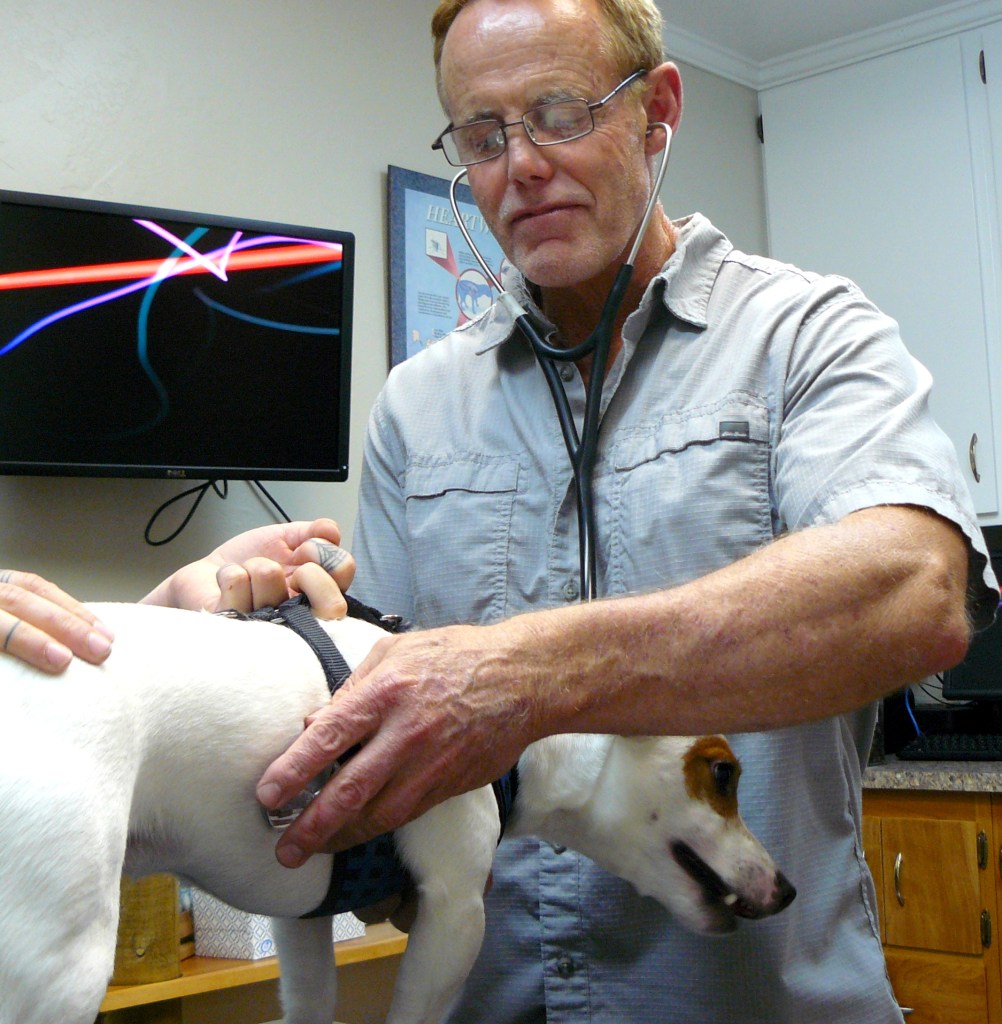
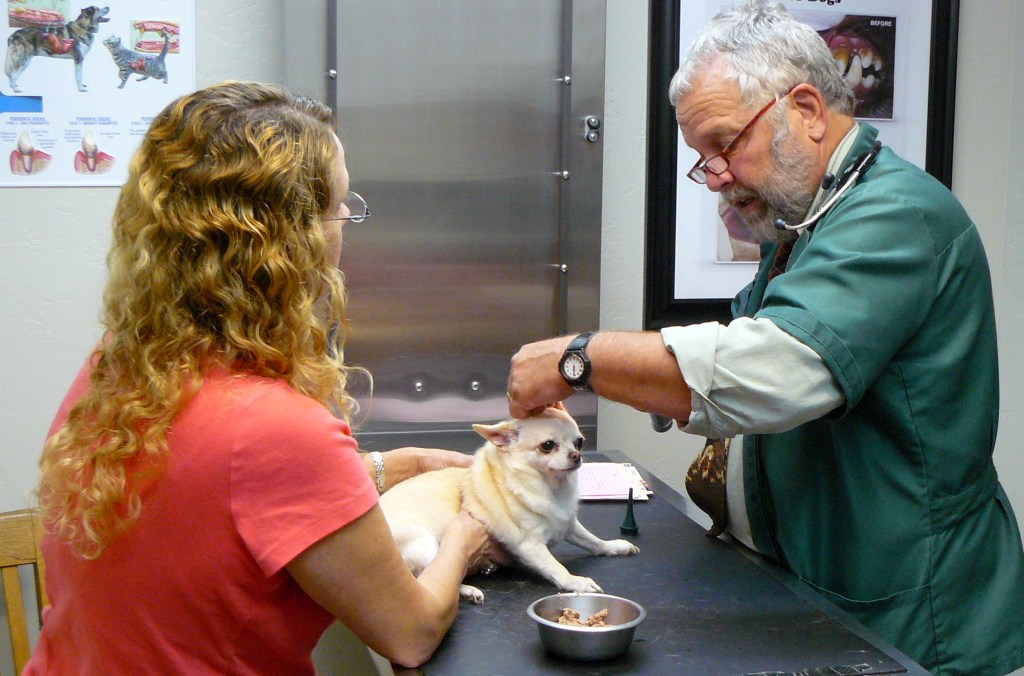
This is Cooper, a male Jack Russell, being checked out by Dr. Russ.
Dr. Russ started the afternoon at 14:30 so there was a bit of a wait after Jim had finished his morning at 12:05. That prompted me to see if future sessions watching Dr. Russ at work could be morning ones.
In other words, I would go across to Lincoln Road on two mornings a month; one to spend with Dr. Jim and one with Dr. Russ. I have yet to speak to Russ about that but can’t envisage an issue.
What Russel Codd did say to me that afternoon was that he really supported this theme and that he might arrange for me to ‘shadow’ one or two specialists who work locally in Grants Pass. Plus, I did venture the idea that maybe there was book potential and Russ was very happy with that possible development as well.
So Sue, there’s the answer to you writing last week: “Lots of information here perhaps for a second book?” Great suggestion! (Indeed, good people, I am giving the idea of turning this series into a book very careful thought and will ask for feedback from you in a subsequent post once I am clearer about the purpose and objectives of such a book.)
So the first of my reports from my visit on the 13th will be published either later this week or early next week.
Thank you, everyone, for your interest, suggestions and support. You really are a great group of readers!
This is why some choose to become veterinary doctors.
Today I write about the last animal that Dr. Jim attended to from my morning at Lincoln Road on June 22nd. I have been blown away by the interest in this theme from so many of you. Thank you!
Indeed, today I am back at the clinic spending both the morning and some of the afternoon watching and recording.
My plan from now on, subject to Dr. Codd supporting the idea, is to spend time at the clinic roughly one day a month. For in just the five or six hours of a day’s visit there is such a variety of events that it will provide more than enough material for me to present Visiting the Vet posts regularly each week during the following month.
OK! Now to the last patient that morning.
12:20
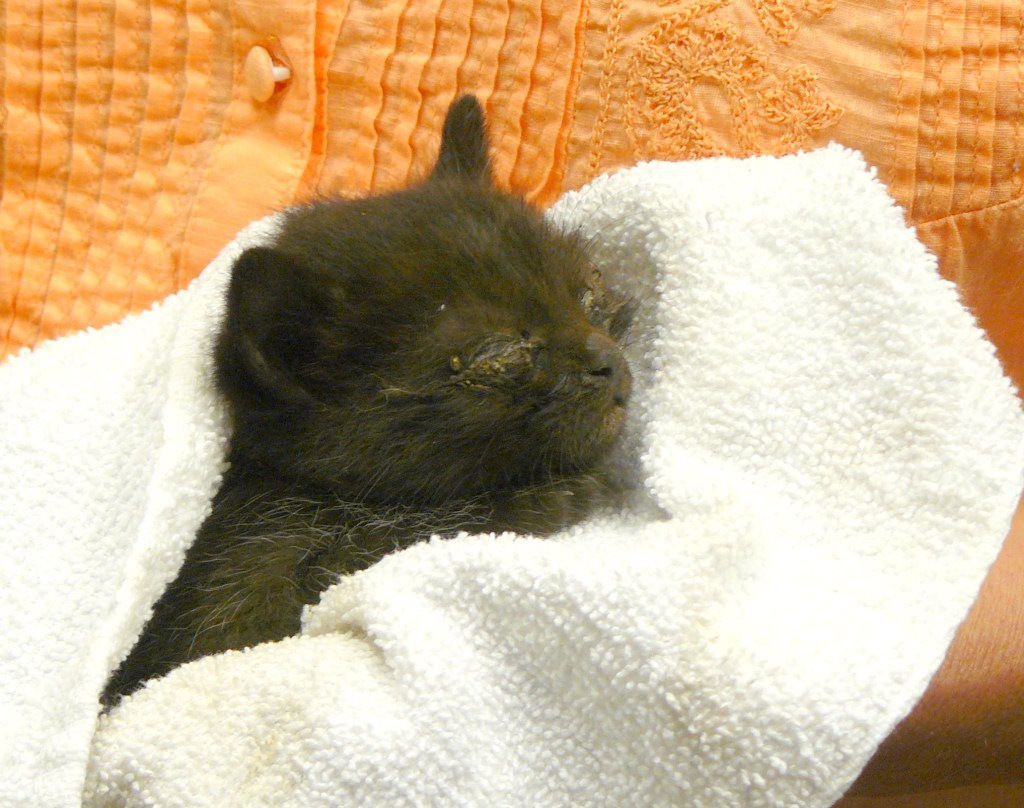
A woman carries in a stray kitten that had been found on the premises of a local scrap metal dealer.
The woman, Lynn, didn’t hesitate to bring the kitten to Lincoln Road because it had an infected right eye.
Jim takes some blood, in itself a bit of a challenge with such a young kitten, and looks more closely at the male kitten. He observes that the eye is most terribly infected with puss pouring out and Jim is of no doubt that the kitten had this eye infection since birth just a few weeks ago.
I come closer to take a photograph (the one above) and am in awe of the delicate way that Jim uses a tiny swab, Lynn holding the kitten for Jim, to clear the puss away from the eye. Moments later Jim has not only cleaned out all the puss but found and removed the cause of the infection that was behind the kitten’s eyeball.
12:40 The kitten sees with both eyes. What a transformation in just twenty minutes.
Jim looks up at Lynn: “Lynn, you do know you have saved his life!”
Lynn replies: “I didn’t really want another cat!”
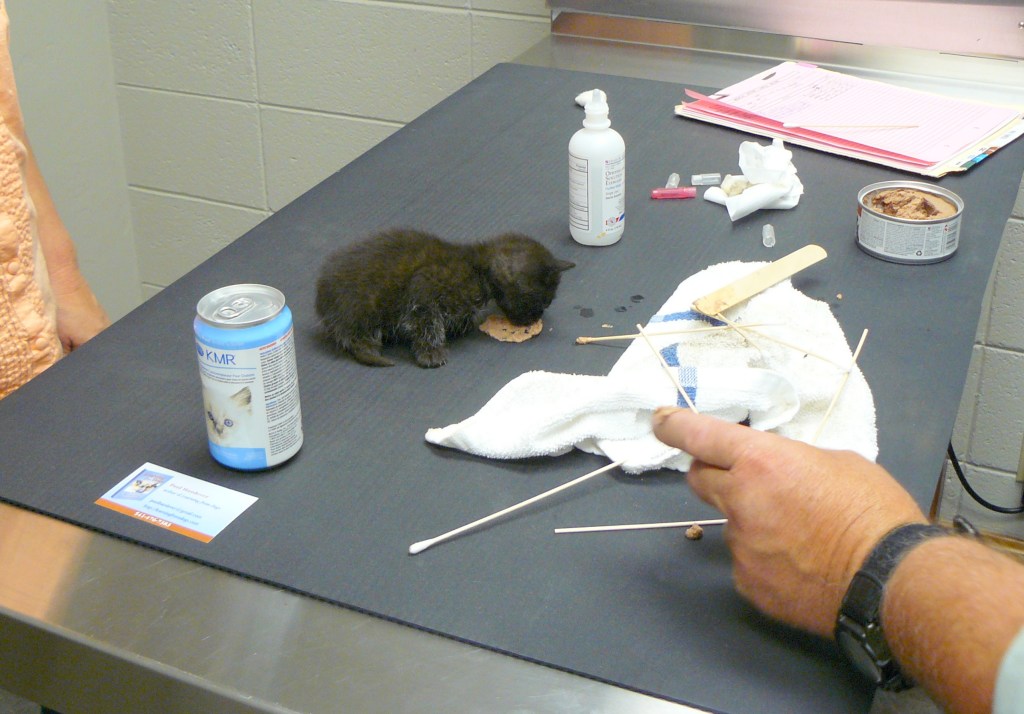
Jim then gets some food for the kitten and gives it time to settle down.
Lynn and I chat and I am flattered to learn that Lynn has previously purchased a copy of my book. It can be such a small world at times!
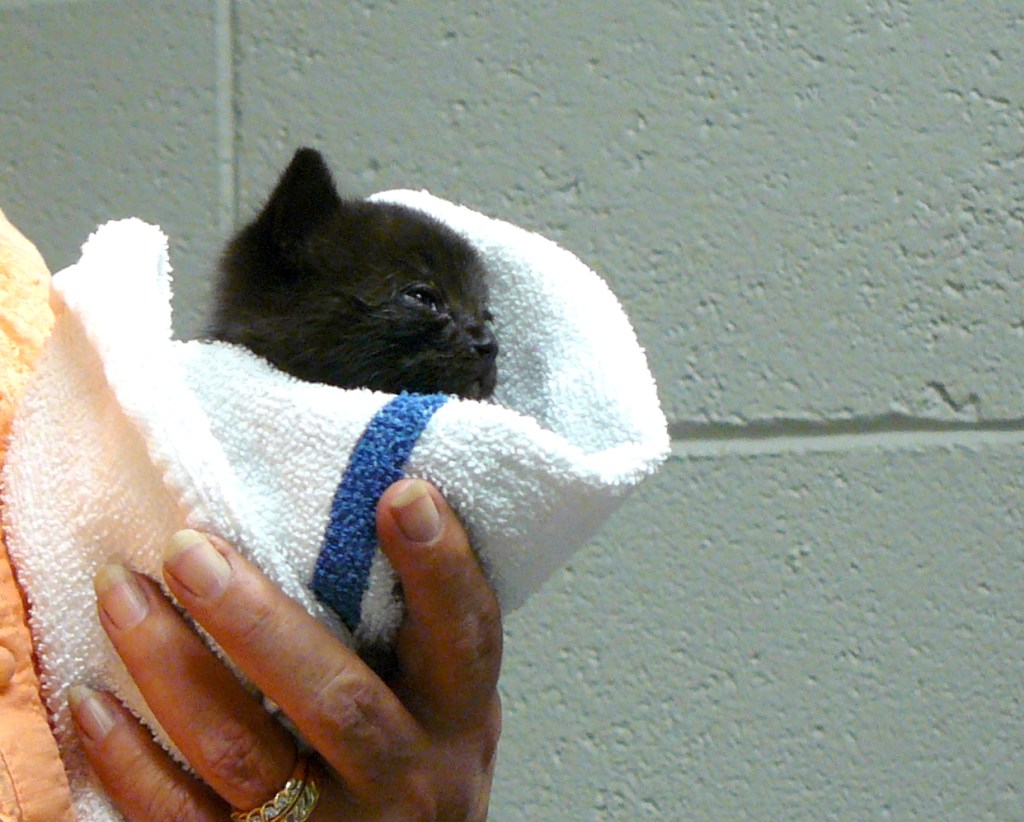
12:30 All done. Lynn wraps the kitten back into the same towel that was used to bring it in to the clinic such a short time ago.
Thus ended my first experience of being behind the scenes of a busy vet practice.
The experience has profoundly affected me.
For as well as the astounding level of medical skill that I have observed it was also clear, as Jim put it, that he has to play counselor, psychotherapist, and even bartender. Why bartender? Because Jim quietly offers the observation that quite a few persons come in with their pets when they are the worse for drink! The owner that is not the animal!
Seriously though, let me offer what I concluded after just this one visit to Lincoln Road. That Jim and, I’m sure, Dr. Russ and many thousands of DVMs across the world, have many more demands on them than just being a good doctor.
They must display attention to detail and have an inquiring mind. They must be genuinely empathetic for the animal owner’s circumstances. But also good record keepers! Also they will have to endure a great deal of kneeling. Then, again, those knees have to be topped with a head that is jam-packed full of knowledge and experience to avoid jumping to incorrect conclusions. More subjectively, their emotions have to be kept under control for they frequently will see animals that have not been best cared for and, again all too frequently, they will have to end the life of a dear pet as gently and painlessly as is possible.
I’m always a little cautious about submissions of guest articles from those who are ‘in the business’. But sometimes drawing the line between a genuinely informative article from a pet-related business and overt promotion is a fine one. I chose to publish an article from Alex back in November last year. It was about behavioral issues with dogs and was well received.
Earlier this month, in came another guest article from DoctorPup and, again, I think this is a good share with you. But please do let me know if you think it is too much of a product ‘sell’. I protect the integrity of this blog without question.
ooOOoo
Michael Schoeff reveals how to effectively potty train a puppy
Written by Florentina Popa on behalf of the company
Michael Schoeff, the inventor of the innovative potty training system called Pup Pee Poo Palace, considers that classic house training a puppy is a difficult process that takes time, patience, commitment and consistency.
Traditional potty training
If you want to follow the traditional path, it is important to inform yourself carefully and to establish clear guidelines to get on the right track your pup in just a few weeks. Puppies learn very fast from two to four months, picking up easily on the concept of housebreaking. Five to 30 minutes after eating, puppies want to defecate, so it is important to respect a clear schedule. The most important aspects you should take into consideration is to stay consistent, positive and patient and the results will appear gradually.
The first step is to establish a routine by creating a schedule for eating and playing. Feeding your puppy according to a clear schedule depending on his age, ensures eliminations at consistent times. This is crucial because generally, a puppy has control of his bladder one hour for every month of age so they are prone to accidents if they are not taken outdoor regularly. During his first months of life, a puppy should be taken outside at least every two hours as well as immediately after he wakes up, during and after playing and after eating.
Pick a specific spot outside and always take him there. Also, use a specific word or phrase before he goes outside to remind what he has to do. Take him to walks or playtime after he eliminated. Your attitude is important during potty training, so avoid being nervous or impatient as well as using a loud tone because you’ll make your pup anxious.
Reward him every time he eliminates outdoor, praising or giving treats immediately after he has finished and before coming back inside. This will help teaching him what you are expecting from him.
It is recommended to pick up his water dish about two hours before bedtimes to avoid relieving himself during the night.
An essential rule and hard to apply is to always supervise your puppy when he is indoor to avoid accidents or soiling. Keep your puppy in a specific area and watch him for signs he needs to go out. If you notice him barking, scratching the door, squatting, sniffing or circling, take him outdoor.
If there are times when you cannot supervise him, restrict him to an area small enough that he won’t want to eliminate there. Make sure that the space is comfortable to stand, lie down and turn around. A good idea is to use a crate or a leash, but don’t forget to take him outdoors whenever he needs to eliminate. You can gradually give him more freedom in the house as he learns to eliminate outdoor.
Keep in mind that accidents can happen anytime and make sure you act properly. If you see him eliminating indoor, interrupt him by saying “outside!” or making a noise without scaring him and take him to his eliminating spot outdoors. Always use positive reinforcement, keep calm and be assertive. Don’t punish him for eliminating in the house to avoid a negative connection with his bodily function, just clean up the room and make sure to remove the smell.
If your program doesn’t allow to stay at home with your puppy, you need to find someone to take your pup for bathroom breaks several times a day. You can teach him to eliminate in specific place indoors, but be careful regarding this process as he will get used to it and will practice it as well when becoming adult. Pup Pee Poo Palace was released in 2013 as an ideal solution for busy dog owners that don’t have enough time to spend with their puppies. The system is based on puppies’ natural behavior to get up on things, so it contains the separate elevated sleep and play area and the elimination area. Bedding area is made of a frame covered in bedding material and it is raised above the floor of the cage using frame extensions. The system helps reinforcing good patterns for puppies and encouraging them to repeat the actions.Puppy owners can let the palace door open when being with their puppies so they can return to the cage whenever they need to eliminate.
Using Pup Pee Poo Palace avoids the risks of infections especially if your puppy hasn’t completed all his vaccinations. You can perform your daily activities while your pup is enjoying his comfortable private space without worrying that he needs to potty.
Furthermore, you can still train your puppy to go outdoors whenever you can, especially after eating, drinking, playing or sleeping, but if you are busy or you’re not at home, count on Pup Pee Poo Palace and stay assured. Your puppy potty training will be easier and faster. Michael Schoeff and his partner, Gary Rybka, have created not only a very useful tool for dog owners, but a tool that suits any dog breed, starting with breeds that weigh under 5 lbs at maturity and finishing with those that weigh under 70 lbs at maturity. Author Bio
Florentina Popa is the founder of the digital marketing agency. She is a young entrepreneur with a strong passion for innovation, digital marketing technologies and a real focus on marketing strategies and evaluation process for her clients. She currently advises several companies in the Southeastern Europe and USA. She is content writer and social media manager for several small and medium companies located in the Southeastern Europe. She loves to create articles about business, leadership, digital marketing, lifestyle, animals (especially dogs). She has a great collection of materials published on various online marketing, business and lifestyle websites. When she’s not online, Florentina loves exploring the mountains and local coffee shops with her dogs, traveling and discovering new cultures watching movies and reading. ‘If you believe, you can achieve’ – that’s her motto!
ooOOoo
Good people, I do hope you found this interesting and not crossing the line of offering free promotion to a business. Neither me nor Learning from Dogs in publishing this guest post can offer any explicit or implicit endorsement of the company or this product. Any reader interesting in learning more must conduct their own research.
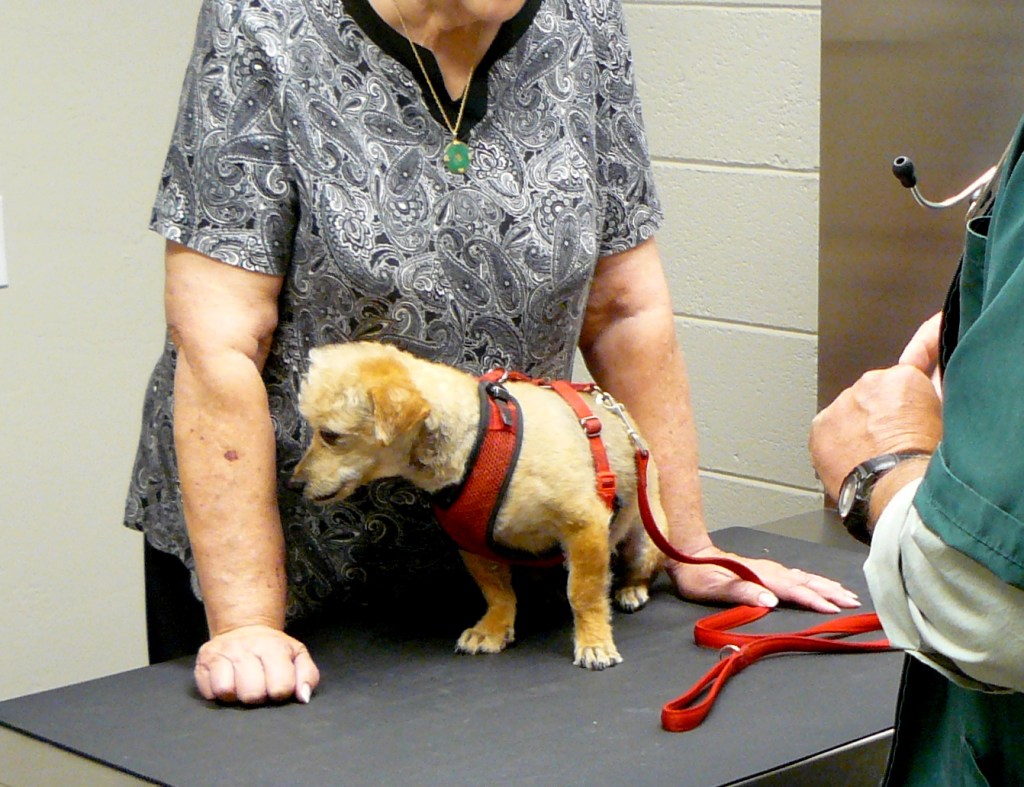
This is Buffy, a nine-year-old Dachshund crossed with a Terrier, who is drinking and peeing too much according to the lady who brought Buffy in to the clinic this morning. Adding that Buffy seems to be always hungry and quieter than normal.
Jim runs a blood test and not long after says that nothing has jumped out at him as a potential issue from Part One of the test results. (Apparently, the blood test comprised two parts – I will learn more in a subsequent visit to Lincoln Road.)
Buffy’s heart sounds good. Buffy has not lost weight.
Then Part Two of the blood test results reveal, thankfully, that Buffy is not diabetic, is not indicating Cushing’s Syndrome, and that Buffy’s kidneys are fine.
In other words, Buffy has the look of a healthy dog.
Has this all been a waste of time and money? Not at all, says Dr. Jim. This is the first time the clinic has seen Buffy and all the test results can now be logged providing a baseline of data for future reference purposes.
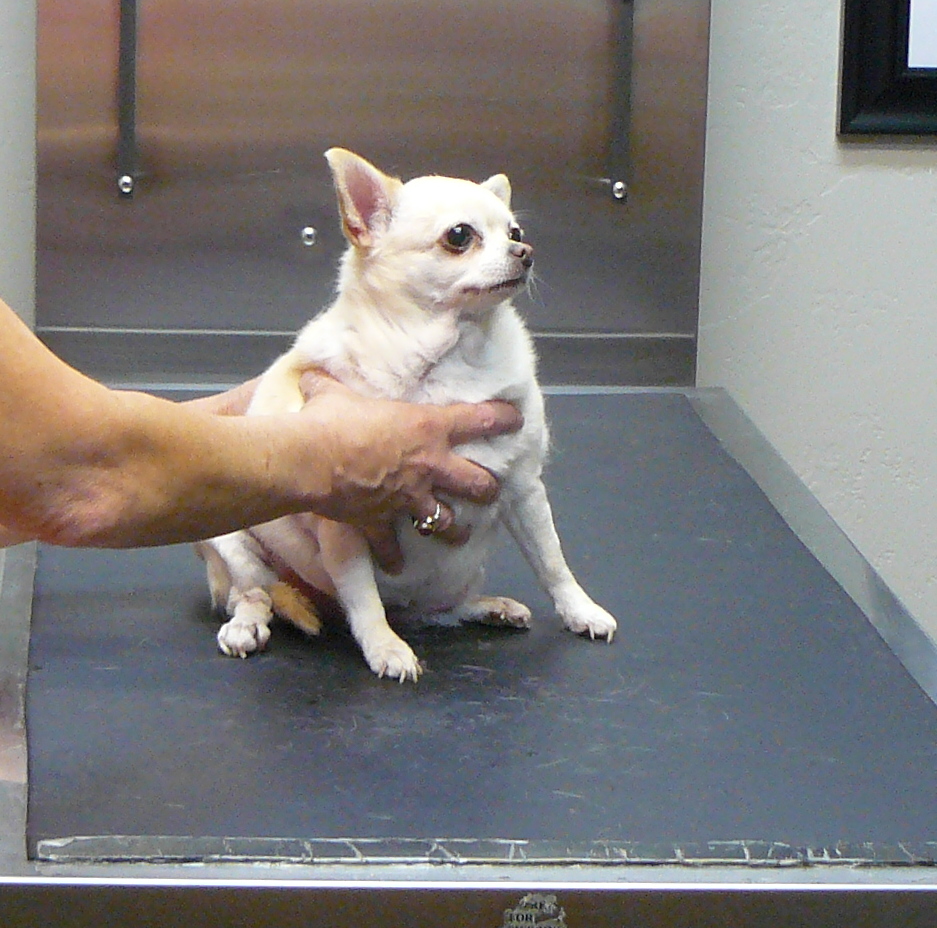
11:50 In comes Chloe.
Chloe has been vomiting up her food and, consequently, has stopped eating. Jim is concerned that Chloe is overweight and that in the very hot weather of recent days (high 90s F./mid 30s C.) he has been seeing a number of dogs with excessive heat problems.
One thing that could be done to Chloe was to clip her excessively long toe nails.
Jim does that.
12:15 All done.
To be continued:
(Please note: These observations are mine alone and because of the busy environment it must be assumed that my interpretation of what was taking place might not be totally accurate. Nothing in this blog post should be used by a reader to make any medical judgment about an animal. If you have any concern about an animal do make an appointment to see a properly qualified veterinarian doctor.)
“A dog is the only thing on earth that will love you more than you will love yourself.” – Josh Billings
oooo
“You can live without a dog, but it is not worthwhile.”
oooo
“If a dog does not come to you after looking you in the face, it is better that you go home and examine your conscience“ – Woodrow Wilson
oooo
“Buying a dog may be the only opportunity that a human being has to choose a relative”. – Mordecai Siega
oooo
“You can say any foolish thing to a dog and the dog will look at you in a way that seems to say: ‘My God, he is right!!! That would have never occurred to me’ “. – Dave Barry
oooo
“Sitting back in the evening, stargazing and stroking your dog, is an infallible remedy.“ – Ralph Waldo Emerson
oooo
“To exercise, walk with someone who will accompany you willingly, preferably a dog.“ – David Brown
oooo
It breaks my heart to advise you that the Picture Parade in a week’s time will be the last of the most glorious and touching photographs that came from Marg down in Tasmania.
In the days when I lived in South Devon in England and had cause to travel, as in drive, to London one of the route options was to take the M5 motorway (Freeway in American speak) up to Bristol and then follow the M4 motorway that ran from Bristol all the way into the outskirts of London.
One of the benefits of this was that half-way, give or take, was at the Swindon exit and a further ten-minute drive took one to the delightful car-park at the White Horse at Uffington. No, it wasn’t a pub despite numerous pubs in England being called The White Horse; it was something much more special.
The Uffington White Horse is a highly stylisedprehistorichill figure, 110 m (360 ft) long, formed from deep trenches filled with crushed white chalk. The figure is situated on the upper slopes of White Horse Hill in the Englishcivil parish of Uffington (in the county of Oxfordshire, historically Berkshire), some 8 km (5 mi) south of the town of Faringdon and a similar distance west of the town of Wantage; or 2.5 km (1.6 mi) south of Uffington. The hill forms a part of the scarp of the Berkshire Downs and overlooks the Vale of White Horse to the north. The best views of the figure are obtained from the air, or from directly across the Vale, particularly around the villages of Great Coxwell, Longcot and Fernham. The site is owned and managed by the National Trust and is a Scheduled Ancient Monument. The Guardian stated in 2003 that “for more than 3,000 years, the Uffington White Horse has been jealously guarded as a masterpiece of minimalist art.” It has also inspired the creation of other white horse hill figures.
Against All Odds, England’s Massive Chalk Horse Has Survived 3,000 Years
Cleaning up the Uffington Horse is the neigh-borly thing to do
The White Horse at Uffington, Oxfordshire (AP Photo)
Emily Cleaver smithsonian.com July 6, 2017
If you stand in the valley near the village of Uffington in Oxfordshire, England, and look up at the high curve of chalk grassland above you, one thing dominates the view. Across the flank of the hill runs an enormous white, abstract stick figure horse cut from the chalk itself. It has a thin, sweeping body, stubby legs, a curiously long tail and a round eye set in a square head.
This is the Uffington White Horse, the oldest of the English hill figures. It’s a 3,000-year-old pictogram the size of a football field and visible from 20 miles away. On this July morning black specks dot the lower slopes as small groups of people trudge slowly upwards. They’re coming to clean the horse.
It’s chalking day, a cleaning ritual that has happened here regularly for three millennia. Hammers, buckets of chalk and kneepads are handed out and everyone is allocated an area. The chalkers kneel and smash the chalk to a paste, whitening the stony pathways in the grass inch by inch. “It’s the world’s largest coloring between the lines,” says George Buce, one of the participants.
Chalking or “scouring” the horse was already an ancient custom when antiquarian Francis Wise wrote about it in 1736. “The ceremony of scouring the Horse, from time immemorial, has been solemnized by a numerous concourse of people from all the villages roundabout,” he wrote.
In the past, thousands of people would come for the scouring, holding a fair in the circle of a prehistoric fort nearby. These days it’s a quieter event. The only sounds are the wind, distant birdsong and the thumping of hammers on the chalk that can be felt through the feet.
Conservation organization the National Trust oversees the chalking, making sure the original shape of the horse is maintained. But the work is done by anyone who wants to come along. Lynda Miller is working on the eye, a circle the size of a car wheel. “The horse has always been part of our lives,” she says. “We’re really excited that we’re cleaning the eye today. When I was a little girl and I came here with my mother and father, the eye was a special spot. We used to make a wish on it.”
National Trust ranger Andy Foley hands out hammers. “It must have happened in this way since it was put on the hillside,” he says. “If people didn’t look after it the horse would be gone within 20 to 30 years; overgrown and eroded. We’re following in the footsteps of the ancients, doing exactly what they did 3,000 years ago.”
“There is something very special about this landscape that attracts people,” says archaeologist David Miles. In the 1990s, he led an excavation of the site that established the prehistoric date for the horse. Before the excavation, it was thought that the design was only scratched into the chalk surface, and therefore un-datable, but Miles’ team discovered the figure was actually cut into the hill up to a meter deep. That meant it was possible to use a technique called optical stimulated luminescence to date layers of quartz in the trench.
Emily CleaverEmily Cleaver
Up on the hill it’s not possible to view the whole horse at once; the curve of the slope gets in the way, the sheer scale of it confuses the eye. It is only from the valley below that the whole picture can be taken in. From this long distance, the horse is a tiny white figure prancing timelessly across the brow of the hill. But to the people who live near and tend the horse, it’s a monumental reminder of Britain’s ancient past.
“It was older than I’d been expecting,” Miles remembers. “We already knew it must be ancient, because it’s mentioned in the 12th-century manuscript The Wonders of Britain, so it was obviously old then. And the abstract shape of the horse is very similar to horses on ancient British coins just over 2,000 years old. But our dating showed it was even older than that. It came out as the beginning of the Iron Age, perhaps even the end of the Bronze Age, nearly 3,000 years ago.”
The trenches would have been dug out using antler picks and wooden spades: tough, labor-intensive work. How the builders planned and executed such a large figure when the full effect can only be taken in from several miles away is still a mystery.
Nobody knows for certain why the horse was made. “It’s a beautiful shape, very elegant,” says Miles. “It looks like it’s bounding across the hillside. If you look at it from below, the sun rises from behind it and crosses over it. In Celtic art, horses are often shown pulling the chariot of the sun, so that may be what they were thinking of here.”
From the start the horse would have required regular upkeep to stay visible. It might seem strange that the horse’s creators chose such an unstable form for their monument, but archaeologists believe this could have been intentional. A chalk hill figure requires a social group to maintain it, and it could be that today’s cleaning is an echo of an early ritual gathering that was part of the horse’s original function.
The Berkshire Downs where the horse lies are scattered with prehistoric remains. The Ridgeway, Britain’s oldest road, runs nearby. This is the heart of rural England and the horse is one of the country’s most recognizable landmarks, an identity badge stamped into the landscape. During World War II, it was covered over with turf and hedge trimmings so Luftwaffe bombers couldn’t use it for navigation. (Oxford is about a 30-minute drive and London about an hour-and-a-half.)
For locals, it’s part of the backdrop of daily life. Residents in the village reportedly arrange their rooms so that they sit facing the horse. Offerings, flowers, coins and candles are left on the site.
The people who come to the chalking have a variety of motivations. Martha Buckley is chalking the horse’s neck. ” I’m a neo-Pagan and I feel it connects me to the land. It’s of great spiritual significance,” she says. Lucy Bartholomew has brought her children. “It’s good to be able to explain to them why it’s here.” For Geoff Weaver, it’s the imperative to preserve history. “If we don’t do it, it would disappear, and the world would be a sorrier place,” he says.
Speaking of Berkshire, as in the Berkshire Downs, the only way to close today’s post is with a link to a dog walk on Greenham Common in Berkshire. That includes the following photograph.
Please forgive the shortness of the introduction. It’s just that Jean and I were out all day and I didn’t sit down to present today’s post for all you good people until 4pm.
Frankly, this is such a wonderful account of caring for dogs that any intro from me would be superfluous!
ooOOoo
From Rags to Kisses: Abused Dogs Find Happy Homes in Colorado
In December 2014, Animal House Rescue and Grooming in Fort Collins, Colorado, found a very special delivery on its doorstep. Three dogs arrived from the Pine Ridge Reservation in South Dakota, an Oglala Lakota Native American reservation.
One of the poorest communities in the country, the reservation has an overabundance of unwanted pets facing the risk of disease, starvation, exposure to the elements and, unfortunately, violence.
After a five-hour drive, DeeDee, Prince and Maizy made the first step to finding new and happy lives.
DeeDee was originally discovered living in the trash dump on the Pine Ridge Reservation, where she made her home upon an old discarded sofa atop a pile of tires. A local rescuer, aware of her plight, spent a week slowly gaining DeeDee’s trust with food.
Once the understandably nervous dog allowed the rescuer to get close enough to her, she found herself on a leash and then in a car. Little did DeeDee know she was on her long way home.
DeeDee spent some time in foster care in South Dakota, recovering from mange and learning to trust again before she was transferred to Animal House to give her a better chance of finding her future family. It didn’t take long for them to find each other, with DeeDee’s charming and playful nature quickly winning over their hearts.
Prince, a 2-year-old shepherd mix, had been found covered in matted fur and burrs. He showed up at Animal House having been shaved, but full of affection.
When Prince arrived, they noticed that there was a problem with his back leg and quickly got him in for x-rays. The cause became quickly apparent, and horrible: Prince had been shot on the reservation. The bullet had travelled through his rear hip and shattered his femoral head.
Not knowing how long he had been suffering through the pain of his injury, the staff at Animal House was anxious for Prince to find relief as quickly as possible. He was sent to CSU Veterinary Teaching Hospital for a femoral head osteotomy, a surgery that alleviated his pain and allowed him to keep his rear leg.
Thankfully, his lovable nature showed through. Prince was able to recover in comfort and bask in newfound love, as he went to his new home shortly after surgery.
Maizy was a beautiful 8-month-old Husky mix puppy with eyes that melted hearts. Whatever happened to Maizy on the reservation, something that will remain a mystery, she came to Animal House in a lot of pain.
Maizy had several neurological symptoms and pain in her neck. After x-rays, the shelter soon found that the puppy had a fractured cervical vertebra, which was causing compression on her spinal cord. This could have been catastrophic for Maizy, but she’s a fighter.
Maizy’s foster family dedicated their time to bringing her to CSU Veterinary Teaching Hospital for regular bandaging and casting to keep her spine in place. Her beautiful face and wonderful personality through all of this ended up winning the heart of an Animal House volunteer. Having made a full recovery and a lifelong connection, Maizy now lives happily in her loving forever home.
Adoption Highlight: Special Needs Dogs
These adorable special needs dogs are still waiting to find their way to new homes.
Banjo is a 6-year-old pit bull terrier mix who had a rough start to life, facing his many challenges with a great attitude. He arrived at Animal House with skin issues related to allergies, worn down teeth and scarring on his body, as well as kidney disease. Banjo gives the best hugs and thinks he is a lap dog, so he would make an excellent snuggle buddy.
Bella is a 2-year-old shih tzu mix who arrived at Animal House after her former sanctuary had to close its doors. Bella has a love for life and gets along well with other dogs and cats. She does struggle in some areas, though, specifically with constipation and some house-training. Bella is looking for a patient and kind forever home willing to help her live comfortably with her condition.
Ghost is a 2-year-old Australian Cattle Dog mix who is sensitive, intelligent, and inquisitive. He is nervous about new people and environments and needs a home that can build his confidence so that he can be happy and comfortable in a variety of situations. Ghost just wants some good old-fashioned love and patience!
You can find out more about these adoptable dogs here.
Photo credits: Animal House Rescue and Grooming, Colorado
ooOOoo
Whatever the state of the world, as long as there are organisations and people who will love and care for animals in need then I will be at peace.