Category: Dog lessons

Two years today!

Learning from Dogs first saw the light of day two years ago.

It all started on July 15th, 2009, during a very hot summer down in San Carlos, Mexico where I was first living with Jean.

Now, some 1,000 posts later life is very different.  Jean and I are now married and living incredibly happily, with our twelve dogs and six cats, in Payson, Arizona, some 80 miles NE of Phoenix, up at 5,000 feet on the fringe of the world’s largest Ponderosa Pine forest.

Ponderosa pine forest

So apologies if today’s Post is partly reflective on the last two years.  It also seems appropriate to revisit the reasons why so many articles on the Blog aren’t about dogs.

I feel the need to do that because the number of new readers now is just staggering.

The first full month was August 2009.  Wordpress stats reveal that there were 1,172 unique viewers of the Blog.  The last full month was, of course, June 2011.  Wordpress figures were 31,664 unique viewers!  That’s over a 1,000 viewers a day, and the trend is still upwards!

I am, of course, deeply moved by this response.  Thank you, one and all!

In writing Learning from Dogs, I have tried to stay close to the theme that dogs are a metaphor for change for mankind.  But that doesn’t mean that this is a doggy Blog.

As I wrote on the Welcome page, “Dogs live in the present – they just are!  Dogs make the best of each moment uncluttered by the sorts of complex fears and feelings that we humans have. They don’t judge, they simply take the world around them at face value.”

Learning from Dogs is a Blog about the fundamental truths that we need to be reminded of, for our long-term survival. Dogs teach us the importance of integrity, of faith and loyalty and of unconditional love.

But just as importantly, dogs are a reminder that our evolution to Neolithic man may have been an evolutionary mistake.  Stay with me for just a while.

Dogs were domesticated a mind-numbing number of years ago.  There is good evidence that dogs were co-operating with man 30,000 years ago.  However, one might speculate why the DNA of the dog separated from the grey wolf approximately 100,000 years ago.  Was it because they evolved even that far back as domesticated companions to man?  Science can’t tell us that yet.

But 30,000 years ago man was most definitely a hunter-gatherer.  Archaeologists have pondered whether the domesticated dog allowed man to be so successful as a hunter-gatherer that, in time, man was able to evolve into farming which, of course, we describe more accurately as the Neolithic Revolution.

Here’s an extract from WikiPedia,

The “Neolithic” Revolution is the first agricultural revolution—the transition from hunting and gathering to agriculture and settlement. Archaeological data indicate that various forms of domestication of plants and animals arose independently in six separate locales worldwide ca. 10,000–7000 years BP (8,000–5000 BC), with the earliest known evidence found throughout the tropical and subtropical areas of southwestern and southern Asia, northern and central Africa and Central America.

However, the Neolithic Revolution involved far more than the adoption of a limited set of food-producing techniques. During the next millennia it would transform the small and mobile groups of hunter-gatherers that had hitherto dominated human history, into sedentary societies based in built-up villages and towns, which radically modified their natural environment by means of specialized food-crop cultivation (e.g., irrigation and food storage technologies) that allowed extensive surplus food production.

These developments provided the basis for concentrated high population densities settlements, specialized and complex labor diversification, trading economies, the development of non-portable art, architecture, and culture, centralized administrations and political structures, hierarchical ideologies and depersonalized systems of knowledge (e.g., property regimes and writing).

There’s one sentence that just jumps off the ‘page’.  It’s this one. “During the next millennia it would transform the small and mobile groups of hunter-gatherers that had hitherto dominated human history

Here’s a quick bit of history about Homo Sapiens, from here,

Neanderthal man: from 230,000 years ago

Around 250,000 years ago Homo erectus disappears from the fossil record, to be followed in the Middle Palaeolithic period by humans with brains which again have increased in size. They are the first to be placed within the same genus as ourselves, as Homo sapiens(‘knowing man’).

By far the best known of them is Neanderthal man — named from the first fossil remains to be discovered, in 1856, in the Neander valley near Dusseldorf, in Germany. The scientific name of this subspecies is Homo sapiens neanderthalensis. The Neanderthals are widely spread through Europe and the Middle East, and they thrive for an extremely long period (from about 230,000 to 35,000 years ago). Bones of animals of all sizes, up to bison and mammoth, and sophisticated stone tools are found with their remains.

Thus as a species we, as in H. sapiens, survived for approximately 200,000 years as hunter-gatherers!

Now after just 12,000 years, give or take, as ‘farmers’ we are facing the real risk of extinction. Go back to that WikiPedia extract above and re-read “concentrated high population densities settlements, specialized and complex labor diversification, trading economies, the development of non-portable art, architecture, and culture, centralized administrations and political structures, hierarchical ideologies and depersonalized systems of knowledge (e.g., property regimes and writing)“.

If you want to fully comprehend the mess we, as in man, have got ourselves into, then watch the stunning movie What a Way To Go: life at the end of the empire.  That movie website is here or you can watch it from here.  (I will be reviewing the film on Learning from Dogs in the next couple of weeks.)

The filmmakers, Tim Bennett and Sally Erickson, towards the end of the film muse if mankind must go back to some form of hunter-gatherer society, not literally, of course, but ‘back’ to a form of society that is fundamentally sustainable with the world upon which we live.  As successful as Neanderthal man.  Here’s where dogs may have critically important lessons for mankind.

  • Dogs form small packs, up to a maximum of 50 animals
  • They have a simple hierarchy within the pack; the alpha female (who has first choice of breeding male and makes the very big decisions about whether the pack should move to a better territory), the beta male (always a dominant male that teaches the young pups their social skills and breaks up fights within the pack – my Pharaoh, as seen on the home page, is a beta GSD), and the omega dog (the clown dog, male or female. whose role is to keep the pack happy through play).
  • They survive through an extraordinary relationship with humans but if they have to revert to the ‘wild’ they survive as hunter-gatherers.

Maybe humans, at heart, also share certain similar characteristics:

  • We are happiest in social groups of less than 50
  • We much prefer simple methods of group order, where rules and discipline are managed within the group.  (Think about how easily we form all sorts of local clubs and groups.)
  • A ‘local’ approach to survival through deep and extensive group co-operation would be so much more effective than what most of us presently experience in our societies.

That’s why so many of the articles that appear on Learning from Dogs focus on the madness of what we experience so often in our present enormous, faceless, distant societies.

Back to Sally Erickson, one of the film makers mentioned earlier.  Here’s what she wrote in her Blog

Our world is in need of healing at every level. We as a species aren’t going to survive, the way we are going. If we don’t heal ourselves, evolve a new consciousness, and fundamentally change the way we live, human beings won’t make it.

Where’s it all heading?  Who knows?  I am reminded of that wonderful quote attributed to Niels Bohr but, more likely, from an unknown author (although Mark Twain is often suggested), “Prediction is very difficult, especially about the future.

Happy Birthday, Learning from Dogs.  Thank you to all of you that have supported this venture over the last two years.

The Power of the Dog

An incredible moving account of man’s special relationship with the dog.

(Reproduced in full with the very kind written permission of the author, Laban T. where it was first published on UK Commentators.)

The Power of the Dog

Ross’s dog is gravely ill.

 I suppose if you don’t have a dog it is hard to understand why anyone would be so upset (that isn’t an insult or a judgement just a statement of fact) and if you do there isn’t much need to explain.

 As so often he’s spot-on. I remember in my teens a girlfriend walking through the door one Saturday morning and bursting into floods of tears – and it wasn’t the state of my room.

What’s the matter ?

They’ve taken her to the vet to be put down!” – ‘her’ being the companion of her childhood, a thousand walks and a hundred days out in the country with parents. But I didn’t think like that at the time – I was properly sympathetic and held her till my shoulders were soaked in tears – but it was only a dog, a nice enough dog, but still a dog. At this distance memory fails, but I probably assumed it was just a girl thing, what with being more emotionally open and all that.

The same blindness afflicted me with regard to the effect of children, although I think I wasn’t alone in this. Our single lives were so endlessly fascinating, what friends were doing, who was with whom, the places to go, the people, the parties, that we looked on people who’d got children slightly pityingly, as if they’d been afflicted with a crippling disease (and it IS crippling to a wild social life, although I know a few exceptional people and couples who have just carried on – I’m just not exceptional) which not only curtailed their social life but made them talk about children an awful lot – as if that topic was of any interest at all compared to the important things.

You live and learn. Hopefully. Now I feel more that becoming a parent is gaining access to the secret heart of life and the long chain of familial links down the generations. Not that it doesn’t have its many, many drawbacks. Susan and I looked at each other one day after #2 had arrived and said “whatever did we do with all that time we had?”.

I digress. So I finally learned about why parents are interested in kids, but still didn’t get the dog thing. Our neighbours were childless but treated their dogs like their children – they slept upstairs and their doings were part of our everyday chats. Most odd, we thought.

Dog lovers …

I’d taken my firstborn up to visit his grandpa, and grandpa and I were out walking with grandpa’s dog and the pushchair plus baby. I loved that new dad bit, with bonny boy getting cooed over by all and sundry … the checkout queue turning into a little love fest … and he WAS a beautiful baby – he’s 21 now and six foot.

Lady approaching on the pavement, breaks into happy smile :

Oh, what a beautiful …

(Dad smiles modestly… he’s getting used to this …)

Dog!”

(Smile vanishes instantly)

Then our youngest went off to Big School, and it left a bit of a gap in Susan’s life. Suddenly there were no babies to care for – and she likes caring for things. One day she went off and returned with this chap (and promptly had him snipped, to my horror). Apparently Labradors were very even tempered, good with children and an all round ideal first dog for a family with no dog-owning history on either side, at least since our great-grandparents were on the farm. What’s impressive is that AFAIK, apparently all dogs are descended from domesticated wolves. Just shows what breeding will do.

The dog.

The kids were thrilled, promised to walk him etc., etc., – didn’t last and soon Mum and Dad were doing most of the walks. But the exercise is great – he and we usually get about three miles a day in – it’s good for an ageing chap with a desk job. I’ve learned most of the footpaths and circular routes round the house.

Labradors seem to eat anything – three week old bird carcases, stones, deer poo, sheep poo, horse poo – and they roll in fox poo, which is not a nice smell and means an hour shampooing him in the garden (then a shower and complete change of clothes). On the good side they love apples, blackberries, plums, the farmer’s turnips – healthy eaters.

He once found a rotting, rank dead rabbit inside a plastic bag, scoffed it, then sat in his crate in the kitchen and disgorged the lot some hours later. Not a nice clean-up job – the smell at close quarters was truly evil.

They’re meant to have more acid in their stomachs than humans to enable digestion of bad food – but ours pushes that way beyond the limits. The Muslims are right enough when they consider dogs unclean. They’re filthy, dirty creatures.

But they have a way of wrapping themselves round the heart. Always pleased to have human company, playful, cheery.  All the family quickly grew to love him – even grandma, very much a non-dog person, has a soft spot.

October last year, grandma is round for Sunday tea/dinner, I’m just out in the garden using the last of the light at ten to six.

Can he stay out here with you? ”

OK

The call for tea. I call him – he’s not anywhere in the garden. Round the house – no sign.

Has he come in?”

No

He’s not in the garden

Poor grandma. She was left alone in the house while everyone emptied into the darkening garden, calling, then after a quick conference and grabbing of mobiles, two cars head slowly in opposite directions, and the boys are in the local wood with torches. Daughter and I take the car across rough farm tracks, along the routes of his favourite walks, stopping, scanning the gloomy fields, calling him, on again, repeat.

Forty minutes later it’s pitch black and the cars are back. The boys have been right through the woods to the fields on the other side, which we’ve also scanned from the cars as best we could, then back again. Up and down the village – again – half expecting to see a limp form in the headlights. Not a sight or sound.

Tea at seven in almost total silence. The only thing I can compare it with was the first family Christmas without my grandmother.

Eight o’clock. He’s been gone two hours. We’ve been out in the garden and around the house again. Nothing. The feeling that he’s gone for good starts to solidify.

Nine o’clock. My daughter’s standing at the back door, calling his name. Nothing. I feel she’s wasting her time, but in solidarity I go to the side door to call. Open it – he’s standing on the step.

God knows where he’d been. One moment of tremendous pleasure – calling my daughter into the kitchen, without telling her who was there, then watching the ecstatic reunion – the boys hearing the noise and tumbling in, happy uproar. “For he was lost, and is found“.

Once again Mr Kipling has the words :

There is sorrow enough in the natural way
From men and women to fill our day;
And when we are certain of sorrow in store,
Why do we always arrange for more?
Brothers and sisters, I bid you beware
Of giving your heart to a dog to tear.

Buy a pup and your money will buy
Love unflinching that cannot lie
Perfect passion and worship fed
By a kick in the ribs or a pat on the head.
Nevertheless it is hardly fair
To risk your heart to a dog to tear.

When the fourteen years which Nature permits
Are closing in asthma, or tumour, or fits,
And the vet’s unspoken prescription runs
To lethal chambers or loaded guns,
Then you will find – it’s your own affair
But … you’ve given your heart to a dog to tear.

When the body that lived at your single will,
With its whimper of welcome, is stilled (how still!)
When the spirit that answered your every mood
Is gone – wherever it goes – for good,
You will discover how much you care,
And will give your heart to a dog to tear.

We’ve sorrow enough in the natural way,
When it comes to burying Christian clay.
Our loves are not given, but only lent,
At compound interest of cent per cent.
Though it is not always the case, I believe,
That the longer we’ve kept ’em, the more do we grieve:
For, when debts are payable, right or wrong,
A short-term loan is as bad as a long
So why in Heaven (before we are there)
Should we give our hearts to a dog to tear?

Paws of love

They are such wonderful, amazing creatures – man’s longest and best friend, the dog.

A couple of events caused me to be reminded about the preciousness of our relationship with the dog.  The first was coming across this article in The Boston Globe.  It is entitled, A friendly paw to a veteran and is all about how therapy dogs bring relief and joy to veterans.  Incidentally, the story was written by good friend to Learning from Dogs, Daniela Caride who has her own blog, The Daily Tail.  Here’s how that article opens,

NORTHAMPTON — Carter the Chesapeake Bay retriever, Sassy the Pomeranian, and Spyder the German shepherd spend most of their time playing, begging for treats, and getting belly rubs just like other pet dogs. But their unconditional love gains a purpose every time their owners take them to the hospital to visit veterans.

They are therapy dogs — canines trained to give affection to strangers — and they are becoming more popular in veteran facilities. An increasing number of dog owners are willing to volunteer at VA homes and hospices, where 6 million veterans get treated for acute and chronic health conditions. The service they provide is invaluable, health care specialists say.

Read the rest of it here.

The second event was coming across something that I wrote nearly three years ago.  Here it is in full.

The knowing eyes of your best friend

Pharaoh

(Based on an article sent to me, unfortunately from an unknown author, and modified to reflect the special relationship that I have with my 4 year old German Shepherd, Pharaoh. Paul Handover, 14 September, 2007.)

I am your dog and have something I would love to whisper in your ear. I know that you humans lead very busy lives. Some have to work, some have children to raise, some have to do this alone. It always seems like you are running here and there, often too fast, never noticing the truly grand things in life.

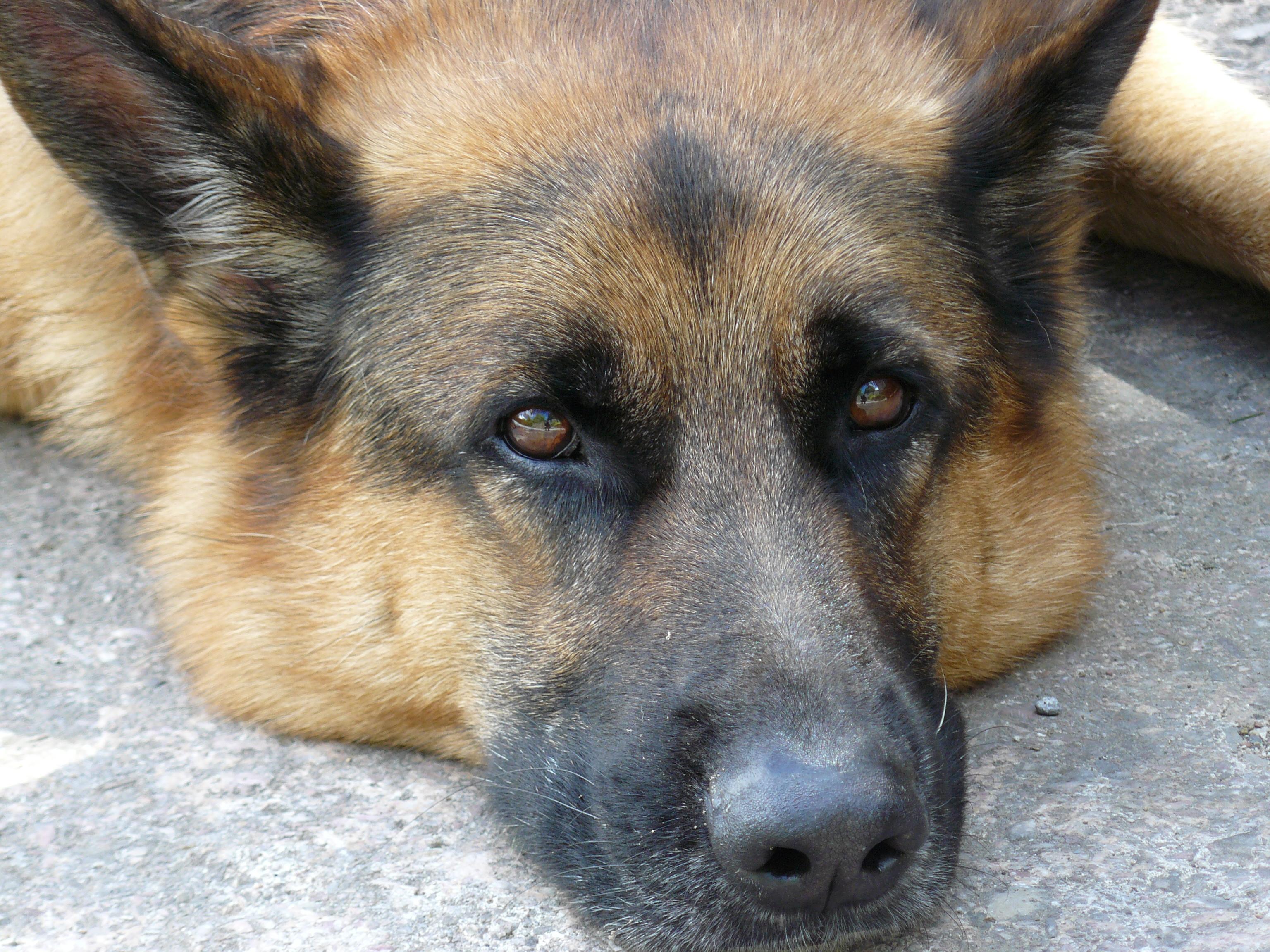
Look down at me now. While you sit at your computer. See the way my dark, brown eyes look at yours.

You smile at me. I see love in your eyes. What do you see in mine? Do you see a spirit? A soul inside who loves you as no other could in the world? A spirit that would forgive all trespasses of prior wrong doing for just a single moment of your time?  That is all I ask.  To slow down, if even for a few minutes, to be with me.

So many times you are saddened by others of my kind passing on. Sometimes we die young and oh so quickly, so suddenly that it wrenches your heart out of your throat. Sometimes, we age slowly before your eyes that you may not even seem to know until the very end, when we look at you with grizzled muzzles and cataract-clouded eyes. Still the love is always there even when we must take that last, long sleep dreaming of running free in a distant, open land.

I may not be here tomorrow. I may not be here next week. Someday you will shed the water from your eyes, that humans have when grief fills their souls, and you will mourn the loss of just ‘one more day’ with me. Because I love you so, this future sorrow even now touches my spirit and grieves me. I read you in so many ways that you cannot even start to contemplate.

We have now together. So come and sit next to me here on the floor and look deep into my eyes. What do you see? Do you see how if you look deeply at me we can talk, you and I, heart to heart. Come not to me as my owner but as a living soul. Stroke my fur and let us look deep into the other’s eyes and talk with our hearts.

I may tell you something about the fun of working the scents in the woods where you and I go. Or I may tell you something profound about myself or how we dogs see life in general. I know you decided to have me in your life because you wanted a soul to share things with. I know how much you have cared for me and always stood up for me even when others have been against me. I know how hard you have worked to help me be the teacher that I was born to be. That gift from you has been very precious to me. I know too that you have been through troubled times and I have been there to guard you, to protect you and to be there always for you. I am very different to you but here I am. I am a dog but just as alive as you.

I feel emotion. I feel physical senses. I can revel in the differences of our spirits and souls. I do not think of you as a dog on two feet; I know what you are. You are human, in all your quirkiness, and I love you still.

So, come and sit with me. Enter my world and let time slow down if only for a few minutes. Look deep into my eyes and whisper in my ears. Speak with your heart and I will know your true self. We may not have tomorrow but we do have now.

There is no question that one of the important aspects of life that we can surely learn from dogs is the ability to stay in the present as much as we can.  Easier to write than accomplish, of course.  But letting go of the past (because it’s gone) and making the best of today as opposed to worrying about the future (because that interferes in the joy of today) is still a powerful reminder of that we would do well to keep close to our heart.

Thomas’s smile

What even a lovely boy, just one year old, can offer the world.

I’m writing this around 5pm UK time on the 8th June.  A little over 4 hours ago, at 1230 give or take, I witnessed a tiny event, something that for many of us wouldn’t have been seen as anything but trivial, albeit lovely.

Here’s what happened.

I had been to an introductory meeting with Richard White of The Accidental Salesman fame.  We met in Pall Mall, just by Trafalgar Square, at the offices of The Institute of Directors.

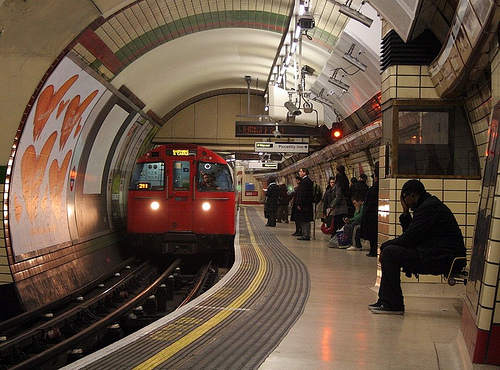
Shortly before 1230, after Richard and I had said our goodbyes, I jumped on a Bakerloo train at the London Underground station at Piccadilly Circus heading north for Baker Street.

Bakerloo line train at Piccadilly Circus station

I think it was one stop later that into my carriage entered parents with their small son.  They sat down and the father, who had been carrying the young lad, was clearly beautifully bonded (not my favourite word, can’t think of a better one just now) with the small boy.  The love and joy of the parents and their child just poured out into the ‘ether’ of the carriage. Result?

One man, middle-aged, sitting opposite to one side of the family beamed smiles in the direction of the young boy.  You could sense that his emotional outlook had been transformed by the unencumbered joy flowing across the carriage.  He really smiled more or less non-stop until I and this family got off at Baker Street station.

Another man, my guess upper middle-aged, was formally dressed in the business suit, tie and polished black shoes.  He was reading a newspaper.  But the boy’s joyful infectiousness touched him.  He put the paper to one side and discretely looked across at the child bouncing on his father’s lap and a private smile crossed his face.

I was standing observing all of this and, of course, seeing the truth of something so core to the needs of humans.  That is, the power of living beautifully in the present and how it demonstrates what my colleague Jon Lavin so often says, “The world reflects back what we think about most”.

Why do I write ‘of course’?  Because what was so natural for this boy at the tender age of one is so natural for dogs throughout all their lives; wonderfully enjoying the present.

In a most un-English manner, I briefly caught up with the parents and established that the young boy’s name was Thomas.

Well done, Thomas, and may that joy in you be with you and all those around you for ever and ever.

Present perfect!

Probably the best lesson dogs offer their human companions.

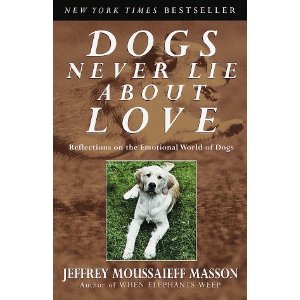
Having surfaced recently from being completely immersed in the writings of Dr. Rupert Sheldrake’s book, Dogs That Know When Their Owners Are Coming Home (start here and work backwards if you missed my musings on Sheldrake) I used the recent flight across to London to start into the book by Jeffrey Moussaieff Masson Dogs Never Lie About Love.

Masson's book

While I might disagree with some minor aspects of the way that dogs relate to humans, the essential premise of the book is very powerful.

Indeed, the very last sentence of Chapter 2, Why We Cherish Dogs reads as follows:

Questers of the truth, that’s who dogs are; seekers after the invisible scent of another’s authentic core.

For me, any attempt to seek our own ‘authentic core’ can only come from understanding the power of remaining in the present.  Dogs do this so naturally and instinctively.  As Masson writes a little earlier in the above chapter,

A dog does not tremble at the thought of his own mortality; I doubt if a dog ever thinks about a time when he will no longer be alive.  So when we are with a dog, we, too, enter a kind of timeless realm, where the future becomes irrelevant.

One could almost imagine this being the ancient wisdom of the teachings of Buddha!

Anyway, in a rather serendipitous manner, just before starting this essay, I read my weekly News and Notes from Terry Hershey.  This is what he wrote about being in the present.

Did you see Mr. Holland’s Opus? About Glenn Holland’s lifetime of teaching music to a high school band. In one scene he is giving a private lesson to Gertrude. She is playing clarinet, making noises that can only be described as other-worldly. He is clearly frustrated. As is she. Finally Mr. Holland says, “Let me ask you a question. When you look in the mirror what do you like best about yourself?”

“My hair,” says Gertrude.

“Why?”

“Well, my father always says that it reminds him of the sunset.”

After a pause, Mr. Holland says, “Okay.  Close your eyes this time. And play the sunset.”

And from her clarinet? Music. Sweet music.

Sometime today, I invite you to set aside the manual, or the list, or the prescription.

Take a Sabbath moment. . . close your eyes and play the sunset.

Mary Oliver describes such a moment this way, “. . .a seizure of happiness. Time seemed to vanish. Urgency vanished.”

Because, in such a moment, we are in, quite literally, a State of Grace.  In other words, what we experience here is not as a means to anything else.

If I am to focused on evaluating, I cannot bask in the moment.

If I am measuring and weighing, I cannot marvel at little miracles.

If I am anticipating a payoff, I cannot give thanks for simple pleasures.

If I am feeling guilty about not hearing or living the music, I cannot luxuriate in the wonders of the day.

Living in the present is not specifically mentioned but how else could one interpret these beautiful concepts.

Just amazing dog power!

Watch this video – any chit-chat from me is superfluous.

Smithfield, Alabama

If a tornado picked you up, threw you across the sky, and set you down in an unfamiliar place far away from home, and you broke two legs in the process, could you find your way back? That’s exactly the incredible story of Mason, a terrier mix in Alabama.

Credits.

I first saw the item as a link in the daily digest from Naked Capitalism.  As ever, I am indebted to the fantastic work that Yves and her team does in scouring the world for interesting news items.

The link went to a website that was just loaded with ads but in the article was another link to Fox 6.  There was the story as well, as this extract explains,

BIRMINGHAM, AL (WBRC) –

Update**:As of Wednesday night, Mason has been x-rayed and put on an IV. His vets at the Vulcan Park Animal Clinic plan to operate on his two broken legs Friday. They will use plates and maybe pins to help realign his bones. Doctors think it will be a long, but ultimately successful recovery.

Amazing stories of survival from the April 27th tornadoes don’t just include people. There are some amazing 4-legged tales of endurance being told including the story of one dog who just returned home yesterday. He is clearly battered, but alive.

Mason, a terrier mix, now rests inside the Vulcan Park Animal Care Clinic where he’s waiting to find out what kind of surgery he will need to repair 2 badly broken legs. This is only the 2nd night he’s spent under any kind of roof in the last 2 weeks and the story of how he got there is almost too amazing to believe.

On April 27th, Mason was hiding in his garage in North Smithfield when the storm picked him up and blew him away. His owners couldn’t find him and had about given up when they came back Monday to sift through the debris, and found Mason waiting for them on the porch.

Do support the Fox 6 website by reading the story in full.

Finally, the original link, as mentioned above, did contain this great news update,

Because of the generosity of Vulcan Park Animal Care in Birmingham, a center that volunteered their services to help the ailing pup, Mason is now on the mend — and needless to say, being showered with affection. Last Friday, Mason underwent surgery to fix metal plates to both his broken limbs, which will keep them stabilized as they heal. Mason will remain at Vulcan Park for about six more weeks, as his family works to restore some sense of order to their shattered home.

Just another account of how remarkable man’s best friend truly is.

Brave, lucky, sweet Mason

Racing in the Rain

A dog story for a man.

Thanks to Steve D. from the congregation here in Payson for mentioning this book.  Certainly one for my next Amazon order.

There’s a trailer on YouTube concerning the book, which is summarised as follows,

A heart-wrenching but deeply funny and ultimately uplifting story of family, love, loyalty, and hope, The Art of Racing in the Rain is a beautifully crafted and captivating look at the wonders and absurdities of human life . . . as only a dog could tell it.

So who is Garth Stein?  Well, of course, he has his own website, from which may be read,

Garth Stein is the author of the New York Times best selling literary novel, The Art of Racing in the Rain (Harper, 2008). Now published in 23 languages, The Art of Racing in the Rainwas the #1 BookSense selection for June, 2008, the Starbucks spring/summer 2008 book selection, and has been on the IndieBound™ bestseller list since its publication. Stein’s previous novel, How Evan Broke His Head and Other Secrets (Soho Press, 2005) won a Pacific Northwest Booksellers Association Award, and was a BookSense Pick in both hardcover and paperback. Raven Stole the Moon (Harper, 2010) was Stein’s first novel. He has also written a full-length play, Brother Jones, and produced a number of award-winning documentaries.

With an M.F.A. in film from Columbia University (1990), Garth worked as a documentary film maker for several years, and directed, produced, or co-produced several award winning films.

Born in Los Angeles and raised in Seattle, Garth’s ancestry is diverse: his mother, a native of Alaska, is of Tlingit Indian and Irish descent; his father, a Brooklyn native, is the child of Jewish emigrants from Austria. After spending his childhood in Seattle and then living in New York City for 18 years, Garth returned to Seattle, where he currently lives with his wife, three sons, and their dog, Comet.

There is also an adaptation for young persons,

Have you ever wondered what your dog is thinking?

Meet one funny dog—-Enzo, the lovable mutt who tells this story. Enzo knows he is different from other dogs. Every dog loves to chase cars, but Enzo longs to race them. He learns by watching TV and by listening to his best friend, Denny, an up-and-coming race-car driver, and his daughter, Zoe, his constant companion. Enzo finds that life just like being on the racetrack. For he sees that life, like racing, isn’t simply about going fast. And, by learning the tricks of racing against all odds, he takes on his family’s challenges and emerges a hero. Enzo holds in his heart the dream that Denny will go on to be a racing champion with his daughter right by his side. For theirs is an extraordinary friendship—one that reminds us all to celebrate the triumph of the human (and canine) spirit.

“The race is long. It is better to drive within oneself and finish the race behind the other than it is to drive too hard and crash.”

That’s the wisdom of Enzo, a dog with a lot to say about cars and life. When THE ART OF RACING IN THE RAIN — Garth Stein’s novel about Enzo and his owners — was published in 2008, readers immediately fell in love with Enzo, and the book has been a New York Times bestseller ever since. That’s because, once people finish reading the novel, they want to tell everybody about it.

Here’s a video of about 3 minutes where Garth Stein explains how he came to write the book.

Plus if you want a longer version, then the following is an  interview of Garth with Stacey Cochran on “The Artist’s Craft” on Raleigh Television Network Channel 10.

Get a dog, the Ben Stein way.

Just lovely!

Ben Stein

I have to admit to not having come across the name or the personage of Ben Stein before.

But that has been an omission on my part.  This is Ben’s website.

This is Ben’s view on dogs!

Why the Blog is called Learning from Dogs.

A reflection on the starting point of this Blog.

It struck me recently that many of you readers that come to Learning from Dogs on a regular basis, say, over the last 18 months, may not be clear as to why it’s called what it is, and the deeper issues behind the name.

First, the name.  Quite a few years ago I was sitting chatting with Jon Lavin, the co-founder of the Blog, in his home in South-West England.  My German Shepherd, Pharaoh (that’s him on the home page) was sleeping on the floor while Jon and I were nattering about the works of Dr David Hawkins of Veritas Publishing.  Jon mentioned that David Hawkins had measured the consciousness of dogs and that they came out about 205.  In other words they were integrous creatures and firmly on the truthful side of the boundary between truth and falsehood.

I was fascinated by that idea.  Later, back at my home, less than an hour away from Jon’s house, I was idly looking at domain names that were available, and imagine my glee when I discovered that learningfromdogs (dot) com was free.  It was rapidly grabbed.

A rather chaotic period of my life descended upon me but the notion that we have much to learn from dogs stayed with me.  Much later, when I was happily settled with Jean, the vision and purpose of the Blog got me under way.  The first post was published on 15th July, 2009.

The ideas behind the theme that dogs have an extraordinary relationship with man is contained in a very early piece written for the Blog back in July 19th, 2009.  That article is called Dogs and integrity.  But nothings stays still.  In that piece, I wrote,

Because of this closeness between dogs and man, we (as in man!) have the ability to observe the way they live.  Now I’m sure that scientists would cringe with the idea that the way that a dog lives his life sets an example for us humans, well cringe in the scientific sense.

However, on Sunday evening we watched a video from PBS that showed that scientists are now taking a very close interest in dogs and why they have such a special relationship with man, perhaps even a critical part in enabling man to prosper as hunter-gatherers.  Here’s a preview of that video programme.

Unfortunately, the video is not freely available from PBS.  However, it was based on the BBC Horizon programme, The Secret Life of the Dog, which I wrote about back in the 25th January, 2011.  (The YouTube link on that post appears to have been curtailed.)

Luckily there are a couple of options to watch this fascinating and very revealing documentary.  You can either watch it in sections from YouTube, the first 10 minutes is below, or you can watch it in full, if you don’t mind some Chinese translations here.  Your choice.

That’s enough for today, I shall return to this theme next week.