Category: Dog lessons

Is it just me?

Some days, one just wonders about a world that appears to be stark, raving mad!

One of the fundamental things that mankind is not learning from dogs, or from other animals for that fact, is having a sensitivity to danger.

Even happy, domesticated dogs, as with cats, are incredibly quick to pick up on something that just doesn’t ‘feel right’!

For example, take what was written here last Wednesday. About the extreme madness of our dependency on oil for our food!

Why is there no outcry?

Just recently, NOAA reported that “April 2014 was tied with April of 2010 as being the warmest April on record globally for land and ocean surface combined. NOAA also said that – globally – the January 2014 to April 2014 period was the 6th warmest Jan-Apr period on record.”

Why is there no outcry?

Just ten days ago, I wrote a post under the title of The nature of delusions. Included in that post was an essay from George Monbiot he called Are We Bothered? His proposition being, “The more we consume, the less we care about the living planet.

Part of me hates the way that this blog often touches on pain and negativity but my motivation is simply that doing nothing, ignoring what is so wrong in the world, would be the height of irresponsibility.

All of which is a preamble to another George Monbiot essay. Mr. Monbiot is a powerful writer as his many essays demonstrate. But this latest one from him is one of the most powerful essays in a very long time.

It’s not a comfortable read. But sure as hell, it’s a must read!

ooOOoo

The Impossibility of Growth

May 27, 2014

Why collapse and salvation are hard to distinguish from each other.

By George Monbiot, published in the Guardian 28th May 2014

Let us imagine that in 3030BC the total possessions of the people of Egypt filled one cubic metre. Let us propose that these possessions grew by 4.5% a year. How big would that stash have been by the Battle of Actium in 30BC? This is the calculation performed by the investment banker Jeremy Grantham (1).

Go on, take a guess. Ten times the size of the pyramids? All the sand in the Sahara? The Atlantic ocean? The volume of the planet? A little more? It’s 2.5 billion billion solar systems (2). It does not take you long, pondering this outcome, to reach the paradoxical position that salvation lies in collapse.

To succeed is to destroy ourselves. To fail is to destroy ourselves. That is the bind we have created. Ignore if you must climate change, biodiversity collapse, the depletion of water, soil, minerals, oil; even if all these issues were miraculously to vanish, the mathematics of compound growth make continuity impossible.

Economic growth is an artefact of the use of fossil fuels. Before large amounts of coal were extracted, every upswing in industrial production would be met with a downswing in agricultural production, as the charcoal or horse power required by industry reduced the land available for growing food. Every prior industrial revolution collapsed, as growth could not be sustained (3). But coal broke this cycle and enabled – for a few hundred years – the phenomenon we now call sustained growth.

It was neither capitalism nor communism that made possible the progress and the pathologies (total war, the unprecedented concentration of global wealth, planetary destruction) of the modern age. It was coal, followed by oil and gas. The meta-trend, the mother narrative, is carbon-fuelled expansion. Our ideologies are mere subplots. Now, as the most accessible reserves have been exhausted, we must ransack the hidden corners of the planet to sustain our impossible proposition.

On Friday, a few days after scientists announced that the collapse of the West Antarctic ice sheet is now inevitable (4), the Ecuadorean government decided that oil drilling would go ahead in the heart of the Yasuni national park (5). It had made an offer to other governments: if they gave it half the value of the oil in that part of the park, it would leave the stuff in the ground. You could see this as blackmail or you could see it as fair trade. Ecuador is poor, its oil deposits are rich: why, the government argued, should it leave them untouched without compensation when everyone else is drilling down to the inner circle of hell? It asked for $3.6bn and received $13m. The result is that Petroamazonas, a company with a colourful record of destruction and spills (6), will now enter one of the most biodiverse places on the planet, in which a hectare of rainforest is said to contain more species than exist in the entire continent of North America (7).

The UK oil company Soco is now hoping to penetrate Africa’s oldest national park, Virunga, in the Democratic Republic of Congo (8); one of the last strongholds of the mountain gorilla and the okapi, of chimpanzees and forest elephants. In Britain, where a possible 4.4 billion barrels of shale oil has just been identified in the south-east (9), the government fantasises about turning the leafy suburbs into a new Niger delta. To this end it’s changing the trespass laws to enable drilling without consent and offering lavish bribes to local people (10,11). These new reserves solve nothing. They do not end our hunger for resources; they exacerbate it.

The trajectory of compound growth shows that the scouring of the planet has only just begun. As the volume of the global economy expands, everywhere that contains something concentrated, unusual, precious will be sought out and exploited, its resources extracted and dispersed, the world’s diverse and differentiated marvels reduced to the same grey stubble.

Some people try to solve the impossible equation with the myth of dematerialisation: the claim that as processes become more efficient and gadgets are miniaturised, we use, in aggregate, fewer materials. There is no sign that this is happening. Iron ore production has risen 180% in ten years (12). The trade body Forest Industries tell us that “global paper consumption is at a record high level and it will continue to grow.” (13) If, in the digital age, we won’t reduce even our consumption of paper, what hope is there for other commodities?

Look at the lives of the super-rich, who set the pace for global consumption. Are their yachts getting smaller? Their houses? Their artworks? Their purchase of rare woods, rare fish, rare stone? Those with the means buy ever bigger houses to store the growing stash of stuff they will not live long enough to use. By unremarked accretions, ever more of the surface of the planet is used to extract, manufacture and store things we don’t need. Perhaps it’s unsurprising that fantasies about the colonisation of space – which tell us we can export our problems instead of solving them – have resurfaced (14).

As the philosopher Michael Rowan points out, the inevitabilities of compound growth mean that if last year’s predicted global growth rate for 2014 (3.1%) is sustained, even if we were miraculously to reduce the consumption of raw materials by 90% we delay the inevitable by just 75 years(15). Efficiency solves nothing while growth continues.

The inescapable failure of a society built upon growth and its destruction of the Earth’s living systems are the overwhelming facts of our existence. As a result they are mentioned almost nowhere. They are the 21st Century’s great taboo, the subjects guaranteed to alienate your friends and neighbours. We live as if trapped inside a Sunday supplement: obsessed with fame, fashion and the three dreary staples of middle class conversation: recipes, renovations and resorts. Anything but the topic that demands our attention.

Statements of the bleeding obvious, the outcomes of basic arithmetic, are treated as exotic and unpardonable distractions, while the impossible proposition by which we live is regarded as so sane and normal and unremarkable that it isn’t worthy of mention. That’s how you measure the depth of this problem: by our inability even to discuss it.

http://www.monbiot.com

References:

1. http://www.theoildrum.com/node/7853

2. Grantham expressed this volume as 1057 cubic metres. In his paper We Need To Talk About Growth, Michael Rowan translated this as 2.5 billion billion solar systems. (http://persuademe.com.au/need-talk-growth-need-sums-well/). This source gives the volume of the solar system (if it is treated as a sphere) at 39,629,013,196,241.7 cubic kilometres, which is roughly 40 x 1021 cubic metres. Multiplied by 2.5 billion billion, this gives 1041 cubic metres.

Since posting this, I’ve received the following clarifications:

From Jacob Bayless:

“… about the volume of the solar system — there is no agreed-upon definition of its diameter, which is why the figures vary wildly. (There are also two definitions of ‘a billion’, which adds to the confusion). Using the radius of Neptune’s orbit, as the farthest ‘planet’ from the sun, gives the 2.5 billion billion figure:

The orbit of Neptune is 4.5 x 10^12 m radius, which yields a 4 x 10^38 cubic m sphere. Multiplying this by 2.5 x 10^18, or “2.5 billion billion”, gives 10^57 cubic m. So that calculation checks out.

The heliopause radius would be another possible way to measure the solar system radius; it’s 4 times as far and thus 64 times the volume.”

From Geoff Briggs:

“Michael Rowan has taken the size of the solar system to be the orbit of Neptune, which is kind of understandable, but the sun’s influence extends a LOT further than that, so his estimate is correspondingly significantly overstated (ie the extra billion).

The 39,629,… cubic km figure from yahoo answers is based on a correct calculation in light years, but then a massive cock-up in the conversion to cubic km. The author seems to have assumed that a light year is about 21,000,000m, which is off by about eight orders of magnitude. 4.2 cubic light years is about 3.6 x 10^39 cubic km (and hence about 3.6 x 10^48 cubic metres).”

From Andrew Bryce:

“Starting volume of Egyptian possessions = 1 m3

after 3000 years volume = 1 x (1.045)^3000

= 2.23 x 10^57 m3

Assume the radius of the solar system is 50 AU (the distance to the Kuiper belt)

1 AU = 1.496 x 10^11 m

radius of the solar system = 50 AU = 7.48 x 10^12 m

volume of solar system = 4/3 x pi x r^3

= 1.75 x 10^39 m3

so the Egyptian possessions would require 2.23 x 10^57 / 1.75 x 10^39 solar systems

= 1.27 x 10^18

= about 1.27 billion billion solar systems

If you consider the radius of the solar system to be 40 AU (about the mid point of the orbit of Pluto), then you would get a figure of about 2.5 billion solar systems.”

But: “if you round off the volume of possessions to exactly 10^57 m3, and you assume the radius of the solar system to be 30 AU (the orbit of Neptune), then you would also get a figure of around 2.5 billion billion solar systems (well, 2.64 billion billion), which might be where the calculation came from. That would be a better definition for the size of the solar system, because it has a neatly defined edge.”

3. EA Wrigley, 2010. Energy and the English Industrial Revolution. Cambridge University Press.

4. http://www.theguardian.com/environment/2014/may/12/western-antarctic-ice-sheet-collapse-has-already-begun-scientists-warn

5. http://www.theguardian.com/environment/2014/may/23/ecuador-amazon-yasuni-national-park-oil-drill

6. http://www.entornointeligente.com/articulo/2559574/ECUADOR-Gobierno-concede-licencia-para-la-explotacion-de-dos-campos-del-ITT-23052014

7. http://www.theguardian.com/world/2013/aug/16/ecuador-approves-yasuni-amazon-oil-drilling

8. http://www.wwf.org.uk/how_you_can_help/virunga/

9. http://www.theguardian.com/environment/2014/may/23/fracking-report-billions-barrels-oil-government-cynicism

10. http://www.telegraph.co.uk/earth/energy/fracking/10598473/Fracking-could-be-allowed-under-homes-without-owners-permission.html

11. http://www.theguardian.com/environment/2014/may/23/fracking-report-billions-barrels-oil-government-cynicism

12. Philippe Sibaud, 2012. Opening Pandora’s Box: The New Wave of Land Grabbing by the Extractive Industries and the Devastating Impact on Earth. The Gaia Foundation. http://www.gaiafoundation.org/opening-pandoras-box

13. http://www.forestindustries.fi/industry/paper_cardboard_converted/paper_pulp/Global-paper-consumption-is-growing-1287.html

14. https://www.globalonenessproject.org/library/articles/space-race-over

15. Michael Rowan, 2014. We Need To Talk About Growth (And we need to do the sums as well.) http://persuademe.com.au/need-talk-growth-need-sums-well/

ooOOoo

Why is there no outcry!


The Natural order – fairness.

I sense the levels of inequity in today’s world reaching crisis levels!

This is the next essay in my irregular series of The Natural order.  The last one, on life and death, was published a couple of weeks ago.

Now it would be tempting to rant on at great length about the ‘haves’ and the ‘have-nots’ but there’s a sense of caution about so doing.  Because, to be blunt about it, the lifestyle that Jean and I enjoy here on our rural retreat in Southern Oregon is, compared to millions, a blissful luxury.

So all I will do is to refer to some recent articles and essays that seem, to me anyway, to speak volumes about the terrible and growing levels of inequity between the majority of citizens and ‘the 1%‘!

Patrice Ayme of the blog Patrice Ayme’s Thoughts has long written about inequality.  I recommend you browse his many essays on the subject of plutocracy but this one, USA: Rich Plutos, Poor People, comes to mind fairly quickly; from which I quote:

Plutocracy is a redistribution of wealth, power, income, from We The People to a small minority of controlling parasites. Plutocracy paralyzes the minds with a warped case of inverted decency. Plutocracy is neither optimal for the society, nor the economy.

Plutocracy affects the USA more than Europe, and the minds, even more than the stomachs. The fact that average Americans feel that they are much better off than in the rest of the world reinforces the plutocratization of the USA. Including astounding tolerance for the amazingly corrupt so-called Supreme Court (Supremely plutocratic!).

I’m “Black”, Mom Was White, & Thus We’re In The Black.

Turning back to this place, not so long ago I published a two-part essay on the loss of democracy.  In the first part, I wrote:

But if you think this is an American problem, let me take you back a couple of days to my post that reflected the feeling that it was all getting too much: I just want to throw up! Reason? Because in that post I referred to a recent essay by George Monbiot called The Shooting Party.  Here are the opening chapters (and you will have to go here to read the numbered references):

As the food queues lengthen, the government is giving our money to the super-rich.
By George Monbiot, published in the Guardian 29th April 2014

So now you might have to buy your own crutches, but you’ll get your shotgun subsidised by the state. A few days after False Economy revealed that an NHS group is considering charging patients for the crutches, walking sticks and neck braces it issues (1), we discovered that David Cameron has intervened to keep the cost of gun licences frozen at £50: a price which hasn’t changed since 2001 (2).

The police are furious: it costs them £196 to conduct the background checks required to ensure that shotguns are issued only to the kind of dangerous lunatics who use them for mowing down pheasants, rather than to the common or garden variety. As a result they – sorry we – lose £17m a year, by subsidizing the pursuits of the exceedingly rich (3). The Country Land and Business Association – the armed wing of the Conservative party – complains that it’s simply not fair to pass on the full cost of the licence to the owners of shotguns (4); unlike, say, the owners of passports or driving licences, who are charged on the basis of full cost recovery.

Three days later – on Friday – the government announced that it will raise the subsidy it provides for grouse moors from £30 per hectare to £56 (5). Yes, you read that right: the British government subsidises grouse moors, which are owned by 1% of the 1% and used by people who are scarcely less rich. While the poor are being forced out of their homes through government cuts, it is raising the payments – across hundreds of thousands of hectares – that some owners use to burn and cut the land (helping to cause floods downstream), shoot or poison hen harriers and other predators, and scar the hills with roads and shooting butts (6). While the rest of us can go to the devil, the interests of the very rich are ringfenced.

Shortly, I’m going to refer to another Monbiot essay recently published that underscores, once again, the corruption of fairness that is happening in the United Kingdom.

Before that, let me remind all you great readers the lesson we should, and must, learn from Nature. Again, using something recently posted:

OK, I opened today’s post with the sub-heading “Probably just now the most important lesson to be learnt from dogs!” Let me expand on that.

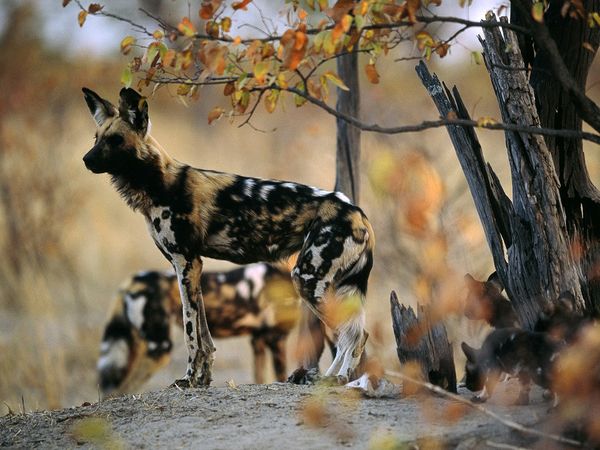
Dogs, like many other ‘pack’ animals, have a relatively flat hierarchy across their group.  Typically, a wild dog pack numbered upwards of 30 animals although in modern times we have only the African Wild dog left to study.  Nevertheless, the African Wild dog offers mankind the key lesson about cooperation and social equality.  Here’s an extract from a National Geographic article [my emphasis]:

African Wild Dog Lycaon pictus

Known as African wild, painted, or Cape hunting dogs, these endangered canines closely resemble wolves in their pack-oriented social structure. Photograph by Chris Johns
Known as African wild, painted, or Cape hunting dogs, these endangered canines closely resemble wolves in their pack-oriented social structure.
Photograph by Chris Johns

The African wild dog, also called Cape hunting dog or painted dog, typically roams the open plains and sparse woodlands of sub-Saharan Africa.

These long-legged canines have only four toes per foot, unlike other dogs, which have five toes on their forefeet. The dog’s Latin name means “painted wolf,” referring to the animal’s irregular, mottled coat, which features patches of red, black, brown, white, and yellow fur. Each animal has its own unique coat pattern, and all have big, rounded ears.

African wild dogs live in packs that are usually dominated by a monogamous breeding pair. The female has a litter of 2 to 20 pups, which are cared for by the entire pack. These dogs are very social, and packs have been known to share food and to assist weak or ill members. Social interactions are common, and the dogs communicate by touch, actions, and vocalizations.

African wild dogs hunt in formidable, cooperative packs of 6 to 20 (or more) animals. Larger packs were more common before the dogs became endangered.

So back to the domesticated dog.  There are just three ‘roles’ to be found: the female alpha dog, the male beta dog and the omega dog that can be of either gender. Even though in a group of dogs (we have eight here at home) the alpha and beta dogs are dominant and will eat first, there is no question of denying the other dogs in the group access to food, water and love from us humans.

The lesson we must learn from dogs is obvious and there’s no need for me to spell it out!

This, then, is the power of the natural order as it applies to animal ‘communities’.

Nature, one way or another, will show us that the natural order is the only ruling order on this natural planet.

So with those tones of mine hopefully ringing in your ears, have a read of this recent Monbiot essay republished with Mr. Monbiot’s kind permission.

ooOOoo

Land of Impunity

May 5, 2014

Politicians and government contractors now seem to be able to get away with almost anything.
By George Monbiot, published in the Guardian 6th May 2014.

What do you have to do to fall out of favour with this government? Last month, the security company G4S was quietly rehabilitated (1). It had been banned in August 2013 from bidding for government contracts (2), after charging the state for tagging 3,000 phantom criminals (3). Those who had died before it started monitoring them presented a particularly low escape risk. G4S was obliged to pay £109m back to the government.

Eight months later, and before an investigation by the Serious Fraud Office has concluded, back it bounces, seeking more government business. Never mind that it almost scuppered the Olympics (4). Never mind Jimmy Mubenga, an asylum seeker who died in 2010 after being “restrained” by G4S guards(5), or Gareth Myatt, a 15-year-old who died while being held down at a secure training centre in 2004(6). Never mind the scandals and crises at Oakwood, the giant prison it runs(7). G4S, recently described by MPs as one of a handful of “privately-owned public monopolies”(8), is crucial to the government’s attempts to outsource almost everything. So it cannot be allowed to fail.

Was it ever banned at all? Six days after the moratorium was lifted, G4S won a new contract to run services for Her Majesty’s Revenue and Customs(9). A fortnight later, it was chosen as one of the companies that will run the government’s Help to Work scheme(10). How did it win these contracts if, in the preceding months, it wasn’t allowed to bid?

When I first worked in Brazil, in the late 1980s, the country was widely described as o pais de impunidade: the land of impunity. What this meant was that there were no political consequences. Politicians, officials and contractors could be exposed for the most flagrant corruption, but they remained in post. The worst that happened was early retirement with a fat pension and the proceeds of their villainy safely stashed offshore. It’s beginning to look a bit like that here.

This is not to suggest that the people or companies I name in this article are crooked or corrupt. It’s to suggest that the political class no longer seems to care about failure.

The failure works both ways of course. As Polly Toynbee has shown, the pilot projects for the Help to Work scheme which G4S will run reveal that it’s a complete waste of time and money(11). Yet the government has decided to go ahead anyway, subjecting the jobless to yet more humiliation and pointlessness. Contrast the boundless forgiveness of G4S to the endless castigation for being unemployed.

A record of failure reflects the environment in which such companies are hired: one in which ministers launch improbable schemes then look the other way when they go wrong. G4S had to pay back so much money for the phantom criminals it wasn’t monitoring because it had been doing it for eight years, and no one in government had bothered to check(12). There is no such thing as failure any more, just lessons to be learnt.

Accountability has always been weak in this country, but under this government you must make spectacular efforts to lose your post. At the Leveson inquiry in April 2012, the relationship between the then culture secretary Jeremy Hunt and the Murdoch empire that he was supposed to be regulating was exposed in gory detail(13,14). Though he was meant to be deciding impartially whether or not to allow the empire to take over the broadcaster BSkyB, he was secretly exchanging gleeful messages with James Murdoch and his staff(15).

We all knew what it meant. The emails, the Guardian observed, were likely to “sever the slim thread connecting Hunt to his cabinet job.”(16) “After this he’s toast … it’s over for Hunt,” wrote Tom Watson MP(17). “He cannot stay in his post,” said Ed Miliband. “And if he refuses to resign, the prime minister must show some leadership and fire him.”(18) We waited. Hunt remained culture secretary for another four months, then he was promoted to secretary of state for health.

On 2 September 2012, the Guardian revealed that the housing minister, Grant Shapps, had founded a business which “creates web pages by spinning and scraping content from other sites to attract advertising”: a process that looks to me like automated plagiarism(19). He had been promoting the business under the name of Michael Green, who claimed to be an internet marketing guru. Again it looked fatal. Two days later, in the same reshuffle that elevated Hunt, he was promoted to Conservative party chairman.

A real Mr Green – Stephen this time – was ennobled by David Cameron and appointed, democratically of course, as minister for trade and investment. In July 2012, a US Senate committee reported that while Lord Green was chief executive and chairman of HSBC, the bank’s compliance culture was “pervasively polluted”(20). Its branches had “actively circumvented US safeguards … designed to block transactions involving terrorists, drug lords, and rogue regimes.” Billions of dollars from Mexican drug barons, from Iran and from “obviously suspicious” travellers’ cheques “benefiting Russians who claimed to be in the used car business” sluiced through its tills(21). Out went dollars and financial services to banks in Saudi Arabia and Bangladesh linked to the financing of terrorists. The Guardian reported that HSBC “continued to operate hundreds of accounts with suspected links to Mexican drug cartels, even after Green and fellow executives were told by regulators that HSBC was one of the worst banks for money laundering.”(22)

Green refused to answer questions and sat tight(23). He remained in post for another 17 months, until he gracefully retired in December 2013.

After it had become obvious to almost everyone that it was impossible for them to remain in the Cabinet, David Cameron refused to sack either Liam Fox or Maria Miller. Forgiveness and redemption, by all means. But they are not unconditional: without contrition or even acknowledgement that wrong has been done, there’s no difference between giving people a second chance and engaging in an almighty cover-up.

There has seldom, in the democratic era, been a better time to thrive by appeasing wealth and power, or to fail by sticking to your principles. Politicians who twist and turn on behalf of business are immune to attack. Those who resist are excoriated.

Here’s where a culture of impossible schemes and feeble accountability leads: to cases like that of Mark Wood, a highly vulnerable man who had his benefits cut after being wrongly assessed by the outsourcing company Atos Healthcare as fit for work, and starved to death(24) – while those who run such companies retire with millions. Impunity for the rich; misery for the poor.

http://www.monbiot.com

References:

1. http://www.bbc.co.uk/news/uk-politics-26958650

2. http://www.bbc.co.uk/news/uk-23596541

3. http://www.theguardian.com/business/2014/mar/12/g4s-repay-overcharging-tagging-contracts

4. http://www.theguardian.com/business/2012/sep/11/g4s-failed-olympic-security-lord-coe

5. http://www.theguardian.com/uk-news/2013/jul/09/jimmy-mubenga-unlawfully-killed-inquest-jury

6. http://www.theguardian.com/society/2007/jun/29/youthjustice.law

7. http://www.theguardian.com/society/2014/apr/29/tales-from-inside-oakwood-prison

8. http://www.publications.parliament.uk/pa/cm201314/cmselect/cmpubacc/777/777.pdf?utm_source=rss&utm_medium=rss&utm_campaign=contracting-out-public-services-to-the-private-sector-forty-seventh-report-of-session-2013-14-report-together-with-formal-minutes-oral-and-written-evidence

9. http://www.telegraph.co.uk/finance/newsbysector/supportservices/10768641/G4S-wins-first-central-Government-contract-since-tagging-scandal.html

10. http://www.ft.com/cms/s/0/4f9118a6-ceed-11e3-9165-00144feabdc0.html#ixzz30pVTWOXh

11. http://www.theguardian.com/commentisfree/2014/apr/15/help-to-work-punishing-jobless

12. http://www.publications.parliament.uk/pa/cm201314/cmselect/cmpubacc/777/777.pdf?utm_source=rss&utm_medium=rss&utm_campaign=contracting-out-public-services-to-the-private-sector-forty-seventh-report-of-session-2013-14-report-together-with-formal-minutes-oral-and-written-evidence

13. http://www.theguardian.com/media/2012/apr/24/leveson-inquiry-jeremy-hunt

14. http://www.theguardian.com/politics/2012/apr/24/jeremy-hunt-murdochs-bskyb-bid

15. http://www.theguardian.com/politics/2012/may/31/jeremy-hunt-james-murdoch-bskyb

16. http://www.theguardian.com/politics/2012/may/24/leveson-inquiry-memo-hunt-murdoch

17. http://www.theguardian.com/commentisfree/2012/apr/24/jeremy-hunt-must-resign

18. http://www.theguardian.com/politics/2012/apr/24/jeremy-hunt-calls-resign-bskyb

19. http://www.theguardian.com/politics/2012/sep/02/grant-shapps-google-howtocorp-adsense

20. http://www.hsgac.senate.gov/subcommittees/investigations/media/hsbc-exposed-us-finacial-system-to-money-laundering-drug-terrorist-financing-risks

21. http://www.hsgac.senate.gov/subcommittees/investigations/hearings/us-vulnerabilities-to-money-laundering-drugs-and-terrorist-financing-hsbc-case-history

22. http://www.theguardian.com/business/2012/jul/22/hsbc-lord-green-mexico-drugs-cash

23. http://www.theguardian.com/business/2012/jul/24/lord-green-hsbc-scandal

24. http://www.oxfordmail.co.uk/news/11112129.Government_admits_Mark_Wood_s_benefits_cut_before_he_starved_to_death__was_wrong_/

ooOOoo


The loss of democracy, Concluding Part.

Part Two of what is probably just now the most important lesson to be learnt from dogs!

(Part One was published last Friday.)

Last Friday I part-used a recent chilling essay on TomDispatch by Peter Van Buren to illustrate the madness and the associated dangers of how we humans are behaving at present.  Here’s the balance of that essay.

ooOOoo

This Land Isn’t Your Land, This Land Is Their Land

An Empire in Decline (City by City, Town by Town)
By Peter Van Buren

The Most Exclusive Gated Community: U.S. Marine Corps Base, Camp Lejeune, North Carolina

I grew up in a fairly small Ohio town that, in the 1970s, was just crossing the sociological divide between a traditional kind of place and a proper bedroom suburb. Not everyone knew each other, but certain principles were agreed upon. A steak should be one inch thick or more. A good potluck solved most problems. Vegetables were boiled, faith rewarded. Things looked better in the morning. Kids drank chocolate milk instead of Coke. We had parades every Memorial Day and every Fourth of July, but Labor Day was just for barbecues because school began the next day and dad had to get up for work. In fact, that line — “I’ve got to get up for work” — was the way most social events broke up. This isn’t nostalgia, it’s history.

In 2014, you could travel significant parts of the decaying Midwest and not imagine that such a place had ever existed. But turn south on Interstate 95 and look for the signs that say “Welcome to U.S. Marine Corps Base Camp Lejeune,” in Jacksonville, North Carolina. Actually, welcome to almost any U.S. military base outside of actual war zones, where a homogeneous military population and generous government spending (re)creates the America of the glory days as accurately as a Hollywood movie. For a first-time visitor, a military base can feel like its own living museum, the modern equivalent of Colonial Williamsburg.

Streets are well maintained, shaded by tall trees planted there (and regularly pruned) for just that purpose. Road, water, and sewer crews are always working. There are no potholes. There is a single school with a prominent football field, and a single shopping area. The restaurants are long-time Department of Defense franchise partners and there’s always a pizza place with a fake-sounding Italian name. Those creature comforts on such bases in the U.S. and around the world come at a cost to taxpayers of billions of dollars a year.

Some of the places employ locals, some military spouses, some high school kids earning pocket money after school. The kids bag groceries. Everybody tips them; they’re neighbors.

The centerpieces of any base like Camp Lejeune are the Base Exchange and the Commissary. The former is a mini-Walmart; the latter, a large grocery store. Both are required by law not to make a profit and so sell products at near wholesale prices. Because everyone operates on federal property, no sales tax is charged. When a member of a Pentagon advisory board proposed shutting down some of the commissaries across the U.S., a step that would have saved taxpayers about $1.4 billion a year, World War III erupted in Congress and halted the idea.

Over in officers’ housing areas, everyone cuts their lawns, has a garage full of sports equipment and a backyard with a grill. Don’t keep up your assigned housing unit and you’ll hear from a senior officer. People get along — they’re ordered to do so.

The base is the whole point of Jacksonville, the town that surrounds it. The usual bars and strip clubs service the Marines, and Camp Lejeune is close to being the town’s sole employer like that old steel mill in Weirton or the gambling palaces in Atlantic City. The base shares another connection to places like Weirton: as men lost their health in the mills thanks to asbestos and other poisons, so Camp Lejeune’s drinking water was contaminated with trichloroethylene, a known carcinogen, between 1953 and 1987.

There, however, the similarities end.

Unlike the archipelago of American towns and cities abandoned to shrivel and die, the “city” inside Camp Lejeune continues to thrive, since its good times are fully covered by taxpayer money. The 23% of the national budget spent on defense assures places like Camp Lejeune of their prosperity.

The Department of Defense, with 3.2 million employees (albeit not all in uniform) is the world’s largest employer. It makes up more than two percent of the American labor force.

And the military pays well; no scrambling for a minimum wage at Camp LeJeune. With combat pay more or less standard since 9/11 (the whole world being a battlefield, of course), the Congressional Budget Office estimates that the average active duty service member receives a benefits and pay compensation package worth $99,000. This includes a livable pension after 20 years of service, free medical and dental care, free housing, a clothing allowance, and more. In most cases, dependents of service members continue to live on a base in the United States while their husbands or wives, fathers or mothers serve abroad. Unlike in the minimum-wage jobs many other Americans now depend on, service members can expect regular training and skills enhancement and a clear path to promotion. Nearly every year, Congress votes for pay increases. The arguments for military benefits may be clear — many service members lead difficult and dangerous lives. The point is, however, that the benefits exist, unlike in so many corporate workplaces today. The government pays for all of them, while Atlantic City and Weirton struggle to stay above water.

Small Town America in the Big Apple: Spanish Harlem

The number of Americans who have visited Harlem, even for a quick stop at a now-trendy restaurant or music club, is unknown but has to be relatively small. Even many lifetime New Yorkers riding the uptown subway under the wealthy upper east side are careful to hop off before reaching the 116th Street stop. Still, get off there, walk a few blocks, and you find yourself in a micro-economy that, in its own way, has more in common with America of the 1950s than 2014.

There are, of course, no shaded areas along the block I was visiting in what has traditionally been known as Spanish Harlem, no boyish Little League games. But what you do find are locally owned stores with hardly a franchised or corporately owned place in sight. The stores are stocked with a wondrous hodge-podge of what people in the area need, including South American root vegetables, pay-as-you-go cell phones, and cheap school supplies.

These stores could not exist in many other places. They are perfectly adapted to the neighborhood they are in. While the quality of goods varies, prices are wondrously below what similar things cost a half-dozen subway stops away in midtown Manhattan. In the stores, the employees of these family businesses speak the same languages as their mostly Dominican immigrant customers, and those who work there are eager to make suggestions and help you find things.

People actually chat with each other. Customer loyalty is important, so prices are often negotiable. When he discovered that his customer was also his neighbor, one shop owner helped carry purchases upstairs. Another store informally accepted and held package deliveries for neighbors.

The guy selling frozen ices on the sidewalk nearby did not work for a conglomerate and doled out healthy-sized servings to his regulars. He told me that he bought his raw materials in the very grocery store we were camped in front of.

Even at night, the sidewalks here are full of people. I never felt unsafe, even though I obviously wasn’t from the neighborhood. People seemed eternally ready to give me directions or suggest a local eatery I shouldn’t miss. The one established mega-corporate store in the area, a Rent-a-Center charging usurious prices for junk, had no customers inside on the day I visited. The shop next to it, with an impressive array of used TVs and small appliances from unknown Chinese manufacturers, seemed to be doing gangbuster business. The owner shifted among English, Spanish, and some sort of Dominican creole based on the needs of his customers.

Few things here are shiny or new. There are vacant lots, an uncomfortable sight at night. Homeless people, some near naked despite the weather and muttering to themselves, are more prevalent than in Midtown. The streets have more trash. I saw drug deals going on against graffiti-scarred walls. There is a busy methadone clinic on a busy street. Not everyone is the salt of the earth, but local businesses do cater to the community and keep prices in line with what people could pay. Money spent in the neighborhood mostly seems to stay there and, if not, is likely sent home to the Dominican Republic to pay for the next family member’s arrival in town — what economist John Maynard Keynes called the “local multiplier effect.” One study found that each $100 spent at local independents generated $45 of secondary local spending, compared to $14 at a big-box chain. Business decisions — whether to open or close, staff up or lay off — were made by people in the area face-to-face with those they affected. The businesses were accountable, the owners at the cash registers.

The stretch of Spanish Harlem I passed through is a galaxy away from perfect, but unlike Weirton, which had long ago given up, Atlantic City, which was in the process of doing so, or Camp Lejeune, which had opted out of the system entirely, people are still trying. It shows that an accountable micro-economy with ties to the community can still work in this country — at least in the short run. But don’t hold your breath. Target recently opened its first superstore not far away and may ultimately do to this neighborhood what cheap foreign steel imports did to Weirton.

Looking Ahead

I grew up in the Midwest at a time when the country still prided itself on having something of a conscience, when it was a place still built on hope and a widespread belief that a better future was anybody’s potential birthright. Inequity was always there, and there were always rich people and poor people, but not in the ratios we see now in America. What I found in my travels was place after place being hollowed out as wealth went elsewhere and people came to realize that, odds on, life was likely to get worse, not better. For most people, what passed for hope for the future meant clinging to the same flat-lined life they now had.

What’s happening is both easy enough for a traveler to see and for an economist to measure. Median household income in 2012 was no higher than it had been a quarter-century earlier. Meanwhile, expenses had outpaced inflation. U.S. Census Bureau figures show that the income gap between rich and poor had widened to a more than four-decade record since the 1970s. The 46.2 million people in poverty remained the highest number since the Census Bureau began collecting that data 53 years ago. The gap between how much total wealth America’s 1% of earners control and what the rest of us have is even wider than even in the years preceding the Great Depression of 1929. Argue over numbers, debate which statistics are most accurate, or just drive around America: the trend lines and broad patterns, the shadows of our world of regime change, are sharply, sadly clear.

After John Steinbeck wrote The Grapes of Wrath, he said he was filled with “certain angers at people who were doing injustices to other people.” I, too, felt anger, though it’s an emotion that I’m unsure how to turn against the problems we face.

As I drove away from Atlantic City, I passed Lucy the Elephant still at her post, unblinking and silent. She looks out over the Boardwalk, maybe America itself, and if she could, she undoubtedly would wonder where the road ahead will take us.

Peter Van Buren blew the whistle on State Department waste and mismanagement during Iraqi reconstruction in his first book, We Meant Well: How I Helped Lose the Battle for the Hearts and Minds of the Iraqi People. A TomDispatch regular, he writes about current events at his blog, We Meant Well. His book Ghosts of Tom Joad: A Story of the #99Percent has just been published.

Follow TomDispatch on Twitter and join us on Facebook and Tumblr. Check out the newest Dispatch Book, Ann Jones’s They Were Soldiers: How the Wounded Return From America’s Wars — The Untold Story.

Copyright 2014 Peter Van Buren

ooOOoo

Let me pick up a sentence that Peter wrote in his penultimate paragraph.  This one; “I, too, felt anger, though it’s an emotion that I’m unsure how to turn against the problems we face.

Those feelings of anger are easy to feel and, of course, anger is a legitimate response to the terrible levels of inequity in many societies.   But the answer is clear.  We need to promote the role of integrity, honesty, love and trust in our affairs, from the top to the bottom of the peoples who make up a nation.  As is explained in my sidebar Dogs and integrity,

Dogs:

  • are integrous ( a score of 210) according to Dr David Hawkins
  • don’t cheat or lie
  • don’t have hidden agendas
  • are loyal and faithful
  • forgive
  • love unconditionally
  • value and cherish the ‘present’ in a way that humans can only dream of achieving
  • are, by eons of time, a more successful species than man.

Not a bad model for the future!

The loss of democracy, Part One

Probably just now the most important lesson to be learnt from dogs! (read to the end!)

I have frequently written about the many growing stresses in societies so, in a sense, today’s post is nothing new.  But the power of a recent essay over on TomDispatch was such that I couldn’t ignore it.  Especially as Tom Engelhardt has given me permission to republish it. I’m referring to the essay by Peter Van Buren under the title of Regime Change in America.

However, while that essay is published wholly as one by Tom, I’m going to break it down into two posts; today and next Monday.  Simply because it resonates so strongly with other items that I want to refer to.

But let me get started by offering you Tom’s introduction to Peter Van Buren’s essay.

The old words are on the rebound, the ones that went out in the last century when the very idea of a Gilded Age, and the plutocrats and oligarchy of wealth that went with it, left the scene in the Great Depression. Now, those three classic terms that were never to return (or so it once seemed) are back in our vocabularies. They’ve been green-lighted by society. (If they’re not on SAT tests in the coming years, I’ll eat my top hat.)

Of course, an inequality gap has been widening into an abyss for decades now, but when it comes to the present boom in old-fashioned words that once went with being really, really, obscenely wealthy and powerful, give the Occupy movement of 2011 credit. After all, they were the ones who took what should already have been on everyone’s lips — the raging inequality in American society — out of the closet and made it part of the national conversation. 1%! 99%!

Now, the stats on national and global inequality are everyday fare (and looking worse all the time). Meanwhile, the book of a French (French!) economist about how the U.S. is leading the way when it comes to inequality and possibly creating the basis for a future… yes!… oligarchy of inherited wealth is on the bestseller list and the talk of the town. And if that weren’t enough, a new study out of Princeton University suggests that, as Talking Points Memo put it, “Over the past few decades America’s political system has slowly transformed from a democracy into an oligarchy, where wealthy elites wield most power.” As the two authors of the study write, “The central point that emerges from our research is that economic elites and organized groups representing business interests have substantial independent impacts on U.S. government policy, while mass-based interest groups and average citizens have little or no independent influence.”

In an America where, when it comes to the political system, the Supreme Court has now granted the dollar the full right to speak its mind, and ever more of those dollars can be found in the pockets of… well, not to put a fine point on it, plutocrats, we need a new (that is, old) vocabulary to fit our changing circumstances.

In all of this, one thing missing has been the classic American observer, the keen reporter setting out on the road to catch the new look of a land in pain and misery. Today, TomDispatch aims to remedy that. Peter Van Buren, former State Department whistleblower and author of a new book on American inequality, Ghosts of Tom Joad: A Story of the #99Percent, has been traveling the ever-expanding, ever-rustier Rust Belt taking the temperature of a land with a significant fever. Here’s his account. Tom

But if you think this is an American problem, let me take you back a couple of days to my post that reflected the feeling that it was all getting too much: I just want to throw up! Reason? Because in that post I referred to a recent essay by George Monbiot called The Shooting Party.  Here are the opening chapters (and you will have to go here to read the numbered references):

As the food queues lengthen, the government is giving our money to the super-rich.
By George Monbiot, published in the Guardian 29th April 2014

So now you might have to buy your own crutches, but you’ll get your shotgun subsidised by the state. A few days after False Economy revealed that an NHS group is considering charging patients for the crutches, walking sticks and neck braces it issues (1), we discovered that David Cameron has intervened to keep the cost of gun licences frozen at £50: a price which hasn’t changed since 2001 (2).

The police are furious: it costs them £196 to conduct the background checks required to ensure that shotguns are issued only to the kind of dangerous lunatics who use them for mowing down pheasants, rather than to the common or garden variety. As a result they – sorry we – lose £17m a year, by subsidizing the pursuits of the exceedingly rich (3). The Country Land and Business Association – the armed wing of the Conservative party – complains that it’s simply not fair to pass on the full cost of the licence to the owners of shotguns (4); unlike, say, the owners of passports or driving licences, who are charged on the basis of full cost recovery.

Three days later – on Friday – the government announced that it will raise the subsidy it provides for grouse moors from £30 per hectare to £56 (5). Yes, you read that right: the British government subsidises grouse moors, which are owned by 1% of the 1% and used by people who are scarcely less rich. While the poor are being forced out of their homes through government cuts, it is raising the payments – across hundreds of thousands of hectares – that some owners use to burn and cut the land (helping to cause floods downstream), shoot or poison hen harriers and other predators, and scar the hills with roads and shooting butts (6). While the rest of us can go to the devil, the interests of the very rich are ringfenced.

So with no further ado, back to the first half of Peter Van Buren’s essay.

ooOOoo

This Land Isn’t Your Land, This Land Is Their Land

An Empire in Decline (City by City, Town by Town)
By Peter Van Buren

As America’s new economy starts to look more like the old economy of the Great Depression, the divide between rich and poor, those who have made it and those who never will, seems to grow ever starker. I know. I’ve seen it firsthand.

Once upon a time, I worked as a State Department officer, helping to carry out the occupation of Iraq, where Washington’s goal was regime change. It was there that, in a way, I had my first taste of the life of the 1%. Unlike most Iraqis, I had more food and amenities than I could squander, nearly unlimited funds to spend as I wished (as long as the spending supported us one-percenters), and plenty of U.S. Army muscle around to keep the other 99% at bay. However, my subsequent whistleblowing about State Department waste and mismanagement in Iraq ended my 24-year career abroad and, after a two-decade absence, deposited me back in “the homeland.”

I returned to America to find another sort of regime change underway, only I wasn’t among the 1% for this one. Instead, I ended up working in the new minimum-wage economy and saw firsthand what a life of lousy pay and barely adequate food benefits adds up to. For the version of regime change that found me working in a big box store, no cruise missiles had been deployed and there had been no shock-and-awe demonstrations. Nonetheless, the cumulative effects of years of deindustrialization, declining salaries, absent benefits, and weakened unions, along with a rise in meth and alcohol abuse, a broad-based loss of good jobs, and soaring inequality seemed similar enough to me. The destruction of a way of life in the service of the goals of the 1%, whether in Iraq or at home, was hard to miss. Still, I had the urge to see more. Unlike in Iraq, where my movements were limited, here at home I could hit the road, so I set off for a look at some of America’s iconic places as part of the research for my book, Ghosts of Tom Joad.

Here, then, are snapshots of four of the spots I visited in an empire in decline, places you might pass through if you wanted to know where we’ve been, where we are now, and (heaven help us) where we’re going.

On the Boardwalk: Atlantic City, New Jersey

Drive in to Atlantic City on the old roads, and you’re sure to pass Lucy the Elephant. She’s not a real elephant, of course, but a wood and tin six-story hollow statue. First built in 1881 to add value to some Jersey swampland, Lucy has been reincarnated several times after suffering fire, neglect, and storm damage. Along the way, she was a tavern, a hotel, and — for most of her life — simply an “attraction.” As owning a car and family driving vacations became egalitarian rights in the booming postwar economy of the 1950s and 1960s, all manner of tacky attractions popped up along America’s roads: cement dinosaurs, teepee-shaped motels, museums of oddities, and spectacles like the world’s largest ball of twine. Their growth paralleled 20 to 30 years of the greatest boom times any consumer society has ever known.

Between 1947 and 1973, actual incomes in the United States rose remarkably evenly across society. Certainly, there was always inequality, but never as sharp and predatory as it is today. As Scott Martelle’s Detroit: A Biography chronicles, in 1932, Detroit produced 1.4 million cars; in 1950, that number was eight million; in 1973, it peaked at 12 million. America was still a developing nation — in the best sense of that word.

Yet as the U.S. economy changed, money began to flow out of the working class pockets that fed Lucy and her roadside attraction pals. By one count, from 1979 to 2007, the top 1% of Americans saw their income grow by 281%. They came to control 43% of U.S. wealth.

You could see it all in Atlantic City, New Jersey. For most of its early life, it had been a workingman’s playground and vacation spot, centered around its famous boardwalk. Remember Monopoly? The street names are all from Atlantic City. However, in the economic hard times of the 1970s, as money was sucked upward from working people, Boardwalk and Park Place became a crime scene, too dangerous for most visitors. Illegal drug sales all but overtook tourism as the city’s most profitable business.

Yet the first time I visited Atlantic City in the mid-1980s, it looked like the place was starting to rebound in the midst of a national economy going into overdrive. With gambling legalized, money poured in. The Boardwalk sprouted casinos and restaurants. Local business owners scrambled to find workers. Everyone and everything felt alive. Billboards boasted of “rebirth.”

Visit Atlantic City in 2014 and it’s again a hollowed-out place. The once swanky mall built on one of the old amusement piers has more stores shuttered than open. Meanwhile, the “We Buy Gold” stores and pawnshops have multiplied and are open 24/7 to rip off the easy marks who need cash bad enough to be out at 4 A.M. pulling off their wedding rings. On a 20-story hotel tower, you can still read the word “Hilton” in dirt shadow where its name had once been, before the place was shuttered.

Trump Plaza, a monument to excess and hubris created by a man once admired as a business magician and talked about as a possible presidential candidate, is now a catalog of decay. The pillows in the rooms smell of sweat, the corners of doors are chipped, many areas need a new coat of paint, and most of the bars and restaurants resemble the former Greyhound bus terminal a few blocks away. People covered with the street gravy that marks the homeless wander the casino, itself tawdry and too dimly lit to inspire fun. There were just too many people who were clearly carrying everything they owned around in a backpack.

Outside, along the Boardwalk, there are still the famous rolling chairs. They are comfortable, bound in wicker, and have been a fixture of Atlantic City for decades. They were once pushed by strong young men, maybe college students earning a few bucks over the summer break. You can still ride the chairs to see and be seen, but now they’re pushed by recent immigrants and not-so-clean older denizens of the city. Lots of tourists still take rides, but there’s something cheap and sad about paying workers close to my own age to wheel you around, just a step above pushing dollars into the G-strings of the strippers in clubs just off the Boardwalk.

One of the things I did while in Atlantic City was look for the family restaurant I had worked in 30 years earlier. It’s now a dollar store run by an angry man. “You buy or you leave,” he said. Those were the last words I heard in Atlantic City. I left.

Dark Side of the Moon: Weirton, West Virginia

The drive into Weirton from the east takes you through some of the prettiest countryside in Maryland and Western Pennsylvania. You cross rivers and pass through the Cumberland Gap along the way and it’s easy going into the town, because the roads are mostly empty during typical business hours. There’s nothing much going on. The surrounding beauty just makes the scarred remains of Weirton that much more shocking when you first come upon them. Take the last turn and suddenly the abandoned steel mills appear like a vision of an industrial apocalypse, nestled by the Ohio River.

In 1909, Ernest T. Weir built his first steel mill next to that river and founded what later became the Weirton Steel Corporation. In the decades to come, the town around it and the mill itself were basically synonymous, both fueled by the industrial needs of two world wars and the consumer economy created following the defeat of Germany and Japan. The Weirton mill directly contributed to wartime triumphs, producing artillery shells and raw steel to support the effort, while Weirton’s sons died on battlefields using the company’s products. (A war memorial across the street from the mill sanctifies the dead, the newest names being from the battlefields of Iraq and Afghanistan.)

tomjoadAt its peak, the Weirton Steel Corporation employed more than 12,000 people, and was the largest single private employer and taxpayer in West Virginia. The owners of the mill paid for and built the Weirton Community Center, the Weirton General Hospital, and the Mary H. Weir Library in those glory days. For years the mill also paid directly for the city’s sewers, water service, and even curbside garbage pickup. Taxes were low and life was good.

In the 1970s and early 1980s, however, costs rose, Asian steel gained traction and American manufacturing started to move offshore. For the first time since the nineteenth century, the country became a net importer of goods. Some scholars consider the mid-1970s a tipping point, when Congress changed the bankruptcy laws to allow troubled companies an easier path to dumping existing union contracts and employee agreements. It was then that Congress also invented individual retirement accounts, or IRAs, which were supposed to allow workers to save money tax-free to supplement their retirements. Most corporations saw instead an opportunity to get rid of expensive pensions. It was around then that some unknown steelworker was first laid off in Weirton, a candidate for Patient Zero of the new economy.

The mill, which had once employed nearly one out of every two people in town, was sold to its employees in 1984 in a final, failed attempt at resuscitation. In the end, the factory closed, but the people remained. Today, the carcass of the huge steel complex sits at one end of Main Street, rusting and overgrown with weeds because it wasn’t even cost-effective to tear it down. Dinosaur-sized pieces of machinery litter the grounds, not worth selling off, too heavy to move, too bulky to bury, like so many artifacts from a lost civilization. A few people do still work nearby, making a small amount of some specialty metal, but the place seems more like a living museum than a business.

Most of the retail shops on Main Street are now abandoned, though I counted seven bars and two strip clubs. There’s the Mountaineer Food Bank that looks like it used to be a hardware store or maybe a dress shop. The only still-thriving industry is, it seems, gambling. West Virginia legalized “gaming” in 1992 and it’s now big business statewide. (Nationally, legal gambling revenues now top $92.27 billion a year.)

Gambling in Weirton is, however, a far cry even from the decaying Trump Hotel in Atlantic City. There are no Vegas-style casinos in town, just what are called “cafes” strung along Main Street. None were built to be gambling havens. In fact, their prior history is apparent in their architecture: this one a former Pizza Hut, that one an old retail store with now-blacked out windows, another visibly a former diner.

One sunny Tuesday, I rolled into a cafe at 7 A.M., mostly because I couldn’t believe it was open. It took my eyes a minute to adjust to the darkness before I could make out three older women feeding nickels into slot machines, while another stood behind a cheap padded bar, a cigarette tucked behind her ear, another stuck to her dry lips. She offered me a drink, gesturing to rows of Everclear pure grain, nearly 99% pure alcohol, and no-name vodka behind her. I declined, and she said, “Well, if you can’t drink all day, best anyway that you not start so early.”

Liquor is everywhere in Weirton. I talked to a group of men drinking out of paper bags on a street corner at 8 A.M. They hadn’t, in fact, been there all night. They were just starting early like the cafe lady said. Even the gas stations were stocked with the ubiquitous Everclear, all octane with no taste or flavor added because someone knew that you didn’t care anymore. And as the state collects tax on it, everyone but you wins.

Booze is an older person’s formula for destruction. For the younger set, it’s meth that’s really destroying Weirton and towns like it across the Midwest. Ten minutes in a bar, a nod at the guy over there, and you find yourself holding a night’s worth of the drug. Small sizes, low cost, adapted to the market. In Weirton, no need even to go shopping, the meth comes to you.

Meth and the Rust Belt were just waiting for each other. After all, it’s a drug designed for unemployed people with poor self-images and no confidence. Unlike booze or weed, it makes you feel smart, sexy, confident, self-assured — before the later stages of addiction set in. For a while, it seems like the antidote to everything real life in the New Economy won’t ever provide. The meth crisis, in the words of author Nick Reding in Methland: The Death and Life of an American Small Town, is “as much about the death of a way of life as the birth of a drug.”

The effects of a lifetime working in the mill — or for the young, of a lifetime not working in the mill — were easy enough to spot around town. The library advertised free diabetes screening and the one grocery store had signs explaining what you could and could not buy with SNAP (food stamps, which have been called the Supplemental Nutrition Assistance Program since 2008). The local TV channels were chock-a-block full of lawyers’ ads urging you to call in if you have an asbestos-related illness. A lot of health was left behind in those mills.

There are some nice people in Weirton (and Cleveland, Detroit, or any of the other industrial ghost towns once inhabited by what Bruce Springsteen calls “steel and stories”). I’m sure there were even nicer parts of Weirton further away from the Main Street area where I was hanging out, but if you’re a stranger, it’s sure damn hard to find them. Not too far from the old mill, land was being cleared to make way for a new Walmart, a company which already holds the distinction of being West Virginia’s largest private employer.

In 1982 at the Weirton mill, a union journeyman might have earned $25 an hour, or so people told me. Walmart pays seven bucks for the same hour and fights like a junkyard dog against either an increase in the minimum wage or unionization.

Copyright 2014 Peter Van Buren

ooOOoo

OK, I opened today’s post with the sub-heading “Probably just now the most important lesson to be learnt from dogs!” Let me expand on that.

Dogs, like many other ‘pack’ animals, have a relatively flat hierarchy across their group.  Typically, a wild dog pack numbered upwards of 30 animals although in modern times we have only the African Wild dog left to study.  Nevertheless, the African Wild dog offers mankind the key lesson about cooperation and social equality.  Here’s an extract from a National Geographic article [my emphasis]:

African Wild Dog Lycaon pictus

Known as African wild, painted, or Cape hunting dogs, these endangered canines closely resemble wolves in their pack-oriented social structure. Photograph by Chris Johns
Known as African wild, painted, or Cape hunting dogs, these endangered canines closely resemble wolves in their pack-oriented social structure.
Photograph by Chris Johns

The African wild dog, also called Cape hunting dog or painted dog, typically roams the open plains and sparse woodlands of sub-Saharan Africa.

These long-legged canines have only four toes per foot, unlike other dogs, which have five toes on their forefeet. The dog’s Latin name means “painted wolf,” referring to the animal’s irregular, mottled coat, which features patches of red, black, brown, white, and yellow fur. Each animal has its own unique coat pattern, and all have big, rounded ears.

African wild dogs live in packs that are usually dominated by a monogamous breeding pair. The female has a litter of 2 to 20 pups, which are cared for by the entire pack. These dogs are very social, and packs have been known to share food and to assist weak or ill members. Social interactions are common, and the dogs communicate by touch, actions, and vocalizations.

African wild dogs hunt in formidable, cooperative packs of 6 to 20 (or more) animals. Larger packs were more common before the dogs became endangered.

So back to the domesticated dog.  There are just three ‘roles’ to be found: the female alpha dog, the male beta dog and the omega dog that can be of either gender. Even though in a group of dogs (we have eight here at home) the alpha and beta dogs are dominant and will eat first, there is no question of denying the other dogs in the group access to food, water and love from us humans.

The lesson we must learn from dogs is obvious and there’s no need for me to spell it out!

The second half of Peter Van Buren’s essay will be published here on Monday.


Duh! Is it me!

Sometimes, one does have to wonder!

Years ago I recall hearing the retort, “What part of the word no are you having trouble with!

It made me laugh out loud.

It comes to mind again, and this is why.

The accumulation of evidence mounts almost on a daily basis that mankind is critically affecting the viability of Planet Earth. Not only threatening a sustainable home for tens of thousands of species but, most importantly, for homo sapiens.

Yesterday, I included a report that suggested we may be on the verge of one of the largest El Ninos in history.  The presumption being that the extra heat energy in the atmosphere is transferring to the Pacific waters.

Today, I want to stay with the theme that it is nature, not mankind, that is dictating our future; that our leaders, are way ‘behind the drag curve’ to use an aviation expression.

But let me offer yet another lesson from dogs.  Learnt from understanding the role of the ‘alpha’ dog; the leader.

When dogs lived in the wild the size of their pack, or community, was around fifty animals.  The most senior in status was the alpha dog.  The alpha dog was a female who had two important roles on behalf of the pack.  First, the alpha dog had the pick of the male dogs to ensure the optimum genetic health of the entire group.

Second, it was alpha dog that, in the rare circumstances of their pack’s territory becoming unsustainable, made the decision for her pack to find a new territory.

Humans are on the verge of understanding that our ‘territory’ is rapidly becoming unsustainable.  Just a great shame we don’t have any ‘alpha leaders’ to find ‘a new territory’.  Clearly in a metaphorical sense.  Because the last time I looked a ‘backup’ to Planet Earth wasn’t anywhere close!

No better illustrated than by a recent essay from George Monbiot that I am republishing in full within his blanket permission to so do.  The essay is called Loss Adjustment and was published in the Guardian newspaper on the 1st April 2014.

ooOOoo

Loss Adjustment

When people say we should adapt to climate change, do they have any idea what that means?
By George Monbiot

To understand what is happening to the living planet, the great conservationist Aldo Leopold remarked, is to live “in a world of wounds … An ecologist must either harden his shell and make believe that the consequences of science are none of his business, or he must be the doctor who sees the marks of death in a community that believes itself well and does not want to be told otherwise.” (1)

The metaphor suggests that he might have seen Henrik Ibsen’s play An Enemy of the People (2). Thomas Stockmann is a doctor in a small Norwegian town, and medical officer at the public baths whose construction has been overseen by his brother, the mayor. The baths, the mayor boasts, “will become the focus of our municipal life! … Houses and landed property are rising in value every day.”

But Dr Stockmann discovers that the pipes were built in the wrong place, and the water feeding the baths is contaminated. “The source is poisoned …We are making our living by retailing filth and corruption! The whole of our flourishing municipal life derives its sustenance from a lie!” People bathing in the water to improve their health are instead falling ill.

Dr Stockmann expects to be treated as a hero for exposing this deadly threat. After the mayor discovers that re-laying the pipes would cost a fortune and probably sink the whole project, he decides that his brother’s report “has not convinced me that the condition of the water at the baths is as bad as you represent it to be.” He proposes to ignore the problem, make some cosmetic adjustments and carry on as before. After all, “the matter in hand is not simply a scientific one. It is a complicated matter, and has its economic as well as its technical side.” The local paper, the baths committee and the business people side with the mayor against the doctor’s “unreliable and exaggerated accounts”.

Astonished and enraged, Dr Stockmann lashes out madly at everyone. He attacks the town as a nest of imbeciles, and finds himself, in turn, denounced as an enemy of the people. His windows are broken, his clothes are torn, he’s evicted and ruined.

Yesterday’s editorial in the Daily Telegraph, which was by no means the worst of the recent commentary on this issue, follows the first three acts of the play (3). Marking the new assessment by the Intergovernmental Panel on Climate Change, the paper sides with the mayor. First it suggests that the panel cannot be trusted, partly because its accounts are unreliable and exaggerated and partly because it uses “model-driven assumptions” to forecast future trends. (What would the Telegraph prefer? Tea leaves? Entrails?). Then it suggests that trying to stop manmade climate change would be too expensive. Then it proposes making some cosmetic adjustments and carrying on as before. (“Perhaps instead of continued doom-mongering, however, greater thought needs to be given to how mankind might adapt to the climatic realities.”)

But at least the Telegraph accepted that the issue deserved some prominence. On the Daily Mail’s website, climate breakdown was scarcely a footnote to the real issues of the day: “Kim Kardashian looks more confident than ever as she shows off her toned curves” and “Little George is the spitting image of Kate”.

Beneath these indispensable reports was a story celebrating the discovery of “vast deposits of coal lying under the North Sea, which could provide enough energy to power Britain for centuries.” (4) No connection with the release of the new climate report was made. Like royal babies, Kim’s curves and Ibsen’s municipal baths, coal is good for business. Global warming, like Dr Stockmann’s contaminants, is the spectre at the feast.

Everywhere we’re told that it’s easier to adapt to global warming than to stop causing it. This suggests that it’s not only the Stern review on the economics of climate change (showing that it’s much cheaper to avert climate breakdown than to try to live with it (5)) that has been forgotten, but also the floods which have so recently abated. If a small, rich, well-organised nation cannot protect its people from a winter of exceptional rainfall – which might have been caused by less than one degree of global warming – what hope do other nations have, when faced with four degrees or more?

When our environment secretary, Owen Paterson, assures us that climate change “is something we can adapt to over time” (6) or Simon Jenkins, in the Guardian yesterday, says that we should move towards “thinking intelligently about how the world should adapt to what is already happening” (7), what do they envisage? Cities relocated to higher ground? Roads and railways shifted inland? Rivers diverted? Arable land abandoned? Regions depopulated? Have they any clue about what this would cost? Of what the impacts would be for the people breezily being told to live with it?

My guess is that they don’t envisage anything: they have no idea what they mean when they say adaptation. If they’ve thought about it at all, they probably picture a steady rise in temperatures, followed by a steady rise in impacts, to which we steadily adjust. But that, as we should know from our own recent experience, is not how it happens. Climate breakdown proceeds in fits and starts, sudden changes of state against which, as we discovered on a small scale in January, preparations cannot easily be made.

Insurers working out their liability when a disaster has occurred use a process they call loss adjustment. It could describe what all of us who love this world are going through, as we begin to recognise that governments, the media and most businesses have no intention of seeking to avert the coming tragedies. We are being told to accept the world of wounds; to live with the disappearance, envisaged in the new climate report, of coral reefs and summer sea ice, of most glaciers and perhaps some rainforests, of rivers and wetlands and the species which, like many people, will be unable to adapt (8).

As the scale of the loss to which we must adjust becomes clearer, grief and anger are sometimes overwhelming. You find yourself, as I have done in this column, lashing out at the entire town.

http://www.monbiot.com

References:

1. Aldo Leopold, 1949. A Sand County Almanac. Oxford University Press.

2. Read at http://www.gutenberg.org/files/2446/2446-h/2446-h.htm

3. http://www.telegraph.co.uk/comment/telegraph-view/10733381/The-climate-debate-needs-more-than-alarmism.html

4. http://www.dailymail.co.uk/news/article-2593032/Coal-fuel-UK-centuries-Vast-deposits-totalling-23trillion-tonnes-North-Sea.html

5. http://webarchive.nationalarchives.gov.uk/+/http:/www.hm-treasury.gov.uk/sternreview_index.htm

6. http://www.theguardian.com/environment/2013/sep/30/owen-paterson-minister-climate-change-advantages

7. http://www.theguardian.com/commentisfree/2014/mar/31/ipcc-report-adaptation-climate-change

8. http://ipcc-wg2.gov/AR5/images/uploads/IPCC_WG2AR5_SPM_Approved.pdf

ooOOoo

Now watch this film!

Published on Apr 6, 2014
Hollywood celebrities and respected journalists span the globe to explore the issues of climate change and cover intimate stories of human triumph and tragedy. Watch new episodes Sundays at 10PM ET/PT, only on SHOWTIME.

It’s the biggest story of our time. Hollywood’s brightest stars and today’s most respected journalists explore the issues of climate change and bring you intimate accounts of triumph and tragedy. YEARS OF LIVING DANGEROUSLY takes you directly to the heart of the matter in this awe-inspiring and cinematic documentary series event from Executive Producers James Cameron, Jerry Weintraub and Arnold Schwarzenegger.

Life, and mortality.

Possibly the most important lesson we can learn from dogs!

I was aware when writing the concluding part of Meet the dogs – Pharaoh that the next day I would be faced with writing about a subject that is a whole degree more difficult.  Death!

It must have been in my mind when I wrote “of the need to smell the flowers in this short life of ours.

What has prompted today’s post?

Simply that Dhalia developed a limp in her front, right-hand, leg.  That was a few weeks ago.  Naturally, we took her to our local vet, Dr. Codd, who diagnosed a strained elbow joint probably as a result of arthritis; Dhalia is believed to be ten-years-old.  With the recommended medication, the limp came to an end.

Then about two weeks ago, the elbow weakness appeared in her left-hand, front leg.

On Monday, we returned to Dr. Codd who took further X-rays and sought a second opinion.  That second opinion came back with the probability that it was a “osteoproliferative neoplastic lesion” or bone cancer to you and me!  It’s not one-hundred-per-cent certain but likely.

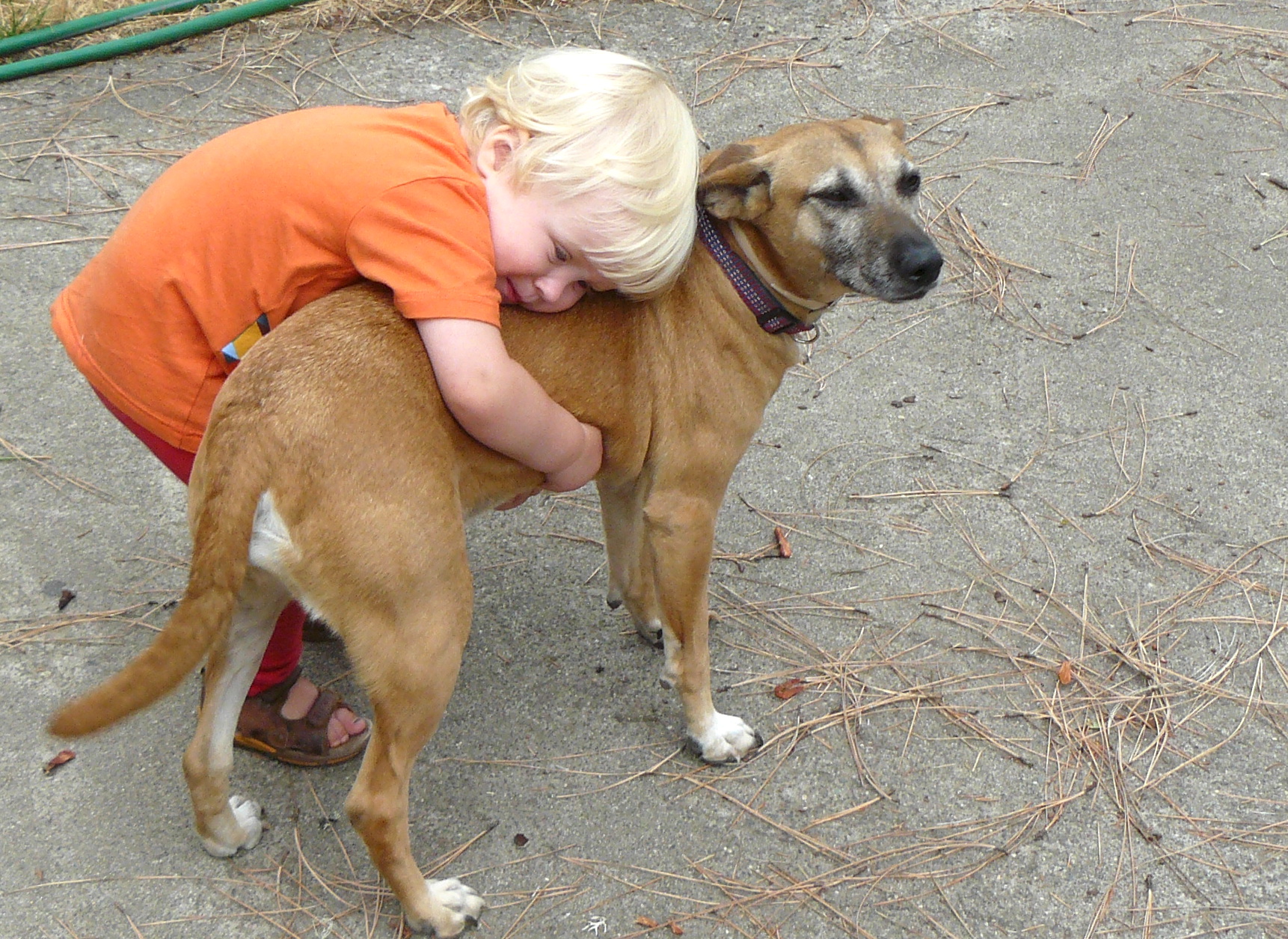
It only seemed like yesterday that Jean wrote about Dhalia in our ‘Meet the dogs’ series. That post included this photograph.

Love and Trust - Grandson Morten hugging Dhalia.
Love and Trust – Grandson Morten hugging Dhalia, September 2013.

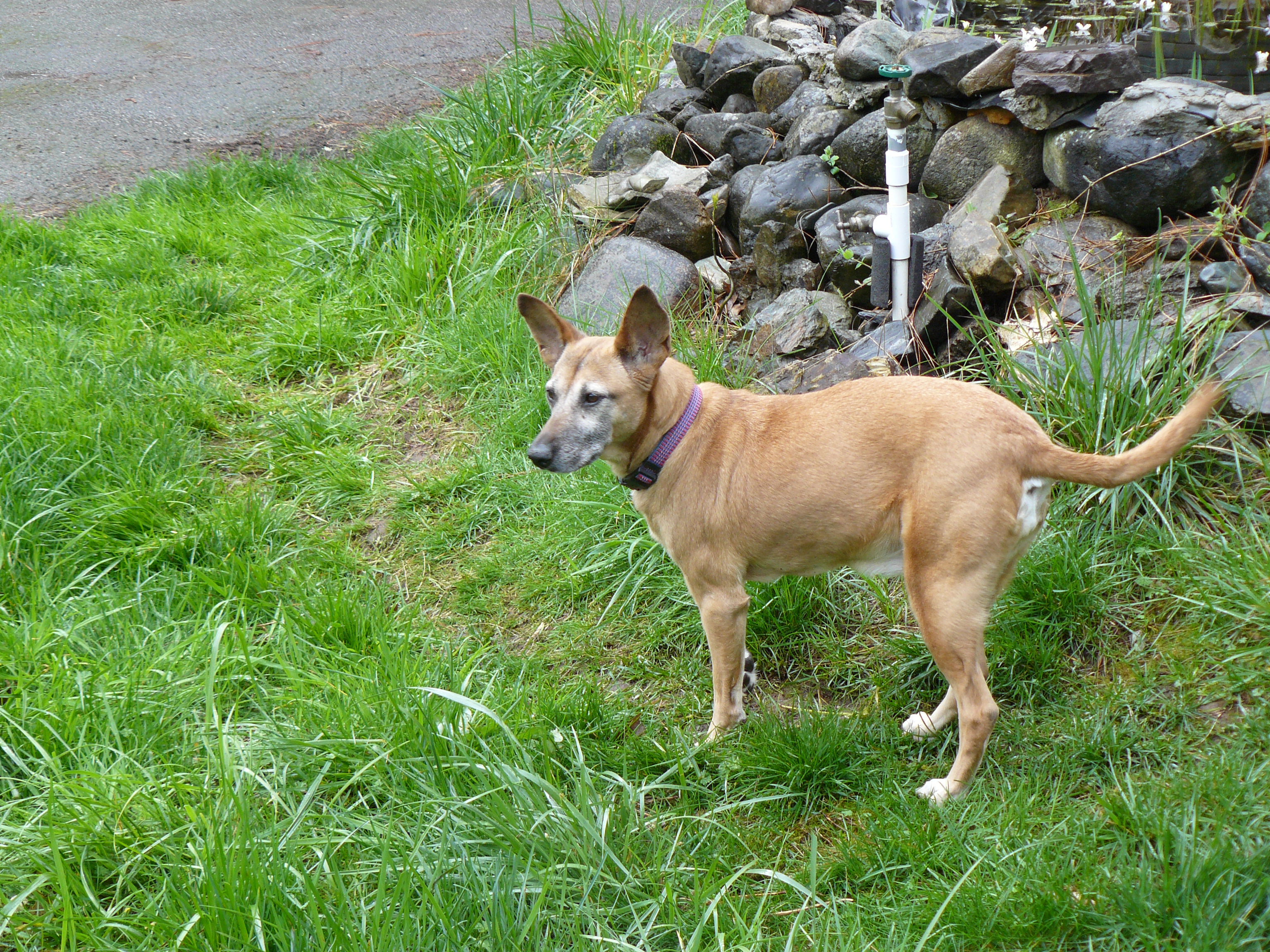
Jean is very sad, as one would expect, nay we both are.  Dhalia, like Hazel and some of the other dogs here at home, has a loving openness towards humans that is truly remarkable when one learns of how these dogs came to be rescued: Dhalia being found by Jean living rough in a desolate part of a Mexican desert.  This is what Jean wrote in that ‘Meet the dogs‘ account:

I named her Dhalia and after treatments for mange she became quite beautiful. She was the pivotal part of a short story, Messages from the Night, Paul wrote back in 2011. Under her sweet exterior remains that same will to survive so evident when I rescued her all those years ago. There has been more than one occasion that she has brought me a recently killed squirrel or an ancient bone. We love our Dhalia: she still reaches out with her front paw when she seeks attention. Dhalia will be ten-years-old this year.

Somehow, Dhalia’s possible last few weeks of life resonated with much else going on.  Close to us, the recent death of a chicken, and one of our cats that does not have much longer to live.  In the wider world, the Washington State mud-slide, flight MH370, and the Ukraine.  The news media treat death as almost a trivial, incidental part of the scheme of things.

It takes others to offer words that elevate death to its deserved meaning.  Take, for example, author Brian Beker, who writes the blog The Dog in the Clouds.  Brian recently wrote the following post:

Prayer for an eagle

Please say a prayer for beautiful bald eagle who just died a death he did not deserve.

He was stuck on the ground near a concrete barrier on a stretch of interstate under construction in Arkansas. I spotted him with his head down, facing into the traffic that was passing a foot away from him.

He was an adult bald eagle-big and brave, facing down the oncoming 18 wheelers.

There was no place to pull off, concrete barriers on both sides, so I went to the next exit and backtracked. My adrenaline was rushing in horror and fear. My plan was just to stop and block traffic, and pick him up. But he had been killed by the time I got back to him three or four minutes later.

I failed that bird.

I hope he is circling over the lakes and trees he loves.

Back to learning about death from our dogs.

Dhalia’s possible terminal condition; my Pharaoh being the age he is; somewhere in there has come the recognition that we should embrace life yet also embrace our mortality; our death.  As Leonardo da Vinci was reputed to have said, “While I thought that I was learning how to live, I have been learning how to die.

What does death mean; truly mean?  I don’t know.  All I know is that death is the end of a life.  That our immortality is only an echo, a reverberation of who we were and what we stood for.  Or no better put than by American lawyer, Albert Pike, who left these words before he died on April 2nd, 1891 (Yes, I looked it up!)

What we have done for ourselves alone dies with us;

what we have done for others and the world remains and is immortal.

Last thought from our dogs. Recall that yesterday, I wrote, “Pharaoh has been my greatest inspiration of the power of unconditional love; of the need to smell the flowers in this short life of ours.

Day in, day out, anyone with dogs in their lives know how often they offer us simple acts of love.

A life of simple acts of love – now that does give death a meaning!

Dhalia - picture taken two days ago.
Dhalia – picture taken two days ago.

Meet the dogs – Pharaoh (pt 2)

The concluding part-two of meeting Pharaoh 

Pharaoh, as of yesterday afternoon!

In yesterday’s first part of my recollection of having Pharaoh in my life for over ten years, I focussed on the early days.  Today, I want to take a more philosophical view of the relationship, right up to the present day.

The biggest, single reward of having Pharaoh as my friend goes back a few years.  Back to my Devon days and the time when Jon Lavin and I used to spend hours talking together.  Pharaoh always contentedly asleep in the same room as the two of us. It was Jon who introduced me to Dr. David Hawkins and his Map of Consciousness. It was Jon one day who looking down at the sleeping Pharaoh pointed out that Dr. Hawkins offered evidence that dogs are integrous creatures with a ‘score’ on that Map of between 205 and 210. (Background story is here.)

So this blog, Learning from Dogs, and my attempt to write a book of the same name flow from that awareness of what dogs mean to human consciousness and what Pharaoh means to me.  No, more than that!  From that mix of Jon, Dr. David Hawkins, experiencing the power of unconditional love from an animal living with me day-in, day-out, came a journey into my self.  Came the self-awareness that allowed me to like who I was, be openly loved by this dog of mine, and be able to love in return.  As is said: “You cannot love another until you love yourself.

Moving on.

Trying to pick out a single example of the bond that he and I have is practically impossible.  I have to rely on photographs to remind me of the thousands of times that a simple look or touch between Pharaoh and me ‘speaks’ to me in ways that words fail. Here’s an extract from my celebration of Pharaoh’s tenth birthday  last June 3rd; written the following day. It comes pretty close to illustrating the friendship bond.

oooo

For many years I was a private pilot and in later days had the pleasure, the huge pleasure, of flying a Piper Super Cub, a group-owned aircraft based at Watchford Farm in South Devon.  The aircraft, a Piper PA-18-135 Super Cub, was originally supplied to the Dutch Air Force in 1954 and was permitted by the British CAA to carry her original military markings including her Dutch military registration, R-151, although there was a British registration, G-BIYR, ‘underneath’ the Dutch R-151.  (I wrote more fully about the history of the aircraft on Learning from Dogs back in August 2009.)

Piper Cub R151
Piper Cub R151

Anyway, every time I went to the airfield with Pharaoh he always tried to climb into the cockpit.  So one day, I decided to see if he would sit in the rear seat and be strapped in.  Absolutely no problem with that!

Come on Dad, let's get this thing off the ground!
Come on Dad, let’s get this thing off the ground!

My idea had been to fly a gentle circuit in the aircraft.  First I did some taxying around the large grass airfield that is Watchford to see how Pharaoh reacted.  He was perfectly behaved.

Then I thought long and hard about taking Pharaoh for a flight.  In the Cub there is no autopilot so if Pharaoh struggled or worse it would have been almost impossible to fly the aircraft and cope with Pharaoh.  So, in the end, I abandoned taking him for a flight.  The chances are that it would have been fine.  But if something had gone wrong, the outcome just didn’t bear thinking about.

So we ended up motoring for 30 minutes all around the airfield which, as the next picture shows, met with doggie approval.  The date was July 2006.

That was fun!
That was fun!

oooo

Moving on again.  This time to another flying experience.  To the day when Pharaoh and I flew out of London bound for Los Angeles and a new life with Jeannie and all her dogs (16 at that time) down in San Carlos, Sonora County, Mexico.  The date: September 15th, 2008.  Just ten months after I had met Jean in Mexico and realised that this was the woman that I was destined to love! (Now you will understand why I described earlier the Jon Lavin, Dr. Hawkins, Pharaoh mix as the biggest, single reward of having Pharaoh as my friend!)

There followed wonderful happy days for me and Pharaoh.  Gorgeous to see how Pharaoh became so much more a dog, if that makes sense, from having his own mini-pack around him.  Those happy days taking us all forwards to Payson, AZ, where Jean and I were married, and then on to Merlin, Oregon arriving here in October, 2012.

Fr. Dan Tantimonaco with the newly weds!

oooo

Pharaoh 'married' to his dearest friends. December, 2013.
Pharaoh ‘married’ to his dearest friends. December, 2013.

oooo

Perfect closeness. Pharaoh and Cleo with Hazel in the middle.  Taken yesterday.
Smelling the flowers! Pharaoh and Cleo with Hazel in the middle. Taken yesterday.

I could go on!  Hopefully, you get a sense, a very strong sense, of the magical journey that both Pharaoh and I have experienced since I first clasped him in my arms back in September, 2003.

Both Pharaoh and I are in the Autumn of our lives, he is 11 in June; I am 70 in November, and we both creak a little. But so what! Pharaoh has been my greatest inspiration of the power of unconditional love; of the need to smell the flowers in this short life of ours.

One very great animal! (March 25th, 2014)

Thank you, my dear, dear friend!

Meet the dogs – Sweeny!

Little Sweeny; our dog number seven.

Last week, I wrote about Hazel.  The week before Jean wrote about Casey. This week it’s back to Jean writing about the one little dog we have here at home: Sweeny.

ooOOoo

Sweeny

Sweeny - taken at the end of October, 2013, here in Oregon.
Sweeny – taken at the end of October, 2013, here in Oregon.

On that day we lost Poppy back in February, 2011, when we were still living in Payson, Arizona, it was as though she had been vaporised! Dear, sweet little Poppy.  A ten-pound Poodle mix I had rescued in Mexico.  She had been living in and around a Mexican construction site and when I rescued her she was very scrawny and without hair.  But Poppy, as I named her, soon blossomed into a little, blonde, beauty and I grew to love her very much.  Prior to Poppy, I had always liked the bigger dog but Poppy taught me the pleasures of a ‘lap’ dog that also happily slept under the covers at night with Paul and me.

The Granite Dells, near Payson, AZ. Picture taken February, 2012.

Most afternoons in Payson, we took some of the dogs for a walk along a trail hike of about 2 miles.  The dogs were allowed to be off-leash and loved it.  Poppy always came and stayed with me, never leaving the trail as did the other, bigger dogs.  That February, it was a chilly Winter’s day (Payson and area were at 5,000 feet above sea-level) and we were all dropping down into a dry wash when I glanced behind to check that Poppy was handling the slope. To my total horror, she wasn’t in sight. Indeed, Poppy was never seen again.

Despite days spent scouring the terrain, notices in Payson shops, radio announcements on the local radio station; it all came to nought.  Poppy was gone!  Locals that we spoke with and who knew the area of desert where the trails were, the Granite Dells, were all of the opinion that Poppy had been stalked by a coyote that would most likely have grabbed her in an instant.  Such happenings had been known before.

I was inconsolable with guilt. I had let Poppy down by not giving her enough attention and it lay heavily upon me. For weeks and weeks I moped, missed her snuggles and that cute, little body crawling into the bed with me.  One day, I broached the idea with Paul of adopting a small dog from the local Humane Society.  Naturally, Paul agreed in an instant and in next to no time we had jumped in the car and were heading to the Society.

I wanted an older dog but the two small dogs that the Society had were really only suited for adoption into a one-dog household.  The Society did, however, have two puppies from a mother that had been taken in by them when that dog was heavily pregnant.  The pups had been born and raised at the shelter.

It was love at first sight when they handed me the puppy that was destined to become Sweeny.  Sweeny Todd to give him his full name was a two-pound bundle of fluff.

Sweeny loving Jeannie on the door-step of our Payson house; May, 2011.

Today, Sweeny is a twenty-pound terrier mix.  A very ‘sassy’ little dog that is as much loved by his doggie brothers and sisters.  Sweeny, too, sleeps on the bed, laying alongside me and the edge of the bed so that he isn’t between Paul and me.  Sweeny has developed the habit of waking me in the morning by laying, full-bodied, over my face; to the point of me not being able to breathe.  Guess I shouldn’t have called him Sweeny Todd! 😉

No dog will ever take the place of Poppy or fully assuage me of my guilt that I still feel to some extent. But ‘The Sween’ has helped beyond measure.

Cleo and Sweeny, 2013.  Our first Christmas Day in our home in Oregon.
Cleo and Sweeny, 2013. Our first Christmas Day in our home here in Oregon.

ooOOoo

Next week, meet our dog number eight.

Meet the dogs – Hazel

Hazel – our dog number six.

Last week Jean wrote about Casey. Slight difference this week in the sense that both Jean and I equally know the story of how Hazel came into our lives. So you are stuck with me today for the story of Hazel.

ooOOoo

Hazel

Picture of Hazel taken in the last twenty-four hours.

I first met Jean in Mexico; namely, in San Carlos, Sonora, Mexico to be precise.  Just a few days before Christmas, 2007.  At that time, Jean had 16 dogs, all of them rescues off the streets in and around San Carlos.  Jean was well-known for rescuing Mexican feral dogs.

In September, 2008 I travelled out to Mexico, via London-Los Angeles, with my Pharaoh. Jean and I have been together ever since.  In February, 2010, because we wanted to be married and to be married in the USA, we moved from San Carlos to Payson, in Arizona; some 80 miles North-East of Phoenix.

One morning, just a few days before we were due permanently to leave San Carlos and move our animals and belongings the 513 miles (827 km) to Payson, AZ, Jean went outside the front of the San Carlos house to find a very lost and disorientated black dog alone on the dusty street.  The dog was a female who in the last few weeks had given birth to puppies that had been weaned.  Obvious to Jean because the dog’s teats were still somewhat extended.

The dog had been abandoned outside in the street.  A not uncommon happening because many of the local Mexicans knew of Jean’s rescues over many years and when they wanted to abandon a dog it was done outside Jean’s house.  The poor people of San Carlos sometimes resorted to selling the puppies for a few Pesos and casting the mother dog adrift.

Of course the dog was taken in and we named her Hazel.  Right from Day One Hazel was the most delightful, loving dog and quickly attached herself to me.

The truest of love between a man and a dog!

Of all the dogs that we have here at home, and, trust me, many are extremely loving, my relationship with Hazel is precious beyond description.  She is in Pharaoh’s ‘group’ (Pharaoh, Hazel, Cleo, Sweeny and Dhalia) so sleeps in our bedroom at night.  Most nights Hazel is tucked up against me.

Plus frequently during the day Hazel will take an interest in what I am doing, as the next photograph illustrates.

Hazel taking an interest in my potterings.

Very little more that can be said without the risk of repeating myself.

If ever one wanted an example of the unconditional love that a dog can offer a human, then Hazel is that example.

ooOOoo

Precious creature!

What we really have to learn from dogs!

And many more of Nature’s creatures besides.

The answer? Unconditional love. (11 words.)

OK, that’s it for today’s post! 😉

oooo

Those that know this blog know that posts of just eleven words coming from yours truly are as rare as hen’s teeth.  So stay with me!

The number of LfD followers has just passed 900.  To say that I am amazed, grateful and humbled still feels like an inadequate response.  Thank you: to everyone of you.

One of those new followers left a recent comment that said, ” I love this blog, dedicated to dogs ..”  It struck me that as the number of new followers has increased significantly in recent times that it wouldn’t do any harm to return to the principles behind Learning from Dogs.

For it’s not a blog about dogs per se but about the qualities that we, as in mankind, have to learn from dogs.

The starting point is truth; as in what is truth?  Such a straightforward question of just three words requires many more words, indeed a book, to answer. A little over two years ago, I published a post called The evolution of the domestic dog, that included the following:

Way back in 2007 I was working with a good friend of mine, Jon, who lives in SW England. Anyway, Jon spoke of the philosophies of Dr. David Hawkins.  David Hawkins has written a number of books including Truth vs Falsehood: How to Tell the Difference which I read a few years ago and found very convincing.

Dr David Hawkins of Veritas Publishing, Sedona, Arizona.

Here’s how Amazon describes the book,

The exploration into the truth of man’s activities is unique, intriguing, and provocative. From a new perspective, one quickly grasps the levels of truth expressed by the media, the arts, writers, painters, architecture, movies, TV, politics, and war, as well as academia and the greatest thinkers and philosophies through the ages and up to present-day science and advanced theories of the nature of the universe. Most importantly, the ego and its structure are revealed to facilitate the understanding of religious and spiritual truths expressed by the mystics and enlightened sages over the centuries. It becomes apparent why the human mind, unaided, has been intrinsically incapable of discerning truth from falsehood. A simple test is described that, in seconds, can solve riddles that have been irresolvable by mankind for centuries. This book delivers far more than it promises.

Here’s the description of the book on David Hawkin’s website,

Reveals a breakthrough in documenting a new era of human knowledge. Only in the last decade has a science of Truth emerged that, for the first time in human history, enables the discernment of truth from falsehood. Presented are discoveries of an enormous amount of crucial and significant information of great importance to mankind, along with calibrations of historical events, cultures, spiritual leaders, media, and more.

A science of consciousness developed which revealed that degrees of truth reflect concordant calibratable levels of consciousness on a scale of 1 to 1,000. When this verifiable test of truth was applied to multiple aspects of society (movies, art, politics, music, sociology, religion, scientific theories, spirituality, philosophy, everyday Americana, and all the countries of the world), the results were startling.

Trust me, I am (slowly) getting to the point!

Dr. Hawkins created a ‘map’ of those calibrated levels of consciousness, see details of that map here.  Also, it wasn’t too difficult to find a plain B&W version on the Web, reproduced below.

Map of Consciousness, copyright Dr. David Hawkins

As you can see when you study the map, the boundary between ‘truth’ and ‘falsehood’ is the calibrated level of 200, the blue line in the above described as ‘The beginning of integrity’.

Anyway, back to Jon.  When I used to visit him, I always had Pharaoh with me and he would settle down behind my chair and let the human talk just flow over him, happy at some dog level to be included.

One day Jon was talking about the different levels of consciousness and looked over at Pharaoh asleep on the floor and said, “Do you that dogs are integrous!”  I responded that I didn’t know that, please tell me more.

Jon continued, “Yes, dogs have been calibrated as having a level of consciousness in the zone of 205 to 210.”

So dogs, horses, cats and many other warm-blooded species of animals are fundamentally integrous creatures.  Creatures that display the qualities of unconditional love, trust, courage, integrity and forgiveness.  Just see where those emotions appear on David Hawkin’s ‘map’ above.  However of all those animals, dogs have been man’s longest companion by far, perhaps all the way back to neolithic times.

So what gets written about Learning from Dogs is what we, as in society, have to learn from dogs. Because the time for mankind to place integrity, as in integrity of thought, word and deed, at the highest pinnacle of our domain is fast running out.

Going to close with a photograph taken yesterday afternoon here at home in Oregon, showing a pair of geese that are giving every indication of using our ‘island’ in our so-called pond as their base for having their goslings!

The integrity of Nature!

Some content on this page was disabled on August 23, 2017 as a result of a DMCA takedown notice from Susan Hawkins. You can learn more about the DMCA here:

https://wordpress.com/support/copyright-and-the-dmca/