As soon as it was time to say ‘goodbye’ to Ace the cat then in came an entirely different case.
1020 – Back to dogs!
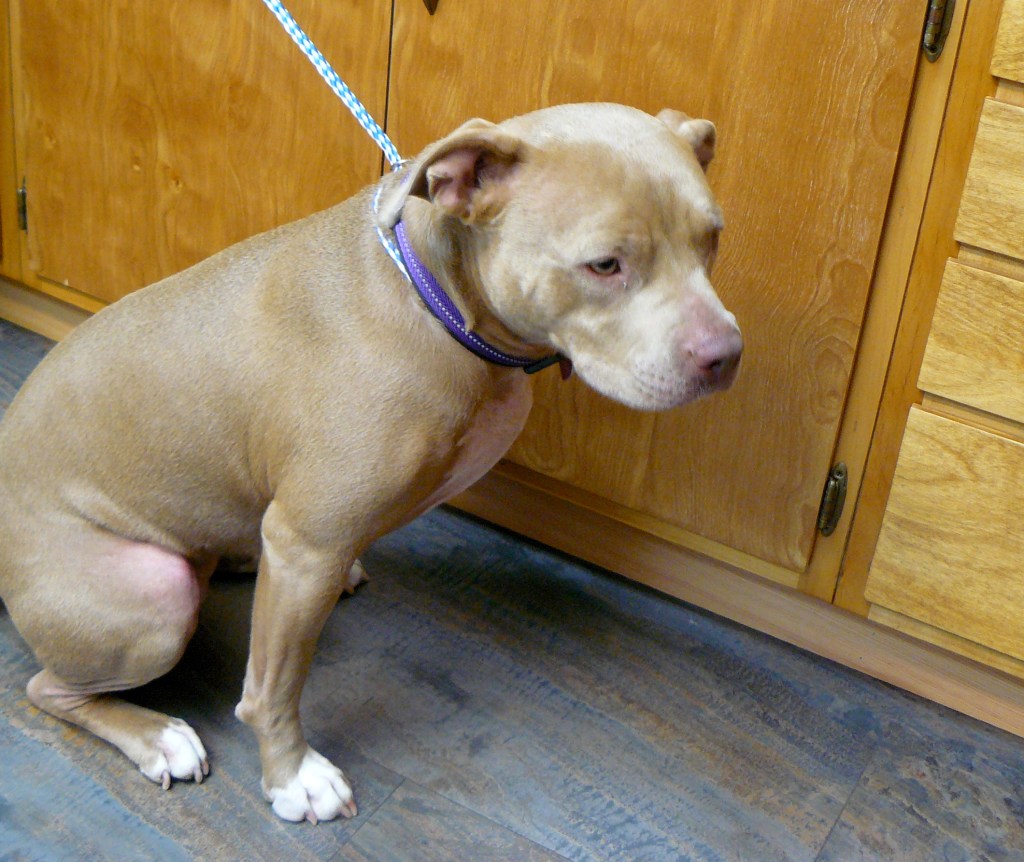
This was Millie, a pit mix, who had been dropped off at the Clinic earlier on. Millie’s owner said that there appeared to be something troubling Millie’s ears. Millie was, indeed, shaking her head a great deal.
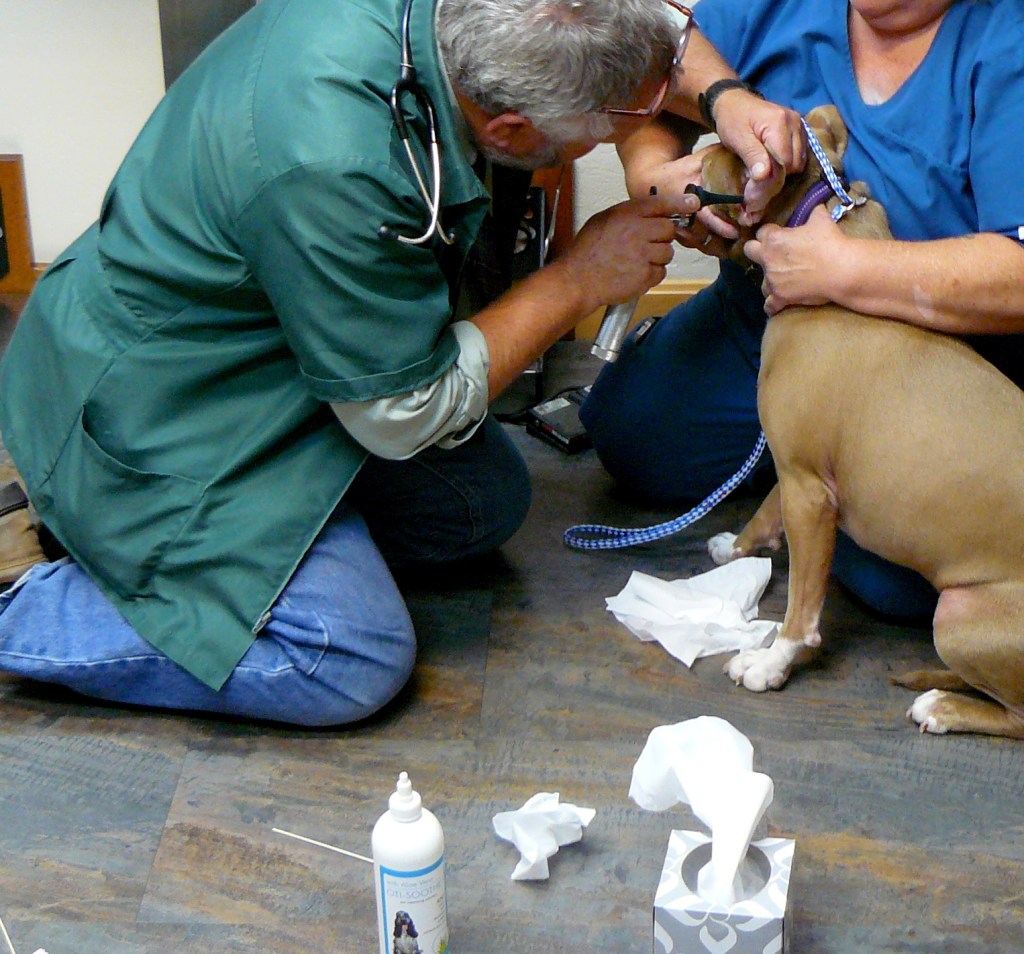
Jim established that it was Millie’s left ear that was the source of the irritation. This was immediately obvious since Millie cried as soon as Jim touched that left ear.
The first examination didn’t identify anything that might be the cause. But apparently the endoscope had such a narrow field of view that it was easy to miss an irritant. Time for another, more extensive examination using that same endoscope.
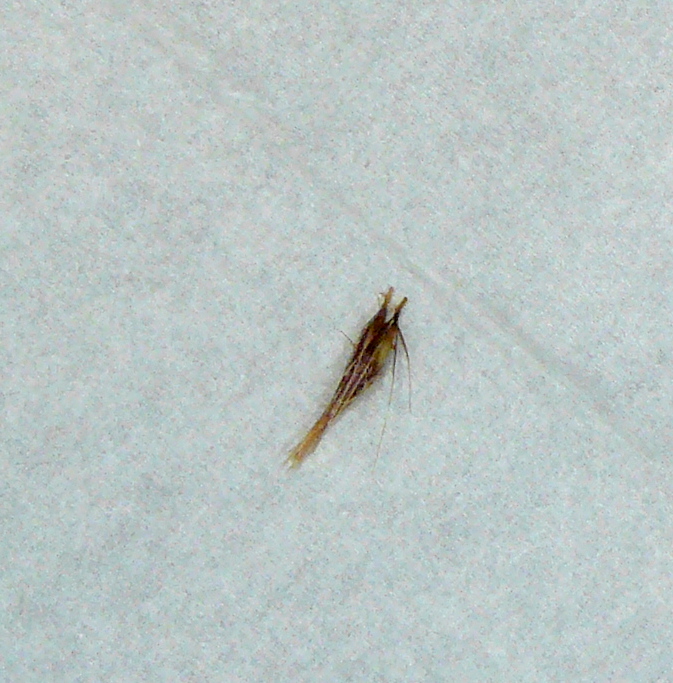
This time the problem was identified. A foxtail that had penetrated Millie’s ear so deeply that the seed-head had pierced Millie’s eardrum.
Carefully, oh so carefully, Jim pulled the foxtail out from Millie’s ear. I couldn’t believe just how large it was.
About an inch (2.5 cm) long.
I was unable to grab a photograph of Millie’s face once the foxtail had been removed. Trust me it was a face full of doggie smiles.
But I can’t move on to the next patient without remarking how Millie was so beautifully behaved. How maligned the Pitbull and Pitbull Mixes are!
10:45 All done with Millie!
To be continued:
(Please note: These observations are mine alone and because of the busy environment it must be assumed that my interpretation of what was taking place might not be totally accurate. Nothing in this blog post should be used by a reader to make any medical judgment about an animal. If you have any concern about an animal do make an appointment to see a properly qualified veterinarian doctor.)
On Thursday afternoon one of the residents not too far away from us telephoned asking if we might take in a dog that had recently been found lost on Hugo Road, our home road.
Despite the fact that we really didn’t want another dog, there was no question of turning our back on the lost soul.
As soon as we set eyes on the dog it was clear that it was used to people, understood a couple of commands and was in very good health albeit had not been castrated. There was no ID on the dog’s collar. Jean thought the dog was about a year old.
We placed the dog in our guest room that has a separate entrance.
Then yesterday, Friday, it was time to see if the dog would integrate happily with the rest of the crew.
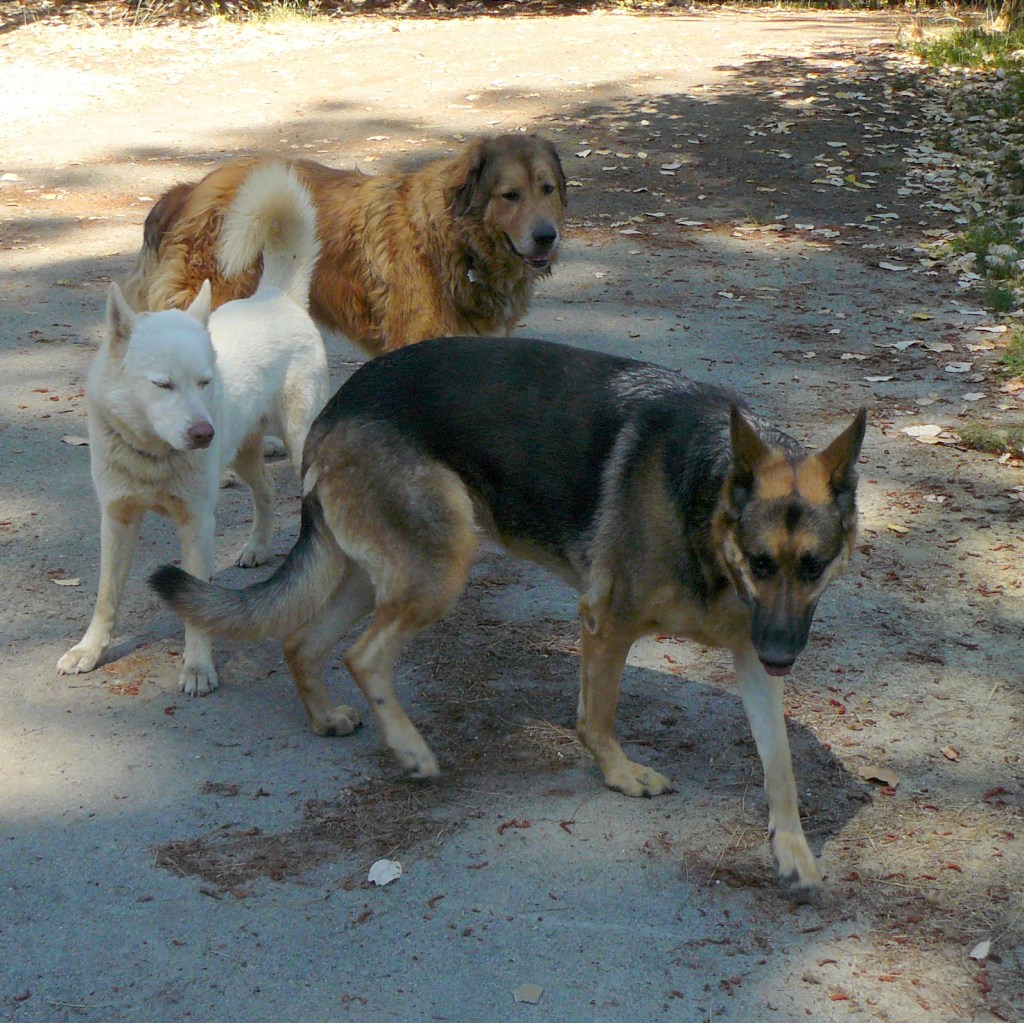
First up was a meeting with Brandy.
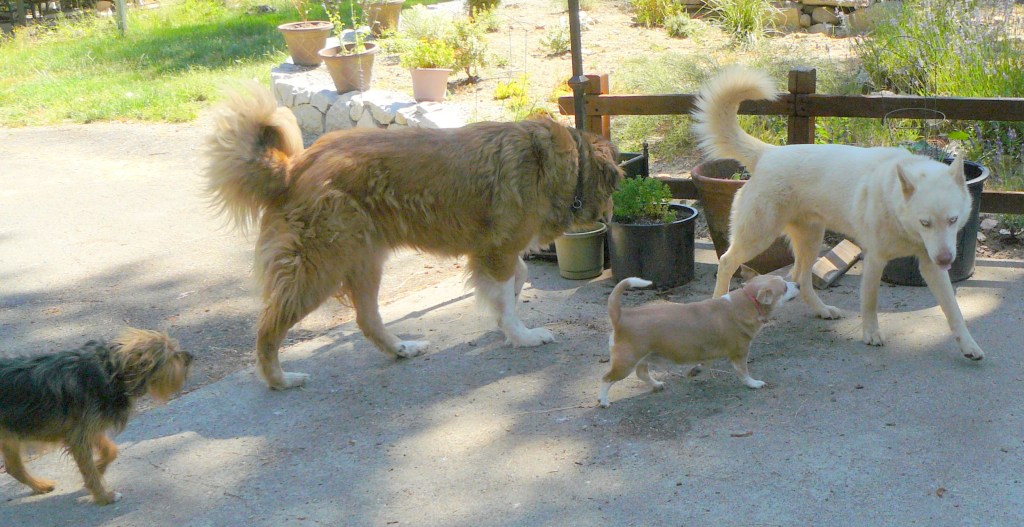
Then along came Sweeny (LHS) and Pedy (looking up at our visitor.)
Time for Cleo to say ‘Hello’.
So far, so good.
Then just before lunchtime yesterday we drove up along Quartz Creek Road that runs up into the hills behind us and is where a number of people live.
That led us to meeting a woman who thought that she knew the owner of the dog. Also that the dog’s name was Colt. This woman said that she would make contact with Colt’s owner.
Plus we have put out a ‘Dog Found’ notice both in our local paper, The Grants Pass Courier, and our local radio station KAJO.
We will see what happens!
Footnote: Around 4pm we received a call from a young woman who was the owner of Colt. Shortly thereafter we drove again along Quartz Creek Road but this time with Colt. Ten minutes later Colt was reunited with his owner.
That left Jean and me with mixed feelings for Colt was such a lovely boy. But it did turn out for the best.
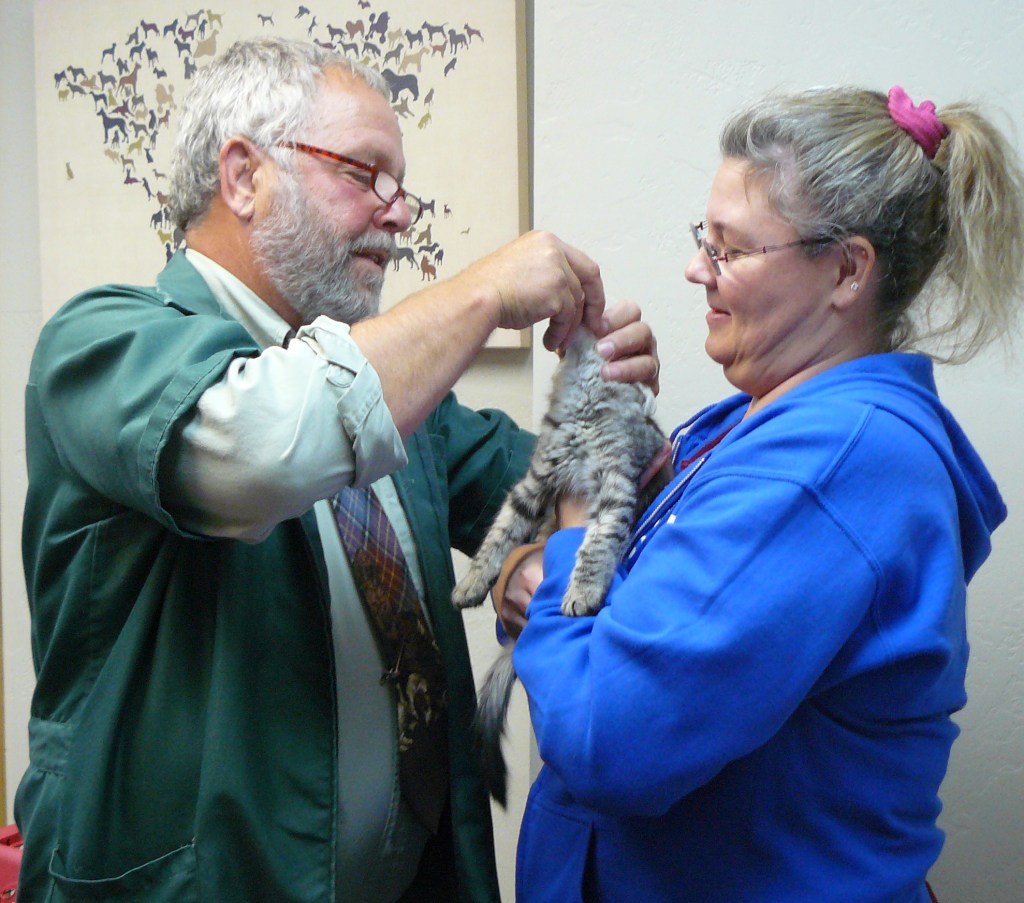
It’s 09:00 and the next animals to be brought in to see Dr. Jim are a couple of cats requiring vaccination.
The kittens are named Grace and Frankie and both were adopted from the Nevada Humane Society although I wasn’t familiar with the circumstances surrounding that adoption.
But great to see them being cared for by the two women and the degree of professional service that I saw in Jim’s briefing of these new cat owners.
That care included giving one of the kittens the necessary pills by mouth.
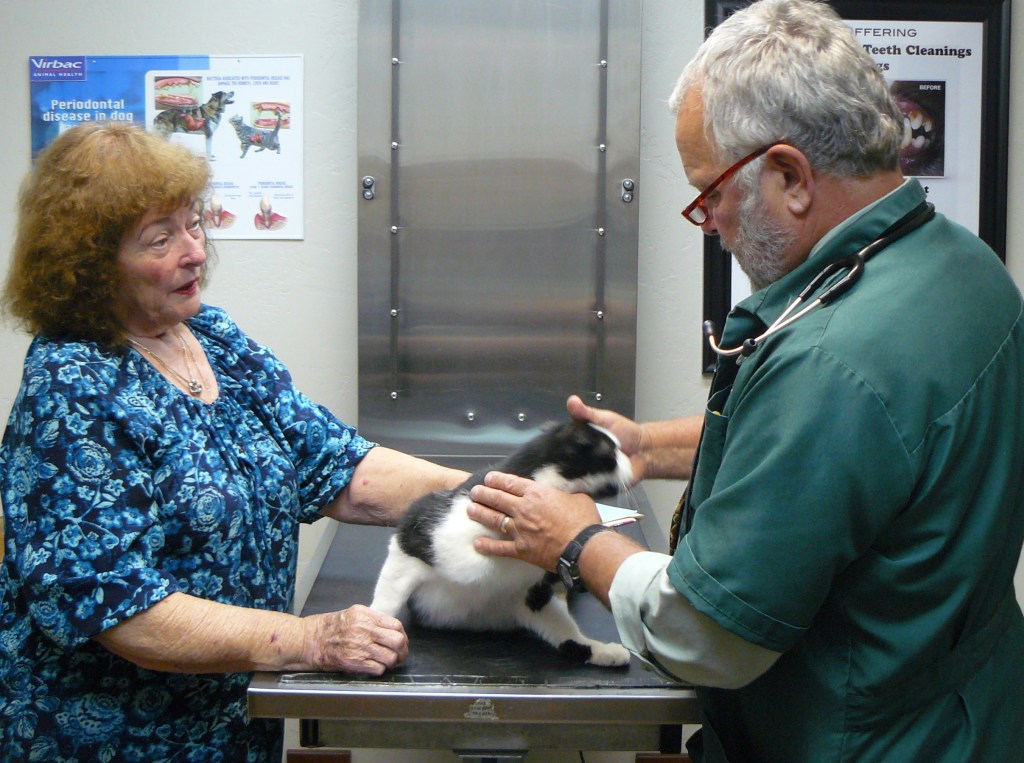
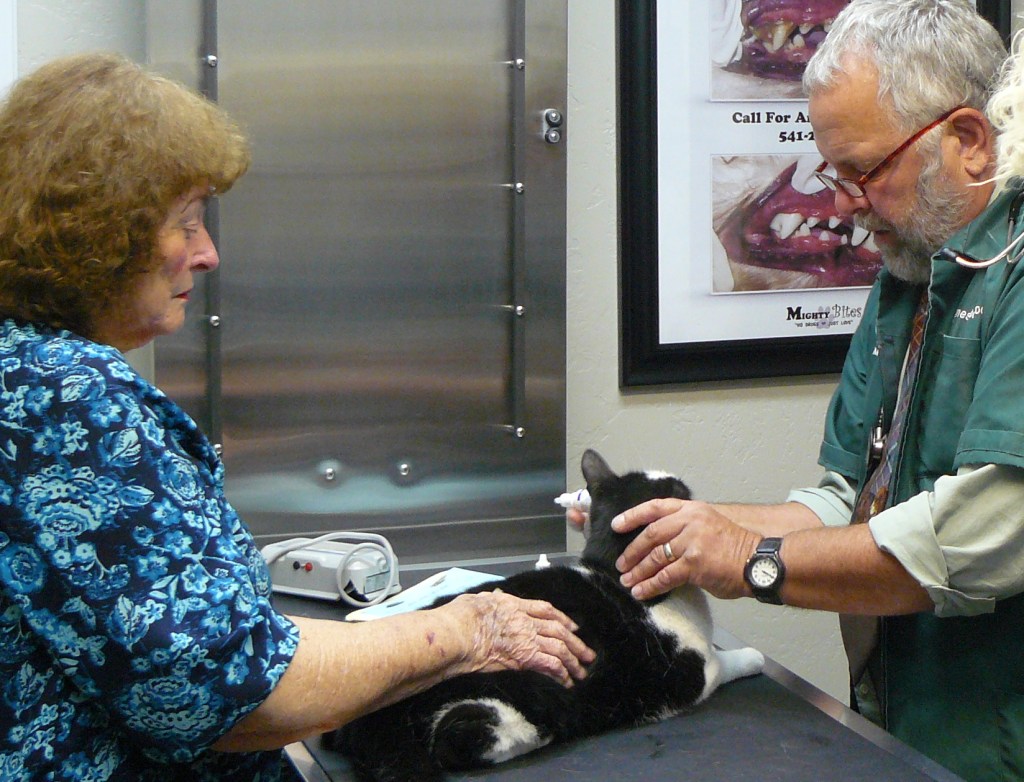
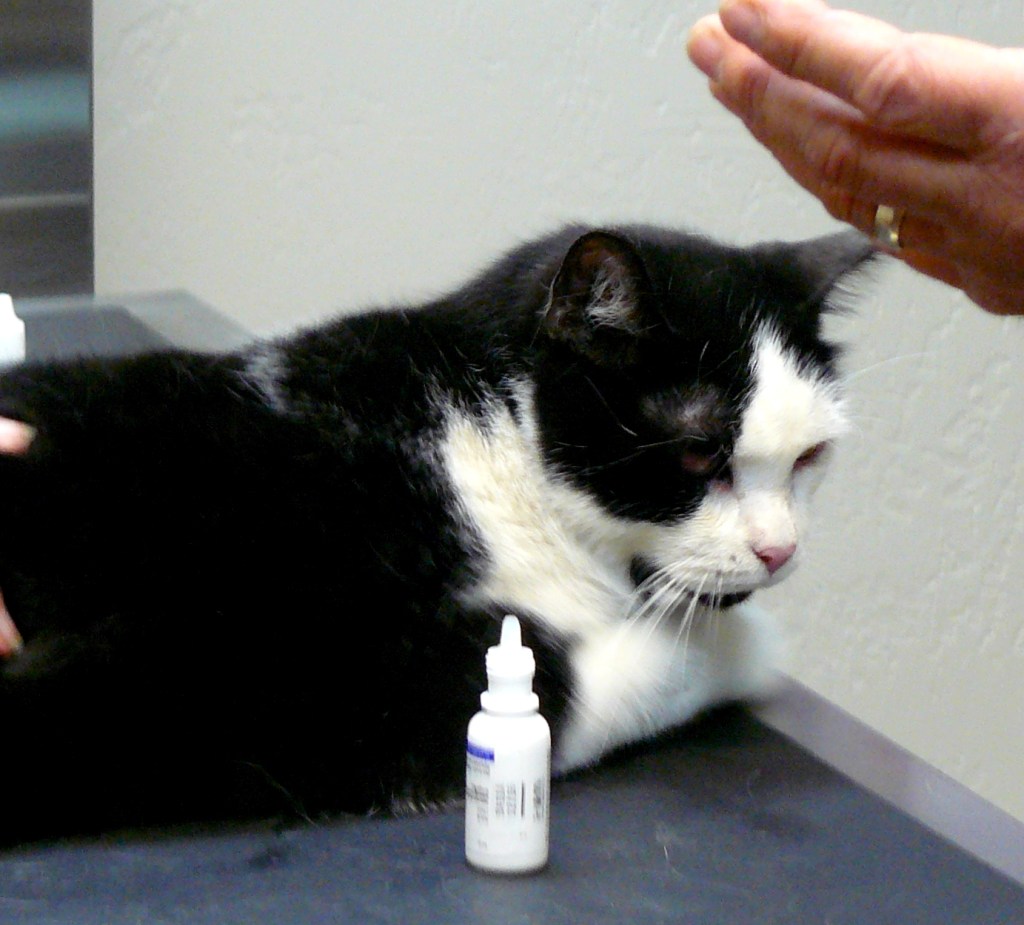
It is now 09:25 and the next case for Jim is another cat. In this case a cat, named Ace, that the owner thinks is having trouble seeing out of it’s right eye.
Jim applies a fluorescent stain to the Ace’s eye that then enables Jim to use a special UV lamp to determine the degree of damage to the eye.
It is determined that the pressure in Ace’s eyeball is normal and Jim is pretty certain that Ace has no sight at all in that right eye. He recommends giving the cat some antibiotics and explains to the owner that cat’s can function perfectly adequately with just one eye. Indeed, if necessary the eyeball could be removed, something that would not be a disadvantage for Ace.
The lady owner of Ace takes note of Jim’s advice and is clearly grateful for what has been explained to her.
It is 10:10.
To be continued:
(Please note: These observations are mine alone and because of the busy environment it must be assumed that my interpretation of what was taking place might not be totally accurate. Nothing in this blog post should be used by a reader to make any medical judgment about an animal. If you have any concern about an animal do make an appointment to see a properly qualified veterinarian doctor.)
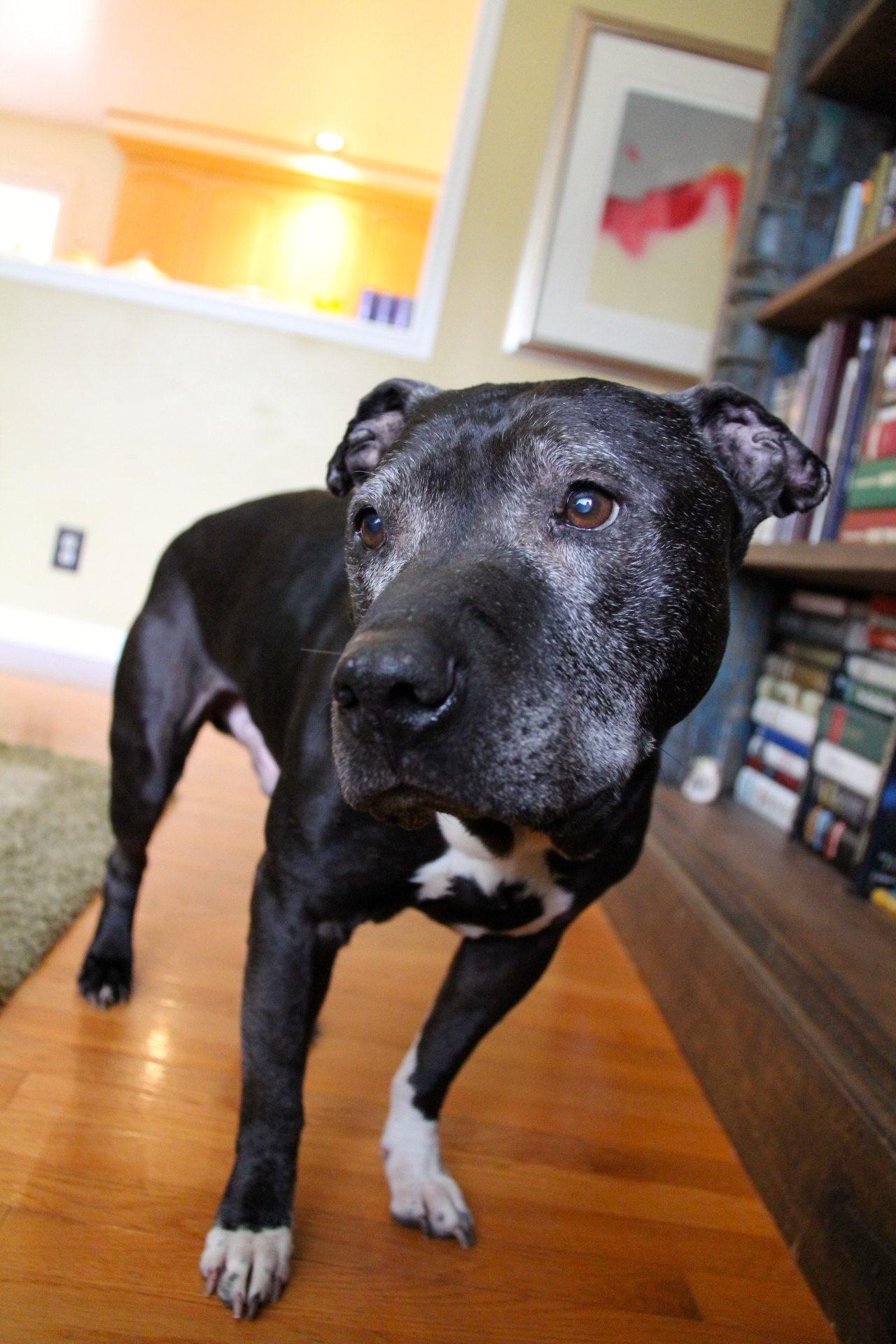
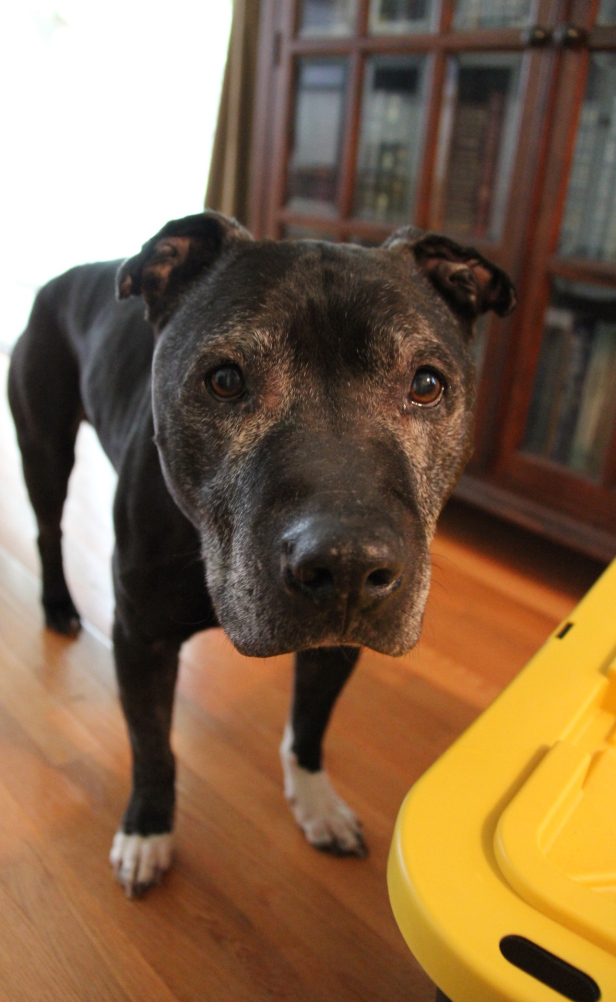
I was left behind, abandoned by my owner who has had me for 14 years. He left me tied up on a 3-foot leash in a trailer for about two weeks (maybe longer) with little or no care by my owner’s parents who were unable to care for me daily. Luckily, a kind and lovely lady named Chrissy, found me after she heard my desperate cries. Chrissy spoke to my owner’s parents and was able to get me out of my filthy living condition and to my foster home, where I’m getting endless love and doggy playmates. Please help me find a forever, loving home!
Roman is old, but he’s still strong and playful. He hops, runs, and bounces around as if he were still a pup. If you’re interested, please contact me!
ooOOoo
Roman’s present home is in Seattle, Washington and if you know of anyone who might be interested then the contact details are here.
Plus, please share this as far and wide as possible.
Thank you!
UPDATE
In response to me querying what Roman was like with other dogs and how far he could be taken in terms of meeting up with a new owner:
He is great with other dogs 🙂 I have two other big pups and they all get along just fine.
It depends on the location. Within a 5hr drive is fair.
oooooooooo
On Monday, the following was left as a comment to that post” (my emboldening!)
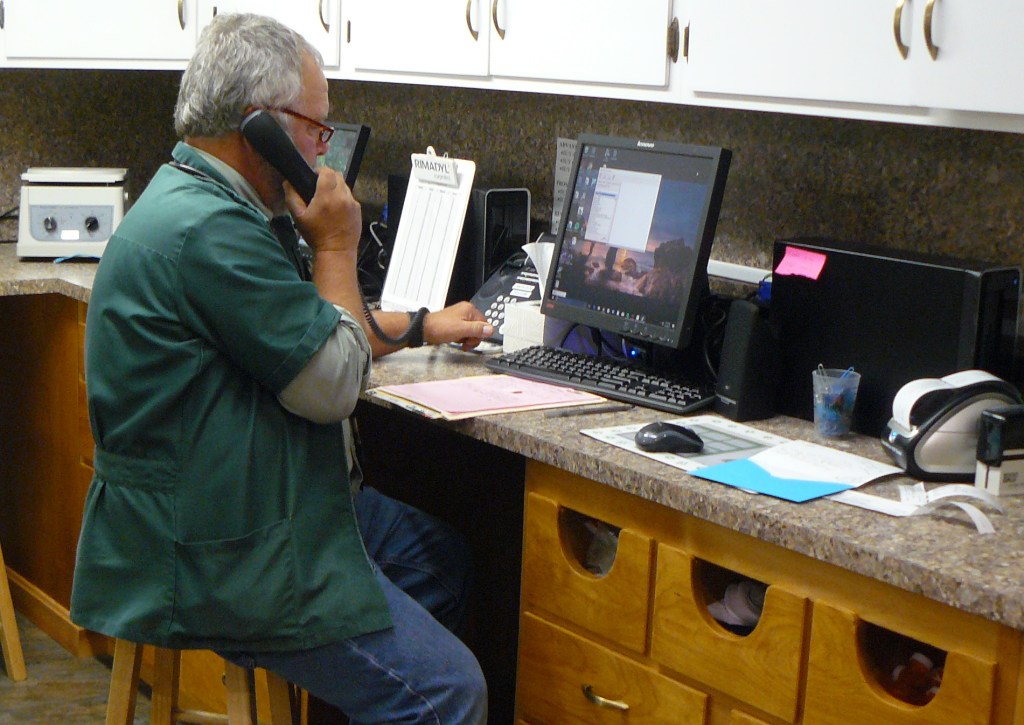
I arrived a little before 8:30 to find both receptionists busy on the telephone. They signaled for me to wait in the reception area until Dr. Jim came out to meet me.
As I waited it quickly became clear that Janice, one of persons behind the front desk, was speaking to someone who was having to make the decision to euthanize their dog. I hadn’t bargained for how that made me feel since it was so recently that Jean and I had trodden the same path. I had to give myself a stern reminder that I was here as the quiet, unobtrusive observer and that my own feelings had to be tucked out of sight.
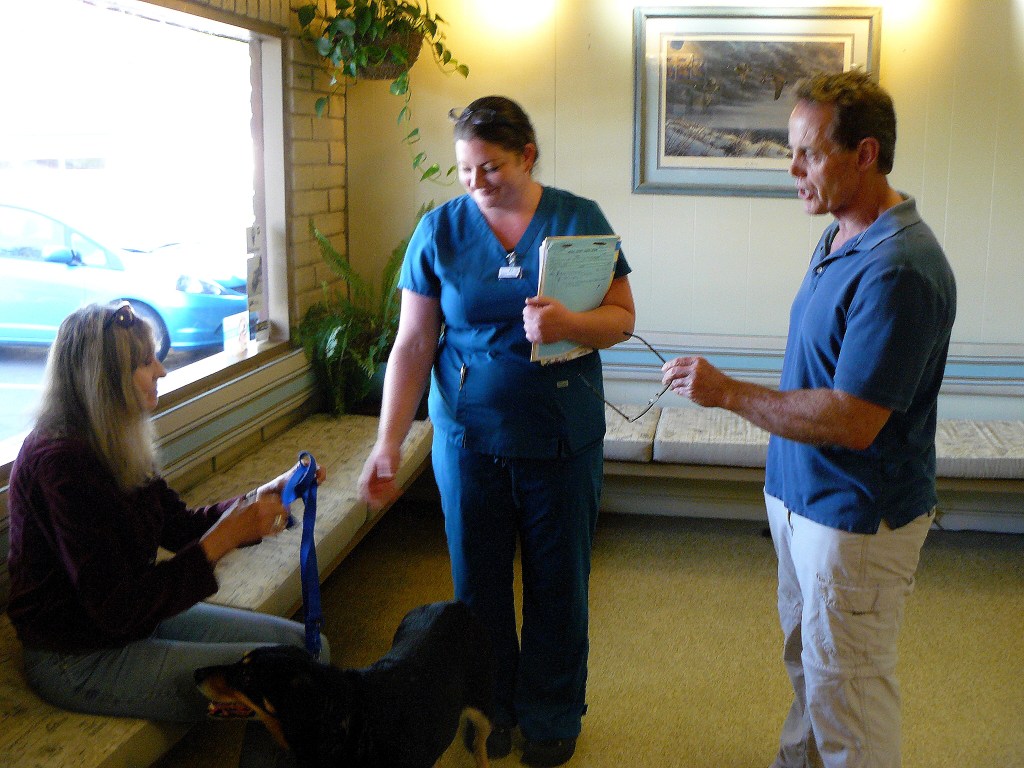
Shortly thereafter, with Janice still on the telephone patiently and compassionately speaking with that dog’s owner, someone came in with Daisy who was here for teeth cleaning. Jim came out to meet her and advise the owner that one of the team would be doing Daisy’s teeth not himself.
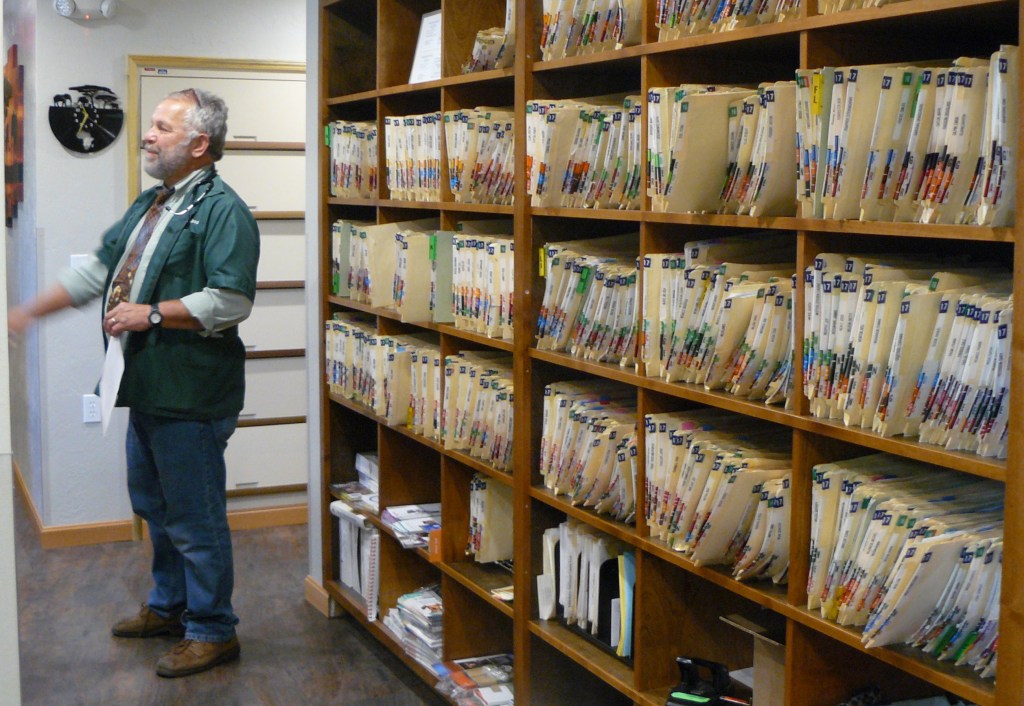
Then it was time for me to go back with Jim and start the day with him. (Jim had arrived at 8:20am.)
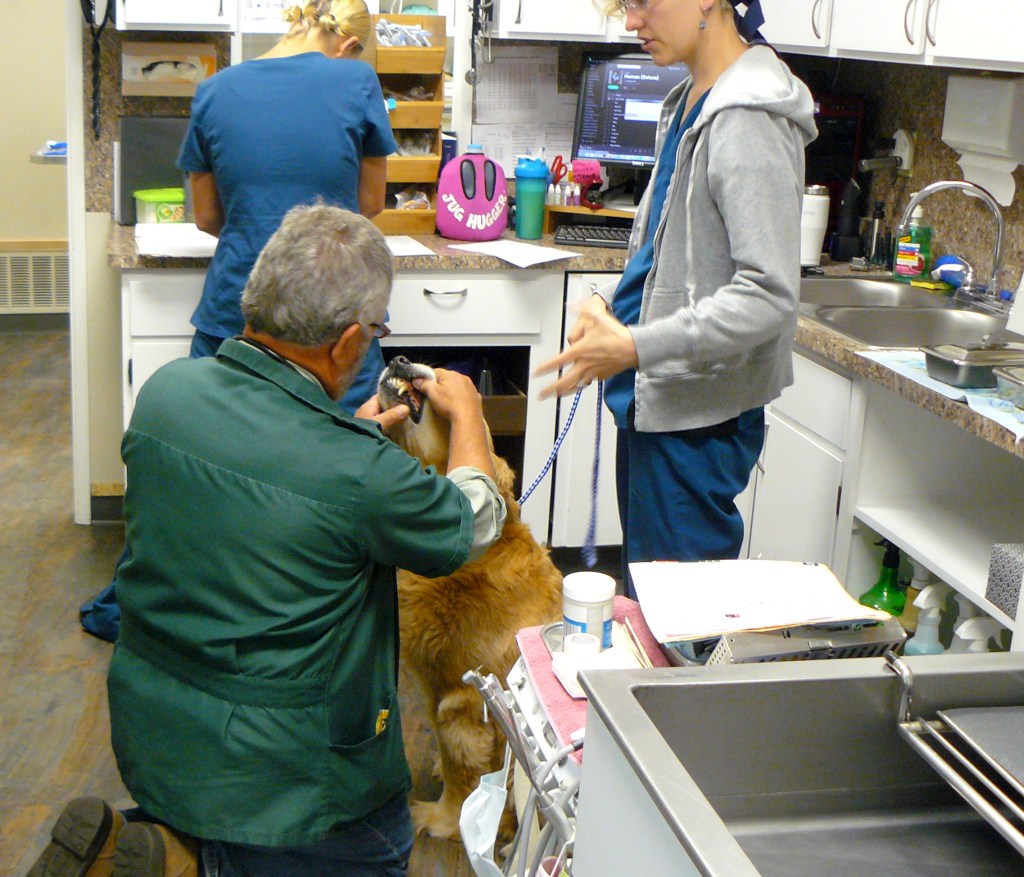
Jim’s first case was Ginger. Ginger, a female Golden Retriever, had been brought in earlier on because she had lost weight, was lethargic and was generally off-color.
Jim started to examine Ginger assisted by Cianna, a veterinary technician at the clinic.
It was immediately clear to Jim when he listened to Ginger’s heart that it was racing; Jim thought at something like 200 beats per minute. Jim continued to check Ginger over although, as he told me later, he had an idea that Ginger’s medical problem was a cardiac issue. Jim arranged for Ginger to be given an X-ray as well as blood work.
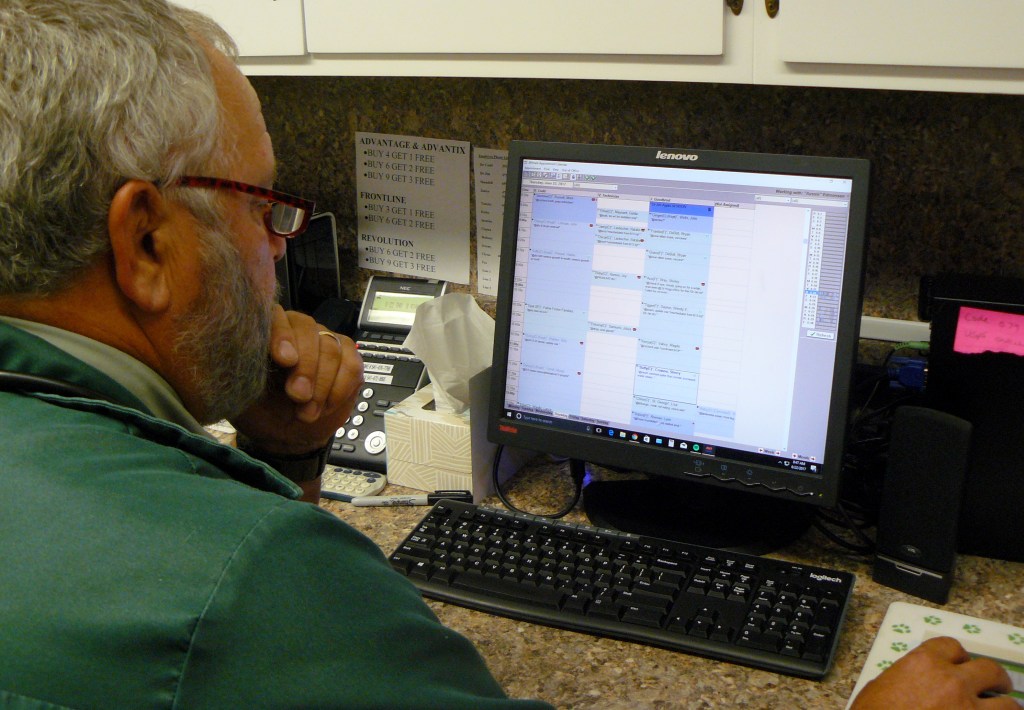
It would take a few minutes for the results of Ginger’s X-ray to come through so Jim showed me the primary software program used in the clinic to record all the details of each patient and all the individual medical details. The software was called AVImark.
I was impressed, very much so, but then again not surprised. For the veterinary business is big business in many countries. For instance, the American Veterinary Medical Association (AVMA) reports that in 2016 there were 107,995 veterinarians in the USA. Of course, there would be a wide range of software tools for the industry.
Back to Ginger’s status.
Her X-ray having been taken, the digital image of her heart was transferred electronically to Dr. Jim’s computer. It showed an extremely enlarged heart. Jim said that the owners of Ginger would be facing a potentially complex analysis but in the interim Ginger should be put on one of the ‘pril’ drugs to reduce the very high stress on Ginger’s heart: Lisinopril; Enalapril; Benazepril. That was arranged then and there. (I didn’t make a note of which drug was given to Ginger.)
Time to call Ginger’s owners and report the findings.
The owners said that they would be in to collect Ginger at 12:30.
I looked at my watch. It was 8:58!
Already the next patient is ready to be seen by the good Doctor.
To be continued:
(Please note: These observations are mine alone and because of the busy environment it must be assumed that my interpretation of what was taking place might not be totally accurate. Nothing in this blog post should be used by a reader to make any medical judgment about an animal. If you have any concern about an animal do make an appointment to see a properly qualified veterinarian doctor.)
Opening up the world of a busy veterinary practice.
Like the majority of pet owners, our experiences of taking a cat or a dog to the local vet clinic are gained entirely in regard to those particular animals. The only small difference between this household and most others is that we have the distinct privilege of having Jim and Janet Goodbrod as close friends just a short distance away. Jim is a Doctor of Veterinary Medicine (DVM) and thank goodness for that as it was more than wonderful that Jim was able to be on hand a week ago when it came to Pharaoh’s last few moments.
Jim is a regular DVM working at Lincoln Road Veterinary Practice in nearby Grants Pass. That practice is run by Dr. Russel Codd.
Dr. Russel Codd (RHS) speaking with Jean at the Clinic back in the days of our dear Hazel.
Some time ago, when we were visiting Lincoln Road, it struck me that the detail of what takes place ‘behind the counter’ of a busy vet clinic is most likely not commonly appreciated by those that visit said clinic.
I asked Russel one day if I might be allowed to spend time watching and listening to what goes on behind the scenes; so to speak. Russel said that he would be delighted for me to do that.
So it came to pass that last Thursday, June 22nd, I did just that.
It was a day when Dr. Jim worked a half-day at the clinic and I spent the thick end of six hours listening and observing what took place. I had a camera with me but as was only fit and proper was very sensitive to what photographs were taken. Likewise, I didn’t interrupt the proceedings with my questions although each pet owner had specifically said it was alright for me to be in the same room. In other words, what I will be writing in each post is much more my impressions of the workings of a day in the life of a veterinary clinic.
So tomorrow I will publish the first of my articles and at regular intervals report more from my day at Lincoln Road.
They will be published under the overall heading of Visiting The Vet.
The power of a dog’s nose is incredible and it is something that has been written about in this place on more than one occasion.
But two recent news items reminded me once again of the way we humans can be helped by our wonderful canine partners.
The first was a report that appeared on the Care2 website about how dogs are being used to search for victims in the burnt out ruins following that terrible Grenfell Tower fire. That report opened, thus:
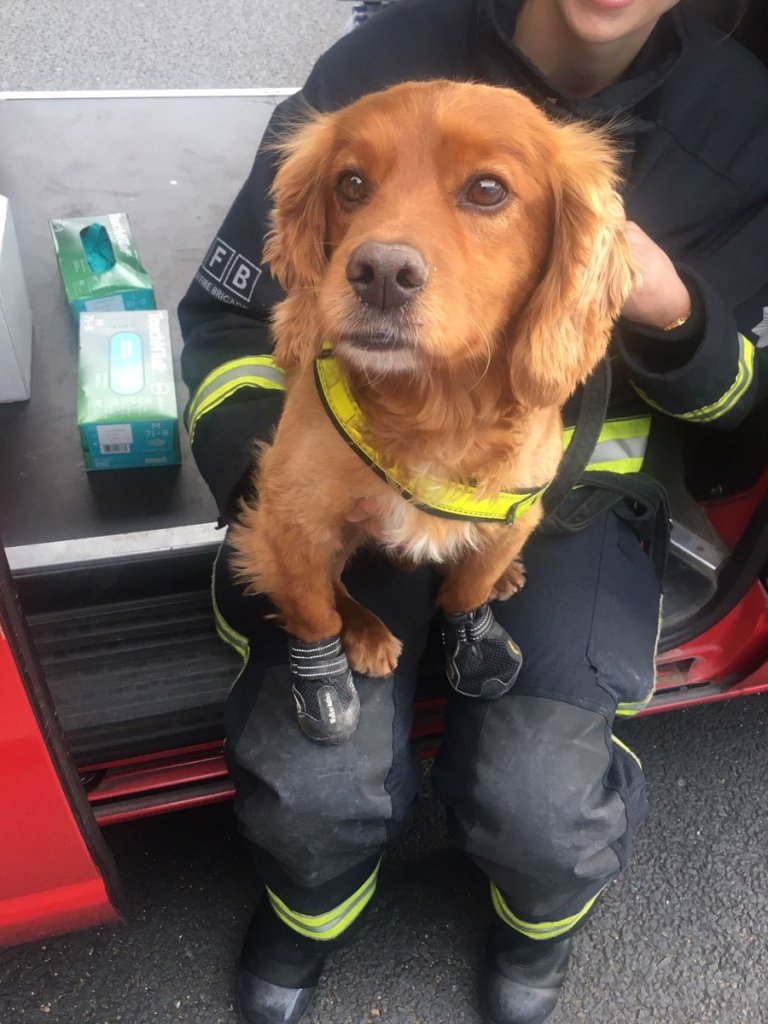
Wearing heat-proof booties to protect their feet, specially trained dogs have been dispatched in London’s Grenfell Tower to help locate victims and determine the cause of last week’s devastating fire that killed at least 79 people.
Because they’re smaller and weigh less than humans, urban search-and-rescue dogs with the London Fire Brigade (LFB) are able to access the more challenging areas of the charred 24-story building, especially the upper floors that sustained the most damage.
It then went on to include a photograph from the London Fire Brigade.
We’ve used specialist search dogs at #GrenfellTower. They’re lighter than humans and can cover a large area quickly.
The next item, apart from also being about the dog’s nose, couldn’t have been more different. It appeared on the Mother Nature Network site and is republished in full.
ooOOoo
Border collies join the search for Amelia Earhart
4 dogs skilled in finding long-buried bones are headed to the uninhabited island of Nikumaroro.
Amelia Earhart standing under nose of her Lockheed Model 10-E Electra. (Photo: Wikimedia Commons)
The high-tech search to find the remains of pilot Amelia Earhart and close the book on one of the aviation world’s greatest mysteries is going to the dogs.
According to National Geographic, four border collies — Berkeley, Piper, Marcy and Kayle — will embark on a voyage later this month to the uninhabited island of Nikumaroro (previously called Gardner Island) in the western Pacific Ocean. The remote triangular coral atoll, less than five miles long and two miles wide, is widely speculated as the location where Earhart and her co-pilot, Fred Noonan, performed an emergency landing during their ill-fated 1937 world flight.
While concrete evidence of the pair surviving as castaways on Nikumaroro has never been found, there have been some intriguing clues. These include a piece of scrap metal that likely came from Earhart’s Lockheed Electra 10E, a sextant box, and fragmented remains of U.S. beauty and skin care products that may date back to the 1930s.
The most intriguing find, however, happened in 1940 with the discovery of 13 bones under a tree on the island’s southeast corner. The remains were shipped to Fiji and subsequently misplaced, but measurements recorded before their loss and examined later by forensic anthropologists indicate that they may have belonged to “a tall white female of northern European ancestry.” With these findings were recently thrown into doubt, the only true way to know if the remains belong to Earhart or Noonan is to find the remaining bones.
The right nose for the job
The four dogs headed to Nikumaroro, officially known as Human Remains Detection Dogs, are part of the latest expedition organized by TIGHAR (The International Group for Historic Aircraft Recovery). Trained at the Institute for Canine Forensics (ICF), these specialized dogs are capable of sniffing out bones centuries old and buried as much as 9 feet deep.
“No other technology is more sophisticated than the dogs,” Fred Hiebert, archaeologist in residence at the National Geographic Society, which is sponsoring the canines, said in a statement. “They have a higher rate of success identifying things than ground-penetrating radar.”
According to the ICF, detection dogs are never trained to smell out live humans, focusing instead on old cases, small scent sources and residual scent. They also excel at locating remains without disturbing the burial site.
You can view one of the ICF dogs in action, seeking out the remains of ancient Native American burial sites, in the video below.
“This kind of searching requires the dog to be slow and methodical and keep its nose just above the surface of the ground, any fast moves and the dog can miss the grave,” the group explains. “It takes many years of slow and patient training to develop the skills needed to do this work.”
Once remains are detected, the dogs generally do little more than lie down on top of the potential burial site. Should Berkeley, Piper, Marcy and Kayle detect anything, TIGHAR’s archeologists will perform a careful excavation to uncover the source.
In addition to using canines, the team from TIGHAR will also take time over the eight-day expedition to survey sites on Nikumaroro using metal detectors and even an advanced underwater drone. Their greatest hope, however, lies with the highly advanced noses of the very good boys and girls sniffing out an 80-year-old mystery.
“If the dogs don’t find anything, we’ll have to think about what that means,” Hiebert added. “But if the dogs are successful, it will be the discovery of a lifetime.”
Margaret (MargfromTassie) comes up with wonderful pictures for you.
These will make today’s Post and the next three Picture Parades. And there was me worrying about where I would find more Picture Parades!!
(Note that on the original Powerpoint images some of them had neat sayings as overlays. In the conversion from pps to jpg formats those were not carried across. I have them as introductions to each picture.)
MAN’s BEST FRIEND!
oooo
“A life without a dog is a mistake” – Karl Zuckmayer
oooo
“Women and cats will do what pleases them, dogs and men should relax and get used to the idea” – Robert A. Heinlein
oooo
“The love for animals, enhances the cultural level of the people.” – F. Salvochea
oooo
When you leave a dog behind because he “grew old”, your children will learn the lesson. Maybe they will do the same to you when you are an old man. Think about it….
oooo
“The dog has made man their God, if the dog was an atheist, it would be perfect” – Paul Valery
oooo
“Love is when your dog licks your face, even if you leave it alone the whole day” – Anita, 4 years old
oooo
“It doesn’t matter if an animal can reason. It matters only that it is capable of suffering and that is why I consider it my neighbor” – Albert Schweitzer
The most profound thing that I learned from Pharaoh is that dogs are creatures of integrity. That goes back to a day in June, 2007. Some six months before I met Jeannie in Mexico in December, 2007. I was sitting in Jon’s home office just a few miles from where Pharaoh and I were then living in South Devon.
It was a key chapter in Part Four of my book where I examine all the qualities that we humans need to learn from our dogs.
So here is Chapter 13 from my book Learning from Dogs. (Written in ‘English’ English!)
ooOOoo
Chapter 13 Integrity
In the Introduction to this book I mentioned how the notion of “learning from dogs” went back to 2007 and me learning that dogs were creatures of integrity. Let me now elaborate on that.
It is a Friday morning in June in the year 2007. I am sitting with Jon at his place with Pharaoh sleeping soundly on the beige carpet behind my chair. I didn’t know it at the time but it was to become one of those rare moments when we gain an awareness of life that forever changes how we view the world, both the world within and the world without.
“Paul, I know there’s more for me to listen to and I sense that we have established a relationship in which you feel safe to reveal your feelings. However, today I want to talk about consciousness. Because I would like to give you an awareness of this aspect of what we might describe under the overall heading of mindfulness.”
I sat quietly fascinated by what was a new area for me.
“During the years that I have been a psychotherapist, I’ve seen an amazing range of personalities, probably explored every human emotion known. In a sense, explored the consciousness of a person. But what is clear to me now is that one can distil those different personalities and emotions into two broad camps: those who embrace truth and those who do not.”
Jon paused, sensing correctly that I was uncertain as to what to make of this. I made it clear that I wanted him to continue.
“Yes, fundamentally, there are people who deny the truth about themselves, who actively resist that pathway of better self-awareness, and then there are those people who want to know the truth of whom they are and seek it out when the opportunity arises. The former group could be described as false, lacking in integrity and unsupportive of life, while the latter group are diametrically opposite: truthful, behaving with integrity and supportive of life.”
It was then that Jon lit a fire inside me that is still burning bright to this day. For he paused, quietly looking at Pharaoh sleeping so soundly on the carpet, and went on to add, “And when I look at dogs, I have no question that they have a consciousness that is predominantly truthful: that they are creatures of integrity and supportive of life.”
That brought me immediately to the edge of my seat, literally, with the suddenness of my reaction causing Pharaoh to open his eyes and lift up his head. I knew in that instant that something very profound had just occurred. I slipped out of my chair, got down on my hands and knees and gave Pharaoh the most loving hug of his life. Dogs are creatures of integrity. Wow!
****
Later, when driving home, I couldn’t take my mind off the idea that dogs were creatures of integrity. What were those other values that Jon had mentioned? It came to me in a moment: truthful and supportive of life. Dogs have a consciousness that is truthful, that they are creatures of integrity and supportive of life: what a remarkable perception of our long-time companions.
I had no doubt that all nature’s animals could be judged in the same manner but what made it such an incredibly powerful concept, in terms of dogs, was the unique relationship between dogs and humans, a relationship that went back for thousands upon thousands of years. I realised that despite me knowing I would never have worked it out on my own, Jon’s revelation about dogs being creatures of integrity was so utterly and profoundly obvious.
As I made myself my usual light lunch of a couple of peanut butter sandwiches and some fruit and then sat enjoying a mug of hot tea, I still couldn’t take my mind off what Jon had revealed: dogs are examples of integrity and truth. I then thought that the word “examples” was not the right word and just let my mind play with alternatives. Then up popped: Dogs are beacons of integrity and truth. Yes, that’s it! Soon after, I recognised that what had just taken place was an incredible opening of my mind, an opening of my mind that didn’t just embrace this aspect of dogs but extended to me thinking deeply about integrity for the first time in my life.
Considering that this chapter is titled “Integrity”, so far all you have been presented with is a somewhat parochial account of how for the first time in my life the word “integrity” took on real meaning. That until that moment in 2007 the word had not had any extra significance for me over the thousands of other words in the English language. Time, therefore, to focus directly on integrity.
“If goodness is to win, it has to be smarter than the enemy.”
That was a comment written on my blog some years ago, left by someone who writes their own blog under the nom-de-plume of Patrice Ayme. It strikes me as beautifully relevant to these times, times where huge numbers of decent, law-abiding folk are concerned about the future. Simply because those sectors of society that have much control over all our lives do not subscribe to integrity, let alone giving it the highest political and commercial focus that would flow from seeing integrity as an “adherence to moral and ethical principles; soundness of moral character; honesty.” To quote my American edition of Roget’s Thesaurus.
Let me borrow an old pilot’s saying from the world of aviation: “If there’s any doubt, there’s no doubt!”
That embracing, cautious attitude is part of the reason why commercial air transport is one of the safest forms of transport in the world today. If you had the slightest doubt about the safety of a flight, you wouldn’t board the aircraft. If you had the slightest doubt about the future for civilisation on this planet, likewise you would do something! Remember, that dry word civilisation means family, children, grandchildren, friends, and loved ones. The last thing you would do is to carry on as before!
The great challenge for this civilisation, for each and every one of us, is translating that sense of wanting to change into practical, effective behaviours. I sense, however, that this might be looking down the wrong end of the telescope. That it is not a case of learning to behave in myriad different ways but looking at one’s life from a deeper, more fundamental perspective: living as a person of integrity. So perfectly expressed in the Zen Buddhist quote: “Be master of mind rather than mastered by mind.” Seeing integrity as the key foundation of everything we do. Even more fundamental than that. Seeing integrity as everything you and I are.
It makes no difference that society in general doesn’t seem to value integrity in such a core manner. For what is society other than the aggregate of each and every one of us? If we all embrace living a life of integrity then society will reflect that.
Integrity equates to being truthful, to being honest. It doesn’t mean being right all the time, of course not, but integrity does mean accepting responsibility for all our actions, for feeling remorse and apologising when we make mistakes. Integrity means learning, being reliable, and being a builder rather than a destroyer. It means being authentic. That authenticity is precisely and exactly what we see in our dogs
The starting point for what we must learn from our dogs is integrity.







 We’ve used specialist search dogs at #GrenfellTower. They’re lighter than humans and can cover a large area quickly.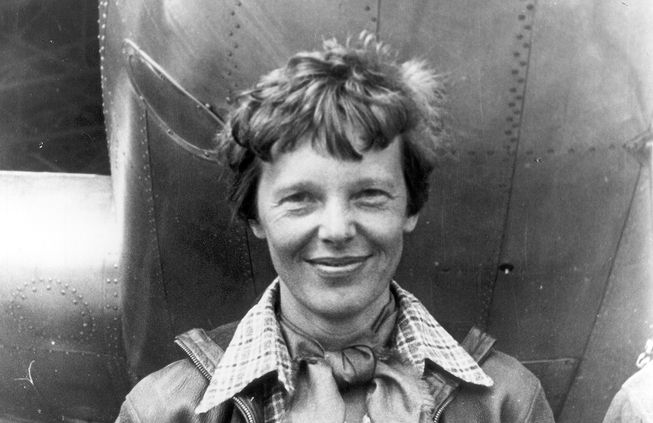





 Learning from Dogs