TIME magazine published a double-issue in February of this year How To Live Longer Better!
The article, on Page 47, opens:
Old age demands to be taken very seriously – and it usually gets its way!
Then later on in that same article one reads:
Exactly how much – or how little – exercise it takes to begin paying dividends has been one of the happy surprises of longevity research. A 2016 study found that elderly people who exercised for just 15 minutes a day, at an intensity level of a brisk walk, had a 22% lower risk of early death compared to people who did not exercise.
Then two sentences later:
Researchers from McMaster University in Canada even found that breaking a sweat for just 60 seconds may be long enough to improve health and fitness (as long as it’s a tough workout).
As part of Jean’s commitment to slowing down the progression of her Parkinson’s Disease (PD) she attends every Monday and Wednesday a special class at our local Club Northwest in Grants Pass. The class runs for 90 minutes and is a boxing class! The instructor, Mark Whiting, is a boxing coach and the class, called the Rock Steady class, is specifically for PD sufferers. One of the exercises involves rapid punching of a punch bag.
Dr. Laurie Mischley of SIM had a telephone consultation with Jean a few days ago. It was Dr. M following up Jean’s consultation with Dr. Nutt in Portland on the 10th that I wrote about in my post Jeannie’s PD Journey. Dr. M commented as to how well Jean was doing.
Possibly, vigorous exercise seems to be offering something that many in their elder years may not have cottoned on to.
Readers may recall Patrice Ayme leaving a comment in my recent Facing up to PD post:
The one and only countermeasure we have is violent neurological activity. As in powerlifting. This has been indicated by research published in 2018… But it was long obvious. So the way to “comfort” is the discomfort of maximum motor-neurological… hmmm… violence. Too much local gentleness doesn’t optimize overall comfort and gentleness… I guess that’s one of my overall philosophical messages… Not one popular with the PC crowd…
Now I’m still trying to get to bottom of this link between vigorous exercise and long-term health and have reached out to McMaster University in Canada seeking academic backing for the link.
More from me as I learn more.
Turning to diet.
In that same TIME magazine, on page 53, there is a single page listing five places around the world known as Blue Zones.
Global life expectancy averages out to 71.4 years. That means. of course, that some parts of the world see much shorter spans, while others enjoy far greater longevity.
Five places, in particular, fall into the latter category. They’re know as Blue Zones – named for the blue circles researchers drew to identify the first one on a map – and they’re home to some of the oldest and healthiest people in the world. Dan Buettner, author of The Blue Zones and The Blue Zones Solution, told TIME why residents of these places live so long – and how you can steal their habits
Those five places are listed below with me republishing just a small extract regarding diet from four of those five place descriptions.
Sardinia, Italy – “A largely plant-based diet ….”
Okinawa, Japan – No mention of diet.
Nicoya, Costa Rica – “The Costa Rican people traditionally get the majority of their caloric intake from beans, squash and corn, plus tropical fruits. This plant-forward, nutrient-dense diet ……”
Loma Linda, Calif., USA – “Adventists live 10 years longer than their fellow Americans. Many avoid meat and eat plenty of plants, whole grains and nuts.”
Ikaria, Greece – ” …. and a strict adherence to the Mediterranean diet – eating lots of fruits, vegetables, beans, whole grains, potatoes and olive oil – propels 1 in 3 ikarians to live into their 90s, often free of dementia and chronic disease.”`
You will just love this story about Terri and Zero.
Enough said!
ooOOoo
My Heart Dog
So what is a “heart dog”? I have heard this saying in the past and was never sure of exactly what it meant. I found a great description and definition from the site Jenna and Snickers. Here is what she writes…
“In my opinion, your heart dog is that once in a lifetime – maybe twice if you’re truly blessed – soul mate dog. He or she is the one you click with similarly to, but different from, how people in love click. There’s an understanding, a bond stronger than most, and a special level of communication. Your heart dog “gets” you and you get him or her right back.”
This is so me and Zero! I have had a couple of dogs in the past when I was growing up, but none have been my dog … my heart dog … like Zero has.
So how did I end up with this amazing dog in my life?
When my son ,Dylan, was younger he started going through that phase of wanting a little brother or a sister. Well, since I wasn’t even dating at the time, I knew that wasn’t going to happen so I figured it was time for a dog!
Side Note: I often joke that if I had the dog first, I might not have had the kid. I mean, if I tell Zero to sit, she just sits…right then…no questions, no complaining, no whining, she just does it. So much easier! LOL
We found Zero at our local Humane Society. She was just under a year and a half old and had been picked up as a stray so they didn’t know anything about her. When we got her out of her kennel and into the big yard so we could see her more, she hardly even came over to us. There was just something about her, though, and we knew she was the one.
We brought her home and the next day when we took her to the vet, learned that she had heart worms…bad. My mom reminded me that the humane society said they would take her back if it was within 72 hours but I just couldn’t do that. First, I was afraid nobody else would adopt her knowing she had heart worms, and second, she was my dog. Like we already totally bonded and I just knew she was my dog.
Long story short, we put her though the pretty intensive heart worm treatment, killed all those little buggers off and she was healthy!
We also learned that she was a pretty fearful dog…scared of so much. She would not walk up the stairs to our apartment so I had to carry her up and down for about a month until we finally coaxed her to walk up and down the entire flight by herself. She had no idea what the TV was and would hide behind my chair whenever it was on. She had no idea how to play with toys. When I would try to teach her fetch and I would throw the ball she would just look at me like, “well, that was stupid…why did you do that?”. She had no idea of anything.
To help socialize her more and build her confidence, we put her in agility with Dylan as the handler. They did great! He was about nine at the time and they even competed and won a couple of times! After that she continued to blossom. She learned how to play with toys, learned a ton of commands (she’s so super smart!) and she even got her CGC (Canine Good Citizen) certificate.
It was so great seeing her come out of her shell and watch her confidence grow. Also during this time she was becoming closer and closer to Dylan and I. We were her pack and she was not happy unless we were all together. In fact, when Dylan would run her in agility trials, I would have to go hide because if she saw me she would stop in the middle of her run and charge over to me. Same would happen if I ran her…she would have to search for Dylan. She likes it when all three of us are together.
Now she is thirteen years old and still going strong. The vet even told me at Zero’s last check up that she can’t believe Zero is thirteen and would never guess she was that old by looking at her. She “checks out” to appear much younger. That is 100% okay with me. I have already told Zero she cannot get any older and she must live forever.
She truly is my heart dog. We just know what the other one is thinking. We have our routine, our habits, and our quirks. She loves me unconditionally and I love her back just the same.
Zero Facts:
What type of breed is she? I don’t know for sure. Someone asked me once if she was a kelpie. I had not even heard of that breed before so I looked it up and found pictures online that I could swear were Zero! So, by looks alone yes, I would think she is kelpie. What do you think?
ooOOoo
Of course, I was interested in Terri’s background and this what she wrote me:
As far as my background…had many jobs in the past but the longest was most recent when I worked as a personal trainer. I was in the fitness industry for about 10 years. Got a little burned out and was trying to figure out what’s next. Knew I wanted to roam and when my son moved out I figured now is the time, so I started planning. Zero and I will be taking off in mid-August to roam and explore the US in my Honda Civic and a tent. Can’t wait!!
Plus Terri explained how Zero took on that name:
One of our favorite movies at the times was ‘The Nightmare Before Christmas’ (I still jam out to that soundtrack #soGood). The main character (Jack Skellington) has a dog named…yep…you guessed it…Zero.
With Terri going on to add the commands and tricks that Zero has learnt.
Sit
Stay
Bang aka Play Dead
Be a bear (stands up on back feet)
Be sneaky (crawls with her belly on the floor)
Shake Hands
High Five
Roll Over
Here (Runs to me and sits at my feet)
Then a list of Zero’s favorite games:
Hide and Seek (with me and/or Dylan)
Find It : basically hide and seek except I hide her toy and make her find it
Keep Away with her frisbee (Dylan and I throw her frisbee back and forth and she’s in the middle jumping up and trying to get it..she freaking loves that game!)
Fetch with her tennis ball
Finally, Terri offers some random facts [Ed: “she” being Zero not Terri!!]:
She likes apples but wont eat a piece unless it’s peeled #soPicky
She looks up at the sky more than any dog I’ve ever seen. She loves gazing at the sky day or night.
She does not like any delivery truck. Fed Ex, UPS, Mailman, etc…Other trucks are fine
She hates storms and shakes like a leaf when there’s thunder
She’s awesome at soccer and it’s almost impossible to get the ball past her
Her favorite toy is her tennis ball
Her middle name is “Marie”. Not sure why, it just slipped out of my mouth one day when she was in trouble..lol….Zero Marie…
She would always help me get Dylan up in the mornings by burrowing under him and raising him up out of bed
So there you have it; a little bit about my heart dog and my best friend. I really can’t imagine life without her. She’s my protector, my companion, my best friend, my partner in crime … pretty much my everything. She makes my life so much better and I have learned as much from her as she has me.
(All the photographs are by Terri.)
ooOOoo
There are millions out there that have the most beautiful and loving relationships with their dogs.
There are far, far fewer who can articulate just what that love means to the level that Terri has done!
“Happiness resides not in possessions, and not in gold, happiness dwells in the soul.”
So wrote the philosopher Democritus who was born in 460 BCE (although some claim his year of birth was 490 BCE). He acquired fame with his knowledge of the natural phenomena that existed in those times and history writes that he preferred a contemplative life to an active life, spending much of his life in solitude. The fact that he lived to beyond 100 suggests his philosophy didn’t do him any harm.
OK! Before I continue, please let me state, as before, that I write to you purely as Jean’s husband. I have no medical skills or knowledge at all and if you are at all affected by any of the following make an appointment to see your own doctor!
The crux of this post is Jean’s relationship with a naturopathic doctor at a practice in Seattle. The practice is Seattle Integrative Medicine (SIM) and a number of the doctors at SIM specialise in patients with PD. That’s how Jean was connected with Dr. Laurie Mischley. (Dr. M)
When one goes to the web page for Dr. M one reads:
Dr M conducted tests including testing her ear wax*, extensive blood analysis and an analysis of a sample of Jean’s hair.
* Dr. M has a dog that can reliably smell the presence of PD in human ear wax!
The favourite drug for those with PD is Levadopa. Within 48 hours of Jean taking Levadopa she had a serious allergic response to that drug.
Back to Dr. M’s tests. All three tests were non-indicative of PD. A while later, in a subsequent telephone conversation, Dr. M wondered if Jean really did have PD. She recommended a referral to the Oregon Health and Science University (OHSU) in Portland. Specifically to their Department of Neurology and to Dr. John Nutt. His background may be viewed here. From which one notes:
John Nutt, M.D.
Co-founder and Director Emeritus of the OHSU Parkinson Center and Movement Disorders Program
Professor of NeurologySchool of Medicine Expertise
Neurology
Special focus on Parkinson’s and Movement Disorders
Jean’s appointment was at 08:30 on Tuesday, 9th July. In terms of the timeline of all of us, Jean was diagnosed as suspected of having PD in December, 2015.
Dr. Nutt saw us promptly at 8:30 and immediately revealed a listening, caring attitude. He also quietly admitted that he had been a doctor specialising in neurology and movement disorders for 39 years! There was no question in my mind that we had landed in front of the ideal physician under these circumstances.
Over the next hour, Dr. Nutt examined Jean in a great number of ways. From her stretching her arms out, Dr. Nutt examining Jean’s arm joints, watching Jean walk along the corridor outside his examining room, and much more.
Eventually he paused and looked us both in the eyes. He then spoke quietly: “Jean is displaying a number of classic symptoms of Parkinson’s disease. I have no doubt that Jean does have the disease.”
Of course it wasn’t long before I mentioned Laurie Mischley’s opinion that Jean might not have PD. But Dr. Nutt was very clear with his reply. Namely that PD cannot be determined from hair and blood tests alone and that the potential sufferer must be examined physically.
Dr. Nutt asked me if I had noticed that when Jean held her arms straight out in front of her at shoulder height the tremors in her right hand ceased yet when she was relaxed with her hands in her lap the tremor in her right hand was very noticeable? I had not spotted that.
“Paul, that is a classic Parkinson’s characteristic.”
Dr. Nutt went on to say that watching Jean walk gave him another indicator of PD. Because although Jean walks well she doesn’t swing her arms. Classic PD!
Without doubt, Dr. Nutt’s impression was Idiopathic Parkinson’s disease.
But Dr. Nutt also said that Jean was doing incredibly well taking into account that she would have been suffering from the disease for at least 4 to 5 years and that her commitment to lots of exercise including her RockSteady class, that he was aware of, and her vegetarian diet was critically valuable.
It was now time to turn to medication for Jean. Dr. Nutt said that of all the drugs Levadopa was the ideal to combat the loss of dopamine in the brain. He was puzzled as to why Jean had had such a strong allergic reaction to the drug. He wondered if it was a reaction to the Carbidopa that in the USA was so often a component of the Levadopa medication. If so, that could be worked around. Dr. Nutt even mused that he had known of a patient who was allergic to the yellow dye that is sometimes in that medication.
His medication plan for Jean was for her to start on a 1/2 tablet of carbidopa-levadopa 25-100 mg tablets just once a day and if she has no bad reaction in a week then up that to two 1/2 tablets a day. If no adverse effects then increase by 1/2 tablet every week until taking 1 tablet three time a day.
So here we are, a week and a day after we returned from OHSU and, touch wood, Jean has had no adverse effects and is now on two 1/2 tablets a day.
But a postscript to that consultation with Dr. Nutt. At the very end I said that I had two questions. Dr. Nutt welcomed me to ask them.
“My first question is to do with the trend for PD. Is it getting worse?”
“Paul, here in the USA we are seeing a slow but definite decline in the incidence of Parkinson’s. What was your second question?”
“Dr. Nutt, my next question was whether or not science was pointing a finger at the cause of Parkinson’s disease?”
He replied without hesitating: “We are seeing a strong correlation between pesticides and Parkinson’s disease.”
Upon hearing that, Jeannie immediately spoke up recalling her times out in the Mexican fields when the crop-spraying aircraft flew right overhead. Adding that she had at times been drenched by the spray.
But, please, let us not forget: Association is not causation!
That’s enough for today. Because I was going on to include information about the importance of exercise. About managing one’s life really well. About the importance of diet and overall health. In a sense, not just for PD sufferers but for anyone the wrong side of 60 years old!!
That will be coming along soon!
I will close by thanking everyone at OHSU. The quality of care, attentiveness and experience of the staff backed by world-class resources was second-to-none!
To be in their system, so to speak, is a privilege.
In addition, Dr. Lee said to always THINK BIG! Big in voice, big in attitude, big in stature.
Finally, let me share with you what was posted on the Visible Procrastinations blog back in 2009. Reposted with the author’s permission.
Change.
Change is unavoidable for everyone one of us. Some changes are certainly wonderfully positive ones. Others not quite so. But the thing about change is that whatever the reason in one’s life for having to experience change it has a disruptive effect.
Today’s post leans heavily on that Visible Procrastinations (VP) post but the main theme is fully endorsed by yours truly!
Some notes from My Change Journey: This workshop is designed to help you understand your emotional and psychological needs during times of change and strategies you can use to take control of your own change journey. It also focuses on creating opportunities and seeing possibilities in the new world of work.
change – an event that occurs when something passes from one state or phase to another;
transition – the act of passing from one state or place to the next
Seeing the Big Picture
Many times we do not always see the bigger picture.
There are two examples of that; the first is this rather delightful 5-minute video that is just a bit of fun to watch. The second comes along shortly.
Experiencing Transitions
When change is implemented at any level in an organisation or personally, people typically respond by moving through a series of phases. People will spend different times in each phase. This is a crucial thing to understand and is at the heart of why change is always disruptive and frequently unsettling.
Take a few moments to reflect on the next item; this three-phase framework.
William Bridges (1995) Bridges’ three-phase transition framework: The first phase, the Ending phase, is about letting go of an old identity, an old reality or an old strategy. The Neutral Zone is akin to crossing the wilderness between the old way and the new. The final phase is making a new beginning and functioning effectively in a new way.
I am going to reinforce this message because it underpins everything to do with us understanding the business of change. Especially when we have to deal with unsettling events!
Ending – Letting go of what has been.
Neutral Zone or The Bridge – yes, it does feel like a ‘wilderness’ in some circumstances. Give it time!
Starting – Embracing the new way and making it work really well for you.
The key is to allow each phase plenty of time to take effect; frequently much longer than one senses!
The Process of Transition
John Fisher’s model of personal change – The Transition Curve – is an excellent analysis of how individuals deal with personal change.
“You should only worry about things that are within your sphere of influence.”
This is such a key message. So take a long hard look at the things that make you anxious or worry you. Then clearly identify those things over which you have no or very little control. Then walk away from them!
There’s a great book: The Seven Habits of Highly Effective People, from which is taken:
You should only worry about things in your “sphere of influence.” If you have no control over certain aspects of your life, why bother worrying about them?
Mental Models: our way of seeing the world
(NB. This includes the second example of seeing the bigger picture)
Mental models are usually tacit, existing below the level of awareness. Another way of thinking about them is as a paradigm. This is a big topic and I am going to return to it by way of a separate post, probably one day next week.
But this second example of not seeing the bigger picture is also stirring the deeper waters of one particular personal paradigm.
Take 1000
add 40 to it
Now add another 1000
Now add 30
Add another 1000
Now add 20
Now add another 1000
Now add 10
What is the total? Did you get 5000?The correct answer is actually 4100.
P.S. The number of times I did this, adding it up in my head, and finding it came to 5000. Then I did it on a calculator and it came to 4100. Talk about the eyes looking but not seeing!!
But there’s an important message. If you, as me and Jeannie did first time around, made it 5000 then you are demonstrating that what your eyes see, interpreted by your brain, isn’t necessarily correct.
So if it’s important: Give it a coating or two of thought!
Ethical work and life learning (Free online education for ethical work, business, career and life learning; training materials for entrepreneurs, organizations, seflf-development, business management, sales, marketing, project management, communications, leadership, time management, team building and motivation) www.businessballs.com
I deliberately chose that sub-heading because Wednesday’s post is going into the details of a consultation that Jean had with Dr. John Nutt, MD, a neurologist at the Oregon Health and Science University (OHSU) in Portland, last Monday, 9th July.
Jean wants me to share the details with you because it is quite likely, nay, almost certainly, that some of you dear readers know of someone close to you that has Parkinson’s Disease (P.D.).
The balance of today’s post, to be continued tomorrow, is a reposting of something I published on February 24th, 2016.
ooOOoo
Life is a one-way track.
Those of you who follow this place on a regular basis know that last Friday I published a post under the title of Friday Fondness. You will also know that later that same day I left this comment to that post:
Sue, and everyone else, we returned from seeing Dr. Lee, the neurologist, a little under two hours ago. Dr. Lee’s prognosis is that Jean is showing the very early signs of Parkinson’s disease, and Jean is comfortable with me mentioning this.
Everyone’s love and affection has meant more than you can imagine. I will write more about this next week once we have given the situation a few ‘coatings of thought’.
Jean sends her love to you all!
Thus, as heralded, I am going to write some more.
You would not be surprised to hear that the last few days have been an emotional roller-coaster, for both Jean and me. Including on Monday Jean hearing from our local doctor here in Grants Pass, OR, that a recent urine test has shown that Jean has levels of lead in her bones some three times greater than the recommended maximum. While our doctor is remaining open-minded it remains to be seen whether Jean is exhibiting symptoms of lead poisoning, whether the lead is a possible cause of the Parkinson’s disease (PD), see this paper, or whether it is a separate issue to be dealt with.
However, I want to offer some more from the consultation that Jean had with the neurologist Dr. Eric Lee last Friday. Shared with the full support of Jean who has read the whole of today’s post yesterday evening; as she does with every post published in this place.
But before so doing, please understand that while I was present throughout the complete examination of Jean, what you are about to read carries no more weight than that of any casual onlooker. If you are at all affected by any of the following make an appointment to see your own doctor!
Jean’s examination lasted for about an hour. It consisted of a great number of checks and tests on how her body responded to many different tests and stimulations. At the end of the examination Dr. Lee said that while he wasn’t 100% certain the balance of probability was that Jean was demonstrating the very early signs of PD. For example, showing such signs as walking and not swinging both arms in a normal, balanced manner. Or having a very slow blink rate. Then she was exhibiting some difficulty with rapid finger-to-thumb taps.
However, Dr. Lee did say that Jean was at the very early stages of PD and that we would have to wait another six months to see if the PD indicators were firming up. He also said that he had PD patients who had had the disease for twenty, even thirty years. Some of the general indicators that PD is progressing include a stooped gait, decreasing size of handwriting, and a quieter speaking tone. The NINDS website has more information on this. Here’s a little of what they explain about PD:
What is Parkinson’s Disease?
Parkinson’s disease (PD) belongs to a group of conditions called motor system disorders, which are the result of the loss of dopamine-producing brain cells. The four primary symptoms of PD are tremor, or trembling in hands, arms, legs, jaw, and face; rigidity, or stiffness of the limbs and trunk; bradykinesia, or slowness of movement; and postural instability, or impaired balance and coordination. As these symptoms become more pronounced, patients may have difficulty walking, talking, or completing other simple tasks. PD usually affects people over the age of 60. Early symptoms of PD are subtle and occur gradually. In some people the disease progresses more quickly than in others. As the disease progresses, the shaking, or tremor, which affects the majority of people with PD may begin to interfere with daily activities. Other symptoms may include depression and other emotional changes; difficulty in swallowing, chewing, and speaking; urinary problems or constipation; skin problems; and sleep disruptions. There are currently no blood or laboratory tests that have been proven to help in diagnosing sporadic PD. Therefore the diagnosis is based on medical history and a neurological examination. The disease can be difficult to diagnose accurately. Doctors may sometimes request brain scans or laboratory tests in order to rule out other diseases.
But here’s the good news regarding my darling wife – there are three things that Dr. Lee strongly recommends:
Hang on to a positive mental attitude for the body actively produces dopamine when in a positive mental state.
At least 30-minutes of good aerobic exercise three times a week,
And physiotherapy.
In addition, Dr. Lee said to always THINK BIG! Big in voice, big in attitude, big in stature.
Finally, let me share with you what was posted on the Visible Procrastinations blog back in 2009. Reposted with the author’s permission.
ooOOoo
That article first seen on Visible Procrastinations will be republished tomorrow. Once more I must stress that I write to you purely as Jean’s husband. I have no medical skills or knowledge at all and if you are at all affected by any of the following make an appointment to see your own doctor!
The idea that humanity will not prevent the approaching disaster is beyond belief!
One of the results of all you great people signing up to follow Learning from Dogs is that it encourages me to share things that strike me as so, so important.
Another of the results in there being, as of today, 3,349 following this place, is that I get the sense of what many of you good people also feel is important. Ergo, it is clear to me, clear beyond doubt, that caring and loving a dog or two makes you a person who cares and loves passionately this beautiful planet that is our home.
The emotion that is spilling out of me via these words to you is a result of having just read an essay published recently on The Conversation site and shared with you today.
Directly, it has nothing to do with our dear dogs. Yet, in a way, it does!
ooOOoo
7.5 billion and counting: How many humans can the Earth support?
By Andrew D. Hwang, Associate Professor of Mathematics, College of the Holy Cross, July 9th 2018.
Humans are the most populous large mammal on Earth today, and probably in all of geological history. This World Population Day, humans number in the vicinity of 7.5 to 7.6 billion individuals.
Can the Earth support this many people indefinitely? What will happen if we do nothing to manage future population growth and total resource use? These complex questions are ecological, political, ethical – and urgent. Simple mathematics shows why, shedding light on our species’ ecological footprint.
The mathematics of population growth
In an environment with unlimited natural resources, population size grows exponentially. One characteristic feature of exponential growth is the time a population takes to double in size.
Exponential growth of world population
It took 127 years for the world population to double from one billion to two. By contrast, it took only 47 years, from 1927 to 1974, to double from two billion to four. Since 1960, world population has grown by about one billion every 13 years. Each point represents an additional one billion people.
Exponential growth tends to start slowly, sneaking up before ballooning in just a few doublings.
To illustrate, suppose Jeff Bezos agreed to give you one penny on Jan. 1, 2019, two pennies on Feb. 1, four on March 1, and so forth, with the payment doubling each month. How long would his $100 billion fortune uphold the contract? Take a moment to ponder and guess.
After one year, or 12 payments, your total contract receipts come to US$40.95, equivalent to a night at the movies. After two years, $167,772.15 – substantial, but paltry to a billionaire. After three years, $687,194,767.35, or about one week of Bezos’ 2017 income.
The 43rd payment, on July 1, 2022, just short of $88 billion and equal to all the preceding payments together (plus one penny), breaks the bank.
Real population growth
For real populations, doubling time is not constant. Humans reached 1 billion around 1800, a doubling time of about 300 years; 2 billion in 1927, a doubling time of 127 years; and 4 billion in 1974, a doubling time of 47 years.
On the other hand, world numbers are projected to reach 8 billion around 2023, a doubling time of 49 years, and barring the unforeseen, expected to level off around 10 to 12 billion by 2100.
This anticipated leveling off signals a harsh biological reality: Human population is being curtailed by the Earth’s carrying capacity, the population at which premature death by starvation and disease balances the birth rate.
World population projections
In 2020, the UN predicts that there will be 7,795,482 people worldwide.
Humans are consuming and polluting resources – aquifers and ice caps, fertile soil, forests, fisheries and oceans – accumulated over geological time, tens of thousands of years, or longer.
According to the Worldwatch Institute, an environmental think tank, the Earth has 1.9 hectares of land per person for growing food and textiles for clothing, supplying wood and absorbing waste. The average American uses about 9.7 hectares.
These data alone suggest the Earth can support at most one-fifth of the present population, 1.5 billion people, at an American standard of living.
A man works recycling plastic bottles outside Hanoi, Vietnam. REUTERS/Kham
Water is vital. Biologically, an adult human needs less than 1 gallon of water daily. In 2010, the U.S. used 355 billion gallons of freshwater, over 1,000 gallons (4,000 liters) per person per day. Half was used to generate electricity, one-third for irrigation, and roughly one-tenth for household use: flushing toilets, washing clothes and dishes, and watering lawns.
If 7.5 billion people consumed water at American levels, world usage would top 10,000 cubic kilometers per year. Total world supply – freshwater lakes and rivers – is about 91,000 cubic kilometers.
World Health Organization figures show 2.1 billion people lack ready access to safe drinking water, and 4.5 billion lack managed sanitation. Even in industrialized countries, water sources can be contaminated with pathogens, fertilizer and insecticide runoff, heavy metals and fracking effluent.
Freedom to choose
Though the detailed future of the human species is impossible to predict, basic facts are certain. Water and food are immediate human necessities. Doubling food production would defer the problems of present-day birth rates by at most a few decades. The Earth supports industrialized standards of living only because we are drawing down the “savings account” of non-renewable resources, including fertile topsoil, drinkable water, forests, fisheries and petroleum.
The drive to reproduce is among the strongest desires, both for couples and for societies. How will humans reshape one of our most cherished expectations – “Be fruitful and multiply” – in the span of one generation? What will happen if present-day birth rates continue?
Population stays constant when couples have about two children who survive to reproductive age. In some parts of the developing world today, couples average three to six children.
We cannot wish natural resources into existence. Couples, however, have the freedom to choose how many children to have. Improvements in women’s rights, education and self-determination generally lead to lower birth rates.
As a mathematician, I believe reducing birth rates substantially is our best prospect for raising global standards of living. As a citizen, I believe nudging human behavior, by encouraging smaller families, is our most humane hope.
ooOOoo
This essay from Professor Hwang is one of those articles that one frequently sees online that comes across as really interesting but, in the end, only gets a skim read; at best.
So if you didn’t fully comprehend what the good Professor included then ‘Stop‘ and go back and read it all very carefully.
Don’t just be alarmed at Professor Hwang writing:
This anticipated leveling off signals a harsh biological reality: Human population is being curtailed by the Earth’s carrying capacity, the population at which premature death by starvation and disease balances the birth rate.
Or:
Though the detailed future of the human species is impossible to predict, basic facts are certain. Water and food are immediate human necessities. Doubling food production would defer the problems of present-day birth rates by at most a few decades. The Earth supports industrialized standards of living only because we are drawing down the “savings account” of non-renewable resources, including fertile topsoil, drinkable water, forests, fisheries and petroleum.
Be concerned that each and every one of us, as in you and me, can only prevent the train crash by making a change in how we live: Today!
Otherwise ….
In so many ways we are such a clever and inventive race, capable of exploring the farthest reaches of outer space and the innermost aspects of quantum mechanics. Surely we must learn to live sustainably on beautiful Planet Earth!
Simply because it offers some very interesting insights into the history of canines in The Americas.
Enjoy!
ooOOoo
European Dogs Devastated Indigenous American Pup Populations
Disease, cultural change wiped out pre-contact populations, leaving no trace of ancient dogs’ DNA in modern counterparts
A dog buried in Western Illinois 10,000 years ago is one of the oldest dogs known in the Americas, and the oldest dog burial in the world. These native American dogs were almost entirely wiped out when European colonists arrived. (Del Baston, courtesy of the Center for American Archeology)
The first humans to populate the Americas arrived from Siberia via the Bering land bridge around 16,000 years ago. Man’s best friend, the domesticated dog, didn’t arrive for another 6,000 years or so, crossing over just in time to avoid the land bridge’s collapse, but archaeological evidence suggests that the two species lived in harmony for thousands of years—at least until 1492, the year Columbus sailed the ocean blue.
According to a study published in Science on Thursday, “pre-contact” American dogs possessed a unique genetic signature derived not from the North American wolf, as previously thought, but from domesticated Siberian ancestors. Today, that singular genome has all but disappeared, eradicated by the 15th-century arrival of European settlers and their canine companions.
National Geographic’s Maya Wei-Haas explains that European dogs, like their human owners, probably carried diseases that pre-contact dogs were unequipped to fend off. The colonists preferred European breeds and discouraged their pets from mating with the native dogs, which study co-author Angela Perri, a zooarchaeologist at Durham University, says were viewed as “wild” and “vicious.”
“This study demonstrates that the history of humans is mirrored in our domestic animals,” Greger Larson, director of the Palaeo-BARN at Oxford and senior author of the study, said in a statement. “People in Europe and the Americas were genetically distinct, and so were their dogs. And just as indigenous people in the Americas were displaced by European colonists, the same is true of their dogs.”
To trace the story of these pre-contact dogs, researchers studied DNA found in the mitochondria of 71 North American and Siberian dog bones. The remains, which date from roughly 10,000 to 1,000 years ago, included those of the Koster dogs, a group of four domesticated canines discovered at a burial site in western Illinois during the 1970s. (A second study, newly published in pre-print server Biorxiv, further discusses these early dogs.) As Science’s David Grimm notes, the Koster pups lived about 10,000 years ago, making them the oldest known dogs in the Americas. Perri, referencing the animals’ small, slender stature, tells Grimm that “it wouldn’t be surprising if they were all used as hunting dogs.”
DNA analysis allowed the scientists to identify pre-contact dogs’ closest relatives: a group of dogs native to Zhokhov Island, a frigid Arctic site situated about 300 miles north of the Russian mainland. The Atlantic’s Ed Yong writes that these dogs were the first to be bred for a specific purpose, namely pulling their humans’ sleds.
In addition to shedding light on the first American dogs’ origins, the study offers insights on pre-contact dogs’ connections—or rather, lack of connections—with modern dogs. Researchers compared the 71 ancient genomes with DNA from more than 5,000 modern dogs, including breeds like chihuahuas and Carolina dogs, which are commonly thought to be descended from indigenous populations. The highest level of pre-contact DNA conclusively found in any of the modern dogs was four percent, a negligible result, the New York Times’ James Gorman reports.
The team’s findings suggest that modern American dogs are descended solely from Eurasian breeds introduced by European settlers. Perri tells Wei-Haas that the scientists expected to find evidence of interbreeding between the pre-contact pups and the new arrivals. Instead, they realized that the native dogs had virtually vanished.
“It is fascinating that a population of dogs that inhabited many parts of the Americas for thousands of years, and that was an integral part of so many Native American cultures, could have disappeared so rapidly,” Laurent Frantz, study co-author and evolutionary geneticist at Queen Mary University of London, said in a statement.
Oddly enough, scientists found that the closest surviving trace of pre-contact dogs’ DNA is found in a sexually transmitted canine cancer. The Los Angeles Times’ Deborah Netburn writes that the disease, known as canine transmissible venereal tumor, stems from the genetic mutation of a single North American dog that lived up to 8,225 years ago. The tumor cells spread through mating and carry a copy of that original DNA, allowing researchers to paint a clear picture of the “founding dog,” or patient zero.
Elaine Ostrander, chief of the cancer genetics and comparative genomics branch at the National Human Genome Research Institute, tells Wei-Haas, “It’s the world’s oldest continuously propagated cell line, which is really, really remarkable.”
We have to keep banging this drum on behalf of our wildlife!
OK! This new essay from George Monbiot applies specifically to the United Kingdom. But there’s no question in my mind that awareness of what is going in the U.K. will be important for readers in many other countries.
ooOOoo
Incompetence By Design
As state bodies are dismantled, corporations are freed to rip the living world apart
By George Monbiot, published in the Guardian 4th July 2018
It feels like the collapse of the administrative state – and this is before Brexit. One government agency after another is losing its budget, its power and its expertise. The result, for corporations and the very rich, is freedom from the restraint of law, freedom from the decencies they owe to other people, freedom from democracy. The public protections that constrain their behaviour are being dismantled.
An example is the cascading decline in the protection of wildlife and environmental quality. The bodies charged with defending the living world have been so enfeebled that they now scarcely exist as independent entities. Natural England, for example, has been reduced to a nodding dog in the government’s rear window.
Its collapse as an autonomous agency is illuminated by the case that will be heard next week in the High Court, where two ecologists, Tom Langton and Dominic Woodfield, are challenging its facilitation of the badger cull. That the cull is a senseless waste of life and money is well established, but this is only one of the issues being tested. Another is that Natural England, which is supposed to assess whether the shooting of badgers causes wider environmental harm, appears incapable of discharging its duties.
As badger killing spreads across England, it intrudes upon ever more wildlife sites, some of which protect animals that are highly sensitive to disturbance. Natural England is supposed to determine whether allowing hunters to move through these places at night and fire their guns has a detrimental effect on other wildlife, and what the impact of removing badgers from these ecosystems might be. The claimants allege that it has approved the shooting without meaningful assessments.
Some of its decisions, they maintain, are farcical. In Dorset, for example, Natural England assumed that overwintering hen harriers and merlins use only one out of all the sites that have been designated for their protection, and never stray from it. It makes the same assumption about the Bewick’s swans that winter around the Severn estuary. That birds fly, enabling them to move from one site to another, appears to have been overlooked.
Part of the problem, the claimants argue, is that staff with specialist knowledge have been prevented from making decisions. The location of the badger cull zones is such a closely guarded secret that Natural England’s local staff are not allowed to see the boundaries. As a result, they can make no meaningful assessment of what the impact might be. Instead, the decisions are made in distant offices by people who have not visited the sites.
I wanted to ask Natural England about this, but its external communications have been shut down by the government: any questions now have to be addressed to Michael Gove’s environment department, Defra. Defra told me “staff carrying out this work have all the necessary information. It would be inappropriate to comment on an ongoing legal matter.” How can Natural England be an independent body when the government it is supposed to monitor speaks on its behalf?
Another example of how far Natural England has fallen is the set of deals it has struck with grouse moor owners, allowing them to burn protected habitats, kill protected species and build roads across sites that are supposed to be set aside for wildlife. For several years, the redoubtable conservationist Mark Avery has been fighting these decisions. This May, Natural England conceded, in effect, that he was right. The agency that is meant to protect our wild places has been colluding in their destruction.
A correspondent from within Natural England tells me its staff are so demoralised that it has almost ceased to function. “Enforcement, for example, is close to non-existent … Gove seems to have somehow both raised the profile of environmental issues whilst simultaneously stripping the resources … it has never been as bad as this.”
In March, the House of Lords reported that Natural England’s budget has been cut by 44% since it was founded in 2006. The cuts have crippled both its independence and its ability to discharge its duties. It has failed to arrest the catastrophic decline in our wildlife, failed to resist the housebuilders trashing rare habitats and abandoned its regulatory powers in favour of useless voluntary agreements. As if in response, the government cut the agency’s budget by a further 14%.
Dominic Woodfield, one of the claimants in the court case next week, argues that Natural England has been “on death row” since it applied the law at Lodge Hill in Kent, where the Ministry of Defence was hoping to sell Britain’s best nightingale habitat to a housing developer. Natural England had no legal choice but to designate this land as a site of scientific interest, hampering the government’s plans. As the government slashed its budget and curtailed its independence, the agency’s disastrous response has been to try to save itself through appeasement. But all this has done is to alienate its defenders, reduce its relevance and hasten its decline. “There are still good people in Natural England. But they’re broken. They talk very slowly because they’re thinking very carefully about everything they say.”
If this is happening before we leave the European Union, I can only imagine where we will stand without the protection of European law. The environmental watchdog that, according to Michael Gove, will fill the role now played by the European Commission, will know, like Natural England, that its budget is provided by the government and can be cut at the government’s discretion. What is to prevent it from being nobbled as other agencies have been?
Already, the deliberate mutilating of the administrative state, delivering incompetence by design, has released landowners, housebuilders and assorted polluters from regulatory restraint. Only through European law have government agencies been forced to discharge their duties. Brexit strips away this defence. And if, as some propose, it paves the way for One Nation Under Gove, we should, the evidence so far suggests, be even more alarmed.
But some of us are now mobilising to turn the great enthusiasm for wildlife and natural beauty in this country into political action, and to fight the dismantling of the laws that protect our precious wild places. Watch this space.
So many times this old blog of mine seems like one great family! Which is why I am sharing an exchange between Lisa and me.
For last Friday in came the following email from Lisa (republished with Lisa’s permission.):
Hi Paul,
I still receive your blog every day and love it! I contributed a couple of blogs to you about our Sabrina which you published on Learning from Dogs.
I have a question for you and perhaps your community.
A picture of Sabrina from an earlier guest post written by Lisa.
Sabrina is experiencing some anxiety at breakfast time. She begins whimpering and crawling on the floor. It happens a few times a week. She usually doesn’t eat her breakfast right away after these episodes. Her behavior is normal the rest of the day.
I’ve told our vet about it and she thinks it’s some kind of anxiety and is willing to prescribe medication. I’d rather not medicate her all the time as this episode happens infrequently.
We may have some blood test taken as our next approach.
Have you ever experienced this kind of thing with one of your dogs or heard of it happening with someone else’s dog?
Also, another question I’ve been meaning to ask you writer-to-writer. I recall you telling me you are from a small town near Cornwall or Devon? I’d love to find some type of writer’s residency in that area and wondering if you know any association or grant available? It’s difficult for me to learn of residency opportunities in the UK being in the USA. No big deal, just thought I’d ask you.
Hope all is well with you and glad to hear you and Jean are going vegan! I’m a former vegan/vegetarian. We are eating more vegetarian these days and I especially love to COOK vegan. I am going to look into the Halo Garden of Vegan dog food too. Great tip.
Thank you!!
Best,
Lisa.
I discussed this with Jean and then sent the following reply to Lisa:
Lisa,
Jean is recommending changing Sabrina’s routine. Such as feeding her in a different place. Plus, trying a proprietary stress relief medicine. We used Bach Rescue Remedy, a homeopathic formula, for our dogs when we moved from Arizona to Oregon back in 2012.
Keep us in the loop with this!
Best wishes,
Paul
Back came Lisa:
Hi Paul!
Thank you to you and Jean for your two emails. Dennis and I were just talking about Sabrina’s behavior and it occurred to me it could be separation anxiety. Dennis gets up at 4:30, feeds her, gets ready for work and is out of the house by 5:30. Sabrina favors him and I’m thinking as much as she loves to eat, it means he’s about to leave and be gone from her all day.
I will pick definitely pick up the Bach’s Rescue Remedy and have Dennis feed her in a different area of the house.
Oh, yes, and please, if interested make the subject of Sabrina’s behavior a post and yes, yes, yes on soliciting for a writer’s retreat in the UK for me 🙂
Thanks a million!
Best,
Lisa.
To which I then responded, thus:
I think you may have solved Sabrina’s behaviour issue. An easy thing to try out is to ask Dennis not to feed Sabrina at that time and you to feed her instead. Would take a few days for her to get accustomed to the change but within a week you would know if this was the fix!
And, thanks for the permission. It will be coming out next week.
So, good people, any other ideas to add to assist Lisa in settling down Sabrina in the morning? And what about that writer’s retreat in the UK?
Any thoughts?
Finally, I am going to be pretty distracted these next 48 hours so apologies if I am not very attentive to your responses. Plus there will be no post tomorrow.
I know I frequently use Saturday for something light-hearted. But there was a very interesting article about burning body fat published over on The Conversation site and I wanted to share it with you. It seemed to make sense to republish it, with permission I should add, this week.
ooOOoo
How does your body ‘burn’ fat?
By David Prologo Associate Professor, Department of Radiology and Imaging Sciences, Emory University, June 27th, 2018
Many of us may be considering “burning some fat” so we feel better in our bathing suits out on the beach or at the pool. What does that actually mean, though?
The normal fat cell exists primarily to store energy. The body will expand the number of fat cells and the size of fat cells to accommodate excess energy from high-calorie foods. It will even go so far as to start depositing fat cells on our muscles, liver and other organs to create space to store all this extra energy from calorie-rich diets – especially when combined with a low activity lifestyle.
Historically, fat storage worked well for humans. The energy was stored as small packages of molecules called fatty acids, which are released into the bloodstream for use as fuel by muscles and other organs when there was no food available, or when a predator was chasing us. Fat storage actually conferred a survival advantage in these situations. Those with a tendency to store fat were able to survive longer periods without food and had extra energy for hostile environments.
But when was the last time you ran from a predator? In modern times, with an overabundance of food and safe living conditions, many people have accumulated an excess storage of fat. In fact, more than one-third of the adult population in the United States is obese.
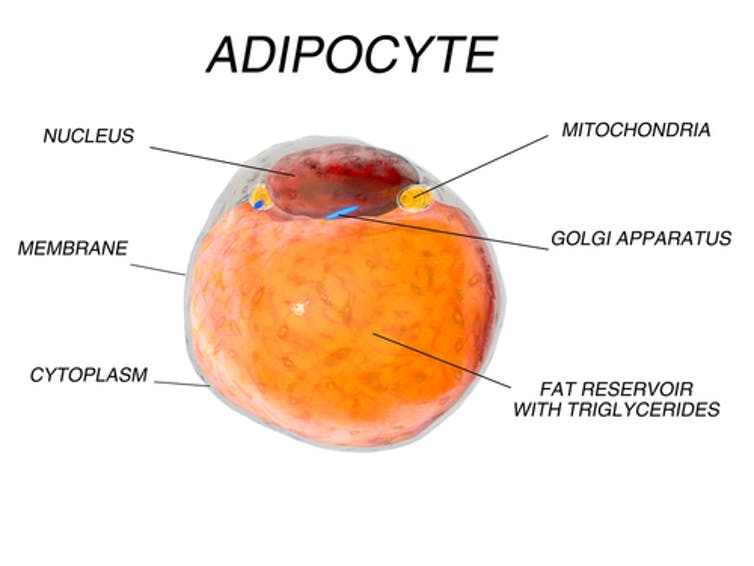
The major problem with this excess fat is that the fat cells, called adipocytes, do not function normally. They store energy at an abnormally high rate and release energy at an abnormally slow rate. What’s more, these extra and enlarged fat cells produce abnormal amountsof different hormones. These hormones increase inflammation, slow down metabolism, and contribute to disease. This complicated pathological process of excess fat and dysfunction is called adiposopathy, and it makes the treatment of obesity very difficult.
A fat cell is loaded with triglycerides, or fatty deposits, and does not resemble other cells in our body. Pavel Chagochkin/Shutterstock.com
When a person begins and maintains a new exercise regimen and limits calories, the body does two things to “burn fat.” First, it uses the energy stored in the fat cells to fuel new activity. Second, it stops putting away so much for storage.
The brain signals fat cells to release the energy packages, or fatty acid molecules, to the bloodstream. The muscles, lungs and heart pick up these fatty acids, break them apart, and use the energy stored in the bonds to execute their activities. The scraps that remain are discarded as part of respiration, in the outgoing carbon dioxide, or in urine. This leaves the fat cell empty and renders it useless. The cells actually have a short lifespan so when they die the body absorbs the empty cast and doesn’t replace them. Over time, the body directly extracts the energy (i.e., calories) from food to the organs that need them instead of storing it first.
As a result, the body readjusts by decreasing the number and size of fat cells, which subsequently improves baseline metabolism, decreases inflammation, treats disease, and prolongs lives. If we maintain this situation over time, the body reabsorbs the extra empty fat cells and discards them as waste, leaving us leaner and healthier on multiple levels.

 We found Zero at our local Humane Society. She was just under a year and a half old and had been picked up as a stray so they didn’t know anything about her. When we got her out of her kennel and into the big yard so we could see her more, she hardly even came over to us. There was just something about her, though, and we knew she was the one.
 William Bridges (1995) Bridges’ three-phase transition framework: The first phase, the Ending phase, is about letting go of an old identity, an old reality or an old strategy. The Neutral Zone is akin to crossing the wilderness between the old way and the new. The final phase is making a new beginning and functioning effectively in a new way.

 [Ed: Text taken from a chart



 Learning from Dogs
Sue, and everyone else, we returned from seeing Dr. Lee, the neurologist, a little under two hours ago. Dr. Lee’s prognosis is that Jean is showing the very early signs of Parkinson’s disease, and Jean is comfortable with me mentioning this.
Everyone’s love and affection has meant more than you can imagine. I will write more about this next week once we have given the situation a few ‘coatings of thought’.
Jean sends her love to you all!