Category: Culture

Group human insanity

In individuals, insanity is rare; but in groups, parties, nations, and epochs it is the rule.Friedrich Nietzsche

I was minded to select this quote because an item in the UK Independent newspaper brought to light a new book from Lester R Brown, founder and President of Earth Policy Institute, called World on the Edge.  Here’s what The Independent wrote (selected extracts by me, the full article is here ):

Like many environmentalists, Lester Brown is worried.

In his new book “World on the Edge,” released this week, Brown says mankind has pushed civilization to the brink of collapse by bleeding aquifers dry and overplowing land to feed an ever-growing population, while overloading the atmosphere with carbon dioxide.

If we continue to sap Earth’s natural resources, “civilizational collapse is no longer a matter of whether but when,” Brown, the founder of Worldwatch and the Earth Policy Institute, which both seek to create a sustainable society, told AFP.

“We’ve got to get our act together quickly. We don’t have generations or even decades – we’re one poor harvest away from chaos,” he said.

Global warming is also impacting the global supply of grain, which Brown calls the foundation of the world food economy.

Every one-degree-Celsius rise above the normal temperature results in a 10 percent fall in grain yields, something that was painfully visible in Russia last year, where a seven-week heatwave killed tens of thousands and caused the grain harvest to shrink by 40 percent.

Food prices soared in Russia as a result of the poor harvest, and Russia – which is one of the top wheat exporters in the world – cut off grain exports.

Different grains are staple foods in most of the world, and foods like meat and dairy products are “grain-intensive.”

It takes seven pounds (3.2 kilograms) of grain fed to a cow to produce a pound of beef, and around four pounds (1.8 kilograms) of grain to produce a pound of cheese, Brown told AFP.

In “World on the Edge”, Brown paints a grim picture of how a failed harvest could spark a grain shortage that would send food prices sky-rocketing, cause hunger to spread, governments to collapse and states to fail.

Regular readers of Learning from Dogs will understand, because I bang on about it, how the behaviour of dogs over thousands and thousands of years gives us so many metaphors that we can use to rethink how we live, before it’s too late.

(Of course, it’s not just dogs, there are many ‘higher order’ pack animals such as horses, lions and dolphins. to name but a few, that instinctively live in harmony with their surroundings and also we shouldn’t forget some of the earlier human inhabitants of this planet; Eskimos, native North American Indians, Australian Aborigines, that lived similarly in balance with their environment.)

Anyway, back to the theme of this article.

Read a little about Lester, his biography is here.  It starts:

Lester Brown

The Washington Post called Lester Brown “one of the world’s most influential thinkers.” The Telegraph of Calcutta refers to him as “the guru of the environmental movement.” In 1986, the Library of Congress requested his personal papers noting that his writings “have already strongly affected thinking about problems of world population and resources.”

Brown started his career as a farmer, growing tomatoes in southern New Jersey with his younger brother during high school and college. Shortly after earning a degree in agricultural science from Rutgers University in 1955, he spent six months living in rural India where he became intimately familiar with the food/population issue. In 1959 Brown joined the U.S. Department of Agriculture’s Foreign Agricultural Service as an international agricultural analyst.

Brown earned masters degrees in agricultural economics from the University of Maryland and in public administration from Harvard. In 1964, he became an adviser to Secretary of Agriculture Orville Freeman on foreign agricultural policy. In 1966, the Secretary appointed him Administrator of the department’s International Agricultural Development Service. In early 1969, he left government to help establish the Overseas Development Council.

As I said, that was just the start; read the full biography here.

Having recently signed up to the EPI mailing list, this morning an email arrived talking further about Lester Brown’s latest book, World on the Edge.  Here’s what was in that email.

World on the Edge: Quick Facts

JANUARY 25, 2011

We are facing issues of near-overwhelming complexity and unprecedented urgency. Can we think systemically and fashion policies accordingly? Can we change direction before we go over the edge? Here are a few of the many facts from the book to consider:

  • In Sana’a, the capital of Yemen—home to 2 million people—water tables are falling fast. Tap water is available only once every 4 days; in Taiz, a smaller city to the south, it is once every 20 days.
  • The indirect costs of gasoline, including climate change, treatment of respiratory illnesses, and military protection, add up to $12 per gallon. Adding this to the U.S. average of $3 per gallon brings the true market price closer to $15 per gallon.
  • Between 2007 and 2010, U.S. coal use dropped 8 percent. During the same period,300 new wind farms came online, adding 21,000 megawatts of U.S. wind-generating capacity.

“We can get rid of hunger, illiteracy, disease, and poverty, and we can restore the earth’s soils, forests, and fisheries. We can build a global community where the basic needs of all people are satisfied—a world that will allow us to think of ourselves as civilized.” –Lester R. Brown

World on the Edge: How to Prevent Environmental and Economic Collapse is available online at www.earth-policy.org.

In a very real sense it’s a book we should all be reading and if so minded you can buy it directly from the EPI here.  But there is a health warning, so to speak.  That is that each and every one of us has to take a stand to protect the world we live on, to preserve it for our children’s children, and to start the long haul towards sustainability.

Think about one small thing you can do this week to make a positive difference, and do it!

“By the inch it’s a cinch, by the yard it’s hard!”

What is the dog?

Time to attempt an answer to this fundamental, well for this Blog, question!


Like wolves, the Dingo is smarter than pet dogs.

(The above photograph comes from an article on ImpactLab – see foot of Post for more details.)

When putting together the Blog ahead of the publication of the very first Post on July 15th, 2009, some 820 Posts ago, I prepared some additional material that set out to justify the Raison d’être for the venture.  Included was a piece regarding Dogs and integrity.  There I wrote:

Dogs are part of the Canidae, a family including wolves, coyotes and foxes, thought to have evolved 60 million years ago.  There is no hard evidence about when dogs and man came together but dogs were certainly around when man developed speech and set out from Africa, about 50,000 years ago.  See an interesting article by Dr. George Johnson.

Anyway, I revisited the article written by Dr Johnson and thought it worthy of being published in full, as a separate article in Learning from Dogs.  I requested permission to reproduce the article in full and Dr. George Johnson was very gracious in quickly coming back to me giving his agreement.  Thank you.  The original article can be read here, the ONSCIENCE home page is here and Dr. Johnson’s details are here.

Evolution of the family dog

I first suspected that Boswell would have a short life when he bit my wife on our nuptial bed.

Boswell was my dog, a feisty Toto-like terrier who shared my bachelor bed and resented the intrusion of a woman where he felt a dog — Boswell — ought to be. As it turns out, my suspicion was correct, and he did not live out the year, which was 1982. Staying with others while I and my bride were overseas, Boswell resented being denied chicken bones, ate them anyway, and died of the consequences. To this day I miss him.

This week I found myself wondering about Boswell’s origins. From what creature did the domestic dog arise? Darwin suggested that wolves, coyotes, and jackals — all of which can interbreed and produce fertile offspring– may all have played a role, producing a complex dog ancestry that would be impossible to unravel. In the 1950s, Nobel Prize-winning behaviorist Konrad Lorenz suggested some dog breeds derive from jackals, others from wolves.

Based on anatomy, most biologists have put their money on the wolf, but until recently there was little hard evidence, and, as you might expect if you know scientists, lots of opinions.

The issue was finally settled in 1997 by an international team of scientists led by Robert Wayne of the University of California, Los Angeles. To sort out the evolutionary origin of the family dog, Wayne and his colleagues used the techniques of molecular biology to compare the genes of dogs with those of wolves, coyotes and jackals.

Wayne’s team collected blood, tissue, or hair from 140 dogs of sixty-seven breeds, and 162 wolves from North America, Europe, Asia, and Arabia. From each sample they extracted DNA from the tiny organelles within cells called mitochondria.

While the chromosome DNA of an animal cell derives from both parents, the mitochondrial DNA comes entirely from the mother. Biologists love to study mitochondrial DNA because of this simple line of descent, female-to-female-to-female. As changes called mutations occur due to copying mistakes or DNA damage, the mitochondrial DNA of two diverging lines becomes more and more different. Ancestors can be clearly identified when you are studying mitochondrial DNA, because clusters of mutations are not shuffled into new combinations like the genes on chromosomes are. They remain together as a particular sequence, a signature of that line of descent.

When Wayne looked at his canine mitochondrial DNA samples, he found that wolves and coyotes differ by about 6% in their mitochondrial DNA, while wolves and dogs differ by only 1%. Already it smelled like the wolf was the ancestor.

Wayne’s team then focused their attention on one small portion of the mitochondrial DNA called the control region, because it was known to vary a lot among mammals. Among the sixty seven breeds of dogs, Wayne’s team found a total of 26 different sequences in the control region, each differing from the others at one or a few sites. No one breed had a characteristic sequence — rather, the breeds of dogs share a common pool of genetic diversity.Wolves had 27 different sequences in the control region, none of them exactly the same as any dog sequence, but all very similar to the dog sequences, differing from them at most at 12 sites along the DNA, and usually fewer.

Coyote and jackal were a lot more different from dogs than wolves were. Every coyote and jackal sequence differed from any dog sequence by at least 20 sites, and many by far more.

That settled it. Dogs are domesticated wolves.

Using statistical methods to compare the relative similarity of the sequences, Wayne found that all the dog sequences fell into four distinct groups. The largest, containing 19 of the 26 sequences and representing 3/4 of modern dogs, resulted from a single female wolf lineage. The three smaller groups seem to represent later events when other wolves mated with the now-domesticated dogs. Domestication, it seems, didn’t happen very often, and perhaps only once.

The large number of different dog sequences, and the fact that no wolf sequences are found among them, suggests that dogs must have been separated from wolves for a long time. The oldest clear fossil evidence for dogs is 12,000 – 14,000 years ago, about when farming arose. But that’s not enough time to accumulate such a large amount of mitochondrial DNA difference. Perhaps dogs before then just didn’t look much different from wolves, and so didn’t leave dog-like fossils. Our species first developed speech and left Africa about 50,000 years ago. I bet that’s when dogs came aboard, when our hunter-gatherer ancestors first encountered them. They would have been great hunting companions.

I think Boswell would be happy to know his ancestor was a wolf. I doubt, however, I will ever be able to get my wife to overlook the biting as “wolf genetic baggage” inherited from nobel ancestors. In my house, science only stretches so far. © Txtwriter Inc

As so often happens, for reasons quite beyond me, when I am pursuing an article idea something else crops up that is highly relevant to my musings.  This was no exception.

A recent article in the Christian Science Monitor describes finding a fragment of dog bone in North America dating back some 9,400 years.  Here’s a flavour of that article.

By Associated Press / January 19, 2011

PORTLAND, MaineNearly 10,000 years ago, man’s best friend provided protection and companionship — and an occasional meal.

That’s what researchers are saying after finding a bone fragment from what they are calling the earliest confirmed domesticated dog in the Americas.

University of Maine graduate student Samuel Belknap III came across the fragment while analyzing a dried-out sample of human waste unearthed in southwest Texas in the 1970s. A carbon-dating test put the age of the bone at 9,400 years, and a DNA analysis confirmed it came from a dog — not a wolf, coyote or fox, Belknap said.

Because it was found deep inside a pile of human excrement and was the characteristic orange-brown color that bone turns when it has passed through the digestive tract, the fragment provides the earliest direct evidence that dogs — besides being used for company, security and hunting — were eaten by humans and may even have been bred as a food source, he said.

Belknap wasn’t researching dogs when he found the bone. Rather, he was looking into the diet and nutrition of the people who lived in the Lower Pecos region of Texas between 1,000 and 10,000 years ago.

The article then, a little later, goes on to say:

Dogs have played an important role in human culture for thousands of years.

There are archaeological records of dogs going back 31,000 years from a site in Belgium, 26,000 years in the Czech Republic and 15,000 years in Siberia, said Robert Wayne, a professor of evolutionary biology at UCLA and a dog evolution expert. But canine records in the New World aren’t as detailed or go back nearly as far.

Darcy Morey, a faculty member at Radford University who has studied dog evolution for decades, said a study from the 1980s dated a dog found at Danger Cave, Utah, at between 9,000 and 10,000 years old. Those dates were based not on carbon-dating or DNA tests, but on an analysis of the surrounding rock layers.

“So 9,400 years old may be the oldest, but maybe not,” Morey said in an e-mail.

Morey, whose 2010 book, “Dogs: Domestication and the Development of a Social Bond,” traces the evolution of dogs, said he is skeptical about DNA testing on a single bone fragment because dogs and wolves are so similar genetically.

My last extract is as follows:

Darcy Morey, a faculty member at Radford University who has studied dog evolution for decades, said a study from the 1980s dated a dog found at Danger Cave, Utah, at between 9,000 and 10,000 years old. Those dates were based not on carbon-dating or DNA tests, but on an analysis of the surrounding rock layers.

“So 9,400 years old may be the oldest, but maybe not,” Morey said in an e-mail.

Morey, whose 2010 book, “Dogs: Domestication and the Development of a Social Bond,” traces the evolution of dogs, said he is skeptical about DNA testing on a single bone fragment because dogs and wolves are so similar genetically.

Fascinating.

Finally, going back to the photograph at the top of the page, this came from an article here in ImpactLab.  It’s well worth a read.

Approaches to ‘growth’.

Some thought-provoking articles on the need, or otherwise, of continued growth.

Intellectually, most people, if they stopped and thought about it, would not challenge the absurdity of the notion that a finite rock in space, Planet Earth, can handle an infinite increase in the demands and resources of that finite planetary body, our home in space!

Yet the reality is very different.  For many complex reasons, way beyond the competencies of this writer to fully explain, we, as in the peoples of Planet Earth, continue to behave as though there are no limits to the resources of this beautiful planet that is home for all of us.

Here are some extracts from some recent items that have passed across my ‘in-box’.

A piece from the CASSE website:

What If We Stopped Fighting for Preservation and Fought Economic Growth Instead?

by Tim Murray

Seriously.

Each time environmentalists rally to defend an endangered habitat, and finally win the battle to designate it as a park “forever,” as Nature Conservancy puts it, the economic growth machine turns to surrounding lands and exploits them ever more intensively, causing more species loss than ever before, putting even more lands under threat. For each acre of land that comes under protection, two acres are developed, and 40% of all species lie outside of parks. Nature Conservancy Canada may indeed have “saved” – at least for now – two million acres, but many more millions have been ruined. And the ruin continues, until, once more, on a dozen other fronts, development comes knocking at the door of a forest, or a marsh or a valley that many hold sacred. Once again, environmentalists, fresh from an earlier conflict, drop everything to rally its defense, and once again, if they are lucky, yet another section of land is declared off-limits to logging, mining and exploration. They are like a fire brigade that never rests, running about, exhausted, trying to extinguish one brush fire after another, year after year, decade after decade, winning battles but losing the war.

Just read again the sentence, “For each acre of land that comes under protection, two acres are developed, and 40% of all species lie outside of parks.” Powerful ideas.

Anyway, do read the article in full and see if it changes your attitude.  Here’s how it ends.

Sir Peter Scott once commented that the World Wildlife Fund would have saved more wildlife it they had dispensed free condoms rather invested in nature reserves. Biodiversity is primarily threatened by human expansion, which may be defined as the potent combination of a growing human population and its growing appetite for resources. Economic growth is the root cause of environmental degradation, and fighting its symptoms is the Labor of Sisyphus.

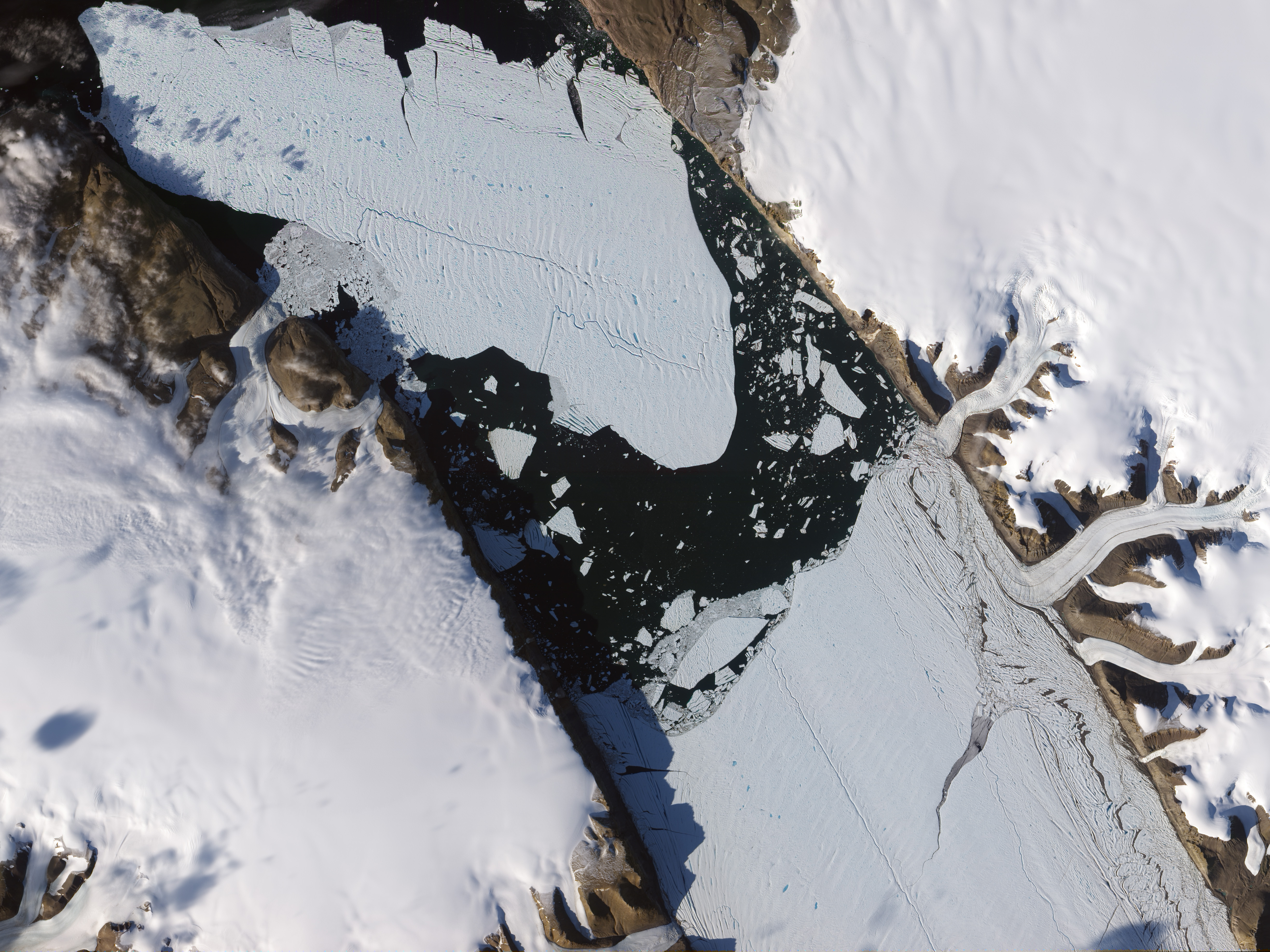
The next article is from The Christian Science Monitor writing about how scientists are getting a new idea about the rate of loss of polar ice.

The seasonal cooling effect of light-reflecting snow and ice in the Northern Hemisphere may be weakening at twice the rate predicted by climate models, a new study shows, accelerating the impact of global warming.

By Pete Spotts, Staff writer / January 18, 2011

A long-term retreat in snow and ice cover in the Northern Hemisphere is weakening the ability of these seasonal cloaks of white to reflect sunlight back into space and cool global climate, according to a study published this week.

Indeed, over the past 30 years, the cooling effect from this so-called cryosphere – essentially areas covered by snow and ice at least part of the year – appears to have weakened at more than twice the pace projected by global climate models, the research team conducting the work estimates.

This is a well-constructed article, easy to read with obvious conclusions.  Towards the end, the author writes:

Snow appears to have its maximum cooling effect – reflecting the most sunlight back into space – in late spring, as the light strengthens but snow cover is still near its maximum extent for the year. Sea ice in the Arctic Ocean has its biggest effect in June, before its annual summer melt-back accelerates, explains Don Perovich, a researcher at the US Army Corps of Engineers Cold Regions Research and Engineering Laboratory in Hanover, N.H., and a member of the team reporting the results.

The final article that I want to include is one from the website Foreign Policy. I’m going to take the liberty of reproducing it in full because it strikes me as an extremely intelligent commentary on where mankind is in terms of our attitudes to growth.

Thomas Homer-Dixon
ECONOMIES CAN’T JUST KEEP ON GROWING

Humanity has made great strides over the past 2,000 years, and we often assume that our path, notwithstanding a few bumps along the way, goes ever upward. But we are wrong: Within this century, environmental and resource constraints will likely bring global economic growth to a halt.

Limits on available resources already restrict economic activity in many sectors, though their impact usually goes unacknowledged. Take rare-earth elements — minerals and oxides essential to the manufacture of many technologies. When China recently stopped exporting them, sudden shortages threatened to crimp a wide range of industries. Most commentators believed that the supply crunch would ease once new (or mothballed) rare-earth mines are opened. But such optimism overlooks a fundamental physical reality. As the best bodies of ore are exhausted, miners move on to less concentrated deposits in more difficult natural circumstances. These mines cause more pollution and require more energy. In other words, opening new rare-earth mines outside China will result in staggering environmental impact.

Or consider petroleum, which provides about 40 percent of the world’s commercial energy and more than 95 percent of its transportation energy. Oil companies generally have to work harder to get each new barrel of oil. The amount of energy they receive for each unit of energy they invest in drilling has dropped from 100 to 1 in Texas in the 1930s to about 15 to 1 in the continental United States today. The oil sands in Alberta, Canada, yield a return of only 4 to 1.

Coal and natural gas still have high energy yields. So, as oil becomes harder to get in coming decades, these energy sources will become increasingly vital to the global economy. But they’re fossil fuels, and burning them generates climate-changing carbon dioxide. If the World Bank’s projected rates for global economic growth hold steady, global output will have risen almost tenfold by 2100, to more than $600 trillion in today’s dollars. So even if countries make dramatic reductions in carbon emissions per dollar of GDP, global carbon dioxide emissions will triple from today’s level to more than 90 billion metric tons a year. Scientists tell us that tripling carbon emissions would cause such extreme heat waves, droughts, and storms that farmers would likely find they couldn’t produce the food needed for the world’s projected population of 9 billion people. Indeed, the economic damage caused by such climate change would probably, by itself, halt growth.

Humankind is in a box. For the 2.7 billion people now living on less than $2 a day, economic growth is essential to satisfying the most basic requirements of human dignity. And in much wealthier societies, people need growth to pay off their debts, support liberty, and maintain civil peace. To produce and sustain this growth, they must expend vast amounts of energy. Yet our best energy source — fossil fuel — is the main thing contributing to climate change, and climate change, if unchecked, will halt growth.

We can’t live with growth, and we can’t live without it. This contradiction is humankind’s biggest challenge this century, but as long as conventional wisdom holds that growth can continue forever, it’s a challenge we can’t possibly address.

Thomas Homer-Dixon is the CIGI chair of global systems at the Balsillie School of International Affairs in Waterloo, Canada.

As Rob Dietz of CASSE wrote in a recent email to me, “I’m a big Thomas Homer-Dixon fan.  His book, The Upside of Down, is outstanding.

Economic growth may one day turn out to be a curse rather than a good, and under no conditions can it either lead into freedom or constitute a proof for its existence” Hannah Arendt (1906-1975).


Well said, Hannah!

In humble recognition of great writers

The technology of the Internet will prove to be of huge democratic value.

Those who know me know a disquieted man.  Someone, who despite being more at peace with himself than ever before, nonetheless senses that we, as in the mankind of Planet Earth, are already deep in the ‘no mans land’ of change between the last, say, forty years and a very different future just around the corner.

In the past opinion and commentary has been in the hands, more or less, of the giant media moguls.  But technology has changed that.  Now more than ever a huge people have access to the Internet.  Indeed, a quick Google search reveals that of a world population of 6.85 billion people, just under 2 billion (29%) have internet access.  In North America that percentage is 77.4% (226 million) and in Europe the percentage is 58.4% (475 million).  I.e. nearly a billion people in just North America and Europe!

My point is that, in a manner never before experienced in human history, the vast majority of us have the ability to read, learn and muse about the critically important issues facing us today, coming to conclusions that carry political weight.  We have almost infinite choice as to where and how we form opinions.

Thus having access, via the internet, to the scribblings of so many wise people may end up giving democracy the boost it really needs in the face of overwhelming powerful plutocratic forces.

Here are just a couple of those wise voices.

Simon Johnson

I first came across him in an article in The Atlantic Magazine back in May 2009.  That article was called The Quiet Coup.  If you haven’t read it, go here.  It is introduced thus:

The crash has laid bare many unpleasant truths about the United States. One of the most alarming, says a former chief economist of the International Monetary Fund, is that the finance industry has effectively captured our government—a state of affairs that more typically describes emerging markets, and is at the center of many emerging-market crises. If the IMF’s staff could speak freely about the U.S., it would tell us what it tells all countries in this situation: recovery will fail unless we break the financial oligarchy that is blocking essential reform. And if we are to prevent a true depression, we’re running out of time.

Simon is also one of the lead writers for the Blog Baseline Scenario.  Have a read of a recent article about the appointment of Bill Daley as President Obama’s new chief of staff.  That article concludes thus:

Top executives at big U.S. banks want to be left alone during relatively good times – allowed to take whatever excessive risks they want, to juice their return on equity through massive leverage, to thus boost their pay and enhance their status around the world.  But at a moment of severe financial crisis, they also want someone in the White House who will whisper at just the right moment: “Mr. President, if you let this bank fail, it will trigger a worldwide financial panic and another Great Depression.  This will be worse than what happened after Lehman Brothers failed.”

Let’s be honest.  With the appointment of Bill Daley, the big banks have won completely this round of boom-bust-bailout.  The risk inherent to our financial system is now higher than it was in the early/mid-2000s.  We are set up for another illusory financial expansion and another debilitating crisis.

Bill Daley will get it done.

Now let’s turn to that other writer, Patrice Ayme.

That name is a nom-de-plume but so what!  Having read Patrice for some time now and corresponded via email from time to time, I have to tell you this is one giant of an intellectual thinker.  Take this Post from example: Pluto Lie #1: Glass Beads Matter More It’s a beautifully written article but not something that you should try a skim read through; it deserves a really focussed mind on the words and the meanings expressed. Here’s a flavour:

Abstract: An American historian paid by the hyper rich, exhumed again the old fallacy that material riches matter more than anything else. He points at recent electronic gadgetry, and attributes it to Reagan. This article of faith in Reagan and American plutocracy amusingly gives, obviously without knowing, prominence to recent French and German governmental research, which allowed to make such gadgets.

I skewer this lamentable, not to say corrupt, piece of dismal propaganda which was published all over the American media, for Christmas. I use the occasion to give a new metric to evaluate riches over the last 100,000 years, explain why the USA does not use the metric system, and what European kings were really about.

Too great a disparity of riches is another name for plutocracy.  Indeed, money is power, and thus, too much money is too much power.

Here is how Patrice’s article closes (but it would be so much better if you read the article in its entirety):

Morality? Europeans Kings of old could live long, and lived strong.The best of them were working relentlessly, brandishing whatever it took to stabilize the situation ethically, politically, and civilizationally. They were incredibly brutal. They would die, and kill, just over the length of hair (kings and prospective kings wore it long, religious wore it nought). Even small children, if viewed as potential kings, would be presented with the scissors and the sword (if they did not go for the former, they would get the later).

So of course, kings of old would have made it to today’s highest class. Kings were often the richest people around, and they got there, or stayed there, by killing, in the name of new, and higher principles. This only happened because their subordinates agreed to strive towards the same new and higher principles. Hanson misses completely the spiritual dimension of the kings of old. Kings of old led an ethical revolution, which was their reason for being in power, and why people elected them (or elected to follow them).

Kings of old lived very comfortably by their metrics, with residences all around Europe, and wives, concubines, nobles under oaths to serve them (to death). Some, such as Charlemagne, were very healthy into old age. What’s more fun than to make war for decades, mostly winning, as Charlemagne did?

Dr. Victor Davis Hanson, a classicist and military historian, is a senior fellow at the Hoover Institution and a recipient of the 2007 National Humanities Medal.

That appurtenance, too, tells volumes. Hanson has tales to tell, and they sing of American plutocracy. It remains to be seen if history will sing along. Two things, though: history does not tell lies, and human beings are not reducible to gadget loving midgets.

So to repeat my point.  Whether or not one choses to agree with the likes of Simon Johnson and Patrice Ayme there is no doubt that in my mind it will be writers like these that, through the better education of millions of citizens, will not only preserve democracy in so many countries but will ensure that the age before us will be fairer and more just.

Change can be achieved by the threat of tomorrow being the same

even quicker than by the hope of tomorrow being different! C. Graham-Leigh.

2011!

A very Happy New Year to everyone!

I started writing this new Post on the 30th December with my mind full of predictions of a terribly difficult year ahead for millions of people.  Indeed, there is no question that there are endless accounts of what calamities may be ahead of us in this New Year.  But, as is said, it is what it is!  The challenge, as always, is how we deal with it.  As my fellow author, Jon, has often said, “The world reflects back what we think about most!

In other words how we relate to the exterior world is really, and fundamentally, a reflection of how we relate to ourselves.  Jon has penned a few words on this theme for tomorrow.

But serendipitously I came across a nice piece on Leo Babauta’s blog, Zen Habits called ‘you’re already perfect’.  The link to it is here.

Here are some extracts:

A lot of people come to Zen Habits (and read other personal development blogs and books) because they want to improve something about themselves. They’re not satisfied with their lives, they’re unhappy with their bodies, they want to be better people.

I know, because I was one of those people.

This desire to improve myself and my life was one of the things that led to Zen Habits. I’ve been there, and I can say that it leads to a lot of striving, and a lot of dissatisfaction with who you are and what your life is.

A powerful realization that has helped me is simply this: You’re already good enough, you already have more than enough, and you’re already perfect.

and later Leo writes:

The thing I’ve learned, and it’s not some new truth but an old one that took me much too long to learn, is that if you learn to be content with who you are and where you are in life, it changes everything.

Consider what changes:

  • You no longer feel dissatisfied with yourself or your life.
  • You no longer spend so much time and energy wanting to change and trying to change.
  • You no longer compare yourself to other people, and wish you were better.
  • You can be happy, all the time, no matter what happens in the world around you.
  • Instead of trying to improve yourself, you can spend your time helping others.
  • You stop spending so much money on things that will supposedly improve your life.

Read the full article here, and ponder.

And have a very, very happy (and perfect) New Year.


Or a song or three?

A few days ago I published an article that had first appeared on the CASSE Blog site entitled Top Ten Songs for a Steady State.  A long-term contributor to this Blog, Per Kurowski, then added a comment to that post that I thought deserved being made into a separate item on Learning from Dogs.  Here it is.

This is also a contender:

Where Do the Children Play?
Cat Stevens, Tea for the Tillerman (1970)

Well I think it’s fine, building jumbo planes.
Or taking a ride on a cosmic train.
Switch on summer from a slot machine.
Yes, get what you want to if you want, ’cause you can get anything.

Chorus: I know we’ve come a long way,
We’re changing day to day,
But tell me, where do the children play?

Well you roll on roads over fresh green grass.
For your lorry loads pumping petrol gas.
And you make them long, and you make them tough.
But they just go on and on, and it seems that you can’t get off.

Well you’ve cracked the sky, scrapers fill the air.
But will you keep on building higher
’til there’s no more room up there?
Will you make us laugh, will you make us cry?
Will you tell us when to live, will you tell us when to die?

By the way the following song should also classify as a contender… though excuse me if when I also use music to keep sane… I might drive others insane

http://ayearofsongs.blogspot.com/2010/06/color-of-wind.html

Thanks Per!

For those that don’t believe in Santa!

(Sent to me by Neil K who used to be a neighbour in my Devon days!)

It’s very sentimental – so be warned!

Click here.


The British at Greeting

Many thanks to close friend Dan G for forwarding this – it’s priceless!

Essence Of The Civilizational Crisis.

A guest Post from Patrice Ayme.

(Well I say ‘guest’ in the sense that Patrice has very kindly allowed me to publish a post he recently published on his own Blog. It’s very much appreciated. I should add that the minor changes that I have made, in my editorial role, are gently to improve the clarity of this fine piece of work, not in any way to amend meaning. Ed.)

THE PRIVATIZATION OF MONEY CREATION IS THE ENGINE OF PLUTOCRACY.

To understand the present financial and economic crisis, we need the clarity of deep philosophy.

The situation is actually simple, in its grossest outline. To create public money, the money everybody uses (be it cash, electronic transfers, swaps, whatever) we use a private system, with proprietary money creating devices inside (say subprime, or derivatives). Civilization has never worked this way before, as the state previously was careful to stay the one and only money creator.

Now society, worldwide, uses a privately-managed public-money ‘system’ creating what is known as a fractional reserve system. [Wikipedia explanation of fractional reserve system, Ed]

That puts huge power in the hands of underground private individuals we don’t even know the names of. Those cloaked powers in turn corrupt the visible political socio-economy, from below. The whole metastasis is not even described, because intellectuals would have to do so, but most are paid by institutions subservient to the present global corruption.

We saw a similar situation in the Roman empire, when the intellectual class was at its richest, but its critical ability had been corrupted.

The modern banking system is a Faustian bargain (as in a deal with the Devil) with the bankers; in exchange for the immense powers the private bankers were given with money creation, they were supposed to loan it back to society for its development.

This worked reasonably well in the Nineteenth Century. But in the Twentieth Century, bankers observed they could support fascism regimes, and get away with it (only Dr. Schacht, one of the “Lords of Finance”, sat in Nuremberg tribunal, and he was exonerated). Now bankers think they can engineer a depression, and get even richer from it: just keep the profits, and make taxpayers pay for the losses.

By Patrice Ayme

Note 1: Paul Krugman observes, with many others, that the crisis of the West needs “intellectual clarity” to be resolved, and, meanwhile we are “overmatched“. I made preceding comment in answer to Krugman’s cogent remarks. (The New York Times had the kindness to publish what I wrote within two minutes! )

Note 2: HOW THE FINANCIAL CRISIS IS TURNING CIVILIZATIONAL:

China just established another train speed record for “unmodified’ train sets (481 km/h). OK, some will claim China stole a lot of Japanese and European technology. And some French engineers have sneered that the very high speed system in China is not as high performing as it looks (France has much higher average speeds, the highest in the world). However, this is not the point. The point is that China is trying very hard to progress and improve. Meanwhile some of the colossal technological edge of the West is eroding away quickly. The result will be world war, or global plutocratic peace (as plutocracy furthers its deal with China).

How does China improve so much and so fast? Because Chinese banks, the largest in the world, operate according to the fiduciary duty, the Faustian bargain, that the fractional reserve system ought to impose, and used to impose in the West.

Top Chinese bankers know all too well that if they cheated, they may end up with a bullet in their skull. China is led by scientists and engineers who turned to politics, but know that they cannot make mistakes in their calculations. Mao made many mistakes, and dozens of millions died.

The history of China, in the 26 centuries before that, was spoiled by a well meaning, but meek philosophy, which left too small a place to deliver progress of the material, and intellectual kinds.

Civilization is not about “leaving it at that”, the way Confucius mostly had it. Civilization is also about the dream, and implementing it. Indeed, civilization cannot stand still, anymore than a biker can stand still, because resources run out always (as Rome and the Mayas found out). Thus moving on is the price of sustainability. Progress is the price of sustainability.

Note 3: It may seem a curious thing that Karl Marx did not make a strident version of the preceding critique (instead he modestly accused tangentially bankers of “monopoly” powers).

But this Marxist discretion proves the point I alluded to above, namely that bankers were better behaved in the 19C. So Marx talked about other things.

Ironically, early American presidents had perfectly well seen the danger bankers posed, and worried more about them than Marx himself! And let no one call Andrew Jackson a communist: that would be serious mistake…

In the 21st Century, by capturing the states (USA, EU), and various institutions above them (IMF, World Bank, BIS), the bankers have established a monopoly of power early American presidents rightly feared (and Jackson, wounded at 13 by an English sword, later a proud carrier of several bullets, and a general in the field, feared very little). The wise know what to fear. The mentally simple just smile, thinking only about themselves, as they can’t think much further than that.

*********************************

From the Ed.

Dear Readers, I really hope that you read Patrice’s post in full and in a quiet place where you could reflect on the meaning and underlying implications of what Patrice is saying.  Those in the UK may have been able to watch a typically fabulous BBC Television series, Ancient Worlds.  It’s still available on BBC iPlayer.

What comes out from the message of mankind over the centuries is that wonderful French expression plus ça change, plus c’est la même chose – the more that changes, the more it stays the same thing.  But where we are as we approach the New Year of 2011 A.D. is possibly at a cross-roads – and I intend to write a little more on this idea over the coming days.

Spices

A fascinating insight and a reminder, courtesy of Alistair Cooke

Jeannie recently gave me the book Alistair Cooke’s America.  The book was published in 1973 and was born out of the scripts that Cooke wrote for the television series America: A Personal History of the United States shown in both countries in 1972.  I can’t recall when I first started listening to the BBC Radio programme Letter from America, broadcast by Cooke, but it was a long time ago considering that the 15-minute programme started to be broadcast on the BBC in March 1946, just 18 months after I was born!


Alistair Cooke Nov 1908 - Mar 2004


Anyway, the motivation to start into the book was born out of a desire to know a lot more about this new country of mine.  But quickly there was a fascinating detour.

Early in Chapter One, The New-found Land, Cooke writes of the consequences of the Turks capturing Constantinople:

In 1453, there was a decisive turn in the centuries of warfare between the Christians of Europe and the Moslems of Asia.  Their common market, bridge, and gateway was Constantinople, our Istanbul.  In 1453, the Turks conquered it, and in so doing shut off the commerce between East and West, the exchange of cloth, leather wines and sword blades of Europe for the silks, jewels, chessmen, and spices of Asia.  All things considered, the stoppage was much harder on the court treasuries of Europe that those of Asia and, in one vital item, harder on all Europeans.  That item was spice.

Cooke then writes about historic change often being caused by the denial of a simple human need.  Shortage of water, total absence of timber for the Egyptians since the time of Solomon, for example.

What I hadn’t realised that for Europeans, spices were regarded as “fundamental to human survival”.  That was simply because in the 15th century spices made food edible.  Cooke writes,

Even in rich houses, the meals came putrid to the table. (Dysentery, by the way, seems to have been considered through most of the last five centuries a hazard as normal as wind and rain.)

Think about that the next time you reach for the pepper!

That led me to think about the enormous benefit that electricity and therefore domestic refrigeration has had on the health and life expectancies of mankind.  It is almost inconceivable to imagine the consequences of a widespread loss of electricity for, say a week, let alone a few months.

Patrice Ayme wrote a guest post for Learning from Dogs that was published on the 26th.  In it he wrote,

But then, after an auspicious start, Mars lost most of most of its atmosphere (probably within a billion years or so). Why? Mars is a bit small, its gravitational attraction is weaker than Earth (it’s only 40%). But, mostly, Mars has not enough a magnetic field. During Coronal Mass Ejections, CMEs, the Sun can throw out billions of tons of material at speeds up to and above 3200 kilometers per seconds. It’s mostly electrons and protons, but helium, oxygen and even iron can be in the mix.

The worst CME known happened during the Nineteenth Century, before the rise of the electromagnetic civilization we presently enjoy. Should one such ejection reoccur now, the electromagnetic aspect of our civilization would be wiped out.It goes without saying that we are totally unprepared, and would be very surprised. Among other things, all transformers would blow up, and they take months to rebuild. we would be left with old books in paper, the old fashion way. A CME can rush to Earth in just one day. (Fortunately the Sun seems to be quieting down presently, a bit as it did during the Little Ice Age.)

So let’s just hope and pray that our continued interest in spices remains a flavouring desire and doesn’t return as a critical need for human survival.

By Paul Handover