Category: Culture

What is this thing called love?

The discovery of love.

love

Through the wonderful world of web connections, I came to this topic by first reading Jeremy Nathan Mark’s blog The Sand County. Highly recommended.

Jeremy had written a post under the intriguing title of Blogging as Virtual Love-Making, And the Science Behind It.  Blogging; Love-Making; have I really just read those words!  In fact, Jeremy had reposted an article written by Deborah J. on her blog Living on the Edge of the Wild; another great find out there in this virtual world.  So with Deborah’s kind permission here it is reposted on Learning from Dogs.

oooOOOooo

Blogging as Virtual Love-Making, And the Science Behind It

dj1Often when I leave comments on a blog post that moved me, I write “I love this post” or “I love the way you do [this]” or “I love that quotation.” Lately I’ve been wondering if I’m overusing the word “love”.

Am I really feeling this strong emotional attachment, or am I just being lazy, unwilling to take the time to precisely articulate what strikes me about a particular piece?

After reading a recent article in The Atlantic  on the science behind love, I’m inclined to believe that, more often than not, I use the word “love” because that’s what I’m actually feeling– a “micro-moment of positivity resonance.”   That’s how Barbara Fredrickson defines love in her new book Love 2.0: How Our Supreme Emotion Affects Everything We Feel, Think, Do.

In The Atlantic article “There’s No Such Thing as Everlasting Love (According to Science), author Emily Esfahani Smith writes:

Fredrickson, a leading researcher of positive emotions at the University of North Carolina at Chapel Hill, presents scientific evidence to argue that love is not what we think it is. It is not a long-lasting, continually present emotion that sustains a marriage; it is not the yearning and passion that characterizes young love; and it is not the blood-tie of kinship.

Rather, it is what she calls a “micro-moment of positivity resonance.” She means that love is a connection, characterized by a flood of positive emotions, which you share with another person—any other person—whom you happen to connect with in the course of your day. You can experience these micro-moments with your romantic partner, child, or close friend. But you can also fall in love, however momentarily, with less likely candidates, like a stranger on the street, a colleague at work, or an attendant at a grocery store. Louis Armstrong put it best in “It’s a Wonderful World” when he sang, “I see friends shaking hands, sayin ’how do you do?’ / They’re really sayin’, ‘I love you.”

PenguinsSo when I say I “love” Louis Armstrong’s song, now I know why—because I feel such a strong positive connection to what he’s saying, as well as with how he says it, and the music he says it with, that I experience a triple love-whammy!

What I feel when reading things by fellow bloggers, or see the images they’ve created, is similar—a deeply-felt resonating connection, often on several levels.

Smith writes:

When you experience love, your brain mirrors the person’s you are connecting with in a special way,” and then she goes on to explain how “[t]he mutual understanding and shared emotions” between a story-teller and a listener “generated a micro-moment of love, which ‘is a single act, performed by two brains,’ as Fredrickson writes in her book.

Flower in Vase Pa-ta San-JenThis can happen between a writer and reader as well, or between an artist and viewer. In his book “Tao and Creativity” Chang Chung-yuan describes this connection between poet and reader as a “spiritual rhythm.”  It is the means by which the reader participates in the inner experience of the poet. He writes:

In other words, the reader is carried into the rhythmic flux and is brought to the depth of original indeterminacy from which the poetic pattern emerges.  The reader is directly confronted with the objective reality which the poet originally faced. The subjectivity of the reader and the objective reality of the poem interfuse . . . .

This is very interesting because Fredrickson discovers a similar phenomenon when she compares the brainwaves of a storyteller and listeners. Smith describes this in her article:

What they found was remarkable. In some cases, the brain patterns of the listener mirrored those of the storyteller after a short time gap. The listener needed time to process the story after all. In other cases, the brain activity was almost perfectly synchronized; there was no time lag at all between the speaker and the listener. But in some rare cases, if the listener was particularly tuned in to the story—if he was hanging on to every word of the story and really got it—his brain activity actually anticipated the story-teller’s in some cortical areas.

The mutual understanding and shared emotions, especially in that third category of listener, generated a micro-moment of love, which ‘is a single act, performed by two brains,’ as Fredrickson writes in her book.

Big Sur and Mothers Day picnic 111Fredrickson also discovered that the capacity to experience these daily love connections in our lives can be increased through simple loving-kindness meditations, where, as Smith describes, “you sit in silence for a period of time and cultivate feelings of tenderness, warmth, and compassion for another person by repeating a series of phrases to yourself wishing them love, peace, strength, and general well-being.”

“Fredrickson likes to call love a nutrient,” Smith writes.  “If you are getting enough of the nutrient, then the health benefits of love can dramatically alter your biochemistry in ways that perpetuate more micro-moments of love in your life, and which ultimately contribute to your health, well-being, and longevity.”

public domain beeSo remember, fellow readers, as you go meandering from one blog site to another like busy little bees, making those “micro-moment” connections with people whose work you admire, that you are engaged in a kind of virtual love-making.  You are distributing a pollen-like “nutrient” that nurtures others, as well as yourself.

As Louis says, “what a wonderful world” we live in!

oooOOOooo

Deborah concludes with Louis Armstrong singing ‘What a Wonderful World’.

However, for me the song that really resonates with this fascinating article is Ella Fitzgerald’s rendition of What Is This Thing Called Love.  Take it away Ella.

A big thank you to Jeremy and Deborah.  Finally, to all those that enjoyed (loved?) this post, do go and read The Atlantic article in full; it’s fascinating.

A rest day.

Taking a day off from the serious stuff!

It’s 4.30pm and I have just come in after being out since 8am.  A dry sunny day offered a great opportunity to get stuck into logging up a large number of trees that had been victims of Winter storms before Christmas.  I’m knackered!

So going to take a break from the serious stuff and offer you a few pics, kindly sent to me by Chris Snuggs.

snuggs1


oooo

snuggs2

oooo

snuggs3

oooo

snuggs4

And the last one that seems very appropriate to how yours truly is feeling!

snuggs5

See you tomorrow.

Plus ça change – footnote

Plus ça change, plus c’est la même chose (“the more it changes, the more it’s the same thing”).

The final of three repostings from a year ago.  To recap, I wrote on Monday, “… out of curiosity I wondered what I had published a year ago, in early February 2012.  To my amazement what was published was as fresh and relevant as if it had been published today.

The second post from a year ago was reposted yesterday.  Today the footnote is from the 9th February, 2012.  (It reads in its original form with the links and references unchanged.)

oooOOOooo

So many vested opinions!

Regular readers will know that I published recently, in two parts, a post with the heading of Climate, truth and integrity, the first part being here and the second part here.

To me the arguments supporting the premise that mankind is engaged in the process of destroying our very being are powerful and convincing.  But if there is any serious scientific doubt, then I am reminded of that saying in aviation circles about a risk to the safety of an aircraft, “If there’s any doubt, there’s no doubt!”  Surely, that’s the stance the climate change skeptics should be taking!  Because when the evidence of global warming, pollution, natural resource depletion, species extinctions, and habitat destruction is drawn together and there are no skeptics left, then will the last person left alive please switch the lights off!

Anyway, I’m going to republish, with permission, a recent Post that appeared on Tom Engelhardt‘s powerful blogsite, Tom Dispatch.  It was written by Bill McKibben of 350.org fame.  Here it is,

Tomgram: Bill McKibben, Why the Energy-Industrial Elite Has It In for the Planet

Posted by Bill McKibben at 9:39am, February 7, 2012.

Introduction

Two Saturdays ago, I was walking with a friend in a park here in New York City.  It was late January, but I was dressed in a light sweater and a thin fall jacket, which I had just taken off and tied around my waist.  We were passing a strip of bare ground when suddenly we both did a double-take.  He looked at me and said, “Crocuses!”  Dumbfounded, I replied, “Yes, I see them.”  And there they were, a few clumps of telltale green shoots poking up from the all-brown ground as if it were spring.  Such a common, comforting sight, but it sent a chill through me that noticeably wasn’t in the air.  Even the flowers, I thought, are confused by our new version of weather.

Later that same week, as temperatures in the Big Apple crested 60 degrees, I was chatting on the phone with a friend in Northampton, Massachusetts.  I was telling him about the crocuses, when he suddenly said, “I’m looking out my window right now and for the first time in my memory of January, there’s not a trace of snow!”

Of course, our tales couldn’t be more minor or anecdotal, even if the temperatures that week did feel like we were on another planet.  Here’s the thing, though: after a while, even anecdotes add up — maybe we should start calling them “extreme anecdotes” — and right now there are so many of them being recounted across the planet.  How could there not be in a winter, now sometimes referred to as “Junuary,” in which, in the United States, 2,890 daily high temperature records have either been broken or tied at last count, with the numbers still rising?  Meanwhile, just to the south of us, in Mexico, extreme anecdotes abound, since parts of the country are experiencing “the worst drought on record.”  Even cacti are reportedly wilting and some towns are running out of water (as they are across the border in drought-stricken Texas).  And worst of all, the Mexican drought is expected to intensify in the months to come.

And who can doubt that in Europe, experiencing an extreme cold spell the likes of which hasn’t been seen in decades — even Rome had a rare snowfall and Venice’s canals were reported to be freezing over — there are another set of all-too-extreme anecdotes.  After all, in places like Ukraine, scores of the homeless are freezing to death, pipes are bursting, power cuts are growing, and maybe even an instant energy crisis is underway (at a moment when the European Union is getting ready to cut itself off from Iranian oil).

That’s just to begin a list.  And yet here’s the strange thing.  At least in this country, you can read the “freaky” weather reports or listen to the breathless TV accounts of unexpected tornadoes striking the South in January and rarely catch a mention of the phrase “climate change.”  Given the circumstances, the relative silence on the subject is little short of eerie, even if worries about climate change lurk just below the surface.  Which is why it’s good to have TomDispatch regular Bill McKibben, author of Eaarth: Making a Life on a Tough New Planet, take a clear-eyed look at American denialism and just what it is we prefer not to take in. Tom

The Great Carbon Bubble
Why the Fossil Fuel Industry Fights So Hard

By Bill McKibben

If we could see the world with a particularly illuminating set of spectacles, one of its most prominent features at the moment would be a giant carbon bubble, whose bursting someday will make the housing bubble of 2007 look like a lark. As yet — as we shall see — it’s unfortunately largely invisible to us.

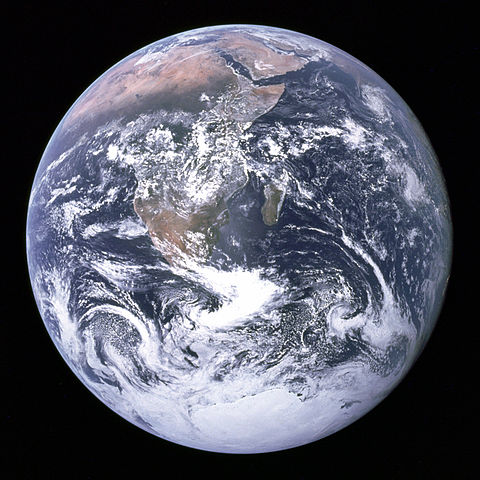
In compensation, though, we have some truly beautiful images made possible by new technology.  Last month, for instance, NASA updated the most iconic photograph in our civilization’s gallery: “Blue Marble,” originally taken from Apollo 17 in 1972. The spectacular new high-def image [see below, Ed] shows a picture of the Americas on January 4th, a good day for snapping photos because there weren’t many clouds.

It was also a good day because of the striking way it could demonstrate to us just how much the planet has changed in 40 years. As Jeff Masters, the web’s most widely read meteorologist, explains, “The U.S. and Canada are virtually snow-free and cloud-free, which is extremely rare for a January day. The lack of snow in the mountains of the Western U.S. is particularly unusual. I doubt one could find a January day this cloud-free with so little snow on the ground throughout the entire satellite record, going back to the early 1960s.”

In fact, it’s likely that the week that photo was taken will prove “the driest first week in recorded U.S. history.” Indeed, it followed on 2011, which showed the greatest weather extremes in our history — 56% of the country was either in drought or flood, which was no surprise since “climate change science predicts wet areas will tend to get wetter and dry areas will tend to get drier.” Indeed, the nation suffered 14 weather disasters each causing $1 billion or more in damage last year. (The old record was nine.) Masters again: “Watching the weather over the past two years has been like watching a famous baseball hitter on steroids.”

In the face of such data — statistics that you can duplicate for almost every region of the planet — you’d think we’d already be in an all-out effort to do something about climate change. Instead, we’re witnessing an all-out effort to… deny there’s a problem.

Our GOP presidential candidates are working hard to make sure no one thinks they’d appease chemistry and physics. At the last Republican debate in Florida, Rick Santorum insisted that he should be the nominee because he’d caught on earlier than Newt or Mitt to the global warming “hoax.”

Most of the media pays remarkably little attention to what’s happening. Coverage of global warming has dipped 40% over the last two years. When, say, there’s a rare outbreak of January tornadoes, TV anchors politely discuss “extreme weather,” but climate change is the disaster that dare not speak its name.

And when they do break their silence, some of our elite organs are happy to indulge in outright denial. Last month, for instance, the Wall Street Journal published an op-ed by “16 scientists and engineers” headlined “No Need to Panic About Global Warming.” The article was easily debunked. It was nothing but a mash-up of long-since-disproved arguments by people who turned out mostly not to be climate scientists at all, quoting other scientists who immediately said their actual work showed just the opposite.

It’s no secret where this denialism comes from: the fossil fuel industry pays for it. (Of the 16 authors of the Journal article, for instance, five had had ties to Exxon.)Writers from Ross Gelbspan to Naomi Oreskes have made this case with such overwhelming power that no one even really tries denying it any more. The open question is why the industry persists in denial in the face of an endless body of fact showing climate change is the greatest danger we’ve ever faced.

Why doesn’t it fold the way the tobacco industry eventually did? Why doesn’t it invest its riches in things like solar panels and so profit handsomely from the next generation of energy? As it happens, the answer is more interesting than you might think.

Part of it’s simple enough: the giant energy companies are making so much money right now that they can’t stop gorging themselves. ExxonMobil, year after year, pulls in more money than any company in history. Chevron’s not far behind. Everyone in the business is swimming in money.

Still, they could theoretically invest all that cash in new clean technology or research and development for the same. As it happens, though, they’ve got a deeper problem, one that’s become clear only in the last few years. Put briefly: their value is largely based on fossil-fuel reserves that won’t be burned if we ever take global warming seriously.

When I talked about a carbon bubble at the beginning of this essay, this is what I meant. Here are some of the relevant numbers, courtesy of the Capital Institute: we’re already seeing widespread climate disruption, but if we want to avoid utter, civilization-shaking disaster, many scientists have pointed to a two-degree rise in global temperatures as the most we could possibly deal with.

If we spew 565 gigatons more carbon into the atmosphere, we’ll quite possibly go right past that reddest of red lines. But the oil companies, private and state-owned, have current reserves on the books equivalent to 2,795 gigatons — five times more than we can ever safely burn. It has to stay in the ground.

Put another way, in ecological terms it would be extremely prudent to write off $20 trillion worth of those reserves. In economic terms, of course, it would be a disaster, first and foremost for shareholders and executives of companies like ExxonMobil (and people in places like Venezuela).

If you run an oil company, this sort of write-off is the disastrous future staring you in the face as soon as climate change is taken as seriously as it should be, and that’s far scarier than drought and flood. It’s why you’ll do anything — including fund an endless campaigns of lies — to avoid coming to terms with its reality. So instead, we simply charge ahead.  To take just one example, last month the boss of the U.S. Chamber of Commerce, Thomas Donohue, called for burning all the country’s newly discovered coal, gas, and oil — believed to be 1,800 gigatons worth of carbon from our nation alone.

What he and the rest of the energy-industrial elite are denying, in other words, is that the business models at the center of our economy are in the deepest possible conflict with physics and chemistry. The carbon bubble that looms over our world needs to be deflated soon. As with our fiscal crisis, failure to do so will cause enormous pain — pain, in fact, almost beyond imagining. After all, if you think banks are too big to fail, consider the climate as a whole and imagine the nature of the bailout that would face us when that bubble finally bursts.

Unfortunately, it won’t burst by itself — not in time, anyway. The fossil-fuel companies, with their heavily funded denialism and their record campaign contributions, have been able to keep at bay even the tamest efforts at reining in carbon emissions. With each passing day, they’re leveraging us deeper into an unpayable carbon debt — and with each passing day, they’re raking in unimaginable returns. ExxonMobil last week reported its 2011 profits at $41 billion, the second highest of all time. Do you wonder who owns the record? That would be ExxonMobil in 2008 at $45 billion.

Telling the truth about climate change would require pulling away the biggest punchbowl in history, right when the party is in full swing. That’s why the fight is so pitched. That’s why those of us battling for the future need to raise our game. And it’s why that view from the satellites, however beautiful from a distance, is likely to become ever harder to recognize as our home planet.

Bill McKibben is Schumann Distinguished Scholar at Middlebury College, founder of the global climate campaign 350.org, a TomDispatch regular, and the author, most recently, of Eaarth: Making a Life on a Tough New Planet.

Follow TomDispatch on Twitter @TomDispatch and join us on Facebook.

Copyright 2012 Bill McKibben

This photo was taken on January 4, 2012.

Most Amazing High Definition Image of Earth – Blue Marble 2012

January 25, 2012

*Updated February 2, 2012: According to Flickr, “The western hemisphere Blue Marble 2012 image has rocketed up to over 3.1 million views making it one of the all time most viewed images on the site after only one week.”

A ‘Blue Marble’ image of the Earth taken from the VIIRS instrument aboard NASA’s most recently launched Earth-observing satellite – Suomi NPP. This composite image uses a number of swaths of the Earth’s surface taken on January 4, 2012. The NPP satellite was renamed ‘Suomi NPP’ on January 24, 2012 to honor the late Verner E. Suomi of the University of Wisconsin.

Suomi NPP is NASA’s next Earth-observing research satellite. It is the first of a new generation of satellites that will observe many facets of our changing Earth.

Suomi NPP is carrying five instruments on board. The biggest and most important instrument is The Visible/Infrared Imager Radiometer Suite or VIIRS.

To read more about NASA’s Suomi NPP go to: www.nasa.gov/npp

Credit: NASA/NOAA/GSFC/Suomi NPP/VIIRS/Norman Kuring

Time and tide wait for no man.

Two delightful contributions about the ageing journey.

First from Cynthia, a very brave Californian lady, who recently sent me these:

oooOOOooo

Couple in their nineties are both having problems remembering things. During a check-up, the doctor tells them that they’re physically okay, but they might want to start writing things down to help them remember ..

Later that night, while watching TV, the old man gets up from his chair. ‘Want anything while I’m in the kitchen?’ he asks.

‘Will you get me a bowl of ice cream?’

‘Sure.’

‘Don’t you think you should write it down so you can remember it?’ she asks.

‘No, I can remember it.’

‘Well, I’d like some strawberries on top, too. Maybe you should write it down, so as not to forget it?’

He says, ‘I can remember that. You want a bowl of ice cream with strawberries.’

‘I’d also like whipped cream. I’m certain you’ll forget that, write it down?’ she asks.

Irritated, he says, ‘I don’t need to write it down, I can remember it! Ice cream with strawberries and whipped cream – I got it, for goodness sake!’

Then he toddles into the kitchen. After about 20 minutes, the old man returns from the kitchen and hands his wife a plate of bacon and eggs. She stares at the plate for a moment.

‘Where’s my toast?’

oooo

An elderly couple had dinner at another couple’s house, and after eating, the wives left the table and went into the kitchen.

The two gentlemen were talking, and one said, ‘Last night we went out to a new restaurant and it was really great. I would recommend it very highly.’

The other man said, ‘What is the name of the restaurant?’

The first man thought and thought and finally said, ‘What’s the name of that flower you give to someone you love? You know, the one that’s red and has thorns.’

‘Do you mean a rose?’

‘Yes, that’s the one,’ replied the man. He then turned towards the kitchen and yelled, ‘Rose, what’s the name of that restaurant we went to last night?’

oooo

A senior citizen said to his eighty-year old buddy:

‘So I hear you’re getting married?’

‘Yep!’

‘Do I know her?’

‘Nope!’

‘This woman, is she good looking?’

‘Not really.’

‘Is she a good cook?’

‘Naw, she can’t cook too well.’

‘Does she have lots of money?’

‘Nope! Poor as a church mouse.’

‘Well, then, is she good in bed?’

‘I don’t know.’

‘Why in the world do you want to marry her then?’

‘Because she can still drive!’

oooo

A man was telling his neighbor, ‘I just bought a new hearing aid. It cost me four thousand dollars, but it’s state of the art. It’s perfect.’

‘Really,’ answered the neighbor. ‘What kind is it?’

‘Twelve thirty.’

oooo

Morris, an 82 year-old man, went to the doctor to get a physical.

A few days later, the doctor saw Morris walking down the street with a gorgeous young woman on his arm.

A couple of days later, the doctor spoke to Morris and said, ‘You’re really doing great, aren’t you?’

Morris replied, ‘Just doing what you said, Doc: ‘Get a hot mamma and be cheerful.”

The doctor said, ‘I didn’t say that.. I said, ‘You’ve got a heart murmur; be careful.’

oooo

Last one!

A little old man shuffled slowly into an ice cream parlour and pulled himself slowly, painfully, up onto a stool… After catching his breath, he ordered a banana split.

The waitress asked kindly, ‘Crushed nuts?’

‘No,’ he replied, ‘Arthritis.’

Now, before you ‘forget ‘, send them on to some other folks you know who could use a good laugh!!

oooOOOooo

The second contribution comes from dear friend, MaryAnne.

julieandrews

To commemorate her birthday, actress/vocalist, Julie Andrews made a special appearance at Manhattan’s Radio City Music Hall for the benefit of the AARP.  One of the musical numbers she performed was ‘My Favorite Things’ from the legendary movie ‘Sound Of Music’. Here are the slightly modified lyrics she used:

(If you sing it, it’s especially hysterical!!!)

Botox and nose drops and needles for knitting,
Walkers and handrails and new dental fittings,
Bundles of magazines tied up in string,
These are a few of my favorite things.

Cadillacs and cataracts, hearing aids and glasses,
Polident and Fixodent and false teeth in glasses,
Pacemakers, golf carts and porches with swings,
These are a few of my favorite things.

When the pipes leak, When the bones creak,
When the knees go bad,
I simply remember my favorite things,
And then I don’t feel so bad.

Hot tea and crumpets and corn pads for bunions,
No spicy hot food or food cooked with onions,
Bathrobes and heating pads and hot meals they bring,
These are a few of my favorite things.

Back pain, confused brains and no need for sinnin’,
Thin bones and fractures and hair that is thinnin’,
And we won’t mention our short shrunken frames,
When we remember our favorite things.

When the joints ache, When the hips break,
When the eyes grow dim,
Then I remember the great life I’ve had,
And then I don’t feel so bad.

(Ms. Andrews received a standing ovation from the crowd that lasted over four minutes and repeated encores.)

oooOOOooo

So there you are.  This old Englishman, vintage 1944, celebrates Cynthia, MaryAnne and Ms. Andrews and all the other wonderful women in this world who refuse to let age or life’s circumstances get in the way.

Nostalgic musings

Early days in London

In my recent post Electrosensitivity, I wrote about “spending a number of years studying for a Diploma in Electrical Engineering at Faraday House, Southampton Row, London and becoming a UK Radio Amateur at the age of 17 (G3PUK)“.

In reverse order, I shall start with becoming a UK Radio Amateur, now rather back in the mists of time!

After my father died in 1956 my mother subsequently remarried.  Her new husband was Richard Mills and he was very knowledgeable about radio matters; he was a technical author in the radio-communications industry.  It was Richard, my step-dad, who showed me how to make a crystal set and I started listening to the strange world of wireless radio.  It fascinated me and motivated me to save up my pennies and buy an ex-military radio receiver known as a R1155.

r1155

I had joined the Harrow Radio Society who, amazingly, are still active today, as their website demonstrates.

Under the fabulous tutelage of many of the older ‘hams’ I went on to sit my exams and on Valentine’s Day 1962 was awarded the Postmaster-General’s Amateur Radio Certificate.  I applied for a call-sign and was allocated G3PUK.  I was just 17 years old!

G3PUK0001

oooOOOooo

Now some memories of Faraday House.  I can do no better than refer you to an article that appeared on the Electrical Review website in the UK.  As the article was published over three years ago, I think republishing it on Learning from Dogs isn’t being too naughty.

faradayhouseplaque

Faraday House Association closes after 105 years

FRIDAY, 29 JANUARY 2010

It is with sadness we report the Faraday House Old Students Association (FHOSA) is to close after operating continuously over the last 105 years. It had been host to thousands of chartered electrical engineers. The Association membership is derived from old students of Faraday House.

In 1888 the revised Electric Lighting Act encouraged many local authorities to apply for Parliamentary Powers to establish generating stations to transmit power. Faraday House was founded to train engineers in this new practice. The college started life as the Electrical Standardising, Testing and Training Institution at Charing Cross but in June 1890 used the name Faraday House. It was located in the Charing Cross area, and fees were 100 guineas per annum. The first Faraday House Dinner was held in 1895 – it was free and some 170 attended. In 1905 the FHOSA was formed and 100 old students joined. A move was then made to Southampton Row. By now the college had 110 students.

In 1909 Dr Russell was appointed principal, and pioneered the sandwich course. This meant students had a year or so of theory and then experienced work in industry, returning again to more theory. By 1914 many old students joined up and a crash course was started to aid the war effort. By 1919 some 350 had been in the services and 34 had died. In 1920 the fees had risen to 300 guineas.

By 1928 1000 students had joined the Old Students Association and in 1929 a 40th anniversary dinner was held. In 1939 a discussion with the governors resulted in a decision to evacuate the college to Thurlestone in Devon. A new principal, Dr WRC Coode-Adams, took over from Dr Russell. Faraday House took over the Links Hotel. Staff and students who were married lived in the hotel or in houses that had been taken over by the college.

In 1942 the college returned to Southampton Row. After the war Faraday House had difficulty in recruiting, students were lured to other colleges and universities by grants. In 1957 Mr GH Randolph Martin was appointed Principal. He had been a lecturer at the college since 1948. The college closed its doors in 1967 as losses were now running at £20,000 per year.

During its lifetime Faraday House produced a succession of engineers who attained the most senior positions in industry and electrical supply in many countries, and six old students have been president of the Institution of Electrical Engineers (now the IET).

The Old Students Association has a membership that is steadily growing older and shrinking as members die. The closure was inevitable without younger people coming forward to run it. The FHOSA will shut its doors finally after the Annual General Meeting in March 2010.

Here’s the front of the building.

Faraday House, London

How the years have flown by!

EMF safety

From knowledge to awareness and then to protection.

Yesterday, I dipped into the subject of electro-magnetic radiation.  As hopefully made clear, I was writing in response to the film Beings of Frequency that was presented the previous day.

If you haven’t yet watched the film, then do.  To be frank, the posts of yesterday and today are that much more valuable after the film has been watched.

Brain-Tumor-Report-Cover-Image

In terms of reducing the effects of EMF, then a quick ‘Google’ search will bring up teems of websites.  Many of them are selling filters, consultancy, EMF surveys, and more.  While in no way impugning those services, my instinct is to be drawn to those websites and blogs motivated by the desire to be informational alone.  At this stage of my research anyway.

Take EMF Damage for example, from which I quote:

There is a connection between electromagnetic fields and some cancers including leukemia

EMFDamage.com is online for these reasons:
1. To let you know there are serious health risks involved in living or working too close to power lines. I am certain the power line behind my home is the direct cause of my diagnosis of chronic lymphocytic leukemia. Electromagnetic fields (EMFs) have also been linked to other adult leukemias, childhood leukemia and brain cancer.

2. In addition to EMFs from power lines, you may also be exposed to unhealthy levels of EMFs from sources inside your home and workplace. These fields are easier to control and correct.

3. There are many ways to detect and measure the EMF levels at your home and at work.

4. You can reduce high EMF levels to reduce your risk of exposure.

We sell nothing on this web site and have no affiliations with any of the linked businesses or organizations. The purpose of this web site is purely informational.

That gets my vote.

So too does the website The EI Wellspring.  On their ‘About‘ page they write:

This website’s primary purpose is to provide practical information for people with severe multiple chemical sensitivity (MCS) and electromagnetic hypersensitivity (EHS/ES). MCS and EHS are closely related illnesses, which together are referred to as Environmental Illness (EI).

This is not a commercial site. Vendors and products are mentioned in some articles, but there are no paid product endorsements. Recommendations are based on the experiences of the authors and do not necessarily reflect the opinions of this site or its management.

The information presented reflects the experience and opinions of individuals who wish to help others. Naturally, what works for one person may not work for another. The reader should evaluate the suggestions in the context of his or her own situation, and apply good judgment and common sense before following suggestions presented.

So at this time, I don’t have the awareness of just what levels of EMF radiation we are exposed to here at home.  But I’m going to undertake an investigation and, if we have a problem, work to a ‘cleaner’ house.

I shall be writing about this journey at regular intervals and explaining clearly why we did or did not do this or that.

What I would be delighted to publish on Learning from Dogs are accounts from others who have made similar journeys or know that they have been affected by EMF radiation.  Do please drop me an email.

Electrosensitivity (EHS)

Musings on the subject of radio frequency energy.

Faraday House, London

Let me first be completely open about this.  Despite spending a number of years studying for a Diploma in Electrical Engineering at Faraday House, Southampton Row, London and becoming a UK Radio Amateur at the age of 17 (G3PUK), my memory of this subject has become less focused!  Bit like my eyesight!  (I’ll wallow in this nostalgia for Saturday’s post!)

There’s a wealth of information available if you do a web search on the subject of ‘radio frequency spectrum‘ including diagrams such as this one.

Radio Spectrum in demand

In fact, if you use the image above with this one below, you will get a quick idea of the range of frequencies and how almost every aspect of modern life is connected to ‘RF’.  (NB: I find the one below a little out of focus but hope it’s legible.)

rf spectrum

If you look at the frequency band 300 MHz to 3GHz, known as the Ultra-High Frequency or UHB band you will see that it is used by devices including mobile or cell phones as well as wireless phones and the newer DECT phones; these latest phones operating at 900 MHz.

Now I don’t understand the physics of Radio Frequency (RF) transmissions but I do know that the higher the frequency, the more energy is carried.  Living cells are not happy in the presence of RF particularly at those higher frequencies.  Just go back to that top diagram and think about being zapped by X-Rays, Gamma Rays or Cosmic Rays!  Here’s an extract from a Wikipedia article on Radiation burn.

The most common type of radiation burn is a sunburn caused by UV radiation. High exposure to X-rays during diagnostic medical imaging or radiotherapy can also result in radiation burns. As the ionizing radiation interacts with cells within the body—damaging them—the body responds to this damage, typically resulting in erythema—that is, redness around the damaged area. Radiation burns are often associated with radiation-induced cancer due to the ability of ionizing radiation to interact with and damage DNA, occasionally inducing a cell to become cancerous. Cavity magnetrons can be improperly used to create surface and internal burning. Depending on the photon energygamma radiation can cause very deep gamma burns, with 60Co internal burns are common. Beta burns tend to be shallow as beta particles are not able to penetrate deep into the person; these burns can be similar to sunburn.

Radiation burns can also occur with high power radio transmitters at any frequency where the body absorbs radio frequency energy and converts it to heat.[1] The U.S. Federal Communications Commission (FCC) considers 50 watts to be the lowest power above which radio stations must evaluate emission safety. Frequencies considered especially dangerous occur where the human body can become resonant, at 35 MHz, 70 MHz, 80-100 MHz, 400 MHz, and 1 GHz.[2] Exposure to microwaves of too high intensity can cause microwave burns.

We marvel at the efficiency of microwave ovens but possibly don’t connect those with holding a cell phone or cordless phone next to the head!  If you didn’t watch yesterday’s film Beings of Frequency then I really do recommend that you put some time to one side and watch it.

Like so many aspects of modern life, once one has been made aware of something one finds a mountain of information.  So it is with Electromagnetic hypersensitivity.

Again, Wikipedia.

Idiopathic environmental intolerance attributed to electromagnetic fields (IEI-EMF) is a descriptive term for symptoms purportedly caused by exposure to electromagnetic fields.[1] Other terms for IEI-EMF include electromagnetic hypersensitivity (EHS), electrohypersensitivityelectro-sensitivity, and electrical sensitivity (ES).

Although the thermal effects of electromagnetic fields on the body are established, self-described sufferers of electromagnetic hypersensitivity report responding to non-ionizing electromagnetic fields (or electromagnetic radiation) at intensities well below the limits permitted by international radiation safety standards. The majority of provocation trials to date have found that self-described sufferers of electromagnetic hypersensitivity are unable to distinguish between exposure to real and fake electromagnetic fields,[2][3] and it is not recognized as a medical condition by the medical or scientific communities.

The reported symptoms of EHS include headache, fatigue, stress, sleep disturbances, skin symptoms like prickling, burning sensations and rashes, pain and ache in muscles and many other health problems. Whatever their cause, EHS symptoms are a real and sometimes a disabling problem for the affected persons.

Later on that WikiPedia reference states:

A 2001 survey found that people related their symptoms most frequently to mobile phone base stations (74%), followed by mobile phones (36%), cordless phones (29%) and power lines (27%). The survey was not designed to find any causal connection between electromagnetic field exposure and ill health.[5]

A report from the UK Health Protection Agency said that self-described “electrical sensitivity” sufferers have symptoms that can be grouped into two broad categories: facial skin symptoms and more general, non-specific symptoms across a range of body systems. The facial skin symptoms and their attribution to visual display units was mostly a Nordic phenomenon. The report pointed out that it did not “imply the acceptance of a causal relationship between symptoms and attributed exposure”.[6]

Recently a smaller group of people in Europe as a whole and in the USA have reported general and severe symptoms such as headache, fatigue, tinnitus, dizziness, memory deficits, irregular heart beat, and whole-body skin symptoms.[7] A 2005 Health Protection Agency report noted the overlap in many sufferers with other syndromes known as symptom-based conditions, FSS (Functional Somatic Syndromes) and IEI (Idiopathic Environmental Intolerance).[6] Levitt proposed ties between electromagnetic fields and some of these 20th-century maladies, including Chronic Fatigue SyndromeGulf War Syndrome, and Autism.[8]

Anyone find what was described in that last paragraph touch a sore point! Go here to read the full item and the numbered references.

There’s a host of other websites on the subject.  Just picking one more or less at random reveals this:

Electromagnetic Hypersensitivity (EHS) is a “growing worldwide health concern” according to a December 2005 press release issued by the World Health Organization. EHS can be difficult to understand and even more difficult to diagnose. Many doctors and other health professionals here in North America are not yet aware of the recent scientific evidence surrounding electromagnetic energy (EMF) and its effects on human health.

Symptoms of Electrical Hypersensitivity may include skin rash, sleep disorders, muscle and joint pain (fibromyalgia), chronic fatigue, depression, headaches, dizziness, nausea, difficulty concentrating, memory loss, irritability, anxiety, weakness, muscle spasms, numbness, tingling, leg and foot pain, “flu-like” symptoms and fever.

So that’s enough for today.

Tomorrow, I will explore what we can do to lessen the effects of Electro-Magnetic Fields.

Don’t delay. In the EU sign now!

Reblogged, with permission, from Lack of Environment

It is nearly 50 years since Rachel Carson wrote here seminal book Silent Spring. Why are we humans so stupid that we do not learn even the most basic of lessons? It is time to put the environmental protection before commercial profit.

This email from Avaaz was sent to me almost 24 hours ago so, if you live in the EU, please sign the petition immedaitely. The politicians clearly want to do the right thing; please help ensure that big business (in this case Bayer) do not persuade them to fail to learn from the past.

——

Dear friends,


Bees around the world are dying off and Europe’s food watchdog just said certain pesticides are part of the problem.We’ve got 48 hours before key meetings – let’s get a 2-million-person swarm to save the bees.Click to take urgent action now:

Sign the petition

Quietly, globally, billions of bees are dying, threatening our crops and food. But in 48 hours the European Union could move to ban the most poisonous pesticides, and pave the way to a global ban that would save bees from extinction.

Four EU countries have begun banning these poisons, and some bee populations are already recovering. Days ago the official European food safety watchdog stated for the first time that certain pesticides are fatally harming bees. Now legal experts and European politicians are calling for an immediate ban. But Bayer and other giant pesticide producers are lobbying hard to keep them on the market. If we build a huge swarm of public outrage now, we can push the European Commission to put our health and our environment before the profit of a few.

We know our voices count! Last year, our 1.2 million strong petition forced US authorities to open a formal consultation on pesticides — now if we reach 2 million, we can persuade the EU to get rid of these crazy poisons and pave the way for a ban worldwide. Sign the urgent petition and send this to everyone – Avaaz and leading MEPs will deliver our message ahead of this week’s key meeting in Brussels:

http://www.avaaz.org/en/hours_to_save_the_bees/?bSkdncb&v=21422

Bees don’t just make honey, they are vital to life on earth, every year pollinating 90% of plants and crops — with an estimated $40bn value and over one-third of the food supply in many countries. Without immediate action to save bees, many of our favourite fruits, vegetables, and nuts could vanish from our shelves.

Recent years have seen a steep and disturbing global decline in bee populations – some bee species are already extinct and some US species are at just 4% of their previous numbers. Scientists have been scrambling for answers and now the European Food Safety Authority is saying that toxic chemicals called neonicotinoid pesticides could be responsible for the bee deaths. France, Italy, Slovenia and even Germany, where the main manufacturer Bayer is based, have banned one of these bee-killing pesticides. But Bayer continues to export its poison across the world.

Now the issue is coming to a boil. EU parliamentarians are stepping up their pressure on the European Commission and key governments to push new legislation to ban the deadly pesticides, and we can offer them the public support they need to counter the powerful pesticide lobby. Sign the urgent petition to Europe’s leaders, then forward this email widely:

http://www.avaaz.org/en/hours_to_save_the_bees/?bSkdncb&v=21422

Our world is beset with threats to what makes it habitable, and to what fills it with wonder. The Avaaz community comes together to defend both — large or small. Whether winning a battle to keep the International Whaling Commission from sanctioning the murder of these giants, or saving bees, the tiny creatures upon which so much depends, we will come together and stand up for the world we all want.

With hope,

Luis, Ari, Alice, Iain, Ricken, David, Alaphia, and the Avaaz team

SOURCES

Pesticides pose danger to bees (European Voice)
http://www.europeanvoice.com/article/2013/january/pesticides-pose-danger-to-bees/76158.aspx

Crop pesticides are ‘killing our bees’ – says MEP (Public Service Europe)
http://www.publicserviceeurope.com/article/3007/crop-pesticides-are-killing-our-bees-says-mep#ixzz2JGICse6a

Death knell for nerve agent pesticides in move to save bees (Independent)
http://www.independent.co.uk/environment/nature/death-knell-for-nerve-agent-pesticides-in-move-to-save-bees-8454443.html

Give Bees a Chance! (The Greens European Free Alliance)
http://www.greens-efa.eu/give-bees-a-chance-9012.html

Studies fault Bayer in bee die-off (Christian Science Monitor)
http://www.csmonitor.com/Science/2012/0406/Studies-fault-Bayer-in-bee-die-off

oooOOOooo

Do go to Martin’s post here if not only to read the comment from Lionel:

I get my honey from local producers it is has far more flavour and texture than the insipid brand names.

Talking to them I learned about their concerns, including vandalism which is sad, and quizzed them on CCD (Colony Collapse Disorder) having read this book:

A Spring without Bees on visiting the associated web site Plan Bee Central,

and this book:

A World Without Bees and a web site of the same name A World Without Bees. The local bee keepers bowered my copy for some time.

I saw a CountryFile (BBC) segment some two or more years ago and John Craven was very soft-footed with a Bayer rep’ as they talked in a field, I was rather disappointed as John let him off the hook rather.

I have taken an interest in photographing Bumble Bees and have an excellent reference on those common, or once common in the UK.

Beings of Frequency

A necessary diversion from my usual style of post.

bees

Today, I am asking you to watch a film.  A full-length film that is on YouTube.  It will open your eyes and almost certainly confirm suspicions that you may have harboured about the long-term consequences of holding a microwave transmitter close to the brain; namely a cell phone or mobile phone.

Tomorrow, I will explore what we can do to reduce the risks that so many of us are exposed to.

So settle down as soon as you can and watch.

Published on Nov 27, 2012

(Full Film) RESONANCE ➜ This James Russell film is a Sensational Eye Opening Documentary that examines 60 years of scientific research! ➜ Join the FACEBOOK page http://goo.gl/yf4Qs

➜ James Russell (Director + Producer)
http://www.FlatFrogFilms.com

➜ John Webster (Director)
http://www.PatientZeroProductions.com

This spectacular documentary uncovers for the very first time the actual mechanisms by which mobile phone technology can cause cancer. And how every single one of us is reacting to the biggest change to the environment this planet has ever seen.

Two billion years ago life first arrived on this planet; a planet which was filled with a natural frequency. As life slowly evolved, it did so surrounded by this frequency and inevitably began tuning in.

By the time mankind arrived on earth an incredible relationship had been struck, a relationship that science is just beginning to comprehend.

Research is showing that being exposed to this frequency is absolutely integral to us. It controls our mental and physical health, it synchronizes our circadian rhythms, and it aids our immune system and improves our sense of wellbeing.

Not only are we surrounded by natural frequencies, our bodies are filled with them too. Our cells communicate using electro-magnetic frequencies. Our brain emits a constant stream of frequencies and our DNA delivers instructions, using frequency waves. Without them we couldn’t exist for more than a second.

This delicate balance has taken billions of years to perfect. But over the last 25 years the harmony has been disturbed and disturbed dramatically.

Mankind has submerged itself in an ocean of artificial frequencies. They are all around us filling the air and drowning out the earth’s natural resonance.

To the naked eye the planet appears to be the same. But at a cellular level it is the biggest change that life on earth has endured; the effects of which we are just starting to see and feel.

butterfly

Interconnectedness

All and every thing is connected on Planet Earth.

I must share the feelings of millions of others across the world when I admit to going through periods of quiet despair about where ‘modern man’ has got himself. (I don’t intend to be gender specific!)

It goes way beyond the disbelief at some of the things happening today; way beyond the anger that is generated by so many examples of greed and corruption.  It goes to a point where I just want to snuggle down with Jean, curl up with the dogs and kiss the rest of the world good-bye!

The expression that comes to mind is the one about the last person to leave the planet please switch the lights off!

(As if to demonstrate how sensitive dogs are to the feelings of us humans, Cleo just came into the room where I am writing this and laid her head across my left thigh.  I stroked her head and then she wandered back to our bed next door – I then took the following photograph)

P1120525

So what’s feeding my feelings?

Well, as many of you know yesterday and Sunday had posts about saving the Ecuadorian Jaguar and the African Lion.  In the case of the former, it’s:

The president of Ecuador claims to stand for indigenous rights and the environment, but he has just come up with a new plan to bring oil speculators in to 4 million hectares of jungle.  (That’s 9.9 million acres in old money!)

In the case of the African Lion, it’s:

In the past fifty years, the African lion population declined by as much as 90%. Many of the lion prides that do exist today are so genetically weak from being small and isolated by international borders that they can’t promise a future for African lions ….. two thirds of the African lions killed by trophy hunters end up in the U.S. That’s thousands of lions!

Last Friday I wrote about how community living for wolves and dogs had given those species “group survival and well-being“ that we humans couldn’t even dream about.

Then over at Liberated Way, Alex Jones recently wrote:

I attended a lecture at Essex University Colchester last Wednesday on the plight of indigenous indians in Canada, specifically those in Labrador. The Canadian government has embarked on a scheme to disenfranchise the indians of all their land, wipe out all their rights forever, and place them in perpetual bondage. Underlying this horror was what has happened to the indians themselves, a people tainted with mental illness, alcoholism and high suicide rates.

I asked the lecturer why it is that it appears all indigenous people across the globe share this common trait of high levels of abuse, mental illness, suicide and alcoholism. The answer given was that outsiders desired to force their alien world views upon these people destroying their sense of personal identity. For example many of these people see land as a shared resource, the capitalist ideas of land ownership is at odds with their world view. All Native American problem solving is through talking, and everyone has choice, whereas outsiders prefer to impose solutions and intellectualise with clever words.

Just read that last paragraph carefully again and note “outsiders desired to force their alien world views upon these people destroying their sense of personal identity.”

Back closer to home, the struggles of the North American Indians are well-known.

So no nice, neat solution to this place that I’m in just now other than to put down my pen and let the music from the following two videos wash over me.

If you read this far, thank you for suffering the ramblings of this silly old fart!

—-