Apologies, forgot who sent me the link to this video.
Which is a little over 5 minutes of watching Mark Gungor speak about the differences between the brains of men and women. I hadn’t come across Mark Gungor before but his website reveals he is “one of the most sought-after speakers on marriage and family in the country.”
A real pleasure and privilege to republish this article from Mr. Monbiot.
For some time now I have subscribed to the articles published by The Permaculture Research Institute of Australia. From time to time references have been made to PRI articles here on Learning from Dogs.
Recently, I read a PRI essay that had been penned by George Monbiot. It was called The Great Unmentionable. It blew me away. So I took a deep breath and dropped George M. an email asking if I might republish it here. George was very gracious in giving me such permission.
Mr. George Monbiot.
First some background to George Monbiot for those who are unfamiliar with his work and his writings. As his website explains:
I had an unhappy time at university, and I now regret having gone to Oxford, even though the zoology course I took – taught, among others, by Richard Dawkins, Bill Hamilton and John Krebs – was excellent. The culture did not suit me, and when I tried to join in I fell flat on my face, sometimes in a drunken stupor. I enjoyed the holidays more: I worked on farms and as a waterkeeper on the River Kennet. I spent much of the last two years planning my escape. There was only one job I wanted, and it did not yet exist: to make investigative environmental programmes for the BBC.
After hammering on its doors for a year, I received a phone call from the head of the BBC’s natural history unit during my final exams. He told me: “you’re so fucking persistent you’ve got the job.” They took me on, in 1985, as a radio producer, to make wildlife programmes. Thanks to a supportive boss, I was soon able to make the programmes I had wanted to produce. We broke some major stories. Our documentary on the sinking of a bulk carrier off the coast of Cork, uncovering evidence that suggested it had been deliberately scuppered, won a Sony award.
We have offshored both our consumption and our perceptions
By George Monbiot
Every society has topics it does not discuss. These are the issues which challenge its comfortable assumptions. They are the ones that remind us of mortality, which threaten the continuity we anticipate, which expose our various beliefs as irreconcilable.
Among them are the facts which sink the cosy assertion, that (in David Cameron’s words) “there need not be a tension between green and growth.”
At a reception in London recently I met an extremely rich woman, who lives, as most people with similar levels of wealth do, in an almost comically unsustainable fashion: jetting between various homes and resorts in one long turbo-charged holiday. When I told her what I did, she responded, “oh I agree, the environment is so important. I’m crazy about recycling.” But the real problem, she explained, was “people breeding too much”.
I agreed that population is an element of the problem, but argued that consumption is rising much faster and – unlike the growth in the number of people – is showing no signs of levelling off. She found this notion deeply offensive: I mean the notion that human population growth is slowing. When I told her that birth rates are dropping almost everywhere, and that the world is undergoing a slow demographic transition, she disagreed violently: she has seen, on her endless travels, how many children “all those people have”.
As so many in her position do, she was using population as a means of disavowing her own impacts. The issue allowed her to transfer responsibility to other people: people at the opposite end of the economic spectrum. It allowed her to pretend that her shopping and flying and endless refurbishments of multiple homes are not a problem. Recycling and population: these are the amulets people clasp in order not to see the clash between protecting the environment and rising consumption.
In a similar way, we have managed, with the help of a misleading global accounting system, to overlook one of the gravest impacts of our consumption. This too has allowed us to blame foreigners – particularly poorer foreigners – for the problem.
When nations negotiate global cuts in greenhouse gas emissions, they are held responsible only for the gases produced within their own borders. Partly as a result of this convention, these tend to be the only ones that countries count. When these “territorial emissions” fall, they congratulate themselves on reducing their carbon footprints. But as markets of all kinds have been globalised, and as manufacturing migrates from rich nations to poorer ones, territorial accounting bears ever less relationship to our real impacts.
While this is an issue which affects all post-industrial countries, it is especially pertinent in the United Kingdom, where the difference between our domestic and international impacts is greater than that of any other major emitter. The last government boasted that this country cut greenhouse gas emissions by 19% between 1990 and 2008. It positioned itself (as the current government does) as a global leader, on course to meet its own targets, and as an example for other nations to follow.
But the cut the UK has celebrated is an artefact of accountancy. When the impact of the goods we buy from other nations is counted, our total greenhouse gases did not fall by 19% between 1990 and 2008. They rose by 20%. This is despite the replacement during that period of many of our coal-fired power stations with natural gas, which produces roughly half as much carbon dioxide for every unit of electricity. When our “consumption emissions”, rather than territorial emissions, are taken into account, our proud record turns into a story of dismal failure.
There are two further impacts of this false accounting. The first is that because many of the goods whose manufacture we commission are now produced in other countries, those places take the blame for our rising consumption. We use China just as we use the population issue: as a means of deflecting responsibility. What’s the point of cutting our own consumption, a thousand voices ask, when China is building a new power station every 10 seconds (or whatever the current rate happens to be)?
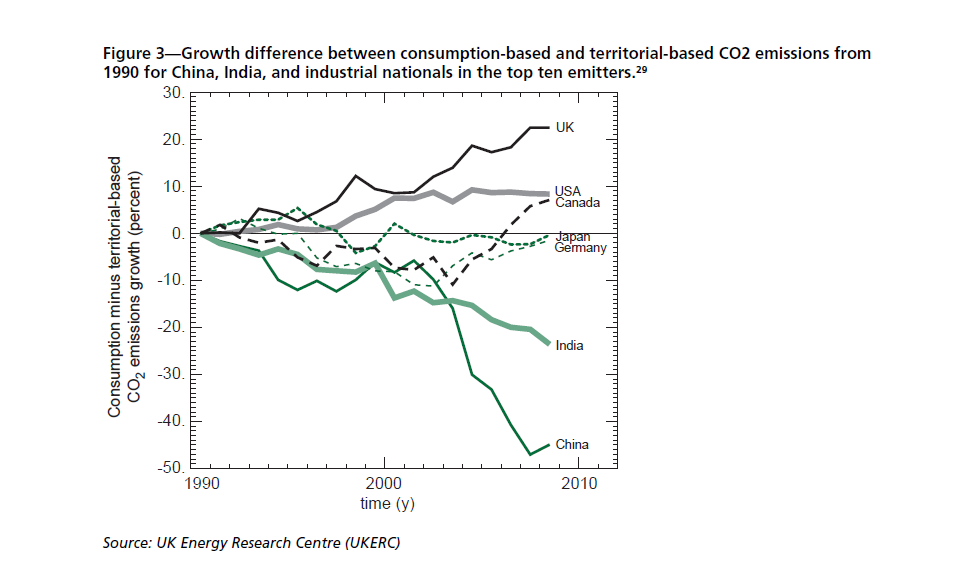
But, just as our position is flattered by the way greenhouse gases are counted, China’s is unfairly maligned. A graph published by the House of Commons Energy and Climate Change Committee shows that consumption accounting would reduce China’s emissions by roughly 45%. Many of those power stations and polluting factories have been built to supply our markets, feeding an apparently insatiable demand in the UK, the US and other rich nations for escalating quantities of stuff.
The second thing the accounting convention has hidden from us is consumerism’s contribution to global warming. Because we consider only our territorial emissions, we tend to emphasise the impact of services – heating, lighting and transport for example – while overlooking the impact of goods. Look at the whole picture, however, and you discover (using the Guardian’s carbon calculator) that manufacturing and consumption is responsible for a remarkable 57% of the greenhouse gas production caused by the UK.
Unsurprisingly, hardly anyone wants to talk about this, as the only meaningful response is a reduction in the volume of stuff we consume. And this is where even the most progressive governments’ climate policies collide with everything else they represent. As Mustapha Mond points out in Brave New World, “industrial civilization is only possible when there’s no self-denial. Self-indulgence up to the very limits imposed by hygiene and economics. Otherwise the wheels stop turning”.
The wheels of the current economic system – which depends on perpetual growth for its survival – certainly. The impossibility of sustaining this system of endless, pointless consumption without the continued erosion of the living planet and the future prospects of humankind, is the conversation we will not have.
By considering only our territorial emissions, we make the impacts of our escalating consumption disappear in a puff of black smoke: we have offshored the problem, and our perceptions of it.
But at least in a couple of places the conjuring trick is beginning to attract some attention.
On April 16th, the Carbon Omissions site will launch a brilliant animation by Leo Murray, neatly sketching out the problem*. The hope is that by explaining the issue simply and engagingly, his animation will reach a much bigger audience than articles like the one you are reading can achieve.
(*Declaration of interest (unpaid): I did the voiceover).
On April 24th, the Committee on Climate Change (a body that advises the UK government) will publish a report on how consumption emissions are likely to rise, and how government policy should respond to the issue.
I hope this is the beginning of a conversation we have been avoiding for much too long. How many of us are prepared fully to consider the implications?
So very difficult to pick out the sentence that carried the most power, for the essay is powerful from start to end. But this one did hit me in the face, “The impossibility of sustaining this system of endless, pointless consumption without the continued erosion of the living planet and the future prospects of humankind, is the conversation we will not have.“
Finally, I can’t resist reminding you, dear reader, of the point made by Prof. Guy McPherson in his book Walking Away from Empire, which I reviewed on March 6th. particularly in the first paragraph of the first chapter; Reason:
At this late juncture in the era of industry, it seems safe to assume we face one of two futures. If we continue to burn fossil fuels, we face imminent environmental collapse. If we cease burning fossil fuels, the industrial economy will collapse. Industrial humans express these futures as a choice between your money or your life, and tell you that, without money, life isn’t worth living. As should be clear by now, industrial humans — or at least our “leaders” — have chosen not door number one (environmental collapse) and not door number two (economic collapse), but both of the above.
Maybe this is why we seem unable to have the conversation because to do so means we have to look at ourselves in the mirror. Each one of us, you and me, has to address something so deeply personal. Back to Prof. McPherson and page 177 of his book (my emphasis):
It’s no longer just the living planet we should be concerned about. It’s us. The moral question, then: What are you going to do about it?
For my money, Mr. Monbiot is yet another voice of reason in the wilderness; another voice that deserves to be followed. I say this because by way of introduction to his philosophy, he opens thus:
My job is to tell people what they don’t want to hear. That is not what I set out to do. I wanted only to cover the subjects I thought were interesting and important. But wherever I turned, I met a brick wall of denial.
Denial is everywhere. I have come to believe that it’s an intrinsic component of our humanity, an essential survival strategy. Unlike other species, we know that we will die. This knowledge could destroy us, were we unable to blot it out. But, unlike other species, we also know how not to know. We employ this unique ability to suppress our knowledge not just of mortality, but of everything we find uncomfortable, until our survival strategy becomes a threat to our survival.
“… until our survival strategy becomes a threat to our survival.”
I sense the growing of this threat to the point where maybe within less than a year the vast majority of open-minded, thinking individuals know the truth of where we are all heading.
In some ways, it is surprising that I haven’t written about my own counselling experiences before. Perhaps it has never felt like the right moment.
But the guest post from Peter Bloch that I had the honour of publishing yesterday so strongly resonated with the ‘Fergus’ inside me that I was compelled to offer my own journey. So if you are not into bouts of personal introspection, look away and come back tomorrow! 😉
The fickle finger of fate
I was born in Acton, North London, just 6 months before the end of World War II. Nothing remarkable about that. Just another one of the millions of soon-to-be post-war babies. My father was an architect; my mother a teacher. Indeed, at the age of 93 my mother is still teaching music!
In 1956 when my father was 55 years-old he developed lung cancer. I and my sister were blissfully unaware of our father’s terminal condition until the evening of December 19th, 1956. That evening Mum came into my bedroom and said that father was very ill and may not live for very much longer. To be honest, it didn’t really register and off I went to sleep. I was 12 and looking forward to Christmas in 5 days time.
My father died in the night hours of December 19th/20th. I had slept through not even wakening when his body was removed from the house. On the morning of the 20th he was just gone!
It was felt by the family doctor, who had been attending my father, that it would be too upsetting for me and my younger sister to attend the funeral. That funeral was a cremation and therefore no grave.
The good and the not so good.
The only obvious effect of the trauma of my father’s death was that I bombed out at school. I had passed my ’11+’ exams at my primary school and in September, 1956, become a pupil at Preston Manor County Grammar School near Preston Road, Wembley where we were living; Wembley Stadium could be seen from the back windows of the 2nd floor of our house.
I struggled with schooling, the victim of much bullying as I recall, sat 8 ‘O-level’ exams, passed 2, struggled to get another couple of ‘O-levels’ but it was clear that a University place was not going to be for me.
From then on, in stark contrast, I enjoyed a wonderfully varied life, working as a business salesman, freelance journalist and ending up starting my own company in Colchester in 1978 which became surprisingly successful.
But when it came to relationships, that wasn’t so successful. If I tell you that Jeannie is my 4th wife, you will get the message!
A little more background.
When running my own business back in the 1980s I had a network of overseas distributors. My US West Coast distributor was Cimarron, a company owned and run by Daniel Gomez out of Los Angeles. Dan and I became good friends and still are some 35 years later. I’ll come back to this highly relevant relationship with Dan.
I sold my business in 1986 and went overseas for 5 years, actually living on a boat based in Larnaca, Cyprus. (The boat was a Tradewind 33 named ‘Songbird of Kent‘.)
In the early 1990s upon returning to England I chose to live in the South Hams area of South Devon, ending up in the small village of Harberton, pop. 300, near Totnes. Once settled I took up business mentoring. In previous years, I had gained Chartered Membership of the Institute of Marketing. In addition, I became a youth mentor with the Prince’s Youth Business Trust, a really fabulous organisation that does so much good for young people.
One of my personal mentees was Jon Lavin, the founder of The People Workshop. (Yes, and Jon is aware that his website is a tad out-of-date!)
Out of sight, but not out of mind.
In time I became married to wife number three. Seemingly happy living in a tranquil part of rural Devon, keeping busy, not thinking too much about life.
Pharaoh became an important part of my life in 2003. At the time, I had no idea how important!
Pharaoh, relaxing in a Devon garden.
On the evening of December 20th, 2006, 50 years to the day that my father died, my wife announced that she had met another man. The implications of this casually delivered bombshell were obvious and catastrophically painful.
I will spare you the details but, trust me, the next few weeks were tough!
High on my priorities were letting close friends know what was happening. Dan, in characteristic Daniel fashion, said over the phone, “Hey, Handover, you get your arse over to Southern California pronto! Like now!” I replied that it was much too difficult to do that now but maybe later on in 2007.
Realising that I might need some psychological support, I spoke with Jon Lavin. However, Jon made it clear that as we already had a working relationship with me as his mentor, he couldn’t now, in turn, be my psychotherapist. I pleaded with Jon. He said he would only work with me on the strict understanding that he would terminate the counselling relationship if our past workings interfered. Of course, I agreed. [See footnote.]
Finding one’s true self after 50 years!
Jon, quite naturally, started into understanding my past experiences. Right back to that fateful day in 1956 when my father died. And, guess what!
Unbeknownst to me, the lack of time to adjust to my father’s cancer, his sudden death, being unable to ‘say goodbye‘; all had been emotionally interpreted as acute and profound emotional rejection. Buried deep within me with both strong positive and negative emotional consequences. Negatively, making me very vulnerable to emotional rejection; positively, causing me to strive for outward success in so many ways. Those sessions with Jon brought it all to the surface bringing with it deep and peaceful calm.
Yet, the true implications of finding myself were still to come.
In the Summer of 2007, I took up Dan’s offer to ‘get my arse to Southern California!‘ I had a fabulous time with Dan and his dear wife, Cynthia. It also included a visit to Dan’s sister, Suzann, and her husband, Don, in their home in Los Osos, California. Su fussed over me restoring my sense of self-worth as Dan and Cynthia had been doing.
One morning over breakfast Suzann said, “Hey Paul, what are you doing for Christmas?”
I replied, “Oh, give me a break, Suzann, it’s the middle of June. Long time before I have to think about dealing with Christmas!”
Su then made the offer that was to change my life irrevocably. “Don and I have a house down in San Carlos, Mexico where we shall be at Christmas. Why don’t you come and have Christmas with us in Mexico?”
And I did. And it was in San Carlos, Mexico that I met Jean. Suzann and Jean were great buddies. Jean had been living there since she and her late husband, Ben, had moved there many years ago. Ben, an American, and Jean had been married for 26 years with Ben, sadly, having died in 2005.
Jean and I spent hundreds of hours chatting and getting to know each other, including the fact that she and I had both been born Londoners within 23 miles of each other. Jean had been rescuing Mexican feral dogs for years and there were 14 dogs in her house in San Carlos. So many of those dogs loved me from the start. It seemed like the most beautiful Christmas I could have wished for. In such stark contrast to just a year ago.
Mexican sunset! San Carlos, 2nd January, 2008.
In September, 2008 after selling the house in Devon, I moved out to San Carlos, Mexico. Just me and Pharaoh who had been such a devoted friend, companion and confidant over the previous months.
In 2010, we moved to Payson in Arizona, some 80 miles NE of Phoenix. On November 20th, 2010 Jean and I were married.
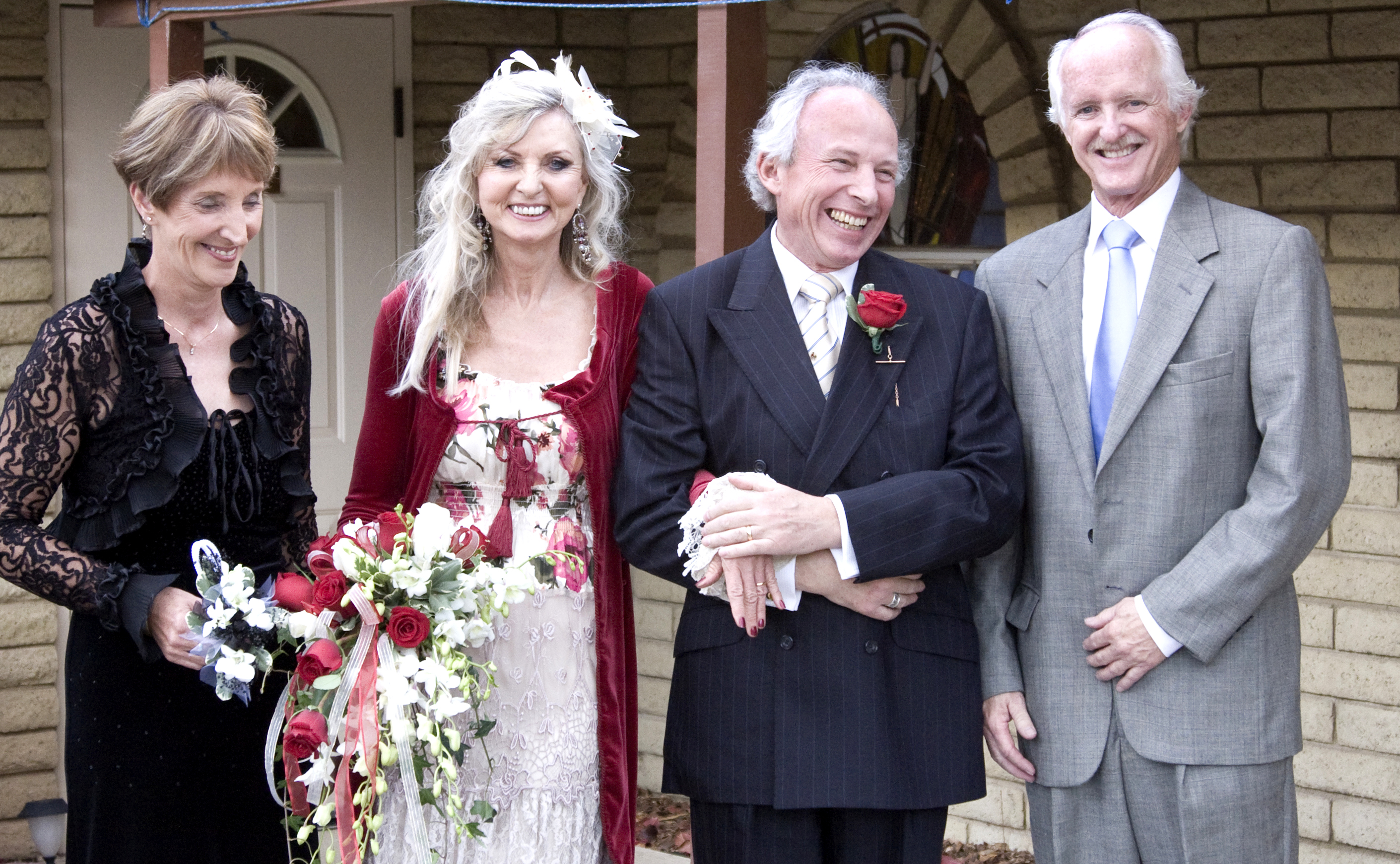
The marriage of Jean and Paul wonderfully supported by Diane, maid of honour, and best man, Dan Gomez.
Releasing the Fergus in me and all of us.
What Peter Bloch wrote yesterday was so true. A dog can only be a happy, fulfilled dog, if allowed to be the true dog that is in him or her. Despite the fact that humans are primates and dogs are canids like wolves, coyotes, and foxes, it still holds as true for us humans as it did for Fergus.
We can only be happy, to put it in the words of Fergus, “happy, energised, purposeful and fulfilled in every way.” if we are given the freedom to be our self.
So if you find that you, like Fergus, suffer from digestive problems, possibly have skin disorders and sometimes behave a little strangely take note – you need to find your healer!
oooOOOooo
Footnote
Back in 2008 when Jon Lavin was working with me, I would take Pharaoh and he would lay on the floor behind my seat. On one occasion Jon was talking about the findings of Dr. David Hawkins and his Scale of Consciousness; from falsehood to truthfulness. (See here and here for more details.)
Anyway that fateful day, Jon mentioned that Dr. Hawkins had measured dogs as being integrous animals. That notion stayed with me and later I registered the domain name learningfromdogs (dot) com leading to – yes, you guessed it – this blog. Funny old world.
I’m clearly not the only one to believe we really can learn from dogs!
Last Friday, I published a post under the title of The healing power of dogs. This is how that post opened:
How dogs offer us humans health and happiness.
Many months ago, I was contacted by a Peter Bloch offering to write a guest post on the subject of the healing power of dogs. Peter had read a post that I had published in July last year which prompted the email dialogue between us.
Not going to say much more at this stage except that today I am republishing that post from last July. On Monday, I will introduce Peter and his guest post. Then on Tuesday, I will speak of my own experiences both as entrepreneurial mentor and as a ‘customer’ of a wonderful psychotherapist back in Devon during 2007.
So, as promised, here is that guest post from Peter.
oooOOOooo
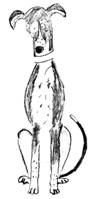
Fergus, the Healing Dog. A sketch by Mrs. Peter Bloch
My dog Fergus is a philosopher, and the nature of health and happiness is his area of special expertise. When he learned about Paul’s blog he became very excited because he has always been convinced that dogs have so much to teach humans about life. As much as anything to have a little peace from his continual philosophical musings, I agreed to set out his theories here for the benefit of everyone who loves dogs.
Fergus would like it to be known that when he is free to pursue the activities to which his particular breed is most naturally attracted then, as a dog, he feels happy, energised, purposeful and fulfilled in every way. Fergus has also observed that when he is able to participate as a co-operating member of his ‘pack’, he feels safe and secure, is clear about how to proceed with his life, and at night he sleeps like a dog.
But Fergus says that when these conditions do not apply, he can be quite remarkably miserable. As a Greyhound, he loves to run very fast, and he is not at all interested in things like retrieving balls, or wallowing in water.
Fergus doing what he loves – running very fast!
However once he was in the care of someone who Fergus thinks we should just call ‘Sarah’. Sarah has a Labrador and thinks that all dogs really ought to be like her dog, resulting in Fergus being put under considerable pressure to enjoy activities that he could not understand.
That lead to Sarah telling Fergus’ owners that he was a difficult dog when in fact he was just a misunderstood dog. He was amazed how, in just one day, he went from sleeping ‘like a dog‘ to ‘living in the doghouse‘!
Indeed, within a week he was suffering from digestive problems and skin disorders, despite an identical diet, and was found to be engaging in several bizarre neurotic behaviours. Fortunately, when more congenial conditions were restored, Fergus returned to feeling safe and secure.
Fergus often expresses surprise that people often do not understand that the freedom to be himself, the true dog that he is, including living in unifying solidarity with his pack, is a fundamental requirement for his health; in all meanings of the word.
For instance, Fergus noticed that Sarah has a son called Henry, who really wanted to be a designer. But his mother thought that it would be better for him to be a lawyer. In fact, Sarah was so certain that in the end Henry became a lawyer. Fergus observes that Henry is always suffering from digestive problems and skin disorders and sometimes behaves a little strangely. Doctors have not been able to find out what is wrong with him, despite all sorts of diets and medicines being tried.
But here’s the rub. When Henry goes out for a walk with Fergus, Fergus always runs as fast as he can and his resulting happiness always makes Henry feel so much better.
Henry is convinced that Fergus is a healer! Who could argue with that?
Fergus, the healing dog.
oooOOOooo
Trust me, when I’m feeling a little down the dogs all know. All of them allow me to come and bury my face in their fur, or rest my face alongside their face. Perhaps one of the most powerful gifts from our dogs is their wonderful, unconditional love for us funny humans.
I have no connection with Peter other than being delighted to have this guest post from him (or was it from Fergus??). Peter offered this brief summary of his work, which I am pleased to include:
Many months ago, I was contacted by a Peter Bloch offering to write a guest post on the subject of the healing power of dogs. Peter had read a post that I had published in July last year which prompted the email dialogue between us.
Not going to say much more at this stage except that today I am republishing that post from last July. On Monday, I will introduce Peter and his guest post. Then on Tuesday, I will speak of my own experiences both as entrepreneurial mentor and as a ‘customer’ of a wonderful psychotherapist back in Devon during 2007. Hope that works for you.
So here’s that Learning from Dogs post.
000OOOooo
The bond between dogs and humans
Such a beautiful and mutually-important relationship.
I didn’t plan to write more about this subject thinking that my last two posts, Woof at the Door and Prof. Pat Shipman, more than covered the theme; indeed much more.
But then a flurry of other articles conspired to pass my desk.
In no particular order there was an article on the Big Think website, Do Dogs Speak Human? As the article opened,
What’s the Big Idea?
Perhaps the better question is, do humans speak dog? Either way, the debate over whether language is unique to humans, or a faculty also possessed by wild and domestic animals from dogs to apes to dolphins, is an interesting one. The answer depends on exactly how we define “language,” and who’s doing the talking, says David Bellos, the Booker prize-winning translator.
The article includes this three-minute video,
and concludes,
Broadly, a language is a mode of expression. “The argument that only human language is language and that animal communication systems, however sophisticated they are — and some of them are quite sophisticated — are not languages because they consist of discrete signals is a circular argument,” he argues. “It’s a self-fulfilling thing. And I think we should be a little bit more interested in the complexity and the variability of animal communication systems and less rigid about this distinction between what is a language and what is not a language.”
For now, we’re happy with this:
The June 30th edition of The Economist had an article entitled, Can dogs really show empathy towards humans? (You may have to register (free) to view this.) That report ends, as follows,
As they report in Animal Cognition, “person-oriented behaviour” did sometimes take place when either the stranger or the owner hummed, but it was more than twice as likely to occur if someone was crying. This indicated that dogs were differentiating between odd behaviour and crying. And of the 15 dogs in the experiment that showed person-oriented responses when the stranger cried, all of them directed their attention towards the stranger rather than their owner.
These discoveries suggest that dogs do have the ability to express empathetic concern. But although the results are clear enough, Dr Custance argues that more work needs to be done to be sure that such behaviour is true empathy. It is possible, she points out, that the dogs were drawing on previous experiences in which they were rewarded for approaching distressed human companions. Dog-owners, however, are unlikely to need any more convincing.
It was then an easy follow-up to that Animal Cognition article which is available online here; here’s the abstract,
Empathy covers a range of phenomena from cognitive empathy involving metarepresentation to emotional contagion stemming from automatically triggered reflexes.
An experimental protocol first used with human infants was adapted to investigate empathy in domestic dogs. Dogs oriented toward their owner or a stranger more often when the person was pretending to cry than when they were talking or humming. Observers, unaware of experimental hypotheses and the condition under which dogs were responding, more often categorized dogs’ approaches as submissive as opposed to alert, playful or calm during the crying condition. When the stranger pretended to cry, rather than approaching their usual source of comfort, their owner, dogs sniffed, nuzzled and licked the stranger instead.
The dogs’ pattern of response was behaviorally consistent with an expression of empathic concern, but is most parsimoniously interpreted as emotional contagion coupled with a previous learning history in which they have been rewarded for approaching distressed human companions.
This was sent to me by Richard Maugham from England. Richard and I go back the thick end of 40 years or more. He and I met when I was a salesman for IBM UK (Office Products Division) and Richard was a salesman for Olivetti UK. Thus we were selling competitive products!
But that didn’t stop us from becoming great friends and remaining so ever since. Indeed, Richard and Julie are out to see us in Oregon in just over 3 weeks time.
One of the bonds between Richard and me is a love for silliness and quirky humour. Hence Richard sending me the following that, in turn, had been sent to him.
For those that are not familiar with the Blackadder comedy series on the BBC, more background provided later on. Anyway, this is what I received from Richard.
oooOOOooo
The Euro according to Blackadder
Baldrick: “What I want to know, Sir, is before there was a Euro there were lots of different types of money that different people used. And now there’s only one type of money that the foreign people use. And what I want to know is, how did we get from one state of affairs to the other state of affairs?”
Blackadder: “Baldrick. Do you mean, how did the Euro start?”
Baldrick: “Yes Sir”.
Blackadder: “Well, you see Baldrick, back in the 1980s there were many different countries all running their own finances and using different types of money. On one side you had the major economies of France, Belgium, Holland and Germany, and on the other, the weaker nations of Spain, Greece, Ireland, Italy and Portugal. They got together and decided that it would be much easier for everyone if they could all use the same money, have one Central Bank, and belong to one large club where everyone would be happy. This meant that there could never be a situation whereby financial meltdown would lead to social unrest, wars and crises”.
Baldrick: “But, Sir, isn’t this a sort of a crisis?”
Blackadder: “That’s right Baldrick. You see, there was only one slight flaw with the plan”.
Baldrick: “What was that then, Sir?”
Blackadder: “It was bollocks”.
oooOOOooo
More about the Blackadder series can be read here, from which I republish:
Blackadder is the name that encompassed four series of a BBC 1 period British sitcom, along with several one-off instalments. All television programme episodes starred Rowan Atkinson as anti-hero Edmund Blackadder and Tony Robinson as Blackadder’s dogsbody, Baldrick. Each series was set in a different historical period with the two protagonists accompanied by different characters, though several reappear in one series or another, for example Melchett and Lord Flashheart.
The first series titled The Black Adder was written by Richard Curtis and Rowan Atkinson, while subsequent episodes were written by Curtis and Ben Elton. The shows were produced by John Lloyd. In 2000 the fourth series, Blackadder Goes Forth, ranked at 16 in the “100 Greatest British Television Programmes”, a list created by the British Film Institute. Also in the 2004 TV poll to find “Britain’s Best Sitcom”, Blackadder was voted the second-best British sitcom of all time, topped by Only Fools and Horses. It was also ranked as the 20th-best TV show of all time by Empire magazine.
Although each series is set in a different era, all follow the “misfortunes” of Edmund Blackadder (played by Atkinson), who in each is a member of a British family dynasty present at many significant periods and places in British history. It is implied in each series that the Blackadder character is a descendant of the previous one, although it is never mentioned how any of the Blackadders manage to father children.
There are many videos on YouTube of Blackadder sketches and it was a hard choosing what to include in today’s post.
See what you make of this:
Captain Blackadder is court-martialled for killing a pigeon and George provides counsel for the defence.
Considering that this blog is called Learning from Dogs, there has been precious little published about the animal species known as Canis familiaris; the classification of the domestic dog. Let me try to correct that.
The subdivision of Canidae into “foxes” and “true dogs” may not be in accordance with the actual relations; also, the taxonomic classification of several canines is disputed. Recent DNA analysis shows that Canini (dogs) and Vulpini (foxes) are valid clades (see phylogeny below). Molecular data imply a North American origin of living Canidae and an African origin of wolf-like canines (Canis, Cuon, and Lycaon).
Currently, the domestic dog is listed as a subspecies of Canis lupus, C. l. familiaris, and the dingo (also considered a domestic dog) as C. l. dingo, provisionally a separate subspecies from C. l. familiaris; the red wolf, eastern Canadian wolf, and Indian wolf are recognized as subspecies. Many sources list the domestic dog as Canis familiaris, but others, including the Smithsonian Institution and the American Society of Mammalogists, more precisely list it as a subspecies of C. l. familiaris; the red wolf, eastern Canadian wolf, and Indian wolf may or may not be separate species; in the past, the dingo has been variously classified as Canis dingo, Canis familiaris dingo and Canis lupus familiaris dingo.
However a recent paper published by Nature magazine throws some interesting light of the development on the domestic dog. As the article preview explains:
The genomic signature of dog domestication reveals adaptation to a starch-rich diet
The domestication of dogs was an important episode in the development of human civilization. The precise timing and location of this event is debated and little is known about the genetic changes that accompanied the transformation of ancient wolves into domestic dogs. Here we conduct whole-genome resequencing of dogs and wolves to identify 3.8 million genetic variants used to identify 36 genomic regions that probably represent targets for selection during dog domestication.
Nineteen of these regions contain genes important in brain function, eight of which belong to nervous system development pathways and potentially underlie behavioural changes central to dog domestication. Ten genes with key roles in starch digestion and fat metabolism also show signals of selection. We identify candidate mutations in key genes and provide functional support for an increased starch digestion in dogs relative to wolves. Our results indicate that novel adaptations allowing the early ancestors of modern dogs to thrive on a diet rich in starch, relative to the carnivorous diet of wolves, constituted a crucial step in the early domestication of dogs.
Anyone who owns a dog knows that it will rummage around in the kitchen bin looking for food, given half a chance.
But this annoying behaviour may have a more profound undercurrent than we realise, according to scientists.
A new study of dog genetics reveals numerous genes involved in starch metabolism, compared with wolves.
It backs an idea that some dogs emerged from wolves that were able to scavenge and digest the food waste of early farmers, the team tells Nature journal.
No-one knows precisely when or how our ancestors became so intimately connected with dogs, but the archaeological evidence indicates it was many thousands of years ago.
One suggestion is that the modern mutt emerged from ancient hunter-gatherers’ use of wolves as hunting companions or guards.
But another opinion holds that domestication started with wolves that stole our food leftovers and eventually came to live permanently around humans as a result.
Anyone who owns or loves dogs will find this article fascinating. Jonathan Amos goes on to say:
“This second hypothesis says that when we settled down, and in conjunction with the development of agriculture, we produced waste dumps around our settlements; and suddenly there was this new food resource, a new niche, for wolves to make use of, and the wolf that was best able to make use of it became the ancestor of the dog,” explained Erik Axelsson from Uppsala University.
“So, we think our findings fit well with this theory that the dog evolved on the waste dump,” he told BBC News.
Dr Axelsson and colleagues examined the DNA of more than 50 modern dogs from breeds as diverse as the cocker spaniel and the German shepherd. They then compared their generic genetic information with those of 12 wolves taken from across the world.
The Swedish-US team scanned the DNA sequences of the two types of canid for regions of major difference. These would be locations likely to contain genes important in the rise of the domesticated dog.
Axelsson’s group identified 36 such regions, carrying a little over a hundred genes. The analysis detected the presence of two major functional categories – genes involved in brain development and starch metabolism.
In the case of the latter, it seems dogs have many more genes that encode the enzymes needed to break down starch, something that would have been advantageous in an ancestor scavenging on the discarded wheat and other crop products of early farmers.
Do go across to that BBC item and read the rest of the article.
That article and the paper in Nature magazine resonate strongly with an article written on the Dr George Johnson on Science website. In fact I referred to the George Johnson piece when I first published the Dogs and integrity side piece in July 2009. (My how time flies!) As that George Johnson piece reveals:
This week I found myself wondering about Boswell’s origins. From what creature did the domestic dog arise? Darwin suggested that wolves, coyotes, and jackals — all of which can interbreed and produce fertile offspring– may all have played a role, producing a complex dog ancestry that would be impossible to unravel. In the 1950s, Nobel Prize-winning behaviorist Konrad Lorenz suggested some dog breeds derive from jackals, others from wolves.
Based on anatomy, most biologists have put their money on the wolf, but until recently there was little hard evidence, and, as you might expect if you know scientists, lots of opinions.
The issue was finally settled in 1997 by an international team of scientists led by Robert Wayne of the University of California, Los Angeles. To sort out the evolutionary origin of the family dog, Wayne and his colleagues used the techniques of molecular biology to compare the genes of dogs with those of wolves, coyotes and jackals.
Wayne’s team collected blood, tissue, or hair from 140 dogs of sixty-seven breeds, and 162 wolves from North America, Europe, Asia, and Arabia. From each sample they extracted DNA from the tiny organelles within cells called mitochondria.
While the chromosome DNA of an animal cell derives from both parents, the mitochondrial DNA comes entirely from the mother. Biologists love to study mitochondrial DNA because of this simple line of descent, female-to-female-to-female. As changes called mutations occur due to copying mistakes or DNA damage, the mitochondrial DNA of two diverging lines becomes more and more different. Ancestors can be clearly identified when you are studying mitochondrial DNA, because clusters of mutations are not shuffled into new combinations like the genes on chromosomes are. They remain together as a particular sequence, a signature of that line of descent.
Finally, just watch this short trailer for a BBC Horizon screened in early 2010. (Wet eyes warning!)
So the next time you look a dog in the eyes or hug their lovely furry body, think how far back the relationship goes and marvel at how much we have learnt from them.
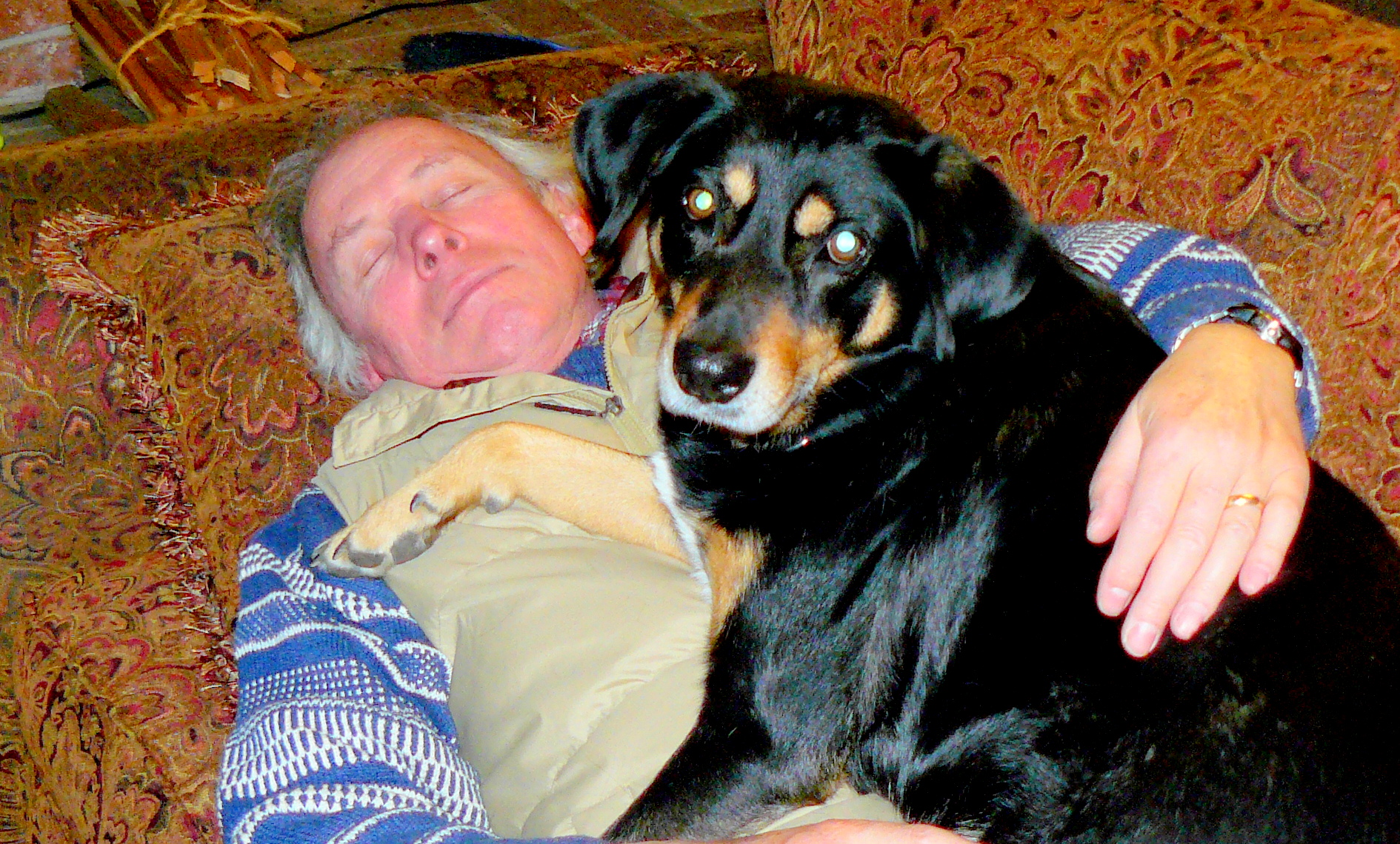
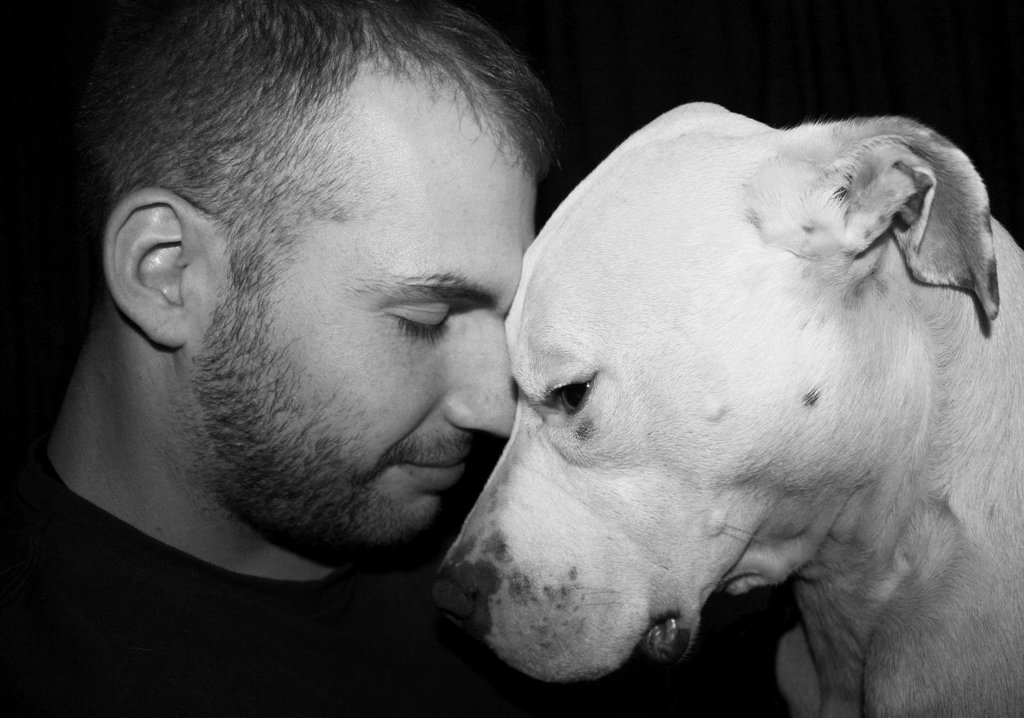
Man and dog. Each loving and protecting the other! (Ex-feral dog Hazel snuggling up on the author’s chest who, I can assure you, was genuinely fast asleep when Jean took the picture one evening last January.)
“Prediction is very difficult, especially if it’s about the future.“ Niels Bohr
I love this saying from Mr. Bohr and often repeat it, albeit at times with my own twist to it. I was reminded of this uncertainty of the future from some comments to a recent post over at Lack of Environment. The particular post was called Can technology save us? and was a reflection of Martin Lack, the blog’s author, watching a recent BBC Horizon special called Tomorrow’s World. (There’s the YouTube of the broadcast at the end of this post.) Martin opened his post by saying:
I happened to stumble across a BBC TV Horizon special, entitled ‘Tomorrow’s World’ last Thursday. It begins with a fascinating review of humankind’s history of – and propensity for – invention. It also explains some truly fascinating – and inspiring – developments in the spheres of space exploration, nanotechnology, biotechnology, and power generation.
In the introduction, the programme presenter and narrator Liz Bronnin explains how, after 100’s of thousands of years of technological stagnation, the fast-moving world of technological innovation is very definitely a modern invention.
Then a little later Martin goes on to say:
After about 32 minutes, Bronnin introduces the power of the Internet to promote innovation – crowd-sourcing research funding and the concept of open-source technology – the complete abrogation of intellectual copyright… It is a fundamental challenge to globalised Capitalism; but it may well be the solution to many of our problems…
However, to me, the final third of the programme is by far the most fascinating… It looks at the challenges of finding a replacement for fossil fuels. It provides a very clear message that this is a technological challenge driven by the reality of physics – not by ideology.
But, overall, Martin lets us know his perspective with his final paragraphs:
Re-engineering nature for our benefit will, without doubt, be very very useful. However, I still think the optimism of the comment at the very end of the programme “…I never worry about the future of the human race, because I think we are totally capable of solving problems…” is very unwise. This is because anthropogenic climate disruption is a problem that is getting harder to solve the longer we fail to address it effectively.
Bronnin concludes by saying that, “it is an exciting time to be alive…” However, I remain very nervous. This is because, as Professor Peter Styles of Keele University – a strong supporter of the hydraulic fracturing industry – recently acknowledged, it will be impossible for carbon capture and storage to remove enough CO2 from the atmosphere to prevent very significant changes to our climate. This is because of the collective hypnosis that deludes most people into seeing perpetual economic growth as the solution to all our problems.
In short, I am certain that technology alone cannot save us. In order to avoid the ecological catastrophe that all but the most ideologically-prejudiced and wilfully-blind can see developing all around us… we need to modify our behaviour: This primarily means that we need to acknowledge the injustice of a “use it up and wear it out” mentality and, as individuals, all learn to use an awful lot less energy.
Climate change “sceptics” have picked a fight with history and science – primarily with the concept of Entropy – and they will lose. The only question that remains is this: Are we going to let them put us all in (what xraymike79 recently called) ‘the dustbin of failed evolutionary experiments’.
Now Jean and I also watched the Horizon special and, to be perfectly frank, found it both uplifting and inspiring. It seemed a great counter to the overwhelming volume of commentary these days along the lines of ‘The end of the world is nigh!‘ some of that coming from yours truly! That’s not to make light of the huge hurdles ahead.
But it was a couple of comments on Martin’s post from Patrice Ayme that got me thinking. Here’s the exchange that went between Patrice and Martin following on from a comment from Thomas Foster.
Considering that it is technology which has enabled us to “conquer” nature and thus the degradation of the environment which is a consequence of that it seems most unlikely to this writer that the cause will also bring about a cure. Thomas Foster
—–
The genus Homo has been technological for 5 million years. Give or take two million. Homo is the cure for life. Patrice Ayme
—-
If we Homo Sapiens have been technological for 5 million years, we have spent most of that time being very unsuccessful; and have spent the rest being far too successful. Is there no scope for just living in harmony with our environment (as opposed to being at war with it)? Martin Lack
—-
Hominids have been masters of the environment for at least three million years. By a million years ago, only Homo was left (but for places like Flores). Dozens of megafauna species got annihilated. Homo’s technology has extended to the entire Earth for at least a million years. The Earth itself was turned into a tool. A tool we are not at war with, but that we use. Patrice Ayme
—-
A utilitarian attitude to Nature is one that does not recognise its inherent value (i.e. which it would have even if we did not exist). Seeing ourselves as superior to Nature rather than as part of it has resulted in our not living in harmony with it. This is, by definition, equivalent to being at war with Nature. QED. Refer: Nature is not your enemy. Martin Lack
—-
Call it what you want, Martin. Man manipulates nature, and that nature one calls nature has not been “natural” for more than a million years. Except if one views man as part of nature! Patrice Ayme
Patrice is a very clear thinker even if, at times, pretty hard-hitting. But this exchange confirmed in my mind that clearly looking out to the future must always be hard. Most certainly in this period of mankind’s evolution predicting the future is especially difficult. Hence my contribution to Martin’s post:
Jean and I watched the Horizon special a couple of evenings ago. To be honest, I’m not entirely sure what my overall thoughts are in response to your post, Martin. What does come to mind is that old saying, “Never underestimate the power of unintended consequences.”
So it may be that we are at a particular point in time, or more likely an era, where seeing clearly into the future is challenging.
The one aspect of modern life that is a game-changer is what we are doing now. Sharing ideas and thoughts across a far-flung net. Not only as the Horizon programme illustrated but as ordinary people trying to make sense of the world.
These are incredibly uncertain times. Undoubtedly not the first in man’s long history as an historian will explain (cue to Alex!). But to all of us alive today, these are the most uncertain times we have ever experienced!
No wonder so many of us feel lost at times in today’s world.
Here’s that BBC Horizon, courtesy of YouTube.
I will close with this thought from one masterly ‘wordsmith’, William Wordsworth.
“Life is divided into three terms – that which was, which is, and which will be. Let us learn from the past to profit by the present, and from the present, to live better in the future.”
I feel very guilty as I didn’t make a note of where I came across this film. Whoever highlighted the film, thank you! It’s truly beautiful. So, please, settle yourself down and be enthralled.
In March 1940, the author John Steinbeck and his friend, marine biologist Ed Ricketts, sailed down the coast of California and Mexico to the Sea of Cortez. “The abundance of life here gives one an exuberance,” they wrote, “a feeling of fullness and richness.”
Their stated purpose was to document the creatures that inhabit shallow waters and tide pools on the margins of the Sea of Cortez. But it became much more. In these mysterious, phosphorescent waters they sought an understanding of mankind’s relationship to the natural world and a wellspring of hope for a world headed toward war.
Looking beyond the events of the day, the two friends foresaw our rising impact on the oceans and the devastating impact that over fishing would have on this rich sea. And yet, in their journey, they encountered a periodic cooling of the eastern Pacific Ocean known as La Niña that can still set off an explosion of life.
Can the story of their journey inspire new efforts to preserve the Sea of Cortez? Down along the shores of western Mexico, the wind blows hot and dry. Beyond these barren landscapes, cold currents rush up from the deep and the ocean literally boils with life.
Following their journey down to the Sea of Cortez in March of 1940, John Steinbeck and Ed Ricketts searched for a way to describe what they saw. “Trying to remember this place,” they wrote, “is like trying to re-create a dream. It is fierce and hostile and sullen. The stone mountains pile up to the sky and there is little fresh water. But we know we must go back if we live, and we don’t know why.”
The Sea of Cortez is one of the most diverse marine ecosystems on the planet. It’s shaped by the cool waters of the California Current flowing into the warm tropics and by a complex undersea terrain that rises up along a chain of islands and sea mounts. It was the shorelines, between the desert and the deep, that drew John Steinbeck, the author, and Ed Ricketts, a marine biologist and expert on coastal ecosystems.
Ricketts’ book, “Between Pacific Tides,” is a classic study of the inter-tidal zones of the California coastline and the myriad creatures that live in shallow pools, clinging to rocks to sift the rich nutrients carried in by the tides. Steinbeck and Ricketts sought to extend this work to the Sea of Cortez and to explore ideas at the core of their friendship. They shared a belief that man’s fate, like that of the animals they saw, is linked to the health of the natural world. [Ed. my emphasis]
Ricketts is said to have inspired some of Steinbeck’s most memorable characters, including Doc in Cannery Row, and the preacher Jim Casy in The Grapes of Wrath, published a year before their voyage. Set against the backdrop of drought and economic depression, the book describes the dustbowl conditions that gripped the American heartland in the 1930’s. “Now the wind grew strong and hard and it worked at the rain crust in the corn fields. Little by little the sky was darkened by the mixing dust, and carried away. The wind grew stronger. The rain crust broke and the dust lifted up out of the fields and drove gray plumes into the air like sluggish smoke.”
In most years, southerly winds carry moisture into the midsection of the country from the Gulf of Mexico. In the 1930’s, according to a recent NASA study, those winds were diverted by a build up of warm water in the Western Atlantic and by a periodic cooling of the Eastern Pacific known as La Niña. This combination robbed the region of rain.
By the time Steinbeck and Ricketts began their journey, the historic backdrop had shifted to war. Fighting had engulfed Europe and was spreading to the western Pacific. While the United States was still officially neutral, American companies had begun supplying arms to the allied effort. In early 1940, John Steinbeck used money he earned from “The Grapes of Wrath” to hire a sardine boat called the Western Flyer. From Monterrey, California, he, his wife Carol, Ed Ricketts and a four-man crew headed south, charting a course along the Mexican coastline.
By all accounts, the journey was filled with adventure, camaraderie, and a sense of wonder at the diversity of living things they encountered. Over a six-week period, the two friends wrote journal entries, took notes on conversations, and catalogued specimens they collected on the way. They compiled these writings into a book: “Sea of Cortez, A Leisurely Journal of Travel and Research,” later changed to “The Log From the Sea of Cortez.”
The work amounts to a search for a way to understand nature, and humanity at large, in a world steadily coming apart at the seams.
Ed Ricketts
The film was released last Feb 28, 2013. Directed by Thomas Lucas, the Producers were John Friday, Thomas Lucas and Adam Ravetch.
oooOOOooo
Will end with a couple of personal reflections. First is that when I was invited out to Mexico for Christmas 2007 by Suzann and Don, I travelled to San Carlos, Mexico on the Eastern shores of the Sea of Cortez. San Carlos is a little under 300 miles south of the Arizonan border with Mexico and was where Jean had been living for many years. Meeting Jean changed my life forever! Here’s a picture of the Sea of Cortez through the rear door of Jean’s house in San Carlos.
Not the longest walk in the world to the beach!
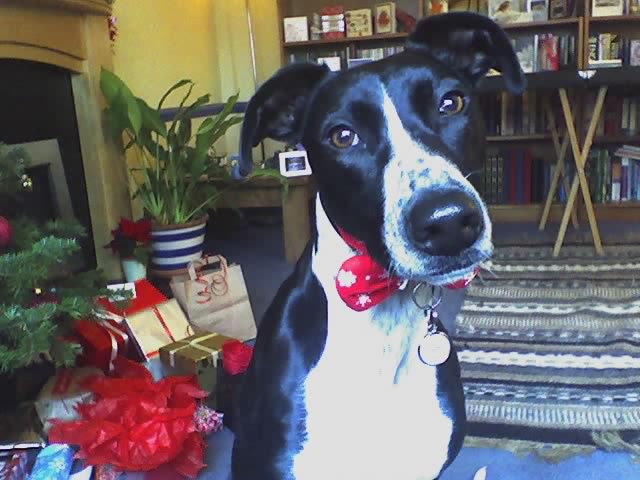
Second reflection is about dogs. Jean had spent many years rescuing Mexican feral dogs and finding homes for them; hundreds of them over her time in San Carlos. We brought 13 of those dogs with us when we moved to Arizona and 9 came to Oregon. Below is Hazel, one of the five remaining Mexican ‘rescue’ dogs that are still with us in Oregon.
A most heart-warming story! Beats the heck out of murders, politics and terrorists!
This was sent in by John Hurlburt for Jean who has been a bit of a ‘horse lady’ in her times and is devoted to the two miniature horses we have here in Oregon.
oooOOOooo
Meet Molly
Molly is a gray speckled pony who was abandoned by her owners when Hurricane Katrina hit southern Louisiana . She spent weeks on her own before finally being rescued and taken to a farm where abandoned animals were stockpiled. While there, she was attacked by a dog and almost died. Her gnawed right front leg became infected and her vet went to Louisiana State University (LSU) for help.
However, LSU were overwhelmed and Molly became a ‘welfare’ case. You know where that goes, don’t you!
Then surgeon Rustin Moore met Molly and changed his mind. He saw how Molly was careful to lie down on different sides so she didn’t seem to get sores. He saw how Molly allowed people to handle her. She protected her injured leg. She constantly shifted her weight and didn’t overload her good leg. She was a smart pony with a serious survival ethic.
Surgeon Moore agreed to remove her leg below the knee and a temporary artificial limb was built. Molly walked out of the clinic and, in a very real sense, that’s where her story really begins.
“This was the right horse and the right owner!” Moore insisted.
Molly happened to be a one-in-a-million patient. She’s tough as nails, but sweet, and she was willing to cope with pain. She made it obvious she understood that she was in trouble. The other important factor, according to Moore , is having a truly committed and compliant owner who is dedicated to providing the daily care required over the lifetime of the horse.
Molly’s story turns into a parable for life in Post-Katrina Louisiana. The little pony gained weight and her mane finally felt a comb. Then, amazingly, a prosthesis designer built her a leg.
The prosthetic has given Molly a whole new life, Allison Barca DVM, Molly’s regular vet, reports:
And she asks for it. She will put her little limb out and come to you and let you know that she wants you to put it on. Sometimes she wants you to take it off too. And sometimes, Molly gets away from Barca. “It can be pretty bad when you can’t catch a three-legged horse,” she laughs.
Most important of all, Molly has a job now. Kay, the rescue farm owner, started taking Molly to shelters, hospitals, nursing homes, and rehabilitation centers. Anywhere she thought that people needed hope. Wherever Molly went, she showed people her pluck. She inspired people, and she had a good time doing it.
“It’s obvious to me that Molly had a bigger role to play in life,” Kay said. “She survived the hurricane, she survived a horrible injury, and now she is giving hope to others.”
Allison Barca concluded, “She’s not back to normal, but she’s going to be better. To me, she could be a symbol for New Orleans itself.”
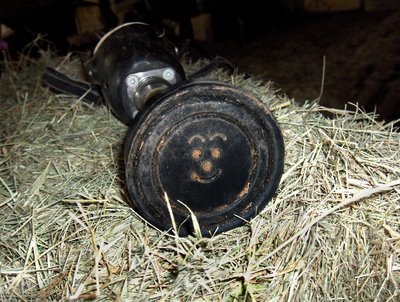
This is Molly’s most recent prosthesis.
Wherever Molly goes, she leaves a smiley hoof print behind. Literally as well as metaphorically.
The photo shows that the bottom flat surface of the prosthesis has a smiley face embossed in it!
Leave you with that wonderful feeling of love for Molly? Feel free to share it with all the animal lovers that you know.







 By Jonathan Amos Science correspondent, BBC News