Category: Culture

Taking a pee, Europe style!

Wonderful item sent to me from Bob Derham.

Important EU announcement


The British Penny

EU Directive No. 456179


In order to help meet the conditions for joining the Single European currency, all citizens of the United Kingdom of Great Britain and Northern Ireland must be made aware that the phrase ‘Spending a Penny’ is not to be used after 31st December 2013 .

From this date, the correct terminology will be: ‘Euronating’.

oooOOOooo

To all readers who are unfamiliar with the phrase ‘spend a penny’ it effectively means going to the bathroom, in American speak.

An English penny, circa 1912

My understanding is that when the first public lavatories were opened in the cities of England, one had to place a penny in the mechanism in order to open the door to the toilet.  Hence the expression of spending a penny.

In praise of Pit Bull dogs.

A guest post by Noella Schink.

Not so long ago, this email was received by me:

Possible Guest Post?

Hello!

My name is Noella and I am a writer and dog enthusiast from Portland, Maine. I am reaching out to you in hopes of contributing to Learning from Dogs as a guest blogger. I have an original, unpublished piece about Top Five Reasons to Pet a Pitbull Today, that I think would fit nicely with the current offering of blog topics you post. I would also be open to writing you a new piece,  if there’s a specific topic you’d like covered.

Please let me know if you’d be interested in having a look at my piece and hopefully fitting it into your editorial calendar.

I hope to hear back from you soon!

Thanks,

Noella

Now to be honest, this type of writing offer is not that rare but almost without exception is connected to some form of commercial organisation seeking to advance their profile. My responses are ‘not interested’!  Initially, that was my first impression of this email from Noella.   But in reply to my query along that vein, Noella sent me this:

Paul,

You’re right, there will be revenue earned from dog friendly businesses that want to get involved and have ads featured on Harry’s Picks. As you can see, presently we have one dog bakery featured. The idea is to keep the website running and give back to the canine community. We are not affiliated with any brand or company.

Thank you,

Noella

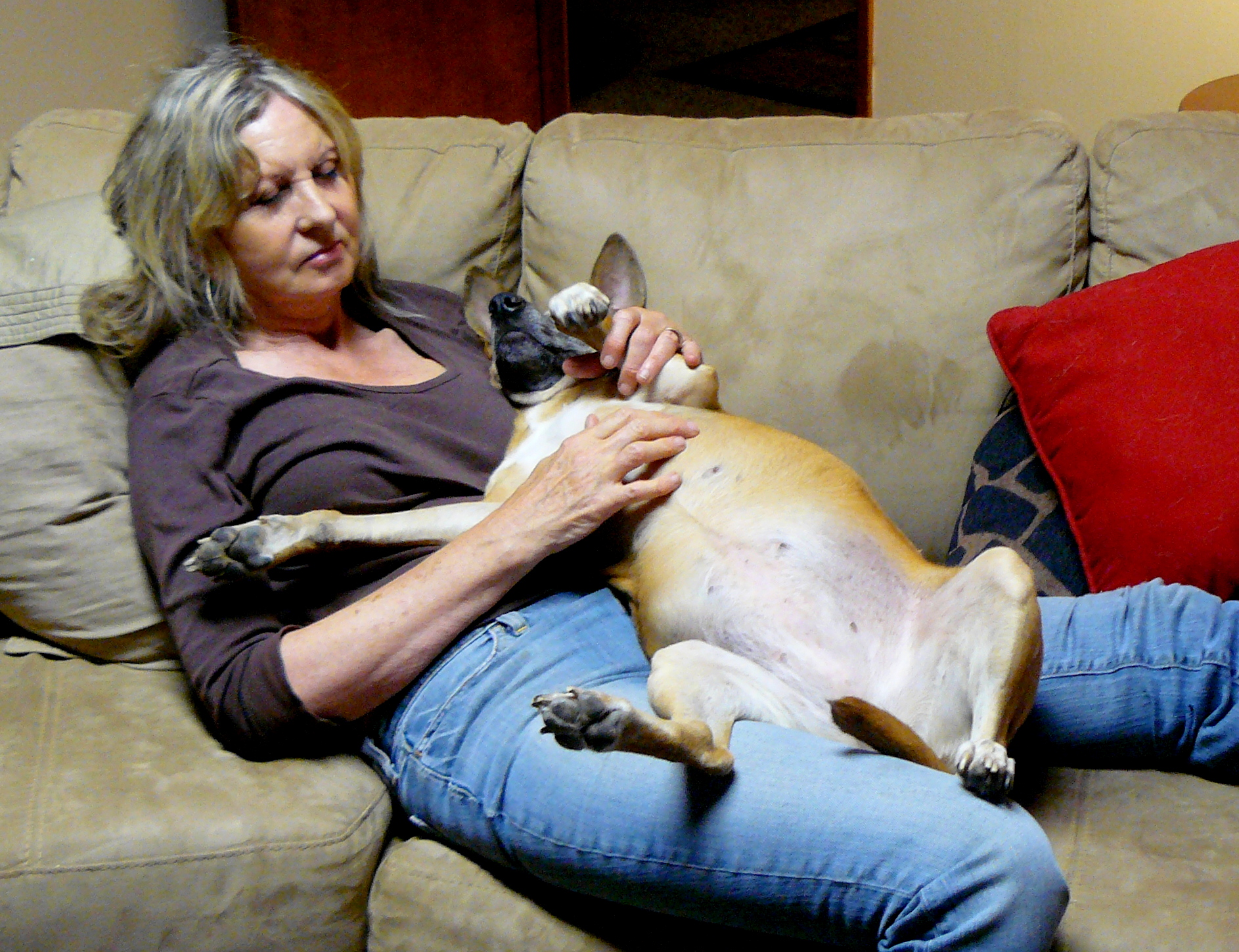
Thus on that basis I was happy to go ahead with the guest post.  Influenced in great part by the gorgeous temperament of our Casey, a Pit Bull that we adopted February, 2012 when we were still living in Payson, Arizona.  Casey, as he was named, had been living in the Humane Centre for nearly a year with no-one taking a liking to him, and his days as a rescue dog were running out.

Jean loved Casey from first sight and in due course brought him home.  He quickly settled into the most wonderful, caring and gregarious dog one could imagine.  He continues to be a happy, warm dog with all of us here in Oregon.

Casey doing what dogs do so well – picking up a scent.
Casey doing what dogs do so well – picking up scents of his new home. (28th February, 2012)

So with all that, let me turn to Noella’s guest post.

oooOOOooo

Top 5 Reasons To Love a Pittie

Addie.
Sweet Addie.

This is Addie. She is my best friend. She is a Pit Bull mix and the sweetest dog I have ever known. I really didn’t know much about Pit Bulls when I adopted her. I hadn’t been spoiled by tales of their viciousness and I had not yet been brought into the fold by a devotee. So I had to learn fast!

Everything I know about Pit Bulls now has been through her or inspired by her.

Here are the top 5 things I love about Addie and Pit Bulls:

5) They are incredibly strong and athletic. They come in pretty small packages but they are dynamos. Addie can jump five feet straight up in the air from standing still. It’s awe inspiring to watch.

4) You will always be missed! They fuss when you come home. I’m sure lots of dogs do this, but I’ve noticed it in a lot of pitties. They whine and wiggle and snort in the most adorable way. They love people and are always ecstatic to see you. I’m lucky to get a raised eyebrow from my hound dog.

3) They love to play. Pitties are a very determined breed. They will play until you are completely worn out and they will be fully engaged and inquisitive the entire time.

2) THEY LOVE PEOPLE. In my experience Pit Bulls are the most affectionate breed. They are snuggle monsters and will use their gigantic noggins to nose their way into your personal space whether you are seeking their attention or not.

1) THEY NEED THE LOVE. Sadly Pit Bulls and Pit Bull mixes makeup 30%-40% of shelter intakes nationwide and that number goes up in urban areas (interesting article on the subject here). Pit Bulls are misunderstood and often times fall into the hands of the wrong people. They need good owners that have the love and patience to provide them solid training and safe homes.

Noella Schink, writes from Portland, Maine, where she lives and plays with her 3-year-old pit bull mix, Addie, 8-year old shih-tzu, Brutus, and 2-year old hound, Lula. For great tips and reviews about dog friendly businesses around the country, she recommends Harry’s Picks, a new online community for dog lovers.

oooOOOooo

The power of love.

The widely reported but nonetheless wonderful story of a man and an eagle.

This was sent to me by Dan Gomez but I very quickly found information all over the ‘web’.  After reading many accounts, I decided to use the version of the story that was in Dan’s email.

oooOOOooo

Freedom and Jeff Guidry

Love and trust across the species gap.

Freedom and I have been together 11 years this summer. She came in as a baby in 1998 with two broken wings. Her left wing doesn’t open all the way even after surgery, it was broken in 4 places.  She’s my baby.

When Freedom came in she could not stand and both wings were broken. She was emaciated and covered in lice. We made the decision to give her a chance at life, so I took her to the vet’s office. From then on, I was always around her. We had her in a huge dog carrier with the top off, and it was loaded up with shredded newspaper for her to lay in. I used to sit and talk to her, urging her to live, to fight; and she would lay there looking at me with those big brown eyes. We also had to tube feed her for weeks.

This went on for 4-6 weeks, and by then she still couldn’t stand. It got to the point where the decision was made to euthanize her if she couldn’t stand in a week. You know you don’t want to cross that line between torture and rehab, and it looked like death was winning. She was going to be put down that Friday, and I was supposed to come in on that Thursday afternoon. I didn’t want to go to the center that Thursday, because I couldn’t bear the thought of her being euthanized; but I went anyway, and when I walked in everyone was grinning from ear to ear. I went immediately back to her cage; and there she was, standing on her own, a big beautiful eagle. She was ready to live. I was just about in tears by then. That was a very good day.

We knew she could never fly, so the director asked me to glove train her. I got her used to the glove, and then to Jesse’s, and we started doing education programs for schools in western Washington.

We wound up in the newspapers, radio (believe it or not) and some TV. Miracle Pets even did a show about us.

In the spring of 2000, I was diagnosed with non-Hodgkin’s lymphoma. I had stage 3, which is not good (one major organ plus everywhere), so I wound up doing 8 months of chemo. Lost the hair – the whole bit. I missed a lot of work. When I felt good enough, I would go to Sarvey and take Freedom out for walks. Freedom would also come to me in my dreams and help me fight the cancer. This happened time and time again.

Fast forward to November 2000.

The day after Thanksgiving, I went in for my last checkup. I was told that if the cancer was not all gone after 8 rounds of chemo, then my last option was a stem cell transplant. Anyway, they did the tests; and I had to come back Monday for the results. I went in Monday, and I was told that all the cancer was gone.

So the first thing I did was get up to Sarvey and take the big girl out for a walk. It was misty and cold. I went to her flight and we went out front to the top of the hill. I hadn’t said a word to Freedom, but somehow she knew. She looked at me and wrapped both her wings around me to where I could feel them pressing in on my back (I was engulfed in eagle wings), and she touched my nose with her beak and stared into my eyes, and we just stood there like that for I don’t know how long. That was a magic moment. We have been soul mates ever since she came in. This is a very special bird.

On a side note: I have had people who were sick come up to us when we are out, and Freedom has some kind of hold on them. I once had a guy who was terminal come up to us and I let him hold her. His knees just about buckled and he swore he could feel her power course through his body. I have so many stories like that..

I never forget the honor I have of being so close to such a magnificent spirit as Freedom.

An inspiring message for all.

oooOOOooo

Fight for the trees.

An update to yesterday’s post.

In the recent post Sing for the trees, Pedantry of the blog Wibble left this comment:

 don’t consider myself an envious type, but I have to admit to being jealous of your location there, Paul. Deer in the back garden! Amazing. I guess I’m lucky to see the odd squirrel. But (as usual) I digress…

Trees… yes. Were I King of the Earth my first edict would be to make it illegal to chop down any more trees anywhere for any reason, and to reward true reforestation efforts (while banning old-forest lumbering dressed up as ‘reforestation’).

As I’m not, the extent of my singing for the trees is limited to pledges on such worthy projects as Who Bombed Judi Bari? (less than subtle hint: just 39 hours to go, as I write).

Your first image above is wonderful, and is a terrific, healing counterpoint to the images I see elsewhere, such as in the clip below, of what we’re doing to our home, out of sight of most people. Thank you.

That comment also included this video:

I thought readers would be interested in learning more by visiting the Kickstarter Campaign page and just possibly offering whatever pledge you can afford.

The importance of this campaign was underlined by the fact that just last Wednesday my daughter Maija, son-in-law Marius, and grandson Morten visited the Redwood Forest as part of their holiday with us in Oregon.  Here are three of their pictures taken just two days ago.

Life-giving Redwoods.

oooo

That need lots of loving.

oooo

From young and old alike.

oooo

So do whatever you can, please!  There are just 26 hours to go at the time of posting this: 9:10 am PDT.

Thanks to Pedantry for bringing this to the attention of LfD readers and followers.

Healing our planet, person by person.

Jon Lavin reflects on the Four Noble Truths of Buddhism.

Last week, I republished a number of Jon’s posts from way back and was delighted at how many of you enjoyed his writings.  Jon and his family are taking a well-earned vacation which clearly includes reading posts on Learning from Dogs: Poor soul!  This was made clear from an email Jon sent me yesterday afternoon.

Jon had read the essay from George Monbiot that was published three days ago under my post title of Dichlorodiphenyltrichloroethane (DDT) all over again?  So hopefully, this introduction puts Jon’s email into proper context.  The subject title of Jon’s email was DDT 2.0.

oooOOOooo

Hi Paul!

Hope you guys are well on your lovely farm! We’re in sunny Falmouth for the week staying in our Ben’s student flat slowly working our way through his food supplies.

In my current chilled state, I read your reproduced article and I got to thinking; so you might pick out the odd bit of coherence in these ramblings!

I am reminded of David Hawkins’ ‘Scale of Human Consciousness’. If 80 percent of us are below the level of Integrity, and therefore truth, and the average level of integrity in business is below this level, it is no wonder that money comes before the greater good. Think of the banking crisis as a good example.

I guess we move forward at the speed of the slowest. We certainly seem to learn through the pain and suffering of our own making. I can understand now why this world is perfect for our development and advancement. We are exposed to every opportunity to better ourselves and not everyone has enough of what it takes to hit the mark. We just have to keep going until we get it, even if this means pain and suffering.

The Four Noble Truths of Buddhism talk about suffering and how we create it.The First Noble Truth states that life is suffering. The 2nd Noble Truth talks about our craving for things: money, possessions, etc.; cravings that create suffering. The Third Noble Truth talks of a cure and a way out of hopelessness and suffering and finally, the Fourth Noble Truth gives guidance on walking the path out of suffering.

So, although your article is awful, it is to be expected that we keep being attracted to these sorts of schemes and are attracted to money. We have to learn through pain and suffering until we get it right.

People frequently ask, “What can I do to help?”. Unfortunately or fortunately, there is a way out! The best way to help is to work on ourselves! Sounds a bit silly but by working and developing ourselves we raise the overall level of human consciousness. This means that when companies and individuals attempt to do things that are not integrous, there is less likelihood of them being successful.

Heady stuff really and I wouldn’t describe myself as Buddhist but I have to admit there seems to be some truth in this.

I hope some of this makes sense.

Warm wishes,

Jon.

oooOOOooo

Well, of course it makes sense; perfect sense!  Reminds me of the old adage that one cannot truly help another without first helping oneself.

Thus what I read in Jon’s words is that by living a life of integrity we help bring up the overall level of human consciousness, right across our planet.  Let me stay with that for a moment longer.  Jon mentioned David Hawkins’ ‘Scale of Human Consciousness’.  It was included in a post in January 2012 The evolution of the domestic dog but to save you going there, here it is again:

Map of Consciousness, copyright Dr. David Hawkins

One might argue that the column headed ‘LEVEL’ is a pseudonym for ‘Behaviour’. In other words, those behaviours from Courage and up represent integrity.

So when Jon writes, “The best way to help is to work on ourselves!“, what he is saying that by consciously abandoning levels below 200 we open ourselves to being a force for good beyond ourselves.  Just run your eye down the emotions from Ineffable to Affirmation and reflect on how others that offer those emotions affect us in such a positive and inspiring way.  Indeed, no better than reflecting on how a dog makes us feel when offering unconditional love!

Of course it’s not easy! Nothing great ever is. There is so much around us that we can hate (score 150), so much to create anxiety (score 100), and so many examples of despair (score 50).

But remember the beginning of integrity is 200.

Which is why trust (score 250) and optimism (score 310) and forgiveness (score 350) and especially love (score 500) are truly the tools of healing our planet.

You can start right now by hugging a dog (dogs score 210!).

Love and Trust - Grandson Morten hugging Dhalia.
Love and Trust – Grandson Morten hugging Dhalia.

Thank you, Jon.

Some content on this page was disabled on August 23, 2017 as a result of a DMCA takedown notice from Susan Hawkins. You can learn more about the DMCA here:

https://wordpress.com/support/copyright-and-the-dmca/

Healing

Always the need for healing.

My posts from Monday and yesterday about the plight of our bees must to many, frequently me as well, engender a level of hopelessness as to where we, as in the peoples of this planet, are heading.  Too many times the news is discouraging; to say the least.

But hold on for just a moment!  Here’s a quotation from this week’s Sabbath Moment from Terry Hershey:

Tears have a purpose.

they are what we carry of the ocean, and

perhaps we must become sea,

give ourselves to it,

if we are to be transformed.

Linda Hogan

What this says to me is that feelings of sadness, of grief, even of despair are an essential part of the process of ‘letting go’; of being able to heal oneself.  Just as dogs and many other animals know when to crawl away and recuperate in some peaceful and quiet place, so too must we humans counter our feelings of pain and anguish with healing.

So with that all in mind, I’m delighted, and very grateful, to Sue of Dreamwalker’s Sanctuary for permission to repost her item on Sound Healing, published last Friday.

oooOOOooo

Friday Facts ~ Sound Healing

by Sue Dreamwalker

Healing music
Healing music

Have you ever wondered why we so enjoy Music? Why various styles seem to either lift our mood or sooth our spirits? Or some grate on our nerve endings?

Sound Healing comes in various forms. I have received healing from various sources: Crystal Singing Bowls, Tuning Forks and the Mighty Gongs. The Gong Bath  in particular shifted something within my being as I physically felt something leave my aura to be replaced with a new found peace within.

Sound Healing isn’t new and if you research back to ancient times many ceremonies were done through sound.

I know in the 90s when I was going through my own major self-healing after listening to some tapes by Deepak Chopra called Magical Mind Magical Body in which he speaks about our vowel sounds. I remember driving to work, and on occasion still do, chanting out Very Loudly the vowel sounds in a chant, each vowel holds its own frequency.  Chanting brings an awareness of our own voice, as we express outwards our feelings, and there are some interesting theories as how certain frequencies are powerfully connected to our body. This includes the frequency of 528hz,referred to as ancient solfeggio frequencies which has been researched for its proposed ability to heal and resonate with human DNA. I did my own research on the net, and came across this site and post Forgotten in Time: The Ancient Solfeggio Frequencies )

Interestingly too the author of that post went on to explain how Deepak Chopra was a big inspiration and listened to the same tapes I did where Deepak Chopra explained saying: “Quantum physics has found that there is no empty space in the human cell, but it is a teeming, electro-magnetic field of possibility or potential.” This made me smile as synchronicity seemed to be playing a role.

Within that same article the author went on to say how music makes waves which produces shapes and patterns and quoted a passage from a book by the first to make that connection, a German scientist, Ernst Chladni who in 1787 detailed his findings in his book “Discoveries Concerning the Theory of Music.” These patterns and figures are called Chladni figures with each note having a corresponding pattern or vibration.

My drum, as I painted it.

My own tool is the Drum and if we look back through time we see how the Drum beat has been used not only in rituals but also within our military as we march to its beat!  The Drum is very powerful and many join Drumming circles.  You, too, can find out how to call Healing from within a Drumming Circle from an article in the magazine Sacred Hoop of 2003 called Healing Power of the Drum Circle

Side view of my drum.

Sound Healing works, because we are all vibration, we all resonate with our own frequencies. For those wishing to learn more the links are below and of course there are many many articles covering this subject on the ‘web’.

For those who have not much time I will leave you with this one note of vibration from a Singing bowl. If you go to the YouTube site you will find more about this One note and how it heals.

… and for those who have 5 minutes to spare this Om Meditation.

Sue~Dreamwalker

Sources:
http://www.holistic-resonance.com/

http://gongsofjoy.com/articles/

http://www.amazon.co.uk/Magical-Body-Mind-Connection-Well-Being/dp/0743530136/ref=sr_1_1?ie=UTF8&qid=1376658622&sr=8-1&keywords=magical+mind+magical+body

http://www.somaenergetics.com/forgotten_in_time.php

http://theworlddrum.com/more.html

http://shamanicdrumming.com/healing_power_of_the_drum_circle.html

oooOOOooo

I thought it would be helpful to include the YouTube notes that were associated with those two videos.

First: 7th Chakra – Reiki Angel Crystal Singing Bowl Sound Healing

Chakra’s are energy centers in your body. There are 7 major Chakra’s. Each Chakra governs specific issues and lessons.By aligning the chakra system you can heal your mental, emotional, spiritual & physical bodies.

7th Chakra= Crown Chakra

Color: Purple

Location: top of head

Element: Superether

Musical note/ sound: B/ silence

Glands/ Organs: Pineal gland, cerebral cortex, central nervous system, right eye

Foods: Fasting

Essential Oils: Frankincense, Myrrh

Stones/ Crystals: amethyst, alexandrite,diamond, sugalite, purple fluorite, quartz, selenite

Purpose: vitalizes upper brain, unification with higher self. Being open to source, accepting our own Divinity, Beauty, healing, Inspiration. Perception beyond space & time, perceives “miracles”.

When Harmonious: Idealism, selfless service, One with divine, spiritual will, unity.

When Disrupted: lack of inspiration, confusion, depression, alienation, hesitation to serve, senility, crisis of faith.

Second: Aum Meditation

Working with Aums will resonate into all objects around you, effectively re-writing all undesirable environmental energy programming. Like a springboard of positivity. Use it to launch your spiritual work to new heights. This is just a small sample of the full meditation.

Dichlorodiphenyltrichloroethane (DDT) all over again?

The terribly worrying bee crisis.

Yesterday, I wrote about the growing awareness of a major crisis affecting bees in a number of countries.  Coincidentally, when researching the various articles for that post, into my email ‘inbox’ came the latest essay from George Monbiot published both in the UK Guardian newspaper and on his own blog.  The title was DDT 2.0.  I emailed Mr. Monbiot requesting permission to republish his essay in full on Learning from Dogs and promptly received his approval to so do.

But for those who for whatever reason, don’t recall clearly the history of DDT, here’s some background.

Wikipedia’s entry opens, thus:

DDT (dichlorodiphenyltrichloroethane) is an organochlorineinsecticide which is a colorless, crystalline solid, tasteless and almost odorless chemical compound. Technical DDT has been formulated in almost every conceivable form including solutions in xylene or petroleum distillates, emulsifiable concentrates, water-wettable powders, granules, aerosols, smoke candles, and charges for vaporisers and lotions.[2]

First synthesized in 1874, DDT’s insecticidal properties were not discovered until 1939, and it was used with great success in the second half of World War II to control malaria and typhus among civilians and troops. The Swiss chemist Paul Hermann Müller was awarded the Nobel Prize in Physiology or Medicine in 1948 “for his discovery of the high efficiency of DDT as a contact poison against several arthropods.”[3] After the war, DDT was made available for use as an agricultural insecticide, and soon its production and use skyrocketed.[4]

Then goes on to mention Rachel Carson (1907 – 1964) and her mind-boggling expose of DDT in the famous book Silent Spring.

The legacy of Rachel Carson.

The Natural Resources Defense Council (NRDC) website explains:

The Story of Silent Spring

How a courageous woman took on the chemical industry and raised important questions about humankind’s impact on nature.

Although their role will probably always be less celebrated than wars, marches, riots or stormy political campaigns, it is books that have at times most powerfully influenced social change in American life. Thomas Paine’s Common Sense galvanized radical sentiment in the early days of the American revolution; Uncle Tom’s Cabin by Harriet Beecher Stowe roused Northern antipathy to slavery in the decade leading up to the Civil War; and Rachel Carson’s Silent Spring, which in 1962 exposed the hazards of the pesticide DDT, eloquently questioned humanity’s faith in technological progress and helped set the stage for the environmental movement.

Carson, a renowned nature author and a former marine biologist with the U.S. Fish and Wildlife Service, was uniquely equipped to create so startling and inflammatory a book. A native of rural Pennsylvania, she had grown up with an enthusiasm for nature matched only by her love of writing and poetry. The educational brochures she wrote for the Fish and Wildlife Service, as well as her published books and magazine articles, were characterized by meticulous research and a poetic evocation of her subject.

You can read the rest of that NRDC article here.

So with all that in mind, here’s the essay from George Monbiot.

oooOOOooo

DDT 2.0

August 13, 2013

We’re just beginning to understand the wider impacts of neonicotinoids.

By George Monbiot, published on the Guardian’s website, 5th August 2013

It’s the new DDT: a class of poisons licensed for widespread use before they had been properly tested, which are now ripping the natural world apart. And it’s another demonstration of the old truth that those who do not learn from history are destined to repeat it.

It is only now, when neonicotinoids are already the world’s most widely deployed insecticides, that we are beginning to understand how extensive their impacts are. Just as the manufacturers did for DDT, the corporations which make these toxins claimed that they were harmless to species other than the pests they targeted. Just as they did for DDT, they have threatened people who have raised concerns, published misleading claims and done all they can to bamboozle the public. And, as if to ensure that the story sticks to the old script, some governments have collaborated in this effort. Among the most culpable is the government of the United Kingdom.

As Professor Dave Goulson shows in his review of the impacts of these pesticides, we still know almost nothing about how most lifeforms are affected. But as the evidence has begun to accumulate, scientists have started discovering impacts across a vast range of wildlife.

Most people who read this newspaper will be aware by now of the evidence fingering neonicotinoids as a major cause of the decline of bees and other pollinators. These pesticides can be applied to the seeds of crops, and they remain in the plant as it grows, killing the insects which eat it. The quantities required to destroy insect life are astonishingly small: by volume these poisons are 10,000 times as powerful as DDT. When honeybees are exposed to just 5 nanogrammes of neonicotinoids, half of them will die. As bees, hoverflies, butterflies, moths, beetles and other pollinators feed from the flowers of treated crops, they are, it seems, able to absorb enough of the pesticide to compromise their survival.

But only a tiny proportion of the neonicotinoids that farmers use enter the pollen or nectar of the flower. Studies conducted so far suggest that only between 1.6 and 20% of the pesticide used for dressing seeds is actually absorbed by the crop: a far lower rate even than when toxins are sprayed onto leaves. Some of the residue blows off as dust, which is likely to wreak havoc among the populations of many species of insects in hedgerows and surrounding habitats. But the great majority – Goulson says “typically more than 90%” – of the pesticide applied to the seeds enters the soil.

In other words, the reality is a world apart from the impression created by the manufacturers, which keep describing the dressing of seeds with pesticides as “precise” and “targeted”.

Neonicotinoids are highly persistent chemicals, lasting (according to the few studies published so far) for up to 19 years in the soil. Because they are persistent, they are likely to accumulate: with every year of application the soil will become more toxic.

What these pesticides do once they are in the soil, no one knows, as sufficient research has not been conducted. But – deadly to all insects and possibly other species at tiny concentrations – they are likely to wipe out a high proportion of the soil fauna. Does this include earthworms? Or the birds and mammals that eat earthworms? Or for that matter, the birds and mammals that eat insects or treated seeds? We don’t yet know enough to say.

This is the story you’ll keep hearing about these pesticides: we have gone into it blind. Our governments have approved their use without the faintest idea of what the consequences are likely to be.

You might have had the impression that neonicotinoids have been banned by the European Union. They have not. The use of a few of these pesticides has been suspended for two years, but only for certain purposes. Listening to the legislators, you could be forgiven for believing that the only animals which might be affected are honeybees, and the only way in which they can be killed is through the flowers of plants whose seeds were dressed.

But neonicotinoids are also sprayed onto the leaves of a wide variety of crop plants. They are also spread over pastures and parks in granules, in order to kill insects that live in the soil and eat the roots of the grass. These applications, and many others, remain legal in the European Union, even though we don’t know how severe the wider impacts are. We do, however, know enough to conclude that they are likely to be  bad.

Of course, not all the neonicotinoids entering the soil stay there indefinitely. You’ll be relieved to hear that some of them are washed out, whereupon … ah yes, they end up in groundwater or in the rivers. What happens there? Who knows? Neonicotinoids are not even listed among the substances that must be monitored under the EU’s water framework directive, so we have no clear picture of what their concentrations are in the water that we and many other species use.

But a study conducted in the Netherlands shows that some of the water leaving horticultural areas is so heavily contaminated with these pesticides that it could be used to treat lice. The same study shows that even at much lower concentrations – no greater than the limits set by the European Union – the neonicotinoids entering river systems wipe out half the invertebrate species you would expect to find in the water. That’s another way of saying erasing much of the foodweb.

I was prompted to write this article by the horrible news from the River Kennet in southern England: a highly protected ecosystem that is listed among the few dozen true chalk streams on earth. Last month someone – farmer or householder, no one yet knows – flushed another kind of pesticide, chlorpyrifos, down their sink. The amount was equivalent – in pure form – to two teaspoonsful. It passed through Marlborough sewage works and wiped out most of the invertebrates in fifteen miles of the river.

The news hit me like a bereavement. The best job I ever had was working, during a summer vacation from university, as temporary waterkeeper on the section of the Kennet owned by the Sutton estate. The incumbent had died suddenly. It was a difficult job and, for the most part, I made a mess of it. But I came to know and love that stretch of river, and to marvel at the astonishing profusion of life the clear water contained. Up to my chest in it for much of the day, I immersed myself in the ecology, and spent far more time than I should have done watching watervoles and kingfishers; giant chub fanning their fins in the shade of the trees; great spotted trout so loyal to their posts that they had brushed white the gravel of the river bed beneath their tails; native crayfish; dragonflies; mayflies; caddis larvae; freshwater shrimps and all the other teeming creatures of the benthos.

In the evenings, wanting company and fascinated in equal measure by the protest and the remarkable people it attracted, I would stop at the peace camp outside the gates of the Greenham Common nuclear base. I’ve told the strange story that unfolded during my visits in another post.

Campaigners seeking to protect the river have described how, after the contamination,the river stank from the carcases of the decaying insects and shrimps. Without insects and shrimps to feed on, the fish, birds and amphibians that use the river are likely to fade away and die.

After absorbing this news, I remembered the Dutch study, and it struck me that neonicotinoid pesticides are likely, in many places, to be reducing the life of the rivers they enter to a similar extent: not once, but for as long as they are deployed on the surrounding land.

Richard Benyon, the minister supposed to be in charge of protecting wildlife and biodiversity, who happens to own the fishing rights on part of the River Kennet, and to represent a constituency through which it passes, expressed his “anger” about the chlorpyrifos poisoning. Should he not also be expressing his anger at the routine poisoning of rivers by neonicotinoids?

Were he to do so, he would find himself in serious trouble with his boss. Just as they are systematically poisoning our ecosystems, neonicotinoids have also poisoned the policies (admittedly pretty toxic already) of the department supposed to be regulating them. In April, Damian Carrington, writing in the Observer, exposed a letter sent by the ministerin charge of the Department for Environment, Food and Rural Affairs (Defra), Owen Paterson, to Syngenta, which manufactures some of these pesticides. Paterson promised the company that his efforts to prevent its products from being banned “will continue and intensify in the coming days”.

And sure enough, the UK refused to support the temporary bans proposed by the commission both in April and last month, despite the massive petitions and the 80,000 emails on the subject that Paterson received. When Paterson and Deathra were faced with a choice between the survival of natural world and the profits of the pesticides companies, there was not much doubt about how they would jump. Fortunately they failed.

Their attempt to justify their votes led to one of the most disgraceful episodes in the sorry record of this government. The government’s new chief scientist, Sir Mark Walport, championed a “study” Deathra had commissioned, which purported to show that neonicotinoids do not kill bees. It was not published in a peer-reviewed journal, nor could it be, as as any self-respecting scientist, let alone the government’s chief scientist, should have been able to see in a moment that it was complete junk. Among many other problems, the controls were hopelessly contaminated with the pesticide whose impacts the trial was supposed to be testing. The “study” was later ripped apart by the European Food Safety Authority.

But Walport did still worse, making wildly misleading statements about the science, and using scare tactics and emotional blackmail to try to prevent the pesticides from being banned, on behalf of his new masters.

It is hard to emphasise sufficiently the importance of this moment or the dangers it contains: the total failure of the government’s primary source of scientific advice, right at the beginning of his tenure. The chief scientist is not meant to be a toadying boot-licker, but someone who stands up for the facts and the principles of science against political pressure. Walport disgraced his post, betrayed the scientific community and sold the natural world down the river, apparently to please his employers.

Last week, as if to remind us of the extent of the capture of this government by the corporations it is supposed to be regulating, the scientist who led the worthless trials that Walport and Paterson cited as their excuse left the government to take up a new post at … Syngenta. It seems to me that she was, in effect, working for them already.

So here we have a department staggering around like a drunkard with a loaded machine gun, assuring us that it’sh perfectly shafe. The people who should be defending the natural world have conspired with the manufacturers of broad-spectrum biocides to permit levels of destruction at which we can only guess. In doing so they appear to be engineering another silent spring.

oooOOOooo

Frankly, there are more and more occasions when I think that if homo sapiens becomes virtually extinct there will be no queries as to why it happened.  Then again, a much more positive muse would be to see the ever-increasing madness going on in today’s world as the crumbling death throws of a materialistic and consumptionist era that is past its time.

It’s not music; yet it is and more so!

The polyphonic me: Just be amazed.

Published on Aug 2, 2013

Frustrated by not being able to sing two notes at the same time, musical inventor Beardyman built a machine to allow him to create loops and layers from just the sounds he makes with his voice. Given that he can effortlessly conjure the sound of everything from crying babies to buzzing flies, not to mention mimic pretty much any musical instrument imaginable, that’s a lot of different sounds. Sit back and let the wall of sound of this dazzling performance wash over you.

Enjoy!

On being honest.

A reposting of an article by Jon Lavin, first published on the 3rd July, 2010.)

Conscientiousness isn’t all it’s cracked out to be!

(Foreword from Paul.)

Jon is one of those rare individuals who not only has been committed to a path of self-awareness for more than 30 years but who has also studied incredibly hard so as to be able to help others and do so from a base of real competence, as his own Blog describes.

But then I realised the great strength in what Jon has written.  It is this.

There are many notable teachers to whom thousands upon thousands have turned to for a deeper understanding of what life is all about.  As far back as time itself, teachers have surfaced and given spiritual guidance to those that come in need.  But it’s very difficult to read or listen to these great teachers and connect with the fact that they were born, as we are all born, with nothing.  And all of them, like many of us, went through Hell on wheels to come out the other side with a greater self-awareness and a deeper understanding of the real truths in nature.  Like all of us who wish to rise above our present place they first acknowledged their own frailties. It is the starting point.

So, let me get to the point.  Jon has the awareness and understanding to offer real help to those that seek answers that are currently beyond reach.  Jon’s article is an wonderful illustration that he experiences the same fears and feelings of helplessness that you and I feel.  You and I and Jon and all of humanity are much more closely connected than we realise.

Paul H.

oooOOOooo

To see in is to see out!

I’ve been running my own business for about 12 years now. In the beginning it started because I had a thirst for wanting to make a difference in small business in our local area and a passion for wanting to do it through working with people directly, on their behaviours. Still have, really.

I think this came as a form of acknowledgement to the few exceptional people managers I experienced while I was employed, and the all too common, terrible ones.

I was also mentored by a group of people to whom no developmental tool was barred. My eyes were well and truly opened to how a change of view could change outcomes.

The final boot up the backside was redundancy in the late 90s. I was all ready to go and just needed a kick.

My work ethic, trained at home and then through an engineering apprenticeship, was to conscientiously work hard and try hard and to treat people the way you want to be treated. Nothing wrong with that. I assumed automatic reward would follow as long as I did those things.

Over time I wised up and became a bit less idealistic and a little more politically aware but carried on in much the same way.

Much later I found myself embarking on a whole new adventure, with a lovely wife and family, all dependent on me, with a few contacts to start getting work from!

It took a year before the first jobs came in that didn’t necessitate robbing the almost non-existent savings and redundancy payment just to keep food on the table. Then, work slowly picked up and it started to get quite good for a one-man band. We were able to go on holiday once a year, camping, but still great, and then abroad.

All the time, I beavered away, trying hard, being very conscientious, as I’d been brought up to be, but slowly getting very stressed.

Time was when it took Friday night to de-stress, then 3 days, then 10 days and recently, not at all.

So faced with this present downturn, which is likely to go on for much longer than any of the others I’ve seen and survived, I’m wondering just what new strategy to adopt. Money is already getting very tight and everything is feeling very ‘hand to mouth’. Can’t really see one month in front of the other.

I notice our local farmer who I went to school with but didn’t really know.

I’ve got degrees, lived abroad, can speak Finnish fluently, (what use is that, I hear you say!), and can turn my hand to most things, but I still feel quite dis-empowered and at a bit of a loss.

My farmer friend is always smiling, he’s got a flock of geese he’s fattening up, the same with his beef cattle, does livery for half a dozen horses or so, has fields planted with various cereal crops, and has his finger in lots of different pies – and definitely does not look stressed. He is also renting his land plus another farm.

I honestly don’t know what to make of this all except for a few really important things – the importance of diversification, relationships and appreciating what you’ve got, especially people things, here, in the now.

I have also come to the realisation that I still haven’t cracked the main thing with being self-employed, and that is replacing fear with trust.

It’s been said by various enlightened people that we see a reflection of the world we hold in mind. Going forward into this brave new world I would like to see opportunities rather than fear, I will diversify into things which make more use of my wide range of talents, and I will swap fear for trust.

By Jon Lavin

Journey into (inner) space

(A reposting of an article by Jon Lavin, first published on the 11th September, 2009.)

The journey into inner space is just as fascinating as the one into outer space.

Tony Buzan
Tony Buzan

Many, many years ago, 1973 to be precise, an English author, Tony Buzan, was involved in presenting a series on BBC television called Use Your Head.  Tony released a book to accompany the television series.  There is not a lot that I remember about that book but one thing I never forgot.  That was the number of neurons in the brain, 10 to the power 200, give or take.  I will return to this aspect in a later Post but now to the main point of this, my introductory Post.

I was working with a telephone coaching client this week who I’ve been with for over a year now.

He differs from my normal clients in that he’s paralysed from the shoulders down. About 8 years ago he was involved in a horrendous car accident which 99% of us would probably not have survived. He was in hospital for 18 months and now with the aid of his PAs (Personal Assistants), as he calls them, who get him up in the morning and put him to bed in the evening, he manages on his own.

He’s been working on a novel for sometime now and his optimism and faith in his own inherent sense of well-being is truly inspirational. He works at the novel every moment he can.

He has had to overcome many other setbacks in life but still manages to live a life which is far fuller than most able bodied people.

He frequently gives motivational talks and says things to me that wake me up from the trance state that I seem to occupy too much of the time, generally worrying about things that statistically are highly unlikely to happen. He is one of the most awake people I have ever come across.

I’m reading a book at the moment called, “Journey of Souls”, by Michael Newton, Phd. His research carried out on numerous clients under hypnosis has shown that we choose the conditions of our lives.

In order to learn the maximum amount in life, we might opt to experience life in a body that only barely functions in order to learn to overcome extreme difficulties and gain a fresh insight into what is really important.

The book is analytical to a certain extent so suits my engineer’s mind but certainly encourages reflection on decisions we make, their impact on others and the level of integrity of those decisions. The book reminds me frequently of my coaching client.

By Jon Lavin

(John may be contacted at jon.lavin (at) peopleworkshop(dot)co(dot)uk – PH)

Footnote: Recently we were driving back after being a week away.  We were on the motorway (Freeway to North Americans), quite relaxed and looking forward to being home soon.

Out of nowhere, a car 70 to 100yds in front suddenly swerved violently to the left then back to the right, hit the central metal reservation, bounced off again and, as we drove past, missed the side of our car by a few yards. This whole drama unfolded in a matter of an instant in time.

As if in slow motion, I steered the car to the inside lane and drove past – at 75mph. We were so shaken up that we were 1/4 of a mile on before I looked in the rear-view mirror and saw cars stopping and people getting out. The few seconds that this all happened in are now etched in my mind.

I wonder if it has to be like this to truly wake us from our trance?

Share