If you had to make a playlist of your life, what would be on it?
That intriguing sub-title comes from a video that Jean and I watched a couple of weeks ago.
But first I want to return to the matter of Parkinson’s Disease (PD) that was written about in a post dated the 24th February Personal Journeys. I wrote, in part,
Sue, and everyone else, we returned from seeing Dr. Lee, the neurologist, a little under two hours ago. Dr. Lee’s prognosis is that Jean is showing the very early signs of Parkinson’s disease, and Jean is comfortable with me mentioning this.
Everyone’s love and affection has meant more than you can imagine. I will write more about this next week once we have given the situation a few ‘coatings of thought’.
Jean sends her love to you all!
In recent weeks Jean has been experiencing increasing feelings of apathy, lack of motivation, lack of energy, all of which she summed up as a feeling of isolation. Plus the tremor in her hand has been slowly worsening.
Last week we decided that rather than waiting until August for the next planned appointment with Dr. Eric Lee, the neurologist, we should appraise Dr. Lee of the decline in Jean’s overall mood. That has now been done and Dr. Lee’s response is that Jean should start a trial course of the drug Sinamet® that a quick web search (see link on trade name) explains is:
SINEMET® (carbidopa-levodopa) is a combination of carbidopa and levodopa for the treatment of Parkinson’s disease and syndrome.
As before, Jean is happy for me to share this with you.
So back to the theme of playlists of our lives.
The Australian Broadcast Commission, ABC, have a YouTube channel ABCTVCatalyst that is full of great science programmes. As that website explains:
At Catalyst we know that science is a dynamic force for change. Each week Catalyst brings you stories from Australia and around the world. Our passion to meet scientists at the forefront of discovery is matched by our fascination with science breakthroughs however big or small. Science changes all our lives. For better or worse, we are committed to showing you what our future holds.
That is how Jean and I came across the following incredibly interesting talk about the role of music in our past lives assisting those with fading cognitive skills, as in my case, and including those with PD. It is just twenty-nine minutes long and something we should all watch, irrespective of our present age.
Published on Mar 8, 2016
If you had to make a playlist of your life, what would be on it? And if, toward the end of your life, your mind and memories were fading away, would this soundtrack help bring them back?
My final observation is that as a direct result of watching this programme I blew the dust off my iPod that I hadn’t used in many months. It was remarkable that despite me struggling at times to recall something I did just a few hours ago, I can hum along with tunes that are on my iPod that go back ten or twenty years.
Sully the Saint Bernard still hasn’t outgrown his love for mud.
I was working outside until late afternoon so wanted to find something quickly for today’s post.
Came across this video on YouTube from Rumble Viral – enjoy!
Published on May 19, 2016
At 4 years old Sully the Saint Bernard still hasn’t outgrown his love for mud. Here we find him playing with another dog as they run, jump and lay in a big pool of muddy water. If you’re wondering what pure happiness looks like, this is it!
One hopes these two happy dogs don’t go home and lay on the furniture.
Over the days of the 13th to 15th May, in other words roughly a week-and-a-half ago, a number of pet adoption charities in Northern California and Southern Oregon came together courtesy of PetSmart in Medford, Oregon to find new homes for unadopted dogs and cats.
I came to hear about this from an email sent to me by Tammy Moore of the organisation Shelter Friends. Tammy also c.c.’d her email to Tana Mason who is Fundraising Coordinator for the charity. Tammy’s email was an invite for me, and Jean, to attend the event on the Saturday as the author of my book.
(I would have written about the event before now but many of you will recall that was the weekend when my internet connection was down for a number of days.)
Anyway, that Saturday started off rather damp and grey but all the pet charities had previously been set up for the Friday.
But soon Jean and I had our own stand all ready for the opening time for the event and we were very grateful for being offered a table position just inside the main entrance door.
People soon started arriving and all were very friendly.
I shall continue with the photographs of the day over the next two picture parades.
But let me leave you with the results of all the fine people involved, both volunteers and the great staff at PetSmart.
In the words of Tana in answer to my question of how many animals were found homes:
I have the total for all three days, Friday, Saturday and Sunday: 9 puppies, 9 dogs and 14 cats!
I am not sure if this is a complete list of all the shelters that attended but certainly the following wonderful charities did:
Shelter Friends, Grants Pass, OR
Friends of Animals, Brookings, OR
Goliath Mountain Rescue, Yreka, CA
Rescue Ranch, Yreka, CA
Curry County Animal Shelter, Gold Beach, OR
“I believe in preventing cruelty to all living beings in any form.”
This quote from Morarji Desai, the former Prime Minister of India, is a very appropriate introduction to me republishing a post courtesy of Roughseasinthemed. It concerns the cruelty being meted out to some Spanish dogs. Or in her own words:
Thanks for picking up on the ‘dangerous’ dogs aspect. I think it is really important that dogs are not mislabelled, responsible dog owners have enough problems as it is. People are too quick to point fingers, and those of us who rescue dogs know what a difference food, water, a home, love and affection can make to a starving street animal. No dog asks to be thrown out. Or mistreated and abused. I’m currently trying to get some help and advice for a man who lives next to six Spanish hunting dogs that are chained up all day in a shed with a tin roof, where temps can go up to 50 degrees celsius, no food in their dishes and a floor covered in shit. Deplorable. These poor dogs must be traumatised.
Katherine later sent me a link to another blog with the details and some pictures. It is republished below, first in the original Spanish and then with an English translation.
ooOOoo
Perros de caza maltratados en Benissa:
Tenemos un “vecino” aquí en Benissa (Alicante), con 6 perros de caza encadenaros y estaban encerrados en una zona pequeña de 2 x 2m, un agujero tapado de placas de alumnio… las temperaturas en verano pueden subir a más de 50 grados, y los perros sufren terriblemente, lloran y ladran día y noche, viven y mueren en el infierno y sobre su propia “mierda”… Mi esposa y mi suegra están traumatizadas por esta crueldad, mandamos nuestra queja al Ayuntamiento y después de 8 meses respondieron que era lo que esperábamos por vivir en el campo… Tengo fotos tomadas de estos perros y su infames condiciones pero no estoy seguro de qué hacer con ellos porque aquí nadie parece querer saber nada…
We have a ‘neighbour’ here in Benissa, Alicante with six hunting dogs, chained up and imprisoned in a tiny hole of a place (agujero is a hole but it’s not a literal hole, or you could use hellhole, which would be my choice), two by two metres, covered with a tin roof.
The temperatures in summer get towards fifty degrees Celsius (122 deg F.), the dogs suffer terribly, they cry and bark day and night, and they live and die in the hell of their own ‘shit’.
My wife and my mother-in-law are traumatised by this cruelty, we’ve complained to the council and after eight months they’ve replied: ‘what do you expect when you live in the countryside?’
I’ve taken photos of these dogs and their suffering but I’m not sure what to do with them, because here, nobody seems to know what to do.
ooOOoo
In a response to Katherine I wrote that these dogs must be given better lives. She then added:
Fair enough Paul. We do too, so, easy to do. Sadly this man has contacted Seprona, which is the Guardia Civil section in charge of hunting, and they have washed their hands of it. But people are trying to help, coming up with suggestions, and that is the important thing.
When you read this please hold these dogs in your thoughts and hope that their terrible ordeal will soon come to an end. Also go to that blogsite that is carrying the story and leave your messages of support, in whatever language you choose! Every little bit helps, as this comment on that Spanish post illustrates:
Contact DeAnimals, a firm of lawyers in Murcia who work with the police, judges, vets etc on animal abuse cases. Also ACTIN in Murcia. They will tell you what to do.
“The ultimate tragedy is not the oppression and cruelty by the bad people but the silence over that by the good people.”Martin Luther King, Jr
Slowly picking up the pieces from our internet outage.
The fact that I was sitting in front of my PC at 4:30am yesterday morning writing this says a lot about the inconvenience of losing our internet connection last Friday evening. We love living in this rural part of Southern Oregon surrounded by such dramatic scenery but it does have a couple of downsides, one of which is that we are very limited as to internet service providers.
Anyway, on with the show!
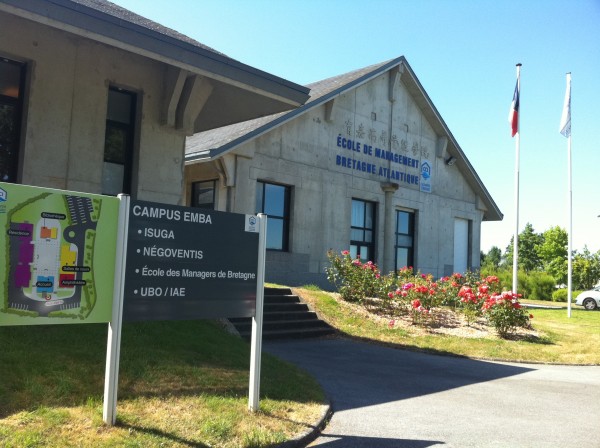
One of the posts that I had in mind for earlier this week was this rather poignant piece from Chris Snuggs. Chris and I go back many years to the time when he was Head of Studies at ISUGA; a French college based in Quimper. I was a visiting teacher at ISUGA covering entrepreneurial topics.
Enough of me, here is that story from Chris. It was sent to me on the 10th May.
ooOOoo
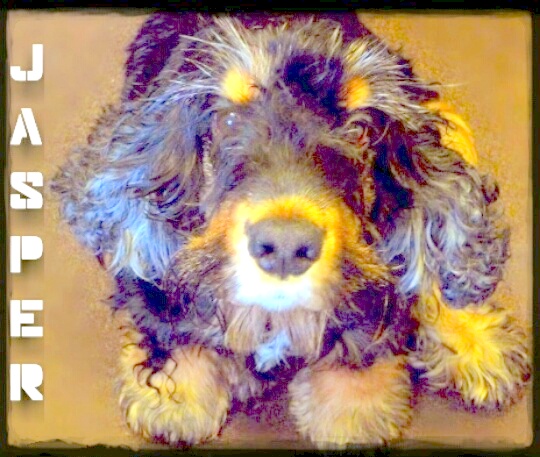
My sister’s dog died last night. Margaret woke me at 03.00 in the morning saying she needed my help. I found her at the front door, where Jasper was lying motionless, having crawled there in his last moments.
“I think he’s gone,” she said, sobbing quietly.
I knelt down and felt his side; indeed, there was no sign of breathing, though his body was still warm. Jasper had died. He had been ill for a few days, been down to the vet and got some medicine, but it had been to no avail. Maggie said he had been unusually quiet and motionless that last evening, making strange noises as his lungs failed him. At 12 years old, one cannot say it was a surprise, but until the last few days he had been right as rain, barking senselessly at nothing in particular when let out into the garden, getting under my feet as I did jobs around the house.
But death of any companion – or indeed of any living creature – is moving, shocking. He was not my dog, nor do I see him often or for long, but the one thing about dogs is that once they make friends with you – as Jasper had with me – you are a friend for life.
No matter how depressed you are, no matter how low an opinion you have of yourself, no matter how sheit your day was, whenever you walk through that front door, a dog will greet you with his tail wagging. They have infinite love, devotion and optimism; they take you as you are and love you whatever you are.
And so Jasper will be missed by me, but of course more so by my sister, who had him from a puppy. As anyone who has lost a companion knows, the house seems empty afterwards. There will be no more greetings with the wagging tail, no more forbidden jumping up onto the sofa to be patted, no more barking at the seagulls in the garden.
Death is a part of life, but hard to accept even so.
Chris Snuggs
ooOOoo
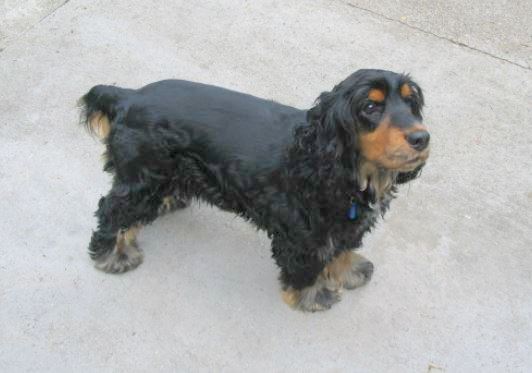
Chris also forwarded some photographs of dear Jasper that are offered in memory of the little chap.
oooo
oooo
oooo
oooo
oooo
Embracing the reality of death: One of the most important lessons that we learn from our dogs.
It is not the first time that I have written on the theme of the importance of relationships. However, I am inspired by a number of separate and discrete outcomes in the last couple of days that compell me to return to this most important principle of all: We are what we think about most.
The first outcome was a lovely reply left by Hariod Brawn to yesterday’s post. This is what she wrote:
My GSD had hip dysplasia too, Paul – if that’s what you’re alluding to with Pharaoh. He still was able to die a natural death though, as his rear quarters became paralysed with the dysplasia and he felt no pain. There were plenty of other problems resulting from his immobility, but I wouldn’t have traded those difficulties and the incredible communication we shared as a result of them, for anything – his last few weeks were some of the most powerful and precious of my entire life.
Then after my response, Hariod went on to say:
It was a deeply profound time for me, and I honestly wouldn’t have believed anyone had they told me what I experienced, but experience it I did. It was not the product of fanciful imagination, much as it might sound so in words. The communication between the two of us was quite incredible, and which really was empathic in nature, in the deepest sense of the word. We always had great communication and understanding, which all dog lovers do with their charges, of course, but this was another level altogether. Some might call it ‘psychic’, as if that meant something mystical and woo-like, but it just means ‘of the mind’. The question is, does the mind have the psychical power to share in understanding across physical borders? You will doubtless know of J. Allen Boone:
I will return to that mention of J. Allen Boone at the end of the post.
Then later on there was a further reply to the post from Barb of Passionate About Pets :
Thanks for re-publishing Gina’s post here, I found it interesting because Poppy, my little shih-tzu is an old dame now – she will be 17 in two months time. She has developed serious separation anxiety in the last year and if I am working in the garden, she barks for me to get back inside even though my husband is inside with her – she wants us BOTH with her. She is weak in her back legs so her walks are shorter. All these signs of old age make me so sad. Just like you and Pharoah, old age is creeping up on us all.
A special thank you to Hariod for including that video clip of J. Allen Boone’s dog Strongheart and the very special connection they had; he was so wise about Strongheart’s qualities – they never die. It really resonated with me.
Thank you for a wonderful post.
You can see why I entitled today’s post Relationships!
Then earlier on in my day I had a call with Jon Lavin, a friend from my days when I lived in Devon, South-West England. Jon and I still speak on a regular basis and yesterday I was complimenting Jon on a wonderful post he had written on his own business blog The People Workshop.
Jon’s post was about relationships in the workplace, his area of professional experience, and I was struck by how far the messages were relevant to all of us, in all areas of our lives. But just as key it was another reminder of the importance of all of us who express themselves on blogs; both as authors and as commentators. Because those expressions make, build and maintain great relationships.
Jon’s post is republished here with his full permission.
When you look at how much of our lives we spend at work it’s really quite attention-grabbing. I did a very rough calculation based on 40 years and 40 hours a week – and I took out holidays and weekends. It works out approximately at 4900 hours. That’s a lot of hours, especially if you do lots of overtime and weekends. All of that time, you’re probably going to be mixing with people – usually, quite a large number of people.
We are ‘relationship seeking’, says Eric Berne, originator of Transactional Analysis. So for all of that time, we’re moving in and out of relationships with other people. So here, I’m categorising any interaction with another as ‘relationship’.
Then there’s what happens when we go home, another set of relationships, and where we came from – our parents and families.
So how we are in relationship with others is very important and has a major impact on the results we get generally and particularly in the context of this article, at work.
I hear a lot of talk about ’employee engagement’ at the moment. I believe that for employees to be ‘engaged’, so actively involved in what they’re doing, thinking about it, in the ‘here and now’, they’ve got to be in relationship with their manager and probably, the team they’re part of, at least, if the job is being done properly.
I see it as the role of the manager or team leader that they have the skills and ability to develop these relationships with as many team members as possible, any exclusions being the exception. This requires a lot of self-awareness and confidence, plus the ability to build high levels of trust with a wide range of character types. I think it also requires the ability to see the world from the view point of the other person – ‘putting yourself in somebody else’s shoes’, we say. That’s quite difficult to do in my experience. However, we can donate the time to get to know the people in our team and so increase the likelihood of all of us coming from the same angle.
I think this is about the ability to value the uniqueness of others in all the different forms and approaches that manifests in, and finding ways of harnessing those skills and abilities.
These are not easy things and I am aware of the relatively few, good people managers I come across in my work but it is possible to develop these skills. You need to have the intention to want the best from ALL relationships. Also, to be prepared to use the feedback we all get, especially when things don’t go to plan in a relationship, and be continually revisiting and adjusting your approach so that you get more of what works. This way, you automatically get less of what doesn’t work.
Never under estimate the power of intention.
Stormy seas
ooOOoo
I am now going to close today’s post with those words of J. Allen Boone that Hariod had in her second reply:
To echo Jon’s closing message, let us never cease our intention of having wonderful relationships; with our dogs, with others and, not least of all, with ourselves.
Whether we like it or not, time flows in one direction.
I find it almost as difficult to know that I shall be 72 years old in November as I know that dear Pharaoh will be 13 on June 3rd., a little over three weeks from today. Both of us most firmly now in our senior years.
Knowing that dozens of you dear readers will have dogs that are also in their senior years was the motivation for me republishing the article; as follows:
ooOOoo
7 Steps to Help Your Senior Dog Be Happy and Fulfilled
I can hardly believe that my yellow Labrador, Sanchez, is turning 13 next week. I count my blessings that he is in good health and still enjoys our twice daily walks. But, I’m also aware that he can’t keep up to his activity level from even a year ago, let alone in his prime. I’m always looking for ways to provide mental stimulation to his environment without physically taxing his body.
1. Alone Time Together Daily It’s not always easy having a multi-dog household. But, it’s important to make a priority of having time alone with your pets daily. Since Sanchez was an only dog for the first seven years of his life, he particularly appreciates this. It means walks take longer (walking Gina separately), but it’s well worth the time when I see Sanchez’s smile of contentment.
2. Keep Training Dogs love to learn, no matter their age. I still spend time training every night with Sanchez. If it gets late, he starts whining and begging for his training time with me. The bonding time is precious and it stimulates him to keep learning and being challenged. He has no complaints about his yummy rewards either.
3. Give Him Attention in Creative Ways Gina is a high-drive dog. We spend a lot of time retrieving and tugging. While it helps alleviate her pent up energy, Sanchez used to look neglected when she was getting the extra attention. So, I started sneaking him small treats while tugging with her. At night time, I often play ball with her inside, having her run down and up the stairs, chasing and retrieving the ball. I include Sanchez in the game by discreetly tossing him small treats while she’s running back up to me to deliver the ball. It not only makes him feel included, but it also engages his senses as his nose has to search for the tossed treat.
4. Reward. Reward. Reward. In the video above, I am training both of my dogs together. Even though Gina is doing all of the physical activity, Sanchez is getting equally paid for staying calm and still while she jumps over and goes under him. Good Boy, Sanchez!
5. Pay Attention to New Behaviors It’s not unusual for senior dogs to develop anxiety issues later in life that seemingly come out of nowhere. They can include sound phobias, separation anxiety or resource guarding. There are some that I just accept, such as tearing tissue out of the bathroom waste basket. I call it his puppy behavior returned. I just make sure that I don’t put anything in the trash that could be harmful when chewed. Other behaviors will only get worse if ignored, such as separation anxiety or food resource guarding. Tips for Separation Anxiety are here. For all anxiety issues, consult with your veterinarian and/or a positive reinforcement dog trainer. Ignored, they will only escalate.
6. Keep The Safe Physical Activity Sanchez and I used to enjoy musical freestyle classes. He would weave between my legs, spin and jump on my arm on cue. While that would be too taxing on his body now, we have kept in what is safe for him. He still loves to “go back,” lift his left and right paw on cue, and show off his “downward dog.” Of course, he is well paid for his behavior.
7. Engage The Senses
National Association of Canine Scent Work (NACSW™) is the official sanctioning and organizing body for the sport of K9 Nose Work. It is a growing popular sport, and it’s great for dogs of all ages. K9 Nose Work is built on scent work where dogs use their nose to search for their prize. Sanchez loved his K9 Nose Work class. Now, at home, I put pieces of liver into a mixed variety of cardboard boxes. He is told to “find” the liver. Boy, does his tail ever wag when he is searching!
Dog training should always be fun for both 4- and 2-leggeds. Get creative with your senior pup. Because you can teach an old dog new tricks.
Mark Holtuhusen
ooOOoo
This strikes me as very sound advice.
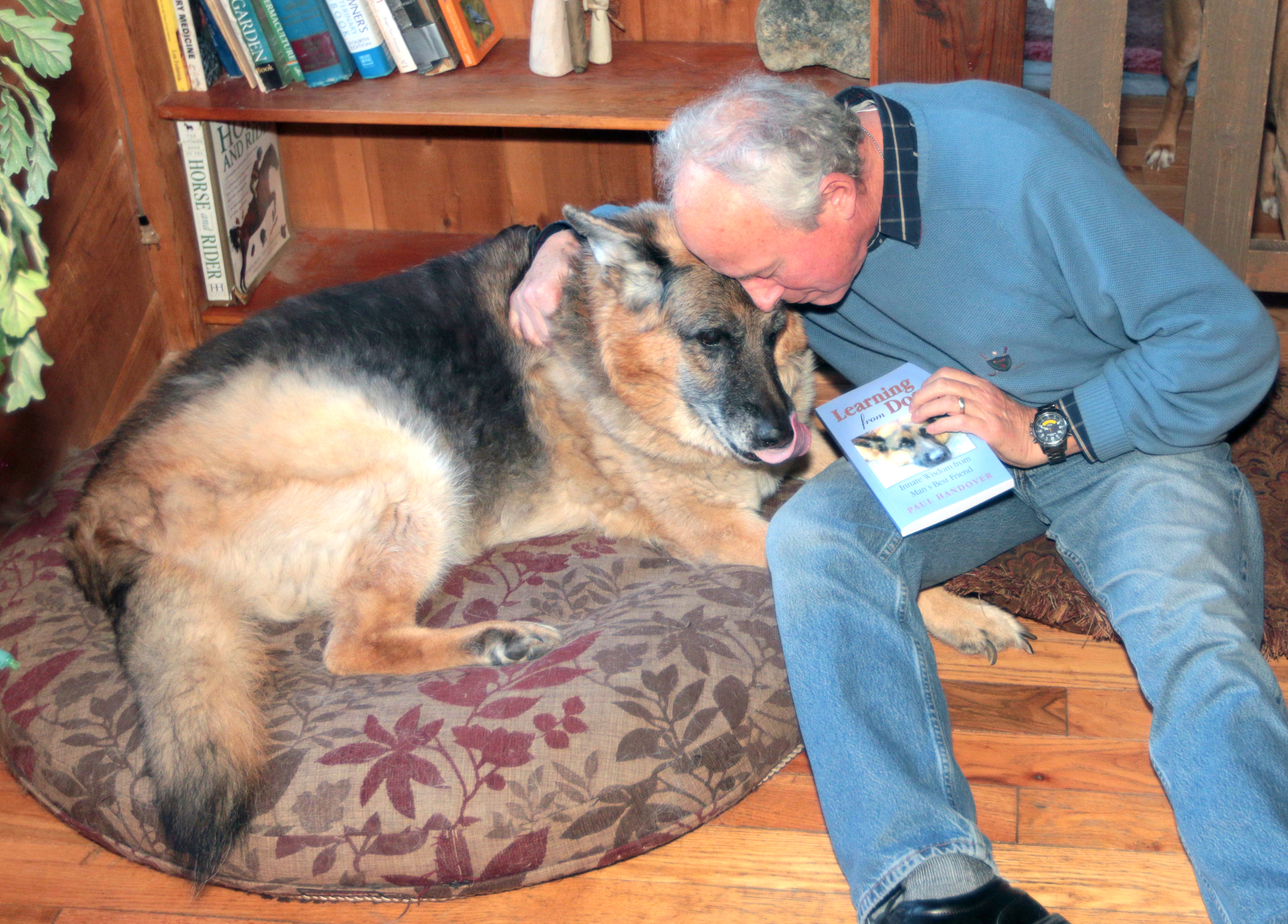
I will close today’s post with a photograph of dear Pharoah and me, both well into our senior years, taken just a few weeks ago demonstrating that both of us are old dogs learning new tricks!
TIMOTHY BULLARD/Daily CourierPaul Handover with Pharaoh, a 12year-old German Shepard that he uses on the cover of his new book about man’s best friend.
On second thoughts there’s a much better way to close this post that reflects on those precious years before the end of our days. That is by offering you the poem by John Oldham, A Quiet Soul.
A Quiet Soul
Thy soul within such silent pomp did keep,
As if humanity were lull’d asleep;
So gentle was thy pilgrimage beneath,
Time’s unheard feet scarce make less noise,
Or the soft journey which a planet goes:
Life seem’d all calm as its last breath.
A still tranquillity so hush’d thy breast,
As if some Halcyon were its guest,
And there had built her nest;
It hardly now enjoys a greater rest.
In yesterday’s post I wrote about how we determined that our Brandy was a Pyrenean Mastiff (Spanish Mastin del Pirineo). In that search, into both the breeder and the history of the breed, we came across the website of De La Tierra Kennels located in Quartz Hill, California who are Pyrenean Mastiff breeders. As they state on their website:
Tierra Alta were the first kennel to introduce the Mastin del Pirineo to the U.S.A. Our kennels have produced excellent show potential pups bred from the finest imported and now domestic stock available – Tajadera del Tio Roy, Castillo de Ali, Do Limoeiro, De Domus, El Bellotero, Rocaforte, Larresalkoak, Del Paso del Oso, Moralet, Wela Brillante, Springstrand, Iirismaan, Bondadoso and Farma Stekot, Murtoi’s, Del Mostin and Can Cabot. Our foundation mostines are imports directly from Spain, Italy, Finland and the Czech Republic. Our kennels have also exported to Canada, Europe and Mexico. Our kennel has the broadest bloodlines for the PM in the U.S.A. and the largest number of Pyrenean Mastiffs in the country.
and two paragraphs later:
A Moment In History!
Breeder of Pyrenean Mastiffs since 1996: Tierra Alta kennels were proud to announce the arrival of the first Pyrenean Mastiff litter born in the U.S.A. October 1st, 1997
It was then quickly discovered that there is a breed association for Pyrenean Mastiffs and almost as quickly revealed that the breed association shares the same telephone number as the breeders. Nonetheless, I’m going to republish the history of the breed as it is presented on the website of the PMCA Pyrenean Mastiff Club of America.
ooOOoo
Mastin de los Pirineos – Pyrenean Mastif
Statue of the Molossus Belonging to Olympias, daughter of the Molossian King Pyrrhus
Edited By Brian Vesey-Fitzgerald – “The Book Of The Dog“
THE SPANISH MASTIFF & THE PYRENEAN MASTIFF THE HISTORY OF SPAIN
In the Middle Ages, the Christians in the north and the Moslems in the south of the Iberian peninsula were fighting against each other for the control of the land that would one day become known as Espana. In the Christian kingdoms, the business of wool and lambs was the livelihood of the people. At that time existed two hegemonic kingdoms in the yet unborn Spain, Castilla and Aragon. In these kingdoms, each having a very different way of life, were born two breeds of dogs.
In the wide and flat Castilla, the Mastin Espanol (Spanish Mastiff); in the heterogeneous and abrupt Aragon, the Mastin del Pirineo (Pyrenean Mastiff). The system of “trashumancia” in Castilla was completely homogeneous. The big herds had a lot of very detailed rules imposed by the “Honrado Concejo de la Mesta”. These rules included the way to treat the dogs, which was important, since these dogs defended the flocks from many risky situations across many thousands of miles. These big and valiant dogs are the breed we know today as the Spanish Mastiff.
In the kingdom of Aragon, the “Honrado Concejo de la Mesta” had no authority, and the herding rules differed from one valley to the next. The Pyreneans were home to many wolves and bears, and here another magnificent protector, the Pyrenean Mastiff or “Mostin”(from the old aragonish language) was employed.
As the centuries passed these systems continued. The river Ebro remained the border between these two excellent molosser breeds up until our day.
The Spanish Mastiff and Pyrenean Mastiff are both molossoid breeds. The Spanish Mastiff has a shorter coat, slightly bigger head and a little more skin on the throat. The Pyrenean Mastiff has a longer coat and his color is always white with an obligatory mask around the eyes and on the ears. In both cases, the texture of the coat is hard, not soft or wooly. In both breeds the head is important, the structure powerful, a wide chest and round ribs. The expression of the Spanish Mastiff is much “sweeter” than that of the expressive face of the Pyrenean Mastiff.
These two magnificent canine giants have conquered the hearts of many. They are both breeds of excellent temperament and indescribable charm. These Mastiff dogs do not require extensive care. They are healthy breeds that require to spend their days with someone who will be more of a friend and companion than just an “owner’. They are proud, strong and sure of themselves and a great piece of the history of Spain.
ASPECTS OF THE PYRENEAN MASTIFF
The dog we know as the Pyrenean Mastiff belongs to the breed of very big molosus dogs. These dogs were the guardians of the Aragonien sheep herds protecting them from predators such as the wolf and bear. The Mastiff from Navarra and Cataluna are included in the Pyrenean Mastiff of today. They were also used to protect houses, farms and castles.
In their work of protecting the herd they were assisted by the shepherd dog today known as Gos d’Atura Catala. In order to protect themselves while working the Pyrenean Mastiff used to wear a special collar called a “carlanca” generally made of iron with sharp protruding spikes. The collar was an extraordinary help in case of an attack from wolves or bears.
The time eventually came when the herds worst predators disappeared from the Pyreneas. This was around 1930 to 1940. The question of what to do with such a big dog with a large appetite was pondered by the farmers. Due to the lack of interest in this big dog it gradually began to disappear. This could have been disastrous for the breed had it not have been for a few big dog lovers who adopted the task of the breeds survival.
It was hard to feed such a big dog during the period just after the Spanish Civil War but it was obviously one that was accomplished. The great-great-grandchildren of these dogs are the seeds that have been used to revive the breed today. The Pyrenean Mastiff is part of the common origin of the molosus or molususlupoides to guard the livestock. It was distributed within different breeds in the southern part of Europe from Turkey to Portugal and from Caucaso to Sierra Morena.
In the Spanish breed the molosus factor dominates the lupoide one and its structure with a big skull, strong bones and round ribs makes it difficult to rest. The Pyrenean Mastiff is a rectangular dog, thick, big head and wide breast. The ears should be implanted over the eyes line and not too big. The eyes should be intelligent and dark. Overall the Pyrenean Mastiff shall show his power and his strength. The base color of the coat should always be white. The eyes and ears should always be colored. The hair should be long and thick. The Pyrenean Mastiff character is noble, tame with the children and with the people who get along well with the dog, but implacable with those who dare to challenge him.
Often people who are unfamiliar with the breed may say that these dogs are very big and very stupid. Those who refer to the breed in this context are usually more familiar with the barking-attacking anyone or anything without any reason type of dog. The Pyrenean Mastiff is and was a very calm dog possibly due to the fact that his function depended on that. It is a very self reliant dog and barks very little. However if necessary it can be extremely aggressive although it only comes to this point if there really is no other way out. The Pyrenean Mastiff is quiet, good and equilibrated in practically all circumstances. The Pyrenean Mastiff is a dog happy to put on a collar and walk patiently by the side of his owner.
“To each his own” as the saying is known. However in the case of the Pyrenean Mastiff there are some helpful points to look for in the breed: More importance should be placed on the massivity than the size, and to the head rather than the tail. A deeper breast than the elbows rather than shorter and poor. Preferably a too aggressive dog to a too timid one. A deep face profile to a “wolf- thin” profile. A dog with open toes, but extremely strong bones rather than one with perfect toes and too light in the bones or too flat of a breast and ribs. It is more important to seek maybe some incorrect teeth in a powerful and big head rather than some perfect teeth in a “wolfie” head. The ultimate dog is strong, rustic, powerful and full of typicity rather than an “elegant” or “harmonic” or “changed” one.
As previously noted ten to twelve years after the Spanish Civil War the breed was less abundant. With the onset of the seventies, lover of the Spanish dog breeds began to research dogs in the mountains and in the rest of Aragon for the dog that perhaps could belong to the beloved Spanish breed, the old and great molossus from Aragon. The Club del Mastin del Pirineo de Espana (Spanish Pyrenean Mastiff Club) was founded in 1977. It is an association where all breeders, owners and lovers of the breed united to become the most important club dedicated to a Spanish breed. Some years after their beginning the only *monographic book about the Pyrenean Mastiff was written by the club. The international history of the Pyrenean Mastiff is only beginning. Today there are about 4000 Pyrenean Mastiffs in their homeland of Spain.
ORIGIN
Origin: Spain.
The Pyrenean mastiff is a native of the southern slopes of the Pyrenees mountains. The mastiff was developed in the region of the Pyrenean Mountains that stretches from Aragon to Navarra. The breed was once known as the Navarra mastiff. The breed was at one time almost extinct but has gained new interest in recent years. It is still rare despite this. It is also known as the Mastiff of Navarre and the Mastin d’Aragon.
The Pyrenean mastiff should not be confused with its French counterpart, the Great Pyrenees.
The Phoenecian traders acquired mastiffs in Assyria and Sumeria. These dogs were sold in Spain where they were to be bred as working dogs and their heritage can be traced back to the great Asiatic mastiffs.
Description: It is a strong, powerful and tall dog of elegant beauty. Ideal height at the withers for males is 32 inches/81 cm and 29 1/2 inches/75 cm for females. Life expectancy is about 12 -14 years.
The Pyrenean mastiff has such a light step that it hardly leaves any footprints. It posesses a large, long and strong head and long muzzle with a black nose. The skull is slightly rounded, broad and convex, prominent occiput and a wide, deep muzzle. The head should be massive and broad. The neck is powerful and surrounded by loose skin and hanging double dewlaps. The face is symmetrical and the eyes are small and dark with the lower eye lid showing. The ears are pointed and pendant. Although the ears can be cropped and the tail docked, this is not recommended. The tail is carried low and has a fringe and should have a curl at the tip and although it stands up when active, is never carried over the back. The body should be rectangular, well muscled and with strong bone. The back is level, slightly hollow and more inclined toward the withers.
The Pyrenean mastiff has a thick, abundant and coarse coat that is medium long on the body but is slightly longer on the throat and neck. Coat colors most frequently seen are white with markings either golden, any shade of grey, black or badger, sand, red or marbling markings on the sides of the head and ears and the beginning of the neck. Markings may also be found on the posterior. Least prized dogs are those to have black and white markings. No matter what the markings the main body color is always white. A few large patches on the body are permissible but not in all white or tricolored dogs. The fore and hindquarters are strong with plenty of bone and muscle. The forefeet are not very large with toes that are closed and well arched. Double dewclaws on the hindlegs are typical but NOT obligatory in this breed.
TEMPERAMENT
Silent, friendly and intelligent
Uses: The Pyrenean mastiff is a flock guardian, hunter of wild game, personal guardian and working dog. It is an excellent sheep protector, resistant to cold weather and capable of fighting off predators such as wolves.
Every Spring, for many centuries, the shepherds of the Pyrenees would move their large flocks from the lower mountain plains to grazing areas in the high, mountain valleys. The Pyrenean mastiff aided in moving and protecting these flocks during the trip. Four or five dogs would take charge of up to a thousand sheep. The mastiff was equipped with a heavy spiked collar known as a “carlanca” in order to protect the neck during a wolf attack. The mastiff was regognized as a distinct breed in the latter part of the last century. It is a reliable, obedient and protective companion.
All along the southern third part of Europe, from Caucase to Sierra Morena and from Lisboa to Stambul, exist, and have existed during centuries past, molosoid and lupo – molosoid large breeds of dogs. These dogs are dedicated traditionally to guard the ewe herds, and have adapted both their physical and mental abilities to the different circumstances, countries, climates, etc., where their jobs have taken them.
We have known guarding breeds such as the Anatolian Karabash, the Komondor, the Ovtcharka, the Kuvasz, the Polish Tatra, the Maremma – Abruzzese, the Pyrenean Mountain Dog, the Mastin Espanol, the Rafeiro de Alentejo, the Estrela Mountain Dog and others. Among them, one of the more fascinating breeds is the Pyrenean Mastiff (Mastin de los Pirineos). This breed is one of the most primitive breeds of flock guardian dogs.
The Pyrenean Mastiff, like the Mastin Espanol (Spanish Mastiff) breed, was influenced in the past from the blood of molosser dogs coming probably to Spain through the South (Cadiz or “Gadir”) proceeding from Asia in the Phoenecian boats. This influence produced two different types of large and powerful dogs perfectly adapted for the job that would be required to do for so many centuries, protecting the lambs against the wolf and the bear.
There were two molossoid Spanish breeds, the Mastin del Pirineo and the Mastin Espanol. The first of these two lived in the north – east part of Spain and the latter in the center, in the area of Castilla and Leon. In the middle age times when both breeds became established, the lands of Aragon and Cataluna were independent and this was where the Pyrenean Mastiff was living. The Mastin del Pirineo can compare his history to that of the Pyrenean Mountain Dog because they have many breed similarities.
Imagine that the Pyreneans valleys direction was north-south and both sides belonged to the Navarra-Aragon-Cataluna crown or in essence to Spain. This situation changed in 1659, when Mazarino, the Regent of France and Philippe IV, King of Spain signed a decree through which France acquired the Northern side of the Pyreneans. From that time on, the French raised their dogs in their own direction and style, hence leading to a characteristic type that later became known as Chien de Montagne des Pyrenees (Pyrenean Mountain Dog/Great Pyrenees). In the Southern Pyrenees, the Spanish chose to remain with the traditional type dogs, working dogs that were more primitive and wide, less refined and homogeneous. During the international expansion that the official cynology has experienced in our twentieth century, both breeds have had opposite appeal.
The Pyrenean Mountain Dog (Great Pyrenees) has enjoyed great recognition due to the excellent selection efforts of the French breeders and those of other countries also. The Spanish Pyrenean Mastiff was barely surviving as a breed, still working in his traditional role as guardian of the lambs, until the middle of this century when the last wolf was killed off in the Spanish Pyreneans. In the forties and fifties Spain was in poor shape, still trying to recuperate from the effects of a civil war. A large breed such as this, that eats a lot and with no useful job to perform in its homeland became a heavier burden on the people during such hard times and with each passing year their numbers began to diminish as a pure breed. In the seventies, a new passion grew among many people who had an interest in the Spanish breed. Gradually the Pyrenean Mastiff began to make a comeback, although far from the wolves and lambs, but closer to a bigger friend, man.
Today people are beginning to once again take an interest in the Pyrenean Mastiff. If luck is on the side of this large and wonderful Spanish breed, it will this time enjoy the recognition that it rightfully deserves.
Information provided by Rafael Malo
Story translated and edited by Karin S.Graefe
ooOOoo
I closed yesterday’s post with these words:
Further research on this breed has turned up some very interesting information. Come back tomorrow to read that and what we discovered when we spoke to the breeder.
Well you have had the interesting information and later I had a wonderful conversation with Karin Graefe of that breeder; De La Tierra Alta Kennels in Oakdale, California. (See footnote.)
In a web search for other PM breeders I came across Pyrenean Mastiffs de Monte Sano based in Alabama. Here’s what you read on their website home page:
Pyrenean Mastiffs de Monte Sano owner, Victoria Betterton, is an active member of the Pyrenean Mastiff Club of Spain (Club Del Mastín Del Pirineo De España (C.M.P.E)) and is the US representative for the club.
Located in Huntsville Alabama, we have done a lot of research into the Pyrenean Mastiff breed and have worked hard to bring wonderful specimens to the USA. Our dogs are the result of the vision of breeders that are among the best in Italy and Spain. These breeders have become good friends as these dogs are now a loving part of our family.
The Pyrenean Mastiff has recently been added to the American Kennel Club’s (AKC’s) Foundation Stock Service (FSS). Our breeding dogs are registered with FSS as well as with both the Federación Canófila de Puerto Rico (FCPR) for Fédération Cynologique Internationale (FCI) approved registry purposes, and the United Kennel Club (UKC) for show purposes. All our dogs and their offspring can also be registered with all of the smaller clubs that accept FCI approved or UKC registrations such as the American Rare Breed Association (ARBA).
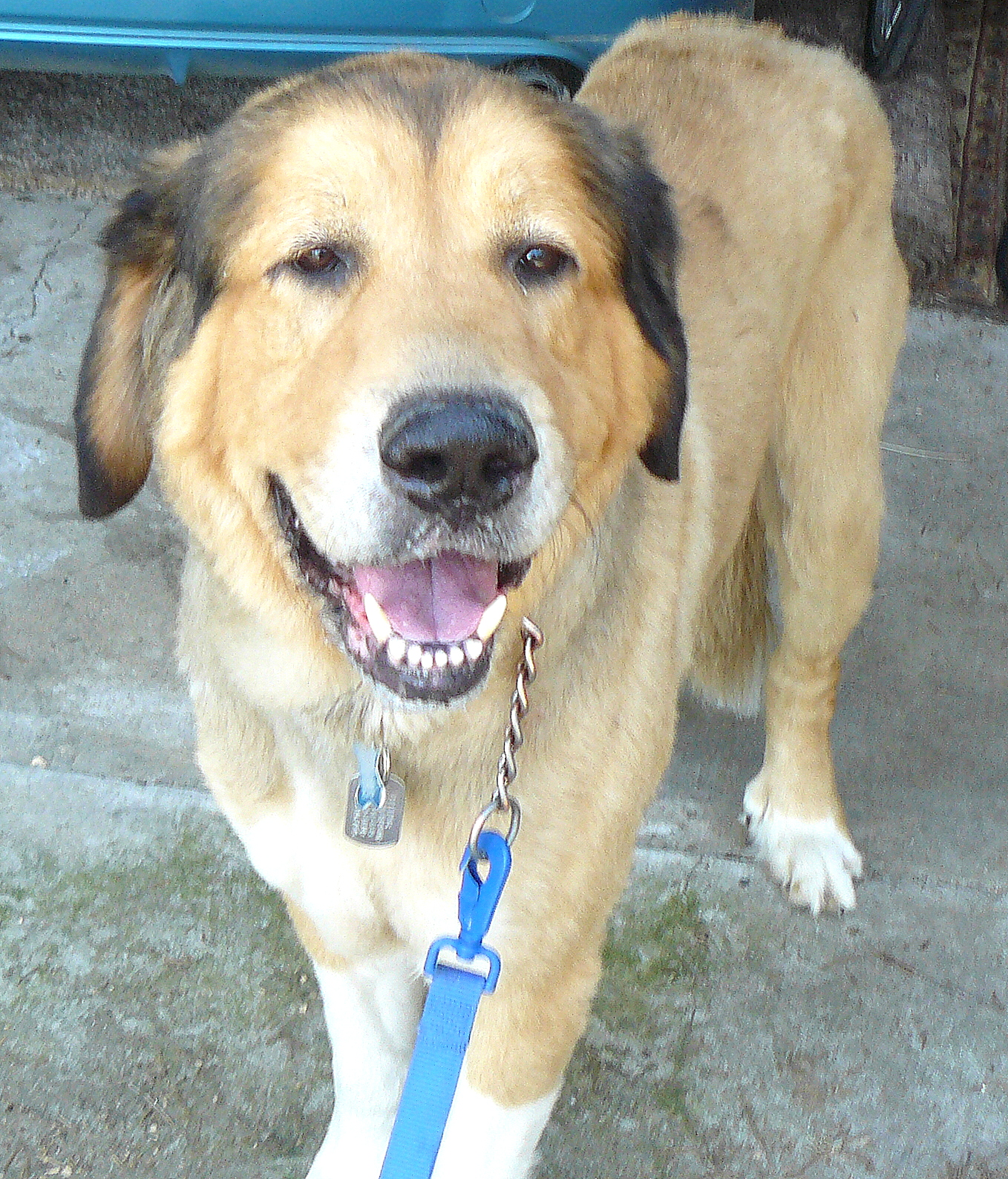
I called them and it was Victoria who took the call. I explained the circumstances of Brandy coming into our lives and then sent her an email with some photographs of Brandy. This was her reply:
Hi Paul,
It could be that Brandy has Pyrenean Mastiff in him, but I doubt he is purebred. The jowls, and especially the coloring is not characteristic. He doesn’t have near the droop in the lip of typical PMs, and he is missing way too much white, especially on the nose. While there are PMs with darker muzzles, they always have some white or they are not considered correct for the breed. I’d say he is definitely a mix of something and PM or GP. If you could trace the owner by microchip, you may be able to find out.
He is a beautiful dog. I wonder why they clipped him. I never clip mine. The hair protects from cold and heat both.
Best Regards, Vicki Betterton
Clearly more to find out!
Footnote:
Later in the afternoon I had a most delightful conversation with Karin Graefe of De la Tierra Alta Kennels in California who came up with another possible explanation of Brandy’s roots. More of that another day. But can’t resist telling you that in my call with Karin it was very quickly established that she joins me and Jean in being another Londoner as she was born in Kensington. Small world at times!