First thing that must be mentioned is that it was our neighbour Larry Little who opened my eyes to the film. He sent me an email with the link to the film. Thank you, Larry.
Obviously I have no way of knowing how many of you watched the film that was the object of yesterday’s post: Words are Superfluous. But for those of you that did here is the background to that most moving film.
Shawn Welling
If one goes across to Shawn Welling’s website and clicks on the About link one reads a bio that is truly fascinating. WikiPedia also has a very good summary of Welling Films that opens thus:
Welling Films (sometimes written as WF) is an American film production company and studio based in Houston, Texas. It was launched in mid-2006 by Houston-born choreographer and photographer Shawn Welling. They have produced five feature films, along with the web series AXI: Avengers of eXtreme Illusions, and several narrative and documentary short films.
Yesterday’s post, quite deliberately, did not include all the credits and background information. Here it is:
Published on Mar 27, 2015
Hey:)
Thanks for watching my film. I really hope you share and comment as we love your feedback also feel free to email your thoughts as well. http://www.ShawnWellingVisuals.com for more info and my email.
The Director
-Shawn Welling
Full Synopsis:
A friend to share the ups and downs of life with him — and, soon, his family. “If I Could Talk” gives this dog the one chance he wants to share his thoughts.
Director: Shawn Welling AXI
Story: Mark Galvin
Screenplay: Shawn Welling
Starring:
Max Welling / The White Lab
Shawn Welling / Shawn Welling
Michelle Simmons / Michelle Welling
Grace Calabrese / Grace Welling
Kalyssa Lauer / Kalyssa Welling
Music:
Reuel
Composer:
Phillip Glass
Cinematographer
Shawn Welling
Art Giraldo
Scott Budge
To close today’s post here’s another film from Shawn Welling. (And trust me, this film is very different to yesterday’s!)
Published on Jul 24, 2014
“SALVATOR”
(Latin for ICON or statue of “THE SAVIOR”)
Another beautiful collaboration between Les Twins and Shawn Welling AXI Films.
Filmed on in front the statue of “the Savior” at the First Presbyterian Church of Houston, Houston, TX
Just to demonstrate that Learning from Dogs isn’t wall-to-wall about dogs!
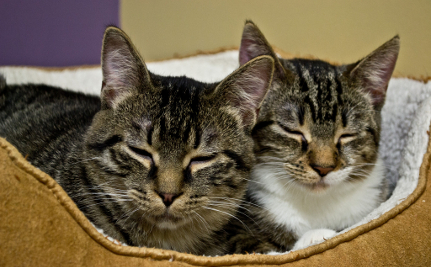
Over the years that I have been writing in this place it has been mentioned before that as well as us having our dogs we also have cats. When Jeannie and I moved up from Mexico to the USA in 2010 we came with six cats, all of them cats that Jean had rescued off local streets down in San Carlos, Mexico.
Four years ago, when we moved up from Arizona to this present home here in Merlin, Southern Oregon, we built a cat run that was attached to the garage. Then about a year ago we brought what was now four cats into the house. The cats are in their own rooms during the day but mingle with the ‘living room’ group of dogs in the evening. The cats are not let outside for we fear that they would be grabbed by a passing coyote or similar before they learnt to return home in the evening.
All of which is my preamble to an article that was published a month ago over on the Care2 Causes site, and is republished here within Care2’s terms.
Once every eight seconds, an unwanted cat or dog is euthanized somewhere in the United States thanks to pet overpopulation and limited shelter capacity. No one likes to think about that reality, but you can do your small part to help. In addition to supporting organizations that promote an aggressive national spay and neuter policy, facilitate no-kill shelter transitions and work with communities to address specific issues like feral cat colonies, you can adopt a shelter cat (or dog!).
If you’re thinking of adding a cat to your life (and really, why stop with one?), here are ten compelling reasons to consider a shelter cat over one from a breeder or a pet store.
10. Shelter cats come in all shapes, sizes and colors.
If you want a kitten, shelters are usually overflowing with them, especially during spring kitten season. If you’re interested in an adolescent feline or even a more mature companion, shelters have those too. In fact, many are really excited by potential adopters who want to take on an older kitty, because mature cats tend to linger in shelters longer because many people prefer kittens. If you’re looking for a cat to accompany an older adult or someone who’s not as mobile, a mellow older cat might be a great fit.
9. Shelter cats are ready to go!
They’re spayed or neutered, immunized, dewormed, microchipped and assessed for behavioral issues by the skilled staff at the shelter. They’ve also been trained to use the litterbox in most cases, so you don’t have to worry about an awkward and potentially smelly transition to living at your house. Many also come with a certificate for a free first visit to the vet, and some shelters have a take-home package with food, toys and other goodies. You’re all set up for your first year of pet ownership, and your pet will be healthy, because the shelter has a vested interest in keeping its animals happy and healthy, while pet stores and unscrupulous breeders do not.
8. Shelter staff can help you pick the perfect companion.
Adopting an animal is a big commitment, and not all cats are the same. If you come in with your family, the shelter staff can get to know you, introduce you to some prospects, and help with the matchmaking process. They’re motivated to make sure cats find their forever homes, and they won’t lead you astray when it comes to, well, rescuing a stray. Shelter staff can also provide you with information about the adjustment period if you’ve never had a cat before.
7. Turns out you can teach an old cat new tricks.
(Note that when she’s tired of it, she’s not afraid to make her opinion known!)
6. Set an example!
There are a lot of myths about cats living in animal shelters, like claims that they’re damaged, feral or broken in some way. In fact, the vast majority of unwanted animals are happy, healthy and well-adjusted, they just need loving homes to get comfortable and let their personalities come up. By adopting a shelter cat, you can encourage other people to do the same; talking about your positive experiences and introducing people to your cat will help reduce the stigma about adopting from a rescue group.
If you want to adopt a special-needs animal, you’re certainly welcome to. Shelters are particularly choosy when it comes to homing out cats with medical problems, but they are always happy to hear people are interested, committed and ready to give a cat with some extra needs a home to share.
5. Adult cats are low maintenance.
If you want a cat in your life but you don’t have a lot of time for teaching a kitten how to use the litterbox, stay away from the toilet paper roll, and stop wreaking havoc on your shoes, an adult cat is definitely for you. Adult cats already know the lay of the land and they tend to settle into routines quickly, making them great housemates. And if you travel a lot, consider adopting cats as a pair so they can keep each other company. A shelter often has a pair of cats whom they’d love to see go out together because they’re relatives or they’ve developed a close bond.
4. You’ll feel better.
Companion animals offer a number of mental health benefits. Having a pet of any species around can make people feel happier and more balanced, and the routine of caring for and interacting with a pet like a cat can improve mood and reduce the sense of isolation. Cats are especially great companion animals for people who don’t have the energy or ability to care for a dog, but still want someone around the house to keep them company.
3. Shelter cats have varied personalities.
Cats are incredibly diverse, personality-wise. They can be shy and outgoing, playful or more reserved, fascinated by sinks or horrified by water. If you haven’t had the pleasure of having a cat in your life yet, a shelter cat might totally change the way you view these delightful animals.
Check out some of the personalities on display at the Los Alamos Animal Shelter:
2. Don’t support animal cruelty.
Pet stores source their animals from a variety of places, and those cute kittens in the window might come from an abusive kitten mill where cats endure horrible conditions to produce animals for the pet trade. The sale of companion animals in general promotes the continued existence of exploitative breeders that view cats as cash drawers, not living beings. By turning away from companion animals offered for sale and choosing to adopt, you’ll be voting with your wallet. And that adoption fee? Will be a lot lower than buying an animal from a petstore or breeder.
1. You’ll save a life.
Even if your local shelter is no-kill (which is great! consider an extra donation to help them with operational costs), adopting shelter cats to get them out of the shelter system and into living homes reduces the strain on shelters and frees up space for more homeless animals. No-kill shelters often rescue from facilities that euthanize, so by adopting from them, you’re opening up another slot for a kitty who’d otherwise be on death row. If you live in an area where there is a kill shelter or where animal care and control adopts out animals, please consider looking there first for a new cat. Some organizations maintain “kill lists” published by shelters, listing animals slated for euthanasia within the next few days, and you might find your new companion on just such a list.
ooOOoo
Even if just one person who reads this makes a commitment to take on a shelter cat it will be one less cat on a ‘kill list’.
Independence Day should also apply to our beloved dogs!
So today is July 4th. One of the key days of the year in the American calendar, if not the key day.
Freedom and independence are the corner stones of a healthy nation. That ‘nation’ should include our dogs. Ergo, I have no hesitation in republishing the following that first was seen on the Care2 site.
The sight is heartbreaking: a sad animal, exposed to the heat or the cold, often without shelter, chained in a backyard. Sometimes all it takes to secure them is a thin rope tied around their collar on one end and a dog house on the other, in others it’s a thick metal chain that keeps the dog from moving away from a tree. Whatever the case, it’s enough to inspire any animal lover to change that dog’s life, but how? The answer is simpler than one would imagine: build a fence.
“Building a fence really changes the relationship between dogs and owners,” explains Michele Coppola, President of Fences for Fido, a nonprofit organization that builds fences in houses that have chained dogs so the dogs can run freely in the backyard. “Many times dogs who were outside 24/7 go on to become a family member, spending time in the house and outside because they’re no longer a location.”
Since 2009, Fences for Fido has been helping dogs in the Southwest Oregon and Washington state areas. People can anonymously nominate a house with a chained dog on their website or people can nominate themselves if they don’t have the means to build their own fence. According to the Coalition to Unchain Dogs, who helped Fences for Fido get started and has been building fences since 2006 in North Carolina, that lack of resources is the most common reason why people keep dogs chained.
“When we first started we thought we would we would build this fence and solve a problem but we quickly saw the problem is not chained dogs, it’s poverty,” explains Lori Hensley, Director of Operations at Coalition to Unchain Dogs. “No one wants to chain a dog. They just don’t have the means to build a fence.”
Other common reasons are not understanding that dogs are social animals that need to run around, an owner not knowing how to address behavioral problems and trying to keep the dog from running away, says the Humane Society of the United States.
“People chain their dogs for a variety of reasons so we always approach them without judgement because most times we’re not seeing the whole story,” says Coppola adding that those issues are addressed when building a fence for someone to make sure they’re educated on why chaining their dogs shouldn’t be a solution. “Maybe they didn’t have a fence to start with and someone, maybe a family member, dumped a dog with them and they’re keeping it out of the goodness of their hearts but they don’t have a fence. You don’t know.”
Between the two organizations, over 3,400 dogs have been freed from chains but since they only operate locally, they have created resources for people in other parts of the country who want to help. Unchained Planet, a Facebook group of volunteer fence builders, offers advice and tips to anyone looking to start their own fence building organization and a DIY tutorial is also available for free download.
From materials needed to step by step instructions, anyone can start building a fence to help chained dogs in their communities, though to complete novices, the guidance of a seasoned builder or a professional is encouraged.
“If you’re starting out for the very first time, it might be a good idea to pair up with a fence company who may be willing to help and even donate the materials,” suggests Coppola. “Or you want to find somebody who’s done a fence before and can kind of show you how to go about it.”
Fences for Fido is an Oregon-based organisation and I’m going to contact them and ask for more information to share with you all.
I am also going to contact local charity The Toby Fund of Wolf Creek (Oregon) who do great work in unchaining dogs and seek an article from them for you.
I sat down in front of my PC a little after 3pm. I was knackered, not to put too polite a spin on it! For the reason that since 9am this morning young Justin and I had been working outside repairing the front, road-side, boundary fence because our lovely Brandy had discovered a hole in it. Jean and I only becoming aware of that break in the fence when neighbouring residents, Dordie and Pam, on setting out for a bike ride yesterday, found Brandy waiting outside our front gate, which is a quarter-of-a-mile from our house. Brandy, as with all the other dogs that we have, is far too precious to delay mending the fence.
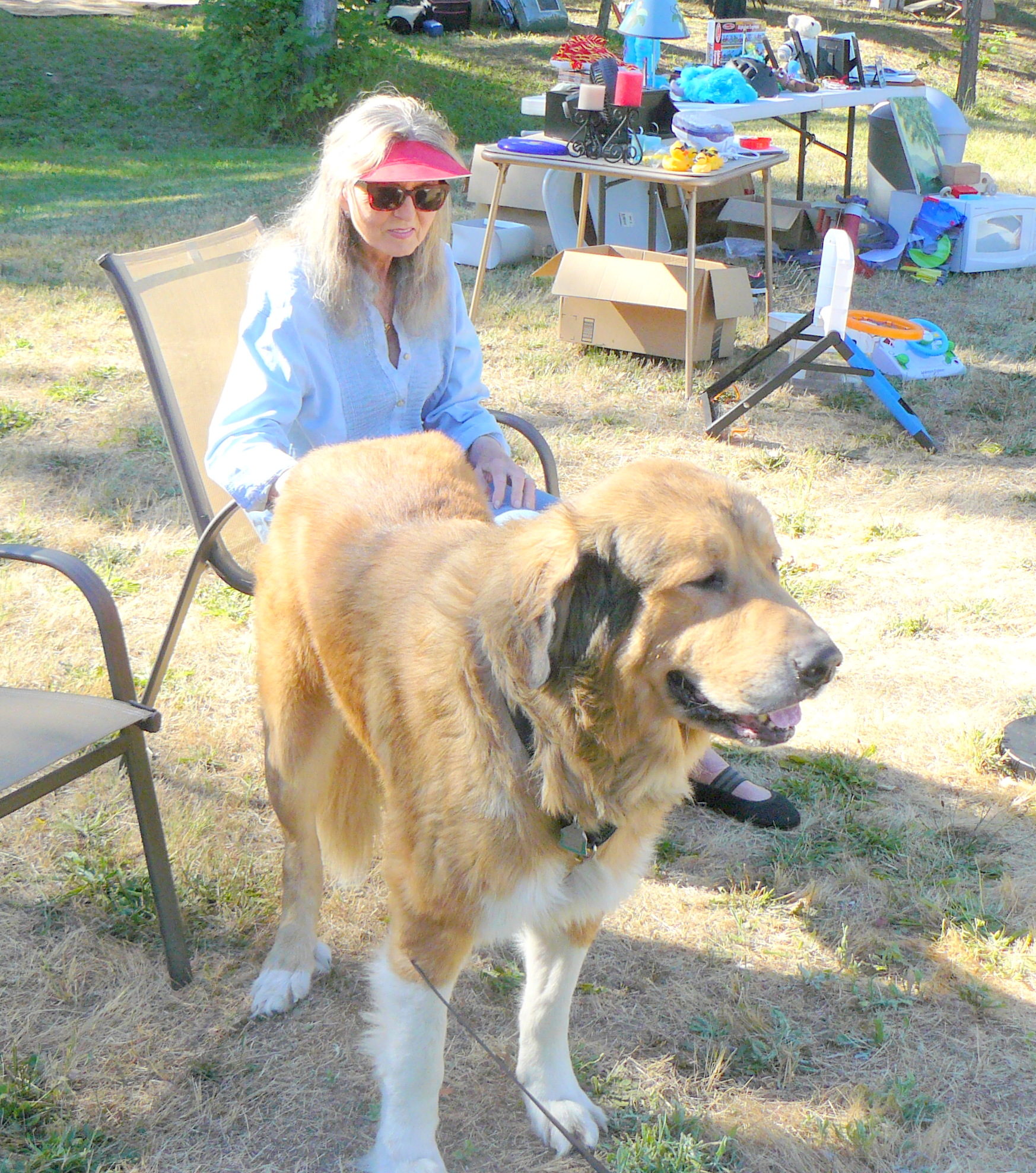
Jean and Brandy at our local yard sale last weekend.
So, as I always do, when I can’t muster the creative juices is to see what’s sitting in my ‘blog’ mail folder.
Bingo.
The following recently was sent to me by neighbour Larry, his email simply saying, “Is this what they call “British Humor”??”
Enjoy!
(P.S. Best to watch a little after you have eaten!)
The stranger the times the more we need to ‘ground’ ourselves.
Without doubt these are incredibly strange and unsettling times. For the United Kingdom, for the USA, for the British Commonwealth, for Scotland, for Gibraltar; and for many other places.
When we are faced with unsettling periods then it is essential to ‘ground’ ourselves, and there are many effective ways of doing this.
One way that always works for me is to gaze into a clear, night sky. The night sky over one’s head is captivating beyond words. Perhaps I should have written that it is captivating beyond my words.
Not so for Sue Dreamwalker. Just read this most beautiful poem that Sue published a little over two weeks ago. Republished here with Sue’s kind permission.
(And to demonstrate how your’s truly is becoming a forgetful old fart when I read this out to Jeannie last night she reminded me that I had already published it! It’s worthy of another showing!)
Note: Let me declare immediately that I have a personal interest in this post. Namely that my daughter, Maija Handover, is a partner of the charitable company SOUND UK. Their most recent sound adventure is extremely interesting.
Sonic Journeys are soundtracks to specific journeys. Each commissioned piece is available as a free download for limited periods, enabling listeners to experience the music travelling through the landscape that inspired it. Or wherever they choose.
Let me allow Sonic Journeys to explain in their words what it is about:
Sonic Journeys is a series of soundtracks to specific journeys. The series commissions artists to create new works in response to journeys that inspire them. These works are recorded and available for free download for a limited period, enabling listeners to experience the music travelling through the landscape that inspired it. Previous commissions include Adrian Utley from Portishead (2012, a walk through ancient trees at National Trust’s Croft Castle & Parkland), Mica Levi (2011, a walk at Barbican Centre), Shackleton & Vengeance Tenfold (2011, two train journeys in Devon), Will Gregory from Goldfrapp (2009, a walk in Malvern Hills for Big Chill festival).
For those that would like to create and share their own Sonic Journey, we are inviting online submissions of music, or music and video, to journeys the public find personally inspiring here. Previous Your Sonic Journeys have included music to journeys in Kew Gardens in London, Bregenz in Austria, South Western Transylvania and more.
Here’s an example of one of those commissioned journeys, from my old home county of Devon. It is called Shackleton + Vengeance Tenfold – South Devon, stopping train from Starcross → Teignmouth and the Field Notes explain:
Unique British bass producer Shackleton collaborated with his original musical partner, spoken word artist Vengeance Tenfold, to present his own distinctive vision of a journey through some very special parts of Devon; the main railway line between Exeter and Totnes, and part of the Tarka railway line between Exeter and Barnstaple.
Travelling from Exeter to Newton Abbot, in South Devon the artists respond to the iconic stretch of railway as the stopping train travels through the Exe estuary from Starcross station and journeys along the sea and wonderfully dramatic scenery.
Earl Fontainelle a.k.a. Vengeance Tenfold lives on Dartmoor in Devon. He plays in the Amsterdam-based Cajun deathcountry band Earl Fontainelle and the Pearl of Great Price and has worked in many other musical and lyrical projects, including a long-term collaborative relationship with Shackleton with whom he worked together on a live performance alongside the Tom Dale Dance Company involving spoken word, live electronic music, a Siberian Jew’s harp, and a lantern.
This link will allow you to listen to the Sonic Journey. To give those unfamiliar with this part of Devon, South-West England here’s a video of that train journey.
Published on Sep 17, 2013
Here I have some footage of a famous scenic coastal main line railway route that runs from Teignmouth via Dawlish to Starcross in South Devon. It is used by both long distance and local train services currently operated by First Great Western and Cross Country that runs from Cornwall and Plymouth to all points north and east.
I know I’m biased but it still strikes me as one incredibly innovative idea! Well done, the team!
In the run-up to the EU referendum by the UK this Brit was tempted several times to offer an opinion on what I thought was the best decision. But I resisted. (I was qualified to vote as an overseas voter and had voted for Remain.)
My resistance was because it seemed inappropriate to pass any form of opinion before the die had been cast, so to speak. I hadn’t been living in the country for over eight years and, inevitably, was out of touch with feelings.
The Conversation blogsite yesterday had a series of articles on the aftermath of the Brexit decision but the one that seemed most useful to share with you all was an article by Gavin Barrett, a Professor of European Constitutional and Economic Law at University College in Dublin. For many readers, including me, both within and without the UK this seemed a valuable primer.
ooOOoo
Britain votes to leave the EU, Cameron quits – here’s what happens next
June 23, 2016 11.41pm EDT
Leave ahead. Anthony Devlin / PA Wire
Author
Gavin Barrett Associate Professor, Jean Monnet Professor of European Constitutional and Economic Law, University College Dublin
Britain has voted to leave the European Union. This is having an immediate effect on markets. It is also having immediate political ramifications. David Cameron has announced he will not continue in his role as British prime minister.
Legally speaking, though, the process of actually leaving will take some time. Britain will now enter a kind of phoney Brexit period. It is still a member of the EU. The referendum vote is not as such legally binding. It is advisory only – but if it is out it creates a political imperative for the UK government to arrange its exit of the EU.
The law governing Brexit is found in Article 50 of the EU Treaty. This is a provision adopted by EU member states in 2009 to govern Brexit-like scenarios. It puts a two-year time limit on withdrawal negotiations. When the two years is up (or on the date any agreement reached before this enters into force) the UK is officially out of the EU.
Article 50 requires the UK to trigger the exit process by notifying its intention to withdraw. Not one, but rather a cascade of agreements, will follow this Brexit notification:
The Article 50 exit agreement
A separate treaty governing the UK’s future relationship with the EU – which could take many years to negotiate (and which, if it goes beyond trade, will require ratification by every single EU member state)
Trade agreements between the UK and up to 134 other WTO members
A tidying-up treaty between all the remaining EU states that removes all references to the UK from the EU treaties.
The initial main focus, however, will clearly be the Article 50 Brexit agreement.
How will it work?
The UK would be the first state to leave the EU but it is most likely that the European Commission, the executive arm of the EU, will do the negotiating on behalf of the remaining 27 member states. They will no doubt cast a watchful eye on proceedings, before voting on the deal.
That vote will be by a weighted majority, with bigger states like Germany, France and Italy having a more powerful voice than smaller members (although in practice, strong efforts are made to ensure every member state can live with a deal before a matter is approved). Above and beyond this, should the Article 50 Brexit agreement venture beyond trade matters, it will then need to be ratified by every EU member state.
The European Parliament has a veto option, making it an important player too. Article 50 negotiations will thus have a lot of players with powerful voices – and many not necessarily be inclined to give the UK a very favourable deal lest “exiters” in their own countries get any ideas.
Powerful voices at play. EPA/Patrick Seeger
Could the UK delay giving Article 50 notification?
Legally, yes, the UK could delay giving Article 50 notification or avoid it altogether. But other EU states will probably refuse to negotiate until they get the notification.
Brexit campaigners have suggested adopting a swath of domestic laws so that the UK can short-circuit Article 50. But such measures would violate EU law and probably won’t see the light of day. Enacting them would pointlessly violate EU and international law, alienate the UK’s future negotiating partners and jeopardise the UK’s future relationship with the EU.
Can the UK withdraw notification?
This might be attempted if, for instance, the UK doesn’t like the way negotiations are going. It is unclear if it is legally permissible. The EU Treaty certainly doesn’t prohibit it in so many words. Political misgivings would abound – but might possibly be met by having a second referendum to reject any Article 50 deal ultimately reached.
Ireland, after all, had referendum second thoughts on the Lisbon and Nice Treaties, Denmark had them on the Maastricht Treaty and France and Holland agreed to a Lisbon Treaty deal very similar to the 1994 Constitutional Treaty earlier rejected by both states in referendum.
What will the UK get from negotiations?
That depends on how (and who) conducts the negotiations for the UK, and what the other states are prepared to offer it. Even assuming they prove pleasantly amenable, the UK will be left with awkward choices.
Does it want continued access to the single market with its 500m consumers? If so, it is may have
On the outside. EPA/Laurent Dubrule
to make Norway-like concessions – including continued EU migration and cash payments for the privilege. Does it want to block out EU migrants? Then it may well have to say goodbye to single European market access.
No matter what the UK chooses, it will unavoidably find itself outside the corridors of power in the EU for the first time in over forty years.
Is there any way back in?
Article 50 does envisage the possibility of UK re-entry to the EU one day – but subject to a unanimous vote of member states. This pretty much guarantees it will only ever happen by the UK accepting the euro currency, participation in the Schengen area of free movement and no rebate.
Welcome to the brave new world of Brexitland.
ooOOoo
All I can say is that when I wrote up my post on comfort dogs I had no idea that matters Europe would be creating an enormous need for them. Better put in the words of Per and Val:
One dissatisfied member has soundly rejected club Europe’s management. It needs to radically improve before other leave. The managers must sure be in need of comfort dogs today.
Those of you that read my republication of Deborah’s article yesterday, Six ways dogs help us heal, would undoubtedly have picked up that one of those six ways was Dogs give us physical comforting. They snuggle and lie in our laps.
If we ever needed proof of that quality of comforting then an article from the Care2 site offers such evidence in spades.
ooOOoo
Comfort Dogs Provide Furry Solace to People in Orlando
They were deployed to Newtown. They were deployed to Boston. And now comfort dogs have made their way from around the U.S. to Orlando, Fla., to comfort those affected by yet another terror attack — the deadliest mass shooting in U.S. history that occurred on June 12 at the Pulse, an LGBT nightclub.
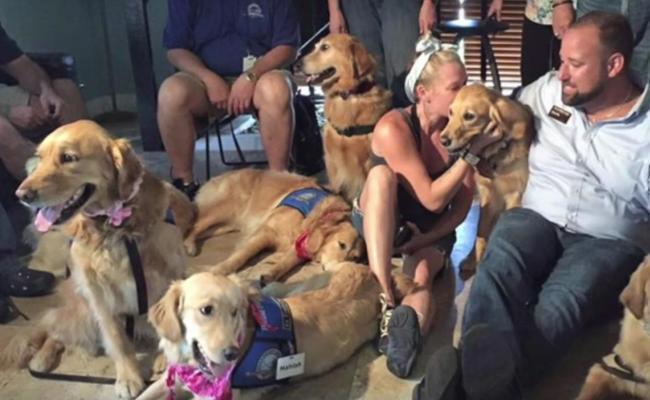
The dogs are available for anyone who needs a hug or a furry neck to absorb their tears. They wear vests with the irresistible invitation, “I’m Friendly. Please pet me.”
About a dozen dogs and 20 handlers from the nonprofit are currently in Orlando.
“Your blood pressure goes down when you pet a dog, you feel more comfortable and people end up talking,” Hetzner said. “They’re good listeners, they’re non-judgmental, they’re confidential.”
The dogs will be in Orlando for at least a week, providing comfort to survivors, first responders and Pulse employees. They’ve visited hospitals (many are trained to climb into hospital beds and calmly lie there) and counseling centers, and joined more than 10,000 people at a June 13 candlelight vigil for the victims.
LCC K-9 Comfort Dogs, based in Northbrook, Ill., deploys trained therapy dogs from around the country to areas where tragedies and disasters have occurred, as well as to local churches, hospitals and nursing homes. The nonprofit was created in 2008 after five students were killed at Northern Illinois University. To help ease students’ stress, handlers brought their therapy dogs to the campus, and the effort proved to be very successful.
When it started out, the nonprofit had four comfort dogs. Eight years later, it has more than 100 dogs in 23 states. The dogs are all golden retrievers — Hetzner told the Huffington Post this is because they’re a lovable breed by nature. “Also, because of their fur, they leave a little of themselves with everyone they meet,” he said.
Starting when they’re 8 months old, the comfort dogs-to-be and their handlers go through 12 to 14 months of intensive training before being deployed to areas that need them. Their travel expenses are covered by donations.
“Our dogs have to be able to relate with all age groups and stay calm in all circumstances,” Hetzner told the Huffington Post.
One of the LCC K-9 Comfort Dogs who was flown to Orlando is 5-year-old Gracie of Davenport, Iowa. She’s a comfort-providing veteran, having previously consoled people after the Sandy Hook massacre and in the aftermath of devastating tornadoes in Illinois and Oklahoma.
Gracie is known as one of the sweetest of all the LCC comfort dogs, Jane Marsh-Johnson, one of her handlers, told BuzzFeed News. “She’s always got a big smile.”
Therapy dogs are also helping people in Orlando cope. Zoey and her owner, Marc Gelbke, have been in town since Monday, comforting visitors to the GLBT Community Center of Central Florida. Zoey will also visit a church and hospital, and is available by request, free of charge, through the Loving Paws of Clermont to anyone in the Orlando area who needs a hug.
“We encourage those [in Orlando] who are grieving to sit down on the floor and pet dogs like Gracie,” Marsh-Johnson said.
“The dogs do more for those suffering than human beings can do.”
Care2 stands in solidarity with the LGBTQ community in Orlando, and against all forms of violence and discrimination.
I was reminded of the incredible healing power of our dogs in a recent article published by author Deborah Taylor-French.
Before going on to that article let me say a little more about Deborah. Most easily done by offering what is detailed in her bio:
Deborah Taylor-French, M.A.
Deborahwrites mysteries full of dogs, positive dog leadership and animal rescue. Deborah was awarded and served as a guest artist for California’s Artists in the Schools. As an arts educator, Deborah has led over a hundred residences and teacher workshops.
An active member of Redwood Writers, Deborah continues to serve as Author Support Facilitator. Redwood Writers is the largest branch of the California Writers Club. The true story of Sydney’s adoption, “Punk Rocker With A Poodle Brain” is published in “Vintage Voices Four Part Harmony.” Her fiction and memoir published in eight volumes of the Redwood Writers Anthology.
Deborah was also very supportive over my book and wrote an endorsement:
In “Learning From Dogs” author Paul Handover returns us to our origins where we find how early humans and dogs mutual survival and social relations. Visit the rich evidence of man and dog’s co-evolution. Dive into this man and species adventure. Reading this changes out perspective on dogs, wolves and humankind. Most importantly, “Learning From Dogs” values life on planet earth while offering ideas on peaceful co-evolution. Handover holds out a hand to readers, a hand called hope. A gem of a book.
They hear into the distance beyond our hearing range. Dogs alert us to the approach of other people and animals. With their gift of night vision, dogs often guide us, just go camping with your dog or walk a dog at night.
Examples: Therapy dogs of every kind help the blind, the mobility challenged plus visit the sick and in-firmed. Dogs sniff out cancerous tumors, this field is now being explored by science with the goal of creating a laboratory replica of how dogs detect cancer. Many dog lovers witness their dogs seeking out members coping with illness. The world over has many truth stories of dogs comforting the sick or dying.
Dogs sensing seizeures before they happen so they can maneuver their person to a safe position, such as sitting or lying down.
Give back to dogs
Want to help homeless dogs and cats but can’t adopt?
Click here and visit The Animal Rescue Site. Through this site you can download an app, which gives money to feed needy shelterless pets. This app is called Pet to Give. Just like its title, every pet gives a selected shelterless funds to feed dogs and cats.
Check out the Greater Good. I like it because they respect my time. When I signed up for email updates, I learned that I could put in vacation holds on email updates. This is the only site informational source that I have never unsubscribed from.
Please share to spread the ways dogs heal us. In this terrible time following the mass murder in Orlando, Florida, I hope we all will spread loving kindness and healing.
Don’t have a dog right now?
No problem. Make dog friends.
If you do not have a dog, take some fresh sugar snap peas (cut or break them up for small dogs) sit in a park. As dog walkers if their dog is friendly with new people. Once the dog’s person says it’s okay to greet the dog, LET THE DOG COME TO YOU. A friendly dog will wag his or her tail and slink up to sniff your hand. After you have a relaxed connection, ask the dog’s person if you can give him or her a treat. Show them the snap peas. Hold one in the palm of your hand and let the dog eat off your hand like a dinner plate. There you go. You’ve made a good friend. Now go make another.
For eight years we lived in an apartment and could not have any pets. I missed having a dog so much. Most dog lovers know that pain and will be sympathetic. Dogs always have enough love for everyone.
ooOOoo
Hope you loved this as much as Jean and I did.
Please come back tomorrow where we continue the theme of the ways in which our dogs comfort us.