Category: Core thought

Being at sea!

A discovery of some writing from the past triggers memories.

Way back on the 15th November, 2009, I wrote a post about single-handed sailing and how it caused me much disquiet.  Rather than just leave you with a link to that reflection, I’m going to include the post again, below.  The reason is that a few days ago, in looking through some of my earlier writings in conjunction with a writing group that Jean and I belong to, I came across a piece that I wrote following a solo voyage from Larnaca in Cyprus, west along the Mediterranean Sea and then out over the Atlantic from Gibraltar to Horta on the  island of Faial in the Azores.  That last leg was a little over 1,100 nautical miles (1,300 land miles) and took me eight days.

So first here’s that earlier post from 2009.

A personal reflection on this rather strange way of travelling!

The recent Post about young Jessica Watson sailing alone around the world raised a few comments but also reminded me of my own experiences of solo sailing.

Some years ago, having successfully sold my own IT company, I warmed to the idea of being a full-time yachtie! A second-hand Tradewind 33 was discovered on the Island of Corfu.  (Now here’s a surprise!  I was just browsing the web looking for a picture of a Tradewind and came across my old yacht currently up for sale.  Her name is Songbird of Kent! Picture below.)
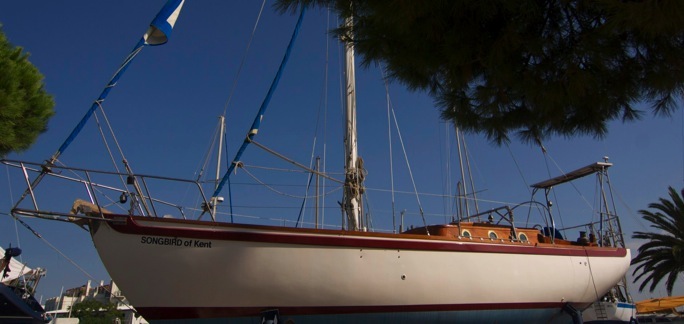
Songbird of Kent
Tradewind 33 - Songbird of Kent

Anyway, the deal was done and having sold my house in England I flew out to Corfu to collect Songbird of Kent. Inevitably it was a number of months before the boat was ready to head out into the Mediterranean but in early Spring 1988 it was time to explore the long coastlines of Greece and Turkey.

After a fantastic summer cruising from one idyllic anchorage to another mostly with friends or family on board, it was time to find a winter haven.  Many recommended Larnaca Marina in Cyprus.  Thus it was late in the summer of 1988 that I said goodbye to friends and set out on my own to cross from Antalya in Turkey to Cyprus and along the South coast of Cyprus to Larnaca, on the SE side of the island.

That sea crossing, a little over 200 nautical miles, was to become a regular solo experience at the start and end of each summer season. Impossible to do in a single day thus it always included a night at sea and rarely, if things didn’t go well with the weather, a couple of nights. I hated it! Maybe it was the sudden transition from coastal sailing to a deep water crossing, often going from having friends on board to being alone, but whatever it was I never enjoyed my time on my own and knew that long-distance solo sailing was never going to be my scene.

Anyway, I ended up spending several very happy winters in Larnaca.

One time, there was news of a Frenchman who had come into Larnaca on his way home to France having nearly completed a circumnavigation of the world. He was on his own!

I was astounded to hear how someone could do this and made a point of calling round to his berth. The boat was a beautiful, solid steel yacht, the very epitome of a craft that could challenge the oceans. The owner’s name was Pierre (it would be!). Pierre invited me aboard and we went down to his saloon to drink a hot coffee – real French coffee!

Inevitably the conversation turned to the challenges of sailing alone. Pierre said that the big cargo ships at sea moved quickly relative to the speed of a yacht so at night he set an alarm for every 15 minutes. That was the time that a ship could go from being hull down over the horizon to being close enough to be a hazard. Thus while at sea Pierre got up briefly every 15 minutes during the night to avoid being run down! It sounded totally exhausting.

Then Pierre asked me about the sailing I had done and whether I had sailed on my own. I declared my trivial journeys back and forth from Cyprus to Turkey and revealed that being on my own made me very, very unhappy. Pierre was surprised to hear that as he admitted that being at sea alone was one of the most tranquil and peaceful experiences ever. Pierre asked how long these solo journeys took. I replied, two or three days.

Ah!”, he said, “That is the problem.” “I, too, hate the three days. It is always a period where you adjust and it is terrible.

My friend, you must find a way to be alone for more than three days. You will see that it is very different.

It was some years before that opportunity came about but, in the end, I did undertake a solo journey of 8 days. Pierre was right. The first three days were hell, the rest were heaven!

Thank you, Songbird of Kent, you gave me some fabulous memories!
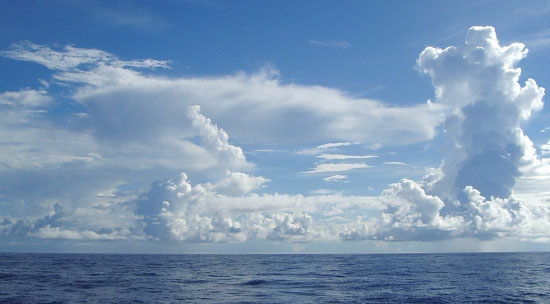
at sea

By Paul Handover

Now on to my writings about being out at sea alone on a small yacht.

Being at Sea

Going to sea in a small vessel is a profound experience.

In harbour we build up a reliance on things external. We have no need to worry if there is insufficient food on board, we can plug into the dockside power supply, sleep through the night undisturbed and we can wander off and enjoy the company of others if the boat feels a little claustrophobic.

Then slowly, imperceptibly, but with huge force, arrives the need to move on.  The realisation that our cosy life connected to the busy, bustling and self-obsessed world of shoreside is not fulfilling our search for adventure and for the truths that lay over the horizon.  It is time to leave.

The act of casting off is always exciting as it heralds a new adventure. But it also carries feelings of loss and apprehension as one lets go of the bonds of a previous certainty.  The first few hours are filled with the workload of getting one’s craft shipshape and battened down for the unknown seas. Then gradually comes the realisation that the land is now less the dominating visual feature than the vastness of the seascape that is ahead.  But with the land in sight, albeit a distant horizon behind one, you can still sense the life you are leaving.

Now all that surrounds you is the sea.  You are now truly disconnected from the land.  It is often at this point that despondency and uncertainty play with your mind; after all this new life is still very unfamiliar compared to the warmth of that island home that still resonates in your heart. Time to remind yourself of why you wanted to take this voyage.

A small boat is very fragile.  Just a centimetre of hull separating you from the unimaginable depths of the ocean beneath your keel. Not until the end of your voyage, when you draw your boat up, metaphorically on to that beach, will you ever stop feeling how close fate is, how it rides on your shoulder night and day. That, of course, is why we go to sea. It is the place where we taste life, where we savour each moment of the present because the future seems too bound up in the mystery, the uncertainty of the ocean. You are in charge of your tiny craft. Your survival depends on how you manage your small ship, how you navigate these seas, how you read the weather ahead and avoid the storms.

Soon your life on the ocean becomes everything to you. You have time to reflect on so much that is left behind. The distance seems to dissolve all the nuisances, bring into focus all the things that are important to you. There is no certainty with the ocean apart from the knowledge that you are very small and very, very vulnerable and yet, in a sense, also so strong.

In the end, we have to break away from our insecurities and our emotional dependencies on external people and situations because, without that, we are never able to command our own life and the destiny that flows from that captaincy.  There is a real strength in knowing ourselves as we would know our own boat.  If we really know every spar, sail, rope and fitting, if we have real understanding of the strengths and weaknesses of our small vessel then we are able to know when to breast the waves or when to turn and run before the storm.  We are secure that our small craft will protect us day and night.

Thus self-knowledge gives us the same freedom to manage our lives, to know when to fight and when to turn away.  And just as after every long voyage the boat will need hours of careful maintenance so our own souls need regular love and caring from our spiritual keeper.
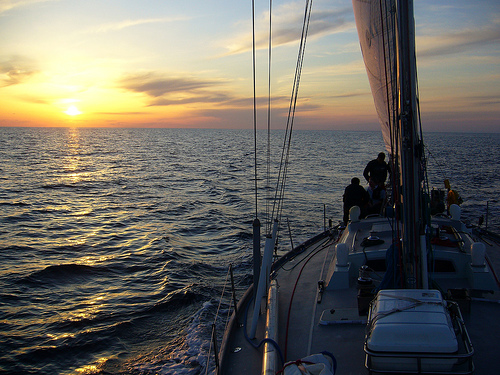
The setting sun ahead of a night on the ocean.

Copyright © 2008 Paul Handover

Just some ‘ah’ moments.

Taking a rest from the serious stuff!

The first picture comes from Merci O. from here in Payson.

Lost for words!

The next two are from the camera of ‘yours truly’.

Tough work being a puppy!

Cleo has settled in so beautifully and we can’t believe that these two weeks have gone so quickly.

Finally, talking of settling in, our five young chicks have reached the stage where they could be housed outside in their new chicken house, the move taking place just five days ago.

Welcome to your new home, young chick!

Grandad, tell me what polar bears were like?

Politics, oil and our natural world – tell me it’s all a bad dream!

Note

Yesterday, Thursday, I was really under the cosh in terms of finding time to write a careful and thoughtful Post for today, being involved in meetings both in the morning and afternoon, those meetings all about launching a transition town movement for Payson.

So my apologies for taking a short-cut and reproducing an item that was published on Common Dreams that, fortuitously, linked in with yesterday’s Post Moved to help?

Obama Echoes Bush, Sets Plan for Polar Bear Extinction

“President Obama’s proposal for these magnificent and imperiled animals is a gift to Big Oil”

– Common Dreams staff

The Obama Administration issued a proposed rule yesterday that disregards the effects of greenhouse gases on polar bear habitat leading one conservation group to say that the rule echoes former President George W. Bush’s plan, and that it will lead to the extinction of polar bears.

Kassie Siegel from the Center for Biological Diversity: “President Obama’s proposal for these magnificent and imperiled animals is a gift to Big Oil and an affirmation of the pro-industry policies of the Bush government. (photo: Subhankar Banerjee)

Kassie Siegel from the Center for Biological Diversity: “President Obama’s proposal for these magnificent and imperiled animals is a gift to Big Oil and an affirmation of the pro-industry policies of the Bush government. (photo: Subhankar Banerjee)Noting that polar bears are only on the endangered species list precisely because of loss of habitat caused by greenhouse gases generated from activities outside the Arctic, the proposed rule excluding activities outside the range of polar bears from regulations will lead to the bears’ demise.

Brendan Cummings of the Center for Biological Diversity called the rule “complete doublespeak,” the Associated Press reports.  “It’s saying, ‘Here is a rule necessary for the conservation of the polar bear,’ yet the only thing it does is exempt from regulation the overwhelming threat to the species.”

“If polar bears are to survive we have to directly confront the greatest threat to them: our greenhouse gas emissions,” said Kassie Siegel, director of the Center for Biological Diversity’s Climate Law Institute.

“With their sea-ice habitat rapidly disappearing, polar bears need the full protection of the Endangered Species Act,” said Siegel. “President Obama’s proposal for these magnificent and imperiled animals is a gift to Big Oil and an affirmation of the pro-industry policies of the Bush government. When it comes to saving urgently endangered polar bears, the only ‘change’ Obama has delivered is more climate change.”

The rule, released by the U.S. Fish and Wildlife Service, has 60-day public comment period.

* * *

Center for Biological Diversity: Obama Administration Again Proposes Polar Bear Extinction Plan
New Rule Echoes Bush Plan Ignoring Polar Bears’ Plight Against Global Warming

WASHINGTON – April 17 – The Obama administration announced today that it is reissuing a Bush-era regulation that sharply limits protections for polar bears under the Endangered Species Act. Both the current proposal and the previous Bush rule exclude activities occurring outside the range of polar bears — such as the greenhouse gas emissions of industrial polluters like coal plants — from regulations that could help stop the bear’s extinction. Today’s announcement comes as a result of a court order that struck down the Bush rule in October 2011.

Polar bears were the first species added to the endangered and threatened species list solely because of threats from global warming. Regulations issued under the Endangered Species Act must provide for the “conservation” of threatened species. Notably, the press release issued by the U.S. Fish and Wildlife Service announcing the new proposed rule today did not mention greenhouse gases or climate change at all, while the very purpose of the rule is to exempt greenhouse emissions from the reach of the Act.

“If polar bears are to survive we have to directly confront the greatest threat to them: our greenhouse gas emissions,” said Kassie Siegel, director of the Center for Biological Diversity’s Climate Law Institute. “But the Obama administration seems to be living in a fantasy world where the way to solve a difficult problem is to deny its existence.”

The proposed rule severely undermines protection for polar bears by exempting from portions of the Endangered Species Act all activities that occur outside of the bears’ range. But the species is endangered precisely because of activities occurring outside the Arctic — namely the emission of greenhouse gases and resulting warming that is leading to the rapid disappearance of summer sea ice.

“With their sea-ice habitat rapidly disappearing, polar bears need the full protection of the Endangered Species Act,” said Siegel. “President Obama’s proposal for these magnificent and imperiled animals is a gift to Big Oil and an affirmation of the pro-industry policies of the Bush government. When it comes to saving urgently endangered polar bears, the only ‘change’ Obama has delivered is more climate change.”

The special rule also reduces the protections the bear would otherwise receive in Alaska from oil-industry activities in its habitat.

When the polar bear was listed as a threatened species in May 2008 (following a petition by the Center), the Bush administration simultaneously issued a special rule under section 4(d) of the Endangered Species Act. A similar rule was finalized in December 2008 and defended by the Obama administration in court. On Oct. 17, 2011, a federal district court judge struck it down owing to the Fish and Wildlife Service’s failure to conduct an environmental review of the rule’s impacts.

The challenge was brought by the Center for Biological Diversity, Natural Resources Defense Council, Greenpeace and Defenders of Wildlife. Today’s proposal, in response to the 2011 court order, triggers a 60-day public comment period, with the rule scheduled for finalization by the end of 2012.

So I ponder on how to respond to the question from my grandson, currently one-year-old, when, in a few years time, the polar bears are no longer?

Connecting the dots

On the 23rd March, I wrote a piece entitled The most important alarm ever heard.  It opened as follows:

The most important alarm ever heard.

The heading says it all.

In fact the heading was taken from an email that came in from Bill McKibben’s 350.org yesterday.  But before reproducing that email in full, let me take you back to the 6th January this year when I published a piece simply called Keystone XL pipeline.  This is how that Post opened up,

Yesterday, I had published a lecture given in Melbourne by Britain’s eminent Astronomer Royal, Lord Martin Rees.  Lord Rees concluded his lecture with the call for us to take better care of our own planet. He, like many others, recognises the unique place in history that we occupy. For the first time a single species is capable of exerting profound changes on the Earth’s natural and physical environments.

Over and over again, scientists are reporting the rise in climate temperature of Planet Earth and the implications thereof if we do not wakeup soon to changing our ways.  The Keystone pipeline is a huge potential mistake!

Bill McKibben of 350.org

Not easy to focus on a single sentence from Lord Rees but this one’s pretty direct, “For the first time a single species is capable of exerting profound changes on the Earth’s natural and physical environments.”

Now have a read of the article on 350orbust.com called Things Happen, But It’s Time To Connect The Dots. I’ve taken the liberty of republishing it in full.  But first the video:

Things Happen, But It’s Time To Connect The Dots

APRIL 16, 2012

Thailand has the worst flooding in its history, only a month after Central America has the worst flood in its history, a month after Vermont has the worst flooding in its history in the same year that the Mississippi river has the worst flooding in its history. And Queensland in Australia has its worst floods only a few months after Pakistan floods so badly that 20 million people are forced from their homes – it’s connected, folks.

Across the planet now we see ever more flood, ever more drought, ever more storms. People are dying, communities are being wrecked — the impacts we’re already witnessing from climate change are unlike anything we have seen before.

But because the globe is so big, it’s hard for most people to see that it’s all connected. That’s why, on May 5, we will Connect the Dots.

In places from drought-stricken Mongolia to flood-stricken Thailand, from fire-ravaged Australia to Himalayan communities threatened by glacial melt, we will hold rallies reminding everyone what has happened in our neighborhoods. And at each of those rallies, from Kenya to Canada, from Vietnam to Vermont, someone will be holding a…dot. A huge black dot on a white banner, a “dot” of people holding hands, encircling a field where crops have dried up, a dot made of fabric and the picture taken from above — you get the idea. We’ll share those images the world around, to put a human face on climate change–we’ll hold up a mirror to the planet and force people to come face to face with the ravages of climate change.

Anyone and everyone can participate in this day. Many of us do not live in Texas, the Philippines, or Ethiopia — places deeply affected by climate impacts. For those communities, there are countless ways to stand in solidarity with those on the front-lines of the climate crisis: some people will giving presentations in their communities about how to connect the dots. Others will do projects to demonstrate what sorts of climate impacts we can expect if the crisis is left unchecked. And still others of us will express our indignation to local media and politicians for failing to connect the dots in their coverage of “natural disasters.”

However you choose to participate, your voice is needed in this fight — and you can sign up here: www.climatedots.org

These will be beautiful events, we’re sure. But they will also have an edge. It’s important for all of us whose lives are being damaged to know that it’s right that we get a little angry at those forces causing this problem. The fossil fuel industry is at fault, and we have to make that clear. Our crew at 350.org will work hard to connect all these dots — literally — and weave them together to create a potent call to action, and we will channel that call directly to the people who need to hear it most.

May 5 is coming soon; we need to work rapidly. Because climate change is bearing down on us, and we simply can’t wait. The world needs to understand what’s happening, and you’re the people who can tell them.

Please join us–we need you to send the most important alarm humanity has ever heard:www.climatedots.org

Onwards,

Bill McKibben for the whole team at ClimateDots.org

RMS Titanic – in memory.

Spare a moment’s thought today.

On April 14th, 1912, at 23.40 ships time, the Titanic struck an iceberg and the rest is history.  I’m not going to add to the wealth of information available on this sad centenary except to say that 1,514 people lost their lives and they and their descendants should be held in our prayers.  And to recognise that one of those who lost his life was young ‘Jack’ Phillips, Senior Wireless Operator, who persisted in sending out distress messages by Morse Code to the very last, thus enabling the RMS Carpathia to rescue 710 souls.

Rest In Peace

Below are some local times to assist you in offering up a quiet thought as one hundred years ago to the moment the sound of a liner hitting an iceberg reverberated around the world.

RMS Titanic Ships Time April 14th 2340 – 11.40 PM

GMT/UTC April 15th 0240 – 2.40 AM

British Summer Time April 15th 0340 – 3.40 AM

Arizona/California April 14th 1940 – 7.40 PM

New York April 14th 2240 – 10.40 PM

London April 15th 0340 – 3.40 AM

Paris April 15th 0440 – 4.40 AM

Moscow April 15th 0640 – 6.40 AM

Singapore April 15th 1040 – 10.40 AM

Sydney, Australia April 15th 1240 – 2.40 PM

More world times may be calculated from this website.

Autism and bees – a disturbing link

If you eat food, and hope to do so in the future, read this!

I subscribe to Food Freedom News and often read their articles when they appear in my ‘in-box’.  Especially so yesterday morning when the headline jumped off the ‘page’ at me: Autism and Disappearing Bees: A Common Denominator?

So, in a sense, hand-in-hand with the article in yesterday’s Learning from Dogs Food, glorious food!  Because if trying to feed 9 billion people living on a planet where ‘farmers holding seeds that won’t sprout‘ means the even greater use of chemicals then ….. then, I don’t know what!

The Food Freedom website showed that the article came from Brian Moench of the Common Dreams website.  Not a website I had come across before but one that quickly impressed me!

So here’s that article.

Autism and Disappearing Bees: A Common Denominator?

by Brian Moench

A few days ago the Salt Lake Tribune’s front page headline declared, “Highest rate in the nation, 1 in 32 Utah boys has autism.”  This is a national public health emergency, whose epicenter is Utah, Gov. Herbert.  A more obscure story on the same day read: “New pesticides linked to bee population collapse.”  If you eat food, and hope to do so in the future, this is another national emergency, Pres. Obama.  A common  denominator may underlie both headlines.

A honeybee pollinates a flower in a citrus grove just coming into blossom. (Photograph: David Silverman/Getty Images)

A Stanford University study with 192 pairs of twins, with one twin autistic and one not, found that genetics accounts for 38% of the risk of autism, and environmental factors account for  62%.

Supporting an environmental/genetic tag team are other studies showing autistic children and their mothers have a high rate of a genetic deficiency in the production of glutathione,  an anti-oxidant and the body’s primary means of detoxifying heavy metals.  High levels of toxic metals in children are strongly correlated with the severity of autism.  Low levels of glutathione, coupled with high production of another chemical, homocysteine, increase the chance of a mother having an autistic child to one in three.  That autism is four times more common among boys than girls is likely related to a defect in the single male X chromosome contributing to anti-oxidant deficiency.   There is no such thing as a genetic disease epidemic  because genes don’t change that quickly.  So the alarming rise in autism must be the result of increased environmental exposures that exploit these genetic defects.

During the critical first three months of gestation a human embryo adds 250,000 brain cells per minute reaching 200 billion by the fifth month.  There is no chemical elixir that improves this biologic miracle, but thousands of toxic substances can cross the placenta and impair that process, leaving brain cells stressed, inflamed, less well developed, fewer in number and with fewer connections with each other all of which diminish brain function.  The opportunity to repair the resulting deficits later on is limited.

The list of autism’s environmental suspects is long and comes from many studies that show higher rates of autism with greater exposure to flame retardants, plasticizers like BPA,  pesticides, endocrine disruptors in personal care products, heavy metals in air pollution, mercury, and pharmaceuticals like anti-depressants.  [my emphasis]  (Utah’s highest in the nation autism rates are matched by the highest rates of anti-depressant use and the highest mercury levels in the country in the Great Salt Lake).

Doctors have long advised women during pregnancy to avoid any unnecessary consumption of drugs or chemicals.  But as participants in modern society we are all now exposed to over 83,000 chemicals from the food we eat, the water we drink, the air we breathe and the consumer products we use.  Pregnant women and their children have 100 times more chemical exposures today than 50 years ago.  The average newborn has over 200 different chemicals and heavy metals contaminating  its blood when it takes its first breath. 158 of them are toxic to the brain.  Little wonder that rates of autism, attention deficit and behavioral disorders are all on the rise.

How does this relate to vanishing bees and our food supply?  Two new studies, published simultaneously in the journal Science,  show that the rapid rise in use of insecticides is likely responsible for the mass disappearance of bee populations.   The world’s food chain hangs in the balance because 90% of native plants require pollinators to survive.

The brain of insects is the intended target of these insecticides.  They disrupt the bees homing behavior and their ability to return to the hive, kind of like “bee autism.”   But insects are different than humans, right?   Human and insect nerve cells share the same basic biologic infrastructure.  Chemicals that interrupt electrical impulses in insect nerves will do the same to humans.  But humans are much bigger than insects and the doses to humans are  miniscule, right?

During critical first trimester development a human is no bigger than an insect so there is every reason to believe that pesticides could wreak havoc with the developing brain of a human embryo.   But human embryos aren’t out in corn fields being sprayed with insecticides, are they?  A recent study showed that every human tested had the world’s best selling pesticide, Roundup, detectable in their urine at concentrations between five and twenty times the level considered safe for drinking water.

The autism epidemic and disappearing bees are real public health emergencies created by allowing our world to be overwhelmed by environmental toxins.  Environmental protection is human protection, especially for the smallest and most vulnerable among us.

oooOOOooo

Brian Moench

Dr. Brian Moench is President of Utah Physicians for a Healthy Environment and a member of the Union of Concerned Scientists. He can be reached at: drmoench@yahoo.com

Please bring this to the notice of any couples who you know are planning for a family!

If all this sort of information makes you want to curl up and kiss your backside goodnight, then hold on.  Next week I hope to publish a summary of a fascinating presentation given to a local women’s group here in Payson that shows the many obvious and easy steps we can all take to revert back to a resilient life on this planet.  

Dogs really do know better!

Food, glorious food!

Advisory.

This Post includes the details of a live broadcast of an important event Feeding the World While the Earth Cooks from Washington D.C. If you would like to watch that broadcast then it starts at:

6am US Mountain Time Zone

9am US Eastern Daylight Time

13:00 Greenwich Mean Time (GMT/UTC)

2pm British Summer Time

Full details below.

H’mm, maybe the days of Oliver are well and truly numbered!

A quick ‘search’ found the lyrics of the famous song from the musical Oliver.  Here’s a part of the chorus:

Food, glorious food!
Don’t care what it looks like —
Burned!
Underdone!
Crude!
Don’t care what the cook’s like.
Just thinking of growing fat —
Our senses go reeling
One moment of knowing that
Full-up feeling!

Not to be taken for granted.

However, a recent announcement from Arizona State University quite rightly points out the challenges that lay ahead in terms of feeding the world’s population.  Here are the details of that ASU announcement.

The future of food: feeding the world while the Earth cooks

Editor’s Note: This event is presented by Future Tense, a partnership between Arizona State University, the New America Foundation and Slate, that examines emerging technologies, public policy and society.

Arizona State University, the New America Foundation and Slate present Feeding the World While the Earth Cooks live from Washington, D.C., on April 12.

The program will air in it’s entirety on ASUtv.

The event considers the agricultural crisis that may ensue when today’s toddlers are parents themselves – a time when the world population will reach 9 billion. “A growing global middle class will demand more food. And climate change will leave farmers holding seeds that won’t sprout. By 2050, will our global appetite outgrow our agricultural capacity?”

Tune in to find out how everyone – growers, technologists, governments, business leaders, and carbon-conscious consumers – will be part of the solution.

Speakers include Nina Fedoroff, special advisor on science and technology to the Secretary of State; Fred Kirschenmann, Distinguished Fellow at the Leopold Center for Sustainable Agriculture and President of Stone Barnes Center; Debra Eschmeyer, founder and program director of FoodCorps; and Bill Hohenstein, director of the USDA Global Change Program Office.

Let me highlight that the event is being carried live and is available to view.

The link you need to that ASUtv programme is here.  From where you will see that:

Arizona State University, the New America Foundation , and Slate present “Feeding the World While the Earth Cooks” live from Washington, D.C., this April 12 from 6:00 am to 12:15 pm. The program will air in it’s entirety onASUtv.

(From the New America Foundation): When today’s toddlers are parents themselves, they will face an agricultural crisis. The world population will reach 9 billion. A growing global middle class will demand more food. And climate change will leave farmers holding seeds that won’t sprout. By 2050, will our global appetite outgrow our agricultural capacity?

Join us to find out how everyone—growers, technologists, governments, business leaders, and carbon-conscious consumers—will be part of the solution.

The day’s speakers include Dr. Nina Fedoroff, Special Advisor on Science and Technology to the Secretary of State; Dr. Fred Kirschenmann, Distinguished Fellow at the Leopold Center for Sustainable Agriculture and President of Stone Barnes Center; Debra Eschmeyer, Founder and Program Director of FoodCorps; Bill Hohenstein, Director of the USDA Global Change Program Office; and many more.

So if you want to watch that event then here are the UTC times.

April 12 from 6:00 am to 12:15 pm US Mountain Time equates to 13:00 – 19:15 UTC (2 pm to 8:15 pm British Summer Time)

The unconscious

A Biological Basis for the Unconscious? Surely not?

Ten days ago or thereabouts, I saw a piece on Big Think about the unconscious.  The title of the piece was as the sub-heading: A Biological Basis for the Unconscious?  I was intrigued, to say the least, and wanted to write about that on Learning from Dogs.

The article started thus:

What’s the Big Idea?

Eric Richard Kandel

Today, the question of how people make decisions is an animated and essential one, capturing the attention of everyone from neuroscientists to lawyers to artists. In 1956, there was one person in all of New York known for his work on the brain: Harry Grundfest. An aspiring psychiatrist who was born in Austria in the 1930’s, Eric Kandel took an elective in brain science during medical school and found himself studying alongside Grudfest at Columbia University.

“What is it you want to study?” Grundfest asked Kandel. “I want to know where the id, the ego, and the super-ego are located in the brain,” Kandel replied. Grundfest looked at him as if he was crazy. “I haven’t got the foggiest notion whether these constructs exist,” he said. “But the way to approach the brain is to study it one cell at a time. Why don’t you study how the cells work?”

Now it would be improper to republish the whole article, not having permission to so do, and I thoroughly recommend you going to the article here and reading it completely from the Big Think website.

But there are a number of interesting videos on YouTube and the one I have selected is a great example of Kandel’s power of mind.  As the short description of the video reveals, “A Conversation With Nobel Laureate Eric Kandel, Who Continues to Look Forward at 80.”

Titanic, 100 years on, Apr 10th 2012

A very famous, albeit sad, anniversary of a great ship.

Such a short life!

From launch to maiden voyage, 100 years ago today.

April 10th, 1911.

And just four, short days after RMS Titanic left Southampton for her maiden voyage; on April 14th, at 11.40 pm ….

Not even a year after the launch.

“The Sinking of the Titanic, 1912,” EyeWitness to History www.eyewitnesstohistory.com (2000).

On April 10, 1912, the Titanic, largest ship afloat, left Southampton, England on her maiden voyage to New York City. The White Star Line had spared no expense in assuring her luxury. A legend even before she sailed, her passengers were a mixture of the world’s wealthiest basking in the elegance of first class accommodations and immigrants packed into steerage.

She was touted as the safest ship ever built, so safe that she carried only 20 lifeboats – enough to provide accommodation for only half her 2,200 passengers and crew. This discrepancy rested on the belief that since the ship’s construction made her “unsinkable,” her lifeboats were necessary only to rescue survivors of other sinking ships. Additionally, lifeboats took up valuable deck space.

Four days into her journey, at 11:40 P.M. on the night of April 14, she struck an iceberg. Her fireman compared the sound of the impact to “the tearing of calico, nothing more.” However, the collision was fatal and the icy water soon poured through the ship.

It became obvious that many would not find safety in a lifeboat. Each passenger was issued a life jacket but life expectancy would be short when exposed to water four degrees below freezing. As the forward portion of the ship sank deeper, passengers scrambled to the stern. John Thayer witnessed the sinking from a lifeboat. “We could see groups of the almost fifteen hundred people still aboard, clinging in clusters or bunches, like swarming bees; only to fall in masses, pairs or singly, as the great after part of the ship, two hundred and fifty feet of it, rose into the sky, till it reached a sixty-five or seventy degree angle.” The great ship slowly slid beneath the waters two hours and forty minutes after the collision

The next morning, the liner Carpathia rescued 705 survivors. One thousand five hundred twenty-two passengers and crew were lost. Subsequent inquiries attributed the high loss of life to an insufficient number of lifeboats and inadequate training in their use.

Read more of this fascinating account, especially the story of Elizabeth Shutes who, aged 40, was governess to nineteen-year-old Margaret Graham who was traveling with her parents. As Shutes and her charge sit in their First Class cabin they feel a shudder travel through the ship. At first comforted by her belief in the safety of the ship, Elizabeth’s composure is soon shattered by the realization of the imminent tragedy.

Also grateful to my cousin, Rose F., who sent me a link to a story in the British newspaper The Telegraph that came out in September, 2010.  I don’t have permission to reproduce that story but hope that it being 18 months since it was published by the Telegraph makes my act forgiveable!

Titanic sunk by steering blunder, new book claims

It was always thought the Titanic sank because its crew were sailing too fast and failed to see the iceberg before it was too late.

10:55PM BST 21 Sep 2010

But now it has been revealed they spotted it well in advance but still steamed straight into it because of a basic steering blunder.

According to a new book, the ship had plenty of time to miss the iceberg but the helmsman panicked and turned the wrong way.

By the time the catastrophic error was corrected it was too late and the side of the ship was fatally holed by the iceberg.
Even then the passengers and crew could have been saved if it had stayed put instead of steaming off again and causing water to pour into the broken hull.

The revelation, which comes out almost 100 years after the disaster, was kept secret until now by the family of the most senior officer to survive the disaster.

Second Officer Charles Lightoller covered up the error in two inquiries on both sides of the Atlantic because he was worried it would bankrupt the liner’s owners and put his colleagues out of job.

Since his death – by then a war hero from the Dunkirk evacuation – it has remained hidden for fear it would ruin his reputation.

But now his granddaughter the writer Lady (Louise) Patten has revealed it in her new novel.  “It just makes it seem all the more tragic,” she said. “They could easily have avoided the iceberg if it wasn’t for the blunder.

The error on the ship’s maiden voyage between Southampton and New York in 1912 happened because at the time seagoing was undergoing enormous upheaval because of the conversion from sail to steam ships.

The change meant there were two different steering systems and different commands attached to them.

Some of the crew on the Titanic were used to the archaic Tiller Orders associated with sailing ships and some to the more modern Rudder Orders.

Crucially, the two steering systems were the complete opposite of one another.

So a command to turn “hard a starboard” meant turn the wheel right under the Tiller system and left under the Rudder.
When First Officer William Murdoch spotted the iceberg two miles away, his “hard a-starboard” order was misinterpreted by the Quartermaster Robert Hitchins.

He turned the ship right instead of left and, even though he was almost immediately told to correct it, it was too late and the side of the starboard bow was ripped out by the iceberg.

The steersman panicked and the real reason why Titanic hit the iceberg, which has never come to light before, is because he turned the wheel the wrong way,” said Lady Patten who is the wife of former Tory Education minister, Lord (John) Patten.

Whilst her grandfather Lightoller was not on watch at the time of the collision, her book Good as Gold reveals that a dramatic final meeting of the four senior officers took place in the First Officer’s cabin shortly before Titanic went down.

There, Lightoller heard not only about the fatal mistake, but also what happened next, up on the bridge.

While Hitchins had made a straightforward error, what followed was a deliberate decision.

Bruce Ismay, chairman of Titanic’s owner, the White Star Line, persuaded the Captain to continue sailing.  For ten minutes, Titanic went “Slow Ahead” through the sea.

This added enormously to the pressure of water flooding through the damaged hull, forcing it up and over the watertight bulkheads, sinking Titanic many hours earlier than she otherwise would have done.

Ismay insisted on keeping going, no doubt fearful of losing his investment and damaging his company’s reputation,” said Lady Patten.  “The nearest ship was four hours away. Had she remained at ‘Stop’, it’s probable that Titanic would have floated until help arrived.

The truth of what happened on that historic night was deliberately buried.

Lightoller, the only survivor who knew precisely what had happened, and who would later go on to be a twice-decorated war hero, decided to hide what he knew from the world, including two official inquiries into the sinking.

By his code of honour, he felt it was his duty to protect his employer – White Star Line – and its employees.

Lady Patten said: “The inquiry had to be a whitewash. The only person he told the full story to was his beloved wife Sylvia, my grandmother.  As a teenager, I was enthralled by the Titanic. Granny revealed to me exactly what had happened on that night and we would discuss it endlessly.

She died when I was sixteen and, though she never told me to keep the knowledge to myself, I didn’t tell anyone. My mother insisted that everything remained strictly inside the family: a hero’s reputation was at stake.

Nearly forty years later, with Granny and my mother long dead, I was plotting my second novel and it struck me that I was the last person alive to know what really happened on the night Titanic sank.

My grandfather’s extraordinary experiences felt like perfect material for Good As Gold.

© Copyright of Telegraph Media Group Limited 2010

Anyone who reads this and is as fascinated as I was should read the comments as there is much discussion about the nature of the steering error.

Rest in peace.

Happiness = Ten minus five or thereabouts!

Brilliant mathematics without the need for a calculator!

Thanks to the bottomless resources of the Internet, I could quickly find a relevant quote or two to open up today’s Post.  Rene Descartes (1596-1650) was reputed to have said, “Perfect numbers like perfect men are very rare.

Sorry, couldn’t resist that!  It wasn’t the quote relevant to this essay but it was too good to miss.  (Descartes was also the person who coined the phrase: I think therefore I am!)

 The quote that I thought was relevant was this one from Descartes, “With me everything turns into mathematics.”  Well until I read something recently on the Big Think website I would have been certain that the emotions, such as happiness, were well beyond reach of the logical power of mathematics.  I was wrong!

Big Think recently reported on a new book from Mr. Chip Conley called Emotional Equations where he …….,

….. argues (against Einstein, as it happens), that everything that counts can and ought to be counted. A hotelier by trade, he says that GDP and the bottom line are blunt instruments for measuring the health of a society or a business. After the dot.com crash of 2001, and a visit to the Buddhist nation of Bhutan, which has a “Gross National Happiness” index, Conley and his team decided to create indices for measuring the well-being of their employees and customers.

And a paragraph later continues,

In Emotional Equations, Conley takes the mathematics of human happiness a step further, creating simple formulas like anxiety = uncertainty x powerlessness, which, when used systematically, he says, can give individuals and organizations a concrete method for addressing the human needs that drive them.

The description of the book on the Amazon website is thus,

Mr Chip Conley

Using brilliantly simple math that illuminates universal emotional truths, Emotional Equations crystallizes some of life’s toughest challenges into manageable facets that readers can see clearly—and bits they can control. Popular motivational speaker and bestselling author Chip Conley has created an exciting, new, immediately accessible visual lexicon for mastering the age of uncertainty. Making mathematics out of emotions may seem a counterintuitive idea, but it’s an inspiring and incredibly effective one in Chip Conley’s hands. When Conley, dynamic author of the bestselling Peak, suffered a series of tragedies, he began using what he came to call “Emotional Equations” (like Joy = Love – Fear) to help him focus on the variables in life that he could deal with, rather than ruminating on the unchangeable constants he couldn’t, like the bad economy, death, and taxes. Now this award-winning entrepreneur shares his amazing new self-help paradigm with the rest of us. Emotional Equations offers an immediately understandable means of identifying the elements in our lives that we can change, those we can’t, and how they interact to create the emotions that define us and can help or hurt our progress through life. Equations like “Despair = Suffering – Meaning” and “Happiness = Wanting What You Have/Having What You Want” (Which Chip presented at the prestigious TED conference) have been reviewed for mathematical and psychological accuracy by experts. Conley shows how to solve them through life examples and stories of inspiring people and role models who have worked them through in their own lives. In these turbulent times, when so many are trying to become “superhuman” to deal with our own and the world’s problems, Emotional Equations arms readers with effective formulas for becoming super human beings.

So it all seems not quite so daft as one might initially guess.  Indeed, settle down for twenty minutes and watch Chip eloquently explain his ideas captured at that TED Conference referred to above.

There’s also an audio conversation with Mr. Conley that you can download free from here.

Finally, let me close with yet another quote from Rene Descartes, “It is not enough to have a good mind. The main thing is to use it well.” Amen to that!