Category: Core thought

The power in these words.

Day three of recognising the passing of 400 ppm atmospheric CO2.

In nearly four years of writing for Learning from Dogs, I can’t recall devoting three days of posts to a single subject. To put that into context, today’s post is number 1,683 since the first one was published on July 15th, 2009; not all of them from the brain of yours truly by any means you understand!

Today, I’m going to feature a recent essay written by George Monbiot finishing up three days of ‘reporting’ on the deeply disturbing, but fully anticipated, news that the planet’s atmosphere has reached a concentration of 400 ppm CO2.

Last Monday, I published What legacy do we wish to leave for others?

Then yesterday, a post under the title of 400 ppm, as the BBC reported it.  I closed with a reference to a remark made by Professor Sir Brian Hoskins, director of the Grantham Institute for Climate Change at Imperial College London; the remark being “A greater sense of urgency was needed.

I wrote that those wishy-washy words were pathetic.  That we needed the sort of words that George Monbiot penned a few days ago in the Guardian newspaper.  There it was entitled “Climate milestone is a moment of symbolic significance on road of idiocy“.

But I think the title that Mr. Monbiot chose to use on his own blog was far more apt: Via Dolorosa.  (Note that I haven’t formally requested permission to republish the essay but trust that the following is acceptable to both Mr. Monbiot and the Guardian newspaper.)

Here’s how it opened:

Via Dolorosa

May 10, 2013

Corruption and short-termism are pushing us along the path of sorrows.

By George Monbiot, published on the Guardian’s website, 10th May 2013

The records go back 800,000 years: that’s the age of the oldest fossil air bubbles extracted from Dome C, an ice-bound summit in the high Antarctic. And throughout that time there has been nothing like this. At no point in the pre-industrial record have concentrations of carbon dioxide in the air risen above 300 parts per million. 400 is a figure that belongs to a different era.

The difference between 399 and 400ppm is small, in terms of its impacts on the world’s living systems. But this is a moment of symbolic significance, a station on the Via Dolorosa of environmental destruction. It is symbolic of our collective failure to put the long term prospects of the natural world and the people it supports above immediate self-interest.

The symbolic significance of the planet’s atmospheric concentrations of CO2 passing 400ppm  is that, I hope, with all the hope that my heart can summon up, it will bring us back from the brink.  Then one ponders about this possibility as Monbiot’s next paragraph unfolds:

The only way forward now is back: to retrace our steps along this road and to seek to return atmospheric concentrations to around 350 parts per million, as the 350.org campaign demands. That requires, above all, that we leave the majority of the fossil fuels which have already been identified in the ground. There is not a government or an energy company which has yet agreed to do so.

“not a government or an energy company … has yet agreed to do so.”

I’m going to repeat that again, with emboldening; “not a government or an energy company … has yet agreed to do so.

In fact, one could reasonable argue that having any hope for a turning back is utterly naive. Look what the essay goes on to say:

Just before the 400-mark was reached, Shell announced that it will go ahead with its plans to drill deeper than any offshore oil operation has gone before: almost three kilometres below the Gulf of Mexico.

A few hours later, Oxford University opened a new laboratory in its department of earth sciences. The lab is funded by Shell. Oxford says that the partnership “is designed to support more effective development of natural resources to meet fast-growing global demand for energy.” Which translates as finding and extracting even more fossil fuel.

The European Emissions Trading Scheme, which was supposed to have capped our consumption, is now, for practical purposes, dead. International climate talks have stalled; governments such as ours now seem quietly to be unpicking their domestic commitments. Practical measures to prevent the growth of global emissions are, by comparison to the scale of the challenge, almost non-existent.

As an example of the scale of the hypocrisy in which we are all immersed, last week’s The Economist magazine carried a full-age advertisement from Chevron on page 5 under the banner of ‘Protecting The Planet Is Everyone’s Job – We agree‘ and going on to explain:

We go to extraordinary lengths to protect the integrity of the places where we operate.  Places all over the world, like Australia’s Barrow Island.  It’s home to hundreds of native species of wildlife, including wallabies, ospreys, and perenties.

We’ve been producing energy on the island for more than 40 years, and it remains a Class A Nature Reserve.

Didn’t take me two moments to find this image:
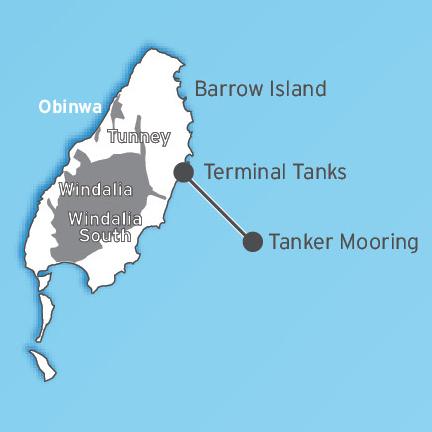
Barrow Island, Australia.  Taken from the Chevron Australia website.
Barrow Island, Australia. Taken from the Chevron Australia website.

To my mind this advertisement completely misses the point; deliberately or otherwise.  Chevron and all other oil producing companies in the world are endangering the future of the entire planet by continuing to ‘produce energy’, aka oil.  Period. Full stop.

Or to put it in the words of George Monbiot’s essay:

The problem is simply stated: the power of the fossil fuel companies is too great. Among those who seek and obtain high office are people characterised by a complete absence of empathy or scruples, who will take money or instructions from any corporation or billionaire who offers them, and then defend those interests against the current and future prospects of humanity. This new mark reflects a profound failure of politics, worldwide, in which democracy has quietly been supplanted by plutocracy. Without a widespread reform of campaign finance, lobbying and influence-peddling and the systematic corruption they promote, our chances of preventing climate breakdown are close to zero.

Thus the final sentence in GM’s essay carries a deep sadness.

So here we stand at a waystation along the road of idiocy, apparently determined only to complete our journey.

http://www.monbiot.com

Why are we not seeing, hearing and reading words of a similar weight and power from just about every ‘opinion maker’ in the world?
Why not?  Why not?

The counter-intuitive aspect of liberty.

How libertarian ideology is holding back our liberty to change.

Martin Lack, he of the popular blog Lack of Environment is taking a small break from his writings.  In his own words,

I am afraid this may be the last post on this blog for a while because – what with the all the willful blindness and ideological prejudice that seems to stop people from recognising what an Eff-ing mess humanity is in – and my as yet unresolved employment situation – I am feeling somewhat emotionally drained. However, please don’t cancel your subscription (as who knows how quickly I may recover).

So what a pleasant surprise when less than a day after those words in came an email that read, “Since I have told readers of my blog that I am taking a rest, I offer you the text appended below to post on your blog instead (or not – as you see fit).

On reading the text I most certainly ‘saw fit‘ to publish it!

It is a very interesting approach to climate science denialism resulting from an analysis of conspiracy theories.

So over to Martin.

oooOOOooo

Professor Stephan Lewandowsky.

Libertarian ideology is the real road block

I have recently been catching up on a bit of reading – focusing on the recent work of Professor Stephan Lewandowsky (and others).  Following in the wake of James Hansen, Ben Santer and Michael Mann, Lewandowsky has recently been the target of hate-mail campaigns by climate change sceptics.  Unlike all the others, however, Lewandowsky (formerly at the University of Western Australia but now at Bristol University in the UK) is not a climate scientist.  This is how Bristol University announced his recent appointment.

Steve is an internationally renowned cognitive scientist who has joined us from the University of Western Australia. His research has already revolutionised our understanding of human memory and cognition, and he now stands poised to build upon his impressive body of work with a project as ambitious as it is timely. In particular, Steve’s intention to improve our understanding of how people choose to acquire information, and to use this understanding to help create a more informed populace, is a unique and much needed undertaking. Thus, this research offers enormous benefits in the fields of experimental psychology, climate research and the wider public engagement with and understanding of scientific research.

I must admit that, until recently, I had not sat down to read either of the papers by Lewandowsky et al (  ‘Motivated Rejection of Science’ [PDF]  or ‘Recursive Fury: Conspiracy Ideation in the Blogosphere’ [PDF] ) – I had only read about them.

However, now that I have read them, the thing that strikes me most forcefully is not the stupidity of conspiracy “ideation”, the invocation of conspiracy theories, it is the fact that, as Lewandowsky et al acknowledge, their work confirms the findings of many previous studies; that climate change scepticism is associated with prejudicial adherence to libertarian ideology.  Also key is that climate change scepticism can be predicted by that prejudicial adherence to libertarian ideology.

Amongst many other things, this explains why EU sceptics are climate sceptics and why the United Kingdom Independence Party (UKIP) do not like Wind Farms.  I had understood this for some time.  However, I had not fully realised its importance; it was just one theme among others.  Anyone who has read my blog recently will probably have noticed my post about New World Order (NWO) conspiracy theory, in which I acknowledged that I had not realised just how significant such thinking is, and how subliminal and subconscious it may be.

Although adherence to free-market economics and libertarian ideology were themes I highlighted in my MA dissertation and in my subsequent book, and mentioned on my blog numerous times, everything I have read in the last few days points to one conclusion:  We will not succeed in communicating the urgency of the need for radical changes in energy policy until we can convince people that climate scientists are not trying to perpetuate their research funding or halt human progress.

Professor Lewandowsky’s research shows that little can be achieved by simply telling people they are wrong.  Far better is pointing out to people that Limits to Growth and Peak Oil have already halted the progress of globalised Capitalism, as recent times prove dramatically. In other words conveying facts to people rather than ideology.

I must admit that this has been a tough pill to swallow.  I am not naturally progressive and certainly not naturally “liberal”.  On the contrary, I am socially and politically conservative.  However, the reality of anthropogenic climate disruption is a game-changer. Therefore, unlike members of the Flat Earth Society or Young Earth Creationists (YECs), I do not refuse to accept what scientists tell me simply because I don’t like the message.

We cannot defeat such obscurantism by telling people they are irrational; we can only defeat it by focusing on the evidence that suggests strongly that they are mistaken.  To this end, I think the words of St Augustine of Hippo are an important consideration; words going back over 1,400 years before anyone started to question the Age of the Earth or the Origin of Species!  Words echoed by Thomas Aquinas, (often quoted to those YECs):

“… since Holy Scripture can be explained in a multiplicity of senses, one should adhere to a particular explanation only in such measure as to be ready to abandon it if it be proved with certainty to be false, lest Holy Scripture be exposed to the ridicule of unbelievers, and obstacles be placed to their believing.”
– Thomas Aquinas, Summa Theologica (1273).

In the last 150 years or so, most Christians have now come to reject conspiracy theory explanations for fossils, for example, and have realised that it is inappropriate to treat the Bible as a scientific text book.  Regretably, the main source of ideological blindness today is not conventional religion; it is adherence to free-market economics.

Therefore, it is important that we acknowledge the ideological nature of the communication problem we face. That is that the research by Prof Lewandowsky and others has discovered a tendency for libertarians to prefer conspiracy theories to reality.  Perhaps, therefore, not surprising that he has been attacked; no-one likes to be told they are deluded.

Roadblocks to policy change will not be cleared by social and political scientists telling libertarians that they are deluded.  All that will do is confirm their suspicions and reinforce their prejudices!  No, what is needed is for climate scientists to be bolder in stating the facts.

The majority of climate scientists seem content to continue to soft-soap the issue; afraid of “telling it to people straight” because it may induce despair.

No, it is not too late to prevent an ecological catastrophe but I am certain that we are now very short of time and, as everyone from the International Energy Agency, the Pentagon and the IMF agree, further delay will not be cost-effective.

At the same time, I think social and political scientists need to focus on debunking the ‘New World Order’ conspiracy myth and pointing out the logical fallacy in the idea that all Greens are Communists in disguise (the so-called ‘Watermelons’).

The environment has become a political football when it is nothing of the kind.  It is our life support system and we have pushed it near to the point of collapse, as E.F. Schumacher once said, by mistaking Nature’s capital for a form of income.  Therefore, if we do not change course, bankruptcy would seem inevitable.

oooOOOooo

Having read and reflected on Martin’s essay, a couple of recollections surface.  The first is Guy McPherson’s book Walking Away from Empire that I reviewed earlier this year then referred to in a recent republication of a George Monbiot essay:

So very difficult to pick out the sentence that carried the most power, for the essay is powerful from start to end.  But this one did hit me in the face, “The impossibility of sustaining this system of endless, pointless consumption without the continued erosion of the living planet and the future prospects of humankind, is the conversation we will not have.

Finally, I can’t resist reminding you, dear reader, of the point made by Prof. Guy McPherson in his book Walking Away from Empire, which I reviewed on March 6th.  particularly in the first paragraph of the first chapter; Reason:

At this late juncture in the era of industry, it seems safe to assume we face one of two futures. If we continue to burn fossil fuels, we face imminent environmental collapse. If we cease burning fossil fuels, the industrial economy will collapse. Industrial humans express these futures as a choice between your money or your life, and tell you that, without money, life isn’t worth living. As should be clear by now, industrial humans — or at least our “leaders” — have chosen not door number one (environmental collapse) and not door number two (economic collapse), but both of the above.

The second recollection comes most recently; from yesterday’s The story of carbon. A story that showed the power of academic, peer-reviewed, properly conducted, rational science!

I will close with a repeat of the closing words from yesterday:

“By my calculation, we have a 5–10 year window to avoid the catastrophe. It won’t be easy — we’re past the point where any transition will be smooth — but we can make the transition and survive as a civilized species, humans in a recognizable world.”

Nothing counter-intuitive about that!

Oceans and Minds.

How the linking of minds offers us vast horizons!

I subscribe to two blogs: Pendantry’s Wibble and Christine’s 350 or bust. But a temporary lack of quiet reading time has meant that recent posts from each of them were initially only briefly skimmed.  I made a mental note to read the one from Pendantry, Where oceans meet, because I have always had a love affair with the oceans.  When I did read it, I was blown away, to use the modern vernacular.  Why?  Stay with me.

Where oceans meet opened thus:

I’ve recently been introduced to two things that demonstrate (to my satisfaction, anyway) that the universe is much stranger than I first thought. Mind you, my first thought was quite some time ago, now.

Then after showing a wonderful photograph of where the Indian Ocean meets the Southern Ocean, (this one below) …

Twooceansmerging
Even vast oceans come together.

…. Pendantry goes on:

The other one of those ‘strange universe’ things is something that I find even more surprising: after decades of eating meat, an hour watching just one film has persuaded me to reconsider the habits of a lifetime.

That really jumped off the page at me because Jeannie has been a vegetarian for most of her life and I have been flirting with the idea.

That ‘one film’ was Vegucated.  Here’s the rest of that Wibble post republished with Pendantry’s kind permission.

oooOOOooo

A TED talk highlighted yesterday over on 350orbust (well worth watching — thanks, Christine) included a reference to the film Vegucated. Intrigued, was I, so I trundled off to watch it, and returned a changed man. Well, maybe that’s a bit ambitious, but I do now feel motivated to think more about what I eat, why I’m eating it, and to actively seek out vegan alternatives — something that I have never considered before.

vegucated-meat-means-disease-350_zpsc6ef410f
More meat equals more disease.

Vegucated reinforces the betrayal of a society that has sold us all on the idea of having ‘consumer choice’ — but continues to withhold from us the information necessary to make informed choices. And on that point: don’t just take my word for it that this is a film well worth watching: there are many other reviews and quotes about it.

Einstein deliberated, and chose a vegetarian lifestyle

Our world is changing, and, one way or another, we must change with it. I believe that films like Vegucated are essential to help us to choose to move in the direction of a healthier, happier world.

If slaughterhouses had glass walls, everyone would be vegetarian. “— Paul McCartney.

oooOOOooo

As you can see Pendantry referred to Christine’s recent post on 350orbust.  That post was called Are You A Changemaker?

Naturally I was curious and wandered across to that post.  Here are Christine’s own words,

It’s TED Talk Tuesday on 350orbust, and today’s presenter is Zoe Weil who spoke to the young people who gathered at the TEDx Youth symposium held at Cape Elizabeth, Maine, last December. Ms. Weil is the co-founder and president of the Institute for Humane Education. Ms. Weil’s inspiring talk is entitled “How To Be A Solutionary.” Enjoy!

I tell you what!  That 11 minute presentation by Zoe Weil was not just inspirational, it was one of the most inspirational speeches I have ever heard!  That’s EVER!

Take this quote that comes in less than 2 minutes from the start of the speech, “Never before have we had the capacity to cause the breakdown of so many ecological systems that sustain our life.

Now if that doesn’t have you gagging for the rest of what Zoe talks about, nothing will.  So here it is.

Published on Jan 11, 2013

Zoe Weil is the co-founder and president of the Institute for Humane Education and is considered a pioneer in the comprehensive humane education movement, which provides people with the knowledge, tools, and motivation to be conscientious choicemakers and engaged changemakers for a better world. Zoe created the first Master of Education and Certificate Program in Humane Education in the U.S. covering the interconnected issues of human rights, environmental preservation, and animal protection. She has also created acclaimed online programs and leads workshops and speaks at universities, conferences, and events across the U.S. and Canada. She has taught tens of thousands students through her innovative school presentations, and has trained several thousand teachers through her workshops and programs. Zoe’s most recent book, Most Good, Least Harm: A Simple Principle for a Better World and Meaningful Life, won the 2010 Nautilus silver medal in sustainability and green values. She is the author of several other books including Above All, Be Kind: Raising a Humane Child in Challenging Times for parents; The Power and Promise of Humane Education for educators; and Claude and Medea: The Hellburn Dogs, winner of the Moonbeam gold medal in juvenile fiction, which follows the exploits of two seventh graders who become clandestine activists in New York City, righting wrongs where they find them. Zoe received a Master of Theological Studies from Harvard Divinity School and a Master of Arts from the University of Pennsylvania.

So from the meeting of vast oceans to the meeting of minds.

Reflections on pain and peace.

Seeking solace in these times of insanity.

Not sure what it is about Tuesdays because exactly a week ago I wallowed in introspection with an essay Finding one’s true self and here we are again with another wallow!

The pain came about when good friend, Chris Snuggs, included a picture link that is on Facebook in an email exchange we were having.  Here’s that picture.

dead rhino

Here are a couple of comments left on that Facebook page.

Oh Dear God in Heaven. This is just so so so so so wrong. I am so ashamed of my species.

—-

Armina,you have said it right. Animals never sin,they never commit crime, they don’t go to war against each other. Humans do all these and they face the negative results of it. Who will save them? Who will protect them? The very humans that are to protect and save them, are the very heartless wicked people killing them … Sometimes I cry when I see animals being treated badly …. the world is a wicked place and they should not have been here among humans …. I wish there could be a place where there are no humans and no human can be able to go there no matter how hard they may try. So that all animals may go and live there ever safe.

 In his email Chris wrote, “Difficult to comprehend. And all in this bizarre quest to improve themselves, increase their sexual potency or some such tosh. Why do many humans not accept themselves for what they are, warts and all, and just try to do the best with what they can bring to the world?

To which I replied, “That is so disgusting a picture.  Sometimes, in fact too often these days, I seem to want to pull up the drawbridge and just forget this mad, insane world so many seem to ‘enjoy’.

Then yesterday, over on the Wibble blog, there was a post with the title of Schrödinger’s Leopard that generated a comment from Mikestasse, “Yes, we humans think we own everything. Copyright the planet, patent its contents, run amok, screw it all. I’m often ashamed to be human …….

So all of this was reinforcing the pain I was feeling.

I then turned to my email and there was a further reply in from Chris.

Yes, it is a terrible photo, but no doubt there are far worse somewhere. One of the worst things about rhinos (and other large creatures) is that they clearly have largish brains and probably a lot more “consciousness” and/or “understanding” than we appreciate. And therefore are very much aware of what is going on, have pain and other “emotional” sufferings we can’t fully comprehend but which undoubtedly exist. I mean, they are not like fish I guess (though some maintain that even fish feel pain) or even more clearly insects.

Was it Voltaire who said in response to the world’s evils: “Il faut cultiver son jardin.“? [We must cultivate our garden.]

He had a point – sometimes one has to shut oneself off, but on the other hand and at other times if we all do that then the bastards can get on with their evil unchecked – or even uncommented. At least you in particular are spreading good vibrations and a moral view of the world. I feel the same about my political rants and blog entries. It may not do much to change the world but it could perhaps confirm to others that they are not alone in their protests about whatever. I would like to get engaged more actively in a particular “charity” or movement. One, since one cannot do everything. I might go for tigers and rhinos, etc. The last three years have been horrendous for me but I hope things will settle down a bit in coming months so I can do something more positive.

I would just say to you that you SHOULD completely detach sometimes and WHEN you do you should relax TOTALLY and clear your mind of negative thoughts in order to return fully charged to the fray at a later stage!!!

NO, you DON’T need a shrink for this but I understand that the US is well-equipped in this department if needs be!!!

Now because of the time difference between here and Europe it was too late for me to check if Chris was comfortable about me sharing his personal email.  But I took a gamble that it would be OK because of the power of Chris’ advice; the plain common-sense of that penultimate paragraph.

Because if we end up consumed by the pain then, not to put too finer a point on it, the bastards have won!  If we can feel the pain but stay grounded, remaining at peace, then that poor rhino did not die in vain.

So please go now and sign the petition Save the Rhinos!

Extremes of weather.


“It sometimes feels like a strange movie, you know, it’s all so weird that sometimes I wonder if it is really happening.”

This quote by Marshall Bruce Mathers III (born October 17, 1972), better known by his stage name Eminem, is so apt for today’s item.  Because in so many places in so many countries, the weather ain’t what it used to be!

For example, in Grants Pass, Oregon, our local town, yesterday’s high was 86 deg F. (30 deg C.)!  Then recently NOAA reported that:

According to NOAA scientists, the globally-averaged temperature for March 2013 tied with 2006 as the 10th warmest March since record keeping began in 1880. It also marked the 37th consecutive March and 337th consecutive month with a global temperature above the 20th century average.

So with all this in mind, I’m republishing a recent item on Climate Crocks, with the permission of Peter Sinclair.

oooOOOooo

Jet Stream Blows Winds of Change

April 19, 2013

I’ve been recovering from earth-month speaking-event whiplash, having criss crossed the state over recent days to talk about climate change, and what scientists are telling us.

Meanwhile, Paul Douglas, above, gave a brief summary of what we know about the extreme spring in the US, just before the current river of moisture hit across the nation’s midsection last night.

wunder_river

Near record setting flooding is hitting at my location, schools closed and evacuations underway.  I got a bump from Jeff Masters last night about the situation, he is grappling with the big picture, will be posting more later today.  For now, more concern about extreme weather knock-on effects – possible washing of dangerous invasive species into the Great Lakes water system.

WeatherUnderground:

The rains have brought the Des Plaines River on the east side of Chicago to major flood stage this morning, and a record flood crest is expected on Friday. The Asian Carp, a dangerous invasive species that would cost billions of dollars were it to get loose in the Great Lakes, is present in the Des Plaines River. Today’s flood event is capable of washing significant numbers of Asian Carp from the Des Plaines River into a canal that feeds directly into Lake Michigan, where they might be able to set up a breeding population capable of devastating the Great Lakes’ fishing industry. However, in October 2010, the U.S. Army Corps of Engineers completed the Des Plaines River barricade, a 13-mile-long system of concrete barriers and a specially fabricated wire mesh that allows water to flow through the fence but prevents the passage of fish. Hopefully, this barricade will withstand the flood and prevent Asian Carp from washing into Lake Michigan.

CarbonBrief reports on similar extremes in northern Europe :

The Met Office has just released a report entitled “why was the start to spring 2013 so cold?”

The immediate cause was a natural climate fluctuation called the North Atlantic Oscillation (NAO). The NAO switches between two states, and this winter (in its negative phase) saw a southward shift of the jet stream, bringing cold air over the UK from northern Europe and Russia.

The Met Office identifies three other natural climate variations that may have made the negative NAO phase more likely.

One is the recent behaviour of another natural climate fluctuation, called the Madden-Julian Oscillation ( MJO). It was particularly strong during late February and March – often a sign that a negative NAO is on the way.

This winter also saw what’s called a Sudden Stratospheric Warming ( SSW) event, where winds in the stratosphere above the north pole reverse direction. This brought cold weather conditions to the UK.

Finally, Europe’s climate is influenced by another natural climate system – the Atlantic Multi-decadal Oscillation ( AMO). While the influence on UK winters is unclear, the report suggests:

“[T]here is some evidence that the changes in Atlantic sea surface temperatures associated with the AMO, dispose the circulation to give drier than normal spring conditions over the UK and northern Europe.”

Arctic Amplification

What about the effects of human-caused climate change? One question that has been much discussed recently is whether the recent rapid decline in Arctic sea ice could contribute to a change in the UK’s weather.

metoffice_seaicedecline_499x329

The new report explains how this could work:

“It is argued that amplification of global warming over the Arctic is reducing the equator to pole temperature gradient, thereby weakening the strength of the mid-latitude jet streams.”

This could allow cold Arctic air to push further south, over mid-latitude countries like the UK, and weather patterns could stay longer in one place.

The possibility of a link between the Arctic and UK weather appears to be gaining scientific support, but the Met Office acknowledges it’s still an “area of ongoing research”. The Met Office has told us it’s holding an “ informal workshop” in the next two to three months for leading UK scientists plus several international experts.

Multiple factors

While scientists are making progress in working out how climate change could influence the odds of abnormal weather, it would be unwise to attribute one year’s events to a single cause. The report points this out, noting that:

“…no single explanation can account for the cold conditions observed”.

The report also highlights that although this spring was unusually cold,”it is not unprecedented or outside the expected natural variability of our climate”.

Nevertheless, with what the Met Office describes as “particularly heightened interest” in recent weather, getting to grips with how climate change could be affecting things is important. Even if, as the Met Office suggests, the complexities of the UK weather make “communicating the science drivers more complicated and nuanced than some audiences may wish.”

oooOOOooo

So wherever you are, do try and watch the Chasing Ice film because the more we all see the truth of what’s happening the better we can embrace change; locally, regionally, and globably.

Snow leopards

Pure, simple wonderment!

To be honest, I had forgotten that I had this post stored in my ‘drafts’ folder.  But when browsing for something easy on the eye for a Sunday, I discovered this.

Despite the item going back to last July, it’s still wonderful and worth sharing.

Endangered snow leopards to be studied in Mongolia.

First, the news release from the Science Daily website:

First Ever Videos of Snow Leopard Mother and Cubs in Dens Recorded in Mongolia

July 12, 2012 — For the first time, the den sites of two female snow leopards and their cubs have been located in Mongolia’s Tost Mountains, with the first known videos taken of a mother and cubs, located and recorded by scientists from Panthera, a wild cat conservation organization, and the Snow Leopard Trust (SLT).

Because of the snow leopard’s secretive and elusive nature, coupled with the extreme and treacherous landscape which they inhabit, dens have been extremely difficult to locate. This is a tremendous discovery and provides invaluable insight into the life story of the snow leopard.

Dr. Tom McCarthy, Executive Director of Panthera’s Snow Leopard Program stated, “We have spent years trying to determine when and where snow leopards give birth, the size of their litters, and the chances a cub has of surviving into adulthood. This is one of those exceptional moments in conservation where after years of effort, we get a rare glimpse into the life of an animal that needs our help in surviving in today’s world. These data will help ensure a future for these incredible animals.

A short video of the female and her cub who were bedded down in a partially human-made den was recorded from a safe distance by Örjan Johansson, Panthera’s Snow Leopard Field Scientist and Ph.D. student, using a camera fixed to an extended pole.

Read more of the article here.

Now enjoy this!

English, as she are spoken!

Sent to me by Richard Maugham – truly gorgeous.

You think English is easy? Well, we think a retired English teacher was bored and came up with this.

Read all the way to the end and appreciate how much work this took to put it together!

      • The bandage was wound around the wound.
      • The farm was used to produce produce.
      • The dump was so full that it had to refuse more refuse.
      • We must polish the Polish furniture..
      • He could lead if he would get the lead out.
      • The soldier decided to desert his dessert in the desert..
      • Since there is no time like the present, he thought it was time to present the present.
      • A bass was painted on the head of the bass drum.
      • When shot at, the dove dove into the bushes.
      • I did not object to the object.
      • The insurance was invalid for the invalid.
      • There was a row among the oarsmen about how to row.
      • The buck does funny things when the does are present.
      • A seamstress and a sewer fell down into a sewer line.
      • To help with planting, the farmer taught his sow to sow.
      • The wind was too strong to wind the sail.
      • Upon seeing the tear in the painting I shed a tear..
      • I had to subject the subject to a series of tests.
      • How can I intimate this to my most intimate friend?

Let’s face it – English is a crazy language.

There is no egg in eggplant, nor ham in hamburger; neither apple nor pine in pineapple.

English muffins weren’t invented in England or French fries in France . Sweetmeats are candies while sweetbreads, which aren’t sweet, are meat.

We take English for granted. But if we explore its paradoxes, we find that quicksand can work slowly, boxing rings are square and a guinea pig is neither from Guinea nor is it a pig.

And why is it that writers write but fingers don’t fing, grocers don’t groce and hammers don’t ham?

If the plural of tooth is teeth, why isn’t the plural of booth, beeth? One goose, 2 geese. So one moose, 2 meese? One index, 2 indices?

Doesn’t it seem crazy that you can make amends but not one amend? If you have a bunch of odds and ends and get rid of all but one of them, what do you call it?

If teachers taught, why didn’t preachers praught? If a vegetarian eats vegetables, what does a humanitarian eat?

Sometimes I think all the English speakers should be committed to an asylum for the verbally insane. In what language do people recite at a play and play at a recital? Ship by truck and send cargo by ship? Have noses that run and feet that smell?

How can a slim chance and a fat chance be the same, while a wise man and a wise guy are opposites?

You have to marvel at the unique lunacy of a language in which your house can burn up as it burns down, in which you fill in a form by filling it out and in which, an alarm goes off by going on.

English was invented by people, not computers, and it reflects the creativity of the human race, which, of course, is not a race at all.

That is why, when the stars are out, they are visible, but when the lights are out, they are invisible.

PS. – Why doesn’t ‘Buick’ rhyme with ‘quick’?

You lovers of the English language might enjoy this .

There is a two-letter word that perhaps has more meanings than any other two-letter word, and that is ‘UP.’

It’s easy to understand UP, meaning toward the sky or at the top of the list, but when we awaken in the morning, why do we wake UP?

At a meeting, why does a topic come UP?

Why do we speak UP and why are the officers UP for election and why is it UP to the secretary to write UP a report?

We call UP our friends.

And we use it to brighten UP a room, polish UP the silver; we warm UP the leftovers and clean UP the kitchen.

We lock UP the house and some guys fix UP the old car.

At other times the little word has real special meaning.

People stir UP trouble, line UP for tickets, work UP an appetite, and think UP excuses.

To be dressed is one thing, but to be dressed UP is special.

A drain must be opened UP because it is stopped UP.

We open UP a store in the morning but we close it UP at night.

We seem to be pretty mixed UP about UP!

To be knowledgeable about the proper uses of UP, look the word UP in the dictionary.  In a desk-sized dictionary, it takes UP almost 1/4th of the page and can add UP to about thirty definitions.

If you are UP to it, you might try building UP a list of the many ways UP is used.

It will take UP a lot of your time, but if you don’t give UP, you may wind UP with a hundred or more.

When it threatens to rain, we say it is clouding UP. When the sun comes out we say it is clearing UP. When it rains, it wets the earth and often messes things UP. When it doesn’t rain for awhile, things dry UP.

One could go on and on, but I’ll wrap it UP, for now my time is UP, so…….it is time to shut UP!

Now it’s UP to you what you do with this email.

oooOOOooo

What a wonderful exploration with, of course, more beautiful examples yet floating around.  A couple come to my mind.

One is if the English language made any sense, lackadaisical would have something to do with a shortage of flowers.

I will close with a quote reputed to have come from Ronald Reagan, who argued that, “The most terrifying words in the English language are: I’m from the government and I’m here to help.

Finding one’s true self.

A personal journey

In some ways, it is surprising that I haven’t written about my own counselling experiences before.  Perhaps it has never felt like the right moment.

But the guest post from Peter Bloch that I had the honour of publishing yesterday so strongly resonated with the ‘Fergus’ inside me that I was compelled to offer my own journey.  So if you are not into bouts of personal introspection, look away and come back tomorrow! 😉

The fickle finger of fate

I was born in Acton, North London, just 6 months before the end of World War II.  Nothing remarkable about that.  Just another one of the millions of soon-to-be post-war babies.  My father was an architect; my mother a teacher.  Indeed, at the age of 93 my mother is still teaching music!

In 1956 when my father was 55 years-old he developed lung cancer.  I and my sister were blissfully unaware of our father’s terminal condition until the evening of December 19th, 1956.  That evening Mum came into my bedroom and said that father was very ill and may not live for very much longer.  To be honest, it didn’t really register and off I went to sleep.  I was 12 and looking forward to Christmas in 5 days time.

My father died in the night hours of December 19th/20th.  I had slept through not even wakening when his body was removed from the house.  On the morning of the 20th he was just gone!

It was felt by the family doctor, who had been attending my father, that it would be too upsetting for me and my younger sister to attend the funeral.  That funeral was a cremation and therefore no grave.

The good and the not so good.

The only obvious effect of the trauma of my father’s death was that I bombed out at school.  I had passed my ’11+’ exams at my primary school and in September, 1956, become a pupil at Preston Manor County Grammar School near Preston Road, Wembley where we were living; Wembley Stadium could be seen from the back windows of the 2nd floor of our house.

I struggled with schooling, the victim of much bullying as I recall, sat 8 ‘O-level’ exams, passed 2, struggled to get another couple of ‘O-levels’ but it was clear that a University place was not going to be for me.

From then on, in stark contrast, I enjoyed a wonderfully varied life, working as a business salesman, freelance journalist and ending up starting my own company in Colchester in 1978 which became surprisingly successful.

But when it came to relationships, that wasn’t so successful.  If I tell you that Jeannie is my 4th wife, you will get the message!

A little more background.

When running my own business back in the 1980s I had a network of overseas distributors.  My US West Coast distributor was Cimarron, a company owned and run by Daniel Gomez out of Los Angeles.  Dan and I became good friends and still are some 35 years later.  I’ll come back to this highly relevant relationship with Dan.

I sold my business in 1986 and went overseas for 5 years, actually living on a boat based in Larnaca, Cyprus.  (The boat was a Tradewind 33 named ‘Songbird of Kent‘.)

In the early 1990s upon returning to England I chose to live in the South Hams area of South Devon, ending up in the small village of Harberton, pop. 300, near Totnes.  Once settled I took up business mentoring.  In previous years, I had gained Chartered Membership of the Institute of Marketing.  In addition, I became a youth mentor with the Prince’s Youth Business Trust, a really fabulous organisation that does so much good for young people.

One of my personal mentees was Jon Lavin, the founder of The People Workshop.  (Yes, and Jon is aware that his website is a tad out-of-date!)

Out of sight, but not out of mind.

In time I became married to wife number three.  Seemingly happy living in a tranquil part of rural Devon, keeping busy, not thinking too much about life.

Pharaoh became an important part of my life in 2003.  At the time, I had no idea how important!

Pharaoh, relaxing in a Devon garden.

On the evening of December 20th, 2006, 50 years to the day that my father died, my wife announced that she had met another man. The implications of this casually delivered bombshell were obvious and catastrophically painful.

I will spare you the details but, trust me, the next few weeks were tough!

High on my priorities were letting close friends know what was happening.  Dan, in characteristic Daniel fashion, said over the phone, “Hey, Handover, you get your arse over to Southern California pronto! Like now!”  I replied that it was much too difficult to do that now but maybe later on in 2007.

Realising that I might need some psychological support, I spoke with Jon Lavin.  However, Jon made it clear that as we already had a working relationship with me as his mentor, he couldn’t now, in turn, be my psychotherapist.  I pleaded with Jon.  He said he would only work with me on the strict understanding that he would terminate the counselling relationship if our past workings interfered.  Of course, I agreed. [See footnote.]

Finding one’s true self after 50 years!

Jon, quite naturally, started into understanding my past experiences. Right back to that fateful day in 1956 when my father died.  And, guess what!

Unbeknownst to me, the lack of time to adjust to my father’s cancer, his sudden death, being unable to ‘say goodbye‘; all had been emotionally interpreted as acute and profound emotional rejection.  Buried deep within me with both strong positive and negative emotional consequences.  Negatively, making me very vulnerable to emotional rejection; positively, causing me to strive for outward success in so many ways.  Those sessions with Jon brought it all to the surface bringing with it deep and peaceful calm.

Yet, the true implications of finding myself were still to come.

In the Summer of 2007, I took up Dan’s offer to ‘get my arse to Southern California!‘  I had a fabulous time with Dan and his dear wife, Cynthia.  It also included a visit to Dan’s sister, Suzann, and her husband, Don, in their home in Los Osos, California.  Su fussed over me restoring my sense of self-worth as Dan and Cynthia had been doing.

One morning over breakfast Suzann said, “Hey Paul, what are you doing for Christmas?

I replied, “Oh, give me a break, Suzann, it’s the middle of June.  Long time before I have to think about dealing with Christmas!

Su then made the offer that was to change my life irrevocably.  “Don and I have a house down in San Carlos, Mexico where we shall be at Christmas.  Why don’t you come and have Christmas with us in Mexico?

And I did.  And it was in San Carlos, Mexico that I met Jean.  Suzann and Jean were great buddies. Jean had been living there since she and her late husband, Ben, had moved there many years ago.  Ben, an American, and Jean had been married for 26 years with Ben, sadly, having died in 2005.

Jean and I spent hundreds of hours chatting and getting to know each other, including the fact that she and I had both been born Londoners within 23 miles of each other.  Jean had been rescuing Mexican feral dogs for years and there were 14 dogs in her house in San Carlos.  So many of those dogs loved me from the start.  It seemed like the most beautiful Christmas I could have wished for.  In such stark contrast to just a year ago.

Mexican sunset! San Carlos, 2nd January, 2008.

In September, 2008 after selling the house in Devon, I moved out to San Carlos, Mexico.  Just me and Pharaoh who had been such a devoted friend, companion and confidant over the previous months.

In 2010, we moved to Payson in Arizona, some 80 miles NE of Phoenix. On November 20th, 2010 Jean and I were married.

The marriage of Jean and Paul wonderfully supported by Diane, maid of honour, and best man, Dan Gomez.

Releasing the Fergus in me and all of us.

What Peter Bloch wrote yesterday was so true.  A dog can only be a happy, fulfilled dog, if allowed to be the true dog that is in him or her.  Despite the fact that humans are primates and dogs are canids like wolves, coyotes, and foxes, it still holds as true for us humans as it did for Fergus.

We can only be happy, to put it in the words of Fergus, “happy, energised, purposeful and fulfilled in every way.” if we are given the freedom to be our self.

So if you find that you, like Fergus, suffer from digestive problems, possibly have skin disorders and sometimes behave a little strangely take note – you need to find your healer!

oooOOOooo

Footnote

Back in 2008 when Jon Lavin was working with me, I would take Pharaoh and he would lay on the floor behind my seat.  On one occasion Jon was talking about the findings of Dr. David Hawkins and his Scale of Consciousness; from falsehood to truthfulness. (See here and here for more details.)

Anyway that fateful day, Jon mentioned that Dr. Hawkins had measured dogs as being integrous animals.  That notion stayed with me and later I registered the domain name learningfromdogs (dot) com leading to – yes, you guessed it – this blog.  Funny old world.

What I have learned about health and happiness from my dog.

I’m clearly not the only one to believe we really can learn from dogs!

Last Friday, I published a post under the title of The healing power of dogs.  This is how that post opened:

How dogs offer us humans health and happiness.

Many months ago, I was contacted by a Peter Bloch offering to write a guest post on the subject of the healing power of dogs.  Peter had read a post that I had published in July last year which prompted the email dialogue between us.

Not going to say much more at this stage except that today I am republishing that post from last July.  On Monday, I will introduce Peter and his guest post.  Then on Tuesday, I will speak of my own experiences both as entrepreneurial mentor and as a ‘customer’ of a wonderful psychotherapist back in Devon during 2007.

So, as promised, here is that guest post from Peter.

oooOOOooo

Fergus, the Healing Dog.  A sketch by Mrs. Peter Bloch
Fergus, the Healing Dog. A sketch by Mrs. Peter Bloch

My dog Fergus is a philosopher, and the nature of health and happiness is his area of special expertise. When he learned about Paul’s blog he became very excited because he has always been convinced that dogs have so much to teach humans about life. As much as anything to have a little peace from his continual philosophical musings, I agreed to set out his theories here for the benefit of everyone who loves dogs.

Fergus would like it to be known that when he is free to pursue the activities to which his particular breed is most naturally attracted then, as a dog, he feels happy, energised, purposeful and fulfilled in every way. Fergus has also observed that when he is able to participate as a co-operating member of his ‘pack’, he feels safe and secure, is clear about how to proceed with his life, and at night he sleeps like a dog.

But Fergus says that when these conditions do not apply, he can be quite remarkably miserable. As a Greyhound, he loves to run very fast, and he is not at all interested in things like retrieving balls, or wallowing in water.

Fergus doing what he loves - running very fast!
Fergus doing what he loves – running very fast!

However once he was in the care of someone who Fergus thinks we should just call ‘Sarah’.  Sarah has a Labrador and thinks that all dogs really ought to be like her dog, resulting in Fergus being put under considerable pressure to enjoy activities that he could not understand.

That lead to Sarah telling Fergus’ owners that he was a difficult dog when in fact he was just a misunderstood dog. He was amazed how, in just one day, he went from sleeping ‘like a dog‘ to ‘living in the doghouse‘!

Indeed, within a week he was suffering from digestive problems and skin disorders, despite an identical diet, and was found to be engaging in several bizarre neurotic behaviours. Fortunately, when more congenial conditions were restored, Fergus returned to feeling safe and secure.

Fergus often expresses surprise that people often do not understand that the freedom to be himself, the true dog that he is, including living in unifying solidarity with his pack, is a fundamental requirement for his health; in all meanings of the word.

For instance, Fergus noticed that Sarah has a son called Henry, who really wanted to be a designer. But his mother thought that it would be better for him to be a lawyer. In fact, Sarah was so certain that in the end Henry became a lawyer. Fergus observes that Henry is always suffering from digestive problems and skin disorders and sometimes behaves a little strangely.  Doctors have not been able to find out what is wrong with him, despite all sorts of diets and medicines being tried.

But here’s the rub. When Henry goes out for a walk with Fergus, Fergus always runs as fast as he can and his resulting happiness always makes Henry feel so much better.

Henry is convinced that Fergus is a healer! Who could argue with that?

Fergus, the healing dog.

oooOOOooo

Trust me, when I’m feeling a little down the dogs all know.  All of them allow me to come and bury my face in their fur, or rest my face alongside their face.  Perhaps one of the most powerful gifts from our dogs is their wonderful, unconditional love for us funny humans.

I have no connection with Peter other than being delighted to have this guest post from him (or was it from Fergus??).  Peter offered this brief summary of his work, which I am pleased to include:

Peter Bloch has developed a form of existential and person-centred psychotherapy through touch. In this therapeutic model, health is defined as the ability to be true to oneself and open to genuine relationships with others – qualities that he finds in abundance in his dog.

The evolution of dogs

Not quite as obvious as it might seem.

Considering that this blog is called Learning from Dogs, there has been precious little published about the animal species known as Canis familiaris; the classification of the domestic dog.  Let me try to correct that.

So, this reference explains:

The subdivision of Canidae into “foxes” and “true dogs” may not be in accordance with the actual relations; also, the taxonomic classification of several canines is disputed. Recent DNA analysis shows that Canini (dogs) and Vulpini (foxes) are valid clades (see phylogeny below). Molecular data imply a North American origin of living Canidae and an African origin of wolf-like canines (CanisCuon, and Lycaon).

Currently, the domestic dog is listed as a subspecies of Canis lupusC. l. familiaris, and the dingo (also considered a domestic dog) as C. l. dingo, provisionally a separate subspecies from C. l. familiaris; the red wolfeastern Canadian wolf, and Indian wolf are recognized as subspecies. Many sources list the domestic dog as Canis familiaris, but others, including the Smithsonian Institution and the American Society of Mammalogists, more precisely list it as a subspecies of C. l. familiaris; the red wolf, eastern Canadian wolf, and Indian wolf may or may not be separate species; in the past, the dingo has been variously classified as Canis dingoCanis familiaris dingo and Canis lupus familiaris dingo.

However a recent paper published by Nature magazine throws some interesting light of the development on the domestic dog.  As the article preview explains:

The genomic signature of dog domestication reveals adaptation to a starch-rich diet

The domestication of dogs was an important episode in the development of human civilization. The precise timing and location of this event is debated and little is known about the genetic changes that accompanied the transformation of ancient wolves into domestic dogs. Here we conduct whole-genome resequencing of dogs and wolves to identify 3.8 million genetic variants used to identify 36 genomic regions that probably represent targets for selection during dog domestication.

Nineteen of these regions contain genes important in brain function, eight of which belong to nervous system development pathways and potentially underlie behavioural changes central to dog domestication. Ten genes with key roles in starch digestion and fat metabolism also show signals of selection. We identify candidate mutations in key genes and provide functional support for an increased starch digestion in dogs relative to wolves. Our results indicate that novel adaptations allowing the early ancestors of modern dogs to thrive on a diet rich in starch, relative to the carnivorous diet of wolves, constituted a crucial step in the early domestication of dogs.

The BBC News website picked up on this:

Dog evolved ‘on the waste dump’

Jonathan AmosBy Jonathan Amos Science correspondent, BBC News
Anyone who owns a dog knows that it will rummage around in the kitchen bin looking for food, given half a chance.

But this annoying behaviour may have a more profound undercurrent than we realise, according to scientists.

A new study of dog genetics reveals numerous genes involved in starch metabolism, compared with wolves.

It backs an idea that some dogs emerged from wolves that were able to scavenge and digest the food waste of early farmers, the team tells Nature journal.

No-one knows precisely when or how our ancestors became so intimately connected with dogs, but the archaeological evidence indicates it was many thousands of years ago.

One suggestion is that the modern mutt emerged from ancient hunter-gatherers’ use of wolves as hunting companions or guards.

But another opinion holds that domestication started with wolves that stole our food leftovers and eventually came to live permanently around humans as a result.

Anyone who owns or loves dogs will find this article fascinating.  Jonathan Amos goes on to say:

“This second hypothesis says that when we settled down, and in conjunction with the development of agriculture, we produced waste dumps around our settlements; and suddenly there was this new food resource, a new niche, for wolves to make use of, and the wolf that was best able to make use of it became the ancestor of the dog,” explained Erik Axelsson from Uppsala University.

“So, we think our findings fit well with this theory that the dog evolved on the waste dump,” he told BBC News.

Dr Axelsson and colleagues examined the DNA of more than 50 modern dogs from breeds as diverse as the cocker spaniel and the German shepherd. They then compared their generic genetic information with those of 12 wolves taken from across the world.

The Swedish-US team scanned the DNA sequences of the two types of canid for regions of major difference. These would be locations likely to contain genes important in the rise of the domesticated dog.

Axelsson’s group identified 36 such regions, carrying a little over a hundred genes. The analysis detected the presence of two major functional categories – genes involved in brain development and starch metabolism.

In the case of the latter, it seems dogs have many more genes that encode the enzymes needed to break down starch, something that would have been advantageous in an ancestor scavenging on the discarded wheat and other crop products of early farmers.

Do go across to that BBC item and read the rest of the article.

That article and the paper in Nature magazine resonate strongly with an article written on the Dr George Johnson on Science website.  In fact I referred to the George Johnson piece when I first published the Dogs and integrity side piece in July 2009. (My how time flies!)  As that George Johnson piece reveals:

This week I found myself wondering about Boswell’s origins. From what creature did the domestic dog arise? Darwin suggested that wolves, coyotes, and jackals — all of which can interbreed and produce fertile offspring– may all have played a role, producing a complex dog ancestry that would be impossible to unravel. In the 1950s, Nobel Prize-winning behaviorist Konrad Lorenz suggested some dog breeds derive from jackals, others from wolves.

Based on anatomy, most biologists have put their money on the wolf, but until recently there was little hard evidence, and, as you might expect if you know scientists, lots of opinions.

The issue was finally settled in 1997 by an international team of scientists led by Robert Wayne of the University of California, Los Angeles. To sort out the evolutionary origin of the family dog, Wayne and his colleagues used the techniques of molecular biology to compare the genes of dogs with those of wolves, coyotes and jackals.

Wayne’s team collected blood, tissue, or hair from 140 dogs of sixty-seven breeds, and 162 wolves from North America, Europe, Asia, and Arabia. From each sample they extracted DNA from the tiny organelles within cells called mitochondria.

While the chromosome DNA of an animal cell derives from both parents, the mitochondrial DNA comes entirely from the mother. Biologists love to study mitochondrial DNA because of this simple line of descent, female-to-female-to-female. As changes called mutations occur due to copying mistakes or DNA damage, the mitochondrial DNA of two diverging lines becomes more and more different. Ancestors can be clearly identified when you are studying mitochondrial DNA, because clusters of mutations are not shuffled into new combinations like the genes on chromosomes are. They remain together as a particular sequence, a signature of that line of descent.

Do read the full article here.

Finally, just watch this short trailer for a BBC Horizon screened in early 2010.  (Wet eyes warning!)

So the next time you look a dog in the eyes or hug their lovely furry body, think how far back the relationship goes and marvel at how much we have learnt from them.

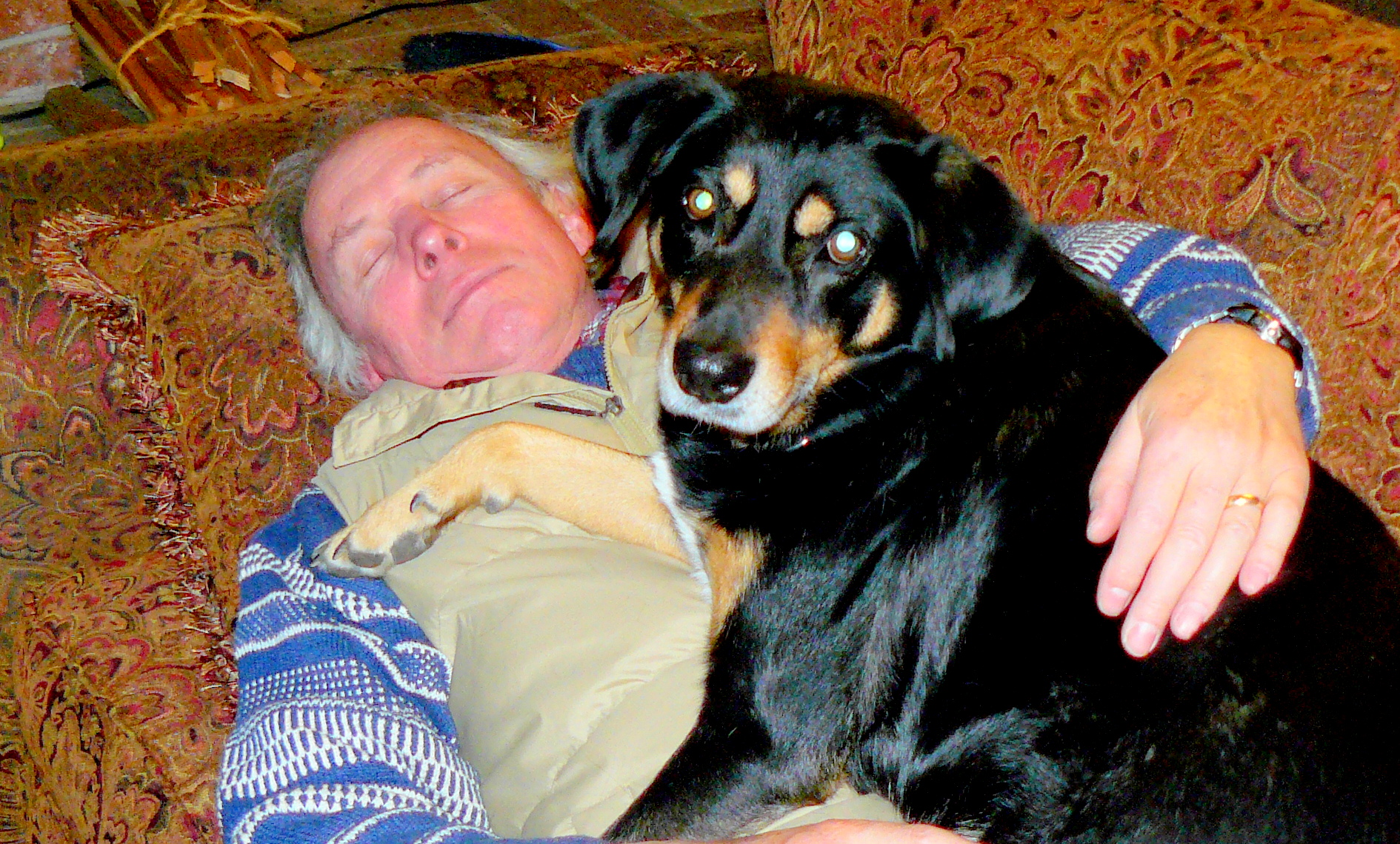
Man and dog.  Each loving and protecting the other!
Man and dog. Each loving and protecting the other! (Ex-feral dog Hazel snuggling up on the author’s chest who, I can assure you, was genuinely fast asleep when Jean took the picture one evening last January.)