Category: Core thought

People, people, everywhere!

What on earth is going to happen?

Without doubt, President Obama’s recent speech on climate change was very welcome.  I fervently hope this is a genuine commitment to change the course of the biggest and most powerful nation on our planet.  Abandoning the Keystone XL pipeline would be the proof to my mind.  UPDATE: But read this!

But the runaway, exponential growth in CO2 has a brother; huge growth in the world’s population.

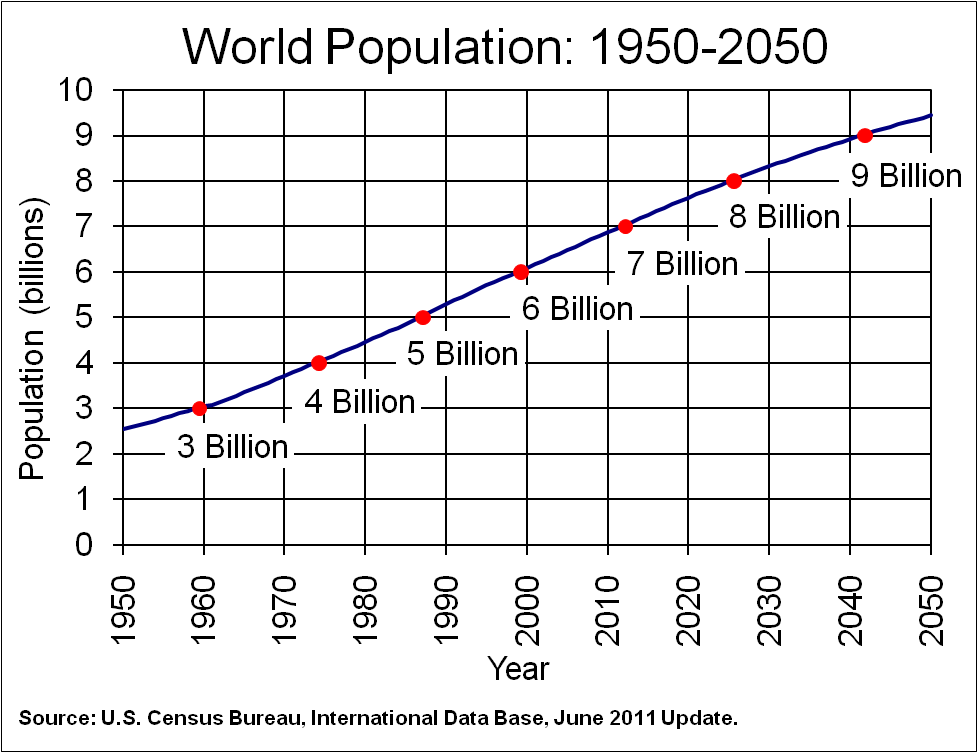
I’m going to ‘smack you in the face‘ with this population chart.

worldpop

To put that into context from a personal perspective, when I was born in 1944 the global population was 2.5 billion persons.  Some 4.7 billion fewer people than today!

But that prediction from the U.S Census Bureau in June, 2011 is already out of date!

Just a couple of weeks ago, the UN released this update:

13 June 2013 – The current world population of 7.2 billion is projected to increase by 1 billion over the next 12 years and reach 9.6 billion by 2050, according to a United Nations report launched today, which points out that growth will be mainly in developing countries, with more than half in Africa.

Now please humour me for a few moments. If the world population is presently 7.2 billion people and by 2050 the prediction is 9.2 billion people, that is an increase of 2,400,000,000 persons.

The end of 2050 is 438 months away. Now do the maths. That growth in population in that time period is the equivalent of an increase in population of 5,479,000 persons every single month!

Need to find a darkened room – I feel a headache coming on!

Rewilding the West

Staying with the theme of rejuvenating our relationship with the natural world.

A recent post from TomDispatch republished in this place once again with the generous permission of Tom Engelhardt.  It follows on so sweetly to yesterday’s post Returning to Nature.

oooOOOooo

Tomgram: Chip Ward, Rewilding the West

Rewilding the West

Here’s a nifty trick that’s been on my mind lately. In case you hadn’t noticed, the weather news this season has been pretty grim. Tornados so large and destructive that they would have given Dorothy pause, 500-year European floods, massive rainstorms rolling across the land, record heat in California and Alaska, late snowfalls that boggle the imagination, wildfires that dwarf past ones in the American West. I could go on, but why bother since anyone who has been watching primetime TV news can’t but notice that staggering weather has been the lead or second story much of the time all spring and into the summer.

You’re probably wondering right now: But what’s the trick? I’m surprised you haven’t noticed yourself. All of this weather has a new, made-for-TV label. It’s now regularly called “extreme weather” or “severe weather.”  And that’s anything but inaccurate. The weather has been both “severe” and “extreme” this spring. The trick is that, as a label, “extreme weather” has managed (with rare exceptions) to obviate the need even to mention that any of this could have the slightest thing to do with climate change, with our overheating, over-greenhouse-gassed planet. Think of it as a fabulous form of recognition and denial wrapped in the same package.

The TV news gets all the benefits of night-after-night, eyeball-gluing drama in which the weather goes nuts, houses are destroyed, and people weep (or are stoic) about ruined lives. It gets to bring in the tornado watchers and the weather people in their raincoats and waders.  (Have you noticed that the TV news can’t report a flood without putting some reporter with a mic knee-deep in water?) It gets to focus nightly on those daunting weather maps with their blazing red danger zones, and offer warnings about what potential disaster tomorrow might have to offer, all the while remaining in official, blissful denial about what’s happening on this planet of ours. Somehow, it has managed to incorporate the possible effects of climate change into the nightly news as a major story, while excluding just about all serious discussion of it. Tell me that isn’t a doubly nifty trick!

Of course, if there’s nothing but “extreme weather” happening and that weather has no extreme context, no extreme meaning, then none of us have to worry our little heads about what’s to be done. Those trying to remedy the degradation of conditions on this planet can also be ignored, which is why we couldn’t be more pleased that TomDispatch regular Chip Ward introduces us to such a person today. Tom

Trek West for the Big Picture
Saving the Land One Footfall at a Time
By Chip Ward

My home sits at the gateway to a national park in Utah, a source of envy among tourists who gather along Capitol Reef’s “scenic drive.” But after 40 years of living in one desert or another, I know firsthand that America’s iconic desert landscapes, places like Monument Valley and Arches National Park, are the exceptions, not the rule. The rule is that we dig up, dump on, dam, bomb, drill, over-graze, and otherwise abuse our deserts, most of them public lands owned by you, the taxpaying citizen. Generally, our management of the nation’s public lands is a disgrace and deserts are exhibit A.

But let’s skip the grim survey of how humans are overloading the carrying capacity of our original earthly Eden that usually opens a report like this. The intent of such a recitation of folly is to compel the reader’s attention by underlining the dire importance of the topic at hand. But I assume you understand by now that you woke up this morning on an overheated planet of slums threatened by ecological collapse.

So instead, let’s get right to the point: what do we do about it? How do we begin to heal the wounds?

The crises we face and that our children and grandchildren will endure long after we leave them invite a visionary response.  On the other hand, the world is already awash in well-intentioned tinkerers.  Yet dysfunction and destruction still reign.  Maybe it’s time to leap to a new paradigm.

Enter John Davis and Trek West.  At this very moment, Davis is walking, biking, paddling, and horseback riding 6,000 miles through a chain of mountain ranges that stretches like a spine across North America from the Sierra Madres of Mexico through the Rockies of the American West up into Canada.  He started this winter in the Sonoran desert we share with our southern neighbor and has been heading northward for months.  He will cross many of our most treasured national parks like Yellowstone and Grand Canyon, the ones that tourists love, but his trek is no sightseeing adventure.

Davis and his Trek West partners along the route are advocating for what they call “landscape connectivity” on a continental scale.  Two years ago, Davis trekked from Key West to Quebec, 8,000 human-powered miles.  Same theme: conserve and connect.

A Conservation Revolution

Gone are the days when conservation was all about bullets, hooks, and cameras.  Fishermen and hunters are still an important constituency in the conservation community, but birdwatchers now outnumber them. Ecological criteria increasingly frame any debate about how to heal degraded habitat.  What the nineteenth century naturalist and Sierra Club founder John Muir knew intuitively — that everything in the universe is “hitched to everything else” — has been confirmed beyond doubt by hard science.

Davis is one of the founders of a new school of thought called conservation biology.  Its proponents argue that it is not faintly enough to preserve scenic rock and ice parks and isolated islands of wildlife.  Wild creatures need room to roam so they can find the necessary water, food, and mates.  In the long run, many of America’s wild creatures from salamanders to bears will survive only in Disney movies if we box out genetic diversity, block migration routes, destroy nesting grounds, and save only carefully preserved, isolated populations of a species.  Connectivity is the keel of an emerging conservation ethic for helping to heal this country.

John Davis envisions an unbroken chain of wild lands spanning North America from Mexico to Canada.  When completed, a necklace of “core” areas, including national parks, wildlife reserves, and protected wilderness areas will be linked together and buffered by national forests and private lands.  Creatures now boxed into wild islands surrounded by a sea of development will have room to roam.

A connected landscape will be more resilient as climate change puts further stress on creatures and their habitats.  Already species from birds to mammals are responding to warming temperatures by moving northward if they can, or to higher ground if they can’t migrate horizontally.  The famed scientist and conservationist E.O. Wilson called the project to link together America’s wild lands the most important conservation initiative in the world today.

After trekking through the habitat of the last remaining jaguars on the continent, Davis ran into the new wall designed to keep illegal Mexican migrants out of the United States. It is, he pointed out, a far more effective barrier against wildlife migration than the human version of the same and so is lobotomizing the border ecosystem we share with Mexico.  As for Davis, he easily climbed it in less than five minutes and was on his way.

Backpacks Meet Cowboy Hats 

Although pushing 50, Davis has the trim, muscular build of a professional athlete — and he’ll need every toned muscle he has to complete his quest.  The day before I met him in Escalante, Utah, he had been surprised by a lingering bout of spring weather and found himself pushing his bike through 10 miles of deep snow on top of Utah’s Aquarius Plateau.  The next week, he planned to paddle through Desolation Canyon, one of the most spectacular river passages on the planet.  But when I encountered him, he was taking a break and making a pitch for connectivity before a gathering of federal land managers, concerned local citizens, and ranchers who share the watershed of the Escalante River.

The Escalante River Watershed Partnership (ERWP) is the unwieldy name for a grassroots coalition whose aim is to restore the river’s degraded ecosystem.  The rugged network of high desert canyons that drain into the remote Escalante River have been eroding for years thanks to overgrazing by cattle.  They are also choked with tamarisk and Russian olive trees.

Tamarisks are an invasive species that suck up precious ground water, while filling in springs and seeps that are the only water sources for many bird and animal species.  The tall, feathery plumes of the tamarisk have taken over hundreds of miles of riverbank in the West.  “Tammies” also salt the surrounding soil when they shed their leaves, killing native plants that might otherwise compete.  A beetle was imported from Eurasia to eat the tammies and was unbelievably successful.  As a result, those thick hedges that still block riverbanks are now dead-dry and ready to ignite.  If not cut back, they will burn or regrow.  Russian olive trees also crowd stream banks and add needle-like thorns to the unpleasant mix.

The diverse stakeholders in the Escalante River Watershed Partnership may not share John Davis’s grand vision of an ecologically whole and “rewilded” continent, but they are intent on sewing together and rewilding their pieces of the torn fabric of American life.  As any effective organizer knows, you start where there is common ground — or where there are common weeds.

Ranchers, rangers, biologists, hikers, and back-country guides are in many ways competing constituencies, but it turns out they all share the goal of clearing riparian (wet) canyons of those suffocating tammies.  The scientists survey the ground and identify targets.  Grants are written to bring in volunteers to do the fieldwork.  Last week, a dozen Great Old Broads for Wilderness, mostly outspoken middle-aged women, spent a week clearing unwanted brush as a service project.

As biologists monitor progress and the group discusses issues that arise, inevitably the damage done by grazing cows comes up.  It couldn’t be a more awkward topic.  After all, ranchers are in the room.  Cattle ranching in these desert landscapes is a marginal activity.  Those ranchers depend on federal grants, tax breaks, and access to public land to make it work.  But cows erode stream banks and silt the water, short-circuit forest succession by eating seedlings, and contaminate fresh water with their voluminous poop that also spreads cheatgrass and weeds.

The hope is that eventually the EWRP will become a platform for a public airing of difficult issues like where cattle should be allowed to graze on public land and how many and when.

A Roadkill Extravaganza

Those awaiting Davis’s Trek West presentation this particular day in this particular corner of Utah have already found a scale that seems to fit the desperate needs of our landscape, state, country, and planet.  Most of us who believe in change are caught between the seeming futility of small-scale actions — like recycling our trash or using more energy-efficient light bulbs — and the impotence we experience when we push for large-scale change like climate legislation in Congress or international treaties to limit atmospheric greenhouse gases.

On the one hand, too little; on the other, too late.  There does, however, turn out to be a middle scale between individual action and national or global campaigns that works well and makes sense: the community.  That’s the place where people can best embrace their roles as citizens, face off, share, contend, cooperate, create, learn from, and empower one another.

Watershed partnerships harken back to an old ideal.  John Wesley Powell, the one-armed general and Civil War hero who later explored the Colorado River and its tributaries, was the first person to grasp and publicize the aridity rather than fecundity of significant parts of the American West.  He argued that practices and policies developed for wet Eastern lands were inappropriate for the drier West.  He advocated for governance around watersheds where local stakeholders committed to living within the limits they knew firsthand could come together and plan.  That’s what I’m observing this morning in Utah.  In twenty-first-century terms, think of it as ecological citizenship.

Davis claims he is shy and a poor presenter, but it turns out that he is quietly charismatic.  The case he makes for corridors is practical.   His listeners know that he is trekking across a landscape that is not your grandfather’s Wild West.  The wide-open spaces where the antelope once roamed are now fragmented by a zillion roads featuring SUVs with flattened animals on their bumpers.  Davis says that, on his most recent journey, he’s already seen at least 1,000 crushed, dead creatures.  It’s been a roadkill extravaganza.

So, what to do?  He shows pictures of a landscaped underpass in nearby Kanab, Utah, constructed at a deer crossing where at least 100 deer a year were being hit by cars.  Every year about 10% of the local herd was becoming roadkill along with foxes, turkeys, and the occasional bobcat.  The underpass cost $2.6 million, which is hardly chump change in this neck of the woods, but each deer-car collision costs, on average, $6,600. Do the math, he tells them. Making the landscape permeable for animals seeking food, mates, and water keeps them healthy and pays for itself soon enough.

The Wolf at the Door 

Ranchers and the Bureau of Land Management (BLM) rangers who serve them view John Davis skeptically.  For one thing, he’s been frank about the need to reintroduce wolves across Western ecosystems, given the “keystone” role they play in shaping a healthy landscape. In case you’re not a Westerner, you should know that the subject of wolf reintroduction is a political third rail in much of our region. It’s an idea that would stun and appall our grandfathers, who killed wolves on their lands to leave more deer and elk for hunters and make meadows safe for cattle.

Ecologically, the reintroduction of wolves to Yellowstone National Park has been an unqualified success. Since wolves were returned to that landscape, elk are no longer bunching up and munching down in stream-fed valleys until they are silted, eroded, and devoid of other wildlife. The wolves thin the elk herds and move them, which, in turn, allows willows, aspens, beavers, birds, and a more biodiverse landscape to thrive.  Their success in Yellowstone has confirmed the insights of conservation biologists, giving them credibility and authority. Cowboys fear that, having pushed aside elk, conservationists will go after their cows next.

Meanwhile, back at the ranch, elk hunters, cowboys, gun-nuts, and tea-hadi politicians have worked themselves into an anti-wolf frenzy.  Western state legislators have introduced several bills designed to limit and control wolves even if they haven’t seen one in their area for 100 years.  They want to trade the wolves’ endangered status under the law for licenses to hunt them.  A few days after Davis met the watershed group, the Obama administration caved in to this eco-political hysteria and agreed to remove endangered species protections from wolves.  This backlash against reintroduction has been painful for advocates like Davis.

A Greater Canyonlands National Monument Moment?

The decision to lift wolf protection is consistent with the Obama administration’s disappointing record on Western environmental issues.  Nevertheless, conservation advocacy groups like the Southern Utah Wilderness Alliance and the Sierra Club are urging the president to take a cue from Bill Clinton’s example.  Back in 1996, he created the Grand Staircase Escalante National Monument under the Antiquities Act that allows presidents to set aside natural and archaeological treasures. Now, the conservation groups want Obama to do something similar on an even grander scale and create a “Greater Canyonlands National Monument” from some of the healthiest wild lands in southern Utah.

A few days later, Davis addressed the need for such a monument at a forum in Moab, Utah.  Our state has about nine million acres of quality wilderness land ready to be designated and protected as such.  That’s a lot of core area for John Davis’s conservation vision, a lot of possibility for connectivity. But the public debate about wilderness designation has been stalemated for decades.  Utah Republicans in particular resist more steps to formally protect wilderness areas even though the public overwhelmingly supports it.

They are wedded to traditional mining and grazing interests and like to portray themselves as victims of a bullying federal government that wants to jam national monuments and formally designated wilderness areas down their throats.  But Clinton’s creation of the new monument has proven a boon for Escalante’s economy.  In the 12 years since it came into being, the populations of surrounding Kane and Garfield counties have grown by 8%.  Jobs rose in those years by 38% and per capita income by 30%.  Adjoining counties whose economies are oriented towards gas and oil lagged far behind.

President Obama’s appointment of Sally Jewel, former CEO of REI, a chain of outdoor gear and clothing stores, may signal a shift away from ranching and mining as the dominant voices on the Western political stage. Jewel understands firsthand that recreation and tourism have become powerful economic engines here.

A presidential initiative alone will hardly begin to settle all the questions we face about how to make peace with the land that holds us in its embrace.  But designating another monument here could be a catalyst for an ever-expanding idea of grassroots stewardship of America’s wild lands.

The Escalante watershed partnership was formed in the wake of Clinton’s catalytic act. At that time, the Clinton administration took another experimental step. It gave stewardship of Grand Staircase Escalante to the controversial Bureau of Land Management instead of the National Park Service.  That was a first and undoubtedly a concession to Utah’s politicians who would rather deal with the traditionally compliant, pro-mining, pro-grazing BLM than the stricter National Park Service.  Clinton gambled that the move might instill a missing environmental ethic in that bureau.

The results on that are not yet in, but there is no question about one thing: Clinton’s creation has been a catalyst for grassroots political activity.  When monument status was a done deal, the river’s stakeholders decided the time had finally come to practice that awkward dance of mutuality among conservationists who want to save the land, ranchers who want to use it, and federal land managers charged with sorting out what exactly to do.  John Davis is clearly on the side of conservation.

Making the Imaginary Real

The Trek West sponsors recognize that there may never be some grand national initiative to accomplish their vision, nothing like the Wilderness Act, the Clean Air Act, or the other signature environmental legislation of the 1960s and 1970s.  If our troubled public lands are rescued, it’s likely to happen in a piecemeal fashion, as local and regional groups work to improve their own backyards.  The folks who gather in Escalante don’t claim to have all the answers.  They are not here to spread the truth and save the world.  They belong to no ideology or movement.  They’re just working on their piece of the puzzle, experimenting and learning as they go.  Rivers being the arteries of the land, it makes sense to start there.

An existing constituency almost always trumps an imaginary one.  You can make a case, for example, that a change in land use practices and policies would benefit more people, boost the local economy, and be healthier for wildlife, too, but those imaginary winners can’t compete with cattlemen who are real, well organized, and have been active in the political arena for many years.  They have established close relationships with local politicians who depend on their support.   Because they were there first, they wrote most of the rules and those favor their uses of public land.

The trick for conservationists who want change is to make that imaginary constituency real, to bring a new set of stakeholders together and find ways to empower them.  That may not be the intention of those who gathered in Escalante for the watershed partnership, but it’s what is happening nonetheless — and John Davis is a catalyst.

According to the prevailing belief, growth should always be the bottom line.  Trek West expresses an alternate vision that aims instead to translate ecological principles and criteria into actual designs on the ground.  That’s not simply a matter of making better maps.  Those of us who live within the iconic Western landscapes so treasured by all Americans understand that maps, charts, and spreadsheets do not adequately measure or describe this inspiring and awesome place where we live.

We experience the land sensually.  Perhaps that is the ultimate message John Davis is delivering as he treks across the continent’s wild spine.  He is making sense of the land one footfall at a time, listening to it, watching it, and feeling it as he goes.  So, reconnect landscapes, yes, but also connect head and heart.

Davis’s quest is heroic, but his testimony is simple: when we learn from the land we lean towards wholeness.

Chip Ward, a former librarian and grassroots organizer, is the author of Canaries on the Rim and Hope’s Horizon as well as a TomDispatch regular. He wrote this essay while living between a mountain on fire and a desert that is blowing away.  

Follow TomDispatch on Twitter and join us on Facebook or Tumblr. Check out the newest Dispatch book, Nick Turse’s The Changing Face of Empire: Special Ops, Drones, Proxy Fighters, Secret Bases, and Cyberwarfare.

Copyright 2013 Chip Ward
oooOOOooo

Simply going to finish off today’s post with the two pictures included recently in, I cry for the wolves.

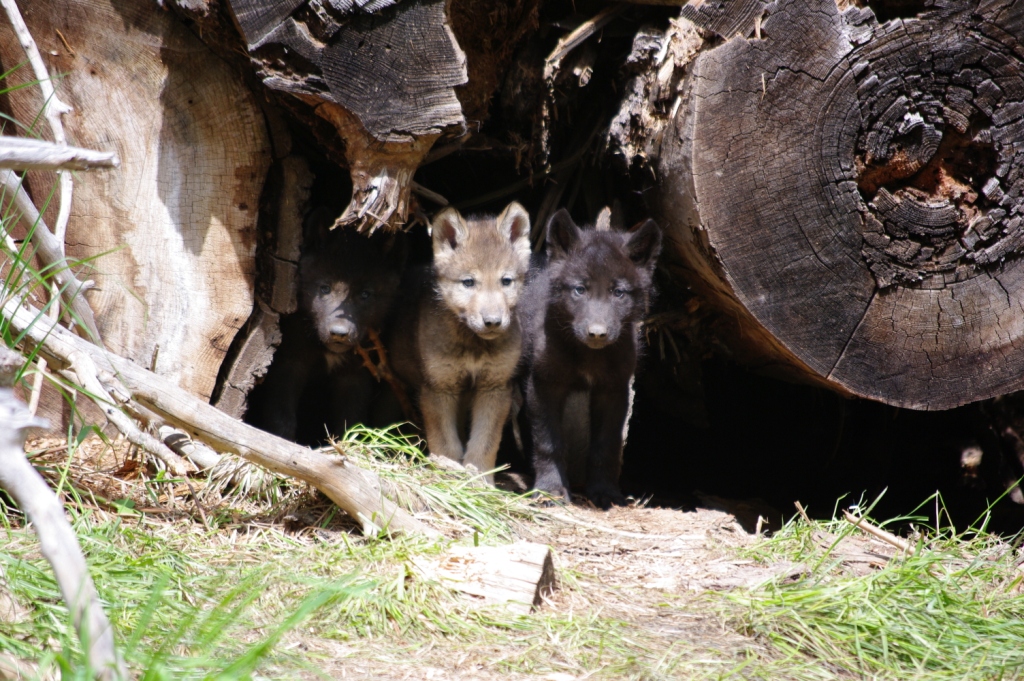
These wolf pups born to the Wenaha Pack in 2012 helped get recovery back on track. But their future remains tenuous (photo courtesy ODFW)

oooo

Wolf greets man.
Wolf greets man, courtesy Wildlife Images Rehabilitation and Education Center, Merlin, Oregon.

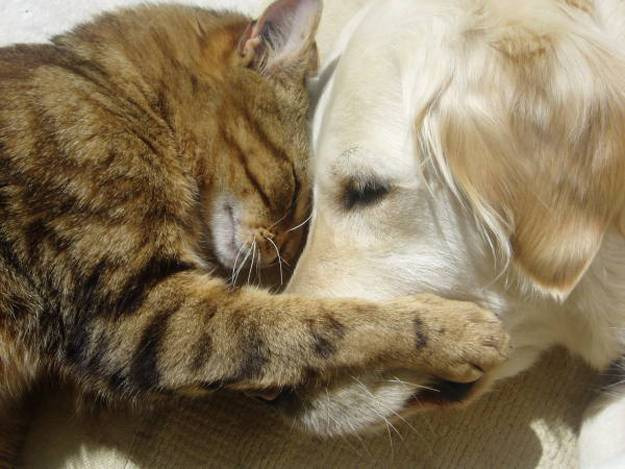
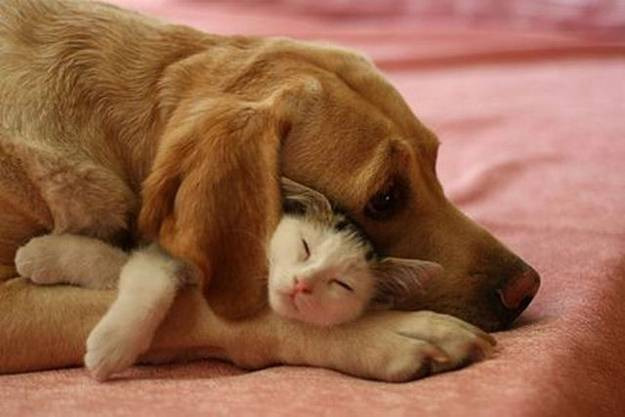
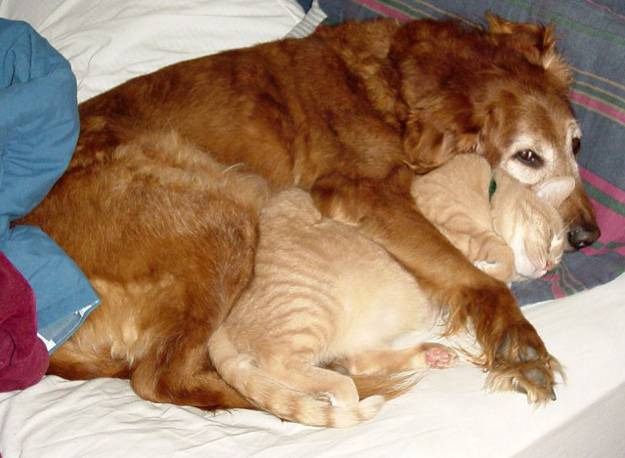
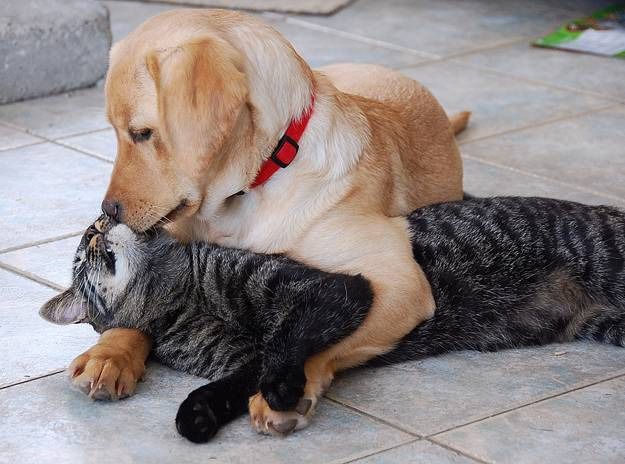
Every dog should have its cat!

Another gem from John Hurlburt.

dogcat1

oooo

dogcat2

oooo

dogcat3

oooo

dogcat4

oooo

dogcat5

oooo

dogcat6

oooo

dogcat7

oooo

dogcat8

oooo

dogcat9

oooo

It came to me that every time I lose a dog,
they take a piece of my heart with them….
And every new dog who comes into my life,
gifts me with a piece of their heart.
If I live long enough, all the components of
my heart will be dog …
and maybe
I will become as generous and loving as they are.

Unknown author.

AGW – summing up.

“If there’s any doubt, there’s no doubt!”

I opened the first post on Monday with the sub-heading: “Certainty is perfect knowledge secure from error or doubt.” going on to write that, “Whatever your views on the effect of man’s behaviours on our planet’s climate, it’s a long way from the logical idea of ‘2 + 2‘!”

Within that very strict definition, I remain unmoved.  The argument that mankind is the cause of the present change in the climate of Planet Earth is not certain!

However, if only life was that simple! The change in our planet’s atmosphere is possibly the most emotionally-laden topic of all time.  For some reason that quotation attributed to Hiram Johnson comes to mind, “The first casualty when war comes is truth.” because the supporters and deniers of AGW are engaged in what amounts to a verbal war.

Each side can draw on much information.

For example, a very recent article in The New York Times by their Justin Gillis offered this:

The rise in the surface temperature of earth has been markedly slower over the last 15 years than in the 20 years before that. And that lull in warming has occurred even as greenhouse gases have accumulated in the atmosphere at a record pace.

The slowdown is a bit of a mystery to climate scientists. True, the basic theory that predicts a warming of the planet in response to human emissions does not suggest that warming should be smooth and continuous. To the contrary, in a climate system still dominated by natural variability, there is every reason to think the warming will proceed in fits and starts.

But given how much is riding on the scientific forecast, the practitioners of climate science would like to understand exactly what is going on. They admit that they do not, even though some potential mechanisms of the slowdown have been suggested. The situation highlights important gaps in our knowledge of the climate system, some of which cannot be closed until we get better measurements from high in space and from deep in the ocean.

As you might imagine, those dismissive of climate-change concerns have made much of this warming plateau. They typically argue that “global warming stopped 15 years ago” or some similar statement, and then assert that this disproves the whole notion that greenhouse gases are causing warming.

Rarely do they mention that most of the warmest years in the historical record have occurred recently. Moreover, their claim depends on careful selection of the starting and ending points. The starting point is almost always 1998, a particularly warm year because of a strong El Niño weather pattern.

Dan Gomez, a long-time friend of over 40 years and a regular contributor to items on Learning from Dogs, wrote in a recent email,

I’m not sure what is meant by “believer”, Paul.  The Universe unfolds as it should.  Because many have been led to “believe” that AGW is inevitable and that all the facts are the ‘Truth”, we’ve created a religious substitute, almost a new “industry” with significant “tithing” obligations, etc. (e.g. Cap and Trade). Presumptions and facts are being manipulated to fulfill the prophecy.

Interesting to note in our daily lives, that weather prediction is very good 24-36 hrs out.  This drops precipitously just a few days out.  More than 7-10 days is nearly impossible. Even though both Europe and the USA have decreased CO2 levels by multiple percentage points over the last 20 years, the rest of the world does not care and the impact is very problematic.  Recently, CO2 gas has increased overall but heat has not. In the past, warming has occurred followed by CO2 levels increasing. Global politics and redistribution of wealth schemes continue to interfere with common sense.

Let’s just deal with the facts as Science reveals its secrets. New information is discovered every day about the interaction of the  Earth/Sun/Atmosphere/Lithosphere/Hydrosphere. New information is learned every day about the Universe.  These are not closed subjects. Climatology, meteorology, geology and solar system dynamics will continue to shape the Earth’s future for millennia to come whether Man is involved or not.

There is much in what Dan writes that has me nodding my head; stimulates my recollection of what Luther Haave and Derek Alker wrote in 2009:

With the explosion of knowledge, particularly in the past 100 years, each of us has found it a requirement for being successful, and to being able to earn a living, to concentrate our knowledge in an ever increasingly narrow field. Just as we have come to expect others to defer to our expertise in our narrow area, we have come to assume that we need to defer to others who have a deeper comprehension of seemingly complex topics such as the science related to climate change. [Apologies, can’t find the web link for this.]

However, if we broaden the perspective from that tight definition of certainty to an analysis of probabilities, then it all changes for me and I can embrace the views so strongly put forward by Martin Lack.

For example, Martin left a comment on Monday, “ACD is not a matter of opinion or belief; it is a matter of probability. As such, all that matters now is the extremely high probability that the scientific consensus is real, reasonable and reliable.”  That comment included a link to a discussion on the website Skeptical Science, Is the science settled? Let me quote from that:

Some aspects of the science of AGW are known with near 100% certainty. The greenhouse effect itself is as established a phenomenon as any: it was discovered in the 1820s and the basic physics was essentially understood by the 1950s. There is no reasonable doubt that the global climate is warming. And there is also a clear trail of evidence leading to the conclusion that it’s caused by our greenhouse gas emissions. Some aspects are less certain; for example, the net effect of aerosol pollution is known to be negative, but the exact value needs to be better constrained.

What about the remaining uncertainties? Shouldn’t we wait for 100% certainty before taking action? Outside of logic and mathematics, we do not live in a world of certainties. Science comes to tentative conclusions based on the balance of evidence. The more independent lines of evidence are found to support a scientific theory, the closer it is likely to be to the truth. Just because some details are still not well understood should not cast into doubt our understanding of the big picture: humans are causing global warming.

In most aspects of our lives, we think it rational to make decisions based on incomplete information. We will take out insurance when there is even a slight probability that we will need it. Why should our planet’s climate be any different?

That, ultimately, delivers for me what truly counts.

I am not a scientist; just a Brit living in Southern Oregon trying to make sense of the world while I still have a functioning head and body – time is not on my side! 😉  The powerful common-sense in the sentence, “Outside of logic and mathematics, we do not live in a world of certainties.” is beyond argument.

In the year 2012, the total number of passengers carried by US Airlines and other carriers in and out of the USA was a staggering 815 million people. 815,000,000 people!

Remember the sub-heading from the start of this post!  “If there’s any doubt, there’s no doubt!” Years ago I heard that from Bob Derham, a long-time friend and a commercial airline Captain since the time God was a boy!  It’s that cautious, safety-focused attitude that has made airline transport such an amazing mode of transport for all those millions of passengers.

Should we not travel with the same cautious, safety-focused attitude on the ‘vehicle’ that carries every man, woman and child; every animal, plant and living thing: Planet Earth!

The answer is obvious – more than obvious!

AGW certainty, Part Two

Continuing the examination of two views on AGW.

Readers will recall that this post opened yesterday.  That Part One closed with Martin writing this:

Martin Lack

Much of what Oakwood writes is an attack upon the Hockey Stick graph of palaeoclimatic temperature reconstructions first produced in 1998 (MBH98).

However, the fatal flaws in Oakwood’s scepticism regarding MBH98 are as follows:

  1. MBH98 has been validated by at least 14 other reconstructions (as cited in IPCC AR4 in 2007) using a wide variety of other proxy data(see Wikipedia for relevant links)
  2. Hockey Stick-shaped graphs turn up in reconstructions of CO2 levels and temperature – now going back over thousands of years – because they are not ‘statistical noise’ –
  3. Arguments about splicing instrumental data onto proxy data only serve to challenge the extent to which the speed of late 20th Century warming is unprecedented.
  4. Such arguments do not invalidate the conclusion that it is now almost certainly warmer than it has been at any time since the last Ice Age (i.e. a period of relative climate and sea level stability that has made agriculture, urbanisation and civilisation possible).

However, this is no reason for us to be complacent because, as Oakwood must know, the 50 to 100 metres of sea level rise that will be caused by the melting of terrestrial ice sheets will necessitate the mass migration of millions of people. This makes his concerns about current poverty and starvation (i.e. the main reason he eventually cites for not believing action is yet necessary) look very trivial indeed.

So continuing ….

Oakwood

The argument that the ‘divergence problem’ does not bring into question proxy studies is just one example of supposed ‘settled’ evidence in the case for AGW. There are others which collectively bring down the case to one of opinion.

Martin Lack

After a lengthy attempt to assert that the “hide the decline” controversy was or is significant, Oakwood eventually moves onto attack the significance of MBH98; and to claim that ACD is no more than a matter of opinion. It is only possible to reach this conclusion by dismissing the majority of climate scientists as being stupid, sloppy, or sinister.

Oakwood

Here are a few others:

  • Mann et al’s original hockey stick (1998) (as well as a number of other studies) shows an unprecedented temperature rise in the first half of the 20th century, a temperature change that most climate scientists believe can be explained by natural phenomena, such as the Sun (while failing to reproduce the man-made rise in the 2nd half of the century, due to the divergence problem explained above).

Martin Lack

However, Climategate and, more especially Climategate 2.0 merely served to demonstrate how deliberate and organised are the attempts to discredit climate science and derail international attempts to tackle the ACD problem.

Oakwood

Thus, we are expected to believe there was both an unprecedented NATURAL temperature rise and unprecedented MAN-MADE rise in the same century. Not impossible, but statistically highly unlikely.

Martin Lack

Oakwood suggests that assertions about early 20th Century warming are statistically highly unlikely (i.e. that climate scientists are stupid to make them). However, the real statistically highly unlikely suggestion is that 30 years of monthly average temperatures exceeding their long-term average values could be a consequence of natural variation. Unlike early 20th Century warming, this is definitely not capable of being explained by natural causes (such as cyclical solar activity or random volcanic eruptions).

Oakwood

  • The ‘record’ (in just 35 years) of minimum summer ice in the Arctic is repeatedly presented as evidence for impending doom. However, the record MAXIMUM ice cover in the ANTarctic, at the same time, is dismissed with ‘we have another explanation for that’.

Martin Lack

Trying to shift the focus away from the accelerating rate of ice loss in the Arctic is very lame indeed. The Arctic is surrounded by land and (now) increasing amounts of warming water. The reasons for the ice loss are well understood and it is happening faster than was predicted even 5 years ago. The Antarctic is surrounded by a huge expanse of cold ocean and is also being kept cold by the human caused hole in the ozone layer. The reasons why its ice is not melting so fast are therefore also well understood. In addition, it should be noted that the Antarctic Peninsula is the fastest warming place in the southern hemisphere.

Oakwood

  • Whatever the weather, blame global warming. A few years ago, milder winters and earlier springs in the UK were hailed as evidence of AGW. But now we get lots of snow, and appalling spring, cooler summers, etc, and guess what, its due to global warming.
  • Hot/dry weather and floods around the world are routinely highlighted as ‘more evidence’ whereas as cold weather extremes and records are dismissed as ‘just natural variation’ – again, and again and again.

Martin Lack

Oakwood‘s remarks about extreme events are also very misleading. The number of records being broken for hot and/or dry events is many times greater than the number of records being broken for cold and/or wet events. As Hansen et al explained last year, in their review of historical data for the last five decades, natural variability does not explain the steady shift in average temperatures and the broadening of the range of conditions experienced in any one place.

I really can’t believe that Oakwood is so parochial in his outlook that he dares to mention the cold weather the UK has experienced recently. We may have had the coldest Spring for 50 years, but, that does not change the fact that global average temperatures are still the highest ever in recorded history. Furthermore, it does not change the fact that the analysis of Hansen et al (2012) continues to be validated by events such as those in Central Europe at the moment – where 1 in 100 year flood events have recurred after only 10 years. Not impossible – just statistically highly unlikely.

Oakwood

Those who highlight the lack of rising temperature for the past 10-15 years are routinely dismissed as deniers and liars. We’re told, ‘but the last decade is the warmest in a 100 years’. No-one disputes that. Given the world warmed by 0.8 degC in 100 years, that’s perfectly reasonable, and is not a defence against the fact that warming has at least paused.

  • We’re told: ‘but the heat is going into the ice caps and the deep oceans and atmospheric heat is just a small percentage of the total’, How convenient. In the 1980s and 1990s, atmospheric temperature was enough for ‘proof’ of serious AGW. We didn’t hear anything about ocean heat then. No-one suggested that perhaps the warming was due to a release of previously ‘hidden’ ocean heat. Or that we shouldn’t read too much into a small atmospheric temperature rise.
  • We see again and again, whatever happens, whatever the data show, the theory is revised to ‘show’ that nothing has changed. This is simply not plausible science.
  • We’re told, the physics of CO2-induced global warming is just that, ‘physics’, and we can’t change that however much we dispute it. No-one disputes the physics. But, the atmosphere (believe it or not) is very complicated. We have the physics that says aerosols reflect the Sun’s heat, that clouds may increase and also reflect more heat. We now hear the relationships with the oceans is very important (which we didn’t hear before). Thus the debate is not about the reality of the CO2-global warming physics. Its about the sensitivity of the system and which physical phenomena will dominate.

Martin Lack

Given the massive inertia in the climate system (which guarantees decades of future temperature rise even if CO2 emissions were completely halted today), there is no reason for us to be complacent about the fact that we have only seen a rise of 0.8C since the Industrial Revolution. The scientific consensus remains that equilibrium climate sensitivity is somewhere in excess of 2C and that such a rise in temperature will not be good for the vast majority of life on Earth. On the evidence of the ACD that we are already experiencing, I think there is very good reason to agree with that conclusion.

Again, I am astonished that Oakwood even dares to mention the ‘global warming has stopped’ canard. This misconception has been debunked so many times; there are even debates about who has written written the best rebuttals.  Here is a summary: Whilst surface warming may have paused, the warming of the ocean (which is driving the increased frequency of extreme weather events of all kinds) has continued. Given that oceans cover two thirds of the Earth’s surface, is this something really worth arguing about?

Climate scientists are therefore not changing their story to accommodate inconvenient new data. Only climate change sceptics do that. The only implausible science on offer today is that which seeks to explain all the data without acknowledging that CO2 is the main driver. Sure, CO2 does not explain everything but, you cannot explain all the data unless the primacy of CO2 is accepted.

Oakwood

Some will respond: ‘but all of these arguments have been debunked many times’. All they really mean is another opinion or speculation has been given by an AGW believer. Nothing wrong with these, but don’t claim they represent settled science.

Martin Lack

However, I should like to re-iterate the importance of the recently-published results of investigations at a lake in the NE of Arctic Russia. What this new 3.6 million year continuous palaeoclimatic record tells us is that current warmth is not unprecedented (if you go back to an era in which humans did not exist – 400 or 1,100 thousand years ago). This demonstrates that good scientists do not change their story when they get unexpected results.

Oakwood

I have no problem with scientists believing in AGW and believing it a serious threat. But when so much of their case is based on weak arguments, I do have a problem with claiming the case is ‘settled’ and that anyone who questions or challenges it is a liar, denier, conspiracy theorist, etc.

Both sides of the debate have their extremists and nutters. My interest is in the rational middle ground. To suggest an ‘eccentric’ like Christopher Monckton is ‘typical’ of all AGW-sceptics is just like claiming all Conservative voters are fascist and all Labour voters communist. It has no place in informed and educated debate.

Martin Lack

Oakwood claims arguments for concern over ACD are “weak” but, in making this assertion, the only information he has referred to is very much out-of-date (such as IPCC AR4 in 2007). Oakwood moves on to discuss unhelpful labels such as “liar” and “denier”.

I do not think I have ever suggested that anyone who professes to be ‘sceptical’ is lying. However, I do think that, just like the tobacco executives whose ‘modus operandi’ they are copying, the executives of fossil fuel companies know more than they care to admit. There is also a great deal of evidence to indicate that climate change ‘scepticism’ is in fact being driven by unscientific economists aided in their anti-science cause by a handful of friendly scientists who tell them what they want to hear. This is not scepticism, it is ideological prejudice.

Oakwood

The term “denier” was introduced with the intention of associating AGW-sceptics with Holocaust Deniers. That is to say, AGW-sceptics are putting millions of lives at risk through their lies and ignorance. Given the weakness of the AGW case, the use of the labels ‘denier’, ‘deny’, denial’ seems to represent an insult to every victim of the Holocaust.

Martin Lack

I agree that use of the term ‘denier’ is generally not helpful, but, given all the evidence that conflicts with their position, I do think that those who remain ‘sceptical’ about the primary cause of ongoing climate change are being irrational. If your beliefs require you to dismiss any and all evidence that conflicts with them, that is not scepticism, it is wilful blindness; it is what Young Earth Creationists have to do in order to protect themselves from wicked and ungodly scientific ideas.

Therefore, even if Oakwood does not do it, many who are ‘sceptical’ do rely upon conspiracy theories to dismiss all the evidence that conflicts with their beliefs. This includes dismissing most scientists as stupid, sloppy or sinister.

Oakwood

And why is it not time to act now? I am an environmentalist and see many environmental and social problems that need addressing. In particular, the need for ‘sustainability’ in all we do. There remain millions dying each year from such things as malnutrition, lack of safe drinking water, malaria, etc.

These are hard facts with zero room for any doubt. Given the weakness in the AGW-case, it is not a priority. I see some benefits in acting. For example, in many cases a reduction in CO2 emissions leads to much improved energy-efficiency, and less pollution. However, the case is not made for diverting money and effort from the more immediate priorities, covering pristine countryside in wind farms to satisfy urban energy demands, or using more biofuels at the expense of more hunger.

Martin Lack

Having wasted so much time trying to falsify MBH98, Oakwood finally gets round to the important bit of my question: Why does he think the time to act has not yet arrived?

Failing to address the point that a wide range of industrial, political and economic organisations now agree that it is time to act, Oakwood opts instead to simply re-state his belief that attempts to mitigate the ACD problem will do more harm than good. All the evidence I have seen suggests that he is mistaken. To-date, I think the most compelling evidence is that contained in the IIED’s 2009 report , ‘Assessing the costs of Adaptation to Climate Change: A review of UNFCCC and other recent estimates’ (PDF available here), which begins with the following very sobering executive summary:

Several recent studies have reported adaptation costs for climate change, including for developing countries. They have similar-sized estimates and have been influential in discussions on this issue.

However, the studies have a number of deficiencies which need to be transparent and addressed more systematically in the future. A re-assessment of the UNFCCC estimates for 2030 suggests that they are likely to be substantial under-estimates. The purpose of this report is to illustrate the uncertainties in these estimates rather than to develop new cost estimates, which is a much larger task than can be accomplished here.

The main reasons for under-estimation are that: (i) some sectors have not been included in an assessment of cost (e.g. ecosystems, energy, manufacturing, retailing, and tourism); (ii) some of those sectors which have been included have been only partially covered; and (iii) the additional costs of adaptation have sometimes been calculated as ‘climate mark-ups’ against low levels of assumed investment. In some parts of the world low levels of investment have led to a current adaptation deficit, and this deficit will need to be made good by full funding of development, without which the funding for adaptation will be insufficient. Residual damages also need to be evaluated and reported because not all damages can be avoided due to technical and economic constraints.

There is an urgent need for more detailed assessments of these costs, including case studies of costs of adaptation in specific places and sectors.

Oakwood

Thus, belief in AGW is not a simple moral argument which some would want to believe – good vs evil, or capitalist vs environmentalist, etc.

Martin Lack

Oakwood says he does not think this is a good-vs- evil or a capitalist-vs- environmentalist issue. I would agree. However:

  • I am not the one who is allowing my political beliefs to prejudice my approach to the science;
  • I am not the one who is accusing most scientists of being stupid, sloppy or sinister in order to dismiss what they are telling me; and
  • I am not the one changing my story or my preferred argument whenever something I have formerly relied upon is shown to be unreasonable.

Although it is a shame that he is part of a minority within the UK’s current Coalition Government, I will conclude by quoting from a recent speech by the Secretary of State for Energy and Climate Change, Edward Davey:

Of course there will always be uncertainties within climate science and the need for research to continue… We make progress by building on what we know, and questioning what we don’t. But some sections of the press are giving an uncritical campaigning platform to individuals and lobby groups who reject outright the fact that climate change is a result of human activity. Some who even deny the reality of climate change itself… By selectively misreading the evidence, they seek to suggest that climate change has stopped so we can all relax and burn all the dirty fuel we want without a care…

Oakwood says he opposes action to curb ACD because there are bigger problems we need to solve. If this were likely to be true, it would be an admirable position to take. Unfortunately, the bulk of the evidence suggests that ACD is a problem unlike any other and, unless we make serious attempts to minimise it, its consequences will dwarf all other problems we face.

This is because basic physics tells us that allowing the Earth to warm up will cause terrestrial ice to melt and sea levels to rise. It was predicted and it is now happening. The time to act to stop it is now. Millions of people cannot and will not adapt to having their land and their cities submerged under water.

oooOOOooo

Well I think that the agreement of Oakwood and Martin to set out their positions is fabulous and very worthy.

If readers will forgive me, tomorrow I will offer my own personal reflections on what has been offered by Martin and Oakwood today and yesterday.

Exploring the certainty of AGW!

“Certainty is perfect knowledge secure from error or doubt.”

You may wonder what this post is all about opening, as it does, with a definition of ‘certainty’.

What that definition might imply is that ‘certainty’ is a tantalising ‘will of the wisp’ creature.  Excepting for pure mathematics, of course! “Pure mathematics is, in its way, the poetry of logical ideas.” – Einstein quotation.

Whatever your views on the effect of man’s behaviours on our planet’s climate, it’s a long way from the logical idea of ‘2 + 2‘!  So when Oakwood, a reader of Learning from Dogs, submitted a long, carefully written comment rejecting Anthropogenic Global Warming (AGW), the idea came to me that perhaps this comment should stand on its own two feet, so to speak, as a separate post.  I asked Martin Lack, a passionate believer in AGW, to counter the points set out by Oakwood.  Both Martin and Oakwood are scientists; both hydrogeologists.

Now please take a moment to read and assimilate the next few sentences.  The length of the ‘dialogue’ runs to two posts.  Making it without question the longest post that has ever been published on Learning from Dogs.  It is also the most important!  If there is one question above all others for these times, it is the question of whether or not mankind is changing the climate of this planet; the only one we have.

These posts are not an easy read.  They can’t be skim read. They don’t have pictures! But I hope with all my heart that you will settle down today and tomorrow and read each post carefully to the end.

Now to some background information on the two gentlemen.  ‘Oakwood’ is a nom-de-plume.  However, he and I have exchanged emails and I support his need for anonymity. This is how Oakwood describes himself:

  • I am an Earth systems scientist
  • I have followed the AGW scientific arguments on both sides for many years
  • Hydrogeology (my field) and climate science have quite a lot in common, the main one being they require some knowledge and expertise in a wide range of disciplines. It’s not a simple case of saying ‘you are an expert or not’.
  • For example, I need to know quite a bit about chemistry, although I am not an ‘expert chemist’.
  • I am experienced in studying long-time period data, and judging its credibility (this also in common with climate science). Many of the key AGW arguments are based on data and statistics.
  • There are many reasons for being an AGW-sceptic, needing many pages. I give one main example: The ‘divergence problem’ applies to tree ring proxy temperature graphs. Most (perhaps all), proxy graphs cannot reproduce modern temperature data from about the 1980s onwards (in fact the very period of detectable man-made global warming). Because of this, we cannot rely on proxy graphs to conclude now is warmer than the past. Although climate scientists claim the divergence problem is only a modern thing, and does not affect historic data, this is purely a statement or belief. There is no convincing science to back that view.
  • For that reason, I am sceptical of the value of proxy graphs to show current temperatures are unprecedented.
  • I list a number of other brief examples.
  • I do not believe in conspiracy theories and have no problem with climate scientists believing in AGW. But in view of the examples I give, I do have a problem in them saying ‘the science is settled’.
  • There are some benefits from acting on the AGW scare now, such as improved energy efficiency and reduced pollution. There are also negatives, such as wind-farms on pristine countryside and biofuels causing increased hunger.
  • Too much focus on the AGW threat (based on relatively weak scientific arguments) diverts effort and money from more immediate and certain problems.
  • I am an environmentalist who cares about the future of our planet and sustainability. My views on AGW are based purely on the science.

Martin‘s background is encapsulated on his Blog, from which I extract:

I have 25 years of professional work experience, as a geologist and hydrogeologist, in both public and private sectors.

Education:
St Albans School, Hertfordshire, 1976-1983.
BSc (Hons) in Geology (Portsmouth), 1983-1986.
MSc in Hydrogeology (Birmingham), 1989-1990.
Postgrad. Cert. in Education (Keele), 1998-1999.
MA in Environmental Politics (Keele), 2010-2011.

Professional Qualifications:
Fellow of the Geological Society (FGS) since 1992.
Chartered Geologist (CGeol) since 1998.
Member of Chartered Institution of Water and Environmental Management (MCIWEM) since 2000.

Martin’s MA dissertation topic was “A Discourse Analysis of Climate Change Scepticism in the UK“  An abstract of that dissertation may be read here.

So two highly professional persons with diametrically different views.  Here’s the ‘debate’.

oooOOOooo

Oakwood

I have been posed a couple of questions [by Martin Lack, Ed.] which Paul has invited me to respond to.

  1. Why do you think the vast majority of relevantly-qualified and active researchers in earth systems science have reached the conclusion that we need to stop pumping CO2 into the atmosphere as fast as we possibly can because it will get harder to avoid excessive climate change the longer we take to do so?
  2.  Explain why you think the time to act has not yet arrived?

If I may, I’m going to treat those questions more like this:

  1. Why do the majority of climate scientists claim to believe man-made climate change (AGW)  is significant and serious?
  2. Why am I an AGW-sceptic?

Martin Lack

I am grateful to Paul for inviting me to respond to Oakwood’s thesis.

My carefully constructed question was:

Why do you think the vast majority of relevantly-qualified and active researchers in earth systems science have reached the conclusion that we need to stop pumping CO2 into the atmosphere as fast as we possibly can because it will get harder to avoid excessive climate change the longer we take to do so?

I am very pleased to see that Oakwood does not dispute the reality of a scientific consensus regarding AGW although I prefer – because it is more accurate – to call it anthropogenic climate disruption (ACD). Sadly, however, he does not appear to accept its validity. Although I asked Oakwood not to deconstruct the question, he clearly felt it necessary to both deconstruct it and re-word it (emphasis here is mine):

  1. Why do the majority of climate scientists claim to believe man-made climate change is significant and serious?
  2. Why am I an AGW-sceptic?

Right from the start, therefore, Oakwood appears to suggest that the majority of climate scientists are either being stupid, unprofessional, or deceitful. I say this because, by replacing my “have reached the conclusion” with his “claim to believe”, Oakwood would appear to think that the majority of climate scientists have reached a conclusion that is:

  1. Reasonable when it is in fact unreasonable; or
  2. Highly-probable when it is highly-improbable; or
  3. Near-certain when they know it is very uncertain.

Bearing this in mind, let us look at the arguments Oakwood then uses to justify his ‘scepticism’.

Oakwood

I am an ‘earth-systems’ scientist with degrees in Geophysics and Hydrogeology and around 25 years working experience in both those fields, but mostly hydrogeology.

Note: working scientists are every bit as important to our advancement as academics and researchers. Academia is a career choice available to the better scientists. (Though a few ‘duds’ manage to survive by playing the right games.) But many excellent scientists and engineers choose to work in the ‘real world’ where science is applied which often includes active research, written up in reports, but not necessarily in peer-reviewed journals. Those scientists and engineers often have a far more immediate level of responsibility in terms of the quality and implications of their work.

If an academic ‘gets it wrong’, the worst things that may happen are embarrassment, loss of research grant or even loss of job. If a working scientist or engineer gets it wrong, then bridges may collapse, planes may crash, people may be poisoned, etc. Also ‘peer review’ doesn’t mean its right, but just that it adds to the debate.

I have followed the scientific debate for many years, reading much that is written on both sides, including a big proportion of the IPCC reports.

Martin Lack

Oakwood starts by attacking academics for being detached from the real world and suggesting that some  may be “duds” that are just playing games, (although he does not say whom exactly)!

He then attacks the peer review process but fails to provide any reasonable explanation as to why only 24 out of nearly 14 thousand articles about ongoing climate change do not consider human activity to be its primary cause (unless the science is of course near certain).

Oakwood claims to have read a big proportion of IPCC reports (more than me I suspect) but, even so, fails to address the reality that IPCC reports have consistently under-reported the scale and urgency of the problems we face. The AR5 report due out later this year will also do this because it still does not include positive feedback mechanisms causing current rates of change to accelerate.

Oakwood

Very much like hydrogeology, climate science is a multi-disciplinary science dependent on a level of knowledge and expertise in a whole range of disciplines. For example, I need to understand quite a lot about chemistry, although I don’t have a degree in chemistry.

I have to keep learning; by reading, researching, learning from expert colleagues, etc. I also need to know something of maths, statistics, fluid mechanics, weather patterns, computer modelling, microbiology, water treatment, etc.

There are better experts in each one of those subject areas, but that’s their focus and they would not normally be able to pull things together to develop a ‘conceptual model’ of a hydrogeological system.

Martin Lack

Oakwood highlights the similarities between hydrogeology and climate science but fails to mention that both make extensive use of probabilistic computer models (of the kind used by climate scientists). These are models that deal with uncertainty in modelled parameters by being run hundreds if not thousands of times using parameter values picked at random from within user-defined ranges. This produces a range of modelled outcomes with accompanying probabilities of being realised.

Oakwood

There is much overlap between scientific disciplines, especially in ‘Earth systems’. Therefore, to suggest you must be a ‘climate scientist’ to understand all of the scientific and statistical arguments, is incorrect. For example, the hockey stick tree ring studies are principally statistical exercises rather than ‘climate science’, and require an understanding of how the Earth’s climate has changed in the past, which geologists are only too aware of.

As a hydrogeologist, I am very experienced in studying time-series data, and judging whether conclusions drawn from them are plausible and reliable. Of course, my conclusions may not always be correct. Others may disagree with me. But that’s how science develops.

It would take me pages to explain all my reasons for being an AGW-sceptic, so instead I will focus on one key example of where I find a key conclusion unreliable.

THE DIVERGENCE PROBLEM IN TREE-RING TEMPERATURE PROXY STUDIES

I will refer to a ‘typical’ paper by Michael Mann et al, 2008, Proxy-based reconstructions of hemispheric and global surface temperature variations over the past two millennia, Proceedings of the National Academy of Sciences of the United States of America – PNAS.

Its main conclusions are:

Recent warmth appears anomalous for at least the past 1,300 years whether or not tree-ring data are used. If tree-ring data are used, the conclusion can be extended to at least the past 1,700 years, but with additional strong caveats. The reconstructed amplitude of change over past centuries is greater than hitherto reported, with somewhat greater Medieval warmth in the Northern Hemisphere, albeit still not reaching recent levels.

Thus, they claim their work shows current temperatures are unprecedented in at least the past 1,300 years, including the Medieval Warm Period (MWP). This is extremely important. If current temperatures are not warmer than the MWP, then there is far less reason for alarm about the current climate. For example, we don’t have records of such things as droughts, hurricanes, tornadoes, etc.,  being noticeably worse or more common during the MWP. (I know, some will respond: ‘regardless of whether its warmer now, predictions are it will get much worse’. But that is a separate argument). Thus, it seems to be very important to the AGW-case that current temperatures are unprecedented, and changing more quickly than in the past 1,000 to 2,000 years.

Despite, their stated conclusions, their work does not show that now is warmer than the MWP. On their graphs in their Figure 3, current temperatures show as warmer. But the proxy data themselves do not show this. The only data that do are the instrumental data. So if proxy data do not align with instrumental data since the 1980’s onwards, how can we rely on them to show us the MWP was cooler than now? We can’t.

They try to address this with the following statement:

The observed warming rises above the error bounds [ie., the highest possible temperature indicated by proxy data – my words] of the estimates during the 1980s decade, consistent with the known ‘‘divergence problem’’, wherein the temperature sensitivity of some temperature-sensitive tree-ring data appears to have declined in the most recent decades. Interestingly, although the elimination of all tree-ring data from the proxy dataset yields a substantially smaller divergence bias, it does not eliminate the problem altogether. This latter finding suggests that the divergence problem is not limited purely to tree-ring data, but instead may extend to other proxy records.

If you look around at other literature, despite what we hear about ‘settled science’ nobody knows the cause of the ‘divergence’ problem. There is only speculation that it might be something to do with modern air pollution or perhaps CO2 itself.

Here’s what SkepticalScience says:

The divergence problem is a physical phenomenon – tree growth has slowed or declined in the last few decades, mostly in high northern latitudes. The divergence problem is unprecedented, unique to the last few decades, indicating its cause may be anthropogenic. The cause is likely to be a combination of local and global factors such as warming-induced drought and global dimming. Tree-ring proxy reconstructions are reliable before 1960, tracking closely with the instrumental record and other independent proxies.

So, the proxies are “reliable before 1960’s”. But back until when? Around 1880, when temperatures were cooler. There is no evidence whatsoever that the proxies were reliable at other periods of higher temperatures. And we are expected to accept this as ‘settled science’.

In fact, it is possible the divergence problem happens every time it’s warmer. They certainly don’t know this is not the case. The real answer is from very basic statistics:

If the proxy data cannot reproduce the higher temperatures of today, we cannot rely on them to compare with other warmer periods in the past. I don’t care if 99.9% of climate scientists tell me this is acceptable science, I will not agree with them, unless they can produce convincing scientific evidence (not just speculation) to back it up.

(I’ve seen one very comical response more than once: ‘We don’t need recent proxy data to be accurate because we have instrumental data to tell us the temperature.’ For example, a John Havery Samuel says: “A technical concern with one proxy since 1960, when we have perfectly good temperature records already, is an irrelevance.” This COMPLETELY misses the point (and I don’t know whether through ignorance or deliberate distortion). Accurate proxy data today are needed, not to tell us the temperature, but to demonstrate that proxy data are reliable for understanding historical temperatures. That’s simple, basic science. )

Martin Lack

Much of what Oakwood writes is an attack upon the Hockey Stick graph of palaeoclimatic temperature reconstructions first produced in 1998 (MBH98).

However, the fatal flaws in Oakwood’s scepticism regarding MBH98 are as follows:

  1. MBH98 has been validated by at least 14 other reconstructions (as cited in IPCC AR4 in 2007) using a wide variety of other proxy data(see Wikipedia for relevant links)
  2. Hockey Stick-shaped graphs turn up in reconstructions of CO2 levels and temperature – now going back over thousands of years – because they are not ‘statistical noise’ –
  3. Arguments about splicing instrumental data onto proxy data only serve to challenge the extent to which the speed of late 20th Century warming is unprecedented.
  4. Such arguments do not invalidate the conclusion that it is now almost certainly warmer than it has been at any time since the last Ice Age (i.e. a period of relative climate and sea level stability that has made agriculture, urbanisation and civilisation possible).

However, this is no reason for us to be complacent because, as Oakwood must know, the 50 to 100 metres of sea level rise that will be caused by the melting of terrestrial ice sheets will necessitate the mass migration of millions of people. This makes his concerns about current poverty and starvation (i.e. the main reason he eventually cites for not believing action is yet necessary) look very trivial indeed.

oooOOOooo

Part two continues tomorrow.

Please don’t forget the wolves!

Time is not on the side of the wolves and for all those who care for them.

It’s unusual for me to publish a post at this time of the day. However, following my recent post I cry for the wolves I wanted to circulate two recent emails received from the Center for Biological Diversity.  Here they are in their original format.

Feel free to forward this post as far and wide as you would like to.

Thank you,

Paul and Jean.

oooOOOOoo

Center for Biological Diversity

Dear Paul,

Gray wolf

Last week the Obama administration issued a sweeping delisting plan to remove protections for wolves across the lower 48 states. The plan only maintains protections for the small population of Mexican gray wolves in Arizona and New Mexico.

If finalized this proposal will mean the premature end of decades of work to restore wolves to the American landscape — even though wolves currently occupy a mere 5 percent of their historic range.

The proposal also means that states will hold the reins of wolf management across most of the country. We’ve already seen what state management entails for wolves in the northern Rocky Mountains and Great Lakes, where protections were removed in the past two years — in short, aggressive trapping and hunting seasons designed to drastically reduce populations, resulting in at least 1,600 wolves killed.

Please take action now to halt this delisting plan before it’s too late: Tell the U.S. Fish and Wildlife Service not to turn its back on America’s wolves.

Click here to take action and get more information.

If you can’t open the link, go to http://action.biologicaldiversity.org/p/dia/action3/common/public/?action_KEY=13725.

oooOOOooo

Center for Biological Diversity

Dear Paul,


Donate Now

Help Save America's Wolves.

Wolves Stripped of Protection —
Don’t Let it Happen.

The future of America’s wolves is at stake right now: The Obama administration just announced its plans to strip Endangered Species Act protections from nearly all wolves in the lower 48 states.

We need your help. A generous member is matching all emergency gifts to our Wolf Defense Fund until tomorrow. Please give right now.

This announcement means the U.S. Fish and Wildlife Service is gutting 40 years of wolf conservation and recovery.

And when wolves lose federal protections, they die. Too often they’re hunted, trapped and ruthlessly persecuted with the same vicious attitude that nearly drove them extinct a century ago.

It also means that wolves — absent today from 95 percent of their historic habitat in the continental United States — are virtually guaranteed never to fully recover in places like the Northeast, California, and most of the Rocky Mountains and Pacific Northwest.

The Center for Biological Diversity’s expert legal team is already working to get into court right away to stop this terrible plan.

The Center has an amazing track record of saving wolves. We’ve overturned illegal wolf-killing decisions in Idaho, Montana, Wyoming, Minnesota and Wisconsin. Wolves in Oregon today are protected by a court injunction won by the Center. But this will be the biggest wolf case yet, and we need your help to win it.

The entire U.S. wolf recovery program hangs in the balance.

If this decision stands, wolves will never be reintroduced to California, the Northeast or the southern Rocky Mountains. Killing of the small population in Oregon and Washington will ramp up, preventing it from ever recovering. Make no mistake: Despite the government’s warm and fuzzy PR spin, this decision is about ending wolf recovery in the United States once and for all.

Our team of scientists, lawyers and activists has been preparing for this terrible decision, and now — with your help — they’ll begin the biggest legal battle of the decade.

If you’re as sickened as I am by the killing, please help us stop it. Donate to the Wolf Defense Fund today.

For the wolves,

Kierán Suckling
Kierán Suckling
Executive Director
Center for Biological Diversity

P.S. Because this is an emergency, one of our members will match every gift made by tomorrow, Sunday, June 16. Help us take advantage of this extraordinary offer by donating as much as you can to the Center’s Wolf Defense Fund and passing this appeal on to your friends and social media networks.

P.P.S. If you have problems with the links above, please cut and paste this into your browser: https://org.salsalabs.com/o/2167/p/salsa/donation/common/public/?donate_page_KEY=9994&track=E1305G2

oooOOOooo

A new word for love – Kabang!

The story of the Philippine dog, Kabang.

This has been very widely reported but nevertheless it’s a great story about the devotion of dogs to humans, and in return, the way that so many people recognised the need for help for the badly injured dog.

Readers will recall that the dog, Kabang, suffered massive injuries back in December 2011 when she jumped into the path of a motorcycle, stopping it from running over her owner’s daughter and niece in Zamboanga, a city in the Southern Philippines.

Here’s a video that was published back in October last year that explores the circumstances of the dog’s actions and the public’s response.

“A dog who became an international cause celebre after her snout was sliced off saving two young girls in the Philippines was examined by veterinarians Thursday at UC Davis, a milestone event in a remarkable humanitarian effort to help a canine heroine.

The mixed-breed dog, named Kabang, became an unlikely star in the Philippines after she reportedly threw herself into the path of a speeding motorcycle just as it was about to hit two young girls crossing a roadway in Zamboanga City.

The lunge, by all accounts, saved the lives of the daughter and niece of Kabang’s owner, but cost the dog her snout and upper jaw, which was sheared off when she got tangled in the motorcycle’s spokes. The gruesome injury puts her in grave danger of developing an infection. At minimum, the gaping wound must be closed, a delicate procedure that is beyond the capability of veterinarians in the Philippines.”* Would you prolong your dog’s life even if it were that costly? Ana Kasparian, John Iadarola, and Jayar Jackson break it down.

Then on June 3rd, CBS Sacramento News reported:

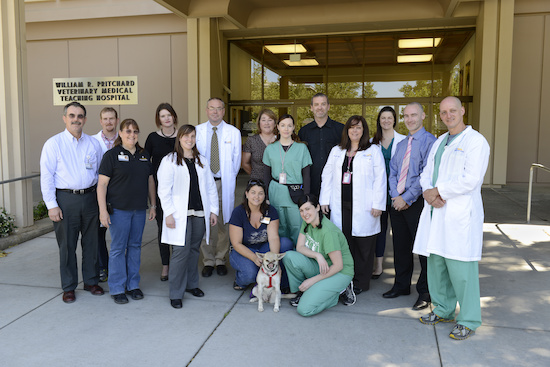
The clinicians, staff and caregivers that treated and cared for Kabang, the snoutless mutt from the Philippines credited with saving the lives of two young girls last year. Kabang has been treated and will be heading back to the Philippines in the near future. Kabang arrived at the UC Davis Veterinary Medical Teaching Hospital on October 11, 2012 after a long journey from her native Philippines. She presented with pre-existing health conditions that significantly delayed her dental and facial surgeries. As the treatments for those conditions were successfully completed in February 2013, she proceeded on to her dental and facial surgeries in March 2013. Kabang came through both of those surgeries successfully and is currently recovering under the watchful eye of the UC Davis VMTH faculty and staff. Photo by Don Preisler/UCDavis © 2013 UC Regents
The clinicians, staff and caregivers that treated and cared for Kabang, the snoutless mutt from the Philippines credited with saving the lives of two young girls last year. Kabang has been treated and will be heading back to the Philippines in the near future.
Kabang arrived at the UC Davis Veterinary Medical Teaching Hospital on October 11, 2012 after a long journey from her native Philippines. She presented with pre-existing health conditions that significantly delayed her dental and facial surgeries. As the treatments for those conditions were successfully completed in February 2013, she proceeded on to her dental and facial surgeries in March 2013. Kabang came through both of those surgeries successfully and is currently recovering under the watchful eye of the UC Davis VMTH faculty and staff.
Photo by Don Preisler/UCDavis
© 2013 UC Regents

DAVIS (CBS13) – Kabang, the Philippine dog that suffered a severely injured snout and upper-jaw while saving two girls from being hit by a motorcycle, has been released from the hospital.

The dog was brought to the veterinary medicine teaching hospital at UC Davis in October 2012 to be treated for the injury that left her with a gaping wound where her snout had been. But veterinarians found she had heartworm disease and a type of infectious cancer. A team of UC Davis veterinarians specializing in oncology; infectious diseases; dental, oral and soft-tissue surgery; internal medicine; and outpatient care was assembled to treat Kabang, according to the UC Davis News Service.

“We were able to treat all of the complications that arose with the best specialists available,” Verstraete said Professor Frank Verstraete, chief of the hospital’s dentistry and oral surgery service.

Finally, a video of Kabang’s return home.

G8 madness!

If it wasn’t so serious, it would be so funny!

I read a recent article posted by Rob Hopkins on the Transition Culture blogsite, a blog that I subscribe to.  Those who are unfamiliar with Rob, the Transition Culture site has his background, from which I quote this snippet:

Rob Hopkins, with a familiar Totnes building in the background.

Rob Hopkins brings humour, imagination and vision to the great challenges of our time, and argues that what is needed, above all else, at this time in history, is “engaged optimism”.  The rapidly-spreading Transition movement which he was pivotal in establishing, is an embodiment of that.  Nicholas Crane, presenter of BBC2’s recent ‘Town’ series, recently referred to Transition as “the biggest urban brainwave of the century”.

He is the co-founder of Transition Town Totnes and of the Transition Network. This grew out of many years experience in education, teaching permaculture and natural building, and setting up the first 2 year full-time permaculture course in the world, at Kinsale Further Education College in Ireland, as well as co-ordinating the first eco-village development in Ireland to be granted planning permission.

Anyway, back to the article.  It struck me as so absurd that I tried my hand at asking Rob for permission to republish.  Back, almost immediately, came his positive reply. Thank you, Rob.

Oh, and before going to Rob’s article, for those that, like me, are a bit rusty on the composition of the G8, here’s a Wikipedia extract:

The Group of Eight (G8) is a forum for the governments of the world’s eight wealthiest countries. The forum originated with a 1975 summit hosted by France that brought together representatives of six governments: France, West Germany, Italy, Japan, the United Kingdom, and the United States, thus leading to the name Group of Six or G6. The summit became known as the Group of Seven or G7 the following year with the addition of Canada. The G7, that is active even after the creation of the G8, is composed by 7 of 8 of the wealthiest countries on Earth (as net wealth and not GDP). In 1997, Russia was added to the group which then became known as the G8. The European Union is represented within the G8 but cannot host or chair summits.

Now without any further ado, here is that article.

oooOOOooo

12 Jun 2013

Why even the G8 prefer vibrant, diverse local economies really …

shop

If there was one picture that captured the times we are living through it is this.  It appeared on the BBC website recently with the following caption:

Kevin McGuire walks his dog past a vacant shop in Belcoo, Northern Ireland.  The empty shop is one of a number that have had graphics placed on the windows to make them look like working shops ahead of the G8 summit which takes place nearby later this month.  

Let’s take that a bit more slowly.  Here is a shop, one of many that has gone out of business due, among other things, to the growth-fixated policies of the G8, situated in a place G8 ministers will be driven past en route to their summit.  Rather than their being able to see how things are actually unfolding in the real world, the division and misery being caused by their approach to the economy, the windows have been plastered with stickers that present it as a fully-stocked, thriving shop.  As singer/comic Mitch Benn put it on BBC Radio 4′s The Now Show on Friday,  ”the last thing you’d want would be for a bunch of people meeting to fix the economy to see how bad the economy’s got”.

The BBC reported the story, giving a bit more information about it:

County Fermanagh’s district council sanctioned the fake retail units as part of a £1m makeover before it hosts the G8 summit. The event takes place on 17 and 18 June at the Lough Erne golf resort near Enniskillen.  The chief executive of Fermanagh District Council has defended the optical illusion.

“It was aimed at undeveloped sites at the entrance to the town and then right throughout the county in terms of the other towns and villages, looking at those vacant properties and really just trying to make them look better and more aesthetically pleasing,” says Brendan Hegarty

Here’s the thing that fascinated me most though.  It’s the kind of shop they chose to portray it as.  They didn’t print up large stickers that would present the shop as being a Tesco Metro, a Sainsbury’s Local, an Aldi perhaps, or even branch of one of the banks that contributed significantly to our getting into this mess in the first place.  They didn’t make one huge sticker, one false façade, that showed a new shopping precinct, glittering with all the usual chain stores that dominate every such precinct.  Or a Travelodge perhaps.  Rather they set out deliberately and in considerable detail to portray the kind of vibrant, local, independent business that has either become extinct, or which survives in spite of, rather than because of, the policies of the G8.  Here’s another one…

_68047523_oldladies

The windows are hung with delicious-looking hams, the display features meats and a whole range of delicious local produce, beautifully arranged.  Although the cut-and-paste nature of the graphic design rather gives the game away (the same arrangements of hams appear two or three times), what they are trying to portray here is that most endangered of species, the local, independent butcher.

In the mid-1990s there were 22,000 butchers in the UK, by 2010 there were just 6,553.  The independent butcher is making something of a spirited fightback though, although certainly not aided, in any sense, by the G8.  The butcher that would have occupied that shop no longer exists, most likely because a supermarket opened nearby and completely shifted the balance of the Belcoo economy (any readers from Belcoo who might like to write in and tell us what led to this shop’s demise would be most welcome).

The other day I spoke to Nick Sherwood of REconomy Herefordshire, who has co-ordinated the Herefordshire Economic Evaluation (the second such piece of work, the Totnes one already being published, and Brixton’s coming soon).  Our conversation will be published here soon, but one of the things that really struck me was the following:

We estimate that the top five major supermarkets in Herefordshire account for between 71% – 83% of all household expenditure on ‘brought home’ food and drink, or up to £180m annually. In addition, around £30m per year is spent in the smaller ‘chain’ supermarkets.

Herefordshire-EB-cover-198x300Their conclusion is that the true ‘local spend’ figure, i.e through local, independent businesses in Herefordshire, could be around 16% of the total.  In terms of a national version of that figure, the best I can find is the figure from the Portas Review that states that 8,000 supermarkets now account for over 97% of all UK grocery sales.  Although clearly other smaller supermarkets account for some of the remaining sales, let’s assume, for argument’s sake, that nationally, 3% of what we spend on groceries goes out through local and independent businesses.

I would imagine that everyone seeks an economy that is able to provide jobs, economic activity, stronger and happier communities and community resilience, while also skilfully reducing its carbon emissions on the scale required.  The question of our times though, as far as I’m concerned, is whether that is best achieved by expanding the 97% of our economy currently dominated by huge supermarkets, the kinds of enterprise that the UK government and the G8 see as leading the push for growth, or protecting and enhancing the 3%?

It’s a vital question, because at the moment the push to eradicate the 3% altogether, or at least squeeze it a lot harder, continues apace.  Yet that 3% is better suited to meeting those core needs of ours.  As the recent report by Localise West Midlands on ‘community economic development’ states:

Our research has found strong evidence that local economies with higher levels of SMEs and local ownership perform better in terms of employment growth (especially disadvantaged and peripheral areas), the local multiplier effect, social and economic inclusion, income redistribution, health, civic engagement and well-being than places heavily reliant on inward investment where there are fewer, larger, remotely owned employers.

A study focusing on New Orleans compared 179,000 square feet of retail space that is home to 100 independent businesses to the same-sized space that is home to a single supermarket. The former generated $105 million in sales with $34 million staying in the local economy, while the latter generated $50 million in sales with just $8 million staying locally, and necessitated 300,000 square feet of parking space (see graphic below).

shops

Santander’s ‘Market of Hope’ which I wrote about here last year is a great example of how a city can be fed by looking at large retail spaces in such a way that they boost and support the local independent economy rather than undermine it. When Sir Terry Leahy, CEO of Tesco, was asked whether there was any alternative to supermarkets, replied:

“… queueing at one store than trudging down Watford High Street in the rain to another shop … is this what people actually want to go back to?”

But no, it’s not about “going back”, rather about going forward in a way that meets our needs rather than those of the City of London.  What we now know is that even G8 ministers would rather pass through High Streets populated with small, independent butchers, bakers, grocers, would rather see shop windows overflowing with delicious food,  trusting that the relationship they have built up with the shopkeeper over many years will mean that he/she stocks the best produce they can find.  It feels right.  It’s human scale.  It makes sense.  It’s an economy that is ours, it belongs to local people, to the local economy.  Even G8 ministers would now appear to prefer a shopping experience that actually involves interacting with other human beings rather than wandering anonymously around a superstore and then cashing yourself out at the end.

The core argument of The Power of Just Doing Stuff, published on Friday, is that if we really want to achieve our goals of jobs, economic activity, stronger and happier communities and community resilience, while also skilfully reducing our carbon emissions on the scale required, we’d be better off focusing on growing the 3% rather than the 97%.  It’s a pretty simple idea, and, to me at least, a blindingly obvious one, but that doesn’t mean it’s easy.

However, the experience is that this fightback has already begun.  The explosion of new bakeries, pop-up shops, community renewable energy projects, craft breweries, independent record shops, complementary currencies and communities acquiring their own assets is already happening around us, but it needs us to get behind it, to put our shoulders, our spending power, our sheer bloody will, to making it 10%, 30% 70%.  If we want a stable climate, reduced energy vulnerability, economic stability, and a healthy human culture, we really have no choice.  As Maria van der Hoeven of the IEA said recently at the launch of a World Energy Outlook Special Report, Redrawing the Energy-Climate Map, ”the path we are currently on is more likely to result in a temperature increase of between 3.6 °C and 5.3 °C”.

Fortunately, it’s a push that is life-enhancing, thrill-generating and in which we discover a resourcefulness, a kindness and a passion in ourselves that we may have forgotten was there.  I’ll leave you with a quote from the book, from Helen Cunningham of DE4 Food, a social enterprise food hub in Derbyshire that grew out of Transition Matlock.  The project grew from helping a local farmer with lambing and has grown into an innovative new business:

“Never in my life did I imagine that I’d be able to bring lambs into the world! It wasn’t a skill I ever expected to have. It was such a different thing from what we were doing in the rest of our lives, and I think from then we’ve all thought “OK, we can learn these new skills, we can learn how to lamb, we can learn how to grow vegetables and learn how to do Excel Profit and Loss sheets and whatever.” I think we all just really wanted to change the way we live, and change our own personal lives and to change things and live different lives ourselves as well as a different life in our community”.

You can pre-order your copy of The Power of Just Doing Stuff here.

oooOOOooo

As has been said before, and undoubtedly will be said many times more, it really is a very strange world we live in!

I cry for the wolves.

This is so wrong.

Like thousands of others I have been supporting the efforts to ensure that the US Government did not proceed with the proposal to remove wolves from endangered species protection.

Wolves are the animals that enabled early man to ‘progress’ from hunter-gatherer to the life of farming, and thence to our modern world.  As I write elsewhere on Learning from Dogs,

There is no hard evidence about when dogs and man came together but dogs were certainly around when man developed speech and set out from Africa, about 50,000 years ago.

So it utterly breaks my heart to republish a recent post on The Sand County, Jeremy Nathan Marks wonderful and evocative blog.  Here it is, republished with Jeremy’s kind permission.

oooOOOooo

I used to believe

As some of you may have heard, late last week the Obama Administration officially delisted gray wolves from endangered species protection. This means that 40 years of wolf recovery efforts have come to an end. Wolves only occupy a tiny fraction of their former habitat and with anti-wolf governments occupying the state houses in the few places that still have wolf populations, states like Montana, Wyoming, Idaho and Wisconsin, it is hard to imagine that wolves have a bright future in the lower 48 states.

I am deeply, profoundly saddened by this decision. I have learned over time how wolves -like so many other species- just don’t register on the list of national concerns and priorities. A great many people oppose the delisting, in fact one gets the impression that the effort to remove these protections has consistently been guided by political pressures and a political agenda and not by a true commitment to a sustainable and enduring wolf recovery. I know that I am hardly alone in registering my disappointment and voice of protest.

I cannot let this sad milestone pass without acknowledging it here on this blog. If you do not like wolves -if you feel hatred or resentment towards them or are pleased at what has recently transpired, I respectfully request that you refrain from sharing your feelings here. I seldom offer any “directives” like this, but if you are a reader of this blog then you know how strongly I feel about this issue. I am sharing these thoughts because I want to not only draw attention to what has happened, but also because I feel the need to mourn it. I tremble at the thought of a United States -or a North America- without wolves. Defenders of the administration and the Department of Interior’s position will say that the United States Government is committed to protecting wolves and ensuring their future but I am afraid I see things quite differently. This is not a partisan political issue: Democratic and Republican administrations alike are behind this stance towards wolves.

I would like to share a poem which I feel is very incomplete and does not begin to adequately draw upon the well of feelings, concerns and thoughts I have on this subject. But I would be remiss I think if I did not mark what has just happened.

I used to believe

I used to believe that one day
I might live carefully, cooperatively
beside the wolves

I would go to them but respect their
space; wait for their return and tend
my garden with local mind, open my windows

When they moved off I would wait
and make a space; I would lock my guns
in bolted cabinets to honor and not to intrude

I used to believe that there was a chance
of this because there were others who saw
in wolves the same uncertainties and histories

And we, a new community, would redraw
the map, eradicate “the frontier” and perhaps
expunge that word altogether from our plans

It is ironic really how a word, a concept,
one invisible line can have more tendrils
and seeds than a weed, more pups than a pack.

Jeremy Nathan Marks

oooOOOooo

The Center for Biological Diversity has been incredibly active in fighting for the continued protection of the wolf. The Press Release about the loss of protection is here.  Do read it and do everything you can to help. PLEASE!

Let me share some of my special feelings about wolves.

Back in September, 2009, I wrote about An amazing true story of a relationship between a wild wolf and a man, from which this picture is taken.

Luna, the wild wolf, sleeping with Tim and Tim's dog, taken in 2006.
Luna, the wild wolf, with Tim and Tim’s dog; taken in 2006.

Then in February this year, I wrote about Oregon and the wolf.  The following picture was in that Post.

These wolf pups born to the Wenaha Pack in 2012 helped get recovery back on track. But their future remains tenuous (photo courtesy ODFW)

Please now listen to this:

So you can see that I have written frequently about wolves; indeed just a few days ago did so and included this photograph.

Wolf greets man.
Wolf greets man.

Now just look at those eyes of the Grey Wolf above and compare them to the eyes of the German Shepherd dog below and tell me that wolves aren’t as close to man as dogs.

OLYMPUS DIGITAL CAMERA

Finally, feel free to share this post as far and wide as you can.  Learning from Dogs is published under a Creative Commons License. This link covers how to share my material.

Please do something to help these ancient animals who, more than any other creature, helped put mankind ‘on the map’.

Thank you.