Category: Core thought

Looking at stress from a different perspective

Who doesn’t get stressed out!  Maybe not such an issue?

I have in my bookshelf a book called The Anxiety Epidemic.  On the back cover it explains this:

The Pain & Stress Center was founded in 1979, but the dream started long before that.  The goal is to help individuals realize their true potential and to support and conduct research in the areas of man’s greatest needs – natural alternatives.

I had seen the book in a second-hand bookshop and paid $1.99 for it!

Clearly I have some interest in the topic and like many others around me know that certain situations cause me stress.

Thus when recently there was a TED talk on the topic of ‘How to make stress your friend’ it seemed like a worthwhile thing to watch.  I was not wrong!

Published on Sep 4, 2013

Stress. It makes your heart pound, your breathing quicken and your forehead sweat. But while stress has been made into a public health enemy, new research suggests that stress may only be bad for you if you believe that to be the case. Psychologist Kelly McGonigal urges us to see stress as a positive, and introduces us to an unsung mechanism for stress reduction: reaching out to others.

It was an easy matter to find Kelly McGonigal’s website and discover a mine of advice and other good stuff.  For example, this:

Watch: How to Think Like a Psychologist

My fall 2011 Stanford University course “How to Think Like a Psychologist” is now available as a series of free, downloadable videos through iTunes university.

In this fun course, I invited my favorite psychology and neuroscience researchers at Stanford to talk about their work and what it means for everyday life and real-world problems. Each class starts with a 45-min lecture by the guest speaker, followed by about 30 minutes of Q&A from myself and course participants. I had a great time grilling these amazing scientists about everything from politics to education, parenting, shopping, and the scientific process. You’ll even hear a few personal stories they’ve never shared in public before!

Then there was this:

Learn: Mindfulness of Breathing.

I’m frequently asked questions about how to get started meditating, what is the best meditation for beginners, what is the best meditation for reducing stress (or training willpower, or cultivating self-compassion, or developing focus, etc.). Below is my favorite meditation for all these intentions.

You can listen to (or download) a version of these instructions and a 15-min guided practice here.

Mindfulness of Breathing

The intention of this practice is to turn your attention to the breath, notice when the mind wanders, and bring your attention back to the breath.

This meditation cultivates self-awareness, mindfulness, and the ability to make conscious choices about what you are doing. It also is good practice in not following every impulse or habit.

There are a few different ways to focus on the breath; choose the one that feels right to you.

There’s more to read here.

Of course, I couldn’t sign off without offering yet another thing to learn from dogs- relaxation.

Cleo dealing with stress!

So have a great week ahead: With or without stress!

Empires, time machines and the power of hindsight!

Tom Engelhardt of TomDispatch and the clarity of looking backwards.

A few weeks ago, I said that I was trying to move away from writing about the big issues in our lives and refocus on the meanings, both literal and figurative, on what we can learn from dogs.  Not been entirely successful with that ambition!

For example, yesterday’s post that included the most incredible video illustrating the size of the universe didn’t mention the ‘dog’ word at all.  However, what yesterday did do is to remind us that even the grandest aspect of mankind’s behaviours, of the rise and fall of empires, is a very long way from the the grandness of the universe.

So with that preamble, let me move on to Tom’s recent essay, again published with Tom’s permission. As so often with essays that are published on TomDispatch this one sets out a reality of the America of today that is surely unsustainable.  Interesting times!

oooOOOooo

Tomgram: Engelhardt, Alone and Delusional on Planet Earth

Posted by Tom Engelhardt at 8:01am, September 3, 2013.
Follow TomDispatch on Twitter @TomDispatch.

And Then There Was One – Delusional Thinking in the Age of the Single Superpower 
By Tom Engelhardt

In an increasingly phantasmagorical world, here’s my present fantasy of choice: someone from General Keith Alexander’s outfit, the National Security Agency, tracks down H.G. Wells’s time machine in the attic of an old house in London.  Britain’s subservient Government Communications Headquarters, its version of the NSA, is paid off and the contraption is flown to Fort Meade, Maryland, where it’s put back in working order.  Alexander then revs it up and heads not into the future like Wells to see how our world ends, but into the past to offer a warning to Americans about what’s to come.

He arrives in Washington on October 23, 1962, in the middle of the Cuban Missile Crisis, a day after President Kennedy has addressed the American people on national television to tell them that this planet might not be theirs — or anyone else’s — for long.  (“We will not prematurely or unnecessarily risk the costs of worldwide nuclear war in which even the fruits of victory would be ashes in our mouth, but neither will we shrink from the risk at any time it must be faced.”)  Greeted with amazement by the Washington elite, Alexander, too, goes on television and informs the same public that, in 2013, the major enemy of the United States will no longer be the Soviet Union, but an outfit called al-Qaeda in the Arabian Peninsula (AQAP), and that the headquarters of our country’s preeminent foe will be found somewhere in the rural backlands of… Yemen.

Yes, Yemen, a place most Americans, then and now, would be challenged to find on a world map.  I guarantee you one thing: had such an announcement actually been made that day, most Americans would undoubtedly have dropped to their knees and thanked God for His blessings on the American nation.  Though even then a nonbeliever, I would undoubtedly have been among them.  After all, the 18-year-old Tom Engelhardt, on hearing Kennedy’s address, genuinely feared that he and the few pathetic dreams of a future he had been able to conjure up were toast.

Had Alexander added that, in the face of AQAP and similar minor jihadist enemies scattered in the backlands of parts of the planet, the U.S. had built up its military, intelligence, and surveillance powers beyond anything ever conceived of in the Cold War or possibly in the history of the planet, Americans of that time would undoubtedly have considered him delusional and committed him to an asylum.

Such, however, is our world more than two decades after Eastern Europe was liberated, the Berlin Wall came down, the Cold War definitively ended, and the Soviet Union disappeared.

Why Orwell Was Wrong

Now, let me mention another fantasy connected to the two-superpower Cold War era: George Orwell’s 1948 vision of the world of 1984 (or thereabouts, since the inhabitants of his novel of that title were unsure just what year they were living in).  When the revelations of NSA contractor Edward Snowden began to hit the news and we suddenly found ourselves knee-deep in stories about PrismXKeyscore, and other Big Brother-ish programs that make up the massive global surveillance network the National Security Agency has been building, I had a brilliant idea — reread 1984.

At a moment when Americans were growing uncomfortably aware of the way their government was staring at them and storing what they had previously imagined as their private data, consider my soaring sense of my own originality a delusion of my later life.  It lasted only until I read an essay by NSA expert James Bamford in which he mentioned that, “[w]ithin days of Snowden’s documents appearing in the Guardian and the Washington Post…, bookstores reported a sudden spike in the sales of George Orwell’s classic dystopian novel 1984. On Amazon.com, the book made the ‘Movers & Shakers’ list and skyrocketed 6,021 percent in a single day.”

Nonetheless, amid a jostling crowd of worried Americans, I did keep reading that novel and found it at least as touching, disturbing, and riveting as I had when I first came across it sometime before Kennedy went on TV in 1962.  Even today, it’s hard not to marvel at the vision of a man living at the beginning of the television age who sensed how a whole society could be viewed, tracked, controlled, and surveiled.

But for all his foresight, Orwell had no more power to peer into the future than the rest of us.  So it’s no fault of his that, almost three decades after his year of choice, more than six decades after his death, the shape of our world has played havoc with his vision.  Like so many others in his time and after, he couldn’t imagine the disappearance of the Soviet Union or at least of Soviet-like totalitarian states.  More than anything else, he couldn’t imagine one fact of our world that, in 1948, wasn’t in the human playbook.

In 1984, Orwell imagined a future from what he knew of the Soviet and American (as well as Nazi, Japanese, and British) imperial systems.  In imagining three equally powerful, equally baleful superpowers — Oceania, Eurasia, and Eastasia — balanced for an eternity in an unwinnable global struggle, he conjured up a logical extension of what had been developing on this planet for hundreds of years.  His future was a version of the world humanity had lived with since the first European power mounted cannons on a wooden ship and set sail, like so many Mongols of the sea, to assault and conquer foreign realms, coastlines first.

From that moment on, the imperial powers of this planet — super, great, prospectively great, and near great — came in contending or warring pairs, if not triplets or quadruplets.  Portugal, Spain, and Holland; England, France, and Imperial Russia; the United States, Germany, Japan, and Italy (as well as Great Britain and France), and after World War II, the United States and the Soviet Union.  Five centuries in which one thing had never occurred, the thing that even George Orwell, with his prodigious political imagination, couldn’t conceive of, the thing that makes 1984 a dated work and his future a past that never was: a one-superpower world.  To give birth to such a creature on such a planet — as indeed occurred in 1991 — was to be at the end of history, at least as it had long been known.

The Decade of the Stunned Superpower

Only in Hollywood fantasies about evil super-enemies was “world domination” by a single power imaginable.  No wonder that, more than two decades into our one-superpower present, we still find it hard to take in this new reality and what it means.

At least two aspects of such a world seem, however, to be coming into focus.  The evidence of the last decades suggests that the ability of even the greatest of imperial powers to shape global events may always have been somewhat exaggerated.  The reason: power itself may never have been as centrally located in imperial or national entities as was once imagined.  Certainly, with all rivals removed, the frustration of Washington at its inability to control events in the Greater Middle East and elsewhere could hardly be more evident.  Still, Washington has proven incapable of grasping the idea that there might be forms of power, and so of resistance to American desires, not embodied in competitive states.

Evidence also seems to indicate that the leaders of a superpower, when not countered by another major power, when lacking an arms race to run or territory and influence to contest, may be particularly susceptible to the growth of delusional thinking, and in particular to fantasies of omnipotence.

Though Great Britain far outstripped any competitor or potential enemy at the height of its imperial glory, as did the United States at the height of the Cold War (the Soviet Union was always a junior superpower), there were at least rivals around to keep the leading power “honest” in its thinking.  From December 1991, when the Soviet Union declared itself no more, there were none and, despite the dubious assumption by many in Washington that a rising China will someday be a major competitor, there remain none.  Even if economic power has become more “multipolar,” no actual state contests the American role on the planet in a serious way.

Just as still water is a breeding ground for mosquitos, so single-superpowerdom seems to be a breeding ground for delusion.  This is a phenomenon about which we have to be cautious, since we know little enough about it and are, of course, in its midst.  But so far, there seem to have been three stages to the development of whatever delusional process is underway.

Stage one stretched from December 1991 through September 10, 2001.  Think of it as the decade of the stunned superpower.  After all, the collapse of the Soviet Union went unpredicted in Washington and when it happened, the George H. W. Bush administration seemed almost incapable of taking it in.  In the years that followed, there was the equivalent of a stunned silence in the corridors of power.

After a brief flurry of debate about a post-Cold War “peace dividend,” that subject dropped into the void, while, for example, U.S. nuclear forces, lacking their major enemy of the previous several decades, remained more or less in place, strategically disoriented but ready for action.  In those years, Washington launched modest and halting discussions of the dangers of “rogue states” (think “Axis of Evil” in the post-9/11 era), but the U.S. military had a hard time finding a suitable enemy other than its former ally in the Persian Gulf, Iraq’s Saddam Hussein.  Its ventures into the world of war in Somalia and the former Yugoslavia were modest and not exactly greeted with rounds of patriotic fervor at home.  Even the brief glow of popularity the elder Bush gained from his 1990-1991 war against Saddam evaporated so quickly that, by the time he geared up for his reelection campaign barely a year later, it was gone.

In the shadows, however, a government-to-be was forming under the guise of a think tank.  It was filled with figures like future Vice President Dick Cheney, future Secretary of Defense Donald Rumsfeld, future Deputy Secretary of Defense Paul Wolfowitz, future U.N. Ambassador John Bolten, and future ambassador to Afghanistan Zalmay Khalilzad, all of whom firmly believed that the United States, with its staggering military advantage and lack of enemies, now had an unparalleled opportunity to control and reorganize the planet.  In January 2001, they came to power under the presidency of George W. Bush, anxious for the opportunity to turn the U.S. into the kind of global dominator that would put the British and even Roman empires to shame.

Pax Americana Dreams

Stage two in the march into single-superpower delusion began on September 11, 2001, only five hours after hijacked American Airlines Flight 77 smashed into the Pentagon.  It was then that Secretary of Defense Donald Rumsfeld, already convinced that al-Qaeda was behind the attacks, nonetheless began dreaming about completing the First Gulf War by taking out Saddam Hussein.  Of Iraq, he instructed an aide to “go massive… Sweep it all up. Things related and not.”

And go massive he and his colleagues did, beginning the process that led to the March 2003 invasion of Iraq, itself considered only a precursor to transforming the Greater Middle East into an American protectorate.  From the fertile soil of 9/11 — itself something of a phantasmagoric event in which Osama bin Laden and his relatively feeble organization spent a piddling $400,000-$500,000 to create the look of an apocalyptic moment — sprang full-blown a sense of American global omnipotence.

It had taken a decade to mature.  Now, within days of the toppling of those towers in lower Manhattan, the Bush administration was already talking about launching a “war on terror,” soon to become the “Global War on Terror” (no exaggeration intended).  The CIA would label it no less grandiosly a “Worldwide Attack Matrix.”  And none of them were kidding.  Finding “terror” groups of various sorts in up to 80 countries, they were planning, in the phrase of the moment, to “drain the swamp” — everywhere.

In the early Bush years, dreams of domination bred like rabbits in the hothouse of single-superpower Washington.  Such grandiose thinking quickly invaded administration and Pentagon planning documents as the Bush administration prepared to prevent potentially oppositional powers or blocs of powers from arising in the foreseeable future.  No one, as its top officials and their neocon supporters saw it, could stand in the way of their planetary Pax Americana.

Nor, as they invaded Afghanistan, did they have any doubt that they would soon take down Iraq.  It was all going to be so easy.  Such an invasion, as one supporter wrote in the Washington Post, would be a “cakewalk.”  By the time American troops entered Iraq, the Pentagon already had plans on the drawing board to build a series of permanent bases — they preferred to call them “enduring camps” — and garrison that assumedly grateful country at the center of the planet’s oil lands for generations to come.

Nobody in Washington was thinking about the possibility that an American invasion might create chaos in Iraq and surrounding lands, sparking a set of Sunni-Shiite religious wars across the region.  They assumed that Iran and Syria would be forced to bend their national knees to American power or that we would simply impose submission on them.  (As a neoconservative quip of the moment had it, “Everyone wants to go to Baghdad. Real men want to go to Tehran.”)  And that, of course would only be the beginning.  Soon enough, no one would challenge American power. Nowhere. Never.

Such soaring dreams of — quite literally — world domination met no significant opposition in mainstream Washington.  After all, how could they fail?  Who on Earth could possibly oppose them or the U.S. military?  The answer seemed too obvious to need to be stated — not until, at least, their all-conquering armies bogged down in Iraq and Afghanistan and the greatest power on the planet faced the possibility of defeat at the hands of… well, whom?

The Dark Matter of Global Power

Until things went sour in Iraq, theirs would be a vision of the Goliath tale in which David (or various ragtag Sunni, Shiite, and Pashtun versions of the same) didn’t even have a walk-on role.  All other Goliaths were gone and the thought that a set of minor Davids might pose problems for the planet’s giant was beyond imagining, despite what the previous century’s history of decolonization and resistance might have taught them.  Above all, the idea that, at this juncture in history, power might not be located overwhelmingly and decisively in the most obvious place — in, that is, “the finest fighting force that the world has ever known,” as American presidents of this era came to call it — seemed illogical in the extreme.

Who in the Washington of that moment could have imagined that other kinds of power might, like so much dark matter in the universe, be mysteriously distributed elsewhere on the planet?  Such was their sense of American omnipotence, such was the level of delusional thinking inside the Washington bubble.

Despite two treasury-draining disasters in Afghanistan and Iraq that should have been sobering when it came to the hidden sources of global power, especially the power to resist American wishes, such thinking showed only minimal signs of diminishing even as the Bush administration pulled back from the Iraq War, and a few years later, after a set of misbegotten “surges,” the Obama administration decided to do the same in Afghanistan.

Instead, Washington entered stage three of delusional life in a single-superpower world.  Its main symptom: the belief in the possibility of controlling the planet not just through staggering military might but also through informational and surveillance omniscience and omnipotence.  In these years, the urge to declare a global war on communications, create a force capable of launching wars in cyberspace, and storm the e-beaches of the Internet and the global information system proved overwhelming.  The idea was to make it impossible for anyone to write, say, or do anything to which Washington might not be privy.

For most Americans, the Edward Snowden revelations would pull back the curtain on the way the National Security Agency, in particular, has been building a global network for surveillance of a kind never before imagined, not even by the totalitarian regimes of the previous century.  From domestic phone calls to international emails, from the bugging of U.N. headquarters and the European Union to 80 embassies around the world, from enemies to frenemies to allies, the system by 2013 was already remarkably all-encompassing.  It had, in fact, the same aura of grandiosity about it, of overblown self-regard, that went with the launching of the Global War on Terror — the feeling that if Washington did it or built it, they would come.

I’m 69 years old and, in technological terms, I’ve barely emerged from the twentieth century.  In a conversation with NSA Director Keith Alexander, known somewhat derisively in the trade as “Alexander the Geek,” I have no doubt that I’d be lost.  In truth, I can barely grasp the difference between what the NSA’s Prism and XKeyscore programs do.  So call me technologically senseless, but I can still recognize a deeper senselessness when I see it.  And I can see that Washington is building something conceptually quite monstrous that will change our country for the worse, and the world as well, and is — perhaps worst of all — essentially nonsensical.

So let me offer those in Washington a guarantee: I have no idea what the equivalents of the Afghan and Iraq wars will be in the surveillance world, but continue to build such a global system, ignoring the anger of allies and enemies alike, and “they” indeed will come.  Such delusional grandiosity, such dreams of omnipotence and omniscience cannot help but generate resistance and blowback in a perfectly real world that, whatever Washington thinks, maintains a grasp on perfectly real power, even without another imperial state on any horizon.

2014

Today, almost 12 years after 9/11, the U.S. position in the world seems even more singular.  Militarily speaking, the Global War on Terror continues, however namelessly, in the Obama era in places as distant as Pakistan, Yemen, and Somalia.  The U.S. military remains heavily deployed in the Greater Middle East, though it has pulled out of Iraq and is drawing down in Afghanistan.  In recent years, U.S. power has, in an exceedingly public manner, been “pivoting” to Asia, where the building of new bases, as well as the deployment of new troops and weaponry, to “contain” that imagined future superpower China has been proceeding apace.

At the same time, the U.S. military has been ever-so-quietly pivoting to Africa where, as TomDispatch’s Nick Turse reports, its presence is spreading continent-wide.  American military bases still dot the planet in remarkable profusion, numbering perhaps 1,000 at a moment when no other nation on Earth has more than a handful outside its territory.

The reach of Washington’s surveillance and intelligence networks is unique in the history of the planet.  The ability of its drone air fleet to assassinate enemies almost anywhere is unparalleled.  Europe and Japan remain so deeply integrated into the American global system as to be essentially a part of its power-projection capabilities.

This should be the dream formula for a world dominator and yet no one can look at Planet Earth today and not see that the single superpower, while capable of creating instability and chaos, is limited indeed in its ability to control developments.  Its president can’t even form a “coalition of the willing” to launch a limited series of missile attacks on the military facilities of the Syrian regime of Bashar al-Assad.  From Latin America to the Greater Middle East, the American system is visibly weakening, while at home, inequality and poverty are on the rise, infrastructure crumbles, and national politics is in a state of permanent “gridlock.”

Such a world should be fantastical enough for the wildest sort of dystopian fiction, for perhaps a novel titled 2014.  What, after all, are we to make of a planet with a single superpower that lacks genuine enemies of any significance and that, to all appearances, has nonetheless been fighting a permanent global war with… well, itself — and appears to be losing?

Tom Engelhardt, co-founder of the American Empire Project and author of The United States of Fear as well as a history of the Cold War, The End of Victory Culture (recently published in a Kindle edition), runs the Nation Institute’s TomDispatch.com. His latest book, co-authored with Nick Turse, is Terminator Planet: The First History of Drone Warfare, 2001-2050.

Follow TomDispatch on Twitter and join us on Facebook or Tumblr. Check out the newest Dispatch book, Nick Turse’s The Changing Face of Empire: Special Ops, Drones, Proxy Fighters, Secret Bases, and Cyberwarfare.

Copyright 2013 Tom Engelhardt

oooOOOooo

But as my preamble reminded us, if Tom’s essay gets your emotions running, then turn back to yesterday’s post and put it all back into place!

Putting things into perspective!

More or less makes daily hassles irrelevant!

Now don’t misunderstand me.  There are huge numbers of people on this planet who have challenges and issues that I can’t even imagine handling.  But whatever we are dealing with, it is at a personal ‘size’ proportional to scale of our lives.  For example, I have a guest post coming out tomorrow from Tom Engelhardt about the nature of the American Empire.  Frankly, it’s more than disturbing.  But, or should I write that as BUT, it is about matters that are trivial and inconsequential in the larger scheme of things.

All of which is a little introduction to a YouTube link that Suzann sent me; the video below.  It’s just about 2 1/2 minutes long, yet is incredible. Plus it has already been watched over 9 million times!

In praise of Pit Bull dogs.

A guest post by Noella Schink.

Not so long ago, this email was received by me:

Possible Guest Post?

Hello!

My name is Noella and I am a writer and dog enthusiast from Portland, Maine. I am reaching out to you in hopes of contributing to Learning from Dogs as a guest blogger. I have an original, unpublished piece about Top Five Reasons to Pet a Pitbull Today, that I think would fit nicely with the current offering of blog topics you post. I would also be open to writing you a new piece,  if there’s a specific topic you’d like covered.

Please let me know if you’d be interested in having a look at my piece and hopefully fitting it into your editorial calendar.

I hope to hear back from you soon!

Thanks,

Noella

Now to be honest, this type of writing offer is not that rare but almost without exception is connected to some form of commercial organisation seeking to advance their profile. My responses are ‘not interested’!  Initially, that was my first impression of this email from Noella.   But in reply to my query along that vein, Noella sent me this:

Paul,

You’re right, there will be revenue earned from dog friendly businesses that want to get involved and have ads featured on Harry’s Picks. As you can see, presently we have one dog bakery featured. The idea is to keep the website running and give back to the canine community. We are not affiliated with any brand or company.

Thank you,

Noella

Thus on that basis I was happy to go ahead with the guest post.  Influenced in great part by the gorgeous temperament of our Casey, a Pit Bull that we adopted February, 2012 when we were still living in Payson, Arizona.  Casey, as he was named, had been living in the Humane Centre for nearly a year with no-one taking a liking to him, and his days as a rescue dog were running out.

Jean loved Casey from first sight and in due course brought him home.  He quickly settled into the most wonderful, caring and gregarious dog one could imagine.  He continues to be a happy, warm dog with all of us here in Oregon.

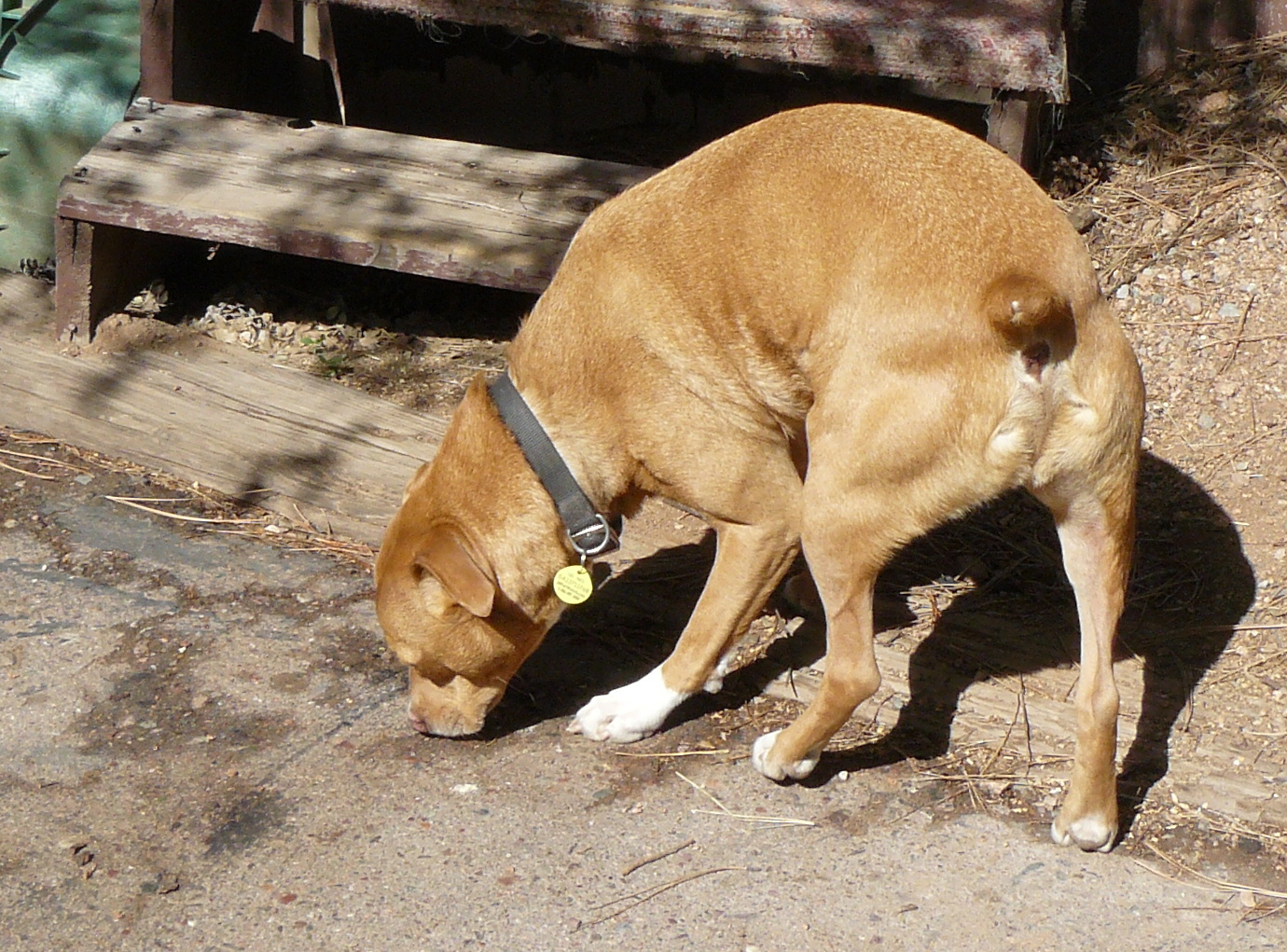
Casey doing what dogs do so well – picking up a scent.
Casey doing what dogs do so well – picking up scents of his new home. (28th February, 2012)

So with all that, let me turn to Noella’s guest post.

oooOOOooo

Top 5 Reasons To Love a Pittie

Addie.
Sweet Addie.

This is Addie. She is my best friend. She is a Pit Bull mix and the sweetest dog I have ever known. I really didn’t know much about Pit Bulls when I adopted her. I hadn’t been spoiled by tales of their viciousness and I had not yet been brought into the fold by a devotee. So I had to learn fast!

Everything I know about Pit Bulls now has been through her or inspired by her.

Here are the top 5 things I love about Addie and Pit Bulls:

5) They are incredibly strong and athletic. They come in pretty small packages but they are dynamos. Addie can jump five feet straight up in the air from standing still. It’s awe inspiring to watch.

4) You will always be missed! They fuss when you come home. I’m sure lots of dogs do this, but I’ve noticed it in a lot of pitties. They whine and wiggle and snort in the most adorable way. They love people and are always ecstatic to see you. I’m lucky to get a raised eyebrow from my hound dog.

3) They love to play. Pitties are a very determined breed. They will play until you are completely worn out and they will be fully engaged and inquisitive the entire time.

2) THEY LOVE PEOPLE. In my experience Pit Bulls are the most affectionate breed. They are snuggle monsters and will use their gigantic noggins to nose their way into your personal space whether you are seeking their attention or not.

1) THEY NEED THE LOVE. Sadly Pit Bulls and Pit Bull mixes makeup 30%-40% of shelter intakes nationwide and that number goes up in urban areas (interesting article on the subject here). Pit Bulls are misunderstood and often times fall into the hands of the wrong people. They need good owners that have the love and patience to provide them solid training and safe homes.

Noella Schink, writes from Portland, Maine, where she lives and plays with her 3-year-old pit bull mix, Addie, 8-year old shih-tzu, Brutus, and 2-year old hound, Lula. For great tips and reviews about dog friendly businesses around the country, she recommends Harry’s Picks, a new online community for dog lovers.

oooOOOooo

Fight for the trees.

An update to yesterday’s post.

In the recent post Sing for the trees, Pedantry of the blog Wibble left this comment:

 don’t consider myself an envious type, but I have to admit to being jealous of your location there, Paul. Deer in the back garden! Amazing. I guess I’m lucky to see the odd squirrel. But (as usual) I digress…

Trees… yes. Were I King of the Earth my first edict would be to make it illegal to chop down any more trees anywhere for any reason, and to reward true reforestation efforts (while banning old-forest lumbering dressed up as ‘reforestation’).

As I’m not, the extent of my singing for the trees is limited to pledges on such worthy projects as Who Bombed Judi Bari? (less than subtle hint: just 39 hours to go, as I write).

Your first image above is wonderful, and is a terrific, healing counterpoint to the images I see elsewhere, such as in the clip below, of what we’re doing to our home, out of sight of most people. Thank you.

That comment also included this video:

I thought readers would be interested in learning more by visiting the Kickstarter Campaign page and just possibly offering whatever pledge you can afford.

The importance of this campaign was underlined by the fact that just last Wednesday my daughter Maija, son-in-law Marius, and grandson Morten visited the Redwood Forest as part of their holiday with us in Oregon.  Here are three of their pictures taken just two days ago.

Life-giving Redwoods.

oooo

That need lots of loving.

oooo

From young and old alike.

oooo

So do whatever you can, please!  There are just 26 hours to go at the time of posting this: 9:10 am PDT.

Thanks to Pedantry for bringing this to the attention of LfD readers and followers.

Sing for the trees.

What can we do for the trees?

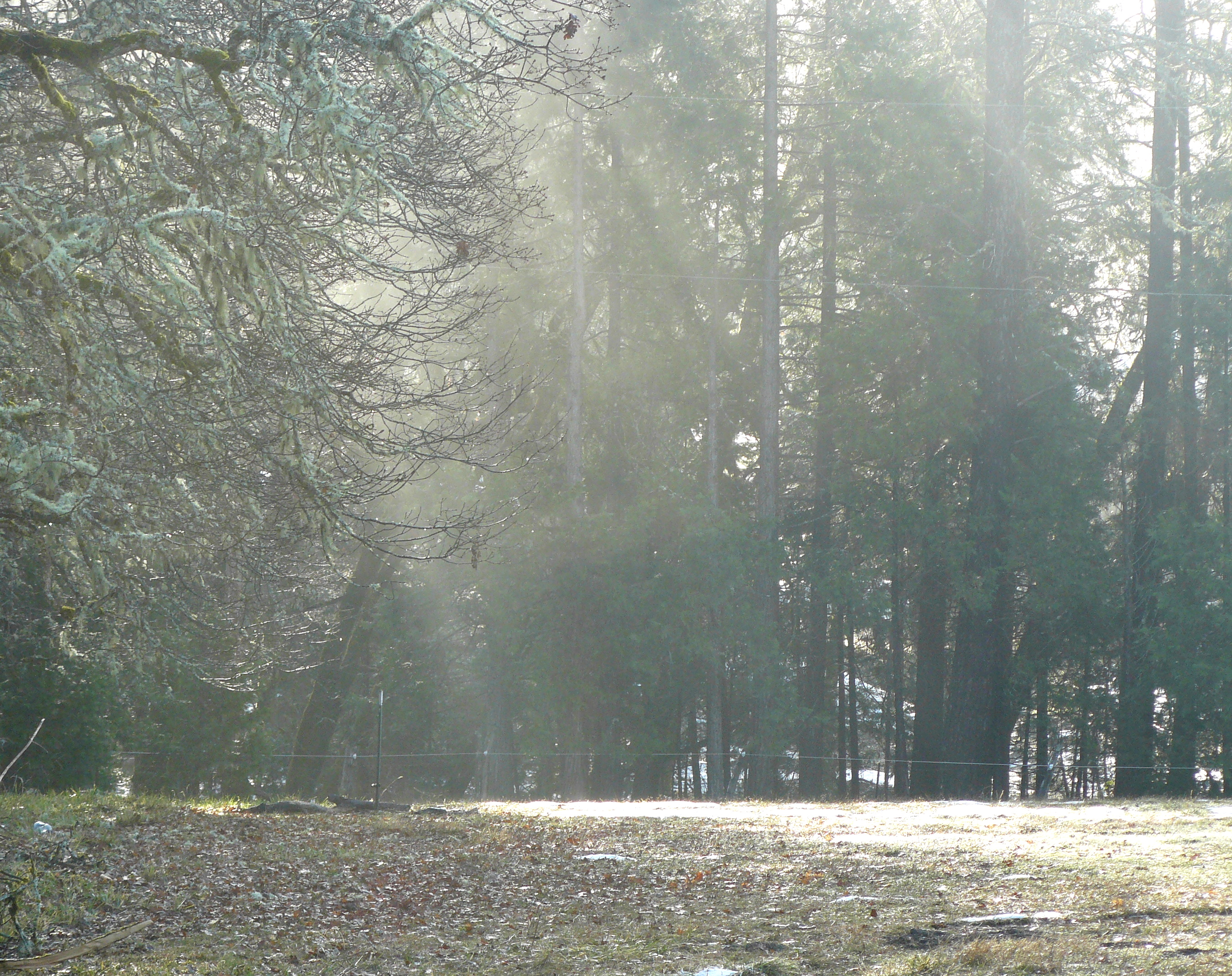
Winter sunlight filtering through the trees. Oregon, January 2013.

We don’t subscribe to television services here at home.  The only way I stay partially informed is via the BBC News website.  Thus it was a few days ago I saw the headline, “European forests near ‘carbon saturation point’”  This was a report by Mark Kinver, Environment reporter, BBC News.  It made me sit up and take notice.  For Mark Kinver wrote:

European forests are showing signs of reaching a saturation point as carbon sinks, a study has suggested.

Since 2005, the amount of atmospheric CO2 absorbed by the continent’s trees has been slowing, researchers reported.

Writing in Nature Climate Change, they said this was a result of a declining volume of trees, deforestation and the impact of natural disturbances.

Carbon sinks play a key role in the global carbon cycle and are promoted as a way to offset rising emissions.

Many of Europe’s forests are reaching an age where growth, and carbon uptake, slows down.

Writing in their paper, the scientists said the continent’s forests had been recovering in recent times after centuries of stock decline and deforestation.

The growth had also provided a “persistent carbon sink”, which was projected to continue for decades.

However, the team’s study observed three warnings that the carbon sink provided by Europe’s tree stands was nearing a saturation point.

It would be wrong to republish the full report but do go and read it here.  It contains much information, some of it counter-intuitive.  Such as Dr. Gert-Jan Nabuurs from Wageningen University and Research Centre, Netherlands saying of Europe’s forest;

“These forests have now reached 70-80 years old and are starting a phase in the life of a tree where the growth rate starts to come down,” he explained.

“So you have large areas of old forest and even if you add these relatively small areas of new forest, this does not compensate for the loss of growth rate in the old forests.”

The report includes the glaringly obvious, “However, mature woodlands have been recognised as a key habitat for supporting and conserving biodiversity.”!

The issue of knowing what is best for the wildlife, of all types and sizes, of balancing doing nothing to the forest or undertaking beneficial husbandry is one that is going to be in our minds here at home this coming Winter.

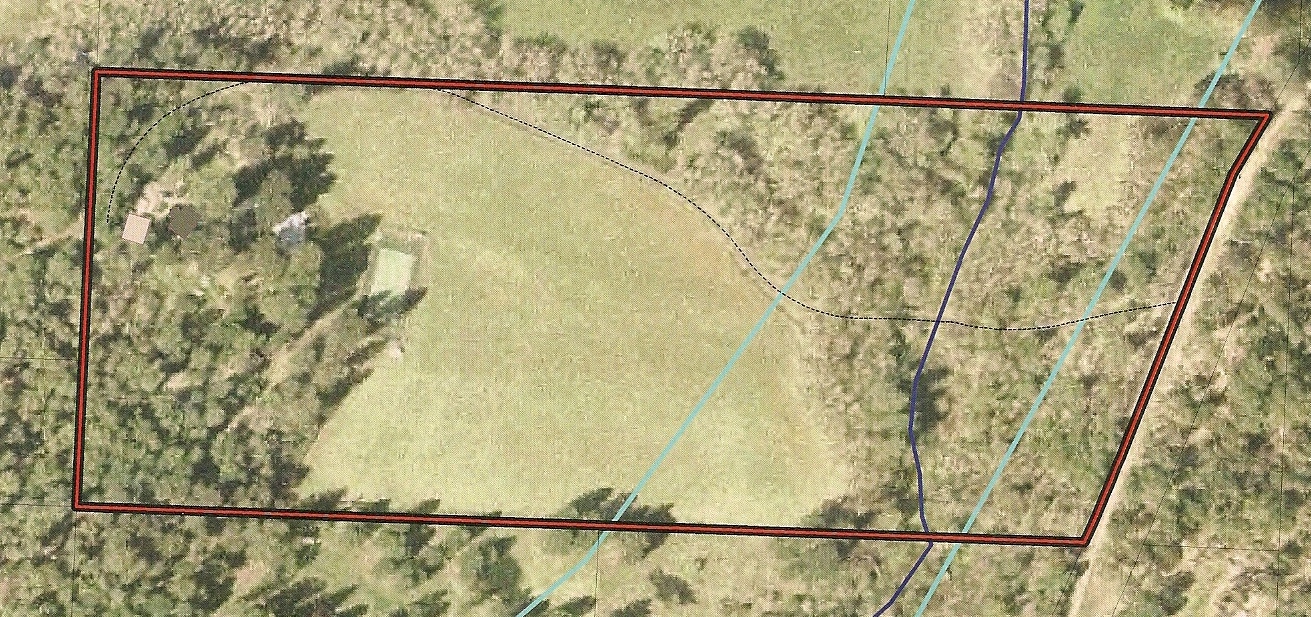
For much of our 13 acres is forest, as the following property map shows.

Assessor's Map 4000 Hugo Road.
Assessor’s Map 4000 Hugo Road.

When we first moved in to the house last October, the most common wild large creatures around were the deer.  The only way one could get close enough to take a photograph was when there wasn’t a dog in sight.  Even then, the slightest sudden sound or movement had a deer dashing into the forest.

Deer very cautiously meets new humans on the block!
Deer very cautiously meets new humans on the block! (Early November 2012)

Yet over the following weeks, the healthy grass made an irresistible Winter meal and the deer settled down to being regular visitors.  But always within a few leaps and bounds of the edge of the trees.

Nevertheless, the deer remained very cautious of feeding during the daytime as they soon became aware that without warning dogs could come rushing out from the house; as happened numerous times!  It seemed clear that having the forest close by enabled them to scatter as soon as the first bark was heard.

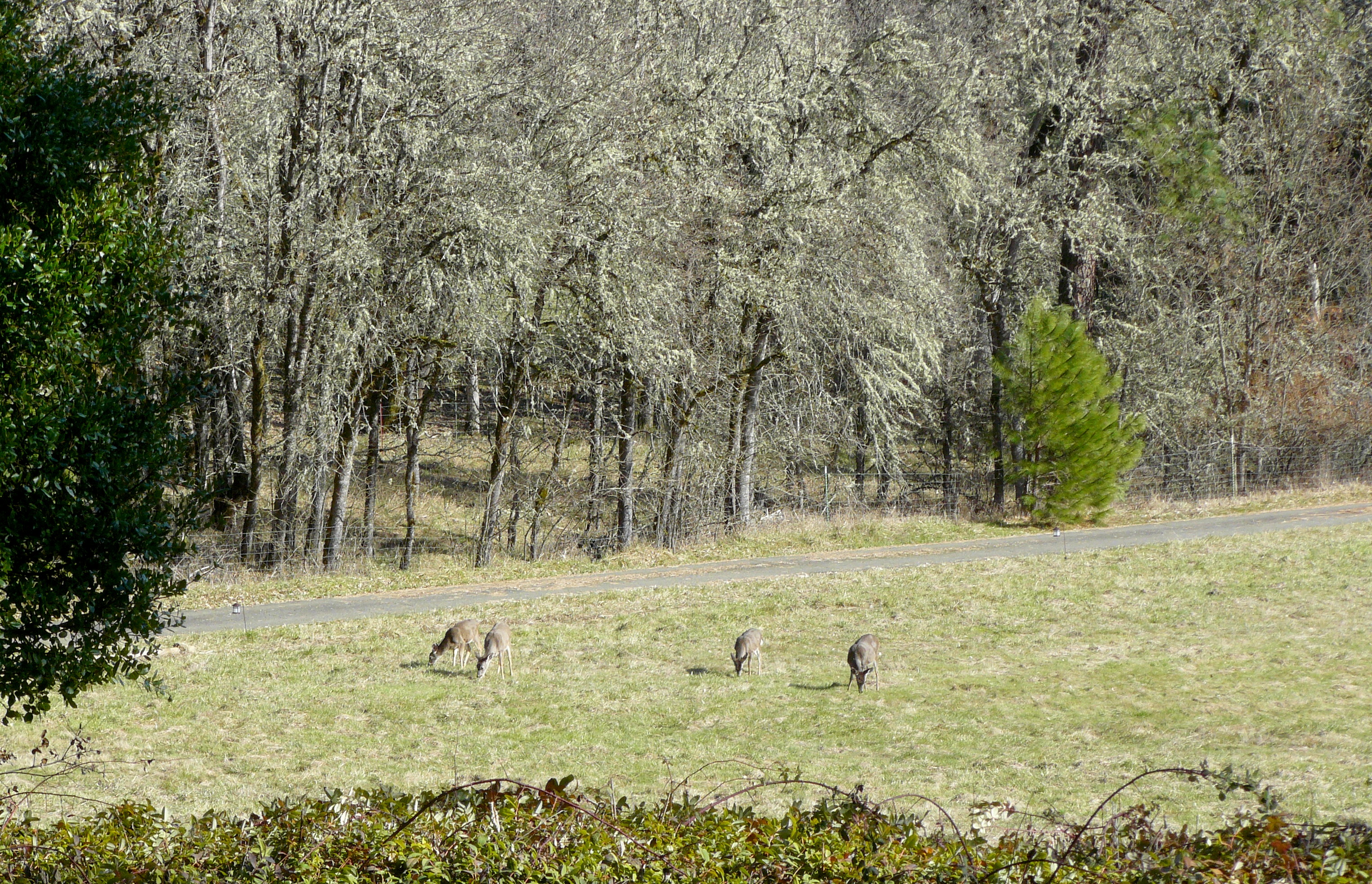
Months later, shown by this photograph taken early afternoon just a couple of weeks ago, these four wild deer still grazed close to the forest.

Wild deer feeding on the grass.

So this Autumn/Fall we shall be coming up with a plan to ensure that the forests on our property are reinvigorated to the best of our abilities.

Healing

Always the need for healing.

My posts from Monday and yesterday about the plight of our bees must to many, frequently me as well, engender a level of hopelessness as to where we, as in the peoples of this planet, are heading.  Too many times the news is discouraging; to say the least.

But hold on for just a moment!  Here’s a quotation from this week’s Sabbath Moment from Terry Hershey:

Tears have a purpose.

they are what we carry of the ocean, and

perhaps we must become sea,

give ourselves to it,

if we are to be transformed.

Linda Hogan

What this says to me is that feelings of sadness, of grief, even of despair are an essential part of the process of ‘letting go’; of being able to heal oneself.  Just as dogs and many other animals know when to crawl away and recuperate in some peaceful and quiet place, so too must we humans counter our feelings of pain and anguish with healing.

So with that all in mind, I’m delighted, and very grateful, to Sue of Dreamwalker’s Sanctuary for permission to repost her item on Sound Healing, published last Friday.

oooOOOooo

Friday Facts ~ Sound Healing

by Sue Dreamwalker

Healing music
Healing music

Have you ever wondered why we so enjoy Music? Why various styles seem to either lift our mood or sooth our spirits? Or some grate on our nerve endings?

Sound Healing comes in various forms. I have received healing from various sources: Crystal Singing Bowls, Tuning Forks and the Mighty Gongs. The Gong Bath  in particular shifted something within my being as I physically felt something leave my aura to be replaced with a new found peace within.

Sound Healing isn’t new and if you research back to ancient times many ceremonies were done through sound.

I know in the 90s when I was going through my own major self-healing after listening to some tapes by Deepak Chopra called Magical Mind Magical Body in which he speaks about our vowel sounds. I remember driving to work, and on occasion still do, chanting out Very Loudly the vowel sounds in a chant, each vowel holds its own frequency.  Chanting brings an awareness of our own voice, as we express outwards our feelings, and there are some interesting theories as how certain frequencies are powerfully connected to our body. This includes the frequency of 528hz,referred to as ancient solfeggio frequencies which has been researched for its proposed ability to heal and resonate with human DNA. I did my own research on the net, and came across this site and post Forgotten in Time: The Ancient Solfeggio Frequencies )

Interestingly too the author of that post went on to explain how Deepak Chopra was a big inspiration and listened to the same tapes I did where Deepak Chopra explained saying: “Quantum physics has found that there is no empty space in the human cell, but it is a teeming, electro-magnetic field of possibility or potential.” This made me smile as synchronicity seemed to be playing a role.

Within that same article the author went on to say how music makes waves which produces shapes and patterns and quoted a passage from a book by the first to make that connection, a German scientist, Ernst Chladni who in 1787 detailed his findings in his book “Discoveries Concerning the Theory of Music.” These patterns and figures are called Chladni figures with each note having a corresponding pattern or vibration.

My drum, as I painted it.

My own tool is the Drum and if we look back through time we see how the Drum beat has been used not only in rituals but also within our military as we march to its beat!  The Drum is very powerful and many join Drumming circles.  You, too, can find out how to call Healing from within a Drumming Circle from an article in the magazine Sacred Hoop of 2003 called Healing Power of the Drum Circle

Side view of my drum.

Sound Healing works, because we are all vibration, we all resonate with our own frequencies. For those wishing to learn more the links are below and of course there are many many articles covering this subject on the ‘web’.

For those who have not much time I will leave you with this one note of vibration from a Singing bowl. If you go to the YouTube site you will find more about this One note and how it heals.

… and for those who have 5 minutes to spare this Om Meditation.

Sue~Dreamwalker

Sources:
http://www.holistic-resonance.com/

http://gongsofjoy.com/articles/

http://www.amazon.co.uk/Magical-Body-Mind-Connection-Well-Being/dp/0743530136/ref=sr_1_1?ie=UTF8&qid=1376658622&sr=8-1&keywords=magical+mind+magical+body

http://www.somaenergetics.com/forgotten_in_time.php

http://theworlddrum.com/more.html

http://shamanicdrumming.com/healing_power_of_the_drum_circle.html

oooOOOooo

I thought it would be helpful to include the YouTube notes that were associated with those two videos.

First: 7th Chakra – Reiki Angel Crystal Singing Bowl Sound Healing

Chakra’s are energy centers in your body. There are 7 major Chakra’s. Each Chakra governs specific issues and lessons.By aligning the chakra system you can heal your mental, emotional, spiritual & physical bodies.

7th Chakra= Crown Chakra

Color: Purple

Location: top of head

Element: Superether

Musical note/ sound: B/ silence

Glands/ Organs: Pineal gland, cerebral cortex, central nervous system, right eye

Foods: Fasting

Essential Oils: Frankincense, Myrrh

Stones/ Crystals: amethyst, alexandrite,diamond, sugalite, purple fluorite, quartz, selenite

Purpose: vitalizes upper brain, unification with higher self. Being open to source, accepting our own Divinity, Beauty, healing, Inspiration. Perception beyond space & time, perceives “miracles”.

When Harmonious: Idealism, selfless service, One with divine, spiritual will, unity.

When Disrupted: lack of inspiration, confusion, depression, alienation, hesitation to serve, senility, crisis of faith.

Second: Aum Meditation

Working with Aums will resonate into all objects around you, effectively re-writing all undesirable environmental energy programming. Like a springboard of positivity. Use it to launch your spiritual work to new heights. This is just a small sample of the full meditation.

Dichlorodiphenyltrichloroethane (DDT) all over again?

The terribly worrying bee crisis.

Yesterday, I wrote about the growing awareness of a major crisis affecting bees in a number of countries.  Coincidentally, when researching the various articles for that post, into my email ‘inbox’ came the latest essay from George Monbiot published both in the UK Guardian newspaper and on his own blog.  The title was DDT 2.0.  I emailed Mr. Monbiot requesting permission to republish his essay in full on Learning from Dogs and promptly received his approval to so do.

But for those who for whatever reason, don’t recall clearly the history of DDT, here’s some background.

Wikipedia’s entry opens, thus:

DDT (dichlorodiphenyltrichloroethane) is an organochlorineinsecticide which is a colorless, crystalline solid, tasteless and almost odorless chemical compound. Technical DDT has been formulated in almost every conceivable form including solutions in xylene or petroleum distillates, emulsifiable concentrates, water-wettable powders, granules, aerosols, smoke candles, and charges for vaporisers and lotions.[2]

First synthesized in 1874, DDT’s insecticidal properties were not discovered until 1939, and it was used with great success in the second half of World War II to control malaria and typhus among civilians and troops. The Swiss chemist Paul Hermann Müller was awarded the Nobel Prize in Physiology or Medicine in 1948 “for his discovery of the high efficiency of DDT as a contact poison against several arthropods.”[3] After the war, DDT was made available for use as an agricultural insecticide, and soon its production and use skyrocketed.[4]

Then goes on to mention Rachel Carson (1907 – 1964) and her mind-boggling expose of DDT in the famous book Silent Spring.

The legacy of Rachel Carson.

The Natural Resources Defense Council (NRDC) website explains:

The Story of Silent Spring

How a courageous woman took on the chemical industry and raised important questions about humankind’s impact on nature.

Although their role will probably always be less celebrated than wars, marches, riots or stormy political campaigns, it is books that have at times most powerfully influenced social change in American life. Thomas Paine’s Common Sense galvanized radical sentiment in the early days of the American revolution; Uncle Tom’s Cabin by Harriet Beecher Stowe roused Northern antipathy to slavery in the decade leading up to the Civil War; and Rachel Carson’s Silent Spring, which in 1962 exposed the hazards of the pesticide DDT, eloquently questioned humanity’s faith in technological progress and helped set the stage for the environmental movement.

Carson, a renowned nature author and a former marine biologist with the U.S. Fish and Wildlife Service, was uniquely equipped to create so startling and inflammatory a book. A native of rural Pennsylvania, she had grown up with an enthusiasm for nature matched only by her love of writing and poetry. The educational brochures she wrote for the Fish and Wildlife Service, as well as her published books and magazine articles, were characterized by meticulous research and a poetic evocation of her subject.

You can read the rest of that NRDC article here.

So with all that in mind, here’s the essay from George Monbiot.

oooOOOooo

DDT 2.0

August 13, 2013

We’re just beginning to understand the wider impacts of neonicotinoids.

By George Monbiot, published on the Guardian’s website, 5th August 2013

It’s the new DDT: a class of poisons licensed for widespread use before they had been properly tested, which are now ripping the natural world apart. And it’s another demonstration of the old truth that those who do not learn from history are destined to repeat it.

It is only now, when neonicotinoids are already the world’s most widely deployed insecticides, that we are beginning to understand how extensive their impacts are. Just as the manufacturers did for DDT, the corporations which make these toxins claimed that they were harmless to species other than the pests they targeted. Just as they did for DDT, they have threatened people who have raised concerns, published misleading claims and done all they can to bamboozle the public. And, as if to ensure that the story sticks to the old script, some governments have collaborated in this effort. Among the most culpable is the government of the United Kingdom.

As Professor Dave Goulson shows in his review of the impacts of these pesticides, we still know almost nothing about how most lifeforms are affected. But as the evidence has begun to accumulate, scientists have started discovering impacts across a vast range of wildlife.

Most people who read this newspaper will be aware by now of the evidence fingering neonicotinoids as a major cause of the decline of bees and other pollinators. These pesticides can be applied to the seeds of crops, and they remain in the plant as it grows, killing the insects which eat it. The quantities required to destroy insect life are astonishingly small: by volume these poisons are 10,000 times as powerful as DDT. When honeybees are exposed to just 5 nanogrammes of neonicotinoids, half of them will die. As bees, hoverflies, butterflies, moths, beetles and other pollinators feed from the flowers of treated crops, they are, it seems, able to absorb enough of the pesticide to compromise their survival.

But only a tiny proportion of the neonicotinoids that farmers use enter the pollen or nectar of the flower. Studies conducted so far suggest that only between 1.6 and 20% of the pesticide used for dressing seeds is actually absorbed by the crop: a far lower rate even than when toxins are sprayed onto leaves. Some of the residue blows off as dust, which is likely to wreak havoc among the populations of many species of insects in hedgerows and surrounding habitats. But the great majority – Goulson says “typically more than 90%” – of the pesticide applied to the seeds enters the soil.

In other words, the reality is a world apart from the impression created by the manufacturers, which keep describing the dressing of seeds with pesticides as “precise” and “targeted”.

Neonicotinoids are highly persistent chemicals, lasting (according to the few studies published so far) for up to 19 years in the soil. Because they are persistent, they are likely to accumulate: with every year of application the soil will become more toxic.

What these pesticides do once they are in the soil, no one knows, as sufficient research has not been conducted. But – deadly to all insects and possibly other species at tiny concentrations – they are likely to wipe out a high proportion of the soil fauna. Does this include earthworms? Or the birds and mammals that eat earthworms? Or for that matter, the birds and mammals that eat insects or treated seeds? We don’t yet know enough to say.

This is the story you’ll keep hearing about these pesticides: we have gone into it blind. Our governments have approved their use without the faintest idea of what the consequences are likely to be.

You might have had the impression that neonicotinoids have been banned by the European Union. They have not. The use of a few of these pesticides has been suspended for two years, but only for certain purposes. Listening to the legislators, you could be forgiven for believing that the only animals which might be affected are honeybees, and the only way in which they can be killed is through the flowers of plants whose seeds were dressed.

But neonicotinoids are also sprayed onto the leaves of a wide variety of crop plants. They are also spread over pastures and parks in granules, in order to kill insects that live in the soil and eat the roots of the grass. These applications, and many others, remain legal in the European Union, even though we don’t know how severe the wider impacts are. We do, however, know enough to conclude that they are likely to be  bad.

Of course, not all the neonicotinoids entering the soil stay there indefinitely. You’ll be relieved to hear that some of them are washed out, whereupon … ah yes, they end up in groundwater or in the rivers. What happens there? Who knows? Neonicotinoids are not even listed among the substances that must be monitored under the EU’s water framework directive, so we have no clear picture of what their concentrations are in the water that we and many other species use.

But a study conducted in the Netherlands shows that some of the water leaving horticultural areas is so heavily contaminated with these pesticides that it could be used to treat lice. The same study shows that even at much lower concentrations – no greater than the limits set by the European Union – the neonicotinoids entering river systems wipe out half the invertebrate species you would expect to find in the water. That’s another way of saying erasing much of the foodweb.

I was prompted to write this article by the horrible news from the River Kennet in southern England: a highly protected ecosystem that is listed among the few dozen true chalk streams on earth. Last month someone – farmer or householder, no one yet knows – flushed another kind of pesticide, chlorpyrifos, down their sink. The amount was equivalent – in pure form – to two teaspoonsful. It passed through Marlborough sewage works and wiped out most of the invertebrates in fifteen miles of the river.

The news hit me like a bereavement. The best job I ever had was working, during a summer vacation from university, as temporary waterkeeper on the section of the Kennet owned by the Sutton estate. The incumbent had died suddenly. It was a difficult job and, for the most part, I made a mess of it. But I came to know and love that stretch of river, and to marvel at the astonishing profusion of life the clear water contained. Up to my chest in it for much of the day, I immersed myself in the ecology, and spent far more time than I should have done watching watervoles and kingfishers; giant chub fanning their fins in the shade of the trees; great spotted trout so loyal to their posts that they had brushed white the gravel of the river bed beneath their tails; native crayfish; dragonflies; mayflies; caddis larvae; freshwater shrimps and all the other teeming creatures of the benthos.

In the evenings, wanting company and fascinated in equal measure by the protest and the remarkable people it attracted, I would stop at the peace camp outside the gates of the Greenham Common nuclear base. I’ve told the strange story that unfolded during my visits in another post.

Campaigners seeking to protect the river have described how, after the contamination,the river stank from the carcases of the decaying insects and shrimps. Without insects and shrimps to feed on, the fish, birds and amphibians that use the river are likely to fade away and die.

After absorbing this news, I remembered the Dutch study, and it struck me that neonicotinoid pesticides are likely, in many places, to be reducing the life of the rivers they enter to a similar extent: not once, but for as long as they are deployed on the surrounding land.

Richard Benyon, the minister supposed to be in charge of protecting wildlife and biodiversity, who happens to own the fishing rights on part of the River Kennet, and to represent a constituency through which it passes, expressed his “anger” about the chlorpyrifos poisoning. Should he not also be expressing his anger at the routine poisoning of rivers by neonicotinoids?

Were he to do so, he would find himself in serious trouble with his boss. Just as they are systematically poisoning our ecosystems, neonicotinoids have also poisoned the policies (admittedly pretty toxic already) of the department supposed to be regulating them. In April, Damian Carrington, writing in the Observer, exposed a letter sent by the ministerin charge of the Department for Environment, Food and Rural Affairs (Defra), Owen Paterson, to Syngenta, which manufactures some of these pesticides. Paterson promised the company that his efforts to prevent its products from being banned “will continue and intensify in the coming days”.

And sure enough, the UK refused to support the temporary bans proposed by the commission both in April and last month, despite the massive petitions and the 80,000 emails on the subject that Paterson received. When Paterson and Deathra were faced with a choice between the survival of natural world and the profits of the pesticides companies, there was not much doubt about how they would jump. Fortunately they failed.

Their attempt to justify their votes led to one of the most disgraceful episodes in the sorry record of this government. The government’s new chief scientist, Sir Mark Walport, championed a “study” Deathra had commissioned, which purported to show that neonicotinoids do not kill bees. It was not published in a peer-reviewed journal, nor could it be, as as any self-respecting scientist, let alone the government’s chief scientist, should have been able to see in a moment that it was complete junk. Among many other problems, the controls were hopelessly contaminated with the pesticide whose impacts the trial was supposed to be testing. The “study” was later ripped apart by the European Food Safety Authority.

But Walport did still worse, making wildly misleading statements about the science, and using scare tactics and emotional blackmail to try to prevent the pesticides from being banned, on behalf of his new masters.

It is hard to emphasise sufficiently the importance of this moment or the dangers it contains: the total failure of the government’s primary source of scientific advice, right at the beginning of his tenure. The chief scientist is not meant to be a toadying boot-licker, but someone who stands up for the facts and the principles of science against political pressure. Walport disgraced his post, betrayed the scientific community and sold the natural world down the river, apparently to please his employers.

Last week, as if to remind us of the extent of the capture of this government by the corporations it is supposed to be regulating, the scientist who led the worthless trials that Walport and Paterson cited as their excuse left the government to take up a new post at … Syngenta. It seems to me that she was, in effect, working for them already.

So here we have a department staggering around like a drunkard with a loaded machine gun, assuring us that it’sh perfectly shafe. The people who should be defending the natural world have conspired with the manufacturers of broad-spectrum biocides to permit levels of destruction at which we can only guess. In doing so they appear to be engineering another silent spring.

oooOOOooo

Frankly, there are more and more occasions when I think that if homo sapiens becomes virtually extinct there will be no queries as to why it happened.  Then again, a much more positive muse would be to see the ever-increasing madness going on in today’s world as the crumbling death throws of a materialistic and consumptionist era that is past its time.

Pity the bees; pity us.

A world without bees would be a world without us!

Note: I would like to remind good readers of Learning from Dogs as to what I wrote a week ago; namely:

My daughter, Maija, son-in-law, Marius, and grandson, Morten, aged two, are staying with us over the next couple of weeks, arriving tomorrow.

So being able to offer a daily fresh post on Learning from Dogs will be a challenge. As indeed, it should be: Family should always be the top priority.

However, rather than leaving you with blank pages, I shall be regurgitating some earlier posts, starting tomorrow.

Thus the room for creative writings from yours truly is restrained, if not impossible, until Maija and company leave on Friday morning.

oooo

Guard their future - and ours!
Guard their future – and ours!

For today I want to focus, primarily using materials from elsewhere, on the developing situation regarding our bees: they are in crisis.

This all came to my attention when Jean and I were able to watch a recent BBC Horizon Special: What’s Killing Our Bees?  As the BBC Horizon website explains:

Bill Turnbull investigates one of the biggest mysteries in the British countryside: what is killing our bees. It is a question that generates huge controversy. Changes in the weather, pesticides and even a deadly virus have all been blamed. It is a question that Bill is all too familiar with as a beekeeper himself. He meets the scientists who are fitting minute radar transponders on to bees to try to find answers.

Not sure how long this will remain available on YouTube but here is the first quarter of that BBC Horizon Special.

But the message put out by Bill Turnbull that this was solely a mystery for the British countryside was demolished in TIME Magazine for August 12th, which ran as their lead story:

g9510.20_Bee.indd
Bees making the headlines.

You can thank the Apis mellifera, better known as the Western honeybee, for 1 in every 3 mouthfuls you’ll eat today. Honeybees — which pollinate crops like apples, blueberries and cucumbers — are the “glue that holds our agricultural system together,” as the journalist Hannah Nordhaus put it in her 2011 book The Beekeeper’s Lament. But that glue is failing. Bee hives are dying off or disappearing thanks to a still-unsolved malady called colony collapse disorder (CCD), so much so that commercial beekeepers are being pushed out of the business.

So what’s killing the honeybees? Pesticides — including a new class called neonicotinoids — seem to be harming bees even at what should be safe levels. Biological threats like the Varroa mite are killing off colonies directly and spreading deadly diseases. As our farms become monocultures of commodity crops like wheat and corn — plants that provide little pollen for foraging bees — honeybees are literally starving to death. If we don’t do something, there may not be enough honeybees to meet the pollination demands for valuable crops. But more than that, in a world where up to 100,000 species go extinct each year, the vanishing honeybee could be the herald of a permanently diminished planet.

Forgive me, but just have to repeat that last sentence: “the vanishing honeybee could be the herald of a permanently diminished planet.

Then piling on the pressure was an article on Food Freedom News on the 11th August: 31 Percent of US Honey Bees Wiped Out This Year – Who Will Pollinate Our Crops?

By Michael Snyder
Blacklisted News

If bees keep dying off at this rate, we are going to be facing a horrific agricultural crisis very rapidly in the United States.  Last winter, 31 percent of all U.S. bee colonies were wiped out.  The year before that it was 21 percent.  These colony losses are being described as “catastrophic” by those in the industry, and nobody is quite sure how to fix the problem.  Some are blaming the bee deaths on pesticides, others are blaming parasites and others are blaming cell phones.  But no matter what is causing these deaths, if it doesn’t stop we will all soon notice the effects at the supermarket.  Bees pollinate about a hundred different crops in the United States, and if the bees disappear nobody is quite sure how we will be able to continue to grow many of those crops.  This emerging crisis does not get a lot of attention from the mainstream media, but if we continue to lose 30 percent of our bees every year it is going to have a cataclysmic effect on our food supply.

The frightening thing is that the bee deaths appear to be accelerating and they appear to be even worse in the UK and Canada…

This past winter was one of the worst on record for bees. In the U.S., beekeepers lost 31 percent of their colonies, compared to a loss of 21 percent the previous winter. In Canada, the Canadian Honey Council reports an annual loss of 35 percent of honey bee colonies in the last three years. In Britain, the Bee Farmers’ Association says its members lost roughly half their colonies over the winter.

“It has been absolutely catastrophic,” said Margaret Ginman, who is general secretary of the Bee Farmers’ Association. “This has been one of the worst years in living memory.”

Scientists have been scrambling to figure out what is causing this, and one study that was recently conducted by researchers at the University of Maryland and the U.S. Department of Agriculture may have some answers…

Please read the rest of the report here.

The United States Department of Agriculture (USDA) website is an obvious point of reference although a quick search by me failed to find confirmation of the importance of bee pollination for many crops, as was reported in the TIME Magazine article, namely:

Although many crops are only partially dependent on bee pollination, others, like the almond, cannot get by without it.  According to USDA, one-third of the food in our diet relies to some extent on bee pollination.

Almond: 100%

Apple: 90%

Asparagus: 90%

Avocado: 90%

I’m sure you get the message!

Tomorrow, I will present a recent essay from George Monbiot who offers his view of this major crisis.

On being honest.

A reposting of an article by Jon Lavin, first published on the 3rd July, 2010.)

Conscientiousness isn’t all it’s cracked out to be!

(Foreword from Paul.)

Jon is one of those rare individuals who not only has been committed to a path of self-awareness for more than 30 years but who has also studied incredibly hard so as to be able to help others and do so from a base of real competence, as his own Blog describes.

But then I realised the great strength in what Jon has written.  It is this.

There are many notable teachers to whom thousands upon thousands have turned to for a deeper understanding of what life is all about.  As far back as time itself, teachers have surfaced and given spiritual guidance to those that come in need.  But it’s very difficult to read or listen to these great teachers and connect with the fact that they were born, as we are all born, with nothing.  And all of them, like many of us, went through Hell on wheels to come out the other side with a greater self-awareness and a deeper understanding of the real truths in nature.  Like all of us who wish to rise above our present place they first acknowledged their own frailties. It is the starting point.

So, let me get to the point.  Jon has the awareness and understanding to offer real help to those that seek answers that are currently beyond reach.  Jon’s article is an wonderful illustration that he experiences the same fears and feelings of helplessness that you and I feel.  You and I and Jon and all of humanity are much more closely connected than we realise.

Paul H.

oooOOOooo

To see in is to see out!

I’ve been running my own business for about 12 years now. In the beginning it started because I had a thirst for wanting to make a difference in small business in our local area and a passion for wanting to do it through working with people directly, on their behaviours. Still have, really.

I think this came as a form of acknowledgement to the few exceptional people managers I experienced while I was employed, and the all too common, terrible ones.

I was also mentored by a group of people to whom no developmental tool was barred. My eyes were well and truly opened to how a change of view could change outcomes.

The final boot up the backside was redundancy in the late 90s. I was all ready to go and just needed a kick.

My work ethic, trained at home and then through an engineering apprenticeship, was to conscientiously work hard and try hard and to treat people the way you want to be treated. Nothing wrong with that. I assumed automatic reward would follow as long as I did those things.

Over time I wised up and became a bit less idealistic and a little more politically aware but carried on in much the same way.

Much later I found myself embarking on a whole new adventure, with a lovely wife and family, all dependent on me, with a few contacts to start getting work from!

It took a year before the first jobs came in that didn’t necessitate robbing the almost non-existent savings and redundancy payment just to keep food on the table. Then, work slowly picked up and it started to get quite good for a one-man band. We were able to go on holiday once a year, camping, but still great, and then abroad.

All the time, I beavered away, trying hard, being very conscientious, as I’d been brought up to be, but slowly getting very stressed.

Time was when it took Friday night to de-stress, then 3 days, then 10 days and recently, not at all.

So faced with this present downturn, which is likely to go on for much longer than any of the others I’ve seen and survived, I’m wondering just what new strategy to adopt. Money is already getting very tight and everything is feeling very ‘hand to mouth’. Can’t really see one month in front of the other.

I notice our local farmer who I went to school with but didn’t really know.

I’ve got degrees, lived abroad, can speak Finnish fluently, (what use is that, I hear you say!), and can turn my hand to most things, but I still feel quite dis-empowered and at a bit of a loss.

My farmer friend is always smiling, he’s got a flock of geese he’s fattening up, the same with his beef cattle, does livery for half a dozen horses or so, has fields planted with various cereal crops, and has his finger in lots of different pies – and definitely does not look stressed. He is also renting his land plus another farm.

I honestly don’t know what to make of this all except for a few really important things – the importance of diversification, relationships and appreciating what you’ve got, especially people things, here, in the now.

I have also come to the realisation that I still haven’t cracked the main thing with being self-employed, and that is replacing fear with trust.

It’s been said by various enlightened people that we see a reflection of the world we hold in mind. Going forward into this brave new world I would like to see opportunities rather than fear, I will diversify into things which make more use of my wide range of talents, and I will swap fear for trust.

By Jon Lavin