Category: Core thought

Sometimes the world seems very strange.

Turn aside if you are looking for a bright, optimistic start to the week.

Two separate experiences have come together to offer, well anyway for me, a sense of now not recognising the world I grew up in. The first was Episode One of a programme on BBC Television, broadcast last Thursday, and the second was an essay from Ann Jones on the TomDispatch site, published yesterday.

First, that BBC programme. Despite not being able to view it directly here in Oregon, both the programme details and a first-hand account from a British viewer confirm the essence of this two-part series. Here’s what is on the BBC iPlayer website:

The Super Rich and Us

First shown: 8 Jan 2015

Britain has more billionaires per head than any other country on earth, yet we’re also the most unequal nation in Europe. We were told the super-rich would make us richer too, so why hasn’t that happened, and what does the arrival of their astronomical wealth really mean for the rest of us? In programme one of this two-part series, Jacques Peretti looks at how the super-rich first exploited an obscure legal loophole to make Britain one of the most attractive tax havens on earth. He argues this was no accident. Wooing the super-rich was a deliberate strategy by government to reconfigure the British economy, under the belief their wealth would trickle down to the rest of us. But it didn’t. The OECD now say the British economy would have been 20 per cent bigger had we not pursued the super-rich. So who sold us the fallacy and why?
Jacques meets the super-rich themselves – from those buying premiership football clubs to the billionaires who are breaking ranks to criticise the decisions that made them richer and society more unequal.

Jacques challenges the architects of these policies, as well as tracking down the foreign multimillionaires who are buying up Britain and turning us from a nation of property owners to a nation of renters. He uncovers new research that shows growing inequality has been driven by this key factor of unaffordable property, and the far-reaching effect this will have on every aspect of our lives. Inequality is reshaping Britain into two simple classes: the 99 per cent and the one per cent. This is the story of how it happened and what it means for all of us.

While, for obvious reasons, the programme can’t be included in this post, one can get a flavour of the degree of inequality in Britain from this BBC News item from last May.

The second experience was reading the latest post published over on the TomDispatch site; an essay from Ann Jones (see bio at end). Some while ago, Tom Engelhardt, he of TomDispatch, was sufficiently generous to give a blanket permission for his essays to be republished on Learning from Dogs. Here is that essay from Ann. (NB: In the original there are numerous hyperlinks to other materials, too many for me to transfer across: Apologies.)

ooOOoo

Tomgram: Ann Jones, Answering for America

Posted by Ann Jones at 8:00am, January 11, 2015.

One of the grimmer small events of recent American life occurred just as 2014 was ending. A mother had her two-year old toddler perched in a shopping cart at an Idaho Wal-Mart. He reached into her purse, specially made for carrying a concealed firearm (and a Christmas gift from her husband), found his mother’s pistol in it, pulled it out, and shot and killed her. And she wasn’t the only victim of a child who came upon a loaded weapon. Between 2007 and 2011, at least 62 children 14 or younger died in similarly nightmarish accidents with loaded weapons.

Nor was this specific incident an anomaly. In fact, if you are an American, you are statistically in less danger of dying from a terrorist attack in this country than from a toddler shooting you. And by the way, you’re 2,059 times more likely to die by your own hand with a weapon of your choosing than in a terrorist attack anywhere on Earth. You’re also more than nine times as likely to be killed by a police officer as by a terrorist.

And remind me, how many American taxpayer dollars have gone into “security” from terrorism and how many into security from weaponry? You know the answer to that. In fact, guns of just about every variety seem to circulate ever more freely in this country as the populace up-armors itself in yet more ways. Think of it as a kind of arms race. Emboldened by the National Rifle Association (NRA), Americans are ever more weaponized. There were an estimated 300-310 million guns in the U.S. in 2009 (a figure that has undoubtedly risen), and up to four million Americans now own assault rifles — one popular weapon of choice, by the way, for mass killers. In the meantime, the percentage of Americans who favor a ban on handguns (25%) has fallen to an all-time low.

As for “carrying,” it’s now legal in every state in America and allowed in ever more situations as well. In the last year, for instance, Idaho, where that mother died, became the seventh state to green-light the carrying of concealed guns on college campuses. To put all this in perspective, less than two decades ago, fewer than a million concealed weapons were being legally carried in the U.S.; now, more than one million people are permitted to carry such weapons in Florida alone. In twenty-first-century America, the “right to bear arms” has been extended in every direction, while there has also been a “sharp rise” in mass killings.

Meanwhile — since what’s an arms race without a second party? — the police, mainlining into the Pentagon, have been up-armoring at a staggering pace. It’s no longer an oddity for American police officers to be armed with assault rifles and grenade launchers as if in a foreign war zone or to arrive on the scene with a mine-resistant ambush-protected vehicle previously used in our distant wars. And by the way, while much anger has been displayed, by the police in particular, over the recent murders of two patrolmen in Brooklyn by a disturbed man carrying a Taurus semiautomatic handgun, that anger seems not to extend to his ability to arm himself or to the pawnshop filled with weaponry that originally sold the gun (but not to him).

One mistake you shouldn’t make, however, is to imagine that Americans consider the right to bear arms universal. Just consider, for example, the CIA’s “signature drone strikes” in Pakistan and elsewhere. Over the last two presidencies, the Agency has gained the “right” to drone-kill young men of military age bearing arms — in societies where arms-bearing, as here, is the norm — about whom nothing specific is known except that they seem to be in the wrong place at the right time. The NRA, curiously enough, has chosen not to defend them.

If, to a visitor from Mars or even (as TomDispatch regular Ann Jones points out) Europe, all this might seem like the definition of madness, it’s also increasingly the definition of a way of life in this country. What was once the “tool” of law enforcement types, the military, and hunters is now the equivalent of an iPhone, a talisman of connection and social order. It’s something that just about anyone can put in a pocket, a purse, or simply strap on in the full light of day in a land where all of us, even toddlers, seem to be heading for the O.K. Corral. Jones, author of They Were Soldiers: How the Wounded Return From America’s Wars — The Untold Story, has seen her share of carnage and experienced her share of stress. Today, however, she considers another kind of stress, the pressure to explain to others a country whose citizens don’t even notice how inexplicable they are becoming. Tom

Is This Country Crazy?

Inquiring Minds Elsewhere Want to Know

By Ann Jones

Americans who live abroad — more than six million of us worldwide (not counting those who work for the U.S. government) — often face hard questions about our country from people we live among. Europeans, Asians, and Africans ask us to explain everything that baffles them about the increasingly odd and troubling conduct of the United States. Polite people, normally reluctant to risk offending a guest, complain that America’s trigger-happiness, cutthroat free-marketeering, and “exceptionality” have gone on for too long to be considered just an adolescent phase. Which means that we Americans abroad are regularly asked to account for the behavior of our rebranded “homeland,” now conspicuously in decline and increasingly out of step with the rest of the world.

In my long nomadic life, I’ve had the good fortune to live, work, or travel in all but a handful of countries on this planet. I’ve been to both poles and a great many places in between, and nosy as I am, I’ve talked with people all along the way. I still remember a time when to be an American was to be envied. The country where I grew up after World War II seemed to be respected and admired around the world for way too many reasons to go into here.

That’s changed, of course. Even after the invasion of Iraq in 2003, I still met people — in the Middle East, no less — willing to withhold judgment on the U.S. Many thought that the Supreme Court’s installation of George W. Bush as president was a blunder American voters would correct in the election of 2004. His return to office truly spelled the end of America as the world had known it. Bush had started a war, opposed by the entire world, because he wanted to and he could. A majority of Americans supported him. And that was when all the uncomfortable questions really began.

jonessoldiersIn the early fall of 2014, I traveled from my home in Oslo, Norway, through much of Eastern and Central Europe. Everywhere I went in those two months, moments after locals realized I was an American the questions started and, polite as they usually were, most of them had a single underlying theme: Have Americans gone over the edge? Are you crazy? Please explain.

Then recently, I traveled back to the “homeland.” It struck me there that most Americans have no idea just how strange we now seem to much of the world. In my experience, foreign observers are far better informed about us than the average American is about them. This is partly because the “news” in the American media is so parochial and so limited in its views both of how we act and how other countries think — even countries with which we were recently, are currently, or threaten soon to be at war. America’s belligerence alone, not to mention its financial acrobatics, compels the rest of the world to keep close track of us. Who knows, after all, what conflict the Americans may drag you into next, as target or reluctant ally?

So wherever we expatriates settle on the planet, we find someone who wants to talk about the latest American events, large and small: another country bombed in the name of our “national security,” another peaceful protest march attacked by our increasingly militarized police, another diatribe against “big government” by yet another wannabe candidate who hopes to head that very government in Washington. Such news leaves foreign audiences puzzled and full of trepidation.

Question Time

Take the questions stumping Europeans in the Obama years (which 1.6 million Americans residing in Europe regularly find thrown our way). At the absolute top of the list: “Why would anyone oppose national health care?” European and other industrialized countries have had some form of national health care since the 1930s or 1940s, Germany since 1880. Some versions, as in France and Great Britain, have devolved into two-tier public and private systems. Yet even the privileged who pay for a faster track would not begrudge their fellow citizens government-funded comprehensive health care. That so many Americans do strikes Europeans as baffling, if not frankly brutal.

In the Scandinavian countries, long considered to be the most socially advanced in the world, a national (physical and mental) health program, funded by the state, is a big part — but only a part — of a more general social welfare system. In Norway, where I live, all citizens also have an equal right to education (state subsidized preschool from age one, and free schools from age six through specialty training or university education and beyond), unemployment benefits, job-placement and paid retraining services, paid parental leave, old age pensions, and more. These benefits are not merely an emergency “safety net”; that is, charitable payments grudgingly bestowed upon the needy. They are universal: equally available to all citizens as human rights encouraging social harmony — or as our own U.S. constitution would put it, “domestic tranquility.” It’s no wonder that, for many years, international evaluators have ranked Norway as the best place to grow old, to be a woman, and to raise a child. The title of “best” or “happiest” place to live on Earth comes down to a neighborly contest among Norway and the other Nordic social democracies, Sweden, Denmark, Finland, and Iceland.

In Norway, all benefits are paid for mainly by high taxation. Compared to the mind-numbing enigma of the U.S. tax code, Norway’s is remarkably straightforward, taxing income from labor and pensions progressively, so that those with higher incomes pay more. The tax department does the calculations, sends an annual bill, and taxpayers, though free to dispute the sum, willingly pay up, knowing what they and their children get in return. And because government policies effectively redistribute wealth and tend to narrow the country’s slim income gap, most Norwegians sail pretty comfortably in the same boat. (Think about that!)

Life and Liberty

This system didn’t just happen. It was planned. Sweden led the way in the 1930s, and all five Nordic countries pitched in during the postwar period to develop their own variations of what came to be called the Nordic Model: a balance of regulated capitalism, universal social welfare, political democracy, and the highest levels of gender and economic equality on the planet. It’s their system. They invented it. They like it. Despite the efforts of an occasional conservative government to muck it up, they maintain it. Why?

In all the Nordic countries, there is broad general agreement across the political spectrum that only when people’s basic needs are met — when they can cease to worry about their jobs, their incomes, their housing, their transportation, their health care, their kids’ education, and their aging parents — only then can they be free to do as they like. While the U.S. settles for the fantasy that, from birth, every kid has an equal shot at the American dream, Nordic social welfare systems lay the foundations for a more authentic equality and individualism.

These ideas are not novel. They are implied in the preamble to our own Constitution. You know, the part about “we the People” forming “a more perfect Union” to “promote the general Welfare, and secure the Blessings of Liberty to ourselves and our Posterity.” Even as he prepared the nation for war, President Franklin D. Roosevelt memorably specified components of what that general welfare should be in his State of the Union address in 1941. Among the “simple basic things that must never be lost sight of,” he listed “equality of opportunity for youth and others, jobs for those who can work, security for those who need it, the ending of special privileges for the few, the preservation of civil liberties for all,” and oh yes, higher taxes to pay for those things and for the cost of defensive armaments.

Knowing that Americans used to support such ideas, a Norwegian today is appalled to learn that a CEO of a major American corporation makes between 300 and 400 times as much as its average employee. Or that governors Sam Brownback of Kansas and Chris Christie of New Jersey, having run up their state’s debts by cutting taxes for the rich, now plan to cover the loss with money snatched from the pension funds of workers in the public sector. To a Norwegian, the job of government is to distribute the country’s good fortune reasonably equally, not send it zooming upward, as in America today, to a sticky-fingered one percent.

In their planning, Norwegians tend to do things slowly, always thinking of the long term, envisioning what a better life might be for their children, their posterity. That’s why a Norwegian, or any northern European, is aghast to learn that two-thirds of American college students finish their education in the red, some owing $100,000 or more. Or that in the U.S., still the world’s richest country, one in three children lives in poverty, along with one in five young people between the ages of 18 and 34. Or that America’s recent multi-trillion-dollar wars were fought on a credit card to be paid off by our kids. Which brings us back to that word: brutal.

Implications of brutality, or of a kind of uncivilized inhumanity, seem to lurk in so many other questions foreign observers ask about America like: How could you set up that concentration camp in Cuba, and why can’t you shut it down? Or: How can you pretend to be a Christian country and still carry out the death penalty? The follow-up to which often is: How could you pick as president a man proud of executing his fellow citizens at the fastest rate recorded in Texas history? (Europeans will not soon forget George W. Bush.)

Other things I’ve had to answer for include:

* Why can’t you Americans stop interfering with women’s health care?

* Why can’t you understand science?

* How can you still be so blind to the reality of climate change?

* How can you speak of the rule of law when your presidents break international laws to make war whenever they want?

* How can you hand over the power to blow up the planet to one lone, ordinary man?

* How can you throw away the Geneva Conventions and your principles to advocate torture?

* Why do you Americans like guns so much? Why do you kill each other at such a rate?

To many, the most baffling and important question of all is: Why do you send your military all over the world to stir up more and more trouble for all of us?

That last question is particularly pressing because countries historically friendly to the United States, from Australia to Finland, are struggling to keep up with an influx of refugees from America’s wars and interventions. Throughout Western Europe and Scandinavia, right-wing parties that have scarcely or never played a role in government are now rising rapidly on a wave of opposition to long-established immigration policies. Only last month, such a party almost toppled the sitting social democratic government of Sweden, a generous country that has absorbed more than its fair share of asylum seekers fleeing the shock waves of “the finest fighting force that the world has ever known.”

The Way We Are

Europeans understand, as it seems Americans do not, the intimate connection between a country’s domestic and foreign policies. They often trace America’s reckless conduct abroad to its refusal to put its own house in order. They’ve watched the United States unravel its flimsy safety net, fail to replace its decaying infrastructure, disempower most of its organized labor, diminish its schools, bring its national legislature to a standstill, and create the greatest degree of economic and social inequality in almost a century. They understand why Americans, who have ever less personal security and next to no social welfare system, are becoming more anxious and fearful. They understand as well why so many Americans have lost trust in a government that has done so little new for them over the past three decades or more, except for Obama’s endlessly embattled health care effort, which seems to most Europeans a pathetically modest proposal.

What baffles so many of them, though, is how ordinary Americans in startling numbers have been persuaded to dislike “big government” and yet support its new representatives, bought and paid for by the rich. How to explain that? In Norway’s capital, where a statue of a contemplative President Roosevelt overlooks the harbor, many America-watchers think he may have been the last U.S. president who understood and could explain to the citizenry what government might do for all of them. Struggling Americans, having forgotten all that, take aim at unknown enemies far away — or on the far side of their own towns.

It’s hard to know why we are the way we are, and — believe me — even harder to explain it to others. Crazy may be too strong a word, too broad and vague to pin down the problem. Some people who question me say that the U.S. is “paranoid,” “backward,” “behind the times,” “vain,” “greedy,” “self-absorbed,” or simply “dumb.” Others, more charitably, imply that Americans are merely “ill-informed,” “misguided,” “misled,” or “asleep,” and could still recover sanity. But wherever I travel, the questions follow, suggesting that the United States, if not exactly crazy, is decidedly a danger to itself and others. It’s past time to wake up, America, and look around. There’s another world out here, an old and friendly one across the ocean, and it’s full of good ideas, tried and true.

Ann Jones, a TomDispatch regular, is the author of Kabul in Winter: Life Without Peace in Afghanistan, among other books, and most recently They Were Soldiers: How the Wounded Return From America’s Wars — The Untold Story, a Dispatch Books project.

Follow TomDispatch on Twitter and join us on Facebook. Check out the newest Dispatch Book, Rebecca Solnit’s Men Explain Things to Me, and Tom Engelhardt’s latest book, Shadow Government: Surveillance, Secret Wars, and a Global Security State in a Single-Superpower World.

Copyright 2015 Ann Jones

ooOOoo

Ann Jones has her own website, from which one learns her background as:

Bio~~element2

ANN JONES is a journalist, photographer, and the author of ten books of nonfiction. She has written extensively about violence against women. Since 2001, she has worked intermittently as a humanitarian volunteer in conflict and post-conflict countries in the Middle East, sub-Saharan Africa, and central and south Asia. From Afghanistan and the Middle East, she has reported on the impact of war upon civilians; and she has embedded with American forces in Afghanistan to report on war’s impact on soldiers. Her articles on these and other matters appear most often in The Nation and online at www.TomDispatch.com. Her work has received generous support from the Radcliffe Institute for Advanced Study at Harvard University, where she held the Mildred Londa Weisman Fellowship in 2010-11, the John Simon Guggenheim Memorial Foundation (2011-12), and the Fulbright Foundation (2012). She lives in Oslo, Norway, with two conversational cats.

oooo

My apologies if you, too, have been disheartened by today’s post. However, these fundamental issues about how nations serve their peoples really do need to be very widely broadcast.

Some self-examination wouldn’t go amiss!

A reflection of the future year; this last day of 2014

I struggled for some time, wondering what to write for this day: December 31st, 2014. Part of me wanted to be light and cheerful. Yet, nothing came to mind in terms of what to write that wouldn’t be pointless or inane. Then dear Colin who writes the blog Wibblejust another glitch in the matrix posted yesterday: Are we ready for 2015?  Here’s that post:

Are we ready for 2015?

I’m not sorry for sounding somewhat melodramatic, here: what we face is nothing less than the archetypical existential threat. You may well

Graph (hand-drawn in 2008) showing that carbon emissions must peak by 2015 to keep global warming to the internationally agreed upper limit of 2°C (the point beyond which we risk runaway climate change).

dismiss me as ‘alarmist’: but if you were in a crowded theatre and you were to hear me shout “FIRE!” — what would you do then?

When, in late 2009, I first saw The Age of Stupid, I was struck by one scene in which ‘a man in a shed’ stated, quite categorically, that humanity’s carbon emissions had to peak by around 2015 in order for us to avoid the risks of passing beyond 2°C above the average pre-industrial global temperature. Almost everyone agrees that two degrees centigrade of warming is the threshold beyond which we will face serious risk of uncontrollable planet-wide climate change effects of potentially catastrophic proportions. And I do mean ‘civilisation-ending’.

This is not histrionics; it’s based upon very solid science. The ‘man in the shed’ is Mark Lynas, author of ‘Six Degrees: Our Future on a Hotter Planet,’ which won the Royal Society’s science book of the year award in 2008. In the short video clip below he speaks from that same year, and his message is blunt: he says we have “seven years” to stabilise global carbon emissions to avoid the risk of climate change accelerating beyond our ability to control it.

The problem is that 2008 + 7 = 2015. Those seven years are up: we’ve squandered them.

Now, I don’t know if you’ve been paying attention — perhaps you’re more focused upon the fortunes of your favourite football team, or the latest antics on ‘Strictly’ or Eastenders; maybe your mind is firmly on your house or job move, or where your children are going to school next year, or any one of the myriad of (relative) trivia such as the ‘immigrant problem’, or the ‘war on terror’ — so in case you’re not familiar with the current situation:

Global carbon emissions are not slowing towards a peak in this coming year. On the contrary, emissions are soaring beyond anything humans have ever previously managed. I’m talking BIG numbers. Yay, us: we’re beating all records.

So… What are your new year resolutions?

On reading the blog post I found myself leaving a comment that seemed to encapsulate my inner fears, explaining why I was struggling to find a light and cheerful tone for today’s post. Here is that comment that I left for Colin:

I hesitate to offer a view. Not because I don’t agree with your article, agree totally, but because I’m afraid that I can’t offer any original thoughts. There is a growing awareness of the need to change, even some quasi-political ambitions that the world ‘needs to talk about climate change’, but no sign that we are anywhere close to a global response of emergency proportions.

Despite being a person with a naturally positive view of life, for reasons I can’t articulate, I have a profound sense of gloom about the New Year. Maybe a result of recently becoming aware of my own mortality. Maybe, an unspoken fear of some huge global catastrophe, natural or otherwise, just around the corner. I hope that I am wrong. Then if I am wrong, it is suggesting that 2015 will be more of the same and, as you so acutely point out, more of the same is the last thing this natural world of ours requires.

So make of that what you will! (And apologies for rambling on a tad!)

Happy New Year to you and all your loved ones.

Then something struck me. It’s no good just giving up and having a moan. Each and every one of us has to find a motivation for changing. Or, if the scale of global change required is just too overwhelming a prospect, then embrace these times as just one of the planet’s natural thresholds; global changes that have been going on for billions of years.

Back to finding the motivation to change. I close today’s post by republishing, with Val’s kind permission, It’s Time for Kind Sight, over on Val’s blog: Find Your Middle Ground:

ooOOoo

It’s Time for Kind Sight

Posted on December 28, 2014 by Val Boyko

As we come to the end of 2014, it’s natural to reflect on the year that has gone by, as well as to look forward to the new year ahead. This is a time for “kind sight”.

reminiscing_by_luthiensnowtail

Below are two journalling exercises to explore, now that the rush of the Holidays is over. I like to think of this as a Middle Ground pause. A time for being present, reflecting and allowing your inner wisdom to inspire you for whatever comes next.

Take a few moments to let yourself get settled and comfortable. Start by reflecting with “kind sight” on the past year. “Kind sight” means being kind to yourself, instead of being critical or judging. With “kind sight” we are able to see mistakes as lessons, and life’s challenges as times of resiliency and personal growth.

Ask yourself the following questions and write down your answers:

What happened during 2014…

images10

 What was a highlight? 

 What was a lowlight?

 What was a surprise?

 What do I feel proud of?

 What do I feel grateful for?

What did I learn (or am still learning) from either the highlights or lowlights?

Some people do a month by month reflection, while others evaluate important areas in their lives. (For example – career, family, health, hobbies, learning, contribution, spirituality, travel, environment, self-care, personal growth).

Once you’ve reflected on 2014, write a Future Gratitude Letter:

screen-shot-2012-11-13-at-5-13-56-pmThis is a letter to yourself written a year in advance, describing all the things that you are grateful for during the year. Start with the date December 31st, 2015 and address it to yourself.

Include who you’ve become and what you now have or are moving towards. Be careful not to include anything that feels like a “have to” goal or something that you “should” achieve.

This is a letter of “kind sight” for the year ahead. The key is in the energy. If your energy feels uplifted when you think about the things you’re grateful for in a year’s time, then you are tapping into your own passion and inner wisdom.

This can be a revealing and inspiring process, letting the creative juices and intention begin it’s journey.

ooOOoo

Val’s recommendation is fabulous. Maybe, just maybe, I’ll have a go myself. And if I do write the letter, it will be published in this place.

So!

However you feel about yourself and about the future, whether you are gloomy and downcast, or upbeat and hopeful, never forget that you are a valid human being, a unique individual, and capable of amazing things.

So go and hug a dog and wish yourself the very best for 2015!

A Happy New Year to all – and thank you for your wonderful support of this blog these past years!

Nostalgia with wings!

Opening up the memory box.

Last Saturday, under the post title of The family flight, I wrote about the formation display given by five A350 XWB development aircraft.

That prompted a comment from Hariod Brawn:

He [my father] was an RAF pilot during the war and through to the early 1960’s. He test-piloted the Vulcan and Victor, though started on what he called ‘string bags’, by which he meant Tiger Moths. In between he flew the Spitfire, Lancaster, Meteor and specialised in flying in electrical storms, about which he wrote a manual for the RAF.

……

I took my father to see Vulcan XH558 fly what was then thought to be its final flight (it subsequently was overhauled and took to the skies again). It flew along the length of the runway at a 45 degree angle with its bomb bay doors open. On the inside of the doors in huge letters was the single word ‘farewell’. It was really quite an emotional experience both for my father and myself.

I thought it would be nice to include some video of XH558; that will be tomorrow’s post. For today, I wanted to reminisce from my own private flying days.

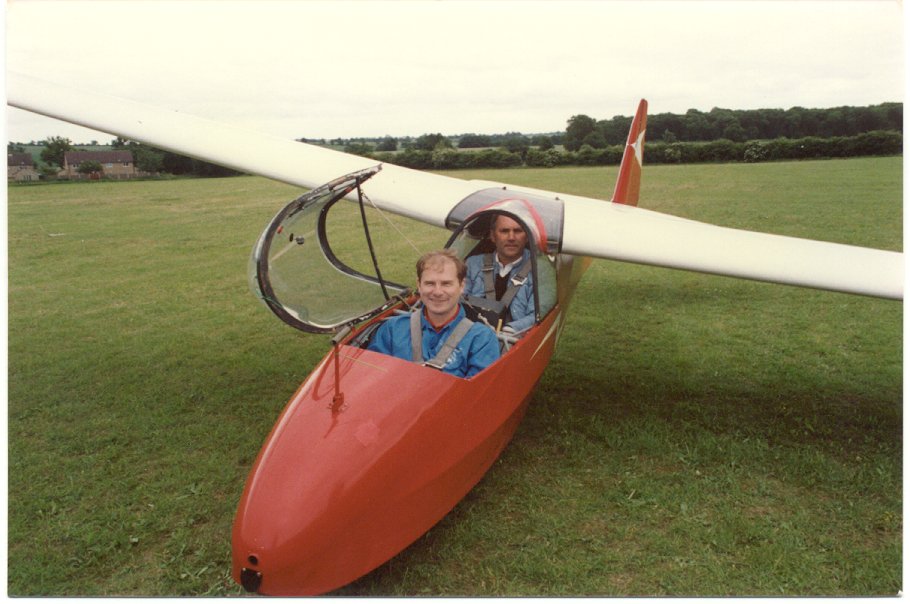
A K-7 two-seat glider.

My first exposure to private flying was on the 7th June, 1981 when, at Rattlesden Gliding Club in Suffolk, I was taken up for two air-experience circuits in a two-seater glider known as a ‘K7’.  I was immediately hooked! Those experience flights leading to a 4-minute flight (flight number 46) on the 6th September, 1981 that has the remark in my pilot’s log book: Solo!  Now fast forward to October, 1984 and my log book shows me attending a gliding instructor’s course at Lasham, resulting in me being issued with a British Gliding Association (BGA) Assistant Instructor Rating on the 14th October. (105/84).

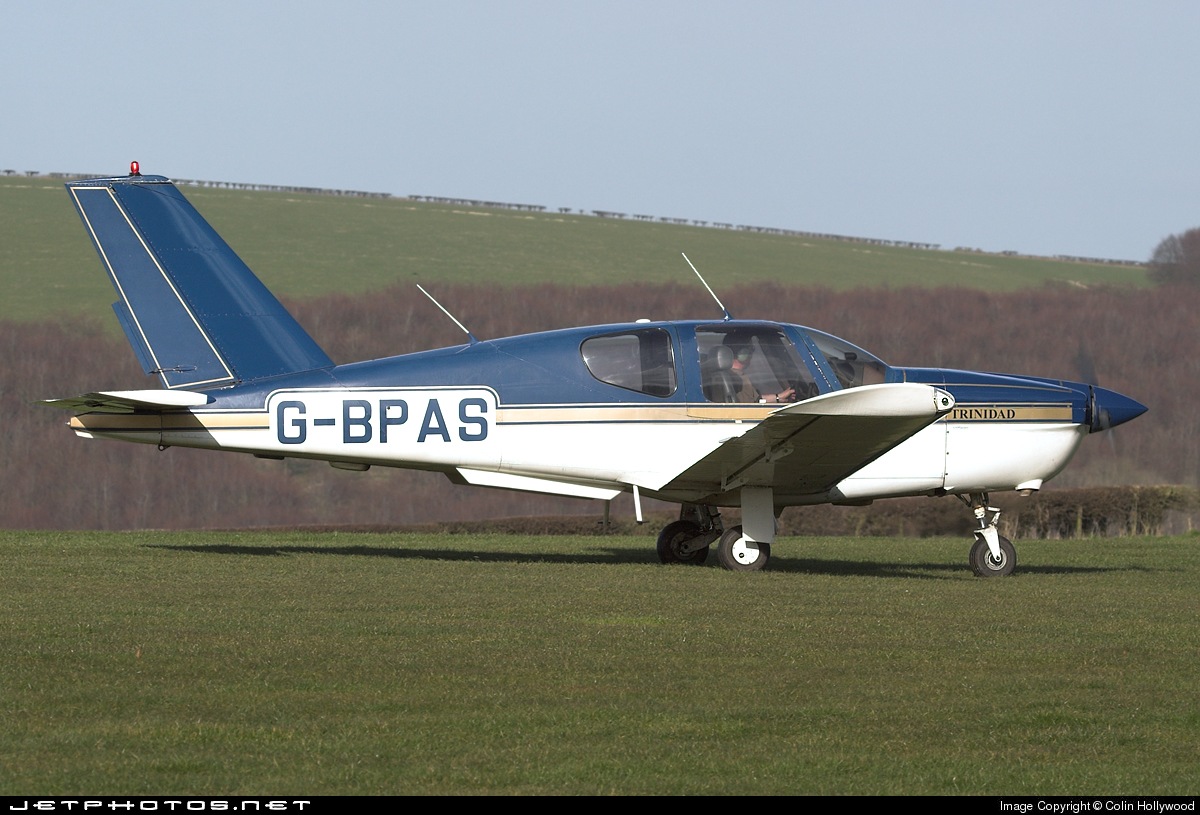
Over on the power side of things, in March, 1984, I started Private Pilot training at the Suffolk Aero Club at Ipswich Airport and gained my PPL on the 9th November, 1984.  Subsequently, gaining my Instrument Rating in July, 1999 when I was then operating from Exeter Airport and flying frequently for business purposes.  For that ‘serious’ flying I used a Socata TB20, a French retractable, single-engined aircraft, based at Exeter.  A very fine, long-distance aircraft.

TB20, G-BPAS, photographed at Compton Abbas airfield (EGHA).

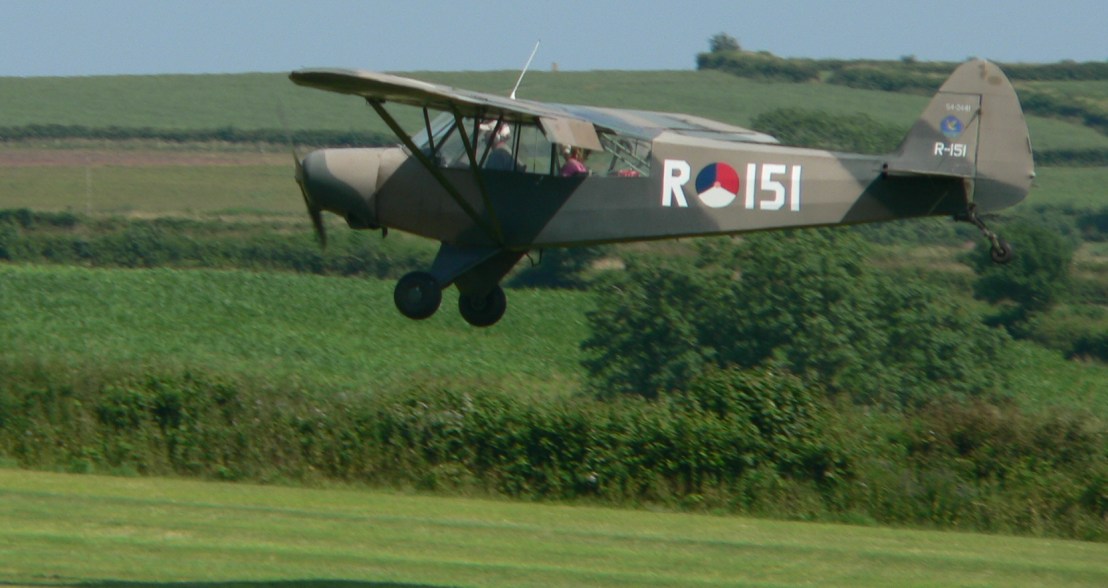
But the aircraft that I had the most fun flying was a dear old Piper Super Cub.  Here’s the background to the aircraft.

Piper Super Cub, L-21B, R-151

A/C Construction No. 18-3841, Frame No. 18-3843

Original Engine, Lycoming 135 Type 0-290-D2, 54/2441

Romeo 151 was one of a batch of 298 L-21’s delivered in 1954. There were 584 L-21B’s produced by Piper for military use, the ‘L’ standing for Liaison. The L-21B’s were PA-18-135’s with civil Lycoming 0-290-D2 engines, glasswork as most L-21A’s and L-18’s and a gross weight of 1760 lbs.

This aircraft was delivered to Koninklijke Luchtmacht, Dutch Air Force, on the 1st July, 1954 and registered R-151. After various homes R-151 transferred to the Dutch civil register as PH-GER, 1st April 1976 with 4,458 hours and shortly thereafter was registered to Vlieclub Hoogeveen, Certificate Number 2380.

On the 27th March, 1981 the aircraft was delivered to the UK with a total time of 5,043 hours and in September, 1981 became G-BIYR; ‘YR’. In April, 1983 YR was the first of type to be given a Public Transport CofA (Certificate of Airworthiness) and was used for training at Tollaton. YR reverted to a Private CofA in January, 1984 when purchased by Mike and Barbara Fairclough. The aircraft had by then accumulated 5,120 hours.

In 1992, YR was re-engined with a Lycoming 150HP, 0320-A2B No. L49809-27A (zero hours). Finally on the 2nd June, 1995 the aircraft was repainted in her original Dutch insignia and given CAA (UK Civil Aviation Authority) permission to use the original call-sign: Romeo 151.

The aircraft was based at and flown from Watchford Farm airstrip in South Devon, England.

Now forgive the nostalgic photographic memories!

Approaching home in South Devon, England
Yours truly approaching Watchford Farm airstrip in South Devon, England
Flying in the French Alps, Mt Blanc in sight
Flying in the French Alps with Mont Blanc in sight
9,300 ft up in the French Alps
9,300 ft up in the French Alps!

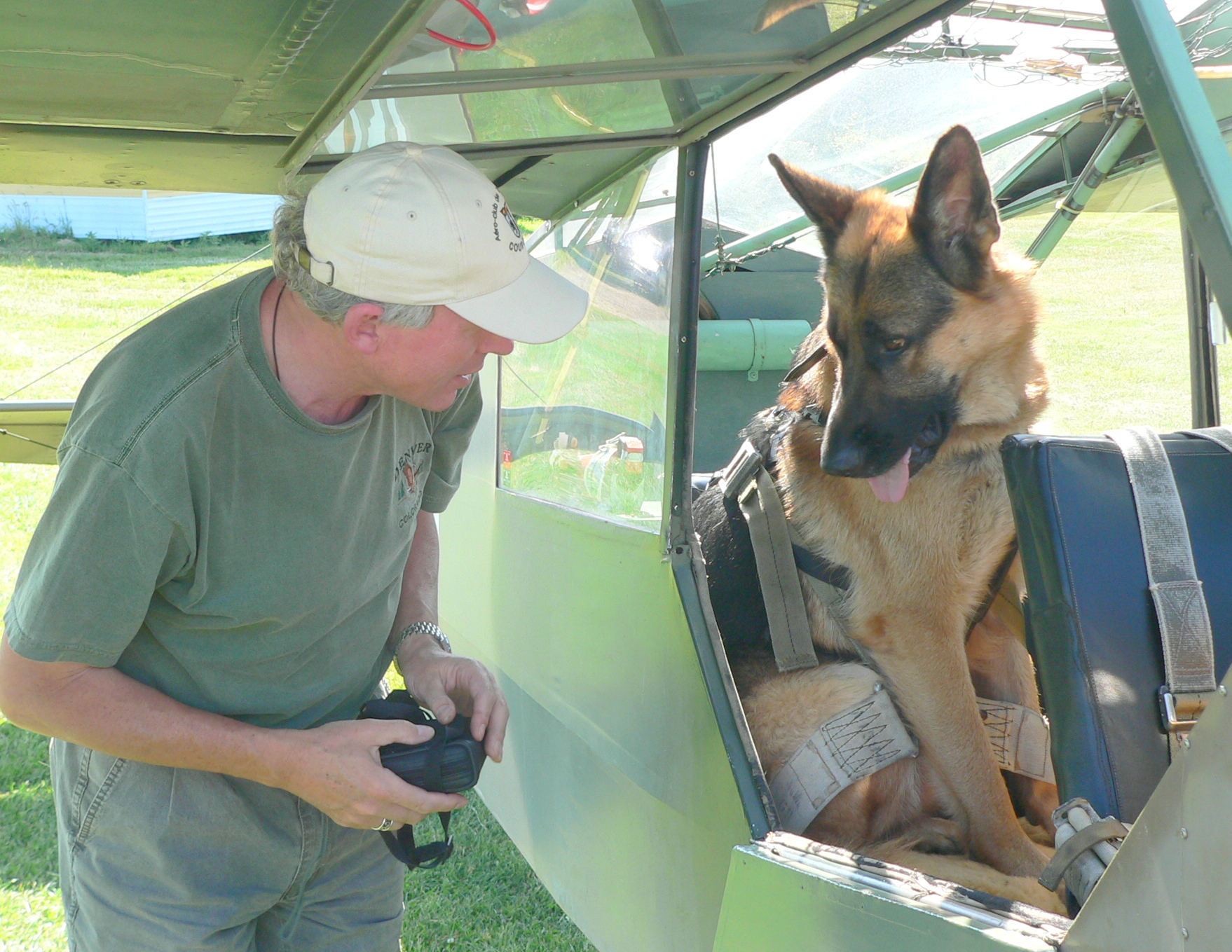
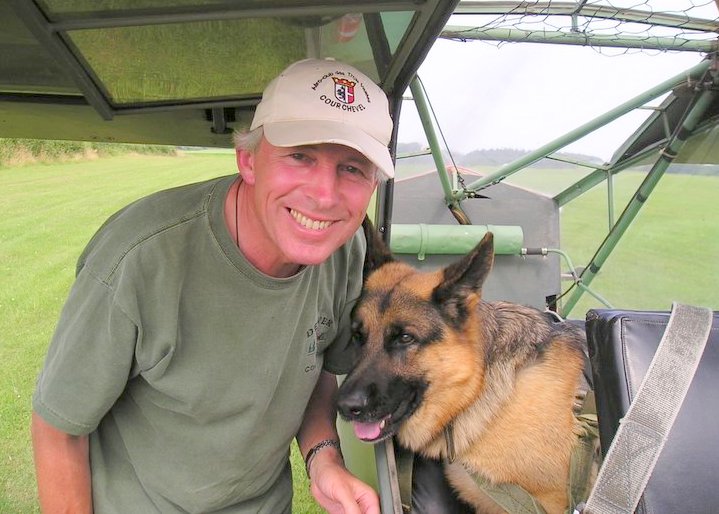
Every time I went to the airfield with Pharaoh he always tried to climb into the cockpit.  So one day, I decided to see if he would sit in the rear seat and be strapped in.  As the next picture shows, there was absolutely no problem with that!

Come on Dad, let's get this thing off the ground!
Come on Dad, let’s get this thing off the ground!

My idea had been to fly a gentle circuit in the aircraft.  First, I did some taxying around Watchford’s large grass airfield to see how Pharaoh reacted.  He was perfectly behaved.

But then I thought long and hard about taking Pharaoh for a flight.  In the Piper Cub there is no autopilot so if Pharaoh struggled or became agitated it would have been almost impossible to fly the aircraft and cope with Pharaoh sitting in the seat behind me.  So, in the end, I abandoned the idea.  The chances are that it would have been fine.  But if something had gone wrong, the outcome just didn’t bear thinking about.

Thus we elected for taxying all around the airfield which, as the next picture shows, met with full doggie approval.  The date was July 2006.

That was fun!
That was fun!

So enough of my recollections for today – tomorrow the Vulcan XH558.

Life is never a rehearsal.

I’ve learned that people will forget what you said, people will forget what you did, but people will never forget how you made them feel.” Maya Angelou

maya-angelou1

In a poignant way, it seems appropriate to feature that quote from Maya Angelou in opening today’s post simply because this wonderful, spiritual woman died earlier on this year; on the 28th May, 2014.

Born in 1928 in St Louis, MO, Maya was, “… an American author, poet, dancer, actress and singer. She published seven autobiographies, three books of essays, and several books of poetry, and was credited with a list of plays, movies, and television shows spanning over 50 years.” (Wikipedia)

In case you are wondering why this post is reflective on life, and the inevitability of death, it is simply because in thirty-minutes time, the last (draft) chapter of ‘the book’ is being published in this place, and I was looking for something to ‘set the tone’, as it were. That last chapter is entitled: And show us the way to embrace death, and the companion to: How the dog offers us a way into our own soul, that was published yesterday.

To be precise, I had in mind two elements in setting the tone. The first being that powerful quotation that is today’s sub-heading and the second being the reposting of a recent item from Val Boyco.

As is the way in this interconnected world of blogging, I hadn’t previously heard of Val Boyco until she signed up to follow my humble scribblings in this place. Naturally, I went across to her blogsite, Find Your Middle Ground, and very quickly signed up to follow her, in return.  That’s how I came to see ‘All Things Change‘; reposted here with Val’s very kind permission.

ooOOoo

All Things Change

ValB

All things arise

Suffer change

And pass away.

This is their nature.

When you know this …

…you become still.

It is easy.

The Ashtavakra Gita

—-

We spend so much time and energy avoiding the way life actually unfolds, and most of the time we are unaware that we are doing this.

We have created these habits over time to avoid facing the uncomfortable feelings that are a part of life.

When we pause and create spaciousness, the resistance begins to dissipate and our inner consciousness grows.

Each time we make space, trust grows.

The more we trust, the more we grow beyond our conditioning and habits and create more space.

With space, life flows freely.

Taking time to connect inwards will not save your life, but may save you from a life of struggle and discontent.

Namaste

ooOOoo

I’m going to close today’s post with a wonderful quote from Sharon Salzberg, taken from her book: Real Happiness: The Power of Meditation. It seems as relevant and as powerful as that opening quote from Maya Angelou.

It is never too late to turn on the light. Your ability to break an unhealthy habit or turn off an old tape doesn’t depend on how long it has been running; a shift in perspective doesn’t depend on how long you’ve held on to the old view.

May we all turn on the lights in ourselves so that we may better leave a light burning in the hearts and minds of others.

For our lives are for real!

The book! Part Five: Honesty.

In one very real sense, a chapter about the quality of honesty in dogs is bizarre. Surely, honesty, and dishonesty, are terms that exclusively describe human tendencies. When the term “dishonest” is used to describe a person, most often we are describing an effort by that person to deceive another. It is a description of someone who intentionally is trying to mislead or misinform us.

But in terms of honesty, or dishonesty, what I am about to say probably applies to all animals; I don’t know. Namely, that if there was one animal on Planet Earth that is incapable of guile or deceit, it has to be the dog. There is no doubt in my mind that dogs remain one of the most beautiful gifts nature has bestowed upon us humans.

Now that last bold statement is not to imply that dogs don’t try to manipulate us humans; far from it. Their attempts at manipulation would impress any three-year-old child! But there’s nothing dishonest about a dog trying to manipulate its owner into giving the dog whatever it wants; they are far too obvious in their motives and methods. As I read somewhere, dogs are: “Just scavengers looking for a way to get something with minimal effort.

Thus I think we can take it as a given that dogs are honest; fundamentally so.

OK, dear reader, you have no way of knowing that after writing that last sentence, I sat staring at the screen for a good ten minutes. I didn’t know how to continue the theme. I couldn’t think of anything to add to what every “good person and true” knows, and has known since time immemorial: honesty is a fundamental aspect of being a good person; the enviable of all titles, as George Washington is reputed to have said.

What was exercising my brain was to come at the subject of honesty in a way that offered a compelling reason for being honest; over and above the natural assumption about honesty, that it is so blindingly obvious not to require being spelt out; in a manner of speaking. It struck me that honesty is very different to the majority of the other qualities that we need to learn from dogs.
Different in the sense that the other qualities are open to being embraced as something that may be learnt, with clear rewards from so doing, whereas honesty seems a fundamental, core way of relating to the world around one. Mind you, there was a tiny voice in my head that was nagging away at me that said that honesty may not be so ‘black and white’. For example, the question of ‘white lies’. But, at heart, I was still lost as to how to proceed.

So, I spent another thirty minutes exploring the web looking for clarity; looking for some inspiration. Yet those web searches just ended up confusing me more. About the least confusing item I came across, more or less at random, was a section from an article read[1] on the website The New Atlantis. The full article was entitled: The truth about human nature.

The section that I read, and is reproduced below, seemed to confirm in my mind that honesty; something that, by rights, should be so fundamentally understood, was anything but simple.

Since Nietzsche, the choice of which version of ourselves we identify with has been widely understood as a choice between lying and truth-telling — to ourselves as much as to others. The moral ideal has become authenticity — a particular kind of honesty. Of course, just about any philosophical ideal is grounded in some sort of honesty: the search for Truth requires truth. Yet Aristotle describes honesty as a virtue only of self-presentation — the balance between self-deprecation and boastfulness. And Plato never lists honesty as a virtue at all, and even distinguishes between “true lies” and useful or noble lies. From the modern to the post-modern era, honesty and authenticity shifted to become much of the telos[2] of life, where before they had been but means in our progress toward that end.

Here was me looking for clarity only to find anything but that!

So what to make of all this?

I am going to fall back on the ideas expressed in the chapter on community. Rather on the closing words of that chapter, “… the power of sharing, of living a local community life, may just possibly be the difference between failure and survival of us humans.

There’s a sense of hope in me that we are heading for an era of new localism that will, in and of itself, reinforce a culture of honesty in one’s life. Why such hope? Because there are signs. Such as this one: the growing concern about factory farming, surfacing as increasingly more vibrant local food movements, demonstrating that people are really scrutinising where their food comes from. More than that! There are increasing concerns as to where our medicines are made and the possible side-effects, and a dawning awareness of how we are living on the backs of exploited third world workers (and poorly paid service workers here at home). Possibly all under a global umbrella of awareness that big government is no longer working as it should be; evidenced by falling voter turnout numbers at key elections in the USA and many other countries.

My hope is that this growing ‘honesty’ about the reality of our present world and where it appears to be heading is at the heart, in my opinion, of an expanding local consciousness permeating the hearts and minds of many people, leading them to want to become more “local.”

Should this come about, and I hope that it does in my lifetime, then an honesty of thought and deed will be, nay, has to be, a core attribute of life in a well-functioning local community.

982 words. Copyright © 2014 Paul Handover

[1] http://www.thenewatlantis.com/publications/the-truth-about-human-nature
[2] As in an end or purpose of life

A breath of common-sense.

George Monbiot perfectly spells it out.

Regular readers of this place will know that it is a rare couple of weeks without a republication of a George Monbiot essay.  His voice seems so often to be a ray of common-sense shining into a dark cave of present-day madness. None more obvious than this essay that was published last Monday under the title of There Is An Alternative.

It’s a huge honour to be able to share this with you, dear readers.

ooOOoo

There Is An Alternative

December 8, 2014

The great political question of our age is what to do about corporate power. It’s time we answered it.
By George Monbiot, published in the Guardian 8th December 2014

Does this sometimes feel like a country under enemy occupation? Do you wonder why the demands of so much of the electorate seldom translate into policy? Why the Labour Party, like other former parties of the left, seems incapable of offering effective opposition to market fundamentalism, let alone proposing coherent alternatives? Do you wonder why those who want a kind and decent and just world, in which both human beings and other living creatures are protected, so often appear to find themselves confronting the entire political establishment?

If so, you have already encountered corporate power. It is the corrupting influence that prevents parties from connecting with the public, distorts spending and tax decisions and limits the scope of democracy. It helps to explain the otherwise inexplicable: the creeping privatisation of health and education, hated by almost all voters; the private finance initiative, which has left public services with unpayable debts(1,2); the replacement of the civil service with companies distinguished only by their incompetence(3); the failure to re-regulate the banks and to collect tax; the war on the natural world; the scrapping of the safeguards that protect us from exploitation; above all the severe limitation of political choice in a nation crying out for alternatives.

There are many ways in which it operates, but perhaps the most obvious is through our unreformed political funding system, which permits big business and multimillionaires effectively to buy political parties. Once a party is obliged to them, it needs little reminder of where its interests lie. Fear and favour rule.

And if they fail? Well, there are other means. Before the last election, a radical firebrand said this about the lobbying industry(4): “It is the next big scandal waiting to happen … an issue that exposes the far-too-cosy relationship between politics, government, business and money. … secret corporate lobbying, like the expenses scandal, goes to the heart of why people are so fed up with politics.” That, of course, was David Cameron, and he’s since ensured that the scandal continues. His lobbying act restricts the activities of charities and trade unions, but imposes no meaningful restraint on corporations(5).

Ministers and civil servants know that if they keep faith with corporations while in office they will be assured of lucrative directorships in retirement. Dave Hartnett, who, as head of the government’s tax collection agency HMRC, oversaw some highly controversial deals with companies like Vodafone and Goldman Sachs(6,7), apparently excusing them from much of the tax they seemed to owe, now works for Deloitte, which advises companies like Vodafone on their tax affairs(8). As head of HMRC he met one Deloitte partner 48 times(9).

Corporations have also been empowered by the globalisation of decision-making. As powers but not representation shift to the global level, multinational business and its lobbyists fill the political gap. When everything has been globalised except our consent, we are vulnerable to decisions made outside the democratic sphere.

The key political question of our age, by which you can judge the intent of all political parties, is what to do about corporate power. This is the question, perennially neglected within both politics and the media, that this week’s series of articles will attempt to address. I think there are some obvious first steps.

A sound political funding system would be based on membership fees. Each party would be able to charge the same fixed fee for annual membership (perhaps £30 or £50). It would receive matching funding from the state as a multiple of its membership receipts. No other sources of income would be permitted. As well as getting the dirty money out of politics, this would force political parties to reconnect with the people, to raise their membership. It will cost less than the money wasted on corporate welfare every day.

All lobbying should be transparent. Any meeting between those who are paid to influence opinion (this could include political commentators like myself) and ministers, advisers or civil servants in government should be recorded, and the transcript made publicly available. The corporate lobby groups that pose as thinktanks should be obliged to reveal who funds them before appearing on the broadcast media(10,11), and if the identity of one of their funders is relevant to the issue they are discussing, it should be mentioned on air.

Any company supplying public services would be subject to freedom of information laws (there would be an exception for matters deemed commercially confidential by the information commissioner). Gagging contracts would be made illegal, in the private as well as the public sector (with the same exemption for commercial confidentiality). Ministers and top officials should be forbidden from taking jobs in the sectors they were charged with regulating.

But we should also think of digging deeper. Is it not time we reviewed the remarkable gift we have granted to companies in the form of limited liability? It socialises the risks which would otherwise be carried by a company’s owners and directors, exempting them from the costs of the debts they incur or the disasters they cause, and encouraging them to engage in the kind of reckless behaviour that caused the financial crisis. Should the wealthy authors of the crisis, like Fred Goodwin or Matt Ridley, not have incurred a financial penalty of their own?

We should look at how we might democratise the undemocratic institutions of global governance, as I outlined in my book The Age of Consent(12). This could involve the dismantling of the World Bank and the IMF, which are governed without a semblance of democracy, and cause more crises than they solve, and their replacement with a body rather like the international clearing union designed by John Maynard Keynes in the 1940s, whose purpose was to prevent excessive trade surpluses and deficits from forming, and therefore international debt from accumulating.

Instead of treaties brokered in opaque meetings between diplomats and transnational capital (of the kind now working towards a Transatlantic Trade and Investment partnership), which threaten democracy, the sovereignty of parliaments and the principle of equality before the law, we should demand a set of global fair trade rules, to which multinational companies would be subject, losing their licence to trade if they break them. Above all perhaps, we need a directly elected world parliament, whose purpose would be to hold other global bodies to account. In other words, instead of only responding to an agenda set by corporations, we must propose an agenda of our own.

This is not only about politicians, it is also about us. Corporate power has shut down our imagination, persuading us that there is no alternative to market fundamentalism, and that “market” is a reasonable description of a state-endorsed corporate oligarchy. We have been persuaded that we have power only as consumers, that citizenship is an anachronism, that changing the world is either impossible or best effected by buying a different brand of biscuits.

Corporate power now lives within us. Confronting it means shaking off the manacles it has imposed on our minds.

www.monbiot.com

References:

1. http://www.dropnhsdebt.org.uk/

2. http://www.monbiot.com/2010/11/22/the-uks-odious-debts/

3. http://www.monbiot.com/2014/05/05/land-of-impunity-2/

4. https://tompride.wordpress.com/2014/10/13/lobbying-camerons-deleted-speech-and-his-jaw-dropping-hypocrisy/

5. http://www.lobbyingtransparency.org/

6. http://www.theguardian.com/commentisfree/2010/oct/22/vodafone-tax-case-leaves-sour-taste

7. http://www.theguardian.com/business/2011/oct/11/goldman-sachs-interest-tax-avoidance

8. http://www.theguardian.com/business/2013/may/27/deloitte-appoints-dave-hartnett-tax

9. http://www.theguardian.com/business/2013/may/27/deloitte-appoints-dave-hartnett-tax

10. http://www.monbiot.com/2013/11/29/hidden-interests/

11. http://www.monbiot.com/2011/10/17/show-me-the-money/

12. http://www.monbiot.com/books/the-age-of-consent/

A ‘growing’ awareness.

The pun is deliberate!

Just at the moment there seems to be an incredible explosion of awareness about the need to change. Won’t say anymore other than from the day of the Winter Solstice, less that two weeks away, I will be publishing a number of posts about this new awareness and the implications, the positive implications, for the coming years.

To set the tone, I am republishing an article that appeared on the website of the organisation Nature Needs Half. I am grateful for their permission to so do.

ooOOoo

Nature Needs Half in the Earth Island Journal

Originally published in the Earth Island Journal by William H. Funk

Conservation group promoting an ambitious new proposal for wilderness protection

During the last half century conservationists around the world have won some impressive victories to protect wild places. Here in the US, the Wilderness Act preserves some 110 million acres of public land. Private holdings by groups like The Nature Conservancy safeguard tens of millions of additional acres. The idea of protecting ecosystems from industrial development has spread around the world. There’s the Mavuradonha Wilderness in Zimbabwe, the El Carmen ecosystem in northern Mexico, Kissama National Park in Angola, and the Tasmanian Wilderness in Australia, to name just a few stunning parks and preserves; UNESCO’s world heritage list includes 197 sites of special beauty and/or biodiversity.

Photo by Trey Ratcliff Nature Needs Half has set out an unbelievable challenge: to formally, legally set aside one half of Earth’s land and water as interconnected natural areas.

But conservation biologists now recognize that these sanctuaries are limited in what they can accomplish precisely because they are special — which is to say, rare. Parks and preserves are all too often islands of biological integrity in a sea of human development. To really protect natural systems, healthy biomes need to be the rule, not the exception.

To achieve that vision, The WILD Foundation, a multinational NGO based in Boulder, Colorado, is pushing a bold concept called “Nature Needs Half.” In a world in which even the wealthiest governments routinely abdicate their responsibilities toward future generations and the environment, Nature Needs Half has set out an unbelievable challenge: to formally, legally set aside one half of Earth’s land and water as interconnected natural areas.

This is, of course, a hugely ambitious endeavor, opposing as it does the assumption that Earth’s resources are here to be exploited solely by humans. We live in what some have called the “Anthropocene,” the Age of Man, a world in which every aspect of physical being, from the oceanic depths to the troposphere, has been radically altered by humankind. Rivers are being dammed, forests leveled, oceans emptied and wildlife eradicated. It’s not a pretty picture, but as an empiric truth it’s difficult to refute. Consider a few facts:

The long-term acidification of the oceans by our ongoing buildup of industrial carbon dioxide is killing off coral reefs around the world, resulting in the loss of a critical barrier to storm surge and further endangering coastal areas at heightened risk from rising seas and stronger and more frequent storms.

Hydropower is increasingly being developed in South America, South Asia and sub-Saharan Africa, preventing the migration of anadromous fishes and destroying the elaborate flood-regime ecosystems of biomes like the Amazon.

The accelerating rate of animal and plants extinctions under the twin hammers of climate change and habitat loss is being compared to Earth’s five other extinction events that followed catastrophic geophysical change such as meteor impact or sudden tectonic shifts. In the case of the sixth great extinction, however, the root cause is purely biotic: us. Either from directly causing species decline through poaching, habitat conversion and the introduction of competitive exotic species, or by indirectly altering ecosystems through our industrial assault on the planet’s atmosphere, one in eight birds, one in four mammals, one in five invertebrates, one in three amphibians, and half of the world’s turtles are facing the eternal night of extinction.

Given those facts, the Nature Needs Half goal is startling in the grandiosity of its vision and the ambitious range of its projects. It is also, in a word, fair. “Half the world for humanity, half for the rest of life, to make a planet both self-sustaining and pleasant,” is how eminent naturalist E.O. Wilson explains the idea in his book The Future of Life. Other endorsers include marine explorer Sylvia Earle and the Zoological Society of London. And while the scope and scale of Nature Needs Half is unprecedented, conservation groups such as the World Wildlife Fund recognize that connecting biodiverse “hotspots” must guide preservation efforts.

The stated goal of Nature Needs Half is “to ensure that enough wild areas of land and water are protected and interconnected (usually at least about half of any given ecoregion) to maintain nature’s life-supporting systems and the diversity of life on Earth, to ensure human health and prosperity, and to secure a bountiful, beautiful legacy of resilient, wild nature.” Underlying this objective is the assumption that humanity, despite its often destructively “unnatural” behavior, is inescapably a part of life on Earth, and that efforts to preserve and protect untrammeled wilderness areas are ultimately means of assuring that the ecosystem services people depend upon are available to us in the distant future. We’re all in this together, and the sooner H. sapiens gets that through its pointy little head, the better off we’ll all be.

How is “protected” defined? The International Union for the Conservation of Nature defines it quite flexibly: “A protected area is a clearly defined geographical space, recognized, dedicated and managed, through legal or other effective means, to achieve the long term conservation of nature with associated ecosystem services and cultural values.” Thus any number of means may be put into play to preserve land, from conservation easements in Virginia to armed ranger patrols in Namibia; what matters is the end result, namely the retention of naturally functioning ecosystems over time.

During the past two decades scientists have determined that the planet’s ecoregions need at least 50 percent ecological integrity, and in some cases more, to ensure the survival of their biological productivity over the long term. (In plain language, “ecological integrity” means that an area’s biodiversity and basic processes are mostly intact.) The goals of Nature Needs Half simply echo the empirical scientific reality: to function over time the world’s biomes need at least half of their structural integrity preserved from human alteration. We are currently falling short of that. A recent report from Yale’s Environmental Performance Index states that just17 percent of Earth’s terrestrial areas and inland waters, and less than 10 percent of marine areas, are currently protected (though for many parks and refuges in poorer countries this protection is often illusory), while about 43 percent remains relatively open and undeveloped, with low human populations and generally undamaged ecosystems.

Nature Needs Half is pursuing its aim in two simultaneous directions: the protection of at least half of the planet’s mostly intact contiguous wilderness areas — concentrating on Eurasian boreal forests, the Amazon basin and Antarctica — and the identification and protection of those fragments or hotspots of abundant biodiversity that have become isolated islands in a sea of human activity.

The aims of Nature Needs Half are precisely the kind of bold approach, rooted in cutting-edge science, which our increasingly desperate times call for. In an Anthropocene of radical climate change and accelerating species extinctions, nothing less than a grand vision of what might yet be achieved will bring about the preservation of our remaining unspoiled landscapes. As the most farsighted wilderness preservation program on Earth, Nature Needs Half promises to be the kind of revolutionary undertaking that, if its aims are fully or even mostly achieved, will be looked back on centuries from now as perhaps the most important attainment in modern human history.

William H. Funk
William H. Funk is a freelance writer, documentary filmmaker and environmental lawyer living in Virginia’s Shenandoah Valley. His work explores the confluences of the natural world, history, culture, law and politics, and as an attorney he has had broad experience with land preservation and endangered species. He may be contacted at williamfunk3@icloud.com or williamhfunk.weebly.com

ooOOoo

Rather puts my next book chapter, Community, into perspective; that chapter being published in thirty minutes time.

Breaking the silence

The second essay this week from George Monbiot

Part of me feels that I am being sucked in to too much ‘doom and gloom’ with the republication of this recent essay from George Monbiot.  I guess it’s a fine balance between spreading the word about the reality of life, in this case in the United Kingdom, or living in sweet innocence of the current state of affairs of ‘man’. But I found George Monbiot’s essay so shocking, in terms of the terrible inequality in British life, that it really did deserve the widest promulgation.

All I can offer in mitigation is that in thirty minutes time, I publish the next chapter of my book: How humans view dogs However, because this chapter is nothing more than setting the scene for the main chapters in Part Five, thirty minutes later comes leading chapter, specifically on Love, under the overall theme of Part Five: What we need to learn.

Your feedback, as always, would be wonderful.

ooOOoo

Breaking the Silence

December 2, 2014

It’s time to bring the Highland Spring south, and, like Scotland, introduce democracy to this quasi-feudal nation.

By George Monbiot, published in the Guardian 3rd December 2014

Bring out the violins. The land reform programme announced by the Scottish government is the end of civilised life on earth, if you believe the corporate press. In a country where 432 people own half the private rural land(1), all change is Stalinism. The Telegraph has published a string of dire warnings, insisting, for example, that deer stalking and grouse shooting could come to an end if business rates are introduced for sporting estates(2). Moved to tears yet?

Yes, sporting estates – where the richest people in Britain, or oil sheikhs and oligarchs from elsewhere, shoot grouse and stags – are exempt from business rates: a present from John Major’s government in 1994(3). David Cameron has been just as generous with our money: as he cuts essential services for the poor, he has almost doubled the public subsidy for English grouse moors(4), and frozen the price of shotgun licences(5), at a public cost of £17m a year.

But this is small change. Let’s talk about the real money. The Westminster government claims to champion an entrepreneurial society, of wealth creators and hard-working families, but the real rewards and incentives are for rent. The power and majesty of the state protects the patrimonial class. A looped and windowed democratic cloak barely covers the corrupt old body of the nation. Here peaceful protestors can still be arrested under the 1361 Justices of the Peace Act. Here, the Royal Mines Act 1424 gives the Crown the right to all the gold and silver in Scotland(6). Here the Remembrancer of the City of London sits behind the Speaker’s chair in the House of Commons(7), to protect the entitlements of a Corporation that pre-dates the Norman conquest. This is an essentially feudal nation.

It’s no coincidence that the two most regressive forms of taxation in the UK – council tax banding and the payment of farm subsidies – both favour major owners of property. The capping of council tax bands ensures that the owners of £100 million flats in London pay less than the owners of £200,000 houses in Blackburn(8,9). Farm subsidies, which remain limitless as a result of the Westminster government’s lobbying(10), ensure that every household in Britain hands £245 a year to the richest people in the land(11). The single farm payment system – under which landowners are paid by the hectare – is a reinstatement of a mediaeval levy called feudal aid(12): a tax the vassals had to pay to their lords.

If this is the government of enterprise, not rent, ask yourself why capital gains tax (at 28%) is lower than the top rate of income tax. Ask yourself why principal residences, though their value may rise by millions, are altogether exempt(13). Ask yourself why rural landowners are typically excused capital gains tax, inheritance tax and the first five years of income tax(14). The enterprise society? It’s a con, designed to create an illusion of social mobility.

The Scottish programme for government(15) is the first serious attempt to address the nature of landholding in Britain since David Lloyd George’s budget of 1909. Some of its aims hardly sound radical until you understand the context. For example it will seek to discover who owns the land. Big deal. Yes, in fact, it is. At the moment the owners of only 26% of the land in Scotland have been identified(16).

Walk into any mairie in France or ayuntamiento in Spain and you will be shown the cadastral registers on request, on which all the land and its owners are named. When The Land magazine tried to do the same in Britain(17), it found that there was a full cadastral map available at the local library, which could be photocopied for 70p. But it was made in 1840. Even with expert help, it took the magazine several weeks of fighting official obstruction and obfuscation and cost nearly £1000(18) to find out who owns the 1.4 km2 around its offices in Dorset. It discovered that the old registers had been closed and removed from public view, at the behest of a landed class that wishes to remain as exempt from public scrutiny as it is from taxes. (The landowners are rather more forthcoming when applying for subsidies from the rural payments agency, which possesses a full, though unobtainable, register of their agricultural holdings). What sort of nation is this, in which you cannot discover who owns the ground beneath your feet?

The Scottish government will consider breaking up large land holdings when they impede the prospects of local people(19). It will provide further help to communities to buy the land that surrounds them. Compare its promise of “a fairer, wider and more equitable distribution of land” to the Westminster government’s vision of “greater competitiveness, including by consolidation”(20): which means a continued increase in the size of land holdings. The number of holdings in England is now falling by 2% a year(21), which is possibly the fastest concentration of ownership since the acts of enclosure.

Consider Scotland’s determination to open up the question of property taxes, which might lead to the only system that is fair and comprehensive: land value taxation(22). Compare it to the fleabite of a mansion tax proposed by Ed Miliband, which, though it recoups only a tiny percentage of the unearned income of the richest owners, has so outraged the proprietorial class that some of them (yes Griff Rhys Jones, I’m thinking of you(23)) have threatened to leave the country. Good riddance.

The Scottish government might address the speculative chaos which mangles the countryside while failing to build the houses people need. It might challenge a system in which terrible homes are built at great expense, partly because the price of land has risen from 2% of the cost of a house in the 1930s to 70% today(24). It might take land into public ownership to ensure that new developments are built by and for those who will live there, rather than for the benefit of volume housebuilders. It might prevent mountains from being burnt and overgrazed(25) by a landowning class that cares only about the numbers of deer and grouse it can bag and the bragging rights this earns in London clubs. As Scotland, where feudalism was not legally abolished until 2000(26), becomes a progressive, modern nation, it leaves England stuck in the pre-democratic past.

Scotland is rudely interrupting the constructed silences that stifle political thought in the United Kingdom. This is why the oligarchs who own the media hate everything that is happening there: their interests are being exposed in a way that is currently impossible south of the border.

For centuries, Britain has been a welfare state for patrimonial capital. It’s time we broke it open, and broke the culture of deference that keeps us in our place. Let’s bring the Highland Spring south, and start discussing some dangerous subjects.

http://www.monbiot.com

References:

1. http://bit.ly/1vi0kuK

2. http://www.telegraph.co.uk/news/uknews/scotland/11262856/Future-bleak-for-grouse-shooting-and-deer-stalking.html

3. http://www.andywightman.com/?p=3975

4. Defra has tried to pass this off as payments for “moorland farmers”, but all owners of grazed or managed moorlands, of which grouse moors are a major component, are eligible. https://www.gov.uk/government/news/cap-boost-for-moorland

5. http://www.theguardian.com/uk-news/2014/apr/22/cameron-blasted-battle-shotgun-licence-fees

6. The Land Reform Review Group, 2014. The Land of Scotland and the Common Good.
http://www.scotland.gov.uk/About/Review/land-reform/events/FinalReport23May2014

7. http://www.monbiot.com/2011/10/31/wealth-destroyers/

8. http://www.theguardian.com/commentisfree/2014/mar/29/why-do-we-pay-more-council-tax-than-knightsbridge-oligarchs

9. This assumes that a house in Blackburn valued at £69,000 in 1991 would cost around £200,000 today. http://www.blackburn.gov.uk/Pages/Council-tax-charges.aspx

10. http://www.monbiot.com/2014/03/03/the-benefits-claimants-the-goverment-loves/

11. Defra, 31st August 2011, by email.

12. http://en.wikipedia.org/wiki/Feudal_aid

13. http://www.theguardian.com/business/2014/sep/22/charge-capital-gains-tax-main-residencies-says-housing-expert

14. http://www.ft.com/cms/s/2/99ae5756-1d89-11df-a893-00144feab49a.html#ixzz3Kexs2dL2

15. http://www.scotland.gov.uk/Publications/2014/11/6336

16. http://www.andywightman.com/?p=3816

17. http://www.thelandmagazine.org.uk/issue/land-issue-14-summer-2013

18. http://www.thelandmagazine.org.uk/issue/land-issue-14-summer-2013

19. http://www.scotland.gov.uk/Publications/2014/11/6336

20. http://archive.defra.gov.uk/foodfarm/policy/capreform/documents/110128-uk-cap-response.pdf

21. Compare the figures, Agriculture in the United Kingdom 2013: http://bit.ly/1vLQSi4
to the figures in the 2011 version: https://www.gov.uk/government/statistics/agriculture-in-the-united-kingdom-2011

22. http://www.theguardian.com/commentisfree/2013/jan/21/i-agree-with-churchill-shirkers-tax

23. http://www.theguardian.com/commentisfree/2014/nov/04/griff-rhys-jones-mansion-tax-soft-option

24. The Land Reform Review Group, 2014. The Land of Scotland and the Common Good. http://www.scotland.gov.uk/About/Review/land-reform/events/FinalReport23May2014

25. http://www.theguardian.com/commentisfree/2014/may/19/vote-yes-rid-scotland-of-feudal-landowners-highlands

26. http://www.scotland.gov.uk/Topics/Justice/law/17975/Abolition

The God of Growth.

A grim reminder of these mad times.

I am conscious that in thirty minutes, my latest draft chapter of the book of the same name as this blog is published. Published under the heading of Faith in goodness.

It seems entirely at odds with the theme of today’s post, the reposting of a recent essay from George Monbiot.  But in a sense the two posts are compatible. Because what George Monbiot writes about, so elegantly in my opinion, is a window into the lives of those in power, politics, and in money.  Whereas, down at street level, so to speak, down where ordinary people lead ordinary lives, one finds a huge gap between the ambitions of the ‘top table’ and decent, everyday folk who are basically good people.

So with that in mind, on to George Monbiot’s essay of the 18th November, published in this place with his kind permission.

ooOOoo

The Insatiable God

The blind pursuit of economic growth stokes a cycle of financial crisis, and wrecks our world.
By George Monbiot, published in the Guardian 19th November 2014

Another crash is coming. We all know it, now even David Cameron acknowledges it (1). The only questions are what the immediate catalyst will be, and when it begins.

You can take your pick. The Financial Times reports today that China now resembles the US in 2007 (2). Domestic bank loans have risen 40% since 2008, while “the ability to repay that debt has deteriorated dramatically”. Property prices are falling and the companies that run China’s shadow banking system provide “virtually no disclosure” of their liabilities. Just two days ago, the G20 leaders announced that growth in China “is robust and is becoming more sustainable” (3). You can judge the value of their assurances for yourself.

Housing bubbles in several countries, including Britain, could pop at any time. A report in September revealed that total world debt (public and private) has reached 212% of GDP (4). In 2008, when it helped to cause the last crash, it stood at 174%. The Telegraph notes that this threatens to cause “renewed financial crisis … and eventual mass default.” (5) Shadow banking has gone beserk, stocks appear to be wildly overvalued, the Eurozone is bust again. Which will blow first?

Or perhaps it’s inaccurate to describe this as another crash. Perhaps it’s a continuation of the last one, the latest phase in a permanent cycle of crisis, exacerbated by the measures (credit bubbles, deregulation, the curtailment of state spending) which were supposed to deliver uninterrupted growth. The system the world’s governments have sought to stabilise is inherently unstable, built on debt, fuelled by speculation, run by sharks.

If it goes down soon, as Cameron fears, in a world of empty coffers and hobbled public services, it will precipitate an ideological crisis graver than the blow to Keynesianism in 1970s. The problem that then arises – and which explains the longevity of the discredited ideology that caused the last crash – is that there is no alternative policy, accepted by mainstream political parties, with which to replace it. They will keep making the same mistakes while expecting a different outcome.

To try to stabilise this system, governments behave like soldiers billeted in an ancient manor, who burn the furniture, the panelling, the paintings and the stairs to keep themselves warm for a night. They are breaking up the post-war settlement, our public health services and social safety nets, above all the living world, to produce ephemeral spurts of growth. Magnificent habitats, the benign and fragile climate in which we have prospered, species that have lived on earth for millions of years, all are being stacked onto the fire, their protection characterised as an impediment to growth.

David Cameron boasted on Monday that he will revive the economy by “scrapping red tape” (6). This “red tape” consists in many cases of the safeguards defending both people and places from predatory corporations. Today, the Small Business, Enterprise and Employment Bill is passing through the House of Commons (7), spinelessly supported, as ever, by Labour. The bill seeks to pull down our protective rules to “reduce costs for business”, even if that means increasing costs for everyone else, while threatening our health and happiness. But why? As the government boasted last week, the UK already has “the least restrictive product market regulation and the most supportive regulatory and institutional environment for business across the G20.” (8) And it still doesn’t work. So let’s burn what remains.

This bonfire of regulation is accompanied by a reckless abandonment of democratic principles, not least of equality before the law. In the House of Commons on Monday, Cameron spoke for the first time about the Transatlantic Trade and Investment Partnership (9). If this treaty between the EU and the US goes ahead, it will grant corporations a separate legal system to which no one else has access, through which they can sue governments passing laws that might affect their profits. Cameron insisted that “it does not in any way have to affect our national health service” (10). (Note those words “have to”.) Pressed to explain this, he cited the former EU trade commissioner, who claimed that “public services are always exempted” (11).

But I have read the EU’s negotiating mandate(12), and it contains no such exemption, just plenty of waffle and ambiguity on this issue. When the Scottish government asked Cameron’s officials for an “unequivocal assurance” that the NHS would not be exposed to such litigation, they refused to provide it(13). This treaty could rip our public services to shreds for the sake of a short and (studies suggest (14,15)) insignificant fizzle of economic growth.

Is it not time to think again? To stop sacrificing our working lives, our prospects, our surroundings to an insatiable god (16)? To consider a different economic model, which does not demand endless pain while generating repeated crises?

Amazingly, this consideration begins on Thursday. For the first time in 170 years, parliament will debate one aspect of the problem: the creation of money (17). Few people know that 97% of our money supply is created not by the government (or the central bank), but by commercial banks in the form of the loans they issue (18). At no point was a democratic decision made to allow banks to do this. So why do we let it happen? This, as Martin Wolf has explained in the Financial Times (19), “is the source of much of the instability of our economies”. The parliamentary debate won’t stop the practice, but it represents the opening of a long-neglected question.

This, though, is just the beginning. Is it not also time for a government commission on post-growth economics? Drawing on the work of thinkers like Herman Daly, Tim Jackson, Peter Victor, Kate Raworth, Rob Dietz and Dan O’Neill, it would investigate the possibility of moving towards a steady state economy: one that seeks distribution rather than blind expansion; that does not demand infinite growth on a finite planet. It would ask the question that never gets asked: why?

Why are we wrecking the natural world and public services to generate growth when that growth is not delivering contentment, security or even, for most of us, greater prosperity? Why have we enthroned growth, regardless of its utility, above all over outcomes? Why, despite failures so great and so frequent, have we not changed the model? When the next crash comes, these questions will be inescapable.

http://www.monbiot.com

References:

1. http://www.theguardian.com/commentisfree/2014/nov/16/red-lights-global-economy-david-cameron

2. http://www.ft.com/cms/s/0/e13e2cf8-6e48-11e4-bffb-00144feabdc0.html#ixzz3JP5QF3et

3. G20, November 2014. Brisbane Action Plan. http://bit.ly/1xk6mLR

4. Luigi Buttiglione et al, September 2014. Deleveraging? What Deleveraging? Geneva Reports on the World Economy 16. http://www.voxeu.org/content/deleveraging-what-deleveraging-16th-geneva-report-world-economy

5. http://www.telegraph.co.uk/finance/economics/11129108/Mass-default-looms-as-world-sinks-beneath-a-sea-of-debt.html

6. http://www.theguardian.com/commentisfree/2014/nov/16/red-lights-global-economy-david-cameron

7. http://services.parliament.uk/bills/2014-15/smallbusinessenterpriseandemployment.html

8. G20, November 2014. Comprehensive Growth Strategy – United Kingdom. http://bit.ly/1yPuIv7

9. http://www.theguardian.com/commentisfree/2014/nov/04/british-government-leading-gunpowder-plot-democracy-eu-us-trade

10. http://www.publications.parliament.uk/pa/cm201415/cmhansrd/cm141117/debtext/141117-0001.htm#14111713000002

11. http://www.bbc.co.uk/news/health-29181332

12. http://bit.ly/1xYr3L6

13. http://www.scotsman.com/news/uk/scottish-government-demands-nhs-ttip-guarantees-1-3589393

14. http://www.theguardian.com/commentisfree/2013/jul/15/us-trade-deal-with-europe-hype

15. http://www.newscientist.com/article/mg22429932.800-ttip-beware-the-treatys-empty-economic-promises.html

16. http://pollystreaming.com/South-Park-Season-13-Episode-3-Margaritaville_v5905

17. http://www.positivemoney.org/2014/11/uk-parliament-debate-money-creation-first-time-170-years/

18. https://www.positivemoney.org/wp-content/uploads/2014/11/Backbench-Briefing-Note.pdf

19. http://www.ft.com/cms/s/0/7f000b18-ca44-11e3-bb92-00144feabdc0.html#ixzz2zsutuZis

Removing the fear of the unknown

This was a post from Jon Lavin back in 2011.

I thought it would be nice to republish it today.

oooo

Removing the fear of the unknown

Seeing the light

I’ve been working with most of my clients recently through painful transformations brought about by the economic downturn.

An interesting metaphor really because since the first wave of uncertainty triggered panic, first noticed in the UK banking system, I have been picking up on that uncertainty that feels like it’s stalking the globe and has been for some time. Recent stock market crashes have simply exacerbated this and that, coupled with the riots taking place in major cities in the UK, make for pretty disturbing reading.

Interestingly, I, too, have been aware of an underlying fear that was difficult either to name or source.

It has been rather like a deep river in that whilst the surface feels slow-moving, currents are moving things powerfully below.

So this ‘fear’ has caused a few household changes.

1) We now are the proud owners of 12 chickens. Our youngest son and I have dug up the back lawn and planted vegetables and built a poly tunnel.

2) We have also installed a wood burning cooker. Right back down to the base of Maslow’s triangle really!

Maslow’s triangle of needs

These feelings have brought about such change everywhere and I wonder seriously whether we will ever return to what was; indeed would we want to?

I might not have mentioned it in previous blogs but as well as an engineering background, in latter years, I have focused on how success in business is linked directly to aspects of relationships and how we are in our relationships with others, so things like integrity, self-awareness and the ability to see the point of view of others, and modify our approach appropriately.

To inform this, some 7 years ago, I embarked on an MA in Core Process Psychotherapy, primarily to work on myself so that I could be the best I could be in my relationships, in and out of work.

The point I’m trying to make is that the same panic I notice in many of the companies I work in, and in me, is based on fear of the unknown and on a lack of trust in all its forms.  I’ve deliberately underlined that last phrase because it is so incredibly important.

The truth is that we get more of what we focus on.

So we can choose to focus on the constant news of more difficulties, hardship and redundancies, or we can focus on what is working.

In the workplace this positive focus has been pulling people together across functions and sites and pooling resources and ideas.

When we realise we’re not doing this alone it’s amazing how much lighter a load can feel and how much more inspired we all feel.

I also notice how humour begins to flow and what a powerful antidote for doom and gloom that is.

Transformation is never easy but the rewards far exceed the effort put in ten fold.

So what is it going to be? Are we all going to bow down to the god of Doom & Gloom, fear and anxiety, heaping more and more gifts around it, or are we going to start noticing and focusing on the other neglected god – that of relationship, joy, trust, abundance and lightness?

Whatever the future holds for us all a belief in our inherent ability to adapt and change and focus on the greater good rather than fear, anxiety, greed and selfishness is the only sustainable way forward.

By Jon Lavin