The way a dog focuses on the immediate task holds a very important lesson for us.
It’s a safe bet to claim that any dog owner has, from time to time, envied the way a dog so perfectly lives in the present. Then let’s not even go to the comparison between dogs and humans when it comes to relaxing!
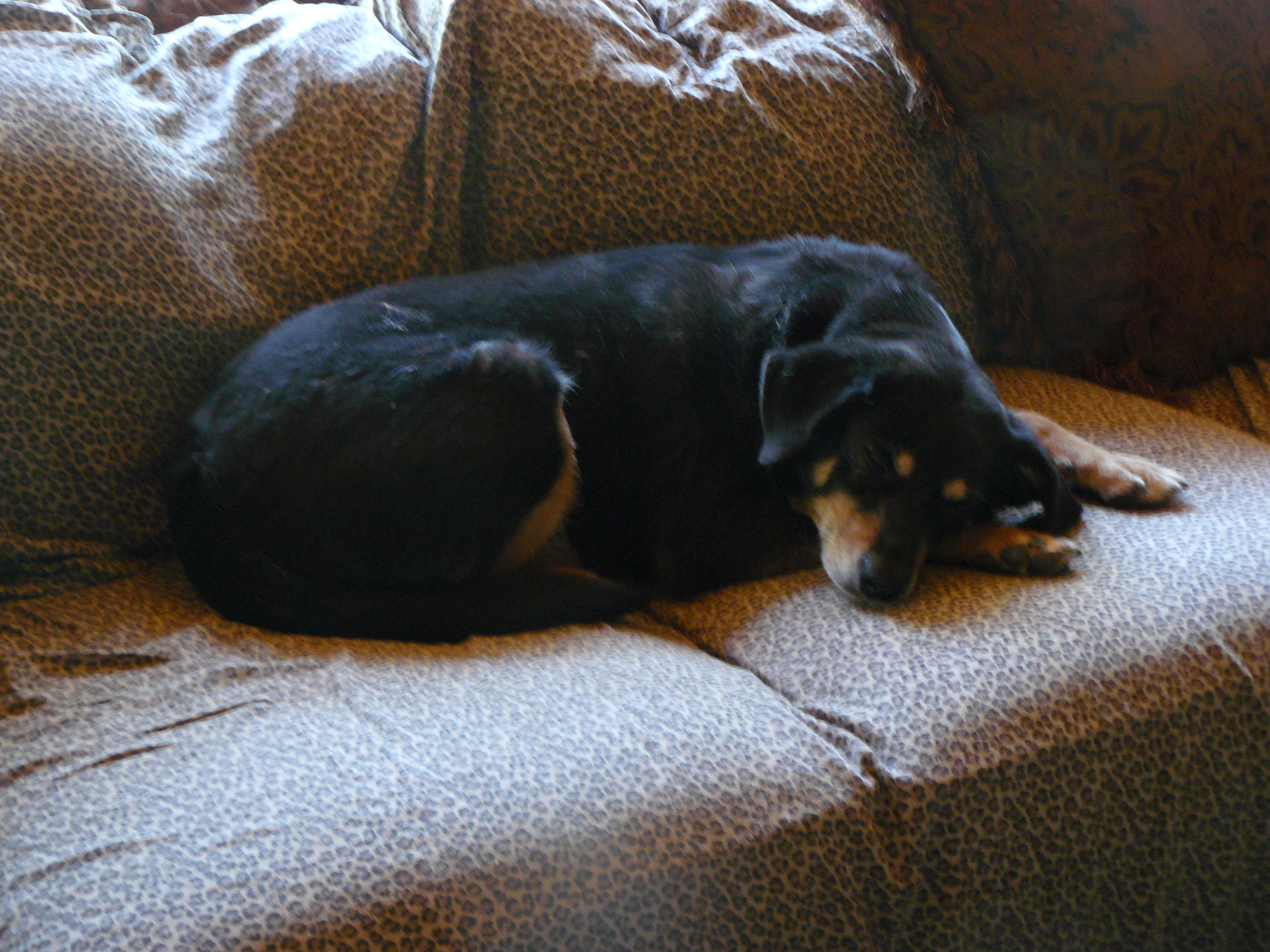
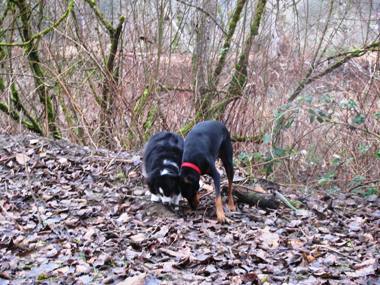
Hazel taking a mid-morning break on Tuesday.
These opening thoughts were prompted by a recent article that was published on The Conversation. The article criticised, rightly in my opinion, the madness (my word) of how many of us live these days, and with particular respect to ‘multi-tasking’. It’s a sobering reminder of the value of letting go and is republished here within the terms of essays published on The Conversation.
ooOOoo
The value of unplugging in the Age of Distraction
July 7, 2015 4.59am EDT
Author: John Rennie Short – Professor, School of Public Policy at University of Maryland, Baltimore County.
Small device, but very demanding. aciej_ie/flickr, CC BY-NC-ND
A common experience: you are walking down the street and someone is walking in the opposite direction toward you. You see him but he does not see you. He is texting or looking at his cellphone. He is distracted, trying to do two things at the same time, walking and communicating.
There is also the telltale recognition of a car driver on a phone; she’s driving either too slowly or too fast for the surrounding conditions, only partly connected to what is going on around her. Connected to someone else in another place, she is not present in the here and now.
These types of occurrences are now common enough that we can label our time as the age of distraction.
A dangerous condition
The age of distraction is dangerous. A recent report by the National Safety Council showed that walking while texting increases the risk of accidents. More than 11,000 people were injured last year while walking and talking on their phones.
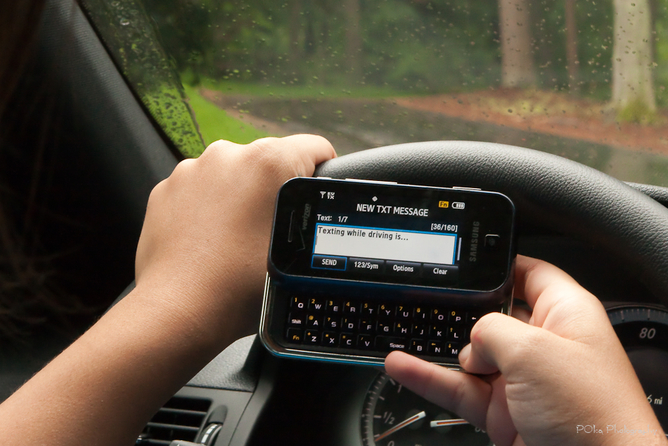
Really bad idea: texting while driving. Paul Oka/flickr, CC BY-NC
Even more dangerous is the distracted car driver. Distracted drivers have more fluctuating speed, change lanes fewer times than is necessary and in general make driving for everyone less safe and less efficient.
Texting while driving resulted in 16,000 additional road fatalities from 2001 to 2007. More than 21% of vehicle accidents are now attributable to drivers talking on cellphones and another 5% were text messaging.
Cognitive impairment
Multitasking relatively complex functions, such as operating handheld devices to communicate while walking or driving, is not so much an efficient use of our time as a suboptimal use of our skills.
We are more efficient users of information when we concentrate on one task at a time. When we try to do more than one thing, we suffer from inattention blindness, which is failing to recognize other things, such as people walking toward us or other road users.
Digital devices, which are proliferating in our lives, encourage multitasking, but does this really help our performance? Thomas Hawk/flickr, CC BY-NC-SA
Multitaskers do worse on standard tests of pattern recognition and memory recall. In a now classic study, researchers at Stanford University found that multitaskers were less efficient because they were more susceptible to using irrelevant information and drawing on inappropriate memories.
Multitasking may not be all that good for you either. A 2010 survey of over 2,000 8- to 12-year-old girls in the US and Canada found that media multitasking was associated with negative social indicators, while face-to-face contact was associated with more positive social indicators such as social success, feelings of normalcy and hours of sleep (vital for young people).
Although the causal mechanism has yet to be fully understood – that is, what causes what – the conclusion is that media multitasking is not a source of happiness.
Distraction-seeking creatures?
There are a number of reasons behind this growing distraction.
One often-cited reason is the pressure of time. There is less time to accomplish all that we need to do. Multitasking then is the result of the pressure to do more things in the same limited time. But numerous studies point to the discretionary use of time among the more affluent, and especially more affluent men. The crunch of time varies by gender and class. And, paradoxically, it is less of an objective constraint for those who often articulate it most.
Although the time crunch is a reality, especially for many women and lower-income groups, the age of distraction is not simply a result of a time crunch. It may also reflect another form of being. We need to reconsider what it means to be human, not as continuous thought-bearing and task-completing beings but as distraction-seeking creatures that want to escape the bonds of the here-and-nowness with the constant allure of someone and somewhere else.
Media theorist Douglas Rushkoff asserts that our sense of time has been warped into a frenzied present tense of what he calls “digiphrenia,” the social media-created effect of being in multiple places and more than one self all at once.
There is also something sadder at work. The constant messaging, emailing and cellphoning, especially in public places, may be less about communicating with the people on the other end as about signaling to those around that you are so busy or so important, so connected, that you exist in more than just the here and now, clearly a diminished state of just being.
There’s greater status in being highly connected and constantly communicating. This may explain why many people speak so loudly on their cellphones in public places.
Reactions
The age of distraction is so recent we have yet to fully grasp it. Sometimes art is a good mediator of the very new.
A video art installation by Siebren Verstag is entitled Neither There nor There. It consists of two screens. On one side a man sits looking at his phone; slowly his form loosens as pixels move to the adjacent screen and back again. The man’s form moves from screen to screen, in two places at one time but not fully in either.
One study that looked at the effect of banning cellphones in schools found that student achievement improved when cellphones were banned, with the greatest improvements accruing to lower-achieving students, who gained the equivalent of an additional hour of learning a week.
On many college campuses, faculty now have a closed-laptop policy after finding students would use their open laptops to skim their emails, surf the web and distract their neighbors. This was confirmed by studies that showed that students with open laptops learned less and could recall less than students with their laptops closed.
We are witnessing a cultural shift occurring with the banning of devices, cellphone usage being curtailed in certain public places and policies banning texting while driving. This is reactive. We also need a new proactive civic etiquette so that the distracted walker, driver and talker have to navigate new codes of public behaviors.
Many coffee stores in Australia, for example, do not allow people to order at the counter when they are on the cellphone, more golf clubs are banning the use of cellphones while on the course and it is illegal in 38 states in the US for novice drivers to use a cellphone while driving.
There is also the personal decision available to us all, one foreshadowed by writer and social critic Siegfried Kracauer, who lived from 1889 to 1966. In a newspaper article on the impact of modernity, first published in 1924, he complained of the constant stimulation, the advertising and the mass media that all conspired to create a “permanent receptivity” that prefigures our own predicament in a world of constant texting, messaging and cellphones.
One response, argued Kracauer, is to surrender yourself to the sofa and do nothing, in order to achieve a “kind of bliss that is almost unearthly.”
One radical response is to unplug and disconnect, live in the moment and concentrate on doing one important thing at a time. Try it for an hour, then for a day. You can even call your friends to tell them about your success – just not while walking or driving, or working on your computer screen or speaking loudly in a public place.
ooOOoo
Oh, did someone mention unplugging and disconnecting?
Regular readers will know that I subscribe to the blog Naked Capitalism masterminded by Yves Smith. Some time ago, there was a link on NK to a story about how a tiny Chihuahua dog rescued some missing girls. It seemed like a good opportunity to take a closer look at this most magical aspect of a dog’s qualities.
First to that story.
I saw it on the Care2 website, from which I quote the following:
A 3-year-old chihuahua named Bell is an unexpected hero after finding three young girls who became lost for hours in the woods in Newnan, Georgia, on Monday.
CBS Atlanta reports that, on Monday, 8-year-old Carlie and 5-year-old Lacey Parga went for a walk with their dog Lucy down a cul-de-sac on trails near their neighborhood.
What started as a casual stroll became an unintended, and at times frightening, experience. As Carlie tells CBS, ‘”We tried to find our way out of the woods. We kept following paths and stuff and we got lost.” Indeed, they became scared that they were only to get more and more lost.
Carlie’s father, David Parga, noted that it wasn’t characteristic of them to wander off and, after searching for them but not hearing them respond, he contacted police and firefighters. Neighbors joined them including Carvin Young who thought to take Bell, who plays with the girls every day and knew their scent. Bell was able to lead searchers to the girls.
The full story on the Care2 website is here and on the CBS website here.
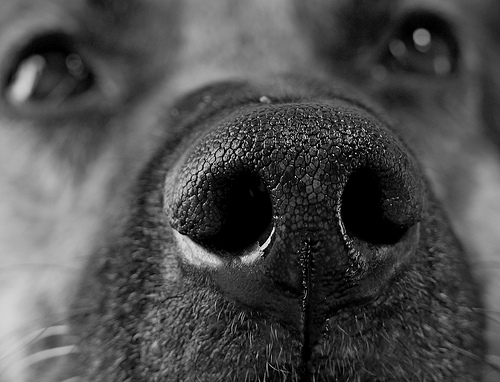
So what is it about the nose of the dog? A dog has more than 220 million olfactory receptors in its nose, while humans have only five million, making dogs’ sense of smell a thousand times greater. Frankly, trying to get one’s intellect around precisely what having a sense of smell one thousand times greater than a human means is tough! So on to another story.
17 Dogs, 3 Generations, 70 Years. There’s one constant… …the family dog.
After moving to Wellesley, Massachusetts for an anchor job with a major television sports network, Kevin began taking his German Shepherd, Beverly, for walks in the surrounding neighborhoods. They developed a route that included historic Atwood Street. Beverly kept veering toward one house in particular that had also caught Kevin’s eye previously, thinking it looked familiar but not knowing the reason.
After talking to a close family relative who had also once lived in Wellesley, Kevin was shocked to discover that the memorable house had once been a childhood home to his father, Bob Walsh, before WWII. After digging through old family photos that had been tucked away for years, Kevin uncovered a picture of his father as a toddler with his family on the house’s front porch, complete with their first family dog, Dee Dee.
Kevin’s father had been writing short stories about all of their family dogs through the years, but never knew about the photo. Its discovery was the pivotal moment that offered proof that the Walsh family’s journey with dogs had come back to the exact place where it started.
They’ve turned this story, along with other dog tales, into a book called Follow the Dog Home: How a Simple Walk Unleashed an Incredible Family Journey.
Dog’s nose leads family to back long lost old home, site unseen. German Shepherd, Beverly, is chronicled on WCVB TV’s news magazine show Chronicle. 70 years later, the family goes back “home” for stunning reunion and photograph.
I started writing this post approaching midnight (UTC) on the afternoon of Tuesday, 26th May, 2015. In other words, approaching 00:00 UTC 26/05/15 (or in American ‘speak’ 05/26/15 – a little thing that is taking me years to become accustomed to.)
At that time, it was fewer than four weeks to the June solstice. Now it was over a week ago and Christmas is just around the corner! (OK, I’ll admit a slight exaggeration!)
However, I thought the TomDispatch essay was just as valid on June 29th as it was on May 26th. So I will continue.
The planet Earth has been in orbit around the sun for a very long time! Time beyond imagination. By comparison, in a very short time one species alone, namely homo sapiens, has altered the biosphere of Planet Earth. It’s almost beyond comprehension!
To expand on that shortage of time, let me republish an essay from TomDispatch from last September. Republished with the kind permission of Tom Engelhardt.
ooOOoo
What to Do When You’re Running Out of Time
Posted by Rebecca Solnit at 8:09am, September 18, 2014.
Follow TomDispatch on Twitter @TomDispatch.
Just when no one needed more lousy news, the U.N.’s weather outfit, the World Meteorological Organization (WMO), issued its annual Greenhouse Gas Bulletin. It offered a shocking climate-change update: the concentrations of long-lasting greenhouse gases in the Earth’s atmosphere (carbon dioxide, methane, and nitrous oxide) rose at a “record-shattering pace” from 2012 to 2013, including the largest increase in CO2 in 30 years — and there was a nasty twist to this news that made it even grimmer.
While such increases reflected the fact that we continue to extract and burn fossil fuels at staggering rates, something else seems to be happening as well. Both the oceans and terrestrial plant life act as carbon sinks; that is, they absorb significant amounts of the carbon dioxide we release and store it away. Unfortunately, both may be reaching limits of some sort and seem to be absorbing less. This is genuinely bad news if you’re thinking about the future warming of the planet. (As it happens, in the same period, according to the Yale Project on Climate Change Communication, parts of the American public stopped absorbing information in no less striking fashion: the number of those who believe that global warming isn’t happening rose 7% to 23%.)
So consider this a propitious moment for a major climate-change demonstration, possibly the largest in history, in New York City this Sunday. [Ed:it turned out to be the largest climate march in history.] As the WMO’s Secretary-General Michel Jarraud pointed out, there is still time to make a difference. “We have the knowledge and we have the tools,” he said, “for action to try to keep temperature increases within 2°C to give our planet a chance and to give our children and grandchildren a future. Pleading ignorance can no longer be an excuse for not acting.” As TomDispatch regular Rebecca Solnit, author of the indie bestseller Men Explain Things to Me, points out, the pressure of mass movements can sometimes turn history upside down. Of course, the only way to find out if climate change is a candidate for this treatment is to get out in the streets. So, for those of you anywhere near New York, see you this Sunday! Tom
The Wheel Turns, the Boat Rocks, the Sea Rises
Change in a Time of Climate Change
By Rebecca Solnit
There have undoubtedly been stable periods in human history, but you and your parents, grandparents, and great-grandparents never lived through one, and neither will any children or grandchildren you may have or come to have. Everything has been changing continuously, profoundly — from the role of women to the nature of agriculture. For the past couple of hundred years, change has been accelerating in both magnificent and nightmarish ways.
Yet when we argue for change, notably changing our ways in response to climate change, we’re arguing against people who claim we’re disrupting a stable system. They insist that we’re rocking the boat unnecessarily.
I say: rock that boat. It’s a lifeboat; maybe the people in it will wake up and start rowing. Those who think they’re hanging onto a stable order are actually clinging to the wreckage of the old order, a ship already sinking, that we need to leave behind.
As you probably know, the actual oceans are rising — almost eight inches since 1880, and that’s only going to accelerate. They’re also acidifying, because they’re absorbing significant amounts of the carbon we continue to pump into the atmosphere at record levels. The ice that covers the polar seas is shrinking, while the ice shields that cover Antarctica and Greenland are melting. The water locked up in all the polar ice, as it’s unlocked by heat, is going to raise sea levels staggeringly, possibly by as much as 200 feet at some point in the future, how distant we do not know. In the temperate latitudes, warming seas breed fiercer hurricanes.
The oceans are changing fast, and for the worse. Fish stocks are dying off, as are shellfish. In many acidified oceanic regions, their shells are actually dissolving or failing to form, which is one of the scariest, most nightmarish things I’ve ever heard. So don’t tell me that we’re rocking a stable boat on calm seas. The glorious 10,000-year period of stable climate in which humanity flourished and then exploded to overrun the Earth and all its ecosystems is over.
But responding to these current cataclysmic changes means taking on people who believe, or at least assert, that those of us who want to react and act are gratuitously disrupting a stable system that’s working fine. It isn’t stable. It is working fine — in the short term and the most limited sense — for oil companies and the people who profit from them and for some of us in the particularly cushy parts of the world who haven’t been impacted yet by weather events like, say, the recent torrential floods in Japan or southern Nevada and Arizona, or the monsoon versions of the same that have devastated parts of India and Pakistan, or the drought that has mummified my beloved California, or the wildfires of Australia.
The problem, of course, is that the people who most benefit from the current arrangements have effectively purchased a lot of politicians, and that a great many of the rest of them are either hopelessly dim or amazingly timid. Most of the Democrats recognize the reality of climate change but not the urgency of doing something about it. Many of the Republicans used to — John McCain has done an amazing about-face from being a sane voice on climate to a shrill denier — and they present a horrific obstacle to any international treaties.
Put it this way: in one country, one party holding 45 out of 100 seats in one legislative house, while serving a minority of the very rich, can basically block what quite a lot of the other seven billion people on Earth want and need, because a two-thirds majority in the Senate must consent to any international treaty the U.S. signs. Which is not to say much for the president, whose drill-baby-drill administration only looks good compared to the petroleum servants he faces, when he bothers to face them and isn’t just one of them. History will despise them all and much of the world does now, but as my mother would have said, they know which side their bread is buttered on.
As it happens, the butter is melting and the bread is getting more expensive. Global grain production is already down several percent thanks to climate change, says a terrifying new United Nations report. Declining crops cause food shortages and rising food prices, creating hunger and even famine for the poorest on Earth, and also sometimes cause massive unrest. Rising bread prices were one factor that helped spark the Arab Spring in 2011. Anyone who argues that doing something about global warming will be too expensive is dodging just how expensive unmitigated climate change is already proving to be.
It’s only a question of whether the very wealthy or the very poor will pay. Putting it that way, however, devalues all the nonmonetary things at stake, from the survival of myriad species to our confidence in the future. And yeah, climate change is here, now. We’ve already lost a lot and we’re going to lose more, but there’s a difference between terrible and apocalyptic. We still have some control over how extreme it gets. That’s not a great choice, but it’s the choice we have. There’s still a window open for action, but it’s closing. As the Secretary-General of the World Meteorological Society, Michel Jarraud, bluntly put it recently, “We are running out of time.”
New and Renewable Energies
The future is not yet written. Look at the world we’re in at this very moment. The Keystone XL tar sands pipeline was supposed to be built years ago, but activists catalyzed by the rural and indigenous communities across whose land it would go have stopped it so far, and made what was supposed to be a done deal a contentious issue. Activists changed the outcome.
Fracking has been challenged on the state level, and banned in townships and counties from upstate New York to central California. (It has also been banned in two Canadian provinces, France, and Bulgaria.) The fossil-fuel divestment movement has achieved a number of remarkable victories in its few bare years of existence and more are on the way. The actual divestments and commitments to divest fossil fuel stocks by various institutions ranging from the city of Seattle to the British Medical Association are striking. But the real power of the movement lies in the way it has called into question the wisdom of investing in fossil fuel corporations. Even mainstream voices like the British Parliament’s Environmental Audit Committee and publications like Forbes are now beginning to question whether they are safe places to put money. That’s a sea change.
Renewable energy has become more efficient, technologically sophisticated, and cheaper — the price of solar power in relation to the energy it generates has plummeted astonishingly over the past three decades and wind technology keeps getting better. While Americans overall are not yet curtailing their fossil-fuel habits, many individuals and communities are choosing other options, and those options are becoming increasingly viable. A Stanford University scientist has proposed a plan to allow each of the 50 states to run on 100% renewable energy by 2050.
Since, according to the latest report of the U.N.’s Intergovernmental Panel on Climate Change, fossil fuel reserves still in the ground are “at least four times larger than could safely be burned if global warming is to be kept to a tolerable level,” it couldn’t be more important to reach global agreements to do things differently on a planetary scale. Notably, most of those carbon reserves must be left untapped and the modest steps already taken locally and ad hoc show that such changes are indeed possible and that an encouraging number of us want to pursue them.
ooOOoo
In case you are wondering why this TomDispatch essay has been published some ten months after it first appeared, it is simply because I made a note to leave it for a few months to see if the benefit of some hindsight put the essay into context.
Here’s the context.
In the month of September, 2014, when this essay was published over on TomDispatch, the Atmospheric CO2 monthly average was 395.26 ppm. In April, 2015 it was 403.26 ppm. I can’t spell it out any better than what is written on the home page of CO2Now.org:
What the world needs to watch
Global warming is mainly the result of CO2 levels rising in the Earth’s atmosphere. Both atmospheric CO2 and climate change are accelerating. Climate scientists say we have years, not decades, to stabilize CO2 and other greenhouse gases.
To help the world succeed, CO2Now.org makes it easy to see the most current CO2 level and what it means. So, use this site and keep an eye on CO2. Invite others to do the same. Then we can do more to send CO2 in the right direction.
What an interesting period in man’s history to be alive.
I’m not going to repeat my full introduction to Professor Bekoff’s essay from yesterday other than to repeat this:
Thus with Marc Bekoff’s generous permission, here is his essay in full. (I’ve taken the decision to split this long essay into two parts.)
Finally, Professor Bekoff includes numerous ‘html’ links within his essay to other materials. I’ve cheated by saving quite some time adding those links but have underlined the linked phrase in question, apart from the very early chapters that do have ‘html’ links. Please go to the site of the original essay to explore further those links.
Marc Bekoff and friend.
ooOOoo
Butts and Noses: Secrets and Lessons from Dog Parks (Concluding Part)
Dog parks are gold mines of information about the behavior of dogs and humans
Are dogs really our best friends and are we really their best friends?
I’m asked these questions a lot and I always say it’s simply not so that dogs are “unconditional lovers.” They discriminate among humans just like we discriminate among dogs. And, while dogs might love “too much,” they’re very careful about to whom they open up. So, sometimes — perhaps very often — dogs are our best friends and we are their best friends but we all know of picky dogs and the horrific abuse to which dogs are subjected.
Are dogs really free at a dog park?
I often hear something like, “Oh I love coming to the dog park because my dog is so free” – and then she’s/he’s called back constantly when he plays too roughly or strays too far. People surely differ in how much control they exert, but some just don’t give their dog the opportunity to play, sniff, and hump. Control freaks often abound and they don’t realize it. Patrick Jackson, in the essay to which I referred above, writes about how “caretakers become ‘control managers’ who must negotiate problems related to a variety of dog behaviors, especially mounting, aggression, and waste management.” He’s right on the mark, but there are also those who get upset when play gets a bit rough, even when the dogs obviously are enjoying themselves.
Do dogs display dominance?
Yes, they do, just like many other animals. There is major confusion and mistakes among many “dog people” about what dominance really means, and dogs, like numerous other animals, do indeed use various forms of dominance in their social interactions. However, this does not mean that dominance is equated with overt aggression and physical harm nor that we need to dominate them in order to live in harmony with them (for more on this topic and the fact that dominance is not a myth please see this essay and and and references therein).
Why do dogs mount and hump?
Here are some of the statements I hear about dog mounting and humping: “Oh my God, my dog was fixed to stop this stuff.” “Oh, that’s easy, it’s always to dominate the other dog.” “Domination.” “Dogs are hyper-sexual because of domestication.” There are many reasons why dogs hump and there’s not a single answer (please see this essay and references therein).
Do Dogs feel shame and guilt?
While I hear numerous stories about shame and guilt, the simple and most correct answer is that we really don’t know. While we’re not all that good at reading guilt this does not mean that they do not feel guilt (please see this essay and references therein).
Do dogs get jealous?
Yes they do and a study published in 2014 showed this to be the case (please see this essay and references therein). I often hear very compelling stories about jealousy in dogs.
Do dogs get bored?
Yes, of course they do, just as do many other mammals, especially those living in various conditions of captivity. It’s clear that researchers and zoo administrators, for example, recognize that animals get bored, hence the numerous enrichment programs that are designed to relieve the animals’ boredom. The detailed research of Francois Wemelsfelder is a wonderful place to begin to learn about boredom in animals (see also the essays listed here).
Do dogs suffer from PTSD and other psychological disorders?
Yes they do as do many other animals.
Do dogs mind being used as service dogs or in animal assisted therapy?
Because dogs are such a variable lot, it’s impossible to say something like, “Of course they do.” The correct answer is that because dogs vary in personality and temperament there are some who would mind it and some who won’t. I’ve met many in each camp and I’m sure many readers have as well.
Are there Attention Deficit Dogs (ADD’s)?
I often hear people say that their dogs don’t hear them or that they ignore them most of the time. While there are many reasons why this might be so, it’s entirely possible that there are dogs who get so excited they simply don’t respond to their human’s requests. But, it’s also possible that some dogs do suffer from attention deficit disorder and hyperactivity.
How often does social play escalate into serious aggressive encounters?
We all know that play behavior predominates at dog parks and that dogs have fun when they play (see also) and that play is very contagious. Dogs play socially with one another, often involving objects, and they also play alone with objects or just go berserk on their own because it feels good. Dogs can play very roughly and still be in control and there are distinct “rules of social play” that help to keep even a vigorous interaction well within bounds so that there’s really little or no worry that play will escalate into aggression. Nonetheless, I hear this statement a lot: “Oh whenever dogs play it turns into aggression.” It doesn’t. My own observations suggest that it seems escalation happens more in large groups in which dogs can’t read one another’s subtle signals that “this still is play,” but it is very rare. Dogs can be rather fair. I want to say a bit more on this topic because it seems to be major reason why dogs are called back to their human or that humans break up rough-and-tumble play.
Although my students and I haven’t kept detailed records on this aspect of play for dogs, we all agree that play didn’t turn into serious fighting in more than around 2% of the 1000s of play bouts we’ve observed. Current observations at dog parks around Boulder, Colorado support our conclusion. And, for the approximately 1000 play bouts that my students and I observed in wild coyotes, mainly youngsters, on only about five occasions did we see play fighting escalate into serious fighting. Along these lines, Shyan, Fortune, and King (2003) discovered that fewer than 0.5% of play fights in dogs developed into conflict, and only half of these were clearly aggressive encounters. In this case our intuitions were right on the mark. Of course, there may be dogs who simply bite too hard or slam too hard into their play partners when they get highly aroused and lost in play, and this results in an aggressive encounter of varying intensity. But that is the exception rather than the rule, for play fighting only very rarely escalates into real fighting. Because play is a foundation of fairness there is a good deal of cooperation among the players as they negotiate the ongoing interaction so that it remains playful. I think one can make a good case for their having a theory of mind. Nonetheless, we still need more data on this aspect of play as well.
Do older dogs play less than younger dogs?
While this is true of wild animals who have to work harder to survive and to thrive, older dogs play a lot when they can and we really need more data on this question.
Do dogs have a theory of mind?
We don’t know. While some studies suggest they don’t, we need more “naturalistic” research especially when dogs are socially interacting. Because play is a foundation of fairness and there is a good deal of cooperation among the players as they negotiate the ongoing interaction so that it remains playful. Perhaps dogs even know what their playmates are thinking and feeling. Do they have a theory of mind? While I think so, we still need more data on this aspect of play as well.
Why do dogs roll and writhe on their back?
It could be to impart an odor. A wild canid known as the raccoon dog who lives in South America has a scent gland on its back. Dogs might also roll on their back to mask their own odor. And, of course, it might feel really good so why not do it? I love watching dogs writhe on their back and they look like they’re in doggie heaven.
Do dogs have a sense of time? The “two minute warning”
We really don’t know much at all about the dog’s sense of time. Yet, people often use what I call the “two minute warning” and ask their dog if it’s okay if they leave in 2 minutes, or people tell their dog something like, “You have 5 minutes more to play with your friends before we go to the store.” They also ask their dog, “What the hell took you so long, I’ve been calling you for minutes?” or “Where were you when I called you?” I can well imagine the dog thinking something like, “Huh?”
Why do dogs snort?
While there are physical reasons why dogs snort, recent research shows that dogs sort odors in their nose, forcing out those that aren’t relevant or salient, hence the snort and often a good deal of snot (for more on the fascinating dog’s nose please see this essay and this.
Why do dogs try to pee and nothing comes out?
This is called “dry marking” and we know that lifting a leg as if the dog is peeing serves as a visual signal to tell others he is. Often a dog will “dry mark” and then pee a few seconds later, so it’s clear their bladder isn’t empty. A study I did years ago with some students showed that dogs do this more often when there are other dogs around who can see them and then pee a bucket.
Why do dogs scratch the ground after they pee or poop?
They do this for a number of possible reasons and there isn’t a simple answer to this question.
Poop central: Why do people talk so much about dog poop at dog parks?
People also talk about poop a lot as if they’re freer to do so with their dog. Matthew Gilbert notes, “poop was more of a thing at the park than I had expected.” (p. 66) He also talks about a “stray bowel movement” as a “voluminous and frozen still life” (p, 67). Dog poop is a ripe area for future research.
Why do dogs stick their noses into butts, groins, and ears?
It’s a way of greeting and social investigation, but there haven’t been any studies of which I’m aware that provide any details about why they do this, even to their dog friends or humans. It’s been suggested that some animals might pick up information on the food others have eaten.
Are there breed specific odors?
Many people report that on their first encounter with other dogs, members of the same breed prefer one another and treat breed members differently from individuals of different breeds. There’s been some discussion that there may be a common odor to members of the same breed. However, my reading of available information is that we really know little about this question right now.
Do dogs know what they look like?
While dogs know what they smell like, they don’t know what they look like, or might they? Research done on birds in the 1960s suggests that they might learn their own color from reflections in water. So, I suppose dogs might know what they look like if they’ve seen their own reflection, but we need much more research about this question.
Why do dogs circle before lying down?
Dogs do not always circle before lying down, as some authors claim. They likely do it to flatten or soften the ground, and may also be looking around to see who’s around before they relax. In a study some of my students did years ago they reported that the dogs they watched circled around 65% of the time, but more detailed studies are needed.
Why does the hair on a dog’s back stand up?
This is called piloerection (sort of like goose bumps) and indicates that a dog is highly aroused but not necessarily aggressive. Many other species, including birds, show the same (sympathetic nervous system) response.
Dogs and humans: Why do people open up at dog parks?
Dogs can easily serve as icebreakers and social catalysts. People often open up at dog parks and talk to friends about things they likely don’t talk about in other arenas. They seem to feel safe among kinfolks. Some people began talking to me about pretty personal stuff within a minute of meeting them such as a woman who decided that she didn’t like her BFF because of how she treated a dog she just rescued, and a woman who, after meeting someone for around 10 seconds, decided that the woman wasn’t a good dog owner because she was suffering from bipolar disorder but didn’t know it! Some people – men and women, alike – have told me that dogs are social magnets and make it easy to meet other people who also are out with their canine BFF. These discussions often have very interesting “conclusions.” Enough on that for now …
Why do dogs eat grass?
There are many reasons and Stanley Coren has written a good myth-debunking essay on this. He notes that dogs do not eat grass to cause vomiting to relieve stomach distress. While it’s possible that some dogs do, we need a lot more research on this question.
More questions for a future essay
The list of questions can go on and on, and some questions I’ll consider in the future include: Why do dogs chase their tail? Why do dogs bark and what sort of barks are there? Why do dogs bark and howl at sirens? Why does my dog hoard tennis balls? Are dogs territorial as are wolves? Why do dogs pee/scent mark so much? Why do dogs sniff pee so much even when it’s their friends’ pee? Why do males sometimes squat when they pee and why do females sometimes lift their leg? Do dogs have a sense of self? Studies of “yellow snow” suggest they do. Are they conscious? (Of course they are, and scientists agree.) Why do dogs sniff and eat frozen turds? Why do dogs eat gooey feces? Why do dogs dig holes and then lie in them? Why do dogs scrape their butt on the ground? Why do people openly disparage their dog and then tell them they love them? (I often hear something like, “Oh, he’s really retarded, but I love him” or “You are so fat!” or “My goodness, your breath stinks!). Do dogs pick up on these mixed signals?“ Do dogs have a “little dog” complex? Do dogs make and use tools? (They do.) Why do dogs drink filthy water? How do dogs pick their mates? Do dogs dream? Do dogs get heartburn? Do dogs sweat? Do dogs understand baby talk? (People are well known to talk to dogs as if they’re infant humans.) What does “feral” mean? How did wolves become dogs? (Please see essays by Mark Derr.) What’s the difference between a socialized animal and a domesticated animal? (A wolf who likes humans is a socialized wolf. A domesticated wolf is a dog.) Do dogs really live in the moment? (No, their past clearly influences their behavior — just ask anyone who’s rescued an abused dog — and they think about the future — just watch a dog waiting for a frisbee or a ball to be thrown and watch them track the trajectory, although tracking might not be conscious, even in humans.)
Where to from here? There are many holes in the database and dog parks are gold mines of information.
It’s important to stress that there here are many holes in the database, and people find this very surprising because of many popular dog books that purport to “tell it like it is,” as if there are facts about this or that question. Dog parks are wonderful places for studies in dog-dog ethology and anthrozoology, the study of human-animal interactions, and I hope this essay will stimulate people to conduct formal studies and encourage citizen scientists to share their stories that can be used to generate further more systematic studies.
Studies in dog parks, that some may call “too uncontrolled,” may also shed light on questions that are being debated among different groups of researchers, for example, whether dogs follow human gazing or pointing and how well they perform these activities, or if dogs have a theory of mind. And, let’s face it, some laboratory studies also are rather uncontrolled, mainly because dogs are such a mixed bag of participants as might be the researchers themselves. Watching animals in their “natural habitats,” and dog parks might qualify as such, has shed much light on various aspects of behavior that are difficult to study in captivity or in other more controlled environs. Although many lab studies of dogs are likely more controlled than those conducted on free-running dogs, many people have seen behavior patterns that warrant reinvestigation in more ecologically relevant situations.
I continue to learn a lot about dog and human behavior when I visit dog parks. People often feel free to offer advice even when they knew who I am and what I do for a living. But, on a number of occasions, I chose to keep some distance to determine if their comments and explanations to other people (and often to the dogs) differ from when they know I’m around. For the most part, they did not. For example, I’ve been told that “familiar dogs definitely play differently from unfamiliar dogs,” that “humping is always about dominance,” that “dogs know what other dogs are thinking and feeling and they also know the same about people,” and that “know-it-all researchers ought to get off their butts and out of the ivory tower and watch dogs in the field.” On a few occasions some people made it clear that I had a lot to learn about dogs and they could teach me some valuable lessons. When I agreed, they were very surprised, and over the years I’ve had many interesting discussions that have made me re-evaluate what we know and don’t know about dog behavior and dog-human interactions. Concerning two of the areas above, we actually don’t know if familiar dogs play differently from unfamiliar dogs (I’ve got a student studying this) and, as I mentioned above, there’s not just one explanation for humping. Anyway …
There are numerous research projects just waiting to be done as we watch dogs romp here and there and have fun, meet old friends and strangers, and negotiate social relationships with other dogs and humans. I’m aware that I may have missed some studies so I hope readers will send me the details and share them in the comments section for this essay.
Dog behavior, in all of its kaleidoscopic forms, is an incredibly exciting field of research
Dogs openly share with us a lot about what they know and what they’re thinking and feeling, and we just have to be keen enough and patient enough to figure it all out. Dogs also are wonderful social catalysts and social magnets and they can help us learn a lot about ourselves. The arena of inquiry about dog-dog behavior and dogs and their humans truly is deep and boundless and there are numerous opportunities for studies at dog parks, where dogs frolic and sometimes cower and have to learn to deal with a wide variety of social situations with other dogs and humans, and at other places where dogs and humans congregate. And, as I mentioned before, talking about “the dog” can often be misleading and perilous.
Dog behavior, in all of its kaleidoscopic forms, is an incredibly exciting field of research, and I really look forward to seeing further studies of the above and other questions. When people tell me they’re having trouble coming up with a research project I humbly ask them if they’ve thought about dogs, and then the conversation gets going and going and going ….
Marc Bekoff’s latest books are Jasper’s story: Saving moon bears (with Jill Robinson), Ignoring nature no more: The case for compassionate conservation, Why dogs hump and bees get depressed, and Rewilding our hearts: Building pathways of compassion and coexistence.The Jane effect: Celebrating Jane Goodall (edited with Dale Peterson) has recently been published. (marcbekoff.com; @MarcBekoff)
ooOOoo
Now I don’t know about you but I found this essay both fascinating and wonderfully interesting. If I ever get the chance to publish other essays or information from the good Professor you can bet your life that I will, and without hesitation!
Part One of a stunningly interesting essay from Professor Marc Bekoff.
As a newbie yet-to-be published author I am technically at the stage of having a completed draft that Jeannie and a close friend are proof-reading. Then after corrections, it is going to be released to some ‘beta’ readers who will give me some early feedback. (Too scary to even think of just now!)
OK, with that admission out of the way, let me move on to my ‘draft’ chapter on play; in Part Four of the book. In researching what is known about the way that dogs play and what lessons there are for us humans, I came across an essay by Marc Bekoff, Ph.D. Marc is Professor Emeritus of Ecology and Evolutionary Biology at the University of Colorado, Boulder. His essay had been published in May on the website of Psychology Today. It was incredibly interesting and full of material for the book!
Within a few minutes of me sending Professor Bekoff an email requesting permission to include quotations in my ‘draft’ chapter, he had responded in the affirmative. I had also sought his permission to publish the essay here on Learning from Dogs. Again, a very quick, positive reply.
Thus with Marc Bekoff’s generous permission, here is his essay in full. (I’ve taken the decision to split this long essay into two parts.)
Finally, Professor Bekoff includes numerous ‘html’ links within his essay to other materials. I’ve cheated by saving quite some time adding those links but have underlined the linked phrase in question, apart from the very early chapters that do have ‘html’ links. Please go to the site of the original essay to explore further those links.
Marc Bekoff and friend.
ooOOoo
Butts and Noses: Secrets and Lessons from Dog Parks (Part One)
Dog parks are gold mines of information about the behavior of dogs and humans
I love going to dog parks. So, too, do dogs and their people. Dog parks are a fascinating recent and growing cultural phenomenon. Indeed, I go rather often to what I call my field sites, for that’s what they are, to study play behavior and other aspects of dog behavior including urination and marking patterns, greeting patterns, social interactions including how and why dogs enter, become part of, and leave short-term and long-term groups, and social relationships. I also study human-dog interactions and when I study how humans and dogs interact I also learn a lot about the humans. For example, I often hear how happy people are that their dogs are free to run here and there or free to be dogs when they’re at the dog park. Often, they say this while they’re constantly calling them back to them even when the dog is simply sniffing here or there or looking for a friend. They also call them to break up play when they think it’s gotten out of hand. You call this free?
Two works to which I often go when thinking about social dynamics at dog parks are Matthew Gilbert’s book titled Off the Leash: A Year at the Dog Park and Sonoma State University’s Patrick Jackson‘s essay called “Situated Activities in a Dog Park: Identity and Conflict in Human-Animal Space.” Linda Case writes about Dr. Jackson’s study and she is not a fan of dog parks because she feels they’re not safe and because “Dog park people frequently behave badly by not being responsible dog owners and by being inconsiderate and uncaring towards other people and their dogs.” We really need empirical studies on the safety issue. After having spent countless hours at dog parks I’ve never entertained drawing this conclusion, but there aren’t any detailed data on this topic of which I’m aware. However, on occasion, but hardly regularly, I’ve marveled at just how inconsiderate a very few people can be. But, as part of the gossip network among the other people, I often hear that a given person behaves like this even in non-dog park situations. On a few ocassions I’ve had a rather inconsiderate person ask me why their dog has bad manners and rather than get involved I call attention to some interesting dog-dog interactions.
Most people realize that “dogs are in” and countless scientific and popular essays (see also New Directions in Canine Behavior, Julie Hecht’s “Dog Spies,” and essays written for Psychology Today by writers including Mark Derr, Stanley Coren, Jessica Pierce, and yours truly) and books have been published in the past decade or so about these fascinating mammals. The bottom line is that a plethora of detailed data — and the database is rapidly increasing — clearly show that dogs are thinking, clever, and feeling sentient beings, and viewing them as sort of robotic machines is incredibly misleading and academically corrupt (please see this essay). This does not mean that they are “doggy Einsteins,” however, ample data from numerous different research groups around the world clearly show that dogs are rather complex and incredibly interesting mammals who deserve a good deal of further study. Perhaps even René Descartes would consider changing his views on nonhuman animals (animals) as unfeeling machines given the enormous amount of empirical evidence on sentience in animals.
Why do dogs do this and that? Canine confidential
“Why do dogs do this and that?” The purpose of this short essay, that can be conceived as a field guide to the extremely interesting and largely unknown world of the fascinating dogs with whom we share our lives, is to provide some lessons in dog behavior from observations and questions arising from visits to various dog parks, especially around Boulder, Colorado where I live. I see myself as “a naturalist in a dog park” and aim to show here, via a series of questions, what we know and don’t know about many different aspects of dog behavior. Dogs are often called social catalysts – icebreakers or lubricants — for social interactions with other dogs and they often open the door for pretty frank and wide-ranging conversations among familiar and unfamiliar humans. It always amazes me how dogs free up humans to talk about things they might be more reluctant to share in other venues including what they really think about their human “BFF’s — best friends forever” — and the infamous “3 p’s,” namely, pee, poop, and puke. Often when I get home and look at my notes I view them as “canine confidential.” So, what follows is a sampler of many “why” questions, including why dogs hump, why they sniff butts, genitals, and ears, why they play, and why they organize themselves the ways they do. There are also many “what” questions such as “What do they know?”, “What are they thinking?”, and “What are they feeling?” in different contexts. The list of questions is endless and I’m sure those that follow can easily mutate in many, many more.
People who are lucky enough to share their world with a dog often think they know it all. And, while they do know a good deal about what their canine buddy is thinking and feeling and what they want and need, there really are large gaps in the scientific database. As I mentioned above, there are numerous anecdotes about why dogs do this or that, and, taken together, they form their own pool of data. However, while the claim that “the plural of anecdote is data” applies in some cases, many mysteries still loom in what we actually know about the world of dogs.
Furthermore, often there is no single “right” answer to a question — even some of the most commonly asked queries — and that’s just fine. Dogs compose a highly variable group of mammals — I often say “the dog” doesn’t really exist — so it’s not surprising that just when we think we have a solid handle on what they’re thinking and feeling and why they do what they’re doing an exception or three arises. Surely, the early experience of individual dogs influences their later behavior. So, while we know a lot, people are often amazed by how little we know and that hard and fast answers can’t be given to some common questions.
Visiting dog parks can be wonderful educational experiences. Visits, some lasting hours on end each and every day, can be myth breakers and icebreakers, and also provide information about why dogs are doing this or that. People are always asking questions about why their dog is doing something and really want to know what we know. They also freely offer advice to other people about why their dog is doing something and how they can treat various problems such as shyness, aggressiveness, and why dogs ignore what their human is asking them to do. And, as I wrote above, dogs also are icebreakers – “social catalysts” the academics call them — and get people to talk with one another and to talk about things.
The questions below range from interests about basic dog behavior such as why do dogs stick their noses where they do, and why they play, bark, pee, eat turds, and roll on their back, to more lofty questions about whether dogs have a theory of mind and whether they know what they look like and if they know who they are. A good number of questions deal with dogs’ butts and noses, hence the title of this brief essay (motivated, of course, by the famous rock group, Guns N’ Roses). Butts and noses — including other “private parts” – figure into a number of the questions below. We all know dogs put their noses in places where we couldn’t imagine there would be anything of interest, and also place their active snouts, often on their first introduction, to other dogs and humans, in places that make us rather uneasy. We don’t greet friends or strangers by immediately licking their mouth or with a genital sniff or slurp. There also are many general questions that don’t center on anatomical features that figure largely in the world of the dog. I’ll answer each question briefly with what we know from various types of research, with some stories where they’re available, and note where we really need more information. It’s entirely possible that I have missed a given study (or studies) and I apologize for the oversights and look forward to hearing from readers.
While we know a lot about dogs, there are holes in the database, so the future is chock full of exciting research. Readers will discover that what we often take to be the gospel about dog behavior frequently isn’t all that well supported by published empirical research or even detailed observations. While good stories are interesting and can serve to stimulate more “controlled” research, in and of themselves they don’t constitute “data” as do detailed and more focused studies (I’ll suggest below that studies in dog parks may be more “ecologically relevant” than studies in laboratories and help to settle on-going debates among different research groups). In some ways, then, this essay is sort of a myth-buster and a fun way not only to learn about dogs but also to stimulate further research about dogs and dogs and humans. So, here we go.
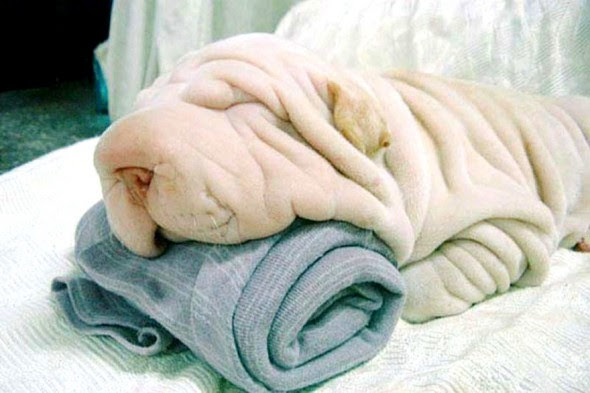
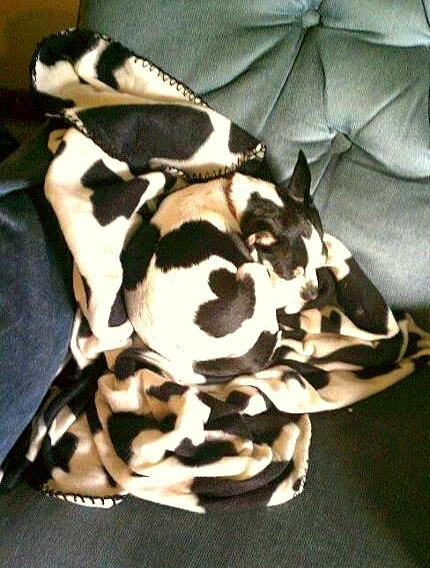
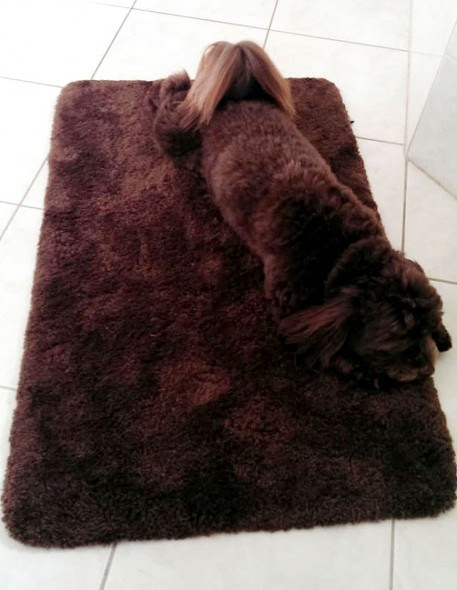
Last week’s picture parade had me wondering where the next set of pictures were coming from. But then dear, long-term friend Dan Gomez emailed me some fabulous pictures that, in turn, had been sent to him. Thanks Dan!
Hiding in Plain Sight
oooo
oooo
oooo
oooo
oooo
oooo
oooo
Another set of wonderful pictures along the same theme next Sunday. (That will be mid-Summer’s Day in the Northern Hemisphere!)
This is a repost of what appeared over on Alex Jones’ blog Liberated Way last Thursday. It resonated so wonderfully with all the young plants and trees around us here at home in Merlin, and the numerous oak saplings making their way into the world! Republished with Alex’s kind permission.
ooOOoo
Things prosper when cared for!
The joy of caring for something.
These oak saplings prosper because of care.
Today, I moved my eight oak saplings into the full sun, added a new layer of quality compost to their pots, and watered them. In their second year of life these oak saplings prosper because of care.
Caring for something means one must pay attention to the small details. For instance, I remove the caterpillars from the oak leaves, and the weeds that grow in the pots. If I did not concentrate on the small details, the little problems could grow into larger problems, the caterpillars destroying the oak saplings, the weeds stealing their nutrients in the pots.
Also, the individual spends time on the thing cared about, establishing regular activities, such as in my case, watering the oak saplings every few days. The individual looks for ways that the cared for thing might benefit, just as I moved my oak saplings into the full sun, added new compost to them, and infected them with a type of symbiotic fungus that aids oak sapling growth.
The thing cared for becomes special, for instance there are millions of oak trees in Britain, but only eight of those, my saplings, are special to me. In such a caring relationship, both sides come to depend upon the other. My oak saplings need my care and attention to survive, I need my oak saplings to feel good about myself when life is hard.
If the individual has nothing to care for, their life becomes empty and meaningless. I love the book by Antoine De Saint-Exupery called The Little Prince, which explores ideas around friendship and caring for things. In The Little Prince is the following beautiful quote:
“You are beautiful, but you are empty. One could not die for you. To be sure, an ordinary passerby would think that my rose looked just like you — the rose that belongs to me. But in herself alone she is more important than all the hundreds of you other roses: because it is she that I have watered; because it is she that I have put under the glass globe; because it is she that I have sheltered behind the screen; because it is for her that I have killed the caterpillars; because it is she that I have listened to, when she grumbled, or boasted, or even sometimes when she said nothing. Because she is my rose.”
ooOOoo
Can’t recommend too highly you dropping in on Alex’s blog Liberated Way – even signing up as a ‘follower’!
How many of us really, truly care about the future?
If you sense a heartfelt plea in my sub-heading then you will not be wrong.
What has happened to our instincts for our survival?
What strikes me as so tragic is that if I asked you to guess the topic of today’s post before you read on, the odds are that you would chose from any number of subjects that reveal a society hell-bent on self-extinction!
OK, let me get to the point.
A little over 10 days ago I republished a George Monbiot essay that spoke about the madness of chicken production in the UK. Mr. Monbiot’s essay was called Fowl Deeds and was within my post called We are what we eat!
Well George Monbiot has just published a sequel to Fowl Deeds that I am going to republish in this place tomorrow.
But what I am going to offer for today, as a prelude to tomorrow’s post, is a YouTube video of a BBC Panorama program that was screened earlier on in May. The program was called Antibiotic Apocalypse and was about the threat of increasing resistance to modern Antibiotics.
Why does this make such an important prelude?
Because as you will see when you watch the Panorama program much of our ‘factory’ food comes from animals that are fed antibiotics!
How to close?
All that comes to mind is a wonderful throwaway remark from a old boy, village resident, when supping a pint of bitter in The Church House Inn; what used to be my local pub in my home village of Harberton, Devon. This is what he said:
All the world’s a little queer except thee and me, and I ha’ me doubts about thee!
Interior of The Church House Inn, Harberton, Devon.
Indeed, all the world is more than a ‘little queer’!
I opened the week last Monday by publishing a post under the title of Beyond humans. That post included me writing about Michael Mountain’s talk at the Personhood Beyond the Human conference at Yale University. That talk, that may be listened to in that post, was described in the following abstract:
Abstract: The past 50 years have seen enormous growth in the animal protection movement. But the situation for nonhuman animals in every sphere, with the exception of homeless pets, continues to deteriorate. Any small advances remain incremental. Animal rights and welfare groups find themselves at a loss to explain their inability to influence the general public. But the work of Ernest Becker (The Denial of Death) and of psychologists in the field of Terror Management Theory (TMT) offer essential insight.
In this talk, we discuss how our need, as humans, to proclaim that “I am not an animal!” and to deny personhood to other animals affects our relationship with them at a fundamental level. We argue that to be effective, the animal protection movement needs to understand TMT and take it into account. And we conclude that a new kind of relationship to the world of nature in the 21st Century is not only essential to the mitigation of the catastrophic effects of the Sixth Great Extinction, but that it also holds the key to Becker’s still-unanswered question of how we can begin to relate positively to our own terror of personal mortality — and therefore our own future as a species.
Thus I want to close the week by reinforcing Michael Mountain’s message by using an article published yesterday over at Mother Nature Network.
ooOOoo
Many Americans support equal rights for animals
Animal rights cases and films like ‘Blackfish’ are credited with influencing public opinion.
By: Tanya Lewis, LiveScience
Tue, May 26, 2015 at 11:08 AM
About 33 percent of people said they were ‘very concerned’ about the use of animals in research, and 21 percent were very concerned about zoo animals. (Photo: Pavel L Photo and Video/Shutterstock)
Nearly one-third of Americans believe animals should have the same rights as people, a recent poll finds.
Thirty-two percent of the people surveyed believe animals and humans should have equal rights, up from 25 percent in 2008. Another 62 percent believe animals deserve some protection from harm and exploitation, but it is “still appropriate to use them for the benefit of humans.” Only 3 percent believe animals don’t require protection from harm and exploitation “since they are just animals,” according to the poll.
Gallup interviewed a random sample of more than 1,000 people across the United States on May 6 to 10, 2015. About half of those surveyed were asked about the protection of animals, while the other half were surveyed about the treatment of animals in various settings. The poll’s margin of sampling error was 5 percentage points. [The 5 Smartest Non-Primates on the Planet]
Across all demographic groups, an increasing fraction of people support equal rights for animals, although women were more likely than men to have this view, the poll found. About 42 percent of the women polled supported full animal equality in 2015, compared with 22 percent of men. However, the percentage of men and women who support this view has increased by about the same amount since 2008 — from 35 percent to 42 percent for women, and 14 percent to 22 percent for men.
In addition, Democrats and Democratic-leaning independents were more likely than their Republican counterparts to support complete animal equality. About 39 percent of liberal-leaning people supported that view this year, compared with 23 percent of conservative-leaning people. But the number of both Democrats and Republicans who support animal equality has increased since the last poll, according to Gallup.
The poll found little difference between the views of younger and older Americans.
Gallup also asked Americans how they felt about the treatment of animals in different settings. About 33 percent of people said they were “very concerned” about the use of animals in research, compared with 21 percent who were very concerned about zoo animals. About two-thirds of people said they were “very or somewhat” concerned about animals in the circus; in competitive animal sports or contests; or in research. About 46 percent of people said they were very or somewhat concerned about the treatment of household pets.
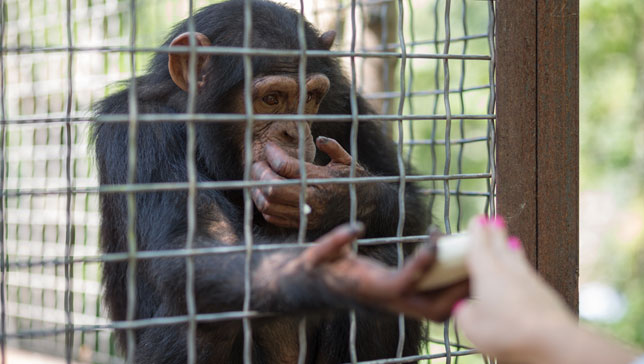
The increasing concern for animals can be seen, for example, in the recent court case where animal-rights advocates sought personhood for chimpanzees. The Nonhuman Rights Project has argued for a writ of habeas corpus — a court order to prevent unreasonable detention — to free a pet chimpanzee named Tommy being kept in a cage in upstate New York.
Meanwhile, views on the treatment of marine or farm animals may have been influenced by popular documentaries such as “Blackfish” and “Food, Inc.,” which sought to expose truths about the treatment of whales at SeaWorld and of farm animals raised for consumption, respectively.
Concerns about the treatment of pets may reflect campaigns to stop cruelty toward these animals by organizations such as the American Society for the Prevention of Cruelty to Animals.
Follow Tanya Lewis on Twitter. Follow us @livescience, Facebook & Google+. This story was originally written for LiveScience and was republished with permission here. Copyright 2015 LiveScience, a Purch company. All rights reserved.
ooOOoo
The MMN article above included a number of links; too many on balance for me to insert in this republication.
So I recommend strongly that if this article strikes a chord of interest with you that you go to this place and check out all the many links.
Published exactly as it was received by me in a recent email.
Dear Fellow Dog Lover,
Because you signed up on our website and asked to be notified, I’m sending you this special recall alert.
On May 27, 2015, PetSmart announced that Himalayan Corporation of Mukilteo, Washington, is recalling specific lots of its Himalayan Ruff Roots All-Natural Dog Chews due to possible metal contamination.
To learn which products are affected, please visit the following link:











 Learning from Dogs