So said Sir Winston Churchill. It applies equally to the price of power.
There was an essay recently written and published by Hariod Brawn over on her blog Contentedness.net that was incredibly thought-provoking and very beautiful besides. Hariod has given me permission to republish it and it follows shortly.
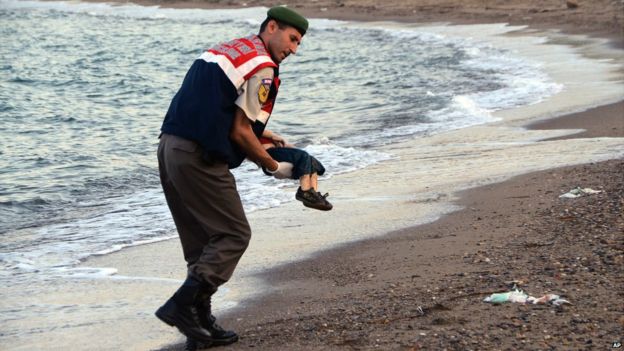
I have no doubt that Hariod’s essay was, in part, inspired by that terrible photograph that has been circulated and commented upon by thousands around the world.
In the words of the BBC, “The pictured boy is reported to be three-year-old Aylan, who drowned along with his five-year-old brother Galip and their mother, Rihan. Their father, Abdullah Kurdi, survived.”
The emotions created by this and other tragic photographs are disturbing, and I am no exception to having those same emotions. But as friend, Chris Snuggs, mentioned in a telephone call between us yesterday morning, what has been happening in Syria is no less terrible, perhaps even more so when one looks at the blood that is, metaphorically, on the hands of a number of western governments. The old saying of reaping what we sow comes to mind.
None of which takes away the intense beauty of Hariod’s essay: Empathetic apes.
ooOOoo
Empathic apes
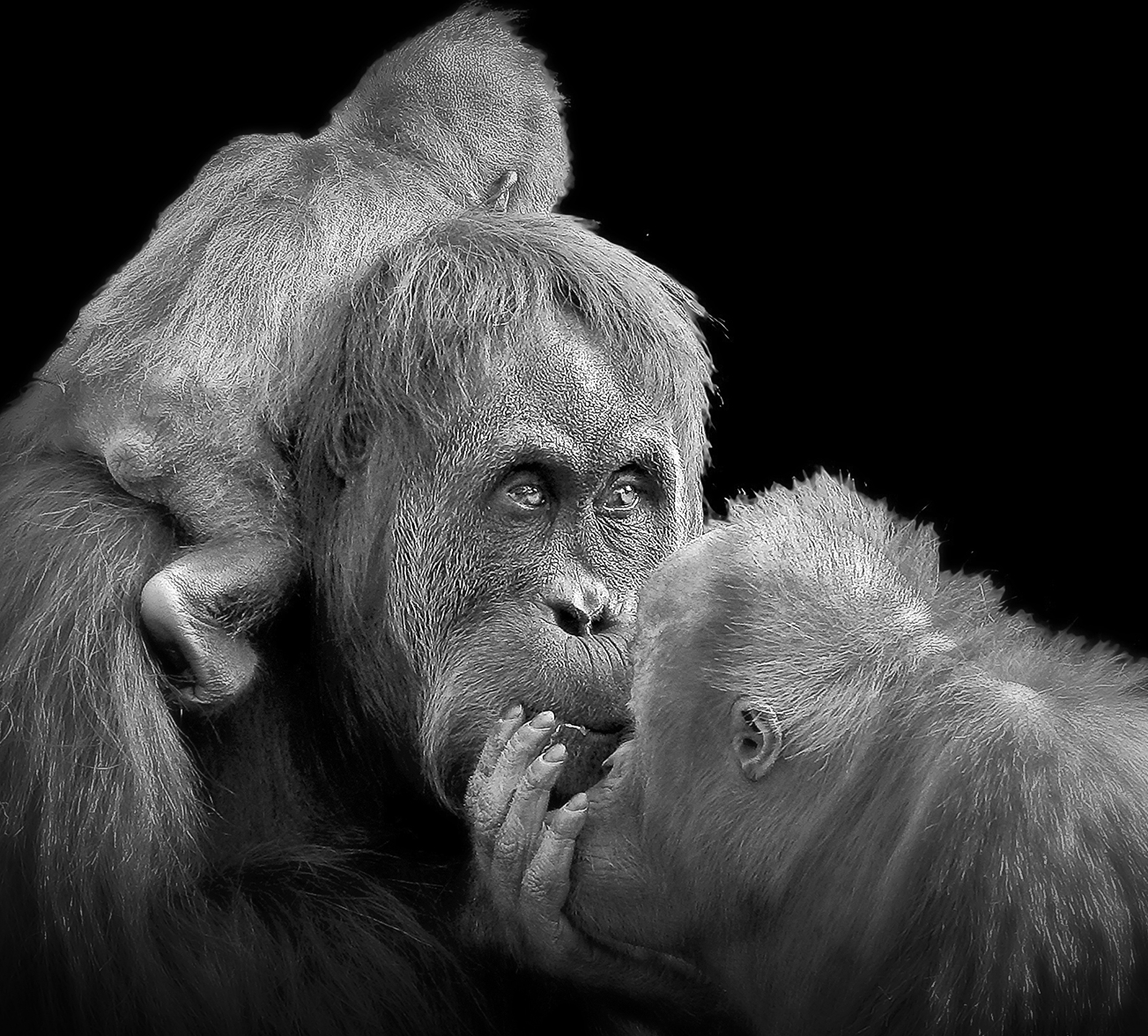
Orangutan mother and kids. By Patrick Bouquet, Chantilly.
The year is 1955, and far from the nearest village, somewhere within the Northwestern jungle region of Thailand, a 48 year-old Englishman and ordainee to the Buddhist monkhood sits quietly in studious attention. A few feet away, a female ape sits, arms carefully wrapped around some precious possession. The monk first chanced upon her the previous day, and due to the curiosity roused in observing her melancholic countenance, has remained respectfully nearby to her. A trust has developed, the ape sensing the monk’s gentle disposition and harmlessness. He really ought to be making his way to the village for alms, yet somehow senses that he should stay. A silent, palpable communication has developed between the two, and slowly, carefully and deliberately, the ape, her sadness still etched upon her face, finally unfolds her arms and offers a first sight of what she has been protecting. The monk slowly approaches to within a pace or two, sensing the invitation, only to catch sight of her lifeless and terribly deformed baby.
Two empathic apes, ancestrally and psychologically speaking, separated by little more in this moment than a distant, lineage-splitting, speciation event. Opposable thumbs, one hers and one his, in turn chase away a monk’s tear and a delicately mottled butterfly as it alights from the baby’s forehead, though cannot do the same for their conjoined feelings. Eyes meet, evincing as they do a deepening rush of sadness. Nothing can be done – is this what she is thinking in her way? In his unknowing, the saffron-robed wanderer radiates compassion, yet knows he has nothing to do with it; an offering from wisdom, not from the self. All that need be known arrives in the fullest of measures. What use now the venerable elder’s sagacity, his knowledge of emptiness, renunciation, equanimity, the void? She inhabits the void, is the void, her bleak knowing piercing its veils. Without turning, the monk slowly retreats, still reverently holding her gaze alongside a shared understanding. A slight suggestion of a bowing head betokens what passes between them.
It is the ability to empathise which in part distinguishes the psychopathic mind from its otherwise healthy state, and the primary orbit of empathy is that of feeling, not the mere gyrations of intellect. This is why many species of sentience can empathise, and we human animals are but one of them. We may erroneously presume that an ability to reflect upon others’ situations facilitates human empathic capacity; yet the state of those others and their situations need not be known as verbally abstracted objects in the mind – little stories packaged in words. We may just as well occupy others’ frames of reference by intuited means; and vitality, morbidity, distress and joy may all be recognised across species in differing ways; one need not indulge any anthropomorphisation, for clear evidence abounds. What is intuited here, or instinctively known, is the nature of the other’s felt emotional condition; and in this way, 60 years ago, the grieving mother ape and mendicant monk shared that intense experience – a wordless world of deep, primate feeling.
Engraving of Orangutan. By Willem Piso (1611-1678). Courtesy Wellcome Trust
Was the mother ape empathic? Well, she came to appreciate the monk’s amity; she felt able to extend trust; she intuited the monk’s concern for her as well as his desire for understanding as to the reasons for, and significance of, her sadness; and finally, she recognised that the monk would feel something of that sadness in revealing its causes to him. This is all to say that she significantly placed herself within the monk’s frame of reference and innately understood that emotions can be matched in shared experience – the personal does not expire at the boundary of the body. Her empathic appreciation was sophisticated, certainly moreso than any psychopathic human ape. Now, one way to cheat the system is to mimic expressions and gestures, which results in a like proprioceptive sense. This means our feelings echo the other’s, so affecting an emotional contagion of sorts, whether volitionally induced or not. Yet neither jungle dweller did so, their empathic link being forged in mind purely intuitively, and silently.
Empathy subsists in knowledge; it is in part to know the mind of the other, and whilst its currency is both cognitive (knowing) and emotional (feeling) in nature, it is the latter that strengthens the connective link to altruistic and prosocial leanings, as well as ameliorating aggressive traits. Primates’ mirror-neuron systems help forge innate empathic leanings, with research suggesting that empathy evolved in part as a survival mechanism. Right now, tens of thousands of refugees are fleeing war-torn regions of Africa and the Middle East so as to seek sanctuary, and survival, in Europe. A few hours ago, a three year-old Syrian boy, Aylan Kurdi, drowned and was washed up on the shores of the Greek island of Kos. Equally tragically, his five year-old brother met a similar fate. Whilst Europe’s politicians exhibit an ongoing empathy gap, innocent children are dying. We live, not literally, though metaphorically, in a jungle, sharing the empathic faculties of the monk and bereaved mother ape. Are we wise enough to nurture the same?
ooOOoo
We need leaders who understand the integrity that is required from them. We need leaders that accept and understand the responsibilities that they have embraced, indivisible from the power that society has lent to them. We need leaders that understand a different aspect of their power, the power of those unanticipated consequences from their actions.
Until we the people understand that electing leaders who do not embrace integrity then Aylan Kurdi and thousands of others in those ‘hot spots’ around the world will continue dying in vain.
Integrity equates to being truthful, to being honest. It doesn’t mean being right all the time, of course not, but integrity does mean accepting responsibility for all our actions, for feeling remorse and apologising when we make mistakes. Integrity means learning, being reliable, being a builder rather than a destroyer. It means being authentic. That authenticity is precisely and exactly what we see in our dogs.
The starting point for what we must learn from our dogs is integrity.
Even before I met Jean back in 2007 and came out from England to be with her in 2008 (with Pharaoh), I had learnt that one of the many joys in having a dog was being able to share so much of one’s life with your loving canine companion.
Thus you will not be surprised in the slightest that walking with your dog is another joyous activity. Plus the benefit of living a few more years, as the following article from Mother Nature News illustrates.
ooOOoo
The secret to adding 7 years to your life
Hint: Get ready to lace up your sneakers.
By: Jenn Savedge, August 31, 2015
Researchers find that just 25 minutes of walking each day can trigger the anti-aging process. (Photo: Nejc Vesel/Shutterstock)
It’s easier than you might think to add another seven years to your life. Researchers have found that adding a simple 25-minute walk to your daily routine could give you several more years of healthy living.
Researchers found that participants in their 50s and 60s who took a brisk daily walk that lasted for at least 25 minutes had half the risk of dying from a heart attack than their couch-potato peers. The study, conducted at Saarland University in Germany, evaluated the health of 69 healthy non-smokers, aged between 30 and 60, who were not regular exercisers before the study began.
Participants were asked to complete various types of daily exercise — from simple aerobics to high-intensity interval training to strength training over a six-month period. Meanwhile, researchers took blood samples that allowed them to measure the increase of telomerase activity and the decrease of senescence markers, two indicators of cellular aging found in the blood. Using these measurements, researchers found that daily aerobic exercise triggers the anti-aging process.
Researchers presented their findings at the European Society of Cardiology conference with the suggestion that people add regular exercise to their daily routine to add years to their lives. They also noted that it’s never too late to start. A 70-year-old woman who has never exercised before can still gain tremendous mental and physical health benefits by adding a brisk daily walk to her routine.
Heart disease is the number one killer of men and women in the U.S. According to the Centers for Disease Control and Prevention, more than 600,000 Americans will lose their lives to the disease this year, but exercise could slash that figure in half, bringing more years to millions of Americans.
Do you have your sneakers laced yet?
ooOOoo
So there you are! Just twenty-five minutes a day with your favourite person and your favourite dog or two and you will all live forever.
Carry on sharing!
Pharaoh in the back of a Piper Super Cub back in 2002. Proving that he loved taxying around the grass airfield but I drew the line at flying – for both our sakes!
P.S. When I showed Jean this post yesterday evening she remarked that I still had, and wore at times, the same green T-shirt and cap that I featured in the photograph above some 13 years ago. I guess I’m not a fashion plate!
Another fabulous lesson we can learn from our dogs.
Stillness. It is a very simple, single word yet, somehow, it sounds as though it belongs to a different age. As though stillness is a very long way from the modern society that millions and millions of us subscribe to.
The dog is the master of being still. Being still, either from just laying quietly watching the world go by, or being still from being fast asleep. The ease at which they can find a space on a settee, a carpeted corner of a room, the covers of a made-up bed, and stretch out and be still, simply beggars belief. Dogs offer us humans the most wonderful quality of stillness that we should all practice. Dogs reveal their wonderful relationship with stillness.
Now watch this entrancing talk from Pico Iyer.
Published on Nov 26, 2014
The place that travel writer Pico Iyer would most like to go? Nowhere. In a counterintuitive and lyrical meditation, Iyer takes a look at the incredible insight that comes with taking time for stillness. In our world of constant movement and distraction, he teases out strategies we all can use to take back a few minutes out of every day, or a few days out of every season. It’s the talk for anyone who feels overwhelmed by the demands for our world.
Why you should listen.
Acclaimed travel writer Pico Iyer began his career documenting a neglected aspect of travel — the sometimes surreal disconnect between local tradition and imported global pop culture. Since then, he has written ten books, exploring also the cultural consequences of isolation, whether writing about the exiled spiritual leaders of Tibet or the embargoed society of Cuba.
Iyer’s latest focus is on yet another overlooked aspect of travel: how can it help us regain our sense of stillness and focus in a world where our devices and digital networks increasing distract us? As he says: “Almost everybody I know has this sense of overdosing on information and getting dizzy living at post-human speeds. Nearly everybody I know does something to try to remove herself to clear her head and to have enough time and space to think. … All of us instinctively feel that something inside us is crying out for more spaciousness and stillness to offset the exhilarations of this movement and the fun and diversion of the modern world.”
What others say
“[Iyer] writes the kind of lyrical, flowing prose that could make Des Moines sound beguiling.” — Los Angeles Times
“Thousands have lived without love, not one without water.”
That sub-heading is a quotation from W. H. Auden and while directed at man it applies to all animal life including our beloved dogs.
The drought that California is experiencing is world-wide news but, possibly, the fact that this drought extends to much of the Pacific West Coast on the United States is not as widely known.
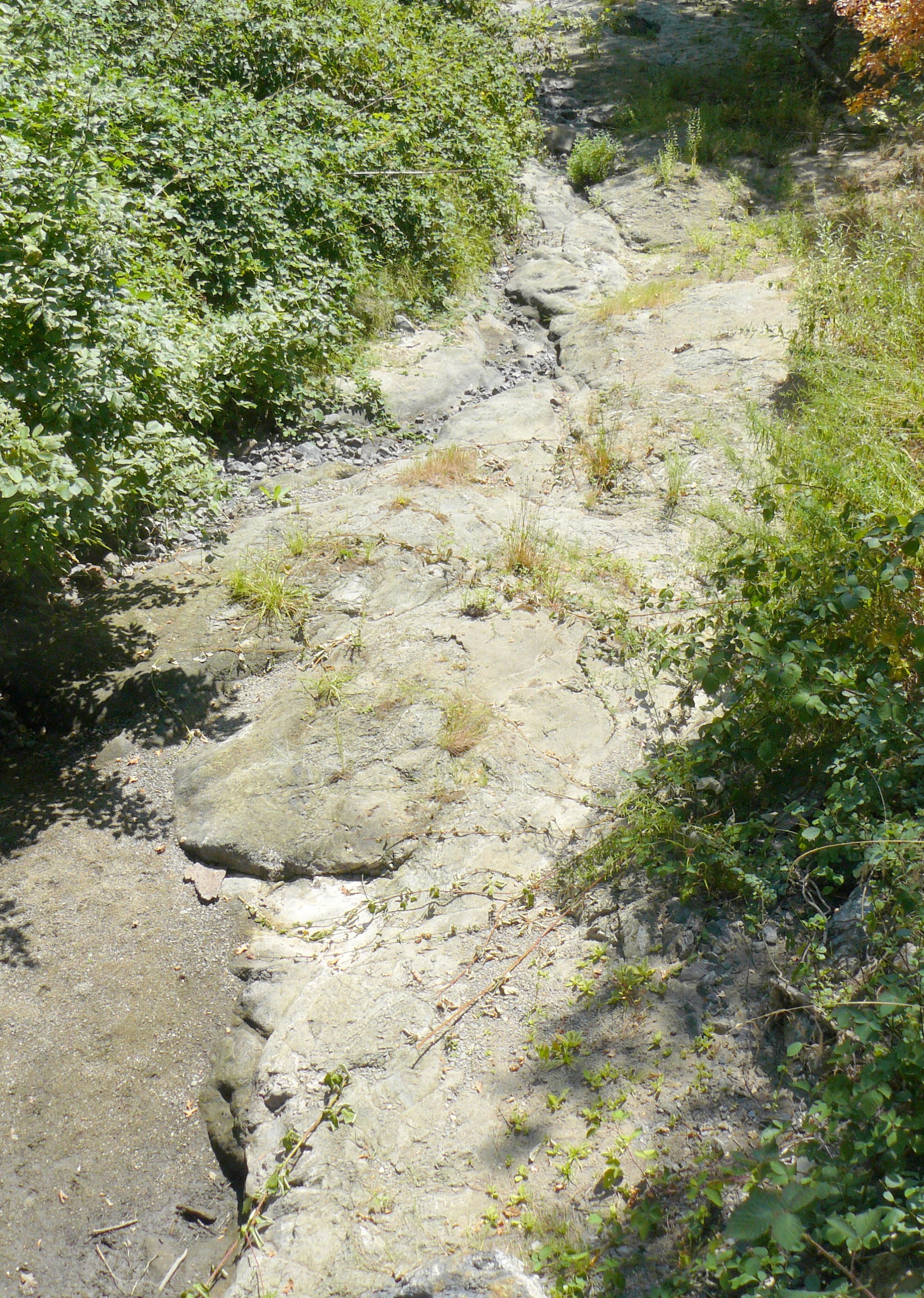
Here in Merlin, Southern Oregon, our own ‘all-year’ creek, Bummer Creek, that flows through our property has been dry for about two weeks. Our grass fields are parched brown and many of the trees are signalling a shortage of water. And let’s not even think about the underground aquifer that supplies our drinking water.
All of which makes a sombre introduction to a recent essay over on TomDispatch, republished here with the very kind permission of Tom Engelhardt. (But see my note at the end of the essay.)
ooOOoo
Tomgram: William deBuys, Entering the Mega-Drought Era in America
Posted by William deBuys at 4:17pm, August 16, 2015.
The other day here in New England it was chilly, rainy, and stormy and I complained. Where was the sun? The warmth? The summer? I happened to be with someone I know from California and he shook his head and said, “It’s fine with me. I like it rainy. I haven’t seen much rain in a while.” It was a little reminder of how insular we can be. California, after all, is in the fourth year of a fearsome drought that has turned much of the North American West, from Alaska and Canada to the Mexican border, into a tinderbox. Reservoirs are low, rivers quite literally drying up, and the West is burning. In rural northern California, where the fires seem to be least under control, the Rocky Fire has already burned 109 square miles and destroyed 43 homes, while the Jerusalem Fire, which recently broke out nearby, quickly ate up almost 19 square miles while doubling in size and sent local residents fleeing, some for the second time in recent weeks.
Fires have doubled in these drought years in California. The fire season, once mainly an autumnal affair, now seems to be just about any day of the year. (This isn’t, by the way, just a California phenomenon. The latest study indicates that fire season is extending globally, with a growth spurt of 18.7% in the last few decades.) In fact, fire stats for the U.S. generally and the West in particular are worsening in the twenty-first century, and this year looks to be quite a blazing affair, with six million acres already burned across the region and part of the summer still to go. And here’s the thing: though “I’m not a scientist,” it’s pretty hard at this point not to notice — though most Republican candidates for president seem unfazed — that this planet is heating up, that today’s droughts, bad as they are, will be put in the shade by the predicted mega-droughts of tomorrow, and that the problem of water in the American West is only going to deepen — or do I mean grow shallower? TomDispatch regular William deBuys, an expert on water in that region and author of A Great Aridness: Climate Change and the Future of the American Southwest, has already written dramatically of a future “exodus from Phoenix.” For clues to what we will all experience sooner or later, he now turns to California, that bellwether state in which, as he writes, the future always seems to play itself out first. Tom
California First
As Both Climate Victim and Responder, the National Style-Setter Leads the Way
By William deBuys
Long ago, I lived in a cheap flat in San Francisco and worked as the lone straight man in a gay construction company. Strangely enough, the drought now strangling California brings back memories of those days. It was the 1970s. Our company specialized in restoring the Victorian “gingerbread” to the facades of the city’s townhouses, and I got pretty good at installing cornices, gable brackets, and window hoods, working high above the street.
What I remember most, though, is the way my co-workers delighted in scandalizing me on Monday mornings with accounts of their weekend exploits.
We were all so innocent back then. We had no idea of the suffering that lay ahead or of the grievous epidemic already latent in the bodies of legions of gay men like my friends, an epidemic that would afflict so many outside the gay community but was especially terrible within it.
It’s unlikely that many of those guys are alive today. HIV was already in the population, although AIDS had yet to be detected or named, and no one had heard of “safe sex,” let alone practiced it. When the epidemic broke out, it was nowhere worse than in trendsetting San Francisco.
By then I had returned to New Mexico, having traded my hammer for a typewriter. When I announced my intention to leave California, the guys all said the same thing. “Don’t go back there,” they protested. “You’ll just have to go through all of this again!”
All of this required no translation. It meant the particular newness of life in that state, which was always sure to spread eastward, as Californian styles, attitudes, problems, tastes, and fads had been spreading to the rest of the country almost since the days of the Gold Rush.
Hippies, flower power, bikers, and cults. The movies we see and the music we listen to. The slang we pick up (I mean like, what a bummer, dude). Wine bars and fern bars, hot tubs and tanning booths, liposuction and boob jobs. The theft of rivers (Forget it, Jake. It’s Chinatown) and the theft of baseball teams (Brooklyn still mourns). Gay rights, car culture, and the Reagan Revolution. Scientology, mega-churches, Buddhist chic, and exercise videos. If they didn’t actually start in California, they got big and came to national attention there. Without the innovations of Silicon Valley, would you recognize your mobile phone or computer? Would you recognize yourself?
It’s the same with climate change. California in the Great Drought is once again Exhibit A, a living diorama of how the future is going to look for a lot of us.
And the present moment — right now in 2015 — reminds me of San Francisco as the AIDS epidemic broke out. Back then we had no idea how bad things were going to get, and that is likely to be true now, as well. As usual, California is giving us a preview of our world to come.
The Arrival of the Bone-Dry New Normal
On the U.S. Drought Monitor’s current map, a large purple bruise spreads across the core of California, covering almost half the state. Purple indicates “exceptional drought,” the direst category, the one that tops both “severe” and “extreme.” If you combine all three, 95% of the state is covered. In other words, California is hurting.
Admittedly, conditions are better than at this time last year when 100% of the state was at least “severe.” Recent summer rains have somewhat dulled the edge of the drought, now in its fourth year. Full recovery, however, would require about a foot of rain statewide between now and January, a veritable deluge for places like Fresno, which in good times only get that much rain in a full year.
To be clear, the current drought may not have been caused by climate change. After all, California has a long history of periodic fierce droughts that arise from entirely natural causes, some of them lasting a decade or more. Even so, at a minimum climate change remains a potent factor in the present disaster. The fundamental difference between California’s current desiccation and its historical antecedents is that present conditions are hotter thanks to climate change, and hotter means drier since evaporation increases with temperature. Moreover, the relationship between the two is non-linear: as temperature creeps up, evaporation gallops. Bottom line: the droughts of the future will be much more brutal — and destructive — than those of the past.
California is already on average about 1.7° Fahrenheit hotter than a century ago, and its rate of warming is expected to triple in the century ahead. The evaporative response to this increase will powerfully amplify future droughts in unprecedented ways, no matter their causes.
Throughout the state, draconian cutbacks in water use remain in force. Some agricultural districts are receiving 0% of the federally controlled irrigation water they received in past years, while state water deliveries are running at about 15% of normal.
Meanwhile, a staggering 5,200 wildfires have burned in the state’s forests and chaparral country this year, although timely rains everywhere but in the northern parts of California and the rapid responses of a beefed-up army of firefighters limited the burning to less acreage than last year — at least until recently. The blow-up of the Rocky Fire, north of San Francisco, in the early days of August — it burned through 20,000 acres in just a few hours — may change that mildly promising statistic. And the fire season still has months to go.
So how is this a trendsetter, a harbinger for lands to the east? California’s drought is deep and long — we don’t yet know how long — and the very long-term forecast for an immense portion of western North America, stretching from California to Texas and north to South Dakota, is for a future of the same, only worse. Here is the unvarnished version of that future (on which an impressive number of climate models appear to agree) as expressed in a paper that appeared in Science Advances last February: “The mean state of drought in the late 21st century over the Central Plains and Southwest will likely exceed even the most severe mega-drought periods of the Medieval era in both high and moderate emissions scenarios, representing an unprecedented fundamental shift with respect to the last millennium.”
Let’s unpack that a little bit: principal author Benjamin Cook of NASA and his colleagues from Columbia and Cornell universities are saying that climate change will bring to the continent a “new normal” more brutally dry than even the multiple-decades-long droughts that caused the Native American societies of Chaco Canyon and Mesa Verde to collapse. This, they add, is now expected to happen even if greenhouse gas emissions are significantly lowered in the decades to come. The impact of such droughts, they conclude, will exceed the bounds of anything known in the history of the continent or in its scientifically reconstructed pre-history.
In other words, the California drought of recent years offers only a foretaste of what is to come. Incidentally, Cook, et al. are by no means outliers in the literature of climate prediction. Other important studies with similar forecasts support a steadily broadening consensus on the subject.
And North American droughts will have to compete for attention with countless other climate change impacts, especially the hundreds of millions of refugees worldwide who will be put into motion by rising sea levels and other forces that will render their present homes unlivable.
A User’s Guide to Climate Change
If California points the way to dry times ahead, it also gives us an early glimpse of how a responsible society will try to live with and adjust to a warmer future. The state has imposed stringent new limits on water use and is actively enforcing them, and in general, individual consumers have responded positively to the new requirements, in some cases even exceeding mandated conservation goals.
In a similar spirit, the state has augmented its wildland fire-fighting capacity to good effect, even as the fire danger has approached levels never before seen.
Perhaps most impressively the state has adopted its own pioneering cap-and-trade program aimed at rolling back total greenhouse gas emissions to 1990 levels. Under cap-and-trade, carbon polluters have to obtain permits to continue their emissions, and only a finite number of such permits are made available. A coal-burning power plant or a refinery has to buy its permit from the state or from another company that already has one. This way, a ceiling is established for total greenhouse gases emitted by the most energy-intensive sectors of the economy.
Although the jury may still be out on how well the program meets its goals, there is no debating its positive impact on the state treasury. In the fiscal year just begun, the auction of permits under California’s cap-and-trade program will net approximately $2.2 billion, a windfall that will be spent on mass transit, affordable housing, and a range of climate-adaptation programs. And by the way, the warnings of nay-sayers and climate deniers that cap-and-trade would prove a drag on the economy have proved groundless.
In a manner similar to the U.N.’s prestigious Intergovernmental Panel on Climate Change, California now publishes an assessment every three years of both its vulnerability to climate change and the steps it plans to take to mitigate or adapt to its effects. The report is a model of its kind and draws on copious California-specific scientific research, some of which is funded by the state.
You might think California’s neighbors would follow suit, and eventually, as with most things Californian, they undoubtedly will. If President Obama’s just-announced “Clean Power Plan” withstands the expected court challenges, it will prove a powerful spur in that direction as it mandates state-by-state reductions in power plant carbon emissions that will, in the end, drive them 32% below 2005 levels. Many states will undoubtedly have to adopt cap-and-trade systems in order to comply. As they set about devising their own programs, where do you think they will look for a workable example? You guessed it: California.
An “Island” Again, or Nearly So
In the seventeenth century, Spanish cartographers thought California was an island separated from the rest of North America by the legendary Straits of Anian. In some ways, nothing has changed. In late July, while California Governor Jerry Brown was at the Vatican joining Pope Francis in calling for urgent global action to combat climate change, his opposite numbers across the putative straits continued to assume the posture of startled ostriches.
Doug Ducey, the Republican governor of Arizona, admits that the climate may indeed be changing but doubts that humans play a causal role in it. Susana Martinez of New Mexico, also a Republican, continues to insist that climate science is inconclusive, while former governor of Texas and current presidential candidate Rick Perry adamantly remains “not a scientist,” although he knew enough to inform us in his 2012 campaign screed Fed Up that climate change science is “a contrived phony mess.”
In general, when it comes to climate change, the leadership of statehouses across the country remains as troglodytic as the House of Representatives. Only in Hawaii, Oregon and Washington on the West Coast, Minnesota in the Midwest, and a handful of Northeastern states will governors even acknowledge the importance of acting to curb climate change as well as adapt to it.
This year, the deniers may get a boost from an unlikely source. Warm surface waters seem to be brewing something special in the Pacific Ocean. Says one researcher, “The El Niño event currently ongoing in the eastern and central Pacific is strengthening. The only question is whether it will be just a significant event, or a huge one.”
El Niño draws the winter Pacific storm track southward, bringing precipitation to southern California, Arizona, and points eastward. If the southern tier of states has a wet winter, the Republican rain-dancers will feel confirmed in their official doubt and denialism, much as a broken clock is right at least twice a day.
Occasional El Niños, however, will not avert the long-term new normal for California and much of the West. As that state is showing, adaptation will soften some of the blows, and possibly, if we act soon enough and strongly enough, we may manage to cap the overall changes at some still livable level. The jury will be out on that for quite some time.
Meanwhile, as in pre-AIDS San Francisco, we are all still in a state of at least semi-innocence. Maybe we can imagine in an intellectual way what it might be like to lose the forests across half of the continent, but can any of us conjure the feeling of how that would be?
After many missteps and halting starts, the medical and public health establishments finally came to the assistance of the victims of AIDS. As difficult as that was, it was easy compared to the remedies climate change will demand. And for much of the damage there will be no remedy. Get ready.
William deBuys, a TomDispatch regular, is the author of eight books, the most recent of which is The Last Unicorn: A Search for One of Earth’s Rarest Creatures. He has written extensively on water, drought, and climate in the West, including A Great Aridness: Climate Change and the Future of the American Southwest.
Follow TomDispatch on Twitter and join us on Facebook. Check out the newest Dispatch Book, Nick Turse’s Tomorrow’s Battlefield: U.S. Proxy Wars and Secret Ops in Africa, and Tom Engelhardt’s latest book, Shadow Government: Surveillance, Secret Wars, and a Global Security State in a Single-Superpower World.
Copyright 2015 William deBuys
ooOOoo
Again, there are far too many links for me to bring across to this republication but I do recommend that if you have an extra special interest in William deBuys essay that you check through all the links in the original version to be read here.
We have a guest staying with us for twenty-four hours and the last thing I wanted to do was to spend time at a keyboard composing a new post for today.
So just for fun, I thought of reposting what appeared on this blog five years ago: August 18th, 2010.
It’s almost unimaginable that Planet Earth could go the same way. Then again, anyone over the age of, say 60, would find where we are today, in terms of mankind’s long-term survival, equally unimaginable from how the world looked 40 years ago.
This is a TED video presented by Will Marshall. A quick web search reveals that Will Marshall is:
Co-founder & CEO of Planet Labs.
Planet Labs is helping share near-real-time images of our planet, from a constellation of earth-observing satellites.
In his Twitter bio, William Marshall calls himself a “quantum physicist cum space scientist in search of world peace and harmony.” And when you hear about his job, it falls into place: he and his cofounders at Planet Labs want to show the earth what it looks like, almost real time, via a new network of compact, capable satellites. They hope that up-to-date images will inform future humanitarian and commercial projects all over our planet; it will enable people to make decisions that enable us to take care of our dearest spaceship, spaceship earth.
Before co-founding Planet Labs, Marshall was a scientist at NASA/USRA, where he helped to formulate the Small Spacecraft Office at NASA Ames Research Center. He worked on lunar orbiter mission LADEE, lunar impactor mission LCROSS and the groundbreaking PhoneSat project, building satellites out of consumer parts.
It was only a couple of mouse clicks to find the website for Planet Labs.
All of which is my way of introducing the TED video but not before thanking next door neighbour Larry Little who emailed me the link to the video.
Published on Nov 18, 2014
Satellite imaging has revolutionized our knowledge of the Earth, with detailed images of nearly every street corner readily available online. But Planet Labs’ Will Marshall says we can do better and go faster — by getting smaller. He introduces his tiny satellites — no bigger than 10 by 10 by 30 centimeters — that, when launched in a cluster, provide high-res images of the entire planet, updated daily.
Another example of the fabulous ways in which blogging connects people.
In the last twenty-four hours, Learning from Dogs has attracted a new follower. As always, I went across to this person’s blogsite and left a ‘thank you’ note. I loved what I saw because the blogsite was called Wolves of Douglas County Wisconsin authored by Rachel Tilseth. Better than that, there were a number of posts that I know LfD readers would enjoy very much.
Let me offer you an example of what you will find over on Rachel’s blog: Compassionate Conservation. Republished here with Rachel’s kind permission (but see my note at the very end of the post).
ooOOoo
Compassionate Conservation
When I think of compassionate conservation several well known conservationists, scientists, and psychologists come to mind. On a scale one to ten Dr. Jane Goodall, Joy Adamson, Bill Travers and Virginia McKenna, and Marc Bekoff Ph.D all rate in the top ten for their compassionate ideals and work regarding wild animals. I believe that it is wrong for humankind to kill off one species to save another because it is not acting in the best interests of wild animals and the ecosystems they support.
In a recent Facebook post on Todd Wilkinson’s timeline I was alerted to a column by Dr. Marc Bekoff on the subject of ‘compassionate conservation’ and decided to post Beckoff’s thought provoking article on my blog.
The broad and interdisciplinary field of conservation biology(link is external) has received a good deal of attention in the past two weeks that has stimulated researchers and others to weigh in on what sorts of human-animal interactions are permissible as we try to save nonhuman animals (animals) and their homes. For example, some of the challenging questions that arise are: Should we kill in the name of conservation? Is it okay to trade off the lives of animals of one species for the good of their own or other species? Is seeking the “most humane” way of killing animals the only way to move forward? Is it possible to stop the killing of other animals and factor compassion that centers on the lives of individuals into our decisions? Should we try a “hands off” policy to see if it works where it’s clear our interference, despite our best intentions, has not solved the problems at hand? How do we factor in the interests of other animals and humans as we deal with the numerous — and growing — challenging and frustrating conflicts at hand? The field of anthrozoology (link is external) focuses on these and other questions.
Clearly, there are going to be differences among the people who are trying to save other animals and their homes and also take into account the interests of humans. And, this is what makes the field of conservation biology so exciting, for we are the only animals who are able to do what needs to be done to reverse the rather dismal and depressing situations in which humans and other animals find themselves in conflict. It goes without saying that the major problem is that there are too many humans and if we don’t stop making more of us it’s going to be a long and hard battle to right the wrongs for which we are responsible. And, given all of the information that is currently available, I like to call attention to a quote from William Wilberforce sent to me by Sadie Parr of Wolf Awareness(link is external), “You may choose to look the other way but you can never say again that you did not know. (link is external)”
Compassionate conservation comes of age
A recent meeting that centered on the rapidly growing international field called compassionate conservation (link is external) brought people together from all over the world, all of whom are trying to reduce or eliminate human-animal conflict. The conference was sponsored and coordinated by the Born Free Foundation (link is external) and the Centre for Compassionate Conservation(link is external) at the University of Technology, Sydney and hosted by the Animal Welfare Program(link is external) at the University of British Columbia (for more on compassionate conservation please click here, here (link is external), and here (link is external)). A most exciting part of the meetings was the presence of numerous students and young researchers. And, also very stimulating, were the obvious differences of opinion — the expected shades of gray — in what is possible and what methods are permissible as we try to deal with rampant and growing global human-animal conflicts. Some people argued that in the “real world” the “most humane” ways of killing are the only ways forward, whereas others argued that compassionate conservation is not about the “most humane” way of killing, but rather centers on stopping the killing because it is unethical and in many instances it really hasn’t worked. For them, individual animals are the focus of concern and the guide for compassionate conservation and “First do no harm (link is external)” means not harming or killing other animals “in the name of conservation.”
There also was very valuable discussion of the words people use to refer to the killing of otherwise healthy animals “in the name of conservation,” with the recognition that it is not euthanasia, or mercy-killing, but rather “zoothanasia” when it’s done in zoos or slaughter when done in other situations (please see “Animal ‘Euthanasia’ Is Often Slaughter: Consider Kangaroos“). Also of interest was the use of the word “pests” to refer to animals who are causing problems. Many agreed that it’s humans who are the pests, but because we can dominate and control other animals, they pay the price for just doing what comes naturally for them but is bothersome for us.
Clearly, there were many valuable discussions, and the abstracts of the broad array of papers that were presented can be seen here (link is external). They are a goldmine of information on the broad topics that were covered, the numerous different species discussed, and anthrozoologists should them to be indispensable for future studies of human-animal relationships. We learned that many wild animals really aren’t free (Yolanda Pretorius of the Centre for Wildlife Management at the University of Pretoria told us that elephants in South Africa are fenced and can’t migrate) and that “methods to assess the well-being of elephants are not included as a requirement for developing an elephant management plan.” Moles are ruthlessly killed in the UK because they destroy gardens and in many locations geese are killed because they poop on golf courses. We take away the geese’s habitats and then we kill them because they have nowhere else to go.
We also learned in a paper by MarÍa Fàbregas and G. M. Koehler of Save China’s Tigers(link is external) that in order to reintroduce critically endangered captive South China tigers back to restored protected areas within their historic range in China, they are allowed to practice killing ungulates. Many people were rather concerned with this practice, and it reminded me of breeding golden hamsters to allow endangered black-footed ferrets to practice killing them before being released into wild habitat. For many, these sorts of trade-offs are unacceptable.
In another project that was the focus of discussion, almost 900 wolves and other non-target animals were killed in Alberta, Canada (please also see and and), to try to save woodland caribou (it didn’t work) and not only were families broken up but there also are trans-generational effects. Simply put, far too many other animals are harmed or killed because we move into their homes and they have nowhere else to go and thus, they, innocent victims, become the “problems.” It’s a no-win situation for millions of other animals and we need to do much better so the killing stops.
Compassionate conservation meets Cecil the slain lion
It was also rather timely, and of course incredibly sad, that news about the thoroughly unnecessary killing of Cecil the lion(link is external) by Walter Palmer (please also see the numerous articles listed here (link is external) and Jennifer Jacquet’s “The Shaming of Walter Palmer (link is external)“) was making world-wide headlines as the meeting got under way. A few of us received requests for interviews the first morning of the meeting and Cecil was the topic of conversation at a number of talks and also at the coffee breaks, as was Marius, the young giraffe who was mercilessly killed at the Copenhagen Zoo in February 2014, because he didn’t fit into the zoo’s breeding program. Marius us a classic case of an animal who was zoothanized, not euthanized, as claimed by zoo administrators.
Many people are interested in the status and fate of African lions and as I was writing this essay I came across a review of a book called Lions in the Balance: Man-Eaters, Manes, and Men with Guns(link is external) by world renowned lion researcher Dr. Craig Packer(link is external) (the Kindle edition can be found here(link is external)). In the review by Iris Barber(link is external) called “Lions in the Balance: Can hunting save the kings of the jungle?” we learn that Dr. Packer argues, “‘Lions need trophy-hunting just as much as trophy-hunting needs lions.’ His plan: kill only male lions over the age of 6, so cubs aren’t killed by a lion mating with their mother who seeks to safeguard his own progeny. This is a fresh approach to conservation, where hunting is essential to survival.”
While numerous compassionate conservationists would argue against killing lions, when experts like Dr. Packer speaks, it’s highly worthwhile to listen carefully because it makes clear just how complex the issues are. As the book’s description notes, “Packer is sure to infuriate millionaires, politicians, aid agencies, and conservationists alike as he minces no words about the problems he encounters. But with a narrative stretching from far flung parts of Africa to the corridors of power in Washington, DC, and marked by Packer’s signature humor and incredible candor, Lions in the Balance is a tale of courage against impossible odds, a masterly blend of science, adventure, and storytelling, and an urgent call to action that will captivate a new generation of readers.”
Putting an end to dancing bears: All stakeholders count
Another tenet of compassionate conservation is that all stakeholders count, human and nonhuman. Of course, this is very challenging because various animals kill or harm humans or kill or harm animals on whom the livelihoods of humans and their communities depend. In an earlier essay I wrote about two projects in India that stress peaceful coexistence between humans and nonhumans who harm and kill the humans and destroy their businesses. Another excellent example of a project that took into account the interests of humans and nonhumans centered on putting an end to the use of dancing bears, discussed by Kartick Satyanarayan and Geeta Seshamani of the organization Wildlife SOS, India (link is external). The abstract for their talk reads as follows:
“Wildlife SOS spearheaded a conservation success story in India by resolving the barbaric dancing bear practice in which sloth bear cubs were poached from the wild, brutally trained in inhumane ways and spent their short tragic lives at the end of a four foot rope dragged through towns and villages to earn for the indigent, nomadic community called the Kalandars. Wildlife SOS’s initiative was to both rehabilitate the sloth bears held in captivity and the Kalandars themselves in alternative livelihoods. This in turn made a huge difference to the sloth bear population in the wild helping in its conservation.
“Compassionate Conservation and sustainability of wildlife and forests was the focus of the program which is still ongoing. Wildlife SOS also works with human-animal conflict situations similarly aiming for compassionate conservation and rehabilitation measures which educate the stakeholders, such as the villagers or dwellers around a forested area, in avoidance behavior.
“The education awareness programs are run in Maharashtra where the conflict species is the leopard and in Kashmir where the conflict species is the black bear and in Delhi and Agra the program deals with the rhesus macaque which seems to be the species humans have declared war on. Attempts at resolution involve creating safe spaces for the animals (rehabilitation centres) teaching people behaviours which do not lead to confrontation with the animals in question (awareness and education) but most importantly to inculcate a feeling for the animals in question emphasizing adjustment and acceptance of the existence of wildlife close to our human habitations. Our work with captive elephants is yet another conservation attempt at bringing down an ancient Indian traditional bastion that emphasizes training elephants using pain, fear and physical abuse by replacing it with compassion.
“Our training school – the kindness school provide straining to elephant keepers on modern and humane elephant management systems, compassionate handling, replacing negative management with positive reinforcement. However conservation also demands use of the law so the Wildlife SOS Anti-Poaching enforcement unit works to gatherintelligence on wildlife traffickers and smugglers and enforces the law working in partnership with the Indian Government.
“Compassionate conservation is the key to the future ahead of us.”
Another wonderful project in which human and nonhuman interests were taken into account and satisfied was concerned with how to deal non-lethally with “problem” raccoons at a fast food restaurant in Vancouver. Dr. Sara Dubois, who works with theBritish Columbia SPCA (link is external), outlined various strategies for coming to terms with urban “pests.” She noted, “The overall goal of developing humane standards for nuisance wildlife control is to create an educational and enforcement tool, setting a higher bar for control measures, whether they are done for conservation or nuisance purposes.”
The coming of age of compassionate conservation: It’s a “sad bad” if killing is the only viable option for “peaceful” coexistence
The field of compassionate conservation is slowly coming of age and it’s essential that all opinions come to the table to be discussed. Ethicist Bill Lynn, who supported the experimental humane killing of a few thousand barred owls to try to save endangered snowy owls, called this practice a “sad good.” While it may be a “sad good” for the snowy owls, it’s surely not for the slaughtered barred owls. I would call it a “sad bad” for the barred owls and many other animals if killing remains the only option. A “sad good” is a very slippery slope that sets a lamentable precedent for opening the door for the more widespread “experimental killing” of barred owls and other species just to see if it works.
Compassionate conservation requires a large change in heart and practices, and like any other revolutionary paradigm shift it will take time. Many hope that this most needed paradigm shift in conservation biology that entails stopping the killing “in the name of conservation” will endure its growing pains as more and more researchers and others realize that killing is not the answer. I hope those who see the “real world” as mandating killing will change their minds and hearts. Future and young researchers are critical to the development and implementation of compassionate conservation, as are those careerconservation officers, zoo administrators, and researchers who come to realize that using “the most humane killing” is not what compassionate conservation is all about. I like to imagine a world where killing is no longer part of the conservationist’s toolkit. The welfarist calculus patronizes other animals and when push comes to shove, or often when it’s merely convenient, the nonhumans suffer and are killed when it’s determined that the benefits to humans outweigh the costs to the animals.
It’s time to put away the guns, the traps, the snares, the poisons, and other “weapons of mass destruction” (as a few attendees called them) and figure out how to live in peaceful coexistence with the fascinating animals with whom we’re supposed to share our most magnificent planet. There does not have to be blood. I dedicated my talk to Cecil the lion and also to Bryce Casavant, a most courageous conservation officer who refused to kill two black bear cubs (link is external) near Port Hardy on northern Vancouver Island and was suspended because he said “no.” More people simply have to say “no” to killing other animals. We need to stop the violence and recognize that “The world becomes what we teach (link is external).” Compassion begets compassion and violence begets violence. By rewilding our hearts (link is external) and by becoming re-enchanted and reconnecting with nature I like to think that the killing will come to an end, slow as it may be.
If some people argue the killing cannot stop, it will not stop. It saddens me to think that we’ve gotten to the point where for some, killing is the only viable option for peaceful coexistence. Shame on us. As Kartick Satyanarayan and Geeta Seshamani concluded, “Compassionate conservation is the key to the future ahead of us.” I couldn’t agree more. We need to leave our comfort zones and think and act “outside of the box.”
The next meeting that will focus on compassionate conservation is slated for 2017 in Sydney, Australia. I often say that compassionate conservation is a wonderful meeting place for people who would otherwise not, but should, meet. This was so in Vancouver and I anticipate this will be the case in Sydney. Please stay tuned for more information on this future gathering and the exciting, challenging, and forward-looking field of compassionate conservation in general.
Note: I just learned of an essay titled “Mutant Animals Bred to be Brutally Killed by Hunters(link is external)” in which the person offering up these freaks outlandishly claims, “Conservation is a by-product of what I do.”
Marc Bekoff’s latest books are Jasper’s story: Saving moon bears (with Jill Robinson), Ignoring nature no more: The case for compassionate conservation, Why dogs hump and bees get depressed, and Rewilding our hearts: Building pathways of compassion and coexistence. The Jane effect: Celebrating Jane Goodall (edited with Dale Peterson) has recently been published. (marcbekoff.com; @MarcBekoff)
As Rachel points out in an earlier paragraph, the bulk of this essay was published by Marc Bekoff and I included the links in the third paragraph back to Marc’s essay.
However, Marc’s essay, via Rachel’s post, had a very great number of links including the many ‘link is external’ references and, sadly, far too many for me to enter in this reposting. So if you are curious about any aspect of Rachel/Marc’s essay then please re-read it here where all the links will be available to you.
Jean and I were out for much of yesterday resulting in me not sitting down to compose today’s post until nearly 5pm (PDT) in the afternoon. I must admit I didn’t have a clue as to what to write about. Then sitting in my email inbox was another email from Chris Gomez with this short but valuable sentence, “Love is real….Check this out! (via ABC7 Los Angeles local news iOS app) Study reveals scientific reason your dog is happy to see you.” Chris included a link to the ABC7 news item. I’m republishing it here.
ooOOoo
STUDY REVEALS SCIENTIFIC REASON YOUR DOG IS HAPPY TO SEE YOU
A new study explains why your dog gets so happy to see you. (Shutterstock)
Tuesday, August 11, 2015 11:04AM
Is your dog overwhelmed with joy anytime you walk through the door? There’s a scientific reason behind their excitement, a new study shows, and it’s not just because you feed them.
Researchers at Emory University used functional magnetic resonance imaging (fMRI) to scan dogs’ brains for activity when they were shown images of dog faces, human faces and ordinary objects.
The dogs’ temporal lobes lit up “significantly more” when presented with the faces than with the objects. These findings suggest that dogs may recognize both human and dog faces.
Facial recognition causes dog brains to activate in the same areas as in monkey and human brains, the study found. This is separate from the “reward areas” that would be triggered by anticipation of food.
“What we’re finding with the imaging work is that dogs love their humans-and not just for food,” researcher Gregory Berns told io9. “They love the company of humans simply for its own sake.”
“The existence of a face-selective region in the temporal dog cortex opens up a whole range of new questions to be answered about their social intelligence,” the researchers explained, such as whether dogs can understand different facial expressions and whether they can read body language.
This isn’t the first time scientists have explored what makes dogs’ tails wag with excitement when reunited with their owners. A January study that Berns was also involved in found that dogs have a positive reaction to the scent of familiar humans compared with other smells, even those of other dogs.
The results of that study “suggested that not only did the dogs discriminate that scent [of familiar humans] from the others, they had a positive association with it.”
A 2013 behavioral study found that dogs can show when they’re happy to see their owners by lifting their eyebrows. Their left eyebrow went up when they saw their respective owners, the study found. They didn’t have this reaction for other things that may excite them, such as attractive toys.
ooOOoo
Granted there was some overlap with Monday’s post but there was more than enough in the ABC7 article to warrant sharing it with you.
(I’m conscious that many recent posts have been more of me republishing stuff than being creative on my own account. Blame it on ‘the book’: my first edit is now complete and the next stage is sending the manuscript out to those who have volunteered to proof-read the book.)
I saw this article on Mother Nature Network and it struck me immediately as being full of common-sense and well worth sharing with you.
ooOOoo
How to build the perfect backyard for dogs
Learn which plants are hardy, which are poisonous, and how to create a beautiful but functional layout.
Designing your garden with your dog in mind will prevent an infinite number of headaches down the road. (Photo: upixa/Shutterstock)
A dog and a healthy, beautiful backyard don’t often go hand in hand. The amount of wear and tear a dog throws at a garden can leave it in tatters. But it doesn’t have to be this way! With a bit of planning and a careful selection of plants able to hold up to whatever dogs spray at them, your backyard can be both a haven for humans and a paradise for your pups.
Here are helpful strategies for planning out a yard and a list of plants to use or to avoid.
7 tips for dog-friendly garden design
Build raised beds for the more sensitive plants or for any fruits and vegetables you may want to grow. Add in some fencing or netting around the boxes to protect them if your dog is still tempted to hop up and snoop around in them.
Build a dog-friendly path around the yard. This will guide your dog through the garden and minimize the detours into the flowerbeds. You may want to start by watching where your dog goes on his own, and creating the path along that route. That way you aren’t trying to train your dog to go somewhere he doesn’t normally want to go, and you aren’t frustrated when your dog goes where he wants to anyway.
Providing pathways for your dogs will show them where they’re allowed to run and will help keep them out of more sensitive areas of the garden. (Photo: Julius Elias/Shutterstock)
Discourage digging through design. If your dog sometimes digs holes, you can help keep your garden beds safe by making them raised beds. However, if your dog is a relentless digger and no part of the yard is safe, then consider building an area where your dog can do anything he’d like within that space, including dig. This could be a fenced area that has a sand box, where the outlet of digging is welcomed.
Create a designated area for bathroom breaks. This will of course require training your dog to use it, but the time and effort spent in training will counter any time and money spent in replacing dead plants.
Provide places to sun. Many dogs love to sunbathe and might pick the sunniest spot in the middle of your favorite bed of flowers. Avoid a dog selecting his own area by providing one for him instead. A small deck, or a few paving stones in a pretty design, or even an area with bark chips will be a welcoming place for your dog to lie down, out of the way of the plants.
Create shaded areas to keep your pet comfortable. Yards are the perfect place to hang out in the sun, but on hot days it can feel pretty miserable without relief with a little shade. Plant trees or tall shrubs where your dog can enjoy a cool break from playing in the sun.
If you have a water feature, make sure the water is drinkable and free of chemicals.
Safe and hardy plants for dogs
After figuring out a few design elements to make your yard a place where both dogs and humans can feel comfortable, it’s time to review your plant selection. There are a fair number of plants that are resistant to dog urine. By placing these plants in the areas your dog frequents, you can reduce how much replanting you need to do as well as keep your yard looking fresh and healthy.
Many herbs are not only safe but also healthy for dogs. But you’ll still want to protect them from your dog by growing them in a raised bed or pots. (Photo: Jamie Hooper/Shutterstock)
Luckily, the herbs you likely want to have in your kitchen garden are also healthy for dogs. If you like cooking with these savory staples, you’ll be happy to know they’re more than welcome in your dog-friendly garden! The five best options include:
Basil — antioxidant, antiviral and antimicrobial properties
Oregano — helps digestive problems including diarrhea and gas
Parsley — a source of flavonoids, antioxidants and vitamins
Peppermint — soothes upset stomachs, reduces gas and nausea, and helps with travel sickness
Rosemary — high in iron, calcium and Vitamin B6
Groundcovers are a great alternative to a grassy lawn. Many varieties can withstand abuse from dogs better than any grasses. Great options include:
Carpet bugle
Elfin thyme
Kinnikinick
Miniature stonecrop
Silver carpet
Snow in summer
Winter creeper
Another staple for a dog-friendly yard are urine-resistant plants. Here are a few suggestions:
Bears breech
Burkwood osmanthus
Doublefile viburnum
Feather reed grass
Holly fern
Japanese spindle tree
Mexican sage
New Zealand flax
Redtwig dogwood
Snowball viburnum
Spider plants
Sword fern
Plants poisonous to dogs
Even if they look pretty, there are quite a few plants you should avoid having in your yard because ingesting them can mean illness or death for your pet. It doesn’t mean you can’t have these plants around; it just means you’ll want to plant them in areas your dog can’t access, such as fenced-off portions of the yard or in hanging baskets out of reach. University of California, Davis put together a list of the 12 plants that cause the most visits to their vet hospital. They include:
Aloe vera
All species of amaryllis
Anemone
Asparagus fern
Chrysanthemums
Cycads (including Sago palm and cardboard palm)
Cyclamen
Daffodil
Jade plants
Lilies
Lily of the valley
Philodendrons
The ASPCA provides a full list of plants toxic to dogs. Reviewing this list before planting will help prevent trips to the vet in the future.
Be sure to double check if the plants you’re adding to your garden are toxic to dogs. While some dogs stay out of the plants, others may munch on anything they feel like, which could lead to a trip to the vet’s office. (Photo: Dora Zett/Shutterstock)
Other things your dog could, but shouldn’t eat
Which mulch you select could be important to your dog’s health. Cocoa mulch, made of cocoa bean shells, is a by-product of chocolate production and can be toxic. Most dogs aren’t going to eat mulch and if they do, they probably wouldn’t eat enough to cause a problem. However, if you have a dog that seems to dine on anything and everything, you may want to consider using something like shredded pine instead.
Much like eating mulch, ingesting large amounts of fertilizer can be unhealthy or even life-threatening for your pet. Be sure to use all-natural fertilizers, follow the directions and make sure that your pet isn’t allowed into the fertilized area within the suggested waiting period after application.
Compost piles are a great addition to any garden but depending on what you’re tossing in them, they can also pose problems for pets. Coffee grinds, moldy food and certain types of fruit and vegetables are toxic to dogs. In addition, fungal toxins can grow within the compost piles that can cause problems for your pet’s health and overall immunity if consumed. It’s a good idea to keep your compost in a bin that is off limits to your dog.
It is also a smart idea to ditch the chemical herbicides and pesticides. Not only are they terrible for the environment but they can also have disastrous effects on pets, including causing cancer.
ooOOoo
This is so brimful of good advice that it deserves to be shared as widely as possible.
Integrity really is at the heart of all that we are – or it should be.
The fundamental premise behind this blog is my discovery back in 2007, when I was living in South Devon, England with Pharaoh, that dogs are creatures of integrity. As is written elsewhere in this place:
Dogs are part of the Canidae, a family including wolves, coyotes and foxes, thought to have evolved 60 million years ago. There is no hard evidence about when dogs and man came together but dogs were certainly around when man developed speech and set out from Africa, about 50,000 years ago. See an interesting article by Dr. George Johnson.
Because of this closeness between dogs and man, we (as in man!) have the ability to observe the way they live. Now I’m sure that scientists would cringe with the idea that the way that a dog lives his life sets an example for us humans, well cringe in the scientific sense. But man seems to be at one of those defining stages in mankind’s evolution where the forces bearing down on the species homo sapiens have the potential to cause very great harm. If the example of dogs can provide a beacon of hope, an incentive to change at a deep cultural level, then the quicker we ‘get the message’, the better it will be.
value and cherish the ‘present’ in a way that humans can only dream of achieving
are, by eons of time, a more successful species than man.
And have poetry written for them:
Inner Peace
If you can start the day without caffeine,
If you can always be cheerful, ignoring aches and pains,
If you can resist complaining and boring people with your troubles,
If you can eat the same food every day and be grateful for it,
If you can understand when your loved ones are too busy to give you any time,
If you can take criticism and blame without resentment,
If you can conquer tension without medical help,
If you can relax without liquor,
If you can sleep without the aid of drugs,
You are probably the family dog!
So an essay that I came across in undertaking research for ‘the book’ really struck a chord. An essay written by Stephanie Staples (see footnote), and you can learn more about her at this place. Her essay was entitled Reflections On The Value of Integrity and is republished here with Stephanie’s very kind permission.
ooOOoo
Your Life, Unlimited
Stephanie Staples
Reflections on The Value of Integrity?
Integrity comes into play in everything we do. In fact, it’s more than everything we do, it’s everything we are.
Having a high level of integrity is one of the most important characteristics we can possess. It is a core value, a choice, and something we can nurture. Integrity is modeled all around us, yet its value in our society seems to be underrated.
Coming from a place of integrity means being truthful and honest. It means being reliable. It means trying to build rather than break, help rather than hurt, connect rather than crumble. Coming from a place of integrity means being authentic—the same you, whether people are watching or not.
We will not always be right or do right, but when we have integrity, we step up; we accept responsibility for our actions, we feel remorse, we have an understanding of what went wrong and why it happened so that we can put a plan in place to ensure it won’t happen again.
You know how a bad reputation follows you around? Well, the fabulous thing about living life brimming with integrity is that it actually precedes you. If you tell the truth even when you don’t have to, do the right thing even when nobody is around to notice, honestly do your best, keep your promises, etc., then that is what people will assume of you. Your actions define your character. This comes in handy so when you do make a mistake, people tend to give you the benefit of the doubt, and perhaps forgive more easily. You see how the reputation comes first? Can you see how it could work in reverse as well? If you lack integrity, people will not trust, value or respect you.
Think about how integrity plays a role in your life, in the life of your family, and in your career. Think about what sort of values you are modeling, how you are modeling them, and how you can live a life of integrity.
This could mean being honest and saying your son is 12, even if he looks 11, and 12 years olds have to pay. This may mean answering a call light of a patient who is not ‘yours.’ It might mean accommodating a request even if you don’t want to. Perhaps it is giving credit where credit is due? What might it mean to you?
If you are not getting what you want out of your life, then look inside and see exactly what’s going on in your life. I know if you focus on being a person of integrity, your character will be strengthened, your relationships at home and at work will be strengthened, and your life will be strengthened. Start by being honest and true to yourself, and the rest will follow.
One final point—it is not just the big things that count, it is the hundreds of little things we do every day that mould our character, that develop our integrity, and that help us live our lives, unlimited!
ooOOoo
Of all the qualities that we have to learn from dogs, the one of integrity is the most important, by a mile. Stephanie’s essay gets to the heart of what integrity really means in a way that I have not previously come across. I am very grateful to have been given her permission to republish it.
Footnote
Stephanie Staples is a member of Rockford Kingsley’s Advisory Board
and is a proud Canadian coach and speaker who helps audiences
around North America shift their perspective and kick up the quality of their life!






 Learning from Dogs