Category: consciousness

Ecology and faith

The National Preach-In held the week-end of February 11th/12th.

Some while ago, I signed up for a week-end organised by the Arizona Interfaith Power & Light.  It was part of a national programme inviting faith leaders from across the country to give sermons and reflections on climate change over the weekend of February 10-12, 2012.  My interest was simply to learn more about the week-end.

Then I quickly discovered that Father Dan from our church, St. Paul’s, had also signed up.  In my innocence I offered to help in any way which was quickly met by a response that bowled me over, “Well, you can be the homilist and give the sermon!”  Thus it came about that at yesterday’s 8am and 10am services yours truly rather uncertainly delivered the sermon.  John H., who with my dear wife Jeannie, did so much to turn my rambling thoughts into a coherent theme, encouraged me to publish the sermon as today’s Post on Learning from Dogs.  It now follows.

oooOOOooo

St. Paul’s Episcopal Church, Payson, Arizona

The 6th Sunday after the Epiphany

Year B

February 12th, 2012

2 Kings 5:1-14 X Psalm 30 1:13 X 1 Corinthians 9:24-27 X Mark 1:40-45

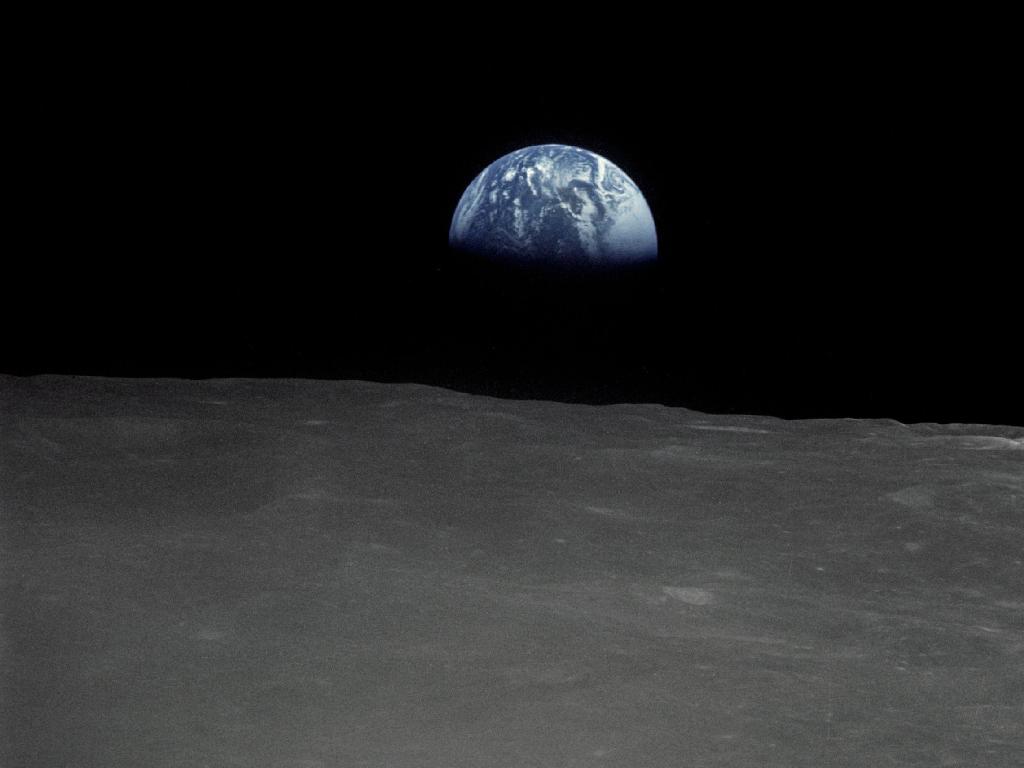
It was just a photograph. OK, one taken 43 years ago but, so what! Well, the late Galen Rowell, the famous Californian wilderness photographer called it, “the most influential environmental photograph ever taken.”

We are talking about the photograph called ‘Earthrise’ taken from Apollo 8 on December 24th, 1968 during the first manned mission to the Moon. Each of you should have a copy of that picture close by. Look at it now and let your imagination be carried back to that Apollo 8 capsule and that momentous experience.

As the Earth rose above the horizon of the moon, NASA astronaut Frank Borman uttered the words, “Oh my God! Look at that picture over there! Here’s the Earth coming up. Wow, is that pretty.” Bill Anders then took the ‘unscheduled’ photograph.

Then recall that evening, Christmas Eve 1968, when the three NASA crew members took turns reading from the book of Genesis to what was probably the biggest audience ever in the history of television, Frank Borman finishing with the words, “God called the dry land earth, and the gathering of the waters He called seas; and God saw that it was good.

Our planet is good, and so beautiful, and so precious to life. Life that arose in just a fraction of time after the Solar System formed 3.7 billion years ago; the oldest traces of life have been found in fossils dating back 3.4 billion years. That miracle of life.

Who hasn’t gazed into a clear, Arizonan, night sky and been lost in the beauty above our heads. Or felt the wind, flowing across ancient lands, kiss our face. We stand so mite-like, so insignificant in all this immensity of creation; God’s creation.

Our dreams, our hopes and failures, everything we are, have ever been and ever will be, nothing more than a swirl of dust across a desert track.

Jeremiah was called to be a prophet in 626 BC, some 2,638 years ago. In Jeremiah 12:4 he wrote, “How long will the land mourn, and the grass of every field wither? For the wickedness of those who live in it, the animals and the birds are swept away…

Words from so long ago! But Jeremiah would, surely, have gasped with disbelief had he realised how, some 2,600 years later, ‘the land now mourns and the grasses so wither’.

Jeremiah reveals much that we all could learn about ourselves. The other prophets couldn’t be accused of hiding behind their work but Jeremiah, out of all of them, allowed us to see the evidence of his own spiritual condition. He was a man of deep feelings and sensibilities and in his book there are five laments over the serious spiritual and moral condition of God’s people. That’s us, by the way!

In that time of Jeremiah, the world population was 100 million persons; slightly less than the population of Mexico today.

Some 1,350 years later, 1,000 A.D., the global population was 265 million.

But by the year 2,000 A.D., our population had increased to 6,000 millions! Put another way, that’s an increase of 5.7 million people every year for a 1,000 years !

Any guesses on the increase in the last 12 years, since 2,000? Well, the global population has increased by 990 million. About 90 million every year!

It is utterly unsustainable at present levels of Western consumption, let alone with poorer nations trying to ‘catch up’.

Last September, our House of Bishops issued A Pastoral Teaching. Our Bishops believe those ancient words of Jeremiah describe these present times. They call us to repentance, to change.

That Pastoral Teaching, in part, says, “Christians cannot be indifferent to global warming, pollution, natural resource depletion, species extinctions, and habitat destruction, all of which threaten life on our planet. Because so many of these threats are driven by greed, we must also actively seek to create more compassionate and sustainable economies that support the well-being of all God’s creation.

Our bishops refer to The Anglican Communion Environmental Network that calls to mind the dire consequences that our environment faces, again I quote: “We know that we are now demanding more than the earth is able to provide. Science confirms what we already know: our human footprint is changing the face of the earth and because we come from the earth, it is changing us too. We are engaged in the process of destroying our very being. If we cannot live in harmony with the earth, we will not live in harmony with one another.

Let those words enter our souls: “If we cannot live in harmony with the earth, we will not live in harmony with one another.” Planet Earth mirrors our souls! Nothing new about that. In 1975, Berkeley physicist Fritjof Capra wrote in his book The Tao of Physics, “we can never speak of nature without, at the same time, speaking about ourselves”.

Fr. Dan reflected in his January 22nd sermon on the questions, “Am I really free? Can I really change?” ….. and continued with the words from Jesus, “The time is fulfilled, the Kingdom of God has come near, Repent.” Fr. Dan reminded us that the word ‘repent’ indicates that we can change. We can change, we must, and we will.

Otherwise we will learn the truth of that Cree prophecy, “When all the trees have been cut down, when all the animals have been hunted, when all the waters are polluted, when all the air is unsafe to breathe, only then will you discover you cannot eat money.

OK, from out of the mouths of North American Braves to out of the mouths of English babes.

The ‘eat money’ phrase reminds me of a story I heard years ago, back in England. You need to imagine a dilapidated, rural Anglican church with a dwindling congregation. A young boy was given a five pound note to put in the collection plate. When the offering came around, he didn’t put it in. However, after the end of the service, he went up to the vicar, shook his hand and gave him the five pound note. The vicar asked him, “Why are you giving me this money? Why didn’t you put it in the collection plate?”

The young boy answered, “Because my Mummy told me you’re the poorest vicar we’ve ever had!”

Let me stay in Britain. Martin Rees is a British cosmologist and astrophysicist and has been Britain’s Astronomer Royal since 1995.

Sir Martin Rees, indeed Lord Rees as he is now, has been Master of Trinity College, Cambridge since 2004 and was President of the Royal Society between 2005 and 2010.

In a presentation in 2005, he said this, “We can trace things back to the earlier stages of the Big Bang, but we still don’t know what banged and why it banged.

Lord Rees continued, “But the unfinished business for 21st-century science is to link together cosmos and micro-world with a unified theory. And until we have that synthesis, we won’t be able to understand the very beginning of our universe. You want to not only synthesise the very large and the very small, but we want to understand the very complex. And the most complex things are ourselves, midway between atoms and stars.”

Hang on to that word ‘midway’ as I continue reading from Rees’ presentation.

We depend on stars to make the atoms we’re made of. We depend on chemistry to determine our complex structure. We clearly have to be large, compared to atoms, to have layer upon layer of complex structure. We clearly have to be small, compared to stars and planets — otherwise we’d be crushed by gravity.

And in fact, we are midway. It would take as many human bodies to make up the sun as there are atoms in each of us. The geometric mean of the mass of a proton and the mass of the sun is 50 kilogrammes (110 lbs), within a factor of two of the mass of each person here. Well, most of you anyway!

Back to me! Just reflect on the magnificence of that fact! Science and poetry so beautifully woven together. We, as in humankind, the poetic manifestations of God’s unbelievable creation. Our relationship with the atoms perfectly balanced with our relationship with the sun. Brings a whole new meaning to seeing starlight in the eyes of the one you love!

It is all so beautiful, so magical, so spiritual, so God-like. It is also so fragile and vulnerable.

There is a copy of that Pastoral Teaching available for you on your way out of Church. I implore you to read it, nay more than read it, hold it close to your heart. Within that teaching all of us are invited to join our Bishops in a 5-point commitment for the good of our souls and the life of the world, our beautiful planet; the essence of those 5 points being:

That we, as brothers and sisters in Christ, commit ourselves:

  • To repent all acts of greed, over-consumption, and waste;
  • To pray for environmental justice, for sustainable development;
  • To practice environmental stewardship and justice, energy conservation, the use of clean, renewable sources of energy; and wherever we can to reduce, reuse, and recycle;
  • To uproot the political, social, and economic causes of environmental destruction and abuse;
  • To advocate for a “fair, ambitious, and binding” climate treaty, and to work toward climate justice through reducing our own carbon footprint and advocating for those most negatively affected by climate change.

As our Bishops wrote, “May God give us the grace to heed the warnings of Jeremiah and to accept the gracious invitation of the incarnate Word to live, in, with, and through him, a life of grace for the whole world, that thereby all the earth may be restored and humanity filled with hope.”

I started with the taking of a photograph 43 years ago that forever changed our view of our planet. Now is the time to change our relationship with our planet, to love it and cherish it; it’s the only one we have. Otherwise, we may not have another 43 years left.

Or in the words from today’s Psalm, “O LORD my God, I cried out to you, and you restored me to health.

Amen.

The three amigos

Big thanks to Suzann for forwarding this to me.

Despite the fact that this has been widely circulated on the Web, I hadn’t come across it and it makes a lovely week-end item.

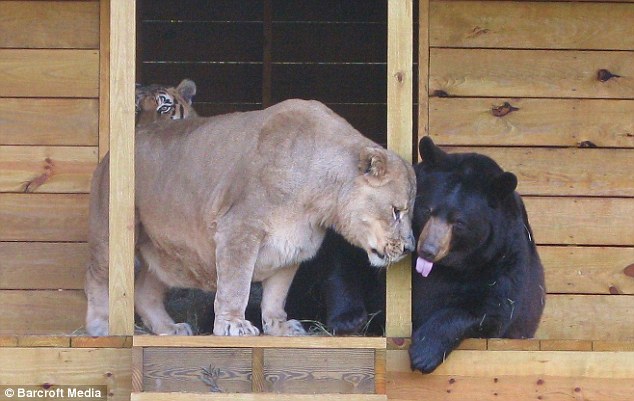
They make an unlikely trio but Baloo the bear, Leo the lion and Shere Khan the tiger have forged an unusually strong bond.

Considering that they would be mortal enemies if they ever were to meet in the wild, it is stunning to see their unique and genuine friendship in these intimate pictures.

Rescued eight years ago during a police drugs raid in Atlanta , Georgia , the three friends were only cubs at the time at barely two months old.  They had been kept as status symbol pets by the drug barons.

Living with the zoo's founders for the past eight years, Shere Khan, Baloo and Leo have now moved to a purpose built habitat Photo: BARCROFT

Delivered to the Noah’s Ark Animal Rescue Centre in Locust Grove, Georgia, the decision was made to keep the youngsters together, because of their budding rapport. ‘We could have separated them, but since they came as a kind of family, the zoo decided to keep them together,’ said Diane Smith, assistant director of Noah’s Ark. ‘To our knowledge, this is the only place where you’ll find this combination of animals together.’

Living with the zoo’s founders for the past eight years, Shere Khan, Baloo and Leo have now moved to a purpose-built habitat where the US public can now witness first hand their touching relationships.

We didn’t have the money to move them at first,’ said Diane.  ‘Now their habitat is sorted and they have been moved away from the children’s zoo areas where the public couldn’t really get a good look.’

It is possible to see Baloo, who is a 1000lb bear, Shere Khan, a 350lb tiger and Leo the Lion, who is also 350lbs, messing around like brothers.  ‘They are totally oblivious to the fact that in any other circumstance they would not be friends.’

Handled by Charles and Jama Hedgecoth, the zoo’s owners and founders, the three friendly giants appear to have no comprehension of their animal differences.

Baloo and Shere Khan are very close,’ says Diane, ‘That is because they rise early, and as Leo is a lion, he likes to spend most of the day sleeping.  It is wonderful and magical to see a giant American Black Bear put his arm around a Bengal and then to see the tiger nuzzle up to the bear like a domestic cat.  When Leo wakes up the three of them mess around for most of the day before they settle down to some food.’

Surprisingly for three apex predators with the power to kill with a single bite or swipe of their paw, they are very relaxed around each other.

They eat, sleep and play together,’ said Jama.  ‘As they treat each other as siblings they will lie on top of each other for heat and simply for affection.  At the moment they are getting used to their new habitat.  Shere Khan is being quite reticent about the move, but Baloo, the bear, is very good at leading him on and making him feel comfortable and safe.’

Explaining that the three ‘brothers’ have always seemed to share a unique bond, Charles said: ‘Noah’s Ark is their home and they could not possibly be separated from each other.  You just have to remember who you’re dealing with when you are with them, though.  It’s when you forget that these fellows are wild animals that you get yourself in trouble.’

The trio’s new habitat had to be constructed carefully, in order to accommodate its occupants.

Jama said: ‘The clubhouse had to be very sturdy for the guys, because they all sleep in it together.’

She added: ‘We had to include a creek, because the tiger and the bear both like to be in water.’

Climate, truth and integrity, part two

Continuing from Part One last Friday.

Last Friday I started re-publishing the wonderful comments that had appeared on Climate Sight in response to a question that I had raised, namely,

While in every way that I can think of, I support the premise of mankind affecting global climate, I would love to hear from someone who could reconcile the Post above with these recent items:” and then included the links to the WSJ and Daily Mail items.

If you are not familiar with those WSJ and Daily Mail items, then you will need to go back to Friday’s Post.

So moving on.

The third response was from chrisd3, here’s what he wrote,

Paul, here is the Met Office’s response, which begins, “[The Daily Mail] article includes numerous errors in the reporting of published peer reviewed science undertaken by the Met Office Hadley Centre and for Mr. Rose to suggest that the latest global temperatures available show no warming in the last 15 years is entirely misleading.”

Here is Deltoid taking David Rose apart on some earlier pieces:

And NASA never said anything about the Thames freezing over. Rose just made that bit up.

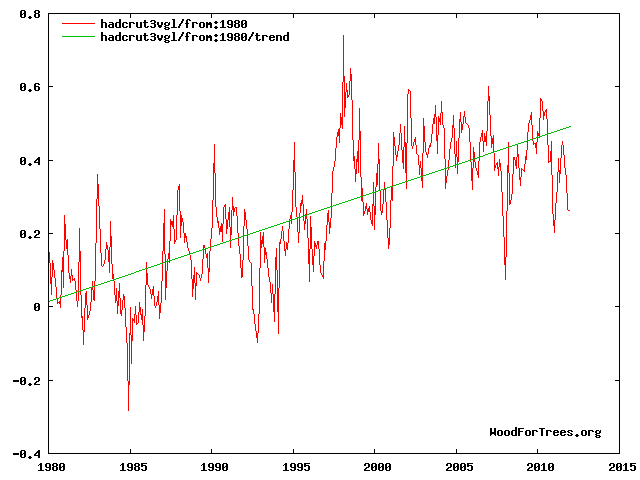
Finally, here is a chart of global temps from HadCRU:

From this, it is pretty clear why Rose chooses 15 years as his starting point: 1997-1998 was the time of the largest El Nino ever recorded, resulting in a huge temperature spike. Using that as the starting point for a temperature comparison is absolutely classic cherry-picking.

And in any event, you can’t say anything about trends in noisy data by simply comparing two arbitrary points. That is not a valid way to analyze the data (especially if you pick an obvious outlier as your starting point!). It is like trying to say whether the tide is coming in or going out by looking at the height of two waves. It just doesn’t work that way. You have to look at the long-term trend to remove the noise.

Let me take you to that Met Office response (and I’m republishing it in full).

Met Office in the Media: 29 January 2012

Today the Mail on Sunday published a story written by David Rose entitled “Forget global warming – it’s Cycle 25 we need to worry about”.

This article includes numerous errors in the reporting of published peer reviewed science undertaken by the Met Office Hadley Centre and for Mr. Rose to suggest that the latest global temperatures available show no warming in the last 15 years is entirely misleading.

Despite the Met Office having spoken to David Rose ahead of the publication of the story, he has chosen to not fully include the answers we gave him to questions around decadal projections produced by the Met Office or his belief that we have seen no warming since 1997.

For clarity I have included our full response to David Rose below:A spokesman for the Met Office said: “The ten year projection remains groundbreaking science. The complete period for the original projection is not over yet and these projections are regularly updated to take account of the most recent data.

“The projections are probabilistic in nature, and no individual forecast should be taken in isolation. Instead, several decades of data will be needed to assess the robustness of the projections.

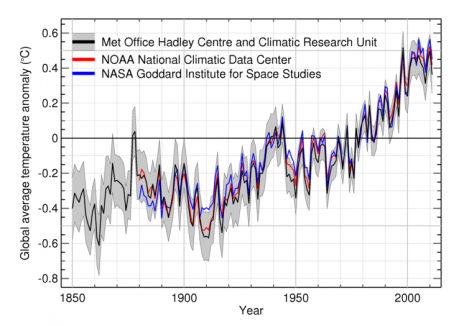
“However, what is absolutely clear is that we have continued to see a trend of warming, with the decade of 2000-2009 being clearly the warmest in the instrumental record going back to 1850. Depending on which temperature records you use, 2010 was the warmest year on record  for NOAA NCDC and NASA GISS, and the second warmest on record in HadCRUT3.”

Global average temperatures from 1850 to 2011 from the three individual global temperature datasets (Met Office/UEA HadCRUT3, NASA GISS and NOAA NCDC)

Furthermore despite criticism of a paper published by the Met Office he chose not to ask us to respond to his misconceptions. The study in question, supported by many others, provides an insight into the sensitivity of our climate to changes in the output of the sun.

It confirmed that although solar output is likely to reduce over the next 90 years this will not substantially delay expected increases in global temperatures caused by greenhouse gases. The study found that the expected decrease in solar activity would only most likely cause a reduction in global temperatures of 0.08 °C. This compares to an expected warming of about 2.5 °C over the same period due to greenhouse gases (according to the IPCC’s B2 scenario for greenhouse gas emissions that does not involve efforts to mitigate emissions).  In addition the study also showed that if solar output reduced below that seen in the Maunder Minimum – a period between 1645 and 1715 when solar activity was at its lowest observed level – the global temperature reduction would be 0.13C.

Back to that response from chrisd3.  He offered this, “Finally, here is a chart of global temps from HadCRU.”  Here is that chart, remember we are looking at Global temperatures.

Global temperature trend

OK, between this Post and my Post last Friday, you probably get the message!  There were many other contributions and I could go on and on quoting the great responses I got, all of them uniformly saying there IS global warming unprecedented in recent years.  The message is crystal clear and those who wish to deny the evidence … well, I can’t come up with a polite term, so will just leave it at that!

My final contribution is from Martin Lack, author of the Blog Lack of Environment, and a good friend of Learning from Dogs.  Here is what he wrote in a recent email,

You may have seen my latest response to How much is most?

When I eventually saw your earlier comment, I was surprised and disappointed in equal measure because I almost feel that I have failed in some way. Let me explain:  Unlike ClimateSight and SkepticalScience, which both do an excellent job of focusing on the science of climate change, my blog is deliberately focused on the politics underlying the denial of all environmental our problems; including 2 key aspects to my MA dissertation, namely the political misuse of scepticism; and the psychology of denial.  See my How to be a Climate Change ‘Sceptic’  for more detail.

Therefore, although not specifically categorised as such, just about everything I have posted is traceable back to Paul and Anne Ehrlich’sBetrayal of Science and Reason (1996) and/or Naomi Oreskes and Erik Conway’s Merchants of Doubt (2010).  For someone who does not currently go to any Church, I am remarkably fond of quoting Scripture so, if necessary, please forgive me but, as the Good Book says:  “What has been will be again, what has been done will be done again; there is nothing new under the sun” (Ecclesiastes 1:9).

Therefore, I do not think you should be surprised by the amount of misinformation and misrepresentation contained in the original WSJ Sixteen’s article; and/or the fact that denialist arguments are repeated no matter how many times they have been shown to be false.  Furthermore, I would warn against trying to summarise it all on Learning from Dogs.  This is definitely Book territory and, in addition to the two mentioned above, the market is already saturated by the likes of Climate Change Cover-up by James Hoggan and Climate Change Denial by Haydn Washington and John Cook.

With very best wishes for a fog-free future,

What to say to close these two Posts off?  Frankly, it’s difficult to know how to pitch it.  The science seems clear beyond reasonable doubt.  But if you are reading this and disagree, then PLEASE offer the science to refute the conclusions presented here.  I promise you that I will present it on Learning from Dogs.

So let me end with a simple photograph.

Earthrise

This is the photograph that wilderness photographer Galen Rowell called, “the most influential environmental photograph ever taken.”

The now world-famous photograph was taken by Astronaut William Anders from Apollo 8, the first manned mission to the Moon, a little over 43 years ago on December 24th, 1968.

As the Earth rose above the horizon of the moon, NASA astronaut Frank Borman uttered the words, “Oh my God! Look at that picture over there! Here’s the Earth coming up. Wow, is that pretty.”  Bill Anders then took the ‘unscheduled’ photograph.

Now project forward 43 years to the year 2055 and play with the idea of what ‘pretty‘ planet Earth will be like for mankind and so many other species, including our longest companion, the dog, if we don’t get our act together pretty soon!

An ancient bond, indeed!

The mystery of the call of a dog in need of help.

Two days ago, I wrote a piece about how the evolution of the domestic dog has been reliably re-calibrated back to around 33,000 years ago.  I quoted from an article in the Arizona Republic, here are the opening paragraphs of that article.

Tamed dogs may go back 33,000 years

by Anne Ryman – Jan. 24, 2012 11:33 PM
The Republic | azcentral.com

Dogs have been “man’s best friend” longer than any other animal. And, as it turns out, longer than previously thought.

A pair of research papers published in the past few years, one most recently by a team that includes the University of Arizona, significantly pushes back the timeline for domestication of dogs from about 14,000 years ago to more than 30,000 years ago.

Researchers at UA and universities in England and the Netherlands used radiocarbon dating to determine that the skull of a Siberian dog was about 33,000 years old. Slightly older dog remains were identified in Belgium a few years ago by a separate research team.

The full Post is here.

So moving on, and apologies for a bit of a personal muse.

Last night (the night of the 30th/31st Jan.) a single, gentle yelp from Pharaoh had me instantly awake. Initially hadn’t a clue about the time but instinctively knew it was an un-Godly hour!  Jean and I had been late to bed and I was pretty tired when the lights went out – off to sleep in an instant.  Ergo, waking up at 2am as it turned out to be, the classic deep-sleep time of the night, was challenging!  It is also relevant to mention that Pharaoh is reliably a very good sleeper at night.

Yet, in literally an instant of time, I had transitioned from being totally asleep to being mentally alert wondering what had caused him to cry out.  Pharaoh came to the side of the bed and let me rub his head, then went back to near the door and uttered another soft yelp.  I knew without any doubt at all that he was in pain and lay on my back anticipating what would be coming – putting a dressing-gown on and leading his nibs out into a very cold and dark night!

Then a clawed paw on the door told me to get moving, and within moments of Pharaoh being outside, it was clear that he had a badly upset tummy.

The whole episode was repeated around 4.45 am.

It was later in the morning that I was reflecting with Jean about the evolution of the dog-human relationship that a) gave the dog the instinctive confidence to call out to his ‘master’ in a different ‘I need help‘ tone, and b) that the call was so rapidly interpreted by a human as a call for help from another species.

But dogs sleeping near or around their human companions for more than 30,000 years allows plenty of time for species bonding to develop in ways that are both beautiful and mysterious.  Long may that bonding remain beautiful and mysterious.

Fabulous animals!

Pharaoh. June 2008, 3 months before we both left for Mexico!

Rupert Sheldrake

An opportunity to watch a new video of Rupert Sheldrake talking about his new book The Science Delusion

I have written or referred to Rupert Sheldrake many times previously on Learning from Dogs. I have also read the book by Mr. Sheldrake, Dogs That Know When Their Owners Are Coming Home. (The linked title takes you to something I published about the book and the author on the 9th May, 2011 and also links to other articles about Rupert Sheldrake.)

Rupert Sheldrake

Previously, I had written about what Rupert Sheldrake calls morphic resonance and morphic fields, see my article here.

Yesterday, I received an email promoting Sheldrake’s new book.  This is what it said,

From Rupert Sheldrake
London January 30th, 2012

In my last newsletter I said that the UK launch of my new book The Science Delusion would be streamed live from Kings College, London University, on January 17, but unfortunately the internet connection at King College broke down, so this did not happen.

Clearly they were able to film that launch and that video link is available, but only until February 7th, 2012!  So if you want to watch the video then please go here.  I am not able to embed that into this Post.  You will be going to the video of this:

ONLINE VIDEO STREAM

THE SCIENCE DELUSION: FREEING THE SPIRIT OF INQUIRY

January 17, 2012, 7pm – 8:30pm (GMT), 2pm – 3:30pm (EST)
Venue: Great Hall King’s College London, Strand, London WC2R 2LS

In addition, that email newsletter carried the link to a review of the new book in the British Guardian newspaper, by Mary Midgley.  It starts thus,

The unlucky fact that our current form of mechanistic materialism rests on muddled, outdated notions of matter isn’t often mentioned today. It’s a mess that can be ignored for everyday scientific purposes, but for our wider thinking it is getting very destructive. We can’t approach important mind-body topics such as consciousness or the origins of life while we still treat matter in 17th-century style as if it were dead, inert stuff, incapable of producing life. And we certainly can’t go on pretending to believe that our own experience – the source of all our thought – is just an illusion, which it would have to be if that dead, alien stuff were indeed the only reality.

If you want to read the review in full then it is here. (If you are a follower of Rupert Sheldrake, best not to take the comments to Mary’s article too seriously!)

Also, the Guardian blog carried a piece by Mark Vernon, that opened thus,

Werner Heisenberg, one of the founding fathers of quantum physics, once observed that history could be divided into periods according to what people of the time made of matter. In his book Physics and Philosophy, published in the early 60s, he argued that at the beginning of the 20th century we entered a new period. It was then that quantum physics threw off the materialism that dominated the natural sciences of the 19th century.

Of materialism, he wrote:

“[This] frame was so narrow and rigid that it was difficult to find a place in it for many concepts of our language that had always belonged to its very substance, for instance, the concept of mind, of the human soul or of life. Mind could be introduced into the general picture only as a kind of mirror of the material world.”

Today we live in the 21st century, and it seems that we are still stuck with this narrow and rigid view of the things. As Rupert Sheldrake puts it in his new book, published this week, The Science Delusion: “The belief system that governs conventional scientific thinking is an act of faith, grounded in a 19th-century ideology.”

Mark Vernon closes the fascinating piece with these tantalising words.

The analogy has the benefit of naturalising extrasensory perception, Watts notes. But it also raises problems. For example, how would it be possible mentally “to touch” objects that don’t exist, as would happen when contemplating a centaur? Watts concludes: “An adequate account of the mind must encompass both first- and third-person description whereas the idea of a ‘field’, along with the other spatial descriptions that Sheldrake uses, seem to be exclusively third-person type descriptions.” Oddly, this is a strikingly 19th century attitude to have.

Nonetheless, Sheldrake must welcome such serious engagement with his work. He may not be right in the details. But he is surely right, with Heisenberg, in insisting that the materialist world view must go.

Don’t rely on my short excerpts, read the article in full here.

For my money, this will be a book that I won’t miss reading!

Another reflection

Thanks to family member Freyja D. for this piece.

I saw this on Freyja’s Facebook account and thought it would be appropriate for a Saturday reflection along with Random Notes 2.  I’m sure many have seen it already but it was new to me!

There was a blind girl who hated herself because she was blind. She hated everyone except her loving boyfriend. He was always there for her. She told her boyfriend, ” If I could see the world, I’d marry you”.

One day someone donated eyes to her. When the bandages came off, she was able to see everything, including her boyfriend. He asked her, “Now that you can see the world, will you marry me?”

The girl looked at her boyfriend and saw that he was blind. The sight of his closed eyelids shocked her. She hadn’t expected that.  The thought of looking at him for the rest of her life led her to refuse his offer of marriage.  Her boyfriend left her in tears and days later wrote a note to her saying; “Take good care of your eyes, my dear, for before they were yours, they were mine.”

Having just cut and pasted that from the Facebook page, I thought that I would do a web search on ‘There was a blind girl who hated herself‘ and the first link on the results page was Stories from the Heart from the A View on Buddhism website.  So that was a lovely find and a web site that deserves more browsing.

At the top of the ‘Home Page’ was the following quote:

Don’t try to use what you learn from Buddhism to be a Buddhist;
use it to be a better whatever-you-already-are.

His Holiness the 14th Dalai Lama

Nothing much to argue with there!

May our eyes open our heart.

Fitting the pieces together!

And how!

On Wednesday, I wrote how something, as I thought then, had corrupted my PC causing it to run very slowly.  In fact, it was running so unreliably that I really struggled to wonder what had happened.  As I wrote, buggins at this end hadn’t got around to making a back-up of the hard disk in 18 months, so for a while I sweated big time!  But miracle of miracles, the PC in ‘Safe’ mode allowed me to take a complete copy of the My Documents folder.

Then yesterday (Thursday) on the dot of 9am I marched into the local Payson branch of The Computer Guys with my PC.  Quickly I was appraised of the fact that my hard drive was operating intermittently and plumped for a new system, just grateful that they could transfer all the data from my old drive across to the new one.

Two hours later, they advised me that my existing hard drive had totally failed  So yet another miracle in my life; I had a backup of my documents including my priceless Scrivener projects.

It was a long day spent re-installing software programs and uploading all the relevant files but by 8pm it was done!  Phew!

So if was serendipity itself to see a Post come in from Sue Dreamwalker’s fabulous blog with the title, ‘Fitting the Pieces Together‘.  I had spent my whole day fitting pieces back together!  Knowing I would have so little time, I asked Sue for permission to re-publish her Post and, bless her, she readily agreed.  It now follows.

Making the pieces of life fit smoothly!

Fitting the Pieces Together.

None of us need to be a genius to know that something is shifting within the Human Consciousness. Each of us is sensing these changes.

Many more now are awakening to the possibilities that there is more to our physical ‘Being’ than mere flesh and blood as more and more of us get in touch once again with our intuition.

In this modern age we have pushed aside and stopped the flow of our natural abilities in favour of a world that relies upon its Gadgets.  Take all those Gadgets away from us and we wouldn’t survive very long if  only we had was  the skin we are living in to rely upon. Unlike our Indigenous tribes around the world today, whom modern man may term ‘Primitive’ in comparison, And I also wonder if such a machine were  ever invented to measure our Awareness and Happiness factors, just how Primitive we would compare to  our Indigenous brothers to their own Conscious Awareness. For they have long known the things which we have long since forgotten.

Throughout time we have lost touch with our inner selves as we gathered together our gadgets, bigger homes, faster cars trinkets and ornaments, accumulating more debt in order to gather yet more ‘Things’. And still when we think we have everything money can buy, there is still something Missing…  We keep on searching, driven to that higher paid job, the next relationship as we each search for that which makes us feel complete and whole, as we search for the meaning of Life.

Each of us are searching for their own piece of the Puzzle, and yet if only we could realise that we are all of us part of that Huge jigsaw puzzle.. ‘The Puzzle of Life’

But unlike the Jigsaws we buy we don’t get to see the ‘Big Picture’ on the box lid.

We travel along in life as that little separate jigsaw piece searching to fit in, looking for that connection to more pieces as we slot our lives together.

When we start our puzzle making, we start by looking for all those straight edges pieces, we need structure, a place to start from. It may take us some time to put the boarders together, especially when there are so many pieces to choose from. But we sift through them, gathering together the one’s we need.

We may have to scrabble around the ‘box of life’ trying many pieces to fit with ours. We start by following similar pieces, those with straight lines, whose colours match our own, and gradually we create the perimeters, a structure, rules, a base from which we can then start to fill in more missing pieces.

So too in life we start by congregating with similar people as we join various groups, whether that be education, social, or spiritual. That part is easy, we can see which piece is sky-blue, or Green-Grass and so we huddle together knowing we are going to fit in somewhere. But what about all those mingled colours, the pieces in the box that could be anything.. If we had the picture box lid, we could make more sense of it, but as we don’t, we scratch our heads and wonder as we hold that random jigsaw which represents our self, just where DO we fit in? Often we can drop it/our direction and pick up another/following a different route hoping this one we’ll have better luck with. So to with our careers, our relationships we swop and change forever searching for that perfect fit.

And you know it when it slots into place.. How?  because it ‘Feels’ right, and when that happens, just how much more quicker do the rest of the pieces then start to slot into place.. For once again we are following our intuition, as we ‘know’ we are then on its correct coarse again.

Life is like that Puzzle, all the pieces are there right before our eyes, and yet we miss what’s right under our very noses. We are constantly being given signs from the Universal Mind , the source of creation, but we have been wrapped up for so long within our Material world, we no longer see the signs that naturally occur and point us in the right direction.

The first part of putting the Puzzle together is to see yourself not as separate from anything else, we are all part of this huge picture called ‘Life on Earth’, We cannot function as a lone piece. We need others to connect with. Each adding their own colour creating the whole. It would not be Earth if we didn’t have the Flora and Fauna and each of us are inevitably connected via that same Life Source of Energy which permeates through each of us.

The indigenous tribes survive because they function as a whole, they connect to Nature and the Universal Mind serving each for the good of the whole working within the natural laws of oneness.

To find the answers of “ Where do I fit in?” and “What is my purpose?”we need to understand we are connected to a “Whole” lot more, and that the time is now, whereby we need to start and dig around in that Box of Life  and turn over some of our own jigsaw pieces as we discover the make up of our reality.

We need to see that by adding our Conscious awareness to that of others piece by piece our memory of just who we are will return.

I am reminded of that saying.

 “ Together we stand, Divided we Fall 

This is why our Lights need now more than ever to join together to bring Illumination into the world..

Keep searching, for the pieces are coming together, ~ One by one of us are seeking to understand and Wake-Up..But first we need to  re-discover ourselves 

Now is the time to reach out with your Hearts and send each other Love, Pray for Peace around this word… For this world needs YOU.. for You are a vital Piece of the Puzzle..

We need to Unite each other to complete the task we came to achieve.

We Are One

© Sue Dreamwalker – 2012 All rights reserved.

Thank you so much, Sue, for bailing me out, and for writing such a thought-provoking essay.

Affairs of the heart.

That is, a la dog!

Hazel

This is Hazel. She is one of three dogs that ‘belong’ to Pharaoh.

Last Tuesday, we took Pharaoh and his mini-pack of 3 dogs out for our usual afternoon walk at the very end of Granite Dells Rd, out where the forest road ends and soon becomes the relative wilderness of the Tonto National Forest.

Pharaoh, and Hazel, Dhalia and little Sweeny.

However, on this occasion Hazel decided to leave us and link up with a stranger who was hiking the forest.  That was the last we saw of Hazel for many hours.  Miracle of miracles, the stranger, Joanie, was a dog-lover so when Hazel had followed Joanie and her dog all the way to Joanie’s car, the next stop for her, Hazel that is, was our local Payson Humane Center.  Hazel’s tag very quickly linked her to Jean (a great reminder of the importance of tagging your dogs!) who is well-known as a volunteer assistant at the Humane Society Thrift store and the scare was over.

But during the hours of tramping those miles along challenging forest tracks, calling out Hazel’s name, both Jeannie and I had plenty of time to hurt.  Here’s a small insight, that millions of pet owners will resonate with, that demonstrates the way that dogs offer us so much love which, in turn, opens our human hearts to the purity of unconditional love. (And I know it’s not just dogs but many animals in our lives that offer us such love!)

Pharaoh and his ‘team’ sleep in our bedroom.  During the Winter months Hazel will often lay stretched out on the bed-cover alongside the back of my legs.  If I need a trip to the bathroom during the night, not unknown at my age, I can almost guarantee that Hazel will shift her cuddly body up to the warm sheets just below my pillow.

Thus it was this last Tuesday morning when I returned from my bathroom run about 3am; Hazel asleep with her head on my pillow!  I didn’t have the heart to push her off the bed, so just slipped in beside her and moments later back asleep, my head nestled against Hazel’s warm head.  Sleeping so close to a dog is more than just nice, it seems to stir very ancient memories deep in the subconscious, perhaps back all those thousands of years to when domesticated dogs were an integral part of early man’s security.

So you can imagine the anguish that, in our own separate minds, Jeannie and I were experiencing.  I just couldn’t go to the place where never again would I feel the warmth of Hazel’s body against mine.  Jean was desperately hoping this wasn’t a tragic repeat of losing Poppy.  Thus when I went round to the Humane Center just as they were closing up and Hazel came out to me, I dissolved in sobs of relief.

That’s the heart-felt closeness of dogs and humans.

The purity of a dog's heart!

Money and morality

Money must be guided by morality. – A powerful essay courtesy of Resurgence Magazine

(Because the essay, by Satish Kumar, is so well-worth reading, let me postpone my background chit-chat until later!)

Here it is.

If we take care of people and Nature, then the economy will take care of itself.

Money was a clever and convenient invention; it was designed as a means of exchange and a measure of wealth. But somehow that has changed; what was once solely a means to an end has become the end itself, and what was a measure of wealth has become wealth itself.

Take for example agriculture, the purpose of which was to produce nutritious food whilst ensuring that the land remained in good heart for all future generations and for the good health of biotic communities. Agriculture was a way of life that gave farmers their dignity, and in turn they cultivated the crops with tender loving care and considered their work intrinsically good.

Then came money, which changed everything: agriculture turned into agribusiness and the paramount purpose of it became the making of money. Food became a commodity and yet another means of making large profits. As a result British farmers – even those with 2,000 acres of land – cannot make a living, and farm labourers are paid £10 an hour whilst bankers are paid £1,000 an hour.

The example of agriculture turned to agribusiness is only one illustration of how our society has lost sight of right and wrong. We can cut down the rainforest to make money, we can pollute the rivers and over-fish the oceans for profit, we can destroy the local economy in search of cheaper goods, no matter how much CO2 is omitted in the process. The bottom line always comes first. We can hire and fire people at will for the sake of boosting the economy; people have become little more than the instruments of making money. GM crops, nuclear energy, cloning and animal experimentation – nothing is forbidden, just as long as it adds to GDP and increases the share value of corporations and companies.

Ethics, morals and human dignity are all secondary and subservient to the profit margin. Bankrupt bankers have to be bailed out even though we can all see that they and other business leaders are utterly incapable of solving the economic crisis. Politicians and policymakers have to obey their desires. No wonder then that our governments are completely incapable of creating conditions for the stability and wellbeing of people – because all social, political, educational and communal values exist solely to serve economic growth, which simply means growth in money supply, in GDP and in consumption.

As long as we are wedded to this financial paradigm and its money model, the strong will exploit the weak, and our social and environmental fabric (and morals) will continue to fall apart.

The current economic crisis gives us an opportunity to look deeper and examine the consequences of confusing the means with the ends. Money has a place, of course, but we must keep it in its place and not allow it to dominate our lives in such a manner that we lose all our bearings and become its slaves. Money was made to serve people, not the other way around. Unfortunately, we have allowed money to become the master and override all other moral, ethical and ecological values. There is more to life than an endless pursuit of money and profit.

Money is not wealth; real wealth is land, forest, rivers, animals and people. Wealth is created by the imagination, creativity and skill. Bankers and business leaders in search of ever-increasing profit are not the wealth creators; at best they are wealth counters and at worst wealth destroyers. So let’s honour the true wealth creators: skilled workers, architects and artists, craftsmen and women, teachers and doctors, builders and farmers; the economy is safe in their hands. Let us respect the generous Earth and wild Nature, the eternal source of wellbeing and prosperity. If we take care of people and Nature, then the economy will take care of itself.

Some people might say that this is too idealistic; but what have the realists done? They have made a complete mess of the world economy. Normally, we need idealism and realism in equal measure, but for the time being a little extra idealism will be helpful. We have had far too much realism.

Money must be guided by morality. And we are delighted to present this ideal in this issue of Resurgence, the first of a brand-new year.

Satish Kumar is Editor-in-Chief at Resurgence magazine.

with written permission from Resurgence magazine – at the heart of earth, art and spirit
published by The Resurgence Trust, Ford House, Hartland, Bideford, Devon EX39 6EE

oooOOOooo

OK, back to me!

I hope you enjoyed the essay, it certainly jumped off the page, as it were, for me hence my email to Emma Cocker, Picture Researcher & Assistant Editor at Resurgence Magazine which resulted in a very prompt approval for re-publishing on Learning from Dogs.

Satish Kumar

Satish Kumar is an extraordinary person as a dip into his biographical details here will underline.  Please do read about Satish; you will be amazed by his background!  It includes this fact,

During this time, he has been the guiding spirit behind a number of now internationally-respected ecological and educational ventures including Schumacher College in South Devon where he is still a Visiting Fellow.

Schumacher College was well-know to me, 2006 and before, as I lived in the small village of Harberton, just outside Totnes in South Devon, England and Schumacher College at Dartington was less than 5 miles away.  The College description includes,

People from all over the world, of all ages and backgrounds, have been informed, inspired and encouraged to act, by our 20 years of transformative courses for sustainable living.

Then later, this,

It is precisely at this time of global upheaval that we want you to come to the College to share with us the ways in which you are moved to live and act differently.

No wonder that Bill McKibben of 350.org fame and often quoted on this Blog is quoted on the Schumacher website,

Schumacher is a very special place. As we try and figure out what on earth we’re going to do with this unraveling planet, it’s become a thinktank for hope, a battery for positive vision!

Bill McKibben, founder of 350.org

Finally, there are a number of videos presented by Satish that I propose to include in subsequent Posts on Learning from Dogs.

What We Still Don’t Know? Part 3

The concluding part – Are We Real?

As I implied when I introduced Part 2 last Thursday, Why Are We Here?, these are deeply interesting films.  Do find time to watch them both (Part 1 Are We Alone is here ) if you can.  So here is the concluding part, Are We Real? You can either go to it via this link, or watch the YouTube elements below.

There is a fundamental chasm in our understanding of ourselves, the universe, and everything. To solve this, Sir Martin takes us on a mind-boggling journey through multiple universes to post-biological life.

On the way we learn of the disturbing possibility that we could be the product of someone else’s experiment.

I do hope you all found these three films as stimulating and thought-provoking as Jean and I did.