Category: consciousness

Being at sea!

A discovery of some writing from the past triggers memories.

Way back on the 15th November, 2009, I wrote a post about single-handed sailing and how it caused me much disquiet.  Rather than just leave you with a link to that reflection, I’m going to include the post again, below.  The reason is that a few days ago, in looking through some of my earlier writings in conjunction with a writing group that Jean and I belong to, I came across a piece that I wrote following a solo voyage from Larnaca in Cyprus, west along the Mediterranean Sea and then out over the Atlantic from Gibraltar to Horta on the  island of Faial in the Azores.  That last leg was a little over 1,100 nautical miles (1,300 land miles) and took me eight days.

So first here’s that earlier post from 2009.

A personal reflection on this rather strange way of travelling!

The recent Post about young Jessica Watson sailing alone around the world raised a few comments but also reminded me of my own experiences of solo sailing.

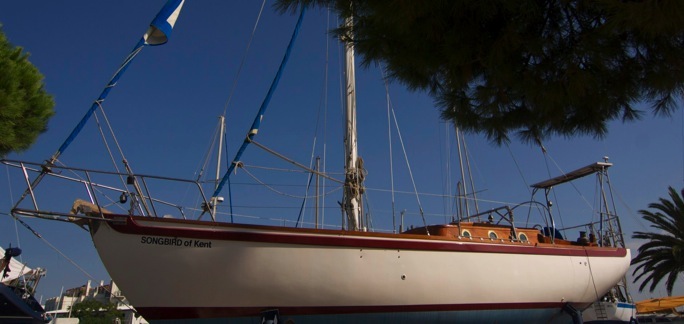
Some years ago, having successfully sold my own IT company, I warmed to the idea of being a full-time yachtie! A second-hand Tradewind 33 was discovered on the Island of Corfu.  (Now here’s a surprise!  I was just browsing the web looking for a picture of a Tradewind and came across my old yacht currently up for sale.  Her name is Songbird of Kent! Picture below.)

Songbird of Kent
Tradewind 33 - Songbird of Kent

Anyway, the deal was done and having sold my house in England I flew out to Corfu to collect Songbird of Kent. Inevitably it was a number of months before the boat was ready to head out into the Mediterranean but in early Spring 1988 it was time to explore the long coastlines of Greece and Turkey.

After a fantastic summer cruising from one idyllic anchorage to another mostly with friends or family on board, it was time to find a winter haven.  Many recommended Larnaca Marina in Cyprus.  Thus it was late in the summer of 1988 that I said goodbye to friends and set out on my own to cross from Antalya in Turkey to Cyprus and along the South coast of Cyprus to Larnaca, on the SE side of the island.

That sea crossing, a little over 200 nautical miles, was to become a regular solo experience at the start and end of each summer season. Impossible to do in a single day thus it always included a night at sea and rarely, if things didn’t go well with the weather, a couple of nights. I hated it! Maybe it was the sudden transition from coastal sailing to a deep water crossing, often going from having friends on board to being alone, but whatever it was I never enjoyed my time on my own and knew that long-distance solo sailing was never going to be my scene.

Anyway, I ended up spending several very happy winters in Larnaca.

One time, there was news of a Frenchman who had come into Larnaca on his way home to France having nearly completed a circumnavigation of the world. He was on his own!

I was astounded to hear how someone could do this and made a point of calling round to his berth. The boat was a beautiful, solid steel yacht, the very epitome of a craft that could challenge the oceans. The owner’s name was Pierre (it would be!). Pierre invited me aboard and we went down to his saloon to drink a hot coffee – real French coffee!

Inevitably the conversation turned to the challenges of sailing alone. Pierre said that the big cargo ships at sea moved quickly relative to the speed of a yacht so at night he set an alarm for every 15 minutes. That was the time that a ship could go from being hull down over the horizon to being close enough to be a hazard. Thus while at sea Pierre got up briefly every 15 minutes during the night to avoid being run down! It sounded totally exhausting.

Then Pierre asked me about the sailing I had done and whether I had sailed on my own. I declared my trivial journeys back and forth from Cyprus to Turkey and revealed that being on my own made me very, very unhappy. Pierre was surprised to hear that as he admitted that being at sea alone was one of the most tranquil and peaceful experiences ever. Pierre asked how long these solo journeys took. I replied, two or three days.

Ah!”, he said, “That is the problem.” “I, too, hate the three days. It is always a period where you adjust and it is terrible.

My friend, you must find a way to be alone for more than three days. You will see that it is very different.

It was some years before that opportunity came about but, in the end, I did undertake a solo journey of 8 days. Pierre was right. The first three days were hell, the rest were heaven!

Thank you, Songbird of Kent, you gave me some fabulous memories!

at sea

By Paul Handover

Now on to my writings about being out at sea alone on a small yacht.

Being at Sea

Going to sea in a small vessel is a profound experience.

In harbour we build up a reliance on things external. We have no need to worry if there is insufficient food on board, we can plug into the dockside power supply, sleep through the night undisturbed and we can wander off and enjoy the company of others if the boat feels a little claustrophobic.

Then slowly, imperceptibly, but with huge force, arrives the need to move on.  The realisation that our cosy life connected to the busy, bustling and self-obsessed world of shoreside is not fulfilling our search for adventure and for the truths that lay over the horizon.  It is time to leave.

The act of casting off is always exciting as it heralds a new adventure. But it also carries feelings of loss and apprehension as one lets go of the bonds of a previous certainty.  The first few hours are filled with the workload of getting one’s craft shipshape and battened down for the unknown seas. Then gradually comes the realisation that the land is now less the dominating visual feature than the vastness of the seascape that is ahead.  But with the land in sight, albeit a distant horizon behind one, you can still sense the life you are leaving.

Now all that surrounds you is the sea.  You are now truly disconnected from the land.  It is often at this point that despondency and uncertainty play with your mind; after all this new life is still very unfamiliar compared to the warmth of that island home that still resonates in your heart. Time to remind yourself of why you wanted to take this voyage.

A small boat is very fragile.  Just a centimetre of hull separating you from the unimaginable depths of the ocean beneath your keel. Not until the end of your voyage, when you draw your boat up, metaphorically on to that beach, will you ever stop feeling how close fate is, how it rides on your shoulder night and day. That, of course, is why we go to sea. It is the place where we taste life, where we savour each moment of the present because the future seems too bound up in the mystery, the uncertainty of the ocean. You are in charge of your tiny craft. Your survival depends on how you manage your small ship, how you navigate these seas, how you read the weather ahead and avoid the storms.

Soon your life on the ocean becomes everything to you. You have time to reflect on so much that is left behind. The distance seems to dissolve all the nuisances, bring into focus all the things that are important to you. There is no certainty with the ocean apart from the knowledge that you are very small and very, very vulnerable and yet, in a sense, also so strong.

In the end, we have to break away from our insecurities and our emotional dependencies on external people and situations because, without that, we are never able to command our own life and the destiny that flows from that captaincy.  There is a real strength in knowing ourselves as we would know our own boat.  If we really know every spar, sail, rope and fitting, if we have real understanding of the strengths and weaknesses of our small vessel then we are able to know when to breast the waves or when to turn and run before the storm.  We are secure that our small craft will protect us day and night.

Thus self-knowledge gives us the same freedom to manage our lives, to know when to fight and when to turn away.  And just as after every long voyage the boat will need hours of careful maintenance so our own souls need regular love and caring from our spiritual keeper.

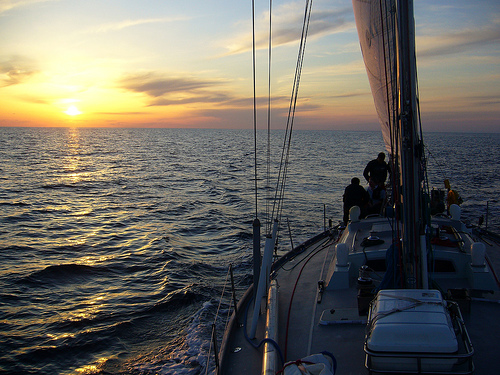
The setting sun ahead of a night on the ocean.

Copyright © 2008 Paul Handover

Home, sweet home!

The only one we have, Earth Day or not!

Earthrise.

It was called “the most influential environmental photograph ever taken.” Rightly so!

Those words were spoken by the late Galen Rowell, the famous Californian wilderness photographer, commenting about the Earthrise photograph taken from Apollo 8 on December 24th, 1968 during the first manned mission to the Moon.

No one who saw that picture of the planet we all live on could fail to be moved. Indeed, none more so than onboard NASA astronaut Frank Borman who uttered the words as the Earth rose above the horizon of the moon, “Oh my God! Look at that picture over there! Here’s the Earth coming up. Wow, is that pretty.” It was fellow Apollo 8 crew-member, Bill Anders, who then took the ‘unscheduled’ photograph.

Who hasn’t gazed into a night sky and been lost in the beauty above our heads. Or felt the wind, flowing across our ancient lands, kiss our face. We stand so mite-like, so insignificant in all this immensity of creation. Our planet is ‘pretty’. Indeed, Planet Earth is good, beautiful, and so precious to life. Life that arose in just a fraction of time after our Solar System formed 3.7 billion years ago; the oldest traces of life have been found in fossils dating back 3.4 billion years. Our miracle of life.

But the one thing we cannot do is to take that miracle of life for granted. Here’s a perspective on that. Just a couple of months after that famous Earthrise photograph, in February 1969, America’s National Oceanic and Atmospheric Administration (NOAA) recorded the level of CO2 in the Earth’s atmosphere as 324.42 parts per million (PPM).

From 43 years ago we fast forward to February of 2012. NOAA now recorded that CO2 level as 393.65 PPM, some 21% higher than the 1969 level, but even more importantly over 12% higher than the figure of 350 PPM which is regarded by climate scientists as the maximum safe level for our Planet. And the trend upwards is steepening. Not just for CO2 but also for Methane and Nitrous Oxide which have the potential to be incredibly more damaging to our beautiful planet than CO2.

Across the face of the world people are waking up to the fact that something has to be done. While some Governments and many industries are providing great leadership, the complexities of these modern institutions means that progress is slow; far too slow. People are now taking action for themselves and for their communities.

The most notable group is the worldwide Transition Movement. It started in the UK in September 2006, indeed started in the town of Totnes, Devon, just three miles from where I used to live.

Less than 6 years later across the world there are 975 initiatives!  Including nearly 500 Transition Communities in Europe and 392 in the UK.

In the USA, there are a staggering 285 initiatives with 26 in California and three here in Arizona: Tucson, Pima and and East Valley in Phoenix ‘mulling’ it over. The ideas behind the Transition concept are powerfully simple and can be easily summarised thus:

  • That it is inevitable that our lives will soon have to adapt to a dramatically lower energy consumption, especially carbon-based energy, and that it’s better to plan for it than to be taken by surprise.
  • That the over-whelming majority of communities, currently lacks resilience.
  • That we have to act now to rebuild our community resilience and prepare for life without fossil fuels.
  • That by tapping into the collective potential of the community, it is possible to develop new ways of living that are nourishing, fulfilling and ecologically sustainable.

Reduce our energy use, increase our resilience, switch away from carbon-based fuels and go back to the strength of communities.  No mystery about what to do!

We do not have another 43 years.  Indeed, some say we are very close to the tipping point of runaway climate consequences.

My message for this Earth Day and, indeed, for every day of the rest of our lives.

Moved to help?

A plea to take action to preserve the Western Arctic Reserve in Alaska.

I received the following email from the Center for Biological Diversity the other day.

Dear Paul,

caribouThe Western Arctic Reserve, also known as the National Petroleum Reserve-Alaska, is the largest tract of unprotected, relatively pristine public land in the United States. But Big Oil has the reserve in its sights and will not hesitate to turn this vast wilderness into a sprawling industrial complex to drum up massive profits.

The 23.5 million-acre reserve is home to imperiled polar bears, seabirds and one of the densest populations of nesting raptors in the world. Its shores and lagoons harbor beluga whales, seals, walruses and other marine mammals.

In the rapidly warming Arctic, short-sighted oil and gas development will further stress the remarkable wildlife that lives and breeds there.The Bureau of Land Management (BLM) is now collecting comments on a planning document that will set the stage for oil and gas leasing in the western Arctic for decades to come.

You can help save this national treasure: Take action to tell the BLM to protect the Western Arctic Reserve from dirty fossil fuel development.

The action that is requested is to email or mail the following to the BLM  (the link is here.)  The email address for Bob Abbey, taken from the relevant BLM webpage is Director: Bob Abbey E-mail: Director@blm.gov

Director Bob Abbey
Bureau of Land Management
NPR-A IAP/EIS Comments, AECOM Project Office
1835 South Bragaw Street, Suite 490
Anchorage, AK 99508
US

Subject: Comments Regarding the BLM’s National Petroleum Reserve-Alaska Integrated Activity, DEIS

The National Petroleum Reserve-Alaska, or Western Arctic Reserve, comprises the largest unprotected tract of public land in the United States. It provides habitat for a wide variety of Arctic species, and its wilderness values are second to none. While the most environmentally protective alternative analyzed by the Bureau of Land Management (Alternative B) is an improvement over previous plans, it still allows over 11 million acres of ecologically intact wilderness-quality lands to be leased for oil development. As the BLM develops the “integrated activity plan” and “final environmental impact statement” for the reserve, I urge you to provide maximum protection for areas with high-value habitats by designating all of the Special Area contained in Alternative B, and to create additional protections for all other areas in the reserve that contain ecologically intact and/or wilderness-quality lands.

The BLM must also consider the long-term impacts of greenhouse gas emissions from oil and gas development, and any future impacts of climate change on the low-lying western Arctic. Arctic animals are already stressed by a melting and warming Arctic, and none of the alternatives considered go far enough to protect these species from the wide array of impacts from oil and gas development.

Among other things, the BLM must account for sea-level rise due to ice melt, permafrost collapse, coastal erosion and increased high-energy storm events that will degrade, or wipe out, critical coastal habitat, including the Teshekpuk Lake area. The BLM must also consider the impacts of ocean acidification, changes in circulation, increased freshening due to sea ice melt, and shifts in productivity to the marine environment and to marine species, including polar bears, ice seals, walruses, bowhead whales, and beluga whales.

Congress has required that “maximum protection” be given to Special Areas in the reserve. I encourage the BLM to adopt an alternative that provides protections for these areas, which include Teshekpuk Lake, the Colville River, Kasegaluk Lagoon, and the Utukok River Uplands. The BLM must also protect the Dease Inlet-Meade River area, Peard Bay and adjacent wetlands, and the Ikpikpuk River and adjacent wetlands.

I implore the BLM to adopt a management alternative that includes the strongest possible protections for the Western Arctic Reserve. This means designating Alternative B as the preferred alternative, and adding additional protective measures for important wildlife habitat and wilderness areas so they are not destroyed by ecologically devastating oil and gas development, or from the long-term impacts of greenhouse gas emissions and climate change.

Thank you.

But if that doesn’t work then there is a full webpage offering detailed information and which also has links relevant to letting the BLM know your views.  That webpage starts,

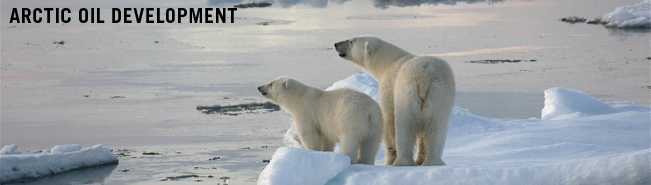
ARCTIC OIL DEVELOPMENT

Alaska’s north coast and ocean waters are teeming with species found in few other places, and many of them are now under threat. The Western Arctic Reserve and the Arctic National Wildlife Refuge provide critical denning areas for polar bears, support vast caribou herds and are essential nesting grounds for thousands of bird species, including threatened eiders and yellow-billed loons. The sea ice of the Arctic Ocean is hunting and denning habitat for polar bears and a foraging platform for Pacific walrus and numerous Arctic ice seal species. Under the sea ice, endangeredbowhead whales and other whale species live off the biological richness of the Arctic Ocean.
Nearly all Arctic species are at risk from global warming. But that’s not the only problem: In a drastically changing environment, Arctic species must now contend with dirty, industrial fossil fuel development.

Please go here, read the the full information and do your little bit.  It all makes a difference.

RMS Titanic – in memory.

Spare a moment’s thought today.

On April 14th, 1912, at 23.40 ships time, the Titanic struck an iceberg and the rest is history.  I’m not going to add to the wealth of information available on this sad centenary except to say that 1,514 people lost their lives and they and their descendants should be held in our prayers.  And to recognise that one of those who lost his life was young ‘Jack’ Phillips, Senior Wireless Operator, who persisted in sending out distress messages by Morse Code to the very last, thus enabling the RMS Carpathia to rescue 710 souls.

Rest In Peace

Below are some local times to assist you in offering up a quiet thought as one hundred years ago to the moment the sound of a liner hitting an iceberg reverberated around the world.

RMS Titanic Ships Time April 14th 2340 – 11.40 PM

GMT/UTC April 15th 0240 – 2.40 AM

British Summer Time April 15th 0340 – 3.40 AM

Arizona/California April 14th 1940 – 7.40 PM

New York April 14th 2240 – 10.40 PM

London April 15th 0340 – 3.40 AM

Paris April 15th 0440 – 4.40 AM

Moscow April 15th 0640 – 6.40 AM

Singapore April 15th 1040 – 10.40 AM

Sydney, Australia April 15th 1240 – 2.40 PM

More world times may be calculated from this website.

The unconscious

A Biological Basis for the Unconscious? Surely not?

Ten days ago or thereabouts, I saw a piece on Big Think about the unconscious.  The title of the piece was as the sub-heading: A Biological Basis for the Unconscious?  I was intrigued, to say the least, and wanted to write about that on Learning from Dogs.

The article started thus:

What’s the Big Idea?

Eric Richard Kandel

Today, the question of how people make decisions is an animated and essential one, capturing the attention of everyone from neuroscientists to lawyers to artists. In 1956, there was one person in all of New York known for his work on the brain: Harry Grundfest. An aspiring psychiatrist who was born in Austria in the 1930’s, Eric Kandel took an elective in brain science during medical school and found himself studying alongside Grudfest at Columbia University.

“What is it you want to study?” Grundfest asked Kandel. “I want to know where the id, the ego, and the super-ego are located in the brain,” Kandel replied. Grundfest looked at him as if he was crazy. “I haven’t got the foggiest notion whether these constructs exist,” he said. “But the way to approach the brain is to study it one cell at a time. Why don’t you study how the cells work?”

Now it would be improper to republish the whole article, not having permission to so do, and I thoroughly recommend you going to the article here and reading it completely from the Big Think website.

But there are a number of interesting videos on YouTube and the one I have selected is a great example of Kandel’s power of mind.  As the short description of the video reveals, “A Conversation With Nobel Laureate Eric Kandel, Who Continues to Look Forward at 80.”

Titanic, 100 years on, Apr 10th 2012

A very famous, albeit sad, anniversary of a great ship.

Such a short life!

From launch to maiden voyage, 100 years ago today.

April 10th, 1911.

And just four, short days after RMS Titanic left Southampton for her maiden voyage; on April 14th, at 11.40 pm ….

Not even a year after the launch.

“The Sinking of the Titanic, 1912,” EyeWitness to History www.eyewitnesstohistory.com (2000).

On April 10, 1912, the Titanic, largest ship afloat, left Southampton, England on her maiden voyage to New York City. The White Star Line had spared no expense in assuring her luxury. A legend even before she sailed, her passengers were a mixture of the world’s wealthiest basking in the elegance of first class accommodations and immigrants packed into steerage.

She was touted as the safest ship ever built, so safe that she carried only 20 lifeboats – enough to provide accommodation for only half her 2,200 passengers and crew. This discrepancy rested on the belief that since the ship’s construction made her “unsinkable,” her lifeboats were necessary only to rescue survivors of other sinking ships. Additionally, lifeboats took up valuable deck space.

Four days into her journey, at 11:40 P.M. on the night of April 14, she struck an iceberg. Her fireman compared the sound of the impact to “the tearing of calico, nothing more.” However, the collision was fatal and the icy water soon poured through the ship.

It became obvious that many would not find safety in a lifeboat. Each passenger was issued a life jacket but life expectancy would be short when exposed to water four degrees below freezing. As the forward portion of the ship sank deeper, passengers scrambled to the stern. John Thayer witnessed the sinking from a lifeboat. “We could see groups of the almost fifteen hundred people still aboard, clinging in clusters or bunches, like swarming bees; only to fall in masses, pairs or singly, as the great after part of the ship, two hundred and fifty feet of it, rose into the sky, till it reached a sixty-five or seventy degree angle.” The great ship slowly slid beneath the waters two hours and forty minutes after the collision

The next morning, the liner Carpathia rescued 705 survivors. One thousand five hundred twenty-two passengers and crew were lost. Subsequent inquiries attributed the high loss of life to an insufficient number of lifeboats and inadequate training in their use.

Read more of this fascinating account, especially the story of Elizabeth Shutes who, aged 40, was governess to nineteen-year-old Margaret Graham who was traveling with her parents. As Shutes and her charge sit in their First Class cabin they feel a shudder travel through the ship. At first comforted by her belief in the safety of the ship, Elizabeth’s composure is soon shattered by the realization of the imminent tragedy.

Also grateful to my cousin, Rose F., who sent me a link to a story in the British newspaper The Telegraph that came out in September, 2010.  I don’t have permission to reproduce that story but hope that it being 18 months since it was published by the Telegraph makes my act forgiveable!

Titanic sunk by steering blunder, new book claims

It was always thought the Titanic sank because its crew were sailing too fast and failed to see the iceberg before it was too late.

10:55PM BST 21 Sep 2010

But now it has been revealed they spotted it well in advance but still steamed straight into it because of a basic steering blunder.

According to a new book, the ship had plenty of time to miss the iceberg but the helmsman panicked and turned the wrong way.

By the time the catastrophic error was corrected it was too late and the side of the ship was fatally holed by the iceberg.
Even then the passengers and crew could have been saved if it had stayed put instead of steaming off again and causing water to pour into the broken hull.

The revelation, which comes out almost 100 years after the disaster, was kept secret until now by the family of the most senior officer to survive the disaster.

Second Officer Charles Lightoller covered up the error in two inquiries on both sides of the Atlantic because he was worried it would bankrupt the liner’s owners and put his colleagues out of job.

Since his death – by then a war hero from the Dunkirk evacuation – it has remained hidden for fear it would ruin his reputation.

But now his granddaughter the writer Lady (Louise) Patten has revealed it in her new novel.  “It just makes it seem all the more tragic,” she said. “They could easily have avoided the iceberg if it wasn’t for the blunder.

The error on the ship’s maiden voyage between Southampton and New York in 1912 happened because at the time seagoing was undergoing enormous upheaval because of the conversion from sail to steam ships.

The change meant there were two different steering systems and different commands attached to them.

Some of the crew on the Titanic were used to the archaic Tiller Orders associated with sailing ships and some to the more modern Rudder Orders.

Crucially, the two steering systems were the complete opposite of one another.

So a command to turn “hard a starboard” meant turn the wheel right under the Tiller system and left under the Rudder.
When First Officer William Murdoch spotted the iceberg two miles away, his “hard a-starboard” order was misinterpreted by the Quartermaster Robert Hitchins.

He turned the ship right instead of left and, even though he was almost immediately told to correct it, it was too late and the side of the starboard bow was ripped out by the iceberg.

The steersman panicked and the real reason why Titanic hit the iceberg, which has never come to light before, is because he turned the wheel the wrong way,” said Lady Patten who is the wife of former Tory Education minister, Lord (John) Patten.

Whilst her grandfather Lightoller was not on watch at the time of the collision, her book Good as Gold reveals that a dramatic final meeting of the four senior officers took place in the First Officer’s cabin shortly before Titanic went down.

There, Lightoller heard not only about the fatal mistake, but also what happened next, up on the bridge.

While Hitchins had made a straightforward error, what followed was a deliberate decision.

Bruce Ismay, chairman of Titanic’s owner, the White Star Line, persuaded the Captain to continue sailing.  For ten minutes, Titanic went “Slow Ahead” through the sea.

This added enormously to the pressure of water flooding through the damaged hull, forcing it up and over the watertight bulkheads, sinking Titanic many hours earlier than she otherwise would have done.

Ismay insisted on keeping going, no doubt fearful of losing his investment and damaging his company’s reputation,” said Lady Patten.  “The nearest ship was four hours away. Had she remained at ‘Stop’, it’s probable that Titanic would have floated until help arrived.

The truth of what happened on that historic night was deliberately buried.

Lightoller, the only survivor who knew precisely what had happened, and who would later go on to be a twice-decorated war hero, decided to hide what he knew from the world, including two official inquiries into the sinking.

By his code of honour, he felt it was his duty to protect his employer – White Star Line – and its employees.

Lady Patten said: “The inquiry had to be a whitewash. The only person he told the full story to was his beloved wife Sylvia, my grandmother.  As a teenager, I was enthralled by the Titanic. Granny revealed to me exactly what had happened on that night and we would discuss it endlessly.

She died when I was sixteen and, though she never told me to keep the knowledge to myself, I didn’t tell anyone. My mother insisted that everything remained strictly inside the family: a hero’s reputation was at stake.

Nearly forty years later, with Granny and my mother long dead, I was plotting my second novel and it struck me that I was the last person alive to know what really happened on the night Titanic sank.

My grandfather’s extraordinary experiences felt like perfect material for Good As Gold.

© Copyright of Telegraph Media Group Limited 2010

Anyone who reads this and is as fascinated as I was should read the comments as there is much discussion about the nature of the steering error.

Rest in peace.

Ten didn’t last for long! Welcome Cleo.

The arrival of Cleo brings us back to eleven dogs.

Way back in 2003 when I became the proud ‘Dad’ of Pharaoh, my German Shepherd dog that you see on the home page of Learning from Dogs, Sandra Tucker who ran the GSD Breeders Jutone, where Pharaoh was born, gave me some advice.  Sandra said that when Pharaoh was getting on in life, then bring in a German Shepherd puppy.  Apparently, there were two solid reasons why this made sense.  The first was that Pharaoh would teach the new puppy many of the skills and disciplines that Pharaoh had learnt as a young dog and, secondly, the puppy would keep Pharaoh active.

Now we know this to be true because years later when Pharaoh had his own mini pack here in Payson, we introduced a new ‘rescue’ puppy called Sweeny.  Pharaoh took an instant like to him and became very tolerant to Sweeny’s ‘games’.

Hi! I'm Pharaoh, going to be my buddy? (February, 2011)

But as adorable as Sweeny is, Jean understood the deep reasons why I always wanted a German Shepherd in our lives.  So when a chance encounter in Payson Feed Store between Jean and Brendon S. revealed that Brendon had a litter of German Shepherd puppies for sale, just a couple of miles outside Payson, the temptation was irresistible!

Thus a few days ago, Jean and I went round to Brendon’s home and spent a couple of hours mingling with the puppies and their GSD mother.  They all looked excellent dogs and a review of their blood lines showed that their genetic background included German stock not too far back.  It was difficult to select any one pup as they were all wonderful animals.  But one youngster seemed to catch Jean’s eye.

Little bit of bonding going on!

Then the next test was to introduce Pharaoh to the puppies.  That took place last Friday and it was wonderful to see how well he coped with the onslaught of puppies!

More puppies that one could shake a stick at!

In the end, we ran out of reasons not to follow Sandra’s advice from all those years ago and we agreed terms on a young female GSD that, inevitably, was christened Cleopatra (Cleo) by Jean!

Cleo meet your new Mum!

Then yesterday, Saturday, we went back round to collect young Cleo, meeting Brendan’s wife Ebony in the process.  The following photographs record some of the key moments.

Homeward bound to a new life!
Next step is to meet the gang!
Welcome, young lady. I'm the boss around here!
It's my pool but you can use it!
Hey Sweeny, fancy having one's own woods to play in!
She'll do! Nice addition to my family!

So there we are.  Back up to eleven dogs, five chickens, six cats, and a fish!

Finally, a big thanks to Sandra of Jutone for her guidance in the last few days.

I am your dog!

A story about the bond between a dog and a human.

Introduction

I was clearing my desk yesterday (yet again) and came across an article that I wrote in 2007.  It’s a message of love; the love of a dog for a human.  But before going to that article, look at the photo below.  It’s a wonderful example of the joy of having Pharaoh in my life.  It was taken in July 2006 at the airfield in Devon, SW England, where a group of us shared a Piper Super Cub, about which I wrote in Learning from Dogs in August 2009.

If you think Pharaoh is smiling, I’m not going to argue with you.  First time in the Cub, first time strapped in to the rear seat, everything utterly strange and Pharaoh is clearly more joyful than the pilot!

Happiness is sharing life with your dog!

Anyway, to the article.  I wrote it in September, 2007, based on something that was sent to me from an unknown author, and modified to reflect the special relationship that I had, and still have, with my then four-year-old German Shepherd, Pharaoh.

I am your dog and have something I would love to whisper in your ear.

I am your dog and have something I would love to whisper in your ear.

I know that you humans lead busy lives. Some have to work, some have children to raise, some have to do this alone.  It always seems like you are running here and there, often much too fast, often never noticing the truly grand things in life.

Look down at me now. See the way my dark brown eyes look at yours.

You smile at me.  I see love in your eyes.  What do you see in mine?  Do you see a spirit? A soul inside, who loves you as no other could in the world? A spirit that would forgive all trespasses of prior wrongdoing for just a simple moment of your time?

That is all I ask. To slow down, if even for a few minutes, and be with me.

So many times, you have been saddened by others of my kind, passing on.  Sometimes we die young and oh so quickly, so suddenly it wrenches your heart out of your throat.  Sometimes, we age so slowly before your eyes that you may not even seem to know until the very end, when we look at you with grizzled muzzles and cataract-clouded eyes.  Still the love is always there, even when we must take that last long sleep dreaming of running free in a distant, open land.

I may not be here tomorrow.  I may not be here next week.  Someday you will shed the water from your eyes, that humans have when grief fills their souls, and you will mourn the loss of just ‘one more day’ with me.  Because I love you so, this future sorrow even now touches my spirit and grieves me. I read you in so many ways that you cannot even start to contemplate.

We have now together.  So come and sit next to me here on the floor and look deep into my eyes. Do you see how if you look deeply at me we can talk, you and I, heart to heart. Come not to me as my owner but as a living soul.  Stroke my fur and let us look deep into the other’s eyes and talk with our hearts.

I may tell you something about the fun of working the scents in the woods where you and I go.  Or I may tell you something profound about myself or how we dogs see life in general.  I know you decided to have me in your life because you wanted a soul to share things with.  I know how much you have cared for me and always stood up for me even when others have been against me.  I know how hard you have worked to help me to be the teacher that I was born to be.  That gift from you has been very precious to me.  I know too that you have been through troubled times and I have been there to guard you, to protect you, to be there for you always.

I am very different to you but here I am.  I am a dog but just as alive as you.

I feel emotion.  I feel physical senses.  I can revel in the differences of our spirits and souls. I do not think of you as a dog on two feet; I know what you are. You are human, in all of your quirkiness, and I love you still.

So come sit with me on the floor. Enter my world and let time slow down if only for a few minutes.  Look deep into my eyes and whisper in my ears. Speak with your heart and I will know your true self.

We may not have tomorrow but we do have now.

Postscript.

Just three months after writing the above, on December 17th, 2007, I flew in to Hemosillo Airport in Mexico to spend Christmas with Suzann, sister of dear friend Dan Gomez, and her husband Don down in the coastal town of San Carlos.  That’s when I met Jean, leading to me and Jean falling in love.  Jean then came to England and I came back to Mexico in June, 2008.  In September, 2008 Pharaoh and I left England permanently and travelled out to San Carlos to be with Jean and her dogs.  In February, 2010, Jean and I, Pharaoh and twelve other dogs, and six cats all moved to Payson, Arizona.

In November, 2010 Jean and I were married.  So the miracle for me and Pharaoh is that when I wrote that piece back in 2007 this most beautiful future was yet to unfold.    I never miss a day when I don’t, “… come sit with me on the floor. Enter my world and let time slow down if only for a few minutes.  Look deep into my eyes and whisper in my ears. Speak with your heart and I will know your true self.”  Now not just with Pharaoh but with Hazel, Dhalia, Sweeny, Casey, Loopy, Lilly, Ruby, and all the other beautiful dog souls.

Jean and me, Yecora, Sonora, Mexico. June 2008

Isn’t anyone going to find me?

The most beautiful story of a dog rescue.

It’s been a while since Sue of Dreamwalker’s Sanctuary and I started following each other’s Blogs and from time to time Sue sends me an email with something for Learning from Dogs.  On the 20th March, I published a guest post from Sue called the Winds of Change.  If you didn’t read her wonderful poem then do go there and read it.

Anyway, just a couple of days ago Sue sent me an email with a link to a YouTube video.  Put aside a few minutes and be entranced.

So you have just watched the video.  How do you feel?  I bet that your feelings are not a million miles from the realisation that, like Fiona the dog, being ‘lost‘ is an uncomfortable, unsettling but necessary step along the journey of being ‘found‘.  As I wrote in the concluding part of my story Night messages, “The message from the night, as clear as the rays of this new day’s sun, the message to pass to all those he loved. If you don’t get lost, there’s a chance you may never be found.”

When the bond between a human and a dog is expressed as deep love, as it so often is, we relearn the most important lesson of all creation.  That mankind’s only hope for the future comes from the pool of love.

No better portrayed than by the photograph below that I presented in a Post on the 17th March, Change out of Hope.

The power of love.

The one absolutely unselfish friend that man can have in this selfish world, the one that never deserts him, the one that never proves ungrateful or treacherous, is his dog.“ Samuel Coleridge

Winds of Change

A guest post from Sue Dreamwalker.

Introduction

Sue has been a wonderful supporter of Learning from Dogs for which I am very grateful.  Sue is the author of the blog, Dreamwalker’s Sanctuary and I do recommend that you pop across there and read her wonderful Posts.  Recently, I read a beautiful poem that Sue had written and not only did she give me permission to republish that Post but also offered the following introduction.  Thank you, Sue.  The rest is all Sue!

First my thanks go to Paul who continues to awaken our knowledge to the Earth and our environment and whose posts are in-depth and informative posts on subjects which we should all be immersed in.

For Planet Earth is our Home and she is dying.  And we Humans are still in a slumber as to the destruction we have inflicted upon her.

Our Native American Brothers knew long ago that we have to balance nature and we should only take that which we need.. But we have used Greed as our cutting tools and we as a species have become out of balance with nature and ourselves.

Paul has kindly asked if he could re-blog my poem .  This poem speaks of those changes we all feel is happening within our world.  I firmly believe like the Native Americans that we are united in Consciousness and that extends to our Earth Mother. We are linked together As One.

…oooOOOooo…

The Winds Of Change

The Winds of Change.

The Winds of Change flow across our land

Sweeping us up like the grains of sand

Twisting us round to look in the mirror

Cutting us deep to make us consider…

~

Our past which holds so many stains

As Ego rules in a world full of pain

The winds of Change are here to uplift

It’s time for Humanity to embrace all her gifts

~

But before we fly along with the wind

Mankind is reaping all his sown sins

The Anger, the Hatred, the Greed and his Pride

Will no longer have any places to hide

~

For the Winds of Change a tornado will swirl

As into the Abyss the Material will hurl

A river so deep into Oceans will run

With all tears cried from when time first begun

~

A cleansing of hearts as each soul will cry

As the Winds of Change blows into our eyes

Eyes that will open as we come awake

And Mankind will realise he can no longer take

~

The road of discovery can often be hard

A lonely walk as the Winds they bombard

It strips us bare to reveal our true souls

In a journey we’ve walked from Millennia of old

~

And as our tears fall they wash us all clean

Of the lies of the Past and all that has been

The Winds of Change it whistles in our Hearts

Get ready to fly – for we’re soon to depart.

~~~

Many things are happening around our world right now, and for many we are all going through some personal changes.. Change is always hard, and painful, for we resist it as we cling onto that which is familiar. But without Change we do not grow, or progress..

Some of those Changes which are taking place around our Earth are bringing with it tears..

Tears we weep help cleanse our inner-most souls as we wash ourselves from within and we release our emotions.

So, too, our Earth Mother is getting ready for Change… her Winds too are blowing a warning, as she is releasing her tears as she lets them spill as rain..

Too long has she held them within…

We are One with Mother Nature… Watch her, as she is stirring..

Be Ready..

She is Changing, and as she does we will feel her shake, as her body sobs.

By sending out your love,

By loving your selves we are helping each other over these Changes..

We are helping Unite ourselves and Mother Earth once again in Harmony

~~~~

A tree knows how to bend in the wind, or it breaks and falls..

Water finds its path as it flows into ALL to find its own level

So too we must go within that flow and follow our hearts

We need to be that Oneness,

We need to stop hurting one another,

We need to breath in that Light of Love

And Share it in Unity of Oneness

This is the Time of Change

Let the Winds blow

Love into your

Hearts

 Native American Indian Quote

“You must teach your children that the ground beneath their feet is the ashes of your grandfathers.
So that they will respect the land, tell your children that the earth is rich with the lives of our kin.
Teach your children what we have taught our children, that the earth is our mother.
Whatever befalls the earth befalls the sons of the earth.
If men spit upon the ground, they spit upon themselves.”
~ Unknown ~

© Sue Dreamwalker – 2012 All rights reserved.