On April 14th, 1912, at 23.40 ships time, the Titanic struck an iceberg and the rest is history. I’m not going to add to the wealth of information available on this sad centenary except to say that 1,514 people lost their lives and they and their descendants should be held in our prayers. And to recognise that one of those who lost his life was young ‘Jack’ Phillips, Senior Wireless Operator, who persisted in sending out distress messages by Morse Code to the very last, thus enabling the RMS Carpathia to rescue 710 souls.
Rest In Peace
Below are some local times to assist you in offering up a quiet thought as one hundred years ago to the moment the sound of a liner hitting an iceberg reverberated around the world.
RMS Titanic Ships Time April 14th 2340 – 11.40 PM
GMT/UTC April 15th 0240 – 2.40 AM
British Summer Time April 15th 0340 – 3.40 AM
Arizona/California April 14th 1940 – 7.40 PM
New York April 14th 2240 – 10.40 PM
London April 15th 0340 – 3.40 AM
Paris April 15th 0440 – 4.40 AM
Moscow April 15th 0640 – 6.40 AM
Singapore April 15th 1040 – 10.40 AM
Sydney, Australia April 15th 1240 – 2.40 PM
More world times may be calculated from this website.
A Biological Basis for the Unconscious? Surely not?
Ten days ago or thereabouts, I saw a piece on Big Think about the unconscious. The title of the piece was as the sub-heading: A Biological Basis for the Unconscious? I was intrigued, to say the least, and wanted to write about that on Learning from Dogs.
Today, the question of how people make decisions is an animated and essential one, capturing the attention of everyone from neuroscientists to lawyers to artists. In 1956, there was one person in all of New York known for his work on the brain: Harry Grundfest. An aspiring psychiatrist who was born in Austria in the 1930’s, Eric Kandel took an elective in brain science during medical school and found himself studying alongside Grudfest at Columbia University.
“What is it you want to study?” Grundfest asked Kandel. “I want to know where the id, the ego, and the super-ego are located in the brain,” Kandel replied. Grundfest looked at him as if he was crazy. “I haven’t got the foggiest notion whether these constructs exist,” he said. “But the way to approach the brain is to study it one cell at a time. Why don’t you study how the cells work?”
Now it would be improper to republish the whole article, not having permission to so do, and I thoroughly recommend you going to the article here and reading it completely from the Big Think website.
But there are a number of interesting videos on YouTube and the one I have selected is a great example of Kandel’s power of mind. As the short description of the video reveals, “A Conversation With Nobel Laureate Eric Kandel, Who Continues to Look Forward at 80.”
On April 10, 1912, the Titanic, largest ship afloat, left Southampton, England on her maiden voyage to New York City. The White Star Line had spared no expense in assuring her luxury. A legend even before she sailed, her passengers were a mixture of the world’s wealthiest basking in the elegance of first class accommodations and immigrants packed into steerage.
She was touted as the safest ship ever built, so safe that she carried only 20 lifeboats – enough to provide accommodation for only half her 2,200 passengers and crew. This discrepancy rested on the belief that since the ship’s construction made her “unsinkable,” her lifeboats were necessary only to rescue survivors of other sinking ships. Additionally, lifeboats took up valuable deck space.
Four days into her journey, at 11:40 P.M. on the night of April 14, she struck an iceberg. Her fireman compared the sound of the impact to “the tearing of calico, nothing more.” However, the collision was fatal and the icy water soon poured through the ship.
It became obvious that many would not find safety in a lifeboat. Each passenger was issued a life jacket but life expectancy would be short when exposed to water four degrees below freezing. As the forward portion of the ship sank deeper, passengers scrambled to the stern. John Thayer witnessed the sinking from a lifeboat. “We could see groups of the almost fifteen hundred people still aboard, clinging in clusters or bunches, like swarming bees; only to fall in masses, pairs or singly, as the great after part of the ship, two hundred and fifty feet of it, rose into the sky, till it reached a sixty-five or seventy degree angle.” The great ship slowly slid beneath the waters two hours and forty minutes after the collision
The next morning, the liner Carpathia rescued 705 survivors. One thousand five hundred twenty-two passengers and crew were lost. Subsequent inquiries attributed the high loss of life to an insufficient number of lifeboats and inadequate training in their use.
Read more of this fascinating account, especially the story of Elizabeth Shutes who, aged 40, was governess to nineteen-year-old Margaret Graham who was traveling with her parents. As Shutes and her charge sit in their First Class cabin they feel a shudder travel through the ship. At first comforted by her belief in the safety of the ship, Elizabeth’s composure is soon shattered by the realization of the imminent tragedy.
Also grateful to my cousin, Rose F., who sent me a link to a story in the British newspaper The Telegraph that came out in September, 2010. I don’t have permission to reproduce that story but hope that it being 18 months since it was published by the Telegraph makes my act forgiveable!
Titanic sunk by steering blunder, new book claims
It was always thought the Titanic sank because its crew were sailing too fast and failed to see the iceberg before it was too late.
But now it has been revealed they spotted it well in advance but still steamed straight into it because of a basic steering blunder.
According to a new book, the ship had plenty of time to miss the iceberg but the helmsman panicked and turned the wrong way.
By the time the catastrophic error was corrected it was too late and the side of the ship was fatally holed by the iceberg.
Even then the passengers and crew could have been saved if it had stayed put instead of steaming off again and causing water to pour into the broken hull.
The revelation, which comes out almost 100 years after the disaster, was kept secret until now by the family of the most senior officer to survive the disaster.
Second Officer Charles Lightoller covered up the error in two inquiries on both sides of the Atlantic because he was worried it would bankrupt the liner’s owners and put his colleagues out of job.
Since his death – by then a war hero from the Dunkirk evacuation – it has remained hidden for fear it would ruin his reputation.
But now his granddaughter the writer Lady (Louise) Patten has revealed it in her new novel. “It just makes it seem all the more tragic,” she said. “They could easily have avoided the iceberg if it wasn’t for the blunder.”
The error on the ship’s maiden voyage between Southampton and New York in 1912 happened because at the time seagoing was undergoing enormous upheaval because of the conversion from sail to steam ships.
The change meant there were two different steering systems and different commands attached to them.
Some of the crew on the Titanic were used to the archaic Tiller Orders associated with sailing ships and some to the more modern Rudder Orders.
Crucially, the two steering systems were the complete opposite of one another.
So a command to turn “hard a starboard” meant turn the wheel right under the Tiller system and left under the Rudder.
When First Officer William Murdoch spotted the iceberg two miles away, his “hard a-starboard” order was misinterpreted by the Quartermaster Robert Hitchins.
He turned the ship right instead of left and, even though he was almost immediately told to correct it, it was too late and the side of the starboard bow was ripped out by the iceberg.
“The steersman panicked and the real reason why Titanic hit the iceberg, which has never come to light before, is because he turned the wheel the wrong way,” said Lady Patten who is the wife of former Tory Education minister, Lord (John) Patten.
Whilst her grandfather Lightoller was not on watch at the time of the collision, her book Good as Gold reveals that a dramatic final meeting of the four senior officers took place in the First Officer’s cabin shortly before Titanic went down.
There, Lightoller heard not only about the fatal mistake, but also what happened next, up on the bridge.
While Hitchins had made a straightforward error, what followed was a deliberate decision.
Bruce Ismay, chairman of Titanic’s owner, the White Star Line, persuaded the Captain to continue sailing. For ten minutes, Titanic went “Slow Ahead” through the sea.
This added enormously to the pressure of water flooding through the damaged hull, forcing it up and over the watertight bulkheads, sinking Titanic many hours earlier than she otherwise would have done.
“Ismay insisted on keeping going, no doubt fearful of losing his investment and damaging his company’s reputation,” said Lady Patten. “The nearest ship was four hours away. Had she remained at ‘Stop’, it’s probable that Titanic would have floated until help arrived.”
The truth of what happened on that historic night was deliberately buried.
Lightoller, the only survivor who knew precisely what had happened, and who would later go on to be a twice-decorated war hero, decided to hide what he knew from the world, including two official inquiries into the sinking.
By his code of honour, he felt it was his duty to protect his employer – White Star Line – and its employees.
Lady Patten said: “The inquiry had to be a whitewash. The only person he told the full story to was his beloved wife Sylvia, my grandmother. As a teenager, I was enthralled by the Titanic. Granny revealed to me exactly what had happened on that night and we would discuss it endlessly.
She died when I was sixteen and, though she never told me to keep the knowledge to myself, I didn’t tell anyone. My mother insisted that everything remained strictly inside the family: a hero’s reputation was at stake.
Nearly forty years later, with Granny and my mother long dead, I was plotting my second novel and it struck me that I was the last person alive to know what really happened on the night Titanic sank.
My grandfather’s extraordinary experiences felt like perfect material for Good As Gold.
The arrival of Cleo brings us back to eleven dogs.
Way back in 2003 when I became the proud ‘Dad’ of Pharaoh, my German Shepherd dog that you see on the home page of Learning from Dogs, Sandra Tucker who ran the GSD Breeders Jutone, where Pharaoh was born, gave me some advice. Sandra said that when Pharaoh was getting on in life, then bring in a German Shepherd puppy. Apparently, there were two solid reasons why this made sense. The first was that Pharaoh would teach the new puppy many of the skills and disciplines that Pharaoh had learnt as a young dog and, secondly, the puppy would keep Pharaoh active.
Now we know this to be true because years later when Pharaoh had his own mini pack here in Payson, we introduced a new ‘rescue’ puppy called Sweeny. Pharaoh took an instant like to him and became very tolerant to Sweeny’s ‘games’.
Hi! I'm Pharaoh, going to be my buddy? (February, 2011)
But as adorable as Sweeny is, Jean understood the deep reasons why I always wanted a German Shepherd in our lives. So when a chance encounter in Payson Feed Store between Jean and Brendon S. revealed that Brendon had a litter of German Shepherd puppies for sale, just a couple of miles outside Payson, the temptation was irresistible!
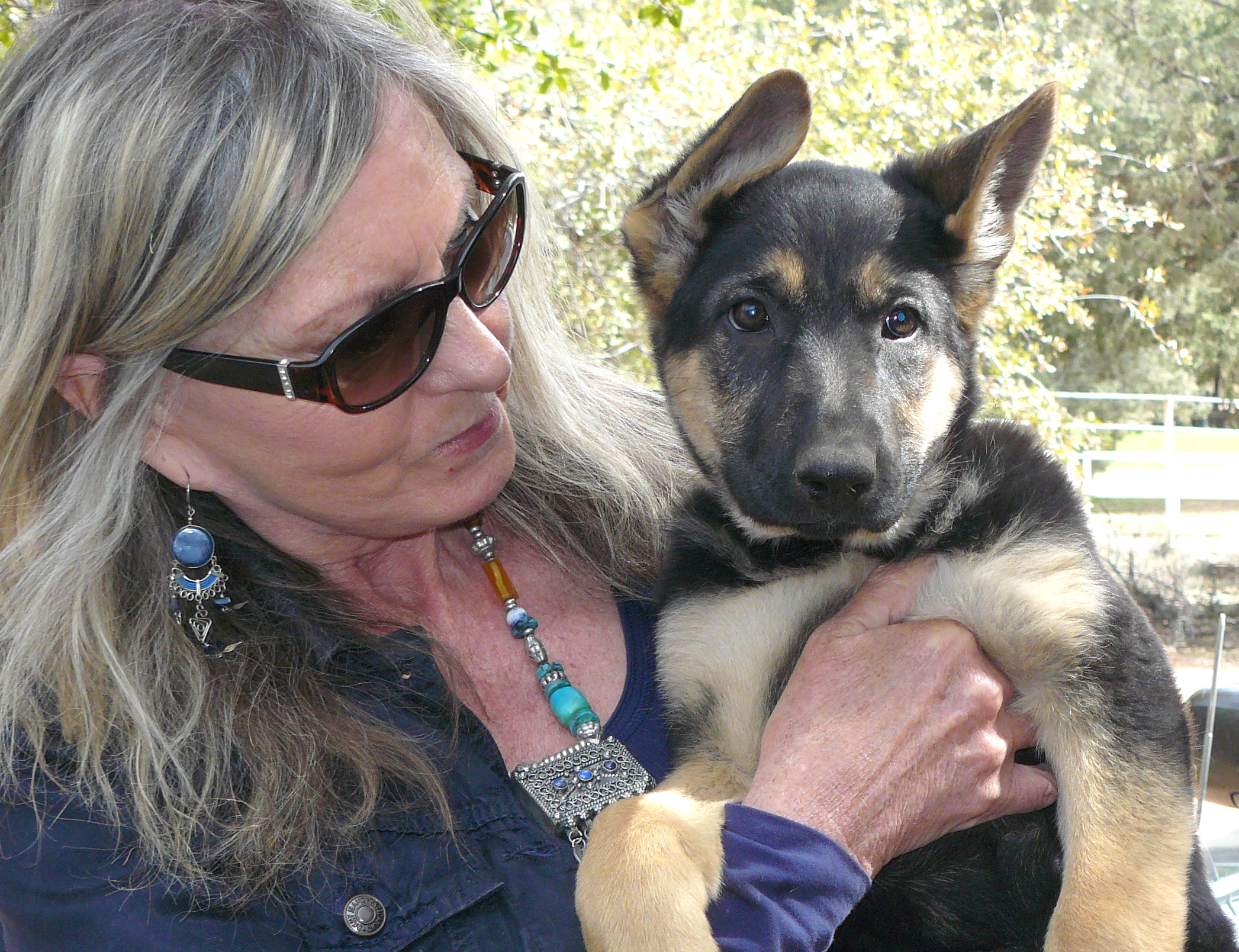
Thus a few days ago, Jean and I went round to Brendon’s home and spent a couple of hours mingling with the puppies and their GSD mother. They all looked excellent dogs and a review of their blood lines showed that their genetic background included German stock not too far back. It was difficult to select any one pup as they were all wonderful animals. But one youngster seemed to catch Jean’s eye.
Little bit of bonding going on!
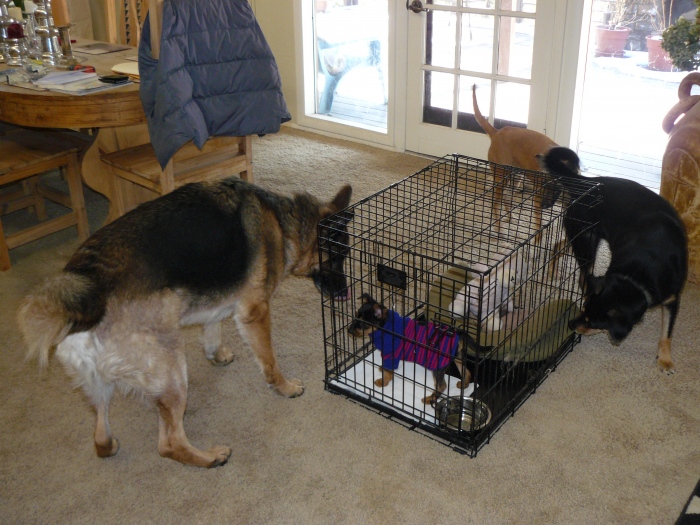
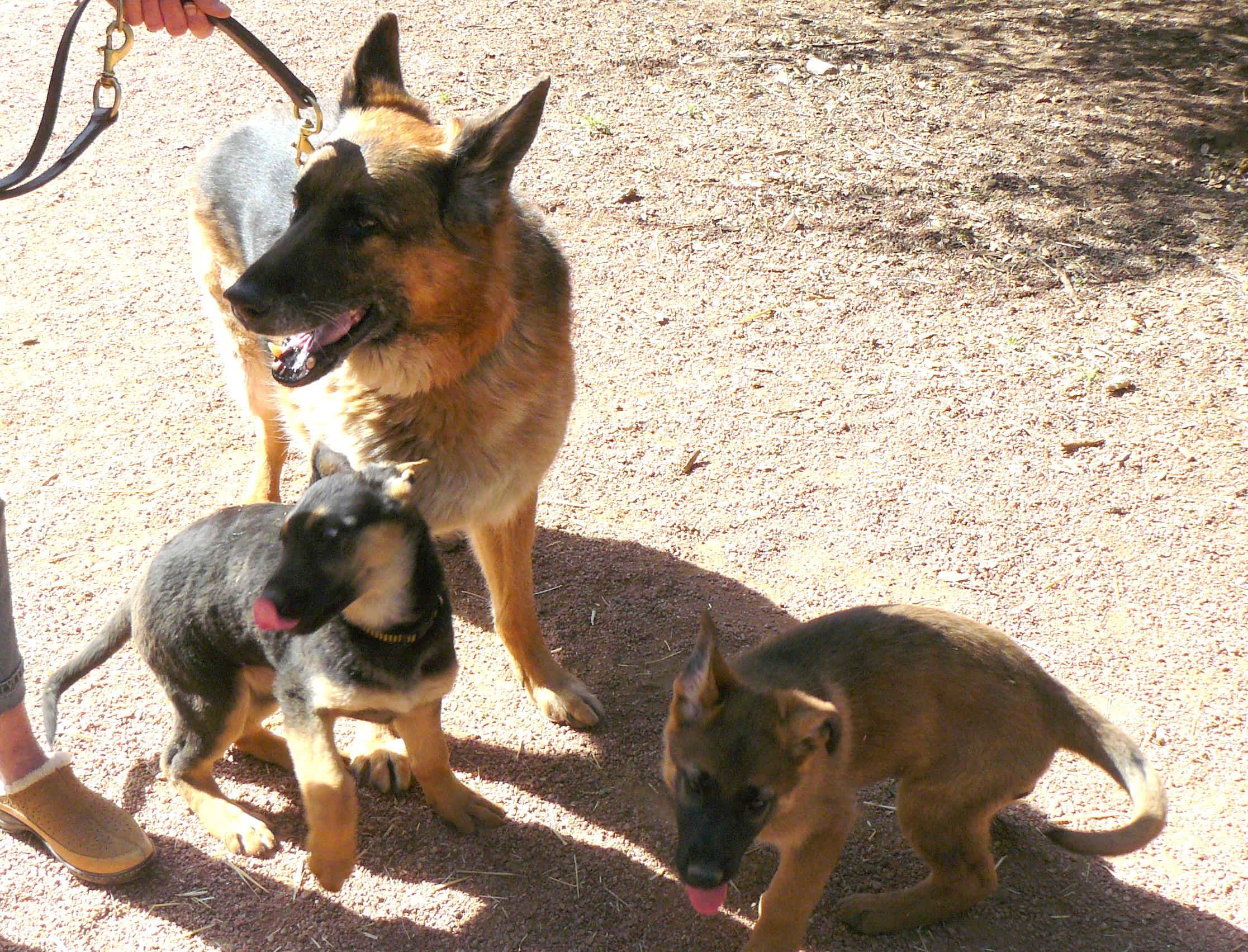
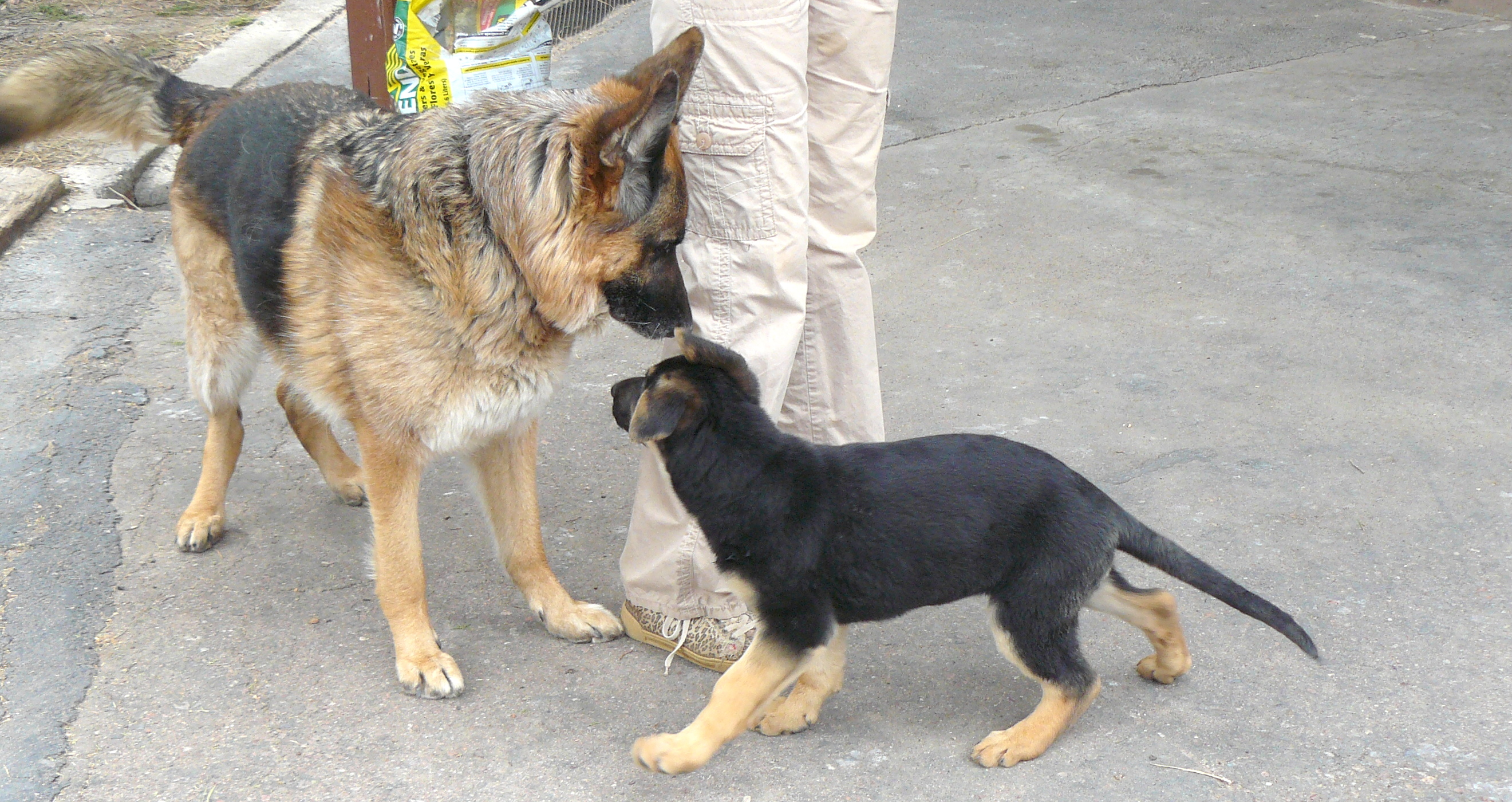
Then the next test was to introduce Pharaoh to the puppies. That took place last Friday and it was wonderful to see how well he coped with the onslaught of puppies!
More puppies that one could shake a stick at!
In the end, we ran out of reasons not to follow Sandra’s advice from all those years ago and we agreed terms on a young female GSD that, inevitably, was christened Cleopatra (Cleo) by Jean!
Cleo meet your new Mum!
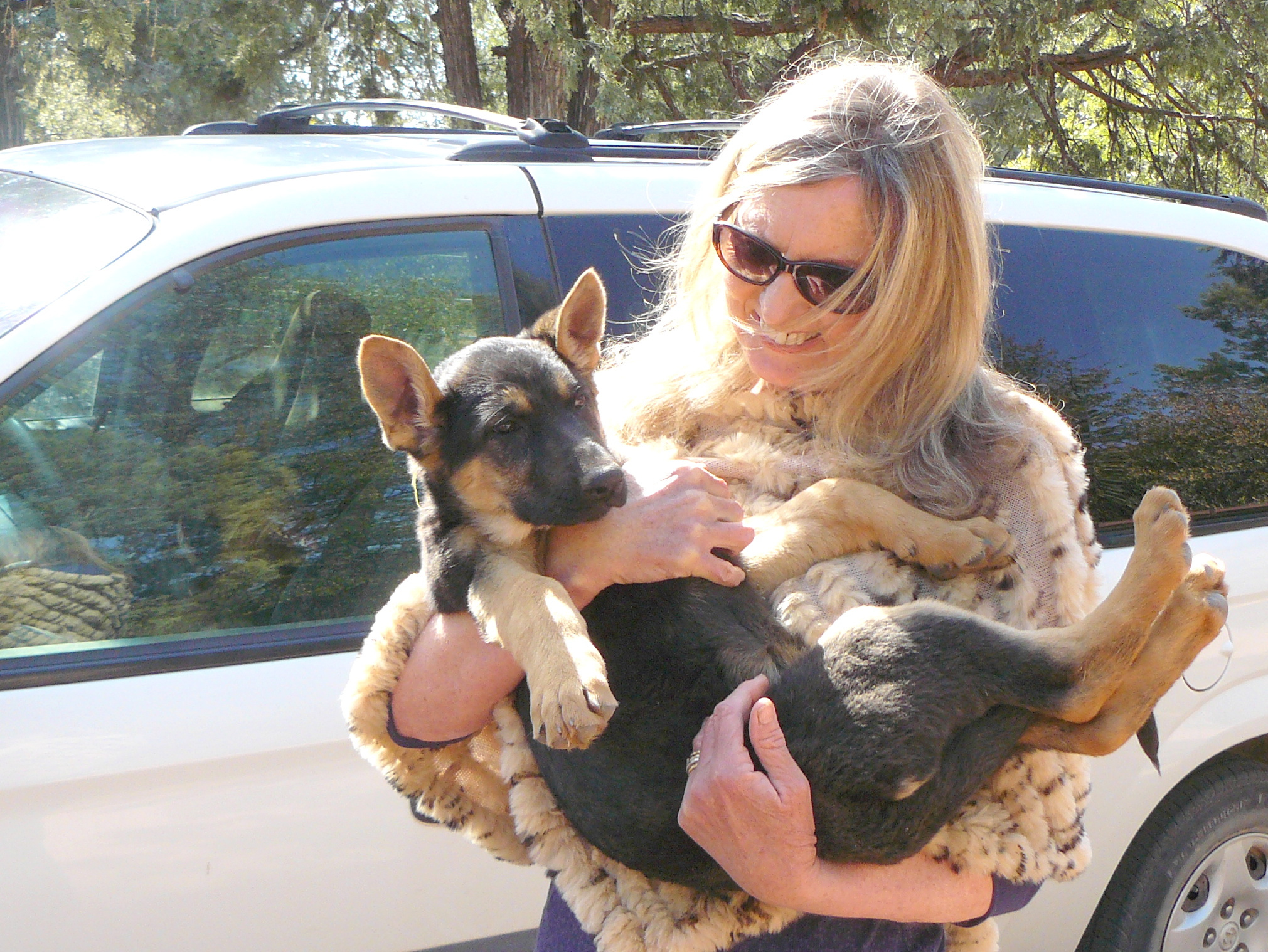
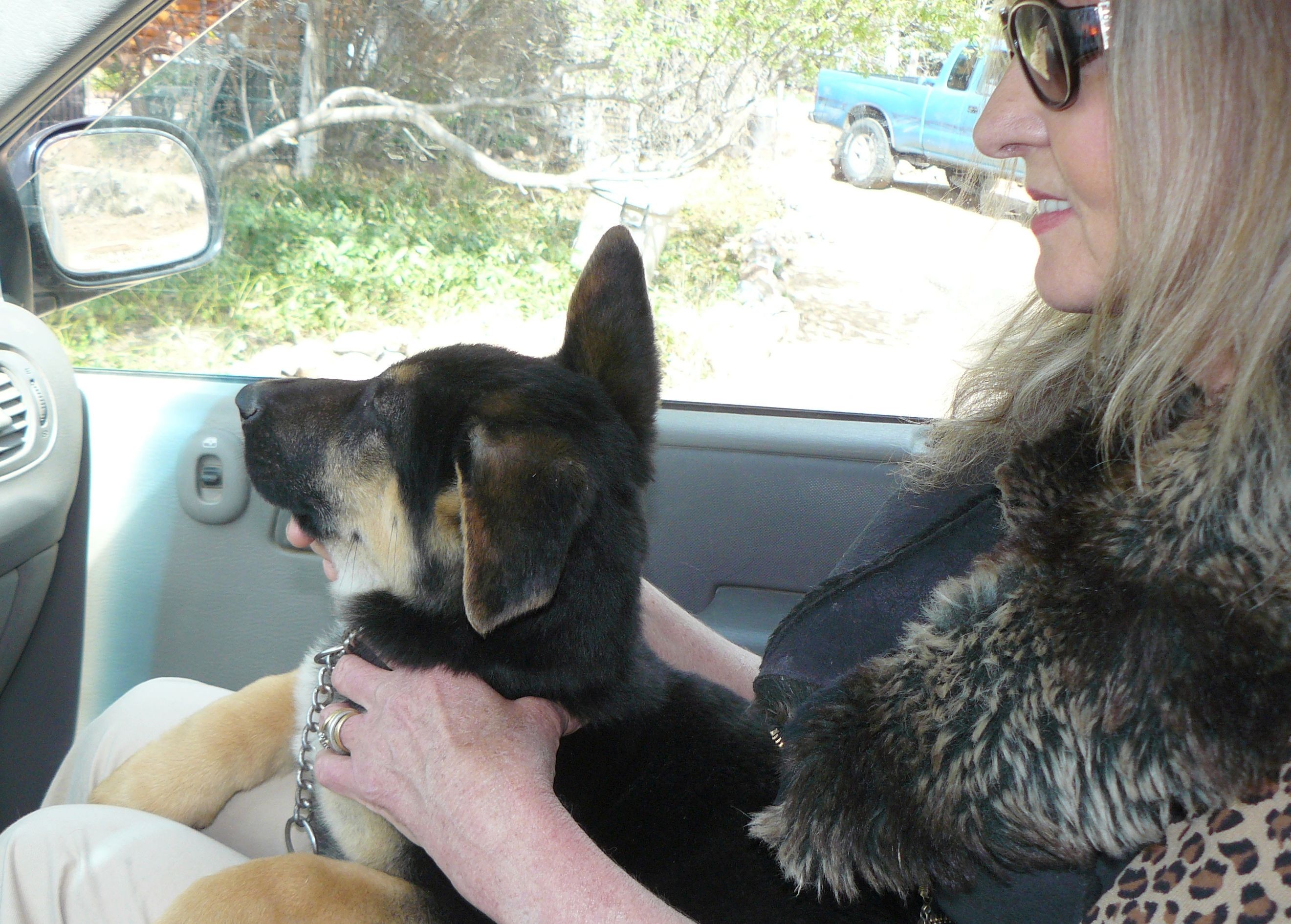
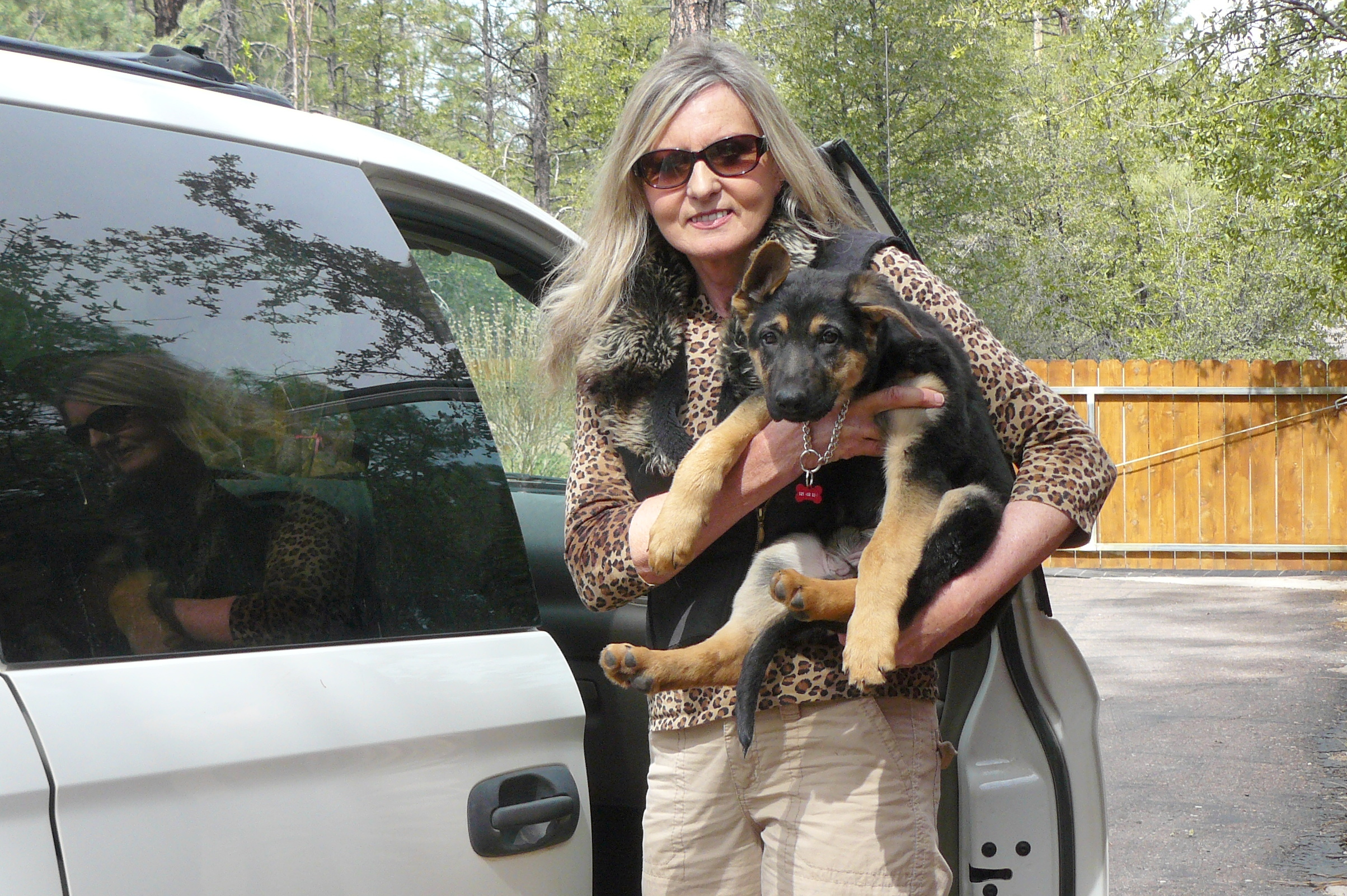
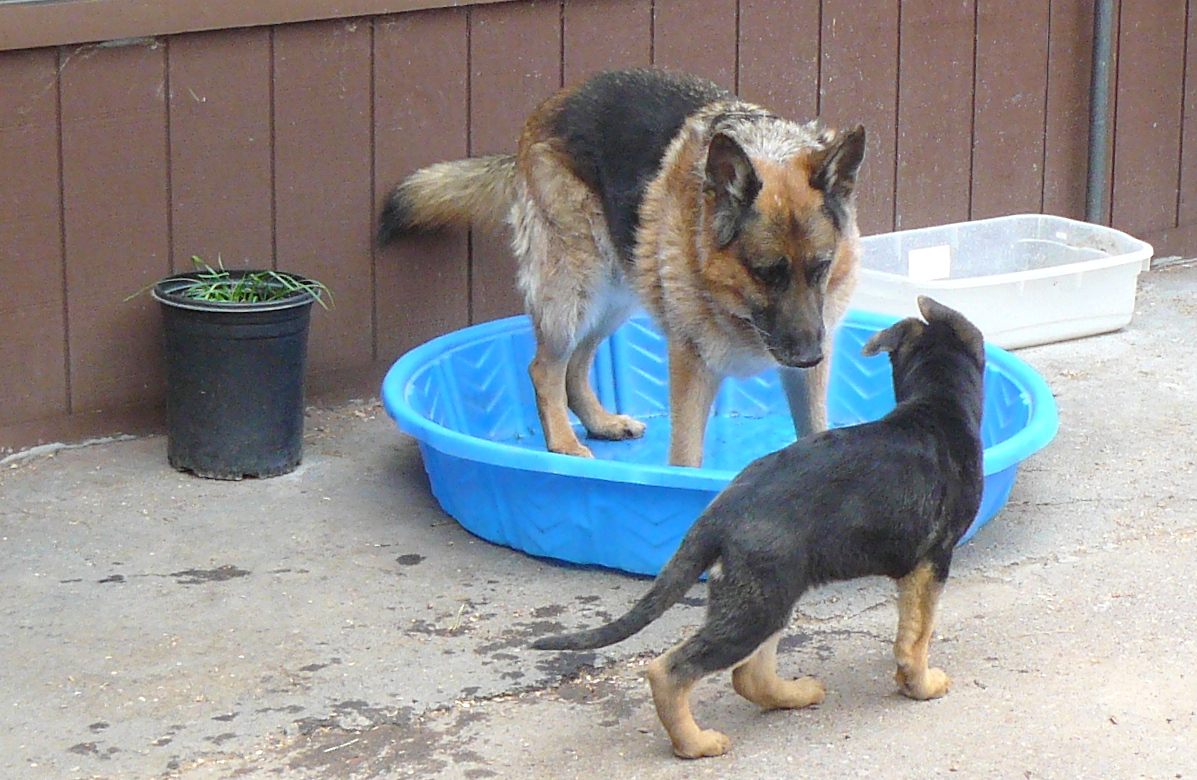
Then yesterday, Saturday, we went back round to collect young Cleo, meeting Brendan’s wife Ebony in the process. The following photographs record some of the key moments.
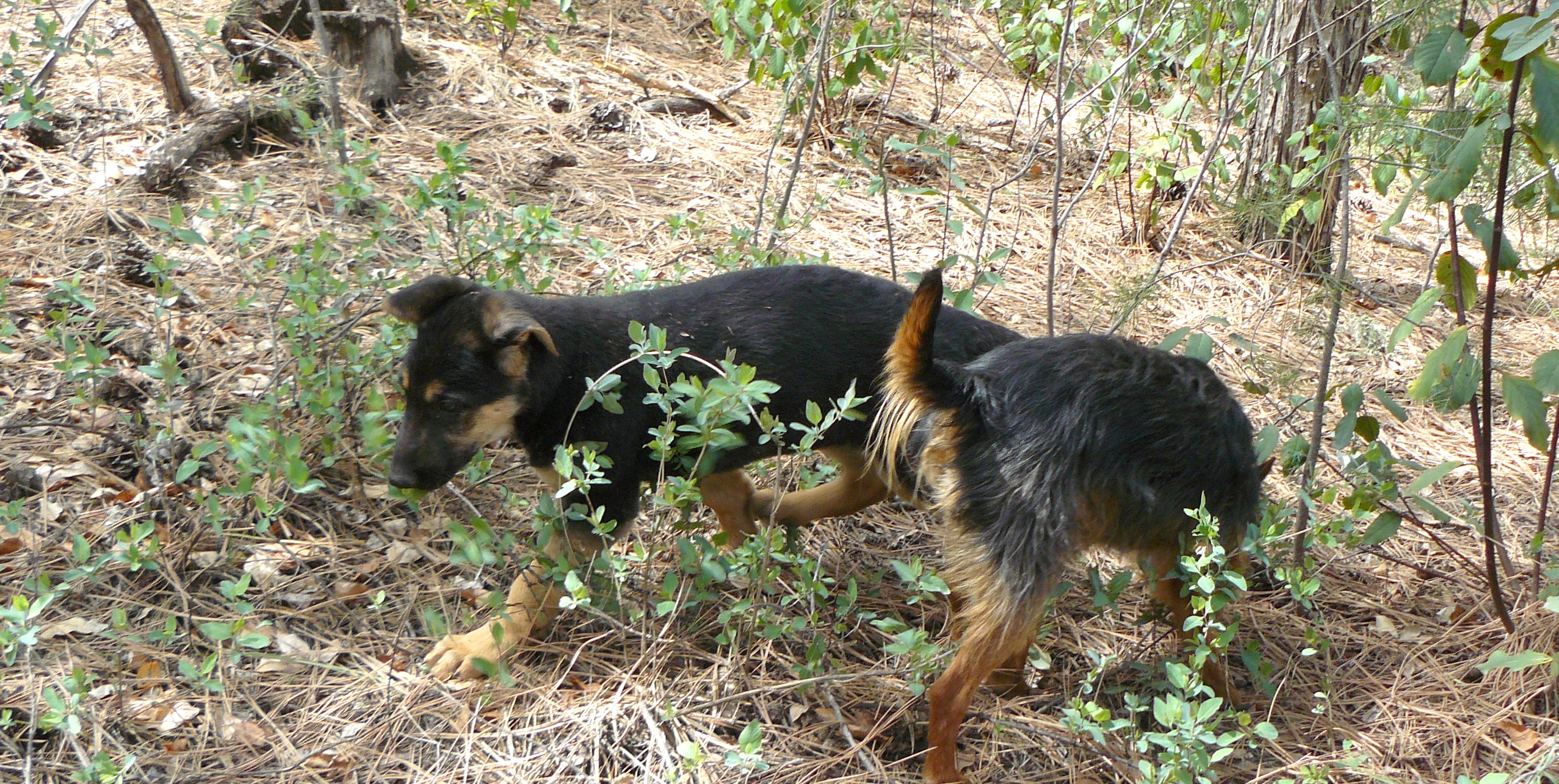
Homeward bound to a new life!Next step is to meet the gang!Welcome, young lady. I'm the boss around here!It's my pool but you can use it!Hey Sweeny, fancy having one's own woods to play in!She'll do! Nice addition to my family!
So there we are. Back up to eleven dogs, five chickens, six cats, and a fish!
Finally, a big thanks to Sandra of Jutone for her guidance in the last few days.
I was clearing my desk yesterday (yet again) and came across an article that I wrote in 2007. It’s a message of love; the love of a dog for a human. But before going to that article, look at the photo below. It’s a wonderful example of the joy of having Pharaoh in my life. It was taken in July 2006 at the airfield in Devon, SW England, where a group of us shared a Piper Super Cub, about which I wrote in Learning from Dogs in August 2009.
If you think Pharaoh is smiling, I’m not going to argue with you. First time in the Cub, first time strapped in to the rear seat, everything utterly strange and Pharaoh is clearly more joyful than the pilot!
Happiness is sharing life with your dog!
Anyway, to the article. I wrote it in September, 2007, based on something that was sent to me from an unknown author, and modified to reflect the special relationship that I had, and still have, with my then four-year-old German Shepherd, Pharaoh.
I am your dog and have something I would love to whisper in your ear.
I am your dog and have something I would love to whisper in your ear.
I know that you humans lead busy lives. Some have to work, some have children to raise, some have to do this alone. It always seems like you are running here and there, often much too fast, often never noticing the truly grand things in life.
Look down at me now. See the way my dark brown eyes look at yours.
You smile at me. I see love in your eyes. What do you see in mine? Do you see a spirit? A soul inside, who loves you as no other could in the world? A spirit that would forgive all trespasses of prior wrongdoing for just a simple moment of your time?
That is all I ask. To slow down, if even for a few minutes, and be with me.
So many times, you have been saddened by others of my kind, passing on. Sometimes we die young and oh so quickly, so suddenly it wrenches your heart out of your throat. Sometimes, we age so slowly before your eyes that you may not even seem to know until the very end, when we look at you with grizzled muzzles and cataract-clouded eyes. Still the love is always there, even when we must take that last long sleep dreaming of running free in a distant, open land.
I may not be here tomorrow. I may not be here next week. Someday you will shed the water from your eyes, that humans have when grief fills their souls, and you will mourn the loss of just ‘one more day’ with me. Because I love you so, this future sorrow even now touches my spirit and grieves me. I read you in so many ways that you cannot even start to contemplate.
We have now together. So come and sit next to me here on the floor and look deep into my eyes. Do you see how if you look deeply at me we can talk, you and I, heart to heart. Come not to me as my owner but as a living soul. Stroke my fur and let us look deep into the other’s eyes and talk with our hearts.
I may tell you something about the fun of working the scents in the woods where you and I go. Or I may tell you something profound about myself or how we dogs see life in general. I know you decided to have me in your life because you wanted a soul to share things with. I know how much you have cared for me and always stood up for me even when others have been against me. I know how hard you have worked to help me to be the teacher that I was born to be. That gift from you has been very precious to me. I know too that you have been through troubled times and I have been there to guard you, to protect you, to be there for you always.
I am very different to you but here I am. I am a dog but just as alive as you.
I feel emotion. I feel physical senses. I can revel in the differences of our spirits and souls. I do not think of you as a dog on two feet; I know what you are. You are human, in all of your quirkiness, and I love you still.
So come sit with me on the floor. Enter my world and let time slow down if only for a few minutes. Look deep into my eyes and whisper in my ears. Speak with your heart and I will know your true self.
We may not have tomorrow but we do have now.
Postscript.
Just three months after writing the above, on December 17th, 2007, I flew in to Hemosillo Airport in Mexico to spend Christmas with Suzann, sister of dear friend Dan Gomez, and her husband Don down in the coastal town of San Carlos. That’s when I met Jean, leading to me and Jean falling in love. Jean then came to England and I came back to Mexico in June, 2008. In September, 2008 Pharaoh and I left England permanently and travelled out to San Carlos to be with Jean and her dogs. In February, 2010, Jean and I, Pharaoh and twelve other dogs, and six cats all moved to Payson, Arizona.
In November, 2010 Jean and I were married. So the miracle for me and Pharaoh is that when I wrote that piece back in 2007 this most beautiful future was yet to unfold. I never miss a day when I don’t, “… come sit with me on the floor. Enter my world and let time slow down if only for a few minutes. Look deep into my eyes and whisper in my ears. Speak with your heart and I will know your true self.” Now not just with Pharaoh but with Hazel, Dhalia, Sweeny, Casey, Loopy, Lilly, Ruby, and all the other beautiful dog souls.
It’s been a while since Sue of Dreamwalker’s Sanctuary and I started following each other’s Blogs and from time to time Sue sends me an email with something for Learning from Dogs. On the 20th March, I published a guest post from Sue called the Winds of Change. If you didn’t read her wonderful poem then do go there and read it.
Anyway, just a couple of days ago Sue sent me an email with a link to a YouTube video. Put aside a few minutes and be entranced.
So you have just watched the video. How do you feel? I bet that your feelings are not a million miles from the realisation that, like Fiona the dog, being ‘lost‘ is an uncomfortable, unsettling but necessary step along the journey of being ‘found‘. As I wrote in the concluding part of my story Night messages, “The message from the night, as clear as the rays of this new day’s sun, the message to pass to all those he loved. If you don’t get lost, there’s a chance you may never be found.”
When the bond between a human and a dog is expressed as deep love, as it so often is, we relearn the most important lesson of all creation. That mankind’s only hope for the future comes from the pool of love.
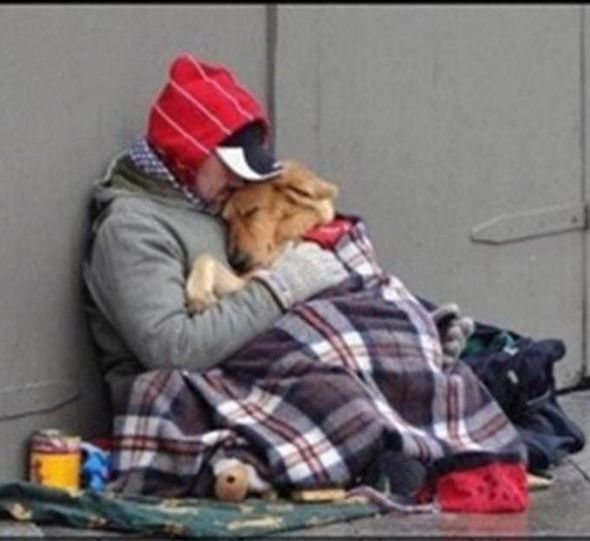
No better portrayed than by the photograph below that I presented in a Post on the 17th March, Change out of Hope.
The power of love.
“The one absolutely unselfish friend that man can have in this selfish world, the one that never deserts him, the one that never proves ungrateful or treacherous, is his dog.“ Samuel Coleridge
Sue has been a wonderful supporter of Learning from Dogs for which I am very grateful. Sue is the author of the blog, Dreamwalker’s Sanctuary and I do recommend that you pop across there and read her wonderful Posts. Recently, I read a beautiful poem that Sue had written and not only did she give me permission to republish that Post but also offered the following introduction. Thank you, Sue. The rest is all Sue!
First my thanks go to Paul who continues to awaken our knowledge to the Earth and our environment and whose posts are in-depth and informative posts on subjects which we should all be immersed in.
For Planet Earth is our Home and she is dying. And we Humans are still in a slumber as to the destruction we have inflicted upon her.
Our Native American Brothers knew long ago that we have to balance nature and we should only take that which we need.. But we have used Greed as our cutting tools and we as a species have become out of balance with nature and ourselves.
Paul has kindly asked if he could re-blog my poem . This poem speaks of those changes we all feel is happening within our world. I firmly believe like the Native Americans that we are united in Consciousness and that extends to our Earth Mother. We are linked together As One.
…oooOOOooo…
The Winds Of Change
The Winds of Change.
The Winds of Change flow across our land
Sweeping us up like the grains of sand
Twisting us round to look in the mirror
Cutting us deep to make us consider…
~
Our past which holds so many stains
As Ego rules in a world full of pain
The winds of Change are here to uplift
It’s time for Humanity to embrace all her gifts
~
But before we fly along with the wind
Mankind is reaping all his sown sins
The Anger, the Hatred, the Greed and his Pride
Will no longer have any places to hide
~
For the Winds of Change a tornado will swirl
As into the Abyss the Material will hurl
A river so deep into Oceans will run
With all tears cried from when time first begun
~
A cleansing of hearts as each soul will cry
As the Winds of Change blows into our eyes
Eyes that will open as we come awake
And Mankind will realise he can no longer take
~
The road of discovery can often be hard
A lonely walk as the Winds they bombard
It strips us bare to reveal our true souls
In a journey we’ve walked from Millennia of old
~
And as our tears fall they wash us all clean
Of the lies of the Past and all that has been
The Winds of Change it whistles in our Hearts
Get ready to fly – for we’re soon to depart.
~~~
Many things are happening around our world right now, and for many we are all going through some personal changes.. Change is always hard, and painful, for we resist it as we cling onto that which is familiar. But without Change we do not grow, or progress..
Some of those Changes which are taking place around our Earth are bringing with it tears..
Tears we weep help cleanse our inner-most souls as we wash ourselves from within and we release our emotions.
So, too, our Earth Mother is getting ready for Change… her Winds too are blowing a warning, as she is releasing her tears as she lets them spill as rain..
Too long has she held them within…
We are One with Mother Nature… Watch her, as she is stirring..
Be Ready..
She is Changing, and as she does we will feel her shake, as her body sobs.
By sending out your love,
By loving your selves we are helping each other over these Changes..
We are helping Unite ourselves and Mother Earth once again in Harmony
~~~~
A tree knows how to bend in the wind, or it breaks and falls..
Water finds its path as it flows into ALL to find its own level
So too we must go within that flow and follow our hearts
We need to be that Oneness,
We need to stop hurting one another,
We need to breath in that Light of Love
And Share it in Unity of Oneness
This is the Time of Change
Let the Winds blow
Love into your
Hearts
Native American Indian Quote
“You must teach your children that the ground beneath their feet is the ashes of your grandfathers. So that they will respect the land, tell your children that the earth is rich with the lives of our kin. Teach your children what we have taught our children, that the earth is our mother. Whatever befalls the earth befalls the sons of the earth. If men spit upon the ground, they spit upon themselves.”
~ Unknown ~
Don’t worry, this is not going to be some chest-banging Post! I leave those for Monday to Friday. 😉 No, I just wanted to offer a couple of examples of the power of goodness and how making a positive difference is no more than wanting it. As Perfect Stranger commented last Tuesday, “A single candle may light a thousand others and they in turn many thousands more” – Buddha
The first example is about how a group of upstanding citizens rescue a school of dolphins that became stuck on a beach in Brazil.
The second example comes from closer to home. Ginger I. is a Board Member of the Humane Society of Central Arizona and is based at Payson. Jean has been a volunteer at the Society’s Thrift Store for some time and has got to know Ginger well.
Ginger recently emailed me this; it has already done the rounds of the WWW, and quite rightly so. It reminds me of the book Dogs Never Lie About Love, written by Jeffrey Masson, from which comes the following,
This ambiguity, which includes a certain ambivalence as well, has been memorialized in our speech, in our sayings, and in our tributes to and about dogs. Sir John Davies, in his epigram In Cineam (written in 1594), observed:
Thou sayest thou art as weary as a dog,
As angry, sick, and hungry as a dog,
As dull and melancholy as a dog,
As lazy, sleepy, idle as a dog.
But why dost thou compare thee to a dog?
In that for which all men despise a dog,
I will compare thee better to a dog.
Thou art as fair and comely as a dog,
Thou art as true and honest as a dog,
Thou art as kind and liberal as a dog,
Thou art as wise and valiant as a dog.
Ever since Madame Roland said in the eighteenth century “Plus je vois les hommes, plus j’admire les chiens” (The more I see of men, the more I admire dogs), generally what has been written about dogs tends to be positive. Sometimes it is even wonderful, as in William James’s statement “Marvelous as may be the power of my dog to understand my moods, deathless as is his affection and fidelity, his mental state is as unsolved a mystery to me as it was to my remotest ancestor.” Or it may be delicious, like Ambrose Bierce’s definition in his Devil’s Dictionary, “Dog, n. A kind of additional or subsidiary Deity designed to catch the overflow and surplus of the world’s worship.” Samuel Coleridge, in Table-Talk (May 2, 1830), was one of the first to note that “the best friend a man has in the world may turn against him and become his enemy. His son or daughter … may prove ungrateful. Those who are nearest and dearest to him … may become traitors to their faith…. The one absolutely unselfish friend that man can have in this selfish world, the one that never deserts him, the one that never proves ungrateful or treacherous, is his dog.”
Just read that last sentence again from Samual Coleridge as you look at the photograph below, “The one absolutely unselfish friend that man can have in this selfish world, the one that never deserts him, the one that never proves ungrateful or treacherous, is his dog.”
All my life, well all the years that I have appreciated a ‘tea-break’, stopping for a cup of hot tea has been laden with symbolism. A chance to let the brain catch up with whatever one is doing. When working with others an opportunity to stand back and evaluate how the particular project is going. When sharing a project with a loved one, an opportunity to lay down memories for future years, and so forth. (Jean and I were building a chicken coop yesterday afternoon.) Sure there are millions of people that share these feelings.
Anyway, as many of you have been aware, the last 10 days or so on Learning from Dogs have been pretty ‘full-on’ in terms of man and Planet Earth. It started with me publishing on the 27th February a Post called Please help! – A plea to those who understand climate science so much better than I do!. Then on the 2nd March, I republished a Post from Patrice Ayme called The collapse of the biosphere.
That there were a total of 6,313 viewings of those Posts and 69 comments (OK, that doesn’t mean different individuals) was incredibly gratifying – a very big ‘thank you’ to all of you that read the Posts, and likewise to those that commented.
But one of the most wonderful aspects for me was the incredible sharing of ideas and resources. So the point of today’s Post is to bring all those links and contacts onto one ‘page’, so to speak.
Martin Lack was the first to point me in the direction of the book, Merchants of Doubt. There are a number of videos on YouTube but the one below is a good introduction to Naomi Oreskes.
On October 28, 2010 historian of science Naomi Oreskes gave a presentation at Forum Lectures (US Embassy Brussels), based on her new book, Merchants of Doubt: How a Handful of Scientists Obscured the Truth on Issues from Tobacco Smoke to Global Warming, about how right wing scientists founded the George Marshall Institute which has become a key hub for successfully spreading fear, uncertainty and doubt about climate change, along with other environmental issues, and how myths about science enable these political strategies to work.
An in-depth video of over an hour from the University of Rhode Island’s Spring 2010 Vetlesen Lecture Series, hugely worth watching, is here.
Then there is the powerful blog site, De Smog Blog. As the site explains, “The DeSmogBlog Project began in January 2006 and quickly became the world’s number one source for accurate, fact based information regarding global warming misinformation campaigns. TIME Magazine named DeSmogBlog in its “25 Best Blogs of 2011” list.”
Moving on. One of the challenges is knowing how to look up some reasonably reliable information about a person who is claiming this or that. That’s where SourceWatch is invaluable. The website describes itself, “The Center for Media and Democracy publishes SourceWatch, this collaborative resource for citizens and journalists looking for documented information about the corporations, industries, and people trying to influence public policy and public opinion. We believe in telling the truth about the most powerful interests in society—not just relating their self-serving press releases or letting real facts be bleached away by spin.”
Let me give you an example of how SourceWatch works. In my Post A skeptic’s view, Dan offered extensive comment about U.S. Senator James Inhofe’s book The Greatest Hoax. A quick search on SourceWatch revealed (a) (my emboldening)
Arthur B. Robinson is one of the three co-founders of the Oregon Institute of Science and Medicine, a group best known for organising a petition disputing the scientific evidence for human-induced global warming.
On January 7, 2009, the Willamette Week reported that Robinson is “in the vanguard of a small but vocal and persistent collection of scientists, industry advocates and commentators who dismiss human culpability for climate change. … Robinson’s critics say his analysis is simplistic, but it remains persuasive a decade later with powerful policymakers like U.S. Senator James Inhofe (R-Okla.), a visible and effective player in blocking a bill to limit greenhouse-gas emissions last fall.
James Mountain Inhofe, usually known as Jim Inhofe, has been a Republican Senator for Oklahoma since winning a special election in 1994.
Oil
James M. Inhofe has voted in favor of big oil companies on 100% of important oil-related bills from 2005-2007, according to Oil Change International. These bills include Iraq war funding, climate change studies, clean energy, and emissions.
On to another book. I forget who recommended the book by James Hansen, Storms of my Grandchildren but it’s another ‘must-read’ for all those wanting to better understand the risks that lay ahead. As the book’s website explains,
In Storms of My Grandchildren, Dr. James Hansen—the nation’s leading scientist on climate issues—speaks out for the first time with the full truth about global warming: The planet is hurtling even more rapidly than previously acknowledged to a climatic point of no return.
On that website there is a section Hansen On The Issues that includes this 2-minute YouTube video of Dr. Hansen talking about his book.
I can’t close without mentioning some other wonderful websites. There is Skeptical Science, described thus,
Explaining climate change science & rebutting global warming misinformation
Scientific skepticism is healthy. Scientists should always challenge themselves to improve their understanding. Yet this isn’t what happens with climate change denial. Skeptics vigorously criticise any evidence that supports man-made global warming and yet embrace any argument, op-ed, blog or study that refutes global warming. This website gets skeptical about global warming skepticism. Do their arguments have any scientific basis? What does the peer reviewed scientific literature say?
Then there’s ClimateSight, a wonderful effort by Kate, “Kate is a B.Sc. student and aspiring climatologist from the Canadian prairies. She started writing this blog when she was sixteen, simply to keep herself sane, but hopes that she’ll be able to spread accurate information about climate change far and wide while she does so.” Kate’s interest and passion in the subject is unmissable and it’s a real pleasure to subscribe to her postings.
Bill McKibben’s famous site, 350.org, is a must for the thousands of people that are working for a better future. As the mission statement opens up,
350.org is building a global grassroots movement to solve the climate crisis. Our online campaigns, grassroots organizing, and mass public actions are led from the bottom up by thousands of volunteer organizers in over 188 countries.
350 means climate safety. To preserve our planet, scientists tell us we must reduce the amount of CO2 in the atmosphere from its current level of 392 parts per million to below 350 ppm. But 350 is more than a number—it’s a symbol of where we need to head as a planet.
350.org works hard to organize in a new way—everywhere at once, using online tools to facilitate strategic offline action. We want to be a laboratory for the best ways to strengthen the climate movement and catalyze transformation around the world.
RealClimate is a commentary site on climate science by working climate scientists for the interested public and journalists. We aim to provide a quick response to developing stories and provide the context sometimes missing in mainstream commentary. The discussion here is restricted to scientific topics and will not get involved in any political or economic implications of the science. All posts are signed by the author(s), except ‘group’ posts which are collective efforts from the whole team. This is a moderated forum.
There are so many more fabulous sources of real caring about the society we are and, more importantly, the society we hope to be. In this category comes Wibble. Then there’s Dogs of Doubt, that I shall be referring to tomorrow on Learning from Dogs, and The Green Word and so on and so on. It shows the power of ‘hands across the ether’ that the modern world of web sites now offers. I put great faith in this power becoming the power of truth and the power of change. (If you have a blog or a website that resonates with the ones mentioned here, please do drop me an email giving me details.)
Finally, I’m closing with this. If it all sometimes feels too much for you and you want to drift away into the world of the inner consciousness, into the world of dreamtime, then you can do no worse than to call by Sue Dreamwalker‘s wonderful website. Try this, for example. Dan and I had no idea what we were getting into. 😉
For me that quotation sums up how I would like to reply to not only my dear friend, Dan Gomez, who is a denialist of anthropogenic climate change, as last Monday’s Post illustrated, but also to skeptics everywhere else.
I should also add the important qualifier that I am neither a scientist nor have any expert skills in the relevant areas. But, then again, neither does Dan. He and I are both citizens of Planet Earth with a passion for the truth.
So where to go from here? There is no question that the Earth’s climate is complex and endeavouring to understand ’cause and effect’ relies heavily on mathematical models. But many complex aspects of our world are treated similarly, therefore so what! Dan and I share with millions of others a lack of scientific competence, ergo we have to be rely on the scientific views expressed by those who do have the scientific competencies.
Would one challenge the competence of Scientific American magazine, that in an article on March 18, 2007, (five years ago!) opened thus,
Paris–The signs of global climate change are clear: melting glaciers, earlier blooms and rising temperatures. In fact, 11 of the past 12 years rank among the hottest ever recorded.
and continued later with this, [my emboldening]
For example, after objections by Saudi Arabia and China, the report dropped a sentence stating that the impact of human activity on the earth’s heat budget exceeds that of the sun by fivefold. “The difference is really a factor of 10,” says lead author Piers Forster of the University of Leeds in England: compared with its historical output, the sun currently contributes an extra 0.12 watt of energy for each square meter of the earth’s surface, whereas man-made sources trap an additional 1.6 watts per square meter.
Or what ‘influence’ might be at play when the British newspaper The Guardian reported earlier this year that,
Wall Street Journal rapped over climate change stance
The Wall Street Journal has received a dressing down from a large group of leading scientists for promoting retrograde and out-of-date views on climate change. In an opinion piece run by the Journal on Wednesday, nearly 40 scientists, including acknowledged climate change experts, took on the paper for publishing an article disputing the evidence on global warming.
The offending article, No Need to Panic About Global Warming, which appeared last week, argued that climate change was a cunning ploy deployed by governments to raise taxes and by non-profit organisations to solicit donations to save the planet.
It was signed by 16 scientists who don’t subscribe to the conventional wisdom that climate change is happening and is largely man-made – but as Wednesday’s letter points out, many of those who signed don’t actually work in climate science.
Later in that article Suzanne writes, referring to the 40 scientists, [again, my emboldening]
The letter goes on to note that some 97% of researchers who actively publish on climate science agree that climate change is real and caused by humans. It concludes: “It would be an act of recklessness for any political leader to disregard the weight of evidence and ignore the enormous risks that climate change clearly poses.”
There’s much, much more evidence that shows that the science is clear – mankind is risking the future viability of this planet for the species homo sapiens and countless other species!
One of the important points made by Dan in that Post last Monday was about the book, written by Senator James Inhofe, The Greatest Hoax. Dan wrote, “This is all about money and power, not weather.”
There are a number of independent websites across the world where one can quickly research the credentials and background by name of any person. Try Skeptical Science as an example. A quick enquiry using Senator Inhofe’s name came up with this: Quotes by James Inhofe – Climate Myth/What the Science Says. Read It! And read this on the website Think Progress. There are other websites where one can do that type of research.
In an email just a day ago, Dan wrote, “My message/warning remains the same: “Follow the Money”. When the “End-of-the-World” is the message, what politician can resist?” If only it was that easy.
OK, I’m going to start rounding this all off by first asking you to watch this 4-minute video that I came across thanks to Pedantry’s blogsite Wibble.
Next I’m going to repeat something that I have previously mentioned on Learning from Dogs. There’s a saying in the aviation industry, “If there’s any doubt, there’s no doubt!” That saying underpins the culture that has turned commercial air transport into one of the safest means of travel in history.
Let’s ponder that idea of doubt.
There is no question that there is a great deal of doubt. Back in 2010 Gallup Poll reported that “42% of adults worldwide who see global warming as a threat to themselves and their families in 2010 hasn’t budged in the last few years“.
Would you get into a commercial airliner to fly from ‘a’ to ‘b’ if 42% of the passengers saw the flight as a threat to themselves? No, of course not!
So one certainly wouldn’t fly then if 62% thought it was risky! From here,
The newest study from the National Survey of American Public Opinion on Climate Change, which is a biannual survey taken since fall 2008 and organized by the Brookings Institute, shows that 62 percent of Americans now believe that man-made climate change is occurring, and 26 percent do not. The others are unsure.
So back to the theme that started this Post. For the sake of all of us on this planet, for all our children and grandchildren and beyond, we need to start caring deeply about the future, changing our life-styles in as many ways as we can and demanding that our politicians and leaders are similarly committed to the future.
Not because the future is anything like certain – but to reduce the risks of a global catastrophy. I have a grandson who will be one-year-old on March 21st. I want to be certain that he has a viable life ahead of him for many, many years. That means caring ‘a whole awful lot‘, letting hope motivate me to change, and recognising that change is already taking place, as the following trailer so superbly demonstrates.
“Unless someone like you cares a whole awful lot, Nothing is going to get better. It’s not.”





 Learning from Dogs